EP4144907B1 - Machine à laver et procédé de fonctionnement d'une machine à laver - Google Patents
Machine à laver et procédé de fonctionnement d'une machine à laver Download PDFInfo
- Publication number
- EP4144907B1 EP4144907B1 EP22191737.0A EP22191737A EP4144907B1 EP 4144907 B1 EP4144907 B1 EP 4144907B1 EP 22191737 A EP22191737 A EP 22191737A EP 4144907 B1 EP4144907 B1 EP 4144907B1
- Authority
- EP
- European Patent Office
- Prior art keywords
- compartment
- drum
- washing machine
- recirculation
- flow
- Prior art date
- Legal status (The legal status is an assumption and is not a legal conclusion. Google has not performed a legal analysis and makes no representation as to the accuracy of the status listed.)
- Active
Links
Images

Classifications
-
- D—TEXTILES; PAPER
- D06—TREATMENT OF TEXTILES OR THE LIKE; LAUNDERING; FLEXIBLE MATERIALS NOT OTHERWISE PROVIDED FOR
- D06F—LAUNDERING, DRYING, IRONING, PRESSING OR FOLDING TEXTILE ARTICLES
- D06F39/00—Details of washing machines not specific to a single type of machines covered by groups D06F9/00 - D06F27/00
- D06F39/08—Liquid supply or discharge arrangements
- D06F39/083—Liquid discharge or recirculation arrangements
-
- D—TEXTILES; PAPER
- D06—TREATMENT OF TEXTILES OR THE LIKE; LAUNDERING; FLEXIBLE MATERIALS NOT OTHERWISE PROVIDED FOR
- D06F—LAUNDERING, DRYING, IRONING, PRESSING OR FOLDING TEXTILE ARTICLES
- D06F33/00—Control of operations performed in washing machines or washer-dryers
- D06F33/30—Control of washing machines characterised by the purpose or target of the control
- D06F33/32—Control of operational steps, e.g. optimisation or improvement of operational steps depending on the condition of the laundry
- D06F33/37—Control of operational steps, e.g. optimisation or improvement of operational steps depending on the condition of the laundry of metering of detergents or additives
-
- D—TEXTILES; PAPER
- D06—TREATMENT OF TEXTILES OR THE LIKE; LAUNDERING; FLEXIBLE MATERIALS NOT OTHERWISE PROVIDED FOR
- D06F—LAUNDERING, DRYING, IRONING, PRESSING OR FOLDING TEXTILE ARTICLES
- D06F39/00—Details of washing machines not specific to a single type of machines covered by groups D06F9/00 - D06F27/00
- D06F39/02—Devices for adding soap or other washing agents
-
- D—TEXTILES; PAPER
- D06—TREATMENT OF TEXTILES OR THE LIKE; LAUNDERING; FLEXIBLE MATERIALS NOT OTHERWISE PROVIDED FOR
- D06F—LAUNDERING, DRYING, IRONING, PRESSING OR FOLDING TEXTILE ARTICLES
- D06F25/00—Washing machines with receptacles, e.g. perforated, having a rotary movement, e.g. oscillatory movement, the receptacle serving both for washing and for centrifugally separating water from the laundry and having further drying means, e.g. using hot air
-
- D—TEXTILES; PAPER
- D06—TREATMENT OF TEXTILES OR THE LIKE; LAUNDERING; FLEXIBLE MATERIALS NOT OTHERWISE PROVIDED FOR
- D06F—LAUNDERING, DRYING, IRONING, PRESSING OR FOLDING TEXTILE ARTICLES
- D06F39/00—Details of washing machines not specific to a single type of machines covered by groups D06F9/00 - D06F27/00
- D06F39/12—Casings; Tubs
- D06F39/14—Doors or covers; Securing means therefor
-
- D—TEXTILES; PAPER
- D06—TREATMENT OF TEXTILES OR THE LIKE; LAUNDERING; FLEXIBLE MATERIALS NOT OTHERWISE PROVIDED FOR
- D06F—LAUNDERING, DRYING, IRONING, PRESSING OR FOLDING TEXTILE ARTICLES
- D06F58/00—Domestic laundry dryers
- D06F58/20—General details of domestic laundry dryers
- D06F58/22—Lint collecting arrangements
Definitions
- the invention relates to a washing machine according to the preamble of patent claim 1 and a method for operating a washing machine.
- washing machines are already known from the prior art in a large number of embodiments and comprise a housing, a suds container arranged in the housing, a drum rotatable about a rotation axis in the suds container for holding laundry, a door for loading and unloading the drum, a water inlet device that can be connected to a fresh water source in a flow-conducting manner and can be controlled by means of a control of the washing machine for supplying the washing machine with fresh water, a dispensing compartment for rinsing detergent into the drum and a circulation device that can be controlled by the control for circulating a washing solution formed from the detergent and the fresh water.
- the invention therefore addresses the problem of improving a washing machine and a method for operating a washing machine.
- a washing machine with the features of patent claim 1, which is characterized in that the detergent dispenser is arranged on an inner side of the door facing the drum and has a first and a second compartment each for holding detergent, wherein, depending on an actuation by means of the control, the first compartment can be connected to the flow-through device and the second compartment can be connected directly to the water inlet device. Furthermore, this problem is solved by a method for operating a washing machine with the features of patent claim 8.
- the washing machine according to the invention can be designed as a household appliance or a commercial appliance, i.e. a washing machine for professional use. Furthermore, the washing machine can be designed as a combination device for washing and drying laundry, namely as a so-called washer-dryer.
- the laundry can be textiles in particular.
- the advantage achievable with the invention is in particular that a washing machine and a method for operating a washing machine are improved.
- the detergent drawer is structurally and functionally decoupled from a control panel of the washing machine according to the invention. Accordingly, embodiments of the washing machine according to the invention are conceivable in which the control panel does not have to have an opening for a detergent drawer. This results in completely new design options for improving the overall visual impression of the washing machine according to the invention.
- additional installation space is created behind the control panel of the washing machine for other components of the washing machine, which is usually taken up by the detergent drawer.
- the fluidic assignment of the first compartment of the detergent drawer to the flooding device and the second compartment of the detergent drawer directly to the water inlet device it is possible to flush the two aforementioned compartments of the detergent drawer essentially independently of one another.
- washing machine according to the invention can be freely selected in terms of type, functionality, material and dimensions within wide suitable limits. See, for example, the relevant statements in the introduction to the description.
- the washing machine provides that the first compartment can be connected to the bypass device in a flow-conducting manner by means of a bypass nozzle device, wherein the bypass nozzle device has a bypass nozzle inlet that is connected to the bypass device in a flow-conducting manner, a bypass nozzle outlet that is connected directly to the drum in a flow-conducting manner and a bypass nozzle outlet that is connected to the first compartment in a flow-conducting manner, preferably that the two bypass nozzle outlets are designed to be coordinated with one another in such a way that a main volume flow of the washing liquor can be introduced directly into the drum and a secondary volume flow of the washing liquor that is smaller than the main volume flow can be introduced into the drum by means of the first compartment.
- the preferred embodiment of this development also has the advantage that a specific, advantageous volume ratio can be set between the washing liquor flushed directly into the drum and the washing liquor introduced into the drum via the first compartment.
- the flood nozzle device can be designed as a component of the flood device. However, this is not absolutely necessary.
- the flood nozzle device can be arranged on another component of the washing machine, for example the door.
- an advantageous development of the method according to the invention provides that the washing machine has a flow-conductingly connected to the flow-through device A recirculation nozzle device according to claim 2, wherein a main volume flow of the washing liquor is introduced directly into the drum and a secondary volume flow of the washing liquor, which is smaller than the main volume flow, is introduced into the drum by means of the first compartment.
- a particularly advantageous development of the above-mentioned development of the washing machine according to the invention provides that the flooding device and the flooding nozzle device are designed to be coordinated with one another in such a way that the washing solution can be introduced into the drum and the first compartment as a pendulum jet.
- a pendulum jet that is advantageous for a washing process in the drum can also be used advantageously for flushing detergent from the first compartment into the drum.
- the detergent in the first compartment can be flushed out of the first compartment essentially completely, i.e. without residue, by means of the pendulum jet introduced into the first compartment.
- an advantageous development of the method according to the invention according to claim 9 provides that the washing liquor is introduced into the drum and the first compartment as a pendulum jet by means of the flooding device and the flooding nozzle device.
- a further advantageous development of the washing machine according to the invention provides that the second compartment has a siphon mechanism which is designed in such a way that the washing solution from the second compartment can only be introduced into the drum after the second compartment has reached a predetermined filling level with fresh water.
- This makes it possible to implement a time delay in the rinsing in of the detergent from the second compartment in a simple way in terms of design and production technology.
- the second compartment for a detergent designed as a fabric softener and/or a detergent with certain additives.
- the siphon mechanism can effectively prevent unwanted premature leakage of the detergent from the second compartment.
- the water inlet device can be connected to the drum in a flow-conducting manner via a water path independent of the detergent dispenser, depending on the control by means of the control. In this way, it is possible, for example, to dispense with a separate pre-wash compartment in the detergent dispenser. If a pre-wash is to take place, the detergent intended for this purpose is added directly to the laundry in the drum and the drum is supplied directly with fresh water from the water inlet device via the aforementioned water path.
- the water required for the pre-wash The detergent used can be added to the drum, for example, as a capsule or in a detergent ball.
- bypass nozzle device is arranged on or in a door sealing ring for sealing the suds container when the door is closed, preferably that the bypass nozzle device is designed as an integral part of the door sealing ring.
- the bypass nozzle device can be arranged on the washing machine in a structurally and manufacturing-technically simple manner, for example independently of the bypass device. This applies in particular to the preferred embodiment of this development.
- a further advantageous development of the washing machine according to the invention provides that the washing machine is designed as a washer-dryer, wherein a filter for filtering process air for drying the laundry in the drum is arranged in an area of the water inlet device, preferably that the water inlet device and the filter are arranged behind a control panel of the washing machine, wherein the filter is arranged on the control panel side and the water inlet device is arranged behind the filter away from the control panel.
- the functionality of the washing machine according to the invention is significantly improved.
- the installation space that is no longer occupied by the detergent dispenser in the washing machine according to the invention is made usable for the aforementioned filter for the process air.
- the preferred embodiment of this development also provides a particularly user-friendly arrangement of the filter.
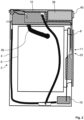
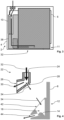
- the washing machine 2 is designed here as a so-called washer-dryer for textiles and comprises a housing 4, a suds container 6 arranged in the housing 4, a drum in the suds container 6 which can be rotated about a rotation axis for receiving laundry, namely the textiles, a door 8 for loading and unloading the drum, a water inlet device 10 which can be connected to a fresh water source in a flow-conducting manner and can be controlled by means of a control of the washing machine 2 for supplying the washing machine 2 with fresh water, a dispensing box 12 for rinsing detergent 14 into the drum and a circulation device 16 which can be controlled by the control for circulating a washing solution 32 formed from the detergent 14 and the fresh water 11.
- the rotation axis of the drum, the drum, the laundry, the fresh water source and the control are shown in the Fig. 1 to 4 not shown.
- the detergent 14 is only in the Fig. 4 and designed as a washing powder. However, other forms of detergent known to those skilled in the art are also conceivable.
- the detergent dispenser 12 is arranged on an inner side of the door 8 facing the drum and has a first compartment 18 and a second compartment 20, each for holding detergent 14, wherein, depending on an actuation by means of the control system, the first compartment 18 can be connected in a flow-conducting manner to the recirculation device 16 and the second compartment 20 can be connected directly to the water inlet device 10.
- the first compartment 18 is designed as a main wash compartment and the second compartment 20 is designed as a fabric softener compartment.
- the first compartment 18 can be connected to the bypass device 16 in a flow-conducting manner by means of a bypass nozzle device 22, wherein the bypass nozzle device 22 has a bypass nozzle inlet 24 that is connected to the bypass device 16 in a flow-conducting manner, a bypass nozzle outlet 26 that is connected directly to the drum in a flow-conducting manner, and a bypass nozzle outlet 28 that is connected to the first compartment 18 in a flow-conducting manner, and wherein the two bypass nozzle outlets 26, 28 are designed to be coordinated with one another in such a way that a main volume flow 30 of the washing solution 32 can be introduced directly into the drum and a secondary volume flow 34 of the washing solution 32 that is smaller than the main volume flow 30 can be introduced into the drum by means of the first compartment 18.
- the bypass nozzle device can be arranged, for example, on or in a door sealing ring (not shown) for sealing the tub when the door is closed, for example in such a way that the bypass nozzle device is designed as an integral part of the door sealing ring.
- the flooding device 16 and the flooding nozzle device 22 are designed to be coordinated with one another in such a way that the washing solution 32 can be introduced simultaneously as a pendulum jet into the drum and the first compartment 18.
- the second compartment 20 has a suction lifter mechanism (not shown) which is known per se to the person skilled in the art and which is designed such that the washing solution 32 from the second compartment 20 can only be introduced into the drum after a previously determined filling level of the second compartment 20 with fresh water 11 has been reached.
- the water supply device 10 can also be connected to the drum in a direct flow-conducting manner via a water path 36 that is independent of the detergent dispenser 12, depending on the control by the controller. In conjunction with the aforementioned water path 36, a pre-wash is thus also possible in the washing machine 2. Since the detergent dispenser 12 here only has the first and second compartments 18, 20, i.e. does not have a pre-wash compartment, the detergent for the pre-wash (not shown) is simply placed directly into the drum with the laundry.
- the washing machine 2 is designed as a so-called washer-dryer.
- a filter 38 for filtering a process air (not shown) for drying the laundry in the drum is arranged for this purpose in an area of the water inlet device 10, wherein the water inlet device 10 and the filter 38 are arranged behind a control panel 40 of the washing machine 2, wherein the filter 38 is arranged on the control panel side and the water inlet device 10 is arranged remotely from the control panel behind the filter 38. See for example the Fig. 1 and 3 in a synopsis.
- a user loads the drum of the washing machine 2 with the laundry (not shown) and adds the detergent required for the intended pre-wash directly to the laundry in the drum.
- the user closes the door 8, selects an automatic program for the laundry using the control panel 40 in a manner known to those skilled in the art, and starts the automatic program.
- the water inlet device 10 is controlled in such a way that fresh water 11 flows from the fresh water source into the water inlet device 10 and is initially introduced by means of the water inlet device 10 via the water path 36 directly into the tub 6 and thus into the drum with the laundry and the detergent for the prewash.
- the flooding device 16 is controlled by the control system in such a way that the washing liquor 32 flows through the flooding nozzle inlet 24 into the flooding nozzle device 22 and by means of the flooding nozzle outlets 26, 28 into a main volume flow 30 introduced directly into the drum and, on the other hand, into a secondary volume flow 34 introduced into the first compartment 18 of the detergent dispenser 12.
- the secondary volume flow 34 flows into the first compartment 18 via an inlet opening 42, takes up the detergent 14 stored in the first compartment 18 for the main wash and discharges it from the first compartment 18 via an outlet opening 44 and into the drum.
- Both the main volume flow 30 and the secondary volume flow 34 are designed as a pendulum jet.
- the laundry is finally softened.
- the water inlet device 10 is controlled by the control system in such a way that the fresh water 11 from the fresh water source is fed directly into the second compartment 20 by the water inlet device 10.
- the detergent for the softening process (not shown) is not immediately rinsed out of the second compartment and fed into the drum.
- the second compartment 20 is filled with fresh water 11 until the fill level in the second compartment 20 is so high that the siphon mechanism (not shown) enables this detergent to be discharged from the second compartment 20 using the fresh water 11.
- the selected automatic program also provides for the laundry to be dried after the washing process has ended in a manner known to those skilled in the art. From time to time, it may be necessary to clean or even replace the filter 38 for filtering the process air (not shown) used to dry the laundry.
- the filter 38 is arranged in a location on the washing machine 2 that is easily accessible to the user, namely behind the control panel 40.
- the filter 38 can, for example, be designed like a drawer, so that the user can pull the filter 38 out of the washing machine 2 for cleaning or replacement and then push it back in again, similar to a detergent dispenser commonly used in the prior art.
- the invention is not limited to the present embodiment. See, for example, the relevant statements in the introduction to the description. In particular, the invention is not limited to the specific design, manufacturing and process details of the present embodiment but is defined by the present claims.
Landscapes
- Engineering & Computer Science (AREA)
- Textile Engineering (AREA)
- Detail Structures Of Washing Machines And Dryers (AREA)
Claims (9)
- Lave-linge (2), comprenant un boîtier (4), une cuve de lessivage (6) disposée dans le boîtier (4), un tambour pouvant tourner autour d'un axe de rotation dans la cuve de lessivage (6) et destiné à recevoir un article à laver, une porte (8) permettant de charger et de décharger le tambour, un dispositif d'arrivée d'eau (10) pouvant être relié de manière conductrice d'écoulement à une source d'eau fraîche et pouvant être commandé au moyen d'une commande du lave-linge (2) pour l'alimentation du lave-linge (2) en eau fraîche (11), ainsi qu'un bac d'introduction (12) permettant d'introduire un agent de lavage (14) dans le tambour, dans lequel le bac d'introduction (12) est disposé sur un côté intérieur de la porte (8) tourné vers le tambour et présente un premier et un second compartiment (18, 20) destinés à respectivement recevoir un agent de lavage (14),
caractérisépar un dispositif de recirculation (16) pouvant être commandé par la commande et permettant de faire circuler une lessive (32) formée par l'agent de lavage (14) et l'eau fraîche (11), eten ce que, en fonction d'une commande au moyen de la commande, le premier compartiment (18) peut être relié au dispositif de recirculation (16) de manière conductrice d'écoulement et le second compartiment (20) peut être relié directement au dispositif d'arrivée d'eau (10) de manière conductrice d'écoulement, eten ce que le premier compartiment (18) peut être relié de manière conductrice d'écoulement au dispositif de recirculation (16) au moyen d'un appareil formant buse de recirculation (22), dans lequel l'appareil formant buse de recirculation (22) présente une entrée de buse de recirculation (24) reliée de manière conductrice d'écoulement au dispositif de recirculation (16), une sortie de buse de recirculation (26) reliée directement au tambour de manière conductrice d'écoulement et une sortie de buse de recirculation (28) reliée de manière conductrice d'écoulement au premier compartiment (18), de préférence, en ce que les deux sorties de buse de recirculation (26, 28) sont conçues de manière à être adaptées l'une à l'autre de telle sorte qu'un flux volumique principal (30) de la lessive (32) peut être introduit directement dans le tambour et qu'un flux volumique secondaire (34) de la lessive (32), plus petit que le flux volumique principal (30), peut être introduit dans le tambour au moyen du premier compartiment (18). - Lave-linge (2) selon la revendication 1, caractérisé en ce que le dispositif de recirculation (16) et l'appareil formant buse de recirculation (22) sont conçus de manière à être adaptés l'un à l'autre de telle sorte que la lessive (32) peut être introduite dans le tambour et dans le premier compartiment (18) sous la forme d'un jet oscillant.
- Lave-linge (2) selon l'une des revendications 1 à 2, caractérisé en ce que le second compartiment (20) présente un mécanisme formant siphon qui est conçu de telle sorte que la lessive (32) provenant du second compartiment (20) ne peut être introduite dans le tambour qu'après avoir atteint un degré de remplissage prédéfini du second compartiment (20) avec de l'eau fraîche (11).
- Lave-linge (2) selon l'une des revendications 1 à 3, caractérisé en ce que le dispositif d'arrivée d'eau (10) peut être relié directement au tambour de manière conductrice d'écoulement, en fonction de la commande au moyen de la commande, par l'intermédiaire d'un trajet d'eau (36) indépendant du bac d'introduction (12).
- Lave-linge selon l'une des revendications 1 à 4, caractérisé en ce que l'appareil formant buse de recirculation est disposé sur ou dans un anneau d'étanchéité de porte permettant d'assurer l'étanchéité de la cuve de lessivage lorsque la porte est fermée, de préférence, en ce que l'appareil formant buse de recirculation est conçu en tant que partie intégrante de l'anneau d'étanchéité de porte.
- Lave-linge (2) selon l'une des revendications 1 à 5, caractérisé en ce que le lave-linge (2) est conçu comme un sèche-linge, dans lequel un filtre (38) destiné à filtrer un air de traitement pour le séchage de l'article à laver est disposé dans le tambour dans une zone du dispositif d'arrivée d'eau (10), de préférence,
en ce que le dispositif d'arrivée d'eau (10) et le filtre (38) sont disposés derrière un panneau de manipulation (40) du lave-linge (2), dans lequel le filtre (38) est disposé côté panneau de manipulation et le dispositif d'arrivée d'eau (10) est disposé derrière le filtre (38) à l'écart du panneau de manipulation. - Procédé permettant de faire fonctionner un lave-linge (2) selon l'une des revendications 1 à 6, selon lequel, en fonction d'une commande du dispositif d'arrivée d'eau (10) et du dispositif de recirculation (16), au moyen de la commande, le premier compartiment (18) est relié au dispositif de recirculation (16) de manière conductrice d'écoulement et le second compartiment (20) est relié directement au dispositif d'arrivée d'eau (10) de manière conductrice d'écoulement.
- Procédé selon la revendication 7, caractérisé en ce qu'un flux volumique principal (30) de la lessive (32) est introduit directement dans le tambour et un flux volumique secondaire (34) de la lessive (32), plus petit que le flux volumique principal (30), est introduit dans le tambour au moyen du premier compartiment (18).
- Procédé selon la revendication 8, caractérisé en ce que la lessive (32) est introduite dans le tambour et le premier compartiment (18) sous la forme d'un jet oscillant au moyen du dispositif de recirculation (16) et de l'appareil formant buse de recirculation (22).
Applications Claiming Priority (1)
| Application Number | Priority Date | Filing Date | Title |
|---|---|---|---|
| DE102021123053.5A DE102021123053A1 (de) | 2021-09-07 | 2021-09-07 | Waschmaschine und Verfahren zum Betrieb einer Waschmaschine |
Publications (3)
| Publication Number | Publication Date |
|---|---|
| EP4144907A1 EP4144907A1 (fr) | 2023-03-08 |
| EP4144907C0 EP4144907C0 (fr) | 2025-01-29 |
| EP4144907B1 true EP4144907B1 (fr) | 2025-01-29 |
Family
ID=83049880
Family Applications (1)
| Application Number | Title | Priority Date | Filing Date |
|---|---|---|---|
| EP22191737.0A Active EP4144907B1 (fr) | 2021-09-07 | 2022-08-23 | Machine à laver et procédé de fonctionnement d'une machine à laver |
Country Status (2)
| Country | Link |
|---|---|
| EP (1) | EP4144907B1 (fr) |
| DE (1) | DE102021123053A1 (fr) |
Family Cites Families (6)
| Publication number | Priority date | Publication date | Assignee | Title |
|---|---|---|---|---|
| EP1607507B1 (fr) | 2004-05-18 | 2007-05-23 | CANDY S.p.A. | Machine à laver à chargement frontal avec porte adaptée à contenir des lessives |
| KR101257703B1 (ko) * | 2006-04-13 | 2013-04-24 | 삼성전자주식회사 | 드럼세탁기 |
| ITTO20060739A1 (it) * | 2006-10-13 | 2008-04-14 | Indesit Co Spa | Macchina lavabiancheria a carica frontale |
| ITTO20060872A1 (it) | 2006-12-07 | 2008-06-08 | Indesit Co Spa | Macchina lavabiancheria a carica frontale con dispensatore di agenti di lavaggio nello sportello |
| US10253443B2 (en) | 2016-04-25 | 2019-04-09 | Whirlpool Corporation | Laundry treating appliance with closure mounted dispenser |
| DE102019121641A1 (de) * | 2019-08-12 | 2021-02-18 | Miele & Cie. Kg | Waschmaschine oder Waschtrockner mit einem Waschmitteleinspülsystem |
-
2021
- 2021-09-07 DE DE102021123053.5A patent/DE102021123053A1/de active Pending
-
2022
- 2022-08-23 EP EP22191737.0A patent/EP4144907B1/fr active Active
Also Published As
| Publication number | Publication date |
|---|---|
| EP4144907C0 (fr) | 2025-01-29 |
| EP4144907A1 (fr) | 2023-03-08 |
| DE102021123053A1 (de) | 2023-03-09 |
Similar Documents
| Publication | Publication Date | Title |
|---|---|---|
| DE102009030290B4 (de) | Haushalts-Reinigungsgerät mit einem einzigen Wasserführungsweg für die Einzelchargen- und die Mengenausgabe | |
| DE3401899C2 (fr) | ||
| EP3660198B1 (fr) | Procédé de fonctionnement pour une machine à laver | |
| EP2038468A1 (fr) | Lave-linge à amenée d'eau fraîche pouvant être commandée et procédé permettant de faire fonctionner ce lave-linge | |
| DE102008062925B4 (de) | Verfahren zum Steuern einer Waschmaschine | |
| EP2497855B1 (fr) | Lave-linge doté d'un caisson d'introduction formé comme un tiroir et procédé de nettoyage d'un compartiment d'introduction | |
| DE102012105041B3 (de) | Waschmaschine oder Waschtrockner mit einer Einrichtung zum Umfluten und Aufheizen der Waschflotte | |
| DE102008050862B4 (de) | Trommelwaschmaschine und Verfahren zum Betreiben einer Trommelwaschmaschine | |
| DE102007037159A1 (de) | Verfahren zum Waschen von Wäsche in einer Waschmaschine und Waschmaschine | |
| EP4144907A1 (fr) | Machine à laver et procédé de fonctionnement d'une machine à laver | |
| EP2492387B1 (fr) | Dispositif de rinçage pour un lave-linge doté d'un tiroir agencé dans un compartiment d'introduction | |
| EP0837172A1 (fr) | Machine à laver à tambour | |
| EP4148176A1 (fr) | Aiguillage de liquide pour machine à laver, système de liquide, machine à laver et procédé de fonctionnement d'une machine à laver | |
| DE69610796T2 (de) | Wäschewaschmaschine mit Vorrichtung zum Filtern der Waschlauge | |
| DE102015114118B4 (de) | Deckel für einen Einspülkasten für einen Waschautomaten, Einspülkasten für einen Waschautomaten, Waschautomat und Verfahren zum Überspülen eines Schauglases eines Waschautomaten | |
| DE10131537B4 (de) | Verfahren zum Waschen von Textilien sowie Durchlaufwaschmaschine zur Durchführung des Verfahrens | |
| DE102020125563A1 (de) | Waschmaschine und Verfahren zum Betreiben einer Waschmaschine | |
| EP3916147B1 (fr) | Lave-linge conçu pour introduire le fluide de processus directement dans l'espace intérieur d'un tambour et son procédé de fonctionnement | |
| DE102023205744A1 (de) | In eine Tür integrierte Dosiervorrichtung für wasserführende Haushaltsgeräte | |
| DE102023206842A1 (de) | Modulare türseitige Einspülschale für ein Haushaltsgerät | |
| DE102021106347A1 (de) | Waschmaschine und Verfahren zum Betrieb einer Waschmaschine | |
| DE69712680T2 (de) | Waschmaschine mit verbessertem Waschverfahren | |
| DE102020104222A1 (de) | Waschmaschine mit einem Einspülbehälter und Verfahren zum Waschen eines zu waschenden Gutes | |
| DE102020128152A1 (de) | Waschmaschine, Einspülkasten für eine Waschmaschine, Baugruppe für eine Waschmaschine und Verfahren zum Betrieb einer Waschmaschine | |
| DE19908805A1 (de) | Verfahren zum Betreiben einer Waschmaschine sowie zur Durchführung des Verfahrens geeignete Waschmaschine |
Legal Events
| Date | Code | Title | Description |
|---|---|---|---|
| PUAI | Public reference made under article 153(3) epc to a published international application that has entered the european phase |
Free format text: ORIGINAL CODE: 0009012 |
|
| STAA | Information on the status of an ep patent application or granted ep patent |
Free format text: STATUS: THE APPLICATION HAS BEEN PUBLISHED |
|
| AK | Designated contracting states |
Kind code of ref document: A1 Designated state(s): AL AT BE BG CH CY CZ DE DK EE ES FI FR GB GR HR HU IE IS IT LI LT LU LV MC MK MT NL NO PL PT RO RS SE SI SK SM TR |
|
| STAA | Information on the status of an ep patent application or granted ep patent |
Free format text: STATUS: REQUEST FOR EXAMINATION WAS MADE |
|
| 17P | Request for examination filed |
Effective date: 20230908 |
|
| RBV | Designated contracting states (corrected) |
Designated state(s): AL AT BE BG CH CY CZ DE DK EE ES FI FR GB GR HR HU IE IS IT LI LT LU LV MC MK MT NL NO PL PT RO RS SE SI SK SM TR |
|
| GRAP | Despatch of communication of intention to grant a patent |
Free format text: ORIGINAL CODE: EPIDOSNIGR1 |
|
| STAA | Information on the status of an ep patent application or granted ep patent |
Free format text: STATUS: GRANT OF PATENT IS INTENDED |
|
| RIC1 | Information provided on ipc code assigned before grant |
Ipc: D06F 58/22 20060101ALI20240930BHEP Ipc: D06F 25/00 20060101ALI20240930BHEP Ipc: D06F 39/08 20060101ALI20240930BHEP Ipc: D06F 39/14 20060101ALI20240930BHEP Ipc: D06F 39/02 20060101ALI20240930BHEP Ipc: D06F 33/37 20200101AFI20240930BHEP |
|
| INTG | Intention to grant announced |
Effective date: 20241021 |
|
| GRAS | Grant fee paid |
Free format text: ORIGINAL CODE: EPIDOSNIGR3 |
|
| GRAA | (expected) grant |
Free format text: ORIGINAL CODE: 0009210 |
|
| STAA | Information on the status of an ep patent application or granted ep patent |
Free format text: STATUS: THE PATENT HAS BEEN GRANTED |
|
| AK | Designated contracting states |
Kind code of ref document: B1 Designated state(s): AL AT BE BG CH CY CZ DE DK EE ES FI FR GB GR HR HU IE IS IT LI LT LU LV MC MK MT NL NO PL PT RO RS SE SI SK SM TR |
|
| REG | Reference to a national code |
Ref country code: GB Ref legal event code: FG4D Free format text: NOT ENGLISH |
|
| REG | Reference to a national code |
Ref country code: CH Ref legal event code: EP |
|
| REG | Reference to a national code |
Ref country code: DE Ref legal event code: R096 Ref document number: 502022002763 Country of ref document: DE |
|
| REG | Reference to a national code |
Ref country code: IE Ref legal event code: FG4D Free format text: LANGUAGE OF EP DOCUMENT: GERMAN |
|
| U01 | Request for unitary effect filed |
Effective date: 20250129 |
|
| U07 | Unitary effect registered |
Designated state(s): AT BE BG DE DK EE FI FR IT LT LU LV MT NL PT RO SE SI Effective date: 20250205 |
|
| REG | Reference to a national code |
Ref country code: GB Ref legal event code: 746 Effective date: 20250306 |
|
| PG25 | Lapsed in a contracting state [announced via postgrant information from national office to epo] |
Ref country code: RS Free format text: LAPSE BECAUSE OF FAILURE TO SUBMIT A TRANSLATION OF THE DESCRIPTION OR TO PAY THE FEE WITHIN THE PRESCRIBED TIME-LIMIT Effective date: 20250429 |
|
| PG25 | Lapsed in a contracting state [announced via postgrant information from national office to epo] |
Ref country code: PL Free format text: LAPSE BECAUSE OF FAILURE TO SUBMIT A TRANSLATION OF THE DESCRIPTION OR TO PAY THE FEE WITHIN THE PRESCRIBED TIME-LIMIT Effective date: 20250129 |
|
| PG25 | Lapsed in a contracting state [announced via postgrant information from national office to epo] |
Ref country code: ES Free format text: LAPSE BECAUSE OF FAILURE TO SUBMIT A TRANSLATION OF THE DESCRIPTION OR TO PAY THE FEE WITHIN THE PRESCRIBED TIME-LIMIT Effective date: 20250129 |
|
| PG25 | Lapsed in a contracting state [announced via postgrant information from national office to epo] |
Ref country code: NO Free format text: LAPSE BECAUSE OF FAILURE TO SUBMIT A TRANSLATION OF THE DESCRIPTION OR TO PAY THE FEE WITHIN THE PRESCRIBED TIME-LIMIT Effective date: 20250429 Ref country code: IS Free format text: LAPSE BECAUSE OF FAILURE TO SUBMIT A TRANSLATION OF THE DESCRIPTION OR TO PAY THE FEE WITHIN THE PRESCRIBED TIME-LIMIT Effective date: 20250529 |
|
| PG25 | Lapsed in a contracting state [announced via postgrant information from national office to epo] |
Ref country code: HR Free format text: LAPSE BECAUSE OF FAILURE TO SUBMIT A TRANSLATION OF THE DESCRIPTION OR TO PAY THE FEE WITHIN THE PRESCRIBED TIME-LIMIT Effective date: 20250129 |
|
| PG25 | Lapsed in a contracting state [announced via postgrant information from national office to epo] |
Ref country code: GR Free format text: LAPSE BECAUSE OF FAILURE TO SUBMIT A TRANSLATION OF THE DESCRIPTION OR TO PAY THE FEE WITHIN THE PRESCRIBED TIME-LIMIT Effective date: 20250430 |
|
| PG25 | Lapsed in a contracting state [announced via postgrant information from national office to epo] |
Ref country code: SM Free format text: LAPSE BECAUSE OF FAILURE TO SUBMIT A TRANSLATION OF THE DESCRIPTION OR TO PAY THE FEE WITHIN THE PRESCRIBED TIME-LIMIT Effective date: 20250129 |
|
| U20 | Renewal fee for the european patent with unitary effect paid |
Year of fee payment: 4 Effective date: 20250901 |
|
| PGFP | Annual fee paid to national office [announced via postgrant information from national office to epo] |
Ref country code: TR Payment date: 20250811 Year of fee payment: 4 |
|
| PG25 | Lapsed in a contracting state [announced via postgrant information from national office to epo] |
Ref country code: CZ Free format text: LAPSE BECAUSE OF FAILURE TO SUBMIT A TRANSLATION OF THE DESCRIPTION OR TO PAY THE FEE WITHIN THE PRESCRIBED TIME-LIMIT Effective date: 20250129 |
|
| PG25 | Lapsed in a contracting state [announced via postgrant information from national office to epo] |
Ref country code: SK Free format text: LAPSE BECAUSE OF FAILURE TO SUBMIT A TRANSLATION OF THE DESCRIPTION OR TO PAY THE FEE WITHIN THE PRESCRIBED TIME-LIMIT Effective date: 20250129 |
|
| PLBE | No opposition filed within time limit |
Free format text: ORIGINAL CODE: 0009261 |
|
| STAA | Information on the status of an ep patent application or granted ep patent |
Free format text: STATUS: NO OPPOSITION FILED WITHIN TIME LIMIT |
|
| REG | Reference to a national code |
Ref country code: CH Ref legal event code: L10 Free format text: ST27 STATUS EVENT CODE: U-0-0-L10-L00 (AS PROVIDED BY THE NATIONAL OFFICE) Effective date: 20251210 |
|
| 26N | No opposition filed |
Effective date: 20251030 |
|
| REG | Reference to a national code |
Ref country code: CH Ref legal event code: H13 Free format text: ST27 STATUS EVENT CODE: U-0-0-H10-H13 (AS PROVIDED BY THE NATIONAL OFFICE) Effective date: 20260324 |
|
| PG25 | Lapsed in a contracting state [announced via postgrant information from national office to epo] |
Ref country code: MC Free format text: LAPSE BECAUSE OF FAILURE TO SUBMIT A TRANSLATION OF THE DESCRIPTION OR TO PAY THE FEE WITHIN THE PRESCRIBED TIME-LIMIT Effective date: 20250129 |
|
| PG25 | Lapsed in a contracting state [announced via postgrant information from national office to epo] |
Ref country code: CH Free format text: LAPSE BECAUSE OF NON-PAYMENT OF DUE FEES Effective date: 20250831 |