EP4145561A1 - Électrode négative pour batterie secondaire au lithium ayant un collecteur de courant oxydé dans celle-ci, et son procédé de fabrication - Google Patents
Électrode négative pour batterie secondaire au lithium ayant un collecteur de courant oxydé dans celle-ci, et son procédé de fabrication Download PDFInfo
- Publication number
- EP4145561A1 EP4145561A1 EP21797917.8A EP21797917A EP4145561A1 EP 4145561 A1 EP4145561 A1 EP 4145561A1 EP 21797917 A EP21797917 A EP 21797917A EP 4145561 A1 EP4145561 A1 EP 4145561A1
- Authority
- EP
- European Patent Office
- Prior art keywords
- negative electrode
- current collector
- electrode current
- lithiophilic
- coating
- Prior art date
- Legal status (The legal status is an assumption and is not a legal conclusion. Google has not performed a legal analysis and makes no representation as to the accuracy of the status listed.)
- Granted
Links
Images




Classifications
-
- H—ELECTRICITY
- H01—ELECTRIC ELEMENTS
- H01M—PROCESSES OR MEANS, e.g. BATTERIES, FOR THE DIRECT CONVERSION OF CHEMICAL ENERGY INTO ELECTRICAL ENERGY
- H01M4/00—Electrodes
- H01M4/02—Electrodes composed of, or comprising, active material
- H01M4/13—Electrodes for accumulators with non-aqueous electrolyte, e.g. for lithium-accumulators; Processes of manufacture thereof
-
- H—ELECTRICITY
- H01—ELECTRIC ELEMENTS
- H01M—PROCESSES OR MEANS, e.g. BATTERIES, FOR THE DIRECT CONVERSION OF CHEMICAL ENERGY INTO ELECTRICAL ENERGY
- H01M4/00—Electrodes
- H01M4/02—Electrodes composed of, or comprising, active material
- H01M4/64—Carriers or collectors
- H01M4/66—Selection of materials
- H01M4/661—Metal or alloys, e.g. alloy coatings
-
- H—ELECTRICITY
- H01—ELECTRIC ELEMENTS
- H01M—PROCESSES OR MEANS, e.g. BATTERIES, FOR THE DIRECT CONVERSION OF CHEMICAL ENERGY INTO ELECTRICAL ENERGY
- H01M10/00—Secondary cells; Manufacture thereof
- H01M10/05—Accumulators with non-aqueous electrolyte
- H01M10/052—Li-accumulators
-
- H—ELECTRICITY
- H01—ELECTRIC ELEMENTS
- H01M—PROCESSES OR MEANS, e.g. BATTERIES, FOR THE DIRECT CONVERSION OF CHEMICAL ENERGY INTO ELECTRICAL ENERGY
- H01M10/00—Secondary cells; Manufacture thereof
- H01M10/05—Accumulators with non-aqueous electrolyte
- H01M10/052—Li-accumulators
- H01M10/0525—Rocking-chair batteries, i.e. batteries with lithium insertion or intercalation in both electrodes; Lithium-ion batteries
-
- H—ELECTRICITY
- H01—ELECTRIC ELEMENTS
- H01M—PROCESSES OR MEANS, e.g. BATTERIES, FOR THE DIRECT CONVERSION OF CHEMICAL ENERGY INTO ELECTRICAL ENERGY
- H01M10/00—Secondary cells; Manufacture thereof
- H01M10/42—Methods or arrangements for servicing or maintenance of secondary cells or secondary half-cells
-
- H—ELECTRICITY
- H01—ELECTRIC ELEMENTS
- H01M—PROCESSES OR MEANS, e.g. BATTERIES, FOR THE DIRECT CONVERSION OF CHEMICAL ENERGY INTO ELECTRICAL ENERGY
- H01M10/00—Secondary cells; Manufacture thereof
- H01M10/42—Methods or arrangements for servicing or maintenance of secondary cells or secondary half-cells
- H01M10/4235—Safety or regulating additives or arrangements in electrodes, separators or electrolyte
-
- H—ELECTRICITY
- H01—ELECTRIC ELEMENTS
- H01M—PROCESSES OR MEANS, e.g. BATTERIES, FOR THE DIRECT CONVERSION OF CHEMICAL ENERGY INTO ELECTRICAL ENERGY
- H01M4/00—Electrodes
- H01M4/02—Electrodes composed of, or comprising, active material
-
- H—ELECTRICITY
- H01—ELECTRIC ELEMENTS
- H01M—PROCESSES OR MEANS, e.g. BATTERIES, FOR THE DIRECT CONVERSION OF CHEMICAL ENERGY INTO ELECTRICAL ENERGY
- H01M4/00—Electrodes
- H01M4/02—Electrodes composed of, or comprising, active material
- H01M4/04—Processes of manufacture in general
-
- H—ELECTRICITY
- H01—ELECTRIC ELEMENTS
- H01M—PROCESSES OR MEANS, e.g. BATTERIES, FOR THE DIRECT CONVERSION OF CHEMICAL ENERGY INTO ELECTRICAL ENERGY
- H01M4/00—Electrodes
- H01M4/02—Electrodes composed of, or comprising, active material
- H01M4/04—Processes of manufacture in general
- H01M4/0402—Methods of deposition of the material
- H01M4/0404—Methods of deposition of the material by coating on electrode collectors
-
- H—ELECTRICITY
- H01—ELECTRIC ELEMENTS
- H01M—PROCESSES OR MEANS, e.g. BATTERIES, FOR THE DIRECT CONVERSION OF CHEMICAL ENERGY INTO ELECTRICAL ENERGY
- H01M4/00—Electrodes
- H01M4/02—Electrodes composed of, or comprising, active material
- H01M4/04—Processes of manufacture in general
- H01M4/0471—Processes of manufacture in general involving thermal treatment, e.g. firing, sintering, backing particulate active material, thermal decomposition, pyrolysis
-
- H—ELECTRICITY
- H01—ELECTRIC ELEMENTS
- H01M—PROCESSES OR MEANS, e.g. BATTERIES, FOR THE DIRECT CONVERSION OF CHEMICAL ENERGY INTO ELECTRICAL ENERGY
- H01M4/00—Electrodes
- H01M4/02—Electrodes composed of, or comprising, active material
- H01M4/13—Electrodes for accumulators with non-aqueous electrolyte, e.g. for lithium-accumulators; Processes of manufacture thereof
- H01M4/134—Electrodes based on metals, Si or alloys
-
- H—ELECTRICITY
- H01—ELECTRIC ELEMENTS
- H01M—PROCESSES OR MEANS, e.g. BATTERIES, FOR THE DIRECT CONVERSION OF CHEMICAL ENERGY INTO ELECTRICAL ENERGY
- H01M4/00—Electrodes
- H01M4/02—Electrodes composed of, or comprising, active material
- H01M4/13—Electrodes for accumulators with non-aqueous electrolyte, e.g. for lithium-accumulators; Processes of manufacture thereof
- H01M4/139—Processes of manufacture
-
- H—ELECTRICITY
- H01—ELECTRIC ELEMENTS
- H01M—PROCESSES OR MEANS, e.g. BATTERIES, FOR THE DIRECT CONVERSION OF CHEMICAL ENERGY INTO ELECTRICAL ENERGY
- H01M4/00—Electrodes
- H01M4/02—Electrodes composed of, or comprising, active material
- H01M4/13—Electrodes for accumulators with non-aqueous electrolyte, e.g. for lithium-accumulators; Processes of manufacture thereof
- H01M4/139—Processes of manufacture
- H01M4/1395—Processes of manufacture of electrodes based on metals, Si or alloys
-
- H—ELECTRICITY
- H01—ELECTRIC ELEMENTS
- H01M—PROCESSES OR MEANS, e.g. BATTERIES, FOR THE DIRECT CONVERSION OF CHEMICAL ENERGY INTO ELECTRICAL ENERGY
- H01M4/00—Electrodes
- H01M4/02—Electrodes composed of, or comprising, active material
- H01M4/36—Selection of substances as active materials, active masses, active liquids
-
- H—ELECTRICITY
- H01—ELECTRIC ELEMENTS
- H01M—PROCESSES OR MEANS, e.g. BATTERIES, FOR THE DIRECT CONVERSION OF CHEMICAL ENERGY INTO ELECTRICAL ENERGY
- H01M4/00—Electrodes
- H01M4/02—Electrodes composed of, or comprising, active material
- H01M4/36—Selection of substances as active materials, active masses, active liquids
- H01M4/362—Composites
- H01M4/366—Composites as layered products
-
- H—ELECTRICITY
- H01—ELECTRIC ELEMENTS
- H01M—PROCESSES OR MEANS, e.g. BATTERIES, FOR THE DIRECT CONVERSION OF CHEMICAL ENERGY INTO ELECTRICAL ENERGY
- H01M4/00—Electrodes
- H01M4/02—Electrodes composed of, or comprising, active material
- H01M4/36—Selection of substances as active materials, active masses, active liquids
- H01M4/38—Selection of substances as active materials, active masses, active liquids of elements or alloys
- H01M4/381—Alkaline or alkaline earth metals elements
- H01M4/382—Lithium
-
- H—ELECTRICITY
- H01—ELECTRIC ELEMENTS
- H01M—PROCESSES OR MEANS, e.g. BATTERIES, FOR THE DIRECT CONVERSION OF CHEMICAL ENERGY INTO ELECTRICAL ENERGY
- H01M4/00—Electrodes
- H01M4/02—Electrodes composed of, or comprising, active material
- H01M4/36—Selection of substances as active materials, active masses, active liquids
- H01M4/48—Selection of substances as active materials, active masses, active liquids of inorganic oxides or hydroxides
- H01M4/485—Selection of substances as active materials, active masses, active liquids of inorganic oxides or hydroxides of mixed oxides or hydroxides for inserting or intercalating light metals, e.g. LiTi2O4 or LiTi2OxFy
-
- H—ELECTRICITY
- H01—ELECTRIC ELEMENTS
- H01M—PROCESSES OR MEANS, e.g. BATTERIES, FOR THE DIRECT CONVERSION OF CHEMICAL ENERGY INTO ELECTRICAL ENERGY
- H01M4/00—Electrodes
- H01M4/02—Electrodes composed of, or comprising, active material
- H01M4/62—Selection of inactive substances as ingredients for active masses, e.g. binders, fillers
-
- H—ELECTRICITY
- H01—ELECTRIC ELEMENTS
- H01M—PROCESSES OR MEANS, e.g. BATTERIES, FOR THE DIRECT CONVERSION OF CHEMICAL ENERGY INTO ELECTRICAL ENERGY
- H01M4/00—Electrodes
- H01M4/02—Electrodes composed of, or comprising, active material
- H01M4/64—Carriers or collectors
- H01M4/66—Selection of materials
-
- H—ELECTRICITY
- H01—ELECTRIC ELEMENTS
- H01M—PROCESSES OR MEANS, e.g. BATTERIES, FOR THE DIRECT CONVERSION OF CHEMICAL ENERGY INTO ELECTRICAL ENERGY
- H01M4/00—Electrodes
- H01M4/02—Electrodes composed of, or comprising, active material
- H01M4/64—Carriers or collectors
- H01M4/66—Selection of materials
- H01M4/665—Composites
- H01M4/667—Composites in the form of layers, e.g. coatings
-
- H—ELECTRICITY
- H01—ELECTRIC ELEMENTS
- H01M—PROCESSES OR MEANS, e.g. BATTERIES, FOR THE DIRECT CONVERSION OF CHEMICAL ENERGY INTO ELECTRICAL ENERGY
- H01M10/00—Secondary cells; Manufacture thereof
- H01M10/05—Accumulators with non-aqueous electrolyte
- H01M10/058—Construction or manufacture
- H01M10/0585—Construction or manufacture of accumulators having only flat construction elements, i.e. flat positive electrodes, flat negative electrodes and flat separators
-
- H—ELECTRICITY
- H01—ELECTRIC ELEMENTS
- H01M—PROCESSES OR MEANS, e.g. BATTERIES, FOR THE DIRECT CONVERSION OF CHEMICAL ENERGY INTO ELECTRICAL ENERGY
- H01M4/00—Electrodes
- H01M4/02—Electrodes composed of, or comprising, active material
- H01M2004/026—Electrodes composed of, or comprising, active material characterised by the polarity
- H01M2004/027—Negative electrodes
-
- Y—GENERAL TAGGING OF NEW TECHNOLOGICAL DEVELOPMENTS; GENERAL TAGGING OF CROSS-SECTIONAL TECHNOLOGIES SPANNING OVER SEVERAL SECTIONS OF THE IPC; TECHNICAL SUBJECTS COVERED BY FORMER USPC CROSS-REFERENCE ART COLLECTIONS [XRACs] AND DIGESTS
- Y02—TECHNOLOGIES OR APPLICATIONS FOR MITIGATION OR ADAPTATION AGAINST CLIMATE CHANGE
- Y02E—REDUCTION OF GREENHOUSE GAS [GHG] EMISSIONS, RELATED TO ENERGY GENERATION, TRANSMISSION OR DISTRIBUTION
- Y02E60/00—Enabling technologies; Technologies with a potential or indirect contribution to GHG emissions mitigation
- Y02E60/10—Energy storage using batteries
-
- Y—GENERAL TAGGING OF NEW TECHNOLOGICAL DEVELOPMENTS; GENERAL TAGGING OF CROSS-SECTIONAL TECHNOLOGIES SPANNING OVER SEVERAL SECTIONS OF THE IPC; TECHNICAL SUBJECTS COVERED BY FORMER USPC CROSS-REFERENCE ART COLLECTIONS [XRACs] AND DIGESTS
- Y02—TECHNOLOGIES OR APPLICATIONS FOR MITIGATION OR ADAPTATION AGAINST CLIMATE CHANGE
- Y02P—CLIMATE CHANGE MITIGATION TECHNOLOGIES IN THE PRODUCTION OR PROCESSING OF GOODS
- Y02P70/00—Climate change mitigation technologies in the production process for final industrial or consumer products
- Y02P70/50—Manufacturing or production processes characterised by the final manufactured product
Definitions
- the present invention relates to a negative electrode for lithium secondary batteries including an oxidized current collector and a method of manufacturing the same, and more particularly to a negative electrode for lithium secondary batteries configured such that a lithiophilic material is introduced to the surface of a negative electrode current collector in order to enlarge the portion of the surface of the negative electrode current collector on which lithium plating occurs, whereby it is possible to prevent lithium dendrites from being formed at a specific portion of the negative electrode, and a method of manufacturing the same.
- a lithium secondary battery which is reusable and has high energy density, has attracted attention as a new energy source that has environmentally friendly characteristics, since the lithium secondary battery not only remarkably reduces the use of fossil fuels but also does not generate by-products as the result of the use of energy.
- the lithium secondary battery has been spotlighted as a power source that has high energy density suitable for wearable devices or portable devices and as a high-output power source for electric vehicles. As a result, research on a lithium secondary battery that has high operating voltage and energy density has been more actively conducted.
- the operating voltage and energy density of the lithium secondary battery may be changed depending on the kind of an electrode active material, the kind of an electrolytic solution, and the loading amount of an electrode mixture layer.
- a lithium cobalt composite oxide or a lithium-containing manganese composite oxide is used as a positive electrode active material, and lithium metal, a carbon-based material, or silicon is used as a negative electrode active material.
- the lithium metal has an advantage of high energy density but has a problem in that, when lithium metal reacts with moisture in air, by-products, such as LiOH, Li 2 O, and Li 2 CO 3 , are generated.
- lithium dendrites are formed on the surface of the lithium metal during charging and discharging of the battery.
- the lithium dendrites grow and penetrate a separator, the lifespan of the lithium secondary battery may be reduced and a fatal problem related to safety may occur. For example, microscopic short circuit may occur.
- Patent Document 1 discloses a lithium polymer secondary battery configured such that a cross-linking polymer protective thin film using a diacrylic-based monomer is formed on the surface of lithium metal in order to improve safety of a lithium metal negative electrode, whereby it is possible to improve interface characteristics between the lithium metal electrode and a polymer electrolyte.
- the protective thin film is easily peeled from the surface of the electrode as the result of driving of the battery, however, it is difficult to sufficiently obtain a lithium dendrite growth prevention effect.
- Patent Document 2 discloses an electrode for lithium secondary batteries including an electrode active material layer including lithium metal between a current collector and a protective layer, the protecting layer including a thermally conductive material, wherein heat is uniformly distributed on the surface of the electrode during charging and discharging, whereby lithium dendrites uniformly grow.
- Patent Document 2 does not solve a problem in that lithium dendrites grow on the surface of a negative electrode that faces a positive electrode, whereby microscopic short circuit occurs.
- the lithium metal negative electrode has still not been applied to the related fields due to growth of lithium dendrites in spite of advantages of high energy density and high voltage
- the present invention has been made in view of the above problems, and it is an object of the present invention to provide a negative electrode for lithium secondary batteries configured such that a coating material coated on a negative electrode current collector is oxidized in order to prevent occurrence of short circuit as the result of lithium dendrites that grow on a specific portion of the surface of the negative electrode coming into contact with a positive electrode and a method of manufacturing the same.
- a negative electrode for lithium secondary batteries includes a negative electrode current collector and a lithiophilic material (LPM) coated on at least one surface of the negative electrode current collector, wherein the lithiophilic material is an oxidized product of a coating material coated on the negative electrode current collector and includes at least one of a metal or a metal oxide, and an oxide layer is formed on a surface of the negative electrode current collector having the lithiophilic material formed thereon.
- LPM lithiophilic material
- Lithium plating may occur on the lithiophilic material.
- the coating material may be at least one of: a metal salt including HAuCl 4 , H 2 PtCl 6 , AgNO 3 , AuCl, Aucl 3 , K(AuCl 4 ), AuBr 3 , PtCl 2 , PtCl 4 , AgCl, AgCN, or CuCl 2 ; a metal including Au, Ag, Pt, Zn, Si, or Mg; and a metal oxide including CuO, ZnO, CoO, or MnO.
- a metal salt including HAuCl 4 , H 2 PtCl 6 , AgNO 3 , AuCl, Aucl 3 , K(AuCl 4 ), AuBr 3 , PtCl 2 , PtCl 4 , AgCl, AgCN, or CuCl 2 ; a metal including Au, Ag, Pt, Zn, Si, or Mg; and a metal oxide including CuO, ZnO, CoO, or MnO.
- the lithiophilic material may be at least one of: a metal including Au, Ag, Pt, Zn, Si, or Mg; or a metal oxide including CuO, ZnO, CoO, or MnO.
- An oxide layer may be formed on the surface of the negative electrode current collector that is not coated with the lithiophilic material.
- the present invention provides a method of manufacturing the negative electrode. Specifically, the method includes 1) preparing a negative electrode current collector, 2) coating at least one surface of the negative electrode current collector with a coating material, and 3) oxidizing the negative electrode current collector of step 2).
- Lithiophilicity of the coating material may be increased by the oxidation.
- the coating step may be performed by immersing, spin coating, dip coating, spray coating, doctor blade coating, solution casting, drop coating, physical vapor deposition (PVD), or chemical vapor deposition (CVD).
- PVD physical vapor deposition
- CVD chemical vapor deposition
- the oxidation may be performed through a heat treatment process at a temperature of 50°C to 500°C.
- the oxidation may be performed for 1 minute to 360 minutes.
- the present invention provides an electrode assembly including the negative electrode.
- the electrode assembly may be a mono-cell in which a positive electrode, a separator, and a negative electrode are sequentially stacked, or a bi-cell in which a negative electrode, a separator, a positive electrode, a separator, and a negative electrode are sequentially stacked.
- the electrode assembly may include a negative electrode for lithium secondary batteries configured such that opposite surfaces of a negative electrode current collector are coated with lithiophilic materials.
- the electrode assembly may include a negative electrode current collector, a first surface of which is coated with a lithiophilic material and a second surface of which is coated with no lithiophilic material, wherein the second surface may be disposed so as to face a positive electrode in the state in which a separator is interposed therebetween.
- the present invention provides a lithium secondary battery having the electrode assembly received in a battery case together with an electrolytic solution or a solid electrolyte.
- the present invention provides a battery module or a battery pack including the lithium secondary battery as a unit cell.
- a negative electrode for lithium secondary batteries including an oxidized current collector according to the present invention and a method of manufacturing the same
- the entire surface of a negative electrode current collector is coated with a lithiophilic material in a dispersed state, whereby lithium plating may occur over the entire surface of the negative electrode current collector. Consequently, nucleation potential is lowered and a plurality of lithium nuclei may be formed.
- a rate at which additional plating occurs on a plurality of lithium nuclei widely dispersed may be increased, compared to a rate at which a lithium nucleus grows on a specific region of the surface of the negative electrode current collector in a vertical direction. Consequently, it is possible to prevent local occurrence of lithium plating on the surface of the negative electrode current collector, thus preventing growth of lithium dendrites.
- the portion of the negative electrode current collector that is coated with no lithiophilic material is oxidized, the surface of the negative electrode current collector that is coated with no lithiophilic material is reformed so as to be lithiophilic. Consequently, it is possible to further inhibit local occurrence of lithium plating.
- a negative electrode for lithium secondary batteries including lithium metal may include a negative electrode current collector and a lithiophilic material (LPM) coated on at least one surface of the negative electrode current collector, wherein the lithiophilic material, which is an oxidized product of a coating material coated on the negative electrode current collector, may include at least one of a metal or a metal oxide, and an oxide layer may be formed on a surface of the negative electrode current collector having the lithiophilic material formed thereon.
- LPM lithiophilic material
- the coating material itself may be a material that exhibits lithiophilicity or may be a material that exhibits no lithiophilicity before oxidation but is configured such that an oxidized product of the coating material generated as the result of oxidation exhibits lithiophilicity.
- lithiophilicity may be further increased through oxidation. Alternatively, contrary thereto, improvement in lithiophilicity through oxidation may be insignificant.
- the negative electrode current collector is in the state in which an oxide layer is formed on the surface of the negative electrode current collector by oxidation.
- the negative electrode current collector is denatured so as to exhibit lithiophilicity.
- lithiophilicity may be further increased by a copper oxide layer formed by oxidation.
- the coating material may be at least one of: a metal salt including HAuCl 4 , H 2 PtCl 6 , AgNO 3 , AuCl, AuCl 3 , K(AuCl 4 ), AuBr 3 , PtCl 2 , PtCl 4 , AgCl, AgCN, or CuCl 2 ; a metal including Au, Ag, Pt, Zn, Si, or Mg; or a metal oxide including CuO, ZnO, CoO, or MnO.
- a metal salt including HAuCl 4 , H 2 PtCl 6 , AgNO 3 , AuCl, AuCl 3 , K(AuCl 4 ), AuBr 3 , PtCl 2 , PtCl 4 , AgCl, AgCN, or CuCl 2 ; a metal including Au, Ag, Pt, Zn, Si, or Mg; or a metal oxide including CuO, ZnO, CoO, or MnO.
- the metal salt may be nitrate and chloride.
- the lithiophilic material which is an oxidized product of the coating material coated on the negative electrode current collector, may be at least one of: a metal including Au, Ag, Pt, Zn, Si, or Mg; or a metal oxide including CuO, ZnO, CoO, or MnO.
- a metal included in the lithiophilic material is reduced after becoming a metal oxide by oxidation, since the metal has a nature of not being easily oxidized, and may be in the same state as the coating material before oxidation. In the case in which a metal is included in the coating material, therefore, the effect of improvement in lithiophilicity due to oxidation may be low.
- the metal corresponds to the lithiophilic material, however, lithium is plated on the metal.
- metals that are not easily oxidized in spite of oxidation are noble metals, whereby material costs may be increased.
- material costs may be increased.
- the particle size of the noble metal is small, costs may be further increased, since further processing costs are needed.
- the noble metal may be acquired using the metal salt. It is possible to reduce material costs by using the metal salt as the coating material.
- the metal salt is changed to a metal that exhibits lithiophilicity as the result of oxidation, whereby a difference in lithiophilicity before and after oxidation may be large.
- the negative electrode current collector may include copper, nickel, stainless steel, aluminum, or an alloy thereof.
- the negative electrode current collector may be foil made of copper, nickel, stainless steel, aluminum, lithium, or an alloy thereof.
- a negative electrode may be manufactured by forming a negative electrode mixture on the negative electrode current collector by coating and drying and rolling the negative electrode mixture.
- the negative electrode has advantages of high energy density and high output.
- the lithium metal which is lithium in a metal state, means pure lithium, which is not alloyed with a metal other than lithium.
- the lithium metal may form a lithium nucleus on the surface of the negative electrode, and the lithium nucleus may grow into lithium dendrites. There is a high danger of the lithium dendrites penetrating a separator, whereby internal short circuit may occur.
- the present invention provides a negative electrode, the surface of which is coated with a lithiophilic material through a method of oxidizing a negative electrode current collector having a coating layer formed thereon, whereby lithium plating occurs over the entire surface of the negative electrode current collector.
- the lithiophilic material is a material that has high reactivity with lithium, and lithium plating (Li plating) occurs on the lithiophilic material.
- the surface of the negative electrode current collector is coated with a coating material that becomes the lithiophilic material, and the coating material is oxidized.
- the lithiophilic material lowers nucleation potential on the surface of the negative electrode current collector such that a plurality of lithium nuclei is formed.
- a rate at which additional plating occurs on a plurality of lithium nuclei widely dispersed may be increased, compared to a rate at which a lithium nucleus grows on a specific region of the surface of the negative electrode current collector in a vertical direction, whereby it is possible to prevent growth of lithium dendrites on a specific portion of the surface of the negative electrode current collector in the vertical direction.
- the negative electrode current collector coated with the coating material is oxidized, whereby lithiophilicity of the lithiophilic material, which is an oxidized product of the coating material, is improved, and the portion of the negative electrode current collector that is not coated with the lithiophilic material is oxidized, whereby a metal oxide layer that exhibits lithiophilicity is formed. Lithium plating may occur over the entire surface of the negative electrode current collector by such oxidation.
- the negative electrode current collector may be configured in any of various forms, such as a film, a sheet, a foil, a net, a porous body, a foam body, and a non-woven fabric body, each of which has a micro-scale uneven pattern formed on the surface thereof or each of which has no micro-scale uneven pattern formed on the surface thereof.
- the thickness of the negative electrode current collector is not particularly restricted, the thickness of the negative electrode current collector is preferably 5 um to 30 ⁇ m, more preferably 10 um to 20 um. If the thickness of the negative electrode current collector is greater than 30 ⁇ m, the capacity of the electrode per volume may be reduced. If the thickness of the negative electrode current collector is less than 5 ⁇ m, a folding phenomenon may occur at the time of manufacture of the electrode.
- an electrode active material layer may be optionally included. That is, the negative electrode according to the present invention may include only a negative electrode current collector coated with a lithiophilic material without inclusion of a negative electrode active material layer or may include a foil type negative electrode current collector and a negative electrode active material layer.
- the negative electrode active material may include at least one selected from the group consisting of a carbon material, a lithium alloy, a lithium metal composite oxide, lithium-containing titanium composite oxide (LTO), and a combination thereof.
- the lithium alloy includes an element capable of being alloyed with lithium, and mention of Si, Sn, C, Pt, Ir, Ni, Cu, Ti, Na, K, Rb, Cs, Fr, Be, Mg, Ca, Sr, Sb, Pb, In, Zn, Ba, Ra, Ge, or Al may be made as the element capable of being alloyed with the lithium.
- the thickness of the negative electrode active material layer may be 5 um to 40 um, more specifically 10 um to 20 um.
- a method of forming the negative electrode active material layer on the negative electrode current collector is not particularly restricted, and a method known in the art may be used.
- the negative electrode active material layer may be formed on the negative electrode current collector by dry or wet deposition or coating.
- the lithiophilic material is located on the negative electrode current collector in a state of being dispersed over the negative electrode current collector.
- the lithiophilic material may be agglutinated so as to be disposed in an island shape such that the negative electrode current collector is partially exposed.
- the lithiophilic material may be distributed within a range of 5% to 100%, specifically a range of 10% to 90%, more specifically a range of 30% to 80%, of the total area of the negative electrode current collector. In addition, more specifically, the lithiophilic material may be distributed within a range of 50% to 70% of the total area of the negative electrode current collector.
- the distribution area of the lithiophilic material is small, whereby it is difficult to obtain the effect provided by the lithiophilic material, which is undesirable.
- the area of the lithiophilic material is greater than 100% of the total area of the negative electrode current collector, which means introduction of surplus lithiophilic material, energy density is reduced, which is undesirable.
- the present invention is characterized in that the entirety of the negative electrode current collector is oxidized, whereby the portion of the negative electrode current collector that is not coated with the lithiophilic material is also reformed so as to be lithiophilic.
- the present invention is characterized in that the entirety of the negative electrode current collector is oxidized, whereby the portion of the negative electrode current collector that is not coated with the lithiophilic material is also reformed so as to be lithiophilic.
- a metal oxide layer formed on the surface of the negative electrode current collector by oxidation may be copper oxide, and, as the result of formation of the copper oxide, lithiophilicity is higher than in the copper current collector before oxidation
- the present invention provides a method of manufacturing the negative electrode for lithium secondary batteries.
- the method of manufacturing the negative electrode for lithium secondary batteries may include a step of preparing a negative electrode current collector, a step of coating at least one surface of the negative electrode current collector with a coating material, and a step of oxidizing the negative electrode current collector.
- a lithiophilic material coating method is not particularly restricted. For example, immersing, spin coating, dip coating, spray coating, doctor blade coating, solution casting, drop coating, physical vapor deposition (PVD), or chemical vapor deposition (CVD) may be used.
- immersing spin coating, dip coating, spray coating, doctor blade coating, solution casting, drop coating, physical vapor deposition (PVD), or chemical vapor deposition (CVD) may be used.
- Oxidation may be performed through a heat treatment process at a temperature of 50°C to 500°C. Specifically, oxidation may be performed at a temperature of 80°C to 400°C. More specifically, oxidation may be performed at a temperature of 150°C to 300°C.
- the oxidation time may range from 1 minute to 360 minutes, specifically from 5 minutes to 180 minutes, more specifically from 10 minutes to 60 minutes.
- the oxidation time is shorter than 1 minute, it is difficult to adjust the degree of oxidation, which is undesirable. In the case in which the oxidation time is longer than 360 minutes, processability is deteriorated due to such long oxidation time, which is also undesirable.
- the oxidation temperature and the oxidation time are factors that are related to each other, however, the oxidation temperature and the oxidation time may be adjusted.
- the oxidation time may be set to be short in the case in which the oxidation temperature is high, and the oxidation time may be set to be long in the case in which the oxidation temperature is low.
- a time duration of 1 hour or more may be needed in order to obtain the same effect as in the case in which oxidation is performed at 300°C for 1 hour.
- the present invention provides an electrode assembly including the negative electrode for lithium secondary batteries.
- a negative electrode current collector of the negative electrode for lithium secondary batteries includes a first surface coated with a lithiophilic material and a second surface coated with no lithiophilic material, wherein the second surface is disposed so as to face a positive electrode in the state in which a separator is interposed therebetween.
- the positive electrode is manufactured, for example, by applying a positive electrode mixture including a positive electrode active material to a positive electrode current collector and drying the positive electrode mixture.
- the positive electrode mixture may further optionally include a binder, a conductive agent, and a filler, as needed.
- the positive electrode current collector is not particularly restricted, as long as the positive electrode current collector exhibits high conductivity while the positive electrode current collector does not induce any chemical change in a battery to which the positive electrode current collector is applied.
- the positive electrode current collector may be made of stainless steel, aluminum, nickel, titanium, or sintered carbon.
- the positive electrode current collector may be made of aluminum or stainless steel, the surface of which is treated with carbon, nickel, titanium, or silver.
- the positive electrode current collector may have a micro-scale uneven pattern formed on the surface thereof so as to increase the force of adhesion of the positive electrode active material.
- the positive electrode current collector may be configured in various forms, such as a film, a sheet, a foil, a net, a porous body, a foam body, and a non-woven fabric body.
- the positive electrode active material is a material that is capable of inducing an electrochemical reaction.
- the positive electrode active material may be a lithium transition metal oxide including two or more transition metals.
- the conductive agent is generally added so that the conductive agent accounts for 1 weight% to 30 weight% based on the total weight of the mixture including the positive electrode active material.
- the conductive agent is not particularly restricted, as long as the conductive agent exhibits high conductivity without inducing any chemical change in a battery to which the conductive agent is applied.
- carbon for example, carbon; graphite, such as natural graphite or artificial graphite; carbon black, such as acetylene black, Ketjen black, channel black, furnace black, lamp black, or summer black; conductive fiber, such as carbon fiber or metallic fiber; metallic powder, such as carbon fluoride powder, aluminum powder, or nickel powder; conductive whisker, such as a zinc oxide or potassium titanate; a conductive metal oxide, such as a titanium oxide; or a conductive materials, such as a polyphenylene derivative, may be used as the conductive agent.
- carbon graphite, such as natural graphite or artificial graphite
- carbon black such as acetylene black, Ketjen black, channel black, furnace black, lamp black, or summer black
- conductive fiber such as carbon fiber or metallic fiber
- metallic powder such as carbon fluoride powder, aluminum powder, or nickel powder
- conductive whisker such as a zinc oxide or potassium titanate
- a conductive metal oxide such as a titanium oxide
- the binder is a component assisting in binding between the active material and the conductive agent and in binding with the current collector.
- the binder is generally added in an amount of 1 weight% to 30 weight% based on the total weight of the mixture including the positive electrode active material.
- the binder there may be used polyvinylidene fluoride, polyvinyl alcohol, carboxymethylcellulose (CMC), starch, hydroxypropylcellulose, regenerated cellulose, polyvinylpyrrolidone, tetrafluoroethylene, polyethylene, polypropylene, styrene butadiene rubber, fluoro rubber, and various copolymers thereof.
- the filler is an optional component used to inhibit expansion of the electrode.
- the filler there is no particular limit to the filler, as long as the filler is made of a fibrous material while the filler does not cause chemical changes in a battery to which the filler is applied.
- the filler there may be used olefin-based polymers, such as polyethylene and polypropylene; and fibrous materials, such as glass fiber and carbon fiber.
- the electrode assembly according to the present invention includes a separator interposed between the positive electrode and the negative electrode.
- the separator may be a porous substrate made of any one selected from the group consisting of polyethylene, polypropylene, polybutylene, polypentene, polyethylene terephthalate, polybutylene terephthalate, polyester, polyacetal, polyamide, polycarbonate, polyimide, polyetheretherketone, polyethersulfone, polyphenylene oxide, polyphenylene sulfide, and polyethylene naphthalate or a mixture of two or more thereof.
- a copper current collector and a coating solution including a coating material were prepared, the coating solution was dropped onto the copper current collector, and spin coating was performed at 3,000 rpm for 1 minute to form a coating layer.
- a solution in which HAuCl 4 was dissolved in ethanol so as to have a concentration of 10 mg/ml was used as the coating solution.
- the negative electrode current collector coated with the coating solution was thermally treated at 300°C for 60 minutes to manufacture a negative electrode in which the copper current collector and the coating material were oxidized.
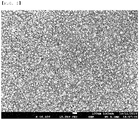
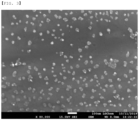
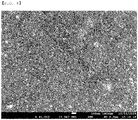
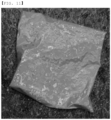
- FIG. 1 A photograph of the surface of the negative electrode manufactured according to Example 1 is shown in FIG. 1 , and an SEM photograph of the negative electrode is shown in FIG. 2 .
- a negative electrode was manufactured using the same method as in Example 1 except that HAuCl 4 in the coating solution was changed to H 2 PtCl 6 in Example 1.
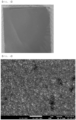
- a photograph of the surface of the negative electrode manufactured according to Example 2 is shown in FIG. 3 .
- a negative electrode was manufactured using the same method as in Example 1 except that HAuCl 4 in the coating solution was changed to AgNo 3 in Example 1.
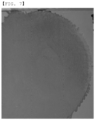
- a photograph of the surface of the negative electrode manufactured according to Example 3 is shown in FIG. 4 .
- a copper current collector the surface of which was coated with no lithiophilic material and which was not thermally treated, was prepared so as to be used as a negative electrode.
- a photograph of the surface of the negative electrode manufactured according to Comparative Example 1 is shown in FIG. 5
- a SEM photograph of the negative electrode is shown in FIG. 6 .
- a negative electrode was manufactured using the same method as in Example 1 except that no heat treatment was performed in Example 1.
- a photograph of the surface of the negative electrode manufactured according to Comparative Example 2 is shown in FIG. 7
- a SEM photograph of the negative electrode is shown in FIG. 8 .
- a copper current collector coated with no LPM was thermally treated at 300°C for 60 minutes to manufacture a negative electrode.
- a photograph of the surface of the negative electrode manufactured according to Comparative Example 3 is shown in FIG. 9 .
- a copper current collector coated with no LPM was thermally treated at 300°C for 360 minutes to manufacture a negative electrode.
- a photograph of the surface of the negative electrode manufactured according to Comparative Example 4 is shown in FIG. 10 .
- a negative electrode was manufactured using the same method as in Example 1 except that heat treatment time was lengthened from 60 minutes to 360 minutes in Example 1.
- a photograph of the surface of the negative electrode manufactured according to Comparative Example 5 is shown in FIG. 11 .
- FIGS. 1 to 11 when comparing FIGS. 5 and 6 , which show the negative electrode manufactured according to Comparative Example 1, in which the copper current collector was not treated, and FIGS. 7 and 8 , which show the negative electrode manufactured according to Comparative Example 2, in which the copper current collector was coated with the LPM, with each other, it can be seen that the surface of the negative electrode of FIG. 7 was coated with the LPM in a circular shape, and it can also be seen from the enlarged view that the surface of the negative electrode was coated with gold (Au) .
- Example 1 corresponds to Comparative Example 2 that was additionally thermally treated.
- FIGS. 1 and 2 which show the surface of the negative electrode manufactured according to Example 1
- FIGS. 7 and 8 which show the negative electrode manufactured according to Comparative Example 2
- the LPM material formed on the surface of the negative electrode current collector by coating, i.e. gold, and the current collector were oxidized, whereby a color difference occurred in appearance.
- FIG. 3 which is a SEM photograph of the negative electrode manufactured according to Example 2, it can be seen that the surface of the negative electrode current collector was coated with Pt in a dispersed state.
- Pt may be nonuniformly dispersed depending on the state of the surface of the negative electrode current collector.
- an oxide layer is formed on the surface of the negative electrode current collector by oxidation, whereby the surface of the negative electrode current collector on which Pt is nonuniformly dispersed is reformed so as to be lithiophilic, and therefore it is possible to enlarge the portion of the negative electrode current collector on which lithium plating occurs.
- FIG. 4 which is an SEM photograph of the negative electrode manufactured according to Example 3, it can be seen that the entirety of the surface of the negative electrode current collector was coated with Ag although Ag partially congregated due to the state of the surface of the negative electrode current collector, whereby Ag was oxidized together with the negative electrode current collector and thus was reformed.
- FIG. 9 which shows the negative electrode manufactured according to Comparative Example 3, the outer periphery of the negative electrode current collector was further rolled than in the negative electrode manufactured according to Example 1, and the surface of the negative electrode current collector was oxidized by heat treatment.
- FIG. 10 which shows the negative electrode manufactured according to Comparative Example 4
- FIG. 11 which shows the negative electrode manufactured according to Comparative Example 5
- the oxidation time was too long, whereby the shape of each negative electrode was deformed, and the surface of each negative electrode was partially torn or peeled.
- each of the negative electrodes manufactured according to Comparative Example 4 and Comparative Example 5 was in a state of not being used as the current collector, and therefore the following short-circuit occurrence experiments were not performed.
- NCM811 as a positive electrode active material
- carbon as a conductive agent
- polyvinylidene fluoride as a binder
- the slurry for positive electrode formation was applied to an aluminum current collector so as to have a thickness of 20 um using a doctor blade and was then vacuum-dried at 120°C for 4 hours.
- the aluminum current collector having the vacuum-dried slurry for positive electrode formation was rolled using a roll press to manufacture 3 mAh/cm 2 of a positive electrode.
- LiPF 6 LiPF 6
- 0.5 volume% of vinylene carbonate 0.5 volume% of vinylene carbonate
- 1 volume% of fluoroethylene carbonate were added to a mixture of ethylene carbonate and ethyl methyl carbonate mixed with each other so as to have a volume ratio (volume%) of 3:7.
- a coin cell was manufactured using the liquid electrolyte, the positive electrode, and the negative electrode. The number of charges and discharges at which short circuit occurred was measured while the coil cell was charged and discharged under the following conditions. The results are shown in Table 1 below.
- the number of charges and discharges at which short circuit occurs means a point in time at which voltage is not increased but is maintained uniform or is decreased even though voltage does not reach cut-off voltage while lifespan evaluation is performed under the charging and discharging conditions.
- oxidation is performed at a high temperature of 300°C, therefore, it is preferable for oxidation to be performed for a shorter time than 360 minutes.
- a negative electrode for lithium secondary batteries including an oxidized current collector according to the present invention and a method of manufacturing the same
- the entire surface of a negative electrode current collector is coated with a lithiophilic material in a dispersed state, whereby lithium plating may occur over the entire surface of the negative electrode current collector. Consequently, nucleation potential is lowered and a plurality of lithium nuclei may be formed.
- a rate at which additional plating occurs on a plurality of lithium nuclei widely dispersed may be increased, compared to a rate at which a lithium nucleus grows on a specific region of the surface of the negative electrode current collector in a vertical direction. Consequently, it is possible to prevent local occurrence of lithium plating on the surface of the negative electrode current collector, thus preventing growth of lithium dendrites.
- the portion of the negative electrode current collector that is coated with no lithiophilic material is oxidized, the surface of the negative electrode current collector that is coated with no lithiophilic material is reformed so as to be lithiophilic. Consequently, it is possible to further inhibit local occurrence of lithium plating.
Landscapes
- Chemical & Material Sciences (AREA)
- Chemical Kinetics & Catalysis (AREA)
- Electrochemistry (AREA)
- General Chemical & Material Sciences (AREA)
- Engineering & Computer Science (AREA)
- Manufacturing & Machinery (AREA)
- Materials Engineering (AREA)
- Composite Materials (AREA)
- Inorganic Chemistry (AREA)
- Cell Electrode Carriers And Collectors (AREA)
- Battery Electrode And Active Subsutance (AREA)
- Secondary Cells (AREA)
Applications Claiming Priority (2)
| Application Number | Priority Date | Filing Date | Title |
|---|---|---|---|
| KR1020200050794A KR102845564B1 (ko) | 2020-04-27 | 2020-04-27 | 집전체가 산화 처리된 리튬 이차전지용 음극 및 이의 제조방법 |
| PCT/KR2021/005120 WO2021221388A1 (fr) | 2020-04-27 | 2021-04-22 | Électrode négative pour batterie secondaire au lithium ayant un collecteur de courant oxydé dans celle-ci, et son procédé de fabrication |
Publications (3)
| Publication Number | Publication Date |
|---|---|
| EP4145561A1 true EP4145561A1 (fr) | 2023-03-08 |
| EP4145561A4 EP4145561A4 (fr) | 2023-11-08 |
| EP4145561B1 EP4145561B1 (fr) | 2024-09-11 |
Family
ID=78373654
Family Applications (1)
| Application Number | Title | Priority Date | Filing Date |
|---|---|---|---|
| EP21797917.8A Active EP4145561B1 (fr) | 2020-04-27 | 2021-04-22 | Électrode négative pour batterie secondaire au lithium ayant un collecteur de courant oxydé dans celle-ci, et son procédé de fabrication |
Country Status (8)
| Country | Link |
|---|---|
| US (1) | US20230039594A1 (fr) |
| EP (1) | EP4145561B1 (fr) |
| JP (1) | JP7518170B2 (fr) |
| KR (1) | KR102845564B1 (fr) |
| CN (1) | CN114846645B (fr) |
| ES (1) | ES2997115T3 (fr) |
| HU (1) | HUE068992T2 (fr) |
| WO (1) | WO2021221388A1 (fr) |
Families Citing this family (5)
| Publication number | Priority date | Publication date | Assignee | Title |
|---|---|---|---|---|
| CN114231954A (zh) * | 2021-12-20 | 2022-03-25 | 复旦大学 | 一种亲锂三维氧化钴/泡沫金属复合锂金属负极材料及其超组装制备方法 |
| KR20230095579A (ko) * | 2021-12-22 | 2023-06-29 | 주식회사 엘지에너지솔루션 | 리튬 이차 전지용 음극의 전리튬화 방법, 리튬 이차 전지용 음극 및 음극을 포함하는 리튬 이차 전지 |
| CN114530606B (zh) * | 2022-01-06 | 2023-05-23 | 清华大学深圳国际研究生院 | 一种三维亲锂碳界面修饰的铜基集流体及其制备方法和应用 |
| US20240234742A9 (en) * | 2022-10-20 | 2024-07-11 | Medtronic, Inc. | Over-discharge protection for electrochemical cells |
| CN115732631B (zh) * | 2022-11-28 | 2025-03-21 | 电子科技大学长三角研究院(湖州) | 一种具有双梯度结构的锂/钠离子电池负极及其制备方法 |
Family Cites Families (20)
| Publication number | Priority date | Publication date | Assignee | Title |
|---|---|---|---|---|
| KR100425585B1 (ko) | 2001-11-22 | 2004-04-06 | 한국전자통신연구원 | 가교 고분자 보호박막을 갖춘 리튬 고분자 이차 전지 및그 제조 방법 |
| JP4329357B2 (ja) | 2003-02-24 | 2009-09-09 | 住友電気工業株式会社 | リチウム二次電池負極部材、及びその製造方法 |
| US20070105007A1 (en) | 2005-11-10 | 2007-05-10 | The Board Of Trustees Of The University Of Illinois | Dry impregnation of platinum on a carbon substrate |
| WO2007055007A1 (fr) * | 2005-11-10 | 2007-05-18 | Pionics Co., Ltd. | Particule de matiere active d’electrode negative pour une batterie secondaire au lithium, electrode negative l’utilisant et procede pour les fabriquer |
| JP5135928B2 (ja) | 2007-07-17 | 2013-02-06 | 三菱化学株式会社 | 金属箔、二次電池用集電体、二次電池用電極及び非水電解質二次電池 |
| WO2009119093A1 (fr) * | 2008-03-26 | 2009-10-01 | パナソニック株式会社 | Électrode pour accumulateur au lithium et son procédé de fabrication |
| WO2014134019A1 (fr) | 2013-02-26 | 2014-09-04 | Treadstone Technologies, Inc. | Composants métalliques résistants à la corrosion pour batteries |
| JP7050419B2 (ja) * | 2017-02-07 | 2022-04-08 | 三星電子株式会社 | 全固体型二次電池用負極及び全固体型二次電池 |
| DE102017208218A1 (de) * | 2017-05-16 | 2018-11-22 | Fraunhofer-Gesellschaft zur Förderung der angewandten Forschung e.V. | Verfahren zum Herstellen eines mit einem Alkalimetall beschichteten Substrats mittels einer Vermittlerschicht und eine Vermittlerschicht sowie ein beschichtetes Substrat |
| KR102230751B1 (ko) | 2017-08-01 | 2021-03-22 | 주식회사 엘지화학 | 보호층을 포함하는 리튬 이차전지용 전극 및 이를 포함하는 리튬 이차전지 |
| KR102709297B1 (ko) * | 2017-12-01 | 2024-09-24 | 주식회사 엘지에너지솔루션 | 전극조립체 및 그를 포함하는 리튬 이차전지 |
| US10910653B2 (en) * | 2018-02-26 | 2021-02-02 | Graphenix Development, Inc. | Anodes for lithium-based energy storage devices |
| JP2019164906A (ja) | 2018-03-19 | 2019-09-26 | Tdk株式会社 | リチウム金属二次電池 |
| KR102471094B1 (ko) | 2018-11-02 | 2022-11-24 | 주식회사 엘지화학 | 프로필렌-에틸렌 공중합체 및 그의 제조 방법 |
| CN109860521B (zh) | 2019-03-19 | 2020-08-14 | 北京航空航天大学 | 一种阵列结构的锂金属复合电极及其制备方法 |
| CN110190287B (zh) | 2019-06-25 | 2021-06-08 | 珠海冠宇电池股份有限公司 | 一种多孔亲锂铜箔集流体材料及其制备方法 |
| US11024842B2 (en) * | 2019-06-27 | 2021-06-01 | Graphenix Development, Inc. | Patterned anodes for lithium-based energy storage devices |
| US11495782B2 (en) * | 2019-08-26 | 2022-11-08 | Graphenix Development, Inc. | Asymmetric anodes for lithium-based energy storage devices |
| CN110660969B (zh) | 2019-09-20 | 2020-10-27 | 清华大学深圳国际研究生院 | 一种金属锂负极及其制备方法 |
| CN111063862A (zh) | 2019-12-18 | 2020-04-24 | 吉林大学 | 一种对称型锂氧电池 |
-
2020
- 2020-04-27 KR KR1020200050794A patent/KR102845564B1/ko active Active
-
2021
- 2021-04-22 US US17/791,494 patent/US20230039594A1/en active Pending
- 2021-04-22 CN CN202180007436.1A patent/CN114846645B/zh active Active
- 2021-04-22 JP JP2022538857A patent/JP7518170B2/ja active Active
- 2021-04-22 EP EP21797917.8A patent/EP4145561B1/fr active Active
- 2021-04-22 ES ES21797917T patent/ES2997115T3/es active Active
- 2021-04-22 WO PCT/KR2021/005120 patent/WO2021221388A1/fr not_active Ceased
- 2021-04-22 HU HUE21797917A patent/HUE068992T2/hu unknown
Also Published As
| Publication number | Publication date |
|---|---|
| US20230039594A1 (en) | 2023-02-09 |
| KR20210132425A (ko) | 2021-11-04 |
| KR102845564B1 (ko) | 2025-08-12 |
| CN114846645B (zh) | 2024-09-24 |
| EP4145561A4 (fr) | 2023-11-08 |
| JP2023508373A (ja) | 2023-03-02 |
| CN114846645A (zh) | 2022-08-02 |
| EP4145561B1 (fr) | 2024-09-11 |
| HUE068992T2 (hu) | 2025-02-28 |
| JP7518170B2 (ja) | 2024-07-17 |
| WO2021221388A1 (fr) | 2021-11-04 |
| ES2997115T3 (en) | 2025-02-14 |
Similar Documents
| Publication | Publication Date | Title |
|---|---|---|
| EP4020619A1 (fr) | Anode pour batterie secondaire au lithium comprenant un collecteur de courant revêtu d'une couche primaire et son procédé de fabrication | |
| EP4145560A1 (fr) | Électrode négative pour batterie secondaire au lithium revêtue d'un matériau lithiophile, et son procédé de production | |
| EP4145561B1 (fr) | Électrode négative pour batterie secondaire au lithium ayant un collecteur de courant oxydé dans celle-ci, et son procédé de fabrication | |
| JP6196329B2 (ja) | カソード活性材料、電極及びリチウムイオン移動度及び電池容量が改良された二次バッテリー | |
| KR100770502B1 (ko) | 비수전해액 2차전지 | |
| EP2722914B1 (fr) | Matière active d'anode à densité élevée et son procédé de préparation | |
| CN103797621B (zh) | 双峰型负极活性材料和包含其的锂二次电池 | |
| EP2712009B1 (fr) | Matériau actif d'anode de type bimodal et batterie secondaire au lithium comprenant celui-ci | |
| JP7575572B2 (ja) | 全固体電池用の負極集電体及びそれを含む全固体電池用の負極 | |
| EP4386881A1 (fr) | Couche d'électrode négative pour batterie secondaire tout solide et batterie secondaire tout solide la comprenant | |
| EP4243111A1 (fr) | Électrode négative pour batterie entièrement solide comprenant une couche de revêtement et une couche de transfert d'ions, et batterie secondaire au lithium la comprenant | |
| EP4220750A1 (fr) | Anode de batterie à semi-conducteur comprenant une couche de polymère pour empêcher un micro-court-circuit, et batterie à semi-conducteur la comprenant | |
| KR102759977B1 (ko) | 리튬 이차 전지용 음극, 이의 제조 방법 및 이를 포함하는 리튬 이차 전지 | |
| KR102927238B1 (ko) | 마그네슘 금속 또는 합금을 포함하는 무음극 리튬 이차전지용 집전체, 그 제조방법 및 이를 포함하는 리튬 이차전지 | |
| JPH09171829A (ja) | リチウム二次電池用正極活物質およびリチウム二次電池 | |
| EP4734188A1 (fr) | Électrode négative pour batterie secondaire au lithium et batterie secondaire au lithium la comprenant | |
| EP4447158A1 (fr) | Matériau de cathode pour batterie secondaire au lithium, cathode le comprenant et batterie secondaire au lithium | |
| EP4712162A1 (fr) | Matériau actif de cathode pour batterie entièrement solide, et cathode de batterie entièrement solide et batterie entièrement solide, qui le comprennent |
Legal Events
| Date | Code | Title | Description |
|---|---|---|---|
| STAA | Information on the status of an ep patent application or granted ep patent |
Free format text: STATUS: THE INTERNATIONAL PUBLICATION HAS BEEN MADE |
|
| PUAI | Public reference made under article 153(3) epc to a published international application that has entered the european phase |
Free format text: ORIGINAL CODE: 0009012 |
|
| STAA | Information on the status of an ep patent application or granted ep patent |
Free format text: STATUS: REQUEST FOR EXAMINATION WAS MADE |
|
| 17P | Request for examination filed |
Effective date: 20220628 |
|
| AK | Designated contracting states |
Kind code of ref document: A1 Designated state(s): AL AT BE BG CH CY CZ DE DK EE ES FI FR GB GR HR HU IE IS IT LI LT LU LV MC MK MT NL NO PL PT RO RS SE SI SK SM TR |
|
| DAV | Request for validation of the european patent (deleted) | ||
| DAX | Request for extension of the european patent (deleted) | ||
| A4 | Supplementary search report drawn up and despatched |
Effective date: 20231006 |
|
| RIC1 | Information provided on ipc code assigned before grant |
Ipc: H01M 10/0525 20100101ALI20230929BHEP Ipc: H01M 4/485 20100101ALI20230929BHEP Ipc: H01M 4/38 20060101ALI20230929BHEP Ipc: H01M 4/36 20060101ALI20230929BHEP Ipc: H01M 4/1395 20100101ALI20230929BHEP Ipc: H01M 4/134 20100101ALI20230929BHEP Ipc: H01M 4/02 20060101ALI20230929BHEP Ipc: H01M 10/0585 20100101ALI20230929BHEP Ipc: H01M 10/052 20100101ALI20230929BHEP Ipc: H01M 4/04 20060101ALI20230929BHEP Ipc: H01M 4/139 20100101ALI20230929BHEP Ipc: H01M 4/66 20060101ALI20230929BHEP Ipc: H01M 10/42 20060101ALI20230929BHEP Ipc: H01M 4/62 20060101ALI20230929BHEP Ipc: H01M 4/13 20100101AFI20230929BHEP |
|
| GRAP | Despatch of communication of intention to grant a patent |
Free format text: ORIGINAL CODE: EPIDOSNIGR1 |
|
| STAA | Information on the status of an ep patent application or granted ep patent |
Free format text: STATUS: GRANT OF PATENT IS INTENDED |
|
| INTG | Intention to grant announced |
Effective date: 20240621 |
|
| GRAS | Grant fee paid |
Free format text: ORIGINAL CODE: EPIDOSNIGR3 |
|
| GRAA | (expected) grant |
Free format text: ORIGINAL CODE: 0009210 |
|
| STAA | Information on the status of an ep patent application or granted ep patent |
Free format text: STATUS: THE PATENT HAS BEEN GRANTED |
|
| P01 | Opt-out of the competence of the unified patent court (upc) registered |
Free format text: CASE NUMBER: APP_43135/2024 Effective date: 20240723 |
|
| AK | Designated contracting states |
Kind code of ref document: B1 Designated state(s): AL AT BE BG CH CY CZ DE DK EE ES FI FR GB GR HR HU IE IS IT LI LT LU LV MC MK MT NL NO PL PT RO RS SE SI SK SM TR |
|
| REG | Reference to a national code |
Ref country code: GB Ref legal event code: FG4D |
|
| REG | Reference to a national code |
Ref country code: CH Ref legal event code: EP |
|
| REG | Reference to a national code |
Ref country code: DE Ref legal event code: R096 Ref document number: 602021018755 Country of ref document: DE |
|
| REG | Reference to a national code |
Ref country code: IE Ref legal event code: FG4D |
|
| REG | Reference to a national code |
Ref country code: LT Ref legal event code: MG9D |
|
| PG25 | Lapsed in a contracting state [announced via postgrant information from national office to epo] |
Ref country code: NO Free format text: LAPSE BECAUSE OF FAILURE TO SUBMIT A TRANSLATION OF THE DESCRIPTION OR TO PAY THE FEE WITHIN THE PRESCRIBED TIME-LIMIT Effective date: 20241211 |
|
| REG | Reference to a national code |
Ref country code: NL Ref legal event code: MP Effective date: 20240911 |
|
| PG25 | Lapsed in a contracting state [announced via postgrant information from national office to epo] |
Ref country code: GR Free format text: LAPSE BECAUSE OF FAILURE TO SUBMIT A TRANSLATION OF THE DESCRIPTION OR TO PAY THE FEE WITHIN THE PRESCRIBED TIME-LIMIT Effective date: 20241212 Ref country code: FI Free format text: LAPSE BECAUSE OF FAILURE TO SUBMIT A TRANSLATION OF THE DESCRIPTION OR TO PAY THE FEE WITHIN THE PRESCRIBED TIME-LIMIT Effective date: 20240911 |
|
| PG25 | Lapsed in a contracting state [announced via postgrant information from national office to epo] |
Ref country code: BG Free format text: LAPSE BECAUSE OF FAILURE TO SUBMIT A TRANSLATION OF THE DESCRIPTION OR TO PAY THE FEE WITHIN THE PRESCRIBED TIME-LIMIT Effective date: 20240911 |
|
| PG25 | Lapsed in a contracting state [announced via postgrant information from national office to epo] |
Ref country code: LV Free format text: LAPSE BECAUSE OF FAILURE TO SUBMIT A TRANSLATION OF THE DESCRIPTION OR TO PAY THE FEE WITHIN THE PRESCRIBED TIME-LIMIT Effective date: 20240911 |
|
| PG25 | Lapsed in a contracting state [announced via postgrant information from national office to epo] |
Ref country code: HR Free format text: LAPSE BECAUSE OF FAILURE TO SUBMIT A TRANSLATION OF THE DESCRIPTION OR TO PAY THE FEE WITHIN THE PRESCRIBED TIME-LIMIT Effective date: 20240911 |
|
| PG25 | Lapsed in a contracting state [announced via postgrant information from national office to epo] |
Ref country code: NO Free format text: LAPSE BECAUSE OF FAILURE TO SUBMIT A TRANSLATION OF THE DESCRIPTION OR TO PAY THE FEE WITHIN THE PRESCRIBED TIME-LIMIT Effective date: 20241211 Ref country code: LV Free format text: LAPSE BECAUSE OF FAILURE TO SUBMIT A TRANSLATION OF THE DESCRIPTION OR TO PAY THE FEE WITHIN THE PRESCRIBED TIME-LIMIT Effective date: 20240911 Ref country code: HR Free format text: LAPSE BECAUSE OF FAILURE TO SUBMIT A TRANSLATION OF THE DESCRIPTION OR TO PAY THE FEE WITHIN THE PRESCRIBED TIME-LIMIT Effective date: 20240911 Ref country code: GR Free format text: LAPSE BECAUSE OF FAILURE TO SUBMIT A TRANSLATION OF THE DESCRIPTION OR TO PAY THE FEE WITHIN THE PRESCRIBED TIME-LIMIT Effective date: 20241212 Ref country code: FI Free format text: LAPSE BECAUSE OF FAILURE TO SUBMIT A TRANSLATION OF THE DESCRIPTION OR TO PAY THE FEE WITHIN THE PRESCRIBED TIME-LIMIT Effective date: 20240911 Ref country code: BG Free format text: LAPSE BECAUSE OF FAILURE TO SUBMIT A TRANSLATION OF THE DESCRIPTION OR TO PAY THE FEE WITHIN THE PRESCRIBED TIME-LIMIT Effective date: 20240911 |
|
| REG | Reference to a national code |
Ref country code: ES Ref legal event code: FG2A Ref document number: 2997115 Country of ref document: ES Kind code of ref document: T3 Effective date: 20250214 |
|
| REG | Reference to a national code |
Ref country code: AT Ref legal event code: MK05 Ref document number: 1723504 Country of ref document: AT Kind code of ref document: T Effective date: 20240911 |
|
| PG25 | Lapsed in a contracting state [announced via postgrant information from national office to epo] |
Ref country code: NL Free format text: LAPSE BECAUSE OF FAILURE TO SUBMIT A TRANSLATION OF THE DESCRIPTION OR TO PAY THE FEE WITHIN THE PRESCRIBED TIME-LIMIT Effective date: 20240911 |
|
| REG | Reference to a national code |
Ref country code: HU Ref legal event code: AG4A Ref document number: E068992 Country of ref document: HU |
|
| PG25 | Lapsed in a contracting state [announced via postgrant information from national office to epo] |
Ref country code: IS Free format text: LAPSE BECAUSE OF FAILURE TO SUBMIT A TRANSLATION OF THE DESCRIPTION OR TO PAY THE FEE WITHIN THE PRESCRIBED TIME-LIMIT Effective date: 20250111 Ref country code: PT Free format text: LAPSE BECAUSE OF FAILURE TO SUBMIT A TRANSLATION OF THE DESCRIPTION OR TO PAY THE FEE WITHIN THE PRESCRIBED TIME-LIMIT Effective date: 20250113 |
|
| PG25 | Lapsed in a contracting state [announced via postgrant information from national office to epo] |
Ref country code: SM Free format text: LAPSE BECAUSE OF FAILURE TO SUBMIT A TRANSLATION OF THE DESCRIPTION OR TO PAY THE FEE WITHIN THE PRESCRIBED TIME-LIMIT Effective date: 20240911 Ref country code: RO Free format text: LAPSE BECAUSE OF FAILURE TO SUBMIT A TRANSLATION OF THE DESCRIPTION OR TO PAY THE FEE WITHIN THE PRESCRIBED TIME-LIMIT Effective date: 20240911 |
|
| PG25 | Lapsed in a contracting state [announced via postgrant information from national office to epo] |
Ref country code: EE Free format text: LAPSE BECAUSE OF FAILURE TO SUBMIT A TRANSLATION OF THE DESCRIPTION OR TO PAY THE FEE WITHIN THE PRESCRIBED TIME-LIMIT Effective date: 20240911 Ref country code: AT Free format text: LAPSE BECAUSE OF FAILURE TO SUBMIT A TRANSLATION OF THE DESCRIPTION OR TO PAY THE FEE WITHIN THE PRESCRIBED TIME-LIMIT Effective date: 20240911 |
|
| PG25 | Lapsed in a contracting state [announced via postgrant information from national office to epo] |
Ref country code: CZ Free format text: LAPSE BECAUSE OF FAILURE TO SUBMIT A TRANSLATION OF THE DESCRIPTION OR TO PAY THE FEE WITHIN THE PRESCRIBED TIME-LIMIT Effective date: 20240911 Ref country code: PL Free format text: LAPSE BECAUSE OF FAILURE TO SUBMIT A TRANSLATION OF THE DESCRIPTION OR TO PAY THE FEE WITHIN THE PRESCRIBED TIME-LIMIT Effective date: 20240911 |
|
| PG25 | Lapsed in a contracting state [announced via postgrant information from national office to epo] |
Ref country code: SK Free format text: LAPSE BECAUSE OF FAILURE TO SUBMIT A TRANSLATION OF THE DESCRIPTION OR TO PAY THE FEE WITHIN THE PRESCRIBED TIME-LIMIT Effective date: 20240911 Ref country code: IT Free format text: LAPSE BECAUSE OF FAILURE TO SUBMIT A TRANSLATION OF THE DESCRIPTION OR TO PAY THE FEE WITHIN THE PRESCRIBED TIME-LIMIT Effective date: 20240911 |
|
| REG | Reference to a national code |
Ref country code: DE Ref legal event code: R097 Ref document number: 602021018755 Country of ref document: DE |
|
| PGFP | Annual fee paid to national office [announced via postgrant information from national office to epo] |
Ref country code: DE Payment date: 20250320 Year of fee payment: 5 |
|
| PG25 | Lapsed in a contracting state [announced via postgrant information from national office to epo] |
Ref country code: DK Free format text: LAPSE BECAUSE OF FAILURE TO SUBMIT A TRANSLATION OF THE DESCRIPTION OR TO PAY THE FEE WITHIN THE PRESCRIBED TIME-LIMIT Effective date: 20240911 |
|
| PGFP | Annual fee paid to national office [announced via postgrant information from national office to epo] |
Ref country code: ES Payment date: 20250516 Year of fee payment: 5 |
|
| PGFP | Annual fee paid to national office [announced via postgrant information from national office to epo] |
Ref country code: HU Payment date: 20250425 Year of fee payment: 5 |
|
| PLBE | No opposition filed within time limit |
Free format text: ORIGINAL CODE: 0009261 |
|
| STAA | Information on the status of an ep patent application or granted ep patent |
Free format text: STATUS: NO OPPOSITION FILED WITHIN TIME LIMIT |
|
| 26N | No opposition filed |
Effective date: 20250612 |
|
| PG25 | Lapsed in a contracting state [announced via postgrant information from national office to epo] |
Ref country code: SE Free format text: LAPSE BECAUSE OF FAILURE TO SUBMIT A TRANSLATION OF THE DESCRIPTION OR TO PAY THE FEE WITHIN THE PRESCRIBED TIME-LIMIT Effective date: 20240911 |
|
| REG | Reference to a national code |
Ref country code: CH Ref legal event code: H13 Free format text: ST27 STATUS EVENT CODE: U-0-0-H10-H13 (AS PROVIDED BY THE NATIONAL OFFICE) Effective date: 20251125 |
|
| PG25 | Lapsed in a contracting state [announced via postgrant information from national office to epo] |
Ref country code: LU Free format text: LAPSE BECAUSE OF NON-PAYMENT OF DUE FEES Effective date: 20250422 |
|
| PG25 | Lapsed in a contracting state [announced via postgrant information from national office to epo] |
Ref country code: MC Free format text: LAPSE BECAUSE OF FAILURE TO SUBMIT A TRANSLATION OF THE DESCRIPTION OR TO PAY THE FEE WITHIN THE PRESCRIBED TIME-LIMIT Effective date: 20240911 |
|
| PG25 | Lapsed in a contracting state [announced via postgrant information from national office to epo] |
Ref country code: CH Free format text: LAPSE BECAUSE OF NON-PAYMENT OF DUE FEES Effective date: 20250430 |
|
| PGFP | Annual fee paid to national office [announced via postgrant information from national office to epo] |
Ref country code: GB Payment date: 20260324 Year of fee payment: 6 |
|
| PG25 | Lapsed in a contracting state [announced via postgrant information from national office to epo] |
Ref country code: IE Free format text: LAPSE BECAUSE OF NON-PAYMENT OF DUE FEES Effective date: 20250422 |
|
| PGFP | Annual fee paid to national office [announced via postgrant information from national office to epo] |
Ref country code: BE Payment date: 20260323 Year of fee payment: 6 |
|
| PGFP | Annual fee paid to national office [announced via postgrant information from national office to epo] |
Ref country code: FR Payment date: 20260323 Year of fee payment: 6 |