EP4145794B1 - Verfahren zur dynamischen integration während der bildung eines verbunds von funkkommunikationsnetzen und computerprogrammprodukt - Google Patents
Verfahren zur dynamischen integration während der bildung eines verbunds von funkkommunikationsnetzen und computerprogrammprodukt Download PDFInfo
- Publication number
- EP4145794B1 EP4145794B1 EP22193706.3A EP22193706A EP4145794B1 EP 4145794 B1 EP4145794 B1 EP 4145794B1 EP 22193706 A EP22193706 A EP 22193706A EP 4145794 B1 EP4145794 B1 EP 4145794B1
- Authority
- EP
- European Patent Office
- Prior art keywords
- service orchestrator
- network
- orchestrator
- service
- radio communication
- Prior art date
- Legal status (The legal status is an assumption and is not a legal conclusion. Google has not performed a legal analysis and makes no representation as to the accuracy of the status listed.)
- Active
Links
Images

Classifications
-
- H—ELECTRICITY
- H04—ELECTRIC COMMUNICATION TECHNIQUE
- H04L—TRANSMISSION OF DIGITAL INFORMATION, e.g. TELEGRAPHIC COMMUNICATION
- H04L41/00—Arrangements for maintenance, administration or management of data switching networks, e.g. of packet switching networks
- H04L41/08—Configuration management of networks or network elements
- H04L41/0896—Bandwidth or capacity management, i.e. automatically increasing or decreasing capacities
-
- H—ELECTRICITY
- H04—ELECTRIC COMMUNICATION TECHNIQUE
- H04L—TRANSMISSION OF DIGITAL INFORMATION, e.g. TELEGRAPHIC COMMUNICATION
- H04L43/00—Arrangements for monitoring or testing data switching networks
- H04L43/08—Monitoring or testing based on specific metrics, e.g. QoS, energy consumption or environmental parameters
- H04L43/0805—Monitoring or testing based on specific metrics, e.g. QoS, energy consumption or environmental parameters by checking availability
-
- H—ELECTRICITY
- H04—ELECTRIC COMMUNICATION TECHNIQUE
- H04L—TRANSMISSION OF DIGITAL INFORMATION, e.g. TELEGRAPHIC COMMUNICATION
- H04L41/00—Arrangements for maintenance, administration or management of data switching networks, e.g. of packet switching networks
- H04L41/04—Network management architectures or arrangements
- H04L41/044—Network management architectures or arrangements comprising hierarchical management structures
Definitions
- the present invention relates to the federation of a plurality of radiocommunication networks and, more particularly, to the definition of the service orchestration function within the federated network.
- Network federation allows two separate networks to be connected (possibly through another underlying network) and configured to appear as a single extended network to their users.
- a radiocommunication network is a network of the "private mobile radiocommunications" - PMR type or a network of the type complying with the 3G, 4G, 5G standard, or more, as defined by the 3GPP ("3rd Generation Partnership Project").
- 3GPP 3rd Generation Partnership Project
- a radiocommunication network comprises a host radio network (“Radio Access Network - RAN”), an infrastructure network (“Core Network - CN”) and advantageously a data center, preferably virtual (“Software-defined data center - SDDC”).
- Radio Access Network - RAN Radio Access Network
- Core Network - CN infrastructure network
- data center preferably virtual (“Software-defined data center - SDDC”).
- Radiocommunication networks can be of different types, depending in particular on their maximum capacity.
- a radiocommunication network may be of a first type, such as a tactical network with a maximum capacity of around ten users, a second type, such as a theatre data network with a maximum capacity of a few hundred users, or a third type, such as a command network with a maximum capacity of a few thousand users.
- radiocommunication networks can be deployable and/or mobile. These are called field networks.
- tactical networks are essentially field networks.
- service updating is performed by a service orchestration device.
- orchestration is the automated configuration, management and coordination of computer systems, applications and services in the radiocommunication network. Orchestration facilitates the management of tasks within the network. radiocommunication by implementing a plurality of rules. A rule executed at the current time is chosen based on the requests received by the orchestrator and the current state of the network that the orchestrator maintains. The result of applying a rule is one or more commands addressed to controllers.
- the service orchestration device comprises a service orchestrator supervising various controllers, in particular a network controller and, advantageously, a security controller and a data center controller, or IT ("Information Technology") controller in the following.
- An orchestrator or controller may consist of a plurality of machines. However, for the sake of simplicity in this description, an orchestrator or controller will be considered to consist of a single computer.
- Radiocommunication networks in particular field networks when their geographic radio coverage areas overlap
- the cloud selects a node from a plurality of so-called “volunteer” nodes of the network as an orchestrator.
- the orchestrator selects one or more node(s) from a plurality of volunteer nodes of the network as a "fog” node.
- services are deployed on each selected "fog” node in the form of containers. The selection of a volunteer node as an orchestrator is based on the calculation of a cost function on all the resources of the network.
- the aim of this invention is to solve this problem.
- the invention relates to a dynamic integration method and a program product according to the appended claims.
- the infrastructure comprises a first network 100 and a second network 200, intended to be federated following the establishment of a link 20.
- the first network 100 further comprises a service orchestrator 150 supervising a network controller 152, a security controller 156 and an IT controller 154.
- the network controller 152 controls the machines of the EPC 120 to configure them according to the commands received from the service orchestrator. This involves, for example, configuring the routing of a certain type of data flow of an identified user to ensure bandwidth.
- the IT controller 154 controls the machines of the SDDC 130 to configure them according to the commands received from the service orchestrator. This involves, for example, instantiating a particular virtual application according to an identified need, reserving a certain memory and computing resource for it, and possibly decommissioning it when it is no longer used.
- the security controller 156 controls the machines of the first network 100, in particular the firewall 140, to configure them according to the commands received from the service orchestrator. For example, this involves filtering the circulation of data of an authenticated user according to their privileges associated with their profile.
- the service orchestrator 150 therefore allows, through the controllers, the allocation of available physical and/or virtual resources according to the needs of the users (in accordance with their respective profiles).
- Physical resources include, for example, SDDC compute capacity, SDDC working memory capacity, network bandwidth capacity, firewall Network Address Translation (NAT) capacity, etc.
- Virtual resources include, for example, virtualized bricks, each corresponding to an application enabling specific processing to be performed on specific data, such as, for example, a deep packet inspection (DPI) application by the firewall, an image processing application by the SDDC, or an application for compressing a data stream by the network.
- DPI deep packet inspection
- the service orchestrator is called the Operations Support System - OSS.
- the second network 200 is similar to the first network 100.
- a component of the second network similar to a component of the first network is identified by a reference number that corresponds to the reference number used to identify that similar component of the first network, increased by one hundred.
- the adjective first will be reserved for a component of the first network and that of second will be reserved for the similar component of the second network.
- the problem therefore consists of determining how to provide a service orchestration function to the federated network (wide area network - WAN) resulting from the federation of the first and second networks 100 and 200 when setting up the link 20.
- a dynamic integration method 300 is presented, the implementation of which makes it possible to select one of the service orchestrators among the first and second service orchestrators 150 and 250 as the master service orchestrator of the federated network, the other orchestrator becoming a slave service orchestrator.
- the master service orchestrator (e.g. the first orchestrator) has a global view of the federated network. It is therefore able to manage telecommunications services that extend between the two networks 100 and 200. It therefore maintains a global state of the federated network. It receives requests, applies rules and generates commands whose scope concerns the federated network as a whole. If commands concern services associated with the network that this master orchestrator managed before the federation (the first network 100 in our example), these commands are transmitted to the local controllers for execution. If these commands concern services associated with the other network that this master orchestrator did not manage before the federation (the second network 200 in our example), these commands are transmitted to the slave orchestrator.
- the service orchestrator that becomes the slave orchestrator of the federated network places itself in a mode of listening to commands from the master orchestrator. When it receives a command from the master orchestrator, it relays it to one or other of the local controllers (those of the second network in our example). The service orchestrator thus operates under the supervision of the master orchestrator.
- the slave orchestrator sends local information back to the master orchestrator, allowing the master orchestrator to maintain the part of the federated network state relating to this other network.
- the master orchestrator communicates directly with the local controllers of the other network that it did not manage before the federation, the slave orchestrator then being placed in a sleep mode.
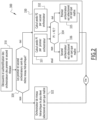
- the method 300 begins, following the establishment of the physical link 20 in a discovery step 310 between the first and second service orchestrators 150 and 250.
- This step consists of the exchange of a presence message between the first and second service orchestrators 150 and 250, through the link 20, followed by a mutual authentication procedure of the two orchestrators.
- an orchestration plan 25 is established between the first and second service orchestrators 150 and 250 for the exchange of orchestration messages in the predefined format.
- a SEND (“Secure Neighbor Discovery”) discovery protocol is implemented.
- Each orchestrator broadcasts a message including a public key.
- These keys then enable the implementation of the communication plan between the two service orchestrators.
- All of the cryptographic keys are preferably loaded into the memory of an orchestrator when preparing its mission.
- a first hierarchical level of the first service orchestrator is transmitted to the second service orchestrator. The latter compares its own hierarchical level (second hierarchical level) with the first hierarchical level received.
- the hierarchical level is a quantity attributed to a network/orchestrator and allowing to classify the networks/orchestrators in relation to each other, for example according to a hierarchical organization between a highest hierarchical level and a lowest hierarchical level, with possibly one or more intermediate hierarchical level(s).
- the service orchestrator with the highest hierarchical level is immediately chosen as the master orchestrator, the other orchestrator being chosen as the slave orchestrator (step 322).
- the first service orchestrator is assigned a high hierarchical level.
- the first orchestrator will systematically be chosen as master of the federated network, and will control the second service orchestrator. This makes it possible to guarantee the quality of the services made available to this privileged user.
- step 330 corresponding to a negotiation between the first and second service orchestrators with the aim of deciding which orchestrator will take over the overall orchestration of the federated network.
- a weight function common to any radiocommunication network is conventionally predefined.
- the weight function is a metric allowing to aggregate, in a single quantitative indicator, different information relating to the resources made available. available by a radiocommunication network at a current time, as well as their level of availability (or use) at said current time.
- a resource contributes to the weight function based on a priority level assigned to them.
- the priority levels of the resources may be static or redefined upon an update at any time during network usage. For example, for each user, a priority level is defined based on a user profile (a user with high importance should contribute more to the total weight). For example, a priority level is associated with each node in the network (a node providing connectivity to a wide area network - WAN should contribute more to the total weight).
- the first orchestrator calculates at regular intervals a first current value of the weight function (step 331).
- the second orchestrator calculates at regular intervals a second current value of the weight function (step 332).
- step 330 that is to say at the time of establishment of the link 20
- the first and second current values of the weight function are exchanged between the first and second service orchestrators and each orchestrator compares the first and second values with each other (step 334).
- the service orchestrator with the highest value takes the master role, while the service orchestrator with the lowest value takes the slave role (steps 335 and 336).
- the present invention provides a dynamic integration method for automatically defining the master orchestrator device when federating a plurality of field networks.
- the service orchestration device of the hierarchically highest network that takes control of the orchestration of the services of the federated network.
- the present method can be implemented to federate more than two networks together. For example, it is first implemented between a first orchestrator of a first network and a second orchestrator of a second network to determine an intermediate master orchestrator. It is then implemented between this intermediate master orchestrator and a third orchestrator of a third network.
- the master orchestrator for the plurality of networks is determined step by step.
- a metric is defined which allows them to be compared at the time of federation to give the prevalence to one rather than the other service orchestrator.
- a service orchestrator is adapted to preferably store a hierarchical level attribute.
- Each service orchestrator is also adapted to periodically calculate the value of the predefined weight function, this calculation being carried out from the information that the orchestrator has of the current state of the network that it manages.
- weight function is defined as a metric making it possible to aggregate, at the current time, different information relating to the resources of a network, as well as to the level of availability of each of these resources.
- the master orchestrator if it decides on a deployment specific on the network controlled by the slave orchestrator transmits commands to the latter, which the slave orchestrator interprets to actually carry out the required deployment.
- the slave orchestrator transmits to the master orchestrator the information necessary for the master orchestrator to determine the current state of the network controlled by the slave orchestrator.
Landscapes
- Engineering & Computer Science (AREA)
- Computer Networks & Wireless Communication (AREA)
- Signal Processing (AREA)
- Environmental & Geological Engineering (AREA)
- Data Exchanges In Wide-Area Networks (AREA)
- Management, Administration, Business Operations System, And Electronic Commerce (AREA)
- Computer And Data Communications (AREA)
Claims (7)
- Verfahren (300), das im Verlauf einer Prozedur zum Zusammenführen eines ersten Funkkommunikationsnetzes (100) mit einem zweiten Funkkommunikationsnetz (200) implementiert wird, das erste Funkkommunikationsnetz (100) umfassend einen ersten Dienstorchestrator (150) und das zweite Funkkommunikationsnetz (200) umfassend einen zweiten Dienstorchestrator (250), das Verfahren umfassend die folgenden Schritte:- Aggregieren, mittels einer Gewichtungsfunktion, verschiedener Informationen in Bezug auf Ressourcen, die von dem ersten Funkkommunikationsnetz bzw. von dem zweiten Funkkommunikationsnetz zu einem aktuellen Zeitpunkt bereitgestellt werden, sowie in Bezug auf ihren Verfügbarkeitsgrad zu dem aktuellen Zeitpunkt;- periodisches Berechnen (331) eines ersten Werts der Gewichtungsfunktion für das erste Funkkommunikationsnetz durch den ersten Dienstorchestrator;- periodisches Berechnen (332) eines zweiten Werts der Gewichtungsfunktion für das zweite Funkkommunikationsnetz durch den zweiten Dienstorchestrator; und beim Aufbauen einer Kommunikationsverbindung (20) zwischen dem ersten und dem zweiten Kommunikationsnetz;- Vergleichen (334) des ersten und des zweiten Werts der Gewichtsfunktion miteinander; und,- wenn der erste Wert größer ist als der zweite Wert, Auswählen des ersten Dienstorchestrators als Master-Dienstorchestrator eines zusammengeführten Netzes, das aus dem Zusammenführen des ersten und des zweiten Funkkommunikationsnetzes (100, 200) resultiert, wobei der zweite Dienstorchestrator unter Aufsicht des ersten Dienstorchestrators als Slave-Dienstorchestrator platziert wird, und, wenn der zweite Wert größer ist als der erste Wert, Auswählen des zweiten Dienstorchestrators als Master-Dienstorchestrator des zusammengeführten Netzes, wobei der erste Dienstorchestrator unter einr Aufsicht des zweiten Dienstorchestrators als Slave-Dienstorchestrator platziert wird,wobei das Verfahren dadurch gekennzeichnet ist, dass der erste Dienstorchestrator bzw. der zweite Dienstorchestrator eine erste hierarchische Ebene bzw. eine zweite hierarchische Ebene speichert, die mit dem ersten Funkkommunikationsnetz bzw. dem zweiten Funkkommunikationsnetz assoziiert ist, und dass das Verfahren ferner einen Schritt (320) umfasst, der darin besteht, die erste und die zweite hierarchische Ebene miteinander zu vergleichen,wenn sie identisch sind, weiter mit den Schritten, die darin bestehen, die Werte der Gewichtungsfunktion zu vergleichen, und wenn sie verschieden sind, Auswählen des Dienstorchestrators mit der höchsten Hierarchieebene als Master-Dienstorchestrator und den anderen Dienstorchestrator als Slave-Dienstorchestrator.
- Verfahren nach Anspruch 1, wobei jeder Dienstorchestrator (150, 250) ein Attribut speichert, das vor dem Zusammenführungsverfahren des ersten und des zweiten Funkkommunikationsnetzes den Wert "nicht definiert", und nach dem Zusammenführungsverfahren des ersten und des zweiten Funkkommunikationsnetzes den Wert "Master" oder "Slave" annimmt.
- Verfahren nach Anspruch 1, wobei der Master-Dienstorchestrator eine Kennung des oder jedes Slave-Dienstorchestrators speichert.
- Verfahren nach einem der Ansprüche 1 bis 3, wobei der Dienstorchestrator eines Funkkommunikationsnetzes eine Netzsteuerung, eine Sicherheitssteuerung und eine Rechenzentrumssteuerung steuert.
- Verfahren nach einem der Ansprüche 1 bis 4, umfassend einen ersten Entdeckungsschritt (310), der aus dem Austausch von Nachrichten zwischen dem ersten und dem zweiten Dienstorchestrator (150, 250) besteht, um einen Orchestrierungsplan (25) über die Verbindung (20) zwischen dem ersten und dem zweiten Dienstorchestrator zu erstellen.
- Verfahren nach Anspruch 5, wobei der Entdeckungsschritt die Implementierung eines Verfahrens zur gegenseitigen Authentifizierung zwischen dem ersten und dem zweiten Dienstorchestrator umfasst.
- Computerprogrammprodukt, umfassend Softwareanweisungen, die, wenn sie von einem Computer ausgeführt werden, eine Implementierung eines Verfahrens nach einem der vorherigen Ansprüche ermöglichen.
Applications Claiming Priority (1)
| Application Number | Priority Date | Filing Date | Title |
|---|---|---|---|
| FR2109229A FR3126828B1 (fr) | 2021-09-03 | 2021-09-03 | Procédé d'intégration dynamique mis en oeuvre au cours de la fédération de réseaux de radiocommunication et produit programme d'ordinateur |
Publications (2)
| Publication Number | Publication Date |
|---|---|
| EP4145794A1 EP4145794A1 (de) | 2023-03-08 |
| EP4145794B1 true EP4145794B1 (de) | 2024-11-20 |
Family
ID=79601602
Family Applications (1)
| Application Number | Title | Priority Date | Filing Date |
|---|---|---|---|
| EP22193706.3A Active EP4145794B1 (de) | 2021-09-03 | 2022-09-02 | Verfahren zur dynamischen integration während der bildung eines verbunds von funkkommunikationsnetzen und computerprogrammprodukt |
Country Status (3)
| Country | Link |
|---|---|
| EP (1) | EP4145794B1 (de) |
| ES (1) | ES3012118T3 (de) |
| FR (1) | FR3126828B1 (de) |
Families Citing this family (1)
| Publication number | Priority date | Publication date | Assignee | Title |
|---|---|---|---|---|
| CN116489227A (zh) * | 2023-05-05 | 2023-07-25 | 中国电信股份有限公司 | 网络运营管理系统、方法、装置、电子设备及存储介质 |
Family Cites Families (2)
| Publication number | Priority date | Publication date | Assignee | Title |
|---|---|---|---|---|
| FR3076025B1 (fr) * | 2017-12-27 | 2020-01-17 | Bull Sas | Reseau informatique d'infrastructures de ressources de calcul et procede d'affectation de ces ressources a des applications client |
| US20210014113A1 (en) * | 2020-09-25 | 2021-01-14 | Intel Corporation | Orchestration of meshes |
-
2021
- 2021-09-03 FR FR2109229A patent/FR3126828B1/fr active Active
-
2022
- 2022-09-02 EP EP22193706.3A patent/EP4145794B1/de active Active
- 2022-09-02 ES ES22193706T patent/ES3012118T3/es active Active
Also Published As
| Publication number | Publication date |
|---|---|
| EP4145794A1 (de) | 2023-03-08 |
| FR3126828B1 (fr) | 2024-11-01 |
| ES3012118T3 (en) | 2025-04-08 |
| FR3126828A1 (fr) | 2023-03-10 |
Similar Documents
| Publication | Publication Date | Title |
|---|---|---|
| Alam et al. | CICS Cloud--Internet Communication Security Framework for the Internet of Smart Devices | |
| US11770296B2 (en) | Decentralized data storage and processing for IoT devices | |
| Sabella et al. | Developing software for multi-access edge computing | |
| US11659390B2 (en) | Integrating CBRS-enabled devices and intent-based networking | |
| Velasquez et al. | Fog orchestration for the Internet of Everything: state-of-the-art and research challenges | |
| Bittencourt et al. | Towards virtual machine migration in fog computing | |
| US11818584B2 (en) | Two-phase discovery and onboarding of internet of things (IoT) devices | |
| BE1021235B1 (fr) | Procede et appareil pour la coordination de fonctions d'auto-optimisation dans un reseau sans fil | |
| CN113795826A (zh) | 用于分布式计算的自动化资源管理 | |
| Fersi | Fog computing and Internet of Things in one building block: A survey and an overview of interacting technologies | |
| JP7598384B2 (ja) | 異種動的環境における複数のタスクの実行を可能にするシステム及び方法 | |
| Lloret et al. | Architecture and protocol for intercloud communication | |
| Lee et al. | Trends in blockchain and federated learning for data sharing in distributed platforms | |
| FR3030168A1 (fr) | Procede de choix d'au moins un service et dispositif associe | |
| Nayyer et al. | A survey of cloudlet-based mobile augmentation approaches for resource optimization | |
| Jin et al. | A distributed fog computing architecture supporting multiple migrating mode | |
| EP4145794B1 (de) | Verfahren zur dynamischen integration während der bildung eines verbunds von funkkommunikationsnetzen und computerprogrammprodukt | |
| Mughal et al. | Resource management in multi-heterogeneous cluster networks using intelligent intra-clustered federated learning | |
| EP4193569A1 (de) | Verfahren zur verarbeitung eines datentransportdienstes | |
| Liyanage et al. | Five driving forces of multi-access edge computing | |
| FR2988257A1 (fr) | Procede et appareil pour coordination de fonctions d'auto-optimisation dans un reseau sans fil | |
| Sahinel et al. | An agent-based network resource management concept for smart city services | |
| EP4207711B1 (de) | System zur verbreitung von inhalten in einer netzwerkföderation, verbreitungsverfahren und computerprogrammprodukt dafür | |
| Gupta et al. | Multi-layered cloud and fog based secure integrated transmission and storage framework for IoT based applications | |
| Muralidhar et al. | Enhancing the storage of mobile nodes through ad hoc storage as a service in MANETs |
Legal Events
| Date | Code | Title | Description |
|---|---|---|---|
| PUAI | Public reference made under article 153(3) epc to a published international application that has entered the european phase |
Free format text: ORIGINAL CODE: 0009012 |
|
| STAA | Information on the status of an ep patent application or granted ep patent |
Free format text: STATUS: THE APPLICATION HAS BEEN PUBLISHED |
|
| AK | Designated contracting states |
Kind code of ref document: A1 Designated state(s): AL AT BE BG CH CY CZ DE DK EE ES FI FR GB GR HR HU IE IS IT LI LT LU LV MC MK MT NL NO PL PT RO RS SE SI SK SM TR |
|
| P01 | Opt-out of the competence of the unified patent court (upc) registered |
Effective date: 20230522 |
|
| STAA | Information on the status of an ep patent application or granted ep patent |
Free format text: STATUS: REQUEST FOR EXAMINATION WAS MADE |
|
| 17P | Request for examination filed |
Effective date: 20230830 |
|
| RBV | Designated contracting states (corrected) |
Designated state(s): AL AT BE BG CH CY CZ DE DK EE ES FI FR GB GR HR HU IE IS IT LI LT LU LV MC MK MT NL NO PL PT RO RS SE SI SK SM TR |
|
| GRAP | Despatch of communication of intention to grant a patent |
Free format text: ORIGINAL CODE: EPIDOSNIGR1 |
|
| STAA | Information on the status of an ep patent application or granted ep patent |
Free format text: STATUS: GRANT OF PATENT IS INTENDED |
|
| RIC1 | Information provided on ipc code assigned before grant |
Ipc: H04L 41/044 20220101ALI20240620BHEP Ipc: H04L 43/0805 20220101ALI20240620BHEP Ipc: H04L 41/0896 20220101AFI20240620BHEP |
|
| INTG | Intention to grant announced |
Effective date: 20240705 |
|
| RIN1 | Information on inventor provided before grant (corrected) |
Inventor name: ANSLOT, MICHEL Inventor name: SALIBA, ERIC Inventor name: CONAN, VANIA Inventor name: BOUET, MATHIEU Inventor name: REBECCHI, FILIPPO Inventor name: SCHOLLER, FRANCK |
|
| GRAS | Grant fee paid |
Free format text: ORIGINAL CODE: EPIDOSNIGR3 |
|
| GRAA | (expected) grant |
Free format text: ORIGINAL CODE: 0009210 |
|
| STAA | Information on the status of an ep patent application or granted ep patent |
Free format text: STATUS: THE PATENT HAS BEEN GRANTED |
|
| AK | Designated contracting states |
Kind code of ref document: B1 Designated state(s): AL AT BE BG CH CY CZ DE DK EE ES FI FR GB GR HR HU IE IS IT LI LT LU LV MC MK MT NL NO PL PT RO RS SE SI SK SM TR |
|
| REG | Reference to a national code |
Ref country code: GB Ref legal event code: FG4D Free format text: NOT ENGLISH |
|
| REG | Reference to a national code |
Ref country code: CH Ref legal event code: EP |
|
| REG | Reference to a national code |
Ref country code: DE Ref legal event code: R096 Ref document number: 602022007870 Country of ref document: DE |
|
| REG | Reference to a national code |
Ref country code: IE Ref legal event code: FG4D Free format text: LANGUAGE OF EP DOCUMENT: FRENCH |
|
| REG | Reference to a national code |
Ref country code: LT Ref legal event code: MG9D |
|
| REG | Reference to a national code |
Ref country code: NL Ref legal event code: MP Effective date: 20241120 |
|
| REG | Reference to a national code |
Ref country code: ES Ref legal event code: FG2A Ref document number: 3012118 Country of ref document: ES Kind code of ref document: T3 Effective date: 20250408 |
|
| PG25 | Lapsed in a contracting state [announced via postgrant information from national office to epo] |
Ref country code: HR Free format text: LAPSE BECAUSE OF FAILURE TO SUBMIT A TRANSLATION OF THE DESCRIPTION OR TO PAY THE FEE WITHIN THE PRESCRIBED TIME-LIMIT Effective date: 20241120 Ref country code: IS Free format text: LAPSE BECAUSE OF FAILURE TO SUBMIT A TRANSLATION OF THE DESCRIPTION OR TO PAY THE FEE WITHIN THE PRESCRIBED TIME-LIMIT Effective date: 20250320 Ref country code: PT Free format text: LAPSE BECAUSE OF FAILURE TO SUBMIT A TRANSLATION OF THE DESCRIPTION OR TO PAY THE FEE WITHIN THE PRESCRIBED TIME-LIMIT Effective date: 20250320 |
|
| PG25 | Lapsed in a contracting state [announced via postgrant information from national office to epo] |
Ref country code: FI Free format text: LAPSE BECAUSE OF FAILURE TO SUBMIT A TRANSLATION OF THE DESCRIPTION OR TO PAY THE FEE WITHIN THE PRESCRIBED TIME-LIMIT Effective date: 20241120 Ref country code: NL Free format text: LAPSE BECAUSE OF FAILURE TO SUBMIT A TRANSLATION OF THE DESCRIPTION OR TO PAY THE FEE WITHIN THE PRESCRIBED TIME-LIMIT Effective date: 20241120 |
|
| REG | Reference to a national code |
Ref country code: AT Ref legal event code: MK05 Ref document number: 1744574 Country of ref document: AT Kind code of ref document: T Effective date: 20241120 |
|
| PG25 | Lapsed in a contracting state [announced via postgrant information from national office to epo] |
Ref country code: BG Free format text: LAPSE BECAUSE OF FAILURE TO SUBMIT A TRANSLATION OF THE DESCRIPTION OR TO PAY THE FEE WITHIN THE PRESCRIBED TIME-LIMIT Effective date: 20241120 |
|
| PG25 | Lapsed in a contracting state [announced via postgrant information from national office to epo] |
Ref country code: NO Free format text: LAPSE BECAUSE OF FAILURE TO SUBMIT A TRANSLATION OF THE DESCRIPTION OR TO PAY THE FEE WITHIN THE PRESCRIBED TIME-LIMIT Effective date: 20250220 |
|
| PG25 | Lapsed in a contracting state [announced via postgrant information from national office to epo] |
Ref country code: AT Free format text: LAPSE BECAUSE OF FAILURE TO SUBMIT A TRANSLATION OF THE DESCRIPTION OR TO PAY THE FEE WITHIN THE PRESCRIBED TIME-LIMIT Effective date: 20241120 Ref country code: LV Free format text: LAPSE BECAUSE OF FAILURE TO SUBMIT A TRANSLATION OF THE DESCRIPTION OR TO PAY THE FEE WITHIN THE PRESCRIBED TIME-LIMIT Effective date: 20241120 Ref country code: GR Free format text: LAPSE BECAUSE OF FAILURE TO SUBMIT A TRANSLATION OF THE DESCRIPTION OR TO PAY THE FEE WITHIN THE PRESCRIBED TIME-LIMIT Effective date: 20250221 |
|
| PG25 | Lapsed in a contracting state [announced via postgrant information from national office to epo] |
Ref country code: PL Free format text: LAPSE BECAUSE OF FAILURE TO SUBMIT A TRANSLATION OF THE DESCRIPTION OR TO PAY THE FEE WITHIN THE PRESCRIBED TIME-LIMIT Effective date: 20241120 |
|
| PG25 | Lapsed in a contracting state [announced via postgrant information from national office to epo] |
Ref country code: RS Free format text: LAPSE BECAUSE OF FAILURE TO SUBMIT A TRANSLATION OF THE DESCRIPTION OR TO PAY THE FEE WITHIN THE PRESCRIBED TIME-LIMIT Effective date: 20250220 |
|
| PG25 | Lapsed in a contracting state [announced via postgrant information from national office to epo] |
Ref country code: SM Free format text: LAPSE BECAUSE OF FAILURE TO SUBMIT A TRANSLATION OF THE DESCRIPTION OR TO PAY THE FEE WITHIN THE PRESCRIBED TIME-LIMIT Effective date: 20241120 |
|
| PG25 | Lapsed in a contracting state [announced via postgrant information from national office to epo] |
Ref country code: DK Free format text: LAPSE BECAUSE OF FAILURE TO SUBMIT A TRANSLATION OF THE DESCRIPTION OR TO PAY THE FEE WITHIN THE PRESCRIBED TIME-LIMIT Effective date: 20241120 |
|
| PG25 | Lapsed in a contracting state [announced via postgrant information from national office to epo] |
Ref country code: EE Free format text: LAPSE BECAUSE OF FAILURE TO SUBMIT A TRANSLATION OF THE DESCRIPTION OR TO PAY THE FEE WITHIN THE PRESCRIBED TIME-LIMIT Effective date: 20241120 |
|
| PG25 | Lapsed in a contracting state [announced via postgrant information from national office to epo] |
Ref country code: RO Free format text: LAPSE BECAUSE OF FAILURE TO SUBMIT A TRANSLATION OF THE DESCRIPTION OR TO PAY THE FEE WITHIN THE PRESCRIBED TIME-LIMIT Effective date: 20241120 |
|
| PG25 | Lapsed in a contracting state [announced via postgrant information from national office to epo] |
Ref country code: SK Free format text: LAPSE BECAUSE OF FAILURE TO SUBMIT A TRANSLATION OF THE DESCRIPTION OR TO PAY THE FEE WITHIN THE PRESCRIBED TIME-LIMIT Effective date: 20241120 |
|
| PG25 | Lapsed in a contracting state [announced via postgrant information from national office to epo] |
Ref country code: CZ Free format text: LAPSE BECAUSE OF FAILURE TO SUBMIT A TRANSLATION OF THE DESCRIPTION OR TO PAY THE FEE WITHIN THE PRESCRIBED TIME-LIMIT Effective date: 20241120 |
|
| REG | Reference to a national code |
Ref country code: DE Ref legal event code: R097 Ref document number: 602022007870 Country of ref document: DE |
|
| PG25 | Lapsed in a contracting state [announced via postgrant information from national office to epo] |
Ref country code: SE Free format text: LAPSE BECAUSE OF FAILURE TO SUBMIT A TRANSLATION OF THE DESCRIPTION OR TO PAY THE FEE WITHIN THE PRESCRIBED TIME-LIMIT Effective date: 20241120 |
|
| PLBE | No opposition filed within time limit |
Free format text: ORIGINAL CODE: 0009261 |
|
| STAA | Information on the status of an ep patent application or granted ep patent |
Free format text: STATUS: NO OPPOSITION FILED WITHIN TIME LIMIT |
|
| PGFP | Annual fee paid to national office [announced via postgrant information from national office to epo] |
Ref country code: DE Payment date: 20250820 Year of fee payment: 4 |
|
| PGFP | Annual fee paid to national office [announced via postgrant information from national office to epo] |
Ref country code: FR Payment date: 20250821 Year of fee payment: 4 |
|
| 26N | No opposition filed |
Effective date: 20250821 |
|
| PGFP | Annual fee paid to national office [announced via postgrant information from national office to epo] |
Ref country code: IT Payment date: 20250930 Year of fee payment: 4 |
|
| PGFP | Annual fee paid to national office [announced via postgrant information from national office to epo] |
Ref country code: ES Payment date: 20251001 Year of fee payment: 4 |
|
| REG | Reference to a national code |
Ref country code: CH Ref legal event code: H13 Free format text: ST27 STATUS EVENT CODE: U-0-0-H10-H13 (AS PROVIDED BY THE NATIONAL OFFICE) Effective date: 20260425 |