EP4145879B1 - Procédé et terminal de connexion de points d'accès wi-fi - Google Patents
Procédé et terminal de connexion de points d'accès wi-fi Download PDFInfo
- Publication number
- EP4145879B1 EP4145879B1 EP22176033.3A EP22176033A EP4145879B1 EP 4145879 B1 EP4145879 B1 EP 4145879B1 EP 22176033 A EP22176033 A EP 22176033A EP 4145879 B1 EP4145879 B1 EP 4145879B1
- Authority
- EP
- European Patent Office
- Prior art keywords
- hotspot
- terminal
- ssid
- encryption manner
- screen
- Prior art date
- Legal status (The legal status is an assumption and is not a legal conclusion. Google has not performed a legal analysis and makes no representation as to the accuracy of the status listed.)
- Active
Links
Images




Classifications
-
- H—ELECTRICITY
- H04—ELECTRIC COMMUNICATION TECHNIQUE
- H04W—WIRELESS COMMUNICATION NETWORKS
- H04W12/00—Security arrangements; Authentication; Protecting privacy or anonymity
- H04W12/08—Access security
- H04W12/084—Access security using delegated authorisation, e.g. open authorisation [OAuth] protocol
-
- H—ELECTRICITY
- H04—ELECTRIC COMMUNICATION TECHNIQUE
- H04W—WIRELESS COMMUNICATION NETWORKS
- H04W36/00—Hand-off or reselection arrangements
- H04W36/0005—Control or signalling for completing the hand-off
- H04W36/0055—Transmission or use of information for re-establishing the radio link
-
- H—ELECTRICITY
- H04—ELECTRIC COMMUNICATION TECHNIQUE
- H04L—TRANSMISSION OF DIGITAL INFORMATION, e.g. TELEGRAPHIC COMMUNICATION
- H04L63/00—Network architectures or network communication protocols for network security
- H04L63/08—Network architectures or network communication protocols for network security for authentication of entities
- H04L63/083—Network architectures or network communication protocols for network security for authentication of entities using passwords
-
- H—ELECTRICITY
- H04—ELECTRIC COMMUNICATION TECHNIQUE
- H04W—WIRELESS COMMUNICATION NETWORKS
- H04W12/00—Security arrangements; Authentication; Protecting privacy or anonymity
- H04W12/03—Protecting confidentiality, e.g. by encryption
-
- H—ELECTRICITY
- H04—ELECTRIC COMMUNICATION TECHNIQUE
- H04W—WIRELESS COMMUNICATION NETWORKS
- H04W12/00—Security arrangements; Authentication; Protecting privacy or anonymity
- H04W12/06—Authentication
-
- H—ELECTRICITY
- H04—ELECTRIC COMMUNICATION TECHNIQUE
- H04W—WIRELESS COMMUNICATION NETWORKS
- H04W12/00—Security arrangements; Authentication; Protecting privacy or anonymity
- H04W12/08—Access security
-
- H—ELECTRICITY
- H04—ELECTRIC COMMUNICATION TECHNIQUE
- H04W—WIRELESS COMMUNICATION NETWORKS
- H04W12/00—Security arrangements; Authentication; Protecting privacy or anonymity
- H04W12/50—Secure pairing of devices
-
- H—ELECTRICITY
- H04—ELECTRIC COMMUNICATION TECHNIQUE
- H04W—WIRELESS COMMUNICATION NETWORKS
- H04W36/00—Hand-off or reselection arrangements
- H04W36/34—Reselection control
- H04W36/36—Reselection control by user or terminal equipment
- H04W36/365—Reselection control by user or terminal equipment by manual user interaction
-
- H—ELECTRICITY
- H04—ELECTRIC COMMUNICATION TECHNIQUE
- H04W—WIRELESS COMMUNICATION NETWORKS
- H04W48/00—Access restriction; Network selection; Access point selection
- H04W48/08—Access restriction or access information delivery, e.g. discovery data delivery
-
- H—ELECTRICITY
- H04—ELECTRIC COMMUNICATION TECHNIQUE
- H04W—WIRELESS COMMUNICATION NETWORKS
- H04W48/00—Access restriction; Network selection; Access point selection
- H04W48/08—Access restriction or access information delivery, e.g. discovery data delivery
- H04W48/14—Access restriction or access information delivery, e.g. discovery data delivery using user query or user detection
-
- H—ELECTRICITY
- H04—ELECTRIC COMMUNICATION TECHNIQUE
- H04W—WIRELESS COMMUNICATION NETWORKS
- H04W48/00—Access restriction; Network selection; Access point selection
- H04W48/16—Discovering, processing access restriction or access information
-
- H—ELECTRICITY
- H04—ELECTRIC COMMUNICATION TECHNIQUE
- H04W—WIRELESS COMMUNICATION NETWORKS
- H04W48/00—Access restriction; Network selection; Access point selection
- H04W48/20—Selecting an access point
-
- H—ELECTRICITY
- H04—ELECTRIC COMMUNICATION TECHNIQUE
- H04W—WIRELESS COMMUNICATION NETWORKS
- H04W76/00—Connection management
-
- H—ELECTRICITY
- H04—ELECTRIC COMMUNICATION TECHNIQUE
- H04W—WIRELESS COMMUNICATION NETWORKS
- H04W88/00—Devices specially adapted for wireless communication networks, e.g. terminals, base stations or access point devices
- H04W88/08—Access point devices
-
- H—ELECTRICITY
- H04—ELECTRIC COMMUNICATION TECHNIQUE
- H04W—WIRELESS COMMUNICATION NETWORKS
- H04W12/00—Security arrangements; Authentication; Protecting privacy or anonymity
- H04W12/60—Context-dependent security
- H04W12/69—Identity-dependent
- H04W12/73—Access point logical identity
-
- H—ELECTRICITY
- H04—ELECTRIC COMMUNICATION TECHNIQUE
- H04W—WIRELESS COMMUNICATION NETWORKS
- H04W84/00—Network topologies
- H04W84/02—Hierarchically pre-organised networks, e.g. paging networks, cellular networks, WLAN [Wireless Local Area Network] or WLL [Wireless Local Loop]
- H04W84/10—Small scale networks; Flat hierarchical networks
- H04W84/12—WLAN [Wireless Local Area Networks]
Definitions
- This application relates to the field of communications technologies, and in particular, to a wireless fidelity (Wireless Fidelity, Wi-Fi) hotspot connection method and a terminal.
- wireless fidelity Wireless Fidelity, Wi-Fi
- CN 106 686 587 A refers to a wireless fidelity, Wi-Fi, connecting method and a mobile terminal.
- This application provides a Wi-Fi hotspot connection method and a terminal.
- a terminal can connect to a Wi-Fi hotspot regardless of whether the Wi-Fi hotspot is configured as a hidden hotspot, and efficiency of connecting to the Wi-Fi hotspot by the terminal can be improved. Therefore, user experience is improved.
- a Wi-Fi hotspot connection method includes: displaying, by a terminal, a first screen that includes an SSID input box and a security selection box for a Wi-Fi hotspot; receiving an SSID of a first Wi-Fi hotspot input by a user in the SSID input box; obtaining an encryption manner of the first Wi-Fi hotspot based on the SSID of the first Wi-Fi hotspot; displaying a second screen when the obtained encryption manner of the first Wi-Fi hotspot is different from an encryption manner selected from the security selection box, where the second screen comprises a password input box; receiving an access password of the first Wi-Fi hotspot input by the user in the password input box; in response to a user's connection operation on the second screen, connecting to the first Wi-Fi hotspot based on the SSID, the access password, and the obtained encryption manner of the first Wi-Fi hotspot.
- the terminal when the encryption manner of the first Wi-Fi hotspot is different from the default encryption manner, the terminal does not directly display information indicating a connection failure, but displays the second screen on which the access password can be input.
- the terminal After the terminal receives the access password input by the user, in response to the user's connection operation, the terminal proceeds to connect to the first Wi-Fi hotspot based on the encryption manner obtained by the terminal for the first Wi-Fi hotspot and the SSID and the access password of the first Wi-Fi hotspot.
- the user does not need to attempt to successively use encryption manners in the foregoing "security" list to connect to the Wi-Fi hotspot. This can reduce operations performed by the user when the terminal connects to the Wi-Fi hotspot, shorten a time for the terminal to connect to the Wi-Fi hotspot, and improve user experience.
- the obtaining, by the terminal, an encryption manner of the first Wi-Fi hotspot based on the SSID of the first Wi-Fi hotspot may include: in response to a user's connection operation on the first screen, obtaining, by the terminal, the encryption manner of the first Wi-Fi hotspot based on the SSID of the first Wi-Fi hotspot. It may be understood that, usually, if the user is unfamiliar with a hidden hotspot connection manner, after the user inputs the SSID on the first screen, the user may directly perform the connection operation on the first screen. A result of the connection operation is that the terminal fails to connect to the first Wi-Fi hotspot.
- the terminal may obtain the encryption manner of the first Wi-Fi hotspot. Then, the terminal displays the second screen that includes the password input box. In this way, the terminal may connect to the first Wi-Fi hotspot based on the access password input by the user in the password input box, the SSID of the first Wi-Fi hotspot, and the obtained encryption manner.
- the terminal may display the "security" list including a plurality of encryption manner options, so that the user selects an encryption manner.
- the user may not know the encryption manner of the first Wi-Fi hotspot, and cannot select the correct encryption manner from the "security" list.
- the method in this application may include: in response to a user's selection operation on the security selection box on the first screen, displaying, by the terminal, a third screen that includes an encryption manner option and a security obtaining option.
- the obtaining, by the terminal, an encryption manner of the first Wi-Fi hotspot based on the SSID of the first Wi-Fi hotspot may include: in response to a user's selection from the security obtaining option, obtaining the encryption manner of the first Wi-Fi hotspot based on the SSID of the first Wi-Fi hotspot.
- the terminal may also obtain the encryption manner of the first Wi-Fi hotspot based on the SSID of the first Wi-Fi hotspot.
- the obtaining, by the terminal, an encryption manner of the first Wi-Fi hotspot based on the SSID of the first Wi-Fi hotspot may include: after responding to the user's input of the SSID of the first Wi-Fi hotspot on the first screen, automatically obtaining, by the terminal, the encryption manner of the first Wi-Fi hotspot based on the SSID of the first Wi-Fi hotspot.
- the terminal may also obtain the encryption manner of the first Wi-Fi hotspot.
- the terminal may further automatically obtain the encryption manner of the first Wi-Fi hotspot in a manner in which the encryption manner of the Wi-Fi hotspot is imperceptible to the user.
- the terminal because when the terminal displays the second screen, the terminal has obtained the encryption manner of the first Wi-Fi hotspot. In this way, the second screen may display the security selection box including the encryption manner of the first Wi-Fi hotspot.
- the terminal may further display the obtained encryption manner on the second screen, so that the user can know which encryption manner is used by the first Wi-Fi hotspot for encryption, that is, which encryption manner is a correct encryption manner used by the first Wi-Fi hotspot. In this way, the user can select the correct encryption manner when controlling another terminal to connect to the first Wi-Fi hotspot.
- the second display may not display the security selection box including the encryption manner of the first Wi-Fi hotspot.
- That the terminal does not display the security selection box including the encryption manner does not indicate that the terminal does not obtain the encryption manner of the first Wi-Fi hotspot. It indicates that the terminal does not display the encryption manner to the user on the display screen of the terminal.
- the terminal still connects to the first Wi-Fi hotspot based on the SSID of the first Wi-Fi hotspot, the encryption manner obtained by the terminal, and an access password of the first Wi-Fi hotspot.
- the terminal may connect to the Wi-Fi hotspot in a manner in which the encryption manner of the Wi-Fi hotspot is imperceptible to the user.
- the obtaining, by the terminal, an encryption manner of the first Wi-Fi hotspot based on the SSID of the first Wi-Fi hotspot may include: broadcasting, by the terminal, a probe request frame carrying the SSID of the first Wi-Fi hotspot; receiving a probe response frame sent by the first Wi-Fi hotspot, where the probe response frame carries the encryption manner of the first Wi-Fi hotspot; and parsing the received probe response frame to obtain the encryption manner of the first Wi-Fi hotspot.
- the obtaining, by the terminal, an encryption manner of the first Wi-Fi hotspot based on the SSID of the first Wi-Fi hotspot may include: sending, by the terminal, an encryption manner obtaining request to a cloud server, where the encryption manner obtaining request carries the SSID of the first Wi-Fi hotspot, and the cloud server stores encryption manners of a plurality of Wi-Fi hotspots; and receiving, by the terminal, an encryption manner obtaining response sent by the cloud server, where the encryption manner obtaining response carries the SSID of the first Wi-Fi hotspot.
- the encryption manner selected from the security selection box is an encryption manner input by default (namely unencrypted) or an encryption manner selected by the user. Specifically, before the user inputs the connection operation on the first screen or the second screen, the user does not select an encryption manner from the security selection box.
- the terminal may consider by default that the encryption manner selected from the security selection box is unencrypted, namely, the encryption manner is N/A. Before the user inputs the connection operation on the first screen or the second screen, the user selects any encryption manner from the security selection box.
- the encryption manner selected from the security selection box is the encryption manner selected by the user.
- this application provides a terminal, and the terminal includes: a display unit, an input unit, an obtaining unit, and a connection unit.
- the display unit is configured to display a first screen, where the first screen includes an SSID input box and a security selection box for a Wi-Fi hotspot.
- the input unit is configured to receive an SSID of a first Wi-Fi hotspot input by a user in the SSID input box displayed on the display unit.
- the obtaining unit is configured to obtain an encryption manner of the first Wi-Fi hotspot based on the SSID of the first Wi-Fi hotspot input from the input unit.
- the display unit is further configured to: display a second screen if the encryption manner of the first Wi-Fi hotspot obtained by the obtaining unit is different from an encryption manner selected from the security selection box, where the second screen includes a password input box.
- the input unit is further configured to receive an access password of the first Wi-Fi hotspot input by the user in the password input box displayed on the display unit.
- the connection unit is configured to: in response to a user's connection operation on the second screen displayed on the display unit, connect to the first Wi-Fi hotspot based on the SSID of the first Wi-Fi hotspot input from the input unit, the access password of the first Wi-Fi hotspot input from the input unit, and the encryption manner obtained by the obtaining unit for the first Wi-Fi hotspot input from the input unit.
- the obtaining unit is specifically configured to: in response to a user's connection operation on the first screen displayed on the display unit, obtain the encryption manner of the first Wi-Fi hotspot based on the SSID of the first Wi-Fi hotspot.
- the obtaining unit is specifically configured to: after responding to the user's input of the SSID of the first Wi-Fi hotspot on the first screen displayed on the display unit, automatically obtain the encryption manner of the first Wi-Fi hotspot based on the SSID of the first Wi-Fi hotspot.
- the obtaining unit is specifically configured to: broadcast a probe request frame, where the probe request frame carries the SSID of the first Wi-Fi hotspot; receive a probe response frame sent by the first Wi-Fi hotspot, where the probe response frame carries the encryption manner of the first Wi-Fi hotspot; and parse the probe response frame to obtain the encryption manner of the first Wi-Fi hotspot.
- the obtaining unit is specifically configured to: send an encryption manner obtaining request to a cloud server, where the encryption manner obtaining request carries the SSID of the first Wi-Fi hotspot, and the cloud server stores encryption manners of a plurality of Wi-Fi hotspots; and receive an encryption manner obtaining response sent by the cloud server, where the encryption manner obtaining response carries the SSID of the first Wi-Fi hotspot.
- the encryption manner selected from the security selection box is an encryption manner input by default or an encryption manner selected by the user.
- the encryption manner selected from the security selection box is an encryption manner input by default or an encryption manner selected by the user.
- this application provides a computer storage medium, where the computer storage medium includes a computer instruction, and when the computer instruction is run on a terminal, the terminal is enabled to perform the Wi-Fi hotspot connection method according to the first aspect and any possible design method of the first aspect.
- first and second mentioned below are merely intended for description, and shall not be understood as an indication or implication of relative importance or implicit indication of a quantity of indicated technical features. Therefore, a feature limited by using “first” or “second” may explicitly or implicitly include one or more features. In the descriptions of this application, unless otherwise specified, "a plurality of" means two or more than two.
- This application provides a Wi-Fi hotspot connection method and a terminal.
- the method may be applied to a process in which a terminal connects to a Wi-Fi hotspot, and may be particularly applied to a process in which the terminal connects to a Wi-Fi hotspot configured as a hidden hotspot.
- the terminal may also connect to a non-hidden hotspot by using the Wi-Fi hotspot connection method provided in this application.
- that a Wi-Fi hotspot is configured as a hidden hotspot specifically means that a function of broadcasting an SSID by the Wi-Fi hotspot by using a wireless signal is disabled, in other words, the hidden hotspot does not broadcast the wireless signal carrying the SSID of the Wi-Fi hotspot.
- the wireless signal may be a Wi-Fi beacon (Beacon) frame.
- the terminal in this application may be an electronic device having a Wi-Fi connection function.
- the terminal may be a mobile phone (for example, a mobile phone 100 shown in FIG. 1(a) and FIG. 1(b) , a tablet computer, a personal computer (Personal Computer, PC), a personal digital assistant (personal digital assistant, PDA), a smartwatch, a netbook, or a wearable electronic device.
- a mobile phone for example, a mobile phone 100 shown in FIG. 1(a) and FIG. 1(b)
- a tablet computer for example, a mobile phone 100 shown in FIG. 1(a) and FIG. 1(b)
- PC Personal Computer
- PDA personal digital assistant
- smartwatch a netbook
- netbook a wearable electronic device.
- a specific form of the device is not particularly limited in this application.
- An SSID of the Wi-Fi hotspot-1 is Zhangsan
- an SSID of the Wi-Fi hotspot-2 is ABC123
- an SSID of the Wi-Fi hotspot-3 is Xyzd
- an SSID of the Wi-Fi hotspot-4 is G1B-1B-19-7R-2.4G.
- the router 110, the notebook computer 120, the mobile phone 130, and the router 140 are located nearby the mobile phone 100, and may each broadcast a Wi-Fi beacon frame, so that a nearby terminal (for example, the mobile phone 100) can detect the Wi-Fi beacon frame of the Wi-Fi hotspot and connect to the Wi-Fi hotspot.
- the Wi-Fi beacon frame broadcast by the Wi-Fi hotspot carries the SSID of the Wi-Fi hotspot.
- the Wi-Fi beacon frame broadcast by the router 140 carries G1B-1B-19-7R-2.4G.
- the terminal may display, on a "Wi-Fi setting" screen of the terminal, the SSID of the Wi-Fi hotspot found by the terminal.
- the terminal cannot find the Wi-Fi hotspot and display an SSID of the Wi-Fi hotspot.
- the notebook computer 120 (namely, the Wi-Fi hotspot-2) shown in FIG. 1(a) and FIG. 1(b) is configured as a hidden hotspot.
- a user uses the notebook computer 120 to log in to a configuration screen 201 of a wireless router shown in FIG. 2 , and configures the notebook computer 120 as the hidden hotspot.
- a screen 203 corresponding to a wireless setting option 202 on the configuration screen 201 shown in FIG. 2 includes a "broadcast an SSID signal of a wireless router" option 204.
- the notebook computer 120 is configured as the hidden hotspot.
- the notebook computer 120 When the notebook computer 120 is configured as the hidden hotspot, the notebook computer 120 does not broadcast the Wi-Fi beacon frame carrying the SSID (ABC123) of the Wi-Fi hotspot-2. In this case, the terminal (for example, the mobile phone) cannot detect the SSID of the notebook computer 120. In other words, the terminal does not display the SSID of the notebook computer 120 on the "Wi-Fi setting" screen. For example, as shown in FIG.
- a "Wi-Fi setting" screen 101 of the mobile phone 100 includes only the SSID (Zhangsan) of the router 110, the SSID (Xyzd) of the mobile phone 130, and the SSID (G1B-1B-19-7R-2.4G) of the router 140, but does not include the SSID (ABC123) of the notebook computer 120.
- the user may tap an "add network” option 102 on the "Wi-Fi setting" screen 101 shown in FIG. 1(a) . Then, the mobile phone 100 may display a hotspot addition screen 103 shown in FIG. 1(b) . As shown in FIG. 1(b) , the hotspot addition screen 103 may include an SSID input box 104, a security selection box 105, a "cancel” button 106, and a "connect” button 107.
- the SSID input box 104 is used to input an SSID (such as ABC123) of a Wi-Fi hotspot.
- the security selection box 105 is used to select an encryption manner of the Wi-Fi hotspot.
- the "cancel” button 106 is used to cancel a connection to the Wi-Fi hotspot.
- the "connect” button 107 is used to instruct the terminal to connect to the Wi-Fi hotspot.
- the terminal broadcasts a probe request (Probe Request) frame carrying an SSID.
- this application merely uses an example to provide information, related to this application, in information carried in the probe request frame, such as the SSID (ABC123) and the length length of the SSID.
- the probe request frame in this application includes but is not limited to the foregoing information. Other information carried in the probe request frame is not described in detail in this application.
- the terminal requests the Wi-Fi hotspot to authenticate (Authentication) the terminal.
- a response made by the Wi-Fi hotspot to the authentication request may indicate whether the authentication on the terminal succeeds.
- the terminal After the authentication succeeds, the terminal sends an association (Association) request to the Wi-Fi hotspot.
- association Association
- the Wi-Fi hotspot responds to the (Association) request from the terminal.
- step S307 the terminal succeeds in connecting to the Wi-Fi hotspot.
- the authentication in this application includes authentication performed by the Wi-Fi hotspot on an access password sent by the terminal.
- the terminal may consider by default that the Wi-Fi hotspot is unencrypted, in other words, the default encryption manner is N/A.
- the encryption manner carried in the probe response frame sent by the Wi-Fi hotspot is N/A.
- the encryption manner carried in the probe response frame is the same as the encryption manner selected from the security selection box.
- the terminal may perform steps S305 to S307, and succeeds in connecting to the Wi-Fi hotspot.
- the user after the user inputs the SSID of the Wi-Fi hotspot in the SSID input box 104, the user further needs to input a correct encryption manner and access password of the Wi-Fi hotspot in the security selection box 105, and then can succeed in connecting to the Wi-Fi hotspot.
- the users may directly tap the "connect" button 107, to connect to the hidden hotspot.
- a result is definitely a connection failure.
- the encryption manner for example, the WPA/WPA2 PSK manner
- the terminal fails to connect to the Wi-Fi hotspot.
- the user may be familiar with the hidden hotspot connection manner.
- the user to connecting to the hidden hotspot successfully, the user not only needs to know the SSID and the access password of the hidden hotspot, but also needs to know the encryption manner of the hidden hotspot.
- a user may usually remember the SSID and the access password of the Wi-Fi hotspot, but is unaware of the encryption manner of the Wi-Fi hotspot.
- the terminal may display a "security" list 401 shown in FIG. 4(b) .
- the "security" list 401 includes a possible encryption manner of the Wi-Fi hotspot, for example, a WEP manner, a WPA/WPA2 PSK manner, a WAPI PSK manner, or a WAPI certificate manner.
- the mobile phone 100 may send a probe request frame to the Wi-Fi hotspot.
- the mobile phone 100 may compare the encryption manner carried in the probe response frame with the encryption manner "WPA/WPA2 PSK" manner selected by the user. If the encryption manner carried in the probe response frame is the same as the WPA/WPA2 PSK manner, the mobile phone 100 performs steps S305 to S307, and succeeds in connecting to the Wi-Fi hotspot. If the encryption manner carried in the probe response frame is the same as the WPA/WPA2 PSK manner, the mobile phone 100 fails to connect to the Wi-Fi hotspot.
- the user needs to attempt to successively use the encryption manners in the "security" list 401 shown in FIG. 4(b) , to connect to the Wi-Fi hotspot.
- the user attempts to successively use the encryption manner in the "security” list (for example, the "security” list 401) to connect to the Wi-Fi hotspot, user operations are complex, and user's experience is affected.
- the Wi-Fi hotspot connection method provided in this application may be applied to not only a process in which the terminal connects to a Wi-Fi hotspot in a hidden state, but also a process in which the terminal connects to a common Wi-Fi hotspot (that is, a Wi-Fi hotspot that is not configured as a hidden hotspot).
- a common Wi-Fi hotspot that is, a Wi-Fi hotspot that is not configured as a hidden hotspot.
- some users may want to control the mobile phone 100 to connect, by using a hotspot addition screen 103 shown in FIG. 4(a) , to the Wi-Fi hotspot that is not configured as the hidden hotspot.
- the Wi-Fi hotspot is an encrypted hotspot
- the user may not know an encryption manner of the Wi-Fi hotspot.
- the user needs to attempt to successively use encryption manners in a "security" list to attempt to connect to the Wi-Fi hotspot, until the user succeeds in connecting to the Wi-Fi hotspot. Consequently, operations performed by the user are complex, and user experience is affected.
- the terminal may automatically obtain the encryption manner of the Wi-Fi hotspot (including the hidden hotspot and the common Wi-Fi hotspot). This can reduce operations performed by the user when the terminal connects to the Wi-Fi hotspot, shorten a time for the terminal to connect to the Wi-Fi hotspot, and improve user experience.
- FIG. 5 is a schematic diagram of an example of a frame structure of a Wi-Fi frame according to this application.
- the Wi-Fi frame 500 may include a frame header (namely, a MAC header) 501, a frame body (Frame Body) 502, and a frame check (Frame Check Sequence, FCS) field 503.
- the MAC header 501 is the media access control (Media Access Control, MAC) header.
- the MAC header 501 may include a frame control (Frame Control) field 5011, a duration/identifier (Duration/ID) 5012, an address (Address) field 5013, a sequence control (Sequence Control) field 5014, and the like.
- Frame Control Frame Control
- Duration/ID Duration/identifier
- Address Address
- Sequence Control Sequence Control
- the frame control field 5011 may include a protocol version (Protocol Version) field 501a, a type field 501b, and the like.
- the protocol version field 501a is used to indicate a protocol version to which the Wi-Fi frame 500 conforms, where the protocol version is usually 0.
- the subtype may indicate that the management frame is a type of management frame, such as a beacon (Beacon) frame, a probe request frame, or a probe response (Probe Response) frame.
- a beacon Beacon
- probe request frame a probe request frame
- Probe Response Probe Response
- the Wi-Fi frame 500 shown in FIG. 5 is the probe request frame.
- the Wi-Fi frame 500 shown in FIG. 5 is the probe response frame.
- the address field 5013 may include address information such as a source address, a destination address, a transmission workstation address, and a receiving workstation address, where the destination address may be any one of a unicast address (Unicast address), a multicast address (Multicast address), and a broadcast address (Broadcast address).
- the frame body 502 includes an SSID field 5021, a supported rate (Supported Rates) 5050, and an extended supported rate (Extended Supported Rates) 5023.
- the supported rate 5022 and the extended supported rate 5023 are used to indicate a set of rates supported by a mobile phone or a wireless router.
- the probe request frame may be a management frame (Management Frame) in IEEE 802.11.
- a station STA (for example, the mobile phone 100) may detect a Wi-Fi signal in a manner of proactively sending a probe request frame carrying an SSID.
- the Wi-Fi frame 500 shown in FIG. 5 is the probe request frame, to be specific, when the type and the subtype in the type field 501b indicate that the Wi-Fi frame 500 is the probe request frame, the SSID field 5021 in the Wi-Fi frame 500 carries an SSID of a Wi-Fi hotspot.
- the frame body 502 not only includes the SSID of the Wi-Fi hotspot, but also includes an encryption manner of the Wi-Fi hotspot.
- a mobile phone 100 is used as the terminal, and the mobile phone 100 may specifically include components such as a processor 601, a radio frequency (Radio Frequency, RF) circuit 602, a memory 603, a touchscreen 604, a Bluetooth apparatus 605, one or more sensors 606, a Wi-Fi apparatus 607, a positioning apparatus 608, an audio circuit 609, a peripheral interface 610, and a power system 611. These components may perform communication by using one or more communications buses or signal cables (not shown in FIG. 6 ).
- a hardware structure shown in FIG. 6 does not constitute a limitation on the mobile phone, and the mobile phone 100 may include more or fewer components than those shown in the figure, or may combine some components, or have different component arrangements.
- the following describes the components of the mobile phone 100 in detail with reference to FIG. 6 .
- the processor 601 is a control center of the mobile phone 100, is connected to components of the mobile phone 100 by using various interfaces and lines, and performs various functions of the mobile phone 100 and data processing by running or executing an application program stored in the memory 603 and invoking data stored in the memory 603.
- the processor 601 may include one or more processing units.
- the processor 601 may further include a fingerprint verification chip, configured to verify a captured fingerprint.
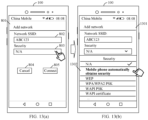
- the security selection box in this application may be a security selection box 803 on a first screen 801 shown in FIG. 13(a) .
- the mobile phone 100 is used as the terminal.
- the mobile phone 100 may display a third screen 1301 shown in FIG. 13(b) .
- the third screen 1301 shown in FIG. 13(b) includes a "security" obtaining option 1302 and encryption manners such as WEP and WPA/WPA2 PSK.
- the mobile phone 100 may obtain the encryption manner of the first Wi-Fi hotspot, and then perform steps S704 to S707.
- the terminal may obtain the encryption manner of the first Wi-Fi hotspot from the cloud server based on the SSID of the first Wi-Fi hotspot.
- the terminal obtains the encryption manner of the first Wi-Fi hotspot from the cloud server.
- the terminal may broadcast a probe response frame to obtain the encryption manner of the first Wi-Fi hotspot from the first Wi-Fi hotspot.
- the terminal may broadcast a probe response frame to obtain the encryption manner of the first Wi-Fi hotspot from the first Wi-Fi hotspot.
- the terminal may display the third screen. Because the third screen includes the encryption manner option and the security obtaining option, even if the user does not know the encryption manner of the first Wi-Fi hotspot, the user may also tap the security obtaining option, so that the terminal automatically obtains the encryption manner of the first Wi-Fi hotspot in response to the user's tapping operation on the security obtaining option. This can reduce operations performed by the user when the terminal connects to the Wi-Fi hotspot, shorten a time for the terminal to connect to the Wi-Fi hotspot, improve efficiency of connecting to the Wi-Fi hotspot by the terminal, and improve user experience.
- the terminal may further perform step S703. Specifically, as shown in FIG. 14 , step S703 shown in FIG. 7 may be replaced with step S1401.
- the mobile phone 100 may obtain the encryption manner of the first Wi-Fi hotspot based on the SSID of the first Wi-Fi hotspot.
- the SSID for example, ABC123
- a default encryption manner N/A of the mobile phone 100 is shown in the security selection box 803. Therefore, when obtaining the encryption manner of the first Wi-Fi hotspot, the mobile phone 100 may perform step S704, and learn that the encryption manner of the first Wi-Fi hotspot is different from the default encryption manner.
- the mobile phone 100 may display a second screen.
- the mobile phone 100 may display a second screen 1501 shown in FIG. 15(b) .
- the second screen 1501 shown in FIG. 15(b) may be replaced with the second screen 901 shown in FIG. 9 .
- the terminal may perform step S1401 to obtain the encryption manner of the first Wi-Fi hotspot based on the SSID that includes all characters input in the SSID input box 802.
- step S1401 if the terminal further detects that the user continues to input a character in the SSID input box 802, the terminal may perform step S1401 again to obtain the encryption manner of the first Wi-Fi hotspot based on the SSID that includes all characters input in the SSID input box 802.
- the terminal may obtain the encryption manner of the first Wi-Fi hotspot from the cloud server based on the SSID of the first Wi-Fi hotspot.
- the terminal obtains the encryption manner of the first Wi-Fi hotspot from the cloud server.
- the terminal may broadcast a probe response frame to obtain the encryption manner of the first Wi-Fi hotspot from the first Wi-Fi hotspot.
- the terminal broadcasts the probe response frame to obtain the encryption manner of the first Wi-Fi hotspot from the first Wi-Fi hotspot.
- the terminal may also directly obtain the encryption manner of the first Wi-Fi hotspot.
- the terminal may further automatically obtain the encryption manner of the first Wi-Fi hotspot in a manner in which the encryption manner of the Wi-Fi hotspot is imperceptible to the user.
- the terminal after the terminal displays the second screen, and before the terminal receives the access password of the first Wi-Fi hotspot input by the user on the second screen, the terminal does not respond to the user's connection operation on the second screen, in other words, the terminal does not respond to the user's tapping operation on the "connect" button on the second screen.
- the mobile phone 100 may display, on a second screen, a "connect” button 805 in an inoperable state shown in FIG. 16(a) .
- the mobile phone 100 does not respond to any user's operation on the "connect" button 805 shown in FIG. 16(a) .
- a "connect” button 805 is switched to an operable state.
- the mobile phone 100 connects to the Wi-Fi hotspot.
- This application provides the Wi-Fi hotspot connection method.
- the terminal may automatically obtain the security information of the first Wi-Fi hotspot, and the user does not need to remember the security information or attempt to successively use different security information to connect to a network. This can reduce operations performed by the user when the terminal connects to the Wi-Fi hotspot, shorten a time for the terminal to connect to the Wi-Fi hotspot, and improve user experience.
- the terminal and the like include corresponding hardware structures and/or software modules for performing the functions.
- the units and algorithm steps in the examples described with reference to the embodiments disclosed in this specification can be implemented by hardware or a combination of hardware and computer software. Whether a function is performed by hardware or hardware driven by computer software depends on particular applications and design constraints of the technical solutions. Persons skilled in the art may use different methods to implement the described functions for each particular application, but it should not be considered that the implementation goes beyond the scope of the embodiments of the present invention.
- the terminal may be divided into functional modules based on the foregoing method examples.
- each functional module may be obtained through division based on each corresponding function, or two or more functions may be integrated into one processing module.
- the integrated module may be implemented in a form of hardware, or may be implemented in a form of a software functional module. It should be noted that the module division in the embodiments of the present invention is an example, and is merely logical function division. There may be another division manner in actual implementation.
- FIG. 17 is a possible schematic structural diagram of a terminal in the foregoing embodiments.
- the terminal 1700 includes a display unit 1701, an input unit 1702, an obtaining unit 1703, and a connection unit 1704.
- the display unit 1701 is configured to support the terminal in performing step S701, step S705, and step S1201 in the method embodiment, and/or is configured to perform another process of the technology described in this specification.
- the input unit 1702 is configured to support the terminal in performing step S702, and step S706 in the method embodiment, and/or is configured to perform another process of the technology described in this specification.
- the obtaining unit 1703 is configured to support the terminal in performing step S703, step S1202, step S1401, step S1101, and steps 1104 to S1106 in the method embodiment, and/or is configured to perform another process of the technology described in this specification.
- the connection unit 1704 is configured to support the terminal in performing step S301, step S303, steps 305 to S307, and step 707 in the method embodiment, and/or is configured to perform another process of the technology described in this specification.
- functional units in the embodiments of this application may be integrated into one processing unit, or each of the units may exist alone physically, or two or more units may be integrated into one unit.
- the integrated units may be implemented in a form of hardware, or may be implemented in a form of a software functional unit.
Landscapes
- Engineering & Computer Science (AREA)
- Computer Security & Cryptography (AREA)
- Computer Networks & Wireless Communication (AREA)
- Signal Processing (AREA)
- Computer Hardware Design (AREA)
- Computing Systems (AREA)
- General Engineering & Computer Science (AREA)
- Human Computer Interaction (AREA)
- Mobile Radio Communication Systems (AREA)
- Telephone Function (AREA)
Claims (14)
- Procédé de connexion à un point d'accès sans fil, dans lequel le procédé comprend :• l'affichage (étape 701), par un terminal, d'un premier écran, dans lequel le premier écran comprend une zone de saisie d'identifiant d'ensemble de services, SSID, une zone de sélection de sécurité pour un point d'accès sans fil de technologie Wi-Fi et une zone de saisie de mot de passe ;• la réception (étape 702), par le terminal, d'un SSID d'un premier point d'accès sans fil saisi par un utilisateur dans la zone de saisie SSID, d'un mot de passe d'accès d'un premier point d'accès sans fil saisi par un utilisateur dans la zone de saisie de mot de passe et d'un mode de chiffrement sélectionné dans la zone de sélection de sécurité dans le premier écran, et• en réponse à la première opération par l'utilisateur sur le premier écran, l'obtention (étape 703), par le terminal, d'un mode de chiffrement du premier point d'accès sans fil sur la base du SSID du premier point d'accès sans fil ;• l'affichage (étape 705), par le terminal, d'un deuxième écran si le mode de chiffrement obtenu du premier point d'accès sans fil est différent d'un mode de chiffrement sélectionné dans la zone de sélection de sécurité, dans lequel le deuxième écran comprend une zone de saisie de mot de passe ;• la réception (étape 706), par le terminal, du mot de passe d'accès du premier point d'accès sans fil saisi par l'utilisateur dans la zone de saisie de mot de passe ; et• en réponse à la seconde opération par l'utilisateur sur le deuxième écran, la connexion (étape 707), par le terminal, au premier point d'accès sans fil sur la base du SSID, du mot de passe d'accès et du mode de chiffrement obtenu du premier point d'accès sans fil.
- Procédé selon la revendication 1, dans lequel, avant l'obtention, par le terminal, du mode de chiffrement du premier point d'accès sans fil sur la base du SSID du premier point d'accès sans fil, le procédé comprend en outre :• en réponse à l'opération de sélection par l'utilisateur sur la zone de sélection de sécurité, l'affichage, par le terminal, d'un troisième écran, dans lequel le troisième écran comprend une option de mode de chiffrement et une option d'obtention de sécurité ; et
l'obtention, par le terminal, du mode de chiffrement du premier point d'accès sans fil sur la base du SSID du premier point d'accès sans fil comprend :• en réponse à la sélection par l'utilisateur depuis l'option d'obtention de sécurité, l'obtention, par le terminal, du mode de chiffrement du premier point d'accès sans fil sur la base du SSID du premier point d'accès sans fil. - Procédé selon la revendication 1, dans lequel l'obtention, par le terminal, du mode de chiffrement du premier point d'accès sans fil sur la base du SSID du premier point d'accès sans fil comprend :• après avoir répondu à la saisie par l'utilisateur du SSID du premier point d'accès sans fil sur le premier écran, l'obtention automatique, par le terminal, du mode de chiffrement du premier point d'accès sans fil sur la base du SSID du premier point d'accès sans fil.
- Procédé selon l'une quelconque des revendications 1 à 3, dans lequel l'obtention, par le terminal, du mode de chiffrement du premier point d'accès sans fil sur la base du SSID du premier point d'accès sans fil comprend :• la diffusion, par le terminal, d'une trame de demande de sonde, dans lequel la trame de demande de sonde transporte le SSID du premier point d'accès sans fil ;• la réception, par le terminal, d'une trame de réponse de sonde envoyée par le premier point d'accès sans fil, dans lequel la trame de réponse de sonde transporte le mode de chiffrement du premier point d'accès sans fil ; et• l'analyse, par le terminal, de la trame de réponse de sonde pour obtenir le mode de chiffrement du premier point d'accès sans fil.
- Procédé selon la revendication 2 ou 3, dans lequel l'obtention, par le terminal, du mode de chiffrement du premier point d'accès sans fil sur la base du SSID du premier point d'accès sans fil comprend :• l'envoi, par le terminal, d'une demande d'obtention de mode de chiffrement à un serveur en nuage, dans lequel la demande d'obtention de mode de chiffrement transporte le SSID du premier point d'accès sans fil, et le serveur en nuage stocke des modes de chiffrement d'une pluralité de points d'accès sans fil ; et• la réception, par le terminal, d'une réponse d'obtention de mode de chiffrement envoyée par le serveur en nuage, dans lequel la réponse d'obtention de mode de chiffrement transporte le SSID du premier point d'accès sans fil.
- Procédé selon l'une quelconque des revendications 1 à 5, dans lequel le procédé comprend : l'enregistrement du mode de chiffrement du premier point d'accès sans fil.
- Procédé selon l'une quelconque des revendications 1 à 6, dans lequel le premier écran est un écran d'ajout de point d'accès.
- Terminal (1800), dans lequel le terminal (1800) comprend un processeur (1801), une mémoire (1802), un écran tactile (1803) et une interface de communications (1804), la mémoire (1802), l'écran tactile (1803) et l'interface de communications (1804) sont couplés au processeur (1801), l'interface de communications (1804) est configurée pour communiquer avec un autre terminal, l'autre terminal comprend un point d'accès sans fil de technologie Wi-Fi, la mémoire (1802) est configurée pour stocker le code de programme informatique, le code de programme informatique comprend une instruction informatique et lorsque le processeur exécute l'instruction informatique,• l'écran tactile (1803) est configuré pour afficher un premier écran, dans lequel le premier écran comprend une zone de saisie d'identifiant d'ensemble de services, SSID, une zone de sélection de sécurité pour le point d'accès sans fil, et une zone de saisie de mot de passe ;• le processeur (1801) est configuré pour : recevoir un SSID d'un premier point d'accès sans fil saisi par un utilisateur dans la boîte de saisie SSID affichée sur l'écran tactile (1803), un mot de passe d'accès d'un premier point d'accès sans fil saisi par un utilisateur dans la boîte de saisie de mot de passe affichée sur l'écran tactile, et un mode de chiffrement sélectionné dans la boîte de sélection de sécurité dans le premier écran, et en réponse à la première opération par l'utilisateur sur le premier écran affiché sur l'écran tactile (1803), obtenir un mode de chiffrement du premier point d'accès sans fil sur la base du SSID du premier point d'accès sans fil ;• dans lequel l'écran tactile (1803) est en outre configuré pour : afficher un deuxième écran si le mode de chiffrement du premier point d'accès sans fil obtenu par le processeur est différent d'un mode de chiffrement sélectionné de la zone de sélection de sécurité, dans lequel le deuxième écran comprend la zone de saisie de mot de passe ;• le processeur (1801) est en outre configuré pour recevoir le mot de passe d'accès du premier point d'accès sans fil saisi par l'utilisateur dans la zone de saisie de mot de passe affichée sur l'écran tactile (1803) ; et• le processeur (1801) est en outre configuré pour : en réponse à la seconde opération par l'utilisateur sur le deuxième écran, se connecter au premier point d'accès sans fil sur la base du SSID, du mot de passe d'accès et du mode de chiffrement obtenu du premier point d'accès sans fil au travers de l'interface de communications.
- Terminal selon la revendication 8, dans lequel l'écran tactile est en outre configuré pour: avant que le processeur n'obtienne le mode de chiffrement du premier point d'accès sans fil sur la base du SSID du premier point d'accès sans fil, en réponse à l'opération de sélection par l'utilisateur dans la boîte de sélection de sécurité sur le premier écran, afficher un troisième écran, dans lequel le troisième écran comprend une option de mode de chiffrement et une option d'obtention de sécurité ; et
le processeur est en outre configuré pour : en réponse à la sélection par l'utilisateur de l'option d'obtention de sécurité affichée sur l'écran tactile, obtenir le mode de chiffrement du premier point d'accès sans fil sur la base du SSID du premier point d'accès sans fil. - Terminal selon la revendication 8, dans lequel le processeur est en outre configuré pour : après avoir répondu à la saisie par l'utilisateur du SSID du premier point d'accès sans fil sur le premier écran affiché sur l'écran tactile, obtenir automatiquement le mode de chiffrement du premier point d'accès sans fil sur la base du SSID du premier point d'accès sans fil.
- Terminal selon la revendication 8, dans lequel l'interface de communications est en outre configurée pour : diffuser une trame de demande de sonde, dans lequel la trame de demande de sonde contient le SSID du premier point d'accès sans fil ; et recevoir une trame de réponse de sonde envoyée par le premier point d'accès sans fil, dans lequel la trame de réponse de sonde transporte le mode de chiffrement du premier point d'accès sans fil ; et
le processeur est en outre configuré pour analyser la trame de réponse de sonde reçue au travers de l'interface de communications, afin d'obtenir le mode de chiffrement du premier point d'accès sans fil. - Terminal selon la revendication 9, dans lequel l'interface de communications est en outre configurée pour : envoyer une demande d'obtention de mode de chiffrement à un serveur en nuage, dans lequel la demande d'obtention de mode de chiffrement transporte le SSID du premier point d'accès sans fil, et le serveur en nuage stocke des modes de chiffrement d'une pluralité de points d'accès sans fil ; et recevoir une réponse d'obtention de mode de chiffrement envoyée par le serveur en nuage, dans lequel la réponse d'obtention de mode de chiffrement transporte le SSID du premier point d'accès sans fil.
- Terminal selon la revendication 8, dans lequel le processeur est en outre configuré pour enregistrer le mode de chiffrement du premier point d'accès sans fil.
- Support de stockage lisible par ordinateur, comprenant une instruction informatique, dans lequel lorsque l'instruction informatique est exécutée sur un terminal, le terminal est activé pour réaliser le procédé selon l'une quelconque des revendications 1 à 7.
Applications Claiming Priority (3)
| Application Number | Priority Date | Filing Date | Title |
|---|---|---|---|
| CN201710729975 | 2017-08-23 | ||
| EP17922690.7A EP3664491B1 (fr) | 2017-08-23 | 2017-09-25 | Procédé et terminal de connexion de points d'accès wi-fi |
| PCT/CN2017/103279 WO2019037190A1 (fr) | 2017-08-23 | 2017-09-25 | Procédé et terminal de connexion de points d'accès wi-fi |
Related Parent Applications (1)
| Application Number | Title | Priority Date | Filing Date |
|---|---|---|---|
| EP17922690.7A Division EP3664491B1 (fr) | 2017-08-23 | 2017-09-25 | Procédé et terminal de connexion de points d'accès wi-fi |
Publications (2)
| Publication Number | Publication Date |
|---|---|
| EP4145879A1 EP4145879A1 (fr) | 2023-03-08 |
| EP4145879B1 true EP4145879B1 (fr) | 2025-07-02 |
Family
ID=65438342
Family Applications (2)
| Application Number | Title | Priority Date | Filing Date |
|---|---|---|---|
| EP22176033.3A Active EP4145879B1 (fr) | 2017-08-23 | 2017-09-25 | Procédé et terminal de connexion de points d'accès wi-fi |
| EP17922690.7A Active EP3664491B1 (fr) | 2017-08-23 | 2017-09-25 | Procédé et terminal de connexion de points d'accès wi-fi |
Family Applications After (1)
| Application Number | Title | Priority Date | Filing Date |
|---|---|---|---|
| EP17922690.7A Active EP3664491B1 (fr) | 2017-08-23 | 2017-09-25 | Procédé et terminal de connexion de points d'accès wi-fi |
Country Status (8)
| Country | Link |
|---|---|
| US (1) | US11277744B2 (fr) |
| EP (2) | EP4145879B1 (fr) |
| JP (2) | JP6834058B2 (fr) |
| KR (1) | KR102279422B1 (fr) |
| CN (2) | CN115134881B (fr) |
| AU (1) | AU2017428472B2 (fr) |
| ES (2) | ES2920959T3 (fr) |
| WO (1) | WO2019037190A1 (fr) |
Families Citing this family (18)
| Publication number | Priority date | Publication date | Assignee | Title |
|---|---|---|---|---|
| CN110557800B (zh) * | 2018-06-01 | 2020-09-01 | 上海连尚网络科技有限公司 | 一种用于识别无线热点的类型的方法及其网络设备 |
| CN110430604B (zh) * | 2019-08-02 | 2022-03-25 | 深圳市康冠商用科技有限公司 | 一种网络控制方法、系统及电子设备和存储介质 |
| JP7244093B2 (ja) * | 2020-04-23 | 2023-03-22 | Necプラットフォームズ株式会社 | 無線通信システム、無線通信装置、無線接続方法及びプログラム |
| US11563807B2 (en) * | 2020-09-27 | 2023-01-24 | Dell Products, L.P. | Fully orchestrated setup of a containerized cloud communication system within an embedded operating system |
| CN114980091A (zh) * | 2021-02-18 | 2022-08-30 | 艾锐势企业有限责任公司 | 用于接入外部网络的网络设备、方法和计算机可读介质 |
| CN114980224B (zh) * | 2021-02-26 | 2024-04-12 | 华为技术有限公司 | WiFi热点的切换方法、终端设备及存储介质 |
| GB2605149B (en) * | 2021-03-23 | 2023-09-06 | British Telecomm | Method of operating a network |
| JP7686421B2 (ja) * | 2021-03-24 | 2025-06-02 | キヤノン株式会社 | 通信装置、通信方法、およびプログラム |
| EP4211913A4 (fr) * | 2021-04-01 | 2024-03-06 | Samsung Electronics Co., Ltd. | Procédés, dispositif de point d'accès et dispositif de station pour réseau de point d'accès wi-fi fermé |
| CN113286349B (zh) * | 2021-05-25 | 2023-05-09 | Oppo广东移动通信有限公司 | 个人热点连接方法、装置、终端及存储介质 |
| CN113556797A (zh) * | 2021-06-29 | 2021-10-26 | 深圳市闪联信息技术有限公司 | 一种移动设备与大屏设备快速建立连接的方法及系统 |
| JP7716306B2 (ja) * | 2021-10-12 | 2025-07-31 | キヤノン株式会社 | 通信機器、電子機器、制御方法及びプログラム |
| GB2612645B (en) | 2021-11-09 | 2024-12-04 | British Telecomm | Method of operating a wireless telecommunications network |
| US12317173B1 (en) | 2022-05-26 | 2025-05-27 | British Telecommunications Public Limited Company | Method of operating a wireless telecommunications network |
| US20240214802A1 (en) * | 2022-12-22 | 2024-06-27 | Arista Networks, Inc. | Wireless client group isolation within a network |
| KR102647226B1 (ko) * | 2023-02-14 | 2024-03-13 | 한화시스템 주식회사 | 비화통신장치 |
| CN116249106B (zh) * | 2023-02-15 | 2023-10-20 | 上海威锐电子科技股份有限公司 | 无线通信内容分向加密控制系统 |
| US20250374048A1 (en) * | 2024-05-31 | 2025-12-04 | Insight Direct Usa, Inc. | Identity registration for wireless networks |
Family Cites Families (32)
| Publication number | Priority date | Publication date | Assignee | Title |
|---|---|---|---|---|
| US7830845B2 (en) * | 2006-03-22 | 2010-11-09 | Broadcom Corporation | Adaptive communication management to accommodate hidden terminal conditions |
| US20080137860A1 (en) | 2006-12-11 | 2008-06-12 | William Bradford Silvernail | Discoverable secure mobile WiFi application with non-broadcast SSID |
| KR20090113033A (ko) * | 2008-04-25 | 2009-10-29 | 삼성전자주식회사 | 기기의 무선 랜 설정 방법 및 장치 |
| JP4844613B2 (ja) * | 2008-09-30 | 2011-12-28 | ブラザー工業株式会社 | 無線ネットワークへの接続方法、無線通信装置及びプログラム |
| JP4978604B2 (ja) * | 2008-09-30 | 2012-07-18 | ブラザー工業株式会社 | 無線通信装置、接続方法及びプログラム |
| WO2011062404A2 (fr) * | 2009-11-17 | 2011-05-26 | 삼성전자 주식회사 | Procédé et dispositif d'examen de service d'affichage wi-fi dans un réseau direct wi-fi |
| CN102231887A (zh) * | 2011-06-21 | 2011-11-02 | 深圳市融创天下科技股份有限公司 | 一种查找隐藏ssid的ap的方法、系统和终端设备 |
| US8763094B1 (en) * | 2011-09-14 | 2014-06-24 | Google Inc. | Network configuration and authorization |
| CN102421166A (zh) * | 2011-11-21 | 2012-04-18 | 华为技术有限公司 | 一种发现无线接入点的方法、装置与系统 |
| JP2013143616A (ja) * | 2012-01-10 | 2013-07-22 | Nec Access Technica Ltd | 無線通信端末、情報提供媒体、アクセスポイント、無線通信方法およびプログラム |
| CN102883449B (zh) * | 2012-09-21 | 2016-08-03 | 腾讯科技(深圳)有限公司 | 一种实现数据共享的方法、相关终端及系统 |
| JP2014078914A (ja) * | 2012-10-12 | 2014-05-01 | Canon Inc | 通信装置、その制御方法、プログラム |
| CN105025486B (zh) * | 2014-04-28 | 2019-02-26 | 腾讯科技(深圳)有限公司 | 网络连接方法和用户设备 |
| ES2934600T3 (es) * | 2014-05-31 | 2023-02-23 | Huawei Tech Co Ltd | Método de conexión de red, terminal de punto de acceso y terminal de gestión |
| CN104135754A (zh) * | 2014-08-05 | 2014-11-05 | 广东欧珀移动通信有限公司 | 一种添加并连接隐藏中文wifi热点的方法及装置 |
| CN104302015A (zh) * | 2014-09-15 | 2015-01-21 | 浙江生辉照明有限公司 | 隐藏ssid的自动适配wi-fi网络连接方法及系统 |
| RU2017119214A (ru) | 2014-11-04 | 2018-12-05 | Хуавей Текнолоджиз Ко., Лтд. | Способ и устройство для получения доступа к скрытому хот-споту |
| JP6246142B2 (ja) * | 2015-01-14 | 2017-12-13 | キヤノン株式会社 | 情報処理装置、情報処理方法及びプログラム |
| CN105188056B (zh) * | 2015-08-17 | 2019-01-25 | 深圳市江波龙科技有限公司 | 一种WiFi设备与接入点的连接方法及装置 |
| JP6127100B2 (ja) * | 2015-09-09 | 2017-05-10 | ソフトバンク株式会社 | 通信端末装置及びシステム |
| US10334438B2 (en) * | 2016-06-21 | 2019-06-25 | ANI Technologies Private Limited | System and method for creating and managing wireless networks |
| CN106255106A (zh) | 2016-07-26 | 2016-12-21 | 广东欧珀移动通信有限公司 | 一种无线网络连接方法和装置 |
| CN107920353A (zh) * | 2016-10-08 | 2018-04-17 | 中兴通讯股份有限公司 | 一种无线保真连接切换热点的方法和热点接入设备 |
| CN106572465B (zh) | 2016-10-18 | 2019-07-30 | 上海众人网络安全技术有限公司 | 一种无线连接方法及系统 |
| CN106572488B (zh) * | 2016-11-02 | 2021-01-08 | 捷开通讯(深圳)有限公司 | 一种终端设备的wifi热点共享方法以及终端设备 |
| CN106792802A (zh) * | 2016-11-29 | 2017-05-31 | 中国科学院深圳先进技术研究院 | 基于二维码的无线热点配置方法及系统 |
| CN106792622A (zh) * | 2016-12-27 | 2017-05-31 | 广东欧珀移动通信有限公司 | 连接隐藏ap的方法与终端设备 |
| CN106686587B (zh) * | 2017-02-20 | 2020-01-14 | Oppo广东移动通信有限公司 | 一种无线保真Wi-Fi连接方法、移动终端及介质 |
| CN106804055B (zh) * | 2017-02-20 | 2019-05-28 | Oppo广东移动通信有限公司 | 一种无线保真Wi-Fi连接方法及移动终端 |
| CN106792699A (zh) * | 2017-02-20 | 2017-05-31 | 广东欧珀移动通信有限公司 | 一种无线保真Wi‑Fi连接方法及移动终端 |
| US10966258B2 (en) * | 2017-03-08 | 2021-03-30 | Comcast Cable Communications, Llc | Methods and systems for managing network hotspots |
| CN107094293A (zh) * | 2017-06-27 | 2017-08-25 | 南京赢纳信息科技有限公司 | 一种获取WiFi终端真实MAC地址的装置及方法 |
-
2017
- 2017-09-25 EP EP22176033.3A patent/EP4145879B1/fr active Active
- 2017-09-25 EP EP17922690.7A patent/EP3664491B1/fr active Active
- 2017-09-25 JP JP2020511249A patent/JP6834058B2/ja active Active
- 2017-09-25 US US16/640,635 patent/US11277744B2/en active Active
- 2017-09-25 ES ES17922690T patent/ES2920959T3/es active Active
- 2017-09-25 CN CN202210594565.1A patent/CN115134881B/zh active Active
- 2017-09-25 KR KR1020207007965A patent/KR102279422B1/ko active Active
- 2017-09-25 AU AU2017428472A patent/AU2017428472B2/en active Active
- 2017-09-25 ES ES22176033T patent/ES3039154T3/es active Active
- 2017-09-25 CN CN201780088554.3A patent/CN110431868B/zh active Active
- 2017-09-25 WO PCT/CN2017/103279 patent/WO2019037190A1/fr not_active Ceased
-
2021
- 2021-02-03 JP JP2021015703A patent/JP7204792B2/ja active Active
Also Published As
| Publication number | Publication date |
|---|---|
| US20200187008A1 (en) | 2020-06-11 |
| JP2020528716A (ja) | 2020-09-24 |
| KR102279422B1 (ko) | 2021-07-19 |
| AU2017428472B2 (en) | 2021-08-12 |
| US11277744B2 (en) | 2022-03-15 |
| EP3664491B1 (fr) | 2022-06-01 |
| EP3664491A1 (fr) | 2020-06-10 |
| CN110431868A (zh) | 2019-11-08 |
| JP7204792B2 (ja) | 2023-01-16 |
| CN115134881B (zh) | 2023-11-10 |
| CN110431868B (zh) | 2022-05-31 |
| CN115134881A (zh) | 2022-09-30 |
| EP3664491A4 (fr) | 2020-07-22 |
| EP4145879A1 (fr) | 2023-03-08 |
| AU2017428472A1 (en) | 2020-03-19 |
| ES2920959T3 (es) | 2022-08-12 |
| JP2021090205A (ja) | 2021-06-10 |
| KR20200038304A (ko) | 2020-04-10 |
| ES3039154T3 (en) | 2025-10-17 |
| JP6834058B2 (ja) | 2021-02-24 |
| WO2019037190A1 (fr) | 2019-02-28 |
Similar Documents
| Publication | Publication Date | Title |
|---|---|---|
| EP4145879B1 (fr) | Procédé et terminal de connexion de points d'accès wi-fi | |
| EP4007321B1 (fr) | Procédé de partage d'informations, appareil terminal, support d'informations et produit-programme d'ordinateur | |
| EP3579596B1 (fr) | Procédé et appareil d'établissement de connexion de réseau local sans fil, et terminal | |
| EP3624404A1 (fr) | Procédé et dispositif d'établissement de connexion de communication sans fil | |
| JP2016528844A (ja) | ネットワーク接続方法、ホットスポット端末及び管理端末 | |
| CN113301669B (zh) | 建立热点连接的方法和终端设备 | |
| KR20160023159A (ko) | 근거리 무선 통신(nfc) 기능을 이용하여 무선 연결을 설정하는 방법 및 이를 수행하기 위한 화상형성장치 | |
| EP3678377B1 (fr) | Dispositif sans fil et système sans fil | |
| US20170164414A1 (en) | Electronic device and method of providing information about the access point (ap) | |
| WO2019140657A1 (fr) | Procédé et dispositif de connexion au réseau, et terminal | |
| CN110870353B (zh) | 一种WiFi连接的方法及终端 | |
| WO2019057119A1 (fr) | Procédé de connexion de point d'accès wifi basé sur un terminal mobile, terminal mobile et support de stockage | |
| US11553393B2 (en) | Transmission control method and device | |
| CN113114798B (zh) | 一种互联网协议ip地址的获取方法及电子设备 | |
| CN112640533B (zh) | 用于提供ap列表的电子设备以及用于操作电子设备的方法 | |
| CN107124721A (zh) | 一种网络接入方法、分享终端及被分享终端 |
Legal Events
| Date | Code | Title | Description |
|---|---|---|---|
| PUAI | Public reference made under article 153(3) epc to a published international application that has entered the european phase |
Free format text: ORIGINAL CODE: 0009012 |
|
| STAA | Information on the status of an ep patent application or granted ep patent |
Free format text: STATUS: REQUEST FOR EXAMINATION WAS MADE |
|
| 17P | Request for examination filed |
Effective date: 20220530 |
|
| AC | Divisional application: reference to earlier application |
Ref document number: 3664491 Country of ref document: EP Kind code of ref document: P |
|
| AK | Designated contracting states |
Kind code of ref document: A1 Designated state(s): AL AT BE BG CH CY CZ DE DK EE ES FI FR GB GR HR HU IE IS IT LI LT LU LV MC MK MT NL NO PL PT RO RS SE SI SK SM TR |
|
| GRAP | Despatch of communication of intention to grant a patent |
Free format text: ORIGINAL CODE: EPIDOSNIGR1 |
|
| STAA | Information on the status of an ep patent application or granted ep patent |
Free format text: STATUS: GRANT OF PATENT IS INTENDED |
|
| RIC1 | Information provided on ipc code assigned before grant |
Ipc: H04W 84/12 20090101ALN20240929BHEP Ipc: H04W 12/50 20210101ALI20240929BHEP Ipc: H04W 12/03 20210101ALI20240929BHEP Ipc: H04W 12/00 20210101ALI20240929BHEP Ipc: H04W 48/08 20090101ALI20240929BHEP Ipc: H04W 76/00 20180101ALI20240929BHEP Ipc: H04W 48/16 20090101ALI20240929BHEP Ipc: H04W 12/08 20210101AFI20240929BHEP |
|
| INTG | Intention to grant announced |
Effective date: 20241014 |
|
| GRAJ | Information related to disapproval of communication of intention to grant by the applicant or resumption of examination proceedings by the epo deleted |
Free format text: ORIGINAL CODE: EPIDOSDIGR1 |
|
| STAA | Information on the status of an ep patent application or granted ep patent |
Free format text: STATUS: REQUEST FOR EXAMINATION WAS MADE |
|
| GRAP | Despatch of communication of intention to grant a patent |
Free format text: ORIGINAL CODE: EPIDOSNIGR1 |
|
| STAA | Information on the status of an ep patent application or granted ep patent |
Free format text: STATUS: GRANT OF PATENT IS INTENDED |
|
| INTG | Intention to grant announced |
Effective date: 20250127 |
|
| RIC1 | Information provided on ipc code assigned before grant |
Ipc: H04W 84/12 20090101ALN20250117BHEP Ipc: H04W 12/50 20210101ALI20250117BHEP Ipc: H04W 12/03 20210101ALI20250117BHEP Ipc: H04W 12/00 20210101ALI20250117BHEP Ipc: H04W 48/08 20090101ALI20250117BHEP Ipc: H04W 76/00 20180101ALI20250117BHEP Ipc: H04W 48/16 20090101ALI20250117BHEP Ipc: H04W 12/08 20210101AFI20250117BHEP |
|
| GRAS | Grant fee paid |
Free format text: ORIGINAL CODE: EPIDOSNIGR3 |
|
| GRAA | (expected) grant |
Free format text: ORIGINAL CODE: 0009210 |
|
| STAA | Information on the status of an ep patent application or granted ep patent |
Free format text: STATUS: THE PATENT HAS BEEN GRANTED |
|
| AC | Divisional application: reference to earlier application |
Ref document number: 3664491 Country of ref document: EP Kind code of ref document: P |
|
| AK | Designated contracting states |
Kind code of ref document: B1 Designated state(s): AL AT BE BG CH CY CZ DE DK EE ES FI FR GB GR HR HU IE IS IT LI LT LU LV MC MK MT NL NO PL PT RO RS SE SI SK SM TR |
|
| REG | Reference to a national code |
Ref country code: GB Ref legal event code: FG4D |
|
| REG | Reference to a national code |
Ref country code: CH Ref legal event code: EP |
|
| REG | Reference to a national code |
Ref country code: DE Ref legal event code: R096 Ref document number: 602017090398 Country of ref document: DE |
|
| REG | Reference to a national code |
Ref country code: IE Ref legal event code: FG4D |
|
| PGFP | Annual fee paid to national office [announced via postgrant information from national office to epo] |
Ref country code: DE Payment date: 20250730 Year of fee payment: 9 |
|
| PGFP | Annual fee paid to national office [announced via postgrant information from national office to epo] |
Ref country code: IT Payment date: 20250922 Year of fee payment: 9 |
|
| PGFP | Annual fee paid to national office [announced via postgrant information from national office to epo] |
Ref country code: GB Payment date: 20250807 Year of fee payment: 9 |
|
| REG | Reference to a national code |
Ref country code: ES Ref legal event code: FG2A Ref document number: 3039154 Country of ref document: ES Kind code of ref document: T3 Effective date: 20251017 |
|
| PGFP | Annual fee paid to national office [announced via postgrant information from national office to epo] |
Ref country code: FR Payment date: 20250808 Year of fee payment: 9 |
|
| REG | Reference to a national code |
Ref country code: NL Ref legal event code: MP Effective date: 20250702 |
|
| PG25 | Lapsed in a contracting state [announced via postgrant information from national office to epo] |
Ref country code: PT Free format text: LAPSE BECAUSE OF FAILURE TO SUBMIT A TRANSLATION OF THE DESCRIPTION OR TO PAY THE FEE WITHIN THE PRESCRIBED TIME-LIMIT Effective date: 20251103 |
|
| PG25 | Lapsed in a contracting state [announced via postgrant information from national office to epo] |
Ref country code: NL Free format text: LAPSE BECAUSE OF FAILURE TO SUBMIT A TRANSLATION OF THE DESCRIPTION OR TO PAY THE FEE WITHIN THE PRESCRIBED TIME-LIMIT Effective date: 20250702 |
|
| REG | Reference to a national code |
Ref country code: AT Ref legal event code: MK05 Ref document number: 1810703 Country of ref document: AT Kind code of ref document: T Effective date: 20250702 |
|
| PG25 | Lapsed in a contracting state [announced via postgrant information from national office to epo] |
Ref country code: IS Free format text: LAPSE BECAUSE OF FAILURE TO SUBMIT A TRANSLATION OF THE DESCRIPTION OR TO PAY THE FEE WITHIN THE PRESCRIBED TIME-LIMIT Effective date: 20251102 |
|
| PG25 | Lapsed in a contracting state [announced via postgrant information from national office to epo] |
Ref country code: NO Free format text: LAPSE BECAUSE OF FAILURE TO SUBMIT A TRANSLATION OF THE DESCRIPTION OR TO PAY THE FEE WITHIN THE PRESCRIBED TIME-LIMIT Effective date: 20251002 |
|
| REG | Reference to a national code |
Ref country code: LT Ref legal event code: MG9D |
|
| PG25 | Lapsed in a contracting state [announced via postgrant information from national office to epo] |
Ref country code: AT Free format text: LAPSE BECAUSE OF FAILURE TO SUBMIT A TRANSLATION OF THE DESCRIPTION OR TO PAY THE FEE WITHIN THE PRESCRIBED TIME-LIMIT Effective date: 20250702 |
|
| PG25 | Lapsed in a contracting state [announced via postgrant information from national office to epo] |
Ref country code: FI Free format text: LAPSE BECAUSE OF FAILURE TO SUBMIT A TRANSLATION OF THE DESCRIPTION OR TO PAY THE FEE WITHIN THE PRESCRIBED TIME-LIMIT Effective date: 20250702 |
|
| PG25 | Lapsed in a contracting state [announced via postgrant information from national office to epo] |
Ref country code: HR Free format text: LAPSE BECAUSE OF FAILURE TO SUBMIT A TRANSLATION OF THE DESCRIPTION OR TO PAY THE FEE WITHIN THE PRESCRIBED TIME-LIMIT Effective date: 20250702 |
|
| PG25 | Lapsed in a contracting state [announced via postgrant information from national office to epo] |
Ref country code: GR Free format text: LAPSE BECAUSE OF FAILURE TO SUBMIT A TRANSLATION OF THE DESCRIPTION OR TO PAY THE FEE WITHIN THE PRESCRIBED TIME-LIMIT Effective date: 20251003 |
|
| PG25 | Lapsed in a contracting state [announced via postgrant information from national office to epo] |
Ref country code: CZ Free format text: LAPSE BECAUSE OF FAILURE TO SUBMIT A TRANSLATION OF THE DESCRIPTION OR TO PAY THE FEE WITHIN THE PRESCRIBED TIME-LIMIT Effective date: 20250702 Ref country code: SE Free format text: LAPSE BECAUSE OF FAILURE TO SUBMIT A TRANSLATION OF THE DESCRIPTION OR TO PAY THE FEE WITHIN THE PRESCRIBED TIME-LIMIT Effective date: 20250702 |
|
| PG25 | Lapsed in a contracting state [announced via postgrant information from national office to epo] |
Ref country code: LV Free format text: LAPSE BECAUSE OF FAILURE TO SUBMIT A TRANSLATION OF THE DESCRIPTION OR TO PAY THE FEE WITHIN THE PRESCRIBED TIME-LIMIT Effective date: 20250702 |
|
| PG25 | Lapsed in a contracting state [announced via postgrant information from national office to epo] |
Ref country code: PL Free format text: LAPSE BECAUSE OF FAILURE TO SUBMIT A TRANSLATION OF THE DESCRIPTION OR TO PAY THE FEE WITHIN THE PRESCRIBED TIME-LIMIT Effective date: 20250702 Ref country code: BG Free format text: LAPSE BECAUSE OF FAILURE TO SUBMIT A TRANSLATION OF THE DESCRIPTION OR TO PAY THE FEE WITHIN THE PRESCRIBED TIME-LIMIT Effective date: 20250702 |
|
| PG25 | Lapsed in a contracting state [announced via postgrant information from national office to epo] |
Ref country code: RS Free format text: LAPSE BECAUSE OF FAILURE TO SUBMIT A TRANSLATION OF THE DESCRIPTION OR TO PAY THE FEE WITHIN THE PRESCRIBED TIME-LIMIT Effective date: 20251002 |
|
| PGFP | Annual fee paid to national office [announced via postgrant information from national office to epo] |
Ref country code: ES Payment date: 20251015 Year of fee payment: 9 |
|
| PG25 | Lapsed in a contracting state [announced via postgrant information from national office to epo] |
Ref country code: RO Free format text: LAPSE BECAUSE OF FAILURE TO SUBMIT A TRANSLATION OF THE DESCRIPTION OR TO PAY THE FEE WITHIN THE PRESCRIBED TIME-LIMIT Effective date: 20250702 |
|
| PG25 | Lapsed in a contracting state [announced via postgrant information from national office to epo] |
Ref country code: SM Free format text: LAPSE BECAUSE OF FAILURE TO SUBMIT A TRANSLATION OF THE DESCRIPTION OR TO PAY THE FEE WITHIN THE PRESCRIBED TIME-LIMIT Effective date: 20250702 |
|
| PG25 | Lapsed in a contracting state [announced via postgrant information from national office to epo] |
Ref country code: DK Free format text: LAPSE BECAUSE OF FAILURE TO SUBMIT A TRANSLATION OF THE DESCRIPTION OR TO PAY THE FEE WITHIN THE PRESCRIBED TIME-LIMIT Effective date: 20250702 |
|
| PG25 | Lapsed in a contracting state [announced via postgrant information from national office to epo] |
Ref country code: EE Free format text: LAPSE BECAUSE OF FAILURE TO SUBMIT A TRANSLATION OF THE DESCRIPTION OR TO PAY THE FEE WITHIN THE PRESCRIBED TIME-LIMIT Effective date: 20250702 Ref country code: SK Free format text: LAPSE BECAUSE OF FAILURE TO SUBMIT A TRANSLATION OF THE DESCRIPTION OR TO PAY THE FEE WITHIN THE PRESCRIBED TIME-LIMIT Effective date: 20250702 |