EP4147637A1 - Système et procédé d'analyse de la démarche - Google Patents
Système et procédé d'analyse de la démarche Download PDFInfo
- Publication number
- EP4147637A1 EP4147637A1 EP20934680.8A EP20934680A EP4147637A1 EP 4147637 A1 EP4147637 A1 EP 4147637A1 EP 20934680 A EP20934680 A EP 20934680A EP 4147637 A1 EP4147637 A1 EP 4147637A1
- Authority
- EP
- European Patent Office
- Prior art keywords
- walking
- information
- walker
- basis
- kinematic
- Prior art date
- Legal status (The legal status is an assumption and is not a legal conclusion. Google has not performed a legal analysis and makes no representation as to the accuracy of the status listed.)
- Granted
Links
Images




Classifications
-
- A—HUMAN NECESSITIES
- A61—MEDICAL OR VETERINARY SCIENCE; HYGIENE
- A61B—DIAGNOSIS; SURGERY; IDENTIFICATION
- A61B5/00—Measuring for diagnostic purposes; Identification of persons
- A61B5/103—Measuring devices for testing the shape, pattern, colour, size or movement of the body or parts thereof, for diagnostic purposes
- A61B5/11—Measuring movement of the entire body or parts thereof, e.g. head or hand tremor or mobility of a limb
- A61B5/112—Gait analysis
-
- A—HUMAN NECESSITIES
- A61—MEDICAL OR VETERINARY SCIENCE; HYGIENE
- A61B—DIAGNOSIS; SURGERY; IDENTIFICATION
- A61B5/00—Measuring for diagnostic purposes; Identification of persons
- A61B5/72—Signal processing specially adapted for physiological signals or for diagnostic purposes
- A61B5/7235—Details of waveform analysis
- A61B5/7264—Classification of physiological signals or data, e.g. using neural networks, statistical classifiers, expert systems or fuzzy systems
-
- A—HUMAN NECESSITIES
- A61—MEDICAL OR VETERINARY SCIENCE; HYGIENE
- A61B—DIAGNOSIS; SURGERY; IDENTIFICATION
- A61B5/00—Measuring for diagnostic purposes; Identification of persons
- A61B5/0033—Features or image-related aspects of imaging apparatus, e.g. for MRI, optical tomography or impedance tomography apparatus; Arrangements of imaging apparatus in a room
- A61B5/0035—Features or image-related aspects of imaging apparatus, e.g. for MRI, optical tomography or impedance tomography apparatus; Arrangements of imaging apparatus in a room adapted for acquisition of images from more than one imaging mode, e.g. combining MRI and optical tomography
-
- A—HUMAN NECESSITIES
- A61—MEDICAL OR VETERINARY SCIENCE; HYGIENE
- A61B—DIAGNOSIS; SURGERY; IDENTIFICATION
- A61B5/00—Measuring for diagnostic purposes; Identification of persons
- A61B5/103—Measuring devices for testing the shape, pattern, colour, size or movement of the body or parts thereof, for diagnostic purposes
- A61B5/11—Measuring movement of the entire body or parts thereof, e.g. head or hand tremor or mobility of a limb
- A61B5/1123—Discriminating type of movement, e.g. walking or running
-
- A—HUMAN NECESSITIES
- A61—MEDICAL OR VETERINARY SCIENCE; HYGIENE
- A61B—DIAGNOSIS; SURGERY; IDENTIFICATION
- A61B5/00—Measuring for diagnostic purposes; Identification of persons
- A61B5/103—Measuring devices for testing the shape, pattern, colour, size or movement of the body or parts thereof, for diagnostic purposes
- A61B5/11—Measuring movement of the entire body or parts thereof, e.g. head or hand tremor or mobility of a limb
- A61B5/1126—Measuring movement of the entire body or parts thereof, e.g. head or hand tremor or mobility of a limb using a particular sensing technique
- A61B5/1127—Measuring movement of the entire body or parts thereof, e.g. head or hand tremor or mobility of a limb using a particular sensing technique using markers
-
- A—HUMAN NECESSITIES
- A61—MEDICAL OR VETERINARY SCIENCE; HYGIENE
- A61B—DIAGNOSIS; SURGERY; IDENTIFICATION
- A61B5/00—Measuring for diagnostic purposes; Identification of persons
- A61B5/103—Measuring devices for testing the shape, pattern, colour, size or movement of the body or parts thereof, for diagnostic purposes
- A61B5/11—Measuring movement of the entire body or parts thereof, e.g. head or hand tremor or mobility of a limb
- A61B5/1126—Measuring movement of the entire body or parts thereof, e.g. head or hand tremor or mobility of a limb using a particular sensing technique
- A61B5/1128—Measuring movement of the entire body or parts thereof, e.g. head or hand tremor or mobility of a limb using a particular sensing technique using image analysis
-
- A—HUMAN NECESSITIES
- A61—MEDICAL OR VETERINARY SCIENCE; HYGIENE
- A61B—DIAGNOSIS; SURGERY; IDENTIFICATION
- A61B5/00—Measuring for diagnostic purposes; Identification of persons
- A61B5/117—Identification of persons
-
- A—HUMAN NECESSITIES
- A61—MEDICAL OR VETERINARY SCIENCE; HYGIENE
- A61B—DIAGNOSIS; SURGERY; IDENTIFICATION
- A61B5/00—Measuring for diagnostic purposes; Identification of persons
- A61B5/74—Details of notification to user or communication with user or patient; User input means
- A61B5/746—Alarms related to a physiological condition, e.g. details of setting alarm thresholds or avoiding false alarms
-
- A—HUMAN NECESSITIES
- A61—MEDICAL OR VETERINARY SCIENCE; HYGIENE
- A61B—DIAGNOSIS; SURGERY; IDENTIFICATION
- A61B2562/00—Details of sensors; Constructional details of sensor housings or probes; Accessories for sensors
- A61B2562/02—Details of sensors specially adapted for in-vivo measurements
- A61B2562/0219—Inertial sensors, e.g. accelerometers, gyroscopes, tilt switches
-
- A—HUMAN NECESSITIES
- A61—MEDICAL OR VETERINARY SCIENCE; HYGIENE
- A61B—DIAGNOSIS; SURGERY; IDENTIFICATION
- A61B5/00—Measuring for diagnostic purposes; Identification of persons
- A61B5/117—Identification of persons
- A61B5/1171—Identification of persons based on the shapes or appearances of their bodies or parts thereof
- A61B5/1176—Recognition of faces
Definitions
- the present disclosure relates to a system and method for analyzing walking behavior, the system and method being able to help experts propose medical opinions by determining problems with walking behavior.
- movement of the center of gravity of posture balance control abilities can be shown not only in an erect posture, but various activities in everyday line, and the load that is applied in situations such as when a person lifts an object or walks with a bag on his/her shoulder has considerable influence on posture maintenance and balance maintenance.
- a coping mechanism for maintaining balance by bringing the center line of gravity, of which the position has been changed due to the way of carrying a load, to the center of base of support, for maintaining balance by bringing the center line further forward to move forward, and for reducing energy consumption for walking is activated in a human body.
- Gait analysis is used in decision making in clinical tests, evaluation after treatment, evaluation of intention and helping tools, and various biomechanical studies for musculoskeletal and neurologic diseases, does an inclusive evaluation by measuring various features of walking, and includes kinematic analysis, dynamic electromyography, energy expenditure measurement, etc.
- walking pattern extraction devices are widely used for rehabilitation of recovering the walking sense of patients with a walking disorder due to injuries to the central nervous system, for walking posture correction training of users who need walking posture correction, or the like.
- attachable sensors for example, inertia sensors such as a gyro sensor and an acceleration sensor
- attachable sensors for example, inertia sensors such as a gyro sensor and an acceleration sensor
- a walking analysis method using a single depth camera has limitation that a range in which walking data can be obtained is small and the accuracy of kinematic information of hidden body parts is deteriorated due to an occlusion phenomenon in which a body part is hidden by another body part.
- the present disclosure intends to provide a system and method for analyzing walking behavior that can solve the problem that the accuracy of kinematic information of body parts is deteriorated due to the occlusion phenomenon.
- An objective of the present disclosure is to provide a system and method for analyzing walking behavior that can solve the problems of the related art.
- a system for analyzing walking behavior includes: an identifier configured to identify a walker; a walking information obtainer configured to image a walking motion of the walker in at least one or more directions of a left, a right, and a front on the basis of an identification signal from the identifier, and to extract and provide kinematic information from the taken images; a walking information collector configured to combine and collect kinematic information (3D and/or 2D skeleton information) of the taken walking images; a walking parameter extractor/classifier configured to extract at least one or more walking parameter on the basis of the combined kinematic information (3D and/or 2D skeleton information), and then classify the kind of the walking; and a walking result informer configured to determine whether the at least one or more walking parameters come out of a recommendation reference value, or are included in a walking parameter range of abnormal walking, or are classified as a pathological gait, and then provide the result to the walker or an expert.
- a method of analyzing walking behavior includes: an identification step of identifying a walker by means of an identifier; a kinematic information extraction step of imaging a walking motion of the walker in at least one or more directions of a left, a right, and a front on the basis of an identification signal from the identifier, and then extracting and providing kinematic information from the taken images by means of a walking information collector; a combination step of combining kinematic information (3D and/or 2D skeleton information) of the walking images taken by a walking information collector; a walking parameter extraction and classification step of a extracting at least one or more walking parameter on the basis of the combined kinematic information (3D and/or 2D skeleton information), and then of classifying a walking type by means of a walking parameter extractor/classifier; and a walking problem determination step of determining a walking problem of a walker on the basis of the at least one or more walking parameters or the result of
- the system and method for analyzing walking behavior it is possible to extract and classify walking parameters such as the step, the speed, the waist curvature, the average knee bending angle, etc. of a walker and to provide the classified walking motion of the walker such that the classified walking motion is used as a datum helping an expert propose a medical opinion.
- a system for analyzing walking behavior includes: an identifier configured to identify a walker; a walking information obtainer configured to image a walking motion of the walker in at least one or more directions of a left, a right, and a front on the basis of an identification signal from the identifier, and to extract and provide kinematic information from the taken images; a walking information collector configured to combine and collect kinematic information (3D and/or 2D skeleton information) of the taken walking images; a walking parameter extractor/classifier configured to extract at least one or more walking parameter on the basis of the combined kinematic information (3D and/or 2D skeleton information), and then classify the kind of the walking; and a walking result informer configured to determine whether the at least one or more walking parameters come out of a recommendation reference value, or are included in a walking parameter range of abnormal walking, or are classified as a pathological gait, and then provide the result to the walker or an expert.
- a method of analyzing walking behavior includes: an identification step of identifying a walker by means of an identifier; a kinematic information extraction step of imaging a walking motion of the walker in at least one or more directions of a left, a right, and a front on the basis of an identification signal from the identifier, and then extracting and providing kinematic information from the taken images by means of a walking information collector; a combination step of combining kinematic information (3D and/or 2D skeleton information) of the walking images taken by a walking information collector; a walking parameter extraction and classification step of a extracting at least one or more walking parameter on the basis of the combined kinematic information (3D and/or 2D skeleton information), and then of classifying a walking type by means of a walking parameter extractor/classifier; and a walking problem determination step of determining a walking problem of a walker on the basis of the at least one or more walking parameters or the result of
- first and/or second, etc. may be used herein to describe various elements, these elements should not be limited by these terms. These terms are only used to distinguish one element, from another element. For instance, a first element discussed below could be termed a second element without departing from the right range of the present disclosure. Similarly, the second element could also be termed the first element.
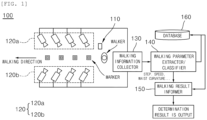
- FIG. 1 is a block diagram showing a system for analyzing walking behavior according to an embodiment of the present disclosure.
- a system 100 for analyzing walking behavior includes an identifier 110, a walking information obtainer 120, a walking information collector 130, a walking parameter extractor/classifier 140, a walking result informer 150, and a database 160.
- the identifier 110 may be a component that identifies a walker.
- the identifier 110 can identify a walker using the facial profile and eyeball information of the walker or can identify a walker using the facial profile, eyeball information, and voice information (voice) of the walker.
- the identifier 110 may be composed of a light emitter 110-1, an image obtainer 110-2, and an identity determiner 110-3 for detecting dilatation information of irises and pupils that respond to the brightness of variable light that is emitted for a predetermined time.
- the light emitter 110-1 emits variable light to an eyeball for a predetermined time.
- the variable light may be emitted in shape of a specific symbol, letter, or number and the sizes of the specific symbol, letter, and number may be changed.
- the image obtainer 110-2 detects iris and pupil regions in an eyeball image collected for a predetermined time.
- the identity determiner 110-3 can detect an iris region and a pupil region from a plurality of eyeball image frames detected for a predetermined time, calculate and process a color variance according to the variable light into a color coordinate vector, detect expansion and contraction distances of the iris region and the pupil region according to the variable light, detect position information of a specific symbol, letter, or number projected into the iris region and changing in size, and convert the color coordinate vector, the expansion and contraction distances, and the position information into a 2D code.
- the identity determiner 110-3 can determine the identity of a walker by determining whether the converted 2D code is the same as a pre-stored 2D code of a walker.
- the identifier 110 may be a reader that can identify a walker by recognizing an ID card in which walker information is recorded in a QR code or an NFC tag.
- the walking information obtainer 110 may be composed of one or a plurality of 2D or depth (3D) cameras.
- 2D cameras or depth cameras (3D cameras) may be arranged in parallel in lines to be able to take pictures of the left side and the right side of a walker, respectively.
- two dept (3D) cameras or 2D cameras may be disposed on the same axis to face each other.
- the present disclosure is not limited to the arrangement of two or more cameras on the same axis and cameras may be randomly disposed in a space for measurement.
- the depth camera may be Kinect, Realsense, Astra, and the like, and an inertia sensor or motion capture equipment that can obtain 3D space information may replace the depth camera.
- the sensor or equipment obtains kinematic information (2D or 3D skeleton and joint information) of a walker who is walking.
- the kinematic information that is provided by the sensor or equipment can provide skeletal coordinates and skeletal reliability.
- Each of the depth cameras can recognize information of the depth to a specific point from at least one or more markers or IR markers attached in a walking path of a walker.
- Each of the depth cameras recognize an axis point (coordinate axis) recorded on the marker positioned at a predetermined imaging point.
- the axis point is used in a calibration (combination) process of kinetic information by an image combiner to be described below.
- the walking information obtainer 110 may include a coordinate sensor that traces positions (coordinates) of markers in a set imaging point when the imaging points of a plurality of depth cameras or 2D cameras due to external factors.
- the walking information collector 130 collects kinematic information (3D and/or 2D skeleton information) according to walking of a target obtained by a plurality of depth cameras, 2D cameras, inertia sensors, or motion capture equipment, classifies in detail kinematic information (3D and/or 2D skeleton information) of cameras positioned in the same axial direction, and calibrates (combines) kinematic information (3D and/or 2D skeleton information) extracted from images taken at positions of the same axis.
- kinematic information (3D and/or 2D skeleton information
- the calibration (combination and modification) process may be process of transforming the axis of coordinates of each frame on the basis of three or more axis points obtained through markers, calculating 3D and/or 2D matrixes of the transformed axes of coordinates, and then projecting kinematic information (3D and/or 2D skeleton information and joint information) extracted from a plurality of images to one axis of coordinates.
- a total of four depth cameras are disposed at the left and right sides of a preset walking path and a walker has walked along the walk path for 0 ⁇ 8 seconds
- depth camera Nos. 1 and 2 provide kinematic information of the walker for 0 ⁇ 3 seconds
- depth camera Nos. 3 and 4 provide kinematic information of the walker for 2.5 ⁇ 5.5 seconds
- left/right kinematic information of each of (1, 2) and (3, 4) may be combined and front/rear kinematic information of (1, 3) and (2, 4) may be combined.
- kinematic information of the walker taken by the four cameras at each time section may be combined front and rear.
- the walking path may be an actual space having a predetermined length or may be a machine such as a treadmill enabling continuous walking.
- the walking parameter extractor/classifier 140 may be a component that extracts walking parameters from the calibrated kinematic information (3D and/or 2D skeleton information and then classifies the types of walking using the extracted walking parameters or continuous skeleton information or uses the extracted walking parameters or continuous skeleton information as input data for machine learning.
- the walking parameter extractor/classifier 140 can classify the extracted walking parameters or continuous skeleton information as any one of types of walking, such as a normal gait, an antlgic gait, an arthrogenic gait, a steppage gait due to weakening of the shin muscles, a lurching gait due to weakening of the gluteus maximus muscle, a trendelenburg gait due to weakening of the gluteus medius muscle, and a pathological gait, using a machine learning model, for example, an algorithm such as CNN, RNN, K-NN, K-MEANS, and RANDOM FOREST.
- the types of walking described herein are only examples.
- the classified walking type can greatly help experts propose medical opinions.
- walking is classified into a pathological gait, it may be used as information for persuading the walker to visit a hospital.
- the walking parameters or continuous skeleton information itself extracted from the walking parameter extractor/classifier may be used as an index for determining a problem with walking.
- the walking parameters may be a step, a speed, the curvature of a waist, left and right knee angles, an ankle angle, a pelvis twist angle, etc.
- the walking speed is calculated as a movement distance/movement time of a body center joint
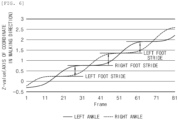
- the step is calculated a z-axial distance between stop sections of both ankles (Z-axial direction: walking direction)
- the knee bending angle is calculated as the average value of the angles made of thigh joint-knee joint-ankle joint
- the curvature of a waist is calculated as the angle made by a vector connecting the head-body centers during walking in an absolute coordinate system.
- the walking result informer 150 determines whether the at least one or more walking parameters come out of a recommendation reference value, or are included in a walking parameter range of abnormal walking, or are classified as the pathological gait, and then provides the result to the walker or an expert.
- the walking result informer 150 determines whether there is a problem with walking of a walker using a recommendation value of each walking parameter.
- the walking result informer 150 may use, as references for determination, 1 how much a walking parameter comes out of a recommendation value, 2 how much a walking parameter has changed from a normal state, 03 whether walking of a walker is classified as the pathological gait (whether a classified result is the pathological gait when entire joint information or walking parameters are input to a machine learning model or when walking is the pathological gait when walking parameter themselves are analyzed), etc.
- walking may be classified into two classes of a normal gait and a pathological gait, or may be classified into a normal gait, a pathological gait 1, a pathological gait 2, ..., and pathological gait n. That is, the range of the normal gait may also be classified into n classes that a user wants, so the reference may depend in situations.
- the walking result informer 150 can determine various walking problems in accordance with the number of times of walking
- a problem with walking speed a problem is sensed when the difference from the average walking speed for each age group
- a problem with a step size it is sensed when the difference from a recommendation step (height - 1m) is 20% or more
- sensing of left-right step unbalance it is sensed when the difference between a right step and a left step is 20cm or more
- front-rear waist curvature it is sensed when the front/rear curvature of a waist is 10 degrees or more
- left-right waist curvature it is sensed when the left/right curvature of a waist is 10 degrees or more
- walking classification a problem is determined when a classified walking type is a pathological gait, etc.
- a problem with walking speed when a walking speed is different from a normal walking speed by 10% or more or gradually decreases
- sensing of left-right step unbalance when the difference between left and right steps is 10% or more or gradually increases
- front-rear waist curvature when the front/rear curvature of a waist is different from a normal state by 10% or more or gradually increases
- left-right waist curvature when the left/right curvature of a waist is different from a normal state by 10% or more or gradually increases
- knee bending angle when the knee bending angle is different from the normal state by 10% or more or gradually decreases, etc.
- the walking information collector 130, the walking parameter extractor/classifier 140, and the walking result informer 150 disclosed the present disclosure may be operated in cooperation with the database 160.
- the database 160 can store the information collected, extracted, and determined by the components described above, and can upload existing stored information.
- the database 160 may include fields or elements such that the database 160 can be implemented to be fitted to the purpose of the present disclosure using a relational database management system (RDBMS) such as Oracle, MYSQL, MSSQL, Infomix, Sybase, and DB2, or an object-oriented database management system (OODBMS) such as Gemston, Orion, and O2, and an XML native database such as Excelon, Tamino, and Sekainu.
- RDBMS relational database management system
- MYSQL MYSQL, MSSQL, Infomix, Sybase, and DB2
- OODBMS object-oriented database management system
- XML native database such as Excelon, Tamino, and Sekainu.
- Each filed or element may be formed as a field or element of a superordinate concept or a subordinate concept.
- FIG. 6 is a flowchart showing a method of analyzing walking behavior according to an embodiment of the present disclosure.
- a method of analyzing walking behavior (S700) according to an embodiment of the present disclosure, first, when a walker is identified (S710), extracts kinematic information of the walker in walking images by means of the walking information obtainer 120 (S720).
- the walking information collector 130 collects kinematic information (3D and/or 2D skeleton information) according to walking of a target obtained by a single or a plurality of depth cameras, 2D cameras, inertia sensors, or motion capture equipment, classifies in detail kinematic information (3D and/or 2D skeleton information) of cameras positioned in the same axial direction, and calibrates (combines) kinematic information (3D and/or 2D skeleton information) extracted from images taken at positions of the same axis (S730).
- kinematic information (3D and/or 2D skeleton information
- the calibration (combination and modification) process may be process of transforming the axis of coordinates of each frame on the basis of three axis points obtained through markers, calculating 3D and/or 2D matrixes of the transformed axes of coordinates, and then projecting kinematic information (3D and/or 2D skeleton information and joint information) extracted from a plurality of images to one axis of coordinates.
- a total of four depth cameras are disposed at the left and right sides of a preset walking path and a walker has walked along the walk path for 0 ⁇ 8 seconds
- depth camera Nos. 1 and 2 provide kinematic information of the walker for 0 ⁇ 3 seconds
- depth camera Nos. 3 and 4 provide kinematic information of the walker for 2.5 ⁇ 5.5 seconds
- left/right kinematic information of each of (1, 2) and (3, 4) may be combined and front/rear kinematic information of (1, 3) and (2, 4) may be combined.
- kinematic information of the walker taken by the four cameras at each time section may be combined front and rear.
- the process S730 may include a process of calculating reliability of the coordinates of a skeleton and a process of combining only items of kinematic information of which the reliability of coordinates is a reference value or more.
- the walking parameter extractor/classifier 140 extracts and classifies walking parameters on the basis of the calibrated kinematic information (3D and/or 2D skeleton information) (S740) .
- the process S740 may include a process of classifying the extracted walking parameters or continuous skeleton information as any one of types of walking, such as a normal gait, an antlgic gait, an arthrogenic gait, a steppage gait due to weakening of the shin muscles, a lurching gait due to weakening of the gluteus maximus muscle, a trendelenburg gait due to weakening of the gluteus medius muscle, and a pathological gait, using a machine learning model, for example, an algorithm such as CNN, RNN, K-NN, K-MEANS, and RANDOM FOREST.
- the types of walking described herein are only examples.
- the classified walking type can greatly help experts propose medical opinions.
- walking is classified into a pathological gait, it may be used as information for persuading the walker to visit a hospital.
- the extracted walking parameters or continuous skeleton information itself may be used as an index for determining a problem with walking or may be input to a machine learning model.
- the walking parameters may include at least one or more of a walking speed, the height of a walker, movement of hands during walking, the length of a step, a front-rear waist curvature, a left-right waist curvature, a knee bending angle, angles of joints, and the times of a stance phase and a swing phase, but are not limited thereto.
- the walking speed is calculated as a movement distance/movement time of a body center joint
- the step is calculated a z-axial distance between stop sections of both ankles (Z-axial direction: walking direction)
- the knee bending angle is calculated as the average value of the angles made of thigh joint-knee joint-ankle joint
- the curvature of a waist is calculated as the angle made by a vector connecting the head-body centers during walking in an absolute coordinate system.
- the walking result informer 150 determines whether there is a problem with walking of the walker on the basis of the walking parameters (S750) .
- the process S750 which is a process of determining whether there is a problem with walking of a walker using a recommendation value for each walking parameter, is a process of determining various walking problems in accordance with the number of times of walking.
- the process S750 may use, as references for determination, 1 how much a walking parameter comes out of a recommendation value, 2 how much a walking parameter has changed from a normal state, 3 whether walking of a walker is classified as the pathological gait (whether a classified result is the pathological gait when entire joint information or walking parameters are input to a machine learning model or when walking is the pathological gait when walking parameter themselves are analyzed), etc.
- walking may be classified into two classes of a normal gait and a pathological gait, or may be classified into a normal gait, a pathological gait 1, a pathological gait 2, ..., and pathological gait n. That is, the range of the normal gait may also be classified into n classes that a user wants, so the reference may depend in situations.
- a problem with walking speed a problem is sensed when the difference from the average walking speed for each age group
- a problem with a step size it is sensed when the difference from a recommendation step (height - 1m) is 20% or more
- sensing of left-right step unbalance it is sensed when the difference between a right step and a left step is 20cm or more
- front-rear waist curvature it is sensed when the front/rear curvature of a waist is 10 degrees or more
- left-right waist curvature it is sensed when the left/right curvature of a waist is 10 degrees or more
- walking classification a problem is determined when a classified walking type is a pathological gait, etc.
- a problem with walking speed when a walking speed is different from a normal walking speed by 10% or more or gradually decreases
- sensing of left-right step unbalance when the difference between left and right steps is 10% or more or gradually increases
- front-rear waist curvature when the front/rear curvature of a waist is different from a normal state by 10% or more or gradually increases
- left-right waist curvature when the left/right curvature of a waist is different from a normal state by 10% or more or gradually increases
- knee bending angle when the knee bending angle is different from the normal state by 10% or more or gradually decreases, etc.
- FIG. 7 is a view showing an exemplary computing environment in which one embodiment disclosed herein can be implemented, in which a system 1000 including a computing device 1100 configured to implement the one or more embodiments described above is exemplified.
- the computing device 1100 includes a personal computer, a server computer, a hand-held or laptop device, a mobile device (a mobile phone, a PDA, a media player, etc.), a multiprocessor system, a consumer electronic device, a mini computer, a main frame computer, and a distribution computing environment including these systems or devices, but is not limited thereto.
- the computing device 1100 may include at least one processing unit 1110 and memory 1120.
- the processing unit 1110 may include a central processing unit, a graphic processing unit, a microprocessor, an Application Specific Integrated Circuit (ASIC), a Field Programmable Gate Arrays (FPGA), etc., and may have a plurality of cores.
- the memory 1120 may be a volatile memory (e.g., a RAM, etc.), a nonvolatile memory (e.g., a ROM, a flash memory, etc.), or a combination thereof.
- the computing device 1100 may include an additional storage 1130.
- the storage 1130 includes a magnetic storage, an optical storage, etc., but is not limited thereto.
- the storage 1130 computer-readable instructions for implementing one or more of embodiments disclosed herein may be stored, and other computer-readable instructions for implementing an operating system, application programs, etc. may also be included.
- the computer-readable instructions stored in the storage 1130 can be loaded to the memory 1120 to be executed by a processing unit 1110.
- the computer device 1110 may further includes an input device(s) 1140 and an output device(s) 1150.
- the input device(s) 1140 may include a keyboard, a mouse, a pen, a voice input device, a touch input device, an infrared camera, a video input device, or any other input devices.
- the output device(s) 1150 may include one or more displays, speakers, printers, or any other output devices.
- the computing device 1100 may include an input device or an output device of another computer device as the input device(s) 1140 or the output device(s) 1150.
- the computing device 1100 may further include a communication connection(s) 1160 enabling the computing device 1100 to communicate with another device (e.g., a computing device 1300).
- the communication connection(s) 1160 may include a modem, a network interface card (NIC), an integrated network interface, a wireless frequency transmitter/receiver, an infrared port, a USB connection, or other interfaces for connecting the computing device 1100 to another computing device.
- the communication connection(s) 1160 may further include a wired communication or a wireless communication.
- the components of the computing device 1100 may be connected by various interconnections such as a bus (e.g., a periphery component interconnection (PCI), a USB, firmware (IEEE 1394, an optical bus structure, etc.), and may be interconnected by a network 1200.
- PCI periphery component interconnection
- IEEE 1394 firmware
- optical bus structure etc.
- the terms 'component', 'system', etc. used herein generally means hardware, a combination of hardware and software, software, or a computer-related entity that is software that is being executed.
- a component may be a process that is being executed by a processor, a processor, an object, an executable matter, an execution thread, a program, and/or a computer, but is not limited thereto.
- an application that is being executed by a controller and the controller both may be components.
- One or more components may exist in a process and/or an execution thread, and components may be localized in one computer or may be distributed between two or more computers.
Landscapes
- Health & Medical Sciences (AREA)
- Life Sciences & Earth Sciences (AREA)
- Engineering & Computer Science (AREA)
- Physics & Mathematics (AREA)
- Public Health (AREA)
- General Health & Medical Sciences (AREA)
- Veterinary Medicine (AREA)
- Animal Behavior & Ethology (AREA)
- Surgery (AREA)
- Molecular Biology (AREA)
- Medical Informatics (AREA)
- Heart & Thoracic Surgery (AREA)
- Biophysics (AREA)
- Pathology (AREA)
- Biomedical Technology (AREA)
- Physiology (AREA)
- Oral & Maxillofacial Surgery (AREA)
- Dentistry (AREA)
- Nuclear Medicine, Radiotherapy & Molecular Imaging (AREA)
- Computer Vision & Pattern Recognition (AREA)
- Artificial Intelligence (AREA)
- Radiology & Medical Imaging (AREA)
- Psychiatry (AREA)
- Signal Processing (AREA)
- Mathematical Physics (AREA)
- Fuzzy Systems (AREA)
- Evolutionary Computation (AREA)
- Measurement Of The Respiration, Hearing Ability, Form, And Blood Characteristics Of Living Organisms (AREA)
Applications Claiming Priority (2)
| Application Number | Priority Date | Filing Date | Title |
|---|---|---|---|
| KR1020200054386A KR102297110B1 (ko) | 2020-05-07 | 2020-05-07 | 보행 분석 시스템 및 방법 |
| PCT/KR2020/019341 WO2021225249A1 (fr) | 2020-05-07 | 2020-12-29 | Système et procédé d'analyse de la démarche |
Publications (4)
| Publication Number | Publication Date |
|---|---|
| EP4147637A1 true EP4147637A1 (fr) | 2023-03-15 |
| EP4147637A4 EP4147637A4 (fr) | 2024-05-22 |
| EP4147637B1 EP4147637B1 (fr) | 2025-08-06 |
| EP4147637C0 EP4147637C0 (fr) | 2025-08-06 |
Family
ID=77784811
Family Applications (1)
| Application Number | Title | Priority Date | Filing Date |
|---|---|---|---|
| EP20934680.8A Active EP4147637B1 (fr) | 2020-05-07 | 2020-12-29 | Système et procédé d'analyse de la démarche |
Country Status (3)
| Country | Link |
|---|---|
| EP (1) | EP4147637B1 (fr) |
| KR (1) | KR102297110B1 (fr) |
| WO (1) | WO2021225249A1 (fr) |
Cited By (3)
| Publication number | Priority date | Publication date | Assignee | Title |
|---|---|---|---|---|
| US20230040650A1 (en) * | 2021-07-21 | 2023-02-09 | The Board Of Trustees Of The University Of Alabama | Real-time, fine-resolution human intra-gait pattern recognition based on deep learning models |
| WO2024202231A1 (fr) * | 2023-03-24 | 2024-10-03 | 株式会社日立ハイテク | Système d'analyse de mouvement |
| EP4516217A1 (fr) * | 2023-08-28 | 2025-03-05 | Assistance Publique - Hôpitaux de Paris | Dispositif médical pour détecter un état médical |
Families Citing this family (11)
| Publication number | Priority date | Publication date | Assignee | Title |
|---|---|---|---|---|
| JP7501439B2 (ja) * | 2021-04-28 | 2024-06-18 | トヨタ自動車株式会社 | 歩行訓練システム、その制御方法、及び、制御プログラム |
| KR102477479B1 (ko) * | 2021-12-29 | 2022-12-14 | 광주과학기술원 | 복수의 센서 또는 장치를 이용하여 복수 참가자의 전방향 움직임을 오류 없이 인식 및 분류하여 콘텐츠 기반의 다자 게임을 가능하게 하는 시스템 및 방법 |
| KR102856081B1 (ko) * | 2022-09-28 | 2025-09-08 | 단국대학교 산학협력단 | 보행로 관리 방법 및 시스템 |
| KR20240091591A (ko) | 2022-12-14 | 2024-06-21 | 주식회사 비라이프 | 영상 객체 인식을 이용한 보행분석 시스템 |
| KR102894296B1 (ko) * | 2022-12-23 | 2025-12-02 | 주식회사 리모 | 근로자의 건강 관리 제공 방법 및 장치 |
| CN116869515A (zh) * | 2023-07-04 | 2023-10-13 | 广东省人民医院 | 一种膝关节软骨退变步态图特征的检测系统 |
| CN118285809B (zh) * | 2024-03-21 | 2024-09-03 | 济南大学 | 一种基于双导联ecg信号的多特征辅助诊断方法、终端机及可读存储介质 |
| KR20250163641A (ko) | 2024-05-14 | 2025-11-21 | (주)로보케어 | 이동형 보행 분석 로봇 및 이를 이용한 보행 분석 방법 |
| WO2026005243A1 (fr) * | 2024-06-26 | 2026-01-02 | 삼성전자주식회사 | Appareil et procédé d'estimation de taille corporelle à l'aide d'informations de marche |
| KR102752615B1 (ko) * | 2024-06-27 | 2025-01-10 | 에이트스튜디오주식회사 | Ai 기술을 활용한 보행 분석 장치 |
| CN119339412B (zh) * | 2024-12-20 | 2025-03-25 | 北京南口鸭育种科技有限公司 | 基于视频监控的种鸭状态图像识别方法及系统 |
Family Cites Families (8)
| Publication number | Priority date | Publication date | Assignee | Title |
|---|---|---|---|---|
| KR101134433B1 (ko) * | 2007-01-30 | 2012-04-09 | 파나소닉 주식회사 | 보행 능력 진단 시스템 |
| JP2010017447A (ja) * | 2008-07-14 | 2010-01-28 | Nippon Telegr & Teleph Corp <Ntt> | 歩行動作分析装置、歩行動作分析方法、歩行動作分析プログラムおよびその記録媒体 |
| KR20130013935A (ko) | 2011-07-29 | 2013-02-06 | (주)우리들웰니스 | 보행자 보법 분석시스템 |
| KR101373628B1 (ko) * | 2012-09-28 | 2014-03-12 | 주식회사 자세과학 | 보행 분석 장치 |
| JP6334925B2 (ja) * | 2013-01-18 | 2018-05-30 | キヤノンメディカルシステムズ株式会社 | 動作情報処理装置及び方法 |
| JP2016140591A (ja) * | 2015-02-03 | 2016-08-08 | 国立大学法人 鹿児島大学 | 動作解析評価装置、動作解析評価方法、及びプログラム |
| US20170243354A1 (en) * | 2016-02-19 | 2017-08-24 | Xerox Corporation | Automatic frontal-view gait segmentation for abnormal gait quantification |
| MY197393A (en) * | 2016-10-07 | 2023-06-15 | Panasonic Ip Man Co Ltd | Cognitive function evaluation device, cognitive function evaluation system, cognitive function evaluation method, and program |
-
2020
- 2020-05-07 KR KR1020200054386A patent/KR102297110B1/ko active Active
- 2020-12-29 WO PCT/KR2020/019341 patent/WO2021225249A1/fr not_active Ceased
- 2020-12-29 EP EP20934680.8A patent/EP4147637B1/fr active Active
Cited By (5)
| Publication number | Priority date | Publication date | Assignee | Title |
|---|---|---|---|---|
| US20230040650A1 (en) * | 2021-07-21 | 2023-02-09 | The Board Of Trustees Of The University Of Alabama | Real-time, fine-resolution human intra-gait pattern recognition based on deep learning models |
| US12592097B2 (en) * | 2021-07-21 | 2026-03-31 | The Board Of Trustees Of The University Of Alabama | Real-time, fine-resolution human intra-gait pattern recognition based on deep learning models |
| WO2024202231A1 (fr) * | 2023-03-24 | 2024-10-03 | 株式会社日立ハイテク | Système d'analyse de mouvement |
| EP4516217A1 (fr) * | 2023-08-28 | 2025-03-05 | Assistance Publique - Hôpitaux de Paris | Dispositif médical pour détecter un état médical |
| WO2025045670A1 (fr) * | 2023-08-28 | 2025-03-06 | Assistance Publique - Hopitaux De Paris | Dispositif médical pour détecter une affection médicale |
Also Published As
| Publication number | Publication date |
|---|---|
| EP4147637B1 (fr) | 2025-08-06 |
| EP4147637A4 (fr) | 2024-05-22 |
| EP4147637C0 (fr) | 2025-08-06 |
| KR102297110B1 (ko) | 2021-09-03 |
| WO2021225249A1 (fr) | 2021-11-11 |
Similar Documents
| Publication | Publication Date | Title |
|---|---|---|
| EP4147637B1 (fr) | Système et procédé d'analyse de la démarche | |
| Viswakumar et al. | Human gait analysis using OpenPose | |
| Dikovski et al. | Evaluation of different feature sets for gait recognition using skeletal data from Kinect | |
| US20150005910A1 (en) | Motion information processing apparatus and method | |
| CN110969114A (zh) | 一种人体动作功能检测系统、检测方法及检测仪 | |
| CN112438723B (zh) | 认知功能评估方法、认知功能评估装置以及存储介质 | |
| JP6649323B2 (ja) | 歩行解析システム及び方法 | |
| JP2016140591A (ja) | 動作解析評価装置、動作解析評価方法、及びプログラム | |
| Cheng et al. | Periodic physical activity information segmentation, counting and recognition from video | |
| KR102879470B1 (ko) | 2차원 영상을 이용한 3차원 인체 관절 각도 예측 방법 및 시스템 | |
| JP2023549838A (ja) | 児童の顔認識に基づく児童の座位姿勢検出の方法及びシステム | |
| Kargar et al. | Automatic measurement of physical mobility in get-up-and-go test using kinect sensor | |
| Lee et al. | Fall-detection algorithm using plantar pressure and acceleration data | |
| US9420963B2 (en) | Apparatus and method for recognizing user's posture in horse-riding simulator | |
| KR20160035497A (ko) | 스켈레톤 추출정보를 이용한 동작분석 기반의 체형분석 시스템 | |
| CN113271848B (zh) | 身体健康状态影像分析装置、方法以及系统 | |
| CN115910310A (zh) | 一种心肺复苏按压姿势标准阈值的确定方法及处理器 | |
| Ferlinghetti et al. | Validation of Contact Measurement System for Wheelchair Tennis Propulsion using Marker-less Vision System | |
| Xu et al. | Modeling and assessing hip-knee joint coordination based on cyclograms using a portable motion capture system | |
| Watanabe et al. | P2P-Insole: human pose estimation using foot pressure distribution and motion sensors | |
| Salim et al. | People Tracking in a Smart Room Using Kinect Sensor | |
| CN120279599B (zh) | 一种基于步态分析的肥胖症患者自动识别方法及应用 | |
| Park et al. | Development of Gait Analysis System Based on the Tactile Sensor and the RGB Camera | |
| KR102953311B1 (ko) | 신체동작 유사도 판단 시스템 | |
| Alothmany et al. | Accuracy of joint angles tracking using markerless motion system |
Legal Events
| Date | Code | Title | Description |
|---|---|---|---|
| STAA | Information on the status of an ep patent application or granted ep patent |
Free format text: STATUS: THE INTERNATIONAL PUBLICATION HAS BEEN MADE |
|
| PUAI | Public reference made under article 153(3) epc to a published international application that has entered the european phase |
Free format text: ORIGINAL CODE: 0009012 |
|
| STAA | Information on the status of an ep patent application or granted ep patent |
Free format text: STATUS: REQUEST FOR EXAMINATION WAS MADE |
|
| 17P | Request for examination filed |
Effective date: 20221122 |
|
| AK | Designated contracting states |
Kind code of ref document: A1 Designated state(s): AL AT BE BG CH CY CZ DE DK EE ES FI FR GB GR HR HU IE IS IT LI LT LU LV MC MK MT NL NO PL PT RO RS SE SI SK SM TR |
|
| DAV | Request for validation of the european patent (deleted) | ||
| DAX | Request for extension of the european patent (deleted) | ||
| A4 | Supplementary search report drawn up and despatched |
Effective date: 20240419 |
|
| RIC1 | Information provided on ipc code assigned before grant |
Ipc: A61B 5/00 20060101ALI20240416BHEP Ipc: A61B 5/117 20160101ALI20240416BHEP Ipc: A61B 5/11 20060101AFI20240416BHEP |
|
| GRAP | Despatch of communication of intention to grant a patent |
Free format text: ORIGINAL CODE: EPIDOSNIGR1 |
|
| STAA | Information on the status of an ep patent application or granted ep patent |
Free format text: STATUS: GRANT OF PATENT IS INTENDED |
|
| INTG | Intention to grant announced |
Effective date: 20241108 |
|
| GRAS | Grant fee paid |
Free format text: ORIGINAL CODE: EPIDOSNIGR3 |
|
| GRAA | (expected) grant |
Free format text: ORIGINAL CODE: 0009210 |
|
| STAA | Information on the status of an ep patent application or granted ep patent |
Free format text: STATUS: THE PATENT HAS BEEN GRANTED |
|
| AK | Designated contracting states |
Kind code of ref document: B1 Designated state(s): AL AT BE BG CH CY CZ DE DK EE ES FI FR GB GR HR HU IE IS IT LI LT LU LV MC MK MT NL NO PL PT RO RS SE SI SK SM TR |
|
| REG | Reference to a national code |
Ref country code: GB Ref legal event code: FG4D |
|
| REG | Reference to a national code |
Ref country code: CH Ref legal event code: EP |
|
| REG | Reference to a national code |
Ref country code: IE Ref legal event code: FG4D |
|
| REG | Reference to a national code |
Ref country code: DE Ref legal event code: R096 Ref document number: 602020056274 Country of ref document: DE |
|
| U01 | Request for unitary effect filed |
Effective date: 20250903 |
|
| U07 | Unitary effect registered |
Designated state(s): AT BE BG DE DK EE FI FR IT LT LU LV MT NL PT RO SE SI Effective date: 20250908 |
|
| PG25 | Lapsed in a contracting state [announced via postgrant information from national office to epo] |
Ref country code: IS Free format text: LAPSE BECAUSE OF FAILURE TO SUBMIT A TRANSLATION OF THE DESCRIPTION OR TO PAY THE FEE WITHIN THE PRESCRIBED TIME-LIMIT Effective date: 20251206 |
|
| PG25 | Lapsed in a contracting state [announced via postgrant information from national office to epo] |
Ref country code: NO Free format text: LAPSE BECAUSE OF FAILURE TO SUBMIT A TRANSLATION OF THE DESCRIPTION OR TO PAY THE FEE WITHIN THE PRESCRIBED TIME-LIMIT Effective date: 20251106 |
|
| PG25 | Lapsed in a contracting state [announced via postgrant information from national office to epo] |
Ref country code: HR Free format text: LAPSE BECAUSE OF FAILURE TO SUBMIT A TRANSLATION OF THE DESCRIPTION OR TO PAY THE FEE WITHIN THE PRESCRIBED TIME-LIMIT Effective date: 20250806 |
|
| PG25 | Lapsed in a contracting state [announced via postgrant information from national office to epo] |
Ref country code: GR Free format text: LAPSE BECAUSE OF FAILURE TO SUBMIT A TRANSLATION OF THE DESCRIPTION OR TO PAY THE FEE WITHIN THE PRESCRIBED TIME-LIMIT Effective date: 20251107 |
|
| U20 | Renewal fee for the european patent with unitary effect paid |
Year of fee payment: 6 Effective date: 20251217 |
|
| PG25 | Lapsed in a contracting state [announced via postgrant information from national office to epo] |
Ref country code: PL Free format text: LAPSE BECAUSE OF FAILURE TO SUBMIT A TRANSLATION OF THE DESCRIPTION OR TO PAY THE FEE WITHIN THE PRESCRIBED TIME-LIMIT Effective date: 20250806 |
|
| PG25 | Lapsed in a contracting state [announced via postgrant information from national office to epo] |
Ref country code: RS Free format text: LAPSE BECAUSE OF FAILURE TO SUBMIT A TRANSLATION OF THE DESCRIPTION OR TO PAY THE FEE WITHIN THE PRESCRIBED TIME-LIMIT Effective date: 20251106 |
|
| PG25 | Lapsed in a contracting state [announced via postgrant information from national office to epo] |
Ref country code: ES Free format text: LAPSE BECAUSE OF FAILURE TO SUBMIT A TRANSLATION OF THE DESCRIPTION OR TO PAY THE FEE WITHIN THE PRESCRIBED TIME-LIMIT Effective date: 20250806 |
|
| PG25 | Lapsed in a contracting state [announced via postgrant information from national office to epo] |
Ref country code: SM Free format text: LAPSE BECAUSE OF FAILURE TO SUBMIT A TRANSLATION OF THE DESCRIPTION OR TO PAY THE FEE WITHIN THE PRESCRIBED TIME-LIMIT Effective date: 20250806 |
|
| PG25 | Lapsed in a contracting state [announced via postgrant information from national office to epo] |
Ref country code: CZ Free format text: LAPSE BECAUSE OF FAILURE TO SUBMIT A TRANSLATION OF THE DESCRIPTION OR TO PAY THE FEE WITHIN THE PRESCRIBED TIME-LIMIT Effective date: 20250806 |
|
| PG25 | Lapsed in a contracting state [announced via postgrant information from national office to epo] |
Ref country code: SK Free format text: LAPSE BECAUSE OF FAILURE TO SUBMIT A TRANSLATION OF THE DESCRIPTION OR TO PAY THE FEE WITHIN THE PRESCRIBED TIME-LIMIT Effective date: 20250806 |