EP4147732A1 - Pansement pour thérapies par pression négative - Google Patents
Pansement pour thérapies par pression négative Download PDFInfo
- Publication number
- EP4147732A1 EP4147732A1 EP21798935.9A EP21798935A EP4147732A1 EP 4147732 A1 EP4147732 A1 EP 4147732A1 EP 21798935 A EP21798935 A EP 21798935A EP 4147732 A1 EP4147732 A1 EP 4147732A1
- Authority
- EP
- European Patent Office
- Prior art keywords
- layer
- dressing
- holes
- face
- negative pressure
- Prior art date
- Legal status (The legal status is an assumption and is not a legal conclusion. Google has not performed a legal analysis and makes no representation as to the accuracy of the status listed.)
- Granted
Links
Images


Classifications
-
- A—HUMAN NECESSITIES
- A61—MEDICAL OR VETERINARY SCIENCE; HYGIENE
- A61F—FILTERS IMPLANTABLE INTO BLOOD VESSELS; PROSTHESES; DEVICES PROVIDING PATENCY TO, OR PREVENTING COLLAPSING OF, TUBULAR STRUCTURES OF THE BODY, e.g. STENTS; ORTHOPAEDIC, NURSING OR CONTRACEPTIVE DEVICES; FOMENTATION; TREATMENT OR PROTECTION OF EYES OR EARS; BANDAGES, DRESSINGS OR ABSORBENT PADS; FIRST-AID KITS
- A61F13/00—Bandages or dressings; Absorbent pads
- A61F13/01—Non-adhesive bandages or dressings
- A61F13/01021—Non-adhesive bandages or dressings characterised by the structure of the dressing
- A61F13/01029—Non-adhesive bandages or dressings characterised by the structure of the dressing made of multiple layers
-
- A—HUMAN NECESSITIES
- A61—MEDICAL OR VETERINARY SCIENCE; HYGIENE
- A61F—FILTERS IMPLANTABLE INTO BLOOD VESSELS; PROSTHESES; DEVICES PROVIDING PATENCY TO, OR PREVENTING COLLAPSING OF, TUBULAR STRUCTURES OF THE BODY, e.g. STENTS; ORTHOPAEDIC, NURSING OR CONTRACEPTIVE DEVICES; FOMENTATION; TREATMENT OR PROTECTION OF EYES OR EARS; BANDAGES, DRESSINGS OR ABSORBENT PADS; FIRST-AID KITS
- A61F13/00—Bandages or dressings; Absorbent pads
- A61F13/00051—Accessories for dressings
- A61F13/00072—Packaging of dressings
-
- A—HUMAN NECESSITIES
- A61—MEDICAL OR VETERINARY SCIENCE; HYGIENE
- A61F—FILTERS IMPLANTABLE INTO BLOOD VESSELS; PROSTHESES; DEVICES PROVIDING PATENCY TO, OR PREVENTING COLLAPSING OF, TUBULAR STRUCTURES OF THE BODY, e.g. STENTS; ORTHOPAEDIC, NURSING OR CONTRACEPTIVE DEVICES; FOMENTATION; TREATMENT OR PROTECTION OF EYES OR EARS; BANDAGES, DRESSINGS OR ABSORBENT PADS; FIRST-AID KITS
- A61F13/00—Bandages or dressings; Absorbent pads
- A61F13/05—Bandages or dressings; Absorbent pads specially adapted for use with sub-pressure or over-pressure therapy, wound drainage or wound irrigation, e.g. for use with negative-pressure wound therapy [NPWT]
Definitions
- the present invention falls within the technical field of dressings, more specifically in the field of dressings specially designed for the thorax, abdomen and extremities, as well as in the field of suction or pumping devices for medical use and refers in particular to a dressing for the application of negative pressure therapies.
- NPWT negative pressure therapy
- NPWT can be broadly divided into three main groupings.
- ACS abdominal compartment syndrome
- septic problems such as peritonitis and pancreatitis account for more than 50% of the use of OA in the first world.
- a key point to optimize outcome is early abdominal closure within 7 days, as failure to do so will increase morbidity, mortality and bowel fistula formation.
- Temporary abdominal closure (TAC) protects the viscera and drains fluids as part of the treatment of ACS, but the key component of this therapy in OA is the NPWT-associated visceral protection lamina (VPL), which is not present in the other types of NPWT.
- VPL visceral protection lamina
- VPLs were designed in the various commercial brands to actively remove abdominal fluid and help reduce oedema but have difficulty removing high viscosity fluid and particulate drainage such as that seen in abdominal septic processes and pancreatitis.
- This drainage called complex exudate, is a protein-rich fluid that can coagulate in the VPL, and also contains blood, purulent material and various solid and semi-solid particles from clots, fibrin and necrosis removed from tissues such as the pancreas, These accumulate in the device, mainly in the VPL, quickly saturate it and obstruct it, making it difficult to control the septic focus and oedema, prolonging the time of use of the NPWT, which increases the feared complications of OA such as intestinal fistula.
- the Spanish utility model with publication number ES1215290 describes a multilayer visceral protection dressing incorporating an intermediate layer comprising a plurality of evenly distributed alveoli or bubbles filled with low-pressure air.
- This multilayer structure optimizes the distribution of negative pressure across the surface of the sheet to the most distal areas and improves the drainage capacity of complex exudate and reduces clogging of the device.
- VPL also produces a uniform distribution of the negative pressure over the entire surface in contact with the VPL, however, it may fail in case of having to drain or communicate with the negative pressure source collections, abscesses in sites far from the VPL and difficult to access as for example the omentum transcavity in pancreatitis or an infected collection or isolated abscess such as a retrocolic abscess in a perforated diverticulitis.
- the VPL design may not be effective and may require an extra device to allow better drainage of the cavity and early control of the septic focus.
- the time to complete healing-epithelialization varies according to some factors and comorbidities such as diabetes, autoimmune diseases, peripheral vascular disease, obesity, anatomical location of the lesion and medications.
- wound healing will largely depend on the condition of the wound bed, vascular supply, microcirculation, presence of infection and bacterial load.
- NPWT application systems are currently known for this particular type of wound, as well as specific dressings and drainage components, all based on polyurethane or polyvinyl foam in direct contact with the wound. These foams produce rapid saturation in case of complicated exudate, infection and/or necrosis.
- Polyurethane foam is used in multiple commercial devices, but all focus on some small design changes. It is an open pore foam (400-600 microns) that changes structure with negative pressure, which significantly decreases pore size and in wounds with abundant debris, necrosis and infection does not provide an even distribution of vacuum therapy across the wound surface. A phenomenon of foam saturation has also been identified which decreases the effectiveness of the therapy and increases usage times and costs.
- disposable NPWT systems are used to help control low to moderate exudate.
- These generally consist of a small portable pump without a reservoir, capable of generating a lower negative pressure than conventional devices, as described in Spanish patent publication number ES2555493T3 .
- the pump is connected to a dressing containing an absorbent material composed of cellulose fibres that traps exudate but quickly becomes saturated. Excess exudate can flow through the tube that conducts the negative pressure in the inlet direction into the vacuum pump which, not having a reservoir, is damaged.
- NPWT systems in which the pump differs in that the pump lasts 30 days, are connected to a dressing in which the layer in direct contact with the wound consists of Sodium Carboxymethicellulose, which gels on contact with the exudate. This is a disadvantage because the gel hinders and even interrupts the distribution of negative pressure.
- both dressings present a similar problem, based on rapid saturation and clogging by viscous contents in a real wound, making them of little use in infected wounds. Although they are intended to highlight the benefit of helping to reduce the likelihood of infection in surgical incisions, preferably abdominal, they cease to work in the short term, increasing the cost of therapy. In addition, the high environmental impact of these disposable pumps must be considered.
- the subject matter of the invention consists of a dressing for negative pressure therapies comprising a plurality of overlapping laminar layers solidly linked to each other by at least their respective perimeter edges.
- the dressing comprises from two to four layers in total.
- Each of these layers has properties and capabilities, including air or other gas-filled housings such as nitrogen or CO 2 , preferably at low pressure, as well as drainage channels and fluid perfusion channels.
- air or other gas-filled housings such as nitrogen or CO 2 , preferably at low pressure, as well as drainage channels and fluid perfusion channels.
- the abdominal viscera protection dressing described above is temporarily placed over an open wound.
- a sponge body is placed on top of the dressing, on which a negative pressure therapy system is supported.
- the air-filled pockets prevent the sheets from sticking together in the first place, as this configuration prevents rapid saturation and clogging of the polyurethane sponge by other dressings with more viscous and solid elements such as pus debris, fibrin, clots and necrosis.
- the air pockets also prevent adherence to internal organ tissues, and internal organ effluents (fluids, necrotic tissues, clots, etc.) are drained homogeneously through the through holes.
- the uniform distribution of both air pockets and through holes over the entire surface of the respective layers optimizes the drainage capacity and the distribution of the negative pressure therapy, allowing it to be exerted even in the most distal areas of the cavity.
- the dressing is preferably made of a material selected from the group of EVAS, PU, PVC, PE, PET, PTFE, TPE, silicone or a mixture thereof. Furthermore, the dressing can be adjusted in size, depending on the required treatment, by cutting out the necessary surface area.
- the negative pressure therapy dressing thus described provides optimized drainage of exudates, enables debridement of necrotic tissue and offers the possibility of instillation or perfusion for easier diffusion of the instilled or perfused fluid to the wound surface.
- the various preferred embodiments of the dressing are able to solve the problems described above.
- the dressing in the case of NPWT applied in the open abdomen (OA), the dressing can help drain deep or distant areas in the abdomen. It can also be used folded on itself, in the form of a temporary packing to perform site-specific negative pressure limitation by removing or blocking the interlayer with the gaseous lodgments.
- the dressing comprises sheets made of polyurethane foam and an element for uniform pressure distribution.
- this element consists of a cylinder made of a fenestrated polyurethane sheet folded on itself, so that the alveoli are arranged in a tubular shape towards the outside, and distal orifices forming a central channel. The combination of both elements allows the administration of a fluid from the NPWT machine, hitherto used for instillation.
- the internal element consists of an intermediate sheet, also made of polyurethane foam, provided with holes in contact with the wound, so that a network of channels is generated that allows the uniform transmission of the negative pressure and also the infusion of fluids from the NPWT machine.
- the knitted fabric is reinforced with a bearded thread sewn in a spring form.
- materials such as gauze or foam are used for such wounds, which are very difficult to apply and become dislodged with use.
- the bearded spring fabric and encapsulated sheet allow for a more comfortable and adapted placement and also allows for an extension of the NP source so that it is not in the same place.
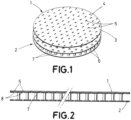
- the dressing for negative pressure therapy described is made up of a multilayer structure, which in its first preferred embodiment comprises a first layer (1) and a second layer (2), linked together by their respective perimeter edges, as shown in figure 1 .
- the first layer (1) consists of a laminar body with a first inner face (3), which is intended to face inwards and face the second layer (2), and a first outer face (4), which is intended to face outwards.
- the laminar body also comprises a number of first through holes (5) uniformly distributed, which allow the passage of fluid through it, giving the first layer (1) a fenestrated character that allows an adequate distribution of a negative pressure.
- the second layer (2) has geometry and dimensions essentially similar to those of the first layer (1) and is made up of two lamellar bodies (6) solidly linked together by means of a plurality of tubular elements (7) uniformly distributed and inside which a gaseous fluid is housed and maintained at low pressure.
- the distribution of the tubular elements (7) is such that the mutual separation distance between two adjacent tubular elements (7) is equal to or greater than half their diametrical dimensions.
- the tubular elements (7) of essentially cylindrical geometry, are linked perpendicularly at each of their ends to the respective lamellar bodies (6).
- Each of the lamellar bodies (6) incorporates a plurality of second through holes (8) that allow the passage of fluid through them, giving the second layer (2) a fenestrated character that contributes to allow an adequate distribution of negative pressure.
- Said second through holes (8) which in this preferred embodiment have an essentially rhomboidal geometry, are evenly distributed in each laminar body (6) and so that they are adjacent to, but not coincident with, the inserts of the tubular elements, as illustrated in the detail of figure 2 .
- Figure 2 also shows that the first layer (1) and the second layer (2) overlap each other so that the first (5) and second through holes (8) face each other, creating channels that allow the passage of negative pressure between two opposite sides of the dressing.
- the dressing additionally comprises a third layer (9) of geometry and dimensions essentially similar to those of the first layer (1) and the second layer (2).
- This second preferred embodiment is intended for application to light and superficial wounds and for protection of abdominal viscera.
- the third layer (9) is made up of a laminar body with a second inner face (10), which is intended to face inwards and face the second layer (2), and a second outer face (11).
- the laminar body also comprises a plurality of third through holes (12) uniformly distributed, which allow the passage of fluid through it, giving the third layer (9) a fenestrated character that allows an adequate distribution of a negative pressure.
- Figure 3 also shows that the first layer (1), the second layer (2) and the third layer (9) overlap each other so that the first (5), second (8) and third through holes (12) face each other, creating channels that allow the passage of the negative pressure between two opposite sides of the dressing.
- the second through holes (8) have different geometries and dimensions, as shown in figure 3 .
- the dressing additionally comprises a fourth layer (13), with geometry and dimensions essentially similar to those of the first (1), second (2) and third (9) layers.
- the fourth layer (13) allows the dressing to function for wounds with infection and necrosis.
- the fourth layer (13) consists of a knitted fabric reinforced with a barbed thread sewn in the form of a spring, so as to allow the passage of fluids into the through holes (5), (8), (12).
- the fourth layer (13) thus described has a certain resistance to deformation exerted by the application of negative pressure.
- the fourth layer (13) is made of polypropylene and is less than 8 mm thick.
- the fourth layer (13) is placed directly over an infected wound, such that the first layer (1) is free to attach to a negative pressure therapy system.
- a negative pressure therapy system By applying negative pressure to the dressing, efficient and homogeneous drainage of wound fluids is achieved through the mesh of the fourth layer (13) and the through holes (5), (8), (12), as the tubular elements (7) allow the negative pressure therapy to be distributed in a homogeneous manner which also optimizes the drainage capacity.
- the bearded thread of the fourth layer (13) contributes to the maintenance of a fresh wound and the removal of necrotic tissue when the dressing is removed, facilitating faster and more efficient healing.
- Figures 6, 7 and 8 show a fourth preferred embodiment of the dressing, in which the fourth layer (13) consists of a sheet of porous foamed material, in this case polyurethane foam.
- This preferred embodiment incorporates a closure element (14) designed to keep the dressing in a rolled and encapsulated configuration, as shown in figure 8 .
- the closure element (1) can be either an element external to the dressing, such as a small adhesive strip or a suture thread, or an element of its own, such as a die-cut or a tongue and groove joint.
Landscapes
- Health & Medical Sciences (AREA)
- Animal Behavior & Ethology (AREA)
- Biomedical Technology (AREA)
- Heart & Thoracic Surgery (AREA)
- Vascular Medicine (AREA)
- Life Sciences & Earth Sciences (AREA)
- Engineering & Computer Science (AREA)
- General Health & Medical Sciences (AREA)
- Public Health (AREA)
- Veterinary Medicine (AREA)
- Media Introduction/Drainage Providing Device (AREA)
- External Artificial Organs (AREA)
- Materials For Medical Uses (AREA)
Applications Claiming Priority (2)
| Application Number | Priority Date | Filing Date | Title |
|---|---|---|---|
| ES202030820U ES1248484Y (es) | 2020-05-06 | 2020-05-06 | Aposito para terapias de presion negativa |
| PCT/ES2021/070302 WO2021224526A1 (fr) | 2020-05-06 | 2021-05-03 | Pansement pour thérapies par pression négative |
Publications (4)
| Publication Number | Publication Date |
|---|---|
| EP4147732A1 true EP4147732A1 (fr) | 2023-03-15 |
| EP4147732A4 EP4147732A4 (fr) | 2024-06-12 |
| EP4147732C0 EP4147732C0 (fr) | 2025-02-26 |
| EP4147732B1 EP4147732B1 (fr) | 2025-02-26 |
Family
ID=71109034
Family Applications (1)
| Application Number | Title | Priority Date | Filing Date |
|---|---|---|---|
| EP21798935.9A Active EP4147732B1 (fr) | 2020-05-06 | 2021-05-03 | Pansement pour thérapies par pression négative |
Country Status (4)
| Country | Link |
|---|---|
| US (1) | US20240000614A1 (fr) |
| EP (1) | EP4147732B1 (fr) |
| ES (1) | ES1248484Y (fr) |
| WO (1) | WO2021224526A1 (fr) |
Family Cites Families (18)
| Publication number | Priority date | Publication date | Assignee | Title |
|---|---|---|---|---|
| US4207885A (en) * | 1979-03-07 | 1980-06-17 | Carolon Company | Woven elastic compression bandage |
| FR2509169B1 (fr) * | 1981-07-10 | 1985-11-15 | Molinier Sa | Bande de contention elastique en tout sens |
| US5167613A (en) * | 1992-03-23 | 1992-12-01 | The Kendall Company | Composite vented wound dressing |
| WO1995025482A1 (fr) * | 1994-03-22 | 1995-09-28 | Organogenesis, Inc. | Tissus au collagene tridimensionnels bioremodelables |
| DE102006017194B4 (de) * | 2006-04-12 | 2010-11-04 | Birgit Riesinger | Flüssigkeitsdurchlässiger Primärverband |
| DE102009038131A1 (de) | 2009-08-12 | 2011-02-17 | ATMOS Medizin Technik GmbH & Co. KG | Am Körper eines Benutzers tragbare Vorrichtung zur Bereitstellung von Unterdruck für medizinische Anwendungen |
| EP2404557A1 (fr) * | 2010-07-06 | 2012-01-11 | Tornier, Inc. | Échafaudages à crans |
| EP2680800B1 (fr) * | 2011-03-03 | 2016-04-27 | Neodyne Biosciences, Inc. | Dispositifs permettant le resserrement de la peau |
| WO2013128606A1 (fr) * | 2012-03-01 | 2013-09-06 | アルケア株式会社 | Pansement |
| EP3157484B1 (fr) * | 2014-06-18 | 2020-02-26 | Smith & Nephew plc | Pansement |
| EP3305957B1 (fr) * | 2015-05-29 | 2021-01-06 | Kuraray Co., Ltd. | Feuille de fibres |
| CA3010496C (fr) * | 2016-01-06 | 2024-07-02 | Solventum Intellectual Properties Company | Systeme et procedes pour le traitement de plaies avec un pansement comportant des cellules fermees |
| WO2019027810A1 (fr) * | 2017-07-29 | 2019-02-07 | Lin Edward D | Appareil de traitement de plaie avec propriétés de modulation de cicatrice et procédés associés |
| CN107693213B (zh) * | 2017-11-06 | 2024-04-30 | 侯强 | 一种用于创面负压治疗的可降解敷料 |
| EP3706686B1 (fr) * | 2017-11-09 | 2023-06-07 | KCI Licensing, Inc. | Pansement multi-module et procédés de thérapie |
| ES1215290Y (es) * | 2018-06-06 | 2018-10-03 | Servicio Cantabro De Salud | Apósito protector de vísceras abdominales en terapia de presión negativa |
| US12239779B2 (en) * | 2019-04-08 | 2025-03-04 | Solventum Intellectual Properties Company | Low profile instillation and negative-pressure bridge |
| EP3986346B8 (fr) * | 2019-06-20 | 2024-03-20 | Solventum Intellectual Properties Company | Pansement à décoller et placer pour thérapie par pression négative |
-
2020
- 2020-05-06 ES ES202030820U patent/ES1248484Y/es active Active
-
2021
- 2021-05-03 EP EP21798935.9A patent/EP4147732B1/fr active Active
- 2021-05-03 WO PCT/ES2021/070302 patent/WO2021224526A1/fr not_active Ceased
- 2021-05-03 US US17/998,093 patent/US20240000614A1/en not_active Abandoned
Also Published As
| Publication number | Publication date |
|---|---|
| EP4147732C0 (fr) | 2025-02-26 |
| EP4147732A4 (fr) | 2024-06-12 |
| EP4147732B1 (fr) | 2025-02-26 |
| US20240000614A1 (en) | 2024-01-04 |
| WO2021224526A1 (fr) | 2021-11-11 |
| ES1248484U (es) | 2020-06-26 |
| ES1248484Y (es) | 2020-09-16 |
Similar Documents
| Publication | Publication Date | Title |
|---|---|---|
| EP4268775B1 (fr) | Appareil de distribution | |
| CN103370090B (zh) | 用于线状伤口的减压敷件、系统和方法 | |
| US11040127B2 (en) | Abdominal dressing with mechanism for fascial closure | |
| US8162909B2 (en) | Negative pressure wound treatment | |
| US20190175416A1 (en) | Multi-Layer Dressings, Systems, And Methods For Applying Reduced Pressure At A Tissue Site | |
| US8128615B2 (en) | Wound cleansing apparatus with scaffold | |
| CN103841935B (zh) | 组织愈合 | |
| US11446429B2 (en) | Systems and methods for managing pneumatic pathways in integrated multilayer wound dressings | |
| AU2016298176A1 (en) | Sub-atmospheric wound therapy systems and methods | |
| CN102470200A (zh) | 采用解凝固阻挡层的减压敷料、系统和方法 | |
| US12156788B2 (en) | Dressing with epithelialization and scar reduction feature | |
| EP4147732B1 (fr) | Pansement pour thérapies par pression négative | |
| EP3804674B1 (fr) | Timbre protecteur pour les viscères abdominaux dans la thérapie par pression négative | |
| HK1158123A (en) | Laminar dressings, systems, and methods for applying reduced pressure at a tissue site |
Legal Events
| Date | Code | Title | Description |
|---|---|---|---|
| STAA | Information on the status of an ep patent application or granted ep patent |
Free format text: STATUS: THE INTERNATIONAL PUBLICATION HAS BEEN MADE |
|
| PUAI | Public reference made under article 153(3) epc to a published international application that has entered the european phase |
Free format text: ORIGINAL CODE: 0009012 |
|
| STAA | Information on the status of an ep patent application or granted ep patent |
Free format text: STATUS: REQUEST FOR EXAMINATION WAS MADE |
|
| 17P | Request for examination filed |
Effective date: 20221104 |
|
| AK | Designated contracting states |
Kind code of ref document: A1 Designated state(s): AL AT BE BG CH CY CZ DE DK EE ES FI FR GB GR HR HU IE IS IT LI LT LU LV MC MK MT NL NO PL PT RO RS SE SI SK SM TR |
|
| DAV | Request for validation of the european patent (deleted) | ||
| DAX | Request for extension of the european patent (deleted) | ||
| A4 | Supplementary search report drawn up and despatched |
Effective date: 20240510 |
|
| RIC1 | Information provided on ipc code assigned before grant |
Ipc: A61F 13/00 20060101ALI20240503BHEP Ipc: A61M 1/00 20060101AFI20240503BHEP |
|
| GRAP | Despatch of communication of intention to grant a patent |
Free format text: ORIGINAL CODE: EPIDOSNIGR1 |
|
| STAA | Information on the status of an ep patent application or granted ep patent |
Free format text: STATUS: GRANT OF PATENT IS INTENDED |
|
| INTG | Intention to grant announced |
Effective date: 20241022 |
|
| GRAS | Grant fee paid |
Free format text: ORIGINAL CODE: EPIDOSNIGR3 |
|
| GRAA | (expected) grant |
Free format text: ORIGINAL CODE: 0009210 |
|
| STAA | Information on the status of an ep patent application or granted ep patent |
Free format text: STATUS: THE PATENT HAS BEEN GRANTED |
|
| AK | Designated contracting states |
Kind code of ref document: B1 Designated state(s): AL AT BE BG CH CY CZ DE DK EE ES FI FR GB GR HR HU IE IS IT LI LT LU LV MC MK MT NL NO PL PT RO RS SE SI SK SM TR |
|
| REG | Reference to a national code |
Ref country code: GB Ref legal event code: FG4D |
|
| REG | Reference to a national code |
Ref country code: CH Ref legal event code: EP |
|
| REG | Reference to a national code |
Ref country code: DE Ref legal event code: R096 Ref document number: 602021026861 Country of ref document: DE |
|
| REG | Reference to a national code |
Ref country code: IE Ref legal event code: FG4D |
|
| U01 | Request for unitary effect filed |
Effective date: 20250305 |
|
| U07 | Unitary effect registered |
Designated state(s): AT BE BG DE DK EE FI FR IT LT LU LV MT NL PT RO SE SI Effective date: 20250312 |
|
| U20 | Renewal fee for the european patent with unitary effect paid |
Year of fee payment: 5 Effective date: 20250409 |
|
| PG25 | Lapsed in a contracting state [announced via postgrant information from national office to epo] |
Ref country code: RS Free format text: LAPSE BECAUSE OF FAILURE TO SUBMIT A TRANSLATION OF THE DESCRIPTION OR TO PAY THE FEE WITHIN THE PRESCRIBED TIME-LIMIT Effective date: 20250526 |
|
| PG25 | Lapsed in a contracting state [announced via postgrant information from national office to epo] |
Ref country code: PL Free format text: LAPSE BECAUSE OF FAILURE TO SUBMIT A TRANSLATION OF THE DESCRIPTION OR TO PAY THE FEE WITHIN THE PRESCRIBED TIME-LIMIT Effective date: 20250226 |
|
| PG25 | Lapsed in a contracting state [announced via postgrant information from national office to epo] |
Ref country code: ES Free format text: LAPSE BECAUSE OF FAILURE TO SUBMIT A TRANSLATION OF THE DESCRIPTION OR TO PAY THE FEE WITHIN THE PRESCRIBED TIME-LIMIT Effective date: 20250226 |
|
| PG25 | Lapsed in a contracting state [announced via postgrant information from national office to epo] |
Ref country code: IS Free format text: LAPSE BECAUSE OF FAILURE TO SUBMIT A TRANSLATION OF THE DESCRIPTION OR TO PAY THE FEE WITHIN THE PRESCRIBED TIME-LIMIT Effective date: 20250626 Ref country code: NO Free format text: LAPSE BECAUSE OF FAILURE TO SUBMIT A TRANSLATION OF THE DESCRIPTION OR TO PAY THE FEE WITHIN THE PRESCRIBED TIME-LIMIT Effective date: 20250526 |
|
| PG25 | Lapsed in a contracting state [announced via postgrant information from national office to epo] |
Ref country code: HR Free format text: LAPSE BECAUSE OF FAILURE TO SUBMIT A TRANSLATION OF THE DESCRIPTION OR TO PAY THE FEE WITHIN THE PRESCRIBED TIME-LIMIT Effective date: 20250226 |
|
| PG25 | Lapsed in a contracting state [announced via postgrant information from national office to epo] |
Ref country code: GR Free format text: LAPSE BECAUSE OF FAILURE TO SUBMIT A TRANSLATION OF THE DESCRIPTION OR TO PAY THE FEE WITHIN THE PRESCRIBED TIME-LIMIT Effective date: 20250527 |
|
| PG25 | Lapsed in a contracting state [announced via postgrant information from national office to epo] |
Ref country code: SM Free format text: LAPSE BECAUSE OF FAILURE TO SUBMIT A TRANSLATION OF THE DESCRIPTION OR TO PAY THE FEE WITHIN THE PRESCRIBED TIME-LIMIT Effective date: 20250226 |
|
| PG25 | Lapsed in a contracting state [announced via postgrant information from national office to epo] |
Ref country code: CZ Free format text: LAPSE BECAUSE OF FAILURE TO SUBMIT A TRANSLATION OF THE DESCRIPTION OR TO PAY THE FEE WITHIN THE PRESCRIBED TIME-LIMIT Effective date: 20250226 |
|
| PG25 | Lapsed in a contracting state [announced via postgrant information from national office to epo] |
Ref country code: SK Free format text: LAPSE BECAUSE OF FAILURE TO SUBMIT A TRANSLATION OF THE DESCRIPTION OR TO PAY THE FEE WITHIN THE PRESCRIBED TIME-LIMIT Effective date: 20250226 |
|
| U1N | Appointed representative for the unitary patent procedure changed after the registration of the unitary effect |
Representative=s name: HERRERO & ASOCIADOS, S.L.; ES |
|
| REG | Reference to a national code |
Ref country code: CH Ref legal event code: H13 Free format text: ST27 STATUS EVENT CODE: U-0-0-H10-H13 (AS PROVIDED BY THE NATIONAL OFFICE) Effective date: 20251223 |
|
| PLBE | No opposition filed within time limit |
Free format text: ORIGINAL CODE: 0009261 |
|
| STAA | Information on the status of an ep patent application or granted ep patent |
Free format text: STATUS: NO OPPOSITION FILED WITHIN TIME LIMIT |
|
| PG25 | Lapsed in a contracting state [announced via postgrant information from national office to epo] |
Ref country code: CH Free format text: LAPSE BECAUSE OF NON-PAYMENT OF DUE FEES Effective date: 20250531 |
|
| GBPC | Gb: european patent ceased through non-payment of renewal fee |
Effective date: 20250526 |
|
| PG25 | Lapsed in a contracting state [announced via postgrant information from national office to epo] |
Ref country code: MC Free format text: LAPSE BECAUSE OF FAILURE TO SUBMIT A TRANSLATION OF THE DESCRIPTION OR TO PAY THE FEE WITHIN THE PRESCRIBED TIME-LIMIT Effective date: 20250226 |
|
| 26N | No opposition filed |
Effective date: 20251127 |
|
| PG25 | Lapsed in a contracting state [announced via postgrant information from national office to epo] |
Ref country code: GB Free format text: LAPSE BECAUSE OF NON-PAYMENT OF DUE FEES Effective date: 20250526 |
|
| PG25 | Lapsed in a contracting state [announced via postgrant information from national office to epo] |
Ref country code: IE Free format text: LAPSE BECAUSE OF NON-PAYMENT OF DUE FEES Effective date: 20250503 |
|
| U20 | Renewal fee for the european patent with unitary effect paid |
Year of fee payment: 6 Effective date: 20260320 |