EP4148830B1 - Matériau actif d'électrode positive, plaque d'électrode positive, batterie secondaire au lithium-ion et appareil - Google Patents
Matériau actif d'électrode positive, plaque d'électrode positive, batterie secondaire au lithium-ion et appareil Download PDFInfo
- Publication number
- EP4148830B1 EP4148830B1 EP22201510.9A EP22201510A EP4148830B1 EP 4148830 B1 EP4148830 B1 EP 4148830B1 EP 22201510 A EP22201510 A EP 22201510A EP 4148830 B1 EP4148830 B1 EP 4148830B1
- Authority
- EP
- European Patent Office
- Prior art keywords
- positive electrode
- active material
- electrode active
- particle size
- lithium
- Prior art date
- Legal status (The legal status is an assumption and is not a legal conclusion. Google has not performed a legal analysis and makes no representation as to the accuracy of the status listed.)
- Active
Links
Images


Classifications
-
- H—ELECTRICITY
- H01—ELECTRIC ELEMENTS
- H01M—PROCESSES OR MEANS, e.g. BATTERIES, FOR THE DIRECT CONVERSION OF CHEMICAL ENERGY INTO ELECTRICAL ENERGY
- H01M4/00—Electrodes
- H01M4/02—Electrodes composed of, or comprising, active material
- H01M4/36—Selection of substances as active materials, active masses, active liquids
- H01M4/48—Selection of substances as active materials, active masses, active liquids of inorganic oxides or hydroxides
- H01M4/485—Selection of substances as active materials, active masses, active liquids of inorganic oxides or hydroxides of mixed oxides or hydroxides for inserting or intercalating light metals, e.g. LiTi2O4 or LiTi2OxFy
-
- C—CHEMISTRY; METALLURGY
- C01—INORGANIC CHEMISTRY
- C01G—COMPOUNDS CONTAINING METALS NOT COVERED BY SUBCLASSES C01D OR C01F
- C01G53/00—Compounds of nickel
- C01G53/40—Complex oxides containing nickel and at least one other metal element
- C01G53/42—Complex oxides containing nickel and at least one other metal element containing alkali metals, e.g. LiNiO2
- C01G53/44—Complex oxides containing nickel and at least one other metal element containing alkali metals, e.g. LiNiO2 containing manganese
- C01G53/50—Complex oxides containing nickel and at least one other metal element containing alkali metals, e.g. LiNiO2 containing manganese of the type (MnO2)n-, e.g. Li(NixMn1-x)O2 or Li(MyNixMn1-x-y)O2
-
- H—ELECTRICITY
- H01—ELECTRIC ELEMENTS
- H01M—PROCESSES OR MEANS, e.g. BATTERIES, FOR THE DIRECT CONVERSION OF CHEMICAL ENERGY INTO ELECTRICAL ENERGY
- H01M4/00—Electrodes
- H01M4/02—Electrodes composed of, or comprising, active material
- H01M4/36—Selection of substances as active materials, active masses, active liquids
- H01M4/48—Selection of substances as active materials, active masses, active liquids of inorganic oxides or hydroxides
- H01M4/52—Selection of substances as active materials, active masses, active liquids of inorganic oxides or hydroxides of nickel, cobalt or iron
- H01M4/525—Selection of substances as active materials, active masses, active liquids of inorganic oxides or hydroxides of nickel, cobalt or iron of mixed oxides or hydroxides containing iron, cobalt or nickel for inserting or intercalating light metals, e.g. LiNiO2, LiCoO2 or LiCoOxFy
-
- C—CHEMISTRY; METALLURGY
- C01—INORGANIC CHEMISTRY
- C01G—COMPOUNDS CONTAINING METALS NOT COVERED BY SUBCLASSES C01D OR C01F
- C01G53/00—Compounds of nickel
- C01G53/80—Compounds containing nickel, with or without oxygen or hydrogen, and containing one or more other elements
- C01G53/82—Compounds containing nickel, with or without oxygen or hydrogen, and containing two or more other elements
-
- H—ELECTRICITY
- H01—ELECTRIC ELEMENTS
- H01M—PROCESSES OR MEANS, e.g. BATTERIES, FOR THE DIRECT CONVERSION OF CHEMICAL ENERGY INTO ELECTRICAL ENERGY
- H01M10/00—Secondary cells; Manufacture thereof
- H01M10/05—Accumulators with non-aqueous electrolyte
- H01M10/052—Li-accumulators
- H01M10/0525—Rocking-chair batteries, i.e. batteries with lithium insertion or intercalation in both electrodes; Lithium-ion batteries
-
- H—ELECTRICITY
- H01—ELECTRIC ELEMENTS
- H01M—PROCESSES OR MEANS, e.g. BATTERIES, FOR THE DIRECT CONVERSION OF CHEMICAL ENERGY INTO ELECTRICAL ENERGY
- H01M4/00—Electrodes
- H01M4/02—Electrodes composed of, or comprising, active material
- H01M4/04—Processes of manufacture in general
- H01M4/0402—Methods of deposition of the material
- H01M4/0404—Methods of deposition of the material by coating on electrode collectors
-
- H—ELECTRICITY
- H01—ELECTRIC ELEMENTS
- H01M—PROCESSES OR MEANS, e.g. BATTERIES, FOR THE DIRECT CONVERSION OF CHEMICAL ENERGY INTO ELECTRICAL ENERGY
- H01M4/00—Electrodes
- H01M4/02—Electrodes composed of, or comprising, active material
- H01M4/13—Electrodes for accumulators with non-aqueous electrolyte, e.g. for lithium-accumulators; Processes of manufacture thereof
- H01M4/131—Electrodes based on mixed oxides or hydroxides, or on mixtures of oxides or hydroxides, e.g. LiCoOx
-
- H—ELECTRICITY
- H01—ELECTRIC ELEMENTS
- H01M—PROCESSES OR MEANS, e.g. BATTERIES, FOR THE DIRECT CONVERSION OF CHEMICAL ENERGY INTO ELECTRICAL ENERGY
- H01M4/00—Electrodes
- H01M4/02—Electrodes composed of, or comprising, active material
- H01M4/36—Selection of substances as active materials, active masses, active liquids
- H01M4/48—Selection of substances as active materials, active masses, active liquids of inorganic oxides or hydroxides
- H01M4/50—Selection of substances as active materials, active masses, active liquids of inorganic oxides or hydroxides of manganese
- H01M4/505—Selection of substances as active materials, active masses, active liquids of inorganic oxides or hydroxides of manganese of mixed oxides or hydroxides containing manganese for inserting or intercalating light metals, e.g. LiMn2O4 or LiMn2OxFy
-
- H—ELECTRICITY
- H01—ELECTRIC ELEMENTS
- H01M—PROCESSES OR MEANS, e.g. BATTERIES, FOR THE DIRECT CONVERSION OF CHEMICAL ENERGY INTO ELECTRICAL ENERGY
- H01M4/00—Electrodes
- H01M4/02—Electrodes composed of, or comprising, active material
- H01M4/64—Carriers or collectors
- H01M4/66—Selection of materials
- H01M4/665—Composites
- H01M4/667—Composites in the form of layers, e.g. coatings
-
- C—CHEMISTRY; METALLURGY
- C01—INORGANIC CHEMISTRY
- C01P—INDEXING SCHEME RELATING TO STRUCTURAL AND PHYSICAL ASPECTS OF SOLID INORGANIC COMPOUNDS
- C01P2004/00—Particle morphology
- C01P2004/51—Particles with a specific particle size distribution
-
- C—CHEMISTRY; METALLURGY
- C01—INORGANIC CHEMISTRY
- C01P—INDEXING SCHEME RELATING TO STRUCTURAL AND PHYSICAL ASPECTS OF SOLID INORGANIC COMPOUNDS
- C01P2004/00—Particle morphology
- C01P2004/60—Particles characterised by their size
- C01P2004/64—Nanometer sized, i.e. from 1-100 nanometer
-
- C—CHEMISTRY; METALLURGY
- C01—INORGANIC CHEMISTRY
- C01P—INDEXING SCHEME RELATING TO STRUCTURAL AND PHYSICAL ASPECTS OF SOLID INORGANIC COMPOUNDS
- C01P2004/00—Particle morphology
- C01P2004/80—Particles consisting of a mixture of two or more inorganic phases
- C01P2004/82—Particles consisting of a mixture of two or more inorganic phases two phases having the same anion, e.g. both oxidic phases
- C01P2004/84—Particles consisting of a mixture of two or more inorganic phases two phases having the same anion, e.g. both oxidic phases one phase coated with the other
-
- C—CHEMISTRY; METALLURGY
- C01—INORGANIC CHEMISTRY
- C01P—INDEXING SCHEME RELATING TO STRUCTURAL AND PHYSICAL ASPECTS OF SOLID INORGANIC COMPOUNDS
- C01P2006/00—Physical properties of inorganic compounds
- C01P2006/11—Powder tap density
-
- C—CHEMISTRY; METALLURGY
- C01—INORGANIC CHEMISTRY
- C01P—INDEXING SCHEME RELATING TO STRUCTURAL AND PHYSICAL ASPECTS OF SOLID INORGANIC COMPOUNDS
- C01P2006/00—Physical properties of inorganic compounds
- C01P2006/40—Electric properties
-
- H—ELECTRICITY
- H01—ELECTRIC ELEMENTS
- H01M—PROCESSES OR MEANS, e.g. BATTERIES, FOR THE DIRECT CONVERSION OF CHEMICAL ENERGY INTO ELECTRICAL ENERGY
- H01M10/00—Secondary cells; Manufacture thereof
- H01M10/05—Accumulators with non-aqueous electrolyte
- H01M10/052—Li-accumulators
-
- H—ELECTRICITY
- H01—ELECTRIC ELEMENTS
- H01M—PROCESSES OR MEANS, e.g. BATTERIES, FOR THE DIRECT CONVERSION OF CHEMICAL ENERGY INTO ELECTRICAL ENERGY
- H01M4/00—Electrodes
- H01M4/02—Electrodes composed of, or comprising, active material
- H01M2004/021—Physical characteristics, e.g. porosity, surface area
-
- H—ELECTRICITY
- H01—ELECTRIC ELEMENTS
- H01M—PROCESSES OR MEANS, e.g. BATTERIES, FOR THE DIRECT CONVERSION OF CHEMICAL ENERGY INTO ELECTRICAL ENERGY
- H01M4/00—Electrodes
- H01M4/02—Electrodes composed of, or comprising, active material
- H01M2004/026—Electrodes composed of, or comprising, active material characterised by the polarity
- H01M2004/028—Positive electrodes
-
- Y—GENERAL TAGGING OF NEW TECHNOLOGICAL DEVELOPMENTS; GENERAL TAGGING OF CROSS-SECTIONAL TECHNOLOGIES SPANNING OVER SEVERAL SECTIONS OF THE IPC; TECHNICAL SUBJECTS COVERED BY FORMER USPC CROSS-REFERENCE ART COLLECTIONS [XRACs] AND DIGESTS
- Y02—TECHNOLOGIES OR APPLICATIONS FOR MITIGATION OR ADAPTATION AGAINST CLIMATE CHANGE
- Y02E—REDUCTION OF GREENHOUSE GAS [GHG] EMISSIONS, RELATED TO ENERGY GENERATION, TRANSMISSION OR DISTRIBUTION
- Y02E60/00—Enabling technologies; Technologies with a potential or indirect contribution to GHG emissions mitigation
- Y02E60/10—Energy storage using batteries
Definitions
- This application belongs to the technical field of batteries, and specifically relates to a positive electrode active material, a positive electrode plate, a lithium-ion secondary battery, and an apparatus.
- Lithium-ion secondary batteries are a kind of rechargeable batteries, and mainly rely on the movement of lithium ions between a positive electrode and a negative electrode to work.
- the positive electrode active material provides lithium ions that move back and forth between the positive and negative electrodes for charging and discharging of the batteries. Therefore, the positive electrode active material is very important to the performance of the batteries.
- the nickel-cobalt-manganese ternary material has become a potential positive electrode active material for lithium-ion secondary batteries due to its unique advantages.
- the existing nickel-cobalt-manganese ternary material usually includes a relatively high content of cobalt, which can stabilize the structure of the material to meet the requirements for high cycle performance of secondary batteries.
- cobalt resource's reserves are scarce, so it is necessary to seek for a new nickel-cobalt-manganese ternary positive electrode active material with relatively low cobalt content but still high structural stability.
- Lithium-nickel-cobalt-manganese composite oxide positive electrode active materials are known for example from CN101847722 A , WO 2014/175191 A1 and CN 105 977 475 A .
- cobalt can stabilize the layered structure of a nickel-cobalt-manganese ternary positive electrode active material and improve the electronic conductivity of the material, thus structural stability and electronic conductivity of the positive electrode active material deteriorate seriously after the cobalt content is reduced, which ultimately damages cycle performance of batteries.
- the reduction of the cobalt content also disadvantageously reduces the powder compaction density of the positive electrode active material, which also deteriorates cycle performance of the batteries and even leads to a relatively low energy density of the batteries.
- the inventors have conducted a lot of research, aiming to enable the positive electrode active material to have low cobalt content and relatively high structural stability, electronic conductivity and powder compaction density, so as to obtain a lithium-ion secondary battery with relatively high cycle performance and energy density.
- a first aspect of the present application provides a positive electrode active material in accordance with claim 1.
- a second aspect of the present application provides a positive electrode plate, including a positive electrode current collector and a positive electrode active material layer disposed on the positive electrode current collector, wherein the positive electrode active material layer includes the positive electrode active material provided in the first aspect of the present application.
- a third aspect of the present application provides a lithium-ion secondary battery, including the positive electrode plate provided in the second aspect of the present application.
- a fourth aspect of the present application provides an apparatus, including the lithium-ion secondary battery described in the third aspect of the present application, wherein the lithium-ion secondary battery is used as a power source for the apparatus; and preferably, the apparatus includes a mobile device, an electric vehicle, an electric train, a satellite, a ship, and an energy storage system.
- the positive electrode active material provided by the present application satisfies the chemical formula Li 1+ x (Ni a Co b Mn c ) 1- d M d O 2- y A y with relatively low cobalt content, which reduces the use of high-priced cobalt materials. It is surprisingly found by the inventors of the present invention that the proportion of elements in the positive electrode active material satisfying the predetermined relationship mentioned above also ensures that the positive electrode active material has both relatively high structural stability and relatively high lithium ion and electron transport performance, which enables the positive electrode active material to have relatively high cycle life, thereby improving the cycle performance of lithium-ion secondary battery using such positive electrode active material.
- the full width at half maximum D FW of the interval particle size distribution curve of the positive electrode active material within the predetermined range enables the positive electrode active material to have an appropriate powder compaction density, which can improve the plate compaction density of the positive electrode plate using such positive electrode active material, thereby further improving the cycle performance of the battery and enabling the battery to have a relatively high energy density.
- the battery module, the battery pack, and the apparatus of the present application include the lithium-ion secondary battery, and thus have at least the same advantages as the lithium-ion secondary battery.
- any lower limit may be combined with any upper limit to form an unspecified range; and any lower limit may be combined with other lower limits to form an unspecified range, and any upper limit may be combined with any other upper limit to form an unspecified range.
- each point or single value between the endpoints of the range is included in the range.
- each point or single value can be combined with any other point or single value as its own lower limit or upper limit or combined with other lower limit or upper limit to form a range that is not explicitly specified.
- the interval particle size distribution (also referred to as a differential distribution of particle size) curve of the positive electrode active material has a well-known meaning in the art. It is a curve drawn with the particle size as the abscissa and the volume percentage as the ordinate, and can relatively accurately reflect the particle size distribution characteristics of positive electrode active material particles.
- a laser particle size analyzer can be used for measuring the volume particle size distribution of the positive electrode active material and drawing the interval particle size distribution curve, for example, a Mastersizer 3000 laser particle size analyzer manufactured by Malvern Instruments Co., Ltd., UK.
- the full width at half maximum D FW herein refers to a difference between two particle size values corresponding to half of the maximum height of the interval particle size distribution curve.
- the positive electrode active material provided in the present application satisfies the chemical formula Li 1+ x (Ni a Co b Mn c ) 1- d M d O 2- y A y , indicating that the cobalt content in the positive electrode active material is relatively low, which reduces the use of high-priced cobalt materials. It is surprisingly found by the inventors of the present invention that the proportion of elements in the positive electrode active material satisfying the above-mentioned predetermined relationship can reduce disordered arrangement between lithium ions and transition metal ions and improve the order degree of positive ions in the layered structure, thereby ensuring that the positive electrode active material has relatively high structural stability.
- the positive electrode active material has a relatively high cycle life and can improve the cycle performance of lithium-ion secondary batteries. It is also found by the inventors that satisfying the above chemical formula also ensures that lithium ions and electrons have relatively high transport performance in the positive electrode active material particles, thereby further improving the cycle performance of batteries.
- the positive electrode active material has relatively high lithium ion and electron transport performance, can also improve the capacity performance of batteries, and enables the batteries to obtain relatively high rate performance and power performance.
- the full width at half maximum D FW of the interval particle size distribution curve of the positive electrode active material within a predetermined range can improve the powder compaction density of the positive electrode active material, and ensure that the positive electrode plate using the positive electrode active material has an appropriate plate compaction density, thereby further improving the cycle performance of batteries and enabling the batteries to have a relatively high energy density.
- a y indicates a relatively high nickel content therein, where a ⁇ 0.5.
- the positive electrode active material has a relatively high capacity per gram, which can improve the capacity performance and increase energy density of batteries.
- the positive electrode active material of the present application enables the lithium-ion secondary battery to have both good cycle performance and relatively high energy density.
- the lithium-ion secondary battery also has relatively high rate performance and power performance.
- the "cycle performance" mentioned in this specification includes normal temperature cycle performance and high temperature cycle performance.
- the high temperature as mentioned above is, for example, 40°C or more, or 60°C or more.
- the full width at half maximum D FW of the interval particle size distribution curve of the positive electrode active material may be 8 ⁇ m or less, 7.8 ⁇ m or less, 7.5 ⁇ m or less, 7.2 ⁇ m or less, 7 ⁇ m or less, 6.8 ⁇ m or less, 6.5 ⁇ m or less, 6.3 ⁇ m or less, or 6 ⁇ m or less, and may be 4 ⁇ m or more, 4.2 ⁇ m or more, 4.5 ⁇ m or more, 4.7 ⁇ m or more, 5 ⁇ m or more, 5.3 ⁇ m or more, 5.5 ⁇ m or more, 5.7 ⁇ m or more, or 5.8 ⁇ m or more.
- the interval particle size distribution curve of the positive electrode active material has a full width at half maximum D FW of from 4.5 ⁇ m to 7.5 ⁇ m, and more preferably from 5 ⁇ m to 7 ⁇ m. This can further increase the powder compaction density of the positive electrode active material, thereby further increasing the plate compaction density of the positive electrode plate and further increasing the energy density of the battery.
- the interval particle size distribution curve of the positive electrode active material is a unimodal curve.
- the positive electrode active material By doping the positive electrode active material with an M element, the structure of the positive electrode active material can be further stabilized, and the transport performance of lithium ions in the positive electrode active material particles can be improved, so that the cycle performance of the battery can be further improved.
- the doping of the M element in the positive electrode active material can further increase the crystal face activation energy of primary particles with low cobalt content and improve the crystal structure, which is conducive to optimizing the particle size and size distribution and improving the transport performance of electrons and lithium ions in the positive electrode active material, thereby further improving the cycle performance, rate performance, power performance and energy density of the lithium-ion secondary battery.
- M is one or more selected from Zr, Sr, B, Ti, Mg and Al. More preferably, M is one or more selected from Zr, Sr, B, Ti and A1. Especially preferably, M is one or more selected from Zr, Sr and B.
- the structural stability of the positive electrode active material can be further improved, thereby increasing the cycle life of the positive electrode active material, which is conducive to improving the cycle performance of the battery.
- A is one or more selected from S, N and F.
- the positive electrode active material according to the embodiment of the present application may include, for example, LiNi 0.55 Co 0.05 Mn 0.4 O 2 , LiNi 0.55 Co 0.1 Mn 0.35 O 2 , LiNi 0.55 Co 0.12 Mn 0.33 O 2 , LiNi 0.55 Co 0.15 Mn 0.3 O 2 , LiNi 0.6 CO 0.15 Mn 0.25 O 2 , LiNi 0.6 Co 0.18 Mn 0.22 O 2 , LiNi 065 Co 0.05 Mn 0.3 O 2 , LiNi 0.65 Co 0.09 Mn 0.2 eO 2 , LiNi 0.65 Co 0.12 Mn 0.23 O 2 , and LiNi 0.65 Co 0.15 Mn 0.2 O 2 , and may also be a positive electrode active material obtained after doping the above materials with the M element at the transition metal site, and/or doping the above materials with the A element at the oxygen site.
- the positive electrode active material has a particle size distribution D n 10 and a particle size distribution D v 50 preferably satisfying: D n 10 ⁇ 0.2 ⁇ m, and 2 ⁇ m ⁇ D v 50 ⁇ 7 ⁇ m. This ensures that the positive electrode active material has a relatively low content of fine particles, and can reduce the side reaction of an electrolyte on the surface of the positive electrode active material, inhibit gas production and reduce heat generation, thereby improving cycle performance and safety performance of the positive electrode active material and improving electrochemical performance of the positive electrode active material at a high temperature.
- the high temperature is, for example, 40°C or more, or 60°C or more.
- the reduction of the content of fine particles in the positive electrode active material is also conducive to lowering the interface resistance of the positive electrode active material, and inhibiting the agglomeration between material particles, thereby improving the rate performance and power performance of the battery.
- the positive electrode active material has a uniform particle distribution, and can have a relatively high powder compaction density, so that the positive electrode plate has a more uniform areal density and a higher compaction density, which can further improve the capacity performance and energy density of the lithium-ion secondary battery.
- the particle size distribution D n 10 and the particle size distribution D v 50 of the positive electrode active material within the above ranges can further improve the transport performance of lithium ions and electrons in the positive electrode active material particles, and reduce polarization of the battery, thereby improving the cycle performance, rate performance and power performance of the lithium-ion secondary battery.
- the particle size distributions of the positive electrode active material are preferably D n 10 ⁇ 1 ⁇ m, and 3 ⁇ m ⁇ D v 50 ⁇ 6 ⁇ m. This can better exert the above effects.
- the full width at half maximum D FW of the interval particle size distribution curve of the positive electrode active material and a particle size distribution D v 99 and a particle size distribution D v 10 of the positive electrode active material satisfy: 0.4 ⁇ D FW / (D v 99 - D v 10) ⁇ 1.2.
- the particle size distributions of the positive electrode active material satisfying the above relationship means that the particle size distributions of the positive electrode active material tend to be a normal distribution, the positive electrode active material contains a relatively low amount of fine particles and relatively large particles, and the particle size distributions of the particles are within preferred ranges. This can further improve the compaction density, capacity performance and power performance of the positive electrode active material, thereby further improving the cycle performance, rate performance, power performance and energy density of the lithium-ion secondary battery.
- the particle size distribution D v 99 and the particle size distribution D v 10 of the positive electrode active material satisfy: 7 ⁇ m ⁇ D v 99 ⁇ 15 ⁇ m, and 1 ⁇ m ⁇ D v 10 ⁇ 4 ⁇ m.
- the positive electrode active material has a specific surface area of preferably from 0.1 m 2 /g to 1.2 m 2 /g, and more preferably from 0.3 m 2 /g to 0.9 m 2 /g.
- the specific surface area of the positive electrode active material within the appropriate range enables the positive electrode active material to have both relatively high active specific surface area and relatively low oxidation activity of electrolyte on its suface, thereby increasing the capacity and cycle life of the positive electrode active material.
- the positive electrode active material includes dispersed primary particles.
- the dispersed primary particles indicate that these primary particles are separated and independent from each other, will not be agglomerated, and/or are composed of only 5 or less primary particles.
- these primary particles have a smooth surface morphology, fewer surface heteroatoms and functional groups, a relatively good crystal structure and a relatively high crystallinity. This can improve the transport performance of lithium ions and electrons in the positive electrode active material, reduce the side reaction of the electrolyte on particle surfaces, and increase the compaction density of the positive electrode active material, thereby improving the cycle performance, rate performance, power performance and energy density of battery.
- the dispersed primary particles have a number percentage of preferably 50% or more, 60% or more, or 70% or more in the positive electrode active material. This means that the positive electrode active material has relatively high structural stability during the charging and discharging cycle, and is unlikely to break, thereby improving the cycle performance of battery.
- the dispersed primary particles have a monodisperse particle size distribution.
- the term "monodisperse” represents a dispersion system in which the dispersed primary particles has a unimodal particle size distribution and most of particles have similar or equal particle sizes, and the particle size distribution is a normal distribution.
- the dispersed primary particles have a number percentage of 100% in the positive electrode active material, that is, all of particles of the positive electrode active material are the dispersed primary particles with a monodisperse particle size distribution.
- the positive electrode active material further includes secondary particles aggregated from a plurality of primary particles.
- the term "a plurality of” is, for example, 5 or more. That is, the positive electrode active material may be a mixed powder including dispersed primary particles and secondary particles.
- the positive electrode active material has better lithium ion and electron transport performance, which is conducive to the intercalation and deintercalation of lithium ions and electron migration, and the capacity performance of the positive electrode active material is improved, thereby increasing the energy density of lithium-ion secondary battery.
- the secondary particles have a number percentage of preferably from 5% to 50%, further from 10% to 30% in the positive electrode active material. This is conducive to improving the cycle performance, rate performance, power performance and energy density of battery.
- a ratio of particle sizes of the primary particles in the secondary particles to the secondary particles is preferably from 0.03 to 0.9, from 0.06 to 0.5, or from 0.1 to 0.35.
- the primary particles have a relatively good morphology, are less agglomerated, and have a relatively good crystal form and a relatively high crystallinity, which are beneficial to improving the cycle performance, rate performance and power performance of the positive electrode active material.
- the positive electrode active material can also achieve relatively high capacity performance, thereby increasing the energy density of battery.
- the positive electrode active material has a tap density of preferably from 1.6 g/cm 3 to 2.6 g/cm 3 .
- the positive electrode plate using the positive electrode active material can obtain a relatively high plate compaction density.
- the positive electrode active material has a compaction density of preferably from 3.0 g/cm 3 to 3.6 g/cm 3 , further from 3.1 g/cm 3 to 3.6 g/cm 3 under a pressure of 3 tons.
- the positive electrode active material has a relatively high compaction density, which can increase the plate compaction density of the positive electrode plate, so that the lithium-ion secondary battery has relatively high capacity performance and energy density.
- a surface of the positive electrode active material has a coating.
- the coating is preferably a coating including an X element oxide.
- the X element oxide is an inert oxide.
- the X element is one or more selected from trivalent elements and tetravalent elements.
- the surface of the positive electrode active material has a coating, which can further stabilize the structure of the positive electrode active material, reduce the oxidation activity of electrolyte on the surface of the material, reduce the side reaction of the electrolyte on the surface of the material, inhibit gas production, and reduce heat production, thereby improving the cycle performance and safety performance of battery.
- the X element preferably includes one or more of Zr, B, Ti, Al and Sn.
- the coating has a weight of from 0.01% to 1%, or from 0.03% to 1%, relative to a weight of the positive electrode active material before coating. This can ensure that the above good effects of the coating, and meanwhile ensure that the coated positive electrode active material has relatively high rate performance, power performance and capacity performance.
- the morphology of the positive electrode active material is one or more of spherical and quasi-spherical shapes. This is beneficial to enabling the positive electrode active material to obtain a relatively high compaction density, thereby increasing the energy density of the battery.
- the particle size distributions D n 10, D v 50, D v 99 and D v 10 of positive electrode active material all have well-known meanings in the art, wherein the particle size distribution D n 10 represents a particle size corresponding to 10% of the number distribution of the positive electrode active material particles; the particle size distribution D v 50, also referred to as an average particle size or a median particle size, represents a particle size corresponding to 50% of the volume distribution of the positive electrode active material particles; the particle size distribution D v 99 represents a particle size corresponding to 99% of the volume distribution of the positive electrode active material particles; the particle size distribution D v 10 represents a particle size corresponding to 10% of the volume distribution of the positive electrode active material particles.
- the particle size distributions can be measured by instruments and methods well-known in the art.
- the particle size distributions may be conveniently measured with a laser particle size analyzer, such as Mastersizer 3000 laser particle size analyzer of Malvern Instruments Co., Ltd., UK.
- the number percentages of the dispersed primary particles and the secondary particles in the positive electrode active material have well-known meanings in the art, and can be measured by instruments and methods known in the art, such as a scanning electron microscope (SEM).
- a method for testing the number percentage of the dispersed primary particles is: taking at least 10 SEM photos of different regions of a powder sample of positive electrode active material, counting the number of the dispersed primary particles and the number of overall positive electrode active material particles respectively, and calculating an average value, thus obtaining the number percentage of the dispersed primary particles in the positive electrode active material.
- the number percentage of the secondary particles in the positive electrode active material can also be tested.
- the specific surface area of the positive electrode active material has a well-known meaning in the art, and can be measured by instruments and methods known in the art.
- the specific surface area may be tested by nitrogen adsorption specific surface area analysis test and calculated by a BET (Brunauer Emmett Teller) method.
- the nitrogen adsorption specific surface area analysis test may be performed by Tri Star II specific surface and pore analyzer of Micromeritics, USA.
- the tap density of the positive electrode active material can be measured by instruments and methods known in the art, for example, it may be conveniently measured by a tap density tester, such as FZS4-4B type tap density tester.
- the compaction density of the positive electrode active material can be measured by instruments and methods known in the art, for example, it may be conveniently measured by an electronic pressure tester, such as UTM7305 electronic pressure tester.
- a method for preparing a positive electrode active material by which the above-mentioned positive electrode active material can be prepared.
- the method comprises:
- the positive electrode active material precursor may be one or more of oxides or hydroxides containing Ni, Co and Mn at a stoichiometric ratio, such as [Ni a Co b Mn c ](OH) 2 .
- the positive electrode active material precursor may be prepared by a co-precipitation method, a gel method or a solid phase method.
- a method for preparing the positive electrode active material precursor includes the following steps:
- the Ni source is selected from a soluble nickel salt.
- the nickel salt may be one or more selected from nickel sulfate, nickel nitrate, nickel chloride, nickel oxalate, and nickel acetate, for example, one or more selected from nickel sulfate and nickel nitrate, such as nickel sulfate.
- the Co source is selected from a soluble cobalt salt.
- the cobalt salt may be one or more selected from cobalt sulfate, cobalt nitrate, cobalt chloride, cobalt oxalate and cobalt acetate, for example, one or more selected from cobalt sulfate and cobalt nitrate, such as cobalt sulfate.
- the Mn source is selected from a soluble manganese salt.
- the manganese salt may be one or more selected from manganese sulfate, manganese nitrate, manganese chloride, manganese oxalate and manganese acetate, for example, one or more selected from manganese sulfate and manganese nitrate, such as manganese sulfate.
- the solvent may be one or more selected from water, methanol, ethanol, acetone, isopropanol and n-hexanol, wherein the water may include one or more of deionized water, distilled water, mineral water and tap water, such as deionized water.
- the concentration of the mixed solution has a concentration of from 1.5 mol/L to 3.5 mol/L, for example, from 2.0 mol/L to 2.9 mol/L.
- the pH value of the mixed solution may be adjusted to from 10 to 12.
- the reaction system can be formed by adding a precipitant and a complexing agent to the mixed solution, the concentration of the complexing agent and the concentration of the precipitant in the reaction system may be adjusted, and the pH value of the reaction system may be adjusted to from 10 to 12 for co-precipitation reaction, thus obtaining the positive electrode active material precursor, such as [Ni a Co b Mn c ](OH) 2 .
- the precipitant may be one or more selected from LiOH, NaOH and KOH, such as NaOH. Further, the precipitant may be in the form of a solution. Solvent in the solution may be one or more selected from water, methanol, ethanol, acetone, isopropanol and n-hexanol. The mentioned water may include one or more of deionized water, distilled water, mineral water and tap water, such as deionized water. There is no special restriction on the concentration of the precipitant solution, and it can be determined according to actual needs.
- the complexing agent may be one or more selected from ammonia water, ammonium sulfate, ammonium nitrate, ammonium chloride, ammonium citrate, and ethylenediamine tetraacetic acid disodium salt (EDTA). Further, the complexing agent may be in the form of a solution. Solvent in the solution may be one or more selected from water, methanol, ethanol, acetone, isopropanol and n-hexanol. The mentioned water may include one or more of deionized water, distilled water, mineral water and tap water, such as deionized water.
- the complexing agent is ammonia water.
- concentration of the ammonia water there is no special restriction on the concentration of the ammonia water, and it can be selected according to actual needs.
- the ammonia water has a concentration of from 0.1 mol/L to 2 mol/L, further from 0.3 mol/L to 1.5 mol/L, and still further from 0.5 mol/L to 1 mol/L.
- the reaction temperature in step S120 may be from 40°C to 70°C, further from 45°C to 65°C, and still further from 50°C to 60°C.
- step S120 the reaction is carried out under an inert gas protective atmosphere with continuous stirring.
- the inert gas is, for example, one or more selected from nitrogen, argon, and helium.
- the stirring speed is, for example, from 100 rpm to 800 rpm.
- the term "rpm" means revolutions per minute, representing number of revolutions of a stirring device per minute.
- washing agent when the co-precipitation reaction product is washed, there is no special restriction on washing agent, and it can be selected according to actual needs.
- deionized water is used for washing.
- the number of washing times is not specially limited, as long as residual ions on the surface of the reaction product can be washed away.
- the temperature and method of drying are not specially limited, and can be selected according to actual needs.
- the temperature of drying is from 100°C to 150°C.
- the lithium source may be one or more selected from lithium oxide (Li 2 O), lithium phosphate (Li 3 PO 4 ), lithium dihydrogen phosphate (LiH 2 PO 4 ), lithium acetate (CH 3 COOLi), lithium hydroxide (LiOH), lithium carbonate (Li 2 CO 3 ) and lithium nitrate (LiNOs). Further, the lithium source is one or more selected from lithium carbonate, lithium hydroxide and lithium nitrate. Furthermore, the lithium source is lithium carbonate.
- the M source may be one or more selected from oxides, nitrate compounds, carbonate compounds, hydroxides, and acetate compounds containing M element.
- the M source is selected from, for example, oxides containing M element.
- the M source is one or more selected from magnesium oxide, strontium oxide, titanium oxide, tin oxide, zirconium oxide, aluminum oxide and boron oxide; for example, one or more selected from magnesium oxide, strontium oxide, titanium oxide, zirconium oxide, aluminum oxide and boron oxide; for another example, one or more selected from strontium oxide, titanium oxide, zirconium oxide, aluminum oxide and boron oxide; for still another example, one or more selected from zirconium oxide, strontium oxide and boron oxide.
- the A source may be selected according to actual needs.
- the A source may be one or more selected from ammonium fluoride, lithium fluoride, hydrogen fluoride, ammonium chloride, lithium chloride, hydrogen chloride, ammonium bromide, lithium bromide, hydrogen bromide, ammonium iodide, lithium iodide, hydrogen iodide, hydrogen sulfide, lithium sulfide and ammonium sulfide.
- the amount of the M source added is, for example, from 0.03% to 1.5% of the total weight of the positive electrode active material precursor and the lithium source before the addition.
- the atmosphere for sintering is an oxygen-containing atmosphere, for example, an air atmosphere or an oxygen atmosphere.
- the sintering temperature may be from 820°C to 1000°C, further from 850°C to 1000°C, and still further from 900°C to 1000°C.
- the way of crushing is not particularly limited, and can be selected according to actual needs, for example, using a particle crusher.
- the finally obtained positive electrode active material can have the particle size distribution described above.
- the active material precursor has an average particle size D v 50 of from 3 ⁇ m to 6 ⁇ m, for example, from 4 ⁇ m to 6 ⁇ m.
- the tempering temperature may be from 400°C to 900°C, for example, from 400°C to 800°C, further from 400°C to 700°C, still further from 450°C to 600°C, and furthermore from 500°C to 600°C.
- the method further includes step S400 of coating the active material precursor with an X element oxide.
- the positive electrode active material obtained in these embodiments has a coating comprising an X element oxide on its surface.
- the X element oxide may be one or more selected from aluminum oxide, tin oxide, zirconium oxide, boron oxide and titanium oxide.
- the adding amount of the X element oxide is, for example, from 0.01% to 1%, or from 0.03% to 1% of the weight of the material before coating.
- the coating can be carried out by using methods and devices known in the art, such as dry coating, liquid coating method, or vapor deposition coating.
- the positive electrode active material provided by the embodiments of the present application is easy to prepare, easy to implement, and low in cost, and can be applied to industrial production on a large scale.
- the second aspect of the present application provides a positive electrode plate.
- the positive electrode plate comprises any one or more of the positive electrode active materials according to the first aspect of the present application.
- the positive electrode plate of the present application adopts the positive electrode active material according to the first aspect of the present application, the positive electrode plate can simultaneously have good cycle performance, rate performance and power performance, and relatively high energy density.
- the positive electrode plate comprises a positive electrode current collector and a positive electrode active material layer disposed on at least one surface of the positive electrode current collector.
- the positive electrode current collector has two opposite surfaces in its thickness direction, and the positive electrode active material layer is laminated on either or both of the two surfaces of the positive electrode current collector.
- the positive electrode active material layer includes any one or more of the positive electrode active materials according to the first aspect of the present application.
- the positive electrode active material layer may further comprise a conductive agent and/or a binder.
- a conductive agent is one or more selected from graphite, superconducting carbon, acetylene black, carbon black, Ketjen black, carbon dots, carbon nanotubes, graphene, and carbon nanofibers.
- the binder is one or more selected from styrene-butadiene rubber (SBR), water-based acrylic resin, sodium carboxymethyl cellulose (CMC), polyvinylidene fluoride (PVDF), polytetrafluoroethylene (PTFE), polyvinyl butyral (PVB), ethylene-vinyl acetate copolymer (EVA), and polyvinyl alcohol (PVA).
- SBR styrene-butadiene rubber
- CMC sodium carboxymethyl cellulose
- PVDF polyvinylidene fluoride
- PVDF polytetrafluoroethylene
- PVB polyvinyl butyral
- EVA ethylene-vinyl acetate copolymer
- PVA polyvinyl alcohol
- the positive electrode current collector may be a metal foil or a porous metal plate, and its material may be one or more of aluminum, copper, nickel, titanium, silver, and respective alloys thereof.
- the positive electrode current collector is, for example, an aluminum foil
- the positive electrode plate may be prepared according to conventional methods in the art. For example, a positive electrode active material, a conductive agent and a binder are dispersed in a solvent which may be N-methyl pyrrolidone (NMP) to form a uniform positive electrode slurry, the positive electrode slurry is applied on a positive electrode current collector, followed by the process including drying, rolling etc., a positive electrode plate is obtained.
- NMP N-methyl pyrrolidone
- the third aspect of the present application provides a lithium-ion secondary battery.
- the lithium-ion battery comprises a positive electrode plate, a negative electrode plate, a separator and an electrolyte, wherein the positive electrode plate is the one according to the second aspect of the present application.
- the lithium-ion secondary battery of the present application can simultaneously have good cycle performance, rate performance and power performance, and relatively high energy density.
- the negative electrode plate may be a metal lithium plate.
- the negative electrode plate may further include a negative electrode current collector and a negative electrode active material layer disposed on at least one surface of the negative electrode current collector.
- the negative electrode current collector has two opposite surfaces in its thickness direction, and the negative electrode active material layer is laminated on either or both of the two surfaces of the negative electrode current collector.
- the negative electrode active material layer includes a negative electrode active material.
- the negative electrode active material layer may further include a conductive agent and/or a binder.
- a conductive agent and/or a binder there is no specific limit on the types of the conductive agent and the binder in the negative electrode active material layer, which can be selected according to actual needs.
- the conductive agent is one or more selected from graphite, superconducting carbon, acetylene black, carbon black, Ketjen black, carbon dots, carbon nanotubes, graphene, and carbon nanofibers.
- the binder is one or more selected from styrene-butadiene rubber (SBR), polyvinylidene fluoride (PVDF), polytetrafluoroethylene (PTFE), polyvinyl butyral (PVB), water-based acrylic resin, and sodium carboxymethyl cellulose (CMC).
- SBR styrene-butadiene rubber
- PVDF polyvinylidene fluoride
- PTFE polytetrafluoroethylene
- PVB polyvinyl butyral
- water-based acrylic resin and sodium carboxymethyl cellulose (CMC).
- the negative electrode active material layer may further optionally include a thickener, such as sodium carboxymethyl cellulose (CMC).
- a thickener such as sodium carboxymethyl cellulose (CMC).
- the negative electrode current collector may be a metal foil or a porous metal plate, and its material may be one or more of copper, nickel, titanium, iron, and respective alloys thereof.
- the negative electrode current collector is, for example, a copper foil.
- the negative electrode plate may be prepared according to conventional methods in the art. For example, a negative electrode active material, a conductive agent, a binder and a thickener are dispersed in a solvent which may be N-methyl pyrrolidone (NMP) or deionized water, to form a uniform negative electrode slurry; the negative electrode slurry is applied on a negative electrode current collector, and the negative electrode plate is obtained after steps of drying, rolling, etc.
- NMP N-methyl pyrrolidone
- the electrolyte may be a solid electrolyte or an electrolyte solution.
- the electrolyte solution includes a solvent and a lithium salt dissolved in the solvent.
- the solvent may be a non-aqueous organic solvent, including, for example, one or more of ethylene carbonate (EC), propylene carbonate (PC), ethyl methyl carbonate (EMC), diethyl carbonate (DEC), dimethyl carbonate (DMC), dipropyl carbonate (DPC), methyl propyl carbonate (MPC), ethylene propyl carbonate (EPC), methyl formate (MF), methyl acetate (MA), ethyl acetate (EA), propyl acetate (PA), methyl propionate (MP), ethyl propionate (EP), propyl propionate (PP), methyl butyrate (MB) and ethyl butyrate (EB).
- the solvent preferably includes two or more of the above compounds.
- the lithium salt may be one or more selected from LiPF 6 (lithium hexafluorophosphate), LiBF 4 (lithium tetrafluoroborate), LiClO 4 (lithium perchlorate), LiAsF 6 (lithium hexafluoroarsenate), LiFSI (lithium bis(fluorosulfonyl)imide), LiTFSI (lithium bis(trifluoromethanesulphonyl)imide), LiTFS (lithium trifluoromethanesulfonate), LiDFOB (lithium difluoroborate), LiBOB (lithium bis(oxalate)borate), LiPO 2 F 2 (lithium difluorophosphate), LiDFOP (lithium difluorobisoxalate phosphate) and LiTFOP (lithium tetrafluorooxalate phosphate), for example, including one or more of LiPF 6 (lithium hexafluorophosphate), LiBF 4 (lithium tetraflu
- the electrolyte may optionally include other additives, such as one or more of vinylene carbonate (VC), vinyl ethylene carbonate (VEC), fluoroethylene carbonate (FEC), difluoroethylene carbonate (DFEC), trifluoromethyl ethylene carbonate (TFPC), succinonitrile (SN), adiponitrile (ADN), glutaronitrile (GLN), hexanetrinitrile (HTN), sulfonate cyclic quaternary ammonium salt, tris(trimethylsilane) phosphate (TMSP), and tris(trimethylsilane) borate (TMSB).
- VEC vinylene carbonate
- FEC fluoroethylene carbonate
- DFEC difluoroethylene carbonate
- TFPC trifluoromethyl ethylene carbonate
- succinonitrile SN
- ADN adiponitrile
- GNN glutaronitrile
- HN hexanetrinitrile
- the separator which may be any well-known porous separator with electrochemical stability and mechanical stability.
- the separator includes one or more of glass fibers, a non-woven fabric, polyethylene (PE), polypropylene (PP), and polyvinylidene fluoride (PVDF).
- the separator may be a single-layer or multi-layer film.
- the positive electrode plate and the negative electrode plate are laminated in an alternating mode, and the separator is disposed between the positive electrode plate and the negative electrode plate to separate the positive electrode plate and the negative electrode plate to obtain a battery cell.
- a winding step may also be used to obtain a battery cell.
- the battery cell is placed in a case, and the case is injected with the electrolyte and sealed to obtain a lithium-ion secondary battery.
- the fourth aspect of the present application relates to a battery module, including any one or more of the lithium-ion secondary batteries described in the third aspect of the present application.
- the number of the lithium-ion secondary batteries included in the battery module may be adjusted according to the application and capacity of the battery module.
- a plurality of lithium-ion secondary batteries 5 may be arranged sequentially in a length direction of the battery module 4. Hence, they may also be arranged in any other way. Further, the plurality of lithium-ion secondary batteries 5 may be fixed by fasteners.
- the battery module 4 may further include a case having a receiving space, and the plurality of lithium-ion secondary batteries 5 are included in the receiving space.
- the fifth aspect of the present application relates to a battery pack, including any one or more of the battery modules described in the fourth aspect of the present application. That is, the battery pack includes any one or more of the lithium-ion secondary batteries described in the third aspect of the present application.
- the number of the battery modules in the battery pack may be adjusted according to the application and capacity of the battery pack.
- the battery pack 1 may include a battery box and a plurality of battery modules 4 disposed in the battery box.
- the battery box includes an upper box body 2 and a lower box body 3.
- the upper box body 2 may cover the lower box body 3 to form a closed space for receiving the battery modules 4.
- the plurality of battery modules 4 may be arranged in the battery box in any manner.
- the sixth aspect of the present application relates to an apparatus, including any one or more of the lithium-ion secondary batteries described in the third aspect of the present application.
- the lithium-ion secondary battery may be used as a power source for the apparatus.
- the apparatus may be, but is not limited to, a mobile device (e.g., a mobile phone, a notebook computer, etc.), an electric vehicle (e.g., a pure electric vehicle, a hybrid electric vehicle, a plug-in hybrid electric vehicle, an electric bicycle, an electric scooter, an electric golf vehicle, an electric truck, etc.), an electric train, a ship, a satellite, an energy storage system, etc.
- a mobile device e.g., a mobile phone, a notebook computer, etc.
- an electric vehicle e.g., a pure electric vehicle, a hybrid electric vehicle, a plug-in hybrid electric vehicle, an electric bicycle, an electric scooter, an electric golf vehicle, an electric truck, etc.
- an electric train e.g., a ship, a satellite, an energy storage system, etc.
- Fig. 7 shows an apparatus including the lithium-ion secondary battery of the present application.
- the apparatus is a pure electric vehicle, a hybrid electric vehicle, or a plug-in hybrid electric vehicle.
- the lithium-ion secondary battery of the present application supplies power to the apparatus.
- the above-mentioned battery module, battery pack and apparatus include the lithium-ion secondary battery provided by the present application, and therefore have at least the same advantages as the lithium-ion secondary battery. Details are not described here again.
- Lithium carbonate Li 2 CO 3 , the positive electrode active material precursor Ni 0.55 Co 0.15 Mn 0.3 (OH) 2 and strontium oxide SrO were mixed mechanically.
- the d in the chemical formula of the positive electrode active material was 0.002.
- the mixture was put into a tube furnace, heated to 940°C at a program of 5°C/min in an air atmosphere, sintered for 13 h, then cooled to room temperature with the furnace, and crushed and graded to obtain an active material precursor with an average particle size D v 50 of 4.5 ⁇ m.
- the active material precursor was coated with aluminum oxide Al 2 O 3 , then tempered at a temperature of 550°C, and sieved to obtain an Al 2 O 3 -coated positive electrode active material CA1.
- the positive electrode active material (without coating) had a chemical formula of Li(Ni 0.55 Co 0.15 Mn 0.3 ) 0.998 Sr 0.002 O 2 .
- the coating had a weight of 0.02% relative to a weight of the positive electrode active material before coating step.
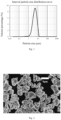
- the particle morphology of the positive electrode active material CA1 was tested with a scanning electron microscope (SEM), and the test results were shown in Fig. 2 , which showed a large number of dispersed primary particles with uniform morphology, compact structure and uniform distribution, and few agglomerated secondary particles.
- the ratio of particle sizes of the primary particles in the secondary particles to the secondary particles was from 0.15 to 0.21.
- the dispersed primary particles had a number percentage of 70%, and the secondary particles had a number percentage of 30%.
- the interval particle size distribution curve of the positive electrode active material CA1 was shown in Fig. 1 , where the full width at half maximum D FW was 6.2 ⁇ m.
- the positive electrode active material prepared above and a conductive carbon black SP and PVDF as a binder were dispersed in solvent NMP at a weight ratio of 181: 1 and mixed uniformly to obtain a positive electrode slurry; the positive electrode slurry was uniformly applied on an aluminum foil as a positive electrode current collector, and a positive electrode plate was obtained after drying and cold pressing.
- a metal lithium plate was used.
- Ethylene carbonate (EC), ethyl methyl carbonate (EMC) and diethyl carbonate (DEC) were mixed uniformly according to a mass ratio of 30: 30: 40 to obtain an organic solvent.
- LiPF 6 was dissolved in the solvent and mixed uniformly to obtain an electrolyte.
- the concentration of LiPF 6 in the electrolyte was 1 mol/L.
- the positive electrode plate, a PPIPEIPP composite separator and the negative electrode plate were laminated in order, and the above-mentioned electrolyte was added to complete the preparation of a button battery.
- Example 1 The differences from Example 1 were as follows in preparation steps of a positive electrode active material:
- the positive electrode active material CA2 included dispersed primary particles and a small amount of secondary particles.
- the ratio of particle sizes of the primary particles in the secondary particles to the secondary particles was from 0.1 to 0.19.
- the dispersed primary particles had a number percentage of 65%, and the secondary particles had a number percentage of 35%.
- the interval particle size distribution curve of the positive electrode active material CA2 had a full width at half maximum D FW of 6.5 ⁇ m.
- Example 1 The differences from Example 1 were as follows in preparation steps of a positive electrode active material:
- the positive electrode active material CA3 included dispersed primary particles and a small amount of secondary particles.
- the ratio of particle sizes of the primary particles in the secondary particles to the secondary particles was from 0.18 to 0.28.
- the dispersed primary particles had a number percentage of 82%, and the secondary particles had a number percentage of 18%.
- the interval particle size distribution curve of the positive electrode active material CA3 had a full width at half maximum D FW of 5.3 ⁇ m.
- Example 1 The differences from Example 1 were as follows in preparation steps of a positive electrode active material:
- a MgO-coated positive electrode active material CA4 was obtained.
- the chemical formula of the positive electrode active material (without coating) satisfied Li(Ni 0.55 Co 0.12 Mn 0.33 ) 0.998 Mg 0.002 O 2 .
- the positive electrode active material CA4 included dispersed primary particles and a small amount of secondary particles.
- the ratio of particle sizes of the primary particles in the secondary particles to the secondary particles was from 0.14 to 0.20.
- the dispersed primary particles had a number percentage of 90%, and the secondary particles had a number percentage of 10%.
- the interval particle size distribution curve of the positive electrode active material CA4 had a full width at half maximum D FW of 5.7 ⁇ m.
- Example 1 The differences from Example 1 were as follows in preparation steps of a positive electrode active material:
- the positive electrode active material CA5 included dispersed primary particles and a small amount of secondary particles.
- the ratio of particle sizes of the primary particles in the secondary particles to the secondary particles was from 0.03 to 0.12.
- the dispersed primary particles had a number percentage of 72%, and the secondary particles had a number percentage of 28%.
- the interval particle size distribution curve of the positive electrode active material CA5 had a full width at half maximum D FW of 7.4 ⁇ m.
- Example 1 The differences from Example 1 were as follows preparation steps of a positive electrode active material:
- the positive electrode active material CA6 included dispersed primary particles and a small amount of secondary particles.
- the ratio of particle sizes of the primary particles in the secondary particles to the secondary particles was 0.65 to 0.83.
- the dispersed primary particles had a number percentage of 80%, and the secondary particles had a number percentage of 20%.
- the interval particle size distribution curve of the positive electrode active material CA6 had a full width at half maximum D FW of 5.5 ⁇ m.
- Example 1 The differences from Example 1 were as follows in preparation steps of a positive electrode active material:
- the positive electrode active material CA7 included dispersed primary particles and a small amount of secondary particles.
- the ratio of particle sizes of the primary particles in the secondary particles to the secondary particles was 0.42 to 0.60.
- the dispersed primary particles had a number percentage of 70%, and the secondary particles had a number percentage of 30%.
- the interval particle size distribution curve of the positive electrode active material CA7 had a full width at half maximum D FW of 5.3 ⁇ m.
- Example 2 The differences from Example 1 were as follows in preparation steps of a positive electrode active material: 2) Preparation of a positive electrode active material
- the positive electrode active material CA8 had a lot of secondary particles.
- the ratio of particle sizes of the primary particles in the secondary particles to the secondary particles was 0.03 to 0.08.
- the dispersed primary particles had a number percentage of 15%, and the secondary particles had a number percentage of 85%.
- the interval particle size distribution curve of the positive electrode active material CA8 had a full width at half maximum D FW of 4.1 ⁇ m.
- Example 1 The differences from Example 1 were as follows in preparation steps of a positive electrode active material:
- the particle morphology of the positive electrode active material D1 was tested by SEM, showing that particles were severely agglomerated.
- the ratio of particle sizes of the primary particles in the secondary particles to the secondary particles was 0.005 to 0.01.
- the dispersed primary particles had a number percentage of 28%, and the secondary particles had a number percentage of 72%.
- the interval particle size distribution curve of the positive electrode active material D1 had a full width at half maximum D FW of 2.4 ⁇ m.
- Example 2 The differences from Example 1 were as follows in preparation steps of a positive electrode active material: 2) Preparation of a positive electrode active material
- the particle morphology of the positive electrode active material D2 was tested by SEM, showing agglomerated secondary particles with a relatively wide particle size distribution and basically no dispersed primary particles.
- the ratio of particle sizes of the primary particles in the secondary particles to the secondary particles was 0.003 to 0.006.
- the interval particle size distribution curve of the positive electrode active material D2 had a full width at half maximum D FW of 8.3 ⁇ m.
- Example 1 The test results of Examples 1 to 8 and Comparative Examples 1 and 2 were shown in Table 2.
- Table 1 D n 10 ( ⁇ m) D v 10 ( ⁇ m) D v 50 ( ⁇ m) D v 99 ( ⁇ m) Full width at half maximum D FW ( ⁇ m) D FW / (D v 99 - D v 10)
- Example 1 0.8 2.2 4.5 10.5 6.2 0.75
- Example 2 1.4 2.1 3.8 8.8 6.5 0.97
- Example 3 1.1 1.9 3.9 12.1 5.3 0.52
- Example 4 1.9 2.8 4.7 10.5 5.7 0.74
- Example 5 1.4 2.2 4.4 13.1 7.4 0.68
- Example 6 1.0 2.3 5.5 12.4 5.5 0.65
- Example 7 1.2 1.9 3.0 10.7 5.3 0.52
- Example 8 2.4 1.5 4.2 11.5 4.1 0.41 Comparative Example 1 3.4 4 5.5 9.6 2.4 0.43
- Comparative Example 2 1.4 2.5 6.1 15.8 8.3 0.62
- Table 2 Compaction density under
- the positive electrode active material prepared in Comparative Example 1 had a relatively low cobalt content, the severely agglomerated secondary particles in the material accounted for a relatively high proportion, the full width at half maximum D FW of the interval particle size distribution curve was too small, and the particle size distribution was too centralized; although the capacity per gram was relatively high and the DCR was relatively good, the powder compaction density of the positive electrode active material was low, and the capacity retention rate after high temperature cycles was relatively low, which were not conducive to improving the volume energy density, weight energy density and high temperature cycle performance of the battery.
- the cobalt content in the positive electrode active materials was relatively low, and meanwhile the proportion of elements in the chemical formula satisfied a predetermined relationship. This ensures that the positive electrode active material had relatively high structural stability; the full width at half maximum D FW of the interval particle size distribution curve of the positive electrode active material within a predetermined range ensures that the positive electrode plate using the positive electrode active material had a relatively high compaction density; meanwhile, the positive electrode active material had relatively high lithium ion and electron transport performance. Therefore, the lithium-ion secondary batteries using the positive electrode active materials had good cycle performance and power performance, and relatively high energy density.
Landscapes
- Chemical & Material Sciences (AREA)
- Chemical Kinetics & Catalysis (AREA)
- Electrochemistry (AREA)
- General Chemical & Material Sciences (AREA)
- Engineering & Computer Science (AREA)
- Inorganic Chemistry (AREA)
- Materials Engineering (AREA)
- Organic Chemistry (AREA)
- Manufacturing & Machinery (AREA)
- Composite Materials (AREA)
- Battery Electrode And Active Subsutance (AREA)
Claims (15)
- Matériau actif d'électrode positive, satisfaisant à une formule chimique Li1+x (Ni a Co b Mn c )1-d M d O2-y A y , dans lequel M est un ou plusieurs choisis parmi Zr, Sr, B, Ti, Mg, Sn et Al, A est un ou plusieurs choisis parmi S, N, F, Cl, Br et I, -0,01 ≤ x ≤ 0,2, a ≥ 0,5, 0,12 ≤ blc ≤ 0,9, 0,002 ≤ b × c/a 2 ≤ 0,23, a + b + c = 1, 0 ≤ d ≤ 0,1, et 0 ≤ y < 0,2; et
une courbe de distribution granulométrique dans un intervalle du matériau actif d'électrode positive a une largeur totale à mi-maximum DFW de 4 µm à 8 µm. - Matériau actif d'électrode positive selon la revendication 1, dans lequel le matériau actif d'électrode positive présente une distribution granulométrique Dn10 et une distribution granulométrique Dv50 satisfaisant à : Dn10 ≥ 0,2 µm, et 2 µm ≤ Dv50 ≤ 7 µm ;
de préférence, Dn10 ≥ 1 µm, et 3 µm ≤ Dv50 ≤ 6 µm. - Matériau actif d'électrode positive selon la revendication 1 ou 2, dans lequel la largeur totale à mi-maximum DFW de la courbe de distribution granulométrique dans un intervalle du matériau actif d'électrode positive et une distribution granulométrique Dv99 et une distribution granulométrique Dv10 du matériau actif d'électrode positive satisfont à : 0,4 ≤ DFW/ (Dv99 - Dv10) ≤ 1,2 ;
de préférence, 0,5 ≤ DFW/ (Dv99 - Dv10) ≤ 1,0. - Matériau actif d'électrode positive selon la revendication 3, dans lequel la distribution granulométrique Dv99 et la distribution granulométrique Dv10 du matériau actif d'électrode positive satisfont à : 7 µm ≤ Dv99 ≤ 15 µm, et 1 µm ≤ Dv10 ≤ 4 µm ;
de préférence, 8 µm ≤ Dv99 ≤ 13 µm, et 1,5 µm < Dv10 ≤ 2,5 µm. - Matériau actif d'électrode positive selon l'une quelconque des revendications 1 à 4, dans lequel le matériau actif d'électrode positive comprend des particules primaires dispersées, et les particules primaires dispersées représentent un pourcentage en nombre de 50 % ou plus, de préférence 70 % ou plus dans le matériau actif d'électrode positive, et de préférence les particules primaires dispersées présentent une distribution granulométrique monodispersée.
- Matériau actif d'électrode positive selon la revendication 5, dans lequel le matériau actif d'électrode positive comprend en outre des particules secondaires agrégées à partir d'une pluralité de particules primaires ;
les particules secondaires représentent un pourcentage en nombre de 5 % à 50 %, de préférence de 10 % à 30 % dans le matériau actif d'électrode positive. - Matériau actif d'électrode positive selon la revendication 6, dans lequel un rapport des tailles des particules des particules primaires dans les particules secondaires aux particules secondaires est de 0,03 à 0,9.
- Matériau actif d'électrode positive selon l'une quelconque des revendications 1 à 7, dans lequel le matériau actif d'électrode positive a une densité de tapotement de 1,6 g/cm3 à 2,6 g/cm3 ; et/ou,
le matériau actif d'électrode positive présente une densité tassée de poudre de 3,0 g/cm3 à 3,6 g/cm3, de préférence de 3,1 g/cm3 à 3,6 g/cm3 à une pression de 3 tonnes. - Matériau actif d'électrode positive selon l'une quelconque des revendications 1 à 8, dans lequel une surface du matériau actif d'électrode positive a un revêtement comprenant un oxyde d'élément X, l'élément X étant un ou plusieurs parmi un élément trivalent et un élément tétravalent, et l'élément X comprenant de préférence un ou plusieurs parmi Zr, B, Ti, Al et Sn.
- Matériau actif d'électrode positive selon la revendication 9, dans lequel le revêtement présente un poids de 0,01 % à 1 % ou de 0,03 % à 1 %, par rapport à un poids du matériau actif d'électrode positive exempt du revêtement.
- Matériau actif d'électrode positive selon l'une quelconque des revendications 1 à 10, dans lequel la courbe de distribution granulométrique dans un intervalle du matériau actif d'électrode positive a une largeur totale à mi-maximum DFW de 4,5 µm à 7,5 µm, et de préférence de 5 µm à 7 µm, et/ou
- Matériau actif d'électrode positive selon l'une quelconque des revendications 1 à 11, dans lequel le matériau actif d'électrode positive présente une surface spécifique de 0,1 m2/g à 1,2 m2/g, et de préférence de 0,3 m2/g à 0,9 m2/g.
- Plaque d'électrode positive, comprenant un collecteur de courant d'électrode positive et une couche de matériau actif d'électrode positive appliquée sur le collecteur de courant d'électrode positive, la couche de matériau actif d'électrode positive comprenant le matériau actif d'électrode positive selon l'une quelconque des revendications 1 à 12.
- Batterie secondaire au lithium-ion (5), comprenant la plaque d'électrode positive selon la revendication 13.
- Dispositif comprenant la batterie secondaire au lithium-ion (5) selon la revendication 14, dans lequel la batterie secondaire au lithium-ion (5) est utilisée comme source de puissance pour le dispositif ; et de préférence, le dispositif comprend un équipement mobile, un véhicule électrique, un train électrique, un satellite, un navire et un système de stockage d'énergie.
Applications Claiming Priority (3)
| Application Number | Priority Date | Filing Date | Title |
|---|---|---|---|
| CN201910350192.1A CN110518232B (zh) | 2019-04-28 | 2019-04-28 | 正极活性材料、正极极片及锂离子二次电池 |
| PCT/CN2019/121545 WO2020220662A1 (fr) | 2019-04-28 | 2019-11-28 | Matériau actif d'électrode positive, pôle d'électrode positive, batterie secondaire au lithium-ion et appareil |
| EP19926913.5A EP3951946B1 (fr) | 2019-04-28 | 2019-11-28 | Matériau actif d'électrode positive, plaque d'électrode positive, batterie secondaire au lithium-ion et dispositif |
Related Parent Applications (2)
| Application Number | Title | Priority Date | Filing Date |
|---|---|---|---|
| EP19926913.5A Division EP3951946B1 (fr) | 2019-04-28 | 2019-11-28 | Matériau actif d'électrode positive, plaque d'électrode positive, batterie secondaire au lithium-ion et dispositif |
| EP19926913.5A Division-Into EP3951946B1 (fr) | 2019-04-28 | 2019-11-28 | Matériau actif d'électrode positive, plaque d'électrode positive, batterie secondaire au lithium-ion et dispositif |
Publications (3)
| Publication Number | Publication Date |
|---|---|
| EP4148830A2 EP4148830A2 (fr) | 2023-03-15 |
| EP4148830A3 EP4148830A3 (fr) | 2023-04-05 |
| EP4148830B1 true EP4148830B1 (fr) | 2023-08-09 |
Family
ID=68622523
Family Applications (2)
| Application Number | Title | Priority Date | Filing Date |
|---|---|---|---|
| EP22201510.9A Active EP4148830B1 (fr) | 2019-04-28 | 2019-11-28 | Matériau actif d'électrode positive, plaque d'électrode positive, batterie secondaire au lithium-ion et appareil |
| EP19926913.5A Active EP3951946B1 (fr) | 2019-04-28 | 2019-11-28 | Matériau actif d'électrode positive, plaque d'électrode positive, batterie secondaire au lithium-ion et dispositif |
Family Applications After (1)
| Application Number | Title | Priority Date | Filing Date |
|---|---|---|---|
| EP19926913.5A Active EP3951946B1 (fr) | 2019-04-28 | 2019-11-28 | Matériau actif d'électrode positive, plaque d'électrode positive, batterie secondaire au lithium-ion et dispositif |
Country Status (5)
| Country | Link |
|---|---|
| US (3) | US12176534B2 (fr) |
| EP (2) | EP4148830B1 (fr) |
| CN (2) | CN110518232B (fr) |
| ES (1) | ES2934943T3 (fr) |
| WO (1) | WO2020220662A1 (fr) |
Families Citing this family (34)
| Publication number | Priority date | Publication date | Assignee | Title |
|---|---|---|---|---|
| CN110931772B (zh) | 2020-02-12 | 2020-06-19 | 湖南长远锂科股份有限公司 | 一种高功率型的锂离子电池用正极材料的制备方法 |
| CN111900380A (zh) * | 2020-08-10 | 2020-11-06 | 湖北融通高科先进材料有限公司 | 一种制备镍钴锰酸锂单晶三元材料的方法 |
| JP7599557B2 (ja) * | 2020-10-19 | 2024-12-13 | 寧徳新能源科技有限公司 | 正極およびそれを含む電気化学装置、並びに電子装置 |
| JP7461309B2 (ja) * | 2021-01-27 | 2024-04-03 | プライムプラネットエナジー&ソリューションズ株式会社 | 正極活物質層形成用材料および該正極活物質層形成用材料を用いた非水電解質二次電池 |
| JP7225284B2 (ja) | 2021-02-15 | 2023-02-20 | プライムプラネットエナジー&ソリューションズ株式会社 | 正極活物質および該正極活物質を用いた非水電解質二次電池 |
| CN113348570B (zh) * | 2021-02-23 | 2022-10-11 | 宁德新能源科技有限公司 | 电化学装置和电子装置 |
| CN115461896A (zh) * | 2021-03-19 | 2022-12-09 | 积水化学工业株式会社 | 非水电解质二次电池用正极、以及使用了该正极的非水电解质二次电池、电池模块和电池系统 |
| EP4187669B1 (fr) * | 2021-09-27 | 2025-01-08 | Contemporary Amperex Technology (Hong Kong) Limited | Batterie secondaire, module de batterie, bloc-batterie et appareil à consommation d'énergie |
| CN119297222B (zh) * | 2021-12-13 | 2026-02-10 | 宁德时代新能源科技股份有限公司 | 一种正极活性材料及其相关的极片、二次电池、电池模块、电池包和装置 |
| EP4273956A4 (fr) * | 2022-01-14 | 2024-07-10 | Contemporary Amperex Technology Co., Limited | Matériau ternaire monocristallin à faible teneur en cobalt et son procédé de préparation, batterie secondaire, bloc-batterie et dispositif électrique |
| CN119905664B (zh) * | 2022-03-31 | 2025-10-31 | 宁德新能源科技有限公司 | 一种电化学装置及包含其的电器 |
| CN115504518A (zh) * | 2022-09-15 | 2022-12-23 | 广东邦普循环科技有限公司 | 一种正极材料前驱体、正极材料及其制备方法和应用 |
| CN115483393A (zh) * | 2022-10-28 | 2022-12-16 | 欣旺达电动汽车电池有限公司 | 正极材料、二次电池和用电设备 |
| KR20240066903A (ko) * | 2022-11-08 | 2024-05-16 | 에스케이온 주식회사 | 리튬 이차전지용 양극 활물질 및 이를 포함하는 리튬 이차전지 |
| CN115939337B (zh) * | 2022-11-18 | 2024-12-06 | 欣旺达动力科技股份有限公司 | 一种正极活性材料、锂离子二次电池和用电设备 |
| CN115881892B (zh) * | 2022-11-22 | 2026-01-02 | 欣旺达动力科技股份有限公司 | 二次电池及用电设备 |
| WO2024113200A1 (fr) * | 2022-11-30 | 2024-06-06 | 宁德时代新能源科技股份有限公司 | Matériau actif d'électrode positive et son procédé de préparation, feuille d'électrode positive, batterie secondaire et appareil électrique |
| CN116830333B (zh) * | 2023-02-06 | 2024-08-09 | 宁德时代新能源科技股份有限公司 | 正极片、二次电池和用电装置 |
| EP4668366A1 (fr) * | 2023-02-15 | 2025-12-24 | Prologium Technology Co., Ltd. | Batterie secondaire lithium capable d'autoempoisonnement |
| CN118572050B (zh) * | 2023-02-28 | 2026-01-27 | 宁德时代新能源科技股份有限公司 | 正极活性材料、正极极片、二次电池和用电装置 |
| CN115911514B (zh) * | 2023-03-02 | 2023-05-05 | 中创新航科技集团股份有限公司 | 一种锂离子电池 |
| CN116314601A (zh) * | 2023-03-24 | 2023-06-23 | 欣旺达电动汽车电池有限公司 | 一种二次电池和用电设备 |
| CN116598475B (zh) * | 2023-06-15 | 2023-11-17 | 宁波容百新能源科技股份有限公司 | 一种正极材料及其制备方法和锂离子电池 |
| CN117525542A (zh) * | 2023-07-28 | 2024-02-06 | 宁德时代新能源科技股份有限公司 | 电池单体、电池和用电装置 |
| CN117423827A (zh) * | 2023-09-15 | 2024-01-19 | 宁波容百新能源科技股份有限公司 | 一种正极活性材料及其制备方法和锂离子电池 |
| CN116960276B (zh) * | 2023-09-20 | 2023-12-29 | 中创新航科技集团股份有限公司 | 一种正极极片、包含该正极极片的电化学装置和电子装置 |
| KR20250065253A (ko) * | 2023-11-03 | 2025-05-12 | 주식회사 엘지화학 | 양극 활물질, 이의 제조 방법, 및 이를 포함하는 양극 및 리튬 이차전지 |
| CN117254113B (zh) * | 2023-11-17 | 2024-04-02 | 宁德时代新能源科技股份有限公司 | 二次电池及用电装置 |
| CN120149387A (zh) * | 2023-12-11 | 2025-06-13 | 深圳市贝特瑞纳米科技有限公司 | 正极材料及正极浆料、锂离子电池 |
| CN117987920A (zh) * | 2023-12-29 | 2024-05-07 | 华友新能源科技(衢州)有限公司 | 金属氧化物前驱体及其制备方法和应用 |
| CN118507714B (zh) * | 2024-03-29 | 2025-10-31 | 比亚迪股份有限公司 | 正极活性材料、正极、二次电池及用电设备 |
| CN119812189B (zh) * | 2024-09-27 | 2025-12-16 | 比亚迪股份有限公司 | 正极极片、电池和用电设备 |
| CN120221638B (zh) * | 2025-05-28 | 2025-09-09 | 宁德时代新能源科技股份有限公司 | 电池单体、电池装置及用电装置 |
| CN121416427A (zh) * | 2025-12-29 | 2026-01-27 | 比亚迪股份有限公司 | 一种正极片及其制备方法、电池、电池组以及用电设备 |
Family Cites Families (35)
| Publication number | Priority date | Publication date | Assignee | Title |
|---|---|---|---|---|
| KR100531992B1 (ko) * | 2000-05-30 | 2005-12-02 | 세이미 케미칼 가부시끼가이샤 | 리튬 전이금속 복합산화물 |
| JP5034136B2 (ja) | 2000-11-14 | 2012-09-26 | 株式会社Gsユアサ | 非水電解質二次電池用正極活物質およびそれを用いた非水電解質二次電池 |
| KR100578877B1 (ko) | 2004-03-12 | 2006-05-11 | 삼성에스디아이 주식회사 | 리튬 이차 전지 |
| JP2008235157A (ja) * | 2007-03-23 | 2008-10-02 | Matsushita Electric Ind Co Ltd | リチウム二次電池用正極活物質 |
| CN101847722A (zh) * | 2009-03-26 | 2010-09-29 | 青岛新正锂业有限公司 | 高能锂离子电池正极材料及其制备方法 |
| US8871113B2 (en) * | 2010-03-31 | 2014-10-28 | Samsung Sdi Co., Ltd. | Positive active material, and positive electrode and lithium battery including positive active material |
| CN101947722B (zh) * | 2010-10-14 | 2012-07-04 | 攀钢集团钢铁钒钛股份有限公司 | 开坯机轧辊孔型加工方法 |
| JP5255143B2 (ja) * | 2011-09-30 | 2013-08-07 | 富士重工業株式会社 | 正極材料、これを用いたリチウムイオン二次電池、及び正極材料の製造方法 |
| WO2013063367A1 (fr) * | 2011-10-27 | 2013-05-02 | Infinite Power Solutions, Inc. | Fabrication d'une batterie à densité d'énergie élevée |
| CN102952878B (zh) * | 2012-09-28 | 2014-07-02 | 中国科学院过程工程研究所 | 一种鉴别正品玛咖、伪品玛咖及掺杂玛咖的its序列及方法 |
| WO2014175191A1 (fr) * | 2013-04-25 | 2014-10-30 | 旭硝子株式会社 | Composé composite, oxyde composite contenant du lithium et leurs procédés respectifs de production |
| JP6244713B2 (ja) * | 2013-07-24 | 2017-12-13 | 住友金属鉱山株式会社 | 非水電解質二次電池用正極活物質の製造方法 |
| US10236499B2 (en) * | 2013-07-26 | 2019-03-19 | Lg Chem, Ltd. | Polycrystalline lithium manganese oxide particles, preparation method thereof, and cathode active material including the same |
| WO2015049862A1 (fr) * | 2013-10-03 | 2015-04-09 | 株式会社Gsユアサ | Matière active d'électrode positive pour batterie secondaire au lithium ainsi que procédé de fabrication associé, électrode pour batterie secondaire au lithium, batterie secondaire au lithium, et dispositif d'accumulation |
| JP6108141B2 (ja) * | 2014-12-25 | 2017-04-05 | 住友化学株式会社 | リチウム二次電池用正極活物質、リチウム二次電池用正極、及びリチウム二次電池 |
| CN105185980A (zh) * | 2015-08-17 | 2015-12-23 | 上海电力学院 | 一种TiO2包覆的层状富锂三元正极材料的制备方法 |
| DE102015115691B4 (de) * | 2015-09-17 | 2020-10-01 | Zentrum für Sonnenenergie- und Wasserstoff-Forschung Baden-Württemberg Gemeinnützige Stiftung | Lithium-Nickel-Mangan-basierte Übergangsmetalloxidpartikel, deren Herstellung sowie deren Verwendung als Elektrodenmaterial |
| CN106935849B (zh) * | 2015-12-31 | 2019-12-20 | 比亚迪股份有限公司 | 一种锂离子电池正极材料及其制备方法 |
| CN110589898B (zh) * | 2016-01-14 | 2022-09-27 | 飞翼新能源公司 | 一种高镍正极材料及其制备方法 |
| CN105529457A (zh) * | 2016-02-24 | 2016-04-27 | 无锡凯力克能源材料有限公司 | 高压实3.7g/cm3 镍钴锰酸锂NCM523三元正极材料的工业化生产方法 |
| CN105990577B (zh) * | 2016-06-15 | 2019-07-19 | 电子科技大学 | 一种锂离子电池正极材料LiNi0.6-xCo0.2Mn0.2AlxO2-yFy及其制备方法 |
| CN105932321A (zh) * | 2016-06-20 | 2016-09-07 | 北京理工大学 | 一种掺杂型微米级单晶三元正极材料及其制备方法 |
| CN105977475A (zh) * | 2016-07-06 | 2016-09-28 | 中国科学院宁波材料技术与工程研究所 | 一种高容量锂离子电池正极材料及其制备和应用 |
| EP3490041A4 (fr) * | 2016-07-22 | 2020-01-08 | Umicore | Poudre d'oxyde métallique composite au lithium |
| CN107248576A (zh) * | 2017-06-22 | 2017-10-13 | 芜湖浙鑫新能源有限公司 | 一种低阳离子混排高镍球形锂离子电池正极材料及其制备方法 |
| JP6984202B2 (ja) * | 2017-07-12 | 2021-12-17 | 日産自動車株式会社 | 非水電解質二次電池の制御装置および制御方法、当該制御装置を有する非水電解質二次電池システム、並びに非水電解質二次電池の製造方法 |
| JP6965606B2 (ja) | 2017-07-12 | 2021-11-10 | 住友金属鉱山株式会社 | 非水系電解質二次電池用正極活物質前駆体、非水系電解質二次電池用正極活物質、非水系電解質二次電池用正極活物質前駆体の製造方法、非水系電解質二次電池用正極活物質の製造方法 |
| CN107572603A (zh) * | 2017-08-28 | 2018-01-12 | 浙江新时代海创锂电科技有限公司 | 一种小粒度球形ncm前驱体的制备方法 |
| KR102552140B1 (ko) * | 2017-10-13 | 2023-07-05 | 현대자동차주식회사 | 전고체 전지용 전극의 제조 방법 |
| CN108539138A (zh) | 2018-03-02 | 2018-09-14 | 广东邦普循环科技有限公司 | 一种锂离子正极材料及其制备方法与锂离子电池 |
| CN109037614B (zh) * | 2018-07-05 | 2021-06-11 | 佛山市德方纳米科技有限公司 | 一种高压实单晶镍钴锰三元材料及其制备方法 |
| CN109216697A (zh) * | 2018-07-31 | 2019-01-15 | 青海泰丰先行锂能科技有限公司 | 一种高镍大晶粒三元材料及其制备方法 |
| CN109461928B (zh) * | 2018-09-19 | 2020-11-13 | 北京当升材料科技股份有限公司 | 一种高能量密度多元正极材料及其制备方法 |
| CN109599537A (zh) * | 2018-10-23 | 2019-04-09 | 欣旺达电子股份有限公司 | 锂离子电池复合正极材料及其制备方法 |
| CN109686938B (zh) * | 2018-12-18 | 2021-02-09 | 中南大学 | 镁离子掺杂梯度镍钴锰酸锂正极材料及其制备方法 |
-
2019
- 2019-04-28 CN CN201910350192.1A patent/CN110518232B/zh active Active
- 2019-04-28 CN CN202011340288.9A patent/CN112436134B/zh active Active
- 2019-11-28 EP EP22201510.9A patent/EP4148830B1/fr active Active
- 2019-11-28 WO PCT/CN2019/121545 patent/WO2020220662A1/fr not_active Ceased
- 2019-11-28 ES ES19926913T patent/ES2934943T3/es active Active
- 2019-11-28 EP EP19926913.5A patent/EP3951946B1/fr active Active
-
2021
- 2021-10-28 US US17/512,702 patent/US12176534B2/en active Active
-
2023
- 2023-03-08 US US18/118,754 patent/US12300816B2/en active Active
-
2024
- 2024-11-22 US US18/957,107 patent/US20250087686A1/en active Pending
Also Published As
| Publication number | Publication date |
|---|---|
| CN112436134B (zh) | 2022-03-08 |
| EP4148830A3 (fr) | 2023-04-05 |
| US20230246184A1 (en) | 2023-08-03 |
| EP3951946A4 (fr) | 2022-06-15 |
| US20220052338A1 (en) | 2022-02-17 |
| EP3951946B1 (fr) | 2022-11-30 |
| US20250087686A1 (en) | 2025-03-13 |
| EP3951946A1 (fr) | 2022-02-09 |
| EP4148830A2 (fr) | 2023-03-15 |
| CN110518232A (zh) | 2019-11-29 |
| US12300816B2 (en) | 2025-05-13 |
| CN112436134A (zh) | 2021-03-02 |
| WO2020220662A1 (fr) | 2020-11-05 |
| US12176534B2 (en) | 2024-12-24 |
| ES2934943T3 (es) | 2023-02-28 |
| CN110518232B (zh) | 2020-12-15 |
Similar Documents
| Publication | Publication Date | Title |
|---|---|---|
| US12300816B2 (en) | Positive electrode active material, positive electrode plate, lithium-ion secondary battery, and apparatus | |
| US11760657B2 (en) | Positive electrode active material, method for preparation thereof, positive electrode plate, lithium-ion secondary battery and related battery module, battery pack and apparatus | |
| EP3933981B1 (fr) | Matériau actif d'électrode positive et son procédé de préparation correspondant, plaque d'électrode positive, batterie secondaire au lithium-ion, et module de batterie, bloc-batterie, et appareil contenant une telle batterie secondaire au lithium-ion | |
| US11417883B2 (en) | Positive electrode active material, preparation method thereof, positive electrode plate, lithium-ion secondary battery as well as battery module, battery pack and apparatus containing lithium-ion secondary battery | |
| EP3944379B1 (fr) | Matériau actif d'électrode positive, son procédé de préparation, plaque d'électrode positive, batterie secondaire au lithium-ion, et module de batterie, bloc-batterie et dispositif comprenant une batterie secondaire au lithium-ion | |
| US12338137B2 (en) | Positive electrode active material and preparation method thereof, positive electrode plate, lithium-ion secondary battery, and battery module, battery pack, and apparatus containing such lithium-ion secondary battery | |
| US12230810B2 (en) | Secondary battery and apparatus containing the same | |
| EP4131540A1 (fr) | Dispositif électrochimique et dispositif électronique le comprenant | |
| EP3885321A1 (fr) | Matériau actif positif et dispositif électrochimique le contenant | |
| EP3944377A1 (fr) | Substance active d'électrode positive, son procédé de préparation, plaque d'électrode positive, accumulateur lithium-ion et dispositif comprenant un accumulateur lithium-ion | |
| EP4672363A1 (fr) | Matériau actif d'électrode positive et son procédé de préparation, feuille d'électrode positive, batterie et appareil électrique | |
| WO2023122926A1 (fr) | Matériau précurseur ternaire, son procédé de préparation et son utilisation |
Legal Events
| Date | Code | Title | Description |
|---|---|---|---|
| PUAI | Public reference made under article 153(3) epc to a published international application that has entered the european phase |
Free format text: ORIGINAL CODE: 0009012 |
|
| STAA | Information on the status of an ep patent application or granted ep patent |
Free format text: STATUS: THE APPLICATION HAS BEEN PUBLISHED |
|
| PUAL | Search report despatched |
Free format text: ORIGINAL CODE: 0009013 |
|
| AC | Divisional application: reference to earlier application |
Ref document number: 3951946 Country of ref document: EP Kind code of ref document: P |
|
| AK | Designated contracting states |
Kind code of ref document: A2 Designated state(s): AL AT BE BG CH CY CZ DE DK EE ES FI FR GB GR HR HU IE IS IT LI LT LU LV MC MK MT NL NO PL PT RO RS SE SI SK SM TR |
|
| AK | Designated contracting states |
Kind code of ref document: A3 Designated state(s): AL AT BE BG CH CY CZ DE DK EE ES FI FR GB GR HR HU IE IS IT LI LT LU LV MC MK MT NL NO PL PT RO RS SE SI SK SM TR |
|
| RIC1 | Information provided on ipc code assigned before grant |
Ipc: C01G 53/00 20060101ALI20230224BHEP Ipc: H01M 4/485 20100101AFI20230224BHEP |
|
| STAA | Information on the status of an ep patent application or granted ep patent |
Free format text: STATUS: REQUEST FOR EXAMINATION WAS MADE |
|
| 17P | Request for examination filed |
Effective date: 20230412 |
|
| RBV | Designated contracting states (corrected) |
Designated state(s): AL AT BE BG CH CY CZ DE DK EE ES FI FR GB GR HR HU IE IS IT LI LT LU LV MC MK MT NL NO PL PT RO RS SE SI SK SM TR |
|
| GRAP | Despatch of communication of intention to grant a patent |
Free format text: ORIGINAL CODE: EPIDOSNIGR1 |
|
| STAA | Information on the status of an ep patent application or granted ep patent |
Free format text: STATUS: GRANT OF PATENT IS INTENDED |
|
| GRAS | Grant fee paid |
Free format text: ORIGINAL CODE: EPIDOSNIGR3 |
|
| INTG | Intention to grant announced |
Effective date: 20230602 |
|
| GRAA | (expected) grant |
Free format text: ORIGINAL CODE: 0009210 |
|
| STAA | Information on the status of an ep patent application or granted ep patent |
Free format text: STATUS: THE PATENT HAS BEEN GRANTED |
|
| AC | Divisional application: reference to earlier application |
Ref document number: 3951946 Country of ref document: EP Kind code of ref document: P |
|
| AK | Designated contracting states |
Kind code of ref document: B1 Designated state(s): AL AT BE BG CH CY CZ DE DK EE ES FI FR GB GR HR HU IE IS IT LI LT LU LV MC MK MT NL NO PL PT RO RS SE SI SK SM TR |
|
| REG | Reference to a national code |
Ref country code: GB Ref legal event code: FG4D |
|
| REG | Reference to a national code |
Ref country code: CH Ref legal event code: EP |
|
| REG | Reference to a national code |
Ref country code: IE Ref legal event code: FG4D |
|
| REG | Reference to a national code |
Ref country code: DE Ref legal event code: R096 Ref document number: 602019034915 Country of ref document: DE |
|
| P01 | Opt-out of the competence of the unified patent court (upc) registered |
Effective date: 20230908 |
|
| REG | Reference to a national code |
Ref country code: LT Ref legal event code: MG9D |
|
| REG | Reference to a national code |
Ref country code: NL Ref legal event code: MP Effective date: 20230809 |
|
| REG | Reference to a national code |
Ref country code: AT Ref legal event code: MK05 Ref document number: 1598554 Country of ref document: AT Kind code of ref document: T Effective date: 20230809 |
|
| PG25 | Lapsed in a contracting state [announced via postgrant information from national office to epo] |
Ref country code: GR Free format text: LAPSE BECAUSE OF FAILURE TO SUBMIT A TRANSLATION OF THE DESCRIPTION OR TO PAY THE FEE WITHIN THE PRESCRIBED TIME-LIMIT Effective date: 20231110 |
|
| PG25 | Lapsed in a contracting state [announced via postgrant information from national office to epo] |
Ref country code: IS Free format text: LAPSE BECAUSE OF FAILURE TO SUBMIT A TRANSLATION OF THE DESCRIPTION OR TO PAY THE FEE WITHIN THE PRESCRIBED TIME-LIMIT Effective date: 20231209 |
|
| PG25 | Lapsed in a contracting state [announced via postgrant information from national office to epo] |
Ref country code: SE Free format text: LAPSE BECAUSE OF FAILURE TO SUBMIT A TRANSLATION OF THE DESCRIPTION OR TO PAY THE FEE WITHIN THE PRESCRIBED TIME-LIMIT Effective date: 20230809 Ref country code: RS Free format text: LAPSE BECAUSE OF FAILURE TO SUBMIT A TRANSLATION OF THE DESCRIPTION OR TO PAY THE FEE WITHIN THE PRESCRIBED TIME-LIMIT Effective date: 20230809 Ref country code: PT Free format text: LAPSE BECAUSE OF FAILURE TO SUBMIT A TRANSLATION OF THE DESCRIPTION OR TO PAY THE FEE WITHIN THE PRESCRIBED TIME-LIMIT Effective date: 20231211 Ref country code: NO Free format text: LAPSE BECAUSE OF FAILURE TO SUBMIT A TRANSLATION OF THE DESCRIPTION OR TO PAY THE FEE WITHIN THE PRESCRIBED TIME-LIMIT Effective date: 20231109 Ref country code: NL Free format text: LAPSE BECAUSE OF FAILURE TO SUBMIT A TRANSLATION OF THE DESCRIPTION OR TO PAY THE FEE WITHIN THE PRESCRIBED TIME-LIMIT Effective date: 20230809 Ref country code: LV Free format text: LAPSE BECAUSE OF FAILURE TO SUBMIT A TRANSLATION OF THE DESCRIPTION OR TO PAY THE FEE WITHIN THE PRESCRIBED TIME-LIMIT Effective date: 20230809 Ref country code: LT Free format text: LAPSE BECAUSE OF FAILURE TO SUBMIT A TRANSLATION OF THE DESCRIPTION OR TO PAY THE FEE WITHIN THE PRESCRIBED TIME-LIMIT Effective date: 20230809 Ref country code: IS Free format text: LAPSE BECAUSE OF FAILURE TO SUBMIT A TRANSLATION OF THE DESCRIPTION OR TO PAY THE FEE WITHIN THE PRESCRIBED TIME-LIMIT Effective date: 20231209 Ref country code: HR Free format text: LAPSE BECAUSE OF FAILURE TO SUBMIT A TRANSLATION OF THE DESCRIPTION OR TO PAY THE FEE WITHIN THE PRESCRIBED TIME-LIMIT Effective date: 20230809 Ref country code: GR Free format text: LAPSE BECAUSE OF FAILURE TO SUBMIT A TRANSLATION OF THE DESCRIPTION OR TO PAY THE FEE WITHIN THE PRESCRIBED TIME-LIMIT Effective date: 20231110 Ref country code: FI Free format text: LAPSE BECAUSE OF FAILURE TO SUBMIT A TRANSLATION OF THE DESCRIPTION OR TO PAY THE FEE WITHIN THE PRESCRIBED TIME-LIMIT Effective date: 20230809 Ref country code: AT Free format text: LAPSE BECAUSE OF FAILURE TO SUBMIT A TRANSLATION OF THE DESCRIPTION OR TO PAY THE FEE WITHIN THE PRESCRIBED TIME-LIMIT Effective date: 20230809 |
|
| PG25 | Lapsed in a contracting state [announced via postgrant information from national office to epo] |
Ref country code: PL Free format text: LAPSE BECAUSE OF FAILURE TO SUBMIT A TRANSLATION OF THE DESCRIPTION OR TO PAY THE FEE WITHIN THE PRESCRIBED TIME-LIMIT Effective date: 20230809 |
|
| PG25 | Lapsed in a contracting state [announced via postgrant information from national office to epo] |
Ref country code: ES Free format text: LAPSE BECAUSE OF FAILURE TO SUBMIT A TRANSLATION OF THE DESCRIPTION OR TO PAY THE FEE WITHIN THE PRESCRIBED TIME-LIMIT Effective date: 20230809 |
|
| PG25 | Lapsed in a contracting state [announced via postgrant information from national office to epo] |
Ref country code: SM Free format text: LAPSE BECAUSE OF FAILURE TO SUBMIT A TRANSLATION OF THE DESCRIPTION OR TO PAY THE FEE WITHIN THE PRESCRIBED TIME-LIMIT Effective date: 20230809 Ref country code: RO Free format text: LAPSE BECAUSE OF FAILURE TO SUBMIT A TRANSLATION OF THE DESCRIPTION OR TO PAY THE FEE WITHIN THE PRESCRIBED TIME-LIMIT Effective date: 20230809 Ref country code: ES Free format text: LAPSE BECAUSE OF FAILURE TO SUBMIT A TRANSLATION OF THE DESCRIPTION OR TO PAY THE FEE WITHIN THE PRESCRIBED TIME-LIMIT Effective date: 20230809 Ref country code: EE Free format text: LAPSE BECAUSE OF FAILURE TO SUBMIT A TRANSLATION OF THE DESCRIPTION OR TO PAY THE FEE WITHIN THE PRESCRIBED TIME-LIMIT Effective date: 20230809 Ref country code: DK Free format text: LAPSE BECAUSE OF FAILURE TO SUBMIT A TRANSLATION OF THE DESCRIPTION OR TO PAY THE FEE WITHIN THE PRESCRIBED TIME-LIMIT Effective date: 20230809 Ref country code: CZ Free format text: LAPSE BECAUSE OF FAILURE TO SUBMIT A TRANSLATION OF THE DESCRIPTION OR TO PAY THE FEE WITHIN THE PRESCRIBED TIME-LIMIT Effective date: 20230809 Ref country code: SK Free format text: LAPSE BECAUSE OF FAILURE TO SUBMIT A TRANSLATION OF THE DESCRIPTION OR TO PAY THE FEE WITHIN THE PRESCRIBED TIME-LIMIT Effective date: 20230809 |
|
| REG | Reference to a national code |
Ref country code: DE Ref legal event code: R097 Ref document number: 602019034915 Country of ref document: DE |
|
| PG25 | Lapsed in a contracting state [announced via postgrant information from national office to epo] |
Ref country code: IT Free format text: LAPSE BECAUSE OF FAILURE TO SUBMIT A TRANSLATION OF THE DESCRIPTION OR TO PAY THE FEE WITHIN THE PRESCRIBED TIME-LIMIT Effective date: 20230809 |
|
| PLBE | No opposition filed within time limit |
Free format text: ORIGINAL CODE: 0009261 |
|
| STAA | Information on the status of an ep patent application or granted ep patent |
Free format text: STATUS: NO OPPOSITION FILED WITHIN TIME LIMIT |
|
| REG | Reference to a national code |
Ref country code: CH Ref legal event code: PL |
|
| PG25 | Lapsed in a contracting state [announced via postgrant information from national office to epo] |
Ref country code: MC Free format text: LAPSE BECAUSE OF FAILURE TO SUBMIT A TRANSLATION OF THE DESCRIPTION OR TO PAY THE FEE WITHIN THE PRESCRIBED TIME-LIMIT Effective date: 20230809 |
|
| PG25 | Lapsed in a contracting state [announced via postgrant information from national office to epo] |
Ref country code: LU Free format text: LAPSE BECAUSE OF NON-PAYMENT OF DUE FEES Effective date: 20231128 |
|
| 26N | No opposition filed |
Effective date: 20240513 |
|
| PG25 | Lapsed in a contracting state [announced via postgrant information from national office to epo] |
Ref country code: CH Free format text: LAPSE BECAUSE OF NON-PAYMENT OF DUE FEES Effective date: 20231130 |
|
| PG25 | Lapsed in a contracting state [announced via postgrant information from national office to epo] |
Ref country code: MC Free format text: LAPSE BECAUSE OF FAILURE TO SUBMIT A TRANSLATION OF THE DESCRIPTION OR TO PAY THE FEE WITHIN THE PRESCRIBED TIME-LIMIT Effective date: 20230809 Ref country code: LU Free format text: LAPSE BECAUSE OF NON-PAYMENT OF DUE FEES Effective date: 20231128 Ref country code: CH Free format text: LAPSE BECAUSE OF NON-PAYMENT OF DUE FEES Effective date: 20231130 Ref country code: SI Free format text: LAPSE BECAUSE OF FAILURE TO SUBMIT A TRANSLATION OF THE DESCRIPTION OR TO PAY THE FEE WITHIN THE PRESCRIBED TIME-LIMIT Effective date: 20230809 |
|
| REG | Reference to a national code |
Ref country code: BE Ref legal event code: MM Effective date: 20231130 |
|
| REG | Reference to a national code |
Ref country code: DE Ref legal event code: R081 Ref document number: 602019034915 Country of ref document: DE Owner name: CONTEMPORARY AMPEREX TECHNOLOGY (HONG KONG) LI, HK Free format text: FORMER OWNER: CONTEMPORARY AMPEREX TECHNOLOGY CO., LIMITED, NINGDE CITY, FUJIAN, CN |
|
| REG | Reference to a national code |
Ref country code: IE Ref legal event code: MM4A |
|
| REG | Reference to a national code |
Ref country code: GB Ref legal event code: 732E Free format text: REGISTERED BETWEEN 20240829 AND 20240904 |
|
| PG25 | Lapsed in a contracting state [announced via postgrant information from national office to epo] |
Ref country code: IE Free format text: LAPSE BECAUSE OF NON-PAYMENT OF DUE FEES Effective date: 20231128 |
|
| PG25 | Lapsed in a contracting state [announced via postgrant information from national office to epo] |
Ref country code: BE Free format text: LAPSE BECAUSE OF NON-PAYMENT OF DUE FEES Effective date: 20231130 |
|
| PG25 | Lapsed in a contracting state [announced via postgrant information from national office to epo] |
Ref country code: IE Free format text: LAPSE BECAUSE OF NON-PAYMENT OF DUE FEES Effective date: 20231128 Ref country code: BE Free format text: LAPSE BECAUSE OF NON-PAYMENT OF DUE FEES Effective date: 20231130 |
|
| PG25 | Lapsed in a contracting state [announced via postgrant information from national office to epo] |
Ref country code: BG Free format text: LAPSE BECAUSE OF FAILURE TO SUBMIT A TRANSLATION OF THE DESCRIPTION OR TO PAY THE FEE WITHIN THE PRESCRIBED TIME-LIMIT Effective date: 20230809 |
|
| PG25 | Lapsed in a contracting state [announced via postgrant information from national office to epo] |
Ref country code: BG Free format text: LAPSE BECAUSE OF FAILURE TO SUBMIT A TRANSLATION OF THE DESCRIPTION OR TO PAY THE FEE WITHIN THE PRESCRIBED TIME-LIMIT Effective date: 20230809 |
|
| PG25 | Lapsed in a contracting state [announced via postgrant information from national office to epo] |
Ref country code: CY Free format text: LAPSE BECAUSE OF FAILURE TO SUBMIT A TRANSLATION OF THE DESCRIPTION OR TO PAY THE FEE WITHIN THE PRESCRIBED TIME-LIMIT; INVALID AB INITIO Effective date: 20191128 |
|
| PG25 | Lapsed in a contracting state [announced via postgrant information from national office to epo] |
Ref country code: HU Free format text: LAPSE BECAUSE OF FAILURE TO SUBMIT A TRANSLATION OF THE DESCRIPTION OR TO PAY THE FEE WITHIN THE PRESCRIBED TIME-LIMIT; INVALID AB INITIO Effective date: 20191128 |
|
| PGFP | Annual fee paid to national office [announced via postgrant information from national office to epo] |
Ref country code: FR Payment date: 20250930 Year of fee payment: 7 |
|
| PG25 | Lapsed in a contracting state [announced via postgrant information from national office to epo] |
Ref country code: TR Free format text: LAPSE BECAUSE OF FAILURE TO SUBMIT A TRANSLATION OF THE DESCRIPTION OR TO PAY THE FEE WITHIN THE PRESCRIBED TIME-LIMIT Effective date: 20230809 |
|
| PGFP | Annual fee paid to national office [announced via postgrant information from national office to epo] |
Ref country code: DE Payment date: 20250930 Year of fee payment: 7 |
|
| PGFP | Annual fee paid to national office [announced via postgrant information from national office to epo] |
Ref country code: GB Payment date: 20251001 Year of fee payment: 7 |