EP4149017B1 - Procédé de transmission sans fil d'au moins un message d'un répéteur à un récepteur par l'intermédiaire d'un canal de transmission sans fil - Google Patents
Procédé de transmission sans fil d'au moins un message d'un répéteur à un récepteur par l'intermédiaire d'un canal de transmission sans fil Download PDFInfo
- Publication number
- EP4149017B1 EP4149017B1 EP22188600.5A EP22188600A EP4149017B1 EP 4149017 B1 EP4149017 B1 EP 4149017B1 EP 22188600 A EP22188600 A EP 22188600A EP 4149017 B1 EP4149017 B1 EP 4149017B1
- Authority
- EP
- European Patent Office
- Prior art keywords
- repeater
- message
- utilization level
- meters
- meter
- Prior art date
- Legal status (The legal status is an assumption and is not a legal conclusion. Google has not performed a legal analysis and makes no representation as to the accuracy of the status listed.)
- Active
Links
Images
Classifications
-
- H—ELECTRICITY
- H04—ELECTRIC COMMUNICATION TECHNIQUE
- H04B—TRANSMISSION
- H04B7/00—Radio transmission systems, i.e. using radiation field
- H04B7/14—Relay systems
- H04B7/15—Active relay systems
- H04B7/155—Ground-based stations
- H04B7/15528—Control of operation parameters of a relay station to exploit the physical medium
-
- H—ELECTRICITY
- H04—ELECTRIC COMMUNICATION TECHNIQUE
- H04W—WIRELESS COMMUNICATION NETWORKS
- H04W84/00—Network topologies
- H04W84/02—Hierarchically pre-organised networks, e.g. paging networks, cellular networks, WLAN [Wireless Local Area Network] or WLL [Wireless Local Loop]
- H04W84/04—Large scale networks; Deep hierarchical networks
- H04W84/042—Public Land Mobile systems, e.g. cellular systems
- H04W84/047—Public Land Mobile systems, e.g. cellular systems using dedicated repeater stations
Definitions
- the method further comprises the step of initiating transmission of the at least one received message that is temporarily stored locally on the repeater as soon as the current utilization level is below the maximum utilization level and the current utilization level would not exceed the maximum utilization level by sending the at least one received message.
- the transmission time can be determined as described above.
- the initiation of transmission of the message can accordingly take place in a further of the recurring or continuous time periods after a previous or current time period in which the current utilization level already corresponds to the maximum utilization level or is at least already so high that no further message can be sent completely without exceeding the maximum utilization level. can be used has expired, since the new utilization level in the new time period is zero or no utilization has yet occurred. This ensures, on the one hand, that the cached messages can be received by the recipient and are not lost, and that they can be received by the recipient in a timely manner and without excessive delay.
- addresses of meters and/or control units associated with various received messages are compared with a predefined prioritization of various addresses of meters and/or control units.
- the transmission or buffering of the multiple received messages then takes place in an order corresponding to the predefined prioritization.
- the meters and/or control units that transmit messages to the repeater each have an address for the wireless message transmission used between the meters and/or control units and the repeater.
- a wireless transmission channel based on a radio protocol stack with a predefined frequency range can also be used, wherein the radio protocol stack and the frequency range can be the same as that of the repeater.
- the address can be detected by the repeater to identify the meters and/or control units.
- the prioritization now specifies a type of ranking in which the buffered messages are sent. Accordingly, in a predefined time period in which the current utilization rate is lower than the maximum utilization rate or there is still transmission time available for the repeater, those messages with a high priority can be sent first. Other messages with a lower priority can then be sent later, particularly in a future predefined time period, if transmission time is limited.
- the specified prioritization is determined based on the frequency of reception of messages belonging to each address within a predetermined time period.
- the frequency of the received message of each counter and/or control unit can be determined.
- the frequency is the number of received messages per time unit, for example, day, hours, or even the predefined time period.
- prioritization can then be carried out in such a way that addresses or counters and/or control units with a high frequency or, in other words, frequency of messages are prioritized over addresses that have a lower frequency or frequency, i.e. are sent less frequently per unit of time.
- the priority of the first address in the prioritization can be determined or specified to be higher than that of the second address.
- the prioritization can be organized or designed as a table in which the addresses are ordered or numbered according to their priority. The buffered messages associated with the addresses can then be sent according to their order or numbering.
- an address of the at least one meter and/or the at least one control unit associated with the at least one received message is compared with a positive list of various addresses of meters and/or control units. Accordingly, initiating the sending or local buffering of the at least one received message can only occur if the address associated with the at least one received message is on the positive list.
- the repeater can now have a positive list (also referred to as a "white list"), which can be stored in particular on a storage medium of the repeater, with which it compares the address of the received message. If the address is on the positive list, the repeater can send the message to the recipient or buffer it locally, depending on the current load level.
- the message can be ignored or neither sent nor buffered. This provides security against unknown or untrusted meters and/or control units. This also prevents messages from exhausting the repeater's available storage capacity and maximum transmission time that are not required or desired by the receiver operator according to the whitelist.
- the method additionally comprises the step of checking the occupancy of the wireless transmission channel via which the at least one message is sent, before initiating transmission of the at least one received message.
- the check can determine whether the wireless transmission channel is free or occupied in the frequency range of the radio protocol stack. This can additionally prevent messages from being lost due to collisions with other messages in a busy transmission protocol, even when transmission time is available.
- the occupancy of the wireless transmission channel can be checked, for example, using the so-called Carrier Sense Multiple Access/Collision Avoidance method.
- the at least one received message is only initiated to transmit if the check shows that the wireless transmission channel is not occupied. Otherwise, if the message has not yet been buffered, the at least one received message can be buffered locally on the repeater. However, if the message has already been buffered, local buffering can occur as described herein, even if transmission time is available.
- the at least one message contains at least one meter reading.
- the meter reading is understood to be the measured value of the meter, in particular the consumption meter.
- the consumption of water, gas, heat, and cooling can be measured. Such consumption is recorded in one or more buildings, for example, building complexes.
- the at least one meter or consumption meter is at least one from the group of gas meters, water meters, heat meters and/or cooling meters.
- it can be electronic Meters or at least meters equipped with electronic reading devices and wireless communication means. If there are multiple meters from which messages are received by the repeater, each of them can be the same or different meter types in this group.
- the at least one message can contain at least one control value or, in other words, a control specification from the at least one control unit.
- This can be used in various applications in buildings, such as a heating control unit, alarm system, or the like, which are considered as particular embodiments of control units in one or more buildings.
- the at least one meter can be a self-sufficient, particularly battery-operated meter.
- Self-sufficient operation means that a self-sufficient energy or power supply is used, meaning that the meter is not connected to a power grid.
- An example of this is a meter with a battery, or in other words, a battery-operated meter.
- self-sufficient electricity meters cannot continuously send messages because they only have a limited amount of energy available to them.
- the receiver is a central communications unit of an intelligent metering system.
- the intelligent metering system is also known as a so-called smart meter gateway.
- Electronic meters can be connected to the smart meter gateway via a local metrological network (LMN).
- LMS local metrological network
- the meter readings recorded by the electronic meters for water, gas, heat and/or cooling, or similar, can then be sent to the network operator via a wide area network (WAN) of the intelligent metering system.
- WAN wide area network
- the radio protocol stack can also be a wireless M-Bus radio protocol stack.
- the wireless M-Bus radio protocol stack has become particularly popular for utility meters in buildings.
- the frequency range can be below 1,000 MHz, for example, 868 MHz. This comparatively low frequency is advantageously used for the transmission of (consumption) meter readings, as free-space attenuation is low, thus allowing a long range to be achieved.
- other frequency ranges are also possible, for example, the frequency of 433 MHz, which can be used preferably for control units such as those described here.
- the object mentioned at the outset is achieved by a repeater having means for carrying out the method according to one of claims 1-9.
- the means may, in particular, comprise a computer or a CPU, for example in the form of a microcontroller. Furthermore, the means may comprise a computer-readable data memory or a storage medium on which the received messages can be locally buffered. Furthermore, the repeater may comprise, as a means, a communication means, in particular one or more antennas, which have a common receiving and transmitting unit or separate receiving and transmitting units, each for receiving the at least one message and for transmitting the at least one message.
- the object mentioned at the outset is achieved by a system comprising a repeater according to the second aspect of the invention, at least one meter which is or can be connected to the repeater in communication and/or a control unit which is or can be connected to the repeater in communication in one or more buildings and a receiver to which the Repeater over the wireless transmission channel that can send at least one message.
- the object mentioned at the outset is further achieved by the computer-readable storage medium on which the computer program according to the fourth aspect of the invention is stored.
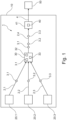
- the repeater 30 is used to repeat the messages 3.1, 3.2, 3.3 with the meter readings contained therein, because the radio range of the wireless transmission or communication channels 2.1, 2.2, 2.3 at the installation location of the meters 20.1, 20.2, 20.3 does not reach the intelligent metering system 41 or its communication unit 40.
- the repeater 30 receives the messages 3.1, 3.2, 3.3, which is done by the communication means 33.
- the computer 31 of the repeater 30 determines a current utilization level for the frequency range of the wireless transmission channel 2.4, i.e., the previous transmission time of the repeater 30 within the predefined time period of one hour.
- the computer 31 compares the previous transmission time or the current utilization level with the maximum transmission time or the maximum utilization level in the current hour or time period.
- the computer 31 then initiates the transmission or forwarding of the received messages 3.1, 3.2, 3.3 if the maximum utilization level has not yet been determined.
- the computer 31 determines the required transmission time for the respective messages 3.1, 3.2, 3.3 and initiates the transmission of the respective messages 3.1, 3.2, 3.3 via the wireless transmission channel 2.4 to the intelligent measuring system 41 only when sufficient transmission time is still available, without to exceed the maximum transmission time. Otherwise, those messages 3.1, 3.2, 3.3 that cannot be sent without exceeding the maximum transmission time are buffered locally in the current time period.
- the buffered messages 3.1, 3.2, 3.3 can be sent at a later time period or hour when transmission time is available again or the current utilization level is so far below the maximum utilization level that the buffered messages 3.1, 3.2, 3.3 can be sent from the repeater 30 to the intelligent metering system 41 without exceeding the maximum utilization level.
- message 3.1 arrives at repeater 30, containing a water meter reading from meter 20.1, which is configured as a water meter.
- the current utilization rate is then determined, which in this example is 3.4 seconds of previous transmission time out of 3.6 seconds of maximum transmission time in this hour.
- Computer 31 initiates the immediate transmission of message 3.1 from repeater 30 or via communication unit 33 to receiver 40.
- the buffered message 3.3 can then be sent from the repeater 30 to the receiver 41 because the current utilization rate is then zero again or no transmission time of the maximum transmission time has yet been used.
Landscapes
- Engineering & Computer Science (AREA)
- Computer Networks & Wireless Communication (AREA)
- Signal Processing (AREA)
- Mobile Radio Communication Systems (AREA)
Claims (13)
- Procédé de transmission sans fil d'au moins un message (3) d'un répéteur (30) à un récepteur (40) par l'intermédiaire d'un canal de transmission sans fil (2), le canal de transmission sans fil (2) étant basé sur une pile de protocoles radio ayant une plage de fréquences prédéterminée et un taux d'utilisation maximal de la plage de fréquences par le répéteur (30), le taux d'utilisation maximal définissant un temps d'émission maximal du répéteur (30) pour des périodes de temps répétitives et prédéfinies dans leur durée, le procédé comprenant les étapes suivantes :- La réception par le répéteur (30) de l'au moins un message (3) provenant d'au moins un compteur (20) et/ou d'au moins une unité de commande d'un ou plusieurs bâtiments (10),- Déterminer un taux d'utilisation actuel de la plage de fréquences du canal de transmission sans fil (2) par le répéteur (30), le taux d'utilisation actuel indiquant un temps d'émission passé du répéteur (30) dans une période actuelle des périodes de temps répétitives et prédéfinies, et- la mémorisation temporaire locale de l'au moins un message reçu (3) sur le répéteur (30), dans la mesure où le taux d'utilisation actuel a atteint le taux d'utilisation maximal ou que le taux d'utilisation actuel dépasserait le taux d'utilisation maximal par l'envoi de l'au moins un message reçu (3),- déclenchement de l'envoi d'au moins un message (3) reçu et stocké temporairement localement sur le répéteur (30) soit envoyé dès que le taux d'utilisation actuel est inférieur au taux d'utilisation maximal et que le taux d'utilisation actuel ne dépasserait pas le taux d'utilisation maximal en envoyant l'au moins un message (3) reçu,dans lequel des adresses de compteurs (20) et/ou d'unités de commande associées à différents messages reçus (3) sont comparées à une priorisation prédéterminée de différentes adresses de compteurs (20) et/ou d'unités de commande, et le déclenchement de l'envoi de la pluralité de messages reçus (3) est effectué dans un ordre suivant la priorisation prédéterminée, la priorisation prédéterminée étant déterminée sur la base d'une fréquence de réception des messages (3) associés à chaque adresse dans une période de temps prédéterminée.
- Procédé selon la revendication 1, dans lequel une adresse de l'au moins un compteur (20) et/ou de l'au moins une unité de commande associée à l'au moins un message reçu (3) est comparée à une liste positive de différentes adresses de compteurs (20) et/ou d'unités de commande et l'initiation de l'émission ou la mémorisation temporaire locale de l'au moins un message reçu (3) n'a lieu que si l'adresse associée à l'au moins un message reçu (3) se trouve sur la liste positive.
- Procédé selon l'une quelconque des revendications précédentes, le procédé comprenant en outre l'étape consistant à vérifier une occupation du canal de transmission sans fil (2) par l'intermédiaire duquel ledit au moins un message (3) est envoyé, avant de provoquer une émission dudit au moins un message reçu (3), en particulier
un déclenchement d'une émission de l'au moins un message reçu (3) n'a lieu que si le contrôle montre que le canal de transmission sans fil (2) n'est pas occupé et, sinon, une mémorisation intermédiaire locale de l'au moins un message reçu (3) a lieu sur le répéteur (30). - Procédé selon l'une quelconque des revendications précédentes, dans lequel ledit au moins un message (3) contient au moins une valeur de mesure de compteur.
- Procédé selon l'une quelconque des revendications précédentes, dans lequel ledit au moins un compteur (20) est au moins l'un parmi un compteur de gaz, un compteur d'eau, un compteur de chaleur et/ou un compteur de froid.
- Procédé selon l'une des revendications précédentes, dans lequel l'au moins un compteur (20) est un compteur (20) fonctionnant de manière autonome, en particulier sur batterie.
- Procédé selon l'une des revendications précédentes, dans lequel le récepteur (40) est une unité de communication centrale (40) d'un système de mesure intelligent (41).
- Procédé selon l'une quelconque des revendications précédentes, dans lequel la pile de protocoles radio est une pile de protocoles radio M-Bus sans fil.
- Procédé selon l'une quelconque des revendications précédentes, dans lequel la plage de fréquences est une plage de fréquences sans licence et/ou est inférieure à 1000 MHz.
- Répéteur (30) comprenant des moyens pour mettre en œuvre le procédé selon l'une quelconque des revendications précédentes.
- Système (1) comprenant un répéteur (30) selon la revendication 10, au moins un compteur (20) en liaison de communication ou pouvant être amené avec le répéteur (30) et/ou au moins une unité de commande en liaison de communication ou pouvant être amenée avec le répéteur (30) dans un ou plusieurs bâtiments (10) et un récepteur (40) auquel le répéteur (30) peut envoyer l'au moins un message (3) via le canal de transmission sans fil (2).
- Programme informatique comprenant des instructions qui, lorsque le programme est exécuté par un ordinateur (31), amènent ce dernier à demander à un répéteur d'exécuter le procédé selon l'une quelconque des revendications 1 - 9.
- Support de stockage lisible par ordinateur (32) sur lequel est stocké le programme d'ordinateur selon la revendication 12.
Applications Claiming Priority (1)
| Application Number | Priority Date | Filing Date | Title |
|---|---|---|---|
| DE102021123398.4A DE102021123398A1 (de) | 2021-09-09 | 2021-09-09 | Verfahren zum drahtlosen Senden von zumindest einer Nachricht von einem Repeater an einen Empfänger über einen drahtlosen Übertragungskanal |
Publications (3)
| Publication Number | Publication Date |
|---|---|
| EP4149017A1 EP4149017A1 (fr) | 2023-03-15 |
| EP4149017B1 true EP4149017B1 (fr) | 2025-04-16 |
| EP4149017C0 EP4149017C0 (fr) | 2025-04-16 |
Family
ID=82839323
Family Applications (1)
| Application Number | Title | Priority Date | Filing Date |
|---|---|---|---|
| EP22188600.5A Active EP4149017B1 (fr) | 2021-09-09 | 2022-08-03 | Procédé de transmission sans fil d'au moins un message d'un répéteur à un récepteur par l'intermédiaire d'un canal de transmission sans fil |
Country Status (2)
| Country | Link |
|---|---|
| EP (1) | EP4149017B1 (fr) |
| DE (1) | DE102021123398A1 (fr) |
Family Cites Families (5)
| Publication number | Priority date | Publication date | Assignee | Title |
|---|---|---|---|---|
| JP6017435B2 (ja) * | 2010-11-08 | 2016-11-02 | コーニンクレッカ フィリップス エヌ ヴェKoninklijke Philips N.V. | ワイヤレスネットワーク内でデューティサイクル情報を交換するシステム及び方法 |
| WO2013174928A1 (fr) * | 2012-05-25 | 2013-11-28 | Ecole Polytechnique Federale De Lausanne (Epfl) | Procédé de mise en conformité à la réglementation en temps réel pour des émetteurs sans fil |
| US9456258B2 (en) * | 2014-07-16 | 2016-09-27 | Itron, Inc. | Transmission timing for battery powered devices |
| DE102017125371A1 (de) | 2017-10-30 | 2019-05-02 | Techem Energy Services Gmbh | Verfahren zum Übertragen von Daten und Datensammler |
| US11582772B2 (en) | 2019-08-23 | 2023-02-14 | Semiconductor Components Industries, Llc | Advanced dual band virtual concurrent for WiFi |
-
2021
- 2021-09-09 DE DE102021123398.4A patent/DE102021123398A1/de active Pending
-
2022
- 2022-08-03 EP EP22188600.5A patent/EP4149017B1/fr active Active
Also Published As
| Publication number | Publication date |
|---|---|
| EP4149017A1 (fr) | 2023-03-15 |
| DE102021123398A1 (de) | 2023-03-09 |
| EP4149017C0 (fr) | 2025-04-16 |
Similar Documents
| Publication | Publication Date | Title |
|---|---|---|
| DE60212452T2 (de) | Verfahren und system zur übertragung von signalen zu knoten in einem system | |
| DE60030363T2 (de) | Funknetzwerksteuerung | |
| DE102012207120A1 (de) | Eingabe-/Ausgabevorrichtungen, Netzwerk, Systeme und Verfahren mit priorisiertem On-Demand-Routing Protokoll für Mehrweg-Funkübertragung | |
| EP3342134B1 (fr) | Transmission de données d'éoliennes et de parcs éoliens à un centre de commande | |
| EP3433960B1 (fr) | Procédé de transmission d'un télégramme par répartition pour les réseaux bidirectionnels | |
| EP3477961B1 (fr) | Procédé de transfert des données et collecteur de données | |
| EP3694126A1 (fr) | Procédé de transmission de la distribution de télégrammes pour réseaux bidirectionnels | |
| DE102009003724A1 (de) | Verfahren zur Optimierung von Netzwerkstrukturen in Funknetzwerken | |
| DE112012005907T5 (de) | Kommunikationssystem, Kommunikationsendgerät und Kommunikationsverfahren | |
| DE102012206529A1 (de) | Drahtloses Echtzeitübertragungssystem | |
| EP3107219B1 (fr) | Système et procédé pour la liaison redondante à un réseau d'ossature ainsi qu'un noeud de liaison montante pouvant ëtre inséré dans ce système | |
| EP1924119B2 (fr) | Procédé destiné à l'échange de données sans fil | |
| EP4149017A1 (fr) | Procédé de transmission sans fil d'au moins un message d'un répéteur à un récepteur par l'intermédiaire d'un canal de transmission sans fil | |
| EP3525476B1 (fr) | Procede de determination de topologie d'un site de communication mobile et un site de communication mobile correspondant | |
| EP1180909B1 (fr) | Méthode et dispositif pour l'acquisition de données | |
| DE102005051563B4 (de) | Verfahren zur Kommunikation mehrerer Sensorknoten in einem Sensornetzwerk | |
| DE102015220422A1 (de) | System und Verfahren zur redundanten Anbindung an ein Backbone-Netzwerk sowie ein in diesem System einsetzbarer Uplink-Knoten | |
| EP2741453B1 (fr) | Procédé de fonctionnement d'un appareil bus d'un dispositif d'automatisation du bâtiment, et appareil de configuration et produit programme d'ordinateur correspondants | |
| EP2020785B1 (fr) | Procédé et système de communication radio bidirectionnelle | |
| EP3022878B1 (fr) | Procédé et dispositif pour envoyer des données, et procédé et dispositif pour envoyer un signal d'identification | |
| EP2798897A1 (fr) | Système de communication avec gestion de l'accès à un moyen de communication commun | |
| EP4040736B1 (fr) | Système, dispositif et procédé de transfert de données entre deux réseaux | |
| DE102010034961B4 (de) | Verfahren zum Betrieb einer Vorrichtung zum Erfassen von Verbrauchswerten in einem Gebäude anfallender Verbrauchsmengen | |
| DE102009039431B4 (de) | Kollisionsverringerungsverfahren sowie Verwendung desselben | |
| DE102014203072A1 (de) | Energiesparender Betrieb eines Kommunikationssystems |
Legal Events
| Date | Code | Title | Description |
|---|---|---|---|
| PUAI | Public reference made under article 153(3) epc to a published international application that has entered the european phase |
Free format text: ORIGINAL CODE: 0009012 |
|
| STAA | Information on the status of an ep patent application or granted ep patent |
Free format text: STATUS: THE APPLICATION HAS BEEN PUBLISHED |
|
| AK | Designated contracting states |
Kind code of ref document: A1 Designated state(s): AL AT BE BG CH CY CZ DE DK EE ES FI FR GB GR HR HU IE IS IT LI LT LU LV MC MK MT NL NO PL PT RO RS SE SI SK SM TR |
|
| STAA | Information on the status of an ep patent application or granted ep patent |
Free format text: STATUS: REQUEST FOR EXAMINATION WAS MADE |
|
| 17P | Request for examination filed |
Effective date: 20230808 |
|
| RBV | Designated contracting states (corrected) |
Designated state(s): AL AT BE BG CH CY CZ DE DK EE ES FI FR GB GR HR HU IE IS IT LI LT LU LV MC MK MT NL NO PL PT RO RS SE SI SK SM TR |
|
| GRAP | Despatch of communication of intention to grant a patent |
Free format text: ORIGINAL CODE: EPIDOSNIGR1 |
|
| STAA | Information on the status of an ep patent application or granted ep patent |
Free format text: STATUS: GRANT OF PATENT IS INTENDED |
|
| INTG | Intention to grant announced |
Effective date: 20241216 |
|
| GRAS | Grant fee paid |
Free format text: ORIGINAL CODE: EPIDOSNIGR3 |
|
| GRAA | (expected) grant |
Free format text: ORIGINAL CODE: 0009210 |
|
| STAA | Information on the status of an ep patent application or granted ep patent |
Free format text: STATUS: THE PATENT HAS BEEN GRANTED |
|
| AK | Designated contracting states |
Kind code of ref document: B1 Designated state(s): AL AT BE BG CH CY CZ DE DK EE ES FI FR GB GR HR HU IE IS IT LI LT LU LV MC MK MT NL NO PL PT RO RS SE SI SK SM TR |
|
| REG | Reference to a national code |
Ref country code: GB Ref legal event code: FG4D Free format text: NOT ENGLISH |
|
| REG | Reference to a national code |
Ref country code: CH Ref legal event code: EP Ref country code: DE Ref legal event code: R096 Ref document number: 502022003576 Country of ref document: DE |
|
| REG | Reference to a national code |
Ref country code: IE Ref legal event code: FG4D Free format text: LANGUAGE OF EP DOCUMENT: GERMAN |
|
| U01 | Request for unitary effect filed |
Effective date: 20250509 |
|
| U07 | Unitary effect registered |
Designated state(s): AT BE BG DE DK EE FI FR IT LT LU LV MT NL PT RO SE SI Effective date: 20250516 |
|
| U20 | Renewal fee for the european patent with unitary effect paid |
Year of fee payment: 4 Effective date: 20250826 |
|
| PG25 | Lapsed in a contracting state [announced via postgrant information from national office to epo] |
Ref country code: ES Free format text: LAPSE BECAUSE OF FAILURE TO SUBMIT A TRANSLATION OF THE DESCRIPTION OR TO PAY THE FEE WITHIN THE PRESCRIBED TIME-LIMIT Effective date: 20250416 |
|
| PG25 | Lapsed in a contracting state [announced via postgrant information from national office to epo] |
Ref country code: NO Free format text: LAPSE BECAUSE OF FAILURE TO SUBMIT A TRANSLATION OF THE DESCRIPTION OR TO PAY THE FEE WITHIN THE PRESCRIBED TIME-LIMIT Effective date: 20250716 Ref country code: GR Free format text: LAPSE BECAUSE OF FAILURE TO SUBMIT A TRANSLATION OF THE DESCRIPTION OR TO PAY THE FEE WITHIN THE PRESCRIBED TIME-LIMIT Effective date: 20250717 |
|
| PG25 | Lapsed in a contracting state [announced via postgrant information from national office to epo] |
Ref country code: PL Free format text: LAPSE BECAUSE OF FAILURE TO SUBMIT A TRANSLATION OF THE DESCRIPTION OR TO PAY THE FEE WITHIN THE PRESCRIBED TIME-LIMIT Effective date: 20250416 |
|
| PG25 | Lapsed in a contracting state [announced via postgrant information from national office to epo] |
Ref country code: HR Free format text: LAPSE BECAUSE OF FAILURE TO SUBMIT A TRANSLATION OF THE DESCRIPTION OR TO PAY THE FEE WITHIN THE PRESCRIBED TIME-LIMIT Effective date: 20250416 |
|
| PG25 | Lapsed in a contracting state [announced via postgrant information from national office to epo] |
Ref country code: RS Free format text: LAPSE BECAUSE OF FAILURE TO SUBMIT A TRANSLATION OF THE DESCRIPTION OR TO PAY THE FEE WITHIN THE PRESCRIBED TIME-LIMIT Effective date: 20250716 |
|
| PG25 | Lapsed in a contracting state [announced via postgrant information from national office to epo] |
Ref country code: IS Free format text: LAPSE BECAUSE OF FAILURE TO SUBMIT A TRANSLATION OF THE DESCRIPTION OR TO PAY THE FEE WITHIN THE PRESCRIBED TIME-LIMIT Effective date: 20250816 |
|
| PG25 | Lapsed in a contracting state [announced via postgrant information from national office to epo] |
Ref country code: SM Free format text: LAPSE BECAUSE OF FAILURE TO SUBMIT A TRANSLATION OF THE DESCRIPTION OR TO PAY THE FEE WITHIN THE PRESCRIBED TIME-LIMIT Effective date: 20250416 |
|
| PG25 | Lapsed in a contracting state [announced via postgrant information from national office to epo] |
Ref country code: CZ Free format text: LAPSE BECAUSE OF FAILURE TO SUBMIT A TRANSLATION OF THE DESCRIPTION OR TO PAY THE FEE WITHIN THE PRESCRIBED TIME-LIMIT Effective date: 20250416 |
|
| PG25 | Lapsed in a contracting state [announced via postgrant information from national office to epo] |
Ref country code: SK Free format text: LAPSE BECAUSE OF FAILURE TO SUBMIT A TRANSLATION OF THE DESCRIPTION OR TO PAY THE FEE WITHIN THE PRESCRIBED TIME-LIMIT Effective date: 20250416 |
|
| PLBE | No opposition filed within time limit |
Free format text: ORIGINAL CODE: 0009261 |
|
| STAA | Information on the status of an ep patent application or granted ep patent |
Free format text: STATUS: NO OPPOSITION FILED WITHIN TIME LIMIT |
|
| REG | Reference to a national code |
Ref country code: CH Ref legal event code: L10 Free format text: ST27 STATUS EVENT CODE: U-0-0-L10-L00 (AS PROVIDED BY THE NATIONAL OFFICE) Effective date: 20260225 |
|
| REG | Reference to a national code |
Ref country code: CH Ref legal event code: H13 Free format text: ST27 STATUS EVENT CODE: U-0-0-H10-H13 (AS PROVIDED BY THE NATIONAL OFFICE) Effective date: 20260324 |
|
| 26N | No opposition filed |
Effective date: 20260119 |
|
| PG25 | Lapsed in a contracting state [announced via postgrant information from national office to epo] |
Ref country code: MC Free format text: LAPSE BECAUSE OF FAILURE TO SUBMIT A TRANSLATION OF THE DESCRIPTION OR TO PAY THE FEE WITHIN THE PRESCRIBED TIME-LIMIT Effective date: 20250416 |
|
| PG25 | Lapsed in a contracting state [announced via postgrant information from national office to epo] |
Ref country code: CH Free format text: LAPSE BECAUSE OF NON-PAYMENT OF DUE FEES Effective date: 20250831 |