EP4149190A1 - Ressourcenzuweisungsverfahren sowie vorrichtung und speichermedium - Google Patents
Ressourcenzuweisungsverfahren sowie vorrichtung und speichermedium Download PDFInfo
- Publication number
- EP4149190A1 EP4149190A1 EP21800962.9A EP21800962A EP4149190A1 EP 4149190 A1 EP4149190 A1 EP 4149190A1 EP 21800962 A EP21800962 A EP 21800962A EP 4149190 A1 EP4149190 A1 EP 4149190A1
- Authority
- EP
- European Patent Office
- Prior art keywords
- subcarriers
- length
- transmission band
- resource
- resource blocks
- Prior art date
- Legal status (The legal status is an assumption and is not a legal conclusion. Google has not performed a legal analysis and makes no representation as to the accuracy of the status listed.)
- Pending
Links
Images



Classifications
-
- H—ELECTRICITY
- H04—ELECTRIC COMMUNICATION TECHNIQUE
- H04L—TRANSMISSION OF DIGITAL INFORMATION, e.g. TELEGRAPHIC COMMUNICATION
- H04L27/00—Modulated-carrier systems
- H04L27/26—Systems using multi-frequency codes
- H04L27/2601—Multicarrier modulation systems
- H04L27/2626—Arrangements specific to the transmitter only
- H04L27/2627—Modulators
- H04L27/2634—Inverse fast Fourier transform [IFFT] or inverse discrete Fourier transform [IDFT] modulators in combination with other circuits for modulation
- H04L27/2636—Inverse fast Fourier transform [IFFT] or inverse discrete Fourier transform [IDFT] modulators in combination with other circuits for modulation with FFT or DFT modulators, e.g. standard single-carrier frequency-division multiple access [SC-FDMA] transmitter or DFT spread orthogonal frequency division multiplexing [DFT-SOFDM]
-
- H—ELECTRICITY
- H04—ELECTRIC COMMUNICATION TECHNIQUE
- H04W—WIRELESS COMMUNICATION NETWORKS
- H04W72/00—Local resource management
- H04W72/04—Wireless resource allocation
- H04W72/044—Wireless resource allocation based on the type of the allocated resource
- H04W72/0453—Resources in frequency domain, e.g. a carrier in FDMA
-
- H—ELECTRICITY
- H04—ELECTRIC COMMUNICATION TECHNIQUE
- H04L—TRANSMISSION OF DIGITAL INFORMATION, e.g. TELEGRAPHIC COMMUNICATION
- H04L27/00—Modulated-carrier systems
- H04L27/26—Systems using multi-frequency codes
- H04L27/2601—Multicarrier modulation systems
- H04L27/2602—Signal structure
- H04L27/261—Details of reference signals
-
- H—ELECTRICITY
- H04—ELECTRIC COMMUNICATION TECHNIQUE
- H04W—WIRELESS COMMUNICATION NETWORKS
- H04W72/00—Local resource management
- H04W72/50—Allocation or scheduling criteria for wireless resources
- H04W72/53—Allocation or scheduling criteria for wireless resources based on regulatory allocation policies
-
- H—ELECTRICITY
- H04—ELECTRIC COMMUNICATION TECHNIQUE
- H04W—WIRELESS COMMUNICATION NETWORKS
- H04W72/00—Local resource management
- H04W72/50—Allocation or scheduling criteria for wireless resources
- H04W72/535—Allocation or scheduling criteria for wireless resources based on resource usage policies
-
- H—ELECTRICITY
- H04—ELECTRIC COMMUNICATION TECHNIQUE
- H04L—TRANSMISSION OF DIGITAL INFORMATION, e.g. TELEGRAPHIC COMMUNICATION
- H04L12/00—Data switching networks
- H04L12/54—Store-and-forward switching systems
- H04L12/56—Packet switching systems
- H04L12/5691—Access to open networks; Ingress point selection, e.g. ISP selection
- H04L12/5692—Selection among different networks
-
- H—ELECTRICITY
- H04—ELECTRIC COMMUNICATION TECHNIQUE
- H04L—TRANSMISSION OF DIGITAL INFORMATION, e.g. TELEGRAPHIC COMMUNICATION
- H04L47/00—Traffic control in data switching networks
- H04L47/70—Admission control; Resource allocation
Definitions
- the present application relates to the field of communication, for example, a resource allocation method, a device, and a storage medium.
- Fifth generation new radio (5G NR) uplink supports a single-carrier discrete Fourier transform spread orthogonal frequency-division multiplexing (DFT-s-OFDM) waveform.
- the waveform supports reference signals including a demodulation reference signal (DMRS), a phase tracking reference signal (PTRS), and the like.
- the reference signal sequence carried by reference signals includes a Zadoff-Chu (ZC) sequence, a ⁇ /2 binary phase-shift keying (BPSK) modulation symbol, and the like.
- ZC Zadoff-Chu
- BPSK binary phase-shift keying
- a wireless communication system estimates characteristics of a channel by relying on the reference signals, helping to cancel the distortion of signals and improving the performance of the communication system.
- the transmission characteristics of high-frequency scenarios are changed. For example, the spectrum, modulation and coding, and waveform of the wireless communication system in the high-frequency scenarios are adjusted, and the reference signals supported by a new waveform and the reference signal sequence, for example, a Golay sequence, carried by the reference signals are adjusted. Therefore, how to allocate frequency domain resources in high-frequency scenarios to make the waveform more flexible is an urgent problem to be solved.
- the present application provides a resource allocation method, a device, and a storage medium, implementing the allocation of frequency domain resources in high-frequency scenarios.
- An embodiment of the present application provides a resource allocation method.
- the method includes determining the number of resource blocks according to the length of a reference signal sequence, a roll-off factor of a frequency domain filter, and the number of subcarriers contained in each resource block and allocating frequency domain resources for a transmission band according to the number of resource blocks.
- An embodiment of the present application provides a resource allocation apparatus.
- the apparatus includes a determination module and an allocator.
- the determination module is configured to determine the number of resource blocks according to the length of a reference signal sequence, a roll-off factor of a frequency domain filter, and the number of subcarriers contained in each resource block.
- the allocator is configured to allocate frequency domain resources for a transmission band according to the number of resource blocks.
- An embodiment of the present application provides a device.
- the device includes a communication module, a memory, and one or more processors.
- the communication module is configured to perform communication interaction between at least two communication nodes.
- the memory is configured to store one or more programs. When executed by the one or more processors, the one or more programs cause the one or more processors to implement the preceding resource allocation method according to any embodiment.
- An embodiment of the present application provides a storage medium storing a computer program which, when executed by a processor, implements the preceding resource allocation method according to any embodiment.
- FIG. 1 is a flowchart of a resource allocation method according to an embodiment of the present application. This embodiment may be executed by a terminal side (for example, a user equipment) or a network side (for example, a base station). As shown in FIG. 1 , this embodiment includes S110 and S120.
- the number of resource blocks is determined according to the length of a reference signal sequence, a roll-off factor of a frequency domain filter, and the number of subcarriers contained in each resource block.
- frequency domain resources are allocated for a transmission band according to the number of resource blocks.
- both user resource allocation and resource scheduling are in units of resource blocks (RB).
- One resource block includes 12 consecutive subcarriers, that is, the number of subcarriers contained in each resource block is 12.
- the reference signal sequence may be transmitted on the time domain resources of the transmission band.
- the transmission band may be the entire transmission band or a sub-band in the channel bandwidth in the communication system.
- the number of resource blocks is determined according to the length of the reference signal sequence, the roll-off factor of the frequency domain filter, and the number of subcarriers contained in each resource block.
- the frequency domain resources are allocated for the transmission band according to the number of resource blocks so that mapping of physical transmission resources can be facilitated, and users can flexibly schedule physical resources.
- the frequency domain resources allocated by the transmission band may be allocated to users so that data of users is transmitted in the frequency domain resources allocated by the transmission band.
- the length of the reference signal sequence satisfies the power of 2 or is another integer.
- the transmission band includes a reference signal block and a data block.
- the reference signal block and the data block are allocated the same number of resource blocks.
- the reference signal sequence is transmitted on the reference signal block or time domain resources of the transmission band.
- the transmission band is the entire transmission band or a sub-band in channel bandwidth in a communication system.
- the manner for determining the number of resource blocks also includes determining the number of resource blocks according to the length of a data block, the roll-off factor of the frequency domain filter, and the number of subcarriers contained in each resource block.
- the length that is, the number of modulation symbols contained in a data block
- OFDM orthogonal frequency-division multiplexing
- frequency domain resources may be allocated for a transmission band according to the length of a data block, facilitating to mapping of physical transmission resources and flexible scheduling of physical resources by users.
- the length of a data block includes the length of a data constellation modulation symbol and the length of a reference signal modulation symbol.
- the length of the data block is equal to the sum of the length of the data constellation modulation symbol and the length of the reference signal modulation symbol.
- the length of the data constellation modulation symbol is less than or equal to the length of the data block and is greater than or equal to zero.
- the length of the reference signal modulation symbol is less than or equal to the length of the data block and is greater than or equal to zero.
- N SC RB denotes the number of subcarriers contained in each resource block.
- N denotes the length of the reference signal sequence.
- ⁇ denotes the roll-off factor of the frequency domain filter, and 0 ⁇ ⁇ ⁇ 1.
- the transmission band uses a single-carrier type waveform modulation mode.
- an operation in the single-carrier type waveform modulation mode includes a discrete Fourier transform (DFT) operation or a fast Fourier transform (FFT) operation.
- DFT discrete Fourier transform
- FFT fast Fourier transform
- the single-carrier type waveform modulation mode includes a discrete Fourier transform spread orthogonal frequency-division multiplexing (DFT-s-OFDM) waveform modulation mode or a single-carrier frequency-division multiple access (SC-FDMA) waveform modulation mode.
- DFT-s-OFDM discrete Fourier transform spread orthogonal frequency-division multiplexing
- SC-FDMA single-carrier frequency-division multiple access
- allocating frequency domain resources for the transmission band according to the number of resource blocks includes, in the case where the number of resource blocks is an integer, allocating a first preset number of subcarriers for the transmission band.
- the first preset number is the product value of the number of resource blocks and the number of subcarriers contained in each resource block.
- the first preset number is N grid size N SC RB .
- allocating frequency domain resources for the transmission band according to the number of resource blocks includes the following processes.
- a second preset number of subcarriers or a third preset number of subcarriers for the transmission band is allocated.
- the second preset number is the product value of the ceiling value of the number of resource blocks and the number of subcarriers contained in each resource block.
- the third preset number is the product value of the floor value of the number of resource blocks and the number of subcarriers contained in each resource block.
- the second preset number ⁇ N grid size ⁇ N SC RB (that is, the product value of the ceiling value of the number of resource blocks and the number of subcarriers contained in each resource block) of subcarriers or the third preset number ⁇ N grid size ⁇ N SC RB (that is, the product value of the floor value of the number of resource blocks and the number of subcarriers contained in each resource block) of subcarriers may be allocated for the transmission band.
- ⁇ ⁇ is a ceiling operation.
- L J is a floor operation.
- the resource allocation method also includes configuring a first threshold value.
- the first threshold value is configured to determine whether to perform a ceiling operation or a floor operation on the number of resource blocks.
- the first threshold value is related to the modulation order of a data constellation modulation symbol.
- the number of resource blocks may be an integer or a non-integer.
- a first threshold value T configured to determine whether to perform a ceiling operation or a floor operation on the number of resource blocks may be set to flexibly allocate frequency domain resources to users.
- the first threshold value is related to the modulation order of the data constellation modulation symbol.
- the first threshold value T configured to determine whether to perform a ceiling operation or a floor operation on the number of resource blocks may be set to be larger, and the number of resource blocks is performed a ceiling operation so that guard subcarriers reduce interference between users.
- the first threshold value T configured to determine whether to perform a ceiling operation or a floor operation on the number of resource blocks may be set to be smaller. The number of resource blocks is performed a floor operation to improve the utilization rate of physical resources.
- the second preset number of subcarriers are allocated for the transmission band.
- the third preset number of subcarriers are allocated for the transmission band.
- the fourth preset number is the difference between the ceiling value of the number of resource blocks and the number of resource blocks.
- the fourth preset number is ⁇ N grid size ⁇ ⁇ N grid size .
- ⁇ N grid size ⁇ ⁇ N grid size ⁇ T ⁇ N grid size ⁇ N SC RB subcarriers are allocated for the transmission band.
- ⁇ N grid size ⁇ ⁇ N grid size > T ⁇ N grid size ⁇ N SC RB subcarriers are allocated for the transmission band.
- the part of the second preset number of subcarriers whose resource length is greater than the first value are set as guard subcarriers.
- the first value is a value determined according to the length of the reference signal sequence and the roll-off factor of the frequency domain filter. In this embodiment, assuming that the length of the reference signal sequence is N and the roll-off factor of the frequency domain filter is ⁇ , the first value may be N ⁇ (1 + ⁇ ).
- the part of ⁇ N grid size ⁇ N SC RB subcarriers whose resource length is greater than N ⁇ (1 + ⁇ ) or all subcarriers are set as guard subcarriers, thereby reducing interference between users.
- the resource length that is greater than the third preset number of subcarriers in frequency domain of the transmission band is removed or zeroed.
- the resource length of the third preset number ⁇ N grid size ⁇ N SC RB of subcarriers is less than N ⁇ (1 + ⁇ )
- the signals in the frequency domain of the transmission band that are greater than the resource length of ⁇ N grid size ⁇ N SC RB subcarriers are directly truncated or zeroed, thereby improving the utilization rate of physical resources and reducing interference between users.
- the third preset number of subcarriers is allocated for the transmission band and the resource length of the third preset number of subcarriers is less than a first value
- signals of the transmission band in frequency domain partially overlap signals of an adjacent transmission band.
- the resource length of the third preset number ⁇ N grid size ⁇ N SC RB of subcarriers is less than N ⁇ (1 + ⁇ )
- signals of the transmission band in frequency domain may partially overlap signals of an adjacent transmission band. In this manner, the advantage is to improve the utilization rate of physical resources and reduce the interference between users.
- FIG. 2 is a diagram of allocation of frequency domain resources according to an embodiment of the present application.
- N N 8)
- N grid size denotes the number of resource blocks.
- N SC RB denotes the number of subcarriers contained in each resource block.
- the reference signal sequence is transmitted on the transmission band.
- N grid size N SC RB 12 subcarriers are allocated for the transmission band.
- the transmission band contains a reference signal block and a data block.
- the reference signal block and the data block are allocated the same number of resource blocks.
- the reference signal block occupies the first OFDM symbol (in other embodiments, the reference signal block may occupy other OFDM symbols).
- the data block occupies the second to fourteenth OFDM symbols.
- the frequency domain resources allocated by the transmission band are allocated to users. The data of users is transmitted in the frequency domain resources allocated by the transmission band.
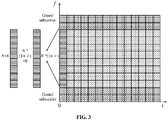
- FIG. 3 is another diagram of allocation of frequency domain resources according to an embodiment of the present application.
- N N 8
- N grid size denotes the number of resource blocks.
- N SC RB denotes the number of subcarriers contained in each resource block.
- the reference signal sequence is transmitted on the transmission band.
- the zeroth subcarrier and the first subcarrier at the left edge of the frequency domain resources allocated by the transmission band are set as guard subcarriers.
- the tenth subcarrier and the eleventh subcarrier at the right edge of the frequency domain resources allocated by the transmission band are set as guard subcarriers.
- the reference signal block occupies the first OFDM symbol.
- the data block occupies the second to fourteenth OFDM symbols.
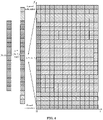
- FIG. 4 is another diagram of allocation of frequency domain resources according to an embodiment of the present application.
- N grid size N ⁇ 1 + ⁇ / N SC RB .
- N grid size denotes the number of resource blocks.
- N grid size denotes the number of subcarriers contained in each resource block.
- the reference signal sequence may be transmitted on the transmission band.
- the reference signal block and the data block occupy the first to the twenty-second subcarriers of the frequency domain resources allocated by the transmission band.
- the zeroth subcarrier at the left edge of the frequency domain resources allocated by the transmission band is set as a guard subcarrier.
- the twenty-third subcarrier at the right edge of the frequency domain resources allocated by the transmission band is set as a guard subcarrier.
- the reference signal block occupies the first OFDM symbol.
- the data block occupies the second to fourteenth OFDM symbols.
- the subcarriers of frequency domain resources set as the guard subcarriers may be symmetrical.
- FIG. 5 is another diagram of allocation of frequency domain resources according to an embodiment of the present application.
- N N 8
- N grid size denotes the number of resource blocks.
- N SC RB denotes the number of subcarriers contained in each resource block.
- the reference signal sequence is transmitted on the transmission band.
- the modulation order of a data constellation modulation symbol is quadrature phase-shift keying (QPSK)
- the resource length of ⁇ N grid size ⁇ N SC RB subcarriers is less than N ⁇ (1 + ⁇ ), the signals in the frequency domain of the transmission band that are greater than the resource length of ⁇ N grid size ⁇ N SC RB subcarriers are directly truncated (that is, the same effect as zeroing).
- the reference signal block occupies the fourteenth OFDM symbol.
- the data block occupies the first to thirteenth OFDM symbols.
- FIG. 6 is another diagram of allocation of frequency domain resources according to an embodiment of the present application.
- N N
- N grid size denotes the number of resource blocks.
- N SC RB denotes the number of subcarriers contained in each resource block.
- the reference signal sequence is transmitted on the transmission band.
- the modulation order of a data constellation modulation symbol is 1024 quadrature amplitude modulation (QAM)
- the resource length of ⁇ N grid size ⁇ N SC RB subcarriers is greater than N ⁇ (1 + ⁇ ), and the part of ⁇ N grid size ⁇ N SC RB subcarriers whose resource length is greater than N ⁇ (1 + ⁇ ) are set as guard subcarriers. That is, the reference signal block and the data block occupy the fourth to the nineteenth subcarriers of the frequency domain resources allocated by the transmission band. The zeroth to the third subcarriers at the left edge of the frequency domain resources allocated by the transmission band are set as guard subcarriers. The twentieth to the twenty-third subcarriers at the right edge of the frequency domain resources allocated by the transmission band are set as guard subcarriers.
- the reference signal block occupies the fourteenth OFDM symbol.
- the data block occupies the first to thirteenth OFDM symbols.
- FIG. 7 is another diagram of allocation of frequency domain resources according to an embodiment of the present application.
- N N
- N N
- ⁇ 1 + ⁇ / N SC RB
- N grid size denotes the number of resource blocks.
- N SC RB denotes the number of subcarriers contained in each resource block.
- the reference signal sequence is transmitted on the transmission band.
- the resource length of ⁇ N grid size ⁇ N SC RB subcarriers is less than N ⁇ (1 + ⁇ ), and signals of the transmission band in frequency domain partially overlap signals of other adjacent transmission bands.
- the reference signal block occupies the first OFDM symbol.
- the data block occupies the second to fourteenth OFDM symbols.
- FIG. 8 is another diagram of allocation of frequency domain resources according to an embodiment of the present application.
- N grid size denotes the number of resource blocks.
- N SC RB denotes the number of subcarriers contained in each resource block.
- the reference signal sequence is transmitted on the transmission band, and a reference signal block and a data block are allocated the same number of resource blocks.
- FIG. 9 is a diagram of allocation of time domain resources according to an embodiment of the present application.
- the first OFDM symbol configures a reference signal block
- the second to the fifteenth OFDM symbols configure data blocks.
- the reference signal modulation symbol in a data block is the same as the reference signal block. That is, the header insertion sequence of the data block is from the header portion of the reference signal block, the occupied resources are the same in size, and the contained contents are the same.
- the tail insertion sequence of the data block is from the tail portion of the reference signal block, the occupied resources are the same in size, and the contained contents are the same. As shown in FIG.
- the resource length of ⁇ N grid size ⁇ N SC RB subcarriers is greater than N ⁇ (1 + ⁇ ), and the part of ⁇ N grid size ⁇ N SC RB subcarriers whose resource length is greater than N ⁇ (1 + ⁇ ) are set as guard subcarriers. That is, the reference signal block and the data block occupy the second to the ninth subcarriers of the frequency domain resources allocated by the transmission band.
- the zeroth subcarrier and the first subcarrier at the left edge of the frequency domain resources allocated by the transmission band are set as guard subcarriers.
- the tenth subcarrier and the eleventh subcarrier at the right edge of the frequency domain resources allocated by the transmission band are set as guard subcarriers.
- FIG. 10 is a block diagram illustrating the structure of a resource allocation apparatus according to an embodiment of the present application. As shown in FIG. 10 , this embodiment includes a determination module 210 and an allocator 220.
- the determination module 210 is configured to determine the number of resource blocks according to the length of a reference signal sequence, a roll-off factor of a frequency domain filter, and the number of subcarriers contained in each resource block.
- the allocator 220 is configured to allocate frequency domain resources for a transmission band according to the number of resource blocks.
- the resource allocation apparatus provided in this embodiment is configured to implement the resource allocation method in the embodiment shown in FIG. 1 and has similar implementation principles and technical effects. The details are not repeated here.
- the transmission band includes a reference signal block and a data block.
- the reference signal block and the data block are allocated the same number of resource blocks.
- the reference signal sequence is transmitted on the reference signal block or time domain resources of the transmission band.
- the transmission band is the entire transmission band or a sub-band in channel bandwidth in a communication system.
- the manner for determining the number of resource blocks includes determining the number of resource blocks according to the length of the data block, the roll-off factor of the frequency domain filter, and the number of subcarriers contained in each resource block.
- the length of a data block includes the length of a data constellation modulation symbol and the length of a reference signal modulation symbol.
- the length of the data block is equal to the sum of the length of the data constellation modulation symbol and the length of the reference signal modulation symbol.
- the length of the data constellation modulation symbol is less than or equal to the length of the data block and is greater than or equal to zero.
- the length of the reference signal modulation symbol is less than or equal to the length of the data block and is greater than or equal to zero.
- N grid size denotes the number of resource blocks.
- N SC RB denotes the number of subcarriers contained in each resource block.
- N denotes the length of the reference signal sequence.
- ⁇ denotes the roll-off factor of the frequency domain filter, and 0 ⁇ ⁇ ⁇ 1.
- the transmission band uses a single-carrier type waveform modulation mode.
- an operation in the single-carrier type waveform modulation mode includes a DFT operation or an FFT operation.
- the single-carrier type waveform modulation mode includes a DFT-s-OFDM waveform modulation mode or a SC-FDMA waveform modulation mode.
- allocating frequency domain resources for the transmission band according to the number of resource blocks includes the following processes.
- a first preset number of subcarriers for the transmission band is allocated.
- the first preset number is the product value of the number of resource blocks and the number of subcarriers contained in each resource block.
- allocating frequency domain resources for the transmission band according to the number of resource blocks includes the following processes.
- a second preset number of subcarriers or a third preset number of subcarriers for the transmission band is allocated.
- the second preset number is the product value of the ceiling value of the number of resource blocks and the number of subcarriers contained in each resource block.
- the third preset number is the product value of the floor value of the number of resource blocks and the number of subcarriers contained in each resource block.
- the resource allocation apparatus also includes a configurator.
- the configurator is configured to configure a first threshold value.
- the first threshold value is configured to determine whether to perform a ceiling operation or a floor operation on the number of resource blocks.
- the first threshold value is related to the modulation order of a data constellation modulation symbol.
- the second preset number of subcarriers are allocated for the transmission band.
- the third preset number of subcarriers are allocated for the transmission band.
- the fourth preset number is the difference between the ceiling value of the number of resource blocks and the number of resource blocks.
- the part of the second preset number of subcarriers whose resource length is greater than the first value are set as guard subcarriers.
- the first value is a value determined according to the length of the reference signal sequence and the roll-off factor of the frequency domain filter.
- the resource length of the third preset number of subcarriers is less than a first value
- the resource length that is greater than the third preset number of subcarriers in frequency domain of the transmission band is removed or zeroed.
- signals of the transmission band in frequency domain partially overlap signals of an adjacent transmission band.
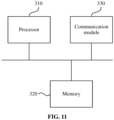
- FIG. 11 is a diagram illustrating the structure of a device according to an embodiment of the present application.
- the device provided in the present application includes a processor 310, a memory 320, and a communication module 330.
- One or more processors 310 may be disposed in the device.
- FIG. 11 shows one processor 310 as an example.
- One or more memories 320 may be disposed in the device.
- FIG. 11 shows one memory 320 as an example.
- the processor 310, memory 320, and communication module 330 in the device may be connected by a bus or in other manners, and the connection by a bus is taken as an example in FIG. 11 .
- the device may be a client side (for example, a user equipment) or a network side (for example, a base station).
- the memory 320 may be configured to store software programs, computer-executable programs, and modules, such as program instructions/modules corresponding to the device in any embodiment of the present application (for example, the determination module 210 and the allocator 220 in the resource allocation apparatus).
- the memory 320 may include a program storage region and a data storage region, where the program storage region may store an operating system and an application program required by at least one function, and the data storage region may store data created depending on the use of the device.
- the memory 320 may include a high-speed random-access memory and may also include a nonvolatile memory such as at least one disk memory, a flash memory, or another nonvolatile solid-state memory.
- the memory 320 may include memories which are remotely disposed relative to the processor 310, and these remote memories may be connected to the device via a network. Examples of the preceding network include, but are not limited to, the Internet, an intranet, a local area network, a mobile communication network, and a combination thereof.
- the communication module 330 is configured to perform communication interaction with other synchronization nodes.
- the preceding device may be configured to execute the resource allocation method provided by any preceding embodiment and has corresponding functions and effects.
- An embodiment of the present application provides a storage medium containing a computer-executable instruction.
- the computer-executable instruction when executed by a computer processor, is configured to execute a resource allocation method.
- the method includes determining the number of resource blocks according to the length of a reference signal sequence, a roll-off factor of a frequency domain filter, and the number of subcarriers contained in each resource block and allocating frequency domain resources for a transmission band according to the number of resource blocks.
- the term user equipment encompasses any suitable type of wireless user equipment, such as a mobile phone, a portable data processing apparatus, a portable web browser, or a vehicle-mounted mobile station.
- multiple embodiments of the present application may be implemented in hardware, dedicated circuits, software, logics, or any combination thereof.
- some aspects may be implemented in hardware while other aspects may be implemented in firmware or software that may be executed by a controller, a microprocessor or another computing apparatus, though the present application is not limited thereto.
- the embodiments of the present application may be implemented by computer program instructions executed by a data processor of a mobile apparatus, for example, implemented in a processor entity, by hardware or by a combination of software and hardware.
- the computer program instructions may be assembly instructions, instruction set architecture (ISA) instructions, machine instructions, machine-related instructions, microcodes, firmware instructions, status setting data, or source or object codes written in any combination of one or more programming languages.
- ISA instruction set architecture
- a block diagram of any logic flow among the drawings of the present application may represent program processes, may represent interconnected logic circuits, modules, and functions, or may represent a combination of program processes with logic circuits, modules, and functions.
- Computer programs may be stored in a memory.
- the memory may be of any type suitable for a local technical environment and may be implemented using any suitable data storage technology, such as, but not limited to, a read-only memory (ROM), a random-access memory (RAM), and an optical memory device and system (digital video disc (DVD) or compact disc (CD)).
- ROM read-only memory
- RAM random-access memory
- DVD digital video disc
- CD compact disc
- a computer-readable medium may include a non-transitory storage medium.
- the data processor may be of any type suitable to the local technical environment such as, but not limited to, a general-purpose computer, a special-purpose computer, a microprocessor, a digital signal processor (DSP), an application-specific integrated circuit (ASIC), a field-programmable gate array (FPGA), and a processor based on a multi-core processor architecture.
- a general-purpose computer such as, but not limited to, a general-purpose computer, a special-purpose computer, a microprocessor, a digital signal processor (DSP), an application-specific integrated circuit (ASIC), a field-programmable gate array (FPGA), and a processor based on a multi-core processor architecture.
- DSP digital signal processor
- ASIC application-specific integrated circuit
- FPGA field-programmable gate array
Landscapes
- Engineering & Computer Science (AREA)
- Computer Networks & Wireless Communication (AREA)
- Signal Processing (AREA)
- Physics & Mathematics (AREA)
- Discrete Mathematics (AREA)
- General Physics & Mathematics (AREA)
- Mathematical Physics (AREA)
- Mobile Radio Communication Systems (AREA)
Applications Claiming Priority (2)
| Application Number | Priority Date | Filing Date | Title |
|---|---|---|---|
| CN202010383694.7A CN111901877A (zh) | 2020-05-08 | 2020-05-08 | 一种资源分配方法、设备和存储介质 |
| PCT/CN2021/079019 WO2021223503A1 (zh) | 2020-05-08 | 2021-03-04 | 资源分配方法、设备和存储介质 |
Publications (2)
| Publication Number | Publication Date |
|---|---|
| EP4149190A1 true EP4149190A1 (de) | 2023-03-15 |
| EP4149190A4 EP4149190A4 (de) | 2024-05-29 |
Family
ID=73206239
Family Applications (1)
| Application Number | Title | Priority Date | Filing Date |
|---|---|---|---|
| EP21800962.9A Pending EP4149190A4 (de) | 2020-05-08 | 2021-03-04 | Ressourcenzuweisungsverfahren sowie vorrichtung und speichermedium |
Country Status (6)
| Country | Link |
|---|---|
| US (1) | US12402111B2 (de) |
| EP (1) | EP4149190A4 (de) |
| KR (1) | KR102909912B1 (de) |
| CN (1) | CN111901877A (de) |
| CA (1) | CA3178065A1 (de) |
| WO (1) | WO2021223503A1 (de) |
Families Citing this family (4)
| Publication number | Priority date | Publication date | Assignee | Title |
|---|---|---|---|---|
| CN111901877A (zh) | 2020-05-08 | 2020-11-06 | 中兴通讯股份有限公司 | 一种资源分配方法、设备和存储介质 |
| CN115913855A (zh) * | 2021-09-29 | 2023-04-04 | 中兴通讯股份有限公司 | 一种数据传输方法、数据调制方法、电子设备和存储介质 |
| CN117082623A (zh) * | 2022-05-05 | 2023-11-17 | 中兴通讯股份有限公司 | 数据序列的形成方法、装置、存储介质及电子装置 |
| CN117082624A (zh) * | 2022-05-05 | 2023-11-17 | 中兴通讯股份有限公司 | 数据的传输方法、装置、存储介质及电子装置 |
Family Cites Families (21)
| Publication number | Priority date | Publication date | Assignee | Title |
|---|---|---|---|---|
| KR100978964B1 (ko) * | 2006-02-08 | 2010-08-30 | 닛본 덴끼 가부시끼가이샤 | 싱글 캐리어 전송 시스템, 통신 장치 및 그들에 이용하는 싱글 캐리어 전송 방법 |
| US8509323B2 (en) * | 2006-08-22 | 2013-08-13 | Motorola Mobility Llc | Resource allocation including a DC sub-carrier in a wireless communication system |
| KR20080077845A (ko) * | 2007-02-21 | 2008-08-26 | 엘지전자 주식회사 | 신호 수신 장치 및 신호 수신 방법 |
| US20100098042A1 (en) * | 2008-10-21 | 2010-04-22 | Paul Wilkinson Dent | Using the same multiplexed radio resource for pilot and information signals |
| RU2011130551A (ru) * | 2008-12-22 | 2013-01-27 | Конинклейке Филипс Электроникс Н.В. | Формирование выходного сигнала посредством обработки сенд-эффектов |
| CA2769965A1 (en) * | 2012-02-17 | 2013-08-17 | Vecima Networks Inc. | Reduced-complexity multiple-mode digital modulation through consolidation of various square-root nyquist shaping transmit filter |
| FR3010268B1 (fr) * | 2013-09-03 | 2015-09-11 | Orange | Procede et dispositif de transmission de blocs de symboles de donnees complexes, procede et dispositif de reception et programmes d'ordinateur correspondants. |
| US10321458B2 (en) * | 2015-05-08 | 2019-06-11 | Lg Electronics Inc. | Method for allocating frequency resources in wireless communication system, and apparatus using the same |
| US10506591B2 (en) * | 2015-05-15 | 2019-12-10 | Qualcomm Incorporated | Narrowband definition for enhanced machine type communication |
| US9774539B1 (en) * | 2015-06-15 | 2017-09-26 | Veritas Technologies Llc | Systems and methods for reconfiguring data flow across network channels |
| CN106612132B (zh) * | 2015-10-16 | 2021-05-18 | 电信科学技术研究院 | 一种信道状态信息的传输方法和装置 |
| CN107222442B (zh) * | 2016-03-22 | 2021-11-12 | 北京三星通信技术研究有限公司 | 基于滤波的载波调制系统中的信号发送、接收方法和装置 |
| WO2017164639A2 (en) | 2016-03-22 | 2017-09-28 | Samsung Electronics Co., Ltd. | Signal transmitting and receiving methods in a filtering-based carrier modulation system and apparatuses thereof |
| AU2017385290B2 (en) * | 2016-12-27 | 2022-03-03 | FG Innovation Company Limited | Terminal apparatus, base station apparatus, and communication method |
| JP7039864B2 (ja) * | 2017-05-18 | 2022-03-23 | ソニーグループ株式会社 | 送信装置、受信装置、方法及び記録媒体 |
| CN109150464B (zh) * | 2017-06-16 | 2020-09-29 | 华为技术有限公司 | 无线通信方法和无线通信装置 |
| CN109219134B (zh) * | 2017-06-30 | 2020-11-06 | 华为技术有限公司 | 一种发送方法及装置 |
| FR3076428B1 (fr) * | 2017-12-28 | 2020-07-31 | Thales Sa | Systeme de localisation longue portee pour utilisation en environnement contraint |
| EP4070611A4 (de) * | 2020-04-10 | 2023-07-05 | ZTE Corporation | Verfahren zur harq-übertragung |
| CN111901877A (zh) * | 2020-05-08 | 2020-11-06 | 中兴通讯股份有限公司 | 一种资源分配方法、设备和存储介质 |
| CN111907877A (zh) | 2020-08-06 | 2020-11-10 | 许敏娟 | 一种基于折纸结构的防冲击包装箱 |
-
2020
- 2020-05-08 CN CN202010383694.7A patent/CN111901877A/zh active Pending
-
2021
- 2021-03-04 KR KR1020227042398A patent/KR102909912B1/ko active Active
- 2021-03-04 US US17/923,812 patent/US12402111B2/en active Active
- 2021-03-04 EP EP21800962.9A patent/EP4149190A4/de active Pending
- 2021-03-04 CA CA3178065A patent/CA3178065A1/en active Pending
- 2021-03-04 WO PCT/CN2021/079019 patent/WO2021223503A1/zh not_active Ceased
Also Published As
| Publication number | Publication date |
|---|---|
| US12402111B2 (en) | 2025-08-26 |
| KR102909912B1 (ko) | 2026-01-08 |
| CN111901877A (zh) | 2020-11-06 |
| EP4149190A4 (de) | 2024-05-29 |
| KR20230005994A (ko) | 2023-01-10 |
| WO2021223503A1 (zh) | 2021-11-11 |
| US20230180198A1 (en) | 2023-06-08 |
| CA3178065A1 (en) | 2021-11-11 |
Similar Documents
| Publication | Publication Date | Title |
|---|---|---|
| EP4149190A1 (de) | Ressourcenzuweisungsverfahren sowie vorrichtung und speichermedium | |
| EP3373673B1 (de) | Verfahren und vorrichtung zur übertragung von referenzsignalen sowie verfahren und vorrichtung zum empfang von referenzsignalen | |
| ES2830151T3 (es) | Método de transmisión de datos y equipo de usuario | |
| EP3934190B1 (de) | Verfahren und vorrichtung zur sequenzbasierten signalverarbeitung | |
| IL264474B2 (en) | Information transmission method and information transmission device | |
| EP3796728B1 (de) | Ressourcenkonfigurationsverfahren, netzwerkvorrichtung und endgerät | |
| WO2017121415A1 (zh) | 一种上行信号发送方法和装置 | |
| JP7463477B2 (ja) | 系列に基づく信号処理方法および装置 | |
| EP4583477A1 (de) | Datenübertragungsverfahren, datenverarbeitungsverfahren, kommunikationsvorrichtung, medium und produkt | |
| EP3567819B1 (de) | Verfahren, vorrichtung und system zur verwendung in der drahtlosen kommunikation | |
| CN113824667A (zh) | 信息的发送方法及装置 | |
| CN108306706B (zh) | 一种数据接收、发送方法和接收、发送设备 | |
| KR20190093665A (ko) | 신호 송신 방법 및 장치 그리고 신호 수신 방법 및 장치 | |
| WO2016000625A2 (en) | System and method for suppressing papr in mc-cdma and derivatives | |
| US20250047431A1 (en) | Method, apparatus and computer program | |
| CN108540418B (zh) | 一种边缘子带的数据调制方法及装置 | |
| EP3598710A1 (de) | Signalverarbeitungsverfahren und -vorrichtung basierend auf einer sequenz | |
| EP4017122A1 (de) | Verfahren und vorrichtung zur erzeugung eines gemeinsamen trägers, verfahren und vorrichtung zur verarbeitung eines gemeinsamen trägers, und computerlesbares speichermedium | |
| CN111212010B (zh) | 一种多载波混合传输方法 | |
| EP4597962A1 (de) | Datenübertragungsverfahren, datenverarbeitungsverfahren, kommunikationsvorrichtung, medium und produkt | |
| EP4521693A1 (de) | Datenmodulationsverfahren und -vorrichtung sowie medium und speichermedium | |
| CN114375043B (zh) | 确定终端初始上行bwp的方法、基站、设备和介质 | |
| WO2023216878A1 (zh) | 通信方法及装置、存储介质 | |
| CN121907645A (zh) | 一种符号处理的方法与装置 | |
| KR20220069847A (ko) | 다중 컴포넌트 캐리어를 지원하는 직교 주파수 분할 다중 접속 시스템에서 기저대역 송신 신호를 생성하는 방법 및 장치 |
Legal Events
| Date | Code | Title | Description |
|---|---|---|---|
| STAA | Information on the status of an ep patent application or granted ep patent |
Free format text: STATUS: THE INTERNATIONAL PUBLICATION HAS BEEN MADE |
|
| PUAI | Public reference made under article 153(3) epc to a published international application that has entered the european phase |
Free format text: ORIGINAL CODE: 0009012 |
|
| STAA | Information on the status of an ep patent application or granted ep patent |
Free format text: STATUS: REQUEST FOR EXAMINATION WAS MADE |
|
| 17P | Request for examination filed |
Effective date: 20221118 |
|
| AK | Designated contracting states |
Kind code of ref document: A1 Designated state(s): AL AT BE BG CH CY CZ DE DK EE ES FI FR GB GR HR HU IE IS IT LI LT LU LV MC MK MT NL NO PL PT RO RS SE SI SK SM TR |
|
| DAV | Request for validation of the european patent (deleted) | ||
| DAX | Request for extension of the european patent (deleted) | ||
| REG | Reference to a national code |
Ref country code: DE Ref legal event code: R079 Free format text: PREVIOUS MAIN CLASS: H04W0072040000 Ipc: H04L0027260000 |
|
| A4 | Supplementary search report drawn up and despatched |
Effective date: 20240502 |
|
| RIC1 | Information provided on ipc code assigned before grant |
Ipc: H04L 27/26 20060101AFI20240426BHEP |