EP4149920B1 - Procédé de synthèse d'isocyanates - Google Patents
Procédé de synthèse d'isocyanates Download PDFInfo
- Publication number
- EP4149920B1 EP4149920B1 EP21720172.2A EP21720172A EP4149920B1 EP 4149920 B1 EP4149920 B1 EP 4149920B1 EP 21720172 A EP21720172 A EP 21720172A EP 4149920 B1 EP4149920 B1 EP 4149920B1
- Authority
- EP
- European Patent Office
- Prior art keywords
- group
- general formula
- compound
- substituted
- unsubstituted
- Prior art date
- Legal status (The legal status is an assumption and is not a legal conclusion. Google has not performed a legal analysis and makes no representation as to the accuracy of the status listed.)
- Active
Links
Classifications
-
- C—CHEMISTRY; METALLURGY
- C07—ORGANIC CHEMISTRY
- C07C—ACYCLIC OR CARBOCYCLIC COMPOUNDS
- C07C263/00—Preparation of derivatives of isocyanic acid
- C07C263/04—Preparation of derivatives of isocyanic acid from or via carbamates or carbamoyl halides
-
- C—CHEMISTRY; METALLURGY
- C07—ORGANIC CHEMISTRY
- C07F—ACYCLIC, CARBOCYCLIC OR HETEROCYCLIC COMPOUNDS CONTAINING ELEMENTS OTHER THAN CARBON, HYDROGEN, HALOGEN, OXYGEN, NITROGEN, SULFUR, SELENIUM OR TELLURIUM
- C07F7/00—Compounds containing elements of Groups 4 or 14 of the Periodic Table
- C07F7/02—Silicon compounds
- C07F7/08—Compounds having one or more C—Si linkages
- C07F7/0834—Compounds having one or more O-Si linkage
-
- C—CHEMISTRY; METALLURGY
- C07—ORGANIC CHEMISTRY
- C07F—ACYCLIC, CARBOCYCLIC OR HETEROCYCLIC COMPOUNDS CONTAINING ELEMENTS OTHER THAN CARBON, HYDROGEN, HALOGEN, OXYGEN, NITROGEN, SULFUR, SELENIUM OR TELLURIUM
- C07F7/00—Compounds containing elements of Groups 4 or 14 of the Periodic Table
- C07F7/02—Silicon compounds
- C07F7/08—Compounds having one or more C—Si linkages
- C07F7/10—Compounds having one or more C—Si linkages containing nitrogen having a Si-N linkage
-
- C—CHEMISTRY; METALLURGY
- C07—ORGANIC CHEMISTRY
- C07F—ACYCLIC, CARBOCYCLIC OR HETEROCYCLIC COMPOUNDS CONTAINING ELEMENTS OTHER THAN CARBON, HYDROGEN, HALOGEN, OXYGEN, NITROGEN, SULFUR, SELENIUM OR TELLURIUM
- C07F7/00—Compounds containing elements of Groups 4 or 14 of the Periodic Table
- C07F7/02—Silicon compounds
- C07F7/08—Compounds having one or more C—Si linkages
- C07F7/12—Organo silicon halides
-
- C—CHEMISTRY; METALLURGY
- C07—ORGANIC CHEMISTRY
- C07F—ACYCLIC, CARBOCYCLIC OR HETEROCYCLIC COMPOUNDS CONTAINING ELEMENTS OTHER THAN CARBON, HYDROGEN, HALOGEN, OXYGEN, NITROGEN, SULFUR, SELENIUM OR TELLURIUM
- C07F7/00—Compounds containing elements of Groups 4 or 14 of the Periodic Table
- C07F7/02—Silicon compounds
- C07F7/08—Compounds having one or more C—Si linkages
- C07F7/18—Compounds having one or more C—Si linkages as well as one or more C—O—Si linkages
- C07F7/1804—Compounds having Si-O-C linkages
-
- C—CHEMISTRY; METALLURGY
- C07—ORGANIC CHEMISTRY
- C07F—ACYCLIC, CARBOCYCLIC OR HETEROCYCLIC COMPOUNDS CONTAINING ELEMENTS OTHER THAN CARBON, HYDROGEN, HALOGEN, OXYGEN, NITROGEN, SULFUR, SELENIUM OR TELLURIUM
- C07F7/00—Compounds containing elements of Groups 4 or 14 of the Periodic Table
- C07F7/02—Silicon compounds
- C07F7/08—Compounds having one or more C—Si linkages
- C07F7/18—Compounds having one or more C—Si linkages as well as one or more C—O—Si linkages
- C07F7/1804—Compounds having Si-O-C linkages
- C07F7/1872—Preparation; Treatments not provided for in C07F7/20
- C07F7/1888—Preparation; Treatments not provided for in C07F7/20 by reactions involving the formation of other Si-linkages, e.g. Si-N
-
- C—CHEMISTRY; METALLURGY
- C07—ORGANIC CHEMISTRY
- C07F—ACYCLIC, CARBOCYCLIC OR HETEROCYCLIC COMPOUNDS CONTAINING ELEMENTS OTHER THAN CARBON, HYDROGEN, HALOGEN, OXYGEN, NITROGEN, SULFUR, SELENIUM OR TELLURIUM
- C07F7/00—Compounds containing elements of Groups 4 or 14 of the Periodic Table
- C07F7/02—Silicon compounds
- C07F7/08—Compounds having one or more C—Si linkages
- C07F7/18—Compounds having one or more C—Si linkages as well as one or more C—O—Si linkages
- C07F7/1896—Compounds having one or more Si-O-acyl linkages
-
- C—CHEMISTRY; METALLURGY
- C07—ORGANIC CHEMISTRY
- C07F—ACYCLIC, CARBOCYCLIC OR HETEROCYCLIC COMPOUNDS CONTAINING ELEMENTS OTHER THAN CARBON, HYDROGEN, HALOGEN, OXYGEN, NITROGEN, SULFUR, SELENIUM OR TELLURIUM
- C07F7/00—Compounds containing elements of Groups 4 or 14 of the Periodic Table
- C07F7/02—Silicon compounds
- C07F7/08—Compounds having one or more C—Si linkages
- C07F7/18—Compounds having one or more C—Si linkages as well as one or more C—O—Si linkages
- C07F7/1804—Compounds having Si-O-C linkages
- C07F7/1872—Preparation; Treatments not provided for in C07F7/20
- C07F7/188—Preparation; Treatments not provided for in C07F7/20 by reactions involving the formation of Si-O linkages
-
- Y—GENERAL TAGGING OF NEW TECHNOLOGICAL DEVELOPMENTS; GENERAL TAGGING OF CROSS-SECTIONAL TECHNOLOGIES SPANNING OVER SEVERAL SECTIONS OF THE IPC; TECHNICAL SUBJECTS COVERED BY FORMER USPC CROSS-REFERENCE ART COLLECTIONS [XRACs] AND DIGESTS
- Y02—TECHNOLOGIES OR APPLICATIONS FOR MITIGATION OR ADAPTATION AGAINST CLIMATE CHANGE
- Y02P—CLIMATE CHANGE MITIGATION TECHNOLOGIES IN THE PRODUCTION OR PROCESSING OF GOODS
- Y02P20/00—Technologies relating to chemical industry
- Y02P20/50—Improvements relating to the production of bulk chemicals
- Y02P20/54—Improvements relating to the production of bulk chemicals using solvents, e.g. supercritical solvents or ionic liquids
Definitions
- the invention relates to a process for the synthesis of isocyanates, in particular aliphatic and aromatic isocyanates. It relates in particular to a process for the synthesis of monoisocyanates and for the synthesis of diisocyanates. It also relates to the use of compounds for the preparation of an isocyanate.
- Isocyanates are an extremely important raw material in numerous industries.
- the main products made from diisocyanates are polyurethanes, which are used in many areas as soft and hard foams, as components for paints and plastic parts, insulation, etc.
- monoisocyanates are also important reactive intermediates, for example to provide urea derivatives or carbamate derivatives for the synthesis of active ingredients, e.g. for pharmaceutical products.
- Industrially, isocyanates are synthesized using phosgene, an extremely toxic and reactive gas. Due to their toxicity, production takes place in cost-intensive, hermetically sealed plants in which the gas is fed directly for recycling after synthesis.
- O-silylated carbamates which are formed by CO 2 insertion into aminosilanes according to the process of the invention (step 2 in Scheme 9), can also be cleaved by thermolysis. However, during the thermal decomposition of these mono-silylated carbamates, no isocyanates are formed, but the corresponding urea derivatives (a) EN 10 2009 045 849 A1 ); C. Wiltzsch, K. Kraushaar, A. Schwarzer, E. Kroke, Z. Naturforsch. 2011, 66b, 917 ; K. Kraushaar, C. Wiltzsch, J. Wagler, U. Böhme, A. Schwarzer, G. Roewer, E. Kroke, Organometallics 2012, 31, 4779 .).
- the object of the invention is to eliminate the disadvantages of the prior art.
- a process for the synthesis of isocyanates, in particular aliphatic and aromatic mono-, di- and triisocyanates is to be specified which enables their economical production without the use of phosgene.
- the process according to the invention enables the production of isocyanates, in particular aliphatic and aromatic isocyanates, in high yields and in high purity.
- the isocyanates can be produced without the use of phosgene.
- the process according to the invention therefore enables the safe production of isocyanates.
- the process according to the invention is associated with low energy consumption. It can be carried out at comparatively moderate temperatures. The use of a catalyst is not necessary. The process according to the invention can therefore be carried out without the use of a catalyst.
- the process according to the invention can be used to produce mono-, di- and triisocyanates.
- the first organosilicon compound has a second silicon atom Si 1 to which a second unit of the formula GI is bonded.
- the first organosilicon compound has a second silicon atom Si 1 to which a second unit of the formula GI is bonded, and a third silicon atom Si 1 to which a third unit of the formula GI is bonded.
- the first organosilicon compound can have further silicon atoms Si 1 to which a unit of the formula GI is bonded.
- the number of silicon atoms Si 1 to which a unit of the formula GI is bonded corresponds to the number of isocyanate groups that the isocyanate produced has.
- a hydrogen atom is bonded to the nitrogen atom.
- no further hydrogen atom may be bonded to this nitrogen atom. This applies to aliphatic and aromatic isocyanates regardless of whether they are substituted or unsubstituted, aliphatic or aromatic isocyanates.
- the designation "Si 1 " identifies silicon atoms which the first organosilicon compound has.
- the designation “Si 2 " identifies the silicon atom which the second organosilicon compound has.
- the exponents "1" and “2" serve only to indicate the affiliation of the silicon atoms to the respective formulas GI and G-II.
- the first organosilicon compound is an O -silylated carbamate.
- the compound of general formula II is a general example of an O -silylated carbamate.
- the compound of general formula II is a compound of general formula II-A when A 1 is R 1.
- the compound of general formula II is a compound of general formula II-B when A 1 is a group G-III.
- R 1 and R 2 have the meanings given in connection with formula II.
- R 2 and Z have the meanings given in connection with formula II.
- Compounds of the general formula II-A are suitable for the preparation of monoisocyanates
- compounds of the general formula II-B are suitable for the preparation of diisocyanates.
- R 1 is preferably a substituted or unsubstituted aliphatic group having 1 to 18 carbon atoms or a substituted or unsubstituted aromatic group having 6 to 18 carbon atoms. If R 1 is an aliphatic group, it may be a branched or unbranched group. R 1 may be a substituted or unsubstituted aliphatic group having 1 to 18 carbon atoms or having 1 to 12 carbon atoms.
- R 1 is selected from the group consisting of a substituted or unsubstituted alkyl group having 1 to 18 carbon atoms, a substituted or unsubstituted heteroalkyl group having 1 to 18 carbon atoms, a substituted or unsubstituted alkenyl group having 1 to 18 carbon atoms, a substituted or unsubstituted alkynyl group having 1 to 18 carbon atoms, a substituted or unsubstituted cycloalkyl group, a substituted or unsubstituted heterocycloalkyl group, a substituted or unsubstituted aryl group, a substituted or unsubstituted heteroaryl group, a substituted or unsubstituted alkylaryl group and a substituted or unsubstituted arylalkyl group.
- R 1 is selected from the group consisting of a substituted or unsubstituted alkyl group having 1 to 12 carbon atoms, a substituted or unsubstituted alkenyl group having 1 to 12 carbon atoms, a substituted or unsubstituted aryl group, a substituted or unsubstituted heteroaryl group, a substituted or unsubstituted alkylaryl group, and a substituted or unsubstituted arylalkyl group.
- R 1 is an alkyl group
- R 1 can, for example, be selected from the group consisting of a substituted or unsubstituted methyl group, a substituted or unsubstituted ethyl group, a substituted or unsubstituted propyl group, a substituted or unsubstituted butyl group, a substituted or unsubstituted pentyl group, a substituted or unsubstituted hexyl group and a substituted or unsubstituted octyl group.
- R 1 is an alkenyl group
- R 1 can, for example, be a substituted or unsubstituted allyl group.
- R 1 can, for example, be a substituted or unsubstituted phenyl group. If R 1 is an arylalkyl group, R 1 can, for example , be a substituted or unsubstituted benzyl group.
- R 1 can be selected from the group consisting of n -butyl, n -octyl, allyl, phenyl, and benzyl. In another example, R 1 is isopentyl.
- Z is preferably a substituted or unsubstituted aliphatic group having 1 to 18 carbon atoms or a substituted or unsubstituted aromatic group having 6 to 18 carbon atoms. If Z is an aliphatic group, it may be a branched or unbranched group. Z may be a substituted or unsubstituted aliphatic group having 1 to 18 carbon atoms or having 1 to 12 carbon atoms.
- Z is a divalent group, in contrast to R 1 , which is a monovalent group.
- Z may be a substituted or unsubstituted group having at least one substituted or unsubstituted alkylene group and/or at least one substituted or unsubstituted arylene or heteroarylene group.
- Z may be selected from a group consisting of a substituted or unsubstituted alkylene group having 1 to 18 carbon atoms, a substituted or unsubstituted phenylene group, and a substituted or unsubstituted phenylenebisalkylene group in which each alkylene group on each occurrence is independently an alkylene group having 1 to 12 carbon atoms.
- R 2 is each independently a substituted or unsubstituted alkyl group having 1 to 6 carbon atoms on each occurrence. More preferably, in the compound of the general formula II, R 2 is each independently selected from the group consisting of a substituted or unsubstituted methyl group, a substituted or unsubstituted ethyl group, a substituted or unsubstituted propyl group and a substituted or unsubstituted butyl group on each occurrence.
- R 2 is selected independently of one another at each occurrence from the group consisting of an unsubstituted methyl group, an unsubstituted ethyl group, an unsubstituted propyl group and an unsubstituted butyl group, with a methyl group being particularly preferred.
- R 2 can have the same meaning or different meanings at each occurrence.
- all R 2 are a methyl group.
- silylating agents may also be used.
- examples of other silylating agents include, but are not limited to, aminosilanes that enable transamination or transsilylation, and silazanes. See, for example, PL Fuchs (ed.) Handbook of reagents for organic synthesis, John Wiley & Sons Inc, London, 2011 Further examples of suitable silylating agents are given in Table 1 .
- the second organosilicon compound carries a leaving group X. It serves as a silylating agent.
- the compound of the general formula III is a general example of such a silane.
- X may be selected from the group consisting of a halogen, a sulfonate, a carbamate, -OR 4 , -NR 7 R 8 and an N-heterocycle. It may be provided that X is a sulfonate.
- the term "sulfonate” is understood to mean an R S -SO 2 -O- group.
- R S may be, for example, a branched or unbranched substituted or unsubstituted C 1 -C 6 alkyl group, a substituted or unsubstituted aryl group, a substituted or unsubstituted alkylaryl group or a substituted or unsubstituted silane group.
- R S is CH 3 -, CF 3 -, CH 3 -C 6 H 4 - or -O-Si(CH 3 ) 3 .
- the sulfonate can, for example, be selected from the group consisting of a toluenesulfonic acid ester group, a methylsulfonic acid ester group and a trifluoromethylsulfonic acid ester group.
- a toluenesulfonic acid ester group is understood to mean an -OTs group, where Ts is tosyl.
- a methylsulfonic acid ester group is understood to mean an -OMs group, where Ms is mesyl.
- a trifluoromethylsulfonic acid ester group is understood to mean CF 3 -SO 2 -O-.
- a trifluoromethylsulfonic acid ester group is also referred to as a triflate.
- X is a carbamate.
- carbamate is understood to mean a (R N ) 2 N-CO-O- group.
- R N can be, for example, a branched or unbranched substituted or unsubstituted C 1 -C 6 alkyl group, a substituted or unsubstituted aryl group or a substituted or unsubstituted alkylaryl group.
- R N is CH 3 - or CH 3 -CH 2 -.
- An example of a compound of the general formula III in which X is a carbamate is (CH 3 ) 3 Si-O-CO-N(CH 3 ) 2 .
- X is -NR 7 R 8 .
- R 7 and R 8 are each independently a substituted or unsubstituted alkyl group having 1 to 6 carbon atoms, for example methyl or ethyl.
- R 7 is a substituted or unsubstituted alkyl group having 1 to 6 carbon atoms and R 8 is -C(O)R 9 , where R 9 is preferably a substituted or unsubstituted alkyl group having 1 to 6 carbon atoms.
- R 7 is methyl and R 8 is -COCF 3 , -COCH 3 or -COCF 2 CF 2 CF 3 .
- N-heterocycle describes a heterocycloalkyl group as defined herein or a heteroaryl group as defined herein, each with the proviso that at least one of the heteroatoms is nitrogen.
- X is preferably selected from the group consisting of chlorine, a toluenesulfonic acid ester group, a methylsulfonic acid ester group and a trifluoromethylsulfonic acid ester group.
- X is a trifluoromethylsulfonic acid ester group (triflate).
- R 3 is independently selected at each occurrence from the group consisting of a substituted or unsubstituted methyl group, a substituted or unsubstituted ethyl group, a substituted or unsubstituted propyl group and a substituted or unsubstituted phenyl group.
- R 3 is selected at each occurrence independently from the group consisting of an unsubstituted methyl group, an unsubstituted ethyl group, an unsubstituted propyl group and an unsubstituted phenyl group, with a methyl group being particularly preferred.
- R 3 can have the same meaning or different meanings at each occurrence.
- all R 3 are a methyl group.
- a particularly preferred compound of general formula III is trimethylsilyl trifluoromethanesulfonate, which is also referred to as trimethylsilyl triflate.
- R 5 is, independently of one another, at each occurrence, an unsubstituted alkyl group having 1 to 6 carbon atoms and that R 6 is a fluorinated or unsubstituted alkyl group having 1 to 6 carbon atoms.
- R 5 and R 6 can each be a methyl group.
- the silylating agent is N,O-bis(trimethylsilyl)acetamide (BSA).
- R 9 is a substituted or unsubstituted alkyl group having 1 to 6 carbon atoms.
- An example of such a compound of the general formula III is (CH 3 ) 3 Si-O-CO-CCl 3 .
- Table 1 shows further examples of suitable silylating agents.
- Table 1 No. formula Name (abbreviation) S1 N,O -Bis(trimethylsilyl)acetamide (BSA) S2 N , O -Bis(trimethylsilyl)-trifluoroacetamide (BSTFA) S3 N -Methyl- N -trimethylsilylheptafluorobutyramide (MSHFBA) S4 Trimethylchlorosilane (TMCS) S5 Trimethylsilyl azide (TMSA) S6 N -(Trimethylsilyl)diethylamine (TMSDEA) S7 Trimethylsilyl -N , N -dimethylcarbamate (DMCTMS) S8 Trimethylsilyltrichloroacetate (TMSTCA) S9 O,O '-Bis(trimethylsilyl)sulfate (BSS) S10 N -Methyl- N -trimethylsilyl acetamide
- the compound of general formula IV-A is a compound of general formula IV when A 2 is R 1.
- the compound of general formula IV-B is a compound of general formula IV when A is a group G-IV.
- R 1 , R 2 and R 3 have the meanings given in connection with formula II.
- R 2 , R 3 and Z have the meanings given in connection with formula II.
- R 3 has at each occurrence the meanings given in connection with the compound of general formula III.
- a compound of the general formula IV-A is an N,O -bissilylated carbamate. Such a compound is particularly suitable for the preparation of monoisocyanates.
- Examples of an N , O -bissilylated carbamate are N,O -bis(trimethylsilyl)-N-phenyl-carbamate ( 1 ), N,O -bis(trimethylsilyl)-N ,n -octyl-carbamate ( 2 ) and N,O -bis(trimethylsilyl)-N-benzyl-carbamate ( 5 ).
- a compound of the general formula IV-B has two N,O- bissilylated carbamate groups. Such a compound is particularly suitable for the preparation of diisocyanates.
- Examples of a compound with two N , O -bissilylated carbamate groups are p -[ N , N ', O , O '-tetrakis(trimethylsilyl)-carbamato]-benzene ( 3 ), m -[ N , N ', O , O '-tetrakis(trimethylsilyl)-carbamato]-xylene ( 4 ) and 1,8-[ N , N ', O , O '-tetrakis(trimethylsilyl)-carbamato]-octane ( 6 ).
- the mentioned compounds are shown in Table 2: ⁇ u>Table 2 ⁇ /u> No.
- the compound of general formula IV can be obtained by reacting the compound of general formula II with the compound of general formula III. This reaction is a silylation. By means of silylation, a second silyl group is introduced into a carbamate group. The second silyl group is bonded to the nitrogen atom of the carbamate group, while the first silyl group is bonded to an oxygen atom of the carbamate group.
- the compound of general formula IV-A can be obtained by reacting the compound of general formula II-A with the compound of general formula III.
- the compound of general formula IV-B can be obtained by reacting the compound of general formula II-B with the compound of general formula III.
- the compound of general formula I is a compound of general formula IA if A 3 is R 1.
- the compound of general formula I is a compound of general formula IB if A 3 is a group GV.
- R 1 has the meanings given in connection with formula II. If R 1 is octyl, the compound of general formula I is octyl isocyanate; if R 1 is phenyl, the compound of general formula I is phenyl isocyanate; if R 1 is benzyl, the compound of general formula I is benzyl isocyanate.
- formula IB Z has the meanings given in connection with formula II. If Z is phenylene, the compound of general formula I is a diisocyanatobenzene, for example a 1,4-diisocyanatobenzene. If Z is xylylene, the compound of general formula I is a diisocyanatoxylylene, for example a 1,3-xylylene diisocyanate (abbreviation mXDI).
- the compound of general formula IV can be converted into the compound of general formula I by thermolysis.
- a compound of general formula IV-A can be converted into the compound of general formula I-A by thermolysis.
- a compound of general formula IV-B can be converted into the compound of general formula I-B by thermolysis.
- Scheme 1 illustrates the preparation of an isocyanate by silylation of the first organosilicon compound having a GI unit to give the third organosilicon compound having a G-II unit and subsequent conversion of the third organosilicon compound to an isocyanate.
- the silylation is carried out by reacting the first organosilicon compound with the second organosilicon compound.
- the silylation described is particularly suitable, for example, for the silylation of aromatic O-trimethylsilylated carbamates, whereby aromatic N , O -bistrimethylsilylated carbamates are obtained.
- the silylation is also suitable for the silylation of, for example, aliphatic O-trimethylsilylated carbamates, whereby aliphatic N , O -bistrimethylsilylated carbamates are obtained.
- Scheme 2 illustrates the preparation of an isocyanate of the general formula I.
- a compound of the general formula II is silylated with a compound of the general formula III to obtain a compound of the general formula IV.
- the compound of the general formula IV is then subjected to thermolysis to obtain the isocyanate of the general formula I.
- the indication " ⁇ T” stands for the application of an increased temperature during thermolysis.
- Scheme 3 illustrates the preparation of an isocyanate of the general formula IA.
- a compound of the general formula II-A is silylated with a compound of the general formula III to obtain a compound of the general formula IV-A.
- the compound of the general formula IV-A is then subjected to thermolysis to obtain the isocyanate of the general formula IA.
- Scheme 4 illustrates the preparation of an isocyanate of the general formula IB.
- a compound of the general formula II-B is silylated with a compound of the general formula III to obtain a compound of the general formula IV-B.
- the compound of the general formula IV-B is then subjected to thermolysis to obtain the isocyanate of the general formula IB.
- the silylation of the first organosilicon compound, in particular the compound of the general formula II, is preferably carried out in the presence of an auxiliary base.
- the auxiliary base serves to bind the leaving group split off from the second organosilicon compound, i.e. the silylating agent, during the silylation, as well as the hydrogen atom split off from the NH group of the compound of the general formula II.
- This group is the group X in the compound of the general formula III.
- the auxiliary base is preferably an amine, for example a trialkylamine, such as triethylamine, or aniline.
- a preferred auxiliary base is a triethylamine.
- an auxiliary base is used to prepare a compound of the general formula I, the aliphatic or aromatic radical of which corresponds to the aliphatic or aromatic radical of the compound of the general formula I.
- a compound of the general formula VI-A can be used as an auxiliary base to prepare a compound of the general formula IA.
- Benzylamine is therefore a suitable auxiliary base for the production of benzyl isocyanate, and aniline for the production of phenyl isocyanate.
- the silylating agent is trimethylchlorosilane and the Auxiliary base around triethylamine, triethylamine hydrochloride ((CH 3 CH 2 ) 3 N*HCl) is formed during silylation.
- the silylation is preferably carried out in an aprotic organic solvent.
- Nonpolar solvents are particularly preferred.
- suitable solvents are n-pentane, n-hexane and anisole, with n-pentane being particularly preferred.
- the first organosilicon compound and the second organosilicon compound are used in a molar ratio such that for each carbamate unit of the formula G-I of the first organosilicon compound there is at least one molecule of the second organosilicon compound.
- the molar ratio of the first organosilicon compound to the second organosilicon compound is 1:n x (1 to 1.5), particularly preferably 1:n x (1 to 1.2), where n is the number of carbamate units of the formula G-I. If a monoisocyanate is to be produced, the first organosilicon compound has one carbamate unit of the formula G-I, so that n is 1.
- the first organosilicon compound has two carbamate units of the formula G-I, so that n is 2. If a triisocyanate is to be prepared, the first organosilicon compound has three carbamate units of the formula G-I, so that n is 3. A slight excess of the second organosilicon compound is preferred, based on the number of carbamate units of the first organosilicon compound. If an auxiliary base is used, the second organosilicon compound and the auxiliary base can be used in a molar ratio of 1:1 to 1.5, preferably 1:1 to 1.2.
- the silylation is preferably carried out at a temperature between 0 and 50 °C, more preferably between 0 and 25 °C and particularly preferably at room temperature.
- Room temperature is understood to mean a temperature between 15 and 25 °C.
- the silylation is preferably carried out under ambient pressure. It can be carried out under an inert gas atmosphere, wherein nitrogen or argon, for example, can be used as the inert gas.
- Thermolysis is a thermal cracking process.
- Thermolysis is preferably carried out at a temperature of 100 to 400 °C, more preferably at a temperature of 150 to 350 °C and particularly preferably at a temperature of 230 to 300 °C.
- the temperature should not exceed 400 °C in order to prevent isocyanates from reacting with one another to form di-, tri- or oligomers.
- Thermolysis is preferably carried out without using solvents.
- Thermolysis is preferably carried out under ambient pressure. It can be carried out under an inert gas atmosphere, with nitrogen or argon, for example, being able to be used as the inert gas.
- the thermolysis may be carried out using a temperature profile.
- the temperature profile may comprise two or more temperature levels, each temperature level being applied for a predetermined period of time.
- Each of the temperature levels applied may be 20 to 80 °C, for example 30 to 50 °C, higher than the previously applied temperature range.
- the predetermined period of time may be between 1 min and 2 h.
- the process according to the invention provides for the use of the first organosilicon compound which has a unit GI, for example a compound of the general formula II.
- This first organosilicon compound can be prepared by inserting carbon dioxide into an aminosilane.
- An aminosilane is understood to mean a compound which has been obtained by silylation of a primary amine group to obtain a direct N-Si bond.
- Scheme 5 illustrates the preparation of a compound of the general formula II-A by inserting carbon dioxide into an aminosilane of the general formula VA.
- R 1 and R 2 have the meanings given in connection with general formula II.
- Scheme 6 illustrates the preparation of a compound of general formula II-B by insertion of carbon dioxide into an aminosilane of general formula VB.
- the aminosilane of the general formula VB is a compound obtained by silylation of two terminal primary amine groups of a molecule to obtain two direct N-Si bonds. It can be regarded as a doubly monosilylated primary diamine.
- R 2 and Z have the meanings given in connection with the general formula II.
- the insertion of carbon dioxide can be effected by introducing gaseous carbon dioxide into the aminosilane or a solution of the aminosilane in a solvent.
- the solvent is preferably an aprotic organic solvent, for example tetrahydrofuran, diethyl ether, toluene, n-pentane or n-hexane, with tetrahydrofuran being particularly preferred.
- the insertion can be carried out under ambient pressure or under excess pressure.
- the use of excess pressure is particularly expedient when R 1 is a substituted or unsubstituted aromatic group or when Z is a substituted or unsubstituted aromatic group.
- the excess pressure is preferably between 1.5 and 10 bar.
- the insertion can be carried out under an inert gas atmosphere, with nitrogen, for example, being used as the inert gas. or argon can be used. Further details on the insertion of carbon dioxide into an aminosilane can be found, for example, EN 10 2009 045 849 A1 be taken.
- the compound of general formula VII is a silane which carries a leaving group X 1.
- a milder silylating agent can be selected compared to the silylation with the compound of general formula III.
- a silylating agent is considered milder if it is less reactive.
- the use of a milder silylating agent is possible because a hydrogen atom of a primary amine group can be silylated more easily than the hydrogen atom of a carbamate group.
- X 1 is selected from the group consisting of a halogen, a sulfonate and a group -OR 4 . It can be provided that X 1 is a sulfonate, i.e. an R S -SO 2 -O group.
- R S can be, for example, a branched or unbranched substituted or unsubstituted C 1 -C 6 alkyl group, an aryl group or an alkylaryl group.
- R S is CH 3 -, CF 3 - or CH 3 -C 6 H 4 -.
- the sulfonate can be selected, for example, from the group consisting of a toluenesulfonic acid ester group, a methylsulfonic acid ester group and a trifluoromethylsulfonic acid ester group.
- X 1 is preferably selected from the group consisting of chlorine, a toluenesulfonic acid ester group, a methylsulfonic acid ester group and a trifluoromethylsulfonic acid ester group.
- X 1 is chlorine.
- R 2 is at each occurrence an unsubstituted alkyl group having 1 to 6 carbon atoms and X 1 is chlorine.
- the compound of general formula VII is a trialkylchlorosilane.
- a particularly preferred compound of general formula VII is trimethylchlorosilane. This is an inexpensive silylating agent.
- Scheme 8 shows the preparation of an aminosilane of the general formula VB by silylation of a primary amine of the general formula VI-B.
- Compound VB is an amine that has two primary amino groups.
- the silylation of the primary amine is preferably carried out in the presence of an auxiliary base.
- the auxiliary base serves to bind the leaving group split off from the silylating agent, e.g. the compound of the general formula VII, during the silylation, as well as the hydrogen atom split off from the NH group of the compound of the general formula II. This group is the group X 1 in the compound of the general formula VII.
- the auxiliary base is preferably an amine, for example a trialkylamine, such as triethylamine, or aniline.
- a preferred auxiliary base is a triethylamine.
- an auxiliary base is used to prepare a compound of the general formula I, the aliphatic or aromatic radical of which corresponds to the aliphatic or aromatic radical of the compound of the general formula I.
- a compound of the general formula VI-A can be used as an auxiliary base to prepare a compound of the general formula IA.
- Benzylamine is therefore a suitable auxiliary base for the production of benzyl isocyanate, and aniline for the production of phenyl isocyanate.
- the compound of the general formula VI-A or VI-B is then not only the starting material, but also the auxiliary base.
- the compound of the general formula VI-A or VI-B in excess of the Silylating agents can be used, for example in a molar ratio of 2:1. If 1 molecule of a compound of the general formula VI-A or VI-B is added to 1 molecule of the silylating agent trimethylchlorosilane, HCl is formed, which in turn is intercepted by a second molecule of the compound of the general formula VI-A or VI-B. Thus, 1 molecule of trimethylchlorosilane consumes 2 molecules of the compound of the general formula VI-A or VI-B.
- auxiliary base Without the use of an auxiliary base, there is a risk that the leaving group will form a reactive acid which impairs the formation of an aminosilane, e.g. the compound of the general formula VA or VB.
- a trialkylchlorosilane is used as a silylating agent, hydrogen chloride is formed during silylation, which is intercepted with the auxiliary base.
- the silylating agent is trimethylchlorosilane and the auxiliary base is triethylamine, triethylamine hydrochloride ((CH 3 CH 2 ) 3 N*HCl) is formed during silylation.
- the silylation of the primary amine for example the primary amine of the general formula VI-A or VI-B, can be carried out under the conditions described above in connection with the silylation of the first organic compound, for example the compound of the general formula II.
- the silylation of the primary amine is carried out at room temperature and ambient pressure.
- a catalyst is not required.
- the aminosilanes are obtained in high yields.
- the process according to the invention can be a two-stage process.
- the preparation of an isocyanate compound starts from the first organosilicon compound (e.g. a compound of the general formula II).
- the two-stage process provides for the silylation of the first organosilicon compound to obtain the compound of the third organosilicon compound (in the case of a compound of the general formula II, this is a compound of the general formula IV) and the subsequent thermolysis of the third organosilicon compound to the isocyanate compound (in the case of a compound of the general formula IV, this is a compound of the general formula I).
- the two-stage process can be carried out at ambient pressure. Ambient pressure can be understood to mean atmospheric pressure.
- the two-stage process can be carried out under an inert gas atmosphere.
- the process according to the invention is a four-stage process.
- the four-stage process provides for the silylation of a primary amine to obtain an aminosilane (1st stage), the insertion of carbon dioxide into the aminosilane to obtain the first organosilicon compound (e.g.
- the four-stage synthesis of isocyanates comprises the synthesis of aminosilanes from primary amines and a silylating agent such as trialkylchlorosilane (stage 1), the reaction of the aminosilanes with CO 2 to form O -silylated carbamates (stage 2), followed by a second silylation step (stage 3) to obtain N , O -bissilylated carbamates and the final thermolysis of the bissilylated CO 2 insertion products, ie the N , O -bissilylated carbamates (stage 4).
- a silylating agent such as trialkylchlorosilane
- the four-stage process dispenses with phosgene, relies on CO 2 as a carbon and oxygen source and runs without catalysts at moderate temperatures.
- the first two stages (stages 1 and 2) are also characterized by the advantages of the entire process according to the invention, such as good yields, low heats of reaction, etc. All four stages can be carried out under ambient pressure. Ambient pressure can be understood as atmospheric pressure.
- the two-stage process can be carried out under an inert gas atmosphere. The use of supercritical CO 2 is not planned.
- siloxanes are formed as a by-product in addition to the target compound, ie an isocyanate compound.
- the siloxanes are disiloxanes.
- Scheme 10 shows the thermolysis of a compound of the general formula IV, whereby in addition to the compound of the general formula I, a disiloxane of the general formula VIII is formed:
- R 2 has the meanings given in connection with the compound of general formula II at each occurrence and R 3 has the meanings given in connection with the compound of general formula III at each occurrence.
- the compound of general formula VIII is hexamethyldisiloxane.
- Hexamethyldisiloxane has various uses, e.g. it can be converted into trimethylsilyl halides using halogens or hydrohalic acid. It is also used in the production of silicone oils to adjust the molecular weight distributions.
- aliphatic refers to a branched or unbranched or cyclic hydrocarbon component, including a component containing both cyclic and chain elements which may be fully saturated or mono- or polyunsaturated.
- saturated hydrocarbon components include alkyl groups, alkylene groups and cycloalkyl groups.
- unsaturated hydrocarbon components include alkenyl groups and alkynyl groups.
- the aliphatic hydrocarbon component may optionally contain one or more, for example one to four, heteroatoms selected from the group consisting of O, N, S, Si and Ge.
- aromatic refers to a hydrocarbon component having at least one aromatic ring, including a component containing both at least one aromatic and at least one chain element, which may be fully saturated or mono- or polyunsaturated.
- aromatic rings include aryl groups, heteroaryl groups, arylene groups, and heteroarylene groups.
- chain elements include alkylene groups.
- aromatic groups containing at least one aromatic ring and at least one chain element include alkylenearylene groups, arylenebis(alkylene) groups, and alkylenebis(arylene) groups.
- the aromatic hydrocarbon component may optionally contain one or more, for example one to four, heteroatoms selected from the group consisting of O, N, S, Si, and Ge.
- alkyl refers in particular to a saturated aliphatic hydrocarbon group having a branched or unbranched carbon chain with 1 to 12 carbon atoms, preferably 1 to 8 carbon atoms and particularly preferably 1 to 6 carbon atoms.
- alkyl groups include, but are not limited to, methyl, ethyl, propyl, isopropyl, isobutyl, sec -butyl, tert -butyl, pentyl, n -hexyl, octyl, dodecyl and the like.
- the alkyl group may optionally be substituted with one or more substituents wherein each substituent is independently alkyl, alkoxy, halogen, haloalkyl, amino, monoalkylamino, dialkylamino, SiR z 3 , Si(OR z ) 3 , SiR z (OR z ) 2 , wherein R z is independently at each occurrence hydrogen or alkyl as defined herein excluding SiH 3 , or a siloxane group, unless specifically stated otherwise.
- the alkyl group may be partially or perfluorinated.
- the alkyl group may optionally contain one or more heteroatoms selected from the group consisting of O, N, S, Si and Ge.
- the alkyl group may contain one or more chains consisting of two or more, for example 2 to 12, Si atoms.
- heteroalkyl refers to an alkyl group as defined herein wherein one, two or three hydrogen atoms have been replaced by a substituent independently selected from the group consisting of -OR a , -NR b R c , -S(O) w R d (wherein w is an integer from 0 to 2), SiR z 3 , Si(OR z ) 3 and SiR z (OR z ) 2 , provided that the point of attachment of the heteroalkyl radical is a carbon atom, wherein R a is acyl, alkyl, cycloalkyl or cycloalkylalkyl; R b and R c are independently acyl, alkyl, cycloalkyl or cycloalkylalkyl; and when w is 0, R d is alkyl, cycloalkyl or cycloalkylalkyl, and when w is 1 or 2, R d is alky
- cycloalkyl refers in particular to saturated carbocyclic groups consisting of mono- or bicyclic rings and having from 3 to 12 ring atoms.
- the cycloalkyl group may optionally be substituted with one or more substituents, each substituent independently being alkyl, alkoxy, amino, monoalkylamino, dialkylamino, SiR z 3 , Si(OR z ) 3 , SiR z (OR z ) 2 , wherein R z at each occurrence is independently hydrogen or alkyl as defined herein excluding SiH 3 , or a siloxane group, unless specifically stated otherwise.
- cycloalkyl groups include, but are not limited to, cyclopropyl, cyclobutyl, cyclopentyl, cyclohexyl, cycloheptyl, and the like.
- the cycloalkyl group may be partially or perfluorinated.
- the cycloalkyl group may optionally contain one or more heteroatoms selected from the group consisting of O, N, S, Si and Ge.
- heterocycloalkyl refers to a saturated cyclic ring having 5 to 12 ring atoms, wherein 1 to 4 of the ring atoms are heteroatoms selected from one or more of N, O and S and the remaining ring atoms are carbon atoms.
- heterocycloalkyl groups include, but are not limited to, piperidinyl, piperazinyl, homopiperazinyl, azepinyl, pyrrolidinyl, pyrazolidinyl, imidazolinyl, imidazolidinyl, oxazolidinyl, isoxazolidinyl, morpholinyl, thiazolidinyl, isothiazolidinyl, quinuclidinyl, tetrahydrofuryl, tetrahydropyranyl, thiomorpholinyl, dihydroquinolinyl and 1,4-diazepane.
- the heterocycloalkyl group may optionally be substituted with one or more substituents, each substituent independently being alkyl, alkoxy, amino, monoalkylamino, dialkylamino, SiR z 3 , Si(OR z ) 3 , SiR z (OR z ) 2 , wherein R z at each occurrence independently is hydrogen or alkyl, as defined herein, except SiH 3 , or a siloxane group, unless specifically stated otherwise.
- the heterocycloalkyl group may be partially or perfluorinated.
- alkenyl refers in particular to an unsaturated aliphatic hydrocarbon group having a branched or unbranched carbon chain of 2 to 12 carbon atoms, preferably 2 to 8 carbon atoms, and most preferably 2 to 6 carbon atoms, having at least one olefinic double bond and more preferably a single double bond.
- alkenyl groups include, but are not limited to, vinyl, allyl, methallyl, 1,1-dimethylallyl, propenyl, butenyl, pentadienyl, hexenyl, octenyl, and the like. An allyl group is preferred.
- the alkenyl group may optionally be substituted with one or more substituents, each substituent independently being alkyl, alkoxy, halogen, haloalkyl, amino, monoalkylamino, dialkylamino, SiR z 3 , Si(OR z ) 3 , SiR z (OR z ) 2 , wherein R z is independently hydrogen or alkyl as defined herein excluding SiH 3 at each occurrence, or a siloxane group, unless specifically stated otherwise.
- the alkenyl group may be partially or perfluorinated.
- the alkenyl group may optionally contain one or more heteroatoms selected from the group consisting of O, N, S, Si and Ge.
- the alkenyl group may contain one or more chains consisting of two or more, for example 2 to 12, Si atoms.
- alkynyl refers in particular to an unsaturated aliphatic hydrocarbon group having a branched or unbranched carbon chain of 2 to 12 carbon atoms, preferably 2 to 8 carbon atoms, and most preferably 2 to 6 carbon atoms, and having at least one olefinic triple bond and more preferably a single triple bond.
- alkynyl groups include, but are not limited to, acetylenyl, propargyl, n-but-2-yn-1-yl, and the like. A propargyl group is preferred.
- the alkynyl group may optionally be substituted with one or more substituents, each substituent independently being alkyl, alkoxy, halogen, haloalkyl, amino, monoalkylamino, dialkylamino SiR z 3 , Si(OR z ) 3 , SiR z (OR z ) 2 , wherein R z at each occurrence is independently hydrogen or alkyl as defined herein excluding SiH 3 , or a siloxane group, unless specifically stated otherwise.
- the alkynyl group may optionally contain one or more heteroatoms selected from the group consisting of O, N, S, Si and Ge.
- the alkynyl group may contain one or more chains consisting of two or more, for example 2 to 12, Si atoms.
- alkoxy refers in particular to a group of the formula -OR, wherein R is an alkyl group as defined herein.
- alkoxy moieties include, but are not limited to, methoxy, ethoxy, isopropoxy, and the like.
- the alkoxy group may optionally be substituted with one or more substituents, each substituent independently being alkyl, alkoxy, halogen, haloalkyl, amino, monoalkylamino, dialkylamino, SiR z 3 , Si(OR z ) 3 , SiR z (OR z ) 2 , wherein R z at each occurrence independently is hydrogen or alkyl as defined herein excluding SiH 3 , or a siloxane group, unless specifically stated otherwise.
- halogen refers to fluorine, chlorine, bromine or iodine.
- aryl refers to a cyclic aromatic hydrocarbon group consisting of or having a mono- or bicyclic aromatic ring system having 5 to 10 ring atoms, preferably 5 or 6 ring atoms.
- the aryl group may optionally be a substituted aryl group.
- aryl groups include, but are not limited to, phenyl, naphthyl, naphthalenyl, fluorenyl, indenyl, pentalenyl, azulenyl, oxydiphenyl, biphenyl, methylenediphenyl, aminodiphenyl, diphenylsulfidyl, diphenylsulfonyl, diphenylisopropylidenyl, benzodioxanyl, benzofuranyl, benzodioxylyl, benzopyranyl, benzoxazinyl, benzoxazinonyl, benzopiperadinyl, benzopiperazinyl, benzopyrrolidinyl, benzomorpholinyl, methylenedioxyphenyl, ethylenedioxyphenyl, and the like, including partially hydrogenated derivatives thereof.
- substituted aryl group refers in particular to an aryl group optionally substituted independently by one to four substituents, preferably one or two substituents, selected from alkyl, cycloalkyl, heteroalkyl, halogen, alkoxy, amino, acylamino, monoalkylamino, dialkylamino, SiR z 3 , Si(OR z ) 3 , SiR z (OR z ) 2 (wherein R z is independently hydrogen or alkyl as defined herein at each occurrence, excluding SiH 3 ), a siloxane group, haloalkyl, haloalkoxy, alkanesulfonyl, -COR (wherein R is alkyl, phenyl or phenylalkyl), -(CR'R") n -COOR (wherein n is an integer from 0 to 5, R' and R" are independently hydrogen or alkyl, and R is alkyl, cycloalkyl, hetero
- heteroaryl refers to a monocyclic or bicyclic group having 5 to 10, more preferably 5 to 6 ring atoms with at least one aromatic ring and further containing one, two, three or four ring heteroatoms selected from N, O and S, with the remaining ring atoms being C.
- the heteroaryl may optionally be substituted with one, two, three or four substituents, each substituent independently being amino, or for the non-aromatic portion of the cyclic ring also by oxo, unless specifically stated otherwise.
- heteroaryl groups include, but are not limited to, optionally substituted imidazolyl, optionally substituted oxazolyl, optionally substituted thiazolyl, optionally substituted pyrazinyl, optionally substituted pyrrolyl, optionally substituted pyridinyl, optionally substituted pyrimidinyl, optionally substituted indonyl, optionally substituted isoquinolinyl, optionally substituted carbazol-9-yl, optionally substituted furanyl, optionally substituted benzofuranyl, optionally substituted Benzo[1,2,3]thiadiazolyl, optionally substituted benzo[b]thiophenyl, optionally substituted 9H-thioxanthenyl and optionally substituted thieno[2,3-c]pyridinyl.
- alkylaryl refers particularly to a group of the formula -R g R h , where R g is an arylene group and R h is an alkyl group as defined herein.
- the alkylaryl group may optionally be a substituted alkylaryl group.
- alkylaryl groups include, but are not limited to, o-tolyl, m-tolyl, p-tolyl, o -tert- butylphenyl, m -tert- butylphenyl, p-tert-butylphenyl, and the like.
- arylalkyl refers particularly to a group of the formula -R e R f , where R e is an alkylene group and R f is an aryl group as defined herein.
- the arylalkyl group may optionally be a substituted arylalkyl group. Examples of arylalkyl groups include, but are not limited to, benzyl, phenylethyl, 3-(3-chlorophenyl)-2-methylpentyl, and the like.
- alkylene refers in particular to a divalent saturated aliphatic hydrocarbon group having a branched or unbranched carbon chain with 1 to 12 carbon atoms, preferably 1 to 8 carbon atoms and particularly preferably 1 to 6 carbon atoms.
- alkylene groups include, but are not limited to, methylene, ethylene, propylene, butylene and the like.
- the alkylene group may optionally be substituted with one or more substituents, each substituent independently being alkyl, alkoxy, halogen, haloalkyl, amino, monoalkylamino, dialkylamino, SiR z 3 , Si(OR z ) 3 , SiR z (OR z ) 2 , wherein R z at each occurrence is independently hydrogen or alkyl as defined herein, excluding SiH 3 , or a siloxane group, unless specifically stated otherwise.
- the alkylene group may be partially or perfluorinated.
- the alkylene group may optionally contain one or more heteroatoms selected from the group consisting of O, N, S, Si and Ge.
- the alkylene group may contain one or more chains consisting of two or more, for example 2 to 12, Si atoms.
- arylene refers to a divalent cyclic aromatic hydrocarbon group consisting of a mono- or bicyclic aromatic ring system having 5 to 10 ring atoms, preferably 5 or 6 ring atoms.
- the arylene group may optionally be a substituted arylene group. Examples of arylene groups include, but are not limited to, phenylene, naphthylene.
- substituted arylene group refers in particular to an arylene group optionally substituted independently by one to four substituents, preferably one or two substituents, selected from alkyl, cycloalkyl, heteroalkyl, halogen, alkoxy, amino, acylamino, monoalkylamino, dialkylamino, SiR z 3 , Si(OR z ) 3 , SiR z (OR z ) 2 (wherein R z is independently hydrogen or alkyl as defined herein at each occurrence, excluding SiH 3 ), a siloxane group, haloalkyl, haloalkoxy, alkanesulfonyl, -COR (wherein R is alkyl, phenyl or phenylalkyl), -(CR'R") n -COOR (wherein n is an integer from 0 to 5, R' and R" are independently hydrogen or alkyl, and R is alkyl, cycloalkyl, hetero
- heteroarylene refers to a divalent cyclic aromatic hydrocarbon group consisting of a mono- or bicyclic aromatic ring system having 5 to 10 ring atoms, preferably 5 or 6 ring atoms, wherein the ring system contains one, two, three or four ring heteroatoms selected from N, O and S, with the remaining ring atoms being C.
- the heteroarylene group may optionally be a substituted heteroarylene group. Examples of heteroarylene groups include, but are not limited to, pyrenylene and furylene.
- substituted heteroarylene group refers in particular to a heteroarylene group optionally substituted independently by one to four substituents, preferably one or two substituents, selected from alkyl, cycloalkyl, heteroalkyl, halogen, alkoxy, amino, acylamino, monoalkylamino, dialkylamino, SiR z 3 , Si z (OR z ) 3 , SiR z (OR z ) 2 (wherein R z is independently hydrogen or alkyl as defined herein at each occurrence, excluding SiH 3 ), a siloxane group, haloalkyl, haloalkoxy, alkanesulfonyl, -COR (wherein R is alkyl, phenyl or phenylalkyl), -(CR'R") n -COOR (wherein n is an integer from 0 to 5, R' and R" are independently hydrogen or alkyl, and R is alkyl, and R is alky
- alkylenearylene refers particularly to a group of the formula -R m R n -, where R m is an arylene group and R n is an alkylene group as defined herein.
- the alkylenearylene group may optionally be a substituted alkylenearylene group. Examples of alkylenearylene groups include, but are not limited to, phenylenemethylene, phenyleneethylene, phenylene-n-propylene, and the like.
- arylenebis(alkylene) refers particularly to a group of the formula -R n R m R n -, wherein R m is an arylene group and R n is independently at each occurrence an alkylene group as defined herein.
- the arylenebis(alkylene) may optionally be a substituted arylenebis(alkylene).
- Examples of arylenebis(alkylene) include, but are not limited to, phenylenebis(methylene), phenylenebis(ethylene), phenylenebis(n-propylene), and the like.
- alkylenebis(arylene) refers particularly to a group of the formula -R m R n R m -, wherein R m is independently at each occurrence an arylene group and R n is an alkylene group as defined herein.
- the alkylenebis(arylene) may optionally be a substituted alkylenebis(arylene).
- alkylenebis(arylene) include, but are not limited to, methylenebis(phenylene), ethylenebis(phenylene), n -propylenebis(phenylene), and the like.
- the process according to the invention and the uses according to the invention offer a safe, phosgene-free synthesis route for isocyanates.
- inexpensive raw materials are used, isocyanates are obtained in high yields and high purity, and usable co-products, i.e. siloxanes, are obtained as by-products.
- the synthesis route has low energy consumption. This is due, among other things, to the fact that the synthesis route is associated with lower heats of reaction. In addition, the synthesis route does not require catalysts.
- the process according to the invention enables in particular the safe and economical synthesis of diisocyanates. These diisocyanates can be used as monomers for the production of polyurethanes.
- the process according to the invention and the uses according to the invention are particularly suitable for the production of aromatic isocyanates, in particular isocyanates in which R 1 is aryl, such as phenyl, or Z contains an arylene group, such as phenylene or phenylenebis(methylene).
- Isocyanates 11 and 12 can be prepared according to the four-step synthesis route shown in Scheme 11.
- Scheme 11 shows a variant of the four-step synthesis route shown in Scheme 9 which is suitable for the preparation of monoisocyanates.
- R 1 is phenyl
- R 2 and R 3 are each occurrence methyl
- X 1 is chlorine and X is triflate.
- R 1 is n -octyl
- R 2 and R 3 are each occurrence methyl
- X 1 is chlorine and X is triflate.
- benzyl isocyanate can also be prepared using the procedure shown in Scheme 11.
- R 1 in this case is benzyl
- R 2 and R 3 are methyl at each occurrence
- X 1 is chlorine and X is triflate.
- the isocyanate 16 can be prepared according to the four-step synthesis route shown in Scheme 12.
- Scheme 12 shows a variant of the four-step synthesis route shown in Scheme 9 which is suitable for the preparation of diisocyanates.
- Z is -(CH 2 ) 8 -, R 2 and R 3 are methyl at each occurrence, X 1 is chlorine and X is triflate.
- 1,3-bis(isocyanatomethyl)benzene also known as m-xylylene diisocyanate
- Z in this case is 1,3-phenylenebis(methylene)
- R 2 and R 3 are methyl at each occurrence
- X 1 is chlorine and X is triflate.
- Phenyl isocyanate (compound 11 ) was prepared according to the procedures shown in Scheme 11. Phenyl isocyanate is an example of an aromatic monoisocyanate.
- N , O -bis(trimethylsilyl) -N -phenyl-carbamate ( 1 ) were filled into the sump ball of the Kugelrohr still under inert conditions.
- the sump ball and the middle ball were pushed into the heating chamber (tube furnace) while the outer ball was cooled in a water bath.
- a temperature profile was run through at a rotation of 20 revolutions per minute (rpm). The furnace was heated to 170 °C for 30 minutes, then the temperature was increased to 200 °C for a further 30 minutes and finally heated to 230 °C for another 30 minutes. After melting the solid used, an accumulation of colorless liquid could be observed in both the middle and the outer sphere.
- the spheres were cooled to room temperature and transferred inertly into Schlenk vessels.
- the composition was investigated using NMR spectroscopy. While undecomposed carbamate was still found in the middle sphere, the 29 Si NMR spectrum of the outer sphere only showed the presence of hexamethyldisiloxane. These results are confirmed by the 13 C NMR spectra.
- the 13 C NMR spectra of the middle and outer sphere each contain a signal at 134.0 ppm, which can be clearly assigned to the phenyl isocyanate.
- n -Octyl isocyanate (compound 12 ) was prepared according to the procedures shown in Scheme 11.
- n -Octyl isocyanate is an example of an aliphatic monoisocyanate.
- N , O -bis(trimethylsilyl)- N , n -octyl carbamate ( 2 ) were filled into the bottom ball of the Kugelrohr still under inert conditions.
- the bottom ball and the middle ball were pushed into the heating chamber (tube furnace) while the outer ball was cooled in a water bath.
- the carbamate was heated to 300 °C for 2 hours while the Kugelrohr still was rotated continuously at 20 rpm.
- the middle ball contained a yellow liquid at the end of the reaction time and the bottom ball was almost empty.
- the balls were then cooled to room temperature and transferred to Schlenk vessels under inert conditions.
- the composition was investigated using NMR spectroscopy.
- 1,8-Diisocyanatooctane (compound 16) was prepared according to the procedures shown in Scheme 12. 1,8-Diisocyanatooctane is an example of an aliphatic diisocyanate.
- the corresponding band in the IR-ATR spectrum is at 2253 cm -1 .
- the comparison with a commercial sample of 1,8-diisocyanatooctane shows complete agreement.
- i -Pentyl isocyanate (compound 21 ) was prepared according to the procedures shown in Scheme 11.
- i -Pentyl isocyanate is another example of an aliphatic monoisocyanate.
- R 1 is i-pentyl
- R 2 and R 3 are methyl at each occurrence
- X 1 is chlorine and X is triflate.
- i-pentyl or “isopentyl” refers to a group of the formula (H 3 C) 2 CH-CH 2 -CH 2 -.
- N , O -bis(trimethylsilyl)- N , i -pentyl-carbamate ( 22 ) is a compound of the general formula IV-A in which R 1 is i-pentyl.
- N, O -bis(trimethylsilyl)- N , i- pentyl-carbamate ( 22 ) has the following formula:
- the aminosilane N -trimethylsilyl- i -pentylamine was obtained as a colorless liquid in a yield of 88% (9.12 g, 57.25 mmol). The purity of the product was confirmed by NMR spectroscopy.
- the balls were then cooled to room temperature and transferred inertly to Schlenk vessels.
- the colorless liquid of the outer sphere was examined using NMR spectroscopy.
- the 29 Si NMR spectrum only shows the presence of hexamethyldisiloxane (7.1 ppm).
- the carbamate used is completely decomposed.
- These results are confirmed by the 13 C NMR spectrum (hexamethyldisiloxane at 1.7 ppm).
- the 13 C NMR spectrum shows a signal at 122.2 ppm, which can be clearly assigned to isopentyl isocyanate (other associated signals: 41.0, 40.1, 25.2, 21.9 ppm).
- the assignment was additionally confirmed using IR spectroscopy.
- the characteristic vibration of the carbonyl group of the carbamate at around 1690 cm -1 has completely disappeared, while the intensive isocyanate band can be found at 2270 cm -1 .
- the bands at 1252, 1053, 841 cm -1 can be assigned to hexamethyldisiloxane.
- Benzyl isocyanate (compound 23 ) was prepared according to the procedures shown in Scheme 11.
- Benzyl isocyanate is another example of an aliphatic monoisocyanate. Referring to Scheme 11, in Example 5, R 1 is benzyl, R 2 and R 3 are methyl at each occurrence, X 1 is chlorine and X is triflate.
- the solvent was removed from the reaction solution by cold distillation to afford the target product, N , O -bis(trimethylsilyl)- N -benzyl carbamate ( 5 ), as an intense yellow, slightly viscous liquid (37.58 g, 127.17 mmol, 94% yield).
- the identity of the target product was confirmed by NMR spectroscopy.
- the outer sphere also contained trimethylsilyl isocyanate (4.2 ppm) as silicon-containing components in the 29 Si-NMR spectrum. This was confirmed in the 13 C-NMR spectrum: HMDSO (1.9 ppm), Me 3 SiNCO (0.9, 124.0 ppm). It was also noticeable that the CH 2 bridge of the benzyl group was not present at around 46 ppm, but instead an intense signal was seen at 21.5 ppm. Together with the signals in the aromatic shift range, the formation of toluene could be identified (137.9, 129.2, 128.4, 125.5, 21.5 ppm).
- Allyl isocyanate (compound 2 4 ) was prepared according to the procedures shown in Scheme 11. Allyl isocyanate is another example of an aliphatic monoisocyanate. Referring to Scheme 11, in Example 6, R 1 is allyl, R 2 and R 3 are methyl at each occurrence, X 1 is chlorine, and X is triflate.
- N,O -bis(trimethylsilyl)- N -allyl carbamate ( 25 ) is a compound of the general formula IV-A, in which R 1 is allyl.
- N,O -bis (trimethylsilyl)- N -allyl carbamate ( 25 ) has the following formula:
- N-trimethylsilyl-allylamine (commercially purchased) were mixed with 20 ml of dry THF and transferred to an autoclave under inert conditions.
- the CO 2 insertion reaction was carried out at 8 bar CO 2 pressure with constant stirring for a period of 43.5 hours. After releasing the pressure and transferring the reaction mixture to a Schlenk vessel with 5 ml of THF under inert conditions, the solvent was removed in a cold distillation and the insertion product was obtained as an intense yellow, slightly viscous liquid. In this way, 9.55 g (55.10 mmol, 93% yield) of N-allyl-O-trimethylsilyl-carbamate were obtained. The identity and purity of the target compound were confirmed by NMR spectroscopy.
Landscapes
- Chemical & Material Sciences (AREA)
- Organic Chemistry (AREA)
- Chemical Kinetics & Catalysis (AREA)
Claims (15)
- Procédé de fabrication d'isocyanates,(i) un premier composé organosilicié, qui présente au moins un atome de silicium Si1 et une unité de formule G-I liée à celui-ci,

 (ii) le troisième composé organosilicié étant converti par thermolyse en un isocyanate, l'unité de la formule G-II étant transformée en un groupe isocyanate.
 - Procédé selon la revendication 1, caractérisé en ce que le premier composé organosilicié est un composé de la formule générale II
 A1 est R1 ou un groupe de la formule générale G-III :
 R1 est un groupe aliphatique ou aromatique, substitué ou non-substitué ;R2 est sélectionné à chaque occurrence de façon indépendante respectivement parmi le groupe, qui est constitué d'hydrogène, d'un groupe alkyle substitué ou non substitué avec 1 à 12 atomes de carbone et d'un groupe aryle substitué ou non substitué, à la condition qu'à chaque atome de silicium Si1 soit lié au moins un radical R2 qui n'est pas l'hydrogène ; etZ est un groupe aliphatique ou aromatique, substitué ou non-substitué ;le deuxième composé organosilicié est un composé de la formule générale III
 oùX est sélectionné parmi le groupe, qui est constitué d'un halogène, -CN, -OCN, -SCN, -N3, d'un sulfonate, d'un carbamate, -O-R4, -NR7R8 ou d'un N-hétérocycle ;R3 est sélectionné à chaque occurrence de façon indépendante respectivement parmi le groupe, qui est constitué d'hydrogène, d'un groupe alkyle substitué ou non substitué avec 1 à 12 atomes de carbone et d'un groupe aryle substitué ou non substitué, à la condition qu'à chaque atome de silicium Si2 soit lié au moins un radical R3, qui n'est pas l'hydrogène ;R4 est -C(O)R9 ou un groupe de la formule générale G-VI
 R5 est à chaque occurrence de façon indépendante respectivement un groupe alkyle substitué ou non substitué avec 1 à 12 atomes de carbone ;R6 est un groupe alkyle substitué ou non substitué avec 1 à 12 atomes de carbone ;R7 et R8 sont de façon indépendante respectivement -C(O)R9 ou un groupe alkyle substitué ou non substitué avec 1 à 12 atomes de carbone ; etR9 est un groupe alkyle substitué ou non substitué avec 1 à 12 atomes de carbone ;et le troisième composé organosilicié est un composé de la formule générale IV
 oùA2 est R1 ou un groupe de la formule générale G-IV :
 R2 à chaque occurrence et Z ont les significations spécifiées en rapport avec le composé de la formule générale II ; etR3 a à chaque occurrence les significations spécifiées en rapport avec le composé de la formule générale III ;le composé de la formule générale II avec le composé de la formule générale III étant converti en composé de la formule générale IV et le composé de la formule générale IV étant converti par thermolyse en un composé d'isocyanate de la formule générale I
 oùA3 est R1 ou un groupe de la formule G-V:
 R1 et Z ont les significations spécifiées en rapport avec le composé de la formule générale II.
 - Procédé selon la revendication 2, caractérisé en ce que R1 dans les composés des formules générales I, II et IV est sélectionné parmi le groupe, qui est constitué d'un groupe alkyle substitué ou non substitué avec 1 à 18 atomes de carbone, d'un groupe hétéroalkyle substitué ou non substitué avec 1 à 18 atomes de carbone, d'un groupe alcényle substitué ou non substitué avec 1 à 18 atomes de carbone, d'un groupe alkinyle substitué ou non substitué avec 1 à 18 atomes de carbone, d'un groupe aryle, substitué ou non substitué et d'un groupe hétéroaryle substitué ou non substitué.
- Procédé selon la revendication 2 ou la revendication 3, caractérisé en ce que R1 dans les composés des formules générales I, II et IV est sélectionné parmi le groupe, qui est constitué de méthyle, d'éthyle, de propyle, de butyle, de pentyle, d'hexyle, d'octyle et de phényle.
- Procédé selon l'une des revendications 2 à 4, caractérisé en ce que Z dans les composés des formules générales I, II et IV est sélectionné parmi le groupe, qui est constitué d'un groupe alkylène substitué ou non substitué avec 1 à 12 atomes de carbone, d'un groupe phénylène substitué ou non substitué et d'un groupe phénylène-bisalkylène substitué ou non substitué, dans lequel chaque groupe alkylène à chaque occurrence de façon indépendante respectivement est un groupe alkylène avec 1 à 12 atomes de carbone.
- Procédé selon l'une des revendications 2 à 5, caractérisé en ce que X dans le composé de la formule générale III est sélectionné parmi le groupe, qui est constitué de chlore, d'un groupe d'ester d'acide toluènesulfonique, d'un groupe d'ester d'acide méthylsulfonique et d'un groupe d'ester d'acide trifluorométhylsulfonique.
- Procédé selon l'une des revendications 2 à 6, caractérisé en ce que R3 à chaque occurrence dans les composés de la formule générale III et IV de façon indépendante respectivement est un groupe alkyle substitué ou non substitué avec 1 à 6 atomes de carbone ou un groupe phényle substitué ou non substitué.
- Procédé selon l'une des revendications 2 à 7, caractérisé en ce que tous les R2 dans les composés des formules générales I, II et IV sont chacun un groupe méthyle et/ou tous les R3 dans les composés des formules générales III et IV sont chacun un groupe méthyle.
- Procédé selon l'une des revendications précédentes, caractérisé en ce que la silylation est effectuée à une température de 0 à 50 °C.
- Procédé selon l'une des revendications précédentes, caractérisé en ce que la silylation est effectuée dans un solvant organique non polaire en présence d'une base auxiliaire.
- Procédé selon l'une des revendications précédentes, caractérisé en ce que la thermolyse est effectuée à une température de 150 à 400 °C.
- Procédé selon l'une des revendications précédentes, caractérisé en ce que la thermolyse est effectuée en appliquant un profil de température, qui comprend deux ou trois niveaux de température, chaque niveau de température étant appliqué à une période prescrite et chaque niveau de température appliqué se situant de 20 à 80 °C au-dessus de la plage de température précédemment appliquée.
- Procédé selon la revendication 12 caractérisé en ce que la période prescrite se situe entre 1 min et 2 h.
- Procédé selon l'une des revendications précédentes, caractérisé en ce que la thermolyse est effectuée en présence d'un gaz inerte.
- Utilisation d'un composé de la formule générale II
 A1 est un groupe de la formule générale G-III :
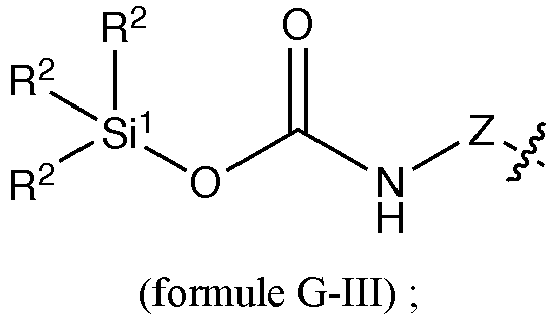 R2 est sélectionné à chaque occurrence de façon indépendante respectivement parmi le groupe, qui est constitué d'hydrogène, d'un groupe alkyle, substitué ou non substitué avec 1 à 12 atomes de carbone et d'un groupe aryle, substitué ou non substitué, à la condition qu'à chaque atome de silicium Si1 soit lié au moins un radical R2, qui n'est pas l'hydrogène ;Z est un groupe aliphatique ou aromatique, substitué ou non-substitué ;pour la fabrication d'un composé d'isocyanate de la formule générale I
A3-N=C=O (formule I),
oùA3 est un groupe de la formule G-V : où Z a les significations spécifiées en rapport avec le composé de la formule générale II.
Applications Claiming Priority (2)
| Application Number | Priority Date | Filing Date | Title |
|---|---|---|---|
| DE102020113028.7A DE102020113028B3 (de) | 2020-05-13 | 2020-05-13 | Verfahren zur Synthese von Isocyanaten |
| PCT/DE2021/100312 WO2021228301A1 (fr) | 2020-05-13 | 2021-03-30 | Procédé de synthèse d'isocyanates |
Publications (3)
| Publication Number | Publication Date |
|---|---|
| EP4149920A1 EP4149920A1 (fr) | 2023-03-22 |
| EP4149920B1 true EP4149920B1 (fr) | 2024-07-31 |
| EP4149920C0 EP4149920C0 (fr) | 2024-07-31 |
Family
ID=75588025
Family Applications (1)
| Application Number | Title | Priority Date | Filing Date |
|---|---|---|---|
| EP21720172.2A Active EP4149920B1 (fr) | 2020-05-13 | 2021-03-30 | Procédé de synthèse d'isocyanates |
Country Status (6)
| Country | Link |
|---|---|
| US (1) | US12559452B2 (fr) |
| EP (1) | EP4149920B1 (fr) |
| DE (1) | DE102020113028B3 (fr) |
| ES (1) | ES2994304T3 (fr) |
| HU (1) | HUE069081T2 (fr) |
| WO (1) | WO2021228301A1 (fr) |
Families Citing this family (1)
| Publication number | Priority date | Publication date | Assignee | Title |
|---|---|---|---|---|
| DE102020113028B3 (de) | 2020-05-13 | 2021-06-24 | Technische Universität Bergakademie Freiberg | Verfahren zur Synthese von Isocyanaten |
Family Cites Families (2)
| Publication number | Priority date | Publication date | Assignee | Title |
|---|---|---|---|---|
| DE102009045849B4 (de) | 2009-10-20 | 2018-03-08 | Technische Universität Bergakademie Freiberg | Verfahren zur Herstellung von Oligo- und Polysiloxanen |
| DE102020113028B3 (de) | 2020-05-13 | 2021-06-24 | Technische Universität Bergakademie Freiberg | Verfahren zur Synthese von Isocyanaten |
-
2020
- 2020-05-13 DE DE102020113028.7A patent/DE102020113028B3/de active Active
-
2021
- 2021-03-30 WO PCT/DE2021/100312 patent/WO2021228301A1/fr not_active Ceased
- 2021-03-30 HU HUE21720172A patent/HUE069081T2/hu unknown
- 2021-03-30 EP EP21720172.2A patent/EP4149920B1/fr active Active
- 2021-03-30 ES ES21720172T patent/ES2994304T3/es active Active
- 2021-03-30 US US17/914,519 patent/US12559452B2/en active Active
Also Published As
| Publication number | Publication date |
|---|---|
| US20230140949A1 (en) | 2023-05-11 |
| US12559452B2 (en) | 2026-02-24 |
| DE102020113028B3 (de) | 2021-06-24 |
| HUE069081T2 (hu) | 2025-02-28 |
| ES2994304T3 (en) | 2025-01-21 |
| WO2021228301A1 (fr) | 2021-11-18 |
| EP4149920C0 (fr) | 2024-07-31 |
| EP4149920A1 (fr) | 2023-03-22 |
Similar Documents
| Publication | Publication Date | Title |
|---|---|---|
| EP0212058B1 (fr) | N-silylpropyl-N'-acyl-urées et procédé de préparation | |
| CA1148969A (fr) | Methode de preparation d'urethanes disubstitues en n et o, pouvant servir de produit de depart pour la preparation d'isocyanates | |
| US4130576A (en) | Method for preparing isocyanates from halosilyl carbamates | |
| DE2917493A1 (de) | Verfahren zur herstellung von aliphatischen und cycloaliphatischen di- und polyurethanen | |
| JP3273059B2 (ja) | ウレタンおよびカーボネートの製造方法 | |
| DE2917490A1 (de) | Verfahren zur herstellung von aliphatischen und cycloaliphatischen di- und polyurethanen | |
| EP1136495A2 (fr) | 1:1 Monoadducts d'aminoalkylalkoxysilanes et diisocyanates, leur préparation et utilisation | |
| DE3888991T2 (de) | Aminokohlenwasserstoff-substituierte Ketoximosilane. | |
| DE102020113028B3 (de) | Verfahren zur Synthese von Isocyanaten | |
| EP2176273B1 (fr) | Procédé de fabrication d'aminoorganosilanes | |
| EP0416236B1 (fr) | Procédé pour l'isolation d'acide cyanique d'un mélange gazeux d'acide cyanique et d'ammoniac | |
| EP1853613A1 (fr) | Procede de production d'alcoxysilylmethylisocyanurates | |
| JPH0524896B2 (fr) | ||
| DE102023103209A1 (de) | Verfahren zur Herstellung von aliphatischen N,O-silylierten Carbamaten | |
| KR880006174A (ko) | 시클로헥실 모노 및 디우레탄과 그로부터 유도된 모노-및 디이소시아네이트의 제조 방법,그 방법에 의해 제조된 신규 모노이소시아네트 및 이를 포함하는 경화성 조성물 | |
| EP3233729B1 (fr) | Procédé de production d'un anion perhalogéné de cyclohexasilane | |
| JPS628446B2 (fr) | ||
| EP0636606B1 (fr) | Procédé de préparation d'adduits liquides d'une amine avec une amide contenant des groupes fluorés | |
| DE69930733T2 (de) | Herstellung von substituierten (amino)alkoxysilanen | |
| DE102023127669A1 (de) | Verfahren zur Herstellung von Halogenalkoxy(organo)silanen und -siloxanen sowie Pseudohalogenalkoxy(organo)silanen und -siloxanen | |
| Blencowe et al. | Alternative syntheses of linear polyurethanes using masked isocyanate monomers | |
| EP0307756A2 (fr) | Procédé pour la préparation d'isocyanates et leur utilisation pour la préparation de polyisocyanates contenant des groupes esters et certaines polyisocyanates contenant ces groupes esters | |
| DE69907094T2 (de) | Organosiliziumverbindungen und deren Herstellung | |
| EP3728277B1 (fr) | Silanes présentant des groupes ester d'oxamine | |
| DE102009045849B4 (de) | Verfahren zur Herstellung von Oligo- und Polysiloxanen |
Legal Events
| Date | Code | Title | Description |
|---|---|---|---|
| STAA | Information on the status of an ep patent application or granted ep patent |
Free format text: STATUS: UNKNOWN |
|
| STAA | Information on the status of an ep patent application or granted ep patent |
Free format text: STATUS: THE INTERNATIONAL PUBLICATION HAS BEEN MADE |
|
| PUAI | Public reference made under article 153(3) epc to a published international application that has entered the european phase |
Free format text: ORIGINAL CODE: 0009012 |
|
| STAA | Information on the status of an ep patent application or granted ep patent |
Free format text: STATUS: REQUEST FOR EXAMINATION WAS MADE |
|
| 17P | Request for examination filed |
Effective date: 20220819 |
|
| AK | Designated contracting states |
Kind code of ref document: A1 Designated state(s): AL AT BE BG CH CY CZ DE DK EE ES FI FR GB GR HR HU IE IS IT LI LT LU LV MC MK MT NL NO PL PT RO RS SE SI SK SM TR |
|
| DAV | Request for validation of the european patent (deleted) | ||
| DAX | Request for extension of the european patent (deleted) | ||
| GRAP | Despatch of communication of intention to grant a patent |
Free format text: ORIGINAL CODE: EPIDOSNIGR1 |
|
| STAA | Information on the status of an ep patent application or granted ep patent |
Free format text: STATUS: GRANT OF PATENT IS INTENDED |
|
| RIC1 | Information provided on ipc code assigned before grant |
Ipc: C07F 7/08 20060101ALI20240206BHEP Ipc: C07F 7/18 20060101ALI20240206BHEP Ipc: C07F 7/12 20060101ALI20240206BHEP Ipc: C07F 7/10 20060101ALI20240206BHEP Ipc: C07C 265/14 20060101ALI20240206BHEP Ipc: C07C 265/08 20060101ALI20240206BHEP Ipc: C07C 265/06 20060101ALI20240206BHEP Ipc: C07C 265/04 20060101ALI20240206BHEP Ipc: C07C 263/04 20060101AFI20240206BHEP |
|
| INTG | Intention to grant announced |
Effective date: 20240222 |
|
| GRAS | Grant fee paid |
Free format text: ORIGINAL CODE: EPIDOSNIGR3 |
|
| GRAA | (expected) grant |
Free format text: ORIGINAL CODE: 0009210 |
|
| STAA | Information on the status of an ep patent application or granted ep patent |
Free format text: STATUS: THE PATENT HAS BEEN GRANTED |
|
| REG | Reference to a national code |
Ref country code: DE Ref legal event code: R081 Ref document number: 502021004585 Country of ref document: DE Owner name: TECHNISCHE UNIVERSITAET BERGAKADEMIE FREIBERG,, DE Free format text: FORMER OWNER: ANMELDERANGABEN UNKLAR / UNVOLLSTAENDIG, 80297 MUENCHEN, DE |
|
| AK | Designated contracting states |
Kind code of ref document: B1 Designated state(s): AL AT BE BG CH CY CZ DE DK EE ES FI FR GB GR HR HU IE IS IT LI LT LU LV MC MK MT NL NO PL PT RO RS SE SI SK SM TR |
|
| REG | Reference to a national code |
Ref country code: CH Ref legal event code: EP Ref country code: GB Ref legal event code: FG4D Free format text: NOT ENGLISH |
|
| REG | Reference to a national code |
Ref country code: DE Ref legal event code: R096 Ref document number: 502021004585 Country of ref document: DE |
|
| REG | Reference to a national code |
Ref country code: IE Ref legal event code: FG4D Free format text: LANGUAGE OF EP DOCUMENT: GERMAN |
|
| U01 | Request for unitary effect filed |
Effective date: 20240830 |
|
| U07 | Unitary effect registered |
Designated state(s): AT BE BG DE DK EE FI FR IT LT LU LV MT NL PT RO SE SI Effective date: 20240910 |
|
| PG25 | Lapsed in a contracting state [announced via postgrant information from national office to epo] |
Ref country code: NO Free format text: LAPSE BECAUSE OF FAILURE TO SUBMIT A TRANSLATION OF THE DESCRIPTION OR TO PAY THE FEE WITHIN THE PRESCRIBED TIME-LIMIT Effective date: 20241031 |
|
| PG25 | Lapsed in a contracting state [announced via postgrant information from national office to epo] |
Ref country code: PL Free format text: LAPSE BECAUSE OF FAILURE TO SUBMIT A TRANSLATION OF THE DESCRIPTION OR TO PAY THE FEE WITHIN THE PRESCRIBED TIME-LIMIT Effective date: 20240731 Ref country code: GR Free format text: LAPSE BECAUSE OF FAILURE TO SUBMIT A TRANSLATION OF THE DESCRIPTION OR TO PAY THE FEE WITHIN THE PRESCRIBED TIME-LIMIT Effective date: 20241101 |
|
| REG | Reference to a national code |
Ref country code: ES Ref legal event code: FG2A Ref document number: 2994304 Country of ref document: ES Kind code of ref document: T3 Effective date: 20250121 |
|
| PG25 | Lapsed in a contracting state [announced via postgrant information from national office to epo] |
Ref country code: IS Free format text: LAPSE BECAUSE OF FAILURE TO SUBMIT A TRANSLATION OF THE DESCRIPTION OR TO PAY THE FEE WITHIN THE PRESCRIBED TIME-LIMIT Effective date: 20241130 |
|
| PG25 | Lapsed in a contracting state [announced via postgrant information from national office to epo] |
Ref country code: HR Free format text: LAPSE BECAUSE OF FAILURE TO SUBMIT A TRANSLATION OF THE DESCRIPTION OR TO PAY THE FEE WITHIN THE PRESCRIBED TIME-LIMIT Effective date: 20240731 |
|
| PG25 | Lapsed in a contracting state [announced via postgrant information from national office to epo] |
Ref country code: RS Free format text: LAPSE BECAUSE OF FAILURE TO SUBMIT A TRANSLATION OF THE DESCRIPTION OR TO PAY THE FEE WITHIN THE PRESCRIBED TIME-LIMIT Effective date: 20241031 |
|
| PG25 | Lapsed in a contracting state [announced via postgrant information from national office to epo] |
Ref country code: RS Free format text: LAPSE BECAUSE OF FAILURE TO SUBMIT A TRANSLATION OF THE DESCRIPTION OR TO PAY THE FEE WITHIN THE PRESCRIBED TIME-LIMIT Effective date: 20241031 Ref country code: PL Free format text: LAPSE BECAUSE OF FAILURE TO SUBMIT A TRANSLATION OF THE DESCRIPTION OR TO PAY THE FEE WITHIN THE PRESCRIBED TIME-LIMIT Effective date: 20240731 Ref country code: NO Free format text: LAPSE BECAUSE OF FAILURE TO SUBMIT A TRANSLATION OF THE DESCRIPTION OR TO PAY THE FEE WITHIN THE PRESCRIBED TIME-LIMIT Effective date: 20241031 Ref country code: IS Free format text: LAPSE BECAUSE OF FAILURE TO SUBMIT A TRANSLATION OF THE DESCRIPTION OR TO PAY THE FEE WITHIN THE PRESCRIBED TIME-LIMIT Effective date: 20241130 Ref country code: HR Free format text: LAPSE BECAUSE OF FAILURE TO SUBMIT A TRANSLATION OF THE DESCRIPTION OR TO PAY THE FEE WITHIN THE PRESCRIBED TIME-LIMIT Effective date: 20240731 Ref country code: GR Free format text: LAPSE BECAUSE OF FAILURE TO SUBMIT A TRANSLATION OF THE DESCRIPTION OR TO PAY THE FEE WITHIN THE PRESCRIBED TIME-LIMIT Effective date: 20241101 |
|
| REG | Reference to a national code |
Ref country code: HU Ref legal event code: AG4A Ref document number: E069081 Country of ref document: HU |
|
| PG25 | Lapsed in a contracting state [announced via postgrant information from national office to epo] |
Ref country code: SM Free format text: LAPSE BECAUSE OF FAILURE TO SUBMIT A TRANSLATION OF THE DESCRIPTION OR TO PAY THE FEE WITHIN THE PRESCRIBED TIME-LIMIT Effective date: 20240731 |
|
| U20 | Renewal fee for the european patent with unitary effect paid |
Year of fee payment: 5 Effective date: 20250317 |
|
| PG25 | Lapsed in a contracting state [announced via postgrant information from national office to epo] |
Ref country code: CZ Free format text: LAPSE BECAUSE OF FAILURE TO SUBMIT A TRANSLATION OF THE DESCRIPTION OR TO PAY THE FEE WITHIN THE PRESCRIBED TIME-LIMIT Effective date: 20240731 |
|
| PG25 | Lapsed in a contracting state [announced via postgrant information from national office to epo] |
Ref country code: SK Free format text: LAPSE BECAUSE OF FAILURE TO SUBMIT A TRANSLATION OF THE DESCRIPTION OR TO PAY THE FEE WITHIN THE PRESCRIBED TIME-LIMIT Effective date: 20240731 |
|
| PLBE | No opposition filed within time limit |
Free format text: ORIGINAL CODE: 0009261 |
|
| STAA | Information on the status of an ep patent application or granted ep patent |
Free format text: STATUS: NO OPPOSITION FILED WITHIN TIME LIMIT |
|
| 26N | No opposition filed |
Effective date: 20250501 |
|
| PGFP | Annual fee paid to national office [announced via postgrant information from national office to epo] |
Ref country code: ES Payment date: 20250416 Year of fee payment: 5 |
|
| PGFP | Annual fee paid to national office [announced via postgrant information from national office to epo] |
Ref country code: HU Payment date: 20250429 Year of fee payment: 5 |
|
| PGFP | Annual fee paid to national office [announced via postgrant information from national office to epo] |
Ref country code: CH Payment date: 20250401 Year of fee payment: 5 |
|
| PG25 | Lapsed in a contracting state [announced via postgrant information from national office to epo] |
Ref country code: MC Free format text: LAPSE BECAUSE OF FAILURE TO SUBMIT A TRANSLATION OF THE DESCRIPTION OR TO PAY THE FEE WITHIN THE PRESCRIBED TIME-LIMIT Effective date: 20240731 |
|
| PG25 | Lapsed in a contracting state [announced via postgrant information from national office to epo] |
Ref country code: IE Free format text: LAPSE BECAUSE OF NON-PAYMENT OF DUE FEES Effective date: 20250330 |
|
| U1K | Transfer of rights of the unitary patent after the registration of the unitary effect |
Owner name: CYNIO GMBH; DE |
|
| PGFP | Annual fee paid to national office [announced via postgrant information from national office to epo] |
Ref country code: GB Payment date: 20260327 Year of fee payment: 6 |
|
| REG | Reference to a national code |
Ref country code: CH Ref legal event code: U11 Free format text: ST27 STATUS EVENT CODE: U-0-0-U10-U11 (AS PROVIDED BY THE NATIONAL OFFICE) Effective date: 20260424 |
|
| U20 | Renewal fee for the european patent with unitary effect paid |
Year of fee payment: 6 Effective date: 20260331 |