EP4150108B1 - Détection précoce des agents pathogènes chez les plantes - Google Patents
Détection précoce des agents pathogènes chez les plantes Download PDFInfo
- Publication number
- EP4150108B1 EP4150108B1 EP21721940.1A EP21721940A EP4150108B1 EP 4150108 B1 EP4150108 B1 EP 4150108B1 EP 21721940 A EP21721940 A EP 21721940A EP 4150108 B1 EP4150108 B1 EP 4150108B1
- Authority
- EP
- European Patent Office
- Prior art keywords
- pathogen
- resistance
- sequence
- plant
- sample
- Prior art date
- Legal status (The legal status is an assumption and is not a legal conclusion. Google has not performed a legal analysis and makes no representation as to the accuracy of the status listed.)
- Active
Links
Images

Classifications
-
- C—CHEMISTRY; METALLURGY
- C12—BIOCHEMISTRY; BEER; SPIRITS; WINE; VINEGAR; MICROBIOLOGY; ENZYMOLOGY; MUTATION OR GENETIC ENGINEERING
- C12Q—MEASURING OR TESTING PROCESSES INVOLVING ENZYMES, NUCLEIC ACIDS OR MICROORGANISMS; COMPOSITIONS OR TEST PAPERS THEREFOR; PROCESSES OF PREPARING SUCH COMPOSITIONS; CONDITION-RESPONSIVE CONTROL IN MICROBIOLOGICAL OR ENZYMOLOGICAL PROCESSES
- C12Q1/00—Measuring or testing processes involving enzymes, nucleic acids or microorganisms; Compositions therefor; Processes of preparing such compositions
- C12Q1/68—Measuring or testing processes involving enzymes, nucleic acids or microorganisms; Compositions therefor; Processes of preparing such compositions involving nucleic acids
- C12Q1/6869—Methods for sequencing
- C12Q1/6874—Methods for sequencing involving nucleic acid arrays, e.g. sequencing by hybridisation
-
- C—CHEMISTRY; METALLURGY
- C12—BIOCHEMISTRY; BEER; SPIRITS; WINE; VINEGAR; MICROBIOLOGY; ENZYMOLOGY; MUTATION OR GENETIC ENGINEERING
- C12Q—MEASURING OR TESTING PROCESSES INVOLVING ENZYMES, NUCLEIC ACIDS OR MICROORGANISMS; COMPOSITIONS OR TEST PAPERS THEREFOR; PROCESSES OF PREPARING SUCH COMPOSITIONS; CONDITION-RESPONSIVE CONTROL IN MICROBIOLOGICAL OR ENZYMOLOGICAL PROCESSES
- C12Q1/00—Measuring or testing processes involving enzymes, nucleic acids or microorganisms; Compositions therefor; Processes of preparing such compositions
- C12Q1/68—Measuring or testing processes involving enzymes, nucleic acids or microorganisms; Compositions therefor; Processes of preparing such compositions involving nucleic acids
- C12Q1/6869—Methods for sequencing
-
- C—CHEMISTRY; METALLURGY
- C12—BIOCHEMISTRY; BEER; SPIRITS; WINE; VINEGAR; MICROBIOLOGY; ENZYMOLOGY; MUTATION OR GENETIC ENGINEERING
- C12Q—MEASURING OR TESTING PROCESSES INVOLVING ENZYMES, NUCLEIC ACIDS OR MICROORGANISMS; COMPOSITIONS OR TEST PAPERS THEREFOR; PROCESSES OF PREPARING SUCH COMPOSITIONS; CONDITION-RESPONSIVE CONTROL IN MICROBIOLOGICAL OR ENZYMOLOGICAL PROCESSES
- C12Q2600/00—Oligonucleotides characterized by their use
- C12Q2600/156—Polymorphic or mutational markers
-
- G—PHYSICS
- G16—INFORMATION AND COMMUNICATION TECHNOLOGY [ICT] SPECIALLY ADAPTED FOR SPECIFIC APPLICATION FIELDS
- G16B—BIOINFORMATICS, i.e. INFORMATION AND COMMUNICATION TECHNOLOGY [ICT] SPECIALLY ADAPTED FOR GENETIC OR PROTEIN-RELATED DATA PROCESSING IN COMPUTATIONAL MOLECULAR BIOLOGY
- G16B20/00—ICT specially adapted for functional genomics or proteomics, e.g. genotype-phenotype associations
- G16B20/20—Allele or variant detection, e.g. single nucleotide polymorphism [SNP] detection
Definitions
- the present invention relates to the early detection of pathogens in, on or in plants or parts of plants, as well as the identification of signs of resistance of these pathogens to chemical or biological control agents.
- the present invention relates to a system, a method and a computer-readable medium for the early detection of the presence of pathogens in, on or in plants or parts of plants using sequence analyses and the identification of signs of resistance.
- WO2017/194276 describes a method for detecting plant diseases based on the analysis of images of a plant part.
- a plant can be infected by a population of pathogens without any visible symptoms appearing.
- the resistance status of the population of pathogens cannot be determined using such image analysis.
- US20120088696A1 discloses a microelectrochemical multiplex PCR platform that can be used for the amplification, investigation and quantification of target nucleotides in real time and can be used, for example, for the rapid detection of plant diseases.
- the platform must be adapted in each individual case for the detection of a specific disease and is comparatively complex to use.
- WO2019149626A1 deals with the identification of resistance markers in the field.
- the present invention is a supplement to the WO2019149626A1
- the present invention combines the determination of resistance with the early detection of pathogens in plants.
- the solutions presented in this description are efficient, adaptable and can incorporate further information into the early detection of pathogens and resistance.
- a user specifies a plant that is grown in a field and, if necessary, also specifies the geocoordinates of the field.
- the system according to the invention can be configured to use the specified plant and, if necessary, the geocoordinates in a database to determine pathogens that can occur in the plant species. Current weather data and/or weather data from the past can be determined, for example, using the geocoordinates. It is conceivable that for pathogens that can occur in the plant, models are selected that use the weather data to calculate a probability that these pathogens will occur in the specified plant at the current time. It is conceivable that only those pathogens are examined in more detail for which the probability of them occurring in the specified plant at the current time is above a threshold value (minimum probability). The threshold value can be determined empirically or set arbitrarily by a user.
- the one or more pathogen sequences are available as an FM index.
- An FM index is a compressed full-text substring index based on the Burrows-Wheeler transformation and was developed by P. Ferragina and G. Manzini (see e.g.: P. Ferragina and G. Manzini: Opportunistic Data Structures with Applications, Proceedings of the 41st Annual Symposium on Foundations of Computer Science 2000; 390-398 ).
- the name FM index stands for full-text index in minute space.
- the FM index is an opportunistic data structure that allows compression of the input text as well as fast substring retrieval.
- An FM index can be used to efficiently count the number of occurrences of a pattern within the compressed input text and locate the position of each occurrence.
- the query time as well as the required storage space are sublinearly complex with respect to the size of the input data.
- no nucleic acid or peptide containing a pathogen sequence is sequenced in the sample within a predefined time period, it can be assumed that no pathogen is present in the sample.
- the predefined time period can be determined empirically. A message can be issued that no pathogen was found in the sample.
- the sequence of a nucleic acid or peptide in the sample matches a specific pathogen sequence, it can be assumed that the corresponding pathogen is present in the sample.
- the knowledge of the pathogen sequence automatically yields the respective pathogen.
- the pathogen thus identified is checked against a database to see whether it there are known resistances to one or more control agents. "Known" means that a corresponding resistance has been observed in a population of the pathogen in the past. If at least one resistance has been observed, at least one resistance marker is determined.
- a “resistance marker” is a piece of genetic information that provides information on whether a pest could develop, is currently developing or has developed resistance to a pesticide.
- a “resistance marker” is therefore a sequence of nucleotides or a sequence of amino acids that has been found in nucleic acids or peptides of resistant populations and that is responsible for the resistance or promotes the resistance. For example, this can be the target sequence in a resistant pathogen that has a mutation compared to non-resistant species of the same type.
- the "target” defines the site of action of the control agent on the pathogen. A genetic change in the target sequence can mean that the control agent no longer works or only works to a reduced extent.
- a message may be issued stating that a pathogen has been identified in the sample, what the pathogen is, and that no resistance is known for the pathogen.
- the second phase of sequencing is initiated.
- the sequencing of the nucleic acids or peptides in the sample continues; however, in the second phase the focus is on identifying signs of Resistance of the identified pathogen to one or more control agents.
- the sequences of nucleotides or amino acids determined during sequencing are compared with at least one resistance marker and/or with a resistance-free sequence.
- a message can be issued that a pathogen has been found, which pathogen it is, and that no signs of known resistance to a control agent have been found, but that there are deviations in the sequence of nucleotides or amino acids compared to the resistance-free sequence that can/should be examined more closely.
- sequences of nucleotides or amino acids appear during sequencing that match the sequence of a resistance marker, this is an indication of the presence of (known) resistance.
- a message can be issued indicating that a pathogen has been found in the sample, that the pathogen shows signs of resistance, and the resistance can be named, e.g. based on the matching resistance marker.
- nucleic acid or peptide from a resistant pathogen differs from the corresponding sequence of a non-resistant pathogen by only one nucleotide or a few nucleotides or only one amino acid or a few amino acids.
- errors can always occur when sequencing individual nucleic acids or peptides. Therefore, if a nucleic acid or peptide is identified that has a sequence corresponding to a resistance marker, it is fundamentally possible that this is an error. It is therefore conceivable that the presence of a sign of resistance is only assumed when a minimum number of nucleic acids or amino acids have been found that have a sequence corresponding to a resistance marker.
- the sequences of nucleic acids or peptides in a sample are compared in the second phase of sequencing not (only) with resistance markers, but also with the corresponding sequence of a non-resistant pathogen of the same species.
- This sequence is also referred to in this description as a resistance-free sequence.
- the resistance-free sequence is also a reference sequence.
- nucleic acids or peptides are found in the sample that originate from a pathogen, but whose sequence does not correspond to the resistance marker or the resistance-free sequence. It may be that this is a new mutation that could lead to an as yet unknown resistance. By comparing the sequences of the nucleic acids or peptides in the sample with the resistance-free sequence, new, possibly developing resistances can be identified at an early stage.
- the second phase of sequencing can be initiated, e.g. to analyze the target sequence in the pathogen and, if necessary, to identify mutations that indicate developing resistance.
- the sequences of nucleotides or amino acids determined are not compared with the resistance marker, but with the target sequence.
- the target sequence is also a reference sequence.
- the target sequence, the resistance-free sequence and the reference marker are also referred to in this description as the resistance-indicating sequence, since resistance or the absence of resistance can be determined based on this sequence section.
- the frequency Q R of nucleic acids or peptides found in a sample with a sequence according to the resistance marker is determined, and the frequency Q NR of nucleic acids or peptides found in the sample with a sequence according to the resistance-free sequence is determined.
- the determined frequencies Q R and Q NR can be put into relation to one another (e.g. Q R / Q NR ) . It is conceivable that the presence of a sign of resistance is only assumed when the ratio has exceeded a predefined minimum value. The minimum value can be determined empirically.
- Information and/or messages can be output when carrying out the present invention, for example, in the form of images and/or text and/or speech.
- Information and/or messages can be displayed on a screen (monitor), printed out via a printer, stored in a data storage device and/or transmitted to another computer via a network.
- Information about a pathogen that has been identified can be, for example, the name of the pathogen. Information can also be provided about which sample the pathogen was found in, and/or where the sample was collected, and/or when the sample was taken, and/or which plant the sample was taken from.
- Information on a resistance that has been identified may include the name of the resistance, the target affected by the resistance and/or the name of one or more control agents or active substances to which the identified pathogen is resistant.
- control agents can be named that can be used to combat the pathogen. If a pathogen has been identified for which signs of known resistance have been found, control agents can be named for which the resistance does not apply.
- Such a control agent can then also be the use of electrical energy, thermal energy (e.g. in the form of steam or flaming), electromagnetic radiation (UV radiation, laser irradiation) and/or mechanical means for removing the infected plant or parts of the plant.
- the system according to the invention can also comprise a control device for controlling pathogens, which can automatically apply the selected control agent to combat the identified pathogen after (automated) selection of the control agent.
- pathogen map is a representation of a part of the earth's surface in which information is recorded for a plurality of locations on the earth's surface as to whether a pathogen has been observed at the corresponding location and whether the pathogen shows any indication of (existing or developing or possible) resistance.
- the pathogen map is preferably a digital pathogen map.
- digital means that the card can be processed by a machine, usually a computer system.
- processing refers to the known methods of electronic data processing (EDP).
- the digital pathogen map is a digital representation of a field or a field including neighboring fields or a region.
- separate pathogen maps are generated for individual pathogens and/or for individual control agents or groups of control agents that have the same active ingredient or the same chemical/biological class (e.g. a chemical structure class) of active ingredients or the same mechanism of action or the same site of action (target), and/or for specific plants in which the pathogen can occur.
- separate digital pathogen maps can be linked to one another, i.e. virtually superimposed on one another.
- the time or times at which the respective analysis was carried out is/are stored.
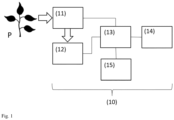
- the control and calculation unit (13) checks whether the growing sequences are contained in one or more pathogen sequences. As soon as it turns out that a growing sequence of a nucleic acid is not contained in the at least one pathogen sequence, the control and calculation unit (13) sends a signal to the sequencing unit (12). The signal aborts the sequencing of the nucleic acid and starts the sequencing of a new nucleic acid. As soon as it turns out that the sequence of a nucleic acid matches a pathogen sequence, the control and calculation unit (13) causes the output unit (15) to output information about the pathogen with whose sequence the sequence of the nucleic acid matches. The control and calculation unit (13) then switches to a second phase.
- the computer receives a new growing sequence S of a nucleic acid.
- the computer checks whether the growing sequence S is contained in at least one resistance-indicating sequence R ( S ⁇ R ?).
- the computer sends a signal that terminates the sequencing of the currently sequenced nucleic acid. Instead, a new nucleic acid is sequenced and the computer receives a growing sequence S of the new nucleic acid.
- FIG. 3 shows schematically a further embodiment of the system according to the invention.
- the system (10) comprises a sequencing unit (12), a control and calculation unit (13), a data memory (14) and an output unit (15).
- the control and calculation unit (13) and the output unit (15) are components of a standard computer system, e.g. a laptop.
- the control and calculation unit (13) receives data from the sequencing unit (12), the data representing growing sequences of nucleotides or amino acids.
- the control and calculation unit (13) is also connected to the database (14) via a network (e.g. the Internet, here represented by a cloud (C)). It is conceivable that several databases are present. It is also conceivable that a database is part of the computer system.
- the control and calculation unit (13) obtains at least one pathogen sequence and optionally at least one resistance-indicating sequence from the at least one database.
- the at least one database can also provide data on environmental conditions, data on control agents, data on plants and plant varieties, data on pathogens and/or the like. It is also conceivable that one or more models for calculating the probability of the occurrence of a pathogen in a plant at the current time based on information on the plant and/or the environmental conditions is/are stored in the at least one database, which model(s) can be retrieved by the control and calculation unit (13) and used for calculation purposes.
Landscapes
- Life Sciences & Earth Sciences (AREA)
- Chemical & Material Sciences (AREA)
- Proteomics, Peptides & Aminoacids (AREA)
- Health & Medical Sciences (AREA)
- Engineering & Computer Science (AREA)
- Organic Chemistry (AREA)
- Bioinformatics & Cheminformatics (AREA)
- Physics & Mathematics (AREA)
- Zoology (AREA)
- Wood Science & Technology (AREA)
- Biotechnology (AREA)
- Genetics & Genomics (AREA)
- Molecular Biology (AREA)
- Analytical Chemistry (AREA)
- General Health & Medical Sciences (AREA)
- Biophysics (AREA)
- Immunology (AREA)
- Microbiology (AREA)
- Biochemistry (AREA)
- General Engineering & Computer Science (AREA)
- Spectroscopy & Molecular Physics (AREA)
- Theoretical Computer Science (AREA)
- Bioinformatics & Computational Biology (AREA)
- Medical Informatics (AREA)
- Evolutionary Biology (AREA)
- Measuring Or Testing Involving Enzymes Or Micro-Organisms (AREA)
Claims (16)
- Procédé comprenant les étapes :- collecte d'un échantillon d'une plante (P) ou d'un milieu dans lequel pousse la plante (P),- identification d'un agent pathogène dans l'échantillon,- identification de signes d'une résistance de l'agent pathogène à un agent de lutte,• l'identification de l'agent pathogène et l'identification des signes d'une résistance s'effectuant au moyen de séquences d'acides nucléiques individuels ou de peptides individuels dans l'échantillon, lors du séquençage des acides nucléiques individuels ou peptides individuels des séquences de nucléotides ou des séquences d'acides aminés étant déterminées, les séquences de nucléotides ou séquences d'acides aminés étant comparées à des séquences de référence,
caractérisé en ce que le séquençage s'effectue en deux phases, une première phase (Ph1) et une seconde phase (Ph2),• dans la première phase (Ph1) pendant le séquençage d'un tel acide nucléique ou d'un tel peptide la séquence déterminée (S) dans chaque cas est comparée à au moins une séquence d'agent pathogène (PS), et▪ dans le cas où la séquence déterminée (S) ne coïncide pas avec ladite au moins une séquence d'agent pathogène (PS), la poursuite du séquençage de cet acide nucléique ou de ce peptide est interrompue,▪ dans le cas où la séquence déterminée (S) coïncide avec une séquence d'agent pathogène (PS), un agent pathogène qui comporte la séquence d'agent pathogène (PS) est déterminé, et à l'aide de l'agent pathogène déterminé on détermine au moins un marqueur de résistance, et on passe à la seconde phase (Ph2),• dans la seconde phase (Ph2) des séquences des acides nucléiques ou peptides dans l'échantillon étant comparées audit au moins un marqueur de résistance déterminé et/ou à une séquence exempte de résistance, une séquence exempte de résistance étant une suite de nucléotides ou une suite d'acides aminés d'un agent pathogène, qui ne présente aucun signe d'une résistance de l'agent pathogène à un agent de lutte. - Procédé selon la revendication 1, comprenant les étapes :- détermination d'une plante (P)- détermination d'au moins un agent pathogène qui peut attaquer la plante (P)- détermination d'au moins une séquence d'agent pathogène (PS) dudit au moins un agent pathogène déterminé- collecte d'un échantillon de la plante (P) ou d'un milieu dans lequel pousse la plante (P),- identification d'un agent pathogène dans l'échantillon- détermination d'au moins un marqueur de résistance pour l'agent pathogène identifié,- identification de signes d'une résistance de l'agent pathogène à un agent de lutte,
- Procédé selon la revendication 1, comprenant les étapes :- détermination d'une plante (P)- détermination de conditions environnementales auxquelles la plante (P) est exposée et/ou a été exposée- détermination d'au moins un agent pathogène qui peut attaquer la plante (P)- détermination d'au moins une séquence d'agent pathogène (PS) dudit au moins un agent pathogène déterminé- collecte d'un échantillon de la plante (P) ou d'un milieu dans lequel pousse la plante (P),- identification d'un agent pathogène dans l'échantillon,- détermination d'au moins un marqueur de résistance pour l'agent pathogène identifié,- identification de signes d'une résistance de l'agent pathogène à un agent de lutte,
- Procédé selon la revendication 1, comprenant les étapes :- détermination d'une plante (P)- détermination d'au moins un agent pathogène qui peut attaquer la plante (P)- détermination de conditions environnementales auxquelles la plante (P) est exposée et/ou a été exposée- calcul d'une probabilité de l'apparition dudit au moins un agent pathogène chez la plante (P) à l'instant actuel- comparaison de la probabilité avec une valeur seuil définie- détermination de séquences d'agents pathogènes (PS) des agents pathogènes déterminés pour lesquels la probabilité est supérieure à la valeur seuil- collecte d'un échantillon de la plante (P) ou d'un milieu dans lequel pousse la plante (P),- identification d'un agent pathogène dans l'échantillon,- détermination d'au moins un marqueur de résistance pour l'agent pathogène identifié,- identification de signes d'une résistance de l'agent pathogène à un agent de lutte,
- Procédé selon l'une quelconque des revendications 1 à 4, dan lequel l'étape d'identification de signes d'une résistance de l'agent pathogène identifié à un agent de lutte comprend les étapes partielles suivantes :- comparaison des séquences des acides nucléiques ou peptides dans l'échantillon avec ledit au moins un marqueur de résistance déterminé,- dans le cas où le marqueur de résistance n'apparaît dans aucune des séquences des acides nucléiques ou peptides dans l'échantillon : émission d'un message indiquant qu'aucun signe d'une résistance n'a été trouvé pour l'agent pathogène identifié,- dans le cas où le marqueur de résistance apparaît dans une ou plusieurs des séquences : émission d'un message indiquant qu'un signe d'une résistance a été trouvé pour l'agent pathogène identifié, et émission d'un message relatif à la résistance.
- Procédé selon l'une quelconque des revendications 1 à 4, dan lequel l'étape d'identification de signes d'une résistance de l'agent pathogène identifié à un agent de lutte comprend les étapes partielles suivantes :- comparaison des séquences des acides nucléiques ou peptides dans l'échantillon avec ledit au moins un marqueur de résistance déterminé,- dans le cas où le marqueur de résistance n'apparaît dans aucune des séquences des acides nucléiques ou peptides dans l'échantillon ou apparaît dans un nombre d'acides nucléiques qui est inférieur à un nombre minimum prédéfini : émission d'un message indiquant qu'aucun signe d'une résistance n'a été trouvé pour l'agent pathogène identifié,- dans le cas où le marqueur de résistance apparaît dans un nombre minimum des séquences ou dans un nombre qui est supérieur au nombre minimum : émission d'un message indiquant qu'un signe d'une résistance a été trouvé pour l'agent pathogène identifié, et émission d'un message relatif à la résistance.
- Procédé selon l'une quelconque des revendications 1 à 6, comprenant les étapes :- collecte d'un échantillon d'une plante (P) ou d'un milieu dans lequel pousse la plante (P),- identification d'un agent pathogène dans l'échantillon- détermination d'au moins un marqueur de résistance pour l'agent pathogène identifié et détermination d'une séquence exempte de résistance pour l'agent pathogène identifié- identification de signes d'une résistance de l'agent pathogène identifié à un agent de lutte par comparaison des séquences d'acides nucléiques ou de peptides dans l'échantillon avec ledit au moins un marqueur de résistance déterminé et la séquence exempte de résistance- dans le cas où une séquence ou un nombre de séquences qui est supérieur ou égal à un nombre minimum ne coïncide ni avec ledit au moins un marqueur de résistance ni avec la séquence exempte de résistance : émission d'un message indiquant que dans l'échantillon a été identifié un agent pathogène qui comporte une mutation indicatrice d'une résistance nouvelle et/ou en extension.
- Procédé selon l'une quelconque des revendications 1 à 6, comprenant les étapes :- collecte d'un échantillon d'une plante (P) ou d'un milieu dans lequel pousse la plante (P),- identification d'un agent pathogène dans l'échantillon,- détermination d'une séquence cible pour l'agent pathogène identifié- identification de signes d'une nouvelle résistance de l'agent pathogène identifié à un agent de lutte par comparaison des séquences d'acides nucléiques ou de peptides dans l'échantillon avec la séquence cible- dans le cas où une séquence ou un nombre de séquences qui est supérieur ou égal à un nombre minimum représente une mutation de la séquence cible : émission d'un message indiquant que dans l'échantillon a été identifié un agent pathogène qui comporte une mutation indicatrice d'une résistance nouvelle et/ou en extension.
- Procédé selon l'une quelconque des revendications 1 à 6, comprenant les étapes :- collecte d'un échantillon d'une plante (P) ou d'un milieu dans lequel pousse la plante (P),- identification d'un agent pathogène dans l'échantillon,- détermination d'au moins un marqueur de résistance pour l'agent pathogène identifié et détermination d'une séquence exempte de résistance pour l'agent pathogène identifié- comparaison des séquences d'acides nucléiques ou de peptides dans l'échantillon avec ledit au moins un marqueur de résistance déterminé et la séquence exempte de résistance- détermination d'une fréquence QR d'acides nucléiques ou de peptides, trouvés dans l'échantillon, comportant une séquence conforme au marqueur de résistance, détermination d'une fréquence QNR d'acides nucléiques ou de peptides trouvés dans l'échantillon qui comportent une séquence conforme à la séquence exempte de résistance, calcul d'un rapport des fréquences déterminées QR et QNR et comparaison du rapport avec une valeur minimale prédéfinie- dans le cas où le rapport est supérieur ou égal à la valeur minimale ; émission d'un message indiquant qu'un signe d'une résistance a été trouvé pour l'agent pathogène identifié, et émission d'un message relatif à la résistance.
- Procédé selon l'une quelconque des revendications 1 à 9, dans lequel pour ce qui est de l'échantillon de la plante (P) il s'agit d'une feuille ou de plusieurs feuilles de la plante (P).
- Procédé selon l'une quelconque des revendications 1 à 10, dans lequel la plante (P) se trouve dans le stade principal 1 ou 2 ou 3 à 6 selon l'échelle BBCH.
- Procédé selon l'une quelconque des revendications 1 à 11, dans lequel pour ce qui est de la séquence d'agent pathogène (PS) il s'agit d'une suite ne nucléotides d'ADN d'un champignon, d'une bactérie ou d'un virus.
- Procédé selon l'une quelconque des revendications 1 à 12, comprenant en outre les étapes :- élaboration et/ou actualisation d'une carte d'agent pathogène, dans la carte d'agent pathogène étant indiqué un site, l'échantillon de la plante (P) ayant été récolté dans le site, pour le site étant indiqué si un agent pathogène a été identifié dans la plante (P) et, dans le cas où un agent pathogène a été identifié dans la plante (P), si l'agent pathogène présente une résistance à un agent de lutte, et- émission de la carte d'agent pathogène, de préférence affichage de la carte d'agent pathogène sur un écran et/ou sortie de la carte d'agent pathogène sur une imprimante et/ou transmission de la carte d'agent pathogène à l'exécution automatisée d'une disposition destinée à la lutte contre l'agent pathogène identifié.
- Procédé selon l'une quelconque des revendications 1 à 13, comprenant en outre les étapes :- détermination d'un agent de lutte destiné à la lutte contre l'agent pathogène identifié avec prise en considération de la résistance éventuellement identifiée,- exécution d'une disposition destinée à la lutte contre l'agent pathogène chez la plante avec utilisation de l'agent de lutte déterminé.
- Système (10) comprenant- une unité de séquençage (12),- une unité de commande et de calcul (13), et- au moins une mémoire de données (14), dans laquelle au moins une séquence d'agent pathogène (PS) et au moins un marqueur de résistance sont mémorisés pour au moins un agent pathogène,l'unité de séquençage (12) étant configurée pour séquencer des acides nucléiques ou des peptides dans un échantillon d'une plante (P) ou d'un milieu dans lequel pousse la plante (P), et pour ainsi déterminer des séquences de nucléotides ou d'acides aminés dans l'échantillon.l'unité de séquençage (12) étant configurée pour transmettre à l'unité de commande et de calcul (13), pendant la détermination des séquences, les séquences chaque fois déterminées,caractérisé en ce que l'unité de commande et de calcul (13) est configurée pour, dans une première phase (Ph1), comparer chaque séquence déterminée (S) d'un acide nucléique ou d'un peptide avec au moins une séquence d'agent pathogène (PS), et• dans le cas où une séquence (S) transmise ne coïncide pas avec ladite au moins une séquence d'agent pathogène (PS), amener l'unité de séquençage (12) à interrompre la poursuite du séquençage de l'acide aminé respectif ou du peptide respectif,• dans le cas où la séquence déterminée (S) coïncide avec une séquence d'agent pathogène (PS), déterminer un agent pathogène qui comporte la séquence d'agent pathogène (PS), et déterminer à l'aide de l'agent pathogène déterminé au moins un marqueur de résistance, et passer dans une seconde phase (Ph2),l'unité de commande et de calcul (13) étant configurée pour, dans la seconde phase (Ph2), comparer des séquences des acides nucléiques ou peptides dans l'échantillon audit au moins un marqueur de résistance déterminé et/ou à une séquence exempte de résistance, une séquence exempte de résistance étant une suite de nucléotides ou une suite d'acides aminés d'un agent pathogène, qui ne présente aucun signe d'une résistance de l'agent pathogène à un agent de lutte.
- Support (de mémoire) lisible par ordinateur, comprenant des instructions qui, lors d'une exécution par un ordinateur, amènent ce dernier à exécuter les étapes suivantes :- pour une pluralité d'acides nucléiques ou de peptides : capture d'une suite croissante de nucléotides ou d'acides aminés dans l'acide nucléique respectif ou le peptide respectif d'une unité de séquençage (12), caractérisé en ce que les instructions amènent en outre l'ordinateur à exécuter les étapes suivantes- dans une première phase (Ph1) pendant la capture de la suite croissante : vérifier si la suite de nucléotides ou d'acides aminés est contenue une ou plusieurs fois dans au moins une séquence d'agent pathogène (PS),- dans le cas où la suite n'est contenue dans aucune séquence d'agent pathogène (PS) : transmettre à l'unité de séquençage (12) un signal visant à l'interruption de la poursuite du séquençage de l'acide nucléique ou du peptide,- dans le cas où la suite coïncide avec une séquence d'agent pathogène (PS) : déterminer un agent pathogène qui comporte la séquence d'agent pathogène, et déterminer au moins un marqueur de référence, et commencer une seconde phase (Ph2),- dans la seconde phase (Ph2) : comparer la suite de nucléotides ou d'acides aminés avec ledit au moins un marqueur de référence et/ou une séquence exempte de résistance, une séquence exempte de résistance étant une suite de nucléotides ou une suite d'acides aminés d'un agent pathogène, qui ne présente aucun signe d'une résistance de l'agent pathogène à un agent de lutte.
Applications Claiming Priority (3)
| Application Number | Priority Date | Filing Date | Title |
|---|---|---|---|
| EP20174320 | 2020-05-13 | ||
| EP20183910.7A EP3933049A1 (fr) | 2020-07-03 | 2020-07-03 | Détection précoce des agents pathogènes chez les plantes |
| PCT/EP2021/061366 WO2021228578A1 (fr) | 2020-05-13 | 2021-04-30 | Détection précoce d'agents pathogènes dans des plantes |
Publications (2)
| Publication Number | Publication Date |
|---|---|
| EP4150108A1 EP4150108A1 (fr) | 2023-03-22 |
| EP4150108B1 true EP4150108B1 (fr) | 2025-01-29 |
Family
ID=75690303
Family Applications (1)
| Application Number | Title | Priority Date | Filing Date |
|---|---|---|---|
| EP21721940.1A Active EP4150108B1 (fr) | 2020-05-13 | 2021-04-30 | Détection précoce des agents pathogènes chez les plantes |
Country Status (8)
| Country | Link |
|---|---|
| US (1) | US20230197191A1 (fr) |
| EP (1) | EP4150108B1 (fr) |
| CN (1) | CN115803459B (fr) |
| BR (1) | BR112022023090A2 (fr) |
| CA (1) | CA3182695A1 (fr) |
| ES (1) | ES3022861T3 (fr) |
| PL (1) | PL4150108T3 (fr) |
| WO (1) | WO2021228578A1 (fr) |
Families Citing this family (3)
| Publication number | Priority date | Publication date | Assignee | Title |
|---|---|---|---|---|
| WO2024099985A1 (fr) | 2022-11-10 | 2024-05-16 | Bayer Aktiengesellschaft | Application ciblée de produits de protection de cultures basée sur des profils génétiques |
| US12228511B1 (en) * | 2023-09-25 | 2025-02-18 | Craig Ellins | Organic plant material microbial test kit devices and processing method |
| US20250347622A1 (en) * | 2023-09-25 | 2025-11-13 | Craig Ellins | Organic plant material microbial test kit devices and processing method |
Family Cites Families (8)
| Publication number | Priority date | Publication date | Assignee | Title |
|---|---|---|---|---|
| TWI495727B (zh) | 2010-10-08 | 2015-08-11 | Nat Applied Res Laboratories | 微型電化學多重即時定量聚合酶連鎖反應(pcr)系統 |
| US10045499B2 (en) * | 2012-05-24 | 2018-08-14 | Iowa State University Research Foundation, Inc. | Arabidopsis nonhost resistance gene(s) and use thereof to engineer disease resistant plants |
| JP2015035212A (ja) * | 2013-07-29 | 2015-02-19 | アジレント・テクノロジーズ・インクAgilent Technologies, Inc. | ターゲットシークエンシングパネルから変異を見つける方法 |
| BR112018008541A2 (pt) * | 2015-10-30 | 2018-10-30 | Koninklijke Philips Nv | método implementado por computador para determinar uma rota de transmissão de patógenos relacionados, mídia de armazenamento não transitório legível por computador e sistema implementado por computador para pré-formar uma análise de genoma |
| EP3216873A1 (fr) * | 2016-03-08 | 2017-09-13 | Curetis GmbH | Combinaison de variations structurelles et de changements de nucléotides simples dans un modèle statistique pour sélection de thérapie améliorée |
| WO2017194276A1 (fr) | 2016-05-13 | 2017-11-16 | Basf Se | Système et procédé pour détecter des maladies de plante |
| GB201707140D0 (en) * | 2017-05-04 | 2017-06-21 | Oxford Nanopore Tech Ltd | Method |
| EP3745857A1 (fr) * | 2018-02-02 | 2020-12-09 | Bayer Aktiengesellschaft | Lutte contre des organismes nuisibles résistants |
-
2021
- 2021-04-30 ES ES21721940T patent/ES3022861T3/es active Active
- 2021-04-30 EP EP21721940.1A patent/EP4150108B1/fr active Active
- 2021-04-30 CN CN202180049134.0A patent/CN115803459B/zh active Active
- 2021-04-30 WO PCT/EP2021/061366 patent/WO2021228578A1/fr not_active Ceased
- 2021-04-30 PL PL21721940.1T patent/PL4150108T3/pl unknown
- 2021-04-30 CA CA3182695A patent/CA3182695A1/fr active Pending
- 2021-04-30 US US17/924,650 patent/US20230197191A1/en active Pending
- 2021-04-30 BR BR112022023090A patent/BR112022023090A2/pt unknown
Also Published As
| Publication number | Publication date |
|---|---|
| CA3182695A1 (fr) | 2021-11-18 |
| EP4150108A1 (fr) | 2023-03-22 |
| BR112022023090A2 (pt) | 2022-12-20 |
| CN115803459A (zh) | 2023-03-14 |
| CN115803459B (zh) | 2025-03-25 |
| WO2021228578A1 (fr) | 2021-11-18 |
| PL4150108T3 (pl) | 2025-06-02 |
| US20230197191A1 (en) | 2023-06-22 |
| ES3022861T3 (en) | 2025-05-29 |
Similar Documents
| Publication | Publication Date | Title |
|---|---|---|
| Kerry et al. | An overview of remote monitoring methods in biodiversity conservation | |
| EP4150108B1 (fr) | Détection précoce des agents pathogènes chez les plantes | |
| Hadley et al. | The effects of landscape fragmentation on pollination dynamics: absence of evidence not evidence of absence | |
| EP3503724B1 (fr) | Lutte contre des organismes nuisibles sur la base de prediction de risques de contamination | |
| Sarthou et al. | Local more than landscape parameters structure natural enemy communities during their overwintering in semi-natural habitats | |
| Debano | Effects of livestock grazing on aboveground insect communities in semi-arid grasslands of southeastern Arizona | |
| Rusch et al. | Effect of crop management and landscape context on insect pest populations and crop damage | |
| Macfadyen et al. | Reducing insecticide use in broad-acre grains production: an Australian study | |
| de Warnaffe et al. | Effects of forest management on carabid beetles in Belgium: implications for biodiversity conservation | |
| Lafage et al. | Relative importance of management and natural flooding on spider, carabid and plant assemblages in extensively used grasslands along the Loire | |
| Sabatier et al. | Non-linear effects of pesticide application on biodiversity-driven ecosystem services and disservices in a cacao agroecosystem: A modeling study | |
| Beals | Understanding community structure: a data-driven multivariate approach | |
| WO2019149626A1 (fr) | Lutte contre des organismes nuisibles résistants | |
| Ng et al. | Dynamic effects of ground-layer plant communities on beetles in a fragmented farming landscape | |
| WO2019034785A1 (fr) | Utilisation de données provenant d'essais sur le terrain dans la protection de plantes pour l'étalonnage et l'optimisation de modèles de prévision | |
| EP3673425A1 (fr) | Estimation du rendement de production de plantes cultivées | |
| Baidya et al. | Influence of human land use and invasive species on beta diversity of tropical ant assemblages | |
| Reich et al. | Assessment of the biological control potential of common carabid beetle species for autumn-and winter-active pests (Gastropoda, Lepidoptera, Diptera: Tipulidae) in annual ryegrass in Western Oregon | |
| EP3516580A1 (fr) | Lutte contre des organismes nuisibles | |
| Rizali et al. | Similarity of ant communities increases with isolation from natural habitat and abundance of invasive ants in oil palm plantations of Central Borneo | |
| Ramm et al. | Comparative analysis of mechanical in-field corn residue shredding methods: evaluating particle size distribution and rating of structural integrity of corn stalk segments | |
| EP3933049A1 (fr) | Détection précoce des agents pathogènes chez les plantes | |
| Herbst et al. | Direct and indirect effects of agricultural intensification on a host-parasitoid system on the ribwort plantain (Plantago lanceolata L.) in a landscape context | |
| Gaberthüel et al. | 61 What does it take to develop nematicide today and for the future? | |
| Lara et al. | Comparison and field validation of binomial sampling plans for Oligonychus perseae (Acari: Tetranychidae) on Hass avocado in southern California |
Legal Events
| Date | Code | Title | Description |
|---|---|---|---|
| STAA | Information on the status of an ep patent application or granted ep patent |
Free format text: STATUS: UNKNOWN |
|
| STAA | Information on the status of an ep patent application or granted ep patent |
Free format text: STATUS: THE INTERNATIONAL PUBLICATION HAS BEEN MADE |
|
| PUAI | Public reference made under article 153(3) epc to a published international application that has entered the european phase |
Free format text: ORIGINAL CODE: 0009012 |
|
| STAA | Information on the status of an ep patent application or granted ep patent |
Free format text: STATUS: REQUEST FOR EXAMINATION WAS MADE |
|
| 17P | Request for examination filed |
Effective date: 20221213 |
|
| AK | Designated contracting states |
Kind code of ref document: A1 Designated state(s): AL AT BE BG CH CY CZ DE DK EE ES FI FR GB GR HR HU IE IS IT LI LT LU LV MC MK MT NL NO PL PT RO RS SE SI SK SM TR |
|
| DAV | Request for validation of the european patent (deleted) | ||
| DAX | Request for extension of the european patent (deleted) | ||
| GRAP | Despatch of communication of intention to grant a patent |
Free format text: ORIGINAL CODE: EPIDOSNIGR1 |
|
| STAA | Information on the status of an ep patent application or granted ep patent |
Free format text: STATUS: GRANT OF PATENT IS INTENDED |
|
| INTG | Intention to grant announced |
Effective date: 20241024 |
|
| GRAS | Grant fee paid |
Free format text: ORIGINAL CODE: EPIDOSNIGR3 |
|
| GRAA | (expected) grant |
Free format text: ORIGINAL CODE: 0009210 |
|
| STAA | Information on the status of an ep patent application or granted ep patent |
Free format text: STATUS: THE PATENT HAS BEEN GRANTED |
|
| AK | Designated contracting states |
Kind code of ref document: B1 Designated state(s): AL AT BE BG CH CY CZ DE DK EE ES FI FR GB GR HR HU IE IS IT LI LT LU LV MC MK MT NL NO PL PT RO RS SE SI SK SM TR |
|
| REG | Reference to a national code |
Ref country code: GB Ref legal event code: FG4D Free format text: NOT ENGLISH |
|
| REG | Reference to a national code |
Ref country code: CH Ref legal event code: EP |
|
| REG | Reference to a national code |
Ref country code: DE Ref legal event code: R096 Ref document number: 502021006520 Country of ref document: DE |
|
| REG | Reference to a national code |
Ref country code: IE Ref legal event code: FG4D Free format text: LANGUAGE OF EP DOCUMENT: GERMAN |
|
| REG | Reference to a national code |
Ref country code: ES Ref legal event code: FG2A Ref document number: 3022861 Country of ref document: ES Kind code of ref document: T3 Effective date: 20250529 |
|
| REG | Reference to a national code |
Ref country code: NL Ref legal event code: MP Effective date: 20250129 |
|
| PG25 | Lapsed in a contracting state [announced via postgrant information from national office to epo] |
Ref country code: NL Free format text: LAPSE BECAUSE OF FAILURE TO SUBMIT A TRANSLATION OF THE DESCRIPTION OR TO PAY THE FEE WITHIN THE PRESCRIBED TIME-LIMIT Effective date: 20250129 |
|
| PG25 | Lapsed in a contracting state [announced via postgrant information from national office to epo] |
Ref country code: RS Free format text: LAPSE BECAUSE OF FAILURE TO SUBMIT A TRANSLATION OF THE DESCRIPTION OR TO PAY THE FEE WITHIN THE PRESCRIBED TIME-LIMIT Effective date: 20250429 |
|
| PG25 | Lapsed in a contracting state [announced via postgrant information from national office to epo] |
Ref country code: FI Free format text: LAPSE BECAUSE OF FAILURE TO SUBMIT A TRANSLATION OF THE DESCRIPTION OR TO PAY THE FEE WITHIN THE PRESCRIBED TIME-LIMIT Effective date: 20250129 |
|
| PGFP | Annual fee paid to national office [announced via postgrant information from national office to epo] |
Ref country code: DE Payment date: 20250319 Year of fee payment: 5 |
|
| PGFP | Annual fee paid to national office [announced via postgrant information from national office to epo] |
Ref country code: ES Payment date: 20250507 Year of fee payment: 5 |
|
| REG | Reference to a national code |
Ref country code: LT Ref legal event code: MG9D |
|
| PG25 | Lapsed in a contracting state [announced via postgrant information from national office to epo] |
Ref country code: IS Free format text: LAPSE BECAUSE OF FAILURE TO SUBMIT A TRANSLATION OF THE DESCRIPTION OR TO PAY THE FEE WITHIN THE PRESCRIBED TIME-LIMIT Effective date: 20250529 Ref country code: NO Free format text: LAPSE BECAUSE OF FAILURE TO SUBMIT A TRANSLATION OF THE DESCRIPTION OR TO PAY THE FEE WITHIN THE PRESCRIBED TIME-LIMIT Effective date: 20250429 |
|
| PGFP | Annual fee paid to national office [announced via postgrant information from national office to epo] |
Ref country code: IT Payment date: 20250424 Year of fee payment: 5 |
|
| PG25 | Lapsed in a contracting state [announced via postgrant information from national office to epo] |
Ref country code: HR Free format text: LAPSE BECAUSE OF FAILURE TO SUBMIT A TRANSLATION OF THE DESCRIPTION OR TO PAY THE FEE WITHIN THE PRESCRIBED TIME-LIMIT Effective date: 20250129 |
|
| PG25 | Lapsed in a contracting state [announced via postgrant information from national office to epo] |
Ref country code: LV Free format text: LAPSE BECAUSE OF FAILURE TO SUBMIT A TRANSLATION OF THE DESCRIPTION OR TO PAY THE FEE WITHIN THE PRESCRIBED TIME-LIMIT Effective date: 20250129 Ref country code: PT Free format text: LAPSE BECAUSE OF FAILURE TO SUBMIT A TRANSLATION OF THE DESCRIPTION OR TO PAY THE FEE WITHIN THE PRESCRIBED TIME-LIMIT Effective date: 20250529 |
|
| PG25 | Lapsed in a contracting state [announced via postgrant information from national office to epo] |
Ref country code: BG Free format text: LAPSE BECAUSE OF FAILURE TO SUBMIT A TRANSLATION OF THE DESCRIPTION OR TO PAY THE FEE WITHIN THE PRESCRIBED TIME-LIMIT Effective date: 20250129 Ref country code: GR Free format text: LAPSE BECAUSE OF FAILURE TO SUBMIT A TRANSLATION OF THE DESCRIPTION OR TO PAY THE FEE WITHIN THE PRESCRIBED TIME-LIMIT Effective date: 20250430 |
|
| P01 | Opt-out of the competence of the unified patent court (upc) registered |
Free format text: CASE NUMBER: UPC_APP_1418_4150108/2025 Effective date: 20250730 |
|
| PG25 | Lapsed in a contracting state [announced via postgrant information from national office to epo] |
Ref country code: SE Free format text: LAPSE BECAUSE OF FAILURE TO SUBMIT A TRANSLATION OF THE DESCRIPTION OR TO PAY THE FEE WITHIN THE PRESCRIBED TIME-LIMIT Effective date: 20250129 |
|
| PG25 | Lapsed in a contracting state [announced via postgrant information from national office to epo] |
Ref country code: SM Free format text: LAPSE BECAUSE OF FAILURE TO SUBMIT A TRANSLATION OF THE DESCRIPTION OR TO PAY THE FEE WITHIN THE PRESCRIBED TIME-LIMIT Effective date: 20250129 |
|
| PG25 | Lapsed in a contracting state [announced via postgrant information from national office to epo] |
Ref country code: DK Free format text: LAPSE BECAUSE OF FAILURE TO SUBMIT A TRANSLATION OF THE DESCRIPTION OR TO PAY THE FEE WITHIN THE PRESCRIBED TIME-LIMIT Effective date: 20250129 |
|
| PG25 | Lapsed in a contracting state [announced via postgrant information from national office to epo] |
Ref country code: CZ Free format text: LAPSE BECAUSE OF FAILURE TO SUBMIT A TRANSLATION OF THE DESCRIPTION OR TO PAY THE FEE WITHIN THE PRESCRIBED TIME-LIMIT Effective date: 20250129 Ref country code: EE Free format text: LAPSE BECAUSE OF FAILURE TO SUBMIT A TRANSLATION OF THE DESCRIPTION OR TO PAY THE FEE WITHIN THE PRESCRIBED TIME-LIMIT Effective date: 20250129 |
|
| PG25 | Lapsed in a contracting state [announced via postgrant information from national office to epo] |
Ref country code: RO Free format text: LAPSE BECAUSE OF FAILURE TO SUBMIT A TRANSLATION OF THE DESCRIPTION OR TO PAY THE FEE WITHIN THE PRESCRIBED TIME-LIMIT Effective date: 20250129 |
|
| PG25 | Lapsed in a contracting state [announced via postgrant information from national office to epo] |
Ref country code: SK Free format text: LAPSE BECAUSE OF FAILURE TO SUBMIT A TRANSLATION OF THE DESCRIPTION OR TO PAY THE FEE WITHIN THE PRESCRIBED TIME-LIMIT Effective date: 20250129 |
|
| REG | Reference to a national code |
Ref country code: DE Ref legal event code: R097 Ref document number: 502021006520 Country of ref document: DE |
|
| REG | Reference to a national code |
Ref country code: CH Ref legal event code: H13 Free format text: ST27 STATUS EVENT CODE: U-0-0-H10-H13 (AS PROVIDED BY THE NATIONAL OFFICE) Effective date: 20251125 |
|
| PLBE | No opposition filed within time limit |
Free format text: ORIGINAL CODE: 0009261 |
|
| STAA | Information on the status of an ep patent application or granted ep patent |
Free format text: STATUS: NO OPPOSITION FILED WITHIN TIME LIMIT |
|
| PG25 | Lapsed in a contracting state [announced via postgrant information from national office to epo] |
Ref country code: LU Free format text: LAPSE BECAUSE OF NON-PAYMENT OF DUE FEES Effective date: 20250430 |
|
| PG25 | Lapsed in a contracting state [announced via postgrant information from national office to epo] |
Ref country code: MC Free format text: LAPSE BECAUSE OF FAILURE TO SUBMIT A TRANSLATION OF THE DESCRIPTION OR TO PAY THE FEE WITHIN THE PRESCRIBED TIME-LIMIT Effective date: 20250129 |
|
| GBPC | Gb: european patent ceased through non-payment of renewal fee |
Effective date: 20250430 |
|
| REG | Reference to a national code |
Ref country code: BE Ref legal event code: MM Effective date: 20250430 |
|
| 26N | No opposition filed |
Effective date: 20251030 |
|
| PG25 | Lapsed in a contracting state [announced via postgrant information from national office to epo] |
Ref country code: GB Free format text: LAPSE BECAUSE OF NON-PAYMENT OF DUE FEES Effective date: 20250430 |
|
| PG25 | Lapsed in a contracting state [announced via postgrant information from national office to epo] |
Ref country code: BE Free format text: LAPSE BECAUSE OF NON-PAYMENT OF DUE FEES Effective date: 20250430 |
|
| PG25 | Lapsed in a contracting state [announced via postgrant information from national office to epo] |
Ref country code: CH Free format text: LAPSE BECAUSE OF NON-PAYMENT OF DUE FEES Effective date: 20250430 |
|
| PG25 | Lapsed in a contracting state [announced via postgrant information from national office to epo] |
Ref country code: IE Free format text: LAPSE BECAUSE OF NON-PAYMENT OF DUE FEES Effective date: 20250430 |
|
| PGFP | Annual fee paid to national office [announced via postgrant information from national office to epo] |
Ref country code: AT Payment date: 20260410 Year of fee payment: 5 |
|
| PGFP | Annual fee paid to national office [announced via postgrant information from national office to epo] |
Ref country code: FR Payment date: 20260323 Year of fee payment: 6 |
|
| PGFP | Annual fee paid to national office [announced via postgrant information from national office to epo] |
Ref country code: PL Payment date: 20260327 Year of fee payment: 6 |