EP4152191B1 - Verfahren zur bereitstellung einer objektbezogenen kommunikation bezogen auf physische objekte - Google Patents
Verfahren zur bereitstellung einer objektbezogenen kommunikation bezogen auf physische objekte Download PDFInfo
- Publication number
- EP4152191B1 EP4152191B1 EP21196828.4A EP21196828A EP4152191B1 EP 4152191 B1 EP4152191 B1 EP 4152191B1 EP 21196828 A EP21196828 A EP 21196828A EP 4152191 B1 EP4152191 B1 EP 4152191B1
- Authority
- EP
- European Patent Office
- Prior art keywords
- information
- container
- digital representation
- packet
- access
- Prior art date
- Legal status (The legal status is an assumption and is not a legal conclusion. Google has not performed a legal analysis and makes no representation as to the accuracy of the status listed.)
- Active
Links
Images

Classifications
-
- H—ELECTRICITY
- H04—ELECTRIC COMMUNICATION TECHNIQUE
- H04L—TRANSMISSION OF DIGITAL INFORMATION, e.g. TELEGRAPHIC COMMUNICATION
- H04L67/00—Network arrangements or protocols for supporting network services or applications
- H04L67/01—Protocols
- H04L67/12—Protocols specially adapted for proprietary or special-purpose networking environments, e.g. medical networks, sensor networks, networks in vehicles or remote metering networks
-
- G—PHYSICS
- G06—COMPUTING OR CALCULATING; COUNTING
- G06F—ELECTRIC DIGITAL DATA PROCESSING
- G06F21/00—Security arrangements for protecting computers, components thereof, programs or data against unauthorised activity
- G06F21/50—Monitoring users, programs or devices to maintain the integrity of platforms, e.g. of processors, firmware or operating systems
- G06F21/55—Detecting local intrusion or implementing counter-measures
- G06F21/552—Detecting local intrusion or implementing counter-measures involving long-term monitoring or reporting
-
- G—PHYSICS
- G06—COMPUTING OR CALCULATING; COUNTING
- G06F—ELECTRIC DIGITAL DATA PROCESSING
- G06F21/00—Security arrangements for protecting computers, components thereof, programs or data against unauthorised activity
- G06F21/60—Protecting data
- G06F21/62—Protecting access to data via a platform, e.g. using keys or access control rules
- G06F21/6218—Protecting access to data via a platform, e.g. using keys or access control rules to a system of files or objects, e.g. local or distributed file system or database
- G06F21/6245—Protecting personal data, e.g. for financial or medical purposes
- G06F21/6263—Protecting personal data, e.g. for financial or medical purposes during internet communication, e.g. revealing personal data from cookies
-
- H—ELECTRICITY
- H04—ELECTRIC COMMUNICATION TECHNIQUE
- H04L—TRANSMISSION OF DIGITAL INFORMATION, e.g. TELEGRAPHIC COMMUNICATION
- H04L67/00—Network arrangements or protocols for supporting network services or applications
- H04L67/50—Network services
- H04L67/56—Provisioning of proxy services
- H04L67/564—Enhancement of application control based on intercepted application data
-
- G—PHYSICS
- G16—INFORMATION AND COMMUNICATION TECHNOLOGY [ICT] SPECIALLY ADAPTED FOR SPECIFIC APPLICATION FIELDS
- G16Y—INFORMATION AND COMMUNICATION TECHNOLOGY SPECIALLY ADAPTED FOR THE INTERNET OF THINGS [IoT]
- G16Y10/00—Economic sectors
- G16Y10/45—Commerce
-
- G—PHYSICS
- G16—INFORMATION AND COMMUNICATION TECHNOLOGY [ICT] SPECIALLY ADAPTED FOR SPECIFIC APPLICATION FIELDS
- G16Y—INFORMATION AND COMMUNICATION TECHNOLOGY SPECIALLY ADAPTED FOR THE INTERNET OF THINGS [IoT]
- G16Y10/00—Economic sectors
- G16Y10/75—Information technology; Communication
Definitions
- the present invention relates generally to the technical field of information technology, and more particularly to a method for providing object-related communication related to a physical object. Furthermore, the present invention relates to an IoT platform, a digital representation of a physical object and a communication device for carrying out the method. Furthermore, the present invention relates to a computer program for carrying out the method.
- the Internet of Things is a collective term for technologies that enable physical and digital objects to be networked and interact through information and communication technologies.
- One approach implemented in the prior art is to create digital representations for physical objects.
- the possibilities provided by the Internet of Things for example to optimize material flows, are used.
- Another area in which the Internet of Things has gained increasing importance in the past is the Smart Home area.
- Devices for example ordinary household appliances, are provided with a digital image on a server and can be monitored or controlled via this, for example.
- US2018/300124 describes, for example, software layers that are physically located between sensors and the network.
- the concept of the Internet of Things is still comparatively insignificant in the field of communication, especially object-related communication. There is therefore a need to use the advantages of the Internet of Things for the area of communication as well.
- the requirement for data that allows conclusions to be drawn about persons should preferably be reduced.
- the object of the present invention is to provide an IoT platform, a digital representation of a physical object and a communication device that enable the method to be carried out.
- the information container particularly preferably contains at least two different types of information packets from the following: static information packet, dynamic information packet, access-sensitive information packet, gateway information packet. Provision can also be made for the information container to contain at least three different types of information packets from the following: static information packet, dynamic information packet, access-sensitive information packet, gateway information packet.
- Physical objects within the meaning of the present invention can in particular be everyday objects or publicly accessible objects.
- a physical object within the meaning of the present invention can be a coffee mug, a beer glass, a T-shirt or a book.
- a public drinking fountain or a place of interest can also be a physical object within the meaning of the present invention.
- digital representations are created on the loT platform.
- the IoT platform can be designed in particular as a server.
- a data package is created on the IoT platform that is uniquely assigned to and/or associated with the physical object.
- the physical object has an information carrier, with an identification mark, in particular a unique identifier (UID) being stored on the information carrier in a readable manner.
- the unique identifier can be read, for example, by a reading device of a communication device, in which case the communication device can be designed in particular as a mobile terminal.
- the Unique Identifier thus ensures that a physical object and its digital representation can be clearly assigned.
- the reading device can include a camera and/or a near-field communication interface and/or a short-range communication interface.
- the reading device is particularly preferably designed as an NFC, RFID or Bluetooth interface.
- the unique identifier can be converted into a persistent identifier (PID) by the communication device, for example.
- PID persistent identifier
- the persistent identifier can particularly advantageously include the unique identifier in order to enable unambiguous assignment to a digital representation.
- the persistent identifier can be used in particular as an Internet link be designed so that the communication device, which can be designed as a mobile terminal, can access the digital representation via the Internet.
- the information carrier can be read by means of a communication device in order to access the digital representation in the same way.
- An information container of a digital representation is to be understood as a data container in which information packages are located and/or in which information packages can be added and/or from which information packages can be removed.
- a fully configured information container can also be viewed as a cluster of information packages.
- the various information packets have different functions from one another, so that the method according to the invention can be used in a particularly versatile and flexible manner due to the provision of the different types of information packets. As a result, the method can advantageously take into account different needs and different physical objects.
- the following constellation is put forward: There is a physical object with an information carrier and a corresponding digital representation of this physical object on the IoT platform. There are also information emitters IE1 and IE2 and users N1, N2 and N3, each having a communication device.
- An information emitter is the one who configures the information container of a digital representation of a physical object, that is to say provides information packets—possibly different—in the information container.
- the information emitter can do this with a communication device which has the required authorization for the configuration of information containers.
- a user is someone who accesses the digital representation with a communication device, but cannot influence the existence of information packages in the information container.
- a static information packet is to be understood as an information packet that is provided by an information emitter IE1 or IE2 in the information container. It contains static information, ie information that cannot be changed by users N1, N2 or N3. For example, a user N1 can access the digital representation with his communication device by reading the information carrier and open, view and/or call up the static information package. In the simplest case, this is information about the physical object, for example operating instructions or historical background information.
- a dynamic information package is to be understood as an information package which is also provided by an information emitter IE1 or IE2 in the information container.
- it contains information that can also be edited by users N1, N2 or N3. Editing includes, in particular, changing, completing and/or deleting existing information.
- a user N1 can access the digital representation with his communication device by reading the information carrier and edit the dynamic information packet.
- a user N2 and/or N3, who also accesses the digital representation with his communication device by reading the information carrier can see the processing and, if necessary, carry out his own processing. Because the dynamic information package is on the loT platform, processing is advantageously possible in real time. In other words: a user N2 and/or N3 can advantageously see the processing of the user N1 immediately.
- An access-sensitive information package is to be understood as an information package with an integrated automatism.
- the automatism ensures that the information in the access-sensitive information package is supplemented with each access.
- the term "access-sensitive" thus expresses the fact that the information package performs the automatism of supplementing the information quasi independently upon access.
- the information can be supplemented, for example, by an access counter, which can be provided by the IoT platform on the software side, for example as a web application, so that the number of accesses is tracked. Based on the access information, specific actions can be triggered, which in particular can be predefined.
- a gateway information packet is to be understood as a kind of intermediate storage for information.
- Different communication devices for example of users N1, N2 and N3, can access the gateway information packet and communicate with each other without direct mutual addressing. In particular, only the digital representation of the physical objects whose information carrier was read is addressed, or to be more precise, the gateway information packet.
- the various users N1, N2 and N3 can access the gateway information packet at the same time or at different times and information that one of the users N1, N2 or N3 or several users has or have stored there. Communication between different users thus takes place, with no direct addressing of the users or of the users' communication devices.
- An example of a physical object with a digital representation whose information container can particularly advantageously contain a gateway information package is a public drinking fountain.
- this drinking fountain can be equipped with an information carrier so that participants in the geocaching game can communicate with one another. Since the participants in a geocaching game usually do not know each other beforehand, i.e. are strangers to one another, it is generally undesirable to immediately reveal one’s identity to one another.
- a social exchange i.e. communication
- the participants in a geocaching game are often not in the same place at the same time, so personal verbal communication is not possible. Anonymous communication among the participants is advantageously made possible by the object-related communication. If the geocaching game takes place in a forest, for example, selected trees can be equipped with information carriers.
- an information carrier can, in particular, be temporary, so that the information carrier can also be removed and/or deactivated again as required.
- the communication via the information packages has the advantage in common that data that can be used to identify persons - in particular users - is not required. In this way, decentralized and anonymous communication via objects can be implemented.
- a communication channel is provided when the communication device reads the identifier by reading the information carrier.
- Reading the information carrier can directly, d. H. by actually reading the information carrier on the physical object, or indirectly, i. H. by reading an image or duplicate of the information carrier, which is located, for example, on another mobile terminal that has previously read the physical object.
- This advantageously enables a communication channel to be set up between a communication device and the IoT platform even without the physical object being present.
- An Internet connection of the communication device is used particularly advantageously for the communication with the IoT platform, with a mobile data network being used particularly preferably for the Internet connection.
- the IoT platform when the communication channel is provided, sends information packets via the communication channel and receives requests and/or information via the communication channel.
- a communication channel information packets can be communicated between a communication device and the loT platform.
- inquiries and/or information can be exchanged via the communication channel.
- requests can be access requests that cause the loT platform enables the communication device to display the information stored in an information container of the digital representation of the physical object.
- information can be sent via the communication channel from the communication device to the loT platform, which in turn receives this information. This enables a particularly efficient communication between a communication device and the loT platform.
- the IoT platform can provide multiple communication channels to each communication device respectively. This means that an information package in the information container of the digital representation of the physical object can be accessed at the same time. Access is particularly advantageous in real time. Furthermore, an object-related communication between the different communication devices can be made possible by the multiple communication channels between the IoT platform and the different communication devices. It is not necessary for communication devices to address one another directly. All communication takes place via the loT platform, i. H. the loT platform is addressed while the communication devices - and thus the users of the communication devices - remain anonymous.
- the information container comprises a gateway information packet
- this acts as a buffer for information communicated by communication devices to the digital representation in order to enable communication between different communication devices by forwarding this information to other communication devices, this preferably being the case through a combination of several communication channels.
- a gateway information packet that acts as a buffer for information enables particularly efficient communication between communication devices.
- Different communication channels are used between the loT platform and the different communicating communication devices. Communication can be real-time or time-delayed.
- the gateway information packet acts as a buffer in which information communicated by a communication device is kept ready in order to make it available to a communication device accessing the gateway information packet at the same time or at a later point in time.
- multiple communication devices can also provide information in real time and thus communicate with one another. Anonymity of the users of the communication devices can be guaranteed particularly advantageously by the communication of different communication devices via the gateway information packet.
- the information container comprises at least one access-sensitive information package
- the access-sensitive information package is supplemented with additional information about the access made with each access by a communication device, with the supplement preferably specifying the time of access and/or the type of access Communication device that has accessed the information packet includes.
- an access-sensitive information packet makes it possible in a particularly simple manner to track, for example, the number of times the information packet has been accessed. Furthermore, the time of access and/or the type of communication device that accessed the information packet can be tracked. By tracking the time of access, for example, the network load can be optimized depending on the time. For example, machine learning can be used to find out at which points in time or times of day a particularly large number of accesses occur in order to optimize the loT platform for these points in time and times of day in the future in order to manage a particularly high network load.
- Information about the type of communication device that has accessed the information packet can be used, for example, to detect possible malfunctions of the IoT platform, for example when establishing communication channels with certain communication devices, and to correct these errors.
- communication devices from certain manufacturers, using e.g. a certain operating system may require an optimization of the IoT platform to ensure smooth communication.
- the information about the number of accesses can be used in particular to trigger specific actions. For example, an information emitter that has provided an access-sensitive information package in the information container of the digital representation of the physical object can be notified after a predefined number of accesses or be asked to take a specific action. Provision can also be made, for example, that after a specific number of accesses, no further access to the digital representation or to the access-sensitive information packet or to specific information packets in the information container of the digital representation is permitted.
- the method according to the invention can thus be used in a particularly versatile and flexible manner.
- An information container of a digital representation of a physical object may have multiple information packages. If the digital representation or the information container is accessed by a communication device by reading the information carrier of the associated physical object, it is regularly desirable to obtain an overview of all available information packets.
- the loT platform provides such an overview of the available information packages that are present in the information container.
- a display device of the communication device can display this overview in a particularly advantageous and simple manner.
- An input by the user of the communication device can lead, for example, to a selection of specific information packages that are to be retrieved from the IoT platform by the communication device.
- the selected information packets can be stored locally on the communication device if required.
- a configurable information container is particularly advantageous in terms of variability and flexibility. In this way, information packages can be added or removed as required or depending on external circumstances. In particular, the configuration can take place independently of the physical objects being placed on the market.
- the information container can be configured either by adding information packages or by removing information packages.
- desired information packs can be advantageously added.
- removing information packages a large number of information packages can be stored in advance, with unwanted information packages being able to be removed in a targeted manner when configuring the information container.
- a particularly simple possibility is thus created for storing specific information packets in an information container of a digital representation associated with a physical object.
- the information container can be configured in a particularly simple manner.
- the pool of information packets can be provided in particular by an IoT platform.
- Various predefined information packages can be stored in the information package pool, which can be used as a template for the configuration of the Information containers can serve.
- an information emitter can create new information packages that are available in the information package pool. This is preferably a third party who is neither the owner nor the issuer of the physical object.
- An information package pool can thus be created and/or changed in an advantageous manner, which leaves room for the creativity of third parties and makes it possible to create a broad spectrum of available information packages. Due to the divergence of issuers of physical objects, owners of physical objects, recipients of information or users and emitters of information, different actors can collaborate with one another in an advantageous manner.
- an at least partially automatic configuration of the information container advantageously simplifies the configuration.
- certain information packages can be preselected, which are based on the physical object.
- the configuration which takes place at least partially automatically, can in particular include the output of a list of information packets sorted according to relevance, the list of information packets being sorted according to decreasing relevance.
- Information packages whose information and/or functions—depending on the type of information package—fit particularly well to the respective physical object are of great relevance.
- the assessment of the relevance or whether an information package matches a respective physical object can advantageously be supported by machine learning.
- Inputs from an information emitter which adds certain information packages to an information container of a digital representation, can be used as training data and evaluated in order to derive criteria for assessing the relevance and for the at least partially automatic configuration (supervised machine learning).
- an initially unassigned digital representation is created, with this taking place independently of the existence of the physical object, with subsequent linking to the physical object being able to take place using the identification tag.
- a physical object may be made or exist long before a digital representation is created.
- Digital representations can thus also be created retrospectively for physical objects that have already been manufactured or have been in use for many years.
- digital representations can be created in advance, which are only subsequently linked to the physical objects. In particular, this advantageously enables the manufacturer and/or issuer of the physical objects and the creator of the digital representations to be different actors.
- a further increase in the flexibility and variability of the method is achieved in that the manufacturer and/or issuer of the physical object and the manufacturer of the information carrier can be different actors from one another. Furthermore, the actor who adds the information carrier to the physical object can be another actor.
- a contract manufacturer A can produce a physical object
- a contract manufacturer B can produce an information carrier
- a third company C which can be the client of contract manufacturers A and B, for example, adds the information carrier to the physical object.
- the information carrier can be added to the physical object in particular by means of common fastening mechanisms, depending on the nature and the material of the physical object and/or the information carrier. For example, sticking the information carrier onto the physical object would be conceivable. Printing, laminating or sewing the information carrier is also possible. Alternatively or in addition, the information carrier can be issued separately as an accompaniment to a physical object.
- an issuer of physical objects can be provided as the one who decides when and/or whether the information container of the digital representation, which is assigned to the respective physical object, may be provided with information packages or with specific information packages. This advantageously increases security and avoids undesirable functionalities. In this way, certain actors can be enabled to administer an information container.
- Special rules can also help to further improve security and desired functionality. For example, only certain information packages and/or a certain type of information package can be added to or removed from the information container for the purpose of protecting minors. As described above, a certain actor, for example the issuer of the physical objects, can decide on the rules. In a particularly advantageous manner, it can be provided that rules for the configuration can be freely defined or added, in particular can be added to the digital representations. An example of such a rule is to set a maximum limit on the number of information packets that can be added. In this way it can be avoided in an advantageous manner that the number of available information packages in an information container becomes confusing due to their number.
- a rule can be provided, for example, according to which information packets can only be added or removed if one or more specific further conditions in addition to the release of the digital representation is or are fulfilled.
- Such a further condition can be, for example, registered access by a communication device.
- an IoT platform or digital representation of a physical object, or a communication device is provided, provided and configured in order to carry out the respective steps of the method according to the invention.
- a computer program comprising instructions which, when the program is executed by a computer, cause the latter to execute the method according to the invention.
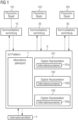
- an IoT platform 6 which includes an information packet pool 7 and digital representations 101', 102', 103'.
- the digital representations 101', 102', 103' are each unique representations of respective physical objects 101, 102, 103.
- the physical objects 101, 102, 103 comprise an information carrier I with a unique identifier UID stored thereon, with which a respective physical object 101, 102, 103 can be clearly assigned to its digital representation 101', 102', 103'.
- the respective digital representation 101 ', 102', 103 'of a physical object 101, 102, 103 can vice versa using a corresponding in the digital Representation 101 ', 102', 103 'stored identifier UID are uniquely assigned to the respective physical object 101, 102, 103.
- digital representation 101' is the representation of physical object 101
- digital representation 102 ⁇ is the representation of physical object 102
- digital representation 103' is the representation of physical object 103.
- the loT platform 6 provides an information packet pool 7 ready.
- the information packet pool 7 includes preconfigured information packets. These can, as in figure 6 shown, be static information packets, dynamic information packets, access-sensitive information packets or gateway information packets.
- the various information packets have different functions from one another, so that the method according to the invention can be used in a particularly versatile and flexible manner due to the provision of the different types of information packets.
- the method can advantageously take into account different needs and different physical objects 101, 102, 103.
- the following constellation should be considered: There is a physical object 101 with an information carrier I and a corresponding digital representation 101 ⁇ of this physical object 101 on the loT platform 6. There are also the information emitters IE1 and IE2 and the users N1, N2 and N3, each having a communication device 10, 20, 30.
- An information emitter 4 is the one who configures the information container 101a of a digital representation 101 of a physical object 101, that is to say provides information packets—possibly different—in the information container 101a.
- the information emitter 4 can do this with a communication device 10, 20, 30 which has the required authorization for the configuration of information containers 101a.
- a user is someone who accesses the digital representation 101 with a communication device 10, 20, 30, but cannot influence the existence of information packets in the information container 101a.
- a static information packet is to be understood as an information packet which is provided by an information emitter IE1 or IE2 in the information container 101a. It contains static information, ie information that cannot be changed by users N1, N2 or N3. For example, a user N1 with his communication device 10 access the digital representation 101 ⁇ by reading the information carrier I and open, view and/or call up the static information package. In the simplest case, this is information about the physical object 101, for example operating instructions or historical background information.
- a dynamic information packet is to be understood as an information packet which is also provided by an information emitter IE1 or IE2 in the information container 101a.
- it contains information that can also be edited by users N1, N2 or N3. Editing includes, in particular, changing, completing and/or deleting existing information.
- a user N1 can access the digital representation 101' with his communication device 10 by reading the information carrier I and process the dynamic information packet.
- a user N2 and/or N3, who also accesses the digital representation with his communication device 20, 30 by reading the information carrier I, can see the processing and, if necessary, carry out his own processing. Because the dynamic information package is on the loT platform, processing is advantageously possible in real time. In other words: a user N2 and/or N3 can advantageously see the processing of the user N1 immediately.
- An access-sensitive information package is to be understood as an information package with an integrated automatism.
- the automatism ensures that the information in the access-sensitive information package is supplemented with each access.
- the term "access-sensitive" thus expresses the fact that the information package performs the automatism of supplementing the information quasi independently upon access.
- the information can be supplemented, for example, by an access counter, which can be provided by the IoT platform 6 in software, for example as a web application, so that the number of accesses is tracked. Based on the access information, specific actions can be triggered, which in particular can be predefined.
- a gateway information packet is to be understood as a kind of intermediate storage for information.
- Different communication devices 10, 20, 30, for example of users N1, N2 and N3 can access the gateway information packet and communicate with one another without direct mutual addressing.
- the gateway information packet only the digital representation 101', 102', 103' of the physical object 101, 102, 103 whose information carrier was read is addressed, or to be more precise, the gateway information packet.
- the various users N1, N2 and N3 can access the gateway information packet at the same time or at different times and information that one of the users N1, N2 or N3 or several users has or have stored there. There is thus a communication between different users, with direct addressing of the users or the communication devices 10, 20, 30 of the users being omitted.
- An example of a physical object 101, 102, 103 with a digital representation 101', 102', 103', whose information container 101a, 102a, 103a can particularly advantageously contain a gateway information package, is a public drinking fountain.
- This drinking fountain can be equipped with an information carrier I, for example as part of a geocaching game, so that participants in the geocaching game can communicate with one another. Since the participants in a geocaching game usually do not know each other beforehand, i.e. are strangers to one another, it is generally undesirable to immediately reveal one’s identity to one another. At the same time, a social exchange, i.e. communication, is desired.
- the participants in a geocaching game are often not in the same place at the same time, so personal verbal communication is not possible. Anonymous communication among the participants is advantageously made possible by the object-related communication. If the geocaching game takes place in a forest, for example, selected trees can be equipped with information carriers I.
- an information carrier I can in particular be temporary, for example for playing a game, so that the information carrier I can also be removed and/or removed again as required.
- the communication via the information packages has the advantage in common that data that can be used to identify persons - in particular users - is not required. In this way, decentralized and anonymous communication via objects can be implemented.
- Preconfigured information packages can be added to the information package pool 7 as desired and preconfigured information packages can be removed from the information package pool 7 and preconfigured information packages from the information package pool 7 can be processed.
- An information emitter 4 can in particular add or remove information packets to or from the information packet pool 7 .
- the information emitter 4 accesses the loT platform 6 and independently makes any desired adjustments to the Information package pools 7. It may be necessary for the adjustment of the information packet pool 7 by an information emitter 4 that the information emitter 4 has to carry out a separate authentication in order to check whether an adjustment of the information packet pool 7 by the respective information emitter 4 is permitted or not.
- An information container 101a, 102a, 103a is also provided on the loT platform for each digital representation 101, 102, 103.
- Information packets can be present in the respective information containers 101a, 102a, 103a.
- the information containers 101a, 102a, 103a of the respective digital representations 101, 102, 103 include selected information packages that are specific to the respective digital representation 101', 102', 103' or for the respective physical object 101, 102, 103 that associated with the respective digital representation 101', 102', 103'.
- An information container 101a, 102a, 103a can, for example, be at least partially automatically filled with information packages from the information package pool 7, or information packages from the information package pool 7 can be actively added to an information container 101a, 102a, 103a by an information emitter 4.
- information packets in particular from an information emitter 4
- An information container 101a, 102a, 103a can be adapted in particular by an information emitter 4.
- the information emitter can preferably also create and add new information packages that were not previously present in the information package pool 7 .
- the IoT platform 6 manages the access rights and/or processing rights that an information emitter 4 has in relation to the information package pool 7 and/or information container 101a, 102a, 103a.
- certain information emitters 4 may be allowed to process the information containers 101a, 102a, 103a of certain digital representations 101', 102', 103', but processing of the information packet pool 7 is denied to them.
- Certain information emitters 4 can also be allowed to adapt only the information packet pool 7 .
- the processing by an information emitter 4 includes in particular the creation, addition, removal or modification of information packages.
- the communication devices 10, 20, 30 can read information carriers I of the physical objects 101, 102, 103. This can in particular, as in figure 5 shown, take place via a reading device 40, which can be designed, for example, as a camera or as an NFC or RFID reading device. In particular, they can be mobile end devices of users.
- a reading device 40 which can be designed, for example, as a camera or as an NFC or RFID reading device. In particular, they can be mobile end devices of users.
- Each physical object 101, 102, 103 has an information carrier I with an identifier UID, with which the respective physical objects 101, 102, 103 can be uniquely assigned to a corresponding digital representation 101', 102', 103' in the IoT platform 6 .
- the respective communication device 10, 20, 30 In order to access the digital representation 101', 102', 103' after a communication device 10, 20, 30 has read the respective information carrier I, the respective communication device 10, 20, 30 preferably converts the identifier UID into a persistent identifier PID.
- the persistent identifier PID can particularly advantageously include or be formed from the identifier UID, which is designed in particular as a unique identifier, in order to enable unambiguous assignment to a digital representation 101′, 102′, 103′ via a data network.
- a mobile radio network for example, can be used as the data network.
- the Persistent Identifier PID can be designed in particular as an Internet link, so that the respective communication device 10, 20, 30 can access the digital representation 101 ⁇ , 102', 103' or the information container 101a, 102a, 103a of the respective digital representation 101', 102', 103' to check the presence of any information packages for the respective physical object 101, 102, 103 and to access them. Such an access can be carried out by several communication devices 10, 20, 30 at the same time.
- the information carrier I of a physical object 101, 102, 103 does not have to be read directly. Indirect reading is also possible.
- further communication devices can optionally read the information carrier on the physical object 101, 102, 103 or the information carrier stored locally on the carrier device, which is now a virtual duplicate of the information carrier I.
- the IoT platform 6 and the respective digital representation 101', 102', 103' can be accessed. From a functional point of view, the existence or presence of the physical object 101, 102, 103 is thus replaced. As a result, the physical object 101, 102, 103 does not have to be carried along in order to have the information carrier I available.
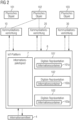
- one of the communication devices 10, 20, 30, namely the communication device 10 reads one of the physical objects 101, 102, 103, namely on the physical object 101 and on the loT platform 6 or the digital representation 101 ⁇ and accesses the information container 101a.
- the information container 101a can contain different types of information packets. In the simplest case, the information container 101a contains a static information package with information about the physical object 101.
- the communication device 10 and the communication device 20 read the information carrier I of the physical object 102.
- the communication devices 10, 20 both access the loT platform 6 or the digital representation 102' and the information container 102a.
- the information container 102a can contain different types of information packets.
- the information container 102a contains a static information package with information about the physical object 102. This can be accessed by the communication devices 10, 20 at the same time.
- the information container 102b contains a dynamic information package that includes a manual for handling the physical object 102, the manual being structured as a kind of "wiki" so that different users can enter their experiences into the manual.
- a user of the communication device 10 can thus enter his or her experiences into the dynamic information package in the information container 102a of the digital representation 102 ⁇ , so that a user of the communication device 20 can call up the additional handling information entered for handling the physical object 102 at the same time or at a later point in time.
- the user of the communication device 20 can in turn bring his own experiences into the dynamic information packet and/or correct the information entered by the user of the communication device 10 .
- the information container 102a comprises an access-sensitive information packet, with a counter counting up with each access. After 100 accesses, for example, any further access is denied.
- the information container 102a contains a gateway information packet, with a user of the communication device 10 wanting to share information with a user of the communication device 20—possibly without knowing their identity.
- the user of the communication device 10 sends his communication device 10 information to the IoT platform 6 or to the gateway information packet in the information container 102a of the digital representation 102', while a user of the communication device 20 simultaneously or at a later time on the gateway Information packet accesses and can retrieve this information shared by the user of the communication device 10 .
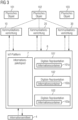
- the communication device 10 the communication device 20 and the communication device 30 read the information carrier I of the physical object 102.
- the communication devices 10, 20, 30 access the loT platform 6 or the digital representation 102 ⁇ and the information container 102a.
- the information container 102a can contain different types of information packets. The retrieval of information or the object-related communication takes place as previously described.
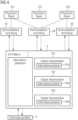
- the communication device 10 and the communication device 20 read the information carrier I of the physical object 101, while the communication device 20 and the communication device 30 read the information carrier I of the physical object 103.
- the communication devices 10, 20 both access the loT platform 6 or the digital representation 101' and the information container 101a, while the communication devices 20, 30 both access the loT platform 6 or the digital representation 103' and the information container 103a access.
- the communication device 20 accesses the communication channel at the same time on the digital representation 101' and 103'. An exchange of information or object-related communication can take place as previously described.
- a situation is shown schematically in which a communication device 10 embodied as a mobile terminal device reads in an information carrier I of a physical object 101 with a reading device 40 embodied as a camera.
- the mobile terminal communicates with an IoT platform 6, for example in order to retrieve or check any existing information packets in the information container 101a, 102a, 103a of a digital representation 101, 102, 103 of a respective physical object 101, 102, 103.
- the mobile terminal can be a mobile terminal of an owner of a physical object 101, 102, 103, a mobile terminal of a visitor or user of a respective physical object 101, 102, 103, or a mobile terminal of a person who uses the information carrier I only for object-related Communication is provided directly or indirectly.
- the identification mark is recorded in particular.
- a communication device can also be used as a carrier device: After the identifier UID has been recorded, it can be transmitted via existing communication interfaces of the communication device used as the carrier device, for example via Bluetooth interfaces, WiFi interfaces, NFC interfaces or via a display device for displaying a visual data code (e.g. QR code) can be passed on virtually.
- the communication device used as the carrier device can replace a physical object 101, 102, 103 in this constellation, so that this does not have to be carried along.
- the method according to the invention makes it possible to replace the log book, to enable communication between participants in the game and to increase the untraceability of the hiding place.
- a tree is made into a physical object 101 according to the invention by attaching an information carrier I, which leads to a digital representation 101′, to the tree.
- An information carrier I can be a small QR code or a small NFC chip, so that it is easier to hide and less conspicuous than a logbook.
- the information container 101a of the digital representation 101' contains an access-sensitive information packet, a dynamic information packet and a gateway information packet. If a participant finds the hiding place, he reads in the information carrier I with his mobile terminal device and a communication channel to the IoT platform 6 is established. The subscriber is shown the available information packages on the mobile device.
- the access-sensitive information package counts the number of accesses to the digital representation and at the same time saves the time of access.
- a game administrator of the geocaching game can track the frequentation of the hideout and based thereon remove the hideout or adjust the position of the hideout if necessary to make it easier to find, for example.
- Participants can add free text or images to the dynamic information package. It thus replaces the logbook and at the same time makes it easy to enter pictures that can be taken with the mobile device. For example, a participant caught in a strong storm can take a photo of the weather and add exciting additional information to their free text.
- a group of 30 people who want to play a geocaching game may be divided into 6 subgroups of 5 people each by a game administrator. Individuals within a subgroup can communicate personally with each other, however the need may be allow communication with everyone in the group. Communication with all persons in the group can be made possible in a simple manner by means of the gateway information package. For example, a person in a first subgroup can send photos to other people in other groups.
- voucher codes or participation authorizations can be stored for users, which, for example, allow participation in a competition make possible.
- a catering business can enable guests to participate in sweepstakes via mobile devices that are appropriate to a current situation.
- a game can be stored on a beer glass that bears a label from a specific brewery, in which the guest can participate anonymously in order to win a free drink, for example.
- Communication devices 10, 20, 30 can also be service devices that service physical objects 101, 102, 103.
- an innkeeper's dishwasher for cleaning beer glasses which can be physical objects 101, 102, 103 within the meaning of the present invention, can be such a communication device 10, 20, 30.
- the dishwasher reads the information carrier I of the beer glasses in the dishwasher and accesses the digital representations 101', 102', 103'.
- An access-sensitive information packet in each information container 101a, 102a, 103a of the respective digital representations 101′, 102′, 103′ counts up by one counter in each flushing cycle. After a predefined number of rinsing cycles or accesses, the innkeeper receives a message that a beer glass should be exchanged.
- the dishwasher can select a suitable wash cycle which, for example, takes into account a specific degree of wear on the beer glasses.
- the degree of wear on the beer glasses can be derived, for example, from information in an access-sensitive information package.
- an information carrier I on a product which is a physical object 101, 102, 103 within the meaning of the present invention, can be verified and/or verified whether it is an original product.
- Static information packets can be used for this, for example.
- warnings, operating instructions, etc. can be stored.
- first products can trigger price reductions when buying second products if the information carriers I of the first products are read by a checkout device, which can be a communication device 10, 20, 30 within the meaning of the present invention.
Landscapes
- Engineering & Computer Science (AREA)
- Health & Medical Sciences (AREA)
- General Health & Medical Sciences (AREA)
- Theoretical Computer Science (AREA)
- Medical Informatics (AREA)
- Computer Networks & Wireless Communication (AREA)
- Signal Processing (AREA)
- Software Systems (AREA)
- Computer Security & Cryptography (AREA)
- Computing Systems (AREA)
- Computer Hardware Design (AREA)
- Physics & Mathematics (AREA)
- General Engineering & Computer Science (AREA)
- General Physics & Mathematics (AREA)
- Bioethics (AREA)
- Databases & Information Systems (AREA)
- Data Exchanges In Wide-Area Networks (AREA)
Priority Applications (3)
| Application Number | Priority Date | Filing Date | Title |
|---|---|---|---|
| EP21196828.4A EP4152191B1 (de) | 2021-09-15 | 2021-09-15 | Verfahren zur bereitstellung einer objektbezogenen kommunikation bezogen auf physische objekte |
| PL21196828.4T PL4152191T3 (pl) | 2021-09-15 | 2021-09-15 | Sposób tworzenia komunikacji powiązanej z obiektem, w odniesieniu do obiektów fizycznych |
| US17/945,342 US12041132B2 (en) | 2021-09-15 | 2022-09-15 | Method for providing object-linked communication in relation to physical objects |
Applications Claiming Priority (1)
| Application Number | Priority Date | Filing Date | Title |
|---|---|---|---|
| EP21196828.4A EP4152191B1 (de) | 2021-09-15 | 2021-09-15 | Verfahren zur bereitstellung einer objektbezogenen kommunikation bezogen auf physische objekte |
Publications (2)
| Publication Number | Publication Date |
|---|---|
| EP4152191A1 EP4152191A1 (de) | 2023-03-22 |
| EP4152191B1 true EP4152191B1 (de) | 2023-06-07 |
Family
ID=77774771
Family Applications (1)
| Application Number | Title | Priority Date | Filing Date |
|---|---|---|---|
| EP21196828.4A Active EP4152191B1 (de) | 2021-09-15 | 2021-09-15 | Verfahren zur bereitstellung einer objektbezogenen kommunikation bezogen auf physische objekte |
Country Status (3)
| Country | Link |
|---|---|
| US (1) | US12041132B2 (pl) |
| EP (1) | EP4152191B1 (pl) |
| PL (1) | PL4152191T3 (pl) |
Family Cites Families (3)
| Publication number | Priority date | Publication date | Assignee | Title |
|---|---|---|---|---|
| US11336511B2 (en) * | 2006-09-25 | 2022-05-17 | Remot3.It, Inc. | Managing network connected devices |
| WO2017035536A1 (en) * | 2015-08-27 | 2017-03-02 | FogHorn Systems, Inc. | Edge intelligence platform, and internet of things sensor streams system |
| US20210366586A1 (en) * | 2018-07-02 | 2021-11-25 | Kelly Dell Tyler | Enterprise Consumer Safety System |
-
2021
- 2021-09-15 EP EP21196828.4A patent/EP4152191B1/de active Active
- 2021-09-15 PL PL21196828.4T patent/PL4152191T3/pl unknown
-
2022
- 2022-09-15 US US17/945,342 patent/US12041132B2/en active Active
Also Published As
| Publication number | Publication date |
|---|---|
| US20230123321A1 (en) | 2023-04-20 |
| US12041132B2 (en) | 2024-07-16 |
| PL4152191T3 (pl) | 2023-11-13 |
| EP4152191A1 (de) | 2023-03-22 |
Similar Documents
| Publication | Publication Date | Title |
|---|---|---|
| Beaman | Molly mormons, mormon feminists and moderates: Religious diversity and the latter day saints church | |
| DE60206059T2 (de) | Verfahren, system und speichermedium für ein ikonensprachenkommunikationswerkzeug | |
| Dickie | Establishing worker identity: A study of people in craft work | |
| DE102008017660A1 (de) | Zugangssteuerungssystem und -verfahren unter Verwendung sozialer Gesetzmäßigkeiten | |
| Banerjee | Democracy, sacred and everyday: An ethnographic case from India | |
| Pronk et al. | Does executive control relate to sacrificial behavior during conflicts of interests? | |
| EP4152191B1 (de) | Verfahren zur bereitstellung einer objektbezogenen kommunikation bezogen auf physische objekte | |
| Sizgorich | “Do Prophets Come with a Sword?” Conquest, Empire, and Historical Narrative in the Early Islamic World | |
| DE102016224778A1 (de) | Verfahren, Gerät und Computer-System zum Bereitstellen eines Gerichts | |
| Cowlishaw et al. | Choosing Among Alternatives: Cultural Transformations & Social Change in Aboriginal Australia & French Jura | |
| Kantrowitz | Always day one: How the tech titans plan to stay on top forever | |
| DE102018123977A1 (de) | Verfahren und System zur Durchführung der Bestellung durch einen Gast in einer gastronomischen Einrichtung und dgl. | |
| WO2001039051A9 (de) | Verfahren zur auswahl und anpassung eines produktes an die körpermasse eines konsumenten | |
| DE102015114824A1 (de) | Verfahren zur automatisierten Aufgabe einer Bestellung in einem Restaurantbetrieb | |
| Meltzer | Contemporary communalism at a time of crisis | |
| Aaker | Winning in the sharing economy: Six keys to Airbnb’s success | |
| Jenkins et al. | Entrepreneurial exit: who, what or to where? Regional relocation as a form of exit | |
| Gutting | Marketing im KI-Zeitalter | |
| Kalinowski | The typology of community: A case study analysis of three intentional communities | |
| Rizzo | Scales of Affordances | |
| Harvey | Tourism is everyone's business: The participants and places of township tourism in Cape Town, South Africa | |
| Sapelli | Financialised, High-tech Capitalism Based on Modern Slavery | |
| Daubs | Integration durch Diversifikation: Die Mediatisierung sozialer Bewegungen vom „Kampf von Seattle “bis Occupy | |
| Switzer | Pulp Friction: Nature, Politics and Plantation Forestry in Soriano, Uruguay | |
| Dittrich et al. | The future of rural communities in Bulgaria |
Legal Events
| Date | Code | Title | Description |
|---|---|---|---|
| STAA | Information on the status of an ep patent application or granted ep patent |
Free format text: STATUS: EXAMINATION IS IN PROGRESS |
|
| PUAI | Public reference made under article 153(3) epc to a published international application that has entered the european phase |
Free format text: ORIGINAL CODE: 0009012 |
|
| REG | Reference to a national code |
Ref country code: DE Free format text: PREVIOUS MAIN CLASS: G06F0021550000 Ref country code: DE Ref legal event code: R079 Ref document number: 502021000802 Country of ref document: DE Free format text: PREVIOUS MAIN CLASS: G06F0021550000 Ipc: H04L0067564000 |
|
| 17P | Request for examination filed |
Effective date: 20220514 |
|
| AK | Designated contracting states |
Kind code of ref document: A1 Designated state(s): AL AT BE BG CH CY CZ DE DK EE ES FI FR GB GR HR HU IE IS IT LI LT LU LV MC MK MT NL NO PL PT RO RS SE SI SK SM TR |
|
| GRAP | Despatch of communication of intention to grant a patent |
Free format text: ORIGINAL CODE: EPIDOSNIGR1 |
|
| STAA | Information on the status of an ep patent application or granted ep patent |
Free format text: STATUS: GRANT OF PATENT IS INTENDED |
|
| GRAS | Grant fee paid |
Free format text: ORIGINAL CODE: EPIDOSNIGR3 |
|
| RIC1 | Information provided on ipc code assigned before grant |
Ipc: H04L 67/12 20220101ALI20230321BHEP Ipc: G06F 21/62 20130101ALI20230321BHEP Ipc: G06F 21/55 20130101ALI20230321BHEP Ipc: H04L 67/564 20220101AFI20230321BHEP |
|
| GRAA | (expected) grant |
Free format text: ORIGINAL CODE: 0009210 |
|
| STAA | Information on the status of an ep patent application or granted ep patent |
Free format text: STATUS: THE PATENT HAS BEEN GRANTED |
|
| INTG | Intention to grant announced |
Effective date: 20230413 |
|
| AK | Designated contracting states |
Kind code of ref document: B1 Designated state(s): AL AT BE BG CH CY CZ DE DK EE ES FI FR GB GR HR HU IE IS IT LI LT LU LV MC MK MT NL NO PL PT RO RS SE SI SK SM TR |
|
| REG | Reference to a national code |
Ref country code: GB Ref legal event code: FG4D Free format text: NOT ENGLISH |
|
| REG | Reference to a national code |
Ref country code: CH Ref legal event code: EP Ref country code: AT Ref legal event code: REF Ref document number: 1578173 Country of ref document: AT Kind code of ref document: T Effective date: 20230615 Ref country code: DE Ref legal event code: R096 Ref document number: 502021000802 Country of ref document: DE |
|
| REG | Reference to a national code |
Ref country code: NL Ref legal event code: FP |
|
| REG | Reference to a national code |
Ref country code: SE Ref legal event code: TRGR |
|
| REG | Reference to a national code |
Ref country code: LT Ref legal event code: MG9D |
|
| PG25 | Lapsed in a contracting state [announced via postgrant information from national office to epo] |
Ref country code: NO Free format text: LAPSE BECAUSE OF FAILURE TO SUBMIT A TRANSLATION OF THE DESCRIPTION OR TO PAY THE FEE WITHIN THE PRESCRIBED TIME-LIMIT Effective date: 20230907 Ref country code: ES Free format text: LAPSE BECAUSE OF FAILURE TO SUBMIT A TRANSLATION OF THE DESCRIPTION OR TO PAY THE FEE WITHIN THE PRESCRIBED TIME-LIMIT Effective date: 20230607 |
|
| PG25 | Lapsed in a contracting state [announced via postgrant information from national office to epo] |
Ref country code: RS Free format text: LAPSE BECAUSE OF FAILURE TO SUBMIT A TRANSLATION OF THE DESCRIPTION OR TO PAY THE FEE WITHIN THE PRESCRIBED TIME-LIMIT Effective date: 20230607 Ref country code: LV Free format text: LAPSE BECAUSE OF FAILURE TO SUBMIT A TRANSLATION OF THE DESCRIPTION OR TO PAY THE FEE WITHIN THE PRESCRIBED TIME-LIMIT Effective date: 20230607 Ref country code: LT Free format text: LAPSE BECAUSE OF FAILURE TO SUBMIT A TRANSLATION OF THE DESCRIPTION OR TO PAY THE FEE WITHIN THE PRESCRIBED TIME-LIMIT Effective date: 20230607 Ref country code: HR Free format text: LAPSE BECAUSE OF FAILURE TO SUBMIT A TRANSLATION OF THE DESCRIPTION OR TO PAY THE FEE WITHIN THE PRESCRIBED TIME-LIMIT Effective date: 20230607 Ref country code: GR Free format text: LAPSE BECAUSE OF FAILURE TO SUBMIT A TRANSLATION OF THE DESCRIPTION OR TO PAY THE FEE WITHIN THE PRESCRIBED TIME-LIMIT Effective date: 20230908 |
|
| PG25 | Lapsed in a contracting state [announced via postgrant information from national office to epo] |
Ref country code: FI Free format text: LAPSE BECAUSE OF FAILURE TO SUBMIT A TRANSLATION OF THE DESCRIPTION OR TO PAY THE FEE WITHIN THE PRESCRIBED TIME-LIMIT Effective date: 20230607 |
|
| PG25 | Lapsed in a contracting state [announced via postgrant information from national office to epo] |
Ref country code: SK Free format text: LAPSE BECAUSE OF FAILURE TO SUBMIT A TRANSLATION OF THE DESCRIPTION OR TO PAY THE FEE WITHIN THE PRESCRIBED TIME-LIMIT Effective date: 20230607 |
|
| PG25 | Lapsed in a contracting state [announced via postgrant information from national office to epo] |
Ref country code: IS Free format text: LAPSE BECAUSE OF FAILURE TO SUBMIT A TRANSLATION OF THE DESCRIPTION OR TO PAY THE FEE WITHIN THE PRESCRIBED TIME-LIMIT Effective date: 20231007 |
|
| PG25 | Lapsed in a contracting state [announced via postgrant information from national office to epo] |
Ref country code: SM Free format text: LAPSE BECAUSE OF FAILURE TO SUBMIT A TRANSLATION OF THE DESCRIPTION OR TO PAY THE FEE WITHIN THE PRESCRIBED TIME-LIMIT Effective date: 20230607 Ref country code: SK Free format text: LAPSE BECAUSE OF FAILURE TO SUBMIT A TRANSLATION OF THE DESCRIPTION OR TO PAY THE FEE WITHIN THE PRESCRIBED TIME-LIMIT Effective date: 20230607 Ref country code: RO Free format text: LAPSE BECAUSE OF FAILURE TO SUBMIT A TRANSLATION OF THE DESCRIPTION OR TO PAY THE FEE WITHIN THE PRESCRIBED TIME-LIMIT Effective date: 20230607 Ref country code: PT Free format text: LAPSE BECAUSE OF FAILURE TO SUBMIT A TRANSLATION OF THE DESCRIPTION OR TO PAY THE FEE WITHIN THE PRESCRIBED TIME-LIMIT Effective date: 20231009 Ref country code: IS Free format text: LAPSE BECAUSE OF FAILURE TO SUBMIT A TRANSLATION OF THE DESCRIPTION OR TO PAY THE FEE WITHIN THE PRESCRIBED TIME-LIMIT Effective date: 20231007 Ref country code: EE Free format text: LAPSE BECAUSE OF FAILURE TO SUBMIT A TRANSLATION OF THE DESCRIPTION OR TO PAY THE FEE WITHIN THE PRESCRIBED TIME-LIMIT Effective date: 20230607 |
|
| REG | Reference to a national code |
Ref country code: DE Ref legal event code: R097 Ref document number: 502021000802 Country of ref document: DE |
|
| PLBE | No opposition filed within time limit |
Free format text: ORIGINAL CODE: 0009261 |
|
| STAA | Information on the status of an ep patent application or granted ep patent |
Free format text: STATUS: NO OPPOSITION FILED WITHIN TIME LIMIT |
|
| PG25 | Lapsed in a contracting state [announced via postgrant information from national office to epo] |
Ref country code: DK Free format text: LAPSE BECAUSE OF FAILURE TO SUBMIT A TRANSLATION OF THE DESCRIPTION OR TO PAY THE FEE WITHIN THE PRESCRIBED TIME-LIMIT Effective date: 20230607 |
|
| PG25 | Lapsed in a contracting state [announced via postgrant information from national office to epo] |
Ref country code: SI Free format text: LAPSE BECAUSE OF FAILURE TO SUBMIT A TRANSLATION OF THE DESCRIPTION OR TO PAY THE FEE WITHIN THE PRESCRIBED TIME-LIMIT Effective date: 20230607 |
|
| 26N | No opposition filed |
Effective date: 20240308 |
|
| PG25 | Lapsed in a contracting state [announced via postgrant information from national office to epo] |
Ref country code: LU Free format text: LAPSE BECAUSE OF NON-PAYMENT OF DUE FEES Effective date: 20230915 |
|
| REG | Reference to a national code |
Ref country code: BE Ref legal event code: MM Effective date: 20230930 |
|
| PG25 | Lapsed in a contracting state [announced via postgrant information from national office to epo] |
Ref country code: SI Free format text: LAPSE BECAUSE OF FAILURE TO SUBMIT A TRANSLATION OF THE DESCRIPTION OR TO PAY THE FEE WITHIN THE PRESCRIBED TIME-LIMIT Effective date: 20230607 Ref country code: LU Free format text: LAPSE BECAUSE OF NON-PAYMENT OF DUE FEES Effective date: 20230915 Ref country code: MC Free format text: LAPSE BECAUSE OF FAILURE TO SUBMIT A TRANSLATION OF THE DESCRIPTION OR TO PAY THE FEE WITHIN THE PRESCRIBED TIME-LIMIT Effective date: 20230607 |
|
| PG25 | Lapsed in a contracting state [announced via postgrant information from national office to epo] |
Ref country code: BE Free format text: LAPSE BECAUSE OF NON-PAYMENT OF DUE FEES Effective date: 20230930 |
|
| PG25 | Lapsed in a contracting state [announced via postgrant information from national office to epo] |
Ref country code: BG Free format text: LAPSE BECAUSE OF FAILURE TO SUBMIT A TRANSLATION OF THE DESCRIPTION OR TO PAY THE FEE WITHIN THE PRESCRIBED TIME-LIMIT Effective date: 20230607 |
|
| PG25 | Lapsed in a contracting state [announced via postgrant information from national office to epo] |
Ref country code: BG Free format text: LAPSE BECAUSE OF FAILURE TO SUBMIT A TRANSLATION OF THE DESCRIPTION OR TO PAY THE FEE WITHIN THE PRESCRIBED TIME-LIMIT Effective date: 20230607 |
|
| PG25 | Lapsed in a contracting state [announced via postgrant information from national office to epo] |
Ref country code: CY Free format text: LAPSE BECAUSE OF FAILURE TO SUBMIT A TRANSLATION OF THE DESCRIPTION OR TO PAY THE FEE WITHIN THE PRESCRIBED TIME-LIMIT; INVALID AB INITIO Effective date: 20210915 |
|
| PG25 | Lapsed in a contracting state [announced via postgrant information from national office to epo] |
Ref country code: HU Free format text: LAPSE BECAUSE OF FAILURE TO SUBMIT A TRANSLATION OF THE DESCRIPTION OR TO PAY THE FEE WITHIN THE PRESCRIBED TIME-LIMIT; INVALID AB INITIO Effective date: 20210915 |
|
| REG | Reference to a national code |
Ref country code: CH Ref legal event code: U11 Free format text: ST27 STATUS EVENT CODE: U-0-0-U10-U11 (AS PROVIDED BY THE NATIONAL OFFICE) Effective date: 20251001 |
|
| PGFP | Annual fee paid to national office [announced via postgrant information from national office to epo] |
Ref country code: DE Payment date: 20250814 Year of fee payment: 5 |
|
| PGFP | Annual fee paid to national office [announced via postgrant information from national office to epo] |
Ref country code: NL Payment date: 20250922 Year of fee payment: 5 Ref country code: PL Payment date: 20250818 Year of fee payment: 5 |
|
| PGFP | Annual fee paid to national office [announced via postgrant information from national office to epo] |
Ref country code: GB Payment date: 20250923 Year of fee payment: 5 |
|
| PGFP | Annual fee paid to national office [announced via postgrant information from national office to epo] |
Ref country code: FR Payment date: 20250924 Year of fee payment: 5 Ref country code: AT Payment date: 20251020 Year of fee payment: 5 |
|
| PGFP | Annual fee paid to national office [announced via postgrant information from national office to epo] |
Ref country code: SE Payment date: 20250922 Year of fee payment: 5 |
|
| PGFP | Annual fee paid to national office [announced via postgrant information from national office to epo] |
Ref country code: IE Payment date: 20250919 Year of fee payment: 5 Ref country code: CZ Payment date: 20250902 Year of fee payment: 5 |
|
| PG25 | Lapsed in a contracting state [announced via postgrant information from national office to epo] |
Ref country code: TR Free format text: LAPSE BECAUSE OF FAILURE TO SUBMIT A TRANSLATION OF THE DESCRIPTION OR TO PAY THE FEE WITHIN THE PRESCRIBED TIME-LIMIT Effective date: 20230607 |
|
| PGFP | Annual fee paid to national office [announced via postgrant information from national office to epo] |
Ref country code: IT Payment date: 20250930 Year of fee payment: 5 |
|
| PGFP | Annual fee paid to national office [announced via postgrant information from national office to epo] |
Ref country code: CH Payment date: 20251001 Year of fee payment: 5 |