EP4154975B1 - Festphasenextraktionsverfahren zur verbesserten entfernung von phospholipiden aus biologischen proben - Google Patents
Festphasenextraktionsverfahren zur verbesserten entfernung von phospholipiden aus biologischen proben Download PDFInfo
- Publication number
- EP4154975B1 EP4154975B1 EP22192475.6A EP22192475A EP4154975B1 EP 4154975 B1 EP4154975 B1 EP 4154975B1 EP 22192475 A EP22192475 A EP 22192475A EP 4154975 B1 EP4154975 B1 EP 4154975B1
- Authority
- EP
- European Patent Office
- Prior art keywords
- sorbent
- ammonium
- solution
- sample
- organic
- Prior art date
- Legal status (The legal status is an assumption and is not a legal conclusion. Google has not performed a legal analysis and makes no representation as to the accuracy of the status listed.)
- Active
Links
Images


Classifications
-
- G—PHYSICS
- G01—MEASURING; TESTING
- G01N—INVESTIGATING OR ANALYSING MATERIALS BY DETERMINING THEIR CHEMICAL OR PHYSICAL PROPERTIES
- G01N1/00—Sampling; Preparing specimens for investigation
- G01N1/28—Preparing specimens for investigation including physical details of (bio-)chemical methods covered elsewhere, e.g. G01N33/50, C12Q
- G01N1/40—Concentrating samples
- G01N1/405—Concentrating samples by adsorption or absorption
-
- B—PERFORMING OPERATIONS; TRANSPORTING
- B01—PHYSICAL OR CHEMICAL PROCESSES OR APPARATUS IN GENERAL
- B01D—SEPARATION
- B01D15/00—Separating processes involving the treatment of liquids with solid sorbents; Apparatus therefor
- B01D15/08—Selective adsorption, e.g. chromatography
- B01D15/26—Selective adsorption, e.g. chromatography characterised by the separation mechanism
- B01D15/32—Bonded phase chromatography
- B01D15/325—Reversed phase
- B01D15/327—Reversed phase with hydrophobic interaction
-
- B—PERFORMING OPERATIONS; TRANSPORTING
- B01—PHYSICAL OR CHEMICAL PROCESSES OR APPARATUS IN GENERAL
- B01D—SEPARATION
- B01D15/00—Separating processes involving the treatment of liquids with solid sorbents; Apparatus therefor
- B01D15/08—Selective adsorption, e.g. chromatography
- B01D15/26—Selective adsorption, e.g. chromatography characterised by the separation mechanism
- B01D15/36—Selective adsorption, e.g. chromatography characterised by the separation mechanism involving ionic interaction, e.g. ion-exchange, ion-pair, ion-suppression or ion-exclusion
- B01D15/361—Ion-exchange
- B01D15/362—Cation-exchange
-
- B—PERFORMING OPERATIONS; TRANSPORTING
- B01—PHYSICAL OR CHEMICAL PROCESSES OR APPARATUS IN GENERAL
- B01D—SEPARATION
- B01D15/00—Separating processes involving the treatment of liquids with solid sorbents; Apparatus therefor
- B01D15/08—Selective adsorption, e.g. chromatography
- B01D15/26—Selective adsorption, e.g. chromatography characterised by the separation mechanism
- B01D15/38—Selective adsorption, e.g. chromatography characterised by the separation mechanism involving specific interaction not covered by one or more of groups B01D15/265 and B01D15/30 - B01D15/36, e.g. affinity, ligand exchange or chiral chromatography
- B01D15/3847—Multimodal interactions
-
- B—PERFORMING OPERATIONS; TRANSPORTING
- B01—PHYSICAL OR CHEMICAL PROCESSES OR APPARATUS IN GENERAL
- B01D—SEPARATION
- B01D15/00—Separating processes involving the treatment of liquids with solid sorbents; Apparatus therefor
- B01D15/08—Selective adsorption, e.g. chromatography
- B01D15/42—Selective adsorption, e.g. chromatography characterised by the development mode, e.g. by displacement or by elution
- B01D15/424—Elution mode
- B01D15/426—Specific type of solvent
-
- B—PERFORMING OPERATIONS; TRANSPORTING
- B01—PHYSICAL OR CHEMICAL PROCESSES OR APPARATUS IN GENERAL
- B01J—CHEMICAL OR PHYSICAL PROCESSES, e.g. CATALYSIS OR COLLOID CHEMISTRY; THEIR RELEVANT APPARATUS
- B01J39/00—Cation exchange; Use of material as cation exchangers; Treatment of material for improving the cation exchange properties
- B01J39/04—Processes using organic exchangers
- B01J39/05—Processes using organic exchangers in the strongly acidic form
-
- B—PERFORMING OPERATIONS; TRANSPORTING
- B01—PHYSICAL OR CHEMICAL PROCESSES OR APPARATUS IN GENERAL
- B01J—CHEMICAL OR PHYSICAL PROCESSES, e.g. CATALYSIS OR COLLOID CHEMISTRY; THEIR RELEVANT APPARATUS
- B01J39/00—Cation exchange; Use of material as cation exchangers; Treatment of material for improving the cation exchange properties
- B01J39/26—Cation exchangers for chromatographic processes
-
- G—PHYSICS
- G01—MEASURING; TESTING
- G01N—INVESTIGATING OR ANALYSING MATERIALS BY DETERMINING THEIR CHEMICAL OR PHYSICAL PROPERTIES
- G01N33/00—Investigating or analysing materials by specific methods not covered by groups G01N1/00 - G01N31/00
- G01N33/48—Biological material, e.g. blood, urine; Haemocytometers
- G01N33/50—Chemical analysis of biological material, e.g. blood, urine; Testing involving biospecific ligand binding methods; Immunological testing
- G01N33/92—Chemical analysis of biological material, e.g. blood, urine; Testing involving biospecific ligand binding methods; Immunological testing involving lipids, e.g. cholesterol, lipoproteins, or their receptors
-
- G—PHYSICS
- G01—MEASURING; TESTING
- G01N—INVESTIGATING OR ANALYSING MATERIALS BY DETERMINING THEIR CHEMICAL OR PHYSICAL PROPERTIES
- G01N30/00—Investigating or analysing materials by separation into components using adsorption, absorption or similar phenomena or using ion-exchange, e.g. chromatography or field flow fractionation
- G01N2030/009—Extraction
-
- G—PHYSICS
- G01—MEASURING; TESTING
- G01N—INVESTIGATING OR ANALYSING MATERIALS BY DETERMINING THEIR CHEMICAL OR PHYSICAL PROPERTIES
- G01N30/00—Investigating or analysing materials by separation into components using adsorption, absorption or similar phenomena or using ion-exchange, e.g. chromatography or field flow fractionation
- G01N30/02—Column chromatography
- G01N30/04—Preparation or injection of sample to be analysed
- G01N30/06—Preparation
- G01N2030/062—Preparation extracting sample from raw material
-
- G—PHYSICS
- G01—MEASURING; TESTING
- G01N—INVESTIGATING OR ANALYSING MATERIALS BY DETERMINING THEIR CHEMICAL OR PHYSICAL PROPERTIES
- G01N2405/00—Assays, e.g. immunoassays or enzyme assays, involving lipids
Definitions
- the present disclosure relates to methods and kits for the enhanced removal of phospholipids from biological samples by Solid Phase Extraction (SPE).
- Biological samples frequently contain phospholipids which can interfere with sample analyses, including liquid chromatography-mass spectrometry (LC-MS) analysis, commonly resulting in signal suppression or enhancement.
- LC-MS liquid chromatography-mass spectrometry
- Phospholipids may also lead to column and instrument fouling during LC-MS analysis. Removing phospholipids is beneficial to improve signal-to-noise ratios and data reproducibility.
- the invention relates to a method of performing a sample enrichment procedure as defined in the claims.
- the present disclosure not encompassed by the wording of the claims pertains to methods of performing sample enrichment procedures, which comprise: adding a sample fluid that comprises at least one phospholipid and at least one target analyte to a sorbent that comprises a hydrophobic component and a cation exchange component (e.g., a sorbent comprising a copolymer that comprises a hydrophobic organic monomer, an organic monomer comprising a cation-exchange group, and optionally a hydrophilic organic monomer, among other possibilities), thereby resulting in sorbent with bound phospholipid and bound target analyte; adding an aqueous solution comprising an acidic compound and a salt (e.g., by adding the aqueous solution to the sample fluid prior to addition of the sample fluid to the sorbent and/or by adding the aqueous solution to the sorbent after addition of the sample fluid to the claims
- the present disclosure not encompassed by the wording of the claims is directed to methods of performing sample enrichment procedures that comprise: adding a sample fluid that comprises at least one phospholipid and at least one target analyte to a sorbent comprising an organic copolymer that comprises a hydrophobic organic monomer, a hydrophilic organic monomer and an organic monomer comprising a cation-exchange group thereby yielding sorbent with adsorbed phospholipid and adsorbed target analyte; adding an aqueous solution comprising an acidic compound and a first salt species (e.g., by adding the aqueous solution to the sample fluid prior to addition of the sample fluid to the sorbent and/or or by adding the aqueous solution to the sorbent after addition of the sample fluid to the sorbent); adding an organic solution comprising a first organic solvent species to the sorbent thereby desorbing at least a portion of the phospholipid from the sorbent: adding an elution solution that comprises (a)
- the present disclosure not encompassed by the wording of the claims is directed to methods of performing a sample enrichment procedure, the method comprising: adding an aqueous solution comprising an acidic compound and a first salt species to a sample fluid that comprises at least one phospholipid and at least one target analyte, thereby forming a pretreated sample: adding the pretreated sample to a sorbent, thereby resulting in sorbent with adsorbed phospholipid and adsorbed target analyte, wherein the sorbent comprises a hydrophobic component and a cation exchange component (e.g., a sorbent comprising a copolymer that comprises a hydrophobic organic monomer, an organic monomer comprising a cation-exchange group, and optionally a hydrophilic organic monomer, among other possibilities); washing the sorbent in a single washing step wherein an organic solution comprising a first organic solvent species is added to the sorbent thereby desorbing at least a portion of the phospho
- the target analyte may be a base with a pK a of at least 5.
- the aqueous solution may comprise the acidic compound in an amount sufficient to provide the aqueous solution with a pH that is at least two pH units below a lowest pK a of the target analyte.
- the acidic compound may be selected from an organic acid. phosphoric acid, hydrochloric acid, or carbonic acid.
- the solutions of the first and second salt species may comprise the salt in an amount corresponding to an ionic strength ranging from 10-250 mM.
- the first and second salt species may be salts that dissociate into an organic acid anion or an inorganic anion and a cation selected from a Group I metal cation, a Group II metal cation, an ammonium cation, and an amine cation.
- the organic acid anion may be selected, for example, from formate, acetate, propionate, butyrate, oxalate, malonate, succinate, maleate, glutarate, glycolate, lactate, malate, citrate and gluconate, among others.
- the first and second organic solvent species may be selected from methanol, ethanol, 1-propanol, 2-propanol, acetonitrile, acetone, ethyl acetate, methyl ethyl ketone, tetrahydrofuran and blends thereof.
- the elution solution may comprise the basic compound in an amount sufficient to provide the elution solution with a pH that is at least two pH units above a highest pK a of the target analyte.
- the sample fluid may comprise a biological sample selected from a whole blood sample, a plasma sample, a serum sample, a food sample, and a food extract sample.
- kits which may be useful, for example, in conjunction with any of the above methods, the kits comprising (a) a sorbent comprising a hydrophobic moiety and a cation exchange moiety; (b) an aqueous solution comprising an acidic compound and a first salt species: and (c) optionally, one or more of the following components: (i) a first organic solution (which may be used, for example, as the organic solution in the preceding methods) that comprises a first organic solvent species.
- the present invention pertains to methods of performing sample enrichment procedures, which comprise: (a) adding a sample fluid that comprises at least one phospholipid and at least one target analyte to a sorbent that comprises a hydrophobic component and a cation exchange component that comprises a counter-ion that is ammonium (e.g., a sorbent comprising a copolymer that comprises a hydrophobic organic monomer, an organic monomer comprising a cation-exchange group that comprises a counter-ion that is ammonium, and optionally a hydrophilic organic monomer, among other possibilities), thereby resulting in sorbent with adsorbed phospholipid and adsorbed target analyte; (b) adding a first organic solution comprising a first organic solvent to remove at least a portion of the adsorbed phospholipid; and (c) adding an elution solution that comprises (i) a basic compound or a salt species and (ii) a second organic solvent species to the sorb
- the cation exchange group comprises a sulfonate moiety.
- the first and second organic solvent species are selected from methanol, ethanol, 1-propanol, 2-propanol, acetonitrile, acetone, ethyl acetate, methyl ethyl ketone, tetrahydrofuran and blends thereof.
- the elution solution comprises the basic compound.
- the basic compound may be provided in an amount sufficient to provide the elution solution with a pH that is at least two pH units above a highest pK a of the target analyte.
- the elution solution comprises the salt species.
- the salt species may be one that dissociates into (a) an organic acid anion (e.g., formate, acetate, propionate, butyrate, oxalate, malonate, succinate, maleate, glutarate, glycolate, lactate, malate, citrate, gluconate, etc.) or an inorganic anion (e.g., chloride, fluoride, bromide, hydroxide, nitrate, nitrite, sulfate,.
- an organic acid anion e.g., formate, acetate, propionate, butyrate, oxalate, malonate, succinate, maleate, glutarate, glycolate, lactate, malate, citrate, gluconate, etc.
- an inorganic anion e.g., chloride, fluoride, bromide, hydroxide, nitrate, nitrite, sulfate,.
- the elution solution that comprises the salt species comprises the salt species in an amount corresponding to an ionic strength ranging from 10-250 mM.
- the methods further comprise adding an aqueous solution to the sorbent (e.g. after adding the sample fluid and before adding the first organic solution).
- the aqueous solution comprises an organic acid.
- the aqueous solution comprises one or more acids selected from the following: formic acid, acetic acid, propionic acid, butyric acid, oxalic acid, malonic acid, succinic acid maleic acid, glycolic acid, lactic acid, tartaric acid, malic acid, citric acid and gluconic acid, phosphoric acid, hydrochloric acid and carbonic acid.
- the target analyte is a base with a pK a of at least 5.
- the sample fluid comprises a biological sample selected from a whole blood sample, a plasma sample, a serum sample, a food sample, and a food extract sample.
- the present disclosure pertains to methods for enhanced removal of phospholipids from biological samples and to sorbents, devices and kits beneficial in performing such methods.
- the present disclosure not encompassed by the wording of the claims pertains to methods of performing sample enrichment that comprise: (a) adding a sample fluid that comprises at least one phospholipid and at least one target analyte to a sorbent, wherein the sorbent comprises a hydrophobic component and a cation exchange component; (b) either (i) adding an aqueous solution comprising an acidic compound and a first salt species to the sample fluid prior to adding the sample fluid to the sorbent or (ii) adding an aqueous solution comprising an acidic compound and a salt to the sorbent after loading the sorbent with the sample fluid; (c) adding a washing solution that comprises a first organic solvent species to the sorbent thereby desorbing at least a portion of the phospholipid from the sorbent; and (d) adding an elution solution that comprises (i) a basic compound or a second salt species, which may be the same as or different from the first salt species, and (ii) a second
- the present disclosure not encompassed by the wording of the claims pertains to methods of performing sample enrichment that comprise: (a) adding a sample fluid that comprises at least one phospholipid and at least one target analyte to a sorbent comprising a hydrophobic component and a cation exchange component comprising a counter-ion that is not H + , thereby resulting in sorbent with adsorbed phospholipid and adsorbed target analyte; (b) adding a washing solution that comprises a first organic solvent species to remove at least a portion of the adsorbed phospholipid; and (c) adding an elution solution that comprises (i) a basic compound or a salt species and (ii) a second organic solvent species to the sorbent, wherein the second organic solvent species may be the same as or different from the first organic solvent species, thereby desorbing at least a portion of the target analyte from the sorbent and forming a solution of the target analyte in the e
- the sample fluid is or is derived from a biological sample.
- biological samples include any biological sample that contains phospholipids, such as biological fluids (e.g., whole blood samples, blood plasma samples, serum samples, etc.), biological tissues, biological matrices, cells (e.g., one or more types of cells), and cell culture supernatants, and foods that contain phospholipids (e.g., meats, whole grains, legumes, eggs, etc.), food extracts.
- the methods of performing sample enrichment described herein include a step where a sample fluid that comprises at least one phospholipid and at least one target analyte is added to a sorbent (suitable sorbents are described in more detail below).
- conditioning and equilibrating may be omitted before sample loading.
- an aqueous solution comprising an acidic compound and a first salt species may be either (a) added to the sample fluid prior to adding the sample fluid to the sorbent or (b) added to the sorbent after loading the sorbent with the sample fluid.
- the acidic compound in the aqueous solution may be selected from a variety of acidic compounds, including one or more of the following: organic acids such as formic acid, acetic acid, propionic acid, butyric acid, oxalic acid, malonic acid, succinic acid and maleic acid, among others and including organic hydroxyacids such as glycolic acid, lactic acid, tartaric acid, malic acid, citric acid and gluconic acid, among others; and inorganic acids such as phosphoric acid, hydrochloric acid, or carbonic acid, among others.
- organic acids such as formic acid, acetic acid, propionic acid, butyric acid, oxalic acid, malonic acid, succinic acid and maleic acid, among others and including organic hydroxyacids such as glycolic acid, lactic acid, tartaric acid, malic acid, citric acid and gluconic acid, among others
- inorganic acids such as phosphoric acid, hydrochloric acid, or carbonic acid, among others
- the amount of acid in the aqueous solution may vary but is beneficially provided in an amount sufficient to provide the aqueous solution with a pH that is at least two pH units below a lowest pK a of the target analyte.
- Salt species for using in conjunction with the present disclosure may be selected from a variety of salts, including salts that comprise (a) an anion selected from organic anions (those based on organic acids), such as formate, acetate, propionate, butyrate, oxalate, malonate, succinate, maleate, or glutarate, glycolate, lactate, malate, citrate, and gluconate, and other anionic species such as halides, nitrate, phosphate, sulfate, and sulfonates, among others and (b) a cation selected from ammonium cations, Group I metal cations, Group II metal cations, and cations based on amines (also referred to herein as an amine cation), such as methyl amine (methyl ammonium), methane diamine (methyl diammonium), ethyl amine (ethyl ammonium), ethyl di
- the amount of salt in the aqueous solution may vary widely.
- I 1 2 ⁇ i c i z i 2
- c i the molar concentration of any ion in solution
- z i is its valence.
- the ionic strength of the solution is equal to the molar concentration of the dissolved salt.
- the washing solution that comprises the first organic solvent species is contacted with the sorbent thereby desorbing at least a portion of the at least one phospholipid from the sorbent.
- non-target substances, including the one or more phospholipids are separated from the one or more target analytes, which are bound to the sorbent, thereby resulting in the elution of the non-target substances, while allowing the one or more target analytes to remain retained on the sorbent.
- the washing solution that comprises the first organic solvent species may be contacted with the sorbent, without an intermediate step employing an aqueous solution comprising an acidic compound and a first salt species as described above.
- the washing solution that comprises the first organic solvent species desorbs at least a portion of the at least one phospholipid from the sorbent, thereby separating non-target substances, including the one or more phospholipids, from the one or more target analytes, which are bound to the sorbent, resulting in the elution of the non-target substances, while allowing the one or more target analytes to remain retained on the sorbent.
- organic solvent species may be used in the washing solutions of the present disclosure, including one or more of the following, among others: methanol, ethanol, 1-propanol, 2-propanol, acetonitrile, acetone, ethyl acetate, methyl ethyl ketone, and tetrahydrofuran.
- the organic solvent species is methanol.
- an elution solution that comprises (a) a basic compound or a salt species (also referred to herein as a second salt species in some embodiments), which may be the same as or different from the first salt species described above, and (b) an organic solvent species (also referred to herein as a second organic solvent species), which may be the same as or different from the first organic solvent species described above, is contacted with the sorbent, thereby desorbing at least a portion of the at least one target analyte from the sorbent and forming a solution of the target analyte in the elution solution.
- a basic compound or a salt species also referred to herein as a second salt species in some embodiments
- an organic solvent species also referred to herein as a second organic solvent species
- the base in the elution solution may be selected from a variety of bases.
- the amount of base in the elution solution may vary but is beneficially provided in an amount sufficient to provide the elution solution with a pH that is at least two pH units above a highest pK a of the target analyte.
- bases may be selected from one or more of the following, among others: ammonium hydroxide (NH 4 OH), alkali metal hydroxides (e.g., LiOH, NaOH, KOH, RbOH, etc.), alkaline earth metal hydroxides (e.g., Mg(OH) 2 , Ca(OH) 2 , Sr(OH) 2 , etc.), organic bases (e.g., triethylamine), and combinations thereof.
- a volatile base such as ammonium hydroxide is particularly beneficial.
- the second salt species in the elution solution may be selected from a variety of salts, including salts that comprise (a) an anion selected from organic anions (those based on organic acids), such as formate, acetate, propionate, butyrate, oxalate, malonate, succinate, maleate, or glutarate, glycolate, lactate, malate, citrate, and gluconate, among others and (b) a cation selected from ammonium cations, and cations based on amines, such as methyl amine (methyl ammonium), methane diamine (methyl diammonium), ethyl amine (ethyl ammonium), ethyl diamine (ethyl diammonium), diethylamine (diethyl ammonium), diethanolamine (diethanol ammonium), tromethamine, choline, pyrrolidine (pyrrolidinium), pyrrole (pyrrolium), piperazine (piperazinium
- a variety of second organic solvent species may be used in the elution solutions of the present disclosure, which solvent species may be same as or different from those of the washing solution (also referred to as the first organic solvent species)_and include one or more of the following, among others: methanol, ethanol, 1-propanol, 2-propanol, acetonitrile, acetone, ethyl acetate, methyl ethyl ketone, and tetrahydrofuran.
- the organic solvent species is methanol.
- the elution solution comprises 2-10 vol% concentrated NH 4 OH and 90-98 vol% methanol
- further processing of the one or more target analytes may include, for example, identifying, quantifying, or otherwise processing the one or more target analytes.
- methods described herein may further comprise analyzing samples using analytical instruments and/or techniques, for example, liquid chromatography (LC), including high performance liquid chromatography (HPLC) and ultra-high performance liquid chromatography (UHPLC ), mass spectrometry (MS), including electrospray ionization mass spectrometry (ESI-MS), or a combination thereof.
- the processed samples may be analyzed using liquid chromatography, such as HPLC or UHPLC, in combination with mass spectrometry, such as ESI-MS, examples of which include liquid chromatography-mass spectrometry (LC-MS) techniques and liquid chromatography-mass spectrometry/mass spectrometry (LC-MS/MS) techniques.
- analytical samples may be evaporated to dryness, and then reconstituted in another solution before being injected into a liquid chromatography system.
- sorbents for use in the present disclosure include sorbents having a hydrophobic component and a cation exchange component
- the sorbents comprise an organic polymer having a hydrophobic component and a cation exchange component.
- hydrophobic means lacking an affinity for, repelling, or failing to adsorb or absorb water
- hydrophilic means having an affinity for, attracting, adsorbing or absorbing water
- organic polymers are organic molecules containing multiple copies (e.g., from 5 to 10 to 25 to 50 to 100 to 250 to 500 to 1000 or more copies) of one or more constitutional units, commonly referred to as organic monomers.
- organic monomers may refer to free monomers and to those incorporated into polymers, with the distinction being clear from the context in which the term is used.
- the following monomer, , and the following incorporated monomer, (where n is 1) may each be referred to herein as "a styrene sulfonate monomer.” It is noted that incorporated monomers are named independently of the monomer that was polymerized to form the polymer.
- the incorporated styrene sulfonate monomer may, in theory, be formed from a free styrene sulfonate monomer or from a styrene monomer that is first polymerized and later subjected to a sulfonation process. In either case, the incorporated organic monomer is referred to herein as a styrene sulfonate monomer.
- Organic polymers may take on a number of configurations, which may be selected, for example, from linear, cyclic and branched configurations, among others.
- Branched configurations include star-shaped configurations (e.g.. configurations in which three or more chains emanate from a single branch point), comb configurations (e.g., configurations having a polymer backbone and a plurality of side chains, also referred to as "graft" configurations), dendritic configurations (e.g., arborescent and hyperbranched poly mers), networked (e.g., crosslinked) configurations and so forth.
- organic homopolymers are polymers that contain multiple copies of a single organic monomer.
- organic copolymers are organic polymers that contain multiple copies of at least two dissimilar organic monomers, examples of which include random, statistical, gradient, periodic (e.g.. alternating) and block copolymers.
- the organic polymer having a hydrophobic component and a cation exchange component may be, for example, an organic copolymer comprising a hydrophobic organic monomer and an organic monomer having a cation-exchange group.
- the organic copolymer comprising the hydrophobic organic monomer and the organic monomer having the cation-exchange group may further comprise a hydrophilic organic monomer, thereby improving the water wettability of the copolymer. Exemplary examples are described in U.S. Patent Nos. 7,232,520 and 7,442,299 .
- the hydrophobic monomer may be selected from alkene monomers (e.g., butadiene), monomers having a straight chain C2-C18-alkyl group. monomers having a branched chain C3-C18-alkyl group, monomers having a C6 - C18 monocyclic or multicyclic, saturated, unsaturated or aromatic carbocyclic group. e.g., a phenyl group, or a phenylene group.
- hydrophobic monomers include, for example, divinylbenzene, styrene, or ethylvinylbenzene.
- the organic monomer having the cation-exchange group may be selected from organic monomers that comprise one or more sulfonate groups.
- the organic monomer having the cation-exchange group may be a divinylbenzene monomer that comprises one or more sulfonate groups.
- the cation-exchange group comprises H + as a counter-ion.
- the cation-exchange group comprises a counter-ion that is not H + (e.g., a Group I metal cation, a Group II metal cation, an ammonium cation, an amine cation, etc.).
- the hydrophilic monomer may be selected from monomers having an amide group, monomers having an ester group, monomers having a carbonate group, monomers having a carbamate group, monomers having a urea group, monomers having a hydroxyl group, and monomers having a nitrogen-containing heterocyclic group, e.g., a saturated, unsaturated or aromatic heterocyclic group.
- Specific examples include, for example, 2-vinylpyridine, 3-vinylpyridine, 4-vinylpyridine, N-vinylpyrrolidone, N-vinyl-piperidone, N-vinyl caprolactam, alkyl acrylates (e.g., methyl acrylate, ethyl acrylate, etc ), alkyl methacrylates (e.g , methyl methacrylate, ethyl methacrylate, etc.), vinyl acetate, acrylamide, or methacrylamide.
- the organic copolymer will comprise a multifunctional hydrophobic monomer such as divinylbenzene and/or a multifunctional hydrophilic monomer such as ethylene glycol dimethacrylate, methylene bisacrylamide or allyl methacrylate to provide crosslinks in the copolymer.
- a multifunctional hydrophobic monomer such as divinylbenzene
- a multifunctional hydrophilic monomer such as ethylene glycol dimethacrylate, methylene bisacrylamide or allyl methacrylate to provide crosslinks in the copolymer.
- a sorbent may be employed that is based on inorganic materials such as silica-based materials, alumina-based materials, titania-based materials, and zirconia-based materials.
- inorganic materials such as silica-based materials, alumina-based materials, titania-based materials, and zirconia-based materials.
- such materials may be surface modified to include both a hydrophobic component (e.g., a C4 to C30 alkyl or aromatic component) and a cation exchange component (e.g., an alkylsulfonate, an aromatic sulfonate or an alkylphosphate).
- Sorbents for use in the present disclosure may comprise sorbent particles, which may vary widely in size and may range, for example, from about 5 to about 100 ⁇ m in diameter, among other possible particle sizes. Sorbent particles for use in conjunction with the present disclosure may be porous or non-porous.
- Devices in accordance with the present disclosure commonly include sorbents such as those described herein in a packed sorbent bed.
- Devices in accordance with the present disclosure commonly include a housing having a chamber for accepting and holding sorbent.
- the housing may be provided an inlet and an outlet.
- the construction materials for the housing include inorganic materials, for instance, metals such as stainless steel and ceramics such as glass, as well as synthetic polymeric materials such as polyethylene, polypropylene, polyether ether ketone (PEEK), and polytetrafluoroethylene, among others.
- inorganic materials for instance, metals such as stainless steel and ceramics such as glass
- synthetic polymeric materials such as polyethylene, polypropylene, polyether ether ketone (PEEK), and polytetrafluoroethylene, among others.
- the device may include one or more filters which act to hold the sorbent in a housing.
- filters may be, for example, in a form of membrane, screen, frit or spherical porous filter.
- a solution received in the housing may flow into the sorbent spontaneously, for example, capillary action.
- the flow may be generated through the sorbent by external forces, such as gravity or centrifugation, or by applying a vacuum to an outlet of the housing or positive pressure to an inlet of the housing.
- housings for use in the present disclosure include, for example, a syringe, an injection cartridge, a column (e.g., a microbore column, capillary column or nanocolumn), a multi-well device such as a 4 to 8- well rack, a 4 to 8-well strip, a 48 to 96-well plate, a 96 to 384-well micro-elution plate, micro-elution tip devices, including a 4 to 8-tip micro-elution strip, a 96 to 384-micro-elution tip array, a single micro-elution pipet tip, a thin layer plate, a microtiter plate, a spin tube or a spin container.
- a column e.g., a microbore column, capillary column or nanocolumn
- a multi-well device such as a 4 to 8- well rack, a 4 to 8-well strip, a 48 to 96-well plate, a 96 to 384-well micro-
- Multi-well formats are commonly used with robotic fluid dispensing systems. Typical multi-well formats include 48-, 96-, and 384-well standard plate formats, although other formats are clearly possible.
- Kits may also be provided which comprise a sorbent as described elsewhere herein and one or more of any of the following: (a) an aqueous solution that comprises an acidic compound and a first salt species as described elsewhere herein, (b) an organic solution comprising a first organic solvent species as described elsewhere herein, (c) an elution solution that comprises (i) a basic compound or a second salt species and (ii) a second organic solvent species as described elsewhere herein, (d) a collection plate or collection vial, (e) a cap mat, (f) calibration and reference standards, and (g) instructions for use.
- the sorbent may be disposed in a housing, for example, in a column, a single-use cartridge, a multi-well strip, a multi-well plate, or other housing as described elsewhere herein.
- 100 mM ammonium formate in 2% aqueous formic acid is a solution prepared from ammonium formate and 98/2 v/v water/formic acid.
- 2% formic acid is a solution prepare by 98/2 v/v water/formic acid.
- 5% ammonium hydroxide in methanol is a solution containing 95/5 (v/v) methanol/concentrated NH 4 OH.
- the solutions from each stage of the SPE protocol were analyzed using UPLC with UV detection, employing the conditions given in Table 2, which shows chromatographic conditions for phosphatidylcholine quantification and Table 3, which shows gradient conditions for phosphatidylcholine quantification.
- the eluted solutions were neutralized by adding 35 ⁇ L of 98% formic acid (aq) before analyzing them, to avoid hydrolysis of the phosphatidylcholine catalyzed by the presence of ammonium hydroxide (NH 4 OH).
- the relative concentrations of phosphatidylcholine in each fraction were determined by comparing the integrated peak areas to the sum of the areas for all four fractions. Eight replicates were carried out, and the average results were calculated.
- Table 4 shows the results of the phosphatidylcholine removal test (% of total phosphatidylcholine found in each fraction) using the two SPE protocols.
- the results show that with the existing Oasis MCX protocol, most of the phosphatidylcholine (84.5%) was found in the elute fraction. Most of the remainder (11.9%) was found in the load fraction, with very little found in the wash fractions.
- the New Protocol 1 most of the phosphatidylcholine (88.7%) was found in the wash 2 fraction.
- the load fraction contained 10.3% and the elute fraction only contained 0.8%. This demonstrates that the new protocol results in a 105-fold reduction in the phosphatidylcholine content of the elute fraction.
- 4% aq H 3 PO 4 is a solution of 96/4 (v/v) water/concentrated H 3 PO 4 .
- Table 5 Step New Protocol 1 Existing Oasis MCX Protocol Load 100 ⁇ L of rat plasma plus 100 ⁇ L of 4% aq H 3 PO 4 100 ⁇ L of rat plasma plus 100 ⁇ L of 4% aq H 3 PO 4 Wash 1 500 ⁇ L of 100 mM ammonium formate in 2% aq. formic acid 500 ⁇ L of 2% aq. formic acid Wash 2 500 ⁇ L methanol 500 ⁇ L methanol Elute 2 x 150 ⁇ L 5% ammonium hydroxide in methanol 2 x 150 ⁇ L 5% ammonium hydroxide in methanol 2 x 150 ⁇ L 5% ammonium hydroxide in methanol
- the elute fractions were diluted 1:1 (v/v) with 50:50 methanol/water and analyzed using UPLC with MS/MS detection, employing the conditions given in Table 6, which shows system and method conditions for LC-MS/MS analyses, Table 7, which shows MRM conditions and transitions for basic analytes, and Table 8, which shows MRM conditions and transitions for the phosphatidylcholine class phospholipids (note: phosphatidylcholine quantitation used the TIC generated from all MRM transitions).
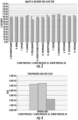
- Fig. 1 is a comparison of the elute fraction analyte % recoveries for the Existing Oasis MCX Protocol and the New Protocol 1
- Fig. 2 is a comparison of the elute fraction phosphatidylcholine peak areas for the Existing Oasis MCX Protocol and the New Protocol 1.
- New Protocol 1 gives over a 5-fold decrease in the amount of phosphatidylcholine present in the Elute fraction relative to the Existing Oasis MCX Protocol, while providing equivalent analyte recoveries, compared to the existing protocol.
- New Protocol 1 A comparison of the New Protocol 1, New Protocol 2a and New Protocol 2b was carried out where the sample was rat plasma (from Bioreclamation IVT, catalog number RATPLEDTA2) containing endogenous phospholipids and spiked with basic analytes (approximately 30 ng/well of each analyte).
- the SPE device was a 96-well SPE plate containing 10 mg per well of a 30 ⁇ m mixed mode reversed phase/strong cation exchange copolymer sorbent.
- the sorbent was prepared as described in US patents 7,232,520 and 7,442,299 .
- the protocols are shown in Table 9.
- Fig. 3 shows a comparison of the elute step analyte % recoveries for the New Protocol 1, New Protocol 2a and New Protocol 2b
- Fig. 4 shows a comparison of the elute fraction phosphatidylcholine peak areas for the New Protocol 1, New Protocol 2a and New Protocol 2b.
- New Protocol 2a gave results similar to New Protocol 1 while New Protocol 2b gave a level that was lower by a factor of approximately two. For the analyte recoveries, New Protocol 2a and 2b gave equivalent results to New Protocol 1.
- New Protocol 3 a salt is added to the methanol wash solution.
- a series of experiments were carried out to determine the ammonium formate concentrations that are best for removing phosphatidylcholine while retaining the analytes.
- the protocols are described in Table 10.
- Table 10 Step Oasis MCX Existing Protocol New Protocol 3 Load 1 mL of sample 1 mL of sample Wash 1 1 mL of 2% Formic Acid (aq) 1 mL of 2% Formic Acid (aq) Wash 2 1 mL of methanol 1 mL of methanol + Ammonium Formate (10 to 100 mM) Elute 1 mL of methanol + 5% NH 4 OH 1 mL of methanol + 5% NH 4 OH
- the sample was a solution of L- ⁇ -phosphatidylcholine from egg yolk (Sigma catalog number P3556) dissolved in acetonitrile/methanol/water (80/1/19 v/v/v).
- the elute solutions were neutralized by adding 35 ⁇ L of 98% formic acid (aq) before analyzing them, to avoid hydrolysis of the phosphatidylcholine catalyzed by the presence of ammonium hydroxide (NH 4 OH).
- the concentrations of phosphatidylcholine in each fraction were determined by comparing the integrated peak areas to those of 1 mg/mL L- ⁇ -phosphatidylcholine in acetonitrile/methanol/water 80/1/19 v/v/v.
- the sample was isotonic saline diluted 1:1 v/v with 4% H 3 PO 4 (aq) spiked with 5.5 ⁇ g/mL amphetamine, 5.9 ⁇ g/mL metoprolol and 3.3 ⁇ g/mL amitriptyline. Recoveries were calculated from the ratio of pre-spiked to post-spiked peak areas. For each protocol, 4 replicates were run. The elute fractions were analyzed using UPLC with UV detection, with the separation conditions described in Tables 2 and 3 (see above).
- Fig. 5 shows a comparison of phosphatidylcholine level and analyte recovery using varying amounts of ammonium formate in the methanol wash step for New Protocol 3.
- 30 mM is a pivotal concentration for both phosphatidylcholine removal and analyte recovery.
- An ammonium formate concentration of 30 mM was found to achieve a low level of phosphatidylcholine in the elute fraction.
- analyte recovery decreases as the ammonium formate concentration is increased beyond this level.
- Oasis MCX-NH 4 + sorbent A 2 gram batch of modified Oasis MCX (Oasis MCX-NH 4 + ) sorbent was prepared as follows. Oasis MCX 30 ⁇ m (Waters Corporation) was suspended in 200 mL of 1 molar ammonium formate, pH 3 for 1.5 to 2 hours, then filtered through a 10 ⁇ m filter and washed 2X using 250 mL of DI water. The material was allowed to air dry for 72 hours in a hood.
- the 2-Step method did not have an aqueous or organic wash step and the bulk of the PC that was not in the load fraction was found in the elute fraction (33.8%).
- Table 11 SPE Protocols and % Phosphatidylcholine in Each Fraction using 1 cc/30 mg Oasis MCX-NH 4 + Cartridges Step 4-Step 3-Step 2-Step Load 1 mL of 1 mg/mL L- a -phosphatidylcholine in acetonitrile/methanol/water 80/1/19 v/v/v Wash 1 1 mL of 2% Formic Acid (aq) No WASH Used No WASH used Wash 2 1 mL of methanol 1 mL of methanol No WASH used Elute 1 mL of methanol + 5% NH 4 OH Results % Phosphatidylcholine in Each Fraction Load 58.3% 57.6% 66.2% Wash 1 6.5% No WASH Used No WASH Used
- the 4-Step protocol (see Table 11) was used to evaluate each batch.
- the solutions from each stage of the SPE protocol were analyzed using UPLC with UV detection, employing the conditions given in Tables 12 and 13.
- the elute solutions were neutralized by adding 35 ⁇ L of 98% formic acid before analyzing them, to avoid hydrolysis of the phosphatidylcholine (PC) catalyzed by the presence of ammonium hydroxide (NH 4 OH).
- the concentrations of phosphatidylcholine in each fraction were determined by comparing the integrated peak areas to the sum of the total area.
- the goal of the experiment was to initially assess if the analytes are retained by the Oasis MCX- NH 4 + sorbent. Recoveries of 100% or greater were achieved with the cartridges prepared using the Oasis MCX- NH 4 + sorbent. Table 14.
Landscapes
- Chemical & Material Sciences (AREA)
- Analytical Chemistry (AREA)
- Chemical Kinetics & Catalysis (AREA)
- Health & Medical Sciences (AREA)
- Life Sciences & Earth Sciences (AREA)
- Immunology (AREA)
- Organic Chemistry (AREA)
- Molecular Biology (AREA)
- Engineering & Computer Science (AREA)
- General Health & Medical Sciences (AREA)
- General Physics & Mathematics (AREA)
- Pathology (AREA)
- Biochemistry (AREA)
- Physics & Mathematics (AREA)
- Hematology (AREA)
- Urology & Nephrology (AREA)
- Biomedical Technology (AREA)
- Biophysics (AREA)
- Cell Biology (AREA)
- Biotechnology (AREA)
- Microbiology (AREA)
- Endocrinology (AREA)
- Food Science & Technology (AREA)
- Medicinal Chemistry (AREA)
- Solid-Sorbent Or Filter-Aiding Compositions (AREA)
- Sampling And Sample Adjustment (AREA)
Claims (10)
- Verfahren zur Durchführung eines Probenanreicherungsverfahrens, wobei das Verfahren Folgendes umfasst:Zugeben eines Probenfluids, das mindestens ein Phospholipid und mindestens einen Zielanalyten umfasst, zu einem ammoniummodifizierten Sorbens, das eine hydrophobe Komponente und eine Kationenaustauschkomponente umfasst, wobei das Kation der Kationenaustauschkomponente ein Ammoniumkation ist, wodurch das ammoniummodifizierte Sorbens mit Phospholipid und mit Zielanalyt adsorbiert wird;optional Zugeben einer wässrigen Lösung, die eine saure Verbindung ausgewählt aus einer organischen Säure, Phosphorsäure, Salzsäure und Kohlensäure umfasst, zu dem ammoniummodifizierten Sorbens;Zugeben einer organischen Lösung, die eine erste organische Lösungsmittelspezies umfasst, zu dem ammoniummodifizierten Sorbens, wodurch mindestens ein Teil des Phospholipids von dem ammoniummodifizierten Sorbens desorbiert wird; undZugeben einer Elutionslösung, die Folgendes umfasst: (i) eine basische Verbindung oder Salzspezies; und (ii) eine zweite organische Lösungsmittelspezies zu dem ammoniummodifizierten Sorbens, wodurch mindestens ein Teil des Zielanalyten von dem ammoniummodifizierten Sorbens desorbiert wird und eine Lösung des Zielanalyten in der Elutionslösung gebildet wird, wobei die zweite organische Lösungsmittelspezies gleich der ersten organischen Lösungsmittelspezies sein kann oder sich davon unterscheiden kann.
- Verfahren nach Anspruch 1, wobei der Zielanalyt eine Base mit einem pKa-Wert von mindestens 5 ist.
- Verfahren nach Anspruch 1, wobei die wässrige Lösung die saure Verbindung in einer Menge umfasst, die ausreicht, um die wässrige Lösung mit einem pH-Wert bereitzustellen, der mindestens zwei pH-Einheiten unter einem niedrigsten pKa-Wert des Zielanalyten liegt.
- Verfahren nach Anspruch 1, wobei die saure Verbindung Formylsäure ist.
- Verfahren nach Anspruch 1, wobei die Elutionslösung die Salzspezies in einer Menge umfasst, die einer Ionenstärke im Bereich von 10-250 mM entspricht.
- Verfahren nach Anspruch 1, wobei die erste organische Lösungsmittelspezies und die zweite organische Lösungsmittelspezies aus Methanol, Ethanol, 1-Propanol, 2-Propanol, Acetonitril, Aceton, Ethylacetat, Methylethylketon, Tetrahydrofuran und Mischungen davon ausgewählt sind.
- Verfahren nach Anspruch 1, wobei die Elutionslösung die basische Verbindung in einer Menge umfasst, die ausreicht, um die Elutionslösung mit einem pH-Wert bereitzustellen, der mindestens zwei pH-Einheiten über dem höchsten pKa-Wert des Zielanalyten liegt.
- Verfahren nach Anspruch 1, wobei das Probenfluid eine biologische Probe umfasst, die aus einer Vollblutprobe, einer Plasmaprobe, einer Serumprobe, einer Lebensmittelprobe und einer Lebensmittelextraktprobe ausgewählt ist.
- Verfahren nach Anspruch 1, wobei das Verfahren nicht das Zugeben der wässrigen Lösung, die die saure Verbindung umfasst, zu dem ammoniummodifizierten Sorbens umfasst.
- Verfahren nach Anspruch 1, wobei das Verfahren Zugeben der wässrigen Lösung, die die saure Verbindung umfasst, zu dem ammoniummodifizierten Sorbens und Zugeben der organischen Lösung, die die erste organische Lösungsmittelspezies umfasst, zu dem ammoniummodifizierten Sorbens umfasst, wodurch mindestens ein Teil des Phospholipids von dem ammoniummodifizierten Sorbens desorbiert wird.
Applications Claiming Priority (3)
| Application Number | Priority Date | Filing Date | Title |
|---|---|---|---|
| US201762609262P | 2017-12-21 | 2017-12-21 | |
| PCT/US2018/067293 WO2019126752A1 (en) | 2017-12-21 | 2018-12-21 | Solid phase extraction methods for enhanced removal of phospholipids from biological samples |
| EP18834273.7A EP3727679B1 (de) | 2017-12-21 | 2018-12-21 | Festphasenextraktionsverfahren zur verbesserten entfernung von phospholipiden aus biologischen proben |
Related Parent Applications (1)
| Application Number | Title | Priority Date | Filing Date |
|---|---|---|---|
| EP18834273.7A Division EP3727679B1 (de) | 2017-12-21 | 2018-12-21 | Festphasenextraktionsverfahren zur verbesserten entfernung von phospholipiden aus biologischen proben |
Publications (2)
| Publication Number | Publication Date |
|---|---|
| EP4154975A1 EP4154975A1 (de) | 2023-03-29 |
| EP4154975B1 true EP4154975B1 (de) | 2025-05-07 |
Family
ID=65024151
Family Applications (2)
| Application Number | Title | Priority Date | Filing Date |
|---|---|---|---|
| EP18834273.7A Active EP3727679B1 (de) | 2017-12-21 | 2018-12-21 | Festphasenextraktionsverfahren zur verbesserten entfernung von phospholipiden aus biologischen proben |
| EP22192475.6A Active EP4154975B1 (de) | 2017-12-21 | 2018-12-21 | Festphasenextraktionsverfahren zur verbesserten entfernung von phospholipiden aus biologischen proben |
Family Applications Before (1)
| Application Number | Title | Priority Date | Filing Date |
|---|---|---|---|
| EP18834273.7A Active EP3727679B1 (de) | 2017-12-21 | 2018-12-21 | Festphasenextraktionsverfahren zur verbesserten entfernung von phospholipiden aus biologischen proben |
Country Status (3)
| Country | Link |
|---|---|
| US (2) | US11604123B2 (de) |
| EP (2) | EP3727679B1 (de) |
| WO (1) | WO2019126752A1 (de) |
Families Citing this family (15)
| Publication number | Priority date | Publication date | Assignee | Title |
|---|---|---|---|---|
| KR101833041B1 (ko) | 2015-06-09 | 2018-02-27 | 삼성전자주식회사 | 예약 톤 설계 방법 및 톤 예약 방식을 이용하여 papr 저감을 수행하는 송신기 |
| WO2016200186A1 (en) | 2015-06-09 | 2016-12-15 | Samsung Electronics Co., Ltd. | Method for determining reserved tones and transmitter for performing papr reduction using tone reservation |
| US12180581B2 (en) | 2017-09-18 | 2024-12-31 | Waters Technologies Corporation | Use of vapor deposition coated flow paths for improved chromatography of metal interacting analytes |
| US12181452B2 (en) | 2017-09-18 | 2024-12-31 | Waters Technologies Corporation | Use of vapor deposition coated flow paths for improved chromatography of metal interacting analytes |
| US11709156B2 (en) | 2017-09-18 | 2023-07-25 | Waters Technologies Corporation | Use of vapor deposition coated flow paths for improved analytical analysis |
| US11709155B2 (en) | 2017-09-18 | 2023-07-25 | Waters Technologies Corporation | Use of vapor deposition coated flow paths for improved chromatography of metal interacting analytes |
| KR102069868B1 (ko) * | 2018-02-28 | 2020-01-23 | 고려대학교 산학협력단 | 합성가스 발효 균의 합성가스 발효 시의 대사체 분석을 위한 대사체 샘플링 및 분석 방법 |
| CN114746749B (zh) * | 2019-12-05 | 2025-01-10 | 沃特世科技公司 | 用于磷酸化的化合物的固相萃取的螯合剂基洗脱液 |
| US11918936B2 (en) | 2020-01-17 | 2024-03-05 | Waters Technologies Corporation | Performance and dynamic range for oligonucleotide bioanalysis through reduction of non specific binding |
| US12352734B2 (en) | 2020-09-24 | 2025-07-08 | Waters Technologies Corporation | Chromatographic hardware improvements for separation of reactive molecules |
| FI130744B1 (fi) | 2022-04-07 | 2024-02-26 | Neste Oyj | Menetelmä vetykäsittelykatalyytin deaktivoinnin vähentämiseksi |
| FI130506B (en) | 2022-04-07 | 2023-10-13 | Neste Oyj | A method for reducing dissolved pollutants in a renewable feedstock |
| CN114755355B (zh) * | 2022-05-20 | 2023-06-16 | 中南大学 | 磷脂脱除剂及其在生物样品脱磷脂中的应用 |
| CN115078612B (zh) * | 2022-06-01 | 2024-08-30 | 长沙理工大学 | 一种基于改性Cr-MOF检测化学品的分析方法 |
| CN120334437B (zh) * | 2025-06-18 | 2025-08-29 | 北京市疾病预防控制中心 | 一种血清液相色谱-串联质谱分析的前处理方法 |
Family Cites Families (7)
| Publication number | Priority date | Publication date | Assignee | Title |
|---|---|---|---|---|
| US7232520B1 (en) | 1998-06-12 | 2007-06-19 | Waters Investments Limited | Ion exchange porous resins for solid phase extraction and chromatography |
| WO1999064480A1 (en) | 1998-06-12 | 1999-12-16 | Waters Investments Limited | Novel ion exchange porous resins for solid phase extraction and chromatography |
| DE10393599T5 (de) * | 2002-10-30 | 2005-10-27 | Waters Investments Ltd., New Castle | Poröse anorganische/organische Homogene copolymerische Hybridmaterialien für chromatographische Auftrennungen und Verfahren für deren Herstellung |
| WO2009032293A1 (en) * | 2007-09-06 | 2009-03-12 | Waters Investments Limited | Methods for isolating functionalized macromolecules |
| EP3148662B1 (de) * | 2014-05-30 | 2025-10-15 | Tecan SP, Inc. | Extraktion, derivatisierung und quantifizierung von analyten |
| GB2552602B (en) * | 2015-03-06 | 2020-12-30 | Micromass Ltd | Desorption electrospray ionisation mass spectrometry ("DESI-MS") analysis of swabs |
| ES2975059T3 (es) * | 2016-12-02 | 2024-07-03 | Magtivio B V | Método para analizar compuestos en muestras biológicas |
-
2018
- 2018-12-21 EP EP18834273.7A patent/EP3727679B1/de active Active
- 2018-12-21 EP EP22192475.6A patent/EP4154975B1/de active Active
- 2018-12-21 WO PCT/US2018/067293 patent/WO2019126752A1/en not_active Ceased
- 2018-12-21 US US16/230,567 patent/US11604123B2/en active Active
-
2023
- 2023-02-09 US US18/166,738 patent/US12467837B2/en active Active
Also Published As
| Publication number | Publication date |
|---|---|
| EP4154975A1 (de) | 2023-03-29 |
| US20230204478A1 (en) | 2023-06-29 |
| EP3727679A1 (de) | 2020-10-28 |
| US20190195758A1 (en) | 2019-06-27 |
| WO2019126752A1 (en) | 2019-06-27 |
| US11604123B2 (en) | 2023-03-14 |
| US12467837B2 (en) | 2025-11-11 |
| EP3727679B1 (de) | 2022-08-31 |
Similar Documents
| Publication | Publication Date | Title |
|---|---|---|
| EP4154975B1 (de) | Festphasenextraktionsverfahren zur verbesserten entfernung von phospholipiden aus biologischen proben | |
| AU2004276760B2 (en) | Quantification of analytes using internal standards | |
| US7442299B2 (en) | Ion exchange porous resins for solid phase extraction and chromatography | |
| US10928366B2 (en) | Compositions and methods for combining protein precipitation and solid phase extraction | |
| EP3234585B1 (de) | Vorrichtung zur durchführung einer festphasenextraktion | |
| US20030042206A1 (en) | Water-wettable chromatographic media for solid phase extraction | |
| GB2558103A (en) | Materials for hydrophilic interaction chromatography and processes for preparation and use thereof for analysis of glycoproteins and glycopeptides | |
| US20140033805A1 (en) | Methods of extracting fat soluble vitamins | |
| US20220280909A1 (en) | Sorbent particles for sample treatment | |
| CN115753702A (zh) | 快速制备标记的葡糖基胺和分析生产所述标记的葡糖基胺的糖基化生物分子的方法 | |
| EP2247933A1 (de) | Verfahren und kits zur bestimmung des vorhandenseins und der menge von vitamin-d-analoga in proben | |
| Santos et al. | Restricted access molecularly imprinted polymers obtained by bovine serum albumin and/or hydrophilic monomers’ external layers: a comparison related to physical and chemical properties | |
| US8048305B2 (en) | Methods for separating and analyzing anionic compounds | |
| Liu et al. | A method by homemade OH/TSO-PMHS fibre solid-phase microextraction coupling with gas chromatography–mass spectrometry for analysis of antiestrogens in biological matrices | |
| WO2021201295A1 (en) | Method for measuring or identifying a component of interest in specimens | |
| Yan et al. | Molecularly imprinted solid-phase extraction for determination of enrofloxacin and ciprofloxacin in chicken muscle | |
| EP2895269A1 (de) | Konische filterplatte mit mehreren vertiefungen | |
| Mourão et al. | Application of polyurethane-based devices as sorption-desorption phases for microextraction analysis–The all-in-one microextraction concept | |
| US20210207189A1 (en) | Compositions, devices, kits and methods useful for removal of phospholipids | |
| US20240159631A1 (en) | Method for detecting at least one analyte in a sample | |
| Böddi | Investigations of non-enzymatic glycation with new bioanalytical methods | |
| Katalin | Investigations of non-enzymatic glycation with new bioanalytical methods | |
| Hansen et al. | Analysis of Small‐Molecule Drugs in Biological Fluids | |
| Daryanavard | Microextraction by packed sorbent of drugs and peptides in biological fluids | |
| Palagama | Development of Liquid Chromatography-Mass Spectrometry Methods for Identification and Quantification of Microcystins in Water and Biological Fluids, and their Removal from Water |
Legal Events
| Date | Code | Title | Description |
|---|---|---|---|
| PUAI | Public reference made under article 153(3) epc to a published international application that has entered the european phase |
Free format text: ORIGINAL CODE: 0009012 |
|
| STAA | Information on the status of an ep patent application or granted ep patent |
Free format text: STATUS: THE APPLICATION HAS BEEN PUBLISHED |
|
| AC | Divisional application: reference to earlier application |
Ref document number: 3727679 Country of ref document: EP Kind code of ref document: P |
|
| AK | Designated contracting states |
Kind code of ref document: A1 Designated state(s): AL AT BE BG CH CY CZ DE DK EE ES FI FR GB GR HR HU IE IS IT LI LT LU LV MC MK MT NL NO PL PT RO RS SE SI SK SM TR |
|
| STAA | Information on the status of an ep patent application or granted ep patent |
Free format text: STATUS: REQUEST FOR EXAMINATION WAS MADE |
|
| 17P | Request for examination filed |
Effective date: 20230927 |
|
| RBV | Designated contracting states (corrected) |
Designated state(s): AL AT BE BG CH CY CZ DE DK EE ES FI FR GB GR HR HU IE IS IT LI LT LU LV MC MK MT NL NO PL PT RO RS SE SI SK SM TR |
|
| STAA | Information on the status of an ep patent application or granted ep patent |
Free format text: STATUS: EXAMINATION IS IN PROGRESS |
|
| 17Q | First examination report despatched |
Effective date: 20240223 |
|
| GRAP | Despatch of communication of intention to grant a patent |
Free format text: ORIGINAL CODE: EPIDOSNIGR1 |
|
| STAA | Information on the status of an ep patent application or granted ep patent |
Free format text: STATUS: GRANT OF PATENT IS INTENDED |
|
| INTG | Intention to grant announced |
Effective date: 20241128 |
|
| GRAS | Grant fee paid |
Free format text: ORIGINAL CODE: EPIDOSNIGR3 |
|
| GRAA | (expected) grant |
Free format text: ORIGINAL CODE: 0009210 |
|
| STAA | Information on the status of an ep patent application or granted ep patent |
Free format text: STATUS: THE PATENT HAS BEEN GRANTED |
|
| AC | Divisional application: reference to earlier application |
Ref document number: 3727679 Country of ref document: EP Kind code of ref document: P |
|
| AK | Designated contracting states |
Kind code of ref document: B1 Designated state(s): AL AT BE BG CH CY CZ DE DK EE ES FI FR GB GR HR HU IE IS IT LI LT LU LV MC MK MT NL NO PL PT RO RS SE SI SK SM TR |
|
| P01 | Opt-out of the competence of the unified patent court (upc) registered |
Free format text: CASE NUMBER: APP_16074/2025 Effective date: 20250402 |
|
| REG | Reference to a national code |
Ref country code: GB Ref legal event code: FG4D |
|
| REG | Reference to a national code |
Ref country code: CH Ref legal event code: EP |
|
| REG | Reference to a national code |
Ref country code: DE Ref legal event code: R096 Ref document number: 602018081861 Country of ref document: DE |
|
| REG | Reference to a national code |
Ref country code: IE Ref legal event code: FG4D |
|
| REG | Reference to a national code |
Ref country code: NL Ref legal event code: MP Effective date: 20250507 |
|
| PG25 | Lapsed in a contracting state [announced via postgrant information from national office to epo] |
Ref country code: PT Free format text: LAPSE BECAUSE OF FAILURE TO SUBMIT A TRANSLATION OF THE DESCRIPTION OR TO PAY THE FEE WITHIN THE PRESCRIBED TIME-LIMIT Effective date: 20250908 Ref country code: ES Free format text: LAPSE BECAUSE OF FAILURE TO SUBMIT A TRANSLATION OF THE DESCRIPTION OR TO PAY THE FEE WITHIN THE PRESCRIBED TIME-LIMIT Effective date: 20250507 Ref country code: FI Free format text: LAPSE BECAUSE OF FAILURE TO SUBMIT A TRANSLATION OF THE DESCRIPTION OR TO PAY THE FEE WITHIN THE PRESCRIBED TIME-LIMIT Effective date: 20250507 |
|
| REG | Reference to a national code |
Ref country code: LT Ref legal event code: MG9D |
|
| PG25 | Lapsed in a contracting state [announced via postgrant information from national office to epo] |
Ref country code: NO Free format text: LAPSE BECAUSE OF FAILURE TO SUBMIT A TRANSLATION OF THE DESCRIPTION OR TO PAY THE FEE WITHIN THE PRESCRIBED TIME-LIMIT Effective date: 20250807 Ref country code: GR Free format text: LAPSE BECAUSE OF FAILURE TO SUBMIT A TRANSLATION OF THE DESCRIPTION OR TO PAY THE FEE WITHIN THE PRESCRIBED TIME-LIMIT Effective date: 20250808 |
|
| PG25 | Lapsed in a contracting state [announced via postgrant information from national office to epo] |
Ref country code: PL Free format text: LAPSE BECAUSE OF FAILURE TO SUBMIT A TRANSLATION OF THE DESCRIPTION OR TO PAY THE FEE WITHIN THE PRESCRIBED TIME-LIMIT Effective date: 20250507 Ref country code: NL Free format text: LAPSE BECAUSE OF FAILURE TO SUBMIT A TRANSLATION OF THE DESCRIPTION OR TO PAY THE FEE WITHIN THE PRESCRIBED TIME-LIMIT Effective date: 20250507 |
|
| REG | Reference to a national code |
Ref country code: AT Ref legal event code: MK05 Ref document number: 1791904 Country of ref document: AT Kind code of ref document: T Effective date: 20250507 |
|
| PG25 | Lapsed in a contracting state [announced via postgrant information from national office to epo] |
Ref country code: BG Free format text: LAPSE BECAUSE OF FAILURE TO SUBMIT A TRANSLATION OF THE DESCRIPTION OR TO PAY THE FEE WITHIN THE PRESCRIBED TIME-LIMIT Effective date: 20250507 |
|
| PG25 | Lapsed in a contracting state [announced via postgrant information from national office to epo] |
Ref country code: HR Free format text: LAPSE BECAUSE OF FAILURE TO SUBMIT A TRANSLATION OF THE DESCRIPTION OR TO PAY THE FEE WITHIN THE PRESCRIBED TIME-LIMIT Effective date: 20250507 |
|
| PG25 | Lapsed in a contracting state [announced via postgrant information from national office to epo] |
Ref country code: AT Free format text: LAPSE BECAUSE OF FAILURE TO SUBMIT A TRANSLATION OF THE DESCRIPTION OR TO PAY THE FEE WITHIN THE PRESCRIBED TIME-LIMIT Effective date: 20250507 |
|
| PG25 | Lapsed in a contracting state [announced via postgrant information from national office to epo] |
Ref country code: RS Free format text: LAPSE BECAUSE OF FAILURE TO SUBMIT A TRANSLATION OF THE DESCRIPTION OR TO PAY THE FEE WITHIN THE PRESCRIBED TIME-LIMIT Effective date: 20250807 |
|
| PG25 | Lapsed in a contracting state [announced via postgrant information from national office to epo] |
Ref country code: IS Free format text: LAPSE BECAUSE OF FAILURE TO SUBMIT A TRANSLATION OF THE DESCRIPTION OR TO PAY THE FEE WITHIN THE PRESCRIBED TIME-LIMIT Effective date: 20250907 |
|
| PG25 | Lapsed in a contracting state [announced via postgrant information from national office to epo] |
Ref country code: LV Free format text: LAPSE BECAUSE OF FAILURE TO SUBMIT A TRANSLATION OF THE DESCRIPTION OR TO PAY THE FEE WITHIN THE PRESCRIBED TIME-LIMIT Effective date: 20250507 |
|
| PGFP | Annual fee paid to national office [announced via postgrant information from national office to epo] |
Ref country code: DE Payment date: 20251126 Year of fee payment: 8 |
|
| PGFP | Annual fee paid to national office [announced via postgrant information from national office to epo] |
Ref country code: GB Payment date: 20251120 Year of fee payment: 8 |
|
| PG25 | Lapsed in a contracting state [announced via postgrant information from national office to epo] |
Ref country code: DK Free format text: LAPSE BECAUSE OF FAILURE TO SUBMIT A TRANSLATION OF THE DESCRIPTION OR TO PAY THE FEE WITHIN THE PRESCRIBED TIME-LIMIT Effective date: 20250507 Ref country code: SM Free format text: LAPSE BECAUSE OF FAILURE TO SUBMIT A TRANSLATION OF THE DESCRIPTION OR TO PAY THE FEE WITHIN THE PRESCRIBED TIME-LIMIT Effective date: 20250507 |
|
| PG25 | Lapsed in a contracting state [announced via postgrant information from national office to epo] |
Ref country code: CZ Free format text: LAPSE BECAUSE OF FAILURE TO SUBMIT A TRANSLATION OF THE DESCRIPTION OR TO PAY THE FEE WITHIN THE PRESCRIBED TIME-LIMIT Effective date: 20250507 |
|
| PG25 | Lapsed in a contracting state [announced via postgrant information from national office to epo] |
Ref country code: EE Free format text: LAPSE BECAUSE OF FAILURE TO SUBMIT A TRANSLATION OF THE DESCRIPTION OR TO PAY THE FEE WITHIN THE PRESCRIBED TIME-LIMIT Effective date: 20250507 |
|
| PG25 | Lapsed in a contracting state [announced via postgrant information from national office to epo] |
Ref country code: SK Free format text: LAPSE BECAUSE OF FAILURE TO SUBMIT A TRANSLATION OF THE DESCRIPTION OR TO PAY THE FEE WITHIN THE PRESCRIBED TIME-LIMIT Effective date: 20250507 |
|
| PG25 | Lapsed in a contracting state [announced via postgrant information from national office to epo] |
Ref country code: IT Free format text: LAPSE BECAUSE OF FAILURE TO SUBMIT A TRANSLATION OF THE DESCRIPTION OR TO PAY THE FEE WITHIN THE PRESCRIBED TIME-LIMIT Effective date: 20250507 |
|
| PG25 | Lapsed in a contracting state [announced via postgrant information from national office to epo] |
Ref country code: RO Free format text: LAPSE BECAUSE OF FAILURE TO SUBMIT A TRANSLATION OF THE DESCRIPTION OR TO PAY THE FEE WITHIN THE PRESCRIBED TIME-LIMIT Effective date: 20250507 |
|
| REG | Reference to a national code |
Ref country code: DE Ref legal event code: R097 Ref document number: 602018081861 Country of ref document: DE |
|
| PLBE | No opposition filed within time limit |
Free format text: ORIGINAL CODE: 0009261 |
|
| STAA | Information on the status of an ep patent application or granted ep patent |
Free format text: STATUS: NO OPPOSITION FILED WITHIN TIME LIMIT |
|
| REG | Reference to a national code |
Ref country code: CH Ref legal event code: L10 Free format text: ST27 STATUS EVENT CODE: U-0-0-L10-L00 (AS PROVIDED BY THE NATIONAL OFFICE) Effective date: 20260318 |
|
| 26N | No opposition filed |
Effective date: 20260210 |