EP4155158A1 - Procédé de fabrication d'une caisse de wagon d'un véhicule ferroviaire, caisse de wagon et véhicule ferroviaire pourvu de caisse de wagon - Google Patents
Procédé de fabrication d'une caisse de wagon d'un véhicule ferroviaire, caisse de wagon et véhicule ferroviaire pourvu de caisse de wagon Download PDFInfo
- Publication number
- EP4155158A1 EP4155158A1 EP22184284.2A EP22184284A EP4155158A1 EP 4155158 A1 EP4155158 A1 EP 4155158A1 EP 22184284 A EP22184284 A EP 22184284A EP 4155158 A1 EP4155158 A1 EP 4155158A1
- Authority
- EP
- European Patent Office
- Prior art keywords
- car body
- modules
- module
- rail vehicle
- individual
- Prior art date
- Legal status (The legal status is an assumption and is not a legal conclusion. Google has not performed a legal analysis and makes no representation as to the accuracy of the status listed.)
- Pending
Links
Images
Classifications
-
- B—PERFORMING OPERATIONS; TRANSPORTING
- B61—RAILWAYS
- B61D—BODY DETAILS OR KINDS OF RAILWAY VEHICLES
- B61D17/00—Construction details of vehicle bodies
- B61D17/04—Construction details of vehicle bodies with bodies of metal; with composite, e.g. metal and wood body structures
- B61D17/043—Construction details of vehicle bodies with bodies of metal; with composite, e.g. metal and wood body structures connections between superstructure sub-units
- B61D17/045—The sub-units being construction modules
-
- B—PERFORMING OPERATIONS; TRANSPORTING
- B61—RAILWAYS
- B61D—BODY DETAILS OR KINDS OF RAILWAY VEHICLES
- B61D13/00—Tramway vehicles
-
- B—PERFORMING OPERATIONS; TRANSPORTING
- B61—RAILWAYS
- B61D—BODY DETAILS OR KINDS OF RAILWAY VEHICLES
- B61D17/00—Construction details of vehicle bodies
- B61D17/04—Construction details of vehicle bodies with bodies of metal; with composite, e.g. metal and wood body structures
- B61D17/043—Construction details of vehicle bodies with bodies of metal; with composite, e.g. metal and wood body structures connections between superstructure sub-units
Definitions
- the invention relates to a method for producing a car body of a rail vehicle, a car body of a rail vehicle and a rail vehicle with a car body.
- the car body of a rail vehicle is assembled and manufactured from many different individual parts made of metallic and/or non-metallic materials, such as parts made of sheet metal or carbon fiber-reinforced plastic, etc., with all possible joining methods being necessary. As a rule, this takes place one after the other in a continuous work process, with the manufacturing process being very complex and therefore time-consuming and expensive as a result. This also applies to the usually downstream process of protecting a car body against corrosion.
- Different requirements, in particular different customer-specific vehicle requirements, for different car body parts, for example width, length, height, number of doors, number of windows, etc. also require individual car bodies, so that different car body units or even vehicle types are produced as a result, with this variance also being very complex and expensive is.
- the invention is based on the object of specifying a method with which the production of a car body of a rail vehicle can be greatly simplified.
- the car body is first segmented into individual modules, then the modules of the car body are manufactured separately and then the manufactured modules are connected to one another to form the car body.
- the solution according to the invention has the advantage that in advance, before the actual production of a car body, a segmentation of a planned car body of a rail vehicle, for example a tram, into individual, different, separate modules, for example door, chassis, small or large window , Roof modules, etc., takes place, and by segmenting such a car body into individual, different, separate modules, a separate production of such modules or module types is made possible independently of one another.
- a separate production of such modules or module types is made possible independently of one another.
- the complexity of the individual assemblies or modules is reduced, as a result of which increased manufacturing accuracy of the individual modules and thus of the entire car body can or is achieved with significantly less effort.
- the modules are prefabricated so that the car body can be assembled even more quickly, since it is not necessary to wait for the production of the required or desired modules, but instead prefabricated modules can be used immediately.
- the individual modules are preferably manufactured in parallel, so that the required individual and different modules are available even more quickly.
- the individual modules are each manufactured with different characteristics.
- individualized module variants can be assembled or connected to one another with unchanged modules without restriction and without additional effort.
- individualized car body variants can thus be produced very easily and with significantly less effort, and customer-specific requirements can therefore be implemented more individually, more quickly and more easily.
- the individual modules are preferably provided separately with corrosion protection.
- the modules are therefore already provided with corrosion protection before the car body is assembled.
- the already completed, entire To protect the car body against corrosion be dispensed with entirely or at least to a significant extent. It is particularly advantageous that the corrosion protection is significantly improved as a result, since the number of blind spots, i.e. the spots that may not be accessible to the corrosion protection in the assembled state of the car body, is significantly reduced and this process is also significantly less complex and thus saves time and money.
- At least some of the individual modules can be connected to one another in any order.
- door, chassis or small or large window modules in particular can be connected to one another in any order, for example in the order door module - chassis module - small window module or in the order small window module - chassis module - door module or in any other permutation.
- two or more identical modules can also be combined and connected in this way with one another and/or with other, differently designed modules, likewise in any number, depending on requirements. As a result, it is very easy to assemble and manufacture almost any desired arrangement and thus a corresponding car body.
- At least some of the individual modules are designed as ring-shaped modules.
- a ring-shaped module has, for example, two side parts as the front and back, which are connected to one another by means of a roof part at the top and a bottom part at the bottom to form a ring-shaped module.
- the open interior of such a ring-shaped module forms part of the interior of a car body.
- the front and back of such a ring-shaped module can of course be equipped differently be. For example, there could be a door on the front and a window on the back. All possible combinations are conceivable and possible here.
- Further modules for example also ring-shaped, can then be added on both sides as required. This makes the assembly of a car body, for example in an assembly stand, even easier and faster.
- central continuous elements running along the longitudinal axis of the resulting car body for example continuous roof longitudinal beams or central longitudinal beam structures, etc.
- central continuous elements running along the longitudinal axis of the resulting car body, for example continuous roof longitudinal beams or central longitudinal beam structures, etc.
- these elements can be arranged centrally.
- modules are, for example, along the central axis of the car body at the top, open in the roof area in order to be able to easily adjust the width of the car bodies, for example for trams, depending on the requirements.
- the open area can be closed, for example, by means of the continuous elements running along the longitudinal axis of the resulting car body, for example continuous roof longitudinal beam or central longitudinal beam structures, etc., which can be designed with different widths depending on the required width of the car body.
- a width that is required and possibly different according to customer requirements can be implemented very easily, as a result of which an even greater degree of modularization can be achieved.
- At least one segmented, individual module forms a model class according to which identically constructed modules can be reproduced.
- at least one individual module for example a door, chassis, small or large window or roof module, etc., serves as a representative or template for a model class, so that any number of identical modules can be reproduced according to this template and can also be manufactured for stock for additional car bodies as required.
- this applies to all different, individual modules or also to corresponding module variants that are individualized depending on customer requirements. This results in an unlimited number of different module classes, from which all possible car bodies with the desired characteristics can be assembled.
- a further preferred embodiment of the invention is a car body of a rail vehicle, which is produced by means of a method according to one of claims 1 to 10.
- Another particularly preferred embodiment of the invention is a rail vehicle with at least one car body according to claim 11.
- the rail vehicle is particularly preferably a tram.
- the production of a car body of a rail vehicle, in particular a tram can be divided into the production of individual modules using the method according to the invention, which are then assembled to complete the car body, e.g. in an assembly stand, or assembled to form the car body. Due to the modules, which can be flexibly combined with one another and connected to one another in a different, desired and essentially any order, individualized car body variants can advantageously be produced very easily and with significantly less effort and customer-specific requirements can therefore be implemented more individually, quickly and easily without having to produce complete, individualized car body variants.
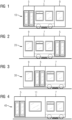
- Fig.1 shows a stylized car body 10 of a rail vehicle, here a tram, which is only partially shown and is produced according to the method according to the invention.
- the partial section of the car body 10 shown consists of three modules, a door module 5, a running gear module 7 and a small window module 9, with the running gear module 7 being directly connected to the door module 5 on the left-hand side and to the small window module 9 on the right-hand side.
- Possible further modules of the car body 10, which are or can be connected to the left of the door module 5 and/or to the right of the small window module 9, but do not necessarily have to be connected, are not shown here.
- a corresponding roof module of the car body 10 is also not shown.
- the three in 1 The modules 5, 7 and 9 shown were manufactured according to the method according to the invention after the segmentation of the planned car body 10 of a rail vehicle, here a tram, into the corresponding individual, different modules 5, 7, 9, separately and independently of one another and then, for example, in one Assembly structure status, lined up according to the segmentation previously carried out and connected to one another by appropriate joining methods, such as welding, screwing, riveting, etc., and assembled to form the complete car body 10 .
- modules 5, 7, 9, which according to the invention may also be manufactured or prefabricated in parallel is in contrast to the full range of joining methods in the conventional manufacturing process in which a car body is usually created in a continuous work process, advantageously only the use of a narrowly limited number of different joining methods is necessary, since the complexity of the individual assemblies, or the modules 5, 7, 9, is significantly lower here. Due to the separate production of the individual modules 5, 7, 9, with their reduced complexity an increased manufacturing accuracy of the individual modules 5, 7, 9, and thus of the entire car body 10 is also achieved with significantly less effort. As a result, the assembly and thus the production of the car body 10 by the method according to the invention is significantly simpler, much faster and therefore, in particular, also significantly cheaper.
- the illustrated modules 5, 7, 9 are advantageously separately provided with anti-corrosion protection even before the car body 10 is assembled, so that the usually downstream process of protecting an already completed entire car body against corrosion is entirely or at least to a significant extent Share can be waived.
- the corrosion protection is thus significantly improved since the number of blind spots, ie the spots that may not be accessible to the corrosion protection in the assembled state of the car body 10, is significantly reduced. At the same time, this makes the process less complex and therefore also faster and cheaper.
- the Figures 2 and 3 show how figure 1 each a stylized, only partially shown, manufactured according to the inventive method body 20 and 30 of a rail vehicle, here a tram.
- the partial section of the car bodies 20 or 30 shown in each case consists of three modules, namely identically constructed or manufactured modules, which are also shown in 1 be used, namely a door module 5, a chassis module 7 and a small window module 9.
- the chassis module 7 is directly connected to the small window module 9 on the left-hand side and to the door module 5 on the right-hand side.
- the door module 5 is directly connected to the small window module 9 on the left-hand side and to the chassis module 7 on the right-hand side.
- the modules 5, 7 and 9 can advantageously be combined and connected to one another in any order, depending on requirements.
- all permutations are possible, even if not all possible permutations are shown here.
- two or more identical modules 5, 7, 9 can also be combined and connected in this way with one another and/or with other modules of different characteristics, not shown here, also, as required, in any number.
- figure 4 shows how figure 1 a stylized car body 40 of a rail vehicle, here a tram, which is only partially shown and is produced according to the method according to the invention.
- the partial section of the car body 40 shown consists of three modules, namely two identically constructed or manufactured modules, which are also shown in 1 be used, namely the door module 5 and the chassis module 7 and a third, different module, namely a large window module 11.
- the different, large window module 11 is directly connected to the door module 5 on the left and to the chassis module 7 on the right.
- Possible further modules of the car body 40 which connect to the left of the door module 5 and/or to the right of the running gear module 7 or can connect, but do not necessarily have to connect, are again not shown.
- a corresponding roof module of the car body 40 is also not shown.
- FIG 4 shows based on the small window module 9 from the Figures 1 to 3 the use of a different module configuration in the form of the large window module 11.
- individual modules can each be manufactured with different configurations, whereby customer-specific requirements or wishes at module level with regard to an individual module, here the small window module 9 or several different modules, are taken into account, so that, if required, only individualized module variants and not separate, complete, individualized car body variants have to be produced.
- individualized module variants 11 can be assembled, combined or connected to one another with unchanged modules 5, 7, 9 without restriction and without additional effort in any number and order and thus very easily and with significantly less effort individualized car body variants 10, 20, 30, 40 to be manufactured.
- the segmented, individual modules 5, 7, 9 can each form model classes, according to which identical modules 5, 7, 9 can be reproduced in each case.
- individual modules such as the door module 5, the chassis module 7, or the small window module 9 are representative or templates for different model classes, so that modules 5, 7, 9 with an identical structure based on this template can be reproduced in any number and for others Wagon bodies can also be manufactured for stock if required.
- Wagon bodies can also be manufactured for stock if required.
- this of course applies to all different individual modules that are not shown here, or also to corresponding Module variants customized according to customer requirements.
- there is an unlimited number of different module classes from which certain car bodies with the desired characteristics can be assembled in a simple manner, or can also be modified via individualized module variants.
Landscapes
- Engineering & Computer Science (AREA)
- Mechanical Engineering (AREA)
- Life Sciences & Earth Sciences (AREA)
- Wood Science & Technology (AREA)
- Transportation (AREA)
- Body Structure For Vehicles (AREA)
Applications Claiming Priority (1)
| Application Number | Priority Date | Filing Date | Title |
|---|---|---|---|
| DE102021210739.7A DE102021210739A1 (de) | 2021-09-27 | 2021-09-27 | Verfahren zur Herstellung eines Wagenkastens eines Schienenfahrzeugs, Wagenkasten und Schienenfahrzeug mit Wagenkasten |
Publications (1)
| Publication Number | Publication Date |
|---|---|
| EP4155158A1 true EP4155158A1 (fr) | 2023-03-29 |
Family
ID=82458727
Family Applications (1)
| Application Number | Title | Priority Date | Filing Date |
|---|---|---|---|
| EP22184284.2A Pending EP4155158A1 (fr) | 2021-09-27 | 2022-07-12 | Procédé de fabrication d'une caisse de wagon d'un véhicule ferroviaire, caisse de wagon et véhicule ferroviaire pourvu de caisse de wagon |
Country Status (2)
| Country | Link |
|---|---|
| EP (1) | EP4155158A1 (fr) |
| DE (1) | DE102021210739A1 (fr) |
Citations (8)
| Publication number | Priority date | Publication date | Assignee | Title |
|---|---|---|---|---|
| EP0533028A1 (fr) * | 1991-09-14 | 1993-03-24 | ABB HENSCHEL WAGGON UNION GmbH | Voiture de tramway à plancher surbaissé |
| DE29608643U1 (de) * | 1996-05-13 | 1997-09-18 | Duewag Ag, 47829 Krefeld | Wagenkasten eines Schienenfahrzeuges |
| DE69231805T2 (de) * | 1992-12-14 | 2001-11-08 | Kawasaki Jukogyo K.K., Kobe | Wagenkasten und Verfahren zum Zusammenbau desselben |
| EP1958844A1 (fr) * | 2007-02-16 | 2008-08-20 | Alstom Transport S.A. | Procédé de fabrication d'un sous-ensemble de rame de transport de voyageurs |
| EP1958847A1 (fr) * | 2007-02-16 | 2008-08-20 | Alstom Transport S.A. | Ensemble ferroviaire de transport de voyageurs, famille de tels ensembles, et procédé de fabrication. |
| EP2130738A1 (fr) * | 2008-06-06 | 2009-12-09 | Bombardier Transportation GmbH | Carrosserie de voiture de véhicule ferroviaire et procédé d'assemblage |
| EP2305529A2 (fr) * | 2009-09-30 | 2011-04-06 | Deutsches Zentrum für Luft- und Raumfahrt e.V. | Caisse de voiture modulaire |
| WO2013024112A1 (fr) * | 2011-08-15 | 2013-02-21 | Bombardier Transportation Gmbh | Module de caisse de véhicule ferroviaire et véhicule ferroviaire associé |
Family Cites Families (1)
| Publication number | Priority date | Publication date | Assignee | Title |
|---|---|---|---|---|
| CH694725A5 (fr) | 2000-11-06 | 2005-06-30 | Vevey Technologies Sa | Procédé de transformation de véhicules ferroviaires et véhicules ferroviaires obtenus par ce procédé. |
-
2021
- 2021-09-27 DE DE102021210739.7A patent/DE102021210739A1/de not_active Withdrawn
-
2022
- 2022-07-12 EP EP22184284.2A patent/EP4155158A1/fr active Pending
Patent Citations (8)
| Publication number | Priority date | Publication date | Assignee | Title |
|---|---|---|---|---|
| EP0533028A1 (fr) * | 1991-09-14 | 1993-03-24 | ABB HENSCHEL WAGGON UNION GmbH | Voiture de tramway à plancher surbaissé |
| DE69231805T2 (de) * | 1992-12-14 | 2001-11-08 | Kawasaki Jukogyo K.K., Kobe | Wagenkasten und Verfahren zum Zusammenbau desselben |
| DE29608643U1 (de) * | 1996-05-13 | 1997-09-18 | Duewag Ag, 47829 Krefeld | Wagenkasten eines Schienenfahrzeuges |
| EP1958844A1 (fr) * | 2007-02-16 | 2008-08-20 | Alstom Transport S.A. | Procédé de fabrication d'un sous-ensemble de rame de transport de voyageurs |
| EP1958847A1 (fr) * | 2007-02-16 | 2008-08-20 | Alstom Transport S.A. | Ensemble ferroviaire de transport de voyageurs, famille de tels ensembles, et procédé de fabrication. |
| EP2130738A1 (fr) * | 2008-06-06 | 2009-12-09 | Bombardier Transportation GmbH | Carrosserie de voiture de véhicule ferroviaire et procédé d'assemblage |
| EP2305529A2 (fr) * | 2009-09-30 | 2011-04-06 | Deutsches Zentrum für Luft- und Raumfahrt e.V. | Caisse de voiture modulaire |
| WO2013024112A1 (fr) * | 2011-08-15 | 2013-02-21 | Bombardier Transportation Gmbh | Module de caisse de véhicule ferroviaire et véhicule ferroviaire associé |
Also Published As
| Publication number | Publication date |
|---|---|
| DE102021210739A1 (de) | 2023-03-30 |
Similar Documents
| Publication | Publication Date | Title |
|---|---|---|
| DE3050288C2 (de) | Baustein eines Stadtomnibusses oder eines ähnlichen Fahrzeuges und ein auf des Basis solcher Bausteine zusammengebauter Omnibus | |
| EP0597242A1 (fr) | Méthode de manufacture d'un cadre porteur pour une carrosserie et un cadre porteur usiné avec cette méthode | |
| EP1108646A2 (fr) | Elément de structure | |
| DE102010048350A1 (de) | Bodengruppe für eine Mehrzahl von Bauvarianten einer Karosserie eines Personenkraftwagens | |
| DE102018214109A1 (de) | Karosseriestruktur für ein elektrisch betriebenes Fahrzeug | |
| DE102013202880A1 (de) | Türinnenverkleidung für Kraftfahrzeug und Verfahren zu ihrer Herstellung | |
| EP4069588B1 (fr) | Assemblage de rail de siège pour fixer un assemblage de siège dans un véhicule, utilisation de tel assemblage de rail de siège dans un avion et procédé de fabrication d'un assemblage de rail de siège | |
| DE69219286T2 (de) | Fahrzeugaufbau mit Verbundseitenwänden | |
| EP4155158A1 (fr) | Procédé de fabrication d'une caisse de wagon d'un véhicule ferroviaire, caisse de wagon et véhicule ferroviaire pourvu de caisse de wagon | |
| DE102020213012A1 (de) | Karosserieverstärkungsvorrichtung für Fahrzeug | |
| DE102020209298A1 (de) | Karosserie für ein Fahrzeug | |
| DE102020119526A1 (de) | Untergestell eines schienenfahrzeuges | |
| WO2017093297A1 (fr) | Profilé à chambres creuses | |
| DE102009026297A1 (de) | Cockpitquerträger mit variablem Lenksäulenneigungswinkel | |
| DE2744757A1 (de) | Verfahren zur anbringung von lageraugen an schwenkbar zu lagernden konstruktionsteilen, insbesondere scharnierfluegeln | |
| EP3727987B1 (fr) | Procédé de fabrication d'un composant de grande taille de véhicule ferroviaire à partir de profilés creux en métal léger | |
| EP3540170B1 (fr) | Système de cadre de porte ou de fenêtre et procédé de fabrication | |
| EP3853096B1 (fr) | Wagon de véhicule ferroviaire et véhicule ferroviaire | |
| DE102023001650B3 (de) | Bodenstruktur für ein Elektrofahrzeug, Elektrofahrzeug und Verfahren | |
| DE102018133153A1 (de) | Fahrwerkseinrichtung für ein schienenfahrzeug | |
| DE4041562C2 (de) | Seitenlangträger-Querträger-Anschluß für Schienenfahrzeuguntergestelle, insbesondere von Reisezugwagen | |
| DE4216606A1 (de) | Verfahren zur Fertigung und zum Ausbau von Schienenfahrzeugwagenkästen mit hoher Maßgenauigkeit | |
| DE102006019479B4 (de) | Türaufbau mit Tailored Blanks | |
| DE102017200641A1 (de) | oFahrzeug zur Personenbeförderung | |
| DE102024003500A1 (de) | Baukastensystem und Verfahren zum Herstellen von unterschiedlichen Bauvarianten einer Bodenstruktur für eine Karosserie eines Personenkraftwagens |
Legal Events
| Date | Code | Title | Description |
|---|---|---|---|
| PUAI | Public reference made under article 153(3) epc to a published international application that has entered the european phase |
Free format text: ORIGINAL CODE: 0009012 |
|
| STAA | Information on the status of an ep patent application or granted ep patent |
Free format text: STATUS: THE APPLICATION HAS BEEN PUBLISHED |
|
| AK | Designated contracting states |
Kind code of ref document: A1 Designated state(s): AL AT BE BG CH CY CZ DE DK EE ES FI FR GB GR HR HU IE IS IT LI LT LU LV MC MK MT NL NO PL PT RO RS SE SI SK SM TR |
|
| STAA | Information on the status of an ep patent application or granted ep patent |
Free format text: STATUS: REQUEST FOR EXAMINATION WAS MADE |
|
| 17P | Request for examination filed |
Effective date: 20230926 |
|
| RBV | Designated contracting states (corrected) |
Designated state(s): AL AT BE BG CH CY CZ DE DK EE ES FI FR GB GR HR HU IE IS IT LI LT LU LV MC MK MT NL NO PL PT RO RS SE SI SK SM TR |
|
| STAA | Information on the status of an ep patent application or granted ep patent |
Free format text: STATUS: EXAMINATION IS IN PROGRESS |
|
| 17Q | First examination report despatched |
Effective date: 20241118 |
|
| RAP3 | Party data changed (applicant data changed or rights of an application transferred) |
Owner name: SIEMENS MOBILITY GMBH |