EP4155193A1 - Moteur de ventilateur à conduit, réseau de moteurs de ventilateur à conduit et aéronef - Google Patents
Moteur de ventilateur à conduit, réseau de moteurs de ventilateur à conduit et aéronef Download PDFInfo
- Publication number
- EP4155193A1 EP4155193A1 EP21198669.0A EP21198669A EP4155193A1 EP 4155193 A1 EP4155193 A1 EP 4155193A1 EP 21198669 A EP21198669 A EP 21198669A EP 4155193 A1 EP4155193 A1 EP 4155193A1
- Authority
- EP
- European Patent Office
- Prior art keywords
- electromotor
- ducted fan
- stator
- heat pipe
- aircraft
- Prior art date
- Legal status (The legal status is an assumption and is not a legal conclusion. Google has not performed a legal analysis and makes no representation as to the accuracy of the status listed.)
- Pending
Links
Images


Classifications
-
- F—MECHANICAL ENGINEERING; LIGHTING; HEATING; WEAPONS; BLASTING
- F01—MACHINES OR ENGINES IN GENERAL; ENGINE PLANTS IN GENERAL; STEAM ENGINES
- F01D—NON-POSITIVE DISPLACEMENT MACHINES OR ENGINES, e.g. STEAM TURBINES
- F01D9/00—Stators
- F01D9/06—Fluid supply conduits to nozzles or the like
- F01D9/065—Fluid supply or removal conduits traversing the working fluid flow, e.g. for lubrication-, cooling-, or sealing fluids
-
- B—PERFORMING OPERATIONS; TRANSPORTING
- B64—AIRCRAFT; AVIATION; COSMONAUTICS
- B64C—AEROPLANES; HELICOPTERS
- B64C11/00—Propellers, e.g. of ducted type; Features common to propellers and rotors for rotorcraft
- B64C11/001—Shrouded propellers
-
- B—PERFORMING OPERATIONS; TRANSPORTING
- B64—AIRCRAFT; AVIATION; COSMONAUTICS
- B64C—AEROPLANES; HELICOPTERS
- B64C29/00—Aircraft capable of landing or taking-off vertically, e.g. vertical take-off and landing [VTOL] aircraft
- B64C29/0008—Aircraft capable of landing or taking-off vertically, e.g. vertical take-off and landing [VTOL] aircraft having its flight directional axis horizontal when grounded
- B64C29/0016—Aircraft capable of landing or taking-off vertically, e.g. vertical take-off and landing [VTOL] aircraft having its flight directional axis horizontal when grounded the lift during taking-off being created by free or ducted propellers or by blowers
- B64C29/0033—Aircraft capable of landing or taking-off vertically, e.g. vertical take-off and landing [VTOL] aircraft having its flight directional axis horizontal when grounded the lift during taking-off being created by free or ducted propellers or by blowers the propellers being tiltable relative to the fuselage
-
- B—PERFORMING OPERATIONS; TRANSPORTING
- B64—AIRCRAFT; AVIATION; COSMONAUTICS
- B64D—EQUIPMENT FOR FITTING IN OR TO AIRCRAFT; FLIGHT SUITS; PARACHUTES; ARRANGEMENT OR MOUNTING OF POWER PLANTS OR PROPULSION TRANSMISSIONS IN AIRCRAFT
- B64D27/00—Arrangement or mounting of power plants in aircraft; Aircraft characterised by the type or position of power plants
- B64D27/02—Aircraft characterised by the type or position of power plants
- B64D27/30—Aircraft characterised by electric power plants
- B64D27/31—Aircraft characterised by electric power plants within, or attached to, wings
-
- B—PERFORMING OPERATIONS; TRANSPORTING
- B64—AIRCRAFT; AVIATION; COSMONAUTICS
- B64D—EQUIPMENT FOR FITTING IN OR TO AIRCRAFT; FLIGHT SUITS; PARACHUTES; ARRANGEMENT OR MOUNTING OF POWER PLANTS OR PROPULSION TRANSMISSIONS IN AIRCRAFT
- B64D27/00—Arrangement or mounting of power plants in aircraft; Aircraft characterised by the type or position of power plants
- B64D27/02—Aircraft characterised by the type or position of power plants
- B64D27/30—Aircraft characterised by electric power plants
- B64D27/34—All-electric aircraft
-
- B—PERFORMING OPERATIONS; TRANSPORTING
- B64—AIRCRAFT; AVIATION; COSMONAUTICS
- B64D—EQUIPMENT FOR FITTING IN OR TO AIRCRAFT; FLIGHT SUITS; PARACHUTES; ARRANGEMENT OR MOUNTING OF POWER PLANTS OR PROPULSION TRANSMISSIONS IN AIRCRAFT
- B64D33/00—Arrangement in aircraft of power plant parts or auxiliaries not otherwise provided for
- B64D33/08—Arrangement in aircraft of power plant parts or auxiliaries not otherwise provided for of power plant cooling systems
-
- B—PERFORMING OPERATIONS; TRANSPORTING
- B64—AIRCRAFT; AVIATION; COSMONAUTICS
- B64D—EQUIPMENT FOR FITTING IN OR TO AIRCRAFT; FLIGHT SUITS; PARACHUTES; ARRANGEMENT OR MOUNTING OF POWER PLANTS OR PROPULSION TRANSMISSIONS IN AIRCRAFT
- B64D35/00—Transmitting power from power plants to propellers or rotors; Arrangements of transmissions
- B64D35/02—Transmitting power from power plants to propellers or rotors; Arrangements of transmissions specially adapted for specific power plants
- B64D35/021—Transmitting power from power plants to propellers or rotors; Arrangements of transmissions specially adapted for specific power plants for electric power plants
- B64D35/026—Transmitting power from power plants to propellers or rotors; Arrangements of transmissions specially adapted for specific power plants for electric power plants the electric power plant being integral with the propeller or rotor
-
- F—MECHANICAL ENGINEERING; LIGHTING; HEATING; WEAPONS; BLASTING
- F01—MACHINES OR ENGINES IN GENERAL; ENGINE PLANTS IN GENERAL; STEAM ENGINES
- F01D—NON-POSITIVE DISPLACEMENT MACHINES OR ENGINES, e.g. STEAM TURBINES
- F01D25/00—Component parts, details, or accessories, not provided for in, or of interest apart from, other groups
- F01D25/08—Cooling; Heating; Heat-insulation
- F01D25/12—Cooling
-
- F—MECHANICAL ENGINEERING; LIGHTING; HEATING; WEAPONS; BLASTING
- F01—MACHINES OR ENGINES IN GENERAL; ENGINE PLANTS IN GENERAL; STEAM ENGINES
- F01D—NON-POSITIVE DISPLACEMENT MACHINES OR ENGINES, e.g. STEAM TURBINES
- F01D25/00—Component parts, details, or accessories, not provided for in, or of interest apart from, other groups
- F01D25/16—Arrangement of bearings; Supporting or mounting bearings in casings
- F01D25/162—Bearing supports
-
- F—MECHANICAL ENGINEERING; LIGHTING; HEATING; WEAPONS; BLASTING
- F02—COMBUSTION ENGINES; HOT-GAS OR COMBUSTION-PRODUCT ENGINE PLANTS
- F02C—GAS-TURBINE PLANTS; AIR INTAKES FOR JET-PROPULSION PLANTS; CONTROLLING FUEL SUPPLY IN AIR-BREATHING JET-PROPULSION PLANTS
- F02C7/00—Features, components parts, details or accessories, not provided for in, or of interest apart form groups F02C1/00 - F02C6/00; Air intakes for jet-propulsion plants
- F02C7/12—Cooling of plants
-
- F—MECHANICAL ENGINEERING; LIGHTING; HEATING; WEAPONS; BLASTING
- F05—INDEXING SCHEMES RELATING TO ENGINES OR PUMPS IN VARIOUS SUBCLASSES OF CLASSES F01-F04
- F05D—INDEXING SCHEME FOR ASPECTS RELATING TO NON-POSITIVE-DISPLACEMENT MACHINES OR ENGINES, GAS-TURBINES OR JET-PROPULSION PLANTS
- F05D2260/00—Function
- F05D2260/20—Heat transfer, e.g. cooling
- F05D2260/208—Heat transfer, e.g. cooling using heat pipes
-
- Y—GENERAL TAGGING OF NEW TECHNOLOGICAL DEVELOPMENTS; GENERAL TAGGING OF CROSS-SECTIONAL TECHNOLOGIES SPANNING OVER SEVERAL SECTIONS OF THE IPC; TECHNICAL SUBJECTS COVERED BY FORMER USPC CROSS-REFERENCE ART COLLECTIONS [XRACs] AND DIGESTS
- Y02—TECHNOLOGIES OR APPLICATIONS FOR MITIGATION OR ADAPTATION AGAINST CLIMATE CHANGE
- Y02T—CLIMATE CHANGE MITIGATION TECHNOLOGIES RELATED TO TRANSPORTATION
- Y02T50/00—Aeronautics or air transport
- Y02T50/60—Efficient propulsion technologies, e.g. for aircraft
Definitions
- the invention relates to a ducted fan engine for providing thrust to propel an aircraft, and to an array comprising several ducted fan engines. Furthermore, the invention relates to an aircraft, in particular an aircraft capable of vertical take-off and landing (VTOL), comprising such a ducted fan engine or array. The invention also relates to a method for cooling an electromotor driving a ducted fan engine of an aircraft.
- VTOL vertical take-off and landing
- Aircraft capable of vertical take-off and landing have the potential to incorporate both the advantages of helicopters, namely starting and landing using the limited space and/or in rough terrain, as well as the advantages of conventional aircraft, such as high traveling velocities and cruising efficiently, with one another.
- Challenges in the design of VTOL aircraft include the necessity that, on the one hand, large propeller areas are required for the provision of a sufficient mass flow to create thrust into the vertical direction for takeoff or landing, and at the same time limit the energy consumption.
- propellers must be configured for the least amount of aerodynamic resistance for cruising, when the lift is dynamically created by means of suitable wing profiles.
- the reduction of energy consumption is particularly relevant in the case of electrically powered VTOL aircraft (eVTOL) such as the eVTOL aircraft described in Lilium ® 's patent applications US 2016/0023754 A1 or US 2016/0311522 A1 .
- US 2016/0023754 A1 describes an eVTOL aircraft with multiple electrically powered ducted fan engines, each of which comprise a shroud containing a stator with at least one stator vane or guiding vane and a rotor with several rotor blades.
- An electromotor with electromagnetic coils is attached to the rotor. Rotor blades are formed in such a way that they deflect part of the air sucked in by the rotor towards the coils in such a way that the coils are cooled by the resulting airflow.
- This improved cooling of the coils makes a higher power of the ducted propeller possible, since for example a high provided rotational speed of the rotor requires a high switching frequency of the coils, which in turn leads to increased heat losses in the coils and in particular the cores, for example made of iron, of the coils, which losses have to be dissipated suitably so as to prevent damage to the coils.
- the stator shaft or shroud is provided with air ducts to guide cooling air to the coils.
- guiding air into contact with the electromotor may be detrimental, as the air may carry corrosive particles or mechanically hazardous objects to the electromotor.
- the tight space constraints in the area of the electromotor render it difficult to provide a large heat transfer area for dissipating heat from the electromotor into the air acting as a heat sink.
- This objective is solved by the subject matter of the independent claims.
- a ducted fan engine is configured for providing thrust for an aircraft, in particular an aircraft having vertical takeoff and landing capability, such as an eVTOL aircraft.
- the ducted fan engine comprises a fan stator, a shroud, a fan rotor and at least one electromotor configured for driving the fan rotor.
- the ducted fan engine defines a rotary axis around which the rotor rotates. It may be preferred that the shroud, the stator and the rotor share a common coaxial orientation with regard to the rotary axis.
- the fan stator has one or more substantially radially extending vanes.
- the ducted fan engine may have at least 4, in particular at least 8 vanes, and/or no more than 30 vanes, in particular no more than 20 vanes.
- Several stator vanes may be arranged on the outside of the stator housing in rotationally symmetrical manner and/or in equal circumferential distances to one another.
- the ducted fan engine has 12, preferably identical, stator vanes.
- the at least one stator vane extends radially between an inner surface of the shroud and an outer surface of a stator housing.
- the shroud circumferentially surrounds the fan stator.
- the fan rotor is rotatably supported by the fan stator.
- the fan rotor includes a hub coaxial with regard to a rotary axis of the ducted fan engine, wherein the rotor blades extend radially outward from the hub.
- the airfoil of the rotor blades extends approximately parallel to the rotary axis in the proximity of the rotor hub.
- the electromotor is encased within the stator housing and/or within the rotor hub.
- the at least one electromotor for driving the fan rotor is preferably arranged within the fan stator.
- the at least one electromotor may have an output shaft directly coupled to the rotor or may be provided with a transmission coupling an output shaft of the electromotor to the rotor.
- the arrangement of an electromotor in the proximity of the rotor allows to minimize drag impact of the motor onto the aircraft, thus allowing for increased overall aircraft operation efficiency.
- the electromotor may include an electromagnetic stator attached to the fan stator.
- the electromotor may include an electromagnetic rotor coupled to the fan rotor, in particular directly to a shaft onto which the rotor blades are mounted or indirectly via a transmission, such as a planetary gear.
- the ducted fan engine according to the invention is electrically driven. It shall be clear that the ducted fan engine according to the invention may be free of a combustion chamber, free of a (multistage) compressor, in particular a compressor for compressing environmental air to be supplied to the combustion chamber, and/or free of a (multistage) turbine, in particular a turbine driving the compressor. It may be preferred that the ducted fan engine comprises no more than one fan rotor and/or no more than one fan stator.
- the ducted fan engine is provided with at least one heat pipe configured for dissipating heat from the electromotor is arranged in at least one vane.
- the at least one vane may comprise or consist of a thermally conductive material, in particular a thermally conductive metal material, such as copper and/or aluminum.
- the ducted fan engine comprises a multitude of heat pipes arranged in several vanes.
- the ducted fan engine may in particular comprise several vanes, each of which holding at least one heat pipe, or multiple heat pipes, such as a set of three, four or five heat pipes, arranged therein.
- the at least one vane or several vanes provide a large heat exchange area for dissipating heat from the electromotor to the air flowing through the ducted fan engine, thereby providing a very efficient heat transfer to the air acting as a heat sink.
- heat from the electromotor may be distributed largely, preferably homogenously, along the radial extension of the stator vane(s), in particular so as to avoid a large temperature gradient in the radial direction of the stator vane.
- the heat pipe preferably contains a mix of a working fluid and preferably its vapor configured for a thermal cycle.
- the working fluid is preferably a phase change material.
- the heat pipe is preferably configured to allow a circulation of the working fluid inside of the heat pipe from the electromotor acting as heat source to the stator vanes, and back.
- the thermal cycle of the heat pipe may preferably include evaporation in the are of the electromotor, condensation in the area of the stator vane, transportation of vapor and possibly working fluid from the electromotor to the stator vane, and/or transportation of working fluid and possibly vapor from the stator vane to the electromotor.
- the eVTOL aircraft may thereby be enabled to remain substantially longer in a vertical take off or hover state. Alternatively or additionally, the eVTOL aircraft may be provided with an increased travel range and/or enabled to carry more payload.
- the at least one heat pipe preferably at least one heat pipe per vane or per set of heat pipes per vane, extends into the electromagnetic stator.
- the heat pipe By at least partially inserting the heat pipe, preferably the radially inner end thereof, into the electromagnetic stator, heat may be received by the heat pipe directly from the heat source in form of the electromotor, particularly the electromagnetic stator.
- the heat pipe may be used to cool the electromotor in one or more hot spots and to evenly distribute the heat through the stator vane.
- at least one heat pipe or at least one set of heat pipes is provided per stator vane and/or electromagnetic coil.
- the heat pipe or heat pipes extend in a radial direction into at least part of the electromagnetic coil, preferably through at least half of the radial extension of the electromagnetic coil with respect to the rotary axis of the ducted fan engine, more preferably through at least 90% of radial extension of the electromagnetic coil with respect to the rotary axis of the ducted fan engine or through the entire radial extension thereof.
- Each electromagnetic coil may be associated with a set comprising one or more protruding heat pipes extending into the coil.
- Each set may optionally comprise one or more engaging heat pipes which extend less far inwards in the radial direction than the protruding heat pipe(s), in particular the engaging heat pipes abut against a radial outside circumference of the electromagnetic coils or end radially outside of the electromagnetic coil.
- the electromotor comprises stator coils of an oval shape, in particular of a stadium shape, wherein at least one heat pipe extends into a particularly narrow arc section of one of the coils.
- the narrow arc section of the coils may generally correspond to a respective hot spot of the electromagnetic coil, where the highest temperature of the electromagnet may be realized during operation.
- each electromagnetic coil is associated with a respective set of heat pipes, wherein in two heat pipes of each set extend into diametrically opposite arc sections of one of the coils.
- At least at least one heat pipe in particular at least one heat pipe or at least one set of heat pipes per vane, extends into a hub of the fan stator.
- the electromotor is arranged in the hub of the fan stator.
- the coils of the electromotor are arranged in the radially outer area of the fan stator hub. It may be preferred, that the at least one heat pipe does not extend into shroud. A radial gap between the heat pipe and the electromotor coil may be minimized.
- a radially inner end of the at least one heat pipe is arranged radially inside of the hub of the fan stator with respect to the axis of rotation of the ducted fan engine.
- the at least one heat pipe is thermally coupled to the electromotor within the hub of the fan stator.
- the electromotor comprises a multitude of stator coils associated with at least one respective heat tube, preferably several respective heat tubes, such as a respective set of heat pipes.
- the ducted fan engine may comprise several sets of heat pipes having the same or different numbers of individual heat pipes, each set of heat pipes being associated with one respective stator coils.
- a set of heat pipes may comprise at least two, preferably exactly three, four or five heat pipes.
- the heat pipe is thermally coupled to the electromotor with a thermal conductor means, in particular a solid thermal conductor means, such as a thermal paste, in particular a hardened thermal paste and/or a thermally conductive adhesive.
- a thermal conductor means thermally couples electromotor directly to the heat pipe.
- the thermal conductor means, in particular the solid thermal conductor means may be arranged in the radial direction with respect to the ducted fan engine's axis of rotation.
- the ducted fan engine is free of a of liquid thermal conductor means, such as oil, for transferring heat from the electromotor to the at least one heat pipe. The omission of liquid thermal conductor saves space and components.
- the vanes of the ducted fan engine comprise radially extending receptions for the at least one heat pipe, wherein in particular at least one filler material, in particular a thermal grease, is arranged at the interface between each reception and the respective at least one heat pipe.
- each stator vane is provided with a respective series of receptions configured to hold a respective set of heat pipes.
- the at least one reception extends radially through at least part of the vane with respect to the axis of rotation of the ducted fan engine, in particular at least half of the vane, preferably through at least 75% or at least 90% of the vane or even through the complete vane.
- heat from the electromotor can be evenly distributed along the radial extension of the stator vane so as to use the entire stator vane as a cooling rib engaging the entire airflow through the ducted fan engine. Heat transfer efficiency may be maximized in this way.
- a thermal filler material between the heat pipe and the stator vane may aid heat transfer out of the heat pipe into the surrounding preferably solid material of the vane.
- a ducted fan engine which may be combined with the aforementioned ones, has a shroud with a width, in particular an inner diameter, being no larger than 500 mm, in particular in a range of 200 mm to 400 mm, more particularly in a range of 270 mm to 330 mm.
- the inner diameter of a shroud may be 300 mm.
- the inner diameter of the shroud is larger than the outer diameter of the rotor, allowing the rotor to be housed and rotate within the shroud.
- the outer (distal) diameter of the rotor blades is at least 70%, in particular at least 80%, more particularly at least 90% or 95% of the inner diameter of the shroud. Surprisingly, it was shown that ducted fan engines of a small shroud diameter are particularly suitable to maximize engine efficiency.
- the invention also relates to an array of several ducted fan engines rigidly coupled to one another, in particular in an axis-parallel manner. It may be preferred that two, three or five ducted fan engines are rigidly coupled to one another, in particular with their respective rotary axes parallel to one another. Using arrays of ducted fan engines such as described above allows for a distribution of sound emission sources at the aircraft, thereby reducing noise radiation.
- Another aspect of the invention relates to an aircraft, in particular a passenger aircraft, having vertical takeoff and landing capability, in particular an electronically powered vertical takeoff and landing aircraft (eVTOL), including a fuselage and at least one ducted fan engine for array of ducted fan engines as described above.
- the aircraft may be equipped with at least 10 or at least 20, in particular at least 30, and/or no more than 100 or no more than 50, in particular no more than 40 ducted fan engines.
- a preferred aircraft may comprise 36 ducted fan engines.
- the at least one ducted fan engine or at least one array of ducted fan engines is rotatably connected to the fuselage around a pitch axis of the aircraft.
- the aircraft in particular includes an engine pivotable in relation to the fuselage between a cruising flight position in which the thrust direction of the engine is aligned with the longitudinal axis of the aircraft, and a takeoff and landing position in which the thrust direction of the engine is angled towards the vertical axis of the aircraft.
- Engines being pivotably attached to the fuselage of the aircraft may be described as a thrust vectoring system.
- the aircraft can include at least one pivotable ducted fan engine in the rear of the aircraft, in particular in combination with an aileron.
- the aircraft may be provided with several, in particular exactly 2, exactly 3, or exactly 4, trailing pairs of arrays of the ducted fan engines arranged in the rear of the aircraft.
- the aircraft can include at least one ducted fan engine in the front of the aircraft, in particular in the manner of, instead of, or in combination with a canard.
- the aircraft may be provided with one or more, in particular exactly 1, or exactly 2, leading pairs of arrays of ducted fan engines arranged in the front of the aircraft.
- the aircraft can include at least one ducted fan engine attached to a central section of the aircraft with regard to its lengthwise extension, in particular in combination with a lift body such as a wing, winglet or canard.
- the aircraft can include a plurality of engines arranged side-by-side in a row transversely to the direction of flow and/or in the direction of the pitch axis.
- the aircraft may include at least one primary lift body, such as a canard structure and/or a wing, which is stationarily attached to the fuselage, wherein the at least one ducted fan engine or array of ducted fan engines is attached to the primary lift body.
- the primary lift body may have a relatively large surface area extending in the wing span direction and the longitudinal direction of the aircraft.
- the primary lift body may be a statically loadbearing element for providing a lifting force during cruising flight of the aircraft in the primary cruise flight direction. It may be preferred that the primary lift body is integrally connected to the fuselage of the aircraft.
- the at least one ducted fan engine is arranged behind the primary lift body with regard to the cruise flight direction of the aircraft.
- the aircraft is configured to be manned with at least two, preferably at least four, more preferred exactly five passengers, who may include at least one aircraft pilot.
- the passenger aircraft comprises a cabin for carrying one or more human passengers.
- the cabin for the passengers is located in the forward portion of the aircraft.
- the use of the ducted fan engine described herein allows to reduce or completely omit the necessity for sound absorption components which may usually surround an aircraft passenger cabin without impairing passenger comfort, rendering the aircraft lighter and thus overall more efficient.
- a further aspect of the invention relates to a method for cooling an electromotor driving a propulsion ducted fan engine of an aircraft, wherein at least one heat pipe is used.
- the method for cooling uses a multitude of heat pipes for cooling the electromotor. Heat pipes have demonstrated as being particularly suitable for transferring heat from a propulsion electromotor of a ducted fan engine.
- the at least one heat pipe preferably the multitude of heat pipes, is used to transmit heat from the electromotor to vanes.
- at least one heat pipe may be provided for each vane and/or electromotor coil, preferably the heat pipes extending radially in a spoke-like-manner from each coil to a respective vane.
- each electromotor coil is provided with a respective set of heat pipes used to transfer heat from each coil to a respective vane.
- the heat pipe receives heat from the electromotor with in a hub of the ducted fan engine.
- heat is transferred, in particular directly, from the electromotor to the at least one heat pipe through a thermal conductor means, in particular a solid thermal conductor means, such as a thermal paste, in particular a hardened thermal paste and/or a thermally conductive adhesive.
- a thermal conductor means in particular a solid thermal conductor means, such as a thermal paste, in particular a hardened thermal paste and/or a thermally conductive adhesive.
- a ducted fan engine or array of ducted fan engines or aircraft comprising one or more ducted fan engines may employ the above-mentioned method for cooling an electromotor.
- Reference numeral 100 generally designates an aircraft provided with two sets of ducted fan engines 1 arranged into a respective array 10.
- the aircraft 100 comprises a fuselage 103 with wings 105 attached thereto.
- Each wing 105 carries a respective array 10 of ducted fan engines 1. It is conceivable that each wing 105 carries two or more respective arrays of ducted fan engines 1 and/or one or more ducted fan engine 1 mounted individually pivotable to the wing 105 and/or fuselage 103.
- the aileron 107 with the engine 1 is rotatably attached to the fuselage 103 via the wing 105.
- the engine 1 is pivotable around the lateral or pitch axis Y corresponding to the direction of the wing span.
- Fig. 1 shows the aircraft 100 having the array 10 arranged in a tilted position in relation to the fuselage 103.
- Fig. 1 shows the aileron 107 including the ducted fan engine array 110 comprising a multitude of electrically powered ducted fan engines 1 arranged in a tilted intermediate pivoting position which may correspond to a state after take-off and before cruise flight or after cruise flight and before landing, which is shown in further detail in Fig. 2 .
- the electromotor 2 for driving the ducted fan engine 1 for propelling the aircraft 100 is described in further detail hereinbelow with regard to Figs. 4, 5 and 6 .
- the engines 1 could be in a different position, such as a cruise flight position in which the axis A of the engines is arranged corresponding, in particular essentially parallel or parallel, to the longitudinal or roll axis X (not shown). In a cruising position, the direction of thrust T of the engine 1 is aligned with the forward cruise flight direction F.
- the forward cruise flight direction F may correspond to the longitudinal axis or roll axis X of the aircraft 100.
- the engines 1 could be arranged in yet another position, such as a vertical take-off and/or landing or hovering position in which the axis A of the engines is arranged corresponding, in particular essentially parallel or parallel, to the vertical or yaw axis Z (not shown).
- Fig. 2 shows the aileron 107 with an engine 1 in a tilted intermediate pivoting position which may correspond to a state after take-off and before cruise flight or after cruise flight and before landing.
- the multitude of electrically powered ducted fan engines 1 are arranged immediately adjacent one another in the direction of the pitch axis Y of the aircraft 100.
- one pair of arrays 10 of multiple individual ducted fan engines is attached to the rear of the left and right wing 105.
- several pairs of arrays 10 could be attached to the wings 105, for example two, three or four pairs of arrays 10, wherein each array may be pivotable with regard to the fuselage 103 independent of the other.
- At least one pair of ducted fan engines or at least pair of arrays of ducted fan engines may alternatively or additionally be attached to the front of the aircraft 100, optionally as or in combination with a canard structure (not shown).
- the width inner diameter d defined by an inner surface 13 of the shroud 1 of the ducted fan engine 1 surrounds the blades 51 of the rotor 5.
- the ducted fan engine 1 defines a rotary axis A in regard to which the shroud 11, stator 3, and rotor 5 are arranged coaxially.
- the rotor 5 With regard to an airflow streaming through the engine 1 for propelling the aircraft, the rotor 5 is arranged upstream of the stator vanes 31.
- the shroud 11 defines an approximately cylindrical cross-section for the airflow.
- the diameter d of the shroud 11, in particular in the area of the rotor 51 may be less than 500 mm, in particular between 250 and 350 mm, for example 300 mm.
- vanes 51 of a stator 5 attaching the rotor 5 to the shroud 11 are arranged downstream relative to the blades 51.
- the outer diameter of the rotor 5 defined by the distal ends of the rotor blades 71 is almost as large as the inner diameter d of the shroud 11.
- the single rotor 5 includes 33 rotor blades, which may all be of the same design.
- FIG. 2 shows a schematic perspective view of the stator 3 and rotor 5 of the ducted fan engine 1.
- the shroud 11 is not shown in Fig. 3 so that the other components are clearly visible.
- the stator 3 shown in the exemplary embodiment comprises 4 large stator vanes 31 which may alternatively be called guiding vanes or stator blades.
- the stator vanes 31 extend in a generally radial direction R from a stator housing 30 towards the shroud 11.
- the stator housing 30 may be of generally cylindrical design and contain at least one electromotor and/or transmission for driving the rotor 5 therein.
- the guide vanes 31 may all be of the same design.
- the guide vanes 31 each define a respective airfoil.
- each guide vane 31 may be essentially constant along the radial extension of the vane 31.
- the guide vane 31 may have a leading edge 35 and the trailing edge 36 both of which may be inclined with respect to the radial direction R at an angle between 20° and 45°, in particular approximately 30°.
- the stator vanes 31 attach the stator housing 30 and the rotor 5 rotatably mounted thereto to the shroud 11.
- the stator vanes 31 define an airfoil with a continuous inclination ⁇ of for example approximately 15° with regard to the rotary axis A.
- the axial vane length measured along the stator housing 30 is substantially larger than the axial blade length measured at the rotor hub.
- Figure 4 shows a perspective view of a fan stator 3 to which an electromotor 2 and several stator vanes 31 are attached.
- Fig. 5 shows a front view of said fan stator 3.
- Fig. 6 shows a sectional view through 1 stator vane 31 of the fan stator 3 according to the sectional line A - A shown in Fig. 5 .
- the ducted fan engine 1 has twelve stator vanes 31.
- Each stator vane 31 is provided with a respective set of heat pipes 4.
- each set comprises five such heat pipes 4.
- the vanes are 31 attached to the outside of a hollow cylindrical stator housing 30.
- Each vane is associated with the corresponding electromagnetic coil 21 of the electromotor 2.
- Each electromagnetic coil 21 may be provided with a hard iron core and/or laminate 23.
- the electromagnetic rotor of the electromotor 2 is not shown in the figures for ease of legibility.
- the shroud 11 is not shown for ease of legibility.
- stator vanes 31 and correspondingly the at least one heat pipe 4 inside of each stator vane 31 extend in a spoke-like manner in the radial direction relative to the rotary axis A of the ducted fan engine 1.
- the stator vanes 31 and each corresponding at least one heat pipe 4 or set of heat pipes extends in the radial direction from the outside of the stator hub's housing 30 with equal angular distances between circumferentially adjacent vanes 31 and/or pipes 4.
- each set of heat pipes 4 associated with a respective coil 21 of the electromotor 2 comprises 5 heat pipes 4, 41, 42 and 43.
- the set of heat pipes for comprises 2 protruding heat pipes 41 which extend in the radial direction R inwardly from the stator vane 31 into the housing 30 of the hub and into the electromagnetic coil 21.
- the coils 21 each have an oval shape, in particular a stadium-shape.
- An electromagnetic coil 21 with an oval shape, in particular a stadium shape has hot spots in its narrow arcs.
- the protruding heat pipes 41, 43 extend into these arcs.
- the remaining engaging heat pipes 42 extend through the stator vane 31 inside of a respective reception 33 in the stator vane 31.
- the engaging heat pipes 42 are connected with the radial outside of the electromotor 2, preferably with a solid thermal paste 32.
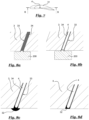
- FIGs 7 and 8a through 8d illustrate the assembly process for attaching one respective heat pipe 31 inside of the respective reception 33 within a stator vane 31.
- a top view onto the stator vane 31 is shown in Fig. 7 .
- the stator vane 31 is first provided with one or several bores extending through the vane 31 in the radial direction, optionally with an inclination with regard to the direction of the axis A of rotation of the engine 1 which may correspond to an angle of the leading edge 35 and/or trailing edge 36 of the vane 31.
- a tool 200 is arranged in the radially inward and and/or radially outward end of the reception 33.
- a thermal filler material such as a thermal grease 34
- the tool 200 is adapted to the shape of the reception 33 such that a first section, preferably the majority, of the opening of the reception 33 is covered by the tool, preferably a nose of thereof, wherein a second section, preferably a minor section and/or annular section, of the opening of the reception remains free to allow filler material 34 to be ejected.
- the tool 200 thus allows the entirety of the reception 33 to be easily filled with the thermal filler material 34, leaving no air bubbles within the reception 33. It may be preferred that first, as shown in Fig. 8a , the thermal grease 34 is inserted into the reception 33 and the heat pipe 4 afterwards, as indicated in Fig. 8b .
- the tool 200 serves as a radial abutment to ensure the correct positioning of the heat pipe 4 in the reception 33. Superfluous thermal filler material 34 may then be removed and the tool 200 may be cleansed.
- a preferably air-gap-free, contact interface between the pipe 4 and the inner circumference of the reception 33 is achieved through the thermal filler 34.
- thermal paste or another preferably solidified able, thermal conductor means is connected to the radially inner end of the heat pipe 4.
- the thermal conductor means 34 is configured to serve the interface between the pipe 4 and the electromagnetic motor 2.
- the thermal conductor means 34 is removed such that a plane inner surface of the stator housing 30 facing the electromotor to is obtained, preferably without any residue.
- a smooth and uniform inner diameter may be particularly suitable for a simple axial introduction of the electromotor 2 into the stator hub.
- the skilled person understands that other shapes or forms of the thermal conductor means 34 may be preferred, for example for realizing a contact interface of a protruding heat pipe 41, 43.
- Superfluous thermal conductor means 32 may then be removed, for example by sanding or read machining the inner diameter or other contact surface.
- a glue with high thermal conductivity may be used as of the thermal conductor means 32. Once the thermal conductor means 32 is hardened, the hardening ensures good mechanical strength.
- A, preferably solidifiable, thermal conductor means may be provided at both radial ends of the heat pipe 4. The thermal conductor means 4 may be used to rigidly connect the heat pipe 4 to the vane 31.
Landscapes
- Engineering & Computer Science (AREA)
- Mechanical Engineering (AREA)
- Aviation & Aerospace Engineering (AREA)
- General Engineering & Computer Science (AREA)
- Chemical & Material Sciences (AREA)
- Combustion & Propulsion (AREA)
- Physics & Mathematics (AREA)
- Fluid Mechanics (AREA)
- Structures Of Non-Positive Displacement Pumps (AREA)
Priority Applications (2)
| Application Number | Priority Date | Filing Date | Title |
|---|---|---|---|
| EP21198669.0A EP4155193A1 (fr) | 2021-09-23 | 2021-09-23 | Moteur de ventilateur à conduit, réseau de moteurs de ventilateur à conduit et aéronef |
| PCT/EP2022/075968 WO2023046632A1 (fr) | 2021-09-23 | 2022-09-19 | Moteur à soufflante carénée, réseau de moteurs à soufflante carénée et aéronef |
Applications Claiming Priority (1)
| Application Number | Priority Date | Filing Date | Title |
|---|---|---|---|
| EP21198669.0A EP4155193A1 (fr) | 2021-09-23 | 2021-09-23 | Moteur de ventilateur à conduit, réseau de moteurs de ventilateur à conduit et aéronef |
Publications (1)
| Publication Number | Publication Date |
|---|---|
| EP4155193A1 true EP4155193A1 (fr) | 2023-03-29 |
Family
ID=77913035
Family Applications (1)
| Application Number | Title | Priority Date | Filing Date |
|---|---|---|---|
| EP21198669.0A Pending EP4155193A1 (fr) | 2021-09-23 | 2021-09-23 | Moteur de ventilateur à conduit, réseau de moteurs de ventilateur à conduit et aéronef |
Country Status (2)
| Country | Link |
|---|---|
| EP (1) | EP4155193A1 (fr) |
| WO (1) | WO2023046632A1 (fr) |
Cited By (4)
| Publication number | Priority date | Publication date | Assignee | Title |
|---|---|---|---|---|
| EP4450394A1 (fr) * | 2023-04-19 | 2024-10-23 | Lilium eAircraft GmbH | Moteur électrique d'aéronef et procédé de fabrication d'une aube pour un moteur électrique d'aéronef |
| EP4467448A1 (fr) | 2023-05-26 | 2024-11-27 | Lilium GmbH | Moteur à hélice et aéronef |
| US12431763B1 (en) * | 2024-05-09 | 2025-09-30 | Whisper Aero Inc. | Conductive aerodynamic stator |
| EP4636227A1 (fr) * | 2024-04-19 | 2025-10-22 | RTX Corporation | Centrale électrique avec tuyau de chauffage |
Families Citing this family (2)
| Publication number | Priority date | Publication date | Assignee | Title |
|---|---|---|---|---|
| CN118894238B (zh) * | 2024-08-21 | 2025-10-17 | 西北工业大学 | 一种利用余热增强气动性能的新能源飞行器热控结构及方法 |
| CN119995267A (zh) * | 2025-02-13 | 2025-05-13 | 清华大学 | 一种热管导叶电机及涵道风扇 |
Citations (9)
| Publication number | Priority date | Publication date | Assignee | Title |
|---|---|---|---|---|
| US20160023754A1 (en) | 2014-07-08 | 2016-01-28 | Lilium GmbH | Vertical take-off aircraft |
| US20160311522A1 (en) | 2015-04-23 | 2016-10-27 | Lilium GmbH | Aerofoil for an aircraft, and an aircraft |
| US20170203839A1 (en) * | 2016-01-15 | 2017-07-20 | Aurora Flight Sciences Corporation | Hybrid Propulsion Vertical Take-Off and Landing Aircraft |
| US20180050810A1 (en) * | 2016-08-19 | 2018-02-22 | General Electric Company | Propulsion engine for an aircraft |
| US20190203735A1 (en) * | 2018-01-02 | 2019-07-04 | General Electric Company | Heat dissipation system for electric aircraft engine |
| US20200070988A1 (en) * | 2018-09-03 | 2020-03-05 | Rolls-Royce Plc | Aircraft propulsion system |
| US20200377222A1 (en) * | 2019-05-31 | 2020-12-03 | Airbus Operations (S.A.S.) | Closed circuit for cooling the engine of an aircraft propulsion plant |
| CN113054802A (zh) * | 2019-12-26 | 2021-06-29 | 通用电气公司 | 具有适形热管组件的电动马达 |
| CN113098177A (zh) * | 2021-04-07 | 2021-07-09 | 清华大学 | 用于内转子电机的定子散热结构、内转子电机及涵道风扇 |
-
2021
- 2021-09-23 EP EP21198669.0A patent/EP4155193A1/fr active Pending
-
2022
- 2022-09-19 WO PCT/EP2022/075968 patent/WO2023046632A1/fr not_active Ceased
Patent Citations (9)
| Publication number | Priority date | Publication date | Assignee | Title |
|---|---|---|---|---|
| US20160023754A1 (en) | 2014-07-08 | 2016-01-28 | Lilium GmbH | Vertical take-off aircraft |
| US20160311522A1 (en) | 2015-04-23 | 2016-10-27 | Lilium GmbH | Aerofoil for an aircraft, and an aircraft |
| US20170203839A1 (en) * | 2016-01-15 | 2017-07-20 | Aurora Flight Sciences Corporation | Hybrid Propulsion Vertical Take-Off and Landing Aircraft |
| US20180050810A1 (en) * | 2016-08-19 | 2018-02-22 | General Electric Company | Propulsion engine for an aircraft |
| US20190203735A1 (en) * | 2018-01-02 | 2019-07-04 | General Electric Company | Heat dissipation system for electric aircraft engine |
| US20200070988A1 (en) * | 2018-09-03 | 2020-03-05 | Rolls-Royce Plc | Aircraft propulsion system |
| US20200377222A1 (en) * | 2019-05-31 | 2020-12-03 | Airbus Operations (S.A.S.) | Closed circuit for cooling the engine of an aircraft propulsion plant |
| CN113054802A (zh) * | 2019-12-26 | 2021-06-29 | 通用电气公司 | 具有适形热管组件的电动马达 |
| CN113098177A (zh) * | 2021-04-07 | 2021-07-09 | 清华大学 | 用于内转子电机的定子散热结构、内转子电机及涵道风扇 |
Cited By (6)
| Publication number | Priority date | Publication date | Assignee | Title |
|---|---|---|---|---|
| EP4450394A1 (fr) * | 2023-04-19 | 2024-10-23 | Lilium eAircraft GmbH | Moteur électrique d'aéronef et procédé de fabrication d'une aube pour un moteur électrique d'aéronef |
| WO2024218335A1 (fr) * | 2023-04-19 | 2024-10-24 | Lilium GmbH | Moteur d'aéronef électrique et procédé de fabrication d'une aube pour un moteur d'aéronef électrique |
| EP4467448A1 (fr) | 2023-05-26 | 2024-11-27 | Lilium GmbH | Moteur à hélice et aéronef |
| EP4636227A1 (fr) * | 2024-04-19 | 2025-10-22 | RTX Corporation | Centrale électrique avec tuyau de chauffage |
| US12486800B2 (en) | 2024-04-19 | 2025-12-02 | Rtx Corporation | Powerplant with integrated heat pipe |
| US12431763B1 (en) * | 2024-05-09 | 2025-09-30 | Whisper Aero Inc. | Conductive aerodynamic stator |
Also Published As
| Publication number | Publication date |
|---|---|
| WO2023046632A1 (fr) | 2023-03-30 |
Similar Documents
| Publication | Publication Date | Title |
|---|---|---|
| EP4155193A1 (fr) | Moteur de ventilateur à conduit, réseau de moteurs de ventilateur à conduit et aéronef | |
| CN111232223B (zh) | 推进发动机热管理系统 | |
| CN109661346B (zh) | 用于飞行器的倾转旋翼推进系统 | |
| EP3626611B1 (fr) | Système de propulsion d'avion | |
| EP1851109B1 (fr) | Vehicule aerien en vol stationnaire a double conduit | |
| CN116714761B (zh) | 使用旋翼以模拟刚性机翼空气动力学的vtol飞行器 | |
| CN109641657B (zh) | 用于飞行器的倾转旋翼推进系统 | |
| CN109641647B (zh) | 用于飞行器的倾转旋翼推进系统 | |
| CN108725804B (zh) | 用于飞行器的推进系统 | |
| CN104968893B (zh) | 无涵道的推力产生系统体系结构 | |
| CN109661345B (zh) | 用于飞行器的倾转旋翼推进系统和具有此系统的飞行器 | |
| EP3323730B1 (fr) | Avion comportant un turbopropulseur à montage incliné | |
| EP3486170B1 (fr) | Systèmes de gestion d'air pour ensembles de moteur empilés | |
| US10392106B2 (en) | Tiltrotor propulsion system for an aircraft | |
| EP3984889B1 (fr) | Système de propulsion d'aéronef à hélice et ventilateur de refroidissement | |
| CN108974348A (zh) | 使用电分布式反扭矩发电机和反向电动马达推力来使主旋翼减速的旋翼制动效果 | |
| US20220267020A1 (en) | Aircraft having cooling system for distributing heat transfer liquid to different regions of aircraft | |
| US20200010210A1 (en) | Aircraft | |
| US10464667B2 (en) | Oblique rotor-wing aircraft | |
| US12486016B2 (en) | High efficiency air intake system and aircraft using same | |
| US12017787B2 (en) | Aircraft propeller blade radiator | |
| US8596569B2 (en) | Front electric rotor helicopter | |
| EP3219606B1 (fr) | Ventilateur à flux transversal avec des aubes directrices de sortie | |
| US12126229B2 (en) | Motor with a fully welded rotor for an electric aircraft and a method for manufacturing | |
| WO2022179789A1 (fr) | Moteur à soufflante carénée, réseau de moteurs à soufflante carénée, et aéronef |
Legal Events
| Date | Code | Title | Description |
|---|---|---|---|
| PUAI | Public reference made under article 153(3) epc to a published international application that has entered the european phase |
Free format text: ORIGINAL CODE: 0009012 |
|
| STAA | Information on the status of an ep patent application or granted ep patent |
Free format text: STATUS: THE APPLICATION HAS BEEN PUBLISHED |
|
| AK | Designated contracting states |
Kind code of ref document: A1 Designated state(s): AL AT BE BG CH CY CZ DE DK EE ES FI FR GB GR HR HU IE IS IT LI LT LU LV MC MK MT NL NO PL PT RO RS SE SI SK SM TR |
|
| STAA | Information on the status of an ep patent application or granted ep patent |
Free format text: STATUS: REQUEST FOR EXAMINATION WAS MADE |
|
| 17P | Request for examination filed |
Effective date: 20230929 |
|
| RBV | Designated contracting states (corrected) |
Designated state(s): AL AT BE BG CH CY CZ DE DK EE ES FI FR GB GR HR HU IE IS IT LI LT LU LV MC MK MT NL NO PL PT RO RS SE SI SK SM TR |
|
| STAA | Information on the status of an ep patent application or granted ep patent |
Free format text: STATUS: EXAMINATION IS IN PROGRESS |
|
| 17Q | First examination report despatched |
Effective date: 20240913 |
|
| 19U | Interruption of proceedings before grant |
Effective date: 20250313 |
|
| 19W | Proceedings resumed before grant after interruption of proceedings |
Effective date: 20260401 |