EP4155227A1 - Attache de câble, garniture de fixation et procédé de montage de l'attache de câble - Google Patents
Attache de câble, garniture de fixation et procédé de montage de l'attache de câble Download PDFInfo
- Publication number
- EP4155227A1 EP4155227A1 EP21306320.9A EP21306320A EP4155227A1 EP 4155227 A1 EP4155227 A1 EP 4155227A1 EP 21306320 A EP21306320 A EP 21306320A EP 4155227 A1 EP4155227 A1 EP 4155227A1
- Authority
- EP
- European Patent Office
- Prior art keywords
- cable tie
- cable
- tensioning
- strap
- component
- Prior art date
- Legal status (The legal status is an assumption and is not a legal conclusion. Google has not performed a legal analysis and makes no representation as to the accuracy of the status listed.)
- Granted
Links
Images


Classifications
-
- F—MECHANICAL ENGINEERING; LIGHTING; HEATING; WEAPONS; BLASTING
- F16—ENGINEERING ELEMENTS AND UNITS; GENERAL MEASURES FOR PRODUCING AND MAINTAINING EFFECTIVE FUNCTIONING OF MACHINES OR INSTALLATIONS; THERMAL INSULATION IN GENERAL
- F16L—PIPES; JOINTS OR FITTINGS FOR PIPES; SUPPORTS FOR PIPES, CABLES OR PROTECTIVE TUBING; MEANS FOR THERMAL INSULATION IN GENERAL
- F16L3/00—Supports for pipes, cables or protective tubing, e.g. hangers, holders, clamps, cleats, clips, brackets
- F16L3/02—Supports for pipes, cables or protective tubing, e.g. hangers, holders, clamps, cleats, clips, brackets partly surrounding the pipes, cables or protective tubing
- F16L3/04—Supports for pipes, cables or protective tubing, e.g. hangers, holders, clamps, cleats, clips, brackets partly surrounding the pipes, cables or protective tubing and pressing it against a wall or other support
-
- B—PERFORMING OPERATIONS; TRANSPORTING
- B65—CONVEYING; PACKING; STORING; HANDLING THIN OR FILAMENTARY MATERIAL
- B65D—CONTAINERS FOR STORAGE OR TRANSPORT OF ARTICLES OR MATERIALS, e.g. BAGS, BARRELS, BOTTLES, BOXES, CANS, CARTONS, CRATES, DRUMS, JARS, TANKS, HOPPERS, FORWARDING CONTAINERS; ACCESSORIES, CLOSURES, OR FITTINGS THEREFOR; PACKAGING ELEMENTS; PACKAGES
- B65D63/00—Flexible elongated elements, e.g. straps, for bundling or supporting articles
- B65D63/10—Non-metallic straps, tapes, or bands; Filamentary elements, e.g. strings, threads or wires; Joints between ends thereof
- B65D63/1018—Joints produced by application of integral securing members, e.g. buckles, wedges, tongue and slot, locking head and teeth or the like
- B65D63/1027—Joints produced by application of integral securing members, e.g. buckles, wedges, tongue and slot, locking head and teeth or the like the integral securing member being formed as a female and male locking member, e.g. locking head and locking teeth, or the like
- B65D63/1063—Joints produced by application of integral securing members, e.g. buckles, wedges, tongue and slot, locking head and teeth or the like the integral securing member being formed as a female and male locking member, e.g. locking head and locking teeth, or the like the female locking member being provided with at least one plastic barb
-
- H—ELECTRICITY
- H02—GENERATION; CONVERSION OR DISTRIBUTION OF ELECTRIC POWER
- H02G—INSTALLATION OF ELECTRIC CABLES OR LINES, OR OF COMBINED OPTICAL AND ELECTRIC CABLES OR LINES
- H02G3/00—Installations of electric cables or lines or protective tubing therefor in or on buildings, equivalent structures or vehicles
- H02G3/30—Installations of cables or lines on walls, floors or ceilings
- H02G3/32—Installations of cables or lines on walls, floors or ceilings using mounting clamps
-
- B—PERFORMING OPERATIONS; TRANSPORTING
- B65—CONVEYING; PACKING; STORING; HANDLING THIN OR FILAMENTARY MATERIAL
- B65D—CONTAINERS FOR STORAGE OR TRANSPORT OF ARTICLES OR MATERIALS, e.g. BAGS, BARRELS, BOTTLES, BOXES, CANS, CARTONS, CRATES, DRUMS, JARS, TANKS, HOPPERS, FORWARDING CONTAINERS; ACCESSORIES, CLOSURES, OR FITTINGS THEREFOR; PACKAGING ELEMENTS; PACKAGES
- B65D2563/00—Flexible elongated elements, e.g. straps for bundling or supporting atricles
- B65D2563/10—Non-metallic straps, tapes or bands; Filamentary elements, e.g. strings, threads, wires; Joints between ends thereof
- B65D2563/101—Details of non-metallic straps, tapes or bands
- B65D2563/103—Details of non-metallic straps, tapes or bands details of the male locking member, e.g. locking teeth on the strap
-
- F—MECHANICAL ENGINEERING; LIGHTING; HEATING; WEAPONS; BLASTING
- F16—ENGINEERING ELEMENTS AND UNITS; GENERAL MEASURES FOR PRODUCING AND MAINTAINING EFFECTIVE FUNCTIONING OF MACHINES OR INSTALLATIONS; THERMAL INSULATION IN GENERAL
- F16L—PIPES; JOINTS OR FITTINGS FOR PIPES; SUPPORTS FOR PIPES, CABLES OR PROTECTIVE TUBING; MEANS FOR THERMAL INSULATION IN GENERAL
- F16L3/00—Supports for pipes, cables or protective tubing, e.g. hangers, holders, clamps, cleats, clips, brackets
- F16L3/22—Supports for pipes, cables or protective tubing, e.g. hangers, holders, clamps, cleats, clips, brackets specially adapted for supporting a number of parallel pipes at intervals
- F16L3/23—Supports for pipes, cables or protective tubing, e.g. hangers, holders, clamps, cleats, clips, brackets specially adapted for supporting a number of parallel pipes at intervals for a bundle of pipes or a plurality of pipes placed side by side in contact with each other
- F16L3/233—Supports for pipes, cables or protective tubing, e.g. hangers, holders, clamps, cleats, clips, brackets specially adapted for supporting a number of parallel pipes at intervals for a bundle of pipes or a plurality of pipes placed side by side in contact with each other by means of a flexible band
- F16L3/2332—Supports for pipes, cables or protective tubing, e.g. hangers, holders, clamps, cleats, clips, brackets specially adapted for supporting a number of parallel pipes at intervals for a bundle of pipes or a plurality of pipes placed side by side in contact with each other by means of a flexible band having a single plastic locking barb
- F16L3/2334—Supports for pipes, cables or protective tubing, e.g. hangers, holders, clamps, cleats, clips, brackets specially adapted for supporting a number of parallel pipes at intervals for a bundle of pipes or a plurality of pipes placed side by side in contact with each other by means of a flexible band having a single plastic locking barb the barb having a plurality of serrations
Definitions
- the invention relates to a cable tie that is easy to mount and to a mounting kit with such a cable tie.
- the invention also relates to a method for producing the cable tie.
- Cable ties are used in the production of numerous products.
- a typical application is the bundling of individual lines into a cable harness and/or the attachment of lines and cables to another component in a product. This type of use has given the cable ties their name, but cable ties are also often used to attach hoses or the like.
- Cable ties owe their success in production to the simple but effective way they work: In most cases, they consist of a flexible plastic strip with a head or lock with an opening at the end. The strip is serrated and the head has a slanted locking tongue that engages with the serration. When the plastic strip is inserted, the inclined latching tongue is deflected transversely to its longitudinal extent and latches in succession into depressions in the toothing.
- the latching tongue is designed in such a way that this force is introduced into the head without the latching tongue becoming deformed. As a result, the strip is blocked from being pulled out of the head.
- the object of the present invention is to create a cable tie in order to overcome or at least improve one or more of the problems mentioned at the outset.
- the invention proposes, according to a first aspect, a cable tie with a strap and a tensioning device integrated in the strap, which divides the strap into a first and a second area, each of which has a toothed section.
- the first and the second area of the band are also referred to below as the first and second band.
- the cable tie according to the invention has the advantage that the cable tie itself does not have to be preassembled for looping.
- a cable duct or a component to which an object such as a cable harness is to be attached can remain in the mounting position because both ends of the cable tie can be inserted into cable locks from one side. No tools are required to install the cable tie.
- the free ends of the cable tie can be inserted into cable turnbuckles, which means that an object can be attached to a component without the cable tie having to be looped around the component and the object first.
- cable turnbuckles There are installation situations or production-related processes in which it is very difficult to form such a loop at all. Such difficult, because cramped installation situations are often encountered, for example, in motor vehicle construction.
- the cable tie is tensioned with the tensioning device and the object is fixed to the component with a predetermined force.
- the tensioning device is pivotable and includes a locking head and two tensioning hooks.
- the locking head fixes the clamping device once it has been clamped in the clamped position so that the clamping device can no longer come loose on its own.
- the tensioning device is connected to the two areas of the belt by means of film hinges.
- the cable tie is available as a uniform component, which offers advantages in terms of production technology, for example because only a single part has to be kept in stock. In addition, a single part is easier for a production worker to handle than multiple parts. Due to the hinge function of the film hinges, a defined direction of movement of the individual parts is also predetermined.
- the first area has a locking opening for accommodating the locking head and the second area has projecting tensioning pins that each fit into a receptacle of the two tensioning hooks.
- the first or second area of the band advantageously has an elastic section which can be stretched in a longitudinal direction of the band.
- the clamping force with which the object is held on the component is essentially defined by the elastic section, so that deviations in the insertion depth of the ends of the cable tie in the cable locks are compensated for by a greater or lesser degree of stretching of the elastic section.
- the more or less strong elongation of the elastic section has no or no significant effect on the tension force, so that a uniform quality of the manufacturing process is ensured.
- the latching head has two resilient tabs, one of which is provided with a latching hook.
- the two resilient tabs ensure that the latching hook is elastically deformable and can thus be inserted into a corresponding opening in the first band and latched there.
- the tensioning hooks can be provided with a latching projection on the side facing the tensioning pegs.
- the latching projections engage behind the second band and ensure that the tensioning device also latches onto the second band and is fixed in the tensioned position.
- the fixation of the clamping device in the clamped position is thereby more stable than if only the latching head were responsible for the fixation. Due to this form-fitting connection of the individual components, the function of the film hinges is no longer required, which is advantageous in the event of damage to the film hinges, for example due to aging or hardening.
- bevels are formed on the latching projections.
- the ramps ensure that the clamping hooks pushed apart just before they snap onto the second band to facilitate snapping.
- the cable tie is a simple injection molded part that requires only simple tools to manufacture.
- the invention proposes a fastening set for fastening objects to a component, which includes two cable tie locks and a cable tie according to the first aspect of the invention.
- the mounting kit provides all of the components needed to attach an object to a structural component, for example in a vehicle or other product. All the advantages that have been explained in connection with the cable ties according to the invention are realized with the fastening set.
- the ends of the cable tie are inserted until the cable tie rests against the object without play. In this way it is achieved that with the clamping device a sufficient clamping force for fastening the object on the component is achieved.
- FIG 1A shows a cable tie as is known from the prior art.
- the cable tie 100 has an elongate flat band 101 and a head 102 .
- a window 103 is formed in the head 102 providing passage through the head 102 .
- the elongate band 101 has a first end 104 and an opposite second end 106.
- the first end 104 is connected to the head 102.
- the band 101 is provided with teeth 107 on one main surface.
- the second end 106 of the strap 101 can be passed through the window 103 .
- the teeth 107 come into engagement with a free end 108 of a latching tongue 109 .
- the latching tongue 109 interacts with the teeth 107 in such a way that the second end 106 of the band 101 can be inserted into the head 102, but can no longer be pulled out, as was described at the outset.
- the cable tie 100 can be looped around a component and an object to be fastened thereto, or can unite a plurality of electrical lines and/or fluid lines (all not shown) into a bundle. This requires the cable tie 100 to be routed around the objects to be combined, which can cause difficulties in some installation situations.
- Figure 1B 12 illustrates a loop formed by cable tie 100 when second end 106 is inserted into head 102.
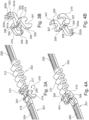
- the Figures 2A and 2B show a cable tie 200 according to the invention in a view from the side and in a plan view from above.
- the cable tie 200 comprises two cable ties 201, 202 which are connected to one another by means of a tensioning device 203.
- the cable ties are simply referred to as "tape".
- the first band 201 is connected to the clamping device 203 by means of a film hinge 204 and the second band 202 is connected to the clamping device 203 by means of a film hinge 206 .
- the first and second bands 201, 202 were also initially referred to as the first and second areas of a single cable band.
- the bands 201 , 202 each have teeth 208 on a main surface 207 .
- the ends 209 of the straps 201, 202 are tapered, thereby facilitating insertion into a cable strap lock 500 ( Figure 5A ).
- the second strap 202 also has a corrugated section 211 which is elastically stretchable in a longitudinal direction 212 of the cable tie 200 .
- the cable tie 200 is in the Figures 2A and 2B shown in an untensioned state.
- the clamping device 203 has a latching head 213 and two clamping hooks 214 .
- the latching head 213 interacts with a latching opening 216 in the first band 201 and the clamping hooks 214 interact with clamping pins 217 which are arranged on the second band 202 .
- the tensioning device 203 is pivoted counterclockwise, as indicated by arrow 218 in Figure 2A is indicated.
- the Figures 2C and 2D represent the cable tie 200 in a tensioned state with the clamping device 203 closed.
- the cable tie 200 is in comparison to that in FIGS Figures 2A and 2B shown in the relaxed state shortened by a length L.
- the shortening of the cable tie 200 by the length L is compensated for by a corresponding stretching of the elastic section 211.
- Figure 3A shows a perspective and enlarged view of a detail from FIG Figure 2A with open clamping device 203.
- Figure 3B shows the open clamping device 203 as a single component.
- the snap-in head 213 is made up of two resilient tabs 301a, 301b, the free ends 302a, 302b of which are chamfered so that the snap-in head 213 finds its way more easily into the opening 216 ( Figure 2C ).
- a latching projection 303 is formed on the resilient tab 301b which, when the clamping device 203 is tensioned, ie when the latching head 213 is seated in the opening 216 ( Figure 2C ), engages behind an underside of the first band 201, so that the latching head 213 can no longer be easily detached from the opening 216.
- the latching head 213 is arranged at one end of a web 304, which carries a traverse 306 at its other end, at the ends of which the two clamping hooks 214 are arranged.
- the clamping hooks 214 each have a receptacle 307 which is dimensioned in such a way that the clamping pins 217 fit into it.
- the tensioning device 203 is tensioned and the cable tie 200 is shown in a tensioned state, which is achieved by pivoting the tensioning device 203 counterclockwise.
- the locking head 213 sits in the opening 216 and the tensioning pins 217 are accommodated in the receptacles 307 of the tensioning hooks 214 .
- the projections 309 engage behind an underside of the cable tie 202, as a result of which the tensioning device 203 engages on the second cable tie 202.
- the projections 309 are each provided with a starting bevel 401, which ensures that the tensioning hooks 214 are pushed outwards by the narrow sides of the cable tie 202 and then snap back when the projections 309 grip the cable tie 202 have happened.
- the free ends 209 of the cable tie 200 are fixed to the component with cable tie locks, as described below with reference to FIG Figures 6A and 6B is explained.
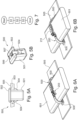
- the Figures 5A, 5B show a cable strap lock 500 in a side view and in a perspective view.
- the cable strap lock 500 has an insertion pin 501 with a rectangular cross section, which carries a support plate 502 at an upper end.
- the support plate 502 protrudes beyond the circumference of the insertion pin 501 on all sides, so that a support flange 503 is formed.
- Snap hooks 504 are formed on the insertion pins at a distance d from the support plate 502 .
- the distance d corresponds approximately to a wall thickness of a component 505 in which the cable strap lock 500 is to be mounted.
- a channel 506, in which a cable tie 200 can be inserted, leads through the insertion pin 501 and the support plate 502.
- a latching tongue 507 is arranged in the channel 506 and engages with the teeth 208 on the cable tie 200 in such a way that the cable tie can be inserted into the cable tie lock 500 but can no longer be pulled out.
- the cross-section of the spigot 501 is and/or has fewer or more than four corners. Furthermore, more or fewer than two latching hooks 504 are provided in other exemplary embodiments of the cable tie lock.
- the Figures 6A and 6B show a concrete installation situation, whereby in Figure 6A the cable tie 200 is not tightened while it is tightened in the course 6B illustration.
- the Figures 6A, 6B illustrate how a cable harness 601 is attached to the component 505 with a cable tie 200. In the component 505, two cable tie locks are mounted in the openings provided in the component 505.
- the cable strap lock can also be an integrated part of a cable duct, which saves an installation process for this lock.
- the method for attaching the wire harness 601 to the component 505 is in figure 7 illustrated as a flow chart.
- a first step S1 cable tie locks 500 are inserted into suitable openings in the component 505 and latched.
- a next step S2 the ends of the cable tie 200 are each inserted into one of the cable tie locks 500 until the cable tie 200 rests against the cable harness 601 without play.
- the tensioning device 203 is tensioned on the cable tie 200 by pivoting.
- the cable harness 601 is fastened to the component 505 with the cable tie 200 without it being necessary for this purpose to loop the cable tie around both the cable harness 601 and the component 505 .
- the elastic section 211 ensures that the cable harness is always attached to the component with a uniform tension, because the tensile force prevailing in the cable tie 200 as a function of the Elongation of the selected portion 211 is substantially constant. It is therefore not absolutely necessary for a uniform production quality that the workers always insert the cable tie 200 into the cable tie locks 500 with the same pretension.
- the cable ties are manufactured using an injection molding process.
- granular raw material is usually heated to a specified temperature and liquefied.
- the molten material is then pressed into an injection mold at high pressure.
Landscapes
- Engineering & Computer Science (AREA)
- Mechanical Engineering (AREA)
- General Engineering & Computer Science (AREA)
- Architecture (AREA)
- Civil Engineering (AREA)
- Structural Engineering (AREA)
- Clamps And Clips (AREA)
- Package Frames And Binding Bands (AREA)
- Supports For Pipes And Cables (AREA)
Priority Applications (3)
| Application Number | Priority Date | Filing Date | Title |
|---|---|---|---|
| EP21306320.9A EP4155227B1 (fr) | 2021-09-24 | 2021-09-24 | Attache de câble, garniture de fixation et procédé de montage de l'attache de câble |
| US17/946,970 US11958670B2 (en) | 2021-09-24 | 2022-09-16 | Cable tie, fitting set and method for producing the cable tie |
| CN202211151047.9A CN115848822A (zh) | 2021-09-24 | 2022-09-21 | 线缆扎带、装配套件和用于生产线缆扎带的方法 |
Applications Claiming Priority (1)
| Application Number | Priority Date | Filing Date | Title |
|---|---|---|---|
| EP21306320.9A EP4155227B1 (fr) | 2021-09-24 | 2021-09-24 | Attache de câble, garniture de fixation et procédé de montage de l'attache de câble |
Publications (2)
| Publication Number | Publication Date |
|---|---|
| EP4155227A1 true EP4155227A1 (fr) | 2023-03-29 |
| EP4155227B1 EP4155227B1 (fr) | 2025-07-23 |
Family
ID=78332737
Family Applications (1)
| Application Number | Title | Priority Date | Filing Date |
|---|---|---|---|
| EP21306320.9A Active EP4155227B1 (fr) | 2021-09-24 | 2021-09-24 | Attache de câble, garniture de fixation et procédé de montage de l'attache de câble |
Country Status (3)
| Country | Link |
|---|---|
| US (1) | US11958670B2 (fr) |
| EP (1) | EP4155227B1 (fr) |
| CN (1) | CN115848822A (fr) |
Families Citing this family (1)
| Publication number | Priority date | Publication date | Assignee | Title |
|---|---|---|---|---|
| CN117816597B (zh) * | 2023-12-25 | 2025-10-31 | 武汉科技大学 | 分布式光伏机器人及使用方法 |
Citations (3)
| Publication number | Priority date | Publication date | Assignee | Title |
|---|---|---|---|---|
| DE202004017224U1 (de) * | 2004-11-04 | 2005-03-03 | Michelbach, Ludwig | Vorrichtung zum Bündeln, Umschlingen und Haltern von Gegenständen, insbesondere Kabeln |
| US10337541B2 (en) * | 2016-11-23 | 2019-07-02 | Financiere de Beaumont-FBD | Device for securing an element on a pipe, assembly, installation and implementation method |
| US20200224797A1 (en) * | 2018-12-21 | 2020-07-16 | Financiere de Beaumont - FBD | Device for securing an element on a pipe, securing system, installation and implementation method |
Family Cites Families (10)
| Publication number | Priority date | Publication date | Assignee | Title |
|---|---|---|---|---|
| US3930287A (en) * | 1974-11-21 | 1976-01-06 | Grise Frederick Gerard J | Adjustable strap |
| DE2813484C2 (de) * | 1978-03-29 | 1982-12-30 | United-Carr Gmbh, 6000 Frankfurt | Kabelband |
| US5395343A (en) * | 1993-10-21 | 1995-03-07 | Iscovich; Angel | Anchoring device for medical tubing |
| US5970585A (en) * | 1998-08-11 | 1999-10-26 | Moldex-Metric, Inc. | Buckle for a respirator mask |
| US6138327A (en) * | 1999-08-31 | 2000-10-31 | Powell; Andrew P. | Flexible strap arrangement |
| FR2832192B1 (fr) * | 2001-11-13 | 2004-03-26 | Legrand Sa | Collier de serrage |
| JP2007091295A (ja) * | 2005-09-29 | 2007-04-12 | Tokyo Ootomakku Kk | 結束具及びその結束用固定具,結束バンド |
| BRPI0604028B1 (pt) * | 2006-09-04 | 2019-12-24 | Embraco Ind De Compressores E Solucoes Em Refrigeracao Ltda | abraçadeira para conexões tubulares em pequenos sistemas de refrigeração |
| US9802743B2 (en) * | 2014-04-29 | 2017-10-31 | Rl Hudson & Company | High strength blind installation hose and cable clamp retainer |
| US11781678B2 (en) * | 2020-10-14 | 2023-10-10 | Commscope Technologies Llc | Devices and methods for holding cables with non-uniform undulations |
-
2021
- 2021-09-24 EP EP21306320.9A patent/EP4155227B1/fr active Active
-
2022
- 2022-09-16 US US17/946,970 patent/US11958670B2/en active Active
- 2022-09-21 CN CN202211151047.9A patent/CN115848822A/zh active Pending
Patent Citations (3)
| Publication number | Priority date | Publication date | Assignee | Title |
|---|---|---|---|---|
| DE202004017224U1 (de) * | 2004-11-04 | 2005-03-03 | Michelbach, Ludwig | Vorrichtung zum Bündeln, Umschlingen und Haltern von Gegenständen, insbesondere Kabeln |
| US10337541B2 (en) * | 2016-11-23 | 2019-07-02 | Financiere de Beaumont-FBD | Device for securing an element on a pipe, assembly, installation and implementation method |
| US20200224797A1 (en) * | 2018-12-21 | 2020-07-16 | Financiere de Beaumont - FBD | Device for securing an element on a pipe, securing system, installation and implementation method |
Also Published As
| Publication number | Publication date |
|---|---|
| US11958670B2 (en) | 2024-04-16 |
| US20230099187A1 (en) | 2023-03-30 |
| EP4155227B1 (fr) | 2025-07-23 |
| CN115848822A (zh) | 2023-03-28 |
Similar Documents
| Publication | Publication Date | Title |
|---|---|---|
| EP1424520B1 (fr) | Dispositif de support pour un article oblong, en particulier harnais de câblage | |
| DE2953181C2 (fr) | ||
| EP1524463B1 (fr) | Dispositif pour le support d'objets allongés, notamment de câbles | |
| DE1934590A1 (de) | Einteiliger Kabelbinder | |
| DE1966107A1 (de) | Kabelbinder | |
| EP4151864B1 (fr) | Pince de bordure modulaire | |
| DE19500161A1 (de) | Einstellbare Klemmvorrichtung | |
| DE2813484A1 (de) | Kabelband | |
| DE69417852T2 (de) | Klemmschelle mit sägzahnförmiger Verschlussanordnung | |
| DE102012000202A1 (de) | Vorrichtung zur Verankerung eines Gurtschlosses | |
| DE102006011205A1 (de) | Kabelklemmelement für Kabelschutz-Führungsvorrichtung | |
| EP4155227B1 (fr) | Attache de câble, garniture de fixation et procédé de montage de l'attache de câble | |
| DE19901914A1 (de) | Haltevorrichtung für durch Wandungen dichtend hindurchgeführte Kabel | |
| DE2835842A1 (de) | Befestigungsvorrichtung | |
| EP4309958A1 (fr) | Clip de routeur, faisceau de câbles, moule et procédé | |
| DE2943954A1 (de) | Austausch-treibriemen | |
| DE3201135C2 (fr) | ||
| EP0922895B1 (fr) | Dispositif à relier un élément allongé | |
| DE102006061617A1 (de) | Befestigungsanordnung, insbesondere zum Halten eines Umlenkbeschlags für einen Gurtbandabschnitt eines Sicherheitsgurtes in einem Fahrzeug, sowie Verfahren zum Befestigen eines Umlenkbeschlags an einer Trägerwand | |
| DE102009040131B3 (de) | Befestigungslasche für ein Schutzzaunfeld | |
| DE102023108705B3 (de) | Halteband | |
| DE102006012648B3 (de) | Befestigungsdose mit Abdeckkappe | |
| DE102005026842B4 (de) | Befestigungseinrichtung für ein in eine Öffnung einsetzbares Bauteil | |
| DE19943275C2 (de) | Gewindeplattenhalterung | |
| DE3049608C2 (de) | Verbindungselement für zwei übereinanderliegende Bandenden |
Legal Events
| Date | Code | Title | Description |
|---|---|---|---|
| PUAI | Public reference made under article 153(3) epc to a published international application that has entered the european phase |
Free format text: ORIGINAL CODE: 0009012 |
|
| STAA | Information on the status of an ep patent application or granted ep patent |
Free format text: STATUS: THE APPLICATION HAS BEEN PUBLISHED |
|
| AK | Designated contracting states |
Kind code of ref document: A1 Designated state(s): AL AT BE BG CH CY CZ DE DK EE ES FI FR GB GR HR HU IE IS IT LI LT LU LV MC MK MT NL NO PL PT RO RS SE SI SK SM TR |
|
| STAA | Information on the status of an ep patent application or granted ep patent |
Free format text: STATUS: REQUEST FOR EXAMINATION WAS MADE |
|
| 17P | Request for examination filed |
Effective date: 20230929 |
|
| RBV | Designated contracting states (corrected) |
Designated state(s): AL AT BE BG CH CY CZ DE DK EE ES FI FR GB GR HR HU IE IS IT LI LT LU LV MC MK MT NL NO PL PT RO RS SE SI SK SM TR |
|
| STAA | Information on the status of an ep patent application or granted ep patent |
Free format text: STATUS: EXAMINATION IS IN PROGRESS |
|
| 17Q | First examination report despatched |
Effective date: 20240702 |
|
| GRAP | Despatch of communication of intention to grant a patent |
Free format text: ORIGINAL CODE: EPIDOSNIGR1 |
|
| STAA | Information on the status of an ep patent application or granted ep patent |
Free format text: STATUS: GRANT OF PATENT IS INTENDED |
|
| RIC1 | Information provided on ipc code assigned before grant |
Ipc: F16L 3/233 20060101ALN20250207BHEP Ipc: F16L 3/04 20060101ALI20250207BHEP Ipc: H02G 3/32 20060101ALI20250207BHEP Ipc: B65D 63/16 20060101AFI20250207BHEP |
|
| INTG | Intention to grant announced |
Effective date: 20250220 |
|
| GRAS | Grant fee paid |
Free format text: ORIGINAL CODE: EPIDOSNIGR3 |
|
| GRAA | (expected) grant |
Free format text: ORIGINAL CODE: 0009210 |
|
| STAA | Information on the status of an ep patent application or granted ep patent |
Free format text: STATUS: THE PATENT HAS BEEN GRANTED |
|
| AK | Designated contracting states |
Kind code of ref document: B1 Designated state(s): AL AT BE BG CH CY CZ DE DK EE ES FI FR GB GR HR HU IE IS IT LI LT LU LV MC MK MT NL NO PL PT RO RS SE SI SK SM TR |
|
| REG | Reference to a national code |
Ref country code: GB Ref legal event code: FG4D Free format text: NOT ENGLISH |
|
| REG | Reference to a national code |
Ref country code: CH Ref legal event code: EP |
|
| REG | Reference to a national code |
Ref country code: IE Ref legal event code: FG4D Free format text: LANGUAGE OF EP DOCUMENT: GERMAN |
|
| REG | Reference to a national code |
Ref country code: DE Ref legal event code: R096 Ref document number: 502021008069 Country of ref document: DE |
|
| PGFP | Annual fee paid to national office [announced via postgrant information from national office to epo] |
Ref country code: DE Payment date: 20250919 Year of fee payment: 5 |
|
| PGFP | Annual fee paid to national office [announced via postgrant information from national office to epo] |
Ref country code: AT Payment date: 20251020 Year of fee payment: 5 Ref country code: FR Payment date: 20250922 Year of fee payment: 5 |
|
| REG | Reference to a national code |
Ref country code: NL Ref legal event code: MP Effective date: 20250723 |
|
| PG25 | Lapsed in a contracting state [announced via postgrant information from national office to epo] |
Ref country code: PT Free format text: LAPSE BECAUSE OF FAILURE TO SUBMIT A TRANSLATION OF THE DESCRIPTION OR TO PAY THE FEE WITHIN THE PRESCRIBED TIME-LIMIT Effective date: 20251124 |
|
| PG25 | Lapsed in a contracting state [announced via postgrant information from national office to epo] |
Ref country code: NL Free format text: LAPSE BECAUSE OF FAILURE TO SUBMIT A TRANSLATION OF THE DESCRIPTION OR TO PAY THE FEE WITHIN THE PRESCRIBED TIME-LIMIT Effective date: 20250723 |
|
| PG25 | Lapsed in a contracting state [announced via postgrant information from national office to epo] |
Ref country code: IS Free format text: LAPSE BECAUSE OF FAILURE TO SUBMIT A TRANSLATION OF THE DESCRIPTION OR TO PAY THE FEE WITHIN THE PRESCRIBED TIME-LIMIT Effective date: 20251123 |
|
| PG25 | Lapsed in a contracting state [announced via postgrant information from national office to epo] |
Ref country code: NO Free format text: LAPSE BECAUSE OF FAILURE TO SUBMIT A TRANSLATION OF THE DESCRIPTION OR TO PAY THE FEE WITHIN THE PRESCRIBED TIME-LIMIT Effective date: 20251023 |
|
| REG | Reference to a national code |
Ref country code: LT Ref legal event code: MG9D |
|
| PG25 | Lapsed in a contracting state [announced via postgrant information from national office to epo] |
Ref country code: FI Free format text: LAPSE BECAUSE OF FAILURE TO SUBMIT A TRANSLATION OF THE DESCRIPTION OR TO PAY THE FEE WITHIN THE PRESCRIBED TIME-LIMIT Effective date: 20250723 |
|
| PGFP | Annual fee paid to national office [announced via postgrant information from national office to epo] |
Ref country code: IT Payment date: 20251030 Year of fee payment: 5 |
|
| PG25 | Lapsed in a contracting state [announced via postgrant information from national office to epo] |
Ref country code: HR Free format text: LAPSE BECAUSE OF FAILURE TO SUBMIT A TRANSLATION OF THE DESCRIPTION OR TO PAY THE FEE WITHIN THE PRESCRIBED TIME-LIMIT Effective date: 20250723 |
|
| PG25 | Lapsed in a contracting state [announced via postgrant information from national office to epo] |
Ref country code: GR Free format text: LAPSE BECAUSE OF FAILURE TO SUBMIT A TRANSLATION OF THE DESCRIPTION OR TO PAY THE FEE WITHIN THE PRESCRIBED TIME-LIMIT Effective date: 20251024 |
|
| PG25 | Lapsed in a contracting state [announced via postgrant information from national office to epo] |
Ref country code: SE Free format text: LAPSE BECAUSE OF FAILURE TO SUBMIT A TRANSLATION OF THE DESCRIPTION OR TO PAY THE FEE WITHIN THE PRESCRIBED TIME-LIMIT Effective date: 20250723 |
|
| PG25 | Lapsed in a contracting state [announced via postgrant information from national office to epo] |
Ref country code: LV Free format text: LAPSE BECAUSE OF FAILURE TO SUBMIT A TRANSLATION OF THE DESCRIPTION OR TO PAY THE FEE WITHIN THE PRESCRIBED TIME-LIMIT Effective date: 20250723 |
|
| PG25 | Lapsed in a contracting state [announced via postgrant information from national office to epo] |
Ref country code: PL Free format text: LAPSE BECAUSE OF FAILURE TO SUBMIT A TRANSLATION OF THE DESCRIPTION OR TO PAY THE FEE WITHIN THE PRESCRIBED TIME-LIMIT Effective date: 20250723 Ref country code: BG Free format text: LAPSE BECAUSE OF FAILURE TO SUBMIT A TRANSLATION OF THE DESCRIPTION OR TO PAY THE FEE WITHIN THE PRESCRIBED TIME-LIMIT Effective date: 20250723 |
|
| PG25 | Lapsed in a contracting state [announced via postgrant information from national office to epo] |
Ref country code: RS Free format text: LAPSE BECAUSE OF FAILURE TO SUBMIT A TRANSLATION OF THE DESCRIPTION OR TO PAY THE FEE WITHIN THE PRESCRIBED TIME-LIMIT Effective date: 20251023 |
|
| PG25 | Lapsed in a contracting state [announced via postgrant information from national office to epo] |
Ref country code: ES Free format text: LAPSE BECAUSE OF FAILURE TO SUBMIT A TRANSLATION OF THE DESCRIPTION OR TO PAY THE FEE WITHIN THE PRESCRIBED TIME-LIMIT Effective date: 20250723 |
|
| PG25 | Lapsed in a contracting state [announced via postgrant information from national office to epo] |
Ref country code: RO Free format text: LAPSE BECAUSE OF FAILURE TO SUBMIT A TRANSLATION OF THE DESCRIPTION OR TO PAY THE FEE WITHIN THE PRESCRIBED TIME-LIMIT Effective date: 20250723 |
|
| PG25 | Lapsed in a contracting state [announced via postgrant information from national office to epo] |
Ref country code: SM Free format text: LAPSE BECAUSE OF FAILURE TO SUBMIT A TRANSLATION OF THE DESCRIPTION OR TO PAY THE FEE WITHIN THE PRESCRIBED TIME-LIMIT Effective date: 20250723 |
|
| PG25 | Lapsed in a contracting state [announced via postgrant information from national office to epo] |
Ref country code: DK Free format text: LAPSE BECAUSE OF FAILURE TO SUBMIT A TRANSLATION OF THE DESCRIPTION OR TO PAY THE FEE WITHIN THE PRESCRIBED TIME-LIMIT Effective date: 20250723 |
|
| PG25 | Lapsed in a contracting state [announced via postgrant information from national office to epo] |
Ref country code: CZ Free format text: LAPSE BECAUSE OF FAILURE TO SUBMIT A TRANSLATION OF THE DESCRIPTION OR TO PAY THE FEE WITHIN THE PRESCRIBED TIME-LIMIT Effective date: 20250723 |
|
| REG | Reference to a national code |
Ref country code: CH Ref legal event code: H13 Free format text: ST27 STATUS EVENT CODE: U-0-0-H10-H13 (AS PROVIDED BY THE NATIONAL OFFICE) Effective date: 20260425 |
|
| PG25 | Lapsed in a contracting state [announced via postgrant information from national office to epo] |
Ref country code: EE Free format text: LAPSE BECAUSE OF FAILURE TO SUBMIT A TRANSLATION OF THE DESCRIPTION OR TO PAY THE FEE WITHIN THE PRESCRIBED TIME-LIMIT Effective date: 20250723 Ref country code: SK Free format text: LAPSE BECAUSE OF FAILURE TO SUBMIT A TRANSLATION OF THE DESCRIPTION OR TO PAY THE FEE WITHIN THE PRESCRIBED TIME-LIMIT Effective date: 20250723 |