EP4155279A1 - Procédé de production de matériau cimentaire supplémentaire - Google Patents
Procédé de production de matériau cimentaire supplémentaire Download PDFInfo
- Publication number
- EP4155279A1 EP4155279A1 EP21198298.8A EP21198298A EP4155279A1 EP 4155279 A1 EP4155279 A1 EP 4155279A1 EP 21198298 A EP21198298 A EP 21198298A EP 4155279 A1 EP4155279 A1 EP 4155279A1
- Authority
- EP
- European Patent Office
- Prior art keywords
- cement
- product
- calcium
- pozzolanic
- feedstock
- Prior art date
- Legal status (The legal status is an assumption and is not a legal conclusion. Google has not performed a legal analysis and makes no representation as to the accuracy of the status listed.)
- Withdrawn
Links
Images
Classifications
-
- C—CHEMISTRY; METALLURGY
- C04—CEMENTS; CONCRETE; ARTIFICIAL STONE; CERAMICS; REFRACTORIES
- C04B—LIME, MAGNESIA; SLAG; CEMENTS; COMPOSITIONS THEREOF, e.g. MORTARS, CONCRETE OR LIKE BUILDING MATERIALS; ARTIFICIAL STONE; CERAMICS; REFRACTORIES; TREATMENT OF NATURAL STONE
- C04B7/00—Hydraulic cements
- C04B7/12—Natural pozzuolanas; Natural pozzuolana cements; Artificial pozzuolanas or artificial pozzuolana cements other than those obtained from waste or combustion residues, e.g. burned clay; Treating inorganic materials to improve their pozzuolanic characteristics
- C04B7/13—Mixtures thereof with inorganic cementitious materials, e.g. Portland cements
-
- C—CHEMISTRY; METALLURGY
- C04—CEMENTS; CONCRETE; ARTIFICIAL STONE; CERAMICS; REFRACTORIES
- C04B—LIME, MAGNESIA; SLAG; CEMENTS; COMPOSITIONS THEREOF, e.g. MORTARS, CONCRETE OR LIKE BUILDING MATERIALS; ARTIFICIAL STONE; CERAMICS; REFRACTORIES; TREATMENT OF NATURAL STONE
- C04B20/00—Use of materials as fillers for mortars, concrete or artificial stone according to more than one of groups C04B14/00 - C04B18/00 and characterised by shape or grain distribution; Treatment of materials according to more than one of the groups C04B14/00 - C04B18/00 specially adapted to enhance their filling properties in mortars, concrete or artificial stone; Expanding or defibrillating materials
- C04B20/02—Treatment
- C04B20/023—Chemical treatment
- C04B20/0232—Chemical treatment with carbon dioxide
-
- C—CHEMISTRY; METALLURGY
- C04—CEMENTS; CONCRETE; ARTIFICIAL STONE; CERAMICS; REFRACTORIES
- C04B—LIME, MAGNESIA; SLAG; CEMENTS; COMPOSITIONS THEREOF, e.g. MORTARS, CONCRETE OR LIKE BUILDING MATERIALS; ARTIFICIAL STONE; CERAMICS; REFRACTORIES; TREATMENT OF NATURAL STONE
- C04B7/00—Hydraulic cements
- C04B7/36—Manufacture of hydraulic cements in general
- C04B7/38—Preparing or treating the raw materials individually or as batches, e.g. mixing with fuel
- C04B7/42—Active ingredients added before, or during, the burning process
- C04B7/421—Inorganic materials
- C04B7/427—Silicates
-
- C—CHEMISTRY; METALLURGY
- C04—CEMENTS; CONCRETE; ARTIFICIAL STONE; CERAMICS; REFRACTORIES
- C04B—LIME, MAGNESIA; SLAG; CEMENTS; COMPOSITIONS THEREOF, e.g. MORTARS, CONCRETE OR LIKE BUILDING MATERIALS; ARTIFICIAL STONE; CERAMICS; REFRACTORIES; TREATMENT OF NATURAL STONE
- C04B2103/00—Function or property of ingredients for mortars, concrete or artificial stone
- C04B2103/0068—Ingredients with a function or property not provided for elsewhere in C04B2103/00
- C04B2103/0088—Compounds chosen for their latent hydraulic characteristics, e.g. pozzuolanes
-
- Y—GENERAL TAGGING OF NEW TECHNOLOGICAL DEVELOPMENTS; GENERAL TAGGING OF CROSS-SECTIONAL TECHNOLOGIES SPANNING OVER SEVERAL SECTIONS OF THE IPC; TECHNICAL SUBJECTS COVERED BY FORMER USPC CROSS-REFERENCE ART COLLECTIONS [XRACs] AND DIGESTS
- Y02—TECHNOLOGIES OR APPLICATIONS FOR MITIGATION OR ADAPTATION AGAINST CLIMATE CHANGE
- Y02P—CLIMATE CHANGE MITIGATION TECHNOLOGIES IN THE PRODUCTION OR PROCESSING OF GOODS
- Y02P40/00—Technologies relating to the processing of minerals
- Y02P40/10—Production of cement, e.g. improving or optimising the production methods; Cement grinding
- Y02P40/18—Carbon capture and storage [CCS]
Definitions
- the present invention relates to a method for producing a pozzolanic product. Further, the invention relates to the pozzolanic product obtainable by the method according to the invention. The invention also relates to the use of the pozzolanic product as supplementary cementitious material. Moreover, the invention relates to a method for manufacturing a composite cement and a composite cement comprising the pozzolanic product and an hydraulic cement.
- EP 2 878 585 A1 describes a method for manufacturing a C-S-H seed by hydrothermal activation of industrial waste and by-products.
- the following materials are listed as potential sources of industrial wastes and by-products: fly ash, silica fume, ground granulated blast furnace slag, salt slag and acetylene lime slurry.
- the described method relates to a hydrothermal activation with an obligatory use of doping agents selected from B, P and S in order to generate the required calcium silicate hydrate. Neither the hydrothermal activation of the aggregates fraction nor the carbonation of the hydrothermally activated material is described.
- WO 2014/183846 A1 describes a method for enhancing the latent hydraulic and/or pozzolanic reactivity of materials comprising sources for CaO and SiO 2 and Al 2 O 3 by mixing this material with water and treating the mixture hydrothermally in an autoclave at 100 °C to 300 °C for 0.1 to 24 hour, preferably tempering the autoclaved product at 350 to 600 °C, wherein the heating rate ranges from 10 to 6000 °C/minute and the residence time ranges from 0.01 to 600 minutes, in order to obtain supplementary cementitious material with enhanced reactivity.
- A1 synthetic pozzolans are produced using local materials to provide a cementitious material that is uniform in chemistry and properties independent of the location where the materials are obtained.
- Two methods of production are described, a high temperature process in which materials are processed in a semi-molten or molten state and a low temperature aqueous process. The latter is accomplished by exploiting the dissolution mechanism of many common silicate minerals.
- EP21176008.7 describes a combination of hydrothermal treatment and carbonation for enhancing and accelerating of the carbonation of recycled waste concrete to increase its CO 2 uptake and activating also parts of the contained aggregates.
- the carbonated fines as supplementary cementitious material are advantageous in that they allow reuse of waste as valuable product and sequester carbon dioxide at the same time, there is still a need for providing reactive supplementary cementitious material and efficient ways to recycle waste and by-products. Accordingly, it is an object of the invention to provide reactive supplementary cementitious material and/or to extend the range of methods making waste and by-products useful while energy consumption should preferably be low.
- silicate and aluminosilicate materials can be transformed into reactive supplementary cementitious materials by the combination of hydrothermal treatment in the presence of calcium ions and subsequent carbonation.
- the obtained product comprising calcium carbonate and silica or alumina or silica-alumina gel shows a good reactivity, comparable to known supplementary cementitious materials, e.g. carbonated recycled concrete fines or calcined clay and limestone.
- a method for manufacturing a pozzolanic product comprising hydrothermal treatment of a feedstock comprising silicate, aluminate, and/or aluminosilicate materials and a source of calcium ions, wherein the feedstock has a molar ratio of Ca:(Si+Al) from 0.4 to 1.2 and a maximum content of hydrated cement paste of 10 wt.-%, providing a hydrate product and subsequent carbonation of the hydrate product providing the pozzolanic product comprising calcium carbonate and silica, alumina and/or silica-alumina gel.
- a pozzolanic product obtainable by the method and comprising the silica or alumina or silica-alumina gel, its use as supplementary cementitious material, as well as a method for manufacturing composite cements comprising hydrothermal treatment of a feedstock comprising silicate, aluminate, and/or aluminosilicate materials and a source of calcium ions, wherein the feedstock has a molar ratio of Ca:(Si+Al) from 0.4 to 1.2 and a maximum content of hydrated cement paste of 10 wt.-%, to provide a hydrate product, subsequent carbonation of the hydrate product to provide a pozzolanic product comprising calcium carbonate and silica, alumina and/or silica-alumina gel, and mixing the pozzolanic product with an hydraulic cement and the composite cement obtainable by the method.
- the amount of hydrated cement paste in the feedstock is ⁇ 10 wt.-%, preferably ⁇ 5 wt.-%, most preferred ⁇ 2 wt.-%, i.e. the feedstock, and especially the silicate, aluminate, and/or aluminosilicate material, is essentially cement paste free.
- Cement paste is only present as 'contamination', e.g. in a construction demolition waste used as component of the feedstock and especially as the silicate, aluminate, and/or aluminosilicate material.
- CKD, CaO, Ca(OH) 2 e.g. as carbide lime
- high calcium fly ashes and slags and other such materials are very suitable.
- silicate, aluminate and/or aluminosilicate materials low in calcium ions are hydrothermally treated in the presence of calcium ions followed by carbonation, large quantities of highly reactive silica, alumina or silica-alumina gel are formed while mineralizing CO 2 .
- Calcium ions are readily available in every cement plant from clinker and/or lime and/or various by-products and wastes.
- Silicates, aluminates and alumino-silicates are abundant as rocks and in many waste and by-products.
- the invention has a potential to produce highly reactive pozzolanic products useful as supplementary cementitious materials in every cement plant and other location with access to suitable sources of calcium ions like clinker, cement, and lime.
- Carbonation sequesters CO 2 for example the emissions from the cement or lime plant, but also from other exhaust gases.
- the invention is especially suitable for plants equipped with Leilac-like technology, since the lime source as well as a high purity CO 2 source are available there.
- Compounds are mostly named by the pure form, without explicit mentioning of solid solutions, foreign ion substitution and impurities etc. as are usual in technical and industrial materials. As is known to the man skilled in the art knows, the exact composition of the phases described may vary due to substitution with foreign ions. Such compounds are comprised herein when mentioning the pure form unless it is expressly stated otherwise.
- reactive shall mean a hydraulic reactivity unless specified otherwise. Hydraulic reactivity designates the reaction of a compound with water or other water containing compounds to form hydrated phases including a reaction of two or more compounds occurring simultaneously.
- cement is used to designate a material that, after mixing with water to form a paste, is able to develop mechanical strength by hydraulic reaction.
- cement denotes a ground clinker or analogous hydraulic phases obtained by other routes, like dicalcium silicate cement obtained by hydrothermal treatment.
- Binder or binder mixture means a material or mixture containing cement and developing mechanical strength by a hydraulic reaction with water, wherein the binder typically but not necessarily contains more components than the cement.
- geopolymer binder, super sulphated cement and composite cements are termed binder herein.
- a binder is used adding water or another liquid and mostly also aggregates as well as optionally admixtures and/or additives, to provide a paste that hardens resulting in a building element. Therefore, paste herein means a mixture of binder with water, especially but not limited to concrete and mortar.
- a supplementary cementitious material is herein defined as a pozzolanic and/or latent hydraulic material useful to replace a part of the cement in a binder or in a hydraulically hardening building material.
- Latent hydraulic materials have a composition that allows hydraulic reaction upon contact with water, wherein typically an activator is needed to enable hardening within technically feasible times.
- Activator means a substance that accelerates the hardening of latent hydraulic materials. It can be an additive like a sulfate or calcium (hydr)oxide and/or products of the hydraulic reaction of the ground clinker, e.g. calcium silicates that liberate calcium hydroxide during hydration.
- Pozzolanic materials are typically characterized by a content of reactive silica and/or alumina which form strength providing calcium silicate hydrates and calcium aluminate hydrates, respectively, during hydration of the clinker together with the calcium hydroxides liberated. These materials may contain reactive magnesium and iron and other reactive elements.
- fly ashes can be both, latent hydraulic and pozzolanic, depending on their calcium oxide content. Consequently, the term SCM designates both, latent hydraulic as well as pozzolanic materials.
- SCM designates both, latent hydraulic as well as pozzolanic materials.
- not reactive or only slightly reactive materials like limestone that substantially do not take part in the hydraulic reaction have to be clearly differentiated from SCM, with which they are sometimes summarized as mineral additions.
- Hydraulically hardening building material means a wet mixture that is able to harden hydraulically, and comprises a cement or binder as well as optionally any other additives and/or admixtures contained to adjust the properties like final strength, processability of the wet mixture and strength development properties, to the intended use of the building material.
- a concrete used to build a bridge needs other properties than a screed for casting a floor or a mortar for laying bricks.
- Building structure denotes the hardened building material.
- a reactive pozzolanic product is obtained by autoclaving and carbonation of a feedstock comprising a source of calcium ions and materials containing silicates, aluminates and/or aluminosilicates with less than 10 wt.-% hydrated cement paste in the feedstock.
- Suitable silicate, aluminate and/or aluminosilicate materials are natural minerals, such as but not limited to granite, rhyolite, quartz, feldspar, minerals containing them and mixtures of two or more thereof.
- Preferred silicate, aluminate and/or aluminosilicate materials are waste and by-products containing silicates, aluminates and/or aluminosilicates. Suitable are e.g., but not limited to, quarry dusts, calcined clays not achieving the required specification, ashes, and slags.
- an amount of Si, Al, or Si and Al of at least 50 wt.-%, preferably at least 60 wt.-%, most preferred at least 70 wt.-%, is desired with respect to the total amount of silicate, aluminate and/or aluminosilicate materials.
- the content of calcium is usually lower than 25 wt.-%, often lower than 20 wt.-%, and most often below 15 wt.-%.
- oxides i.e. as SiO 2 , Al 2 O 3 , Fe 2 O 3 , and CaO, respectively, and on a loss on ignition free basis. Loss on ignition is determined by heating at 950 °C.
- a part of the calcium ions can be provided as component of the silicate, aluminate and/or aluminosilicate materials, but a source of calcium ions is always added to provide the needed amount of calcium ions.
- Useful sources of calcium ions are e.g. cement clinker and lime.
- waste or by-products such as but not limited to cement kiln dust, process dust from clinker grinding, calcium rich fly ash or bottom ash, slags, calcium carbide residues, etc. are used.
- the amount of calcium ions should be at least 30 wt.-%, preferably at least 40 wt.-%, most preferred at least 50 wt.-%, with respect to the total amount of source of calcium ions. Further, 60 wt.-%, preferably at least 70 wt.-%, most preferred at least 80 wt.-%, of the calcium ions should be available for the hydrothermal reactions, i.e. not bound in carbonated phases or glass.
- a by-product or waste as source of calcium ions is typically characterized by a molar ratio Ca/(Si+Al) > 0.9, preferably > 1.2, most preferred > 1.5.
- chloride and sulfate concentration are preferably controlled to ⁇ 5 wt.-% and ⁇ 10 wt.-%, respectively, calculated as oxides.
- chloride and sulfate concentration are preferably controlled to ⁇ 5 wt.-% and ⁇ 10 wt.-%, respectively, calculated as oxides.
- CKD as calcium source
- lower process emissions are obtained, down to about -250 kg CO 2 /t SCM constituted by the product obtained by carbonation of the hydrate product compared to ⁇ 0 kg CO 2 /t SCM if dedicated CaO produced from limestone is used as the calcium source.
- a restriction of chloride and sulfate in the product for example to chloride ⁇ 2 wt.-%, preferably ⁇ 1 wt.-%, most preferred ⁇ 0.5 wt.-%, and/or sulfate ⁇ 10 wt.-%, preferably ⁇ 5 wt.-%, most preferred ⁇ 2 wt.-% in the final product, is usually beneficial.
- PSD particle size distribution
- smaller particles normally react faster so that a D 90 of 250 ⁇ m, preferably a D 90 of 180 ⁇ m, most preferred a D 90 of 150 ⁇ m is adjusted.
- materials have too coarse particles they can be ground with devices known per se.
- the D 10 is from 0.1 to 50 ⁇ m, preferably from 0.5 to 20 ⁇ m, and most preferred from 1 to 10 ⁇ m.
- PSD is measured with laser diffractometry.
- available silicate, aluminate and/or aluminosilicate materials and one or more source(s) of calcium ions are blended in suitable proportions.
- the molar ratio Al/Si is preferably adjusted to lower than 0.5, more preferred lower than 0.4 and most preferred lower than 0.3.
- silicate, aluminate and/or aluminosilicate material(s) is(are) co-ground with the source(s) of calcium ions to mix and homogenize the feedstock for the autoclave.
- the water:solids weight ratio in the autoclave preferably ranges from 0.2 to 10, more preferred from 0.3 to 5, most preferred from 0.4 to 3.
- the temperature in the autoclave usually ranges from 105 to 300 °C, preferably from 110 to 250 °C, most preferred from 120 to 200 °C.
- the overpressure developing in the closed autoclave at 120 °C or above is typically sufficient to transform the silicate, aluminate and/or aluminosilicate material(s) in the presence of calcium ions to the hydrate product.
- the hydrate product comprises calcium-silicate hydrates (C-S-H), calcium-aluminate hydrates (C-A-H) and/or calcium-silicate-aluminate hydrates (C-S-A-H). Stirring is beneficial to avoid segregation and solidification of the material, but not necessary for the reaction to occur.
- carbonation of the hydrate product can proceed at pressurized or pressure free conditions and produces a pozzolanic product composed of calcium carbonate and one, two, or all three of silica gel, alumina gel and silica-alumina gel.
- the hydrate product can be carbonated in the autoclave or, preferably, is transferred to another reactor for carbonation. Both wet and semidry carbonation are particularly suitable for the hydrate product. Thus, it is neither necessary nor desirable to dry the hydrate product. Of course, some water can be separated from the hydrate product before carbonation, e.g. by filtration and/or decantation. Separated water is preferably recycled into the hydrothermal treatment.
- any carbon dioxide can be used for carbonation.
- carbon dioxide containing exhaust gas optionally after concentration, is used.
- One especially preferred carbon dioxide source is exhaust gas from a lime kiln operated with Leilac technology (indirect calcination) to provide exhaust gas comprising almost only CO 2 .
- Indirect limestone calcination by microwave, calcinators and/or kilns operating in the oxyfuel mode etc. are also preferred sources for the CO 2 .
- the concentration of CO 2 during carbonation should range from 1 Vol.-% to 99 Vol.-%, preferably from 2 Vol.-% to 98 Vol.-%, most preferred from 3 Vol.-% to 97 Vol.-%.
- An absolute pressure from ambient to 25 bars is suitable. If over pressure is applied, from 1.1 to 10 bars are preferred.
- the temperature during carbonation can range from ambient, e.g. 15 °C to 30 °C, up to 50 °C, or 80 °C, or 99 °C.
- carbonation takes place at ambient temperature.
- Carbonation can also serve to cool an exhaust gas used to provide the carbon dioxide. In that case, usually higher temperatures result in the carbonation device.
- additional material(s) enhancing carbonation and/or improving the properties of the carbonates can be added for carbonation or already to the feedstock/during hydrothermal treatment.
- additional material will be included in an amount from 0.001 to 1 wt.-% with respect to the total feedstock.
- substances that improve the properties of the cement or hydraulic building material made with the pozzolanic product obtained according to the invention are added to the cement or building material, but some can also accelerate the carbonation. In the latter case their addition to the carbonation (or even hydrothermal treatment) step is advantageous.
- substances for enhancing the carbonating process or mixtures of two or more thereof are used as additional material.
- Suitable materials include substances that improve dissolution of CO 2 in the solution like alkanolamines, for example primary amines like monoethanolamine (MEA) and diglycolamine (DGA), secondary amines like diethanolamine (DEA) and diisopropanolamine (DIPA), and tertiary amines like methyldiethanolamine (MDEA) and triethanolamine (TEA), or mixtures thereof; halogenides; ethylenediaminetetraacetic acid (EDTA) or others.
- enzymes such as carbonic anhydrase can be used to enhance carbonation efficiency and modify the properties of the reaction products.
- amino acids e.g. aspartic acid, serine, arginine
- ammonium salts e.g.
- ammonium chloride, ammonium sulfate and ammonium nitrate are useful, especially to provide the calcium carbonate component of the pozzolanic product in a metastable form.
- Such forms show e.g. a reactivity as calcium carbonate cement not found in calcite.
- these additions may have not only one action but can exercise a double role. They can e.g. modify the hydration process of the final binder as well as modify the carbonation process. The effect can largely depend on the dosage.
- admixtures are water reducing agents and plasticizers like for example, but not exclusively, organic compounds with one or more from carboxylate, sulfonate, phosphonate, phosphate or alcohol functional groups. These serve to achieve a good consistency, i.e. flowability, of the paste with a smaller amount of water. Since a decrease of water/binder ratio normally provides an increase of strength, such admixtures are commonly used.
- Air entraining agents are also able to improve flowability and can be used for this aim or for other reasons such as, but not limited to, density modifications, compactibility improvements etc.
- Useful air entraining agents are e.g. surface active substances, especially ones based on soaps from natural resins or synthetic nonionic and ionic tensides.
- retarders Other admixtures that influence workability are retarders. They mainly aim at prolonging the time that a specified consistency is maintained. Retarders slow the setting and/or hardening of the binder paste. Suitable substances are for example, but not exclusively, phosphates, borates, salts of Pb, Zn, Cu, As, Sb, lignosulphonates, hydroxycarboxylic acids and their salts, phosphonates, sugars (saccharides).
- rheology modifiers like e.g. polycarboxylates, lignosulfonates, starch, Karoo gum, bentonite clay, polyvinyl alcohol, and mixtures thereof.
- Additives can be added as well to the feedstock or hydrate product, but usually those are added to the composite cement or the hydraulic building material.
- Usual and useful additives are e.g. fillers (especially limestone and other stone dust), pigments, reinforcing elements, self-healing agents etc. All these can be added in the amounts known per se.
- the hydrothermal treatment and carbonation step are carried out as continuous operation.
- the feedstock comprising silicate, aluminate, and/or silicate-aluminate materials and the source of calcium ions, is mixed with water to form a slurry as specified above.
- the slurry is fed into a tube at its top and moves down along the tube so that the hydrostatic pressure increases to a desired level controlled by tube length and slurry density.
- the slurry is heated to a desired temperature below the boiling point, which is controlled by the pressure.
- the heated slurry leaves the first tube and rises in a second tube.
- the second tube is arranged around the first tube so that effective heat transfer between rising and sinking slurries is achieved.
- CO 2 -containig gas and/or liquid is/are added and mixed with the slurry so that sufficient CO 2 for the carbonation step is provided.
- the slurry is collected, the solids are separated and dried to provide the pozzolanic product.
- the liquid is usually recycled into fresh slurry and/or re-saturated with CO 2 as CO 2 -containig liquid.
- CO 2 can originate e.g. from gas from kiln in a wet scrubber. All other parameters are the same as described above.
- the pozzolanic product obtained by carbonation comprises calcium carbonate as well as silica, alumina, and/or silica-alumina gel.
- it is a highly reactive SCM and especially useful for manufacturing composite cements. Since the carbonation is able to process all emissions from the limestone calcination of cement clinker production the method according to the invention can result in a CO 2 -neutral SCM.
- the pozzolanic product is usually dried for storage and use. It can be ground to adjust its PSD. Suitable particle sizes are D 90 below 200 ⁇ m, preferably D 90 below 150 ⁇ m, most preferred D 90 below 100 ⁇ m.
- the pozzolanic product can also be subjected to a thermal treatment at a temperature ranging from 120 to 350 °C, preferably from 150 to 300 °C, most preferred from 180 to 250 °C, until constant mass to enhance its reactivity even more.
- the pozzolanic product can be used in the form of a slurry, i.e. without drying as described in EP 3 808 713 A1 , the contents of which are incorporated herein in their entirety.
- the pozzolanic product is blended with an hydraulic cement, especially with Portland cement clinker, to manufacture a composite cement.
- the content of the SCM in the composite cement can vary depending on the application and technical requirements.
- Useful SCM amounts are e.g. from 1 to 5 wt.-% of the composite cement, up to 10 wt.-% or 20 wt.-%, or 30 wt.-%, or 40 wt.-%, or 50 wt.-%, or 60 wt.-%, or 70 wt.-%, or 80 wt.-%, or 90 wt.-%, but not limited to.
- Suitable hydraulic cements are e.g. Portland cement and cements based on Portland clinker, alite based cements, belitic cements, cements based on calcium aluminate clinker, cements based on calcium sulfoaluminate clinker, cements based on calcium sulfoaluminate-belite clinker, cements based on calcium ferrite clinker, and mixtures of them, but not limited to.
- the pozzolanic product can also be added as SCM to the hydraulic building material, especially during concrete mixing.
- the composite cement and/or hydraulic building materials made from it can further comprise admixtures and/or additives as is known per se. Suitable substances are as described above as additional material for adding to the carbonation step and/or feedstock.
- the composite cement can also comprise one or more other SCM, i.e. the composite cement can be a ternary, quaternary, or even more components blend.
- Suitable other SCM are e.g. but not limited to fly ash, ground granulated blast furnace slag, natural and synthetic pozzolan and calcined clay.
- the pozzolanic product can be used to make alkali activated binders like Roman cement, hybrid cements, and geopolymer binders.
- Composite cements and alkali activated binders comprising the pozzolanic product are suitable for all uses where Portland (composite) cements or alkali activated binders from known silica(-alumina) gels have been used so far.
- Typical examples of applications are precast and ready mix concrete, concrete products, structural concrete according to EN 206, dry mix mortars, glues and special products based on hydraulic cements, geotechnical applications such as grouts and soil stabilization etc.
- the useful w/b ratios are from 0.1 to 2, preferred 0.25 to 1, and most preferred from 0.3 to 0.7.
- any amount in % or parts is by weight and in the case of doubt referring to the total weight of the composition/mixture concerned.
- a characterization as “approximately”, “around” and similar expression in relation to a numerical value means that up to 10 % higher and lower values are included, preferably up to 5 % higher and lower values, and in any case at least up to 1 % higher and lower values, the exact value being the most preferred value or limit.
- substantially free means that a particular material is not purposefully added to a composition, and is only present in trace amounts or as an impurity. As used herein, unless indicated otherwise, the term “free from” means that a composition does not comprise a particular material, i.e. the composition comprises 0 weight percent of such material.
- a cement plant equipped with Leilac technology is producing lime (100 % CaO is assumed, see also table 1 below) as an intermediate product and clinker (65 % CaO, 21 % SiO 2 , 7 % Al 2 O 3 , rest others). Such clinker has process emissions of 510 kg CO 2 /t clinker considering all CaO provided by CaCO 3 .
- high quality calcined clay composed of 75 % metakaolin and 25 % quartz
- limestone pure CaCO 3
- They are used to produce a comparison composite cement CC3 with 30 % calcined clay and 20 % limestone with process emissions of 255 kg CO 2 /t cement.
- Such cement also contains about 23 wt.-% of pozzolanic aluminosilicates (metakaolin).
- the lime produced is blended with quartz (1 t of lime + 3.76 t quartz) and autoclaved. Hydrothermal C-S-H with C/S of about 0.8 is produced.
- the C-S-H is carbonated, binding 1.21 t of CO 2 and producing about 9 t of pozzolanic product 1 composed of about 42 wt.-% silica gel (dry basis) and 58 wt.-% CaCO 3 .
- This SCM is used to produce a composite cement CC1 according to the invention.
- CC1 is composed of 50 wt.-% clinker and 50 wt.-% of the pozzolanic product 1 as SCM.
- the process emissions of such cement are 255 kg CO 2 /t cement, calcium carbonate content is 29 wt.-% and the content of reactive pozzolanic silicates is 21 wt.-%.
- clinker is used as calcium source for manufacturing the pozzolanic product.
- 1 t of clinker is blended with 0.64 t of ground quartz, autoclaved and carbonated (0.4 t CO 2 is mineralized).
- the obtained pozzolanic product 2 is used to produce a second composite cement CC2 according to the invention.
- CC2 contains 50 wt.-% clinker and 50 wt.-% the pozzolanic product 2 as SCM. Process emissions of such cement are 255 kg CO 2 / t cement, calcium carbonate content 27 wt.-% and the content of reactive pozzolanic silicates is also 21 wt.-%.
- Table 1 summarizes the composition of the materials in the example.
- Table 2 the compositions of the cements and the carbon dioxide emission associated with their production are listed and compared with a conventional Portland-Limestone cement CEM I.
- Table 1 Material Limestone Lime Clinker Calcined clay pozzolanic product 1 pozzolanic product 2 CaO 56 % 100 % 65 % - 32 % 30 % SiO 2 - 21 % 66 % 42 % 40 % Al 2 O 3 - 7 % 34 % 3 % CO 2 44 % - 65 % - 25 % 24 % Others - 7% - - 3 % Process emissions (t CO 2 /t material) 0 0.785 0.51 0 0 0 0 Pozzolanic SiO 2 +Al 2 O 3 - - - 75 % 42 % 43 % Table 2 Cement CC1 CC2 CC3 CEM I clinker 50 % 50 % 50 % 95 % Limestone -
- composite cements CC1 and CC2 according to the invention contain significantly less clinker than CEM I, saving substantial amounts of carbon dioxide for clinker production. Nonetheless, their strength development is comparable to that of the composite cement CC3 containing a known reactive calcined SCM, namely clay, and limestone.
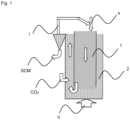
- Figure 1 illustrates an exemplary device for carrying out the method according to the invention as continuous process.
- the hydrothermal treatment takes place in the first tube 1 and the carbonation in the second tube 2, arranged around the first tube 1.
- a feedstock from alumino-silicate material unsuitable as pozzolan and calcium rich fly ash is mixed with water and the formed slurry s with a solids content of e.g. 20 Vol.-% is introduced into the first tube 1 at its top.
- the slurry s has ambient temperature, e.g. 20 °C, or a bit higher, e.g. 40 °C from using the recycled liquid phase as water, and is under ambient pressure, 1 bar, when entering the first tube 1.
- the slurry sinks inside the first tube 1, e.g. with a volume flow of 0.009 m 3 /second.
- a pressure of more than 4 bar is reached at the bottom of first tube 1.
- the slurry s is heated, e.g. with a burner or microwave device or electric resistance heating, to a temperature of e.g. 150 °C.
- the heated slurry passes into the second tube 2 in which it rises to the top, due to the slurry being continuously fed at the top of the first tube 1 and assisted by the heating.
- Carbon dioxide CO 2 is added into the second tube 2. Suitable are e.g.
- gaseous carbon dioxide like exhaust gas or concentrated exhaust gas, as well as aqueous solutions of carbon dioxide.
- the hydrate product in the slurry s is carbonated.
- the slurry is withdrawn and separated into pozzolanic product SCM and a liquid phase I.
- the liquid phase I is recycled into the device e.g. as mixing water to provide the slurry s.
- all or a part of it can be used to provide a solution to scrub carbon dioxide from an exhaust gas in e.g. a spray scrubber and form a carbon dioxide rich solution to be added into the second tube 2.
- a residence time of slurry s in the device i.e. from entering at the top of first tube 1 to withdrawal at the top of second tube 2, of 60 - 120 minutes is usually sufficient to accomplish the hydrothermal treatment and the carbonation.
Landscapes
- Chemical & Material Sciences (AREA)
- Engineering & Computer Science (AREA)
- Ceramic Engineering (AREA)
- Materials Engineering (AREA)
- Structural Engineering (AREA)
- Organic Chemistry (AREA)
- Inorganic Chemistry (AREA)
- Chemical Kinetics & Catalysis (AREA)
- General Chemical & Material Sciences (AREA)
- Combustion & Propulsion (AREA)
- Curing Cements, Concrete, And Artificial Stone (AREA)
Priority Applications (8)
| Application Number | Priority Date | Filing Date | Title |
|---|---|---|---|
| EP21198298.8A EP4155279A1 (fr) | 2021-09-22 | 2021-09-22 | Procédé de production de matériau cimentaire supplémentaire |
| PL22776948.6T PL4396149T3 (pl) | 2021-09-22 | 2022-09-08 | Sposób wytwarzania uzupełniającego materiału cementowego |
| EP22776948.6A EP4396149B1 (fr) | 2021-09-22 | 2022-09-08 | Procédé de fabrication d'un materiau cimentaire supplementaire |
| AU2022352978A AU2022352978A1 (en) | 2021-09-22 | 2022-09-08 | Method for manufacturing supplementary cementitious material |
| CA3227936A CA3227936A1 (fr) | 2021-09-22 | 2022-09-08 | Procede de fabrication d'un materiau cimentaire de remplacement |
| PCT/EP2022/075010 WO2023046499A1 (fr) | 2021-09-22 | 2022-09-08 | Procédé de fabrication d'un matériau cimentaire de remplacement |
| US18/692,426 US20240375998A1 (en) | 2021-09-22 | 2022-09-08 | Method for manufacturing supplementary cementitious material |
| ES22776948T ES3058857T3 (en) | 2021-09-22 | 2022-09-08 | Method for manufacturing supplementary cementitious material |
Applications Claiming Priority (1)
| Application Number | Priority Date | Filing Date | Title |
|---|---|---|---|
| EP21198298.8A EP4155279A1 (fr) | 2021-09-22 | 2021-09-22 | Procédé de production de matériau cimentaire supplémentaire |
Publications (1)
| Publication Number | Publication Date |
|---|---|
| EP4155279A1 true EP4155279A1 (fr) | 2023-03-29 |
Family
ID=77910580
Family Applications (2)
| Application Number | Title | Priority Date | Filing Date |
|---|---|---|---|
| EP21198298.8A Withdrawn EP4155279A1 (fr) | 2021-09-22 | 2021-09-22 | Procédé de production de matériau cimentaire supplémentaire |
| EP22776948.6A Active EP4396149B1 (fr) | 2021-09-22 | 2022-09-08 | Procédé de fabrication d'un materiau cimentaire supplementaire |
Family Applications After (1)
| Application Number | Title | Priority Date | Filing Date |
|---|---|---|---|
| EP22776948.6A Active EP4396149B1 (fr) | 2021-09-22 | 2022-09-08 | Procédé de fabrication d'un materiau cimentaire supplementaire |
Country Status (7)
| Country | Link |
|---|---|
| US (1) | US20240375998A1 (fr) |
| EP (2) | EP4155279A1 (fr) |
| AU (1) | AU2022352978A1 (fr) |
| CA (1) | CA3227936A1 (fr) |
| ES (1) | ES3058857T3 (fr) |
| PL (1) | PL4396149T3 (fr) |
| WO (1) | WO2023046499A1 (fr) |
Cited By (1)
| Publication number | Priority date | Publication date | Assignee | Title |
|---|---|---|---|---|
| WO2025108539A1 (fr) | 2023-11-22 | 2025-05-30 | Cemex Innovation Holding Ag | Procédé de carbonatation de clinker et de fabrication d'un liant |
Families Citing this family (3)
| Publication number | Priority date | Publication date | Assignee | Title |
|---|---|---|---|---|
| CN117843260B (zh) * | 2023-12-05 | 2024-08-27 | 上海悠远建筑工程有限公司 | 高性能矿物基胶凝材料及在制备缓凝固化护壁泥浆中的应用 |
| CN118430711B (zh) * | 2024-04-26 | 2024-11-22 | 东南大学 | 一种硅铝酸盐胶凝体系的判定及其原材料快速筛选方法 |
| CN118908607B (zh) * | 2024-10-08 | 2025-01-24 | 中建材(合肥)粉体科技装备有限公司 | 一种复合钢渣激发剂改性钢渣材料及其制备方法 |
Citations (10)
| Publication number | Priority date | Publication date | Assignee | Title |
|---|---|---|---|---|
| JP2012126617A (ja) * | 2010-12-16 | 2012-07-05 | Nippon Steel Corp | 製鋼スラグの処理方法 |
| WO2014183846A1 (fr) | 2013-05-11 | 2014-11-20 | Heidelbergcement Ag | Procédé permettant d'améliorer la réactivité hydraulique et/ou pouzzolanique latente des matériaux |
| EP2878585A1 (fr) | 2013-11-27 | 2015-06-03 | Fundacíon Tecnalia Research & Innovation | Procédé pour la fabrication de germes C-S-H cimentaires |
| EP3498681A1 (fr) * | 2017-12-13 | 2019-06-19 | HeidelbergCement AG | Utilisation de fines de béton recyclées carbonées en tant que matériau cimentaire supplémentaire |
| US20200247717A1 (en) | 2016-05-05 | 2020-08-06 | Solidia Technologies, Inc. | Synthetic pozzolans |
| EP3724147A1 (fr) | 2017-12-13 | 2020-10-21 | HeidelbergCement AG | Procédé pour réaliser de manière simultanée le nettoyage de gaz d'échappement et la fabrication de matériau cimentaire supplémentaire |
| EP3744700A1 (fr) | 2019-05-28 | 2020-12-02 | HeidelbergCement AG | Procédé et dispositif améliorés de carbonatation de déchets de béton et/ou de séquestration de co2 |
| WO2020239681A1 (fr) | 2019-05-28 | 2020-12-03 | Paroc Group Oy | Produit d'isolation en laine minérale pour rénovation de façades |
| EP3778525A1 (fr) | 2020-06-17 | 2021-02-17 | HeidelbergCement AG | Procédé amélioré de fabrication d'un matériau cimentaire supplémentaire |
| EP3808713A1 (fr) | 2019-10-18 | 2021-04-21 | HeidelbergCement AG | Procédé intégré de fabrication de matériau de construction à durcissement hydraulique |
-
2021
- 2021-09-22 EP EP21198298.8A patent/EP4155279A1/fr not_active Withdrawn
-
2022
- 2022-09-08 CA CA3227936A patent/CA3227936A1/fr active Pending
- 2022-09-08 ES ES22776948T patent/ES3058857T3/es active Active
- 2022-09-08 US US18/692,426 patent/US20240375998A1/en active Pending
- 2022-09-08 WO PCT/EP2022/075010 patent/WO2023046499A1/fr not_active Ceased
- 2022-09-08 EP EP22776948.6A patent/EP4396149B1/fr active Active
- 2022-09-08 PL PL22776948.6T patent/PL4396149T3/pl unknown
- 2022-09-08 AU AU2022352978A patent/AU2022352978A1/en active Pending
Patent Citations (10)
| Publication number | Priority date | Publication date | Assignee | Title |
|---|---|---|---|---|
| JP2012126617A (ja) * | 2010-12-16 | 2012-07-05 | Nippon Steel Corp | 製鋼スラグの処理方法 |
| WO2014183846A1 (fr) | 2013-05-11 | 2014-11-20 | Heidelbergcement Ag | Procédé permettant d'améliorer la réactivité hydraulique et/ou pouzzolanique latente des matériaux |
| EP2878585A1 (fr) | 2013-11-27 | 2015-06-03 | Fundacíon Tecnalia Research & Innovation | Procédé pour la fabrication de germes C-S-H cimentaires |
| US20200247717A1 (en) | 2016-05-05 | 2020-08-06 | Solidia Technologies, Inc. | Synthetic pozzolans |
| EP3498681A1 (fr) * | 2017-12-13 | 2019-06-19 | HeidelbergCement AG | Utilisation de fines de béton recyclées carbonées en tant que matériau cimentaire supplémentaire |
| EP3724147A1 (fr) | 2017-12-13 | 2020-10-21 | HeidelbergCement AG | Procédé pour réaliser de manière simultanée le nettoyage de gaz d'échappement et la fabrication de matériau cimentaire supplémentaire |
| EP3744700A1 (fr) | 2019-05-28 | 2020-12-02 | HeidelbergCement AG | Procédé et dispositif améliorés de carbonatation de déchets de béton et/ou de séquestration de co2 |
| WO2020239681A1 (fr) | 2019-05-28 | 2020-12-03 | Paroc Group Oy | Produit d'isolation en laine minérale pour rénovation de façades |
| EP3808713A1 (fr) | 2019-10-18 | 2021-04-21 | HeidelbergCement AG | Procédé intégré de fabrication de matériau de construction à durcissement hydraulique |
| EP3778525A1 (fr) | 2020-06-17 | 2021-02-17 | HeidelbergCement AG | Procédé amélioré de fabrication d'un matériau cimentaire supplémentaire |
Non-Patent Citations (2)
| Title |
|---|
| SEVELSTED TINE F ET AL: "Carbonation of C-S-H and C-A-S-H samples studied by13C,27Al and29Si", CEMENT AND CONCRETE RESEARCH, PERGAMON PRESS, ELMSFORD, NY, US, vol. 71, 6 February 2015 (2015-02-06), pages 56 - 65, XP029146039, ISSN: 0008-8846, DOI: 10.1016/J.CEMCONRES.2015.01.019 * |
| SKOCEK ET AL.: "Carbon Capture and Utilization by mineralization of cement pastes derived from recycled concrete", SCI REP, vol. 10, 2020, pages 5614, XP055763674, Retrieved from the Internet <URL:https://doi.org/10.1038/s41598-020-62503-z> DOI: 10.1038/s41598-020-62503-z |
Cited By (2)
| Publication number | Priority date | Publication date | Assignee | Title |
|---|---|---|---|---|
| WO2025108539A1 (fr) | 2023-11-22 | 2025-05-30 | Cemex Innovation Holding Ag | Procédé de carbonatation de clinker et de fabrication d'un liant |
| WO2025109100A1 (fr) | 2023-11-22 | 2025-05-30 | Cemex Innovation Holding Ag | Procédé de carbonatation de clinker et de fabrication d'un liant |
Also Published As
| Publication number | Publication date |
|---|---|
| WO2023046499A1 (fr) | 2023-03-30 |
| PL4396149T3 (pl) | 2026-01-26 |
| AU2022352978A1 (en) | 2024-03-07 |
| EP4396149B1 (fr) | 2025-11-05 |
| CA3227936A1 (fr) | 2023-03-30 |
| EP4396149A1 (fr) | 2024-07-10 |
| ES3058857T3 (en) | 2026-03-13 |
| EP4396149C0 (fr) | 2025-11-05 |
| US20240375998A1 (en) | 2024-11-14 |
Similar Documents
| Publication | Publication Date | Title |
|---|---|---|
| EP4396149B1 (fr) | Procédé de fabrication d'un materiau cimentaire supplementaire | |
| EP3778525A1 (fr) | Procédé amélioré de fabrication d'un matériau cimentaire supplémentaire | |
| EP3808713A1 (fr) | Procédé intégré de fabrication de matériau de construction à durcissement hydraulique | |
| AU2022351051B2 (en) | Improving reactivity of carbonated recycled concrete fines | |
| EP4347525B1 (fr) | Procédé de production de matériau cimentaire supplémentaire | |
| US11111180B2 (en) | Building elements made from binders hardening by combined hydration and carbonation | |
| EP4472936B1 (fr) | Matériaux cimentaires supplémentaires à partir de pâte de ciment recyclée | |
| EP4241874A1 (fr) | Amélioration de la réactivité par oxydation | |
| EP4299543B1 (fr) | Ciment composite contenant de la pâte de ciment recyclée et de l'argile calcinée | |
| EP4452463B1 (fr) | Amélioration de la réactivité par oxydation | |
| CA3221081A1 (fr) | Carbonatation de materiaux contenant du sulfate de calcium | |
| EP4692018A1 (fr) | Procédé de fabrication de ciment de type csa | |
| EP4484396A1 (fr) | Procédé de fabrication de ciment composite | |
| EP4378907A1 (fr) | Durcissement de liant composite par carbonatation | |
| EP4692021A1 (fr) | Ajout de pâte de ciment durcie recyclée au refroidisseur de clinker | |
| JP2025135041A (ja) | セメント混和材、セメント組成物、および水硬性組成物 | |
| CN119654299A (zh) | 生产矿物粘结剂添加剂的方法 |
Legal Events
| Date | Code | Title | Description |
|---|---|---|---|
| PUAI | Public reference made under article 153(3) epc to a published international application that has entered the european phase |
Free format text: ORIGINAL CODE: 0009012 |
|
| STAA | Information on the status of an ep patent application or granted ep patent |
Free format text: STATUS: THE APPLICATION HAS BEEN PUBLISHED |
|
| AK | Designated contracting states |
Kind code of ref document: A1 Designated state(s): AL AT BE BG CH CY CZ DE DK EE ES FI FR GB GR HR HU IE IS IT LI LT LU LV MC MK MT NL NO PL PT RO RS SE SI SK SM TR |
|
| RAP3 | Party data changed (applicant data changed or rights of an application transferred) |
Owner name: HEIDELBERG MATERIALS AG |
|
| STAA | Information on the status of an ep patent application or granted ep patent |
Free format text: STATUS: THE APPLICATION IS DEEMED TO BE WITHDRAWN |
|
| 18D | Application deemed to be withdrawn |
Effective date: 20230930 |