EP4155368A1 - Verfahren zur herstellung von koks mit anodenqualität aus rohölen - Google Patents
Verfahren zur herstellung von koks mit anodenqualität aus rohölen Download PDFInfo
- Publication number
- EP4155368A1 EP4155368A1 EP22198174.9A EP22198174A EP4155368A1 EP 4155368 A1 EP4155368 A1 EP 4155368A1 EP 22198174 A EP22198174 A EP 22198174A EP 4155368 A1 EP4155368 A1 EP 4155368A1
- Authority
- EP
- European Patent Office
- Prior art keywords
- stream
- coke
- routing
- fraction
- heavier
- Prior art date
- Legal status (The legal status is an assumption and is not a legal conclusion. Google has not performed a legal analysis and makes no representation as to the accuracy of the status listed.)
- Pending
Links
Images

Classifications
-
- C—CHEMISTRY; METALLURGY
- C10—PETROLEUM, GAS OR COKE INDUSTRIES; TECHNICAL GASES CONTAINING CARBON MONOXIDE; FUELS; LUBRICANTS; PEAT
- C10B—DESTRUCTIVE DISTILLATION OF CARBONACEOUS MATERIALS FOR PRODUCTION OF GAS, COKE, TAR, OR SIMILAR MATERIALS
- C10B55/00—Coking mineral oils, bitumen, tar, and the like or mixtures thereof with solid carbonaceous material
-
- C—CHEMISTRY; METALLURGY
- C01—INORGANIC CHEMISTRY
- C01B—NON-METALLIC ELEMENTS; COMPOUNDS THEREOF; METALLOIDS OR COMPOUNDS THEREOF NOT COVERED BY SUBCLASS C01C
- C01B32/00—Carbon; Compounds thereof
- C01B32/30—Active carbon
- C01B32/312—Preparation
- C01B32/318—Preparation characterised by the starting materials
- C01B32/33—Preparation characterised by the starting materials from distillation residues of coal or petroleum; from petroleum acid sludge
-
- C—CHEMISTRY; METALLURGY
- C10—PETROLEUM, GAS OR COKE INDUSTRIES; TECHNICAL GASES CONTAINING CARBON MONOXIDE; FUELS; LUBRICANTS; PEAT
- C10B—DESTRUCTIVE DISTILLATION OF CARBONACEOUS MATERIALS FOR PRODUCTION OF GAS, COKE, TAR, OR SIMILAR MATERIALS
- C10B57/00—Other carbonising or coking processes; Features of destructive distillation processes in general
- C10B57/04—Other carbonising or coking processes; Features of destructive distillation processes in general using charges of special composition
- C10B57/045—Other carbonising or coking processes; Features of destructive distillation processes in general using charges of special composition containing mineral oils, bitumen, tar or the like or mixtures thereof
-
- C—CHEMISTRY; METALLURGY
- C10—PETROLEUM, GAS OR COKE INDUSTRIES; TECHNICAL GASES CONTAINING CARBON MONOXIDE; FUELS; LUBRICANTS; PEAT
- C10G—CRACKING HYDROCARBON OILS; PRODUCTION OF LIQUID HYDROCARBON MIXTURES, e.g. BY DESTRUCTIVE HYDROGENATION, OLIGOMERISATION, POLYMERISATION; RECOVERY OF HYDROCARBON OILS FROM OIL-SHALE, OIL-SAND, OR GASES; REFINING MIXTURES MAINLY CONSISTING OF HYDROCARBONS; REFORMING OF NAPHTHA; MINERAL WAXES
- C10G55/00—Treatment of hydrocarbon oils, in the absence of hydrogen, by at least one refining process and at least one cracking process
- C10G55/02—Treatment of hydrocarbon oils, in the absence of hydrogen, by at least one refining process and at least one cracking process plural serial stages only
- C10G55/04—Treatment of hydrocarbon oils, in the absence of hydrogen, by at least one refining process and at least one cracking process plural serial stages only including at least one thermal cracking step
-
- C—CHEMISTRY; METALLURGY
- C10—PETROLEUM, GAS OR COKE INDUSTRIES; TECHNICAL GASES CONTAINING CARBON MONOXIDE; FUELS; LUBRICANTS; PEAT
- C10G—CRACKING HYDROCARBON OILS; PRODUCTION OF LIQUID HYDROCARBON MIXTURES, e.g. BY DESTRUCTIVE HYDROGENATION, OLIGOMERISATION, POLYMERISATION; RECOVERY OF HYDROCARBON OILS FROM OIL-SHALE, OIL-SAND, OR GASES; REFINING MIXTURES MAINLY CONSISTING OF HYDROCARBONS; REFORMING OF NAPHTHA; MINERAL WAXES
- C10G63/00—Treatment of naphtha by at least one reforming process and at least one other conversion process
- C10G63/02—Treatment of naphtha by at least one reforming process and at least one other conversion process plural serial stages only
- C10G63/04—Treatment of naphtha by at least one reforming process and at least one other conversion process plural serial stages only including at least one cracking step
-
- C—CHEMISTRY; METALLURGY
- C10—PETROLEUM, GAS OR COKE INDUSTRIES; TECHNICAL GASES CONTAINING CARBON MONOXIDE; FUELS; LUBRICANTS; PEAT
- C10G—CRACKING HYDROCARBON OILS; PRODUCTION OF LIQUID HYDROCARBON MIXTURES, e.g. BY DESTRUCTIVE HYDROGENATION, OLIGOMERISATION, POLYMERISATION; RECOVERY OF HYDROCARBON OILS FROM OIL-SHALE, OIL-SAND, OR GASES; REFINING MIXTURES MAINLY CONSISTING OF HYDROCARBONS; REFORMING OF NAPHTHA; MINERAL WAXES
- C10G9/00—Thermal non-catalytic cracking, in the absence of hydrogen, of hydrocarbon oils
- C10G9/005—Coking (in order to produce liquid products mainly)
-
- C—CHEMISTRY; METALLURGY
- C01—INORGANIC CHEMISTRY
- C01P—INDEXING SCHEME RELATING TO STRUCTURAL AND PHYSICAL ASPECTS OF SOLID INORGANIC COMPOUNDS
- C01P2002/00—Crystal-structural characteristics
- C01P2002/70—Crystal-structural characteristics defined by measured X-ray, neutron or electron diffraction data
- C01P2002/72—Crystal-structural characteristics defined by measured X-ray, neutron or electron diffraction data by d-values or two theta-values, e.g. as X-ray diagram
-
- C—CHEMISTRY; METALLURGY
- C10—PETROLEUM, GAS OR COKE INDUSTRIES; TECHNICAL GASES CONTAINING CARBON MONOXIDE; FUELS; LUBRICANTS; PEAT
- C10G—CRACKING HYDROCARBON OILS; PRODUCTION OF LIQUID HYDROCARBON MIXTURES, e.g. BY DESTRUCTIVE HYDROGENATION, OLIGOMERISATION, POLYMERISATION; RECOVERY OF HYDROCARBON OILS FROM OIL-SHALE, OIL-SAND, OR GASES; REFINING MIXTURES MAINLY CONSISTING OF HYDROCARBONS; REFORMING OF NAPHTHA; MINERAL WAXES
- C10G2300/00—Aspects relating to hydrocarbon processing covered by groups C10G1/00 - C10G99/00
- C10G2300/20—Characteristics of the feedstock or the products
- C10G2300/201—Impurities
- C10G2300/202—Heteroatoms content, i.e. S, N, O, P
-
- C—CHEMISTRY; METALLURGY
- C10—PETROLEUM, GAS OR COKE INDUSTRIES; TECHNICAL GASES CONTAINING CARBON MONOXIDE; FUELS; LUBRICANTS; PEAT
- C10G—CRACKING HYDROCARBON OILS; PRODUCTION OF LIQUID HYDROCARBON MIXTURES, e.g. BY DESTRUCTIVE HYDROGENATION, OLIGOMERISATION, POLYMERISATION; RECOVERY OF HYDROCARBON OILS FROM OIL-SHALE, OIL-SAND, OR GASES; REFINING MIXTURES MAINLY CONSISTING OF HYDROCARBONS; REFORMING OF NAPHTHA; MINERAL WAXES
- C10G2300/00—Aspects relating to hydrocarbon processing covered by groups C10G1/00 - C10G99/00
- C10G2300/20—Characteristics of the feedstock or the products
- C10G2300/201—Impurities
- C10G2300/205—Metal content
-
- C—CHEMISTRY; METALLURGY
- C10—PETROLEUM, GAS OR COKE INDUSTRIES; TECHNICAL GASES CONTAINING CARBON MONOXIDE; FUELS; LUBRICANTS; PEAT
- C10G—CRACKING HYDROCARBON OILS; PRODUCTION OF LIQUID HYDROCARBON MIXTURES, e.g. BY DESTRUCTIVE HYDROGENATION, OLIGOMERISATION, POLYMERISATION; RECOVERY OF HYDROCARBON OILS FROM OIL-SHALE, OIL-SAND, OR GASES; REFINING MIXTURES MAINLY CONSISTING OF HYDROCARBONS; REFORMING OF NAPHTHA; MINERAL WAXES
- C10G2300/00—Aspects relating to hydrocarbon processing covered by groups C10G1/00 - C10G99/00
- C10G2300/20—Characteristics of the feedstock or the products
- C10G2300/30—Physical properties of feedstocks or products
- C10G2300/308—Gravity, density, e.g. API
-
- C—CHEMISTRY; METALLURGY
- C10—PETROLEUM, GAS OR COKE INDUSTRIES; TECHNICAL GASES CONTAINING CARBON MONOXIDE; FUELS; LUBRICANTS; PEAT
- C10G—CRACKING HYDROCARBON OILS; PRODUCTION OF LIQUID HYDROCARBON MIXTURES, e.g. BY DESTRUCTIVE HYDROGENATION, OLIGOMERISATION, POLYMERISATION; RECOVERY OF HYDROCARBON OILS FROM OIL-SHALE, OIL-SAND, OR GASES; REFINING MIXTURES MAINLY CONSISTING OF HYDROCARBONS; REFORMING OF NAPHTHA; MINERAL WAXES
- C10G2400/00—Products obtained by processes covered by groups C10G9/00 - C10G69/14
- C10G2400/06—Gasoil
Definitions
- the present invention relates to the field of refining and more particularly to a method for production of anode grade coke in comparison to fuel grade pet coke directly from crude oils by employing a processing methodology different than a Delayed Coker Unit (DCU).
- DCU Delayed Coker Unit
- Crude oil is a complex mixture of thousands of chemical species, most of which are hydrocarbons, i.e., they are made of carbon and hydrogen. Some chemical species in crude oil contain other elements (referred to as “hetero elements”), such as sulfur, nitrogen, or metals such as vanadium or nickel. Crude oils from different locations on the earth have vastly different composition; the types and relative amounts of compounds they contain can vary greatly. For example, “heavy” crude oils contain a relatively higher amount of large hydrocarbon molecules whereas “light” crude oil contains a relatively higher amount of small hydrocarbon molecules. "Sweet” crude oil contains little sulfur (typically less than about 0.5 weight percent) whereas “sour” crude oil contains a higher amount of sulfur (typically 1-2 weight percent or more).
- Petroleum residues are the remaining fraction left after the distillation of crude oil in Atmospheric Distillation Unit (ADU) and Vacuum Distillation Unit (VDU). Residue fraction obtained from the bottom of ADU which is also called Reduced Crude Oil (RCO) is further fractionated in a VDU. Residue fraction obtained from VDU is a heavy asphaltene containing fraction with high sulfur, high metals, high nitrogen and this feed stock is called Vacuum Residue (VR) which is processed in a thermal cracking unit of a refinery. This thermal cracking process commonly used to treat petroleum residue is termed as Delayed coking.
- ADU Atmospheric Distillation Unit
- VDU Vacuum Distillation Unit
- Coke with a high sulfur and/or metal content is generally subject to combustion as a fuel. "Fuel grade coke" is generally not suitable for other purposes.
- Petroleum coke (also referred to as pet coke and referred to herein simply as coke) is a high carbon product produced as a result of thermal cracking of heavy residue feed stock in DCU.
- the marketability of coke depends on the amount of impurities such as sulfur, metals, nitrogen etc, and its crystalline structure.
- Coke with a relatively high sulfur content is referred to as fuel grade coke and is sold as fuel for coal-burning boilers, typically for power generation. Sulfur content in fuel grade coke is in the range of 6-8 wt%.
- Anode grade coke is a type of coke obtained from a DCU which has a relatively low impurity content and better crystalline structure than fuel grade coke and is used to make electrodes for production of aluminum.
- US 10351778 B2 describes methods and systems for producing anode grade coke from crude oil having a high sulfur content. Crude oil was subjected to atmospheric distillation and the residue generated thereof further divided into different parts. One part is subjected to hydrotreatment while another is subjected to solvent deasphalting. Synthetic stream generated by blending of hydrotreated resid stream and one or more streams from SDA were used for production of anode grade coke.
- the configuration proposed in this prior art is complex and may not be cost effective as hydrotreatment of residue is expected to have a very high hydrogen requirement.
- WO 2012/162008A1 describes different embodiments of process for delayed coking of whole crude oil stream.
- the fresh whole crude feed stream is mixed with bottom stream of coker fractionator and heated to temperature of 480°C to 530°C in the Coker furnace. Thereafter, the outlet stream from coker furnace is routed to the coke drums for coking.
- the coke drum effluent vapors are subjected to flash separation from which a light product gas stream and heavy boiling stream is separated. This heavy boiling stream is routed to the main fractionator with heavy gas oil recycle.
- US 6332975 B1 describes a method of deasphalting a residue stream into resin and asphaltene fractions and producing anode grade coke by coking the resin fraction generated thereof after hydrotreatment. It describes hydrotreating of (1) a minor portion of the residue feedstock wherein the hydrotreated residue is fed to the delayed coker with the resin-containing stream, (2) the resin-containing stream wherein the hydrotreated resin-containing stream is fed to the delayed coker, or (3) a major portion of the residue feedstock wherein the hydrotreated residue is fed to the solvent deasphalting unit.
- This invention discusses the production of improved quality anode grade coke using crude oils. This invention also discusses mixing of aromatic rich stream with crude oil overcoming the operational issue envisaged due to processing of paraffin containing crude feed along with improvement in coke quality.
- DCU Delayed Coker Unit
- the present invention discloses a method for production of anode grade coke directly from crude oils in a DCU.
- the present invention provides a method for production of anode grade coke in a DCU, the method comprising:
- the present invention provides a method for production of anode grade coke in a DCU, the method comprising:
- the hydrocarbon feedstock (1; 32) is selected from the group consisting of different crude oils, sour crude oil, sweet crude oils, opportunity crudes and heavier streams generated thereof.
- the coke drums (12, 13; 43, 44) are operated at an overhead temperature of 430 - 460°C, and a pressure of 1 - 5 Kg/cm 2 (g), and the temperature of heated effluent stream (9; 40) from furnace (8;39) is in the range of 480 - 510°C.
- the heavier stream fraction having a boiling point > 300°C in step (ii) is mixed with an aromatic rich stream (6), routed through the bottom of pre-separator vessel.
- the aromatic rich stream (6) is selected from the group consisting of pyrolysis tar, aromatic tar, clarified light oil.
- the heavier stream fraction having a boiling point > 300°C obtained from step (ii) is mixed with a recycle stream (38), before routing to the furnace (39).
- the Coke drum effluent (47) in the main fractionator (49) is washed by an aromatic rich stream (48), to condense heavier molecules from coke drum product vapor effluent (47) and to produce recycle stream (38), and the aromatic rich stream (48) is selected from the group consisting of pyrolysis tar, aromatic tar, clarified light oil.
- the sulfur and nitrogen content of coke produced are ⁇ 3 wt and 0.1. %, respectively and coke meets anode grade coke quality.
- the method comprising:
- the method comprising:
- Anode grade coke is a type of coke product obtained from a Delayed Coker Unit having a sponge like structure with relatively low levels of sulfur and impurities such as metals, Nitrogen etc.
- the main embodiment of the present invention provides a method for production of anode grade coke by processing crude oil in a Delayed Coker Unit (DCU), the method comprising:
- the crude oil feed stream is separated in a 'Pre-separator vessel' to obtain lighter components (300°C-) from the heavier molecules of crude oil containing 300°C+ fraction.
- the present invention provides a method to overcome the operational constraints of a DCU operation due to processing of crude oil.
- the heavy streams 300°C+
- an aromatic rich stream such as pyrolysis tar, aromatic tar, Clarified Light Oil (CLO) etc. and routed to the Coker furnace and Coke drums subsequently.
- hydrocarbon feed stock used in the process are different crude oils; sour and sweet, opportunity crudes and heavier streams generated thereof etc.
- the process described herein have been carried out by maintaining the Furnace Coil Outlet Temperature in the range of 480-510°C and the coke drum overhead temperature in the range of 430-460°C.
- the operating pressure maintained in the process is in the range of 1-5 Kg/cm 2 (g).
- FIG. 1 A schematic process flow diagram of one of the aspect of the present invention is depicted in Figure 1 , wherein part or whole of the Crude oil feedstock (1) is desalted in a desalter unit (2) to obtain desalted stream (3).
- the desalted stream (3) is thereafter routed to a Pre-Separator Vessel (4) to separate out stream (5) having boiling range less than 300°C from the feed stream (3).
- An aromatic rich Clarified Light Oil (CLO) stream (6) is routed to the bottom of the Pre-separator vessel (4).
- the lighter boiling valuable fraction (300°C-) of this CLO gets separated in pre fractionator and the fraction boiling above 300°C mixes with 300°C+ boiling range material of (3) and mixed feed stream (7) is obtained.
- the mixed feed stream (7) is fed to the furnace (8) of Delayed Coking Unit. Heated effluent stream (9) from furnace (8) is routed to either of Coke Drums (12) or (13) whichever is in filling cycle through (10) or (11). The mixed feed cracks to lighter hydrocarbons and coke inside the Coke drums. Coke drum effluent (16) is thereafter routed to the Main fractionator (17). Product streams from (17) such as gases (18) after mixing with (5) are sent for further processing. Distillate fractions light coker gas oil (20), heavy coker gas oil (21) and fuel oil (22) are sent for downstream processing. The coke (25) obtained from coke drums is sent to a feed silo (26).
- raw coke (27) from silo outlet is calcined in a kiln (28) of a calciner unit.
- Calcined coke (29) from kiln (28) is sent to a cooler (30) and calcined coke product (31) meeting anode grade coke specification is obtained.
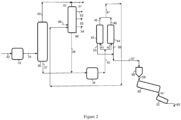
- FIG. 2 Another schematic process flow diagram of the present invention as depicted Figure 2 , part or whole of the Crude oil feedstock (32) is desalted in a desalter unit (33) to obtain desalted stream (34).
- the desalted stream (34) is thereafter routed to a Pre-Separator Vessel (35) to separate stream (36) having boiling range less than 300°C from the feed stream (34).
- the 300+ boiling range stream (37) is mixed with recycle stream (38) and routed to the furnace (39) of Delayed Coking Unit.
- Heated effluent stream (40) from furnace (39) is routed to either of Coke Drums (43) or (44) whichever is in filling cycle through line (41) or (42).
- the mixed feed cracks to lighter hydrocarbons and coke inside the Coke drums.
- Coke drum effluent (47) is thereafter routed to the Main fractionator (49).
- Aromatic oil such as Clarified Light Oil stream (48) is routed to the bottom of Main fractionator (49) where it condenses heavier molecules from coke drum effluent (47) to produce recycle stream (38).
- Product streams from (49) such as gases (50) after mixing with (36) are sent for further processing.
- Distillate fractions light coker gas oil (52), heavy coker gas oil (53) and fuel oil (54) are sent for downstream processing.
- the coke (57) obtained from coke drums is sent to a feed silo (58). Thereafter, raw coke (59) from feed silo outlet is calcined in a kiln (60) of a calciner unit.
- Calcined coke from (61) is sent to a cooler (62) and calcined coke product (63) meeting anode grade coke specification is obtained.
- Processing of 300+ fraction of crude oil and mixing of aromatic rich stream enhances the coke quality in comparison to that obtained from Vacuum residue feed stock.
- Example 1 Crude Blend A with property provided in Table-1 was subjected to thermal cracking as per process conditions provided in Table-2 in a lab scale thermal cracker unit to obtain Raw Petroleum Coke A (RPC A). RPC obtained from the experiment was subjected to calcination in a batch calcination unit at conditions provided in Table-3 to obtain Calcined Petroleum Coke A (CPC A). CPC properties are provided in Table-4.
- Table 1 Crude A property S. N Property of Crude A Value 1. Density, g/cc 0.8908 2. CCR, wt% 8.21 3. SimDist 165/210/285/358/458/582/786 5/10/30/50/70/90/95 4. Sulfur, wt% 3 5.
- Example 2 Crude A described in Table-1 was subjected to Atmospheric Distillation followed by Vacuum Distillation to generate Vacuum Residue (VR) which is a typical Coker feed stock (Table-5). VR was subjected to thermal cracking in a thermal cracker unit as per process conditions described in Table-6 to obtain Raw Petroleum Coke B (RPC B). RPC B thus obtained was subjected to calcination in a batch scale calcination unit as per conditions in Table-7 to generate Calcined Petroleum Coke B (CPC B). Property of coke thus obtained is provided in Table-8 Table 5: Property of Vacuum Residue feed stock from crude A S. N Property Value 1. Density, g/cc 1.0551 2. CCR, wt% 28 3.
- Example-2 CPC B as described in Example-2 was subjected to XRD analysis for measurement of Crystallite size (Lc). Lc was observed to be 34.7 ⁇ which is lower than that of CPC A, indicating a lesser evolved crystalline structure. Also, metals such as Vanadium, Nickel and Sodium were concentrated in coke leading to poor quality of coke. Impurities such as sulphur and Nitrogen content were also found to be high in RPC & CPC B generated from VR.
- Example 3 In another experiment, aromatic stream of Clarified Light Oil (CLO) having property as provided in Table-9 was mixed with crude oil feed stock in a ratio of 10:90 and processed in a laboratory scale thermal cracking unit as per process conditions mentioned in Table-10 to obtain Raw Petroleum Coke C (RPC C). RPC C generated thereof was subjected to calcination as per conditions provided in Table-11 to obtain Calcined Petroleum Coke C (CPC C). Calcined coke obtained had property provided in Table-12.
- Table-9 Property of CLO S. N Property Value 1. Density, g/cc 1.1 2. CCR, wt% 15.9 3. SimDist 219/320/360/386/422/478/524 5/10/30/50/70/90/95 4.
Landscapes
- Chemical & Material Sciences (AREA)
- Oil, Petroleum & Natural Gas (AREA)
- Engineering & Computer Science (AREA)
- Organic Chemistry (AREA)
- Chemical Kinetics & Catalysis (AREA)
- General Chemical & Material Sciences (AREA)
- Materials Engineering (AREA)
- Physics & Mathematics (AREA)
- Thermal Sciences (AREA)
- Inorganic Chemistry (AREA)
- Production Of Liquid Hydrocarbon Mixture For Refining Petroleum (AREA)
- Coke Industry (AREA)
Applications Claiming Priority (1)
| Application Number | Priority Date | Filing Date | Title |
|---|---|---|---|
| IN202121044025 | 2021-09-28 |
Publications (1)
| Publication Number | Publication Date |
|---|---|
| EP4155368A1 true EP4155368A1 (de) | 2023-03-29 |
Family
ID=83505689
Family Applications (1)
| Application Number | Title | Priority Date | Filing Date |
|---|---|---|---|
| EP22198174.9A Pending EP4155368A1 (de) | 2021-09-28 | 2022-09-27 | Verfahren zur herstellung von koks mit anodenqualität aus rohölen |
Country Status (2)
| Country | Link |
|---|---|
| US (1) | US20230101524A1 (de) |
| EP (1) | EP4155368A1 (de) |
Families Citing this family (1)
| Publication number | Priority date | Publication date | Assignee | Title |
|---|---|---|---|---|
| CN119736102B (zh) * | 2024-12-25 | 2025-10-31 | 山东大学 | 一种石油焦的资源化利用方法和系统 |
Citations (8)
| Publication number | Priority date | Publication date | Assignee | Title |
|---|---|---|---|---|
| EP0087968A2 (de) * | 1982-03-01 | 1983-09-07 | Conoco Phillips Company | Verfahren zur Verringerung des Koksertrages |
| GB2134920A (en) * | 1983-02-09 | 1984-08-22 | Intevep Sa | Upgrading heavy hydrocarbons employing a diluant |
| US5350503A (en) * | 1992-07-29 | 1994-09-27 | Atlantic Richfield Company | Method of producing consistent high quality coke |
| US6332975B1 (en) | 1999-11-30 | 2001-12-25 | Kellogg Brown & Root, Inc. | Anode grade coke production |
| WO2012162008A1 (en) | 2011-05-23 | 2012-11-29 | Saudi Arabian Oil Company | Process for delayed coking of whole crude oil |
| US10351778B2 (en) | 2016-05-23 | 2019-07-16 | Kellogg Brown & Root Llc | Systems for producing anode grade coke from high sulfur crude oils |
| EP3514217A1 (de) * | 2018-01-20 | 2019-07-24 | INDIAN OIL CORPORATION Ltd. | Verfahren zur umwandlung von hochsauren rohölen |
| EP3530718A1 (de) * | 2018-02-21 | 2019-08-28 | INDIAN OIL CORPORATION Ltd. | Verfahren zur umwandlung von rohöl in leichte olefine, aromaten und synthesegas |
Family Cites Families (3)
| Publication number | Priority date | Publication date | Assignee | Title |
|---|---|---|---|---|
| US3966560A (en) * | 1974-05-06 | 1976-06-29 | Alcan Research And Development Limited | Method of calcining coke in a rotary kiln |
| US4251323A (en) * | 1979-04-16 | 1981-02-17 | Conoco, Inc. | Method for calcining delayed coke |
| US4919792A (en) * | 1988-06-10 | 1990-04-24 | Mobil Oil Corporation | Clarification of slurry oil |
-
2022
- 2022-09-22 US US17/950,947 patent/US20230101524A1/en active Pending
- 2022-09-27 EP EP22198174.9A patent/EP4155368A1/de active Pending
Patent Citations (8)
| Publication number | Priority date | Publication date | Assignee | Title |
|---|---|---|---|---|
| EP0087968A2 (de) * | 1982-03-01 | 1983-09-07 | Conoco Phillips Company | Verfahren zur Verringerung des Koksertrages |
| GB2134920A (en) * | 1983-02-09 | 1984-08-22 | Intevep Sa | Upgrading heavy hydrocarbons employing a diluant |
| US5350503A (en) * | 1992-07-29 | 1994-09-27 | Atlantic Richfield Company | Method of producing consistent high quality coke |
| US6332975B1 (en) | 1999-11-30 | 2001-12-25 | Kellogg Brown & Root, Inc. | Anode grade coke production |
| WO2012162008A1 (en) | 2011-05-23 | 2012-11-29 | Saudi Arabian Oil Company | Process for delayed coking of whole crude oil |
| US10351778B2 (en) | 2016-05-23 | 2019-07-16 | Kellogg Brown & Root Llc | Systems for producing anode grade coke from high sulfur crude oils |
| EP3514217A1 (de) * | 2018-01-20 | 2019-07-24 | INDIAN OIL CORPORATION Ltd. | Verfahren zur umwandlung von hochsauren rohölen |
| EP3530718A1 (de) * | 2018-02-21 | 2019-08-28 | INDIAN OIL CORPORATION Ltd. | Verfahren zur umwandlung von rohöl in leichte olefine, aromaten und synthesegas |
Non-Patent Citations (1)
| Title |
|---|
| GODSMAN W J: "Delayed coking gives needed flexibility", OIL AND GAS JOURNAL, vol. 52, no. 1, 11 May 1953 (1953-05-11), TULSA, OK, UNITED STATES, pages 119 - 121, XP009541988 * |
Also Published As
| Publication number | Publication date |
|---|---|
| US20230101524A1 (en) | 2023-03-30 |
Similar Documents
| Publication | Publication Date | Title |
|---|---|---|
| US11466222B2 (en) | Low sulfur fuel oil bunker composition and process for producing the same | |
| EP3722392B1 (de) | System und verfahren zur herstellung von anisotropem koks | |
| US11643607B2 (en) | Process for production of graphite coke from an admixture of coal and petroleum based hydrocarbons | |
| EP3186339B1 (de) | Integriertes verfahren zur herstellung von asphalt, grünen erdölkoks, und flüssig- und gasprodukten aus kokseinheit | |
| US7604731B2 (en) | Process for the production of needle coke | |
| KR20000064658A (ko) | 지연된코크스제조공정에서액체생성물수율을증가시키는방법 | |
| US10662385B2 (en) | Delayed coking process with pre-cracking reactor | |
| US20230101524A1 (en) | Method for producing anode grade coke from crude oils | |
| EP0129687A2 (de) | Herstellung von Nadelkoks | |
| RU2321613C1 (ru) | Способ переработки нефти | |
| US10865349B2 (en) | Two stage thermal cracking process with multistage separation system | |
| US11168260B2 (en) | Process for production of superior quality coke | |
| RU2404228C2 (ru) | Способ получения дизельного топлива из остаточного нефтяного сырья | |
| RU2806008C1 (ru) | Способ производства анодного кокса из сырой нефти | |
| EP3514217B1 (de) | Verfahren zur umwandlung von hochsauren rohölen | |
| US10584290B2 (en) | Process for conversion of residue employing de-asphalting and delayed coking | |
| EP4382587A1 (de) | Verfahren zur herstellung von nadelkoks und aromaten | |
| US11788013B2 (en) | Process for production of needle coke | |
| US10808177B2 (en) | Delayed coking process with pre-cracking reactor | |
| US20260042966A1 (en) | Process for production of needle coke from coal tar pitch and petroleum streams | |
| US11072745B1 (en) | Two-stage delayed coking process to produce anode grade coke | |
| WO2023126863A1 (en) | A process for the production of needle coke | |
| NL8701754A (nl) | Werkwijze voor het bereiden van destillatie-inzetprodukten. |
Legal Events
| Date | Code | Title | Description |
|---|---|---|---|
| PUAI | Public reference made under article 153(3) epc to a published international application that has entered the european phase |
Free format text: ORIGINAL CODE: 0009012 |
|
| STAA | Information on the status of an ep patent application or granted ep patent |
Free format text: STATUS: THE APPLICATION HAS BEEN PUBLISHED |
|
| AK | Designated contracting states |
Kind code of ref document: A1 Designated state(s): AL AT BE BG CH CY CZ DE DK EE ES FI FR GB GR HR HU IE IS IT LI LT LU LV MC MK MT NL NO PL PT RO RS SE SI SK SM TR |
|
| P01 | Opt-out of the competence of the unified patent court (upc) registered |
Effective date: 20230712 |
|
| STAA | Information on the status of an ep patent application or granted ep patent |
Free format text: STATUS: REQUEST FOR EXAMINATION WAS MADE |
|
| 17P | Request for examination filed |
Effective date: 20230906 |
|
| RBV | Designated contracting states (corrected) |
Designated state(s): AL AT BE BG CH CY CZ DE DK EE ES FI FR GB GR HR HU IE IS IT LI LT LU LV MC MK MT NL NO PL PT RO RS SE SI SK SM TR |
|
| STAA | Information on the status of an ep patent application or granted ep patent |
Free format text: STATUS: EXAMINATION IS IN PROGRESS |
|
| 17Q | First examination report despatched |
Effective date: 20251110 |