EP4155656B1 - Wärmetauscher und wärmetauscherherstellungsverfahren - Google Patents
Wärmetauscher und wärmetauscherherstellungsverfahren Download PDFInfo
- Publication number
- EP4155656B1 EP4155656B1 EP21809841.6A EP21809841A EP4155656B1 EP 4155656 B1 EP4155656 B1 EP 4155656B1 EP 21809841 A EP21809841 A EP 21809841A EP 4155656 B1 EP4155656 B1 EP 4155656B1
- Authority
- EP
- European Patent Office
- Prior art keywords
- heat transfer
- corrugated sheet
- heat exchanger
- base
- header
- Prior art date
- Legal status (The legal status is an assumption and is not a legal conclusion. Google has not performed a legal analysis and makes no representation as to the accuracy of the status listed.)
- Active
Links
Images









Classifications
-
- F—MECHANICAL ENGINEERING; LIGHTING; HEATING; WEAPONS; BLASTING
- F28—HEAT EXCHANGE IN GENERAL
- F28F—DETAILS OF HEAT-EXCHANGE AND HEAT-TRANSFER APPARATUS, OF GENERAL APPLICATION
- F28F9/00—Casings; Header boxes; Auxiliary supports for elements; Auxiliary members within casings
- F28F9/02—Header boxes; End plates
- F28F9/0219—Arrangements for sealing end plates into casing or header box; Header box sub-elements
- F28F9/0224—Header boxes formed by sealing end plates into covers
-
- F—MECHANICAL ENGINEERING; LIGHTING; HEATING; WEAPONS; BLASTING
- F28—HEAT EXCHANGE IN GENERAL
- F28D—HEAT-EXCHANGE APPARATUS, NOT PROVIDED FOR IN ANOTHER SUBCLASS, IN WHICH THE HEAT-EXCHANGE MEDIA DO NOT COME INTO DIRECT CONTACT
- F28D7/00—Heat-exchange apparatus having stationary tubular conduit assemblies for both heat-exchange media, the media being in contact with different sides of a conduit wall
- F28D7/16—Heat-exchange apparatus having stationary tubular conduit assemblies for both heat-exchange media, the media being in contact with different sides of a conduit wall the conduits being arranged in parallel spaced relation
-
- F—MECHANICAL ENGINEERING; LIGHTING; HEATING; WEAPONS; BLASTING
- F28—HEAT EXCHANGE IN GENERAL
- F28D—HEAT-EXCHANGE APPARATUS, NOT PROVIDED FOR IN ANOTHER SUBCLASS, IN WHICH THE HEAT-EXCHANGE MEDIA DO NOT COME INTO DIRECT CONTACT
- F28D1/00—Heat-exchange apparatus having stationary conduit assemblies for one heat-exchange medium only, the media being in contact with different sides of the conduit wall, in which the other heat-exchange medium is a large body of fluid, e.g. domestic or motor car radiators
- F28D1/02—Heat-exchange apparatus having stationary conduit assemblies for one heat-exchange medium only, the media being in contact with different sides of the conduit wall, in which the other heat-exchange medium is a large body of fluid, e.g. domestic or motor car radiators with heat-exchange conduits immersed in the body of fluid
- F28D1/04—Heat-exchange apparatus having stationary conduit assemblies for one heat-exchange medium only, the media being in contact with different sides of the conduit wall, in which the other heat-exchange medium is a large body of fluid, e.g. domestic or motor car radiators with heat-exchange conduits immersed in the body of fluid with tubular conduits
- F28D1/053—Heat-exchange apparatus having stationary conduit assemblies for one heat-exchange medium only, the media being in contact with different sides of the conduit wall, in which the other heat-exchange medium is a large body of fluid, e.g. domestic or motor car radiators with heat-exchange conduits immersed in the body of fluid with tubular conduits the conduits being straight
- F28D1/0535—Heat-exchange apparatus having stationary conduit assemblies for one heat-exchange medium only, the media being in contact with different sides of the conduit wall, in which the other heat-exchange medium is a large body of fluid, e.g. domestic or motor car radiators with heat-exchange conduits immersed in the body of fluid with tubular conduits the conduits being straight the conduits having a non-circular cross-section
- F28D1/05366—Assemblies of conduits connected to common headers, e.g. core type radiators
-
- F—MECHANICAL ENGINEERING; LIGHTING; HEATING; WEAPONS; BLASTING
- F28—HEAT EXCHANGE IN GENERAL
- F28F—DETAILS OF HEAT-EXCHANGE AND HEAT-TRANSFER APPARATUS, OF GENERAL APPLICATION
- F28F1/00—Tubular elements; Assemblies of tubular elements
- F28F1/10—Tubular elements and assemblies thereof with means for increasing heat-transfer area, e.g. with fins, with projections, with recesses
- F28F1/12—Tubular elements and assemblies thereof with means for increasing heat-transfer area, e.g. with fins, with projections, with recesses the means being only outside the tubular element
-
- F—MECHANICAL ENGINEERING; LIGHTING; HEATING; WEAPONS; BLASTING
- F28—HEAT EXCHANGE IN GENERAL
- F28F—DETAILS OF HEAT-EXCHANGE AND HEAT-TRANSFER APPARATUS, OF GENERAL APPLICATION
- F28F9/00—Casings; Header boxes; Auxiliary supports for elements; Auxiliary members within casings
- F28F9/02—Header boxes; End plates
- F28F9/0202—Header boxes having their inner space divided by partitions
- F28F9/0204—Header boxes having their inner space divided by partitions for elongated header box, e.g. with transversal and longitudinal partitions
-
- F—MECHANICAL ENGINEERING; LIGHTING; HEATING; WEAPONS; BLASTING
- F28—HEAT EXCHANGE IN GENERAL
- F28F—DETAILS OF HEAT-EXCHANGE AND HEAT-TRANSFER APPARATUS, OF GENERAL APPLICATION
- F28F9/00—Casings; Header boxes; Auxiliary supports for elements; Auxiliary members within casings
- F28F9/02—Header boxes; End plates
- F28F9/026—Header boxes; End plates with static flow control means, e.g. with means for uniformly distributing heat exchange media into conduits
- F28F9/0278—Header boxes; End plates with static flow control means, e.g. with means for uniformly distributing heat exchange media into conduits in the form of stacked distribution plates or perforated plates arranged over end plates
-
- F—MECHANICAL ENGINEERING; LIGHTING; HEATING; WEAPONS; BLASTING
- F28—HEAT EXCHANGE IN GENERAL
- F28D—HEAT-EXCHANGE APPARATUS, NOT PROVIDED FOR IN ANOTHER SUBCLASS, IN WHICH THE HEAT-EXCHANGE MEDIA DO NOT COME INTO DIRECT CONTACT
- F28D21/00—Heat-exchange apparatus not covered by any of the groups F28D1/00 - F28D20/00
- F28D2021/0019—Other heat exchangers for particular applications; Heat exchange systems not otherwise provided for
- F28D2021/0068—Other heat exchangers for particular applications; Heat exchange systems not otherwise provided for for refrigerant cycles
-
- F—MECHANICAL ENGINEERING; LIGHTING; HEATING; WEAPONS; BLASTING
- F28—HEAT EXCHANGE IN GENERAL
- F28F—DETAILS OF HEAT-EXCHANGE AND HEAT-TRANSFER APPARATUS, OF GENERAL APPLICATION
- F28F2275/00—Fastening; Joining
- F28F2275/12—Fastening; Joining by methods involving deformation of the elements
- F28F2275/122—Fastening; Joining by methods involving deformation of the elements by crimping, caulking or clinching
Definitions
- the present disclosure relates a heat exchanger having a bridging header and a method of manufacturing a heat exchanger.
- a heat exchanger having pairs of mutually facing heat transfer tubes.
- the heat transfer tubes in a first row and the heat transfer tubes in a second row extend parallel to one another.
- a bridging header into which end portions of the heat transfer tubes are inserted has flow passages.
- refrigerant flows only between a pair of the heat transfer tubes. That is, in the bridging header, the refrigerant that has flowed into the bridging header from a heat transfer tube arranged in the first row does not merge with the flow of the refrigerant that has flowed into the bridging header from another heat transfer tube arranged in the first row.
- Patent Literature 1 JP 5786877 B2 discloses a heat exchanger having a base into which heat transfer tubes are inserted and a bridging header constituted by a corrugated sheet that is provided on the base and that has a wavy shape in which semicircular column portions are continuously formed. Each of the semicircular column portions of the corrugated sheet covers points at which the paired heat transfer tubes are inserted and forms a flow passage between the semicircular column portion and the base.
- Patent Literature 2 US 9 989 317 B2 which is considered as the closest prior art, discloses in a heat exchanger, an outside air passage, through which outside air flows, is provided between adjacent tubes of the refrigerant tube and the coolant tubes. Disposed in the outside air passage is an outer fin joined to at least one of the refrigerant tube and the coolant tube and configured to accelerate heat transfer between the fluids. A dimension of the refrigerant tube in a flow direction of the outside air is different from a dimension of the coolant tube in the flow direction of the outside air. Hence, with respect to the outer fin joined to both of the refrigerant tube and the coolant tube, an area of a joint surface between the refrigerant tube and the outer fin is different from an area of a joint surface between the coolant tube and the outer fin.
- Patent Literature 3 US 2005/217838 A1 discloses an evaporator for an air conditioning apparatus has an upper and a lower tanks and multiple tubes vertically extending and respectively connected to the tanks at upper and lower ends. A fluid passage portion is formed in the lower tank. Multiple drainage recesses are formed in the lower tank at such portions, at which the recesses do not interfere with the fluid passage portion.
- the corrugated sheet of the heat exchanger of Patent Literature 1 is required to be thickened so as not to be deformed by the pressure of the refrigerant flowing through the bridging header. In most cases, a thickened corrugated sheet is likely to interfere with the inserted heat transfer tube and is likely to cover, in a hindering way, a point at which the heat transfer tube is inserted. In the heat exchanger of the Patent Literature 1, because being thickened, the corrugated sheet reduces a region, in the base, into which the heat transfer tubes can be inserted. Thus, regarding the heat exchanger of Patent Literature 1, for example, the number of the heat transfer tubes that are inserted into the bridging header and a space between the heat transfer tubes are limited, and design flexibility is thus decreased.
- the present disclosure has been made to solve such an above-described problem and provides: a heat exchanger enabling adjustment of, for example, the number of the heat transfer tubes that are inserted into a bridging header and a space between the heat transfer tubes and thus enabling increase in design flexibility; and a method of manufacturing the heat exchanger.
- a heat exchanger of one embodiment of the present disclosure has: a heat transfer tube group made up of plural heat transfer tubes each of which has, inside the heat transfer tube, a flow passage through which refrigerant flows, the plural heat transfer tubes that are arranged in a lateral direction being arranged in a longitudinal direction so as to form plural rows; a fin provided on the heat transfer tubes and facilitating heat exchange between refrigerant flowing inside the heat transfer tubes and air; and a bridging header into which end portions of the heat transfer tubes are inserted and that causes refrigerant to flow between the heat transfer tubes arranged in a lateral direction of the heat transfer tube group.
- the bridging header has a base having a flat plate shape and having insertion holes into which respective ones of end portions of the plurality of heat transfer tubes are inserted.
- the bridging header also has a corrugated sheet being a plate having a shape of a wave in which crest portions and valley portions are continuously formed, each of the crest portions being provided so as to cover a pair of the insertion holes arranged in a lateral direction, the valley portions being in contact with the base on both sides of each of the insertion holes in a longitudinal direction of the base, the corrugated sheet forming, between the corrugated sheet and the base, a header flow passage, through which refrigerant flows, for every the heat transfer tubes arranged in a lateral direction of the heat transfer tube group.
- the bridging header also has a covering plate covering the corrugated sheet and pressing the corrugated sheet toward the base.
- a method of manufacturing a heat exchanger of another embodiment of the present disclosure includes: assembling: a heat transfer tube group made up of plural heat transfer tubes each of which has, inside the heat transfer tube, a flow passage through which refrigerant flows, the plural heat transfer tubes that are arranged in a lateral direction being arranged in a longitudinal direction so as to form plural rows; a fin provided on the heat transfer tubes and facilitating heat exchange between refrigerant flowing inside the heat transfer tubes and air; and a bridging header into which end portions of the heat transfer tubes are inserted and that causes refrigerant to flow between the heat transfer tubes arranged in a lateral direction of the heat transfer tube group.
- the method also includes performing brazing of the heat transfer tube group, the fin, and the bridging header.
- the assembling includes: fitting the corrugated sheet of the bridging header into the base, of the bridging header, having insertion holes into which respective ones of end portions of the plurality of heat transfer tubes are inserted, the fitting being performed so that, in the corrugated sheet being a plate having a shape of a wave in which crest portions and valley portions are continuously formed, each of the crest portions covers a pair of the insertion holes arranged in a lateral direction, and the valley portions are in contact with the base on both sides of each of the insertion holes in a longitudinal direction of the base; and carrying out attachment of a covering plate so that the covering plate covers the corrugated sheet.
- FIG. 1 is a circuit diagram of the air-conditioning apparatus 1 according to Embodiment 1. As Fig. 1 illustrates, the air-conditioning apparatus 1 has an outdoor unit 2, an indoor unit 3, and a refrigerant pipe 4. Note that, although Fig. 1 illustrates the single indoor unit 3, the number of the indoor units 3 may be two or more.
- the outdoor unit 2 includes a compressor 5, a flow-switching device 6, the heat exchanger 7, an outdoor fan 8, and an expansion unit 9.
- the indoor unit 3 includes an indoor heat exchanger 11 and an indoor fan 12.
- the refrigerant pipe 4 constitutes a refrigerant circuit by connecting the compressor 5, the flow-switching device 6, the heat exchanger 7, the expansion unit 9, and the indoor heat exchanger 11 to one another and by allowing refrigerant to flow inside the refrigerant pipe 4.
- the compressor 5 sucks low-temperature and low-pressure refrigerant, compresses the sucked refrigerant to bring the refrigerant into a high-temperature and high-pressure state, and discharges the refrigerant.
- the flow-switching device 6 switches flowing directions of refrigerant in the refrigerant circuit and is, for example, a four-way valve.
- the heat exchanger 7 exchanges heat between refrigerant and outdoor air.
- the heat exchanger 7 operates as a condenser during a cooling operation and operates as an evaporator during a heating operation.
- the outdoor fan 8 is a device for sending outdoor air to the heat exchanger 7.
- the expansion unit 9 is a pressure-reducing valve or an expansion valve for reducing the pressure of refrigerant to expand the refrigerant.
- the indoor heat exchanger 11 exchanges heat between indoor air and refrigerant.
- the indoor heat exchanger 11 operates as an evaporator during the cooling operation and operates as a condenser during the heating operation.
- the indoor fan 12 is a device for sending indoor air to the indoor heat exchanger 11.
- the cooling operation will be described.
- the refrigerant sucked into the compressor 5 is compressed by the compressor 5, and the refrigerant that has turned into a high-temperature and high-pressure gas state is discharged from the compressor 5.
- the high-temperature and high-pressure gas state refrigerant that has been discharged from the compressor 5 passes through the flow-switching device 6 and flows into the heat exchanger 7 operating as a condenser.
- the refrigerant that has flowed into the heat exchanger 7 exchanges heat with the outdoor air sent by the outdoor fan 8 and is thus condensed to be liquefied.
- the refrigerant in a liquid state flows into the expansion unit 9 and is reduced in pressure and expanded to turn into a low-temperature and low-pressure two-phase gas-liquid state.
- the refrigerant in a gas-liquid two-phase state flows into the indoor heat exchanger 11 operating as an evaporator.
- the refrigerant that has flowed into the indoor heat exchanger 11 exchanges heat with the indoor air sent by the indoor fan 12 and is thus evaporated to be gasified.
- the indoor air is cooled and air cooling is performed in a room.
- the evaporated refrigerant in a low-temperature and low-pressure gas state passes through the flow-switching device 6 and is sucked into the compressor 5.
- the heating operation will be described.
- the refrigerant sucked into the compressor 5 is compressed by the compressor 5, and the refrigerant that has turned into a high-temperature and high-pressure gas state is discharged from the compressor 5.
- the high-temperature and high-pressure gas state refrigerant that has been discharged from the compressor 5 passes through the flow-switching device 6 and flows into the indoor heat exchanger 11 operating as a condenser.
- the refrigerant that has flowed into the indoor heat exchanger 11 exchanges heat with the indoor air sent by the indoor fan 12 and is thus condensed to be liquefied. At this time, the indoor air is heated and air heating is performed in the room.
- the refrigerant in a liquid state flows into the expansion unit 9 and is reduced in pressure and expanded to turn into a low-temperature and low-pressure two-phase gas-liquid state.
- the refrigerant in a gas-liquid two-phase state flows into the heat exchanger 7 operating as an evaporator.
- the refrigerant that has flowed into the heat exchanger 7 exchanges heat with the outdoor air sent by the outdoor fan 8 and is thus evaporated to be gasified. Subsequently, the evaporated refrigerant in a low-temperature and low-pressure gas state passes through the flow-switching device 6 and is sucked into the compressor 5.
- Fig. 2 is a perspective view of the heat exchanger 7 according to Embodiment 1.
- the heat exchanger 7 has a heat transfer tube group 20, a fin 22, a first lower header 23, a bridging header 24, and a second lower header 25. Note that a configuration similar to the configuration of the heat exchanger 7 may be applied to the indoor heat exchanger 11.
- the bridging header 24 has the covering plate 34 pressing the corrugated sheet 32 toward the base 31.
- the corrugated sheet 32 is suppressed from being deformed by the pressure of the refrigerant flowing through the bridging header 24. That is, for suppressing the corrugated sheet 32 from being deformed by the pressure of the refrigerant flowing through the bridging header 24, the corrugated sheet 32 is not required to be thickened. Consequently, regarding the heat exchanger 7, for example, the number of the heat transfer tubes 21 that are inserted into the bridging header 24 and a space between the heat transfer tubes 21 can be adjusted, and design flexibility can thus be increased.
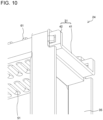
- Fig. 10 is a perspective view of the bridging header 24 according to a modification of Embodiment 1. As Fig. 10 illustrates, the bridging header 24 has a leg portion 35. The leg portion 35 is a plate-shaped part extending in the vertical direction of the heat exchanger 7 and supporting the heat exchanger 7.
- the partition plate 36 has a thickness large enough not to be deformed even when there is a large difference in pressure between the refrigerants on one side and on the other side of the partition plate 36.
- the heat exchanger 7 can cause the refrigerants having different pressures to flow without the corrugated sheet 32 being deformed, as with the case where plural refrigerant pipes 4 constituting different refrigerant circuits are connected.
- Fig. 12 is a perspective view of a bridging header 124 according to Embodiment 2. Note that, in Fig. 12 , a covering plate 134 is transparent for an illustration purpose. Embodiment 2 differs from Embodiment 1 in that a corrugated sheet 132 has a corrugated-sheet hole 173 as Fig. 12 illustrates. In Embodiment 2, by the same parts as the parts of Embodiment 1 being denoted by the same references, the description thereof will be omitted, and differences from Embodiment 1 will be mainly described.
- Fig. 13 is a perspective view of the bridging header 124 according to Embodiment 2.
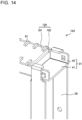
- Fig. 14 is a perspective view of the bridging header 124 according to Embodiment 2.
- the bridging header 124 has a base 131, the corrugated sheet 132, and the covering plate 134.
- the bridging header 124 has no end plate. Note that the bridging header 124 may have an end plate 33.
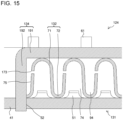
- Fig. 15 illustrates the configuration of the bridging header 124 according to Embodiment 2. As with Fig. 8 and Fig. 11 , Fig. 15 illustrates the section of the bridging header 124 taken in the longitudinal direction. As Fig. 12 and Fig. 15 illustrate, each of the planar portions 75 of the corrugated sheet 132 has the corrugated-sheet hole 173.
- the corrugated-sheet hole 173 is an opening through which refrigerant flows between the header flow passage 74 and the cover space 94. Thus, the cover space 94 is filled with the refrigerant that has flowed out from the header flow passage 74 through the corrugated-sheet hole 173.
- the header flow passage 74 is filled with the refrigerant flowing between the heat transfer tubes 21 facing one another in the lateral direction. That is, with the corrugated-sheet hole 173, the refrigerants in the header flow passage 74 and in the cover space 94 have uniform pressure. Note that the size of the corrugated-sheet hole 173 is set within a range in which the corrugated-sheet hole 173 is not closed by a molten metal when the fixation of a heat exchanger 107 is performed by brazing.
- the covering plate 134 is constituted by an upper covering plate 191 and a side covering plate 192.
- the upper covering plate 191 is a plate covering the upper side of the corrugated sheet 132.
- the upper covering plate 191 presses the corrugated sheet 132 toward the base 131.
- the side covering plate 192 is a plate covering a side portion of the corrugated sheet 132.
- the side covering plate 192 is fixed to the base 131 by being fitted into the plate hole 52 formed in the base 131. That is, the side covering plate 192 has a function similar to the function of the end plate 33 of Embodiment 1.
- the covering plate 134 may be constituted by only the upper covering plate 191 when the bridging header 124 has an end plate 33.
- Fig. 16 is a perspective view of the covering plate 134 according to Embodiment 2.
- Fig. 17 is a perspective view of the bridging header 124 according to Embodiment 2.
- the covering plate 134 may have a shape elongated toward end portions, in the longitudinal direction, of the bridging header 124. In this case, in the heat exchanger 107, the base 131 and the covering plate 134 can be fixed to one another regardless of the thickness of the covering plate 134.
- the corrugated sheet 132 has the corrugated-sheet hole 173.
- the cover space 94 is filled with the refrigerant that has flowed out from the header flow passage 74 through the corrugated-sheet hole 173.
- the header flow passage 74 is filled with the refrigerant flowing between the heat transfer tubes 21 facing one another in the lateral direction. That is, the refrigerants in the header flow passage 74 and in the cover space 94 have uniform pressure.
- the corrugated sheet 132 is further suppressed from being deformed by the pressure of the refrigerant flowing through the header flow passage 74 and is thus not required to be thickened. Consequently, regarding the heat exchanger 107, for example, the number of the heat transfer tubes 21 that are inserted into the bridging header 124 and a space between the heat transfer tubes 21 can be adjusted, and design flexibility can thus be increased.
- Fig. 18 is a perspective view of a corrugated sheet 232 according to Embodiment 3.
- Embodiment 3 differs from Embodiment 1 in that a corrugated-sheet hole 273 is formed in an end portion, in the lateral direction, of the corrugated sheet 232 as Fig. 18 illustrates.
- Embodiment 3 by the same parts as the parts of Embodiment 1 being denoted by the same references, the description thereof will be omitted, and differences from Embodiment 1 will be mainly described.
- the corrugated-sheet hole 273 has a semicircular shape and is formed at each of both the end portions of the corrugated sheet 232 in the lateral direction.
- a portion of the refrigerant flowing through the header flow passage 74 flows out from the corrugated-sheet hole 273 positioned on one side and flows into the cover space 94
- a portion of the refrigerant flowing through the cover space 94 flows out from the corrugated-sheet hole 273 positioned on the other side and flows into the header flow passage 74. That is, the refrigerant circulates between the header flow passage 74 and the cover space 94.
- the refrigerants in the header flow passage 74 and in the cover space 94 have further uniform pressure.
- Fig. 19 illustrates a method of manufacturing a heat exchanger 207 according to Embodiment 3.
- Fig. 19 illustrates a bridging header 224 when the bridging header 224 is viewed in the longitudinal direction.
- Fig. 19 illustrates, for simple description, only the bottom base 41, the side base 42, and the corrugated sheet 232 are illustrated.
- the base 31 is a clad material, and a brazing material is pressure-bonded to an inner surface of the side base 42, that is, a surface to be in contact with the corrugated sheet 232.
- the bridging header 224 is disposed so that the side bases 42 are positioned above and below across the corrugated sheet 232, and brazing is performed.
- a corrugated-sheet hole 271 before brazing is referred to as a before-heating hole. That is, the corrugated-sheet hole 271 is a hole into which the before-heating hole is deformed by the brazing of the bridging header 224.
- a preferable dimension of the before-heating hole that is applicable in Embodiment 3 will be described.
- the before-heating hole is processed, for example, at the same time as uniformization of the length, in the lateral direction, of the corrugated sheet 232.
- the before-heating hole is formed in each of the upper region and the lower region of the corrugated sheet 232 and has a semicircular shape.
- the before-heating holes that is, the lower hole is referred to as a before-heating hole 280d, and the upper hole is referred to as a before-heating hole 280u.
- the width of the lower before-heating hole 280d that is, the width of a region in which the corrugated sheet 232 and the side base 42 on the lower side are not in contact with one another is referred to as a width Wd.
- the before-heating hole 280d has a semicircular shape, the distance from the side base 42 on the lower side to the outer edge of the lower before-heating hole 280d reaches a maximum distance of Wd/2 at a central portion Cd of the outer edge.
- the width of the upper before-heating hole 280u that is, the width of a region in which the corrugated sheet 232 and the side base 42 on the upper side are not in contact with one another is referred to as a width Wu. Because the before-heating hole 280u has a semicircular shape, the distance from the side base 42 on the upper side to the outer edge of the upper before-heating hole 280u reaches a maximum distance of Wu/2 at a central portion Cu of the outer edge.
- Fig. 20 illustrates the presence or absence of closure of the before-heating hole 280d on the lower side caused by brazing according to Embodiment 3, for each of the widths Wd of the before-heating holes and for each of the peak temperatures.
- Fig. 21 illustrates the presence or absence of closure of the before-heating hole 280u on the upper side caused by brazing according to Embodiment 3, for each of the widths Wu of the before-heating holes and for each of the peak temperatures.
- Fig. 20 illustrates the presence or absence of closure of the before-heating hole 280d on the lower side caused by brazing according to Embodiment 3, for each of the widths Wd of the before-heating holes and for each of the peak temperatures.
- Fig. 21 illustrates the presence or absence of closure of the before-heating hole 280u on the upper side caused by brazing according to Embodiment 3, for each of the widths Wu of the before-heating holes and for each of the peak temperatures.
- Fig. 19 illustrates, the presence or absence of closure of the before-heating hole when brazing is performed with the side bases 42 of clad material being positioned above and below the corrugated sheet 232 is verified for each of the widths of the before-heating holes and for each of the peak temperatures, and the presence or absence of closure of the before-heating hole is plotted.
- Fig. 20 illustrates the case of the lower before-heating hole 280d
- Fig. 21 illustrates the case of the upper before-heating hole 280u.
- Fig. 20 and Fig. 21 illustrate, it has been found that even a before-heating hole whose width W is larger is closed as the peak temperature of brazing is increased. It has also been found that there is a difference in a width with which an opening is closed, between the upper before-heating hole and the lower before-heating hole. Specifically, when heating is performed at the same peak temperature, in the case of the lower before-heating hole 280d, closure occurs in a before-heating hole whose width Wd is larger, compared with the case of the upper before-heating hole 280u.
- the difference between the cases is caused by an incident in which, when the molten clad material flowing, by gravitation, along the corrugated sheet 232, the molten clad material flows into the lower before-heating hole 280d formed at a position below the upper before-heating hole 280u.
- Fig. 22 is a side view of the corrugated sheet 232 after brazing according to Embodiment 3.
- Fig. 22 illustrates the corrugated sheet 232 when the corrugated sheet 232 is viewed in the longitudinal direction. The broken line represents a before-heating hole.
- Fig. 22 illustrates, even when before-heating holes having the same width are formed in two end portions, in the lateral direction, of the corrugated sheet 232 before brazing, the corrugated-sheet holes 273 after brazing have different widths depending on the orientation of the bridging header 224 during brazing.
- the before-heating hole 280u positioned on the upper side during brazing is hardly closed even when having a width Wu smaller than the width of the before-heating hole 280d positioned on the lower side.
- the width Wu has room for reduction by 1 mm to reach a width with which closure is caused, compared with the lower before-heating hole 280d that is brazed at the same peak temperature.
- the width Wu of the before-heating hole 280u positioned on the upper side may be 1 mm smaller than the width of the before-heating hole 280d positioned on the lower side.
- the corrugated sheet 232 is further suppressed from being deformed by the pressure of the refrigerant flowing through the header flow passage 74 and is thus not required to be thickened. Consequently, regarding the heat exchanger 207, for example, the number of the heat transfer tubes 21 that are inserted into the bridging header 224 and a space between the heat transfer tubes 21 can be adjusted, and design flexibility can thus be increased.
- the before-heating hole can be formed within the range from 1 mm to L - processing tolerance mm.
- the bonding area between the corrugated sheet 232 and the side base 42 can be ensured, and the bonding strength between the corrugated sheet 232 and the base 31 can thus be suppressed from being decreased.
- Fig. 23 illustrates a method of manufacturing a heat exchanger 307 according to Embodiment 4.
- Fig. 23 illustrates a bridging header 324 when the bridging header 324 is viewed in the longitudinal direction.
- the method of manufacturing the heat exchanger 307 of Embodiment 4 differs from the method of manufacturing the heat exchanger of Embodiment 3 in that a corrugated sheet 332 has a before-heating hole 380 having a rectangular shape as Fig. 23 illustrates.
- Embodiment 4 by the same parts as the parts of Embodiment 3 being denoted by the same references, the description thereof will be omitted, and differences from Embodiment 3 will be mainly described.
- the before-heating hole 380 has a rectangular shape. Note that, although, in Fig. 23 , the bridging header 324 is disposed so that the side bases 42 are positioned above and below across the corrugated sheet 332, the orientation of the bridging header 324 is not limited during brazing in the method of manufacturing the heat exchanger 307 of Embodiment 4. In most cases, in brazing, a molten brazing material forms a fillet along the outer edge of the before-heating hole 380 so as to fill the before-heating hole 380 with a contact point between the outer edge of the before-heating hole 380 and the side base 42 being a starting point.
- the space between the outer edge of the before-heating hole 380 and the side base 42 reaches a maximum size only at a central portion C of the outer edge of the before-heating hole 380.
- the space between the outer edge of the before-heating hole 380 and the side base 42 reaches a maximum size at any point along a side F, of the outer edge of the before-heating hole 380, facing the inner surface of the side base 42.
- the space between the before-heating hole 380 and the side base 42 can be widened as a whole compared with the case of the semicircular before-heating hole when the width of the before-heating hole 380 is the same in both the cases, and the maximum space between the before-heating hole 380 and the side base 42 is the same between both the cases.
- the width W of the rectangular before-heating hole 380 can be within the range from 1 mm to L - processing tolerance mm, as with the diameter of the semicircular before-heating hole 380 in Embodiment 3.
- the processing tolerance is, for example, 0.5 mm.
- the space between the before-heating hole 380 and the side base 42 can be widened as a whole by the before-heating hole 380 being formed into a rectangular shape.
- the before-heating hole 380 can be suppressed from being closed after brazing, the bonding area between the corrugated sheet 232 and the side base 42 can be ensured, and the bonding strength between the corrugated sheet 232 and the base 31 can thus be suppressed from being decreased.
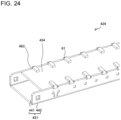
- Fig. 24 is a perspective view of a bridging header 424 according to Embodiment 5.
- Fig. 25 is a perspective view of the bridging header 424 according to Embodiment 5. Note that, in Fig. 25 , a covering plate 434 is transparent, and the corrugated sheet 32 is semitransparent.
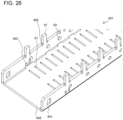
- Fig. 26 is a perspective view of a base 431 according to Embodiment 5. Embodiment 5 differs from Embodiment 1 in that the base 431 has a cutout 463 as Figs. 24 to 26 illustrate. In Embodiment 5, by the same parts as the parts of Embodiment 1 being denoted by the same references, the description thereof will be omitted, and differences from Embodiment 1 will be mainly described.
- a heat exchanger 407 of Embodiment 5 is provided in the outdoor unit 2 so that, for example, a bottom base 441 serves as the lower side of the base 431.
- a side base 442 of Embodiment 5 has the cutouts 463 having a semicircular shape on both sides of each of the claw portions 61. The depth of each of the cutouts 463 is adjusted so that a lower end portion of the cutout 463 is positioned below the upper surface of the covering plate 434.
- the side base 442 when the side base 442 is provided at a position lower than the upper surface of the covering plate 434 throughout the length of the side base 442 for placing priority on drainage, the contact surface between the base 431 and the covering plate 434 cannot be sufficiently ensured, and insufficient brazing may be caused. In this case, the pressure resistance of the bridging header 424 may be decreased.
- the cutouts 463 are provided only beside both sides of the claw portion 61, and the pressure resistance and the drainage properties of the bridging header 424 can thereby be compatible with one another.
- each of the plural claw portions 61 of the side base 442 is bent at the base thereof for pressing the covering plate 434 toward the corrugated sheet 32.
- the bending workability of the claw portion 61 is improved by the cutouts 463 being provided beside both sides of the claw portions 61.
- the side base 442 has plural plate-catching portions 453. On both end portions, in the longitudinal direction, of the side base 442, two plate-catching portions 453 are provided per end portion and protrude from the inner wall surface of the side base 442.
- the bottom base 441 has no plate hole into which an end plate 433 is fitted.
- the end plate 433 is fixed by an end of the end plate 433 being held between the two plate-catching portions 453.
- the end plate 433 can be fixed while a pressure resistance on per with the pressure resistance when the end plate 433 is fitted into the plate hole 52 of Embodiment 1 is ensured.
- the plate-catching portion 453 of Embodiment 5 may be provided for the base 31 of Embodiment 1 as a substitute for a part of the base 31 or as an additional part to the base 31.
- the cutout 463 of Embodiment 5 may be formed in the base of any one of Embodiments 2 to 4.
Landscapes
- Engineering & Computer Science (AREA)
- Physics & Mathematics (AREA)
- Thermal Sciences (AREA)
- Mechanical Engineering (AREA)
- General Engineering & Computer Science (AREA)
- Geometry (AREA)
- Heat-Exchange Devices With Radiators And Conduit Assemblies (AREA)
Claims (16)
- Wärmetauscher (7,107,207,307,407), aufweisend:eine Wärmeübertragungsrohrgruppe (20) aus einer Vielzahl von Wärmeübertragungsrohren (21), die jeweils im Inneren einen Strömungskanal aufweisen, durch den Kältemittel fließt, wobei die Vielzahl von Wärmeübertragungsrohren (21), die in einer Querrichtung angeordnet sind, in einer Längsrichtung so angeordnet sind, dass sie eine Vielzahl von Reihen bilden;eine Lamelle (22), die an den Wärmeübertragungsrohren (21) vorgesehen ist und den Wärmeaustausch zwischen dem innerhalb der Wärmeübertragungsrohre (21) fließenden Kältemittel und der Luft erleichtert; undeinen Verbindungsverteiler (24,124,224,324,424), in den Endabschnitte der Wärmeübertragungsrohre (21) eingesetzt sind und der das Kältemittel zwischen den in einer Querrichtung der Wärmeübertragungsrohrgruppe (20) angeordneten Wärmeübertragungsrohren (21) strömen lässt,wobei der Verbindungsverteiler (24,124,224,324,424) aufweist:eine Basis (31,131,431) mit einer flachen Plattenform, die Einführlöcher (51) aufweist, in die jeweils Endabschnitte der Vielzahl von Wärmeübertragungsrohren (21) eingeführt sind;eine Wellplatte (32,132,232,332), die eine Platte in Form einer Welle ist, in der Kammabschnitte (71) und Talabschnitte (72) kontinuierlich ausgebildet sind, dadurch gekennzeichnet, dass jeder der Kammabschnitte (71) so vorgesehen ist, dass er ein Paar der in einer Querrichtung angeordneten Einführlöcher (51) abdeckt, die Talabschnitte (72) in einer Längsrichtung der Basis (31,131,431) mit der Basis (31,131,431) auf beiden Seiten jedes der Einführlöcher (51) in Kontakt stehen, die Wellplatte (32,132,232,332) zwischen der Wellplatte (32,132,232,332) und der Basis (31,131,431) einen Verteilerströmungskanal (74) bildet, durch den Kältemittel strömt, und zwar für jede der in einer Querrichtung der Wärmeübertragungsrohrgruppe (20) angeordneten Wärmeübertragungsrohre (21); unddes Weiteren dadurch gekennzeichnet, dass eine Abdeckplatte (34,134) die Wellplatte (32,132,232,332) abdeckt und die Wellplatte (32,132,232,332) gegen die Basis (31,131,431) drückt.
- Wärmetauscher (7,107,207,307,407) nach Anspruch 1,
wobei die Wellplatte (32,132,232,332) Wellplattenlöcher (173,273) aufweist, wobei jedes der Wellplattenlöcher (173,273) in einem entsprechenden der Kammabschnitte (71) ausgebildet ist, das Kältemittel durch die Wellplattenlöcher (173,273) zwischen dem Verteilerströmungskanal (74) und einem Abdeckraum (94) strömt, der zwischen der Wellplatte (32,132,232,332) und der Abdeckplatte (34,134) verbleibt. - Wärmetauscher (7,107,207,307,407) nach Anspruch 2,
wobei die Wellplattenlöcher (173,273) in beiden Endabschnitten der Wellplatte (32,132,232,332) in einer Querrichtung ausgebildet sind. - Wärmetauscher (7,107,207,307,407) nach Anspruch 2 oder Anspruch 3,wobei die Wellplattenlöcher (173,273) Löcher sind, in die Vorwärmlöcher (380), die in der Wellplatte (32,132,232,332) ausgebildet sind, durch das Hartlöten des Verbindungsverteilers (24,124,224,324,424) umgeformt werden, undwobei jedes der Vorwärmlöcher (380) eine halbkreisförmige Form mit einer Breite von 1 mm oder mehr und eine Differenz zwischen einer Länge eines planaren Abschnitts (75) der Wellplatte (32,132,232,332) und einer Bearbeitungstoleranz oder weniger aufweist.
- Wärmetauscher (7,107,207,307,407) nach Anspruch 4,
wobei die Vorwärmlöcher (380) mit unterschiedlichen Breiten auf beiden Seiten der Wellplatte (32,132,232,332) in einer Querrichtung ausgebildet sind. - Wärmetauscher (7,107,207,307,407) nach Anspruch 2 oder Anspruch 3,wobei die Wellplattenlöcher (173,273) Löcher sind, in die Vorwärmlöcher (380), die in der Wellplatte (32,132,232,332) ausgebildet sind, durch das Hartlöten des Verbindungsverteilers (24,124,224,324,424) umgeformt werden, undwobei jedes der Vorwärmlöcher (380) eine rechteckige Form aufweist.
- Wärmetauscher (7,107,207,307,407) nach einem der Ansprüche 1 bis 6,wobei die Basis (31,131,431)eine Bodenbasis (41,441) aufweist, in die die Wärmeübertragungsrohre (21) eingesetzt sind, undeine Seitenbasis (42,442), die sich von einem Randabschnitt der Bodenbasis (41,441) entlang eines Randes der Wellplatte (32,132,232,332) in einer Längsrichtung erstreckt.
- Wärmetauscher (7,107,207,307,407) nach Anspruch 7,wobei die Seitenbasis (42,442)einen Klauenabschnitt (61) aufweist, der in Kontakt mit einer Oberfläche der Abdeckplatte (34,134) steht, die der Wellplatte (32,132,232,332) zugewandt ist, und die Abdeckplatte (34,134) gegen die Wellplatte (32,132,232,332) drückt.
- Wärmetauscher (7,107,207,307,407) nach Anspruch 8,
wobei die Seitenbasis (42,442) Aussparungen (463) an beiden Seiten des Klauenabschnitts (61) aufweist. - Wärmetauscher (7,107,207,307,407) nach Anspruch 9,
wobei ein unterer Endabschnitt jeder der Aussparungen (463) unterhalb einer oberen Oberfläche der Abdeckplatte (34,134) angeordnet ist. - Wärmetauscher (7,107,207,307,407) nach einem der Ansprüche 7 bis 10, wobei die Seitenbasis (42,442)
eine Vielzahl von Einrastvorsprüngen (62) aufweist, die von einer inneren Wandfläche vorstehen und Endabschnitte der Kammabschnitte (71) in einer Querrichtung einrasten. - Verfahren zum Herstellen eines Wärmetauschers (7,107,207,307,407), aufweisend:Zusammenbauen:einer Wärmeübertragungsrohrgruppe (20), bestehend aus einer Vielzahl von Wärmeübertragungsrohren (21), die jeweils im Inneren einen Strömungskanal aufweisen, durch den Kältemittel fließt, wobei die Vielzahl von Wärmeübertragungsrohren (21), die in einer Querrichtung angeordnet sind, in einer Längsrichtung so angeordnet sind, dass sie eine Vielzahl von Reihen bilden;einer Lamelle (22), die an den Wärmeübertragungsrohren (21) vorgesehen ist und den Wärmeaustausch zwischen dem innerhalb der Wärmeübertragungsrohre (21) fließenden Kältemittel und der Luft erleichtert; undeines Verbindungsverteilers (24,124,224,324,424), in den Endabschnitte der Wärmeübertragungsrohre (21) eingesetzt sind und der das Kältemittel zwischen den in einer Querrichtung der Wärmeübertragungsrohrgruppe (20) angeordneten Wärmeübertragungsrohren (21) strömen lässt;Durchführen des Hartlötens der Wärmeübertragungsrohrgruppe (20), der Lamelle (22) und des Verbindungsverteilers (24,124,224,324,424),wobei das Zusammenbauen aufweist:Einpassen der Wellplatte (32,132,232,332) des Verbindungsverteilers (24,124,224,324,424) in die Basis (31,131,431) des Verbindungsverteilers (24,124,224,324,424), die Einführlöcher (51) aufweist, in die jeweils Endabschnitte der Vielzahl von Wärmeübertragungsrohren (21) eingesetzt sind, wobei das Einpassen so durchgeführt wird, dass in der Wellplatte (32,132,232,332), die eine Platte in Form einer Welle ist, in der Kammabschnitte (71) und Talabschnitte (72) kontinuierlich ausgebildet sind, jeder der Kammabschnitte (71) ein Paar der in einer Querrichtung angeordneten Einführlöcher (51) abdeckt und die Talabschnitte (72) in einer Längsrichtung der Basis (31,131,431) mit der Basis (31,131,431) auf beiden Seiten jedes der Einführlöcher (51) in Kontakt stehen; undAusführen einer Befestigung einer Abdeckplatte (34,134), sodass die Abdeckplatte (34,134) die Wellplatte (32,132,232,332) abdeckt.
- Verfahren zum Herstellen des Wärmetauschers (7,107,207,307,407) nach Anspruch 12,
wobei eine obere Grenztemperatur beim Durchführen des Hartlötens 580 Grad Celsius oder mehr und 630 Grad Celsius oder weniger beträgt. - Verfahren zum Herstellen des Wärmetauschers (7,107,207,307,407) nach Anspruch 12 oder Anspruch 13, des Weiteren aufweisend:Ausbilden von Vorwärmlöchern (380) in der Wellplatte (32,132,232,332) vor dem Durchführen des Hartlötens,wobei jedes der Vorwärmlöcher (380) eine halbkreisförmige Form mit einer Breite von 1 mm oder mehr und eine Differenz zwischen einer Länge eines planaren Abschnitts (75) der Wellplatte (32,132,232,332) und einer Bearbeitungstoleranz oder weniger aufweist.
- Verfahren zum Herstellen des Wärmetauschers (7,107,207,307,407) nach Anspruch 14,wobei beim Ausbilden der Vorwärmlöcher (380) die Vorwärmlöcher (380) in beiden Endabschnitten der Wellplatte (32,132,232,332) in einer Querrichtung ausgebildet sind,wobei beim Durchführen des Hartlötens der Verbindungsverteiler (24,124,224,324,424) so angeordnet ist, dass die Seitenbasen (42,442) oberhalb und unterhalb der Wellplatte (32,132,232,332) positioniert sind, undwobei beim Ausbilden der Vorwärmlöcher (380) in der Wellplatte (32,132,232,332) ein Vorwärmloch (280u) der Vorwärmlöcher (380), das auf einer oberen Seite positioniert ist, eine kleinere Breite aufweist als ein Vorwärmloch (280d) der Vorwärmlöcher (380), das auf einer unteren Seite positioniert ist.
- Verfahren zum Herstellen des Wärmetauschers (7,107,207,307,407) nach Anspruch 12 oder Anspruch 13, des Weiteren aufweisend:Ausbilden von Vorwärmlöchern (380) in der Wellplatte (32,132,232,332) vor dem Durchführen des Hartlötens,wobei jedes der Vorwärmlöcher (380) eine rechteckige Form aufweist..
Applications Claiming Priority (2)
| Application Number | Priority Date | Filing Date | Title |
|---|---|---|---|
| PCT/JP2020/020355 WO2021234962A1 (ja) | 2020-05-22 | 2020-05-22 | 熱交換器 |
| PCT/JP2021/009971 WO2021235055A1 (ja) | 2020-05-22 | 2021-03-12 | 熱交換器、及び熱交換器の製造方法 |
Publications (3)
| Publication Number | Publication Date |
|---|---|
| EP4155656A1 EP4155656A1 (de) | 2023-03-29 |
| EP4155656A4 EP4155656A4 (de) | 2023-11-01 |
| EP4155656B1 true EP4155656B1 (de) | 2025-04-23 |
Family
ID=78708413
Family Applications (1)
| Application Number | Title | Priority Date | Filing Date |
|---|---|---|---|
| EP21809841.6A Active EP4155656B1 (de) | 2020-05-22 | 2021-03-12 | Wärmetauscher und wärmetauscherherstellungsverfahren |
Country Status (5)
| Country | Link |
|---|---|
| US (1) | US12270612B2 (de) |
| EP (1) | EP4155656B1 (de) |
| JP (1) | JP7345648B2 (de) |
| CN (1) | CN115552191A (de) |
| WO (2) | WO2021234962A1 (de) |
Families Citing this family (2)
| Publication number | Priority date | Publication date | Assignee | Title |
|---|---|---|---|---|
| JP7742926B2 (ja) * | 2022-03-11 | 2025-09-22 | 三菱電機株式会社 | ヘッダ管、熱交換器、空気調和装置及びヘッダ管の製造方法 |
| CN114963796B (zh) * | 2022-06-29 | 2025-12-02 | 天津三电汽车空调有限公司 | 一种换热器用耐高压气室结构及耐高压换热器 |
Family Cites Families (32)
| Publication number | Priority date | Publication date | Assignee | Title |
|---|---|---|---|---|
| JPH0612228B2 (ja) * | 1986-06-23 | 1994-02-16 | 昭和アルミニウム株式会社 | 熱交換器 |
| JPH04295599A (ja) * | 1991-03-25 | 1992-10-20 | Matsushita Refrig Co Ltd | 熱交換器 |
| AU663964B2 (en) * | 1992-08-31 | 1995-10-26 | Mitsubishi Jukogyo Kabushiki Kaisha | Stacked heat exchanger |
| JP2008224213A (ja) * | 2001-06-18 | 2008-09-25 | Showa Denko Kk | 蒸発器 |
| DE10315371A1 (de) * | 2003-04-03 | 2004-10-14 | Behr Gmbh & Co. Kg | Wärmeübertrager |
| JP2005069670A (ja) * | 2003-08-01 | 2005-03-17 | Showa Denko Kk | 熱交換器およびエバポレータ |
| JP4193741B2 (ja) * | 2004-03-30 | 2008-12-10 | 株式会社デンソー | 冷媒蒸発器 |
| WO2005108899A1 (en) * | 2004-05-11 | 2005-11-17 | Showa Denko K.K. | Heat exchangers |
| WO2005124259A1 (en) * | 2004-06-15 | 2005-12-29 | Showa Denko K.K. | Heat exchanger |
| JP3815491B2 (ja) * | 2004-06-30 | 2006-08-30 | ダイキン工業株式会社 | 熱交換器及び空気調和装置 |
| KR101090225B1 (ko) * | 2005-01-27 | 2011-12-08 | 한라공조주식회사 | 열교환기 |
| JP4884754B2 (ja) * | 2005-11-25 | 2012-02-29 | 三菱重工業株式会社 | 熱交換器および空気調和機 |
| JP2007147172A (ja) * | 2005-11-29 | 2007-06-14 | Showa Denko Kk | 熱交換器 |
| US20080023185A1 (en) * | 2006-07-25 | 2008-01-31 | Henry Earl Beamer | Heat exchanger assembly |
| JP4881276B2 (ja) * | 2007-10-19 | 2012-02-22 | 株式会社ティラド | 熱交換器の製造方法および熱交換器 |
| US20090229805A1 (en) * | 2008-03-13 | 2009-09-17 | Delphi Technologies, Inc. | Manifold design having an improved collector conduit and method of making same |
| US8684059B2 (en) | 2008-04-02 | 2014-04-01 | Chris Vanden Broek | Method and apparatus for tabbing manually-manipulated folded material |
| JP5737837B2 (ja) * | 2009-10-16 | 2015-06-17 | 三菱重工業株式会社 | 熱交換器およびこれを備えた車両用空気調和装置 |
| JP5687937B2 (ja) * | 2010-03-31 | 2015-03-25 | モーディーン・マニュファクチャリング・カンパニーModine Manufacturing Company | 熱交換器 |
| WO2011126488A2 (en) * | 2010-04-09 | 2011-10-13 | Ingersoll-Rand Company | Formed microchannel heat exchanger |
| JP5794022B2 (ja) * | 2011-07-28 | 2015-10-14 | ダイキン工業株式会社 | 熱交換器 |
| JP5853948B2 (ja) * | 2012-12-27 | 2016-02-09 | 株式会社デンソー | 熱交換器 |
| WO2014115332A1 (ja) * | 2013-01-28 | 2014-07-31 | 三菱電機株式会社 | 熱交換器及び冷凍サイクル装置 |
| JP5786877B2 (ja) | 2013-02-06 | 2015-09-30 | ダイキン工業株式会社 | 空気調和装置の室外機 |
| JP2015113983A (ja) | 2013-12-09 | 2015-06-22 | 三星電子株式会社Samsung Electronics Co.,Ltd. | 熱交換器 |
| DE102014203038A1 (de) * | 2014-02-19 | 2015-08-20 | MAHLE Behr GmbH & Co. KG | Wärmeübertrager |
| CN104880116A (zh) * | 2014-02-27 | 2015-09-02 | 杭州三花研究院有限公司 | 集管及具有该集管的换热器 |
| SE542001C2 (en) * | 2014-06-27 | 2020-02-11 | Titanx Holding Ab | Heat exchanger with reinforced header plate |
| JP2016095086A (ja) * | 2014-11-14 | 2016-05-26 | ダイキン工業株式会社 | 熱交換器 |
| JP5987889B2 (ja) | 2014-11-14 | 2016-09-07 | ダイキン工業株式会社 | 熱交換器 |
| WO2018074342A1 (ja) * | 2016-10-21 | 2018-04-26 | パナソニックIpマネジメント株式会社 | 熱交換器およびそれを用いた冷凍システム |
| JP2019027614A (ja) | 2017-07-26 | 2019-02-21 | 東芝キヤリア株式会社 | 熱交換装置および空気調和機 |
-
2020
- 2020-05-22 WO PCT/JP2020/020355 patent/WO2021234962A1/ja not_active Ceased
-
2021
- 2021-03-12 WO PCT/JP2021/009971 patent/WO2021235055A1/ja not_active Ceased
- 2021-03-12 JP JP2022524897A patent/JP7345648B2/ja active Active
- 2021-03-12 CN CN202180031166.8A patent/CN115552191A/zh active Pending
- 2021-03-12 EP EP21809841.6A patent/EP4155656B1/de active Active
- 2021-03-12 US US17/912,339 patent/US12270612B2/en active Active
Also Published As
| Publication number | Publication date |
|---|---|
| JPWO2021235055A1 (de) | 2021-11-25 |
| US12270612B2 (en) | 2025-04-08 |
| EP4155656A4 (de) | 2023-11-01 |
| US20230129209A1 (en) | 2023-04-27 |
| JP7345648B2 (ja) | 2023-09-15 |
| EP4155656A1 (de) | 2023-03-29 |
| WO2021235055A1 (ja) | 2021-11-25 |
| CN115552191A (zh) | 2022-12-30 |
| WO2021234962A1 (ja) | 2021-11-25 |
Similar Documents
| Publication | Publication Date | Title |
|---|---|---|
| EP3306252B1 (de) | Wärmetauscher und kältekreislaufvorrichtung | |
| EP2863159B1 (de) | Wärmetauscher, herstellungsverfahren dafür und kältekreislaufvorrichtung | |
| JP6734002B1 (ja) | 熱交換器および冷凍サイクル装置 | |
| US9546824B2 (en) | Heat exchanger | |
| EP2615397A2 (de) | Sammelkasten und Wärmetauscher damit | |
| EP2447661A2 (de) | Endkammer und Wärmetauscher mit einer solchen Endkammer | |
| JP4193741B2 (ja) | 冷媒蒸発器 | |
| CN114174753A (zh) | 热交换器和热泵装置 | |
| US12130057B2 (en) | Heat exchanger, outdoor unit, and refrigeration cycle device | |
| US20080302131A1 (en) | Evaporator | |
| US12270612B2 (en) | Heat exchanger and method of manufacturing heat exchanger | |
| EP3699538B1 (de) | Wärmetauscher und kühlzyklusvorrichtung | |
| US20240271882A1 (en) | Heat exchanger | |
| US20220196345A1 (en) | Heat exchanger, method of manufacturing the same, and air-conditioning apparatus | |
| KR100893746B1 (ko) | 공기조화기 | |
| EP4682453A1 (de) | Wärmetauscher und klimaanlage damit | |
| US11988463B2 (en) | Microchannel heat exchanger for appliance condenser | |
| AU2017444848A1 (en) | Heat exchanger and refrigeration cycle device | |
| EP3971507B1 (de) | Wärmetauscher und kühlzyklusvorrichtung | |
| KR101336346B1 (ko) | 냉매 시스템 | |
| EP4043823A1 (de) | Wärmetauscher, wärmetauschereinheit, kältekreislaufvorrichtung und verfahren zur herstellung eines wärmeaustauschelements | |
| KR101357938B1 (ko) | 냉매 시스템 | |
| WO2019207805A1 (ja) | 熱交換器およびこれを備える空気調和機 | |
| KR101336372B1 (ko) | 냉매 시스템 | |
| KR20150037097A (ko) | 응축기 |
Legal Events
| Date | Code | Title | Description |
|---|---|---|---|
| STAA | Information on the status of an ep patent application or granted ep patent |
Free format text: STATUS: THE INTERNATIONAL PUBLICATION HAS BEEN MADE |
|
| PUAI | Public reference made under article 153(3) epc to a published international application that has entered the european phase |
Free format text: ORIGINAL CODE: 0009012 |
|
| STAA | Information on the status of an ep patent application or granted ep patent |
Free format text: STATUS: REQUEST FOR EXAMINATION WAS MADE |
|
| 17P | Request for examination filed |
Effective date: 20220929 |
|
| AK | Designated contracting states |
Kind code of ref document: A1 Designated state(s): AL AT BE BG CH CY CZ DE DK EE ES FI FR GB GR HR HU IE IS IT LI LT LU LV MC MK MT NL NO PL PT RO RS SE SI SK SM TR |
|
| DAV | Request for validation of the european patent (deleted) | ||
| DAX | Request for extension of the european patent (deleted) | ||
| A4 | Supplementary search report drawn up and despatched |
Effective date: 20230928 |
|
| RIC1 | Information provided on ipc code assigned before grant |
Ipc: F28D 21/00 20060101ALI20230922BHEP Ipc: F28D 1/053 20060101ALI20230922BHEP Ipc: F28F 9/02 20060101AFI20230922BHEP |
|
| GRAP | Despatch of communication of intention to grant a patent |
Free format text: ORIGINAL CODE: EPIDOSNIGR1 |
|
| STAA | Information on the status of an ep patent application or granted ep patent |
Free format text: STATUS: GRANT OF PATENT IS INTENDED |
|
| INTG | Intention to grant announced |
Effective date: 20241203 |
|
| RIN1 | Information on inventor provided before grant (corrected) |
Inventor name: OONISHI, JUNKI Inventor name: INAMI, KOTA Inventor name: CHIKU, NAOKI Inventor name: NAKAMURA, MASASHI Inventor name: KAWABATA, RYOHEI |
|
| GRAS | Grant fee paid |
Free format text: ORIGINAL CODE: EPIDOSNIGR3 |
|
| GRAA | (expected) grant |
Free format text: ORIGINAL CODE: 0009210 |
|
| STAA | Information on the status of an ep patent application or granted ep patent |
Free format text: STATUS: THE PATENT HAS BEEN GRANTED |
|
| AK | Designated contracting states |
Kind code of ref document: B1 Designated state(s): AL AT BE BG CH CY CZ DE DK EE ES FI FR GB GR HR HU IE IS IT LI LT LU LV MC MK MT NL NO PL PT RO RS SE SI SK SM TR |
|
| REG | Reference to a national code |
Ref country code: GB Ref legal event code: FG4D |
|
| REG | Reference to a national code |
Ref country code: CH Ref legal event code: EP |
|
| REG | Reference to a national code |
Ref country code: DE Ref legal event code: R096 Ref document number: 602021029710 Country of ref document: DE |
|
| REG | Reference to a national code |
Ref country code: IE Ref legal event code: FG4D |
|
| REG | Reference to a national code |
Ref country code: NL Ref legal event code: MP Effective date: 20250423 |
|
| PG25 | Lapsed in a contracting state [announced via postgrant information from national office to epo] |
Ref country code: NL Free format text: LAPSE BECAUSE OF FAILURE TO SUBMIT A TRANSLATION OF THE DESCRIPTION OR TO PAY THE FEE WITHIN THE PRESCRIBED TIME-LIMIT Effective date: 20250423 |
|
| REG | Reference to a national code |
Ref country code: AT Ref legal event code: MK05 Ref document number: 1788114 Country of ref document: AT Kind code of ref document: T Effective date: 20250423 |
|
| PG25 | Lapsed in a contracting state [announced via postgrant information from national office to epo] |
Ref country code: PT Free format text: LAPSE BECAUSE OF FAILURE TO SUBMIT A TRANSLATION OF THE DESCRIPTION OR TO PAY THE FEE WITHIN THE PRESCRIBED TIME-LIMIT Effective date: 20250825 Ref country code: FI Free format text: LAPSE BECAUSE OF FAILURE TO SUBMIT A TRANSLATION OF THE DESCRIPTION OR TO PAY THE FEE WITHIN THE PRESCRIBED TIME-LIMIT Effective date: 20250423 Ref country code: ES Free format text: LAPSE BECAUSE OF FAILURE TO SUBMIT A TRANSLATION OF THE DESCRIPTION OR TO PAY THE FEE WITHIN THE PRESCRIBED TIME-LIMIT Effective date: 20250423 |
|
| REG | Reference to a national code |
Ref country code: LT Ref legal event code: MG9D |
|
| PG25 | Lapsed in a contracting state [announced via postgrant information from national office to epo] |
Ref country code: NO Free format text: LAPSE BECAUSE OF FAILURE TO SUBMIT A TRANSLATION OF THE DESCRIPTION OR TO PAY THE FEE WITHIN THE PRESCRIBED TIME-LIMIT Effective date: 20250723 Ref country code: GR Free format text: LAPSE BECAUSE OF FAILURE TO SUBMIT A TRANSLATION OF THE DESCRIPTION OR TO PAY THE FEE WITHIN THE PRESCRIBED TIME-LIMIT Effective date: 20250724 |
|
| PG25 | Lapsed in a contracting state [announced via postgrant information from national office to epo] |
Ref country code: PL Free format text: LAPSE BECAUSE OF FAILURE TO SUBMIT A TRANSLATION OF THE DESCRIPTION OR TO PAY THE FEE WITHIN THE PRESCRIBED TIME-LIMIT Effective date: 20250423 |
|
| PG25 | Lapsed in a contracting state [announced via postgrant information from national office to epo] |
Ref country code: BG Free format text: LAPSE BECAUSE OF FAILURE TO SUBMIT A TRANSLATION OF THE DESCRIPTION OR TO PAY THE FEE WITHIN THE PRESCRIBED TIME-LIMIT Effective date: 20250423 |
|
| PG25 | Lapsed in a contracting state [announced via postgrant information from national office to epo] |
Ref country code: HR Free format text: LAPSE BECAUSE OF FAILURE TO SUBMIT A TRANSLATION OF THE DESCRIPTION OR TO PAY THE FEE WITHIN THE PRESCRIBED TIME-LIMIT Effective date: 20250423 |
|
| PG25 | Lapsed in a contracting state [announced via postgrant information from national office to epo] |
Ref country code: AT Free format text: LAPSE BECAUSE OF FAILURE TO SUBMIT A TRANSLATION OF THE DESCRIPTION OR TO PAY THE FEE WITHIN THE PRESCRIBED TIME-LIMIT Effective date: 20250423 |
|
| PG25 | Lapsed in a contracting state [announced via postgrant information from national office to epo] |
Ref country code: RS Free format text: LAPSE BECAUSE OF FAILURE TO SUBMIT A TRANSLATION OF THE DESCRIPTION OR TO PAY THE FEE WITHIN THE PRESCRIBED TIME-LIMIT Effective date: 20250723 |
|
| PG25 | Lapsed in a contracting state [announced via postgrant information from national office to epo] |
Ref country code: IS Free format text: LAPSE BECAUSE OF FAILURE TO SUBMIT A TRANSLATION OF THE DESCRIPTION OR TO PAY THE FEE WITHIN THE PRESCRIBED TIME-LIMIT Effective date: 20250823 |
|
| PG25 | Lapsed in a contracting state [announced via postgrant information from national office to epo] |
Ref country code: LV Free format text: LAPSE BECAUSE OF FAILURE TO SUBMIT A TRANSLATION OF THE DESCRIPTION OR TO PAY THE FEE WITHIN THE PRESCRIBED TIME-LIMIT Effective date: 20250423 |
|
| PG25 | Lapsed in a contracting state [announced via postgrant information from national office to epo] |
Ref country code: SM Free format text: LAPSE BECAUSE OF FAILURE TO SUBMIT A TRANSLATION OF THE DESCRIPTION OR TO PAY THE FEE WITHIN THE PRESCRIBED TIME-LIMIT Effective date: 20250423 Ref country code: DK Free format text: LAPSE BECAUSE OF FAILURE TO SUBMIT A TRANSLATION OF THE DESCRIPTION OR TO PAY THE FEE WITHIN THE PRESCRIBED TIME-LIMIT Effective date: 20250423 |
|
| PG25 | Lapsed in a contracting state [announced via postgrant information from national office to epo] |
Ref country code: CZ Free format text: LAPSE BECAUSE OF FAILURE TO SUBMIT A TRANSLATION OF THE DESCRIPTION OR TO PAY THE FEE WITHIN THE PRESCRIBED TIME-LIMIT Effective date: 20250423 |
|
| PG25 | Lapsed in a contracting state [announced via postgrant information from national office to epo] |
Ref country code: EE Free format text: LAPSE BECAUSE OF FAILURE TO SUBMIT A TRANSLATION OF THE DESCRIPTION OR TO PAY THE FEE WITHIN THE PRESCRIBED TIME-LIMIT Effective date: 20250423 |
|
| REG | Reference to a national code |
Ref country code: DE Ref legal event code: R097 Ref document number: 602021029710 Country of ref document: DE |
|
| PG25 | Lapsed in a contracting state [announced via postgrant information from national office to epo] |
Ref country code: SK Free format text: LAPSE BECAUSE OF FAILURE TO SUBMIT A TRANSLATION OF THE DESCRIPTION OR TO PAY THE FEE WITHIN THE PRESCRIBED TIME-LIMIT Effective date: 20250423 |
|
| PG25 | Lapsed in a contracting state [announced via postgrant information from national office to epo] |
Ref country code: IT Free format text: LAPSE BECAUSE OF FAILURE TO SUBMIT A TRANSLATION OF THE DESCRIPTION OR TO PAY THE FEE WITHIN THE PRESCRIBED TIME-LIMIT Effective date: 20250423 |
|
| PLBE | No opposition filed within time limit |
Free format text: ORIGINAL CODE: 0009261 |
|
| STAA | Information on the status of an ep patent application or granted ep patent |
Free format text: STATUS: NO OPPOSITION FILED WITHIN TIME LIMIT |
|
| REG | Reference to a national code |
Ref country code: CH Ref legal event code: L10 Free format text: ST27 STATUS EVENT CODE: U-0-0-L10-L00 (AS PROVIDED BY THE NATIONAL OFFICE) Effective date: 20260304 |
|
| 26N | No opposition filed |
Effective date: 20260126 |
|
| PGFP | Annual fee paid to national office [announced via postgrant information from national office to epo] |
Ref country code: GB Payment date: 20260202 Year of fee payment: 6 |
|
| PGFP | Annual fee paid to national office [announced via postgrant information from national office to epo] |
Ref country code: DE Payment date: 20260128 Year of fee payment: 6 |