EP4156110A1 - Erzeugung einer materialeigenschaftskarte eines computermodells eines materials auf basis eines satzes von mikroskaligen bildern - Google Patents
Erzeugung einer materialeigenschaftskarte eines computermodells eines materials auf basis eines satzes von mikroskaligen bildern Download PDFInfo
- Publication number
- EP4156110A1 EP4156110A1 EP20742790.7A EP20742790A EP4156110A1 EP 4156110 A1 EP4156110 A1 EP 4156110A1 EP 20742790 A EP20742790 A EP 20742790A EP 4156110 A1 EP4156110 A1 EP 4156110A1
- Authority
- EP
- European Patent Office
- Prior art keywords
- micro
- scale
- images
- parameters
- render
- Prior art date
- Legal status (The legal status is an assumption and is not a legal conclusion. Google has not performed a legal analysis and makes no representation as to the accuracy of the status listed.)
- Pending
Links
Images



Classifications
-
- G—PHYSICS
- G06—COMPUTING OR CALCULATING; COUNTING
- G06T—IMAGE DATA PROCESSING OR GENERATION, IN GENERAL
- G06T11/00—Two-dimensional [2D] image generation
- G06T11/10—Texturing; Colouring; Generation of textures or colours
-
- G—PHYSICS
- G06—COMPUTING OR CALCULATING; COUNTING
- G06T—IMAGE DATA PROCESSING OR GENERATION, IN GENERAL
- G06T3/00—Geometric image transformations in the plane of the image
- G06T3/40—Scaling of whole images or parts thereof, e.g. expanding or contracting
- G06T3/4046—Scaling of whole images or parts thereof, e.g. expanding or contracting using neural networks
-
- G—PHYSICS
- G06—COMPUTING OR CALCULATING; COUNTING
- G06T—IMAGE DATA PROCESSING OR GENERATION, IN GENERAL
- G06T7/00—Image analysis
- G06T7/97—Determining parameters from multiple pictures
-
- G—PHYSICS
- G06—COMPUTING OR CALCULATING; COUNTING
- G06T—IMAGE DATA PROCESSING OR GENERATION, IN GENERAL
- G06T2207/00—Indexing scheme for image analysis or image enhancement
- G06T2207/10—Image acquisition modality
- G06T2207/10056—Microscopic image
-
- G—PHYSICS
- G06—COMPUTING OR CALCULATING; COUNTING
- G06T—IMAGE DATA PROCESSING OR GENERATION, IN GENERAL
- G06T2207/00—Indexing scheme for image analysis or image enhancement
- G06T2207/10—Image acquisition modality
- G06T2207/10141—Special mode during image acquisition
- G06T2207/10152—Varying illumination
-
- G—PHYSICS
- G06—COMPUTING OR CALCULATING; COUNTING
- G06T—IMAGE DATA PROCESSING OR GENERATION, IN GENERAL
- G06T2207/00—Indexing scheme for image analysis or image enhancement
- G06T2207/20—Special algorithmic details
- G06T2207/20021—Dividing image into blocks, subimages or windows
-
- G—PHYSICS
- G06—COMPUTING OR CALCULATING; COUNTING
- G06T—IMAGE DATA PROCESSING OR GENERATION, IN GENERAL
- G06T2207/00—Indexing scheme for image analysis or image enhancement
- G06T2207/20—Special algorithmic details
- G06T2207/20081—Training; Learning
-
- G—PHYSICS
- G06—COMPUTING OR CALCULATING; COUNTING
- G06T—IMAGE DATA PROCESSING OR GENERATION, IN GENERAL
- G06T2207/00—Indexing scheme for image analysis or image enhancement
- G06T2207/20—Special algorithmic details
- G06T2207/20084—Artificial neural networks [ANN]
-
- G—PHYSICS
- G06—COMPUTING OR CALCULATING; COUNTING
- G06T—IMAGE DATA PROCESSING OR GENERATION, IN GENERAL
- G06T2207/00—Indexing scheme for image analysis or image enhancement
- G06T2207/30—Subject of image; Context of image processing
- G06T2207/30108—Industrial image inspection
- G06T2207/30124—Fabrics; Textile; Paper
-
- G—PHYSICS
- G06—COMPUTING OR CALCULATING; COUNTING
- G06T—IMAGE DATA PROCESSING OR GENERATION, IN GENERAL
- G06T2210/00—Indexing scheme for image generation or computer graphics
- G06T2210/16—Cloth
Definitions
- This disclosure generally relates to computer modeling systems, and more specifically to a system and method for micro-scale image capturing and modeling of visual properties of materials for use in visual computing applications.
- BRDF Bidirectional Reflectance Distribution Function
- SV-BRDF spatially varying
- imaging devices which take pictures under controlled conditions to measure different phenomena of the material.
- digital cameras are used to capture images from multiple viewing and lighting directions covering the hemisphere centered in the normal of the material surface or from a single fixed view but using multiple luminaires.
- micro-scale systems operate on material samples at very small scale with very high resolution in order to obtain properties that are only ascertainable at that micro-scale.
- the diameter range for natural fibers commonly found in fabrics and other materials is between 10 and 50 micrometers.
- cotton fibers range between 16 and 20 micrometers
- flax fibers range between 12 to 16 micrometers
- wool fibers are typically between 10 and 50 micrometers
- silk fibers are between about 10-12 micrometers.
- digital microscopic optical systems are used to capture properties of materials due to these microstructures.
- R ⁇ / 2NA
- NA the numerical aperture of the lens used
- ⁇ the size of the wavelength of the light used to capture the image.
- Texture maps for these material sample images are typically human-generated, using largely manual processes. And while the current micro-scale optical systems can derive material parameters that can be used in generating these renderable scale texture maps, there is no current approach to automatically transfer the properties of materials obtained at the micro-scale level to the texture maps of renderable scale images of the material.
- a prior approach to integrating information of images taken at a micro-scale with images captured at a macro-scale was proposed for its use in biomedical imaging applications, in [Kamen et al. 2013]. However, this approach does not learn a mapping from the micro-scale images that can be used for macro images.
- CNNs convolutional neural networks
- image domain adaptation For solving data-driven problems, and have proven to be particularly useful in computer vision applications, including image classification, segmentation and generation.
- a particular use-case of convolutional neural networks is image-to-image translation, in which the input image that the network receives is transformed to an image of an- another domain [Isola et al. 2017; Lee et al. 2018; Lin et al. 2018]; see also [Wang and Deng 2018].
- CNNs have also shown success in problems of guided super-resolution.
- a high-resolution image is used as a guidance to perform a learned up-sampling operation to a low-resolution image
- These setups are typically designed for improving the quality of the images taken by expensive capture devices (e.g. depth cameras) using higher-resolution images taken by low cost devices, such an standard smartphone camera.
- learning to estimate SVBRDF parameters from a data-set using CNNs has been a topic of interest in the literature.
- the neural network learns to estimate SVBRDF parameters given images of a pre-defined dataset, and hallucinates the parameters for unseen images. See [Deschaintre et al. 2019; Gao et al. 2019].
- an artificial intelligence framework capable of learning to transfer micro-scale details of one material to unseen, larger images of the same material.
- This unique framework is agnostic to the application it may be used for, the type of micro-scale image details that can be transferred, to the approach used to obtain those details, as well as to the way in which larger images of the material are captured.
- methods according to the present invention can be physically based and all the extrapolation can be performed based on real values from the same material, thus making predictions more accurate and realistic.
- a method and system for generating a material property map of a computer model of a material for visual computing applications includes training a machine learning module with a set of micro-scale images of a subsection of a material sample captured under a plurality of different illumination conditions and with a set of one or more micro-scale parameters of the material.
- the training may generate a mapping between a set of image features in the set of micro-scale images and a set of micro-level parameters of the material.
- One or more render-scale images of the material sample are then input and processed with the machine learning module to apply the one or more micro-level parameters to the render-scale images of the material sample.
- the micro-level parameters of the render-scale image of the material sample are then output to generate a property map of the material.
- the micro-scale at which the micro-scale images are captured according to these embodiments corresponds to a scale with a higher resolution than the render-scale at which the one or more render-scale images are captured.
- the method may additionally include capturing the set of micro-scale images with a micro-scale image capturing system with a plurality of controllable light sources.
- the micro-scale image capturing system can include polarizing filters for the plurality of controllable light sources and may also include a computer vision camera for capturing the set of micro-scale images.
- the micro-scale image capturing system can also include a polarizing filter for the computer vision camera for capturing micro-scale images of the set of micro-scale images with orthogonal polarizations.
- a micro-scale material-property map can include the set of micro-scale parameters of the material and the set of micro-scale images of the subsection of a material sample.
- the machine learning module is trained with the micro-scale material-property map.
- the method can include computing the set of one or more micro-scale parameters of the material.
- the micro-scale parameters of the materials can include at least one of fly-outs, fiber twist, normal maps, warp/weft yarn labeling, yarn segmentation, or SVBRDF model parameters.
- the method can additionally include augmenting the set of micro-scale images by processing the set of micro-scale images to derive an augmented set of micro-scale images.
- the augmented set of micro-scale images include additional image features different from the set of image features.
- the training of the machine learning module is performed with the augmented set of micro-scale images.
- the method can additionally include augmenting the set of micro-scale parameters of the material by processing the set of micro-scale parameters to derive an augmented set of micro-scale parameters.
- the augmented set of a set of one or more micro-scale parameters of the material including additional micro-scale parameters different from the set of one or more micro-scale parameters of the material; and wherein the training of the machine learning module is performed with the augmented set of a set of micro-scale parameters of the material.
- Systems and methods according to embodiments can implement the machine learning module with a convolutional neural network, which in some embodiments may include an encoder and a decoder.
- the resolution of the scale that corresponds to the micro-scale at which the micro-scale images are captured can be 30 microns or less per pixel.
- the material may be a fabric, such as for example, cotton, flax, wool, polyester, or silk.
- the set of micro-scale parameters of the fabric can include fly-outs, fiber twist, normal maps, warp/weft yarn labeling, yarn segmentation, or SVBRDF model parameters.
- a non-transitory computer-readable storage medium storing executable code, and systems for optical capture of geometric and optical properties of materials for use modeling of materials in visual computer applications, including, for example, garment design and virtual modeling, motion capture applications, biomechanics and ergonomics design and simulation, education, business, virtual and augmented reality shopping, and entertainment applications, including animation and computer graphics for digital movies, interactive gaming and videos, human, animal, or character simulations, virtual and augmented reality applications, robotics, computer vision, classification and recognition applications, and the like.
- the framework 100 may provide a computer usable model of a material for computer graphics applications.
- a physical sample of the material 101 is used to measure and determine any of its properties that can be used in the computer model to realistically model the material with computers.
- micro-scale details of the material use for computer modeling to generate property maps of materials can include without limitation: color editing; saliency, displacement, depth, normals, tangents, transmittance or alpha maps; key point or edge detection; semantic segmentation information; Cook-Torrance or Disney parameters; and fly-away fibers, to name a few.
- Property maps according to embodiments of this disclosure are similar to texture maps but may include additional properties of the material that conventional texture maps do not include, such as, for example, yarn segmentation, yarn warp/weft labeling, woven/knit structure, fly-outs, and fiber twist.
- the framework includes a micro-scale capture device 103 with S light sources to sample a small patch 102 of the material sample 101. It should be noted that any type of capture device capable of providing sufficient micro-scale detail with different lighting conditions may be used.
- a parameter computation module 105 computes from each patch 102 j , a set of P parameters 106j ⁇ p , j , ⁇ p ⁇ P .
- Each parameter ⁇ p,j can be any type of micro-level parameter, from for example a one-channel image ( ⁇ p , j ⁇ R 2 ), as in a segmentation mask, to a multi-channel image ( ⁇ p , j ⁇ R 3 ), as in a standard colored albedo.
- the framework 100 includes a machine learning system 120, which receives as input the captured micro-scale C j 104i and a higher scale I R 112 images, which may be captured by any kind of capture device appropriate for each type of image.
- a machine learning training module 107 is used to learn a mapping between C j and ⁇ j in a way that generalizes to the images I R 112 of the same material, of any size and taken under any illumination conditions.
- a regular camera 111 is used to capture one or more images of the material sample 101 with a single light source.
- a machine learning module 108 applies the learned mapping to estimate the parameters 113 S2 of any image 112 I R of the material at a higher or renderable scale, including for example, among others parameters, normal, specular and roughness maps.
- a machine learning module 108 applies a learned mapping to an input image I R 112 of a large patch of a material 101 to output an estimation of its relevant parameters 113 ⁇ .
- previous approaches that learn only from individual pixels, without accounting for neighborhood information, are likely to fail because individual pixels do not contain enough information about the micro-scale details of the material 101 to provide accurate estimates for the parameters 106 ⁇ .
- Single-image estimation of many micro-scale parameters, such as SVBRDF maps is an ill-posed problem as many different combinations of parameters may yield the same results.
- convolutional neural networks are used in the machine learning module 108.
- Convolutional neural networks have shown success in image classification, segmentation and generation problems, in part due to their effectiveness at integrating spatial information, thanks to their larger receptive fields.
- encoder-decoder convolutional neural network architectures have shown success at domain adaptation problems.
- This kind of deep learning architecture combines an encoder, which projects the images to a latent space with a small number of variables, and a decoder, which transforms that latent space into the desired domain.
- skip connections between layers are added to increase the visual quality of the outputs by preserving local information.
- the U-net architecture is implemented in the machine learning module 108. This architecture provides a fully convolutional network capable of providing results to image-to-image translation problems.
- This creates a data-set, ( C j I i , j r ), with many redundancies that are exploited to find the mapping between pictures of a material j and its associated ⁇ j , by training an illumination-invariant machine learning module 108.
- This module provides a mapping that generalizes to unseen images 112 (I R ) of the same material at a renderable scale taken in any kind of lighting conditions.
- a neural network is trained to transfer multiple sets of micro-scale parameters ⁇ j of a material to unseen macro-scale or renderable size patches of the same material 101, by using only a data-set composed of images 112 of that same material.
- the training process in training module 107 includes feeding a neural network with random crops of batches of randomly chosen input micro-scale images 104i I i , j r .
- the network For each image 104i I i , j r , the network must estimate the whole set of parameters 109j ⁇ p,j , ⁇ p ⁇ P .
- the machine learning module 108 includes a neural network that is trained with training module 107.
- the neural network is designed without adding randomness to the output or the network itself.
- Some image-to-image translation deep learning architectures require addition of randomness because they are designed to solve multi-modal translation problems. That is, given the same input image, the network is able to generate multiple different output images.
- the deep learning architecture of neural network is optimized for a unimodal operation, that is, each image 104i I i , j r is mapped only to one ⁇ j . Thus, addition of randomness to the output or the network is unnecessary.
- the loss function used in the neural network is rich enough to solve the parameter transfer problem without the need to add adversarial networks.
- neural network may rely on addition of randomness and/or adversarial networks, in more efficient embodiments these techniques are not required. This is particularly beneficial for embodiments in which a neural network is specifically trained for every material for which a model is generated.
- the neural network can be implemented with a U-net architecture of limited size. For example, in embodiments, a shallow 4-layer U-net network is used, with a small number of trainable parameters. This allows for a faster training, as well as reduced memory usage. This size limitation is also beneficial in inference time. As it is a fully-convolutional network, the U-net network can receive inputs of arbitrary sizes for some applications.
- a PyTorch deep learning framework is used.
- a neural network is trained using Adam [Kingma and Ba 2014], with a batch size of 10, a learning rate of 10 -3 and a batch normalization operation after each non-linear activation layer.
- the mean and variance of all the maps in ⁇ j , as well as one anchor image in I i , j r are computed.
- the inputs of the network are standardized using the standardization parameters of the anchor image, and the outputs are standardized using their own standardization parameters.
- the neural network receives standardized inputs and learns to output 0-mean unit-variance images.
- This standardization procedure makes the neural network invariant to global color intensities, as it only learns deviations with respect to the pre-computed mean intensities.
- This approach can be used to improve the network function in inference time, as the input image 112 may not be calibrated in the same way or have the same light intensities as the images present in the training dataset 104i.
- the neural network may be trained for example for 1000 iterations but an evaluation or test dataset is not created so as to maximize the data used for training. In other embodiments a different number of iterations may be used and evaluation or test datasets can be generated.
- the neural network when estimating the parameters ⁇ of an unseen image I R , the neural network that had the smallest in training time is used.
- the unseen image I R is standardized using its own mean and variances, and the output of the network is then de-standardized using the ⁇ p , j standardization parameters.
- the batch normalization operation is not performed during the evaluation phase.
- the estimated ⁇ p maps will consequently have approximately the same mean and variance as their original counterparts ⁇ p .
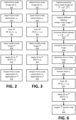
- a method for transferring micro-scale parameters to a renderable-scale image of a material sample is provided according to embodiments.
- a micro-scale image set I i , j r is input 201. Any approach may be used to capture the micro-scale images.
- a set of micro-scale parameters ⁇ j of the material is also input 202. Note that these sets can include data for any number micro-scale patches j of the material sample.
- the inputs are used to train 203 a neural network , for example, according to Equation 2.
- One or more renderable-scale images I R are input 204.
- the material parameters S2 are then output 206.
- the material parameters S2 are used to generate a property map associated with the renderable-scale image of the material, such as for example, a texture map.
- a method for transferring micro-scale parameters to a renderable-scale image of a material sample is provided according to embodiments.
- a micro-scale image set I i , j r is obtained 301.
- a micro-scale camera-based system with multiple illumination sources is used to sample one or more patches of a material sample.
- a set of micro-scale parameters ⁇ j of the material is also input 302. Note that these sets can include data for any number micro-scale patches j of the material sample.
- the inputs are used to train 303 a neural network , for example, according to Equation 2.
- One or more renderable-scale images I R are input 304.
- the training module 107 includes a data augmentation process for training the neural networks.
- data augmentation operations can be provided. It is worth noting that embodiments having an input set of micro-scale images 104i as multiple color images under different illumination sources already provides good performance for generalizing the micro-scale parameters 106j to new, unseen, images 112 with different potential illumination setups. However, a data augmentation process can further enhance the parameter transfer robustness to variations in the renderable-scale input images 112.
- the augmentation operations can include any form of augmentation of the input sets of images 104i or parameters 106j used for training. Some embodiments do not implement any augmentation, some embodiments implement a subset of augmentation operations, while other embodiments implement all the augmentation operations.
- the selection of augmentation operations to implement are left to the implementer depending on the intended application. For example, referring to FIG. 4 , a method for transferring micro-scale parameters to a renderable-scale image of a material sample using augmentation operations is provided according to some embodiments.
- a micro-scale image set I i , j r is input 401. Any approach may be used to capture the micro-scale images.
- a set of micro-scale parameters ⁇ j of the material is also input 402.
- the set of micro-scale parameters ⁇ j is also augmented 402A to an augmented micro-scale parameter set ⁇ j ′ by applying one or more augmentation operations.
- any number of augmented parameters ⁇ j ′ can be added to the augmented set for each augmentation operation.
- the augmented micro-scale image set I i ′ , j r and the augmented micro-scale parameter set ⁇ j ′ are used to train 403 a neural network , for example, according to Equation 2. Note that these sets can include data for any number micro-scale patches j of the material sample.
- the material parameters S2 are then output 506. For example, the material parameters S2 are used to generate a property map associated with the renderable-scale image of the material.
- any type of augmentation operations can be used to augment the input data set for training.
- one augmentation operation includes random rescaling of the input images 104i.
- the micro-scale details that are captured in the parameter estimation process 105 may not have the same scale in the image 112 of the material sample 101 for which the parameters 113 S2 are to be generated. The reason for this difference is not pertinent to the solution but may be due to perspective differences, misalignments, or due to random variations in the material sample 101.
- the training module 107 randomly rescales the set of input images 104 I i , j r and the set of parameters 106 ⁇ j to provide an augmented set of input images and an augmented set of input parameters for training the neural network so as to make scale-invariant.
- another augmentation operation can include random color variations. Even if the micro-structure of the material 101 is relatively homogeneous and can be estimated using only a small patch j , it may not be possible for the neural network to estimate this micro-structure for parts of the material with previously unseen colors. This can be easily solved by randomly permuting the input color channels of the input images104 I i , j r .
- the training module 107 randomly changes the values of the color channels in the set of input images104 I i , j r to provide an augmented set of input images, for example, same image with two or more added variants with randomly permutated color channels, for training the neural network so as to make color-invariant.
- the augmentation operations can include random cropping of input images 104.
- the training module 107 feeds the neural network with small images 104 I i , j r from randomly selected patches 102 of the material sample 101.
- the training module 107 can randomly crop the input images 104 I i , j r to provide an augmented set of input images, for example, same image with two or more added variants with randomly cropped sections of the original image, for training the neural network so as to make size-invariant.
- the augmentation operations can be combined, for example, by applying the random crop augmentation already augmented images sets, for example, randomly illuminated, randomly rescaled and/or randomly colored augmented image sets. Using some or all of these or other augmentation operations in the training process provides a considerable amount of variations of the same material in the input training data for the neural network , thus making the parameter transfer process more robust and as generalized as possible.
- Embodiments of a micro-scale parameter transfer framework according to this disclosure has many applications, including the estimation of render parameters, micro-geometry details or image segmentation masks. By way of example, some specific implementation embodiments are provided below.
- a physically-based Spatially Varying Bidirectional Reflectance Distribution Function (“SVBRDF") estimation.
- SVBRDF Spatially Varying Bidirectional Reflectance Distribution Function
- a method to estimate the spatially-varying BRDF parameters of a planar material from a set of micro and macroscopic image captures of the material is provided.
- the methods according to this embodiment are physically based, and supervised using only the data captured and the estimated parameters for the material.
- high-resolution information of small patches of the material captured at micro-scale are combined to feed a machine learning module that is able to extrapolate, or transfer, these parameters to a bigger patch of the material.
- a regression model of the machine learning module is trained using a scale-invariant approach, which allows the bigger patch image of the material to have any size, pixel resolution, and can be captured with any illumination or device.
- data obtained from an optical capture machine illustrates the operation of this framework for SVBRDFs defined by four different sets of parameters: albedo, specular, roughness, and normal maps.
- the use of four parameters is purely for illustration as any number of parameters may be used in other embodiments.
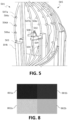
- an acquisition setup is provided that is capable of capturing micro-scale geometry and reflectance, with a particular focus on SVBRDF capture. While any capture system may be used according to this disclosure, in this embodiment a microscopic acquisition is provided with three primary components as illustrated in FIG. 5 : an LED light dome 501 which can illuminate the material at different angles, a machine vision camera 502 which captures the material at a microscopic resolution, and a material sample holder 503 in which the physical sample of the material is placed for optical capture. Additionally, a standard Digital Single Lens Reflex (“DSLR”) camera 505 (not shown) is placed in the dome structure to capture bigger patches of the material at a lower spatial resolution, which will be useful in the texture transfer method of this embodiment.
- DSLR Digital Single Lens Reflex
- a sample of a material for which the SVBRDF parameters are to be captured is lighted using a light dome shaped as an hemisphere which contains a number of white LEDs 506, for example between 70 and 100 LEDs 506, uniformly distributed around the azimuth and zenith angles of the material.
- a linear polarizing filter is placed at a fixed position, which allows for the estimation of the SVBRDF parameters.
- the light dome 501 also contains LED strips (not shown) placed uniformly around the structural rods 507 of the hemispheric dome 501, which are used to capture the material under diffuse lighting.
- a machine vision camera 502 e.g., a Genie TM Nano C4900 available from Teledyne DALSA of Waterloo, Ontario, Canada
- a lens 508 such as for example a Navitar ® MVL50M23 lens available from Navitar Industries, LLC, of Rochester, NY, is attached to the machine vision camera 502.
- This camera setup yields images of 8.9 ⁇ 6.7 mm, with a spatial resolution of 1.8 ⁇ m .
- the focus of the camera is controlled by translating it along the Z axis, using an electronic motor 509.
- a linear polarizer (not shown) capable of rotating to any desired position is placed.
- the polarizer allows for the separation of the diffuse and specular components of the material.
- HDR high-dynamic-range
- a commercially-available DSLR camera 505 such as for example an EOS 5DS R camera, available from Canon U.S.A., Inc. of Melville, New York, is provided for capturing larger patches of the material.
- a 4000 ⁇ 4000 pixels HDR image is obtained, which contains an 11 ⁇ 11 cm patch of the material. This size of image and material sample is suitable for creating texture maps that are useable by rendering engines for computer graphics applications.
- the capture setup is able to obtain high-resolution micro-scale geometry and reflectance measurements from trade-offs that need to be thought of, such as the amount, type and costs of the LEDs, the cost-effectiveness of the cameras and lenses, etc.
- trade-offs such as the amount, type and costs of the LEDs, the cost-effectiveness of the cameras and lenses, etc.
- linear polarizers in both the camera and the LEDs should be used to obtain an accurate, physically-based, separation of the different parts of the SVBRDF parameters to be captured.
- a method for a machine-learning based micro-scale parameter transfer is provided.
- Each image I i p is illuminated by a different light source i ⁇ S and two positions of the polarizer are placed in front of the camera sensor.
- These images have a field of view of 8.9 ⁇ 6.7 mm, and a spatial resolution of 1.8 ⁇ m .
- This set of images C j can be captured at multiple j locations of the material, creating a data-set of captures C .
- the material sample is then illuminated with diffuse lighting, and a macro-scale image of the material sample is captured 602, for example with a field of view of 110 ⁇ 110 mm, and a spatial resolution of 27 ⁇ m .
- This image I R represents an approximation of the reflectance of the surface of the material.
- micro-scale diffuse-specular parameters of the material and its normals are then obtained from these capture sets.
- the diffuse and specular components of the material's appearance are separated by using linear polarizers on the camera and each of the light sources. Due to this separation, the material is assumed to have lambertian properties (thus showing no specular reflections), and the surface normal can be computed using photometric stereo techniques.
- the use of polarized light and filters to separate diffuse and specular components provides the following: the first bounce of light, i.e. specular reflection, keeps the polarization state of the incoming light, while light that penetrates the material and is subject to multiple light bounces (e.g.
- one or more property maps for the material can be computed 604.
- a specular map the polarization filter that is placed on the camera is rotated by 90 degrees to obtain images with specular reflectance I i 90 .
- the filter at the camera is only blocking half of the subsurface scattering which is depolarized when leaving the material.
- the difference between I i 90 and I i 0 , images with orthogonal polarizations, yields the specular component associated with each light direction i , I i S I i 90 ⁇ I i 0 .
- a roughness map can also be computed 604.
- we simply compute the inverse of the specular map, by: k R 1 ⁇ k S
- the photometric normal map of the material can also be computed 604.
- the surface normal can be computed 604, for example, using the Photometric Stereo method [ see Woodham 1980].
- FIG. 7 illustrates a computed albedo map 701 and normal map 702 of a denim fabric according to this embodiment, which assumes the surface is lambertian under certain polarization conditions.
- the computed maps may be adjusted so they match the appearance of the material more accurately, by means of an optimization 605 procedure.
- This optimization algorithm can further modify the maps so as to take into account other factors, such as increasing their local smoothness, for instance.
- results of optimization of SVBRDF parameters according to one embodiment are illustrated.
- FIG. 8 illustrates the optimization of SVBRDF parameters for a sample denim fabric material.
- a specular map 801a and roughness maps 802a are shown before optimization and a specular map 801b and roughness map 802b are shown after optimization.
- a micro-scale texture stack ⁇ j is generated 606.
- the SVBRDF parameters obtained using the method according to this embodiment provides a physically-based, high-resolution representation of a very small patch of a material (for example, less than 1 cm 2 ).
- this material representation becomes the texture stack ⁇ j for micro-scale resolution, and it can include, but is not limited to, albedo, normals, roughness, specular, or opacity maps. Having a texture stack of such resolution can be useful for understanding several properties of the material due to its microstructure that are otherwise impossible to observe at a normal viewing range.
- micro-scale properties are due to microstructures in the 10 to 20 micron range, which typical render-scale imaging systems cannot capture nor can human eyes perceive.
- this micro-scale texture stack is of little use for applications of computer graphics that require tiling the texture to fit an object of a bigger scale.
- one problem that arises with such small textures are repeating artifacts.
- a potential solution would be to directly capture this data at a bigger scale, such as done by recent methods [Gao et al. 2019], however, details of the micro-geometry would be missing. These details are useful for estimating complex parameters of the material, such as for example, depth, transmittance, or fly-out fibers in fabrics.
- a deep learning neural network can be trained 607.
- the transfer framework for this embodiment generally follows the specifications for the general framework description of the embodiments described before.
- One of aspect of this SVBRDF transfer framework embodiment is that it is entirely physically-based.
- the neural network is trained only with these physically correct parameters, using only one material sample as input. Accordingly, the result of the transfer algorithm is also physically accurate, in contrast to other SVBRDF models, which hallucinate the texture maps from different materials.
- ground-truth values for all the maps in ⁇ j are obtained in this embodiment, the mean intensity and variance for every map can be computed. These ground-truth-based values can then be exactly transferred to the output maps ⁇ j , in part thanks to the standardization approach used in this embodiment.
- the estimated maps will thus be physically accurate having the same mean and variance values as the ground-truth maps, which are by definition physically accurate.
- the network can be applied 608 to larger, renderable-scale images I R of the material.
- the application 608 of neural network to an image of a larger patch of the same material I R transfers the micro-geometry details found in high-resolution texture stack ⁇ j into that image. Many real-world materials, like fabrics, show these characteristics.
- the deep learning neural network is able to output 609 the physically correct material property map, S2, of a bigger patch of the same material given a single image as input I R .
- This input image can be of any size and illumination.
- the I R used for as input for this embodiment during the estimation time was taken under controlled conditions (measured and calibrated Camera Response Function, LED intensities, controlled spatial resolution, etc.). This allowed the use of the I R as an approximation to the albedo image that the SVBRDF model needs.
- embodiments of machine learning frameworks according to this disclosure provide standardization and data augmentation policies to increase robustness in transfer performance. For example, even if the color of input images I R does not exactly match what was captured in the input data set C, the transfer network is able to learn to ignore those differences and output physically-based material property maps, including for example, as discussed below, realistic yarn segmentation maps.
- the transfer setup may be uncontrolled situations. One of which is related to geometry shifts or variations in the input renderable-scale image I R . If, for example, the device used to capture the input image I R is not correctly placed (e.g. the sensor is not coplanar to the material sample), perspective shifts may happen, which may make the transfer work sub-optimally.
- the SVBRDF estimation framework can be extended. More precisely, the albedo ⁇ j for each C j patch can be computed and the texture stacks ⁇ j can be extended to include those computed albedos ⁇ j .
- the transfer network thus learns to estimate the albedo from any image I i , j r , which generalizes when estimating material property maps ⁇ given I R .
- FIG. 9 provides a block diagram illustrating an overview of the texture transfer process according to embodiments.
- a training block 901 illustrates the training of neural network (U-NET) 902 to find a mapping between each of input images I d ( ⁇ l ) 903 to computed surface normal, roughness and specular maps in micro-scale texture stacks ⁇ j 904.
- an evaluation block 905 illustrates the input of the image 906 to neural network (U-NET) 902 and the output of the texture stack S2 907, with its normal, roughness and specular and maps.
- the material property maps generated using the transfer framework of this disclosure can then be used for any visual computing application that relies on texture maps, or more broadly property maps, of materials for their operation.
- garment design and virtual modeling, motion capture applications, biomechanics and ergonomics design and simulation, education, business, virtual and augmented reality shopping, and entertainment applications including animation and computer graphics for digital movies, interactive gaming and videos, human, animal, or character simulations, virtual and augmented reality applications, robotics, computer vision, classification and recognition applications, and the like.
- rendering systems use material property maps to realistically model the visual properties of fabrics and other materials on the computer generated graphics of the fabric or material.
- the generated graphics may be used for on-screen display of images, such as video frames, in all sorts of applications, including virtual reality headsets, computer monitor screens, mobile device screens, and the like.
- the generated images may be downloaded, streamed, or otherwise transferred from a server-based system to one or more client devices for display.
- the effect of interaction between the material and the simulated lighting, gravity, and other physical world properties is rendered by the rendering system and displayed based on the material's property maps. These effects include photo-realistic still images, augmented reality videos, virtual reality animations, and all other forms of computer graphics.
- property maps can be used in computer vision applications to recognize specific materials or objects using computer vision.
- the micro-to-macro transfer framework of the embodiments described above can be used in many other scenarios.
- one such use is for solving the single-image semi-supervised yarn segmentation problem.
- a user provides masks for some of the yarns that appear in a input image and the neural network must learn to transfer this segmentation into the rest of the image.
- FIG. 10 a block diagram illustrating an overview of a segmentation transfer process according to this embodiment is shown.
- a training block 1001 illustrates the training of neural network (U-NET) 1002 to find a mapping between a small crop of an input image I d ( ⁇ l ) 1003 to user-provided yarn segmentations 1004.
- U-NET neural network
- an evaluation block 1005 illustrates the input of an albedo image 1006 to neural network (U-NET) 1002 and the output of the segmentation of the yarns of the full albedo image 1007.
- U-NET neural network
- a user provides as input an identification of the segments of the yarn in a small patch j around the center of an input image I d .
- the neural network is trained to map crops of the input image I d to their corresponding user-provided segmentation. When fully trained, the network is able to segment all the yarns in the image correctly.
- realistic graphics with modeled materials are computed at the servers and communicated to client systems for display.
- the modules may be implemented in client systems, for example, in design applications or client-based graphics applications, such as for example computer gaming applications.
- a software module is implemented with a computer program product comprising a computer-readable medium containing computer program code, which can be executed by a computer processor for performing any or all of the steps, operations, or processes described.
- Embodiments may also relate to an apparatus for performing the operations herein.
- This apparatus may be specially constructed for the required purposes, and/or it may comprise a general-purpose computing device selectively activated or reconfigured by a computer program stored in the computer.
- a computer program may be stored in a non-transitory, tangible computer readable storage medium, or any type of media suitable for storing electronic instructions, which may be coupled to a computer system bus.
- any computing systems referred to in the specification may include a single processor or may be architectures employing multiple processor designs for increased computing capability.
- the language used in the specification has been principally selected for readability and instructional purposes, and it may not have been selected to delineate or circumscribe the inventive subject matter.
Landscapes
- Engineering & Computer Science (AREA)
- Physics & Mathematics (AREA)
- General Physics & Mathematics (AREA)
- Theoretical Computer Science (AREA)
- Computer Vision & Pattern Recognition (AREA)
- Artificial Intelligence (AREA)
- Evolutionary Computation (AREA)
- Image Analysis (AREA)
Applications Claiming Priority (1)
| Application Number | Priority Date | Filing Date | Title |
|---|---|---|---|
| PCT/ES2020/070336 WO2021234190A1 (es) | 2020-05-22 | 2020-05-22 | Generación de un mapa de propiedades de un material a partir de un modelo informático del material, basado en un conjunto de imágenes a microescala |
Publications (1)
| Publication Number | Publication Date |
|---|---|
| EP4156110A1 true EP4156110A1 (de) | 2023-03-29 |
Family
ID=71670280
Family Applications (1)
| Application Number | Title | Priority Date | Filing Date |
|---|---|---|---|
| EP20742790.7A Pending EP4156110A1 (de) | 2020-05-22 | 2020-05-22 | Erzeugung einer materialeigenschaftskarte eines computermodells eines materials auf basis eines satzes von mikroskaligen bildern |
Country Status (3)
| Country | Link |
|---|---|
| US (1) | US20230145496A1 (de) |
| EP (1) | EP4156110A1 (de) |
| WO (1) | WO2021234190A1 (de) |
Families Citing this family (7)
| Publication number | Priority date | Publication date | Assignee | Title |
|---|---|---|---|---|
| US12211225B2 (en) * | 2021-04-15 | 2025-01-28 | Adobe Inc. | Scene reconstruction using geometry and reflectance volume representation of scene |
| US11961188B2 (en) * | 2022-06-08 | 2024-04-16 | Adobe Inc. | Neural networks to generate appearance-responsive material map sets in digital graphical environments |
| GB2624375B (en) * | 2022-11-09 | 2024-12-11 | Sony Interactive Entertainment Europe Ltd | Systems and methods for anti-aliasing |
| CN116934308B (zh) * | 2023-09-15 | 2023-12-15 | 浙江恒逸石化有限公司 | 丝路巡检设备的控制方法、装置、设备以及存储介质 |
| US20250148703A1 (en) * | 2023-11-07 | 2025-05-08 | Nvidia Corporation | 3d object reconstruction |
| CN118967901B (zh) * | 2024-10-21 | 2025-06-06 | 浙江大学 | 一种融合非对齐时空信息的超分辨率渲染方法和装置 |
| CN119648774A (zh) * | 2024-12-17 | 2025-03-18 | 吉林农业大学 | 一种基于深度学习的羊毛细度测定方法及系统 |
Family Cites Families (8)
| Publication number | Priority date | Publication date | Assignee | Title |
|---|---|---|---|---|
| US7012615B2 (en) * | 2004-02-12 | 2006-03-14 | Pixar | Using polynomial texture maps for micro-scale occlusions |
| US8386015B2 (en) | 2008-10-27 | 2013-02-26 | Siemens Aktiengesellschaft | Integration of micro and macro information for biomedical imaging |
| EP2686676A4 (de) * | 2011-03-17 | 2015-04-01 | Univ New York | Systeme, verfahren und computerlesbare medien zur authentifizierung und echtheitsprüfung physischer objekte |
| WO2018120043A1 (zh) * | 2016-12-30 | 2018-07-05 | 华为技术有限公司 | 图像重建方法及装置 |
| US10430978B2 (en) * | 2017-03-02 | 2019-10-01 | Adobe Inc. | Editing digital images utilizing a neural network with an in-network rendering layer |
| US10810469B2 (en) * | 2018-05-09 | 2020-10-20 | Adobe Inc. | Extracting material properties from a single image |
| WO2019229293A1 (en) * | 2018-05-31 | 2019-12-05 | Nokia Technologies Oy | An apparatus, a method and a computer program for volumetric video |
| JP7445176B2 (ja) * | 2020-09-09 | 2024-03-07 | 日本電信電話株式会社 | 位置推定方法、位置推定装置及びプログラム |
-
2020
- 2020-05-22 EP EP20742790.7A patent/EP4156110A1/de active Pending
- 2020-05-22 WO PCT/ES2020/070336 patent/WO2021234190A1/es not_active Ceased
- 2020-05-22 US US17/917,599 patent/US20230145496A1/en not_active Abandoned
Also Published As
| Publication number | Publication date |
|---|---|
| US20230145496A1 (en) | 2023-05-11 |
| WO2021234190A1 (es) | 2021-11-25 |
Similar Documents
| Publication | Publication Date | Title |
|---|---|---|
| EP4156110A1 (de) | Erzeugung einer materialeigenschaftskarte eines computermodells eines materials auf basis eines satzes von mikroskaligen bildern | |
| Song et al. | Neural illumination: Lighting prediction for indoor environments | |
| LeGendre et al. | Deeplight: Learning illumination for unconstrained mobile mixed reality | |
| Yu et al. | Self-supervised outdoor scene relighting | |
| Deschaintre et al. | Single-image svbrdf capture with a rendering-aware deep network | |
| Griffiths et al. | OutCast: Outdoor Single‐image Relighting with Cast Shadows | |
| Dib et al. | Practical face reconstruction via differentiable ray tracing | |
| US11451758B1 (en) | Systems, methods, and media for colorizing grayscale images | |
| CN105704479B (zh) | 3d显示系统用的测量人眼瞳距的方法及系统和显示设备 | |
| Godard et al. | Multi-view reconstruction of highly specular surfaces in uncontrolled environments | |
| Azinović et al. | High-res facial appearance capture from polarized smartphone images | |
| Tsiminaki et al. | High resolution 3d shape texture from multiple videos | |
| Czajkowski et al. | Two-edge-resolved three-dimensional non-line-of-sight imaging with an ordinary camera | |
| KR20250108619A (ko) | 외관 캡처 | |
| Song et al. | Real-time shadow-aware portrait relighting in virtual backgrounds for realistic telepresence | |
| GB2627232A (en) | Obtaining spatially varying reflectance with inverse rendering | |
| Liang et al. | Research on face specular removal and intrinsic decomposition based on polarization characteristics | |
| US20240394964A1 (en) | Method of determining illumination pattern for three-dimensional scene and method and apparatus for modeling three-dimensional scene | |
| Wang et al. | Decoloration of multi-color fabric images for fabric appearance smoothness evaluation by supervised image-to-image translation | |
| Karaduzovic-Hadziabdic et al. | Subjective and objective evaluation of multi-exposure high dynamic range image deghosting methods | |
| WO2024227199A2 (en) | Systems and methods for selecting motion models for aligning scene content captured by different image sensors | |
| KR20240169499A (ko) | 3차원 장면을 위한 조명 패턴 결정 방법, 및 3차원 장면을 모델링하는 방법 및 장치 | |
| Ruan et al. | Light Field Synthesis from a Single Image using Improved Wasserstein Generative Adversarial Network. | |
| RU2757563C1 (ru) | Способ визуализации 3d портрета человека с измененным освещением и вычислительное устройство для него | |
| Mora et al. | Visualization and computer graphics on isotropically emissive volumetric displays |
Legal Events
| Date | Code | Title | Description |
|---|---|---|---|
| STAA | Information on the status of an ep patent application or granted ep patent |
Free format text: STATUS: UNKNOWN |
|
| STAA | Information on the status of an ep patent application or granted ep patent |
Free format text: STATUS: THE INTERNATIONAL PUBLICATION HAS BEEN MADE |
|
| PUAI | Public reference made under article 153(3) epc to a published international application that has entered the european phase |
Free format text: ORIGINAL CODE: 0009012 |
|
| STAA | Information on the status of an ep patent application or granted ep patent |
Free format text: STATUS: REQUEST FOR EXAMINATION WAS MADE |
|
| 17P | Request for examination filed |
Effective date: 20221026 |
|
| AK | Designated contracting states |
Kind code of ref document: A1 Designated state(s): AL AT BE BG CH CY CZ DE DK EE ES FI FR GB GR HR HU IE IS IT LI LT LU LV MC MK MT NL NO PL PT RO RS SE SI SK SM TR |
|
| DAV | Request for validation of the european patent (deleted) | ||
| DAX | Request for extension of the european patent (deleted) | ||
| STAA | Information on the status of an ep patent application or granted ep patent |
Free format text: STATUS: EXAMINATION IS IN PROGRESS |
|
| 17Q | First examination report despatched |
Effective date: 20250502 |