EP4156699A2 - Télécommande pour régler un mode en fonction de l'état d'un appareil de réception de diffusion - Google Patents
Télécommande pour régler un mode en fonction de l'état d'un appareil de réception de diffusion Download PDFInfo
- Publication number
- EP4156699A2 EP4156699A2 EP22207960.0A EP22207960A EP4156699A2 EP 4156699 A2 EP4156699 A2 EP 4156699A2 EP 22207960 A EP22207960 A EP 22207960A EP 4156699 A2 EP4156699 A2 EP 4156699A2
- Authority
- EP
- European Patent Office
- Prior art keywords
- remote control
- signal
- state
- controller
- communicator
- Prior art date
- Legal status (The legal status is an assumption and is not a legal conclusion. Google has not performed a legal analysis and makes no representation as to the accuracy of the status listed.)
- Pending
Links
Images


Classifications
-
- H—ELECTRICITY
- H04—ELECTRIC COMMUNICATION TECHNIQUE
- H04Q—SELECTING
- H04Q9/00—Arrangements in telecontrol or telemetry systems for selectively calling a substation from a main station, in which substation desired apparatus is selected for applying a control signal thereto or for obtaining measured values therefrom
- H04Q9/04—Arrangements for synchronous operation
-
- H—ELECTRICITY
- H04—ELECTRIC COMMUNICATION TECHNIQUE
- H04N—PICTORIAL COMMUNICATION, e.g. TELEVISION
- H04N21/00—Selective content distribution, e.g. interactive television or video on demand [VOD]
- H04N21/40—Client devices specifically adapted for the reception of or interaction with content, e.g. set-top-box [STB]; Operations thereof
- H04N21/41—Structure of client; Structure of client peripherals
- H04N21/422—Input-only peripherals, i.e. input devices connected to specially adapted client devices, e.g. global positioning system [GPS]
- H04N21/42204—User interfaces specially adapted for controlling a client device through a remote control device; Remote control devices therefor
- H04N21/42206—User interfaces specially adapted for controlling a client device through a remote control device; Remote control devices therefor characterized by hardware details
- H04N21/42208—Display device provided on the remote control
-
- H—ELECTRICITY
- H04—ELECTRIC COMMUNICATION TECHNIQUE
- H04N—PICTORIAL COMMUNICATION, e.g. TELEVISION
- H04N21/00—Selective content distribution, e.g. interactive television or video on demand [VOD]
- H04N21/40—Client devices specifically adapted for the reception of or interaction with content, e.g. set-top-box [STB]; Operations thereof
- H04N21/41—Structure of client; Structure of client peripherals
- H04N21/4104—Peripherals receiving signals from specially adapted client devices
- H04N21/4126—The peripheral being portable, e.g. PDAs or mobile phones
- H04N21/41265—The peripheral being portable, e.g. PDAs or mobile phones having a remote control device for bidirectional communication between the remote control device and client device
-
- H—ELECTRICITY
- H04—ELECTRIC COMMUNICATION TECHNIQUE
- H04N—PICTORIAL COMMUNICATION, e.g. TELEVISION
- H04N21/00—Selective content distribution, e.g. interactive television or video on demand [VOD]
- H04N21/40—Client devices specifically adapted for the reception of or interaction with content, e.g. set-top-box [STB]; Operations thereof
- H04N21/41—Structure of client; Structure of client peripherals
- H04N21/422—Input-only peripherals, i.e. input devices connected to specially adapted client devices, e.g. global positioning system [GPS]
- H04N21/42204—User interfaces specially adapted for controlling a client device through a remote control device; Remote control devices therefor
-
- H—ELECTRICITY
- H04—ELECTRIC COMMUNICATION TECHNIQUE
- H04N—PICTORIAL COMMUNICATION, e.g. TELEVISION
- H04N21/00—Selective content distribution, e.g. interactive television or video on demand [VOD]
- H04N21/40—Client devices specifically adapted for the reception of or interaction with content, e.g. set-top-box [STB]; Operations thereof
- H04N21/41—Structure of client; Structure of client peripherals
- H04N21/422—Input-only peripherals, i.e. input devices connected to specially adapted client devices, e.g. global positioning system [GPS]
- H04N21/42204—User interfaces specially adapted for controlling a client device through a remote control device; Remote control devices therefor
- H04N21/42206—User interfaces specially adapted for controlling a client device through a remote control device; Remote control devices therefor characterized by hardware details
- H04N21/42222—Additional components integrated in the remote control device, e.g. timer, speaker, sensors for detecting position, direction or movement of the remote control, microphone or battery charging device
-
- H—ELECTRICITY
- H04—ELECTRIC COMMUNICATION TECHNIQUE
- H04N—PICTORIAL COMMUNICATION, e.g. TELEVISION
- H04N5/00—Details of television systems
- H04N5/63—Generation or supply of power specially adapted for television receivers
Definitions
- Apparatuses consistent with the present invention relate to a remote controller, and more particularly, to a remote controller which receives a user command for controlling a broadcast receiving apparatus, and transmits the received command to the broadcast receiving apparatus.
- a remote controller is an electronic device used for the remote operation of a machine.
- the remote controller is widely used to manipulate a television (TV).
- TV television
- the remote controller transmits a command received from a user to a TV via infrared (IR) radiation.
- IR radiation is electromagnetic radiation of a wavelength shorter than that of microwaves. IR radiation cannot penetrate objects, and is inappropriate to transfer massive information.
- a remote controller using radio frequency (RF) communication is provided.
- RF radio frequency
- Exemplary embodiments of the present invention address at least the above problems and/or disadvantages and other disadvantages not described above. Also, the present invention is not required to overcome the disadvantages described above, and an exemplary embodiment of the present invention may not overcome any of the problems described above.
- the present invention provides a remote control apparatus which sets an operation mode according to information regarding a state of a broadcast receiving apparatus received from the broadcast receiving apparatus to reduce power consumption, and a method for setting a mode thereof.
- the present invention also provides a broadcast receiving apparatus which transmits information regarding a state of the broadcast receiving apparatus to a remote control apparatus in order to set an operation mode of the remote control apparatus according to the information regarding the state of the broadcast receiving apparatus.
- a remote control apparatus comprising a communication module which is connected to a broadcast receiving apparatus for communication; a user input unit which receives a user command regarding the broadcast receiving apparatus; and a controller which transmits the user command input through the user input unit to the broadcast receiving apparatus through the communication module, and sets an operation mode according to information regarding a state of the broadcast receiving apparatus received from the broadcast receiving apparatus through the communication module.
- the controller may set the remote control apparatus to a mode to consume less power.
- the predetermined state may represent that the broadcast receiving apparatus is turned off.
- the controller may set the remote control apparatus to a first mode in which power consumption is reduced, and if the user command is not input through the user input unit for a predetermined time, the controller may set the remote control apparatus to a second mode in which power consumption is reduced.
- the controller may set the remote control apparatus to active mode.
- the remote control apparatus may further comprise a display, wherein if it is determined that video information is received from the broadcast receiving apparatus through the communication module, the controller may activate the display, and display the received information on the display.
- the video information may comprise at least one of: information stored in the broadcast receiving apparatus; information acquired by the broadcast receiving apparatus from an external source; information to inform a user of a predetermined condition; and information relating to states of devices adjacent to the broadcast receiving apparatus.
- the user input unit may receive the user command by detecting at least one of a user manipulation of elements of the remote control apparatus, and the user moving the remote control apparatus.
- a method for setting a mode of a remote control apparatus connected to a broadcast receiving apparatus for communication comprising transmitting an input user command to the broadcast receiving apparatus; and setting an operation mode of the remote control apparatus according to information regarding a state of the broadcast receiving apparatus received from the broadcast receiving apparatus.
- the setting may set the remote control apparatus to a mode to consume less power.
- the predetermined state may represent that the broadcast receiving apparatus is turned off.
- the setting may set the remote control apparatus to a first mode to consume less power, and if the user command is not input through the user input unit for a predetermined time, the setting may set the remote control apparatus to a second mode to consume less power.
- the setting may set the remote control apparatus to an active mode.
- the method may comprise activating a display if video information is received from the broadcast receiving apparatus; and displaying the received video information on the display.
- the video information may comprise at least one of: information stored in the broadcast receiving apparatus; information acquired by the broadcast receiving apparatus from an external source; information to inform a user of a predetermined condition; and information relating to states of devices adjacent to the broadcast receiving apparatus.
- the user command may be input by detecting at least one of a user manipulation of elements of the remote control apparatus, and the user moving the remote control apparatus.
- a broadcast receiving apparatus which receives broadcast, and provides a user with the received broadcast
- the apparatus comprising a communication module which is connected to a remote control apparatus for communication; and a controller which controls the broadcast receiving apparatus according to a user command input from the remote control apparatus through the communication module, and transmits information regarding a state of the broadcast receiving apparatus to the remote control apparatus through the communication module in order to set an operation mode of the remote control apparatus according to the information regarding a state of the broadcast receiving apparatus.
- the state of the broadcast receiving apparatus may comprise at least one of a power off state and a power on state
- the operation mode of the remote control apparatus may comprise a mode to consume less power of the remote control apparatus.
- the controller may transmit the user command input through an operating element of the broadcast receiving apparatus to the remote control apparatus through the communication module.
- a method for controlling a broadcast receiving apparatus which receives broadcast, and provides a user with the received broadcast, the apparatus comprising controlling the broadcast receiving apparatus according to a user command input from a remote control apparatus; and transmitting information regarding a state of the broadcast receiving apparatus to the remote control apparatus in order to set an operation mode of the remote control apparatus according to the information regarding a state of the broadcast receiving apparatus.
- the state of the broadcast receiving apparatus may comprise at least one of a power off state and a power on state
- the operation mode of the remote control apparatus may comprise a mode to consume less power of the remote control apparatus.
- the method may further comprise transmitting the user command input through an operating element of the broadcast receiving apparatus to the remote control apparatus.
- a broadcast receiving system comprising a remote control apparatus which transmits an input user command; and a broadcast receiving apparatus which controls an operation according to the user command received from the remote control apparatus, and transmits information regarding a state thereof to the remote control apparatus, wherein the remote control apparatus sets an operation mode thereof according to the information received from the broadcast receiving apparatus.
- FIG. 1 is a view of illustrating a broadcast receiving system applicable to the present invention.
- a broadcast receiving system comprises a DTV 100 as a broadcast receiving apparatus and a remote controller 200.
- the DTV 100 provides a user with broadcast received over wire or wirelessly, and the remote controller 200 receives user inputs regarding the DTV 100.
- the DTV 100 and the remote controller 200 are communicably linked to each via radio frequency (RF) communication.
- the remote controller 200 may transmit the input user command to the DTV 100.
- the DTV 100 comprises a DTV function block 110, a DTV controller 120, and a DTV communication module 130 as illustrated in FIG. 1 .
- the DTV function block 110 performs basic functions of the DTV 100. That is, the DTV function block 110 receives a digital broadcast signal, demodulates the received digital broadcast signal, decodes the demodulated digital broadcast signal, processes the decoded digital broadcast signal, and outputs the processed digital broadcast signal to provide a user with digital broadcast.
- the DTV communication module 130 is communicably linked to the remote controller 200 for RF communication.
- the DTV controller 120 controls the operation of the DTV function block 110 according to a user command which is received from the remote controller 200 through the DTV communication module 130.
- the DTV controller 120 transmits information regarding a state of the operation of the DTV 100 to the remote controller 200 through the DTV communication module 130.
- the operation state of the DTV 100 may include power on and off states.
- the remote controller 200 comprises a remote control communication module 210, a remote control controller 220, a user input unit 230, and a display 240.
- the remote control communication module 210 is communicably linked to the DTV 100 for RF communication.
- the user input unit 230 comprises a motion sensor 232 and a button input unit 234 to receive a user command.
- the motion sensor 232 senses movement of the remote controller 200 according to a user manipulation, and transmits the sensed result to the remote control controller 220.
- a user moves the remote controller 200 up or down, or to the right or left, or rotates the remote controller 200 while holding the remote controller 200.
- the motion sensor 232 senses a direction and degree of movement of the remote controller 200, and transmits the sensed result to the remote control controller 220.
- the movement of the remote controller 200 may be processed as a user command. For example, if a user moves the remote controller 200 up or down, or to the right or left, this may be input as a command directing to move a curser or a pointer on the DTV 100 up or down, or to the right or left.
- the motion sensor 232 may be embodied as a gyro sensor to perform the above functions.
- the button input unit 234 may comprise a power button, a volume button, and a selection button, and a user may input a desired command by pressing a corresponding button.
- the remote control controller 220 transmits a user command input through the user input unit 230 to the DTV 100 through the remote control communication module 210.
- the remote control controller 220 sets an operation mode of the remote controller 200 based on a DTV operation state and a user command input state representing that a user has not input the remote controller 200 for a predetermined period of time.
- the remote control controller 220 sets the remote controller to an active mode, an idle mode, or a sleep mode according to the above two states, which will be explained below in detail.
- FIG. 2 is a view illustrating the operation between the remote controller 200 and the DTV 100 when a user desires to turn on the DTV using the remote controller 200.
- the remote controller 200 is in the sleep mode (S305), and the DTV 100 is in a power off state (S310).
- the DTV 100 In the sleep mode, the DTV 100 is placed in a state of waiting for a power on command and the remote controller 200 only operates to sense a user pressing on the power button.
- the DTV controller 120 and the DTV communication module 130 are in an activation state to receive a user command transmitted from the remote controller 200.
- the remote control controller 220 senses that the power button is pressed, and activates the remote control communication module 210 (S330). The remote control controller 220 transmits a power on command to the DTV 100 through the remote control communication module 210 (S340).
- the DTV controller 120 of the DTV 100 receives the power on command transmitted in operation S340 through the DTV communication module 130 (S350).
- the DTV controller 120 activates the DTV function block 110 to turn on the DTV 100 (S360).
- the DTV controller 120 transmits information regarding a state of the DTV 100, that is a power on state, to the remote controller 200 through the DTV communication module 130 (S370).
- the remote control controller 220 receives the information regarding the state of the DTV 100 transmitted in operation S370 through the remote control communication module 210 (S380).
- the remote control controller 220 determines the power on state of the DTV 100 from the information received from the DTV 100, and activates the display 240, the motion sensor 232, the button input unit 234, and all the buttons of the button input unit 234 excluding the power button to change the remote controller 200 to active mode (S390).
- the remote controller 200 is in the active mode (S405), and the DTV 100 is in a power on state (S410).
- the remote control controller 220 senses the input user command, and transmits the sensed user command to the DTV 100 through the remote control communication module 210 (S430).
- the input of the user command in operation S420 is determined according to: i) whether the motion sensor 232 senses movement of the remote controller 200; or ii) according to whether a user presses a button of the button input unit 234.
- the DTV controller 120 of the DTV 100 receives the user command transmitted in operation S430 through the DTV communication module 130 (S440).
- the DTV controller 120 controls the DTV function block 110 to carry out the received user command (S450).
- the remote control controller 220 sets the remote controller 200 to the idle mode (S470).
- the display 240 is set to an inactivation state, and the remote communication module 210, the motion sensor 232, and the button input unit 234 are maintained in an activation state.
- the remote control controller 220 sets the display 240 to an inactivation state.
- the remote control controller 220 sets the remote controller 200 to the active mode (S490).
- the remote control controller 220 sets the display inactivated by operation S470 to an activation state. After performing operation S490, the operation returns to operation S430.
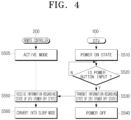
- FIG. 4 is a view illustrating the operation between the remote controller 200 and the DTV 100 when a use desires to turn off the DTV 1100 using a power button of the DTV 100 instead of the remote controller 200.
- the remote controller 200 is in the active mode (S505), and the DTV 100 is in a power on state (S510).
- the DTV controller 120 senses that the power button is pressed, and transmits information regarding a state of the DTV 100, that is a power off state, to the remote controller 200 through the DTV communication module 130 (S530).
- the DTV controller 120 inactivates the DTV function block 110 of the DTV 100 to turn off the DTV 100 (S540).
- the remote control controller 220 receives the information regarding the state of the DTV 100 transmitted in operation S530 through the remote control communication module 210 (S550).
- the remote control controller 200 perceives that the DTV 100 is turned off based on the received information, and inactivates the remote control communication module 210, the display 240, the motion sensor 232, and all the buttons of the button input unit 234 excluding the power button to set the remote controller 200 to the sleep mode (S560). That is, in operation S560, only the function to sense whether the power button is input is activated, while the rest of the functions are inactivated.
- FIG. 4 describes the operation between the remote controller 200 and the DTV 100 when a user desires to turn off the DTV 100 using the power button of the DTV 100.
- the user may use a power button of the remote controller 200 instead of the power button of the DTV 100 to turn off the DTV 100.
- the remote control controller 220 senses that the user inputs the power button of the remote controller 200, and transmits a power off command to the DTV 100 through the remote control communication module 210.
- the DTV controller 120 receives the power off command through the DTV communication module 130, and inactivates the DTV function block 110 to turn off the DTV 100.
- the DTV controller 120 transmits information regarding a state of the DTV 100, that is a power off state to the remote controller 220 through the DTV communication module 130.
- the remote control controller 220 receives the information regarding the power off state of the DTV 100 through the remote control communication module 210.
- the remote control controller 220 perceives the power off state of the DTV 100 based on the received information, and thus sets the remote controller 200 to the sleep mode.
- the remote controller 200 when a user presses the power button of the DTV 100 to turn off the DTV 100, the remote controller 200 is set to the sleep mode.
- this is merely an exemplary embodiment of the present invention for a convenient description.
- the remote controller 200 when the user presses the power button of the DTV 100 to turn on the DTV 100, it is possible for the remote controller 200 to be set to the active mode.
- the user input unit 230 includes the motion sensor 232 to sense the movement of the remote controller 200 and the button input unit 234 to receive a user command.
- the user input unit 230 may employ other devices such as a touch screen, a joystick, and a jog wheel, and a user may input a user command using such devices.
- the state of the DTV 100 is classified as a power on and power off states according to the exemplary embodiments of the present invention, this is merely an exemplary embodiment of the present invention. Accordingly, other states of the DTV 100 are applicable to the present invention. For example, when the DTV 100 is in idle state, or is connected to external apparatuses, the remote controller 200 may be set to a predetermined mode.
- the operation mode of the remote controller 200 is classified as the active mode, the idle mode, and the sleep mode in the exemplary embodiment of the present invention. As this is merely an exemplary embodiment of the present invention, the operation mode of the remote controller 200 may be classified as other modes.
- any low power consuming modes for the remote controller 200 may be applicable to replace the idle or sleep mode of the present invention. That is, the other modes with different names of descriptions may be applied to the present invention.
- the exemplary embodiments of the present invention also do not limit that the remote controller 200 should be set to a lower power consuming mode upon determining the DTV to be in a predetermined state. Therefore, other modes are applicable to the remote controller 200 according to the exemplary embodiment of the present invention.
- the remote controller 200 may be set to a mode for activating the display 240, and display the received video information on the display 240.
- the video information may be information stored in the DTV 100, information acquired from an external source such as external apparatus or the Internet, information informing a user of a predetermined state, or information regarding a state of devices adjacent to the DTV 100.
- the information informing a user of a predetermined state may include a notification that a predetermined alarm time has expired, and the information regarding a state of devices adjacent to the DTV 100 may include a notification that a short message service (SMS) is received in a mobile phone.
- SMS short message service
- the DTV 100 is connected to the remote controller 200 for the RF communication in the exemplary embodiment of the present invention described above, this is merely an exemplary embodiment of the present invention.
- the DTV 100 may be connected to the remote controller 200 for other communication.
- DTV 100 is described as a broadcast receiving apparatus, other broadcast receiving apparatuses may be applied to the present invention, such as other electric devices.
- an operation mode of a remote control apparatus can be set automatically according to information regarding a state of a broadcast receiving apparatus. Accordingly, less power is consumed in the remote control apparatus than in a conventional remote control apparatus.
- the present invention provides: a remote control apparatus for controlling a broadcast receiving apparatus, the remote control apparatus comprising:
- the processor is further configured to change the operation state of the communicator of the remote control apparatus from the active state to the sleep state based on information regarding the power status of the broadcast receiving apparatus transmitted by the broadcast receiving apparatus in response to the control signal to control the power status of the broadcast receiving apparatus.
- the communication connection is disconnected in the sleep state.
- the processor is configured to, based on changing the operation state of the communicator of the remote control apparatus from the sleep state to the active state, control the communicator to transmit a request to the broadcast receiving apparatus via the communication connection to turn on the broadcast receiving apparatus.
- the communication connection is a radio frequency connection.
- the apparatus further comprises:
- the apparatus further comprises:
- the processor is configured to, in response to receiving the information regarding the power status of the broadcast receiving apparatus transmitted by the broadcast receiving apparatus, change the operation state of the display or the sensor from the active state to the sleep state.
- the present invention provides an electronic system comprising a broadcast receiving apparatus and a remote control apparatus for controlling the broadcast receiving apparatus,
- the first processor is further configured to change the operation state of the first communicator of the remote control apparatus from the active state to the sleep state based on the information regarding the power status of the broadcast receiving apparatus transmitted by the broadcast receiving apparatus in response to the control signal to control the power status of the broadcast receiving apparatus.
- the communication connection is disconnected in the sleep state.
- the first processor is configured to, based on changing the operation state of the first communicator of the remote control apparatus from the sleep state to the active state, control the first communicator to transmit a request to the broadcast receiving apparatus via the communication connection to turn on the broadcast receiving apparatus.
- the communication connection is a radio frequency connection.
- the remote control apparatus further comprises a display, wherein the first processor is configured to change the operation state of the display of the remote control apparatus from the sleep state to the active state to display an image based on information received from the broadcast receiving apparatus via the communication connection.
- the remote control apparatus further comprises a sensor, and wherein the first processor is configured to change the operation state of the sensor of the remote control apparatus from the sleep state to the active state to sense a movement of the remote control apparatus based on information received from the broadcast receiving apparatus via the communication connection.
Landscapes
- Engineering & Computer Science (AREA)
- Multimedia (AREA)
- Signal Processing (AREA)
- Human Computer Interaction (AREA)
- Computer Networks & Wireless Communication (AREA)
- Selective Calling Equipment (AREA)
- Circuits Of Receivers In General (AREA)
- Details Of Television Systems (AREA)
Applications Claiming Priority (4)
| Application Number | Priority Date | Filing Date | Title |
|---|---|---|---|
| KR1020070113885A KR101536750B1 (ko) | 2007-11-08 | 2007-11-08 | 방송수신장치의 상태에 따라 모드를 설정하는 원격제어장치 |
| EP20201366.0A EP3787284A3 (fr) | 2007-11-08 | 2008-06-10 | Contrôleur à distance pour régler le mode en fonction de l'état de l'appareil de réception de diffusion |
| EP08157965.8A EP2059032B1 (fr) | 2007-11-08 | 2008-06-10 | Contrôleur à distance pour régler le mode en fonction de l'état de l'appareil de réception de diffusion |
| EP13189212.7A EP2688292A3 (fr) | 2007-11-08 | 2008-06-10 | Contrôleur à distance pour régler le mode en fonction de l'état de l'appareil de réception de diffusion |
Related Parent Applications (3)
| Application Number | Title | Priority Date | Filing Date |
|---|---|---|---|
| EP08157965.8A Division EP2059032B1 (fr) | 2007-11-08 | 2008-06-10 | Contrôleur à distance pour régler le mode en fonction de l'état de l'appareil de réception de diffusion |
| EP20201366.0A Division EP3787284A3 (fr) | 2007-11-08 | 2008-06-10 | Contrôleur à distance pour régler le mode en fonction de l'état de l'appareil de réception de diffusion |
| EP13189212.7A Division EP2688292A3 (fr) | 2007-11-08 | 2008-06-10 | Contrôleur à distance pour régler le mode en fonction de l'état de l'appareil de réception de diffusion |
Publications (2)
| Publication Number | Publication Date |
|---|---|
| EP4156699A2 true EP4156699A2 (fr) | 2023-03-29 |
| EP4156699A3 EP4156699A3 (fr) | 2023-05-31 |
Family
ID=40210592
Family Applications (4)
| Application Number | Title | Priority Date | Filing Date |
|---|---|---|---|
| EP22207960.0A Pending EP4156699A3 (fr) | 2007-11-08 | 2008-06-10 | Télécommande pour régler un mode en fonction de l'état d'un appareil de réception de diffusion |
| EP08157965.8A Active EP2059032B1 (fr) | 2007-11-08 | 2008-06-10 | Contrôleur à distance pour régler le mode en fonction de l'état de l'appareil de réception de diffusion |
| EP13189212.7A Ceased EP2688292A3 (fr) | 2007-11-08 | 2008-06-10 | Contrôleur à distance pour régler le mode en fonction de l'état de l'appareil de réception de diffusion |
| EP20201366.0A Pending EP3787284A3 (fr) | 2007-11-08 | 2008-06-10 | Contrôleur à distance pour régler le mode en fonction de l'état de l'appareil de réception de diffusion |
Family Applications After (3)
| Application Number | Title | Priority Date | Filing Date |
|---|---|---|---|
| EP08157965.8A Active EP2059032B1 (fr) | 2007-11-08 | 2008-06-10 | Contrôleur à distance pour régler le mode en fonction de l'état de l'appareil de réception de diffusion |
| EP13189212.7A Ceased EP2688292A3 (fr) | 2007-11-08 | 2008-06-10 | Contrôleur à distance pour régler le mode en fonction de l'état de l'appareil de réception de diffusion |
| EP20201366.0A Pending EP3787284A3 (fr) | 2007-11-08 | 2008-06-10 | Contrôleur à distance pour régler le mode en fonction de l'état de l'appareil de réception de diffusion |
Country Status (3)
| Country | Link |
|---|---|
| US (7) | US8982284B2 (fr) |
| EP (4) | EP4156699A3 (fr) |
| KR (1) | KR101536750B1 (fr) |
Families Citing this family (24)
| Publication number | Priority date | Publication date | Assignee | Title |
|---|---|---|---|---|
| US8082455B2 (en) | 2008-03-27 | 2011-12-20 | Echostar Technologies L.L.C. | Systems and methods for controlling the power state of remote control electronics |
| US9520743B2 (en) | 2008-03-27 | 2016-12-13 | Echostar Technologies L.L.C. | Reduction of power consumption in remote control electronics |
| US8009054B2 (en) | 2008-04-16 | 2011-08-30 | Echostar Technologies L.L.C. | Systems, methods and apparatus for adjusting a low battery detection threshold of a remote control |
| US7907060B2 (en) * | 2008-05-08 | 2011-03-15 | Echostar Technologies L.L.C. | Systems, methods and apparatus for detecting replacement of a battery in a remote control |
| US20090303097A1 (en) * | 2008-06-09 | 2009-12-10 | Echostar Technologies Llc | Systems, methods and apparatus for changing an operational mode of a remote control |
| US8305249B2 (en) | 2008-07-18 | 2012-11-06 | EchoStar Technologies, L.L.C. | Systems and methods for controlling power consumption in electronic devices |
| KR101635640B1 (ko) * | 2008-12-11 | 2016-07-05 | 삼성전자 주식회사 | 디스플레이장치, 디스플레이장치를 포함하는 시스템 및 그 제어방법 |
| US9094723B2 (en) * | 2008-12-16 | 2015-07-28 | Echostar Technologies L.L.C. | Systems and methods for a remote alarm |
| US9257034B2 (en) * | 2009-02-19 | 2016-02-09 | Echostar Technologies L.L.C. | Systems, methods and apparatus for providing an audio indicator via a remote control |
| JP2010200203A (ja) * | 2009-02-27 | 2010-09-09 | Sony Corp | リモートコントロール方法およびリモートコントローラ |
| US8134475B2 (en) | 2009-03-16 | 2012-03-13 | Echostar Technologies L.L.C. | Backlighting remote controls |
| KR20140060818A (ko) * | 2012-11-12 | 2014-05-21 | 삼성전자주식회사 | 원격 제어 장치, 디스플레이 장치 및 그 제어 방법 |
| DK2755299T3 (en) * | 2013-01-10 | 2018-09-17 | Timotion Technology Co Ltd | Energy-saving remote control device and energy-saving manual control device |
| KR20150007954A (ko) * | 2013-07-12 | 2015-01-21 | 삼성전자주식회사 | 포터블 디바이스, 디스플레이 장치, 디스플레이 시스템 및 이들의 디스플레이 장치 전원 제어 방법 |
| US9959124B1 (en) * | 2014-09-26 | 2018-05-01 | Apple Inc. | Secure bypass of low-level configuration in reconfiguration of a computing system |
| KR102328703B1 (ko) * | 2015-07-24 | 2021-11-19 | 삼성전자주식회사 | 디스플레이 장치 및 디스플레이 장치의 화면 제어방법 |
| US9601006B2 (en) | 2015-07-30 | 2017-03-21 | Roku, Inc. | Universal remote control with automatic state synchronization |
| KR20170073257A (ko) * | 2015-12-18 | 2017-06-28 | 삼성전자주식회사 | 디스플레이 장치 및 디스플레이 장치의 제어방법 |
| KR102790278B1 (ko) | 2016-12-22 | 2025-04-03 | 삼성전자주식회사 | 디스플레이 장치 및 방법 |
| TWI647563B (zh) * | 2017-10-20 | 2019-01-11 | 黃國訓 | 遙控器電量提示系統 |
| EP3514662A1 (fr) * | 2018-01-17 | 2019-07-24 | Harman Professional, Incorporated | Systèmes et procédés de commande de puissance d'un dispositif périphérique |
| FR3086477A1 (fr) * | 2018-09-24 | 2020-03-27 | Orange | Gestion de l'alimentation electrique d'une telecommande. |
| JP7537129B2 (ja) * | 2020-05-27 | 2024-08-21 | セイコーエプソン株式会社 | 画像伝送システム、画像受信装置、及び画像受信装置の制御方法 |
| CN116671112A (zh) * | 2020-12-04 | 2023-08-29 | 三星电子株式会社 | 控制装置及其操作方法 |
Family Cites Families (32)
| Publication number | Priority date | Publication date | Assignee | Title |
|---|---|---|---|---|
| JPH06334890A (ja) * | 1993-05-20 | 1994-12-02 | Mitsubishi Electric Corp | 映像・音声機器 |
| US6120523A (en) | 1994-02-24 | 2000-09-19 | Radiance Medical Systems, Inc. | Focalized intraluminal balloons |
| JP3285065B2 (ja) * | 1994-03-04 | 2002-05-27 | ソニー株式会社 | 双方向放送番組に対する応答方法、応答操作用リモコン送信機、応答情報の送信装置、双方向放送の受信装置及び応答情報の受信装置 |
| US6011546A (en) | 1995-11-01 | 2000-01-04 | International Business Machines Corporation | Programming structure for user interfaces |
| KR200141732Y1 (ko) * | 1995-11-07 | 1999-05-15 | 배순훈 | 절전형 리모콘 |
| JPH10336758A (ja) | 1997-05-28 | 1998-12-18 | Nec Home Electron Ltd | リモコン送信器 |
| US5978923A (en) * | 1997-08-07 | 1999-11-02 | Toshiba America Information Systems, Inc. | Method and apparatus for a computer power management function including selective sleep states |
| US6346891B1 (en) * | 1998-08-31 | 2002-02-12 | Microsoft Corporation | Remote control system with handling sensor in remote control device |
| KR20000037655A (ko) | 1998-12-01 | 2000-07-05 | 전주범 | 초기 채널 확인이 가능한 텔레비젼 리모콘 시스템 및 제어 방법 |
| US6407779B1 (en) | 1999-03-29 | 2002-06-18 | Zilog, Inc. | Method and apparatus for an intuitive universal remote control system |
| US6784805B2 (en) * | 2000-03-15 | 2004-08-31 | Intrigue Technologies Inc. | State-based remote control system |
| JP4514883B2 (ja) * | 2000-03-17 | 2010-07-28 | シャープ株式会社 | 双方向無線通信可能な情報機器 |
| KR100376131B1 (ko) | 2000-09-22 | 2003-03-15 | 삼성전자주식회사 | 대기전원 절전형 전원장치 및 그 제어방법 |
| DE10106132A1 (de) | 2001-02-10 | 2002-08-14 | Philips Corp Intellectual Pty | Aufwachschaltung für ein elektrisches Gerät |
| KR20030000580A (ko) | 2001-06-26 | 2003-01-06 | 주식회사 엘지이아이 | 통합 리모콘 장치 및 방법 |
| EP1276237A1 (fr) * | 2001-07-12 | 2003-01-15 | Sony Corporation | Dispositif de télécommande et système incorporant celui-ci |
| ATE314710T1 (de) * | 2001-10-26 | 2006-01-15 | Koninkl Philips Electronics Nv | Bidirektionales fernbedienungssystem und verfahren |
| US20040169590A1 (en) * | 2002-03-01 | 2004-09-02 | Universal Electronics Inc. | System and method for using appliance power awareness to select a remote control command set |
| JP4363835B2 (ja) * | 2002-10-24 | 2009-11-11 | 株式会社東芝 | 電気機器の動作状態制御システム |
| EP1505554B1 (fr) * | 2003-08-07 | 2010-10-27 | Samsung Electronics Co., Ltd. | Dispositif et méthode de commande d'une pluralité de dispositifs esclaves d'une façon intégrée |
| KR100606060B1 (ko) * | 2004-02-21 | 2006-07-26 | 삼성전자주식회사 | 휴대단말기의 데이터를 외부장치로 출력하는 장치 및 방법 |
| JP2006203333A (ja) * | 2005-01-18 | 2006-08-03 | Canon Inc | 双方向リモートコントロールユニット |
| WO2006109581A1 (fr) * | 2005-04-12 | 2006-10-19 | Matsushita Electric Industrial Co., Ltd. | Dispositif de traitement vidéo/audio et appareil connecté à celui-ci |
| KR20060124594A (ko) | 2005-05-31 | 2006-12-05 | 소니 가부시끼 가이샤 | 원격 제어 장치, 기기 조작 시스템 및 원격 제어 방법 |
| CN101248665B (zh) | 2005-08-23 | 2011-01-19 | 皇家飞利浦电子股份有限公司 | 在多媒体系统中控制功率状态的方法 |
| US7786623B2 (en) * | 2005-09-07 | 2010-08-31 | Amx Llc | Power management for electronic devices |
| TWI316195B (en) * | 2005-12-01 | 2009-10-21 | Ind Tech Res Inst | Input means for interactive devices |
| JP2007174031A (ja) | 2005-12-20 | 2007-07-05 | Nakayo Telecommun Inc | 省電力型バックアップ機能付きキーテレホンシステム |
| US20070185968A1 (en) | 2006-02-08 | 2007-08-09 | Sbc Knowledge Ventures, L.P. | Communicating with a remote control |
| JP2007323137A (ja) * | 2006-05-30 | 2007-12-13 | Funai Electric Co Ltd | 電子機器システム及びコントローラ |
| US7889175B2 (en) * | 2007-06-28 | 2011-02-15 | Panasonic Corporation | Touchpad-enabled remote controller and user interaction methods |
| US20090303097A1 (en) | 2008-06-09 | 2009-12-10 | Echostar Technologies Llc | Systems, methods and apparatus for changing an operational mode of a remote control |
-
2007
- 2007-11-08 KR KR1020070113885A patent/KR101536750B1/ko active Active
-
2008
- 2008-05-13 US US12/119,756 patent/US8982284B2/en active Active
- 2008-06-10 EP EP22207960.0A patent/EP4156699A3/fr active Pending
- 2008-06-10 EP EP08157965.8A patent/EP2059032B1/fr active Active
- 2008-06-10 EP EP13189212.7A patent/EP2688292A3/fr not_active Ceased
- 2008-06-10 EP EP20201366.0A patent/EP3787284A3/fr active Pending
-
2013
- 2013-10-07 US US14/047,675 patent/US9066043B2/en active Active
-
2015
- 2015-02-25 US US14/630,815 patent/US9942507B2/en active Active
-
2018
- 2018-03-01 US US15/909,169 patent/US11153629B2/en active Active
-
2021
- 2021-09-08 US US17/469,528 patent/US11831941B2/en active Active
-
2022
- 2022-11-23 US US17/993,665 patent/US11818415B2/en active Active
-
2023
- 2023-11-10 US US18/506,686 patent/US20240080512A1/en active Pending
Also Published As
| Publication number | Publication date |
|---|---|
| US9066043B2 (en) | 2015-06-23 |
| EP3787284A2 (fr) | 2021-03-03 |
| EP2059032B1 (fr) | 2014-10-15 |
| US11153629B2 (en) | 2021-10-19 |
| EP2059032A3 (fr) | 2010-07-21 |
| US20150172586A1 (en) | 2015-06-18 |
| US11818415B2 (en) | 2023-11-14 |
| EP2688292A2 (fr) | 2014-01-22 |
| US9942507B2 (en) | 2018-04-10 |
| US20140036159A1 (en) | 2014-02-06 |
| US20240080512A1 (en) | 2024-03-07 |
| KR20090047831A (ko) | 2009-05-13 |
| US11831941B2 (en) | 2023-11-28 |
| US8982284B2 (en) | 2015-03-17 |
| EP3787284A3 (fr) | 2021-06-09 |
| US20180191986A1 (en) | 2018-07-05 |
| EP4156699A3 (fr) | 2023-05-31 |
| EP2688292A3 (fr) | 2014-06-25 |
| US20090122206A1 (en) | 2009-05-14 |
| US20230091906A1 (en) | 2023-03-23 |
| US20210409804A1 (en) | 2021-12-30 |
| EP2059032A2 (fr) | 2009-05-13 |
| KR101536750B1 (ko) | 2015-07-15 |
Similar Documents
| Publication | Publication Date | Title |
|---|---|---|
| US11831941B2 (en) | Remote controller for setting mode according to state of broadcast receiving apparatus | |
| US6795130B2 (en) | Signal receiving apparatus, remote controller, signal receiving system, and apparatus to be controlled | |
| JP4811694B2 (ja) | リモートコントロール電子機器の電力状態を制御するためのシステムおよび方法 | |
| EP2654291B1 (fr) | Appareil de réception de signaux de diffusion et son procédé d'appariement | |
| CN102326411B (zh) | 无线通信设备、信息处理设备、无线通信方法、以及信息处理系统 | |
| US8738941B2 (en) | Computer integral device system and method for integrating a tablet personal computer and a computer host | |
| JP2012175606A (ja) | プログラム、携帯端末、映像受信装置、映像受信システム、携帯端末の制御方法、及び映像受信装置の制御方法 | |
| JP2017073747A (ja) | 通信装置、通信装置の制御方法及びプログラム | |
| JP2011087140A (ja) | リモコンシステム、及び、リモコン装置 | |
| KR101624866B1 (ko) | 방송수신장치의 상태에 따라 모드를 설정하는 원격제어장치 | |
| US9720392B2 (en) | Method for coupling a remote control and an electronic device | |
| CN116671112A (zh) | 控制装置及其操作方法 | |
| US20070200952A1 (en) | Television receiver | |
| JP3466473B2 (ja) | 機器用リモコンシステム | |
| JP2015039077A (ja) | 通信装置、及び通信方法 | |
| JP2026045965A (ja) | 通信システム、端末装置およびデバイス識別方法 | |
| JP2007324826A (ja) | テレビ放送受信装置及び電子機器装置 | |
| HK1165160A (en) | Wireless communication device, information processing device, wireless communication method, and information processing system |
Legal Events
| Date | Code | Title | Description |
|---|---|---|---|
| PUAI | Public reference made under article 153(3) epc to a published international application that has entered the european phase |
Free format text: ORIGINAL CODE: 0009012 |
|
| STAA | Information on the status of an ep patent application or granted ep patent |
Free format text: STATUS: REQUEST FOR EXAMINATION WAS MADE |
|
| 17P | Request for examination filed |
Effective date: 20221117 |
|
| AC | Divisional application: reference to earlier application |
Ref document number: 2059032 Country of ref document: EP Kind code of ref document: P Ref document number: 2688292 Country of ref document: EP Kind code of ref document: P Ref document number: 3787284 Country of ref document: EP Kind code of ref document: P |
|
| AK | Designated contracting states |
Kind code of ref document: A2 Designated state(s): DE GB NL |
|
| PUAL | Search report despatched |
Free format text: ORIGINAL CODE: 0009013 |
|
| STAA | Information on the status of an ep patent application or granted ep patent |
Free format text: STATUS: EXAMINATION IS IN PROGRESS |
|
| AK | Designated contracting states |
Kind code of ref document: A3 Designated state(s): DE GB NL |
|
| RIC1 | Information provided on ipc code assigned before grant |
Ipc: H04N 5/63 20060101ALN20230421BHEP Ipc: H04N 21/422 20110101ALI20230421BHEP Ipc: H04N 21/41 20110101AFI20230421BHEP |
|
| 17Q | First examination report despatched |
Effective date: 20230512 |