EP4160764A1 - Électrolyte pour batterie secondaire au lithium et batterie secondaire au lithium le comprenant - Google Patents
Électrolyte pour batterie secondaire au lithium et batterie secondaire au lithium le comprenant Download PDFInfo
- Publication number
- EP4160764A1 EP4160764A1 EP22198131.9A EP22198131A EP4160764A1 EP 4160764 A1 EP4160764 A1 EP 4160764A1 EP 22198131 A EP22198131 A EP 22198131A EP 4160764 A1 EP4160764 A1 EP 4160764A1
- Authority
- EP
- European Patent Office
- Prior art keywords
- secondary battery
- electrolyte
- lithium secondary
- based compound
- lithium
- Prior art date
- Legal status (The legal status is an assumption and is not a legal conclusion. Google has not performed a legal analysis and makes no representation as to the accuracy of the status listed.)
- Pending
Links
Images

Classifications
-
- H—ELECTRICITY
- H01—ELECTRIC ELEMENTS
- H01M—PROCESSES OR MEANS, e.g. BATTERIES, FOR THE DIRECT CONVERSION OF CHEMICAL ENERGY INTO ELECTRICAL ENERGY
- H01M10/00—Secondary cells; Manufacture thereof
- H01M10/05—Accumulators with non-aqueous electrolyte
- H01M10/056—Accumulators with non-aqueous electrolyte characterised by the materials used as electrolytes, e.g. mixed inorganic/organic electrolytes
- H01M10/0564—Accumulators with non-aqueous electrolyte characterised by the materials used as electrolytes, e.g. mixed inorganic/organic electrolytes the electrolyte being constituted of organic materials only
- H01M10/0566—Liquid materials
- H01M10/0567—Liquid materials characterised by the additives
-
- H—ELECTRICITY
- H01—ELECTRIC ELEMENTS
- H01M—PROCESSES OR MEANS, e.g. BATTERIES, FOR THE DIRECT CONVERSION OF CHEMICAL ENERGY INTO ELECTRICAL ENERGY
- H01M10/00—Secondary cells; Manufacture thereof
- H01M10/05—Accumulators with non-aqueous electrolyte
- H01M10/052—Li-accumulators
-
- H—ELECTRICITY
- H01—ELECTRIC ELEMENTS
- H01M—PROCESSES OR MEANS, e.g. BATTERIES, FOR THE DIRECT CONVERSION OF CHEMICAL ENERGY INTO ELECTRICAL ENERGY
- H01M10/00—Secondary cells; Manufacture thereof
- H01M10/05—Accumulators with non-aqueous electrolyte
- H01M10/056—Accumulators with non-aqueous electrolyte characterised by the materials used as electrolytes, e.g. mixed inorganic/organic electrolytes
- H01M10/0564—Accumulators with non-aqueous electrolyte characterised by the materials used as electrolytes, e.g. mixed inorganic/organic electrolytes the electrolyte being constituted of organic materials only
- H01M10/0566—Liquid materials
- H01M10/0568—Liquid materials characterised by the solutes
-
- H—ELECTRICITY
- H01—ELECTRIC ELEMENTS
- H01M—PROCESSES OR MEANS, e.g. BATTERIES, FOR THE DIRECT CONVERSION OF CHEMICAL ENERGY INTO ELECTRICAL ENERGY
- H01M10/00—Secondary cells; Manufacture thereof
- H01M10/05—Accumulators with non-aqueous electrolyte
- H01M10/056—Accumulators with non-aqueous electrolyte characterised by the materials used as electrolytes, e.g. mixed inorganic/organic electrolytes
- H01M10/0564—Accumulators with non-aqueous electrolyte characterised by the materials used as electrolytes, e.g. mixed inorganic/organic electrolytes the electrolyte being constituted of organic materials only
- H01M10/0566—Liquid materials
- H01M10/0569—Liquid materials characterised by the solvents
-
- H—ELECTRICITY
- H01—ELECTRIC ELEMENTS
- H01M—PROCESSES OR MEANS, e.g. BATTERIES, FOR THE DIRECT CONVERSION OF CHEMICAL ENERGY INTO ELECTRICAL ENERGY
- H01M2300/00—Electrolytes
- H01M2300/0017—Non-aqueous electrolytes
- H01M2300/0025—Organic electrolyte
-
- H—ELECTRICITY
- H01—ELECTRIC ELEMENTS
- H01M—PROCESSES OR MEANS, e.g. BATTERIES, FOR THE DIRECT CONVERSION OF CHEMICAL ENERGY INTO ELECTRICAL ENERGY
- H01M2300/00—Electrolytes
- H01M2300/0017—Non-aqueous electrolytes
- H01M2300/0025—Organic electrolyte
- H01M2300/0028—Organic electrolyte characterised by the solvent
-
- H—ELECTRICITY
- H01—ELECTRIC ELEMENTS
- H01M—PROCESSES OR MEANS, e.g. BATTERIES, FOR THE DIRECT CONVERSION OF CHEMICAL ENERGY INTO ELECTRICAL ENERGY
- H01M2300/00—Electrolytes
- H01M2300/0017—Non-aqueous electrolytes
- H01M2300/0048—Molten electrolytes used at high temperature
- H01M2300/0051—Carbonates
-
- Y—GENERAL TAGGING OF NEW TECHNOLOGICAL DEVELOPMENTS; GENERAL TAGGING OF CROSS-SECTIONAL TECHNOLOGIES SPANNING OVER SEVERAL SECTIONS OF THE IPC; TECHNICAL SUBJECTS COVERED BY FORMER USPC CROSS-REFERENCE ART COLLECTIONS [XRACs] AND DIGESTS
- Y02—TECHNOLOGIES OR APPLICATIONS FOR MITIGATION OR ADAPTATION AGAINST CLIMATE CHANGE
- Y02E—REDUCTION OF GREENHOUSE GAS [GHG] EMISSIONS, RELATED TO ENERGY GENERATION, TRANSMISSION OR DISTRIBUTION
- Y02E60/00—Enabling technologies; Technologies with a potential or indirect contribution to GHG emissions mitigation
- Y02E60/10—Energy storage using batteries
Definitions
- the present invention relates to an electrolyte for a lithium secondary battery and a lithium secondary battery including the same. More particularly, the present invention relates to an electrolyte for a lithium secondary battery including an organic solvent and a lithium secondary battery including the same.
- a secondary battery which can be charged and discharged repeatedly has been widely employed as a power source of a mobile electronic device such as a camcorder, a mobile phone, a laptop computer, etc., according to developments of information and display technologies. Recently, a battery pack including the secondary battery is being developed and applied as a power source of an eco-friendly vehicle.
- the secondary battery includes, e.g., a lithium secondary battery, a nickel-cadmium battery, a nickel-hydrogen battery, etc.
- the lithium secondary battery is highlighted due to high operational voltage and energy density per unit weight, a high charging rate, a compact dimension, etc.
- the lithium secondary battery may include an electrode assembly including a cathode, an anode and a separation layer (separator), and an electrolyte immersing the electrode assembly.
- the lithium secondary battery may further include an outer case having, e.g., a pouch shape.
- the electrolyte includes a lithium salt such as LiPF 6 , etc.
- the lithium salt may react with a moisture to form hydrogen fluoride (HF). Hydrogen fluoride may deteriorate cycle and high temperature storage properties of the battery.
- an electrolyte capable of providing a lithium secondary battery with improved chemical stability and operational reliability.
- a lithium secondary battery improved chemical stability and operational reliability.
- An electrolyte for a lithium secondary battery according to embodiments of the present invention includes an organic solvent, a lithium salt and an additive including a succinic anhydride-based compound substituted with a trialkoxysilyl alkyl group.
- an alkoxy group included in the trialkoxysilyl alkyl group may have 1 to 6 carbon atoms.
- an alkylene group of the trialkoxysilyl alkyl group may have1 to 6 carbon atoms.
- the succinic anhydride-based compound may be represented by Chemical Formula 1.
- R 1 is an alkylene group having 1 to 6 carbon atoms
- R 2 to R 4 are each independently an alkyl group having 1 to 6 carbon atoms
- R 5 to R 7 are each independently hydrogen or an alkyl group having 1 to 6 carbon atoms.
- the succinic anhydride-based compound includes a compound represented by Chemical Formula 2.
- the succinic anhydride-based compound may be included in an amount from 0.1 wt% to 5 wt% based on a total weight of the electrolyte.
- the additive may further include a lithium phosphate-based compound.
- the lithium phosphate-based compound may include a compound represented by Chemical Formula 3.
- a weight ratio of the succinic anhydride-based compound and the lithium phosphate-based compound is in a range from 1:0.2 to 1:10.
- the organic solvent may include at least one of ethylene carbonate (EC), ethyl methyl carbonate (EMC), dimethyl carbonate (DMC) and diethyl carbonate (DEC).
- EC ethylene carbonate
- EMC ethyl methyl carbonate
- DMC dimethyl carbonate
- DEC diethyl carbonate
- a lithium secondary battery includes a case, an electrode assembly including an anode and a cathode accommodated in the case, and the electrolyte for a lithium secondary battery according to embodiments of the present invention.
- a succinic anhydride-based compound substituted with a trialkoxysilyl alkyl group may be used as an additive for an electrolyte for a lithium secondary battery.
- the succinic anhydride-based compound may remove, e.g., hydrogen fluoride, Additionally, a solid-electrolyte interphase (SEI) having enhanced stability may be formed on an electrode surface, so that side reactions between an active material and the electrolyte may be suppressed. Accordingly, life-span, capacity retention and high-temperature stability of the secondary battery may be improved.
- SEI solid-electrolyte interphase
- an electrolyte solution a lithium secondary battery including an additive of a predetermined chemical structure is provided.
- a lithium secondary battery including the electrolyte solution is also provided.
- An electrolyte for a lithium secondary battery (hereinafter, that may be abbreviated as an electrolyte) according to embodiments of the present invention may include an organic solvent, and a lithium salt and an additive mixed or dissolved in the organic solvent.
- the organic solvent may include an organic compound providing sufficient solubility for the lithium salt and the additive and having no reactivity in the lithium secondary battery.
- the organic solvent may include a carbonate-based solvent, an carboxylate-based solvent, an ether-based solvent, a ketone-based solvent, an alcohol-based solvent, an aprotic solvent, or the like. These may be used alone or in combination of 2 or more therefrom.
- Examples of the carbonate-based solvent may include dimethyl carbonate (DMC), ethyl methyl carbonate (EMC), methyl propyl carbonate, ethyl propyl carbonate, diethyl carbonate (DEC), dipropyl carbonate, propylene carbonate (PC), ethylene carbonate (EC), fluoroethylene carbonate (FEC), butylene carbonate, etc.
- DMC dimethyl carbonate
- EMC ethyl methyl carbonate
- DEC diethyl carbonate
- PC propylene carbonate
- EC ethylene carbonate
- FEC fluoroethylene carbonate
- butylene carbonate etc.
- Examples of the carboxylate-based may include methyl acetate (MA), ethyl acetate (EA), n-propyl acetate (n-PA), 1,1-dimethylethyl acetate (1,1-dimethylethyl acetate, DMEA), methyl propionate (MP), ethyl propionate (EP), gamma-butyrolactone (GBL), decanolide, valerolactone, mevalonolactone, caprolactone, etc.
- MA methyl acetate
- EA ethyl acetate
- n-PA n-propyl acetate
- n-PA 1,1-dimethylethyl acetate
- DMEA 1,1-dimethylethyl acetate
- DMEA methyl propionate
- MP ethyl propionate
- EP gamma-butyrolactone
- decanolide valerolactone, meval
- ether-based organic solvent examples include dibutyl ether, tetraethylene glycol dimethyl ether (TEGDME), diethylene glycol dimethyl ether (DEGDME), dimethoxy ethane, 2-methyltetrahydrofuran, tetrahydrofuran, etc.
- Examples of the ketone-based solvent may include cyclohexanone.
- Examples of the alcohol-based solvent may include ethyl alcohol, isopropyl alcohol, etc.
- the aprotic solvent may include a nitrile-based solvent, an amide-based solvent such as a dimethyl formamide (DMF), a dioxolane-based solvent such as 1,3-dioxolane, a sulfolane-based solvent, etc.
- a nitrile-based solvent such as a dimethyl formamide (DMF)
- a dioxolane-based solvent such as 1,3-dioxolane
- a sulfolane-based solvent etc.
- the carbonate-based solvent may be used as the organic solvent.
- the organic solvent may include ethylene carbonate (EC), ethyl methyl carbonate (EMC), dimethyl carbonate (DMC), diethyl carbonate (DEC), or a combination thereof.
- EC ethylene carbonate
- EMC ethyl methyl carbonate
- DMC dimethyl carbonate
- DEC diethyl carbonate
- a mixture of EC and EMC may be provided as the organic solvent.
- the lithium salt may include a compound represented by, e.g., Li + X - .
- the anion (X - ) of the lithium salt may include, e.g., F - , Cl - , Br - , I - , NO 3 - , N(CN) 2 - , BF 4 - , ClO 4 - , PF 6 - , SbF 6 - , AsF 6 - , (CF 3 ) 2 PF 4 - , (CF 3 ) 3 PF 3 - , (CF 3 ) 4 PF 2 - , (CF 3 ) 5 PF - , (CF 3 ) 6 P - , CF 3 SO 3 - , CF 3 CF 2 SO 3 - , (CF 3 SO 2 ) 2 N - , (FSO 2 ) 2 N - , CF 3 CF 2 (CF 3 ) 2 CO - , (CF 3 SO 2 ) 2 CH - , (SF 5 ) 3 C - , (CF 3 SO 2 ) 3 C -
- the lithium salt may be included in the organic solvent by a concentration from about 0.1 M to 5 M, preferably about 0.5 M to 2 M. Within the above range, mobility of lithium ions and/or electrons may be facilitated.
- the additive agent may include a succinic anhydride-based compound substituted with a trialkoxysilylalkyl group.
- the succinic anhydride-based compound may include succinic anhydride and a derivative of succinic anhydride.
- the succinic anhydride derivative may include a compound in which an alkyl group having 1 to 6 carbon atoms is substituted in succinic anhydride.
- the succinic anhydride-based compound may be substituted with at least one trialkoxysilyl alkyl group.
- a carbon atom with carbon number 2 or 3 of the succinic anhydride-based compound may be substituted with the trialkoxysilyl alkyl group
- the trialkoxysilyl alkyl group may include an alkyl group substituted with a trialkoxysilyl group (a silyl group having three alkoxy groups).
- the trialkoxysilyl alkyl group may be represented by [-R 1 Si(OR 2 )(OR 3 )(OR 4 )].
- the succinic anhydride-based compound may promote a formation of an SEI with a stable structure to prevent side reactions between an electrode and the electrolyte. In this case, reduction of lithium ions and decomposition of the electrolyte and an active material may be suppressed. Accordingly, cycle properties and high temperature stability of the secondary battery may be improved.
- the succinic anhydride-based compound may remove hydrogen fluoride generated in the battery. Accordingly, degradation of battery life-span and performance due to hydrogen fluoride may be suppressed.
- the alkoxy group included in the trialkoxysilyl alkyl group may have 1 to 6 carbon atoms.
- the alkoxy group may include at least one of a methoxy (CH 3 O-) group having one to a hexoxy (C 6 H 13 O-) group having six carbon atoms.
- the alkoxy group may be linear or branched.
- the alkoxy group may be the methoxy group.
- the trialkoxysilyl alkyl group may include an alkylene group ( -C n H 2n -) connected to the trialkoxysilyl group.
- the alkylene group may connect the trialkoxysilyl group to the succinic anhydride-based compound.
- the alkylene group included in the trialkoxysilyl alkyl group may have 1 to 6 carbon atoms.
- the alkylene group may include at least one of a methylene group ( -CH 2 -) to a hexylene group ( -C 6 H 12 -).
- the alkylene group may be a propylene group ( -C 3 H 6 -).
- the succinic anhydride-based compound may be represented by Chemical Formula 1 below.
- R 1 may be an alkylene group having 1 to 6 carbon atoms
- R 2 to R 4 may be each independently an alkyl group having 1 to 6 carbon atoms
- R 5 to R 7 may each independently be hydrogen or an alkyl group having 1 to 6 carbon atoms.
- the succinic anhydride-based compound may include a compound represented by Chemical Formula 2 below.
- a metal e.g., a transition metal
- the eluted metal may be electrodeposited on an anode to deteriorate performance of the anode.
- a film on a surface of the cathode may be decomposed to cause a side reaction between the surface of the cathode and the electrolyte.
- the additive may stabilize a cathode structure.
- the metal elution, gas generation and volume (thickness) expansion may be suppressed while the lithium secondary battery is used and stored at high temperature. Accordingly, the life-span and high-temperature storage properties of the lithium secondary battery may be improved. Additionally, an increase of resistance in the battery may be suppressed during the high voltage driving.
- the succinic anhydride-based compound may be included in an amount from 0.1 weight percent (wt%) to 5 wt% based on a total weight of the electrolyte. If the succinic anhydride-based compound is included in an amount of less than 0.1 wt%, the SEI film may not be formed or the removal effect of hydrogen fluoride removal effect may be lowered. If the succinic anhydride-based compound is included in an amount greater than 5 wt%, an internal resistance of the lithium secondary battery may be excessively increased.
- the succinic anhydride-based compound may be included in an amount from 0.1 wt% to 3 wt%, more preferably 0.3 wt% to 2 wt%.
- the additive may further include, e.g., a lithium phosphate-based compound represented by Chemical Formula 3 below.
- a weight ratio of the succinic anhydride-based compound and the lithium phosphate-based compound may be from 1:0.2 to 1:10. Preferably, the weight ratio may be from 1:2 to 1:10. Within the above range, the formation of the SEI film may be more effectively promoted to suppress the side reactions with the active material and the electrolyte.
- the electrolyte may include an additional additive such as a cyclic carbonate-based compound including a double bond, a fluorine-substituted cyclic carbonate-based compound, a sultone-based compound, a cyclic sulfonate-based compound, etc.
- an additional additive such as a cyclic carbonate-based compound including a double bond, a fluorine-substituted cyclic carbonate-based compound, a sultone-based compound, a cyclic sulfonate-based compound, etc.
- the cyclic carbonate-based compound including the double bond may include vinylene carbonate, vinyl ethylene carbonate, etc.
- the fluorine-substituted cyclic carbonate-based compound may include fluoroethylene carbonate.
- the cyclic carbonate-based compound including the double bond and the fluorine-substituted cyclic carbonate-based compound may improve thermal and electrical durability of a film formed on an electrode surface.
- each of the cyclic carbonate-based compound including the double bond and the fluorine-substituted cyclic carbonate-based compound may be included in an amount from 0.1 wt% to 5 wt% based on the total weight of the electrolyte. If the content is less than 0.1 wt%, durability of the film may be lowered. If the content is greater than 5 wt%, a thickness of the film may be excessively increased. In this case, the resistance of the battery may be increased and a power of the battery may be decreased.
- the sultone-based compound may include 1,3-propane sultone, 1,3-propene sultone, 1,4-butane sultone, etc.
- the cyclic sulfonate-based compound may include 1,2-ethylene sulfate, 1,2-propylene sulfate, etc.
- the sultone-based compound and the cyclic sulfonate-based compound may form a more stable ion conductive film on the electrode surface.
- each of the sultone-based compound and the cyclic sulfonate-based compound may be included in an amount from 0.1 wt% to 5 wt% based on the total weight of the electrolyte. If the content is less than 0.1 wt%, durability of the film may be lowered. If the content is greater than 5 wt%, the thickness of the film may be excessively increased. In this case, the resistance of the battery may be increased and a power of the battery may be decreased.
- the electrolyte may be a non-aqueous electrolyte that does not include water.
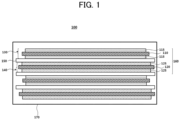
- FIG. 1 is a schematic cross-sectional view illustrating a lithium secondary batteries in accordance with exemplary embodiments.
- a lithium secondary battery 100 may include an electrode assembly including a cathode 130, an anode 140 and a separation layer 150 interposed between the cathode and the anode.
- the electrode assembly may be accommodated together with the electrolyte according to the above-described embodiments to be impregnated therein.
- the cathode 130 may include a cathode current collector 110 and a cathode active material layer 115 formed by coating a cathode active material on the cathode current collector 110.
- the cathode active material may include a compound capable of reversibly intercalating and de-intercalating lithium ions.
- the cathode active material may include a lithium-transition metal oxide.
- the lithium-transition metal oxide may include nickel (Ni), and may further include at least one of cobalt (Co) and manganese (Mn).
- the lithium-transition metal oxide may be represented by Chemical Formula 4.
- Chemical Formula 4 Li 1+a Ni 1-(x+y) CO x M y O 2
- M may be at least one element selected from Mn, Mg, Sr, Ba, B, Al, Si, Ti, Zr or W.
- a slurry may be prepared by mixing and stirring the cathode active material as described above in a solvent with a binder, a conductive material and/or a dispersive agent.
- the slurry may be coated on a cathode current collector 110, and then dried and pressed to form the cathode 130.
- the cathode current collector 110 may include stainless-steel, nickel, aluminum, titanium, copper or an alloy thereof. Preferably, aluminum or an alloy thereof may be used.
- the binder may include an organic based binder such as a polyvinylidene fluoride-hexafluoropropylene copolymer (PVDF-co-HFP), polyvinylidenefluoride (PVDF), polyacrylonitrile, polymethylmethacrylate, etc., or an aqueous based binder such as styrene-butadiene rubber (SBR) that may be used with a thickener such as carboxymethyl cellulose (CMC).
- organic based binder such as a polyvinylidene fluoride-hexafluoropropylene copolymer (PVDF-co-HFP), polyvinylidenefluoride (PVDF), polyacrylonitrile, polymethylmethacrylate, etc.
- an aqueous based binder such as styrene-butadiene rubber (SBR) that may be used with a thickener such as carboxymethyl cellulose (CMC).
- SBR
- a PVDF-based binder may be used as a cathode binder.
- an amount of the binder for forming the cathode active material layer may be reduced, and an amount of the cathode active material may be relatively increased.
- capacity and power of the lithium secondary battery may be further improved.
- the conductive material may be added to facilitate electron mobility between active material particles.
- the conductive material may include a carbon-based material such as graphite, carbon black, graphene, carbon nanotube, etc., and/or a metal-based material such as tin, tin oxide, titanium oxide, a perovskite material such as LaSrCoO 3 or LaSrMnO 3 , etc.
- the anode 140 may include an anode current collector 120 and an anode active material layer 125 formed by coating an anode active material on the anode current collector 120.
- a silicon (Si)-based compound may be used as the anode active material.
- silicon carbide (SiC) or a silicon-carbon particle including a carbon core and a silicon coating layer may be used as the anode active material.
- the silicon-carbon particle may be formed by, e.g., depositing a silicon layer on a surface of a graphite core.
- the silicon-carbon particle may be formed by coating a silicon layer on commercially available graphite particles through a chemical vapor deposition (CVD) process using a silicon precursor compound such as a silane-based compound.
- CVD chemical vapor deposition
- the silicon-carbon particles may have a structure in which a plurality of carbon coating layers and silicon coating layers are alternately and repeatedly coated or laminated on the graphite core.
- a carbon-based material such as graphite has been used as the anode active material, but a theoretical capacity of the carbon-based material may be limited to about 370 mAh/g.
- the silicon-based compound may be used as the anode active material, so that power and capacity properties of the secondary battery may be improved beyond the theoretical capacity limit of the carbon-based material.
- the anode current collector 120 may include, e.g., gold, stainless steel, nickel, aluminum, titanium, copper or an alloy thereof, preferably may include copper or a copper alloy.
- a slurry may be prepared by mixing and stirring the anode active material with a binder, a conductive material and/or a dispersive agent in a solvent.
- the anode slurry may be coated on a surface of the anode current collector 120, and then dried and pressed to form the anode 140.
- Materials substantially the same as or similar to the above-mentioned materials may be used as the conductive material.
- styrene-butadiene rubber capable of reacting with the reactive additive of the above-described electrolyte may be used as the binder for the anode.
- a thickener such as carboxymethyl cellulose (CMC) may be used together.
- the silicon-based compound may be used as the anode active material to enhance the capacity and power properties.
- the silicon-based compound may have a high volume expansion/contraction ratio, and expansion and contraction of the anode active material layer 125 or anode active material particles may be repeated during repeated charging and discharging.
- the anode active material particles may be decomposed or collapsed, and exposed in the electrolyte, which may cause depletion of the electrolyte and increase a resistance by irreversible decomposition of the electrolyte.
- SBR as the anode binder and the reactive additive included in the electrolyte may be combined so that expansion of the anode active material including the silicon-based compound may be suppressed.
- the separation layer 150 may be interposed between the cathode 130 and the anode 140.
- the separation layer 150 may include a porous polymer film prepared from, e.g., a polyolefin-based polymer such as an ethylene homopolymer, a propylene homopolymer, an ethylene/butene copolymer, an ethylene/hexene copolymer, an ethylene/methacrylate copolymer, or the like.
- the separation layer 150 may be also formed from a non-woven fabric including a glass fiber with a high melting point, a polyethylene terephthalate fiber, or the like.
- an area and/or a volume of the anode 140 may be greater than that of the cathode 130.
- lithium ions generated from the cathode 130 may be easily transferred to the anode 140 without loss by, e.g., precipitation or sedimentation.
- an electrode cell 160 may be define by the cathode 130, the anode 140 and the separation layer 150, and a plurality of the electrode cells 160 may be stacked to form an electrode assembly having, e.g., a jelly roll shape.
- the electrode assembly may be formed by winding, laminating or folding of the separation layer.
- the electrode assembly may be accommodated together with the electrolyte according the above described embodiments in a case 170 to define a lithium secondary battery 100.
- An electrode tab may be formed from each of the cathode current collector 110 and the anode current collector 120 included in each electrode cell 160, and may extend to one side of the case 170.
- the electrode tabs may be fused together with the one side of the case 170 to be connected to electrode leads that may be extended or exposed to and outside of the case 170.
- the lithium secondary battery 100 may be manufactured in, e.g., a cylindrical shape using a can, a square shape, a pouch shape or a coin shape.
- a solution of 1M LiPF 6 was prepared using a mixed solvent of EC/EMC/DEC (25:45:35; volume ratio), and electrolytes of Examples and Comparative Examples were prepared by adding additives shown in Table 1 below based on a total weight of the electrolyte.
- Table 1 Additives Type content (wt%) Comparative Example 1 - - Comparative Example 2 Compound of Chemical Formula 3 1
- Example 1 Compound of Chemical Formula 2 0.5
- Compound of Chemical Formula 2 0.5 Compound of Chemical Formula 3 1
- Example 3 Compound of Chemical Formula 2 0.1 Compound of Chemical Formula 3 1
- Example 4 Compound of Chemical Formula 2 5 Compound of Chemical Formula 3 1
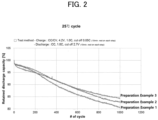
- a cycle property at room temperature was calculated by dividing the discharge capacity in each cycle by the initial capacity while repeating 1,000 cycles of the charge/discharge, and the results are shown in Table 2 below.
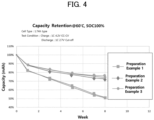
- the secondary batteries of Preparation Examples were charged with 100% SoC, and stored in a chamber at 60°C.
- the secondary batteries stored for 1 week, 3 weeks, 5 weeks, 7 weeks and 8 weeks were each left at room temperature for 30 minutes, and a thickness change of the anode and a capacity retention were measured.
- the capacity retention was calculated as a ratio of a discharge capacity after high-temperature storage relative to an initial discharge capacity.
- a thickness change ratio was calculated as a ratio of a thickness of the anode stored at high temperature relative to an initial thickness of the anode.
Landscapes
- Chemical & Material Sciences (AREA)
- Engineering & Computer Science (AREA)
- Manufacturing & Machinery (AREA)
- Chemical Kinetics & Catalysis (AREA)
- Electrochemistry (AREA)
- General Chemical & Material Sciences (AREA)
- Physics & Mathematics (AREA)
- Condensed Matter Physics & Semiconductors (AREA)
- General Physics & Mathematics (AREA)
- Inorganic Chemistry (AREA)
- Secondary Cells (AREA)
Applications Claiming Priority (1)
| Application Number | Priority Date | Filing Date | Title |
|---|---|---|---|
| KR1020210128235A KR20230045406A (ko) | 2021-09-28 | 2021-09-28 | 리튬 이차 전지용 전해질 및 이를 포함하는 리튬 이차 전지 |
Publications (1)
| Publication Number | Publication Date |
|---|---|
| EP4160764A1 true EP4160764A1 (fr) | 2023-04-05 |
Family
ID=83506525
Family Applications (1)
| Application Number | Title | Priority Date | Filing Date |
|---|---|---|---|
| EP22198131.9A Pending EP4160764A1 (fr) | 2021-09-28 | 2022-09-27 | Électrolyte pour batterie secondaire au lithium et batterie secondaire au lithium le comprenant |
Country Status (4)
| Country | Link |
|---|---|
| US (1) | US12424660B2 (fr) |
| EP (1) | EP4160764A1 (fr) |
| KR (1) | KR20230045406A (fr) |
| CN (1) | CN115882066A (fr) |
Citations (4)
| Publication number | Priority date | Publication date | Assignee | Title |
|---|---|---|---|---|
| JP2001057236A (ja) * | 1999-08-19 | 2001-02-27 | Mitsui Chemicals Inc | 非水電解液およびそれを用いた二次電池 |
| US20130280622A1 (en) * | 2010-02-12 | 2013-10-24 | Mitsubishi Chemical Corporation | Nonaqueous electrolytic solution and nonaqueous-electrolyte secondary battery |
| US9218915B2 (en) * | 2010-10-07 | 2015-12-22 | Uchicago Argonne, Llc | Non-aqueous electrolyte for lithium-ion battery |
| KR20180036457A (ko) * | 2016-09-30 | 2018-04-09 | 삼성전자주식회사 | 리튬이차전지용 음극 및 이를 포함하는 리튬이차전지 |
Family Cites Families (6)
| Publication number | Priority date | Publication date | Assignee | Title |
|---|---|---|---|---|
| KR100645778B1 (ko) | 2005-02-02 | 2006-11-14 | 제일모직주식회사 | 리튬이차전지용 비수전해액 및 이를 이용한 리튬이차전지 |
| KR101065381B1 (ko) | 2009-01-22 | 2011-09-16 | 삼성에스디아이 주식회사 | 리튬 이차 전지용 전해액 및 이를 포함하는 리튬 이차 전지 |
| US8993177B2 (en) | 2009-12-04 | 2015-03-31 | Envia Systems, Inc. | Lithium ion battery with high voltage electrolytes and additives |
| KR102595175B1 (ko) | 2018-03-14 | 2023-10-30 | 삼성전자주식회사 | 트리알콕시알킬실란 화합물을 함유하는 전해액을 포함하는 리튬이차전지 |
| WO2020054863A1 (fr) * | 2018-09-14 | 2020-03-19 | 旭化成株式会社 | Solution électrolytique non aqueuse et batterie secondaire non aqueuse |
| JP7791882B2 (ja) * | 2021-05-14 | 2025-12-24 | 株式会社日本触媒 | 非水電解液及び二次電池 |
-
2021
- 2021-09-28 KR KR1020210128235A patent/KR20230045406A/ko active Pending
-
2022
- 2022-09-23 CN CN202211168156.1A patent/CN115882066A/zh active Pending
- 2022-09-27 EP EP22198131.9A patent/EP4160764A1/fr active Pending
- 2022-09-28 US US17/954,407 patent/US12424660B2/en active Active
Patent Citations (4)
| Publication number | Priority date | Publication date | Assignee | Title |
|---|---|---|---|---|
| JP2001057236A (ja) * | 1999-08-19 | 2001-02-27 | Mitsui Chemicals Inc | 非水電解液およびそれを用いた二次電池 |
| US20130280622A1 (en) * | 2010-02-12 | 2013-10-24 | Mitsubishi Chemical Corporation | Nonaqueous electrolytic solution and nonaqueous-electrolyte secondary battery |
| US9218915B2 (en) * | 2010-10-07 | 2015-12-22 | Uchicago Argonne, Llc | Non-aqueous electrolyte for lithium-ion battery |
| KR20180036457A (ko) * | 2016-09-30 | 2018-04-09 | 삼성전자주식회사 | 리튬이차전지용 음극 및 이를 포함하는 리튬이차전지 |
Also Published As
| Publication number | Publication date |
|---|---|
| US20230098975A1 (en) | 2023-03-30 |
| CN115882066A (zh) | 2023-03-31 |
| US12424660B2 (en) | 2025-09-23 |
| KR20230045406A (ko) | 2023-04-04 |
Similar Documents
| Publication | Publication Date | Title |
|---|---|---|
| EP4210131A2 (fr) | Batterie secondaire au lithium | |
| US12230759B2 (en) | Electrolyte for lithium secondary battery and lithium secondary battery including the same | |
| KR102732031B1 (ko) | 리튬 이차 전지용 전해질 및 이를 포함하는 리튬 이차 전지 | |
| EP3872914B1 (fr) | Électrolyte pour batterie secondaire au lithium et batterie secondaire au lithium l'incluant | |
| EP3890072A1 (fr) | Électrolyte non aqueux et batterie secondaire le comprenant | |
| EP4213263A2 (fr) | Solution électrolytique pour batterie secondaire au lithium et batterie secondaire au lithium la comprenant | |
| EP4210146A2 (fr) | Électrolyte non-aqueux et batterie secondaire au lithium le comprenant | |
| US12051777B2 (en) | Electrolyte solution for lithium secondary battery and lithium secondary battery including the same | |
| KR20240038580A (ko) | 리튬 이차 전지용 전해액 및 이를 포함하는 리튬 이차 전지 | |
| EP4160764A1 (fr) | Électrolyte pour batterie secondaire au lithium et batterie secondaire au lithium le comprenant | |
| KR20230094609A (ko) | 비수 전해액 및 이를 포함하는 리튬 이차 전지 | |
| EP4366019A1 (fr) | Solution électrolytique pour batterie secondaire au lithium et batterie secondaire au lithium la comprenant | |
| EP3958370B1 (fr) | Électrolyte pour batterie secondaire au lithium et batterie secondaire au lithium l'incluant | |
| EP4303978B1 (fr) | Solution électrolytique pour batterie secondaire au lithium et batterie secondaire au lithium la comprenant | |
| EP4270584B1 (fr) | Solution électrolytique pour batterie secondaire au lithium et batterie secondaire au lithium la comprenant | |
| EP4645494A1 (fr) | Électrolyte pour batterie secondaire au lithium et batterie secondaire au lithium le comprenant | |
| EP4340096A1 (fr) | Solution électrolytique pour batterie secondaire au lithium et batterie secondaire au lithium la comprenant | |
| US20230054122A1 (en) | Electrolyte Solution for Lithium Secondary Battery and Lithium Secondary Battery Including the Same | |
| EP4564513A1 (fr) | Électrolyte pour batterie au lithium rechargeable et batterie au lithium rechargeable le comprenant | |
| EP4287336A1 (fr) | Solution électrolytique pour batterie secondaire au lithium et batterie secondaire au lithium la comprenant |
Legal Events
| Date | Code | Title | Description |
|---|---|---|---|
| PUAI | Public reference made under article 153(3) epc to a published international application that has entered the european phase |
Free format text: ORIGINAL CODE: 0009012 |
|
| STAA | Information on the status of an ep patent application or granted ep patent |
Free format text: STATUS: REQUEST FOR EXAMINATION WAS MADE |
|
| 17P | Request for examination filed |
Effective date: 20220927 |
|
| AK | Designated contracting states |
Kind code of ref document: A1 Designated state(s): AL AT BE BG CH CY CZ DE DK EE ES FI FR GB GR HR HU IE IS IT LI LT LU LV MC MK MT NL NO PL PT RO RS SE SI SK SM TR |
|
| P01 | Opt-out of the competence of the unified patent court (upc) registered |
Effective date: 20230602 |