EP4160787A1 - Verfahren zur rückgewinnung von wertmetall aus abfallelektrodenmaterial einer lithiumsekundärbatterie unter verwendung von lithiumcarbonat - Google Patents
Verfahren zur rückgewinnung von wertmetall aus abfallelektrodenmaterial einer lithiumsekundärbatterie unter verwendung von lithiumcarbonat Download PDFInfo
- Publication number
- EP4160787A1 EP4160787A1 EP21812247.1A EP21812247A EP4160787A1 EP 4160787 A1 EP4160787 A1 EP 4160787A1 EP 21812247 A EP21812247 A EP 21812247A EP 4160787 A1 EP4160787 A1 EP 4160787A1
- Authority
- EP
- European Patent Office
- Prior art keywords
- lithium
- electrode material
- sulfuric acid
- washing
- waste electrode
- Prior art date
- Legal status (The legal status is an assumption and is not a legal conclusion. Google has not performed a legal analysis and makes no representation as to the accuracy of the status listed.)
- Withdrawn
Links
Images
Classifications
-
- C—CHEMISTRY; METALLURGY
- C01—INORGANIC CHEMISTRY
- C01D—COMPOUNDS OF ALKALI METALS, i.e. LITHIUM, SODIUM, POTASSIUM, RUBIDIUM, CAESIUM, OR FRANCIUM
- C01D15/00—Lithium compounds
- C01D15/06—Sulfates; Sulfites
-
- C—CHEMISTRY; METALLURGY
- C22—METALLURGY; FERROUS OR NON-FERROUS ALLOYS; TREATMENT OF ALLOYS OR NON-FERROUS METALS
- C22B—PRODUCTION AND REFINING OF METALS; PRETREATMENT OF RAW MATERIALS
- C22B23/00—Obtaining nickel or cobalt
- C22B23/04—Obtaining nickel or cobalt by wet processes
- C22B23/0407—Leaching processes
- C22B23/0415—Leaching processes with acids or salt solutions except ammonium salts solutions
- C22B23/043—Sulfurated acids or salts thereof
-
- C—CHEMISTRY; METALLURGY
- C01—INORGANIC CHEMISTRY
- C01F—COMPOUNDS OF THE METALS BERYLLIUM, MAGNESIUM, ALUMINIUM, CALCIUM, STRONTIUM, BARIUM, RADIUM, THORIUM, OR OF THE RARE-EARTH METALS
- C01F7/00—Compounds of aluminium
- C01F7/77—Aluminium carbonates
-
- C—CHEMISTRY; METALLURGY
- C01—INORGANIC CHEMISTRY
- C01G—COMPOUNDS CONTAINING METALS NOT COVERED BY SUBCLASSES C01D OR C01F
- C01G3/00—Compounds of copper
-
- C—CHEMISTRY; METALLURGY
- C01—INORGANIC CHEMISTRY
- C01G—COMPOUNDS CONTAINING METALS NOT COVERED BY SUBCLASSES C01D OR C01F
- C01G45/00—Compounds of manganese
-
- C—CHEMISTRY; METALLURGY
- C01—INORGANIC CHEMISTRY
- C01G—COMPOUNDS CONTAINING METALS NOT COVERED BY SUBCLASSES C01D OR C01F
- C01G51/00—Compounds of cobalt
- C01G51/06—Carbonates
-
- C—CHEMISTRY; METALLURGY
- C01—INORGANIC CHEMISTRY
- C01G—COMPOUNDS CONTAINING METALS NOT COVERED BY SUBCLASSES C01D OR C01F
- C01G53/00—Compounds of nickel
- C01G53/06—Carbonates
-
- C—CHEMISTRY; METALLURGY
- C22—METALLURGY; FERROUS OR NON-FERROUS ALLOYS; TREATMENT OF ALLOYS OR NON-FERROUS METALS
- C22B—PRODUCTION AND REFINING OF METALS; PRETREATMENT OF RAW MATERIALS
- C22B1/00—Preliminary treatment of ores or scrap
- C22B1/005—Preliminary treatment of scrap
-
- C—CHEMISTRY; METALLURGY
- C22—METALLURGY; FERROUS OR NON-FERROUS ALLOYS; TREATMENT OF ALLOYS OR NON-FERROUS METALS
- C22B—PRODUCTION AND REFINING OF METALS; PRETREATMENT OF RAW MATERIALS
- C22B23/00—Obtaining nickel or cobalt
- C22B23/04—Obtaining nickel or cobalt by wet processes
- C22B23/0453—Treatment or purification of solutions, e.g. obtained by leaching
-
- C—CHEMISTRY; METALLURGY
- C22—METALLURGY; FERROUS OR NON-FERROUS ALLOYS; TREATMENT OF ALLOYS OR NON-FERROUS METALS
- C22B—PRODUCTION AND REFINING OF METALS; PRETREATMENT OF RAW MATERIALS
- C22B23/00—Obtaining nickel or cobalt
- C22B23/04—Obtaining nickel or cobalt by wet processes
- C22B23/0453—Treatment or purification of solutions, e.g. obtained by leaching
- C22B23/0461—Treatment or purification of solutions, e.g. obtained by leaching by chemical methods
-
- C—CHEMISTRY; METALLURGY
- C22—METALLURGY; FERROUS OR NON-FERROUS ALLOYS; TREATMENT OF ALLOYS OR NON-FERROUS METALS
- C22B—PRODUCTION AND REFINING OF METALS; PRETREATMENT OF RAW MATERIALS
- C22B26/00—Obtaining alkali, alkaline earth metals or magnesium
- C22B26/10—Obtaining alkali metals
- C22B26/12—Obtaining lithium
-
- C—CHEMISTRY; METALLURGY
- C22—METALLURGY; FERROUS OR NON-FERROUS ALLOYS; TREATMENT OF ALLOYS OR NON-FERROUS METALS
- C22B—PRODUCTION AND REFINING OF METALS; PRETREATMENT OF RAW MATERIALS
- C22B3/00—Extraction of metal compounds from ores or concentrates by wet processes
- C22B3/04—Extraction of metal compounds from ores or concentrates by wet processes by leaching
- C22B3/06—Extraction of metal compounds from ores or concentrates by wet processes by leaching in inorganic acid solutions, e.g. with acids generated in situ; in inorganic salt solutions other than ammonium salt solutions
- C22B3/08—Sulfuric acid, other sulfurated acids or salts thereof
-
- C—CHEMISTRY; METALLURGY
- C22—METALLURGY; FERROUS OR NON-FERROUS ALLOYS; TREATMENT OF ALLOYS OR NON-FERROUS METALS
- C22B—PRODUCTION AND REFINING OF METALS; PRETREATMENT OF RAW MATERIALS
- C22B7/00—Working up raw materials other than ores, e.g. scrap, to produce non-ferrous metals and compounds thereof; Methods of a general interest or applied to the winning of more than two metals
- C22B7/001—Dry processes
-
- C—CHEMISTRY; METALLURGY
- C22—METALLURGY; FERROUS OR NON-FERROUS ALLOYS; TREATMENT OF ALLOYS OR NON-FERROUS METALS
- C22B—PRODUCTION AND REFINING OF METALS; PRETREATMENT OF RAW MATERIALS
- C22B7/00—Working up raw materials other than ores, e.g. scrap, to produce non-ferrous metals and compounds thereof; Methods of a general interest or applied to the winning of more than two metals
- C22B7/005—Separation by a physical processing technique only, e.g. by mechanical breaking
-
- C—CHEMISTRY; METALLURGY
- C22—METALLURGY; FERROUS OR NON-FERROUS ALLOYS; TREATMENT OF ALLOYS OR NON-FERROUS METALS
- C22B—PRODUCTION AND REFINING OF METALS; PRETREATMENT OF RAW MATERIALS
- C22B7/00—Working up raw materials other than ores, e.g. scrap, to produce non-ferrous metals and compounds thereof; Methods of a general interest or applied to the winning of more than two metals
- C22B7/006—Wet processes
-
- C—CHEMISTRY; METALLURGY
- C22—METALLURGY; FERROUS OR NON-FERROUS ALLOYS; TREATMENT OF ALLOYS OR NON-FERROUS METALS
- C22B—PRODUCTION AND REFINING OF METALS; PRETREATMENT OF RAW MATERIALS
- C22B7/00—Working up raw materials other than ores, e.g. scrap, to produce non-ferrous metals and compounds thereof; Methods of a general interest or applied to the winning of more than two metals
- C22B7/006—Wet processes
- C22B7/007—Wet processes by acid leaching
-
- H—ELECTRICITY
- H01—ELECTRIC ELEMENTS
- H01M—PROCESSES OR MEANS, e.g. BATTERIES, FOR THE DIRECT CONVERSION OF CHEMICAL ENERGY INTO ELECTRICAL ENERGY
- H01M10/00—Secondary cells; Manufacture thereof
- H01M10/05—Accumulators with non-aqueous electrolyte
- H01M10/052—Li-accumulators
-
- H—ELECTRICITY
- H01—ELECTRIC ELEMENTS
- H01M—PROCESSES OR MEANS, e.g. BATTERIES, FOR THE DIRECT CONVERSION OF CHEMICAL ENERGY INTO ELECTRICAL ENERGY
- H01M10/00—Secondary cells; Manufacture thereof
- H01M10/54—Reclaiming serviceable parts of waste accumulators
-
- H—ELECTRICITY
- H01—ELECTRIC ELEMENTS
- H01M—PROCESSES OR MEANS, e.g. BATTERIES, FOR THE DIRECT CONVERSION OF CHEMICAL ENERGY INTO ELECTRICAL ENERGY
- H01M4/00—Electrodes
- H01M4/02—Electrodes composed of, or comprising, active material
- H01M4/36—Selection of substances as active materials, active masses, active liquids
- H01M4/48—Selection of substances as active materials, active masses, active liquids of inorganic oxides or hydroxides
- H01M4/52—Selection of substances as active materials, active masses, active liquids of inorganic oxides or hydroxides of nickel, cobalt or iron
- H01M4/525—Selection of substances as active materials, active masses, active liquids of inorganic oxides or hydroxides of nickel, cobalt or iron of mixed oxides or hydroxides containing iron, cobalt or nickel for inserting or intercalating light metals, e.g. LiNiO2, LiCoO2 or LiCoOxFy
-
- C—CHEMISTRY; METALLURGY
- C01—INORGANIC CHEMISTRY
- C01P—INDEXING SCHEME RELATING TO STRUCTURAL AND PHYSICAL ASPECTS OF SOLID INORGANIC COMPOUNDS
- C01P2006/00—Physical properties of inorganic compounds
- C01P2006/80—Compositional purity
-
- Y—GENERAL TAGGING OF NEW TECHNOLOGICAL DEVELOPMENTS; GENERAL TAGGING OF CROSS-SECTIONAL TECHNOLOGIES SPANNING OVER SEVERAL SECTIONS OF THE IPC; TECHNICAL SUBJECTS COVERED BY FORMER USPC CROSS-REFERENCE ART COLLECTIONS [XRACs] AND DIGESTS
- Y02—TECHNOLOGIES OR APPLICATIONS FOR MITIGATION OR ADAPTATION AGAINST CLIMATE CHANGE
- Y02E—REDUCTION OF GREENHOUSE GAS [GHG] EMISSIONS, RELATED TO ENERGY GENERATION, TRANSMISSION OR DISTRIBUTION
- Y02E60/00—Enabling technologies; Technologies with a potential or indirect contribution to GHG emissions mitigation
- Y02E60/10—Energy storage using batteries
-
- Y—GENERAL TAGGING OF NEW TECHNOLOGICAL DEVELOPMENTS; GENERAL TAGGING OF CROSS-SECTIONAL TECHNOLOGIES SPANNING OVER SEVERAL SECTIONS OF THE IPC; TECHNICAL SUBJECTS COVERED BY FORMER USPC CROSS-REFERENCE ART COLLECTIONS [XRACs] AND DIGESTS
- Y02—TECHNOLOGIES OR APPLICATIONS FOR MITIGATION OR ADAPTATION AGAINST CLIMATE CHANGE
- Y02P—CLIMATE CHANGE MITIGATION TECHNOLOGIES IN THE PRODUCTION OR PROCESSING OF GOODS
- Y02P10/00—Technologies related to metal processing
- Y02P10/20—Recycling
-
- Y—GENERAL TAGGING OF NEW TECHNOLOGICAL DEVELOPMENTS; GENERAL TAGGING OF CROSS-SECTIONAL TECHNOLOGIES SPANNING OVER SEVERAL SECTIONS OF THE IPC; TECHNICAL SUBJECTS COVERED BY FORMER USPC CROSS-REFERENCE ART COLLECTIONS [XRACs] AND DIGESTS
- Y02—TECHNOLOGIES OR APPLICATIONS FOR MITIGATION OR ADAPTATION AGAINST CLIMATE CHANGE
- Y02W—CLIMATE CHANGE MITIGATION TECHNOLOGIES RELATED TO WASTEWATER TREATMENT OR WASTE MANAGEMENT
- Y02W30/00—Technologies for solid waste management
- Y02W30/50—Reuse, recycling or recovery technologies
-
- Y—GENERAL TAGGING OF NEW TECHNOLOGICAL DEVELOPMENTS; GENERAL TAGGING OF CROSS-SECTIONAL TECHNOLOGIES SPANNING OVER SEVERAL SECTIONS OF THE IPC; TECHNICAL SUBJECTS COVERED BY FORMER USPC CROSS-REFERENCE ART COLLECTIONS [XRACs] AND DIGESTS
- Y02—TECHNOLOGIES OR APPLICATIONS FOR MITIGATION OR ADAPTATION AGAINST CLIMATE CHANGE
- Y02W—CLIMATE CHANGE MITIGATION TECHNOLOGIES RELATED TO WASTEWATER TREATMENT OR WASTE MANAGEMENT
- Y02W30/00—Technologies for solid waste management
- Y02W30/50—Reuse, recycling or recovery technologies
- Y02W30/84—Recycling of batteries or fuel cells
Definitions
- the present invention relates to a method for recovering valuable metals. More specifically, the present invention relates to a method of recovering valuable metals from a waste electrode material of a lithium secondary battery by using lithium carbonate. With the method, it is possible to easily recover valuable metals such as lithium, nickel, cobalt, manganese, aluminum, and copper from an anode-cathode mixed electrode material obtained from waste lithium secondary batteries as a raw material by discharging, crushing, screening, and classifying the waste lithium secondary batteries.
- waste lithium secondary batteries Globally, the majority of waste lithium secondary batteries were small batteries used for IT devices, and about 200,000 tons were generated in 2018. In 2025, it is expected that a large amount of waste lithium secondary batteries for electric vehicles and electric buses will be generated, and the amount is expected to become about 700,000 tons.
- Valuable metals such as about 17 kg of lithium, about 79 kg of nickel, and about 41 kg of cobalt are contained in one ton of waste lithium secondary batteries. In a current situation where it is difficult to gain price competitiveness, the recovery of these metals, which are mostly imported, can be a significant advantage in securing raw materials through recycling of waste resources.
- An existing valuable metal recovery method to recycle waste batteries recovers and recycles valuable metals such as nickel and cobalt through sulfuric acid dissolution and solvent extraction processes, but in the case of lithium, the existing method recovers only a small amount of lithium at a low recovery rate and purity in the last stage of the recovery processes or does not recover lithium at all. Thus, lithium is discarded as dissolved in wastewater.
- An objective of the present invention is to provide a method of recovering valuable metals by using lithium carbonate from waste electrode materials of waste lithium secondary batteries, the method being capable of easily recovering valuable metals such as lithium, nickel, cobalt, manganese, aluminum, copper, etc. from the waste electrode materials of the lithium secondary batteries.
- a method of recovering valuable metals from waste electrode materials including: a waste electrode material preparation step of preparing a waste electrode material; a pre-processing step of introducing the waste electrode material into a firing furnace and thermally treating the waste electrode material in the firing furnace; a sulfuric acid dissolution step of adding sulfuric acid to the resulting pre-processed product to cause a reaction; a first solid-liquid separation step of separating the resulting reaction products produced through the sulfuric acid dissolution step into a metal melt and an unreacted residue; a precipitation step of mixing lithium carbonate (Li 2 CO 3 ) with the metal melt and stirring the mixture; and a second solid-liquid separation step of separating the precipitation result generated through the precipitation step into a precipitation residue and a filtrate.
- the method recovers an aqueous solution of lithium sulfate from the filtrate and recovers nickel carbonate and cobalt carbonate from the precipitation residue.
- the pre-processing step may be performed at a temperature of 300°C to 500°C for a duration of 30 minutes to 120 minutes.
- the reaction in the sulfuric acid dissolution step, may be performed by stirring at a temperature in a range of 60°C to 100°C for a duration of 60 minutes to 120 minutes at a speed of 250 rpm to 400 rpm.
- the sulfuric acid dissolution step may further include adding hydrogen peroxide to the pre-processed product.
- a first washing step of washing the unreacted residue with water may be further performed after the first solid-liquid separation step, and the precipitation step may be performed by mixing the lithium carbonate with a mixed solution containing a washing solution and the metal melt and stirring the mixture.
- the reaction in the precipitation step, may be performed by stirring at a temperature of 40°C to 80°C for a duration of 60 minutes to 180 minutes at a speed of 250 rpm to 400 rpm.
- a second washing step of washing the precipitation residue with water may be further performed after the second solid-liquid separation step, and an aqueous solution of lithium sulfate may be recovered from a washing solution obtained through the second washing step.
- the present invention has the advantages described below.
- the following steps are performed: the lithium secondary batteries are discharged, crushed, sorted, and classified to obtain an anode-cathode mixed electrode material; the anode-cathode mixed electrode material is pre-processed; the pre-processed product is dissolved in sulfuric acid to obtain a metal melt; the metal melt is precipitated by using lithium carbonate (Li 2 CO 3 ); valuable metals such as nickel, cobalt, manganese, aluminum, and copper are easily recovered from the precipitate; and an aqueous solution of lithium sulfate (Li 2 SO 4 ) containing lithium is easily recovered from the filtrate.
- Li 2 CO 3 lithium carbonate
- valuable metals such as nickel, cobalt, manganese, aluminum, and copper are easily recovered from the precipitate
- an aqueous solution of lithium sulfate (Li 2 SO 4 ) containing lithium is easily recovered from the filtrate.
- a recovered lithium sulfate aqueous solution can be prepared as lithium hydroxide monohydrate through lithium hydroxide conversion and concentration crystallization processes, and a carbonate composite recovered as a residue has the advantage of being used as a raw material for preparing a precursor.
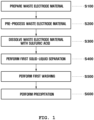
- FIG. 1 is a diagram illustrating a method of recovering valuable metals by using lithium carbonate from a waste electrode material of a lithium secondary battery, according to one embodiment of the present invention.
- equivalent refers to a chemical equivalent which is the amount of a substance that directly or indirectly combines with a hydrogen atomic weight of 1 or an oxygen atomic weight of 8.
- FIG. 1 is a diagram illustrating a method of recovering valuable metals by using lithium carbonate from a waste electrode material of a lithium secondary battery, according to one embodiment of the present invention.
- a method of recovering valuable metals, by using lithium carbonate, from a waste electrode material of a lithium secondary battery is a method of recovering a valuable metal from a waste electrode material of a lithium secondary battery.
- a waste electrode material preparation step S100 of preparing a waste electrode material is performed.
- the waste electrode material may be an anode-cathode (anode-anode active material and cathode-cathode active material) mixed electrode material obtained by discharging, crushing, screening, and classifying waste lithium secondary batteries to be disposed of or may be a waste cathode material that is poorly processed or unsuitable for use and is generated in a cathode material production process.
- the waste electrode material includes at least one selected from lithium nickel cobalt aluminum oxide (LiNiCoAlO 2 , NCA), lithium nickel cobalt manganese oxide (LiNiCoMnO 2 , NCM), lithium iron oxide (LiFePO 4 , LFP), lithium manganese iron oxide (LiMnFePO 4 , LMFP), lithium manganese oxide (LiMn 2 O 4 , LMO), lithium nickel manganese spinel (LiNi 0.5 Mn 1.5 O 4 , LNMO), and lithium cobalt oxide (LiCoO 2 , LCO) .
- lithium nickel cobalt aluminum oxide LiNiCoAlO 2 , NCA
- LiNiCoMnO 2 , NCM lithium iron oxide
- LiFePO 4 , LFP lithium manganese iron oxide
- LiMnFePO 4 , LMFP lithium manganese oxide
- LiMn 2 O 4 , LMO lithium nickel manganese spinel
- a preprocessing step S200 in which the prepared waste electrode material is fired in a firing furnace is performed to thermally treat the prepared waste electrode material.
- the pre-processing step S200 is a process for removing an organic binder contained in the waste electrode material.
- the pre-processing step S200 is performed in an air atmosphere at a temperature of 300°C to 500°C for a duration of 30 minutes to 120 minutes to remove the organic binder.
- the resulting pre-processed waste electrode material contains a cathode active material and a carbon material as an anode active material.
- the pre-processing step S200 When the pre-processing step S200 is performed at a temperature higher than 500°C, the carbon material can be removed as well as the organic binder. However, in this case, the cost of the firing process is increased. In addition, such a high pre-processing temperature is not desirable in terms of recycling of the carbon material separated in a sulfuric acid dissolution step S300 described below. Therefore, preferably, the pre-processing step S200 may be performed in a temperature range of 300°C to 500°C.
- the sulfuric acid dissolution step S300 is performed in which sulfuric acid is added to the pre-processed waste electrode material produced through the pre-processing step S200.
- the pre-processed waste electrode material reacts with the sulfuric acid.
- the sulfuric acid dissolution step S300 is a process for leaching valuable metals contained in the pre-processed product.
- the reaction may be performed with stirring at a temperature of 60°C to 100°C for a duration of 60 minutes to 120 minutes at a speed of 250 rpm to 400 rpm.
- sulfuric acid dissolution step S300 sulfuric acid with a purity of 98% may be used, and 0.94 to 1.0 equivalent of the sulfuric acid relative to Li, Ni, Co, Mn, Al and Cu contained in the pre-processed product may be used.
- the solid to liquid ratio of the pre-processed product and the mixture containing the sulfuric acid and water is 300 g/L or more.
- the hydrogen peroxide may have a purity in a range of 30% to 32%, and the amount of hydrogen peroxide that is added may be in a range of 0.5 mole to 0.55 mole relative to the number of moles of Ni, Co, and Mn contained in the pre-processed product.
- the reason for performing the reduction leaching using hydrogen peroxide is that cobalt contained in the pre-processed product is present as Co 3+ , which causes a low leaching rate. Therefore, in the sulfuric acid dissolution step S300, hydrogen peroxide is added for the reduction of Co 3+ to Co 2+ . This reduction leaching process can also increase the leaching rate of lithium as well as the leaching rate of cobalt.
- a sulfuric acid solution containing valuable metals such as Li 2 SO 4 , NiSO 4 , CoSO 4 , MnSO 4 , Al 2 (SO 4 ) 3 , and CuSO 4 may be obtained.
- a first solid-liquid separation step S400 of separating the dissolved materials in the sulfuric acid solution produced through the sulfuric acid dissolution step S300 into a metal melt and an unreacted residue is performed.
- the solid-liquid separation is performed.
- a first washing step S500 in which the unreacted residue obtained through the first solid-liquid separation step S400 is washed with water is further performed.
- the first washing step S500 is performed to further recover the metal ions present in the unreacted residue wet with water. Water having a temperature in a range of room temperature and 50°C is added to obtain a washing solution resulting from the washing of the unreacted residue.
- a precipitation step S600 is performed in which lithium carbonate (Li 2 CO 3 ) is mixed with the metal melt obtained through the first solid-liquid separation step S400 and stirred.
- the lithium carbonate may be mixed with a mixed solution of the metal melt obtained through the first solid-liquid separation step S400 the washing solution obtained through the first washing step S500 and may be stirred.
- lithium carbonate is added and stirred to cause a precipitation reaction.
- the stirring is performed at a temperature of 40°C to 80°C for a duration of 60 minutes to 180 minutes at a speed of 250 rpm to 400 rpm.
- the amount of lithium carbonate used is preferably adjusted to minimize the loss of lithium that is finally recovered through the precipitation and separation of metals.
- metals such as Ni, Co, Mn, Al, and Cu are precipitated in the form of a carbonate composite due to the reaction between the metal ions in the sulfuric acid solution and the lithium carbonate, and lithium is present in the solution in the form of lithium sulfate (Li 2 SO 4 ).
- reaction Formulae 1 to 5 the reaction formulae of lithium carbonate precipitation of major valuable metals are shown below (See Reaction Formulae 1 to 5).
- CuSO 4 + Li 2 CO 3 CuCO 3 + Li 2 SO 4
- a second solid-liquid separation step S700 of separating the precipitation result generated through the precipitation step S600 into a precipitate and a filtrate is performed.
- lithium sulfate (Li 2 SO 4 ) containing lithium is separated as the filtrate, and the remaining useful metals are recovered in the form of a carbonate composite, i.e., the precipitate.
- a second washing step S800 in which the precipitate obtained through the second solid-liquid separation step S700 is washed with water is further performed.
- the percentage of water content in the precipitate is about 40% or more, and the precipitate contains a considerably large amount of lithium sulfate ions.
- the precipitate may be washed with washing water to recover an aqueous solution of lithium sulfate.
- the waste electrode material pre-processed by firing was subjected to metal leaching that is performed at a reaction temperature of 80°C and a stirring speed of 300 rpm.
- the solid-liquid concentration was 33g/L, 18.4 mL of sulfuric acid (98% concentration) and 81.6 mL of water were added to 33g of the electrode material.
- the sulfuric acid was added as much as 1.0 equivalent to Li, Ni, Co, Mn, Al, Cu of the waste electrode material, and then 10 mL of hydrogen peroxide (30% concentration) was additionally added for reduction leaching.
- the filtrate was recovered through solid-liquid separation after dissolving the waste electrode material in sulfuric acid, and the residue was washed with water.
- the filtrate of the leachate recovered through the sulfuric acid dissolution from the waste electrode material was mixed with the washing solution recovered through the residue washing, and the mixture of the filtrate of the leachate and the washing solution was reacted with lithium carbonate (purity: 98% to 99%) to obtain a precipitate.
- the precipitation products were separated through solid-liquid separation. After washing the precipitate with water, the washing solution was obtained.
- the pre-processed product contained lithium in an amount of 4.02%, nickel in an amount of 11.68%, cobalt in an amount of 10.00%, manganese in an amount of 8.52%, aluminum in an amount of 2.86%, and copper in an amount of 2.05%.
- Li when lithium carbonate is added in an optimum amount, Li can be recovered at a high recovery rate, and a high-purity aqueous lithium sulfate solution can be obtained as a filtrate.
- a metal carbonate composite with high purity can be obtained at a high recovery rate as a precipitate.
- the method of recovering valuable metals from a waste electrode material of a lithium secondary battery by using lithium carbonate has an advantage of recovering valuable metals with high purity at high recovery rates from waste an electrode material of a lithium secondary battery by pre-processing the waste electrode material, dissolving the pre-processed waste electrode material with sulfuric acid to obtain a metal melt, and adding an optimum amount of lithium carbonate (Li 2 CO 3 ) to the metal melt so that the metals can be precipitated.
- lithium carbonate Li 2 CO 3
- valuable metals such as nickel, cobalt, manganese, aluminum, and copper are recovered as a residue in the form of a carbonate composite, and an aqueous solution of lithium sulfate (Li 2 SO 4 ), which contains lithium, is recovered as a filtrate.
- the recovered valuable metals can be used as raw materials for manufacturing a lithium secondary battery.
Landscapes
- Chemical & Material Sciences (AREA)
- Engineering & Computer Science (AREA)
- Organic Chemistry (AREA)
- Manufacturing & Machinery (AREA)
- Materials Engineering (AREA)
- Metallurgy (AREA)
- Mechanical Engineering (AREA)
- Life Sciences & Earth Sciences (AREA)
- Geology (AREA)
- Inorganic Chemistry (AREA)
- Environmental & Geological Engineering (AREA)
- General Life Sciences & Earth Sciences (AREA)
- General Chemical & Material Sciences (AREA)
- Chemical Kinetics & Catalysis (AREA)
- Electrochemistry (AREA)
- Geochemistry & Mineralogy (AREA)
- Manufacture And Refinement Of Metals (AREA)
Applications Claiming Priority (2)
| Application Number | Priority Date | Filing Date | Title |
|---|---|---|---|
| KR1020200063069A KR102205442B1 (ko) | 2020-05-26 | 2020-05-26 | 리튬이차전지의 폐전극소재로부터 탄산리튬을 이용한 유가금속의 회수 방법 |
| PCT/KR2021/006364 WO2021241944A1 (ko) | 2020-05-26 | 2021-05-21 | 리튬이차전지의 폐전극소재로부터 탄산리튬을 이용한 유가금속의 회수 방법 |
Publications (2)
| Publication Number | Publication Date |
|---|---|
| EP4160787A1 true EP4160787A1 (de) | 2023-04-05 |
| EP4160787A4 EP4160787A4 (de) | 2024-02-28 |
Family
ID=74304986
Family Applications (1)
| Application Number | Title | Priority Date | Filing Date |
|---|---|---|---|
| EP21812247.1A Withdrawn EP4160787A4 (de) | 2020-05-26 | 2021-05-21 | Verfahren zur rückgewinnung von wertmetall aus abfallelektrodenmaterial einer lithiumsekundärbatterie unter verwendung von lithiumcarbonat |
Country Status (5)
| Country | Link |
|---|---|
| US (1) | US11987861B2 (de) |
| EP (1) | EP4160787A4 (de) |
| KR (1) | KR102205442B1 (de) |
| CA (1) | CA3177071C (de) |
| WO (1) | WO2021241944A1 (de) |
Cited By (1)
| Publication number | Priority date | Publication date | Assignee | Title |
|---|---|---|---|---|
| WO2025040555A1 (en) * | 2023-08-21 | 2025-02-27 | Watercycle Technologies Ltd | Method for extracting lithium from lithium-containing batteries |
Families Citing this family (22)
| Publication number | Priority date | Publication date | Assignee | Title |
|---|---|---|---|---|
| CA3212497A1 (en) * | 2021-03-02 | 2022-09-09 | Pure Battery Technologies Pty Ltd | Precipitation of metals |
| CN113117637A (zh) * | 2021-04-19 | 2021-07-16 | 重庆大学 | 以废旧钴酸锂电池为原料制备二氧化碳吸附材料的方法 |
| KR102650913B1 (ko) * | 2021-09-07 | 2024-03-22 | 국립부경대학교 산학협력단 | 리튬철인 산화물로부터 리튬의 선택적인 회수 방법 |
| KR102627665B1 (ko) * | 2021-09-09 | 2024-01-23 | 국립부경대학교 산학협력단 | 리튬망간철인 산화물로부터 리튬의 선택적인 회수 방법 |
| KR102715086B1 (ko) * | 2021-10-14 | 2024-10-10 | 에너지머티리얼즈 주식회사 | 폐리튬이온배터리로부터 리튬을 회수하는 방법 |
| KR102672210B1 (ko) | 2021-12-01 | 2024-06-05 | 단국대학교 천안캠퍼스 산학협력단 | 초임계 분산법을 이용한 전극 소재의 분리 및 회수 방법 |
| KR102813073B1 (ko) | 2022-07-25 | 2025-05-27 | 단국대학교 천안캠퍼스 산학협력단 | 결함이 있는 막전극접합체로부터 이오노머와 촉매를 분리하는 방법 |
| CN115051056B (zh) * | 2022-04-18 | 2025-10-14 | 福州华复新能源科技有限公司 | 一种再生废弃电极片过程中工业化分离电极材料的方法 |
| KR102525088B1 (ko) * | 2022-06-09 | 2023-04-24 | 한국선별기 주식회사 | 폐내화갑으로부터 고순도의 황산리튬을 제조하는 방법 |
| KR102789642B1 (ko) * | 2022-08-29 | 2025-04-01 | 주식회사 에코프로이노베이션 | 탄산염을 이용한 폐 양극재 생산도가니로부터 유가금속의 회수방법 |
| KR102806372B1 (ko) * | 2022-08-31 | 2025-05-12 | 에너지머티리얼즈 주식회사 | 폐배터리 전처리단계를 포함하는 폐배터리로부터 유가금속을 회수하는 방법 |
| KR102769864B1 (ko) * | 2022-12-07 | 2025-02-21 | 주식회사 플랜텍 | 추출용 혼합조 |
| WO2024148417A1 (en) * | 2023-01-10 | 2024-07-18 | Ignis Lithium Inc. | Melt process involving a direct use of a metal sulfate precursor for preparing a lithium metal phosphate cathode material |
| CN116179857B (zh) * | 2023-02-22 | 2026-02-17 | 百杰瑞(荆门)新材料有限公司 | 一种从废旧锂分子筛中提取锂的方法 |
| US20250051877A1 (en) * | 2023-08-09 | 2025-02-13 | Ascend Elements, Inc. | Curing process for surface defects of cathode material |
| KR102874902B1 (ko) | 2023-04-05 | 2025-10-23 | 주식회사 지엠텍 | 폐리튬 배터리로부터 리튬을 회수하는 방법 |
| CN116855762B (zh) * | 2023-05-25 | 2024-07-30 | 中铝郑州有色金属研究院有限公司 | 一种从铝电解废阴极中回收锂的方法 |
| WO2025029646A1 (en) * | 2023-07-28 | 2025-02-06 | The Trustees Of Columbia University In The City Of New York | In situ electrochemical hydrogen peroxide generation for hydrometallurgical lithium-ion battery recycling |
| JP7738608B2 (ja) * | 2023-08-03 | 2025-09-12 | プライムプラネットエナジー&ソリューションズ株式会社 | 電池材料の製造方法 |
| WO2025127521A1 (ko) * | 2023-12-14 | 2025-06-19 | 주식회사 천보 | 양극재 폐도가니로부터 리튬 화합물의 회수 방법 |
| WO2025143804A1 (ko) * | 2023-12-28 | 2025-07-03 | 주식회사 코솔러스 | 금속 혼합물로부터 망간을 선택적으로 회수할 수 있는 유기 인산 추출제 및 이를 사용한 망간 회수 방법 |
| KR102917898B1 (ko) * | 2023-12-28 | 2026-01-27 | 주식회사 코솔러스 | 금속 혼합물로부터 망간을 선택적으로 회수할 수 있는 유기 인산 추출제 및 이를 사용한 망간 회수 방법 |
Family Cites Families (9)
| Publication number | Priority date | Publication date | Assignee | Title |
|---|---|---|---|---|
| JP4099057B2 (ja) * | 2002-12-27 | 2008-06-11 | 三井金属鉱業株式会社 | リチウムイオン電池内のコバルト回収方法およびコバルト回収システム |
| JP4892925B2 (ja) * | 2005-10-25 | 2012-03-07 | 住友金属鉱山株式会社 | リチウムイオン電池からの有価金属回収方法 |
| KR101220149B1 (ko) * | 2011-02-17 | 2013-01-11 | 한국지질자원연구원 | 폐배터리로부터 유가금속 황산용액의 제조방법 및 양극활물질의 제조방법 |
| KR101568216B1 (ko) * | 2014-01-17 | 2015-11-11 | 경상대학교산학협력단 | 전극 활물질을 생산하는 방법 및 그 방법에 의해 생산된 양극 활물질 |
| US10246343B2 (en) * | 2016-11-11 | 2019-04-02 | Rocher Manganese, Inc. | Processing of cobaltous sulpha/dithionate liquors derived from cobalt resource |
| US10308523B1 (en) | 2017-11-07 | 2019-06-04 | Rocher Manganese, Inc. | Processing of cobaltous sulphate/dithionate liquors derived from cobalt resource |
| CN108767353B (zh) * | 2018-05-25 | 2020-08-04 | 北京矿冶科技集团有限公司 | 从废旧锂离子电池正极活性材料生产富锂净液的方法 |
| CN110668506B (zh) * | 2019-09-29 | 2021-01-22 | 昆明理工大学 | 一种废旧锂离子电池回收再生钴酸锂的方法 |
| CN111115662B (zh) * | 2019-12-31 | 2021-03-09 | 清华四川能源互联网研究院 | 一种锂电池材料回收方法 |
-
2020
- 2020-05-26 KR KR1020200063069A patent/KR102205442B1/ko active Active
-
2021
- 2021-05-21 CA CA3177071A patent/CA3177071C/en active Active
- 2021-05-21 WO PCT/KR2021/006364 patent/WO2021241944A1/ko not_active Ceased
- 2021-05-21 EP EP21812247.1A patent/EP4160787A4/de not_active Withdrawn
- 2021-05-21 US US17/922,644 patent/US11987861B2/en active Active
Cited By (1)
| Publication number | Priority date | Publication date | Assignee | Title |
|---|---|---|---|---|
| WO2025040555A1 (en) * | 2023-08-21 | 2025-02-27 | Watercycle Technologies Ltd | Method for extracting lithium from lithium-containing batteries |
Also Published As
| Publication number | Publication date |
|---|---|
| US20230160036A1 (en) | 2023-05-25 |
| WO2021241944A1 (ko) | 2021-12-02 |
| CA3177071A1 (en) | 2021-12-02 |
| EP4160787A4 (de) | 2024-02-28 |
| US11987861B2 (en) | 2024-05-21 |
| KR102205442B1 (ko) | 2021-01-20 |
| CA3177071C (en) | 2025-02-18 |
Similar Documents
| Publication | Publication Date | Title |
|---|---|---|
| US11987861B2 (en) | Method for recovering valuable metal from waste electrode material of lithium secondary battery by using lithium carbonate | |
| EP3904546B1 (de) | Verfahren zur rückgewinnung von komponenten aus alkalischen batterien | |
| EP2597164B1 (de) | Verfahren zur trennung von nickel und kobalt von aktivmaterialien bei einer nickel-wasserstoff-altbatterie | |
| US20210079495A1 (en) | Process for the recovery of cobalt, lithium, and other metals from spent lithium-based batteries and other feeds | |
| CN113728118A (zh) | 制备锂电池阴极的前体化合物的方法 | |
| US20240213562A1 (en) | Extraction of metals from lithium-ion battery material | |
| CA3214131A1 (en) | Extraction of metals from lithium-ion battery material | |
| US11682801B1 (en) | Processes for recycling spent catalysts, recycling rechargeable batteries, and integrated processes thereof | |
| JP7052635B2 (ja) | 銅とニッケル及びコバルトの分離方法 | |
| US20240170749A1 (en) | Lithium recovery from lithium-ion batteries | |
| US20240222733A1 (en) | Method for extracting valuable metals from battery waste | |
| JP6314730B2 (ja) | 廃ニッケル水素電池からの有価金属の回収方法 | |
| US8974754B2 (en) | Method for producing nickel-containing acid solution | |
| EP4129507A1 (de) | Legierungsbehandlungsverfahren | |
| JP6201905B2 (ja) | 廃ニッケル水素電池からの有価金属の回収方法 | |
| US20230411721A1 (en) | Process for recovery of metals and carbon powder from spent lithium ion batteries | |
| WO2024057307A1 (en) | Precursor preparation from recycled rechargeable batteries | |
| US20250313491A1 (en) | Process for metal sulphidation | |
| WO2024107207A1 (en) | Lithium recovery from lithium-ion batteries | |
| CN218101414U (zh) | 一种镍、钴、锰浸出回收系统 | |
| EP4372113A1 (de) | Lithiumrückgewinnung aus lithium-ionen-batterien | |
| EP4129506B1 (de) | Verfahren zur behandlung einer legierung | |
| EP4578968A1 (de) | Verfahren zur rückgewinnung von lithium | |
| JP3504813B2 (ja) | ニッケル水素二次電池からの有価金属回収方法 | |
| WO2026015863A1 (en) | Method and apparatus for recycling mixed lithium-ion batteries |
Legal Events
| Date | Code | Title | Description |
|---|---|---|---|
| STAA | Information on the status of an ep patent application or granted ep patent |
Free format text: STATUS: THE INTERNATIONAL PUBLICATION HAS BEEN MADE |
|
| PUAI | Public reference made under article 153(3) epc to a published international application that has entered the european phase |
Free format text: ORIGINAL CODE: 0009012 |
|
| STAA | Information on the status of an ep patent application or granted ep patent |
Free format text: STATUS: REQUEST FOR EXAMINATION WAS MADE |
|
| 17P | Request for examination filed |
Effective date: 20221109 |
|
| AK | Designated contracting states |
Kind code of ref document: A1 Designated state(s): AL AT BE BG CH CY CZ DE DK EE ES FI FR GB GR HR HU IE IS IT LI LT LU LV MC MK MT NL NO PL PT RO RS SE SI SK SM TR |
|
| DAV | Request for validation of the european patent (deleted) | ||
| DAX | Request for extension of the european patent (deleted) | ||
| A4 | Supplementary search report drawn up and despatched |
Effective date: 20240124 |
|
| RIC1 | Information provided on ipc code assigned before grant |
Ipc: C22B 23/00 20060101ALI20240119BHEP Ipc: C22B 26/12 20060101ALI20240119BHEP Ipc: C01G 45/00 20060101ALI20240119BHEP Ipc: C01G 3/00 20060101ALI20240119BHEP Ipc: C01F 7/77 20220101ALI20240119BHEP Ipc: C01D 15/06 20060101ALI20240119BHEP Ipc: H01M 4/525 20100101ALI20240119BHEP Ipc: H01M 10/052 20100101ALI20240119BHEP Ipc: C01G 51/06 20060101ALI20240119BHEP Ipc: C01G 53/06 20060101ALI20240119BHEP Ipc: C22B 7/00 20060101ALI20240119BHEP Ipc: C22B 3/00 20060101ALI20240119BHEP Ipc: H01M 10/54 20060101AFI20240119BHEP |
|
| STAA | Information on the status of an ep patent application or granted ep patent |
Free format text: STATUS: THE APPLICATION IS DEEMED TO BE WITHDRAWN |
|
| 18D | Application deemed to be withdrawn |
Effective date: 20240814 |