EP4161136B1 - Augmentation de la capacité de liaison montante pour les réseaux de campus par l'atténuation des interférences tdd - Google Patents
Augmentation de la capacité de liaison montante pour les réseaux de campus par l'atténuation des interférences tdd Download PDFInfo
- Publication number
- EP4161136B1 EP4161136B1 EP21200124.2A EP21200124A EP4161136B1 EP 4161136 B1 EP4161136 B1 EP 4161136B1 EP 21200124 A EP21200124 A EP 21200124A EP 4161136 B1 EP4161136 B1 EP 4161136B1
- Authority
- EP
- European Patent Office
- Prior art keywords
- interference
- isolation
- time slots
- level
- uplink
- Prior art date
- Legal status (The legal status is an assumption and is not a legal conclusion. Google has not performed a legal analysis and makes no representation as to the accuracy of the status listed.)
- Active
Links
Images

Classifications
-
- H—ELECTRICITY
- H04—ELECTRIC COMMUNICATION TECHNIQUE
- H04W—WIRELESS COMMUNICATION NETWORKS
- H04W28/00—Network traffic management; Network resource management
- H04W28/02—Traffic management, e.g. flow control or congestion control
- H04W28/0231—Traffic management, e.g. flow control or congestion control based on communication conditions
- H04W28/0236—Traffic management, e.g. flow control or congestion control based on communication conditions radio quality, e.g. interference, losses or delay
-
- H—ELECTRICITY
- H04—ELECTRIC COMMUNICATION TECHNIQUE
- H04W—WIRELESS COMMUNICATION NETWORKS
- H04W28/00—Network traffic management; Network resource management
- H04W28/02—Traffic management, e.g. flow control or congestion control
- H04W28/0205—Traffic management, e.g. flow control or congestion control at the air interface
-
- H—ELECTRICITY
- H04—ELECTRIC COMMUNICATION TECHNIQUE
- H04W—WIRELESS COMMUNICATION NETWORKS
- H04W28/00—Network traffic management; Network resource management
- H04W28/02—Traffic management, e.g. flow control or congestion control
- H04W28/0231—Traffic management, e.g. flow control or congestion control based on communication conditions
Definitions
- This invention relates to a system and a method for mitigating downlink to uplink interference and uplink to downlink interference in a Time Division Duplex (TDD) communications system.
- TDD Time Division Duplex
- Campus networks are a new development within the ecosystem of mobile networks. Current networks have been designed and deployed for offering services to the public, especially end customers. In the future, there is the possibility to augment the list of offered services by offering private networks to business customers such as, for example, Campus networks.
- a Campus network can be seen as a dedicated small-scale deployment of the exiting largescale public networks. However, there are several differences when comparing them in detail. One of them is related to the type of data traffic. In public networks, most data traffic flows from the Internet towards the end customer (downlink), whereas there is little traffic in the opposite direction (uplink). This is especially the case for video streaming services. Campus networks are often used for industrial services, where different types of traffic dominate. In general, industrial traffic is not dominated by downlink traffic. In many cases even uplink traffic dominates. For example, cameras can transmit several video streams in uplink.
- a Campus network can be implemented via the most recent mobile radio network technology, 5G.
- 5G In the main 5G frequency band at 3.x GHz, Time Division Duplex (TDD) is applied.
- TDD Time Division Duplex
- uplink and downlink transmissions take place in the same frequency band by switching in time domain.
- FIG. 1 illustrates an example of a Time Division Duplex (TDD) frame structure.
- TDD Time Division Duplex
- the special slot guarantees a time-wise separation from downlink to uplink, such that no downlink signals are present at times of uplink transmission. Switching from uplink to downlink does not require this (due to lower power of uplink signals compared to downlink).
- TDD systems offer the advantage of a flexible configuration of the number of uplink and downlink slots. For the mentioned applications with high uplink requirements, it would therefore be possible to configure a high number of uplink slots and provide high uplink capacity.
- TDD systems transmit and receive on the same or neighbouring frequency band results in four interference scenarios:
- Campus networks are intended to serve industrial applications which often require a higher UL capacity than typical consumer applications served by public networks. This means that it may be necessary to apply, in Campus networks, otherTDD frame structures that have more UL slots than the default frame structure used by the public networks on the adjacent frequency bands.
- a first communications network comprising a first BS and second communications network comprising a second BS, both within the same as well as in neighbouring bands, can operate at different TDD frame structures and thus use more downlink slots.
- FIG. 2 illustrates an exemplary communications system for mitigating the uplink-to-downlink interference according to an embodiment of the invention.
- the communications system comprises a first network and a second network.
- the first network comprises at least a first base station (BS) 1 and at least one User Equipment (UE) 11 served by the first BS 1.
- the first BS 1 may operate at a first frequency band.
- the second network may be a Campus network.
- the second network comprises at least a second BS 2, a network Operation and Maintenance (O&M) entity 3, and at least one UE 21 served by the second BS 2.
- O&M Operation and Maintenance
- the second BS 2 is physically isolated in terms of radio propagation from the first BS 1 (for example, by walls providing physical outdoor to indoor isolation or any other suitable physical isolation).
- the first BS 1 is transmitting information on a first frequency band towards one or more UEs 11 served by the first BS 1 and that the second BS 2 receives information on UL time slots in a second frequency band from one or more UEs 21 served by the second BS 2.
- the first frequency band and the second frequency band are in the same frequency band or are adjacent frequency bands.
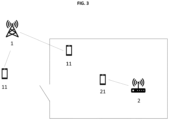
- FIG. 3 illustrates an exemplary scenario for monitoring the physical isolation and corresponding action in a communications system comprising a first and second network physically isolated from the first network according to an embodiment of the invention.
- a lack of isolation between the first and second base stations 1, 2 may happen, for example, due to an open window.
- the second BS 2 has to measure, constantly or every predetermined period of time, the physical isolation.
- the second BS 2 determines the UL time slots that are potentially affected by DL to UL interference and stops the transmission of UL scheduling grants for the UL time slots that are potentially affected by interference, such that the one or more UEs served by the second BS 2 do not transmit information during predetermined intervals in the UL time slots that are potentially affected by downlink to uplink interference.
- the determination, by the second BS 2, of which uplink time slots are potentially affected by downlink to uplink interference may comprise the following steps/actions depending on whether the second BS 2 has knowledge or not of the TDD frame configuration information and start time information of the TDD frame of the first BS 1.
- the second BS 2 checks if the uplink time slots of the first BS 1 and the second BS 2 are not aligned.
- aligned means that in all slots in which the seconds BS 2 receives data from its UEs in uplink, also the first BS 1 receives data in uplink. If they are not aligned, the second BS 2 determines which uplink time slots are potentially affected by downlink to uplink interference. If they are aligned, the slots are potentially not affected by downlink to uplink interference.
- the second BS 2 may determine that all uplink time slots are potentially affected by downlink to uplink interference.
- the second BS 2 can measure a level of interference received within the uplink time slots that are potentially affected by downlink to uplink interference.
- the second BS 2 calculates the level of isolation based on the measured level of interference of the uplink time slots and an expected level of interference of the uplink time slots.
- the expected level of interference may be a level of interference as measured during installation of the second communications network and/or second BS 2.
- the expected level of interference may be predetermined.
- a higher interference e.g. resulting from lacking isolation due to an open window
- the second BS 2 can determine if the measured level of isolation is critical. To do so, the second BS 2 compares the measured level of isolation with a predetermined threshold.
- the second BS 2 is configured to perform, as long as the measured level of isolation is critical, one or more of the following actions:
- the second BS 2 may continuously monitor/measure the level of isolation as described above, until it determines that the measured level of isolation is not critical anymore. Once the level of isolation is not critical, the second BS 2 may revert all the actions that were taken when the level of isolation was critical.
- the second BS 2 may also determine whether the measured level of isolation has been critical during more than a predetermined period of time and perform additional actions accordingly. For example, in case that the second BS 2 determines that the level of isolation has been critical during an extended period of time, the second BS 2 may inform to the network Operation and Maintenance (O&M) entity that the measured level of isolation has been critical more than a predetermined period of time. In addition, the second BS 2 may stop using the one or more interfered uplink time slots until the measured level of isolation becomes not critical.
- O&M Operation and Maintenance
- the second BS 2 may send a message towards the first BS 1 comprising an indication to: reduce power on selected beams or apply slot blanking.
- the physical isolation described above does not mitigate the interference of type B (uplink to downlink interference). Instead a novel scheduling algorithm in the BSs of the network which is subject to the interference (i.e. the public network) mitigates such interference.
- FIG. 2 also illustrates an exemplary communications system for mitigating the downlink-to-uplink interference comprising a first and second network according to this embodiment of the invention.
- the first network comprises at least a first base station (BS) 1 and at least one User Equipment (UE) 11 served by the first BS 1.
- the first BS 1 may operate at a first frequency band.
- the second network may be a Campus network.
- the second network comprises at least a second BS 2, a network Operation and Maintenance (O&M) entity 3, and at least one UE 21 served by the second BS 2.
- O&M Operation and Maintenance
- the physical isolation described above does not mitigate the interference of type B (uplink to downlink interference). Instead a novel scheduling algorithm in the first BSs of the network which is subject to the interference (i.e. the public network) mitigates such interference.
- the at least one UE 11 served by the first BS 1 receives information on a first frequency band from the first BS 1, and that the at least one UE 21 served by the second BS 2 transmits information on a second frequency band to the second BS 2.
- the first frequency band and the second frequency band may be the same frequency band or may be adjacent frequency bands.
- the first BS 1 continuously checks the information feedback by the one or more UEs 11.
- the information feedback by the one or more UEs 11 may be, for example, acknowledgments (ACKs) and/or negative acknowledgements (NACKs) that refer to previous transmissions from the first BS 1 to the at least one UE 11.
- ACKs acknowledgments
- NACKs negative acknowledgements
- the first BS 1 determines, for each UE 11 served by the first BS 1, whether the UE 11 is subject to uplink to downlink interference.
- the first BS 1 determines which uplink time slots are potentially subject to uplink to downlink interference by detecting whether the first BS 1 and the one or more UEs 11 served by the first BS 1 are not aligned with the second BS 2 and the one or more UEs 21 served by the second BS 2. Being not aligned means, for example, that a UE 11 served by the first BS 1 is receiving in a downlink time slot and a UE 21 served by the second BS 2 is transmitting in an uplink time slot or vice-versa.
- the first BS 1 creates a prediction of future slots that will also be subject to uplink to downlink interference based on the slots determined not aligned. This is possible due to the use of TDD frames. In more detail it is possible, because the TDD frame is continuously repeated (after frame 1 ends, frame 2 of the same structure starts).
- the first BS 1 optimizes the future usage of the slots.
- optimizing the future usage of the slots may comprise scheduling slots that are potentially interfered to one or more UEs 11 that are not subject to uplink to downlink interference.
- optimizing the future usage of the slots may comprise scheduling slots that are not potentially subject to uplink to downlink interference to one or more UEs 11 that are subject to uplink to downlink interference.
- the first BS or BSs of the first network are preconfigured with the information of which slots could be subject to interference.
- the steps of continuously checking the information feedback by the one or more UEs 11 and determining which uplink time slots are potentially subject to uplink to downlink interference would not be needed.
Landscapes
- Engineering & Computer Science (AREA)
- Computer Networks & Wireless Communication (AREA)
- Signal Processing (AREA)
- Mobile Radio Communication Systems (AREA)
Claims (6)
- Procédé d'atténuation d'interférence de liaison descendante, DL, vers une liaison montante, UL, dans un système de communication duplex à répartition dans le temps, TDD, ledit système de communication comprenant : un premier réseau de communication comprenant une première station de base, BS, (1), et un ou plusieurs équipements utilisateur, UE, (11), desservis par la première BS (1) ; et un deuxième réseau de communication comprenant une deuxième BS (2), un ou plusieurs équipements utilisateur, UE, (21), desservis par la deuxième BS (2), et une entité d'exploitation et de maintenance du réseau, O&M, la deuxième BS (2) étant physiquement isolée de la première BS (1) en termes de propagation radio, ledit procédé comprenant les étapes suivantes :transmission, par la première BS (1) vers un ou plusieurs UE (11) desservis par la première BS (1), d'informations sur une première bande de fréquences, et réception, par la deuxième BS (2), en provenance d'un ou de plusieurs UE (21) desservis par la deuxième BS (2), d'informations sur des créneaux temporels UL dans une deuxième bande de fréquences, la première bande de fréquences et la deuxième bande de fréquences étant dans la même bande de fréquences ou dans des bandes de fréquences adjacentes ;mesure, par la deuxième BS (2), d'un niveau d'isolation de la première BS (1), par :détermination, par la deuxième BS (2), de créneaux temporels UL potentiellement affectés par une interférence DL-UL,arrêt de la transmission, par la deuxième BS (2), d'autorisations de planification UL pour les créneaux temporels UL potentiellement affectés par une interférence, de sorte que le ou les UE (21) desservis par la deuxième BS (2) ne transmettent pas d'informations pendant des intervalles prédéterminés dans des créneaux temporels UL potentiellement affectés par une interférence liaison descendante-liaison montante,mesure d'un niveau d'interférence reçu dans les créneaux temporels de liaison montante potentiellement affectés par une interférence liaison descendante-liaison montante, etcalcul du niveau d'isolation sur la base du niveau d'interférence mesuré des créneaux temporels de liaison montante et d'un niveau d'interférence attendu des créneaux temporels de liaison montante ;détermination, par la deuxième BS (2), si le niveau d'isolation mesuré est critique par comparaison du niveau d'isolation mesuré à un seuil prédéterminé, où, s'il est déterminé que le niveau d'isolation mesuré est critique, la deuxième BS (2) exécute, tant que le niveau d'isolation mesuré est critique, une ou plusieurs des étapes suivantes :arrêt de la transmission, dans les trames futures, des autorisations de planification UL pour le ou les créneaux temporels UL brouillés ; et/ou planification, dans les trames futures, du ou des créneaux temporels brouillés uniquement pour des données moins critiques, lesdites données moins critiques étant des données pouvant être retransmises en cas d'erreurs ; et/ouabaissement d'un schéma de modulation et de codage, MCS, pour le ou les créneaux temporels de liaison montante brouillés ; et/ouplanification, dans les trames futures, du ou des créneaux temporels de liaison montante brouillée uniquement pour les UE (21) proches de la deuxième BS (2) reçus avec un niveau de puissance élevé, un UE (21) proche de la deuxième BS (2) recevant avec un niveau de puissance élevé signifiant qu'une perte de trajet entre la deuxième BS (2) et l'UE (21) est inférieure à un seuil prédéterminé ; et/ouinformation à l'entité O&M que le niveau d'isolation mesuré est critique, etrépétition de l'étape de mesure du niveau d'isolation et, s'il est déterminé que le niveau d'isolation mesuré n'est plus critique, retour à la ou aux étapes précédentes exécutées lorsque le niveau d'isolation était critique.
- Procédé selon la revendication 1, comprenant en outre :
la détermination, par la deuxième BS (2), si le niveau d'isolation mesuré a été critique pendant une durée supérieure à une période de temps prédéterminée et, dans le cas où il a été critique pendant une durée supérieure à une période de temps prédéterminée, l'exécution des étapes suivantes :information de l'entité O&M par la deuxième BS (2) que le niveau d'isolation mesuré a été critique pendant une durée supérieure à une période de temps prédéterminée ; etarrêt de l'utilisation du ou des créneaux de liaison montante brouillés jusqu'à ce que le niveau d'isolation mesuré ne soit plus critique. - Procédé selon la revendication 1 ou la revendication 2, où le niveau d'interférence attendu est un niveau d'interférence mesuré lors de l'installation du deuxième réseau de communication et/ou de la deuxième BS (2), ou est prédéterminé.
- Procédé selon l'une des revendications 1 à 3, où, après détermination, par la deuxième BS (2), que le niveau d'isolation mesuré a été critique pendant une durée supérieure à une période de temps prédéterminée, ledit procédé comprend en outre :
l'envoi, par la deuxième BS (2), d'un message à la première BS (1), ledit message comprenant une indication pour : réduire la puissance sur des faisceaux sélectionnés ou appliquer une suppression de créneau. - Procédé selon les revendications 1 à 4, où la détermination, par la deuxième BS (2), des créneaux temporels de liaison montante potentiellement affectés par une interférence liaison descendante-liaison montante comprend :si la deuxième BS (2) a connaissance d'informations de configuration de trame TDD et d'informations sur le temps de commencement de la trame TDD de la première BS (1) :la vérification, par la deuxième BS (2), si les créneaux temporels de liaison montante de la première BS (1) et de la deuxième BS (2) ne sont pas alignés, etsi ceux-ci ne sont pas alignés, la détermination, par la deuxième BS (2), des créneaux temporels de liaison montante potentiellement affectés par une interférence liaison descendante-liaison montante,si la BS n'a pas connaissance d'informations de configuration de la trame TDD et d'informations sur le temps de commencement de la trame TDD :
la détermination, par la deuxième BS (2), que tous les créneaux temporels de liaison montante sont potentiellement affectés par une interférence liaison descendante-liaison montante. - Système de communication duplex à répartition dans le temps, TDD, pour l'atténuation d'interférence de liaison descendante, DL, vers une liaison montante, UL, ledit système de communication comprenant : un premier réseau de communication comprenant une première station de base, BS, (1), et un ou plusieurs équipements utilisateur, UE, (11), desservis par la première BS (1) ; et un deuxième réseau de communication comprenant une deuxième BS (2), un ou plusieurs équipements utilisateur, UE, (21), desservis par la deuxième BS (2), et une entité d'exploitation et de maintenance du réseau, O&M, la deuxième BS (2) étant physiquement isolée de la première BS (1) en termes de propagation radio, où :la première BS (1) est configurée pour transmettre à un ou plusieurs UE (11) desservis par la première BS (1), des informations sur une première bande de fréquences, et la deuxième BS (2) est configurée pour recevoir d'un ou de plusieurs UE (21) desservis par la deuxième BS (2), des informations sur des créneaux temporels UL dans une deuxième bande de fréquences, la première bande de fréquences et la deuxième bande de fréquences étant dans la même bande de fréquences ou dans des bandes de fréquences adjacentes ;la deuxième BS (2) est configurée pour mesurer un niveau d'isolation en étant configurée pour :déterminer des créneaux temporels UL potentiellement affectés par une interférence DL-UL,arrêter la transmission d'autorisations de planification UL pour les créneaux temporels UL potentiellement affectés par une interférence, de sorte que le ou les UE (21) desservis par la deuxième BS (2) ne transmettent pas d'informations pendant des intervalles prédéterminés dans des créneaux temporels UL potentiellement affectés par une interférence liaison descendante-liaison montante, mesurer un niveau d'interférence reçu dans les créneaux temporels de liaison montante potentiellement affectés par une interférence liaison descendante-liaison montante, etcalculer le niveau d'isolation sur la base du niveau d'interférence mesuré des créneaux temporels de liaison montante et d'un niveau d'interférence attendu des créneaux temporels de liaison montante ;la deuxième BS (2) est configurée pour déterminer si le niveau d'isolation mesuré est critique par comparaison du niveau d'isolation mesuré à un seuil prédéterminé,où, s'il est déterminé que le niveau d'isolation mesuré est critique, la deuxième BS (2) est configurée pour exécuter, tant que le niveau d'isolation mesuré est critique, une ou plusieurs des opérations suivantes :arrêt de la transmission, dans les trames futures, des autorisations de planification UL pour le ou les créneaux temporels UL brouillés ; et/ou planification, dans les trames futures, du ou des créneaux temporels brouillés uniquement pour des données moins critiques, lesdites données moins critiques étant des données pouvant être retransmises en cas d'erreurs ; et/ouabaissement d'un schéma de modulation et de codage, MCS, pour le ou les créneaux temporels de liaison montante brouillés ; et/ouplanification, dans les trames futures, du ou des créneaux temporels de liaison montante brouillée uniquement pour les UE (21) proches de la deuxième BS (2) reçus avec un niveau de puissance élevé, un UE (21) proche de la deuxième BS (2) recevant avec un niveau de puissance élevé signifiant qu'une perte de trajet entre la deuxième BS (2) et l'UE (21) est inférieure à un seuil prédéterminé ; et/ouinformation à l'entité O&M que le niveau d'isolation mesuré est critique, etrépétition de la mesure du niveau d'isolation et, s'il est déterminé que le niveau d'isolation mesuré n'est plus critique, retour à la ou aux étapes précédentes exécutées lorsque le niveau d'isolation était critique.
Priority Applications (1)
| Application Number | Priority Date | Filing Date | Title |
|---|---|---|---|
| EP21200124.2A EP4161136B1 (fr) | 2021-09-30 | 2021-09-30 | Augmentation de la capacité de liaison montante pour les réseaux de campus par l'atténuation des interférences tdd |
Applications Claiming Priority (1)
| Application Number | Priority Date | Filing Date | Title |
|---|---|---|---|
| EP21200124.2A EP4161136B1 (fr) | 2021-09-30 | 2021-09-30 | Augmentation de la capacité de liaison montante pour les réseaux de campus par l'atténuation des interférences tdd |
Publications (2)
| Publication Number | Publication Date |
|---|---|
| EP4161136A1 EP4161136A1 (fr) | 2023-04-05 |
| EP4161136B1 true EP4161136B1 (fr) | 2024-11-13 |
Family
ID=78211855
Family Applications (1)
| Application Number | Title | Priority Date | Filing Date |
|---|---|---|---|
| EP21200124.2A Active EP4161136B1 (fr) | 2021-09-30 | 2021-09-30 | Augmentation de la capacité de liaison montante pour les réseaux de campus par l'atténuation des interférences tdd |
Country Status (1)
| Country | Link |
|---|---|
| EP (1) | EP4161136B1 (fr) |
Family Cites Families (3)
| Publication number | Priority date | Publication date | Assignee | Title |
|---|---|---|---|---|
| US8908571B2 (en) * | 2010-10-01 | 2014-12-09 | Clearwire Ip Holdings Llc | Enabling coexistence between wireless networks |
| ES2885524T3 (es) * | 2012-05-11 | 2021-12-14 | Nokia Solutions & Networks Oy | Procedimiento para la mitigación de la interferencia del enlace ascendente-enlace descendente en una red heterogénea |
| US20130301423A1 (en) * | 2012-05-11 | 2013-11-14 | Alexander Sirotkin | Method, system and apparatus of time-division-duplex (tdd) uplink-downlink (ul-dl) interference management |
-
2021
- 2021-09-30 EP EP21200124.2A patent/EP4161136B1/fr active Active
Also Published As
| Publication number | Publication date |
|---|---|
| EP4161136A1 (fr) | 2023-04-05 |
Similar Documents
| Publication | Publication Date | Title |
|---|---|---|
| EP2922358B1 (fr) | Traitement des interférences sur une station de base desservante | |
| EP3622758B9 (fr) | Méthode, appareil et support lisible par ordinateur pour la mesure de la perte de propagation | |
| US8908571B2 (en) | Enabling coexistence between wireless networks | |
| US11284355B2 (en) | Interference measurement method and related device | |
| US7804797B2 (en) | Communication control device and communication control method | |
| US8565807B2 (en) | Transmission of a synchronization signal within a cellular telecommunication network with temporarily increased transmitting power | |
| US12425902B2 (en) | Mobile terminal, network node, system and methods | |
| EP2557831A1 (fr) | Système de communication sans fil, station de base radio et procédé de commande de communication | |
| US20110182256A1 (en) | Method and Arrangement in a Wireless Communication System | |
| US9380590B2 (en) | Method and apparatus for handling the TDD tail problem for an ABS pattern | |
| EP4410016B1 (fr) | Atténuation intelligente des interférences pour réseaux à large bande à duplexage par répartition dans le temps | |
| GB2538772A (en) | Beam scheduling | |
| EP2048903B1 (fr) | Système de communications combinées, appareil interdisant la transmission de signaux, station de base sans fil et procédé | |
| EP2485543A1 (fr) | Système de communication sans fil, station de base à grandes cellules et procédé de commande de communication | |
| EP2991415A1 (fr) | Procédé et appareil de synchronisation de noeud | |
| US20160366584A1 (en) | Wireless communications system, base station, terminal, and process method | |
| EP4161136B1 (fr) | Augmentation de la capacité de liaison montante pour les réseaux de campus par l'atténuation des interférences tdd | |
| EP3998715B1 (fr) | Appareil et procédé permettant de régler le gain d'un répéteur radiofréquence en utilisant un signal de synchronisation | |
| EP2211581A1 (fr) | Signal de référence de synchronisation de réseau local. | |
| KR102571817B1 (ko) | 비면허 대역을 통해 데이터를 송수신하는 수신 장치 및 송신 장치 | |
| Hiltunen et al. | Performance of neighboring indoor 5G micro operators with dynamic TDD | |
| WO2009127874A1 (fr) | Commande de puissance de station de base | |
| WO2009142072A1 (fr) | Système de radiocommunication, station de base, terminal, méttransfertde de communication radio, et programme | |
| US20240340650A1 (en) | Methods and Apparatus for Detecting, Managing and/or Mitigating Interference Between Networks Without the Need for A Centralized Controller | |
| EP2530846A1 (fr) | Procédé de configuration dýune communication sans fil et système de communication sans fil |
Legal Events
| Date | Code | Title | Description |
|---|---|---|---|
| PUAI | Public reference made under article 153(3) epc to a published international application that has entered the european phase |
Free format text: ORIGINAL CODE: 0009012 |
|
| STAA | Information on the status of an ep patent application or granted ep patent |
Free format text: STATUS: REQUEST FOR EXAMINATION WAS MADE |
|
| 17P | Request for examination filed |
Effective date: 20220901 |
|
| AK | Designated contracting states |
Kind code of ref document: A1 Designated state(s): AL AT BE BG CH CY CZ DE DK EE ES FI FR GB GR HR HU IE IS IT LI LT LU LV MC MK MT NL NO PL PT RO RS SE SI SK SM TR |
|
| STAA | Information on the status of an ep patent application or granted ep patent |
Free format text: STATUS: EXAMINATION IS IN PROGRESS |
|
| 17Q | First examination report despatched |
Effective date: 20240429 |
|
| GRAP | Despatch of communication of intention to grant a patent |
Free format text: ORIGINAL CODE: EPIDOSNIGR1 |
|
| STAA | Information on the status of an ep patent application or granted ep patent |
Free format text: STATUS: GRANT OF PATENT IS INTENDED |
|
| INTG | Intention to grant announced |
Effective date: 20240813 |
|
| GRAS | Grant fee paid |
Free format text: ORIGINAL CODE: EPIDOSNIGR3 |
|
| GRAA | (expected) grant |
Free format text: ORIGINAL CODE: 0009210 |
|
| STAA | Information on the status of an ep patent application or granted ep patent |
Free format text: STATUS: THE PATENT HAS BEEN GRANTED |
|
| AK | Designated contracting states |
Kind code of ref document: B1 Designated state(s): AL AT BE BG CH CY CZ DE DK EE ES FI FR GB GR HR HU IE IS IT LI LT LU LV MC MK MT NL NO PL PT RO RS SE SI SK SM TR |
|
| REG | Reference to a national code |
Ref country code: GB Ref legal event code: FG4D |
|
| REG | Reference to a national code |
Ref country code: CH Ref legal event code: EP |
|
| REG | Reference to a national code |
Ref country code: DE Ref legal event code: R096 Ref document number: 602021021725 Country of ref document: DE |
|
| REG | Reference to a national code |
Ref country code: IE Ref legal event code: FG4D |
|
| REG | Reference to a national code |
Ref country code: LT Ref legal event code: MG9D |
|
| REG | Reference to a national code |
Ref country code: NL Ref legal event code: MP Effective date: 20241113 |
|
| PG25 | Lapsed in a contracting state [announced via postgrant information from national office to epo] |
Ref country code: PT Free format text: LAPSE BECAUSE OF FAILURE TO SUBMIT A TRANSLATION OF THE DESCRIPTION OR TO PAY THE FEE WITHIN THE PRESCRIBED TIME-LIMIT Effective date: 20250313 Ref country code: IS Free format text: LAPSE BECAUSE OF FAILURE TO SUBMIT A TRANSLATION OF THE DESCRIPTION OR TO PAY THE FEE WITHIN THE PRESCRIBED TIME-LIMIT Effective date: 20250313 Ref country code: HR Free format text: LAPSE BECAUSE OF FAILURE TO SUBMIT A TRANSLATION OF THE DESCRIPTION OR TO PAY THE FEE WITHIN THE PRESCRIBED TIME-LIMIT Effective date: 20241113 |
|
| PG25 | Lapsed in a contracting state [announced via postgrant information from national office to epo] |
Ref country code: FI Free format text: LAPSE BECAUSE OF FAILURE TO SUBMIT A TRANSLATION OF THE DESCRIPTION OR TO PAY THE FEE WITHIN THE PRESCRIBED TIME-LIMIT Effective date: 20241113 Ref country code: NL Free format text: LAPSE BECAUSE OF FAILURE TO SUBMIT A TRANSLATION OF THE DESCRIPTION OR TO PAY THE FEE WITHIN THE PRESCRIBED TIME-LIMIT Effective date: 20241113 |
|
| REG | Reference to a national code |
Ref country code: AT Ref legal event code: MK05 Ref document number: 1742598 Country of ref document: AT Kind code of ref document: T Effective date: 20241113 |
|
| PG25 | Lapsed in a contracting state [announced via postgrant information from national office to epo] |
Ref country code: BG Free format text: LAPSE BECAUSE OF FAILURE TO SUBMIT A TRANSLATION OF THE DESCRIPTION OR TO PAY THE FEE WITHIN THE PRESCRIBED TIME-LIMIT Effective date: 20241113 |
|
| PG25 | Lapsed in a contracting state [announced via postgrant information from national office to epo] |
Ref country code: ES Free format text: LAPSE BECAUSE OF FAILURE TO SUBMIT A TRANSLATION OF THE DESCRIPTION OR TO PAY THE FEE WITHIN THE PRESCRIBED TIME-LIMIT Effective date: 20241113 |
|
| PG25 | Lapsed in a contracting state [announced via postgrant information from national office to epo] |
Ref country code: NO Free format text: LAPSE BECAUSE OF FAILURE TO SUBMIT A TRANSLATION OF THE DESCRIPTION OR TO PAY THE FEE WITHIN THE PRESCRIBED TIME-LIMIT Effective date: 20250213 |
|
| PG25 | Lapsed in a contracting state [announced via postgrant information from national office to epo] |
Ref country code: LV Free format text: LAPSE BECAUSE OF FAILURE TO SUBMIT A TRANSLATION OF THE DESCRIPTION OR TO PAY THE FEE WITHIN THE PRESCRIBED TIME-LIMIT Effective date: 20241113 Ref country code: GR Free format text: LAPSE BECAUSE OF FAILURE TO SUBMIT A TRANSLATION OF THE DESCRIPTION OR TO PAY THE FEE WITHIN THE PRESCRIBED TIME-LIMIT Effective date: 20250214 Ref country code: AT Free format text: LAPSE BECAUSE OF FAILURE TO SUBMIT A TRANSLATION OF THE DESCRIPTION OR TO PAY THE FEE WITHIN THE PRESCRIBED TIME-LIMIT Effective date: 20241113 |
|
| PG25 | Lapsed in a contracting state [announced via postgrant information from national office to epo] |
Ref country code: PL Free format text: LAPSE BECAUSE OF FAILURE TO SUBMIT A TRANSLATION OF THE DESCRIPTION OR TO PAY THE FEE WITHIN THE PRESCRIBED TIME-LIMIT Effective date: 20241113 |
|
| PG25 | Lapsed in a contracting state [announced via postgrant information from national office to epo] |
Ref country code: RS Free format text: LAPSE BECAUSE OF FAILURE TO SUBMIT A TRANSLATION OF THE DESCRIPTION OR TO PAY THE FEE WITHIN THE PRESCRIBED TIME-LIMIT Effective date: 20250213 |
|
| PG25 | Lapsed in a contracting state [announced via postgrant information from national office to epo] |
Ref country code: SM Free format text: LAPSE BECAUSE OF FAILURE TO SUBMIT A TRANSLATION OF THE DESCRIPTION OR TO PAY THE FEE WITHIN THE PRESCRIBED TIME-LIMIT Effective date: 20241113 |
|
| PG25 | Lapsed in a contracting state [announced via postgrant information from national office to epo] |
Ref country code: DK Free format text: LAPSE BECAUSE OF FAILURE TO SUBMIT A TRANSLATION OF THE DESCRIPTION OR TO PAY THE FEE WITHIN THE PRESCRIBED TIME-LIMIT Effective date: 20241113 |
|
| PG25 | Lapsed in a contracting state [announced via postgrant information from national office to epo] |
Ref country code: EE Free format text: LAPSE BECAUSE OF FAILURE TO SUBMIT A TRANSLATION OF THE DESCRIPTION OR TO PAY THE FEE WITHIN THE PRESCRIBED TIME-LIMIT Effective date: 20241113 |
|
| PG25 | Lapsed in a contracting state [announced via postgrant information from national office to epo] |
Ref country code: RO Free format text: LAPSE BECAUSE OF FAILURE TO SUBMIT A TRANSLATION OF THE DESCRIPTION OR TO PAY THE FEE WITHIN THE PRESCRIBED TIME-LIMIT Effective date: 20241113 |
|
| PG25 | Lapsed in a contracting state [announced via postgrant information from national office to epo] |
Ref country code: SK Free format text: LAPSE BECAUSE OF FAILURE TO SUBMIT A TRANSLATION OF THE DESCRIPTION OR TO PAY THE FEE WITHIN THE PRESCRIBED TIME-LIMIT Effective date: 20241113 |
|
| PG25 | Lapsed in a contracting state [announced via postgrant information from national office to epo] |
Ref country code: CZ Free format text: LAPSE BECAUSE OF FAILURE TO SUBMIT A TRANSLATION OF THE DESCRIPTION OR TO PAY THE FEE WITHIN THE PRESCRIBED TIME-LIMIT Effective date: 20241113 |
|
| PG25 | Lapsed in a contracting state [announced via postgrant information from national office to epo] |
Ref country code: IT Free format text: LAPSE BECAUSE OF FAILURE TO SUBMIT A TRANSLATION OF THE DESCRIPTION OR TO PAY THE FEE WITHIN THE PRESCRIBED TIME-LIMIT Effective date: 20241113 |
|
| REG | Reference to a national code |
Ref country code: DE Ref legal event code: R097 Ref document number: 602021021725 Country of ref document: DE |
|
| PG25 | Lapsed in a contracting state [announced via postgrant information from national office to epo] |
Ref country code: SE Free format text: LAPSE BECAUSE OF FAILURE TO SUBMIT A TRANSLATION OF THE DESCRIPTION OR TO PAY THE FEE WITHIN THE PRESCRIBED TIME-LIMIT Effective date: 20241113 |
|
| PLBE | No opposition filed within time limit |
Free format text: ORIGINAL CODE: 0009261 |
|
| STAA | Information on the status of an ep patent application or granted ep patent |
Free format text: STATUS: NO OPPOSITION FILED WITHIN TIME LIMIT |
|
| PGFP | Annual fee paid to national office [announced via postgrant information from national office to epo] |
Ref country code: DE Payment date: 20250919 Year of fee payment: 5 |
|
| PGFP | Annual fee paid to national office [announced via postgrant information from national office to epo] |
Ref country code: GB Payment date: 20250923 Year of fee payment: 5 |
|
| PGFP | Annual fee paid to national office [announced via postgrant information from national office to epo] |
Ref country code: FR Payment date: 20250926 Year of fee payment: 5 |
|
| 26N | No opposition filed |
Effective date: 20250814 |