EP4162818A2 - Article de génération d'aérosol, vaporisateur électronique, système de vaporisation, procédé d'identification et procédé de régulation de température - Google Patents
Article de génération d'aérosol, vaporisateur électronique, système de vaporisation, procédé d'identification et procédé de régulation de température Download PDFInfo
- Publication number
- EP4162818A2 EP4162818A2 EP22199949.3A EP22199949A EP4162818A2 EP 4162818 A2 EP4162818 A2 EP 4162818A2 EP 22199949 A EP22199949 A EP 22199949A EP 4162818 A2 EP4162818 A2 EP 4162818A2
- Authority
- EP
- European Patent Office
- Prior art keywords
- aerosol
- generation
- generation article
- temperature
- electrode
- Prior art date
- Legal status (The legal status is an assumption and is not a legal conclusion. Google has not performed a legal analysis and makes no representation as to the accuracy of the status listed.)
- Pending
Links
Images


Classifications
-
- A—HUMAN NECESSITIES
- A24—TOBACCO; CIGARS; CIGARETTES; SIMULATED SMOKING DEVICES; SMOKERS' REQUISITES
- A24F—SMOKERS' REQUISITES; MATCH BOXES; SIMULATED SMOKING DEVICES
- A24F40/00—Electrically operated smoking devices; Component parts thereof; Manufacture thereof; Maintenance or testing thereof; Charging means specially adapted therefor
- A24F40/40—Constructional details, e.g. connection of cartridges and battery parts
- A24F40/46—Shape or structure of electric heating means
-
- A—HUMAN NECESSITIES
- A24—TOBACCO; CIGARS; CIGARETTES; SIMULATED SMOKING DEVICES; SMOKERS' REQUISITES
- A24D—CIGARS; CIGARETTES; TOBACCO SMOKE FILTERS; MOUTHPIECES OF CIGARS OR CIGARETTES; MANUFACTURE OF TOBACCO SMOKE FILTERS OR MOUTHPIECES
- A24D1/00—Cigars; Cigarettes
- A24D1/20—Cigarettes specially adapted for simulated smoking devices
-
- A—HUMAN NECESSITIES
- A24—TOBACCO; CIGARS; CIGARETTES; SIMULATED SMOKING DEVICES; SMOKERS' REQUISITES
- A24D—CIGARS; CIGARETTES; TOBACCO SMOKE FILTERS; MOUTHPIECES OF CIGARS OR CIGARETTES; MANUFACTURE OF TOBACCO SMOKE FILTERS OR MOUTHPIECES
- A24D1/00—Cigars; Cigarettes
- A24D1/02—Cigars; Cigarettes with special covers
-
- A—HUMAN NECESSITIES
- A24—TOBACCO; CIGARS; CIGARETTES; SIMULATED SMOKING DEVICES; SMOKERS' REQUISITES
- A24F—SMOKERS' REQUISITES; MATCH BOXES; SIMULATED SMOKING DEVICES
- A24F40/00—Electrically operated smoking devices; Component parts thereof; Manufacture thereof; Maintenance or testing thereof; Charging means specially adapted therefor
- A24F40/40—Constructional details, e.g. connection of cartridges and battery parts
-
- A—HUMAN NECESSITIES
- A24—TOBACCO; CIGARS; CIGARETTES; SIMULATED SMOKING DEVICES; SMOKERS' REQUISITES
- A24F—SMOKERS' REQUISITES; MATCH BOXES; SIMULATED SMOKING DEVICES
- A24F40/00—Electrically operated smoking devices; Component parts thereof; Manufacture thereof; Maintenance or testing thereof; Charging means specially adapted therefor
- A24F40/40—Constructional details, e.g. connection of cartridges and battery parts
- A24F40/46—Shape or structure of electric heating means
- A24F40/465—Shape or structure of electric heating means specially adapted for induction heating
-
- A—HUMAN NECESSITIES
- A24—TOBACCO; CIGARS; CIGARETTES; SIMULATED SMOKING DEVICES; SMOKERS' REQUISITES
- A24F—SMOKERS' REQUISITES; MATCH BOXES; SIMULATED SMOKING DEVICES
- A24F40/00—Electrically operated smoking devices; Component parts thereof; Manufacture thereof; Maintenance or testing thereof; Charging means specially adapted therefor
- A24F40/50—Control or monitoring
-
- A—HUMAN NECESSITIES
- A24—TOBACCO; CIGARS; CIGARETTES; SIMULATED SMOKING DEVICES; SMOKERS' REQUISITES
- A24F—SMOKERS' REQUISITES; MATCH BOXES; SIMULATED SMOKING DEVICES
- A24F40/00—Electrically operated smoking devices; Component parts thereof; Manufacture thereof; Maintenance or testing thereof; Charging means specially adapted therefor
- A24F40/50—Control or monitoring
- A24F40/51—Arrangement of sensors
-
- A—HUMAN NECESSITIES
- A24—TOBACCO; CIGARS; CIGARETTES; SIMULATED SMOKING DEVICES; SMOKERS' REQUISITES
- A24F—SMOKERS' REQUISITES; MATCH BOXES; SIMULATED SMOKING DEVICES
- A24F40/00—Electrically operated smoking devices; Component parts thereof; Manufacture thereof; Maintenance or testing thereof; Charging means specially adapted therefor
- A24F40/50—Control or monitoring
- A24F40/53—Monitoring, e.g. fault detection
-
- A—HUMAN NECESSITIES
- A24—TOBACCO; CIGARS; CIGARETTES; SIMULATED SMOKING DEVICES; SMOKERS' REQUISITES
- A24F—SMOKERS' REQUISITES; MATCH BOXES; SIMULATED SMOKING DEVICES
- A24F40/00—Electrically operated smoking devices; Component parts thereof; Manufacture thereof; Maintenance or testing thereof; Charging means specially adapted therefor
- A24F40/50—Control or monitoring
- A24F40/57—Temperature control
-
- A—HUMAN NECESSITIES
- A24—TOBACCO; CIGARS; CIGARETTES; SIMULATED SMOKING DEVICES; SMOKERS' REQUISITES
- A24F—SMOKERS' REQUISITES; MATCH BOXES; SIMULATED SMOKING DEVICES
- A24F40/00—Electrically operated smoking devices; Component parts thereof; Manufacture thereof; Maintenance or testing thereof; Charging means specially adapted therefor
- A24F40/85—Maintenance, e.g. cleaning
-
- H—ELECTRICITY
- H05—ELECTRIC TECHNIQUES NOT OTHERWISE PROVIDED FOR
- H05B—ELECTRIC HEATING; ELECTRIC LIGHT SOURCES NOT OTHERWISE PROVIDED FOR; CIRCUIT ARRANGEMENTS FOR ELECTRIC LIGHT SOURCES, IN GENERAL
- H05B6/00—Heating by electric, magnetic or electromagnetic fields
- H05B6/02—Induction heating
- H05B6/36—Coil arrangements
-
- A—HUMAN NECESSITIES
- A24—TOBACCO; CIGARS; CIGARETTES; SIMULATED SMOKING DEVICES; SMOKERS' REQUISITES
- A24F—SMOKERS' REQUISITES; MATCH BOXES; SIMULATED SMOKING DEVICES
- A24F40/00—Electrically operated smoking devices; Component parts thereof; Manufacture thereof; Maintenance or testing thereof; Charging means specially adapted therefor
- A24F40/20—Devices using solid inhalable precursors
Definitions
- the present application relates to the field of vaporization technologies, and in particular, to an aerosol-generation article, an electronic vaporizer, a vaporization system, a method for identifying a type of an aerosol-generation article, and a temperature control method.
- An electronic vaporizer is a device that mainly heats an aerosol-generation article to form aerosols.
- a low-temperature electronic vaporizer (or referred to as a heat-not-burning (HNB) device) is an electronic vaporizer that mainly bakes an aerosol-generation article at a low temperature of 200 °C to 450 °C to generate aerosols.
- Heating methods that can be used in the low-temperature electronic vaporizer mainly include central heating (heating an aerosol-generation article by directly inserting a heat generation body into the aerosol-generation article) and circumferential heating (heating an aerosol-generation article by placing the aerosol-generation article into a tubular heat generation body). Because aerosols can be formed at a relatively low temperature without a large amount of harmful substances brought by high-temperature pyrolysis, the low-temperature electronic vaporizer is adored by people.
- a temperature sensor connected to a power source is mounted at a position (for example, a surface of a heating rod/pin or an inner side of a heating barrel) close to the heat generation body in a conventional electronic vaporizer, to achieve temperature control.
- a space needs to be reserved for the temperature sensor in the electronic vaporizer, which is not beneficial to improving the structure design of the electronic vaporizer.
- the temperature sensor is arranged on a surface of the heat generation body, making the electronic vaporizer hard to clean.
- an aerosol-generation article an electronic vaporizer, a vaporization system, a method and device for identifying a type of an aerosol-generation article, and a temperature control method are provided.
- An aerosol-generation article including an aerosol-generation substrate and a temperature sensor.
- the temperature sensor includes a dielectric material whose dielectric constant is variable with temperature. A Curie temperature of the dielectric material falls within a temperature range required for the aerosol-generation substrate to form an aerosol.
- the aerosol-generation article includes the aerosol-generation substrate and the temperature sensor.
- the temperature sensor By arranging the temperature sensor as a part of the aerosol-generation article, a temperature of the aerosol-generation article can be measured while the temperature sensor is not in contact with an electronic vaporizer. Therefore, the electronic vaporizer is more convenient to clean, and no space needs to be reserved on the electronic vaporizer, thereby facilitating to improve the structure design of the electronic vaporizer.
- the Curie temperature of the dielectric material of the temperature sensor of the aerosol-generation article falls within the temperature range required for the aerosol-generation substrate to form the aerosol, so that the temperature sensor can be more sensitive to temperature changes, thereby improving the temperature measuring sensitivity.
- the Curie temperature of the dielectric material ranges from 200 °C to 450 °C.
- the dielectric material is at least one selected from the group consisting of niobate, zirconate, titanate, bismuthate, and any combination thereof.
- the dielectric material is at least one selected from the group consisting of NaNbO 3 , K 0.5 Na 0.5 NbO 3 , 0.96K 0.5 Na 0.5 NbO 3 -0.04Bi 0.5 Na 0.5 ZrO 3 , and any combination thereof.
- the temperature sensor is in at least one form of a sheet, a pin, or a particle.
- the aerosol-generation article further includes a packaging layer.
- the aerosol-generation substrate is arranged in the packaging layer and is wrapped by the packaging layer.
- the temperature sensor is arranged on an outer side of the packaging layer or the temperature sensor is arranged in the aerosol-generation substrate.
- An electronic vaporizer including a first electrode, a second electrode, a detection module, a controller, and a heating module.
- a cavity configured to accommodate an aerosol-generation article is formed between the first electrode and the second electrode.
- the detection module is configured to detect a dielectric constant of the aerosol-generation article accommodated in the cavity and feed back a detection result to the controller, and the controller is configured to control power supply to the heating module according to the detection result.
- the first electrode, the aerosol-generation article accommodated in the cavity, and the second electrode form an equivalent capacitor.
- the electronic vaporizer further includes an inductance coil.
- the inductance coil, the equivalent capacitor, and a power source form a resonance circuit.
- the detection module is configured to detect a resonance frequency of the resonance circuit, and the controller is configured to control power supply of the power source to the heating module according to the resonance frequency.
- the controller when a temperature corresponding to the detection result is lower than a preset cooling temperature, the controller is configured to control the power source to supply normal power to the heating module. When the temperature corresponding to the detection result is higher than or equal to the preset cooling temperature, the controller is configured to control the power source to reduce power supply to the heating module.
- the controller is configured to start a heating program when the detection result matches a preset startup parameter.
- the electronic vaporizer includes a plurality of first electrodes that are arranged at intervals and a plurality of second electrodes that are arranged at intervals.
- the plurality of first electrodes and the corresponding second electrodes are configured to cooperatively form equivalent capacitors at different positions on the aerosol-generation article.
- the detection module is configured to detect dielectric constants at different positions on the aerosol-generation article by detecting capacitances of the equivalent capacitors at different positions.
- a vaporization system including the foregoing aerosol-generation article and the foregoing electronic vaporizer adapted to the aerosol-generation article.
- a method for identifying a type of an aerosol-generation article including: detecting a dielectric constant of the aerosol-generation article, and determining that the aerosol-generation article is of an identifiable type when a detection result matches a preset value.
- the detecting the dielectric constant of the aerosol-generation article includes: detecting a parameter associated with the dielectric constant.
- the parameter comprises a capacitance value of an equivalent capacitor in which the aerosol-generation article is located or a resonance frequency of a resonance circuit in which the equivalent capacitor is located.
- a device for identifying a type of an aerosol-generation article including a third electrode, a fourth electrode, a measuring module, and a main controller.
- An accommodating area configured to accommodate the aerosol-generation article is formed between the third electrode and the fourth electrode.
- the measuring module is configured to detect a dielectric constant of the aerosol-generation article arranged in the accommodating area and feed back a detection result to the main controller, and the main controller is configured to compare the detection result with a preset value and determine that the aerosol-generation article is of a type identifiable by the device when the detection result matches the preset value.
- a temperature control method for an electronic vaporizer including: detecting a dielectric constant of an aerosol-generation article, and adjusting a temperature of the aerosol-generation article according to a detection result.
- the detecting the dielectric constant of the aerosol-generation article includes: detecting a parameter associated with the dielectric constant.
- the parameter comprises a capacitance value of an equivalent capacitor in which the aerosol-generation article is located or a resonance frequency of a resonance circuit in which the equivalent capacitor is located.
- the present application provides an aerosol-generation article which is beneficial to structure optimization of an electronic vaporizer and facilitates cleaning of the electronic vaporizer.
- the present application further provides an electronic vaporizer which is easy to clean, a vaporization system, a method for identifying a type of an aerosol-generation article, and a temperature control method.
- an embodiment of the present application provides a vaporization system 10.
- the vaporization system 10 includes an aerosol-generation article 100 and an electronic vaporizer 200 adapted to the aerosol-generation article 100.
- the aerosol-generation article 100 can be heated and vaporized by the electronic vaporizer 200 to form aerosols.
- the aerosols are suspensions of solid particles or droplets suspended in gas (for example, air).
- the aerosol-generation article 100 includes a packaging layer (not shown), an aerosol-generation substrate 110, and a temperature sensor 120.
- the packaging layer is used as an outer packaging and is configured to wrap other components (for example, the aerosol-generation substrate 110 and the temperature sensor 120) of the aerosol-generation article 100 in the packaging layer.
- the packaging layer is packaging paper or plastic.
- the packaging layer is plastic, and the packaging layer can be directly used as a container for containing the aerosol-generation substrate 110 in this case.
- the packaging layer is packaging paper. It may be understood that, when the aerosol-generation substrate 110 is a liquid substrate, a container for containing the aerosol-generation substrate 110 may alternatively be provided independently, and the packaging layer may alternatively be packaging paper in this case.
- the packaging layer is in a shape of a cylinder
- the aerosol-generation article includes the aerosol-generation substrate 110, a hollow tubular element, and a mouthpiece that are sequentially arranged on a central axis and defined by the packaging layer.
- the hollow tubular element is arranged between the aerosol-generation substrate 110 and the mouthpiece and is configured to extend a distance from the aerosols to the mouthpiece, so as to play a role in buffering.
- a cooling element configured to cool the aerosols is further arranged in the hollow tubular element.
- a filtering material for example, cellulose acetate
- an aerosol cooling element is further arranged between the hollow tubular element and the mouthpiece, to prevent the aerosols from being too hot.
- the aerosol-generation article 100 is the aerosol-generation substrate 110. That is, in this case, the packaging layer, the hollow tubular element, the mouthpiece, and the cooling element are omitted in the aerosol-generation article 100. It may be understood that, in some embodiments, some of the foregoing elements may alternatively be included.
- the aerosol-generation substrate 110 is configured to form aerosols.
- the aerosol-generation substrate 110 is a solid substrate.
- the aerosol-generation substrate 110 is in at least one shape of powders, particles, sheets, wires, spaghettis, or strips. It may be understood that, the solid aerosol-generation substrate 110 is not limited to be in the foregoing shape and may also be in other shapes.
- the aerosol-generation substrate 110 includes a functional material and a substrate material.
- the functional material causes the aerosol-generation substrate 110 to generate aerosols; and the substrate material provides support to the functional material to form the aerosol-generation substrate 110.
- the functional material includes a volatile flavor substance and an aerosol-forming agent.
- the aerosol-forming agent is used for forming aerosols; and the volatile flavor substance is used for adding flavors to aerosols. Use amounts and types of the volatile flavor substance and the aerosols may be selected and matched according to requirements.
- the volatile flavor substance is from a natural raw material or artificially synthesized material.
- the volatile flavor substance is at least one selected from the group consisting of alcohols, aldehydes, ketones, lipids, phenols, terpenoids, low-grade fatty acids that include flavors, and any combination thereof.
- the volatile flavor substance is an extract of at least one of a leaf, a stem, a root, or a flower of a plant.
- the volatile flavor substance may be selected and matched according to actual requirements. Certainly, in some embodiments, the volatile flavor substance may be omitted.
- the aerosol-forming agent includes polyol.
- the aerosol-forming agent is at least one selected from the group consisting of triethylene glycol, butylene glycol, glycerol, propylene glycol, and any combination thereof. It may be understood that, the aerosol-forming agent is not limited to the foregoing.
- the substrate material is made of a natural raw material including a volatile flavor substance; and the aerosol-generation substrate 110 is made by mixing the substrate material and the functional material.
- the substrate material is at least one of a leaf, a stem, a root, or a flower of a plant.
- the plant is an herb.
- the natural material including a volatile flavor substance can release the flavor substance and form aerosols. It may be understood that, when the substrate material is made of a natural raw material (for example, an herb) including a volatile flavor substance, the volatile flavor substance and the aerosol-forming agent can be both provided by the substrate material and thus the functional material can be omitted in this case.
- the substrate material is tobacco.
- the substrate material is an artificially synthesized material.
- the substrate material is a porous material, and the functional material is filled in the substrate material.
- the substrate material is in a shape of particles, wires, pieces, or powders, the functional material is distributed in the substrate material, and the aerosol-generation substrate 110 is formed by mixing the functional material and the substrate material.
- the substrate material is an artificially synthesized material, the substrate material only serves as a carrier and does not release a flavor substance.
- the substrate material is an artificially synthesized porous material, for example, a porous polymer.
- the aerosol-generation substrate 110 is not limited to a solid substrate and may also be a liquid substrate.
- the temperature sensor 120 is configured to sense a temperature of the aerosol-generation substrate 110, which facilitates the electronic vaporizer 200 to control a heating temperature of the aerosol-generation substrate 110.
- the temperature sensor 120 includes a dielectric material whose dielectric constant is capable of varying with a temperature, and a Curie temperature of the dielectric material falls within a temperature range required for the aerosol-generation article 100 to form aerosols. Because the dielectric constant of the dielectric material may change as the temperature changes, temperature measurement can be achieved by detecting changes of the dielectric constant of the dielectric material.
- the Curie temperature (Tc) is also referred to as a Curie point, which refers to a temperature at which the spontaneous magnetization intensity in a magnetic material is reduced to zero, and refers to a critical point that a ferromagnetic or ferrimagnetic substance is transformed into a paramagnetic substance.
- the temperature is the Curie temperature
- the dielectric constant of the dielectric material is maximized.
- the dielectric material is a solid dielectric material.
- the dielectric material is a ferroelectric material.
- the dielectric material is at least one selected from the group consisting of niobate, zirconate, titanate, bismuthate, and any combination thereof.
- the dielectric material is at least one selected from the group consisting of NaNbO 3 , K 0.5 Na 0.5 NbO 3 , 0.96K 0.5 Na 0.5 NbO 3 -0.04Bi 0.5 Na 0.5 ZrO 3 , and any combination thereof. It may be understood that, the dielectric material is not limited to the foregoing and other dielectric materials may also be selected according to a specific situation. It may be understood that, in some other embodiments, the temperature sensor 120 may further include other components in addition to the dielectric material.
- the temperature range required for the aerosol-generation substrate 110 to form aerosols is from 250 °C to 450 °C; and the Curie temperature of the dielectric material ranges from 250 °C to 450 °C. Further, the temperature range required for the aerosol-generation substrate 110 to form aerosols is from 250 °C to 400 °C; and the Curie temperature of the dielectric material ranges from 250 °C to 400 °C. Further, the temperature range required for the aerosol-generation article 100 to form aerosols is from 200 °C to 350 °C; and the Curie temperature of the dielectric material ranges from 200 °C to 350 °C. In an embodiment, the temperature range required for the aerosol-generation substrate 110 to form aerosols is from 250 °C to 400 °C, and the Curie temperature of the dielectric material is 400 °C.
- the temperature sensor 120 is arranged in the aerosol-generation substrate 110.
- the temperature sensor 120 characterizes a temperature inside the aerosol-generation substrate 110.
- the temperature sensor 120 is in a shape of a rod or a sheet.
- the temperature sensor 120 is inserted in the aerosol-generation substrate 110.
- an acute angle is formed between a length direction of the temperature sensor 120 and a length direction of the aerosol-generation article 100.
- the length direction of the temperature sensor 120 is parallel to the length direction of the aerosol-generation article 100.
- the temperature sensor 120 is in a shape of particles, powders, or pieces. In this case, the temperature sensor 120 is distributed in the aerosol-generation substrate 110.
- the temperature sensor 120 is arranged on a surface of the aerosol-generation substrate 110.
- the aerosol-generation substrate 110 is a substrate with a shape (for example, a sheet shape or a column shape), which is formed by powder-shaped, particle-shaped, and/or wire-shaped, etc., fine materials through a forming process; and the temperature sensor 120 is arranged on an outer surface of the aerosol-generation substrate 110.
- the temperature sensor 120 characterizes a temperature outside the aerosol-generation substrate 110.
- the temperature sensor 120 is arranged on a surface of the packaging layer and close to the aerosol-generation substrate 110. In this case, the temperature sensor 120 characterizes a temperature outside the aerosol-generation substrate 110. In an embodiment, the temperature sensor 120 is arranged on an outer surface of the packaging layer. In another embodiment, the temperature sensor 120 is arranged on an inner surface of the packaging layer.
- the electronic vaporizer 200 is configured to heat the aerosol-generation substrate 110, to vaporize the aerosol-generation substrate 110 to generate aerosols.
- the electronic vaporizer 200 includes a housing, a power source, a heating module, a first electrode 210, a second electrode 220, a detection module, and a controller.
- the housing is configured to accommodate other elements of the electronic vaporizer 200.
- the power source supplies power to other components (for example, a heat generation body and the controller) in the electronic vaporizer 200.
- a cavity adapted to the aerosol-generation article 100 according to any one of the foregoing embodiments is formed between the first electrode 210 and the second electrode 220; and the first electrode 210, the second electrode 220, and the aerosol-generation article 100 arranged between the first electrode 210 and the second electrode 220 form an equivalent capacitor.
- the detection module is configured to detect a dielectric constant of the aerosol-generation article 100 accommodated in the cavity and feed back a detection result to the controller.
- the controller is configured to control power supply to the heating module according to the detection result to control a temperature of the aerosol-generation substrate 110, thereby preventing the aerosol-generation article 100 from producing a burnt flavor due to an excessively high temperature of the aerosol-generation substrate 110.
- the detection module may directly detect a dielectric constant of a part of the aerosol-generation article 100 that is arranged between the first electrode 210 and the second electrode 220, or may indirectly obtain the dielectric constant of the part of the aerosol-generation article 100 that is arranged between the first electrode 210 and the second electrode 220 by detecting a parameter related to the dielectric constant thereof.
- changes of the dielectric constant of the aerosol-generation article 100 is detected by detecting capacitance changes of the equivalent capacitor formed by the first electrode 210, the second electrode 220, and the aerosol-generation article 100 arranged between the first electrode 210 and the second electrode 220 or a resonance frequency of a resonance circuit in which the equivalent capacitor is located.
- the housing includes an accommodating cavity, and the power source, the heating module, the first electrode, the second electrode, the controller, and the detection module are all arranged in the accommodating cavity.
- the accommodating cavity includes a bottom portion and an opening opposite to the bottom portion.
- the power source is close to the bottom portion of the accommodating cavity. It may be understood that, in some embodiments, the power source may be omitted, and in this case, the electronic vaporizer 200 needs to be connected to an external power source for use.
- the heating module serves as a heating component of the electronic vaporizer 200 and is configured to heat the aerosol-generation article 100.
- the heating module includes a heat generation body.
- the heat generation body is closer to the opening of the accommodating cavity than the power source, and the heat generation body is electrically connected to the power source to form a heating circuit.
- the aerosol-generation substrate is directly heated by the heat generated by the heat generation body to form aerosols. It may be understood that, a heating manner of the heat generation body is not limited, which may be resistance-type heating (heating after a heating resistor is energized) or may be electromagnetic heating (heating through electromagnetic induction, and the heat generation body is not electrically connected to the power source in this case).
- the heat generation body is a heating sheet or a heating rod.
- the aerosol-generation substrate 110 is sleeved on the heat generation body to be heated from inside to outside.
- the heat generation body is a heating sleeve or a heating barrel.
- the aerosol-generation substrate 110 is arranged within the heat generation body to be heated from outside to inside. It may be understood that, in some embodiments, the heat generation body may also be a component of the aerosol-generation article 100.
- a magnetic induction member is distributed in the aerosol-generation substrate 110, and the magnetic induction member distributed in the aerosol-generation substrate generates heat to heat the aerosol-generation substrate 110.
- the heat generation body may also be arranged on both the aerosol-generation article 100 and the electronic vaporizer 200.
- the first electrode 210 is in a shape of a plate or a cylinder; and the second electrode 220 is in a shape of a plate or a cylinder.
- the first electrode 210 is in a shape of a plate
- the second electrode 220 is in a shape of a cylinder
- the first electrode 210 is arranged in the second electrode 220.
- the first electrode 210 is in a shape of a column
- the second electrode 220 is in a shape of a cylinder
- the first electrode 210 and the second electrode 220 are concentrically arranged.
- the first electrode 210 and the second electrode 220 are both in a shape of a plate.
- one first electrode 210 and one second electrode 220 are provided, for example, referring to the embodiments shown in FIG. 2, FIG. 3 , and FIG. 5 to FIG. 7 .
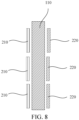
- a plurality of first electrodes 210 are arranged at intervals, and a plurality of second electrodes 220 are arranged at intervals.
- the plurality of first electrodes 210 and the corresponding second electrodes 220 are configured to cooperatively form equivalent capacitors at different positions on the aerosol-generation article 100, for example, referring to the embodiments shown in FIG. 4 and FIG. 8 .
- the power source supplies power to the heating module according to a preset mode.
- the preset mode is to perform segmented heating with different powers or perform sequential segmented heating.
- the segmented heating with different powers refers to that heat generation degrees of different parts on the aerosol-generation substrate 110 are different.
- the aerosol-generation substrate 110 is divided into an upper segment, a middle segment, and a lower segment from top to bottom according to positions corresponding to the first electrodes 210 and the second electrodes 220.
- the middle segment of the aerosol-generation substrate 110 has a largest heat generation degree and a highest temperature, and the upper segment and the lower segment have smaller heat generation degrees and lower temperatures than the middle segment.
- the sequential segmented heating refers to that the heat generation degree of the aerosol-generation substrate is gradually increased or decreased in a specific direction. For example, in another embodiment whose structure arrangement is shown in FIG.
- the aerosol-generation substrate 110 is divided into an upper segment, a middle segment, and a lower segment from top to bottom according to positions corresponding to the first electrodes 210 and the second electrodes 220.
- the heat generation degree and the temperature of the aerosol-generation substrate 110 are sequentially increased according to an order of the lower segment, the middle segment, and the upper segment.
- first electrodes 210 and three second electrodes 220 are provided. It may be understood that, in some other embodiments, the number of the first electrodes 210 is not limited to three and may also be any other integer greater than one; and the number of the second electrodes 220 is also not limited to three and may also be any other integer greater than one.
- the detection module is configured to detect capacitance changes of the equivalent capacitor formed by the first electrode 210, the second electrode 220, and the aerosol-generation article 100 arranged between the first electrode 210 and the second electrode 220. Changes of the dielectric constant of the aerosol-generation article 100 are detected by detecting the capacitance changes of the equivalent capacitor.
- the detection module is configured to detect a capacitance of the equivalent capacitor and feed back a detection result to the controller; and the controller matches the detection result fed back by the detection module with a preset heating program to achieve heating control.
- the principle that the controller obtains the temperature of the aerosol-generation substrate 110 lies in that: there is a correspondence between the dielectric constant of the dielectric material of the temperature sensor 120 and the temperature, and there is a correspondence between the capacitance of the equivalent capacitor and the dielectric constant of the dielectric material of the temperature sensor 120 in the equivalent capacitor. Therefore, the temperature of the aerosol-generation substrate 110 that is sensed by the temperature sensor 120 can be obtained by detecting the capacitance of the equivalent capacitor. Specifically, the controller stores a dielectric constant-temperature characteristic curve of the dielectric material of the temperature sensor 120.
- the controller is not limited to storing only the dielectric constant-temperature characteristic curve of the dielectric material of the temperature sensor 120, and may also store a dielectric constant-temperature characteristic curve of a composite material formed by the dielectric material and other related materials, provided that the temperature of the aerosol-generation substrate 110 can be reflected.
- the changes of the dielectric constants of other components other than the dielectric material of the temperature sensor 120 of the aerosol-generation article 100 with the temperature are not specifically limited herein.
- the detection module detects capacitances of equivalent capacitors at different positions to detect dielectric constants at different positions on the aerosol-generation article 100, and thus the controller can comprehensively adjust the temperature of the aerosol-generation substrate 110. It may be understood that, the detection module may detect the capacitances of the equivalent capacitors at different positions at the same time, or may detect the capacitances of the equivalent capacitors at different positions sequentially within a specific time range.
- the detection module is configured to detect changes of a resonance frequency of a resonance circuit in which the equivalent capacitor is located.
- the changes of the dielectric constant of the aerosol-generation article 100 is obtained by detecting the changes of the resonance frequency of the resonance circuit in which the equivalent capacitor is located.
- the electronic vaporizer 200 further includes an inductance coil.
- the power source, the inductance coil, and the equivalent capacitor form the resonance circuit;
- the detection module is configured to detect the resonance frequency of the resonance circuit and feed back a detection result to the controller; and the controller matches the detection result fed back by the detection module with a preset heating program, to achieve heating control.
- the principle that the controller obtains the temperature of the aerosol-generation substrate 110 lies in that: there is a correspondence between the dielectric constant of the dielectric material of the temperature sensor 120 and the temperature, there is a correspondence between the capacitance of the equivalent capacitor and the dielectric constant of the dielectric material of the temperature sensor 120 in the equivalent capacitor, and there is a correspondence between the resonance frequency of the resonance circuit and the capacitance of the equivalent capacitor. Therefore, the temperature of the aerosol-generation substrate 110 that is sensed by the temperature sensor 120 can be obtained by detecting the resonance frequency of the resonance circuit.
- the electronic vaporizer 200 further includes an inhalation counting module.
- the inhalation counting module is configured to collect the number of peaks and/or troughs of the resonance frequency, calculate the number of times of inhalation, and feed back the number of times of inhalation to the controller.
- the controller is further configured to control the output of the alternating voltage generator according to a counting result fed back by the inhalation counting module.
- the heating program includes a warming program and a cooling program.
- a temperature corresponding to the detection result the capacitance of the equivalent capacitor, the dielectric constant, or the resonance frequency
- the controller controls the power source to supply normal power to the heating module, that is, the warming program is run; and when the temperature corresponding to the detection result fed back by the detection module and received by the controller is higher than or equal to the preset cooling temperature, the controller controls the power source to reduce power supply to the heating module, that is, the cooling program is run.
- the controller is further configured to control a heating start program.
- the detection module detects the dielectric constant of the aerosol-generation article 100 arranged between the first electrode 210 and the second electrode 220 and feeds back a detection result to the controller, and the controller matches the detection result fed back by the detection module with a preset startup parameter.
- the heating program is started; and in response to that the detection result does not match the preset startup parameter, the heating program is not started.
- the heating start program is controlled by the controller, so that the heating program is started only after the aerosol-generation article 100 is identified by the electronic vaporizer 200 as a heatable aerosol-generation article, thereby preventing false heating and improving the user experience.
- the electronic vaporizer 200 includes the corresponding heatable aerosol-generation article 100, which also achieves an anti-counterfeiting effect.
- the preset startup parameter refers to a range in consideration of application scenarios of the aerosol-generation article 100.
- the parameter detected by the detection module is also not limited to the dielectric constant of the aerosol-generation article 100 arranged between the first electrode 210 and the second electrode 220, and may also be other parameters related to the dielectric constant, such as the capacitance of the equivalent capacitor or the resonance frequency of the resonance circuit in which the equivalent capacitor is located that can indirectly reflect the dielectric constant.
- the identification is implemented by using the detection module of the electronic vaporizer 200 to detect the capacitance or the resonance frequency corresponding to the dielectric constant of the aerosol-generation article arranged between the first electrode 210 and the second electrode 220. It may be understood that, in some other embodiments, the electronic vaporizer 200 identifying the aerosol-generation article 100 may also be implemented through additionally arranging an identifying material (for example, an identifying label) on the aerosol-generation article 100 and arranging a corresponding identifying module on the electronic vaporizer 200. For example, the aerosol-generation article 100 further includes an identifying material adapted to the electronic vaporizer 200.
- an identifying material for example, an identifying label
- the identifying material is arranged in the aerosol-generation substrate 110 or arranged on a surface of the aerosol-generation substrate 110. In some other embodiments, the identifying material is arranged on the packaging layer. For example, the identifying material is arranged on an outer surface or an inner surface of the packaging layer. It may be understood that, specific compositions of the identifying material are not specifically limited, provided that the identifying material can be adapted to the identifying module of the electronic vaporizer 200. Certainly, in some embodiments, if the electronic vaporizer 200 is not required to have an identifying function, the electronic vaporizer 200 also does not need to include the corresponding identifying module, and the aerosol-generation article 100 also does not need to be provided with the identifying material.
- the electronic vaporizer 200 may also not include the heating module.
- the electronic vaporizer 200 provides an alternating electric field
- the aerosol-generation substrate 110 of the aerosol-generation article 100 is a material that can generate heat under the action of the alternating electric field
- the aerosol-generation article 100 further includes a heating-assisting material that can generate heat under the action of the alternating electric field.
- the aerosol-generation substrate 110 can generate heat under the action of the alternating electric field to form aerosols through vaporization.
- the aerosol-generation substrate 110 has complex compositions. At the molecular level, the ordering of molecules included in the aerosol-generation substrate 110 in a natural state is disordered. Because a dipole moment of each polar molecule is not zero, polar molecules in the aerosol-generation substrate 110 are subjected to an electric field force under the action of the electric field and then rotate; and under the action of the alternating electric field at a specific frequency, the polar molecules rotate or vibrate, and friction and/or collision occurs among the molecules to generate heat.
- alternating electric field heating is to place a medium in an alternating electric field at a specific frequency, polar molecules in the medium rotate or vibrate at a high speed under the action of the alternating electric field, so that friction and/or collision occurs, and the medium generates heat.
- the frequency of the alternating electric field causing the medium to generate heat is related to properties of the medium, so that the alternating electric field heating may be performed selectively.
- the aerosol-generation substrate 110 Under the action of the alternating electric field, the aerosol-generation substrate 110 generates heat at a high speed and uniformly, so that the utilization of the aerosol-generation substrate 110 is high.
- the matching electronic vaporizer 200 does not need to be provided with a heat generation body, such that residues deposited on the heat generation body can be prevented from affecting the inhalation taste, and use of the electronic vaporizer 200 is more convenient.
- the aerosol-generation substrate 110 includes polar molecules.
- the polar molecules generate heat under the action of the alternating electric field, to implement heating.
- the polar molecules are at least one of water, alcohols, aldehydes, ketones, lipids, phenols, terpenoids, or low-grade fatty acids.
- Water is a polar molecule having a good polarity.
- water may be used as a heat generation substance to cause the aerosol-generation substrate 110 to form aerosols through vaporization.
- water content in the aerosol-generation substrate 110 ranges from 6wt% to 18wt%.
- the water content in the aerosol-generation substrate 110 ranges from 8wt% to 14wt%.
- Alcohols, aldehydes, ketones, lipids, phenols, terpenoids, and low-grade fatty acids have polarities and may be heated by an alternating electric field at an appropriate frequency.
- At least one of alcohols, aldehydes, ketones, lipids, phenols, terpenoids, or low-grade fatty acids is mainly used as a flavor substance, but content of the alcohols, aldehydes, ketones, lipids, phenols, terpenoids, or low-grade fatty acids used as the flavor substance is generally relatively small, which cannot be independently used for heat generation or cannot achieve an apparent heat generation effect, and need to match other polar molecules (for example, water) to generate heat.
- At least one of alcohols, aldehydes, ketones, lipids, phenols, terpenoids, or low-grade fatty acids may also be used as a heat generation substance, and content thereof in this case is enough to cause the aerosol-generation substrate 110 to form aerosols through vaporization.
- the aerosol-forming agent includes water and/or other polar molecules.
- the aerosol-generation substrate 110 is a solid substrate, and water content in the aerosol-generation substrate 110 ranges from 6wt% to 18wt%. Further, the water content in the aerosol-generation substrate 110 ranges from 8wt% to 14wt%.
- the substrate material is tobacco.
- Main compositions in the tobacco are insoluble polysaccharides, such as starch, cellulose, and pectin. Content of the starch in mature tobacco ranges from 10% to 30%.
- the cellulose is a basic substance forming cellular tissue and skeleton of the tobacco, and content of the cellulose in the tobacco is generally about 11%, which increases as a grade of the tobacco decreases.
- the pectin in the tobacco is about 12%, and the pectin affects physical performance such as the elasticity and toughness of the tobacco. Due to the existence of the pectin, when water content in the tobacco is great, the elasticity and toughness of the tobacco are increased, and when water content is small, the tobacco is friable and fragile.
- the substrate material is tobacco
- the functional material can be omitted.
- the water content of the tobacco is enough to cause the tobacco to be heated under the action of the alternating electric field to form aerosols through vaporization.
- the water content of the tobacco ranges from 6wt% to 18wt%.
- the aerosol-generation article 100 further includes a heating-assisting material that can generate heat under the action of the alternating electric field.
- the heating-assisting material is close to the aerosol-generation substrate 110, and the heating-assisting material heats the aerosol-generation substrate 110 to cause the aerosol-generation substrate 110 to form aerosols through vaporization.
- the heating-assisting material is arranged in the aerosol-generation substrate 110. Further, the heating-assisting material is distributed in the aerosol-generation substrate 110. By distributing the heating-assisting material in the aerosol-generation substrate 110, the aerosol-generation substrate 110 can be heated uniformly, and the consistency of aerosols formed by the aerosol-generation substrate 110 is better.
- the heating-assisting material is not limited to being distributed in the aerosol-generation substrate, and may also be in a shape of a sheet, a rod, a pin or the like and close to the aerosol-generation substrate 110, to conduct heat to the aerosol-generation substrate 110.
- the heating-assisting material is a material that can generate heat more easily and/or have a higher heat generation efficiency than the aerosol-generation substrate 110 in the alternating electric field in which the aerosol-generation substrate 110 is located.
- one part of a heat source for vaporization of the aerosol-generation substrate 110 is from heat generated by the aerosol-generation substrate under the alternating electric field
- another part of the heat source is from heat generated by the heating-assisting material under the alternating electric field.
- heat generated by the aerosol-generation substrate 110 under the action of the alternating electric field is relatively small.
- heat required for vaporization of the aerosol-generation substrate 110 is mainly from heat generated by the heating-assisting material.
- a dielectric loss factor of the heating-assisting material is greater than a dielectric loss factor of the aerosol-generation substrate 110.
- the heating-assisting material can have a higher heat generation rate than the aerosol-generation substrate 110 under a heating frequency of the alternating electric field, which can achieve a more efficient heating efficiency.
- a dielectric loss of tobacco with water content of 15wt% is about 0.075
- the dielectric loss increases as the water content increases
- the dielectric loss is about 0.487 when the water content is 30wt%.
- the quality of the tobacco may be affected when the water content is excessively great.
- the heating-assisting material may be added to the aerosol-generation substrate 110 to improve the heat generation efficiency.
- the heating-assisting material is an attenuation ceramic.
- the attenuation ceramic is an aluminum nitride-based attenuation ceramic.
- the aluminum nitride-based attenuation ceramic has good thermal conduction performance, where a theoretical value of thermal conductivity is about 320 W/m ⁇ K, and has a moderate thermal expansion coefficient, a reliable electrical insulation, stable chemical and thermal performances, a good mechanical performance, and no toxicity.
- attenuation agents such as SiC, TiB 2 , Mo, W, and C, are generally added to a substrate of the aluminum nitride-based attenuation ceramic, to achieve a specific attenuation effect.
- a dielectric loss of AlN-TiB 2 attenuation ceramic is about 0.17, and a dielectric loss of tobacco whose water content is greater than 15% is 0.075.
- the electronic vaporizer 200 further includes an alternating voltage generator.
- the alternating voltage generator is electrically connected to the power source.
- the alternating voltage generator provides an alternating voltage for the first electrode 210 and the second electrode 220, to form an alternating electric field between the first electrode 210 and the second electrode 220.
- An accommodating space that can accommodate the aerosol-generation substrate 110 is provided in at least some areas on which the alternating electric field is distributed, so that the aerosol-generation substrate 110 in the alternating electric field can generate heat and form aerosols through vaporization under the action of the alternating electric field.
- the alternating voltage generator, the first electrode 210, and the second electrode 220 are used as components of an alternating electric field generation module.
- the first electrode 210, the aerosol-generation article 100 arranged between the first electrode 210 and the second electrode 220, and the second electrode 220 also form an equivalent capacitor.
- a frequency of an alternating electric field generated by the alternating electric field generation module is adapted to the heated aerosol-generation substrate 110 and/or heating-assisting material.
- the frequency of the alternating electric field generated by the alternating electric field generation module ranges from 10 MHz to 5 GHz.
- the frequency of the alternating electric field generated by the alternating electric field generation module ranges from 10 MHz to 49 MHz.
- a frequency of an alternating electric field required for the aerosol-generation substrate to generate aerosols is 10 MHz, 15 MHz, 20 MHz, 25 MHz, 30 MHz, 35 MHz, 40 MHz, or 49 MHz.
- the frequency of the alternating electric field generated by the alternating electric field generation module ranges from 981 MHz to 5 GHz.
- a frequency of an alternating electric field required for the aerosol-generation substrate to generate aerosols is 985 MHz, 1000 MHz, 1 GHz, 1.5 GHz, 2 GHz, 2.5 GHz, 3 GHz, 3.5 GHz, 4 GHz, or 4.5 GHz.
- the frequency of the alternating electric field generated by the alternating electric field generation module ranges from 985 MHz to 1000 MHz, from 1 GHz to 1.5 GHz, from 1.6 GHz to 2 GHz, from 2.1 GHz to 2.5 GHz, from 2.6 GHz to 3 GHz, from 3.1 GHz to 3.5 GHz, or from 3.6 GHz to 4 GHz.
- a waveform of an alternating voltage generated by the alternating voltage generator is a sine wave, a square wave, or a sawtooth wave.
- the electronic vaporizer 200 further includes an electromagnetic shielding member 230.
- the electromagnetic shielding member 230 is configured to shield or attenuate an overflowed electromagnetic field excited by the alternating electric field between the first electrode 210 and the second electrode 220.
- the electromagnetic shielding member 230 is made of a material selected from a conductive material, a composite material of metals and insulators, or a ferrite material.
- the conductive material is at least one selected from the group consisting of copper, aluminum, iron, nickel, and any combination thereof.
- the composite material is selected from rubber or plastic filled with metal powder or metal fiber (for example, nickel wire, copper wire, silver wire, or the like).
- the ferrite material is selected from manganese-zinc ferrite or nickel-copper ferrite. It may be understood that, in some other embodiments, the conductive material, the composite material of metals and insulators, and the ferrite material forming the electromagnetic shielding member 230 are not limited to the foregoing.
- the electromagnetic shielding member 230 is arranged between the first electrode 210 and the second electrode 220, and wraps the aerosol-generation article 100 in the electromagnetic shielding member, for example, referring to the embodiment shown in FIG. 6 .
- the electromagnetic shielding member 230 is arranged outside the equivalent capacitor formed by the first electrode 210, the aerosol-generation substrate 110, and the second electrode 220, and wraps the equivalent capacitor in the electromagnetic shielding member, for example, referring to the embodiment shown in FIG. 7 .
- the controller may control power supply of the power source to the alternating voltage generator or control an output of the alternating voltage generator, to control the temperature of the aerosol-generation substrate 110.
- the dielectric material of the temperature sensor 120 of the aerosol-generation article 100 is set to be a solid material, and the temperature sensor 120 of the aerosol-generation article 100 forms an equivalent capacitor with the first electrode 210 and the second electrode 220, so that the detection module detects a capacitance of the equivalent capacitor to achieve temperature measurement of the temperature sensor 120.
- the controller controls the power supply of the power source to the heating module according to a temperature situation fed back by the temperature sensor 120 to achieve temperature control.
- the vaporization system 10 at least includes the following advantages.
- an embodiment of the present application further provides a device for identifying a type of the aerosol-generation article 100, a method for identifying a type of the aerosol-generation article 100, and a temperature control method for the electronic vaporizer 200.
- a device for identifying a type of an aerosol-generation article 100 including a third electrode, a fourth electrode, a measuring module, and a main controller.
- An accommodating area configured to accommodate the aerosol-generation article 100 is formed between the third electrode and the fourth electrode.
- the measuring module is configured to detect a dielectric constant of the aerosol-generation article 100 arranged in the accommodating area and feed back a detection result to the main controller.
- the main controller is configured to compare the detection result with a preset value and determine that the aerosol-generation article 100 is of a type identifiable by the device when the detection result matches the preset value.
- the main controller further determines that the aerosol-generation article 100 is not of a type identifiable by the device when the detection result does not match the preset value.
- the preset value is a value or a value range corresponding to the detection result.
- the measuring module directly detects the dielectric constant of the aerosol-generation article 100, and the detection result fed back by the measuring module to the main controller is the dielectric constant of the aerosol-generation article 100.
- the preset value is a preset value or value range corresponding to the dielectric constant.
- the measuring module indirectly reflects the dielectric constant of the aerosol-generation article 100 by detecting a capacitance value of an equivalent capacitor in which the aerosol-generation article 100 is located, and the detection result is the capacitance value of the equivalent capacitor.
- the preset value is a preset value or value range corresponding to the capacitance value.
- the measuring module indirectly reflects the dielectric constant of the aerosol-generation article 100 by detecting a resonance frequency of a resonance circuit in which the aerosol-generation article 100 is located, and the detection result is the resonance frequency.
- the preset value is a preset value or value range corresponding to the resonance frequency.
- the preset value may also be set as a preset value or value range corresponding to the dielectric constant. In this case, the detection result that is obtained by the measuring module and indirectly reflects the dielectric constant of the aerosol-generation article 100 needs to be converted into the dielectric constant.
- the foregoing device includes a determination result output module.
- the determination result output module is configured to present a determination result of the main controller for a user.
- the output module includes a unit configured for outputting a prompt voice and/or prompt text.
- the foregoing device identifies the type of the aerosol-generation article 100 through the dielectric constant of the aerosol-generation article 100, which may be applied to sorting of the aerosol-generation article 100 during production and packaging.
- a method for identifying a type of an aerosol-generation article 100 including the following steps: detecting a dielectric constant of the aerosol-generation article 100, and determining that the aerosol-generation article 100 is of an identifiable type when a detection result matches a preset value.
- the aerosol-generation article 100 is detected, to directly obtain the dielectric constant of the aerosol-generation article 100.
- a parameter associated with the dielectric constant of the aerosol-generation article 100 is detected, to indirectly obtain the dielectric constant of the aerosol-generation article 100.
- a capacitance value of an equivalent capacitor in which the aerosol-generation article 100 is located or a resonance frequency of a resonance circuit in which the equivalent capacitor is located is detected, to indirectly obtain the dielectric constant of the aerosol-generation article 100.
- the preset value is a value or value range corresponding to the detection result.
- the aerosol-generation article 100 is placed in the device according to any one of the foregoing embodiments, to identify the type of the aerosol-generation article 100. Specifically, after the aerosol-generation article 100 is placed in the accommodating area, the measuring module detects the dielectric constant of the aerosol-generation article 100 placed in the accommodating area and feeds back a detection result to the main controller. The main controller compares the detection result with a preset value, and determines that the aerosol-generation article 100 is of a type identifiable by the device when the detection result matches the preset value. The main controller determines that the aerosol-generation article 100 is not of a type identifiable by the device when the detection result does not match the preset value.
- a temperature control method for an electronic vaporizer 200 including the following steps: detecting a dielectric constant of an aerosol-generation article 100, and adjusting a temperature of the aerosol-generation article 100 according to a detection result.
- the aerosol-generation article 100 is detected, to directly obtain the dielectric constant of the aerosol-generation article 100.
- a parameter associated with the dielectric constant of the aerosol-generation article 100 is detected, to indirectly obtain the dielectric constant of the aerosol-generation article 100. For example, a capacitance value of an equivalent capacitor in which the aerosol-generation article 100 is located or a resonance frequency of a resonance circuit in which the equivalent capacitor is located is detected, to indirectly obtain the dielectric constant of the aerosol-generation article 100.
- power supply is adjusted to adjust a temperature of the aerosol-generation article 100.
- an alternating electric field is adjusted to adjust the temperature of the aerosol-generation article 100.
- the electronic vaporizer 200 is the electronic vaporizer 200 according to any one of the foregoing embodiments, and the temperature control method includes the following steps.
- the detection module detects the dielectric constant of the aerosol-generation article 100 and feeds back a detection result to the controller, the controller controls the power source to supply power to the heating module according to the detection result.
- the controller controls the power source to supply normal power to the heating module.
- the controller controls the power source to reduce power supply to the heating module.
Landscapes
- Physics & Mathematics (AREA)
- Electromagnetism (AREA)
- Electrostatic Spraying Apparatus (AREA)
- Sampling And Sample Adjustment (AREA)
- Measuring Temperature Or Quantity Of Heat (AREA)
Applications Claiming Priority (1)
| Application Number | Priority Date | Filing Date | Title |
|---|---|---|---|
| CN202111172472.1A CN113892683B (zh) | 2021-10-08 | 2021-10-08 | 气溶胶生成品、电子雾化器、雾化系统、识别方法和温度控制方法 |
Publications (2)
| Publication Number | Publication Date |
|---|---|
| EP4162818A2 true EP4162818A2 (fr) | 2023-04-12 |
| EP4162818A3 EP4162818A3 (fr) | 2023-06-14 |
Family
ID=79190467
Family Applications (1)
| Application Number | Title | Priority Date | Filing Date |
|---|---|---|---|
| EP22199949.3A Pending EP4162818A3 (fr) | 2021-10-08 | 2022-10-06 | Article de génération d'aérosol, vaporisateur électronique, système de vaporisation, procédé d'identification et procédé de régulation de température |
Country Status (5)
| Country | Link |
|---|---|
| US (1) | US20230110261A1 (fr) |
| EP (1) | EP4162818A3 (fr) |
| JP (1) | JP7564848B2 (fr) |
| KR (1) | KR20230051075A (fr) |
| CN (1) | CN113892683B (fr) |
Families Citing this family (15)
| Publication number | Priority date | Publication date | Assignee | Title |
|---|---|---|---|---|
| KR102774246B1 (ko) * | 2022-02-08 | 2025-02-26 | 주식회사 케이티앤지 | 디바이스 및 디바이스 제어방법 |
| CN114515028B (zh) * | 2022-02-22 | 2025-09-16 | 河南中烟工业有限责任公司 | 基于励磁检测的烟支识别方法 |
| EP4480333A4 (fr) * | 2022-03-04 | 2025-03-19 | Shenzhen Merit Technology Co., Ltd. | Dispositif de génération d'aérosol et dispositif de commande de détection associé |
| CN114568763B (zh) * | 2022-03-04 | 2026-03-20 | 深圳麦时科技有限公司 | 气溶胶生成装置及其雾化控制装置 |
| CN114568750A (zh) * | 2022-03-04 | 2022-06-03 | 深圳麦时科技有限公司 | 气溶胶生成装置及其感应控制装置 |
| CN114468373A (zh) * | 2022-03-17 | 2022-05-13 | 湖北中烟工业有限责任公司 | 一种用于介电加热的介损电子烟屏蔽结构 |
| CN117378823A (zh) * | 2022-07-04 | 2024-01-12 | 深圳麦时科技有限公司 | 气溶胶生成设备及其加热控制方法 |
| CN115024522A (zh) * | 2022-07-04 | 2022-09-09 | 深圳麦时科技有限公司 | 气溶胶生成装置及其感应控制装置 |
| CN115281394B (zh) * | 2022-07-29 | 2025-08-26 | 深圳市基克纳科技有限公司 | 温度场生成方法、系统、计算机设备和存储介质 |
| CN115568636A (zh) * | 2022-09-29 | 2023-01-06 | 深圳麦克韦尔科技有限公司 | 雾化组件、电子雾化装置以及检测方法 |
| US20240277071A1 (en) * | 2023-02-21 | 2024-08-22 | Kt&G Corporation | Aerosol generating device and method of controlling the same |
| WO2024235846A1 (fr) * | 2023-05-12 | 2024-11-21 | Jt International Sa | Article de génération d'aérosol, dispositif de génération d'aérosol, procédé de fabrication d'un article de génération d'aérosol, et procédé de commande d'un dispositif de génération d'aérosol |
| KR20250025139A (ko) * | 2023-08-14 | 2025-02-21 | 주식회사 케이티앤지 | 제어 방법 및 그 방법을 수행하는 에어로졸 생성 장치 |
| WO2026078003A1 (fr) * | 2024-10-07 | 2026-04-16 | Philip Morris Products S.A. | Ensemble de chauffage diélectrique avec élément de détection |
| WO2026078002A1 (fr) * | 2024-10-07 | 2026-04-16 | Philip Morris Products S.A. | Dispositif de génération d'aérosol à chauffage diélectrique et inductif combiné |
Family Cites Families (14)
| Publication number | Priority date | Publication date | Assignee | Title |
|---|---|---|---|---|
| JP4741849B2 (ja) * | 2005-02-07 | 2011-08-10 | ホーチキ株式会社 | 熱感知素子の製造方法 |
| AU2015261847B2 (en) * | 2014-05-21 | 2019-05-02 | Philip Morris Products S.A. | Aerosol-generating article with multi-material susceptor |
| JP6847928B2 (ja) * | 2015-09-16 | 2021-03-24 | フィリップ・モーリス・プロダクツ・ソシエテ・アノニム | 静電容量センサを有するカートリッジ |
| TW201714534A (zh) * | 2015-10-22 | 2017-05-01 | 菲利浦莫里斯製品股份有限公司 | 氣溶膠輸送系統及操作該氣溶膠輸送系統的方法 |
| RU2736230C2 (ru) * | 2016-02-12 | 2020-11-12 | Филип Моррис Продактс С.А. | Система, генерирующая аэрозоль, с идентификацией жидкого субстрата, образующего аэрозоль |
| CN109475194B (zh) * | 2016-09-01 | 2022-08-09 | 菲利普莫里斯生产公司 | 感受器组件和包括所述感受器组件的气溶胶生成制品 |
| CN106418702A (zh) * | 2016-09-06 | 2017-02-22 | 深圳市合元科技有限公司 | 一种电子烟及其温度控制方法和装置 |
| WO2018178217A1 (fr) * | 2017-03-31 | 2018-10-04 | Philip Morris Products S.A. | Ensemble suscepteur pour le chauffage par induction d'un substrat formant un aérosol |
| WO2018184787A1 (fr) * | 2017-04-05 | 2018-10-11 | Philip Morris Products S.A. | Suscepteur à utiliser avec un dispositif ou un système de génération d'aérosol chauffé par induction |
| US11793239B2 (en) * | 2017-08-09 | 2023-10-24 | Philip Morris Products S.A. | Aerosol generating system with multiple susceptors |
| BR112021005112A2 (pt) * | 2018-09-25 | 2021-06-15 | Philip Morris Products S.A. | dispositivo gerador de aerossol aquecido indutivamente compreendendo um conjunto de susceptor |
| EP3855954B1 (fr) * | 2018-09-25 | 2022-11-02 | Philip Morris Products S.A. | Article de génération d'aérosol chauffable par induction comprenant un substrat de formation d'aérosol et un ensemble de suscepteurs |
| EP3923754B1 (fr) | 2019-02-15 | 2024-11-06 | Philip Morris Products S.A. | Dispositif de génération d'aérosols doté d'une commande de puissance basée sur la capacité |
| PH12021552719A1 (en) * | 2019-07-19 | 2022-07-11 | Philip Morris Products Sa | An aerosol-generating system and method using dielectric heating |
-
2021
- 2021-10-08 CN CN202111172472.1A patent/CN113892683B/zh active Active
-
2022
- 2022-09-21 JP JP2022150023A patent/JP7564848B2/ja active Active
- 2022-09-28 US US17/955,037 patent/US20230110261A1/en active Pending
- 2022-09-29 KR KR1020220124561A patent/KR20230051075A/ko active Pending
- 2022-10-06 EP EP22199949.3A patent/EP4162818A3/fr active Pending
Also Published As
| Publication number | Publication date |
|---|---|
| JP2023057037A (ja) | 2023-04-20 |
| US20230110261A1 (en) | 2023-04-13 |
| EP4162818A3 (fr) | 2023-06-14 |
| JP7564848B2 (ja) | 2024-10-09 |
| CN113892683A (zh) | 2022-01-07 |
| CN113892683B (zh) | 2024-06-28 |
| KR20230051075A (ko) | 2023-04-17 |
Similar Documents
| Publication | Publication Date | Title |
|---|---|---|
| US20230110261A1 (en) | Aerosol-generation article, electronic vaporizer, vaporization system, identifying method, and temperature control method | |
| EP4162817A1 (fr) | Article de génération d'aérosol, vaporisateur électronique et système de vaporisation | |
| US12396478B2 (en) | Aerosol-forming article comprising magnetic particles | |
| CN114173591B (zh) | 带温度传感器的感应加热器组件 | |
| CN112888327B (zh) | 气溶胶生成装置及其制造方法 | |
| EP3897247B1 (fr) | Dispositif de génération d'aérosol avec détection d'embout buccal | |
| KR20260036013A (ko) | 정전용량 기반 전력 제어를 갖는 에어로졸 발생 장치 | |
| JP2019511202A (ja) | 電極を備えたエアロゾル発生システム | |
| CN118434314A (zh) | 装置及其控制方法 | |
| KR20240143699A (ko) | 에어로졸 생성 장치 및 그의 동작 방법 | |
| RU2816815C2 (ru) | Индукционный нагревательный узел с датчиком температуры и устройство, генерирующее аэрозоль и содержащее такой узел | |
| CN119326179A (zh) | 感受器及电子雾化装置 | |
| HK1262160A1 (en) | Aerosol-forming article comprising magnetic particles | |
| HK1229647A1 (en) | Aerosol-forming article comprising magnetic particles | |
| HK1229647B (en) | Aerosol-forming article comprising magnetic particles |
Legal Events
| Date | Code | Title | Description |
|---|---|---|---|
| PUAI | Public reference made under article 153(3) epc to a published international application that has entered the european phase |
Free format text: ORIGINAL CODE: 0009012 |
|
| STAA | Information on the status of an ep patent application or granted ep patent |
Free format text: STATUS: THE APPLICATION HAS BEEN PUBLISHED |
|
| AK | Designated contracting states |
Kind code of ref document: A2 Designated state(s): AL AT BE BG CH CY CZ DE DK EE ES FI FR GB GR HR HU IE IS IT LI LT LU LV MC ME MK MT NL NO PL PT RO RS SE SI SK SM TR |
|
| PUAL | Search report despatched |
Free format text: ORIGINAL CODE: 0009013 |
|
| AK | Designated contracting states |
Kind code of ref document: A3 Designated state(s): AL AT BE BG CH CY CZ DE DK EE ES FI FR GB GR HR HU IE IS IT LI LT LU LV MC ME MK MT NL NO PL PT RO RS SE SI SK SM TR |
|
| RIC1 | Information provided on ipc code assigned before grant |
Ipc: A24F 40/57 20200101ALI20230510BHEP Ipc: A24F 40/51 20200101ALI20230510BHEP Ipc: A24F 40/465 20200101ALI20230510BHEP Ipc: A24D 1/20 20200101AFI20230510BHEP |
|
| STAA | Information on the status of an ep patent application or granted ep patent |
Free format text: STATUS: REQUEST FOR EXAMINATION WAS MADE |
|
| 17P | Request for examination filed |
Effective date: 20231110 |
|
| RBV | Designated contracting states (corrected) |
Designated state(s): AL AT BE BG CH CY CZ DE DK EE ES FI FR GB GR HR HU IE IS IT LI LT LU LV MC ME MK MT NL NO PL PT RO RS SE SI SK SM TR |