EP4162862A1 - Verfahren und vorrichtung zur analyse von bildern von haar und haut auf einem körper eines patienten - Google Patents
Verfahren und vorrichtung zur analyse von bildern von haar und haut auf einem körper eines patienten Download PDFInfo
- Publication number
- EP4162862A1 EP4162862A1 EP21201516.8A EP21201516A EP4162862A1 EP 4162862 A1 EP4162862 A1 EP 4162862A1 EP 21201516 A EP21201516 A EP 21201516A EP 4162862 A1 EP4162862 A1 EP 4162862A1
- Authority
- EP
- European Patent Office
- Prior art keywords
- hair
- skin
- subject
- images
- wavelengths
- Prior art date
- Legal status (The legal status is an assumption and is not a legal conclusion. Google has not performed a legal analysis and makes no representation as to the accuracy of the status listed.)
- Withdrawn
Links
Images





Classifications
-
- G—PHYSICS
- G06—COMPUTING OR CALCULATING; COUNTING
- G06T—IMAGE DATA PROCESSING OR GENERATION, IN GENERAL
- G06T7/00—Image analysis
- G06T7/0002—Inspection of images, e.g. flaw detection
-
- A—HUMAN NECESSITIES
- A61—MEDICAL OR VETERINARY SCIENCE; HYGIENE
- A61B—DIAGNOSIS; SURGERY; IDENTIFICATION
- A61B5/00—Measuring for diagnostic purposes; Identification of persons
- A61B5/0059—Measuring for diagnostic purposes; Identification of persons using light, e.g. diagnosis by transillumination, diascopy, fluorescence
- A61B5/0075—Measuring for diagnostic purposes; Identification of persons using light, e.g. diagnosis by transillumination, diascopy, fluorescence by spectroscopy, i.e. measuring spectra, e.g. Raman spectroscopy, infrared absorption spectroscopy
-
- A—HUMAN NECESSITIES
- A61—MEDICAL OR VETERINARY SCIENCE; HYGIENE
- A61B—DIAGNOSIS; SURGERY; IDENTIFICATION
- A61B5/00—Measuring for diagnostic purposes; Identification of persons
- A61B5/103—Measuring devices for testing the shape, pattern, colour, size or movement of the body or parts thereof, for diagnostic purposes
- A61B5/1032—Determining colour of tissue for diagnostic purposes
-
- G—PHYSICS
- G06—COMPUTING OR CALCULATING; COUNTING
- G06T—IMAGE DATA PROCESSING OR GENERATION, IN GENERAL
- G06T5/00—Image enhancement or restoration
- G06T5/50—Image enhancement or restoration using two or more images, e.g. averaging or subtraction
-
- G—PHYSICS
- G06—COMPUTING OR CALCULATING; COUNTING
- G06T—IMAGE DATA PROCESSING OR GENERATION, IN GENERAL
- G06T7/00—Image analysis
- G06T7/10—Segmentation; Edge detection
- G06T7/174—Segmentation; Edge detection involving the use of two or more images
-
- G—PHYSICS
- G06—COMPUTING OR CALCULATING; COUNTING
- G06T—IMAGE DATA PROCESSING OR GENERATION, IN GENERAL
- G06T7/00—Image analysis
- G06T7/90—Determination of colour characteristics
-
- G—PHYSICS
- G06—COMPUTING OR CALCULATING; COUNTING
- G06V—IMAGE OR VIDEO RECOGNITION OR UNDERSTANDING
- G06V10/00—Arrangements for image or video recognition or understanding
- G06V10/10—Image acquisition
- G06V10/12—Details of acquisition arrangements; Constructional details thereof
- G06V10/14—Optical characteristics of the device performing the acquisition or on the illumination arrangements
- G06V10/141—Control of illumination
-
- G—PHYSICS
- G06—COMPUTING OR CALCULATING; COUNTING
- G06V—IMAGE OR VIDEO RECOGNITION OR UNDERSTANDING
- G06V10/00—Arrangements for image or video recognition or understanding
- G06V10/10—Image acquisition
- G06V10/12—Details of acquisition arrangements; Constructional details thereof
- G06V10/14—Optical characteristics of the device performing the acquisition or on the illumination arrangements
- G06V10/143—Sensing or illuminating at different wavelengths
-
- G—PHYSICS
- G16—INFORMATION AND COMMUNICATION TECHNOLOGY [ICT] SPECIALLY ADAPTED FOR SPECIFIC APPLICATION FIELDS
- G16H—HEALTHCARE INFORMATICS, i.e. INFORMATION AND COMMUNICATION TECHNOLOGY [ICT] SPECIALLY ADAPTED FOR THE HANDLING OR PROCESSING OF MEDICAL OR HEALTHCARE DATA
- G16H30/00—ICT specially adapted for the handling or processing of medical images
- G16H30/40—ICT specially adapted for the handling or processing of medical images for processing medical images, e.g. editing
-
- G—PHYSICS
- G16—INFORMATION AND COMMUNICATION TECHNOLOGY [ICT] SPECIALLY ADAPTED FOR SPECIFIC APPLICATION FIELDS
- G16H—HEALTHCARE INFORMATICS, i.e. INFORMATION AND COMMUNICATION TECHNOLOGY [ICT] SPECIALLY ADAPTED FOR THE HANDLING OR PROCESSING OF MEDICAL OR HEALTHCARE DATA
- G16H50/00—ICT specially adapted for medical diagnosis, medical simulation or medical data mining; ICT specially adapted for detecting, monitoring or modelling epidemics or pandemics
- G16H50/20—ICT specially adapted for medical diagnosis, medical simulation or medical data mining; ICT specially adapted for detecting, monitoring or modelling epidemics or pandemics for computer-aided diagnosis, e.g. based on medical expert systems
-
- A—HUMAN NECESSITIES
- A61—MEDICAL OR VETERINARY SCIENCE; HYGIENE
- A61B—DIAGNOSIS; SURGERY; IDENTIFICATION
- A61B5/00—Measuring for diagnostic purposes; Identification of persons
- A61B5/44—Detecting, measuring or recording for evaluating the integumentary system, e.g. skin, hair or nails
- A61B5/441—Skin evaluation, e.g. for skin disorder diagnosis
-
- A—HUMAN NECESSITIES
- A61—MEDICAL OR VETERINARY SCIENCE; HYGIENE
- A61B—DIAGNOSIS; SURGERY; IDENTIFICATION
- A61B5/00—Measuring for diagnostic purposes; Identification of persons
- A61B5/44—Detecting, measuring or recording for evaluating the integumentary system, e.g. skin, hair or nails
- A61B5/448—Hair evaluation, e.g. for hair disorder diagnosis
-
- G—PHYSICS
- G06—COMPUTING OR CALCULATING; COUNTING
- G06T—IMAGE DATA PROCESSING OR GENERATION, IN GENERAL
- G06T2207/00—Indexing scheme for image analysis or image enhancement
- G06T2207/10—Image acquisition modality
- G06T2207/10024—Color image
-
- G—PHYSICS
- G06—COMPUTING OR CALCULATING; COUNTING
- G06T—IMAGE DATA PROCESSING OR GENERATION, IN GENERAL
- G06T2207/00—Indexing scheme for image analysis or image enhancement
- G06T2207/10—Image acquisition modality
- G06T2207/10048—Infrared image
-
- G—PHYSICS
- G06—COMPUTING OR CALCULATING; COUNTING
- G06T—IMAGE DATA PROCESSING OR GENERATION, IN GENERAL
- G06T2207/00—Indexing scheme for image analysis or image enhancement
- G06T2207/10—Image acquisition modality
- G06T2207/10141—Special mode during image acquisition
- G06T2207/10152—Varying illumination
-
- G—PHYSICS
- G06—COMPUTING OR CALCULATING; COUNTING
- G06T—IMAGE DATA PROCESSING OR GENERATION, IN GENERAL
- G06T2207/00—Indexing scheme for image analysis or image enhancement
- G06T2207/20—Special algorithmic details
- G06T2207/20212—Image combination
- G06T2207/20224—Image subtraction
-
- G—PHYSICS
- G06—COMPUTING OR CALCULATING; COUNTING
- G06T—IMAGE DATA PROCESSING OR GENERATION, IN GENERAL
- G06T2207/00—Indexing scheme for image analysis or image enhancement
- G06T2207/30—Subject of image; Context of image processing
- G06T2207/30004—Biomedical image processing
- G06T2207/30088—Skin; Dermal
-
- G—PHYSICS
- G06—COMPUTING OR CALCULATING; COUNTING
- G06T—IMAGE DATA PROCESSING OR GENERATION, IN GENERAL
- G06T2207/00—Indexing scheme for image analysis or image enhancement
- G06T2207/30—Subject of image; Context of image processing
- G06T2207/30168—Image quality inspection
-
- G—PHYSICS
- G06—COMPUTING OR CALCULATING; COUNTING
- G06V—IMAGE OR VIDEO RECOGNITION OR UNDERSTANDING
- G06V2201/00—Indexing scheme relating to image or video recognition or understanding
- G06V2201/03—Recognition of patterns in medical or anatomical images
Definitions
- This disclosure relates to methods and apparatus for analysing images of hair and skin on a body of a subject.
- exemplary personal care operations include shaving, hair cutting, hair removal, hair regrowth, photoepilation, skin massage, skin light treatment, etc.
- a hair cutting or shaving device it can be useful, for example, to determine a thickness or density of hairs to be cut or shaved, as this can be used to adjust the cutting or shaving parameters of the personal care device.
- a photoepilation or skin light treatment device it can be useful, for example, to determine a thickness or colour of hairs, or a skin tone, in order to use an appropriate power and/or wavelength of light, and also useful to determine a hair count per area during the course of treatment to allow for the efficacy of the photoepilation treatment to be monitored.
- Fig. 1 illustrates different skin type and hair colour combinations.
- Six skin types are defined, labelled I-VI, from lightest (type I) to darkest (type VI), and six hair colours, including grey, light blond, dark blond, light brown, dark brown and black.
- the grid 2 shows the possible combinations of skin type and hair colour, with six of those combinations (the ones marked with hatching) not being considered possible.
- the example images 4, 5, 6, 7 were obtained by a device using common settings of different skin type/hair colour combinations.
- Image 4 is for a subject with a dark skin type and black hair
- image 5 is for a subject with a light skin type and black hair
- image 6 is for a subject with a light skin type and brown hair
- image 7 is for a subject with a light skin type and grey/blond hair.
- images 4, 5 and 6 the hairs are readily distinguishable, whereas in image 7 the hairs are difficult to see due to a poor optical hair-skin contrast.
- simulations and user test results show that taking into account user characteristics and variation (e.g. hair, skin, user handling) can be more important for the end shaving performance results than further general improvements that could be made to the mechanical design of the shaver.
- Objective and subjective test results support this, showing a much larger spread between users than between types of shavers.
- a user's hair and/or skin type, and hair and skin properties relevant for the personal care operation can be determined using a sensor or a questionnaire.
- the properties of hairs which can be relevant for personalisation of a personal care operation can include colour, thickness, shape, density and/or orientation.
- the properties of skin which can be relevant for personalisation of a personal care operation can include colour, tone, the presence of scars, moles, freckles, spots, etc.
- optical properties of skin and hair are similar and therefore the contrast between the two is limited. This contrast is dependent not only on the colour of the skin and hair but also on other properties of the skin and hair.
- an optical method that provides a high contrast with respect to the colour of skin and hair can mean that light and thin hairs (e.g. non-medullated blond hairs) on light skin (i.e. skin type 1-2) - such as in image 10 - would be hard to detect. This can lead to poor efficacy for hair detection and thus may deteriorate the possibilities for personalisation.
- a computer-implemented method configured for analysing images of hair and skin on a body of a subject.
- the method comprises (i) receiving one or more images of a body part of the subject, the one or more images comprising a skin region corresponding to skin on the body part and a hair region corresponding to hair on the body part; (ii) processing the one or more images to determine diffuse reflectance of the skin region at different wavelengths of light; (iii) processing the one or more images to determine diffuse reflectance of the hair region at different wavelengths of light; (iv) determining a first contrast measure for a first pair of values of first and second wavelengths, wherein the first contrast measure is determined from the diffuse reflectance intensities for the skin region and the hair region in first and second spectral bands of light, wherein the first and second spectral bands are respectively centred on the value of the first wavelength and the value of the second wavelength in the first pair of values; (v) repeating step (iv) to determine one or more further contrast measures
- step (iv) comprises determining the first contrast measure from (a) a difference between the diffuse reflectance intensity for the skin region in the first spectral band and the diffuse reflectance intensity for the skin region in the second spectral band, and (b) a difference between the diffuse reflectance intensity for the hair region in the first spectral band and the diffuse reflectance intensity for the hair region in the second spectral band.
- step (iv) can comprise determining the first contrast measure as a ratio of the differences.
- one of: the criterion is met if the magnitude of the contrast measure is above a threshold; the criterion is met if the magnitude of the contrast measure is below a threshold; the criterion is met if the contrast measure is the highest of the determined contrast measures; the criterion is met if the contrast measure is the lowest of the determined contrast measures; and the criterion is met if the contrast measure is an optimal value.
- the method further comprises controlling one or more light sources to concurrently or separately illuminate the subject with light including wavelengths corresponding to the selected first and second spectral bands; and receiving one or more further images of the subject while the subject is illuminated with the light including wavelengths corresponding to the selected first and second spectral bands.
- the method can further comprise analysing the received one or more further images to determine one or more properties of the skin and/or hair of the subject.
- the method further comprises analysing the received one or more images in the selected first and second spectral bands to determine one or more properties of the skin and/or hair of the subject.
- the method further comprises receiving or determining an indication of the skin tone of the subject and/or the hair colour of the subject in the received one or more images.
- the method can further comprise repeating the method on images of hair and skin for a plurality of different subjects having different skin tones and/or different hair colours.
- the method can further comprise: storing, in a look-up table or database, an indication of the selected first and second spectral bands, and/or an indication of the pair of values of the first and second wavelengths corresponding to the selected first and second spectral bands, and the corresponding indication of the tone of the skin and/or colour of the hair.
- the method can further comprise: receiving an indication of a skin tone and/or a hair colour of a further subject to be imaged; and using the look-up table or database to determine first and second spectral bands to use for imaging the further subject according to the skin tone and/or hair colour in the received indication.
- the method can further comprise: controlling one or more light sources to illuminate the further subject with light including wavelengths corresponding to the determined first and second spectral bands; and obtaining an image of the further subject while the subject is illuminated with the light including wavelengths corresponding to the determined first and second spectral bands.
- the method can further comprise analysing the obtained image of the further subject in the determined first and second spectral bands to determine one or more properties of the skin and/or hair of the further subject.
- a computer program product comprising a computer readable medium having computer readable code embodied therein, the computer readable code being configured such that, on execution by a suitable computer or processor, the computer or processor is caused to perform the method according to the first aspect or any embodiment thereof.
- an apparatus configured for analysing images of hair and skin on a body of a subject.
- the apparatus is configured to: (i) receive one or more images of a body part of the subject, the image comprising a skin region corresponding to skin on the body part and a hair region corresponding to hair on the body part; (ii) process the one or more images to determine diffuse reflectance of the skin region at different wavelengths of light; (iii) process the one or more images to determine diffuse reflectance of the hair region at different wavelengths of light; (iv) determine a first contrast measure for a first pair of values of first and second wavelengths, wherein the first contrast measure is determined from the diffuse reflectance intensities for the skin region and the hair region in first and second spectral bands of light, wherein the first and second spectral bands are respectively centred on the value of the first wavelength and the value of the second wavelength in the first pair of values; (v) repeat operation (iv) to determine one or more further contrast measures for respective further pairs of values of the first
- the apparatus is configured to receive the one or more images from an image acquisition unit or a memory unit.
- the image acquisition unit comprises an illumination unit for generating light to illuminate the subject when an image is to be acquired.
- the illumination unit is configured to selectively generate light in specific spectral bands.
- the apparatus further comprises the image acquisition unit. In other embodiments, the apparatus is part of a system that comprises the image acquisition unit. Further embodiments of the third aspect are also provided in which the apparatus is further configured to perform the method according to any of the various embodiments of the first aspect.
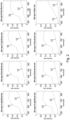
- Fig. 2 shows a graph for each subject, showing the ratio of light intensity detected from the skin for different wavelengths (shown by line 10) and the ratio of light intensity from hairs for different wavelengths (shown by line 12).
- the ratio of light intensity across the range of wavelengths detected from the skin is referred to herein as a "skin diffuse reflectance spectrum” and the ratio of light intensity across the range of wavelengths detected from the hair is referred to herein as a "hair diffuse reflectance spectrum”.
- the eight subjects have different combinations of skin type and hair colour. From left to right in the top row of graphs, the subjects have skin type II and light blond hair, skin type II and dark blond hair, skin type II and light brown hair, and skin type III and dark blond hair. From left to right in the bottom row of graphs, the subjects have skin type III and light brown hair, skin type III and dark brown hair, skin type IV and dark brown hair, and skin type V and black hair.
- the hair-skin contrast is a maximum around in a spectral band between 550 nm and 850 nm, but the optimal range and position of the band depends on the specific hair-skin type for the subject.
- a difference imaging technique in which light in two or more particular spectral bands reflected from the skin and hair is evaluated in order to enhance the contrast between the skin and hair.
- the centre wavelength of each spectral band will depend on the subject (and in particular their skin type and/or hair colour), and in some embodiments the width of the spectral band also depends on the subject (and in particular their skin type and/or hair colour).
- the techniques are described with reference to the use of light in two spectral bands, but it will be appreciated that the techniques can use light in three or more spectral bands. Table 1 below sets out the broad wavelength bands within which the centre wavelengths of two particular spectral bands for any subject will reside.
- the spectral bands are defined by respective centre wavelengths, denoted ⁇ 1 and ⁇ 2 respectively.
- Table 1 shows that, regardless of the skin type and hair colour, the first spectral band has its centre wavelength ⁇ 1 in the range between 600 nm and 850 nm, and the second spectral band has its centre wavelength ⁇ 2 in the range between 425 nm and 650 nm.
- Skin type II Light Blond hair 425-650nm 600-850 nm Dark Blond hair 425-640nm 640-850 nm Light Brown hair 425-630nm 630-850 nm
- Skin type III Dark Blond hair 425-650nm 615-850nm Light Brown hair 425-650nm 605-850nm Dark Brown hair 425-650 nm 600-850 nm
- Skin type V Black hair 425-600 nm 650-850 nm
- Tables 2-9 below show the contrast obtained for different pairs of spectral band centre wavelengths, with the contrast being derived from the diffuse reflectance spectra shown in Fig. 2 .
- Table 2 shows the contrast obtained for different combinations of first and second spectral bands for a subject with skin type II and light blond hair.
- Table 2 ⁇ 2 (nm) ⁇ 1 (nm) CONTRAST ( ⁇ 10 3 ) 499 651 1.0 525 675 1.3 539 689 1.1 547 701 3.9 555 715 1.7 571 739 1.9 581 753 1.3 605 793 1.7 615 813 9.6 619 823 4.5 641 825 0.1
- Table 3 shows the contrast obtained for different combinations of first and second spectral bands for a subject with skin type II and dark blond hair.
- Table 3 ⁇ 2 (nm) ⁇ 1 (nm) CONTRAST ( ⁇ 10 3 ) 475 665 0.7 485 681 1.5 497 699 0.9 507 711 0.8 531 733 1.7 575 769 19.9 583 779 4.7 595 797 5.1 607 819 0.9 609 823 0.7
- Table 4 shows the contrast obtained for different combinations of first and second spectral bands for a subject with skin type II and light brown hair.
- Table 4 ⁇ 2 (nm) ⁇ 1 (nm) CONTRAST ( ⁇ 10 3 ) 475 655 0.4 483 677 2.2 489 691 0.9 491 695 0.5 547 761 0.3 555 767 0.5 569 779 2.3 585 797 2.2 593 807 1.2 605 823 0.7
- Table 5 shows the contrast obtained for different combinations of first and second spectral bands for a subject with skin type III and dark blond hair.
- Table 5 ⁇ 2 (nm) ⁇ 1 (nm) CONTRAST ( ⁇ 10 3 ) 470 640 3.06 480 650 8.14 490 670 3.15 500 690 2.73 530 730 1.17 560 750 1.78 590 780 3.49 600 800 1.2 610 810 1.71 630 830 1.47 Table 6 shows the contrast obtained for different combinations of first and second spectral bands for a subject with skin type III and light brown hair.
- Table 6 ⁇ 2 (nm) ⁇ 1 (nm) CONTRAST ( ⁇ 10 3 ) 475 615 0.3 493 633 38.7 519 675 9.6 539 697 9.0 581 753 34.6 591 769 24.4 603 789 19.6 611 803 5.0 615 813 6.3 621 825 114.0 Table 7 shows the contrast obtained for different combinations of first and second spectral bands for a subject with skin type III and dark brown hair.
- Table 7 ⁇ 2 (nm) ⁇ 1 (nm) CONTRAST ( ⁇ 10 3 ) 470 630 1.89 480 630 1.44 510 660 1.25 520 670 1.1 530 690 0.88 570 740 1.55 590 760 7.83 600 790 0.69 610 810 1.06 620 810 5.03 Table 8 shows the contrast obtained for different combinations of first and second spectral bands for a subject with skin type IV and dark brown hair.
- Table 8 ⁇ 2 (nm) ⁇ 1 (nm) CONTRAST ( ⁇ 10 3 ) 475 625 2.0 483 631 1.6 507 657 1.5 515 667 1.3 535 685 0.8 575 737 1.5 585 755 7.7 593 769 1.6 615 811 5.0 621 825 3.7 Table 9 shows the contrast obtained for different combinations of first and second spectral bands for a subject with skin type V and black hair.
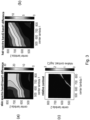
- Fig. 3 shows dual spectral band differential matrices for a particular subject with skin type II and light blond hair.
- the graph in Fig. 3(a) shows the spectral integrated intensity difference calculated between different pairs of spectral bands for skin
- the graph shown in Fig. 3(b) shows the spectral integrated intensity difference calculated between different pairs of spectral bands for hair
- the graph in Fig. 3(c) shows the relative contrast in the form of a contour plot of the skin-to-hair dual spectral band differential contrast ratio.
- Fig. 3(c) allows for a visual determination of optimal wavelength pairs that result in high contrast between hair and skin.
- the relative contrast in Fig. 3(c) is derived as the ratio of the graph in Fig. 3(a) to the graph in Fig. 3(b) .
- Fig. 4 shows graphs of the contrast ratio - derived as shown in Fig. 3 - for the eight subjects from Fig. 2 .
- Fig. 4 shows that, for different skin and hair colour combinations, different optimal wavelength pairs result in maximum contrast values, and thus there is no wavelength pair that is applicable to all skin and hair colour combinations. Therefore, as provided by the techniques described herein, the wavelengths in the wavelength pair is 'tuned' for improved or maximum contrast for a specific hair-skin combination.
- the graph in Fig. 5 illustrates the improvement in contrast between hair and skin in images obtained using the described techniques with suitable dual spectral bands for the eight subjects in Figs. 2 and 4 compared to images obtained using white light.
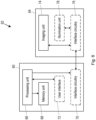
- the block diagram in Fig. 6 illustrates an embodiment of an apparatus 60 for analysing images of hair and skin on a body of a subject according to the techniques described herein.
- the apparatus 60 is shown as part of a system 62 that also includes a separate image acquisition unit 64 for obtaining one or more images of a subject.
- the apparatus 60 can include the image acquisition unit 64, or otherwise include functionality for performing the functions of the image acquisition unit 64.
- the apparatus 60 can be implemented independently of any device or unit that obtains the images of the subject.
- the apparatus 60 can be any type of electronic device or computing device.
- the apparatus 60 can be, or be part of, a smartphone, a tablet, a smart watch, a smart mirror, a laptop, a computer or a server, for example a server in a data centre (also referred to as being 'in the cloud').
- the apparatus 60 can be, or be part of, a personal care device, for example a shaver, epilator, or skin treatment device.
- the image acquisition unit 64 may be in the form of, or be part of, a smartphone, a tablet, a smart watch, a smart mirror, a laptop, or other device capable of obtaining an image of a subject.
- the image acquisition unit 64 may be in the form of, or be part of, a personal care device, for example a shaver, epilator, or skin treatment device.
- the apparatus 60 includes a processing unit 66 that controls the operation of the apparatus 60 and that can be configured to execute or perform the methods described herein.
- the processing unit 66 can be implemented in numerous ways, with software and/or hardware, to perform the various functions described herein.
- the processing unit 66 may comprise one or more microprocessors or digital signal processors (DSPs) that may be programmed using software or computer program code to perform the required functions and/or to control components of the processing unit 66 to effect the required functions.
- DSPs digital signal processors
- the processing unit 66 may be implemented as a combination of dedicated hardware to perform some functions (e.g.
- ADCs analog-to-digital convertors
- DACs digital-to-analog convertors
- processors e.g., one or more programmed microprocessors, controllers, DSPs and associated circuitry
- processors e.g., one or more programmed microprocessors, controllers, DSPs and associated circuitry
- components that may be employed in various embodiments of the present disclosure include, but are not limited to, conventional microprocessors, DSPs, application specific integrated circuits (ASICs), field-programmable gate arrays (FPGAs), hardware for implementing a neural network and/or so-called artificial intelligence (AI) hardware accelerators (i.e. a processor(s) or other hardware specifically designed for AI applications that can be used alongside a main processor).
- AI artificial intelligence
- the processing unit 66 is connected to a memory unit 68 that can store data, information and/or signals for use by the processing unit 66 in controlling the operation of the apparatus 60 and/or in executing or performing the methods described herein.
- the memory unit 68 stores computer-readable code that can be executed by the processing unit 66 so that the processing unit 66 performs one or more functions, including the methods described herein.
- the memory unit 68 can comprise any type of non-transitory machine-readable medium, such as cache or system memory including volatile and non-volatile computer memory such as random access memory (RAM), static RAM (SRAM), dynamic RAM (DRAM), read-only memory (ROM), programmable ROM (PROM), erasable PROM (EPROM) and electrically erasable PROM (EEPROM), and the memory unit 68 can be implemented in the form of a memory chip, an optical disk (such as a compact disc (CD), a digital versatile disc (DVD) or a Blu-Ray disc), a hard disk, a tape storage solution, or a solid state device, including a memory stick, a solid state drive (SSD), a memory card, etc.
- RAM random access memory
- SRAM static RAM
- DRAM dynamic RAM
- ROM read-only memory
- PROM programmable ROM
- EPROM erasable PROM
- EEPROM electrically erasable PROM
- the memory unit 68 can be implemented in the form
- the apparatus 60 can also comprise interface circuitry 70 for enabling a data connection to and/or data exchange with other devices, including, for example, image acquisition unit 64, and optionally any other devices such as servers, databases, user devices, etc.
- the connection may be direct or indirect (e.g. via the Internet), and thus the interface circuitry 70 can enable a connection between the apparatus 60 and image acquisition unit 64 via a network (such as the Internet), or directly between the apparatus 60 and image acquisition unit 64, via any desirable wired or wireless communication protocol.
- the interface circuitry 70 can operate using WiFi, Bluetooth, Zigbee, or any cellular communication protocol.
- the interface circuitry 70 may include one or more suitable antennas for transmitting/receiving over a transmission medium (e.g. the air).
- the interface circuitry 70 may include means (e.g. a connector or plug) to enable the interface circuitry 70 to be connected to one or more suitable antennas external to the apparatus 60 for transmitting/receiving over a transmission medium (e.g. the air).
- the interface circuitry 70 is connected to the processing unit 66 to enable information or data received by the interface circuitry 70 to be provided to the processing unit 66, and/or information or data from the processing unit 66 to be transmitted by the interface circuitry 70.
- the apparatus 60 comprises a user interface 72 that includes one or more components that enables a user of apparatus 60 (e.g. the subject) to input information, data and/or commands into the apparatus 60, and/or enables the apparatus 60 to output information or data to the user of the apparatus 60.
- the user interface 72 can include a display screen for displaying one or more images of the subject, and/or the results of analysis of images of the skin and hair of the subject.
- the user interface 72 can comprise any suitable input component(s), including but not limited to a keyboard, keypad, one or more buttons, switches or dials, a mouse, a track pad, a touchscreen, a stylus, a camera, a microphone, etc., and/or the user interface 72 can comprise any suitable output component(s), including but not limited to a display screen, one or more lights or light elements, one or more loudspeakers, a vibrating element, etc.
- apparatus 60 may include additional components to those shown in Fig. 6 .
- the apparatus 60 may also include a power supply, such as a battery, or components for enabling the apparatus 60 to be connected to a mains power supply.
- the image acquisition unit 64 is provided to obtain one or more images of the skin and hair of the subject. These images are to be analysed by the apparatus 60 according to the techniques described herein. thus, the image acquisition unit 64 comprises an imaging unit 74 for obtaining images.
- the imaging unit 74 may include any suitable components for capturing one or more images or a video sequence comprising multiple images, for example a charge-coupled device (CCD) and one or more lenses and/or mirrors.
- the imaging unit 74 is a camera, such as a digital camera.
- the imaging unit 74 can be configured, or be configurable to, obtain images in one or more specific spectral bands, for example in at least two spectral bands with respective centre wavelengths in the range from 425 nm to 850 nm.
- the imaging unit 74 may comprise one or more filters to enable light in the desired spectral band to be used to form the image.
- the sensor in the imaging unit 74 may be configured to only sense light in one or more specific spectral bands.
- the imaging unit 74 can be sensitive to light across the range from 425 nm to 850 nm, and subsequent processing of the image data can extract or select image data corresponding to a required spectral band.
- the image acquisition unit 64 can comprise interface circuitry 76 for enabling a data connection to and/or data exchange with other devices, including, for example, apparatus 60 (via interface circuitry 70), and optionally any other devices such as servers, databases, user devices, etc.
- the interface circuitry 76 can be implemented in a similar way to the interface circuitry 70 described above.
- the imaging unit 74 obtains images of the subject using the ambient light in the environment of the subject.
- the image acquisition unit 64 comprises an illumination unit 78 for generating light to illuminate the subject when an image is to be acquired by the imaging unit 74.
- the illumination unit 78 may be configured to generate white light or otherwise light across a broad spectrum of wavelengths, e.g. at least from 425 nm to 850 nm.
- the illumination unit 78 may be configured to selectively generate light in specific spectral bands, for example in at least two spectral bands with respective centre wavelengths in the range from 425 nm to 850 nm.
- the illumination unit 78 may be configured to generate the light in the specific spectral bands at the same time, or at different times (i.e. the illumination unit 78 can generate light in the first spectral band for a first time period and light in the second spectral band for a second time period).
- the illumination unit 78 is controllable to generate light in a required spectral band.
- the illumination unit 78 can be controlled to generate light in the two spectral bands identified according to the techniques described herein that are particularly suitable for the subject being imaged.
- the illumination unit 78 can be provided with a suitable arrangement of light sources, filters, etc. to enable light of the required wavelengths to be generated.
- the flow chart in Fig. 7 illustrates a method of analysing images of hair and skin on a body of a subject.
- the method can be implemented by the apparatus 60, for example by the processing unit 66 executing suitable computer code stored in the memory unit 68.
- the method is also described with reference to Fig. 8 , which shows an exemplary image 80 and several graphs/plots 82-96 illustrating steps of the method.
- one or more images of a body part of the subject are received by the apparatus 60.
- the image(s) may have been obtained by an image acquisition unit 64.
- the image(s) may be received directly from the image acquisition unit 64, for example in real-time as the image(s) are acquired, or the image(s) may be received by retrieving the image(s) from a memory, such as memory unit 68.
- An exemplary image 80 is shown in Fig. 8 .
- the body part of the subject in the image 80 includes one or more 'skin regions' 81 which are regions of skin on the body part, and one or more 'hair regions' 82 which are regions of hair on the body part. It should be noted that hair regions 82 correspond to the hairs themselves, and the skin region(s) 81 include areas of skin between individual hairs.
- a plurality of images are received in step 101, with each image 80 being obtained for light of a respective wavelength or narrow band of wavelengths.
- Each image 80 may have been obtained by an image acquisition unit 64 while the body part is sequentially or consecutively illuminated with light of different wavelengths or different narrow bands of wavelengths.
- the plurality of images can be obtained by an image acquisition unit 64 while the body part is illuminated with white light, and an imaging unit 74 can use a filter or other means to capture a set of images from respective wavelengths of light or from respective different narrow bands of wavelengths.
- step 103 the image(s) 80 are processed to determine the intensity of diffuse reflectance from the skin region(s) 81 at different wavelengths of light.
- Fig. 8 shows an exemplary graph 84 of the intensity of diffuse reflectance from the skin region(s) 81 for different wavelengths, which is denoted R skin ( ⁇ ).
- the diffuse reflectance of the skin region(s) 81 for different wavelengths is also referred to as a 'skin region diffuse reflectance spectrum'.
- a diffuse reflectance spectrum is a measurement of the diffuse reflection of light from the sample in the image 80, and excludes the specular reflectance of light from the sample.
- step 105 the image(s) 80 are processed to determine the intensity of diffuse reflectance from the hair region(s) 82 at different wavelengths of light.
- Step 105 can be performed before, after, or at the same time as, step 103.
- Fig. 8 shows an exemplary graph 86 of the intensity of diffuse reflectance from the hair region(s) 82 for different wavelengths, which is denoted R hair ( ⁇ ).
- the diffuse reflectance of the hair region(s) 82 for different wavelengths is also referred to as a 'hair region diffuse reflectance spectrum' .
- Step 103 and/or 105 can be performed in a number of different ways.
- the intensity of diffuse reflectance at a series of different wavelengths or series of narrow bands of wavelengths reflected from the skin region(s) 81 and reflected from the hair region(s) 82 are determined.
- each image 80 can be analysed to determine the intensity of diffuse reflectance from the skin region(s) 81 and the hair region(s) 82 in the images 80.
- the intensity of diffuse reflectance from the skin can be determined by averaging the intensity of a number of pixels in the image 80 corresponding to skin region(s) 81.
- the skin region diffuse reflectance spectrum can be determined from the images 80 in a similar way.
- the received image(s) 80 can be processed in order to identify a part or parts of the image(s) 80 that correspond to skin and a part or parts that correspond to hair.
- Techniques for identifying skin and/or hair in an image are known in the art, and are not described further herein.
- a first contrast measure is determined for a first pair of values of first and second wavelengths.
- the first contrast measure is determined from the diffuse reflectance intensities for the skin region 81 and the hair region 82 in first and second spectral bands of light, with the first and second spectral bands being respectively centred on the value of the first wavelength ( ⁇ 1 ) and the value of the second wavelength ( ⁇ 2 ).
- the first wavelength is a value between 425 nm and 650 nm
- the second wavelength is a value between 600 nm and 850 nm.
- the spectral bands are also referred to herein as 'detection bands'. Plot 87 in Fig.
- the first spectral band is defined as a function F 1 of wavelength ⁇ with a peak at ⁇ 1 , and represents a sensitivity curve or filter that is to be applied to the diffuse reflectance spectra determined in steps 103 and 105.
- the second spectral band is defined as a function F 2 of wavelength ⁇ with a peak at ⁇ 2 , and represents a sensitivity curve or filter that is to be applied to the diffuse reflectance spectra determined in steps 103 and 105.
- the detectable skin diffuse reflectance intensity S skin 1 ( ⁇ 1 ) is shown in plot 90 of Fig. 8 .
- the detectable skin diffuse reflectance intensity S skin 2 ( ⁇ 2 ) is shown in plot 92 of Fig. 8 .
- the detectable hair diffuse reflectance intensity S hair 1 ( ⁇ 1 ) is shown in plot 94 of Fig. 8 .
- the detectable hair diffuse reflectance intensity S hair 2 ( ⁇ 2 ) is shown in plot 96 of Fig. 8 .
- the contrast measure can be determined from a difference between the detected diffuse reflectance intensity for the skin region in the first spectral band (e.g. plot 90) and the detected diffuse reflectance intensity for the skin region in the second spectral band (plot 92), and a difference between the detected diffuse reflectance for the hair region in the first spectral band (plot 94) and the detected diffuse reflectance for the hair region in the second spectral band (plot 96).
- the contrast measure is determined from a ratio of these differences.
- equation (5) gives the contrast of the skin regions relative to the hair regions. It will be appreciated that (although less preferred) the contrast measure could instead relate to the contrast of the hair regions relative to the skin regions by inverting the ratio in equation (5).
- the first contrast measure can be calculated for the first pair of values of the first and second wavelengths directly as:
- C D skin
- D hair ⁇ ⁇ R skin ⁇ F 1 ⁇ ⁇ ⁇ ⁇ R skin ⁇ F 2 ⁇ ⁇ ⁇ R hair ⁇ F 1 ⁇ ⁇ ⁇ ⁇ R hair ⁇ F 2 ⁇
- the contrast measure in equation (6) gives the contrast of the skin regions relative to the hair regions.
- step 107 is repeated for respective further pairs of values of the first and second wavelengths to determine one or more further contrast measures. That is, one or both of the values of the first and second wavelength are changed, and a further contrast measure determined as described above.
- Step 107 can be repeated any number of times, but preferably contrast measures are determined for a range of values of the first wavelength between 425 nm and 650 nm, and a range of values of the second wavelength between 600 nm and 850 nm.
- a skin spectral difference map can be determined for different values of the first and second wavelengths, and a hair spectral difference map can be determined for different values of the first and second wavelengths.
- the plurality of contrast measures are evaluated to select a particular pair of first and second spectral bands.
- a pair of first and second spectral bands are selected for which the corresponding pair of values of the first and second wavelengths provide a contrast measure that meets a criterion.
- the criterion can be the highest contrast measure, and therefore the first and second spectral bands (and the corresponding first and second wavelengths) are selected that provided the highest contrast measure.
- step 111 can be expressed as: arg max ⁇ 1 ⁇ 2 ⁇ 1 ⁇ 2 C , subject to : ⁇ 1 , ⁇ 2 ⁇ 425 nm , 850 nm , ⁇ 1 , ⁇ 2 ⁇ 20 nm , 200 nm where ⁇ ⁇ 1 , ⁇ ⁇ 2 represent the width of the first spectral band and the second spectral band respectively.
- the values of ⁇ ⁇ 1 , ⁇ ⁇ 2 are fixed, whereas in other embodiments, the width of one or both of the first spectral band and the second spectral band can be varied in repetitions of step 107 to determine different contrast measures.
- the width of the spectral bands can be set to any value in the range 20 nm to 200 nm.
- the criterion evaluated in step 111 can take any suitable form.
- the criterion could be or include a threshold, and the criterion can be met by a contrast measure that exceeds the threshold.
- the criterion could be or include a threshold, and the criterion can be met by a contrast measure that is below the threshold.
- the criterion can be met by the highest of the determined contrast measures.
- the criterion can be met by the lowest of the determined contrast measures.
- the criterion is met if the contrast measure is an optimal value.
- An optimal value can be the maximum value, or the minimum value.
- one or more light sources e.g. in illumination unit 78
- illumination unit 78 can be used to concurrently or separately illuminate the subject with light including wavelengths corresponding to the selected first and second spectral bands.
- An imaging unit 74 can be used to obtain one or more further images of the subject while illuminated with this light, and these images received by the processing unit 66. These further images can be analysed to determine one or more properties of the skin and/or hair of the subject.
- the image(s) received in step 101 can be analysed to determine one or more properties of the skin and/or hair of the subject.
- the analysis to determine one or more properties of the skin and/or hair can be performed on the images 80 corresponding to the selected first and second spectral bands.
- the property or properties of hair can include, for example, colour, thickness, shape, density and/or orientation.
- the property or properties of skin can include, for example, colour, tone, the presence of scars, moles, freckles, spots, etc. Techniques for deriving these properties from images are known in the art, and are not described further herein.
- the results of the analysis can be used in a personal care operation, such as shaving, to improve the performance of the personal care operation and/or to provide feedback to the subject about the personal care operation.
- the analysis can determine that there are (still) hairs to be shaved on the body part, and therefore the subject needs to shave that part of the body (again) for a cleaner shave, or to achieve a certain facial hair style.
- the analysis can determine that all hairs have been sufficiently shaved, and the subject can be notified that they don't need to shave that part of the body again, thereby reducing irritation of the skin due to unnecessary shaving strokes.
- the results of the analysis of the skin and/or hair can be used to select an appropriate power level for the light output by the photoepilator, and/or an appropriate wavelength of light output by the photoepilator.
- Any feedback for the subject determined from the analysis of the skin and/or hair can be provided to the subject via the user interface 72. It will be appreciated from the above that to provide guidance and/or feedback on a personal care operation, the image(s) can be obtained, and the analysis of the image(s) performed, during the performance of a personal care operation, e.g. during shaving, or during a photoepilation treatment.
- the method can further comprise receiving or determining an indication of the skin tone of the subject and/or the hair colour of the subject in the image(s) received in step 101.
- an indication can be input by the subject themselves, for example via user interface 72, or the skin tone and/or hair colour can be determined from an analysis of the image(s) themselves as outlined above.
- the indication of the skin tone and/or hair colour can be stored in a look-up table or database, along with the pair of values of the first and second wavelengths corresponding to the first and second spectral bands selected in step 111.
- the method in Fig. 7 can be repeated for a number of different subjects with different skin types and/or hair colours, and these skin types and/or hair colours can be stored in the table or database along with an indication of the pair of values of the first and second wavelengths corresponding to the first and second spectral bands selected for the respective subjects.
- the apparatus 60 when another subject is to be imaged, they can input their skin tone and/or hair colour into the apparatus 60 (e.g. using user interface 72), and the look-up table or database can be consulted to determine the appropriate first and second wavelengths to use for that skin tone and/or hair colour.
- the illumination unit 78 can be controlled to illuminate the subject with light in the appropriate spectral bands and one or more images of the subject obtained, for analysis to determine other properties of the skin and/or hairs.
- the subject can be illuminated with white light (e.g. by the illumination unit 78) and appropriate filters can be used by the imaging unit 74 to obtain images from light in the appropriate spectral bands. Again, these images can be analysed to determine other properties of the skin and/or hairs.
- a computer program may be stored or distributed on a suitable medium, such as an optical storage medium or a solid-state medium supplied together with or as part of other hardware, but may also be distributed in other forms, such as via the Internet or other wired or wireless telecommunication systems. Any reference signs in the claims should not be construed as limiting the scope.
Landscapes
- Engineering & Computer Science (AREA)
- Health & Medical Sciences (AREA)
- Life Sciences & Earth Sciences (AREA)
- Physics & Mathematics (AREA)
- Medical Informatics (AREA)
- Public Health (AREA)
- Theoretical Computer Science (AREA)
- General Physics & Mathematics (AREA)
- Biomedical Technology (AREA)
- General Health & Medical Sciences (AREA)
- Pathology (AREA)
- Biophysics (AREA)
- Animal Behavior & Ethology (AREA)
- Heart & Thoracic Surgery (AREA)
- Surgery (AREA)
- Veterinary Medicine (AREA)
- Molecular Biology (AREA)
- Computer Vision & Pattern Recognition (AREA)
- Multimedia (AREA)
- Dermatology (AREA)
- Primary Health Care (AREA)
- Epidemiology (AREA)
- Quality & Reliability (AREA)
- Radiology & Medical Imaging (AREA)
- Oral & Maxillofacial Surgery (AREA)
- Dentistry (AREA)
- Databases & Information Systems (AREA)
- Spectroscopy & Molecular Physics (AREA)
- Data Mining & Analysis (AREA)
- Nuclear Medicine, Radiotherapy & Molecular Imaging (AREA)
- Measurement Of The Respiration, Hearing Ability, Form, And Blood Characteristics Of Living Organisms (AREA)
- Measuring And Recording Apparatus For Diagnosis (AREA)
- Image Analysis (AREA)
- Medical Treatment And Welfare Office Work (AREA)
Priority Applications (6)
| Application Number | Priority Date | Filing Date | Title |
|---|---|---|---|
| EP21201516.8A EP4162862A1 (de) | 2021-10-07 | 2021-10-07 | Verfahren und vorrichtung zur analyse von bildern von haar und haut auf einem körper eines patienten |
| CN202280067047.2A CN118076286A (zh) | 2021-10-07 | 2022-09-29 | 用于分析受试者身体上的毛发和皮肤的图像的方法和装置 |
| US18/698,814 US20250238910A1 (en) | 2021-10-07 | 2022-09-29 | Methods and apparatus for analysing images of hair and skin on a body of a subject |
| EP22789604.0A EP4412513B1 (de) | 2021-10-07 | 2022-09-29 | Verfahren und vorrichtung zur analyse von bildern von haar und haut auf einem körper eines patienten |
| JP2024520953A JP7725725B2 (ja) | 2021-10-07 | 2022-09-29 | 対象者の身体の毛及び皮膚の画像を解析するための方法及び装置 |
| PCT/EP2022/077110 WO2023057299A1 (en) | 2021-10-07 | 2022-09-29 | Methods and apparatus for analysing images of hair and skin on a body of a subject |
Applications Claiming Priority (1)
| Application Number | Priority Date | Filing Date | Title |
|---|---|---|---|
| EP21201516.8A EP4162862A1 (de) | 2021-10-07 | 2021-10-07 | Verfahren und vorrichtung zur analyse von bildern von haar und haut auf einem körper eines patienten |
Publications (1)
| Publication Number | Publication Date |
|---|---|
| EP4162862A1 true EP4162862A1 (de) | 2023-04-12 |
Family
ID=78086253
Family Applications (2)
| Application Number | Title | Priority Date | Filing Date |
|---|---|---|---|
| EP21201516.8A Withdrawn EP4162862A1 (de) | 2021-10-07 | 2021-10-07 | Verfahren und vorrichtung zur analyse von bildern von haar und haut auf einem körper eines patienten |
| EP22789604.0A Active EP4412513B1 (de) | 2021-10-07 | 2022-09-29 | Verfahren und vorrichtung zur analyse von bildern von haar und haut auf einem körper eines patienten |
Family Applications After (1)
| Application Number | Title | Priority Date | Filing Date |
|---|---|---|---|
| EP22789604.0A Active EP4412513B1 (de) | 2021-10-07 | 2022-09-29 | Verfahren und vorrichtung zur analyse von bildern von haar und haut auf einem körper eines patienten |
Country Status (5)
| Country | Link |
|---|---|
| US (1) | US20250238910A1 (de) |
| EP (2) | EP4162862A1 (de) |
| JP (1) | JP7725725B2 (de) |
| CN (1) | CN118076286A (de) |
| WO (1) | WO2023057299A1 (de) |
Cited By (1)
| Publication number | Priority date | Publication date | Assignee | Title |
|---|---|---|---|---|
| EP4653844A1 (de) * | 2024-05-21 | 2025-11-26 | Sick Ag | Verfahren zum erkennen eines interessierenden bereichs in multispektralen bildern |
Citations (1)
| Publication number | Priority date | Publication date | Assignee | Title |
|---|---|---|---|---|
| US20120224042A1 (en) * | 2009-11-18 | 2012-09-06 | Sony Corporation | Information processing apparatus, information processing method, program, and electronic apparatus |
Family Cites Families (19)
| Publication number | Priority date | Publication date | Assignee | Title |
|---|---|---|---|---|
| US7076088B2 (en) * | 1999-09-03 | 2006-07-11 | Honeywell International Inc. | Near-infrared disguise detection |
| US7027619B2 (en) * | 2001-09-13 | 2006-04-11 | Honeywell International Inc. | Near-infrared method and system for use in face detection |
| US8548570B2 (en) * | 2004-11-29 | 2013-10-01 | Hypermed Imaging, Inc. | Hyperspectral imaging of angiogenesis |
| JP4442472B2 (ja) * | 2005-03-07 | 2010-03-31 | 株式会社豊田中央研究所 | 対象物の部位判別装置 |
| JP4606304B2 (ja) * | 2005-11-09 | 2011-01-05 | セコム株式会社 | 近赤外線顔画像作成装置、近赤外線顔画像作成方法、及び顔画像照合装置 |
| CN102356310B (zh) * | 2009-03-19 | 2015-04-22 | 皇家飞利浦电子股份有限公司 | 具有毛发检测器的剃刮设备 |
| BR112013030487A2 (pt) | 2011-05-30 | 2016-09-27 | Koninkl Philips Nv | dispositivo de tratamento de pelo, método para detectar um pelo próximo a uma superfície da pele, e produto do programa de computador para detectar um pelo próximo a uma superfície da pele |
| US9968285B2 (en) * | 2014-07-25 | 2018-05-15 | Christie Digital Systems Usa, Inc. | Multispectral medical imaging devices and methods thereof |
| US9717417B2 (en) * | 2014-10-29 | 2017-08-01 | Spectral Md, Inc. | Reflective mode multi-spectral time-resolved optical imaging methods and apparatuses for tissue classification |
| DK3297528T3 (da) * | 2015-05-20 | 2020-11-16 | Kent Imaging | Automatisk kompensering for lyssvækkelsen på grund af epidermisk melanin i hudbilleder |
| WO2016204417A1 (ko) * | 2015-06-15 | 2016-12-22 | 서울바이오시스 주식회사 | 하이퍼스펙트럴 이미지 측정장치 및 그 캘리브레이션 방법, 피부 진단용 촬영 모듈 및 장치, 피부 진단 방법 및 피부 이미지 처리 방법 |
| JP2017173764A (ja) * | 2016-03-25 | 2017-09-28 | パナソニックIpマネジメント株式会社 | 映像表示システム及び映像表示方法 |
| WO2017220806A1 (en) * | 2016-06-24 | 2017-12-28 | Koninklijke Philips N.V. | System and method for vital signs detection |
| JP6798616B2 (ja) * | 2017-06-01 | 2020-12-09 | 日本電気株式会社 | 画像生成装置、画像生成方法およびプログラム |
| EP3505047A1 (de) * | 2017-12-27 | 2019-07-03 | Koninklijke Philips N.V. | Vorrichtung zur hautbildgebung |
| EP3530179A1 (de) * | 2018-02-27 | 2019-08-28 | Koninklijke Philips N.V. | Erhalt von bildern zur verwendung bei der bestimmung einer oder mehrerer eigenschaften der haut einer person |
| KR102812782B1 (ko) * | 2018-12-14 | 2025-05-23 | 스펙트랄 엠디, 인크. | 고정밀도 다중-애퍼쳐 스펙트럼 이미징을 위한 시스템 및 방법 |
| US11992698B2 (en) * | 2019-03-19 | 2024-05-28 | Seoul Viosys Co., Ltd. | Light irradiation device |
| JP2024514493A (ja) * | 2021-03-30 | 2024-04-02 | スペクトラル エムディー,インコーポレイテッド | 多重化照明を利用したスナップショット型高精度マルチスペクトルイメージングシステムおよびその方法 |
-
2021
- 2021-10-07 EP EP21201516.8A patent/EP4162862A1/de not_active Withdrawn
-
2022
- 2022-09-29 EP EP22789604.0A patent/EP4412513B1/de active Active
- 2022-09-29 JP JP2024520953A patent/JP7725725B2/ja active Active
- 2022-09-29 WO PCT/EP2022/077110 patent/WO2023057299A1/en not_active Ceased
- 2022-09-29 US US18/698,814 patent/US20250238910A1/en active Pending
- 2022-09-29 CN CN202280067047.2A patent/CN118076286A/zh active Pending
Patent Citations (1)
| Publication number | Priority date | Publication date | Assignee | Title |
|---|---|---|---|---|
| US20120224042A1 (en) * | 2009-11-18 | 2012-09-06 | Sony Corporation | Information processing apparatus, information processing method, program, and electronic apparatus |
Non-Patent Citations (1)
| Title |
|---|
| SUZUKI Y ET AL: "Detection of Skin Region from Multihand Near-IR Spectral Charateristics", ELECTRONICS AND COMMUNICATIONS IN JAPAN, SCRIPTA TECHNICA. NEW YORK, US, vol. 92, no. 11, 1 November 2009 (2009-11-01), pages 19 - 27, XP001549787, DOI: 10.1002/ECJ.10149 * |
Cited By (1)
| Publication number | Priority date | Publication date | Assignee | Title |
|---|---|---|---|---|
| EP4653844A1 (de) * | 2024-05-21 | 2025-11-26 | Sick Ag | Verfahren zum erkennen eines interessierenden bereichs in multispektralen bildern |
Also Published As
| Publication number | Publication date |
|---|---|
| EP4412513B1 (de) | 2025-01-29 |
| US20250238910A1 (en) | 2025-07-24 |
| JP2024536397A (ja) | 2024-10-04 |
| WO2023057299A1 (en) | 2023-04-13 |
| EP4412513A1 (de) | 2024-08-14 |
| CN118076286A (zh) | 2024-05-24 |
| JP7725725B2 (ja) | 2025-08-19 |
Similar Documents
| Publication | Publication Date | Title |
|---|---|---|
| EP3959651B1 (de) | Vorrichtung und verfahren zur bestimmung von kosmetischen hautattributen | |
| US20190239752A1 (en) | Hyperspectral imaging system and method of using the same | |
| CN115668387A (zh) | 用于为美容皮肤处理单元确定最佳操作参数集的方法和系统 | |
| EP4051088B1 (de) | Bewertung der haut | |
| US20250375150A1 (en) | Skin evaluation device, skin evaluation system, skin evaluation method, and non-transitory computer-readable recording medium storing program for skin evaluation | |
| US12243225B2 (en) | Determining whether hairs on an area of skin have been treated with a light pulse | |
| US20240245926A1 (en) | Skincare device | |
| KR20210049396A (ko) | 광을 이용한 마스크형 피부 미용 장치 및 그 제어 방법 | |
| EP3782536A1 (de) | Identifizierung eines körperteils | |
| EP3669375B1 (de) | Systeme und verfahren zur identifizierung von hyperpigmentierten flecken | |
| EP4412513B1 (de) | Verfahren und vorrichtung zur analyse von bildern von haar und haut auf einem körper eines patienten | |
| US20240245300A1 (en) | Skincare device | |
| US20190366117A1 (en) | Feedback energy-release system and operation method thereof | |
| GB2607344A (en) | Skincare device | |
| EP4687658A1 (de) | Automatisierte hautzustandsbewertung | |
| CN114429452A (zh) | 一种获取光谱信息的方法、装置、终端设备及存储介质 | |
| EP4220074A1 (de) | Bestimmung einer parameterkarte für einen körperbereich eines probanden | |
| EP4210324A1 (de) | Verfahren und vorrichtung zum ausrichten von bildern in einer sequenz von bildrahmen | |
| CN121622246A (zh) | 脱毛设备的控制方法、装置、脱毛设备、可读存储介质和程序产品 | |
| JP2022020117A (ja) | 肌の色ムラ評価装置、肌の色ムラ評価方法および肌の色ムラ評価プログラム |
Legal Events
| Date | Code | Title | Description |
|---|---|---|---|
| PUAI | Public reference made under article 153(3) epc to a published international application that has entered the european phase |
Free format text: ORIGINAL CODE: 0009012 |
|
| STAA | Information on the status of an ep patent application or granted ep patent |
Free format text: STATUS: THE APPLICATION HAS BEEN PUBLISHED |
|
| AK | Designated contracting states |
Kind code of ref document: A1 Designated state(s): AL AT BE BG CH CY CZ DE DK EE ES FI FR GB GR HR HU IE IS IT LI LT LU LV MC MK MT NL NO PL PT RO RS SE SI SK SM TR |
|
| STAA | Information on the status of an ep patent application or granted ep patent |
Free format text: STATUS: THE APPLICATION IS DEEMED TO BE WITHDRAWN |
|
| 18D | Application deemed to be withdrawn |
Effective date: 20231013 |