EP4163077A1 - Dispositif, ainsi que procédé d'usinage d'une structure polymère 3d - Google Patents
Dispositif, ainsi que procédé d'usinage d'une structure polymère 3d Download PDFInfo
- Publication number
- EP4163077A1 EP4163077A1 EP21201727.1A EP21201727A EP4163077A1 EP 4163077 A1 EP4163077 A1 EP 4163077A1 EP 21201727 A EP21201727 A EP 21201727A EP 4163077 A1 EP4163077 A1 EP 4163077A1
- Authority
- EP
- European Patent Office
- Prior art keywords
- polymer structure
- polymer
- voxel
- paramagnetic substance
- radiation
- Prior art date
- Legal status (The legal status is an assumption and is not a legal conclusion. Google has not performed a legal analysis and makes no representation as to the accuracy of the status listed.)
- Granted
Links
Images


Classifications
-
- B—PERFORMING OPERATIONS; TRANSPORTING
- B29—WORKING OF PLASTICS; WORKING OF SUBSTANCES IN A PLASTIC STATE IN GENERAL
- B29C—SHAPING OR JOINING OF PLASTICS; SHAPING OF MATERIAL IN A PLASTIC STATE, NOT OTHERWISE PROVIDED FOR; AFTER-TREATMENT OF THE SHAPED PRODUCTS, e.g. REPAIRING
- B29C64/00—Additive manufacturing, i.e. manufacturing of three-dimensional [3D] objects by additive deposition, additive agglomeration or additive layering, e.g. by 3D printing, stereolithography or selective laser sintering
- B29C64/20—Apparatus for additive manufacturing; Details thereof or accessories therefor
- B29C64/264—Arrangements for irradiation
-
- B—PERFORMING OPERATIONS; TRANSPORTING
- B29—WORKING OF PLASTICS; WORKING OF SUBSTANCES IN A PLASTIC STATE IN GENERAL
- B29C—SHAPING OR JOINING OF PLASTICS; SHAPING OF MATERIAL IN A PLASTIC STATE, NOT OTHERWISE PROVIDED FOR; AFTER-TREATMENT OF THE SHAPED PRODUCTS, e.g. REPAIRING
- B29C64/00—Additive manufacturing, i.e. manufacturing of three-dimensional [3D] objects by additive deposition, additive agglomeration or additive layering, e.g. by 3D printing, stereolithography or selective laser sintering
- B29C64/10—Processes of additive manufacturing
-
- B—PERFORMING OPERATIONS; TRANSPORTING
- B29—WORKING OF PLASTICS; WORKING OF SUBSTANCES IN A PLASTIC STATE IN GENERAL
- B29C—SHAPING OR JOINING OF PLASTICS; SHAPING OF MATERIAL IN A PLASTIC STATE, NOT OTHERWISE PROVIDED FOR; AFTER-TREATMENT OF THE SHAPED PRODUCTS, e.g. REPAIRING
- B29C64/00—Additive manufacturing, i.e. manufacturing of three-dimensional [3D] objects by additive deposition, additive agglomeration or additive layering, e.g. by 3D printing, stereolithography or selective laser sintering
- B29C64/10—Processes of additive manufacturing
- B29C64/106—Processes of additive manufacturing using only liquids or viscous materials, e.g. depositing a continuous bead of viscous material
- B29C64/124—Processes of additive manufacturing using only liquids or viscous materials, e.g. depositing a continuous bead of viscous material using layers of liquid which are selectively solidified
-
- B—PERFORMING OPERATIONS; TRANSPORTING
- B29—WORKING OF PLASTICS; WORKING OF SUBSTANCES IN A PLASTIC STATE IN GENERAL
- B29C—SHAPING OR JOINING OF PLASTICS; SHAPING OF MATERIAL IN A PLASTIC STATE, NOT OTHERWISE PROVIDED FOR; AFTER-TREATMENT OF THE SHAPED PRODUCTS, e.g. REPAIRING
- B29C64/00—Additive manufacturing, i.e. manufacturing of three-dimensional [3D] objects by additive deposition, additive agglomeration or additive layering, e.g. by 3D printing, stereolithography or selective laser sintering
- B29C64/30—Auxiliary operations or equipment
- B29C64/386—Data acquisition or data processing for additive manufacturing
- B29C64/393—Data acquisition or data processing for additive manufacturing for controlling or regulating additive manufacturing processes
-
- B—PERFORMING OPERATIONS; TRANSPORTING
- B33—ADDITIVE MANUFACTURING TECHNOLOGY
- B33Y—ADDITIVE MANUFACTURING, i.e. MANUFACTURING OF THREE-DIMENSIONAL [3D] OBJECTS BY ADDITIVE DEPOSITION, ADDITIVE AGGLOMERATION OR ADDITIVE LAYERING, e.g. BY 3D PRINTING, STEREOLITHOGRAPHY OR SELECTIVE LASER SINTERING
- B33Y10/00—Processes of additive manufacturing
-
- B—PERFORMING OPERATIONS; TRANSPORTING
- B33—ADDITIVE MANUFACTURING TECHNOLOGY
- B33Y—ADDITIVE MANUFACTURING, i.e. MANUFACTURING OF THREE-DIMENSIONAL [3D] OBJECTS BY ADDITIVE DEPOSITION, ADDITIVE AGGLOMERATION OR ADDITIVE LAYERING, e.g. BY 3D PRINTING, STEREOLITHOGRAPHY OR SELECTIVE LASER SINTERING
- B33Y30/00—Apparatus for additive manufacturing; Details thereof or accessories therefor
-
- A—HUMAN NECESSITIES
- A61—MEDICAL OR VETERINARY SCIENCE; HYGIENE
- A61B—DIAGNOSIS; SURGERY; IDENTIFICATION
- A61B18/00—Surgical instruments, devices or methods for transferring non-mechanical forms of energy to or from the body
- A61B18/18—Surgical instruments, devices or methods for transferring non-mechanical forms of energy to or from the body by applying electromagnetic radiation, e.g. microwaves
- A61B18/1815—Surgical instruments, devices or methods for transferring non-mechanical forms of energy to or from the body by applying electromagnetic radiation, e.g. microwaves using microwaves
-
- A—HUMAN NECESSITIES
- A61—MEDICAL OR VETERINARY SCIENCE; HYGIENE
- A61N—ELECTROTHERAPY; MAGNETOTHERAPY; RADIATION THERAPY; ULTRASOUND THERAPY
- A61N2/00—Magnetotherapy
- A61N2/004—Magnetotherapy specially adapted for a specific therapy
-
- A—HUMAN NECESSITIES
- A61—MEDICAL OR VETERINARY SCIENCE; HYGIENE
- A61N—ELECTROTHERAPY; MAGNETOTHERAPY; RADIATION THERAPY; ULTRASOUND THERAPY
- A61N5/00—Radiation therapy
- A61N5/02—Radiation therapy using microwaves
- A61N5/022—Apparatus adapted for a specific treatment
- A61N5/025—Warming the body, e.g. hyperthermia treatment
-
- B—PERFORMING OPERATIONS; TRANSPORTING
- B29—WORKING OF PLASTICS; WORKING OF SUBSTANCES IN A PLASTIC STATE IN GENERAL
- B29C—SHAPING OR JOINING OF PLASTICS; SHAPING OF MATERIAL IN A PLASTIC STATE, NOT OTHERWISE PROVIDED FOR; AFTER-TREATMENT OF THE SHAPED PRODUCTS, e.g. REPAIRING
- B29C35/00—Heating, cooling or curing, e.g. crosslinking or vulcanising; Apparatus therefor
- B29C35/02—Heating or curing, e.g. crosslinking or vulcanizing during moulding, e.g. in a mould
- B29C35/08—Heating or curing, e.g. crosslinking or vulcanizing during moulding, e.g. in a mould by wave energy or particle radiation
- B29C35/0805—Heating or curing, e.g. crosslinking or vulcanizing during moulding, e.g. in a mould by wave energy or particle radiation using electromagnetic radiation
- B29C2035/0811—Heating or curing, e.g. crosslinking or vulcanizing during moulding, e.g. in a mould by wave energy or particle radiation using electromagnetic radiation using induction
-
- B—PERFORMING OPERATIONS; TRANSPORTING
- B29—WORKING OF PLASTICS; WORKING OF SUBSTANCES IN A PLASTIC STATE IN GENERAL
- B29C—SHAPING OR JOINING OF PLASTICS; SHAPING OF MATERIAL IN A PLASTIC STATE, NOT OTHERWISE PROVIDED FOR; AFTER-TREATMENT OF THE SHAPED PRODUCTS, e.g. REPAIRING
- B29C35/00—Heating, cooling or curing, e.g. crosslinking or vulcanising; Apparatus therefor
- B29C35/02—Heating or curing, e.g. crosslinking or vulcanizing during moulding, e.g. in a mould
- B29C35/08—Heating or curing, e.g. crosslinking or vulcanizing during moulding, e.g. in a mould by wave energy or particle radiation
- B29C35/0805—Heating or curing, e.g. crosslinking or vulcanizing during moulding, e.g. in a mould by wave energy or particle radiation using electromagnetic radiation
- B29C2035/0861—Heating or curing, e.g. crosslinking or vulcanizing during moulding, e.g. in a mould by wave energy or particle radiation using electromagnetic radiation using radio frequency
-
- B—PERFORMING OPERATIONS; TRANSPORTING
- B29—WORKING OF PLASTICS; WORKING OF SUBSTANCES IN A PLASTIC STATE IN GENERAL
- B29C—SHAPING OR JOINING OF PLASTICS; SHAPING OF MATERIAL IN A PLASTIC STATE, NOT OTHERWISE PROVIDED FOR; AFTER-TREATMENT OF THE SHAPED PRODUCTS, e.g. REPAIRING
- B29C2791/00—Shaping characteristics in general
- B29C2791/004—Shaping under special conditions
-
- B—PERFORMING OPERATIONS; TRANSPORTING
- B29—WORKING OF PLASTICS; WORKING OF SUBSTANCES IN A PLASTIC STATE IN GENERAL
- B29K—INDEXING SCHEME ASSOCIATED WITH SUBCLASSES B29B, B29C OR B29D, RELATING TO MOULDING MATERIALS OR TO MATERIALS FOR MOULDS, REINFORCEMENTS, FILLERS OR PREFORMED PARTS, e.g. INSERTS
- B29K2105/00—Condition, form or state of moulded material or of the material to be shaped
- B29K2105/06—Condition, form or state of moulded material or of the material to be shaped containing reinforcements, fillers or inserts
- B29K2105/16—Fillers
- B29K2105/162—Nanoparticles
-
- B—PERFORMING OPERATIONS; TRANSPORTING
- B29—WORKING OF PLASTICS; WORKING OF SUBSTANCES IN A PLASTIC STATE IN GENERAL
- B29K—INDEXING SCHEME ASSOCIATED WITH SUBCLASSES B29B, B29C OR B29D, RELATING TO MOULDING MATERIALS OR TO MATERIALS FOR MOULDS, REINFORCEMENTS, FILLERS OR PREFORMED PARTS, e.g. INSERTS
- B29K2505/00—Use of metals, their alloys or their compounds, as filler
- B29K2505/08—Transition metals
- B29K2505/12—Iron
-
- B—PERFORMING OPERATIONS; TRANSPORTING
- B29—WORKING OF PLASTICS; WORKING OF SUBSTANCES IN A PLASTIC STATE IN GENERAL
- B29K—INDEXING SCHEME ASSOCIATED WITH SUBCLASSES B29B, B29C OR B29D, RELATING TO MOULDING MATERIALS OR TO MATERIALS FOR MOULDS, REINFORCEMENTS, FILLERS OR PREFORMED PARTS, e.g. INSERTS
- B29K2995/00—Properties of moulding materials, reinforcements, fillers, preformed parts or moulds
- B29K2995/0003—Properties of moulding materials, reinforcements, fillers, preformed parts or moulds having particular electrical or magnetic properties, e.g. piezoelectric
- B29K2995/0008—Magnetic or paramagnetic
-
- G—PHYSICS
- G01—MEASURING; TESTING
- G01N—INVESTIGATING OR ANALYSING MATERIALS BY DETERMINING THEIR CHEMICAL OR PHYSICAL PROPERTIES
- G01N24/00—Investigating or analyzing materials by the use of nuclear magnetic resonance, electron paramagnetic resonance or other spin effects
- G01N24/10—Investigating or analyzing materials by the use of nuclear magnetic resonance, electron paramagnetic resonance or other spin effects by using electron paramagnetic resonance
-
- G—PHYSICS
- G01—MEASURING; TESTING
- G01R—MEASURING ELECTRIC VARIABLES; MEASURING MAGNETIC VARIABLES
- G01R33/00—Arrangements or instruments for measuring magnetic variables
- G01R33/20—Arrangements or instruments for measuring magnetic variables involving magnetic resonance
- G01R33/60—Arrangements or instruments for measuring magnetic variables involving magnetic resonance using electron paramagnetic resonance
Definitions
- a major problem with the known machining processes is their limited spatial resolution, the tool attack that is only possible from the outside, and the sometimes difficult process control.
- the object relating to the device is achieved by a device having the features specified in claim 1 and the object relating to the method is achieved by a method having the features specified in claim 10.
- the device according to the invention allows high-precision processing of 3D polymer structures with superior spatial resolution. This is done by HF stimulation of the paramagnetic substance in defined electromagnetic resonance niches, which are generated site-specifically, in particular on the basis of high-resolution image data, by the targeted superimposition of magnetic gradient fields within the 3D polymer structure.
- the 3D polymer structure can have any geometry, structure, surface design and, depending on the materials used, also have different material properties.
- One-time and multiple-time post-processing procedures of the 3D polymer structure are possible. This makes it possible to achieve a spatial structure and surface quality of the 3D polymer structure that was previously impossible or difficult to achieve.
- the polymer precursor can be arranged in the working area of the device.
- the gradient coils can be used to generate magnetic gradient fields B 1 , B 2 , B 3 in at least all three spatial directions x, y, z in order to three-dimensionally spatially code the paramagnetic substance simultaneously or sequentially in defined voxels V of the polymer precursor.
- control unit is additionally set up or programmed to control the HF field generator in such a way that the spatially coded paramagnetic substance in the respective voxel V uses a field frequency of the HF radiation that is matched to the paramagnetic substance can be excited in such a way that thermal polymerization of the polymer precursor in the defined voxel V is made possible.
- the 3D polymer structure can therefore be produced on the one hand and post-processed on the other.
- the paramagnetic substance is preferably distributed homogeneously or essentially homogeneously in the material of the polymer precursor/of the 3D polymer structure. This is advantageous for a reproducible, defined spatial resolution during the production of the 3D polymer structure or during its post-processing.
- the device can comprise a device for image data acquisition or image acquisition.
- a device for acquiring image data The device particularly preferably comprises an MRT device.
- MRT device enables the acquisition of image data from the work area, thus the 3D polymer structure or the polymer precursor, and if necessary also the respective environment (here in particular tissue structures in vivo).
- MRT devices can be functionally expanded by suitable programming of their control software to form a device according to the invention. It goes without saying that this also applies in principle to existing MRT devices.
- CT computer tomograph
- DVD digital volume tomograph
- PET sonography device
- LASER scanner LASER scanner
- PET positron emission tomograph
- MPI Magnetic Particle Imaging
- the distribution of the (para)magnetic substance in a volume of the polymer material or the polymer precursor can be specifically determined.
- the location and concentration of the same can be determined using the magnetization of the magnetic material or the paramagnetic substance that can be achieved through the MPI functionality of the device.
- the control unit of the device preferably has an operating mode for acquiring and evaluating image data, in particular magnetic resonance tomographic data, from the working area of the device.
- image data can be obtained from the 3D polymer structure or the polymer precursor and, if necessary, also from the respective environment (here in particular tissue structures in vivo) before, during and after the manufacturing or processing process.
- the device allows imaging diagnostics to be integrated into the processing or production of the 3D polymer structure or to combine the logic of electromagnetic and biomimetic induction principles.
- thermometry data can also be stored in the work area, i. H. from the 3D polymer structure or the polymer precursor and, if necessary, from the respective environment (here in particular tissue structures in vivo).
- MPI-based viscosity measurements are made possible in the aforementioned areas.
- the aforementioned thermometric data or measured elasticity values/measured viscosity values can be taken into account when processing/creating the 3D polymer structure, for example when determining the duration or the intensity of the HF field to be radiated to excite a respectively defined voxel.
- thermodynamic phenomena are known to be an important source of artifacts, the effects of which must be controlled as best as possible. This is to prevent both microdimensional losses in detail resolution and macrodimensional structural inhomogeneities and irregularities in the 3D polymer structure.
- thermosensitive sequences in the context of so-called MRI-assisted HIFUS treatments (highly focused ultrasound) have meanwhile proven their clinical practicability and reliability.
- the proton resonance method is characterized by a high spatial, temporal and thermometric resolution and reliability and is therefore also suitable for monitoring the machining or manufacturing process in order to detect unfavorable heat dissipation or accumulations in three-dimensional space at an early stage.
- the device can be designed to carry out such thermosensitive sequences.
- the device preferably has a software application, by means of which absolute temperature values can be determined and preferably color-coded based on the data obtained as part of the thermosensitive sequences, user-defined topographical and thermal threshold values can be linked to site-specific alarms and compliance with precise exposure dose limits can be automated or semi-autonomously regulated.
- the physiological body temperature and the relatively low transition thresholds of the prepolymers or the (partially) cured polymer material are only very low compared to industrial (ex-vivo) processing/manufacturing of 3D polymer structures
- Expect temperature gradients which should be manageable, for example, via accessory heat sources (e.g. infrared diodes, UV/laser diodes, high-energy radiators, hot air) or fractional heating, optimized by segmentation processes and thermometric thresholds.
- Tempering - i.e. preheating - the 3D polymer structure/prepolymer - if necessary also the entire site or - in vivo the anatomical region - serves both to mitigate the temperature gradients and homogenize the temperature profile in general, and specifically to reduce the number of inductively applied ones Energy quantities and thus the risk reduction of aberrant thermal dynamics on a micro and macro level.
- transition threshold of the material when processing and manufacturing the 3D polymer structure, the clearer is the selectivity in terms of manufacturing technology.
- a certain stimulation redundancy of the oscillators or sluggishness of the polymerization/depolymerization (destruction) can also reduce the susceptibility to thermal artefacts in favor of the structural resolution.
- thermoresponsive (pre-)polymer composite
- this is also possible through targeted modulation of the RF pulse duration and intervals as well as their temporal and spatial perception in three-dimensional space through dynamic adaptation of the resonance-vulnerable voxel size and position using dynamic magnetic field gradients.
- a longer continuous local RF excitation of the polymer material of the 3D polymer structure to be processed/the prepolymer leads to a steeper temperature gradient than a repetitively repeated short, impulsive excitation, and the sequential excitation of two immediately adjacent voxels summarily leads to a locally higher heat accumulation than the stimulation two distant voxels.
- the polymerization of the polymer precursor may limit the oscillating power - and the resonance specificity of the (nano-)oscillators - in a self-terminating manner.
- the thicker and larger the 3D polymer structure to be created and the more solid its material the higher the risk of heat accumulation; the smaller, slimmer and more discontinuous the 3D polymer structure to be created, the faster temperature equalization occurs. It is all the more important to pay attention to those effects that can be calculated from this at the earliest possible point in time, to incorporate them into the CAD construction of the 3D polymer structure to be manufactured and to optimize the sequence algorithm and, if necessary, to regulate them adaptively in real time.
- An increase in the procedural ambient pressure, along with a simultaneously reduced prepolymer fluctuation, can also benefit the inductive spatial resolution in the manufacture of the 3D polymer structure. Although macro-aberrations occur across layers, especially during cooling, they also occur within the layers during material consolidation. This phenomenon can also be effectively counteracted by increasing the ambient pressure and providing sufficient polymer precursor reserves.
- the 3D polymer structure can therefore be processed in all spatial directions or the polymer precursor can be polymerized in all spatial directions, so that a "real 3D” processing or Manufacturing process of the 3D polymer structure can be realized.
- the traditional stratification phenomena are neutralized here.
- the control device is preferably set up, in particular programmed, to control all the operating parameters of the device that are relevant for the processing/creation of the 3D polymer structure using predetermined CAD data of the 3D polymer structure.
- the device according to the invention thus enables a processing of 3D polymer structures, which can be referred to as MRIA or RNI- ⁇ process and, if necessary, an additive manufacturing process of the 3D polymer structure, which is known as magnetic resonance -Induction Polymerization, or "MRiP" or RNI- ⁇ for short.
- the 3D polymeric structure that can be machined or manufactured using the device can be any product made of a polymer or polymer composite material.
- the 3D polymer structure can be a machine element. Axles, shafts, bearing elements, transmission parts, sealing elements, connecting elements, housing (parts) etc. come into consideration here in particular.
- the 3D polymer structure can also be a medical product, for example an epithesis, an orthosis, a bandage, braces, a tooth veneer, a breathing tube, a tissue adhesive, a medical implant or a (bio)artificial structure for tissue or organ replacement be.
- the 3D polymer structure can be an everyday object such as jewelry, a watch case, a toy, a carrying case, crockery, cutlery, an electrically insulating layer, or more generally a coating of any other structure.
- the device according to the invention can use the magnetic resonance induction polymerization and processing that can be carried out with it to exploit the potential of generative 3D processes in the medical context of Tissue engineering and - using magnetic resonance as a diagnostic, navigational, supervising instance and generative moment at the same time - directly into the living body.
- in situ (bio)fabrication and processing offers all the advantages of natural tissue regeneration within a physiological, bioresponsive milieu and thus solves the cardinal problems of conventional tissue replacement products and conventional bioreactors, such as lack of stability, lack of integrativity, lack of adaptivity, lack of interactivity and insufficient vitality. From this it follows that a precise stimulation of the paramagnetic substance via the design of the internal structure and surface texture of the 3D polymer structure has a direct and indirect influence on the quality and intensity of its interactions with the recipient organism. So if you master electromagnetic induction, you also master biomimetic induction and thus the bioactive competence of the implant and the bioauthentic capacity of the regenerated material.
- the device according to the invention holds the key to universality and the enormous potential to process or even produce a 3D polymer structure that is highly flexible and individualized for the diversity of tissue defects and recipients requiring therapy on a microtopographical as well as macroarchitectural level.
- a 3D polymer structure can be processed and even generated, which authentically reproduces the natural anisotropy of hierarchically organized biological tissue and the deterministic complexity of bioartificial interfaces in order to create the biomimetic foundations for long-term functionality of the implant in the overall systemic network at the earliest possible time and in a sustainable manner .
- the device can be used, for example, in in-vivo production and processing of the 3D polymer structure.
- the 3D polymer structure to be produced can be seamlessly linked to endogenous or exogenous structures, ie anchoring them at the target location with the respective surrounding tissue.
- the device thus allows direct in-situ 3D bioprinting, including (post-)processing of the 3D polymer structure in the living organism.
- the optional vitalization of the 3D polymer structure through passive and/or active cell colonization can, for example, be implemented in a contactless and minimally invasive manner.
- the device according to the invention enables 3D processing or 8D production and the 3D polymer structure when used in the medical field in a broader sense.
- a technology that can "add” and “subtract” material in all spatial directions without an axis (“real” 3D).
- the 3D polymer structure can interact with its environment (4D), instruct it (5D), be vitalized by cells (6D) and thus be versatile up to complete biological integration (7D), but it can also be contactless and, if necessary, modified externally at several times (8D).
- the "real" 3D processing ensures a homogeneous isotropic - i.e. uniform - resilience of the 3D polymer structure, whereas classic 3D printing products usually have a direction-dependent mechanical axis depending on the traditional structure axis (z-axis). have load-bearing capacity.
- the device according to the invention or the 3D method according to the invention serves the goal of repairing, reconstructing, respecting, correcting and optimizing the integrity and interactivity of functional anatomical structures in order to stimulate authentic regenerative processes and amplify.
- MRiA RNI- ⁇
- MRiP RNI- ⁇
- the device according to the invention and also the method (MRiP/MRiA) for processing or for generating the 3D polymer structure now for the first time offer a practicable solution, such as inductive energy depositions also using non-directional electromagnetic alternating fields (HF field) site-specifically realized, modulated and targeted to the controlled Structural degradation or controlled additive structure build-up can be used. This enables inductive production.
- inductive energy depositions also using non-directional electromagnetic alternating fields (HF field) site-specifically realized, modulated and targeted to the controlled Structural degradation or controlled additive structure build-up can be used. This enables inductive production.
- the steepness and speed of the dynamic gradient fields of the device can be specified in at least 3 spatial directions in order to define the respective voxel dimension (spatial/temporal) and the voxel distribution (spatial/temporal).
- the working area of the device can be arranged within an enclosure or a housing of the device.
- the housing can be made of plastic, for example in the form of a plastic film, of glass or of another material suitable for MRI.
- the device particularly preferably has a pump, by means of which the working area can be filled with a working atmosphere specified for the respective manufacturing process or a subatmospheric pressure or an approximate vacuum can be built up in the working area.
- the device can have a tempering device for tempering the work area or the 3D polymer structure/polymer precursor arranged in the work area.
- the 3D polymer structure/polymer precursor can be cooled as required by means of the temperature control device.
- the temperature control device for example, beforehand and/or during the production of the 3D polymer structure, an undesired uncontrolled polymerization of the polymer precursor outside of the voxel selected/determined for the polymerization can be counteracted.
- the polymer precursor comprises monomers and/or oligomers and/or polymers which polymerize by way of thermal polymerization, ie by the action of thermal energy.
- the polymer precursor and thus the 3D polymer structure can in particular include so-called biopolymers. These are characterized by high biocompatibility, high bioactivity and cell binding capacity.
- biopolymers these are characterized by high biocompatibility, high bioactivity and cell binding capacity.
- alginates, hyaluronic acid, collagens/gelatine, chitosan, fibrin, silk fibroin, cellulose and even derivatives of the human extracellular matrix (ECM derivatives) and so-called (bio)artificial polymers are conceivable.
- Artificial polymers have high mechanical stability and properties that can be precisely modulated (e.g. defined degradation rate). These include traditional materials from biotechnology and pharmacology, but also increasingly established substances from the plastics processing industry, some of which are suitable below: PLA (polylactic acid), PEG (polyethylene glycol), PCL (polycaprolactone; a very good starting material for inorganic bioceramics), PGA (polyglycolic acid), PLGA (poly(-lactide-co-glycolide), PEO (polyethylene glycol), PPO (polyphenylene oxide ), PU (polyurethane), PEEK (polyetheretherketone), polyamides (nylon; +/- polyester), PCU-Sil (polycarbonate-based urethane silicone), PUU (poly-urea-urethane), SMP (shape-memory polymers). ), acrylonitriles (e.g. ABS: acrylonitrile butadiene
- the polymer precursor/3D polymer structure according to the invention can comprise a multi-material mix (e.g. PEG-collagen hydrogels).
- the paramagnetic substance preferably comprises paramagnetic particles, in particular in the form of paramagnetic microparticles or nanoparticles.
- the paramagnetic substance is preferably highly specific frequency-selective, ie can be excited to oscillate by irradiating an HF field with a defined frequency or a defined frequency band. Through this Oscillatory movements of the paramagnetic substance, a thermogenic energy input into the polymer precursor for the polymerization of the polymer precursor can be achieved.
- the concentration of the aforementioned particles is preferably >1000 particles per cubic millimeter of the polymer precursor, in particular >10,000 particles per cubic millimeter of the polymer precursor. This ensures reliable and homogeneous polymerization of the polymer precursor in the respective spatially coded voxel of the polymer precursor during the manufacturing process.
- the concentration of the particles can be adjusted as required depending on the 3D polymer structure to be produced from the polymer precursor or the composition of the polymer precursor. According to the invention, the concentration of the particles can be up to 10 17 particles per cubic millimeter of the polymer precursor. This means that even the smallest 3D polymer structures can be additively manufactured with an unprecedented level of detail.
- the paramagnetic substance preferably comprises metal particles.
- the particles can consist of magnetite (Fe 3 O 4 ) or a silver halide (Ag n X n ), for example.
- the paramagnetic substance is preferably suspended in the polymer precursor.
- a distribution/suspension of the paramagnetic particles in the polymer precursor that is as homogeneous as possible is advantageous.
- the paramagnetic substance can also be bound at least partially or completely to monomers/polymers of the polymer precursor.
- Such metal organyls or metal organic compounds generally have a polar covalent bond between a carbon atom and at least one metal or electropositive element atom.
- the paramagnetic particles of the polymer precursor/3D polymer structure can at least partially differ from one another in their material properties or in their specific chemical composition and/or size.
- the transductivity or thermogenicity of the particles can each have a (specified) coating.
- the coating of the particles can include titanium, for example.
- Other biocompatible coating materials are also conceivable, such as polyetheretherketone (PEEK), polyetherimide (PEI), polycarbonates, acrylonitrile butadiene styrene, polylactides (PLA), polyhydroxyacetic acid, polyglycolic acid.
- the additives can be organic and/or inorganic additives.
- optional biological, chemical, physical and pharmaceutical additives should not be underestimated. These serve, for example, as inducers, promoters, catalysts and terminators of (bio)chemical reactivity, homogenization and stabilization of the environment or the resonance conditions and thus also artefact reduction. Equally, they can lead to an increase or decrease in the electrical or thermal conductivity or insulation within the polymer precursor and thereby influence the polymerization positively or negatively, protect sensitive internal and external zones and possibly simplify post-processing.
- Nanoparticles are able to dramatically change the original properties of materials and their end products in the smallest quantities, to functionalize and (bio)activate them (e.g. Au, Ag, montomorillonite, laponite, hectorite, silica, Fe2O3, Fe3O4, graphene, graphene oxides , nanocellulose, LDHs (layered double hydroxides, pyrroles, ).
- functionalize and (bio)activate them e.g. Au, Ag, montomorillonite, laponite, hectorite, silica, Fe2O3, Fe3O4, graphene, graphene oxides , nanocellulose, LDHs (layered double hydroxides, pyrroles, ).
- the additives can act as adsorbents, be it for binding or converting toxic or counterproductive meta- and catabolites, unwanted messenger substances or pain mediators, for example to prevent immunological defense and sensitization cascades or infections.
- Suitable additives can allow the rheological properties, including the surface tension, of the polymer precursor to be influenced in order to maximize its injectability and microadhesivity.
- additives can help to specifically modulate or limit the final consistency of the 3D polymer structure (e.g. fillers).
- additives in the form of biologics for cell activation and control such as growth factors and immune modulators (e.g. interferons), radiomodulators to support radiation therapy and cytostatics, but also visualization aids such as contrast media or other contactless externally detectable and quantifiable markers.
- the aforementioned additives can be freely dissolved, bound to a substance, or temporarily fixed to transport molecules or in thermosomes.
- the polymer precursor can in particular have a liquid form or a gel form.
- the polymer precursor particularly preferably has a viscosity of between 10 2 and 10 6 mPa ⁇ s.
- the polymer precursor can also be in the form of a so-called "squid". Such squids are otherwise preformed, incompletely cured polymer precursors.
- the polymer precursor is non-toxic to humans. This allows the polymer precursor to be used in the human body for in-vivo 3D manufacturing.
- the polymer precursor is very particularly preferably degradable in the human and/or animal body in the non-polymerized state, for example by endogenous enzymes.
- the manufacturing and processing system according to the invention comprises the device explained above and the polymer precursor or the 3D polymer structure.
- the last-mentioned embodiment is therefore a combined manufacturing or manufacturing and processing method. It should be noted that the processing steps explained above and the polymerisation-related steps may alternate, if necessary iteratively. This makes it possible to manufacture even the most complex 3D structures.
- the three-dimensional spatial resolution is based on the inductive magnetic resonance phenomena of an interplay of electromagnetic resonance isolation and resonance stimulation. It is true that diagnostic and analytical MR methods use this strategy. However, were So far, no specifically resonance-frequency-selective, thermogenic, paramagnetic nanoparticles have been used, which are set into a thermogenic oscillation by HF excitation and thus locally limited to the spatially coded voxel of the polymer precursor destruction of the 3D polymer structure or polymerization of the polymer precursor, ie induction of chemical bonds in the thermosensitive polymer precursor.
- the method proposed here allows continuous volume grading of the destruction of the 3D polymer structure or polymerization (smaller, equal to and larger than a conventional layer dimension) of the polymer precursor, i.e. both high-precision punctiform and "en bloc" destruction of the 3D structure or Polymerization and thus curing of the 3D polymer structure to be created.
- thermogenic nanooscillators in electromagnetic resonance niches, which are generated site-specifically, preferably also on the basis of high-resolution image data, by targeted superimposition of magnetic gradient fields within the at least partially polymerized/fully polymerized 3D polymer structure or a more or less liquid thermosensitive polymer precursor
- processing and production of 3D polymer structures of any geometry, configuration and complexity - depending on the materials used also of any consistency - individually in vitro and also in vivo The strategy of processing a 3D polymer structure by breaking down the smallest possible subunits or building it up from the smallest possible subunits results in maximum design freedom and adaptability.
- the method can be used for editing and manufacturing commodities, machine elements, medical products, especially in the medical and biotechnological biofabrication, and even pave the way for in situ bioprinting.
- MRP method according to the invention
- MRiP/MRiA can make it possible to create implants that repair, reconstruct, respect, correct and optimize the integrity and interactivity of functional anatomical wholes in order to stimulate and amplify natural regenerative processes.
- Coarse focusing such as can be achieved with frequency-coherent amplifiers, is not sufficient for precise subtractive/additive technologies.
- electromagnetic induction does not show any relevant unwanted interference either with increasing travel distance in the 3D polymer structure/polymer precursor or in the tissue (penetration depth) or at material transitions. and absorption phenomena.
- electromagnetic induction does not have any biologically harmful potential while complying with legal dose limits and frequency spectra, does not require a protective atmosphere or rigid, mechanical guidance systems per se and can therefore be regarded as an ideal energy mediator for contactless in vitro as well as in vivo biofabrication.
- HF fields non-directional alternating electromagnetic fields
- all superparamagnetic oscillators In the natural state, all superparamagnetic oscillators have their own minimum oscillation moment, which is defined by their electromagnetic environment and their individual energy content.
- a homogeneous static magnetic field the field strength of which is a multiple of the electromagnetic environment surrounding the paramagnetic oscillators, all oscillators align their rotational moments parallel or antiparallel to the magnetic field lines of the static B 0 field, accompanied by a synchronization of their resonant frequency susceptibility to alternating field impulses, which - in addition to the material, polarity and configuration of the oscillators - proportionally depends on the field strength of the homogeneous magnetic field.
- MRiA/MRiP dynamic gradient fields are used in at least 3 spatial directions for "indirect focusing" of these high-frequency pulses. These magnetic fields are characterized by a continuous increase and decrease in the respective magnetic field strength along their characteristic axes [x, y, z], relative to the static permanent magnetic field and the polymer precursor exposed to the magnetic fields in the work area.
- a gradient field in the x-axis switched on by special coils is superimposed on the previously homogeneous permanent static B 0 field and thus leads to a linear increase or decrease in the total static field strength along the x-axis.
- steeper non-linear gradients would be advantageous in order to enhance the differentiation of neighboring voxels.
- each individual oscillator - or voxel - differ linearly in all spatial directions from the magnetic microenvironment of its neighboring oscillator -or Voxels - then each individual oscillator - or each voxel - has its very own individual resonant frequency and can therefore be individually addressed and selectively excited.
- the steepness of the gradient fields defines the edge lengths of the voxels in all 3 spatial directions, optimally through simultaneous summary superimposition of their local field strength, alternatively sequentially, e.g. using the inverse Fourier transformation.
- either individual voxels or connected volume units can be polymerized "en bloc" in the sense of multi-voxel processing.
- each nano-oscillator represents an autonomous heat source (with minimal coupling distance), the effect of which without addressing gradient fields results in a three-dimensional thermal grid-like heating pattern of initially multiple isomorphic and isothermal heat islands with temperature maxima immediately around each individual oscillator would.
- the characteristic power consumption of the oscillators, their efficiency and the material-specific heat conduction of the 3D polymer structure/polymer precursor define the dimension, dynamics and duration of the heat propagation in an otherwise closed, perfect system up to the point in time at which a globally homogeneous heating of the entire volume is achieved, depending on pulse intensity and pulse periodicity, which can be continuously controlled by the user in real time.
- thermal conduction phenomena lead to a centrifugal temperature drop around each stimulated oscillator, according to a thermodynamic penumbra dependent on the environmental conditions. These thermal islands tend to converge, balance, or reinforce each other with increasing excitation over time.
- these effects can be locally amplified or reduced by the user through focused stimulation of individual individual oscillators (groups) in order to selectively or zonally achieve the final heat pattern and consecutively the sharpness of detail and target properties of the product (e.g. functionality , durability).
- thermogenic nanooscillators paramagnetic substance
- thermogenic nanooscillators paramagnetic substance
- the thermal effects of electromagnetically inductively stimulated nanooscillators allow not only the modulation of the internal polymer cohesion, but also in particular a control of the adhesion of the 3D products through microscopic structural interlocking (microadhesion) on foreign surfaces - assuming a primarily appropriate rheology of the polymer precursor.
- thermocoagulatory adhesive effects in the transition zone to the organism (interface), which optimally results in continuous, seamless regenerative healing. In vivo, this can be accompanied by post-inflammatory reparative or post-necrotic focal, interconnected scar formation.
- site-specific inductive effects can affect the implant bed ⁇ ie the base of the wound - previously conditioned in a beneficial manner, eg by thermal microdebridement, hemostasis and denervation.
- the special appeal of the method according to the invention lies in the subtle, multi-parametric controllability of the step-by-step breakdown and build-up phases of the product structure in real time, resulting in maximum process control, customization and quality of the results.
- the basic prerequisite for this is a differentiated predictive calculation of the energy doses to be applied in all spatial directions for temperature-dependent material destruction or material consolidation.
- the modulation of the energy dose transferred per volume unit succeeds above all through the target-oriented adaptation of the electromagnetic induction parameters and temporospatial algorithmic variation of the resonance conditions, which result from the interaction of the static and dynamic magnetic fields.
- undirected HF stimulation pulses for example with a wavelength in the several-digit centimeter range (MRT diagnostics) - succeed in selectively exciting voxels in the submillimeter range without any relevant weakening of the radiated electromagnetic energy through running distance, interfaces or phase transitions.
- MRT diagnostics for example with a wavelength in the several-digit centimeter range
- the resonance susceptibility of each individual nano-oscillator can be sequentially adapted by a targeted variation of the gradient steepness and strength to an always constant excitation frequency with an all-time constant frequency stimulation pulse.
- the frequency of the stimulation pulse can be sequentially and specifically variably adapted to an individualized resonance susceptibility of each voxel that remains the same due to constant gradient properties at all times.
- a permanent magnet, a superconducting magnet can be used to generate the B 0 field, which is used to rectify the paramagnetic substance, i.e. the paramagnetic nano-oscillators parallel or antiparallel to the magnetic field lines, and to align their field strength-dependent susceptibility to their characteristic, resonant-inductive high-frequency pulse Electromagnet or a resistance magnet are used.
- the device can have a magnet designed in the manner described above.
- the field strength of the (static) B 0 field can be ⁇ 3 Tesla or also ⁇ 3 Tesla.
- the field strength of the B 0 field is very particularly preferably >10 Tesla.
- magnetic resonance tomography is to be regarded as the gold standard with regard to image (data) acquisition or image morphological monitoring of the manufacturing process
- the field strength of the B 0 field according to the invention can be in the mT range or greater.
- the gradient fields for the location-coded addressing of the paramagnetic substance of the individual voxels are generated in ⁇ 3 spatial directions using gradient coils. These gradient fields are switched on sequentially (briefly), with their field strength continuously increasing or decreasing along their respective spatial axis.
- the high-frequency unit can have an HF transmission amplifier and at least one HF transmission coil.
- the HF unit can be integrated into the housing of the device.
- the HF transmission coil can be in the form of one that can be freely positioned relative to the working space of the device, i. H. mobile, HF coil to be executed.
- an anatomical-ergonomic surface coil and a coil that can be placed intracorporeally come into consideration.
- the high-frequency unit can also have a plurality of HF coils in the form of array coils.
- the aim is a maximum inductive, maximum selective excitation of the superparamagnetic substance or superparamagnetic nanoparticles (oscillators) alone of a respectively addressed voxel under resonance conditions.
- interval periodicity or pulse train length of the HF stimulation is primarily defined by the thermodynamic effects in the given setting and possibly limited by the maximum speed of the control unit + magnetic field gradients in order to choose between 2 precise 3D voxel resonance isolations ("indirect focus") to switch.
- the frequency of the HF radiation radiated into the working area can in principle be in the kilohertz to tetrahertz range.
- the HF frequency is particularly preferably 100 kHz or 108 kHz up to 100 MHz.
- control unit can have application software with AI properties.
- the transition zone of the polymer composite to the surrounding tissue poses particular challenges in this context, since significant thermal losses occur here due to tissue-specific heat dissipation, absorption and perfusion phenomena - possibly also movement artifacts. It is also important to respect the relative and absolute thermal tolerance thresholds of biological tissue.
- the limiting factor of the resolution of diagnostic MRI will always be the signal-to-noise ratio, i.e. the number of excited protons or the sum of their readable, provoked echoes per volume unit relative to the ambient noise. This is because the stimulative high-frequency pulses of the MRT - apart from presaturation pulses - always excite all protons of a slice or in the entire preselected 3D examination volume and the exact location coding only takes place in the readout step.
- the gradient fields are therefore primarily activated prospectively, whereas conventional MRI sequences first define slice orientation and thickness within the examination volume using only 1 gradient field (usually z-axis) and only after the RF pulse at the time of echo readout further gradient echoes (usually x-, y-axis) can be switched on for retrospective spatial coding. While repetitive stimulation cycles are essential for the analysis of the MRI sum echoes using Fourier transformation - and lead to an undesired increase in the energy absorption doses - MRiA/MRiP moderates the energy input in a targeted manner within the framework of the temporospatial impulse algorithm.
- the resonant frequency of the oscillators in the manufacturing process should be deliberately chosen to be different from the proton resonant frequency in order to avoid heterotopic polymerization or depolymerization (polymer destruction) through MRI control images.
- An exception are certain preformed "squids” e.g. B. 3D polymer structures in the form of thermoresponsive stents/cages/cava filters, coils/occluders, heart valves, vascular endoprostheses, thermoresponsive bone cement or tissue adhesive.
- MRIA/MRiP or with the device according to the invention will also succeed in subtractively or additively generating powers of smaller structures (e.g. pores). to generate. This on a scale relevant for cell navigation, cell control and histogenetic determination for the spatial and temporal control of tissue regeneration.
- the result of the MRiA/MRiP can be obtained through repetitive real-time image acquisition, e.g. on the basis of robust MRT sequences, alternatively also through other imaging devices/methods of comparable spatial resolution (e.g. surface LASER scanners, DVT, MPI etc. ) to be further improved.
- imaging devices/methods of comparable spatial resolution e.g. surface LASER scanners, DVT, MPI etc.
- the device explained above can be used universally in the field of technology and medicine.
- it can be employed or used to process/produce a medical implant, in particular a bone replacement, a supporting structure for an organ or tissue, or a vascular prosthesis.
- Subtle initial damage can be contained or remedied at the earliest possible point in time, and vulnerable tissue that is particularly at risk can be augmented a priori, with the potential to systematically prevent signs of wear and tear - e.g. in competitive sports - and thus, among other things, early work-related disabilities, resulting in an enormous health-economic and economic benefit.
- the device In addition to the concrete replacement of connective and supporting tissues (cartilage, bones, tendons, ligaments), the device is suitable for plastic reconstruction, functional and aesthetic shaping and shape correction as well as for diffuse tissue stabilization with primarily and secondarily reduced tissue tone.
- the polymer precursor or the 3D polymer structure produced from it can also be used as a binder in fracture zones and arthrodeses, as an adhesive for the treatment of acute wounds and as a bioactive protector for chronic wounds, as a replacement mesh in hernioplasty and as a placeholder, guide structure and carrier material for cellular structures and/or or acellular additives and active ingredients can be used.
- the invention allows the synthesis, anastomosis, stabilization, adaptation and occlusion of cavities in vivo, including valve, sphincter and shunt systems, largely independent of their dimensions, configuration and location.
- this promises individualized curative strategies for a large number of chronic diseases such as PAD, lymphedema and chronic venous insufficiency that have so far only been unsatisfactorily treatable, but should also significantly improve the outcome of classic (microvascular) flap plastics and acral replantations.
- the invention can also be used to optimize the biomechanical coupling of prostheses and one day even to reconstruct and link neuronal guiding structures intracorporeally in a targeted manner.
- the invention allows the interface between a wide variety of tissues and materials to be designed authentically in situ in order to achieve optimal structural integrity, force introduction and transmission. These can be precisely modulated at any time and repeatedly adapted to the differing individual load profiles and complex movement patterns of each patient. This through image-controlled real-time modulation of the process parameters of the device as well as through non-invasive and invasive post-processing.
- the invention can be used to anchor an implant, in particular a joint endoprosthesis, more gently and at the same time more efficiently.
- the device and also the polymer precursor can be used in vivo to re-coat the endoprosthesis.
- the invention can also be used to produce a large or full-surface bioartificial cartilage replacement in situ.
- the device/the 3D polymer structure can be used to avert danger and control the complications of tumorous and inflammatory diseases by isolating affected anatomical compartments by means of the 3D polymer structure.
- pathological processes can occur in an isolated "neoanatomical" space, e.g. B. chemo- or immunotherapeutic, radio-oncological or thermal therapy - or contained palliatively.
- the artificial polymeric coating can also serve as a guide structure for a biopsy, as an orientation aid in the context of tumor surgical resection, as a solidified safety distance and, in general, as a spacer or as a protective shield to vulnerable structures.
- the 3D polymer structure can be depolymerized non-invasively and contact-free by means of the device, i.e. it can be broken down into degradation products that can be sucked off, resorbed and/or excreted if it is no longer needed.
- the device or the polymer precursor can be used in the in vivo generation of 3D polymer structures in the form of guide elements, anatomical (eg electroconductive) guidewires and polymeric 3D rail networks, but also bioartificial sensor technologies and conductor systems.
- an emerging automation of medical therapy and diagnostics for example through intracorporeally used (partly) autonomous Miniature robots, soft robots or, in particular intracorporeal, portable electronic devices, are further advanced.
- the device according to the invention/the polymer precursor can be used robot-assisted for telemedical remote control intervention (remote manufacturing), in particular using CAD design libraries, in order to be able to work at remote locations - e.g. ISS - or in Closing supply gaps in crisis situations and maintaining critical infrastructure.
- the 3D polymer structure can be depolymerized non-invasively and contact-free by means of the device, i.e. broken down into degradation products that can be sucked off, resorbed and/or excreted if they are no longer needed.
- the polymer precursor can be introduced directly into the body or the target site via cannulas, catheters, endoscopes or other appropriate instruments, whether as an infusion or injection or instillate.
- a possible variant is ballooning, i.e. the presentation of at least one single- or multi-lumen - e.g - e.g. in the case of substance intolerance, or the need for an accompanying chemical surface hardening of the respective 3D polymer structure or its forced thermal post-treatment or cooling by means of perfusion systems.
- voxels can be defined in the 3D polymer structure/polymer precursor for the machining process/manufacturing process, which voxels each have a uniform size or at least partially differ in size distinguish from each other.
- the voxels defined on the basis of the CAD/CAM data can be captured using image data, in particular magnetic resonance imaging, in their spatial position in the work area, their size and/or their geometry for the further process be changed.
- image data in particular magnetic resonance imaging
- the processing or manufacturing tolerance of the 3D polymer structure can be improved even further.
- the processing or production process is interrupted, preferably at intervals, in order to collect image data from the work area, in particular from the 3D polymer structure already produced or from the volume of the polymer precursor adjoining the 3D polymer structure.
- the image data can be collected in particular as a function of the CAD/CAM data of the 3D polymer structure to be processed/manufactured.
- the image data are preferably compared with the CAD data and if a deviation is found in the already (partially) manufactured 3D polymer structure, the CAD/CAM data for generating the remaining 3D polymer structure is changed on the basis of the image data. This allows the 3D polymer structure to be machined/manufactured with exceptionally tight tolerances.
- the 3D polymer structure can be processed partially or completely within a living being and possibly also produced in order to be available as an implant after its removal or to fulfill its function in situ.
- the 3D polymer structure can be a supporting structure for tissue, an organ, in particular a bone, a kidney, a liver, a cartilage replacement, a bone replacement or a section of a vessel.
- the purpose of the magnetic field generator 14 is to generate a homogeneous static magnetic field B 0 (abbreviated below: B 0 field) in the working area 26 .
- B 0 field a homogeneous static magnetic field
- the field strength of the B 0 field is powers greater than the earth's magnetic field.
- the magnetic field generator 14 can comprise a permanent magnet or a superconducting magnet, for example.
- This homogeneous B 0 field can be changed in a targeted manner by the gradient coils 18 .
- the gradient coils 18 are preferably located on the periphery of the working area 26. With these gradient coils 18, continuously increasing or decreasing magnetic fields, so-called gradient fields, can be superimposed on the static B 0 field in a defined manner in at least all three spatial directions x, y, z.
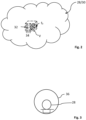
- the polymer structure 28 / polymer precursor 30 comprises according to the schematic representation of a voxel V of the 3D polymer structure 28 / polymer precursor 30 in 2 a paramagnetic substance 32, which is preferably distributed homogeneously in the 3D polymer structure 28/polymer precursor 30.
- the metal particles 34 can in particular consist of nanoparticulate magnetite (Fe 3 O 4 ) or a silver halide (Ag n X n ).
- a cubic millimeter (mm 3 ) of the 3D polymer structure 28 or the polymer precursor 30 preferably contains more than 1000, preferably more than 10,000, and up to 10 17 of the metal particles 34.
- the resonant frequency is equal to the undamped natural frequency (characteristic frequency) f 0 of the paramagnetic metal particles 34.
- the frequency at which the maximum amplitude occurs is always lower than the undamped natural frequency.
- the metal particles 34 Under resonance conditions, therefore, all metal particles 34 that can be excited by the HF radiation have a maximum readiness to absorb energy with regard to the specific HF alternating field. This results in significantly increased oscillating motion of the metal particles 34. These oscillating motions are converted (at the molecular level) into thermal energy due to drag and friction effects with minimal spatial coupling distance. This can lead to the (locally limited) destruction of the 3D polymer structure 28 or to the polymerizing of the polymer precursor 30 . To this extent, the metal particles 34 can therefore be referred to as nano-oscillators.
- the dynamic gradient fields (B1, B2, B3; not shown in the drawing) of the device 10 are used in a manner corresponding to nuclear spin tomography for slice selection and spatial coding in at least 3 spatial directions, i.e. functionally for "indirect focusing" of the HF field generator 20 in HF radiation radiated into the work area.
- the gradient fields are characterized by a continuous increase or decrease in the respective magnetic field strength along their characteristic axes x, y, z, relative to the B 0 field.
- a switched-on gradient field in the x-axis is therefore superimposed on the previously homogeneous, permanent static B 0 field and thus leads to a linear increase or decrease in the total static field strength along the x-axis.
- each metal particle 34 or each spatial volume or voxel of the polymer precursor 30 in three-dimensional space via its individual, him own electromagnetic niche ( spatial coding) in the intersection of at least 3 gradient fields.
- each nanoparticle or features the nanoparticles of each individual voxel have their very own individual resonant frequency and can therefore be individually addressed and selectively excited by a non-directional electromagnetic HF field.
- the respective steepness of the x, y, z gradient fields defines the edge lengths of the voxels in all 3 spatial directions x, y, z, optimally by simultaneous summary superimposition of their local field strength, alternatively sequentially, e.g. using the inverse Fourier transformation.
- the control unit 22 of the device 10 is set up to control the HF field generator 20 in such a way that HF radiation is radiated into the working area 26 with a field frequency tuned to the resonant frequency of the metal particles/oscillators in order to damage the 3D polymer structure 28 or the polymer precursor 30 in the previously spatially encoded voxel V or in the previously spatially encoded coherent volume unit of the 3D polymer structure 28/polymer precursor 30 "en bloc" to locally heat and destroy or, in the case of the polymer precursor 30, to polymerize.
- the typical field frequency of the HF radiation for the oscillation excitation of the paramagnetic substance is between 100 or 108 KHz and 789 THz.
- the control unit 22 of the device 10 preferably has an operating mode which serves to obtain image data (eg magnetic resonance tomographic image data) from the work area 26 or the 3D polymer structure 28 or the polymer precursor 30 .
- the control unit 22, in particular the computer system 24, is used to control all Operating processes of the device 10 based on predetermined CAD / CAM data.
- the control unit 22 is preferably set up to evaluate the image data.
- the control unit 22 can be set up to compare the CAD/CAM data with the previously obtained image data and, if a deviation is detected that is greater than a predetermined permissible maximum deviation, to start the further processing or manufacturing process on the basis of the continue image data.
- control unit can in particular be set up (programmed) to change the CAD/CAM data relating to the remaining 3D polymer structure to be machined or to be produced.
- the 3D polymer structure can be processed/manufactured with particularly small tolerances.
- the working area 26 of the device can according to 3 be delimited by means of a preferably gas-tight housing 36 .
- the housing 36 can be formed, for example, from plastic or from glass or another material that does not shield against HF fields or magnetic fields.
- the housing can be formed by a plastic film, for example.
- a pump 38 ( 1 ) be assigned, by means of which the atmosphere in the housing 36 can be evacuated or essentially evacuated and/or via which the work area within the Housing 36 with a fluid specified for the manufacturing process, in particular a working atmosphere A, can be filled. In this way, for example, undesired oxidative processes of the 3D polymer structure 28/polymer precursor 30 caused by the oxygen contained in the working atmosphere A can be counteracted.
- the device 10 can in particular be formed by a modified MRT device, the control unit 22 of which is adapted to the processing or production of the 3D polymer structure in the manner explained above.
- the polymer precursor 30 can have the same or different monomers or polymers (particularly also dimers, oligomers).
- the 3D polymer structure 28/polymer precursor 30 can comprise fibers and/or one or more other additives, as explained above. Purely by way of example, additives from the group of dyes, antibacterial substances, antibiotics or growth factors are included here.
- the polymer precursor 30 may have a viscosity of approximately 10 2 mPa ⁇ s to 10 5 mPa ⁇ s or greater. If the 3D polymer structure 28 is to be used, for example, as an implant in humans/animals, the polymer precursor 30 in the non-polymerized state is preferably non-toxic to the animal/human organism and is preferably degradable by endogenous enzymes or per viam naturalis from the human/animal. animal body eliminated.
- the device 10 can be used universally.
- medical implants in particular bone replacements, supporting frameworks for tissue/organs or vascular prostheses can be produced with it. This can be done in vitro or directly in vivo.
- the frequency f of the HF radiation 42 is preferably tuned to or matches the respective resonant frequency f 0 of the paramagnetic substance 32 to be excited with the HF radiation or the metal particles 34 of the polymer precursor 30.
- the resonance frequency f 0 of the respective paramagnetic substance 32 can be determined experimentally.
- the voxels V of the 3D polymer structure or the polymer precursor can each have a uniform size or can at least partially differ from one another in size.
- image data 44 of the unpolymerized and/or the polymerized polymer precursor 30 can be obtained.
- Steps 124 can occur after any other method step.
- the image data 44 can be compared with the CAD/CAM data 40 in an optional step 130 and the CAD/CAM data 40 for the 3D polymer structure 28 if a maximum deviation of the 3D polymer structure 28 already generated is exceeded on the basis of the image data for the Generating the rest of the 3D polymer structure 28 can be changed. In this way, the 3D polymer structure 28 can be processed or produced with a particularly small tolerance.
- the 3D polymer structure 28 can be processed completely in a first living being (not shown in the drawing), i.e. in-vivo, or also produced in order to be available as an implant for another living being (not shown) after its removal to stand.
- any 3D polymer structures for example objects of daily use, machine parts, supporting structures for cells, tissue, organs, can be processed and optionally also generated by means of the method 100 according to the invention.
Landscapes
- Chemical & Material Sciences (AREA)
- Engineering & Computer Science (AREA)
- Materials Engineering (AREA)
- Manufacturing & Machinery (AREA)
- Physics & Mathematics (AREA)
- Mechanical Engineering (AREA)
- Optics & Photonics (AREA)
- Health & Medical Sciences (AREA)
- Toxicology (AREA)
Priority Applications (3)
| Application Number | Priority Date | Filing Date | Title |
|---|---|---|---|
| EP21201727.1A EP4163077B8 (fr) | 2021-10-08 | 2021-10-08 | Dispositif, ainsi que procédé d'usinage d'une structure polymère 3d |
| PCT/EP2022/077933 WO2023057624A1 (fr) | 2021-10-08 | 2022-10-07 | Appareil et procédé de traitement d'une structure polymère 3d |
| US18/628,690 US20240269929A1 (en) | 2021-10-08 | 2024-04-06 | Device and method for processing a 3d polymer structure |
Applications Claiming Priority (1)
| Application Number | Priority Date | Filing Date | Title |
|---|---|---|---|
| EP21201727.1A EP4163077B8 (fr) | 2021-10-08 | 2021-10-08 | Dispositif, ainsi que procédé d'usinage d'une structure polymère 3d |
Publications (4)
| Publication Number | Publication Date |
|---|---|
| EP4163077A1 true EP4163077A1 (fr) | 2023-04-12 |
| EP4163077C0 EP4163077C0 (fr) | 2024-07-31 |
| EP4163077B1 EP4163077B1 (fr) | 2024-07-31 |
| EP4163077B8 EP4163077B8 (fr) | 2024-11-20 |
Family
ID=78463362
Family Applications (1)
| Application Number | Title | Priority Date | Filing Date |
|---|---|---|---|
| EP21201727.1A Active EP4163077B8 (fr) | 2021-10-08 | 2021-10-08 | Dispositif, ainsi que procédé d'usinage d'une structure polymère 3d |
Country Status (3)
| Country | Link |
|---|---|
| US (1) | US20240269929A1 (fr) |
| EP (1) | EP4163077B8 (fr) |
| WO (1) | WO2023057624A1 (fr) |
Families Citing this family (1)
| Publication number | Priority date | Publication date | Assignee | Title |
|---|---|---|---|---|
| DE102022131431A1 (de) * | 2022-11-28 | 2024-05-29 | Uppollux Gmbh & Co. Kg | Vorrichtung, System sowie Verfahren zum Erzeugen einer 3D-Struktur |
Citations (3)
| Publication number | Priority date | Publication date | Assignee | Title |
|---|---|---|---|---|
| WO2005119286A1 (fr) * | 2004-06-02 | 2005-12-15 | Terramark Markencreation Gmbh | Appareil de chauffage permettant de chauffer de maniere selective un materiau par resonance spin |
| US20160227876A1 (en) * | 2015-02-05 | 2016-08-11 | Adidas Ag | Method for the manufacture of a plastic component, plastic component, and shoe |
| US20210283838A1 (en) * | 2020-03-13 | 2021-09-16 | Xerox Corporation | Utilization of magnetic particles to improve z-axis strength of 3d printed objects |
Family Cites Families (16)
| Publication number | Priority date | Publication date | Assignee | Title |
|---|---|---|---|---|
| JP2008532610A (ja) * | 2005-03-10 | 2008-08-21 | コーニンクレッカ フィリップス エレクトロニクス エヌ ヴィ | 磁気共鳴rfコイル用のシームレスな筐体 |
| US10239264B2 (en) * | 2015-02-09 | 2019-03-26 | Xerox Corporation | Anti-counterfeiting measures for three dimensional objects |
| WO2017052337A1 (fr) * | 2015-09-25 | 2017-03-30 | 주식회사 엘지화학 | Composition pour impression 3d |
| WO2017100271A1 (fr) * | 2015-12-07 | 2017-06-15 | Northeastern University | Impression en trois dimensions à écriture directe de matériaux composites alignés |
| US20170236639A1 (en) * | 2016-02-16 | 2017-08-17 | Digital Alloys Incorporated | Magnet fabrication by additive manufacturing |
| JP6619092B2 (ja) * | 2016-05-27 | 2019-12-11 | 株式会社日立ハイテクノロジーズ | 細胞の立体構造体の作製装置及び作製方法 |
| WO2019195417A1 (fr) * | 2018-04-03 | 2019-10-10 | Massachusetts Institute Of Technology | Matériaux mous programmables contenant des domaines ferromagnétiques et leurs procédés de fabrication |
| CN113260412A (zh) * | 2018-05-15 | 2021-08-13 | 霍洛比姆技术有限公司 | 利用具有时间相关驻波干涉和相干强度放大的全息能量传送(het)进行能量的精确传送 |
| WO2020094261A1 (fr) * | 2018-11-09 | 2020-05-14 | Arcam Ab | Procédé de commande d'un faisceau d'énergie |
| JP2023517279A (ja) * | 2020-02-04 | 2023-04-25 | 1188511 カナダ エルティーディー. | 電磁力を使用した被加工物に対する操作の実行 |
| US20210299952A1 (en) * | 2020-03-25 | 2021-09-30 | Bmf Material Technology Inc. | Roller-membrane layering micro stereolithography |
| US12070798B2 (en) * | 2020-04-16 | 2024-08-27 | Iowa State University Research Foundation, Inc. | Additive manufacturing with in-situ magnetic field source |
| CN111558718A (zh) * | 2020-05-25 | 2020-08-21 | 上海大学 | 一种高能束增材制造成型的装置及成型方法 |
| WO2021263234A1 (fr) * | 2020-06-26 | 2021-12-30 | University Of Florida Research Foundation, Incorporated | Tête d'impression de stéréolithographie magnétique, imprimante de stéréolithographie et procédé d'impression par stéréolithographie |
| US11862369B2 (en) * | 2020-08-06 | 2024-01-02 | Hrl Laboratories, Llc | Permanent magnets with tailored texture and magnetic orientation |
| EP4094926B1 (fr) * | 2021-05-26 | 2024-01-31 | uppolluX GmbH & Co. KG | Dispositif, système et son utilisation, ainsi que procédé de génération d'une structure 3d |
-
2021
- 2021-10-08 EP EP21201727.1A patent/EP4163077B8/fr active Active
-
2022
- 2022-10-07 WO PCT/EP2022/077933 patent/WO2023057624A1/fr not_active Ceased
-
2024
- 2024-04-06 US US18/628,690 patent/US20240269929A1/en active Pending
Patent Citations (3)
| Publication number | Priority date | Publication date | Assignee | Title |
|---|---|---|---|---|
| WO2005119286A1 (fr) * | 2004-06-02 | 2005-12-15 | Terramark Markencreation Gmbh | Appareil de chauffage permettant de chauffer de maniere selective un materiau par resonance spin |
| US20160227876A1 (en) * | 2015-02-05 | 2016-08-11 | Adidas Ag | Method for the manufacture of a plastic component, plastic component, and shoe |
| US20210283838A1 (en) * | 2020-03-13 | 2021-09-16 | Xerox Corporation | Utilization of magnetic particles to improve z-axis strength of 3d printed objects |
Also Published As
| Publication number | Publication date |
|---|---|
| WO2023057624A1 (fr) | 2023-04-13 |
| US20240269929A1 (en) | 2024-08-15 |
| EP4163077C0 (fr) | 2024-07-31 |
| EP4163077B1 (fr) | 2024-07-31 |
| EP4163077B8 (fr) | 2024-11-20 |
Similar Documents
| Publication | Publication Date | Title |
|---|---|---|
| Song et al. | Advanced strategies of scaffolds design for bone regeneration | |
| US20240092026A1 (en) | Apparatus, system and method for generating a 3d structure | |
| Hutmacher et al. | Scaffold design and fabrication | |
| Pardo et al. | Magnetic nanocomposite hydrogels for tissue engineering: design concepts and remote actuation strategies to control cell fate | |
| Spangenberg et al. | Bioprinting of magnetically deformable scaffolds | |
| US10238496B2 (en) | Bone regeneration using biodegradable polymeric nanocomposite materials and applications of the same | |
| JP6490869B2 (ja) | 心筋組織再生用3次元構造体およびその製造方法 | |
| CA2964107C (fr) | Regeneration osseuse a l'aide de materiaux nanocomposites polymeres biodegradables et applications associees | |
| Li et al. | Magnetically guided fabrication of multilayered iron oxide/polycaprolactone/gelatin nanofibrous structures for tissue engineering and theranostic application | |
| US20240269929A1 (en) | Device and method for processing a 3d polymer structure | |
| Forton et al. | In vivo microcomputed tomography of nanocrystal-doped tissue engineered scaffolds | |
| DE102021211395A1 (de) | Vorrichtung sowie Verfahren zum Bearbeiten einer 3D-Polymerstruktur | |
| DE102021205350A1 (de) | Vorrichtung, System und Verwendung derselben sowie Verfahren zum Erzeugen einer 3D-Struktur | |
| Meng et al. | 3D-printed biodegradable polycaprolactone rib implants with tissue-specific mechanical properties promote chest wall recovery by stimulating tissue fibrosis | |
| KR102691134B1 (ko) | 이물 반응이 감소된 3-차원 이식형 매트릭스 | |
| Mañas-Torres et al. | Biomedical applications of magnetic hydrogels | |
| Abdel Hamid et al. | Review on smart magnetic polymer scaffolds for bone tissue engineering | |
| DE102022131431A1 (de) | Vorrichtung, System sowie Verfahren zum Erzeugen einer 3D-Struktur | |
| Suhag et al. | Introduction to Biomedical Materials | |
| Tseng et al. | Visualization of peripheral nerve regeneration | |
| Khodami et al. | Advanced 3D Printing Techniques for Scaffold Fabrication in Bone Tissue Engineering | |
| Ambiga et al. | Future Trends in Biomedical Applications | |
| Lăbuşcă et al. | Magnetic sensors for regenerative medicine | |
| Lopez-Lopez et al. | Biomedical applications of magnetic hydrogels | |
| Mensitieri | A NOVEL ROUTE TOWARDS THE DESIGN OF 3D MORPHOLOGICALLY CONTROLLED MAGNETIC SCAFFOLDS FOR ADVANCED BONE TISSUE ENGINEERING |
Legal Events
| Date | Code | Title | Description |
|---|---|---|---|
| PUAI | Public reference made under article 153(3) epc to a published international application that has entered the european phase |
Free format text: ORIGINAL CODE: 0009012 |
|
| STAA | Information on the status of an ep patent application or granted ep patent |
Free format text: STATUS: THE APPLICATION HAS BEEN PUBLISHED |
|
| AK | Designated contracting states |
Kind code of ref document: A1 Designated state(s): AL AT BE BG CH CY CZ DE DK EE ES FI FR GB GR HR HU IE IS IT LI LT LU LV MC MK MT NL NO PL PT RO RS SE SI SK SM TR |
|
| STAA | Information on the status of an ep patent application or granted ep patent |
Free format text: STATUS: REQUEST FOR EXAMINATION WAS MADE |
|
| 17P | Request for examination filed |
Effective date: 20230922 |
|
| RBV | Designated contracting states (corrected) |
Designated state(s): AL AT BE BG CH CY CZ DE DK EE ES FI FR GB GR HR HU IE IS IT LI LT LU LV MC MK MT NL NO PL PT RO RS SE SI SK SM TR |
|
| GRAP | Despatch of communication of intention to grant a patent |
Free format text: ORIGINAL CODE: EPIDOSNIGR1 |
|
| STAA | Information on the status of an ep patent application or granted ep patent |
Free format text: STATUS: GRANT OF PATENT IS INTENDED |
|
| INTG | Intention to grant announced |
Effective date: 20240312 |
|
| GRAS | Grant fee paid |
Free format text: ORIGINAL CODE: EPIDOSNIGR3 |
|
| GRAA | (expected) grant |
Free format text: ORIGINAL CODE: 0009210 |
|
| STAA | Information on the status of an ep patent application or granted ep patent |
Free format text: STATUS: THE PATENT HAS BEEN GRANTED |
|
| AK | Designated contracting states |
Kind code of ref document: B1 Designated state(s): AL AT BE BG CH CY CZ DE DK EE ES FI FR GB GR HR HU IE IS IT LI LT LU LV MC MK MT NL NO PL PT RO RS SE SI SK SM TR |
|
| REG | Reference to a national code |
Ref country code: CH Ref legal event code: EP Ref country code: GB Ref legal event code: FG4D Free format text: NOT ENGLISH |
|
| REG | Reference to a national code |
Ref country code: DE Ref legal event code: R096 Ref document number: 502021004562 Country of ref document: DE |
|
| REG | Reference to a national code |
Ref country code: IE Ref legal event code: FG4D Free format text: LANGUAGE OF EP DOCUMENT: GERMAN |
|
| U01 | Request for unitary effect filed |
Effective date: 20240813 |
|
| U07 | Unitary effect registered |
Designated state(s): AT BE BG DE DK EE FI FR IT LT LU LV MT NL PT SE SI Effective date: 20240827 |
|
| GRAT | Correction requested after decision to grant or after decision to maintain patent in amended form |
Free format text: ORIGINAL CODE: EPIDOSNCDEC |
|
| REG | Reference to a national code |
Ref country code: CH Ref legal event code: PK Free format text: BERICHTIGUNG B8 |
|
| U20 | Renewal fee for the european patent with unitary effect paid |
Year of fee payment: 4 Effective date: 20241009 |
|
| RAP2 | Party data changed (patent owner data changed or rights of a patent transferred) |
Owner name: UPPOLLUX GMBH & CO. KG |
|
| U1K | Transfer of rights of the unitary patent after the registration of the unitary effect |
Owner name: UPPOLLUX GMBH & CO. KG; DE |
|
| PG25 | Lapsed in a contracting state [announced via postgrant information from national office to epo] |
Ref country code: NO Free format text: LAPSE BECAUSE OF FAILURE TO SUBMIT A TRANSLATION OF THE DESCRIPTION OR TO PAY THE FEE WITHIN THE PRESCRIBED TIME-LIMIT Effective date: 20241031 |
|
| PG25 | Lapsed in a contracting state [announced via postgrant information from national office to epo] |
Ref country code: PL Free format text: LAPSE BECAUSE OF FAILURE TO SUBMIT A TRANSLATION OF THE DESCRIPTION OR TO PAY THE FEE WITHIN THE PRESCRIBED TIME-LIMIT Effective date: 20240731 Ref country code: GR Free format text: LAPSE BECAUSE OF FAILURE TO SUBMIT A TRANSLATION OF THE DESCRIPTION OR TO PAY THE FEE WITHIN THE PRESCRIBED TIME-LIMIT Effective date: 20241101 |
|
| PG25 | Lapsed in a contracting state [announced via postgrant information from national office to epo] |
Ref country code: IS Free format text: LAPSE BECAUSE OF FAILURE TO SUBMIT A TRANSLATION OF THE DESCRIPTION OR TO PAY THE FEE WITHIN THE PRESCRIBED TIME-LIMIT Effective date: 20241130 |
|
| PG25 | Lapsed in a contracting state [announced via postgrant information from national office to epo] |
Ref country code: HR Free format text: LAPSE BECAUSE OF FAILURE TO SUBMIT A TRANSLATION OF THE DESCRIPTION OR TO PAY THE FEE WITHIN THE PRESCRIBED TIME-LIMIT Effective date: 20240731 |
|
| PG25 | Lapsed in a contracting state [announced via postgrant information from national office to epo] |
Ref country code: ES Free format text: LAPSE BECAUSE OF FAILURE TO SUBMIT A TRANSLATION OF THE DESCRIPTION OR TO PAY THE FEE WITHIN THE PRESCRIBED TIME-LIMIT Effective date: 20240731 Ref country code: RS Free format text: LAPSE BECAUSE OF FAILURE TO SUBMIT A TRANSLATION OF THE DESCRIPTION OR TO PAY THE FEE WITHIN THE PRESCRIBED TIME-LIMIT Effective date: 20241031 |
|
| PG25 | Lapsed in a contracting state [announced via postgrant information from national office to epo] |
Ref country code: RS Free format text: LAPSE BECAUSE OF FAILURE TO SUBMIT A TRANSLATION OF THE DESCRIPTION OR TO PAY THE FEE WITHIN THE PRESCRIBED TIME-LIMIT Effective date: 20241031 Ref country code: PL Free format text: LAPSE BECAUSE OF FAILURE TO SUBMIT A TRANSLATION OF THE DESCRIPTION OR TO PAY THE FEE WITHIN THE PRESCRIBED TIME-LIMIT Effective date: 20240731 Ref country code: NO Free format text: LAPSE BECAUSE OF FAILURE TO SUBMIT A TRANSLATION OF THE DESCRIPTION OR TO PAY THE FEE WITHIN THE PRESCRIBED TIME-LIMIT Effective date: 20241031 Ref country code: IS Free format text: LAPSE BECAUSE OF FAILURE TO SUBMIT A TRANSLATION OF THE DESCRIPTION OR TO PAY THE FEE WITHIN THE PRESCRIBED TIME-LIMIT Effective date: 20241130 Ref country code: HR Free format text: LAPSE BECAUSE OF FAILURE TO SUBMIT A TRANSLATION OF THE DESCRIPTION OR TO PAY THE FEE WITHIN THE PRESCRIBED TIME-LIMIT Effective date: 20240731 Ref country code: GR Free format text: LAPSE BECAUSE OF FAILURE TO SUBMIT A TRANSLATION OF THE DESCRIPTION OR TO PAY THE FEE WITHIN THE PRESCRIBED TIME-LIMIT Effective date: 20241101 Ref country code: ES Free format text: LAPSE BECAUSE OF FAILURE TO SUBMIT A TRANSLATION OF THE DESCRIPTION OR TO PAY THE FEE WITHIN THE PRESCRIBED TIME-LIMIT Effective date: 20240731 |
|
| PG25 | Lapsed in a contracting state [announced via postgrant information from national office to epo] |
Ref country code: SM Free format text: LAPSE BECAUSE OF FAILURE TO SUBMIT A TRANSLATION OF THE DESCRIPTION OR TO PAY THE FEE WITHIN THE PRESCRIBED TIME-LIMIT Effective date: 20240731 |
|
| PG25 | Lapsed in a contracting state [announced via postgrant information from national office to epo] |
Ref country code: CZ Free format text: LAPSE BECAUSE OF FAILURE TO SUBMIT A TRANSLATION OF THE DESCRIPTION OR TO PAY THE FEE WITHIN THE PRESCRIBED TIME-LIMIT Effective date: 20240731 |
|
| PG25 | Lapsed in a contracting state [announced via postgrant information from national office to epo] |
Ref country code: SK Free format text: LAPSE BECAUSE OF FAILURE TO SUBMIT A TRANSLATION OF THE DESCRIPTION OR TO PAY THE FEE WITHIN THE PRESCRIBED TIME-LIMIT Effective date: 20240731 |
|
| PLBE | No opposition filed within time limit |
Free format text: ORIGINAL CODE: 0009261 |
|
| STAA | Information on the status of an ep patent application or granted ep patent |
Free format text: STATUS: NO OPPOSITION FILED WITHIN TIME LIMIT |
|
| PG25 | Lapsed in a contracting state [announced via postgrant information from national office to epo] |
Ref country code: MC Free format text: LAPSE BECAUSE OF FAILURE TO SUBMIT A TRANSLATION OF THE DESCRIPTION OR TO PAY THE FEE WITHIN THE PRESCRIBED TIME-LIMIT Effective date: 20240731 |
|
| 26N | No opposition filed |
Effective date: 20250501 |
|
| PG25 | Lapsed in a contracting state [announced via postgrant information from national office to epo] |
Ref country code: IE Free format text: LAPSE BECAUSE OF NON-PAYMENT OF DUE FEES Effective date: 20241008 |
|
| REG | Reference to a national code |
Ref country code: CH Ref legal event code: U11 Free format text: ST27 STATUS EVENT CODE: U-0-0-U10-U11 (AS PROVIDED BY THE NATIONAL OFFICE) Effective date: 20251101 |
|
| PG25 | Lapsed in a contracting state [announced via postgrant information from national office to epo] |
Ref country code: RO Free format text: LAPSE BECAUSE OF FAILURE TO SUBMIT A TRANSLATION OF THE DESCRIPTION OR TO PAY THE FEE WITHIN THE PRESCRIBED TIME-LIMIT Effective date: 20240731 |
|
| U20 | Renewal fee for the european patent with unitary effect paid |
Year of fee payment: 5 Effective date: 20251022 |
|
| PGFP | Annual fee paid to national office [announced via postgrant information from national office to epo] |
Ref country code: GB Payment date: 20251024 Year of fee payment: 5 |
|
| PGFP | Annual fee paid to national office [announced via postgrant information from national office to epo] |
Ref country code: CH Payment date: 20251101 Year of fee payment: 5 |
|
| PG25 | Lapsed in a contracting state [announced via postgrant information from national office to epo] |
Ref country code: CY Free format text: LAPSE BECAUSE OF FAILURE TO SUBMIT A TRANSLATION OF THE DESCRIPTION OR TO PAY THE FEE WITHIN THE PRESCRIBED TIME-LIMIT; INVALID AB INITIO Effective date: 20211008 |
|
| PG25 | Lapsed in a contracting state [announced via postgrant information from national office to epo] |
Ref country code: HU Free format text: LAPSE BECAUSE OF FAILURE TO SUBMIT A TRANSLATION OF THE DESCRIPTION OR TO PAY THE FEE WITHIN THE PRESCRIBED TIME-LIMIT; INVALID AB INITIO Effective date: 20211008 |