EP4163205A1 - Plate-forme mobile de transport de cargaison destinée à être reçue dans la soute ou la cabine d'un aéronef comportant des ensembles roues orientables séparément et système de transport de cargaison - Google Patents
Plate-forme mobile de transport de cargaison destinée à être reçue dans la soute ou la cabine d'un aéronef comportant des ensembles roues orientables séparément et système de transport de cargaison Download PDFInfo
- Publication number
- EP4163205A1 EP4163205A1 EP21200997.1A EP21200997A EP4163205A1 EP 4163205 A1 EP4163205 A1 EP 4163205A1 EP 21200997 A EP21200997 A EP 21200997A EP 4163205 A1 EP4163205 A1 EP 4163205A1
- Authority
- EP
- European Patent Office
- Prior art keywords
- wheel
- steerable wheel
- cargo
- cargo transport
- steerable
- Prior art date
- Legal status (The legal status is an assumption and is not a legal conclusion. Google has not performed a legal analysis and makes no representation as to the accuracy of the status listed.)
- Pending
Links
Images


Classifications
-
- B—PERFORMING OPERATIONS; TRANSPORTING
- B64—AIRCRAFT; AVIATION; COSMONAUTICS
- B64F—GROUND OR AIRCRAFT-CARRIER-DECK INSTALLATIONS SPECIALLY ADAPTED FOR USE IN CONNECTION WITH AIRCRAFT; DESIGNING, MANUFACTURING, ASSEMBLING, CLEANING, MAINTAINING OR REPAIRING AIRCRAFT, NOT OTHERWISE PROVIDED FOR; HANDLING, TRANSPORTING, TESTING OR INSPECTING AIRCRAFT COMPONENTS, NOT OTHERWISE PROVIDED FOR
- B64F1/00—Ground or aircraft-carrier-deck installations
- B64F1/32—Ground or aircraft-carrier-deck installations for handling freight
- B64F1/322—Cargo loaders specially adapted for loading air freight containers or palletized cargo into or out of the aircraft
-
- B—PERFORMING OPERATIONS; TRANSPORTING
- B65—CONVEYING; PACKING; STORING; HANDLING THIN OR FILAMENTARY MATERIAL
- B65D—CONTAINERS FOR STORAGE OR TRANSPORT OF ARTICLES OR MATERIALS, e.g. BAGS, BARRELS, BOTTLES, BOXES, CANS, CARTONS, CRATES, DRUMS, JARS, TANKS, HOPPERS, FORWARDING CONTAINERS; ACCESSORIES, CLOSURES, OR FITTINGS THEREFOR; PACKAGING ELEMENTS; PACKAGES
- B65D88/00—Large containers
- B65D88/02—Large containers rigid
- B65D88/12—Large containers rigid specially adapted for transport
- B65D88/14—Large containers rigid specially adapted for transport by air
-
- B—PERFORMING OPERATIONS; TRANSPORTING
- B65—CONVEYING; PACKING; STORING; HANDLING THIN OR FILAMENTARY MATERIAL
- B65D—CONTAINERS FOR STORAGE OR TRANSPORT OF ARTICLES OR MATERIALS, e.g. BAGS, BARRELS, BOTTLES, BOXES, CANS, CARTONS, CRATES, DRUMS, JARS, TANKS, HOPPERS, FORWARDING CONTAINERS; ACCESSORIES, CLOSURES, OR FITTINGS THEREFOR; PACKAGING ELEMENTS; PACKAGES
- B65D90/00—Component parts, details or accessories for large containers
- B65D90/12—Supports
- B65D90/18—Castors, rolls, or the like; e.g. detachable
-
- B—PERFORMING OPERATIONS; TRANSPORTING
- B64—AIRCRAFT; AVIATION; COSMONAUTICS
- B64D—EQUIPMENT FOR FITTING IN OR TO AIRCRAFT; FLIGHT SUITS; PARACHUTES; ARRANGEMENT OR MOUNTING OF POWER PLANTS OR PROPULSION TRANSMISSIONS IN AIRCRAFT
- B64D9/00—Equipment for handling freight; Equipment for facilitating passenger embarkation or the like
-
- B—PERFORMING OPERATIONS; TRANSPORTING
- B65—CONVEYING; PACKING; STORING; HANDLING THIN OR FILAMENTARY MATERIAL
- B65D—CONTAINERS FOR STORAGE OR TRANSPORT OF ARTICLES OR MATERIALS, e.g. BAGS, BARRELS, BOTTLES, BOXES, CANS, CARTONS, CRATES, DRUMS, JARS, TANKS, HOPPERS, FORWARDING CONTAINERS; ACCESSORIES, CLOSURES, OR FITTINGS THEREFOR; PACKAGING ELEMENTS; PACKAGES
- B65D2590/00—Component parts, details or accessories for large containers
- B65D2590/0083—Computer or electronic system, e.g. GPS systems
Definitions
- the present invention relates to a cargo transport platform and a cargo transport system for being received in an aircraft cargo hold or cabin and a method for operating such platform.
- Such platforms and systems are generally known from the prior art such as the from DE 10 2020 110 598 A1 .
- These containers comprise a preferably stiff base member having an upper surface which is adapted to receive cargo.
- cargo in the sense of the present invention is to be understood broadly and includes both luggage and heavy cargo elements which are usually received within the cargo hold of an aircraft.
- the containers in accordance with the present invention are dimensioned such that they are capable to be passed through both the doors to the passenger cabin and the cargo hold.
- the term container in the sense of the present invention must not be construed in such a narrow sense so as to cover only those containers which are normally received in the cargo hold of an aircraft.
- the containers of the present invention shall also be capable of being received in the cabin of an aircraft is driven by the fact that it has recently turned out that a more flexible use of an aircraft is desirable where at least parts of the cabin can be converted into cargo space by removing the respective seats, when the complete capacity for passengers is not required. In those cases, the space in the cabin no longer required for passengers can be used for cargo so that the overall cost efficiency may still be kept at a higher level, even though a lower number of passengers are carried by the aircraft.
- the containers of the present invention are adapted such that they may be received both in the cargo hold and in the cabin, specific measures need to be taken to allow for the containers to be slid along the floor surface of both the cargo hold and the cabin.
- the maximum pointloads which can be applied to the cabin floor are limited and much smaller than in case of the floor of the cargo hold.
- normally special means are provided or are installed within the cargo hold that allow for a driven and controlled movement of the containers within the hold, this is not the case in the cabin.
- the containers may either manually be shifted within the cabin or comprise means that allow for a driven movement.
- the containers may have a considerable weight and have to be placed at precisely defined positions, it is also desirable that the assemblies for allowing the containers to be slidable are configured such that they also allow for the precise steering of the containers.
- the object of the present invention to provide a cargo container adapted to be capable of being received on floors having reduced maximum pointloads which can be applied to them without being damaged, wherein the cargo container is also capable of being maneuvered over such floor surfaces in a steerable manner, as well as a method to operate such cargo container tubing maneuvered over floor surfaces.
- a cargo transport platform for being received in an aircraft cargo hold or cabin comprising:
- the cargo transport platform comprises a base member which is provided with an upper surface configured to support cargo elements and a lower surface which is adapted to face a floor surface of the cargo hold or cabin in which the cargo transport platform is received.
- the upper surface is configured to support cargo elements and the term "cargo elements" in the sense of the present invention is to be construed broadly, i.e., it covers both cargo such as luggage or smaller members usually received in a container and large components. Therefore even a support member being provided with a housing so that a receiving space is defined which is capable of receiving smaller cargo members, may be supported on the base member in the sense of the present invention.
- the base element of a cargo container may be supported onthe base member of the platform.
- the base member and in particular its lower surface is provided with a plurality of steerable wheel devices which comprise a carrier and a wheel assembly.
- the wheel assembly comprises at least one wheel which is rotatably supported by the carrier so that it may rotate about a wheel axis that extends parallel to the plane in which the floor extends on which the platform may rest. Further, the wheels of the steerable wheel devices project beyond the lower surface of the base member so that they may get in contact with the floor with a gap between the base member and the floor.
- the steerable wheel devices are configured such that for each wheel device a steering axis is defined about which the carrier may rotate relative to the base member, the steering axes extending vertically with respect to the floor and the plane in which the contact points of the wheels with the floor are located.
- each of the wheel assemblies is adjustable so that the wheel axis may be positioned in any desired direction.
- Each of the steerable wheel devices is provided with a drive assembly that is adapted such that it may rotate the carrier relative to the base member about its steering axis.
- the drive assembly is also adapted to rotatingly drive the wheels of the wheel assembly. Therefore, each of the steerable wheel devices is driven in two ways. Firstly, the wheels are rotatably driven and secondly the rotational position of the wheel axis and hence the direction in which the respective steerable wheel device propels the transport platform is also adjusted with the drive assembly. That means that each of the steerable wheel devices can independently be controlled so as to the direction and the velocity with which the respective device is propelled.
- the platform can flexibly be positioned within the cabin or cargo hold of an aircraft. Furthermore, since the platform is provided with a plurality of such devices the entire load due to the weight of the platform is distributed over several points so that the maximum pointload is kept at a low level.
- the cargo transport platform is provided with a control unit which is connected to each of the drive assemblies so that control signals to these assemblies are provided to effect a movement of the entire platform along a predetermined path such as a path defined by the input of a user.
- each steerable wheel device comprises a first and a second wheel being rotatably supported in the carrier of said steerable wheel device about its wheel axis
- the drive assembly of each of the steerable wheel devices comprises a first rotary drive coupled to the first wheel and a second rotary drive coupled to the second wheel
- the control unit is connected to the drive assembly such that the first and second rotary drives are operable in such a way that the rotational direction and rotational speed of each of the first and second wheels of each steerable wheel device can be controlled independently.
- Such configuration of the wheel assembly allows to adjust the angular position of the wheel axis simply by controlling the rotary drives such that the wheels are driven with different rotational speeds or in different directions which results in a change of the angular position of the wheel axis.
- Such arrangement results in a mechanically simple configuration of the steerable wheel devices.
- the first and the second rotary drives of each of the steerable wheel devices are formed as a hub drive.
- each of the steerable wheel devices comprises a steering drive coupled to the base member and the carrier of said steerable wheel device and adapted to rotate said carrier about its steering axis.
- the drive assembly of each of the steerable wheel devices comprises a steering drive coupled to the base member and the carrier of said steerable wheel device and adapted to rotate said carrier about its vertical axis.
- the steerable wheel devices and the wheel axis of the associated wheel assembly can be adjusted by rotating the carrier relative to the base member by means of a drive device coupled between them.
- the steering drive maybe formed as step motor.
- a sensor assembly is provided which is adapted to detect the position of the carrier of said steerable wheel device relative to the base member and/or the rotational position of the at least one wheel of the wheel assembly of said steerable wheel device and/or the rotational speed of the at least one wheel of the wheel assembly of said steerable wheel device , and wherein the sensor assembly of each of the steerable wheel devices is connected to the control unit and capable of transmitting a signal to the control unit representing the position of the carrier of said steerable wheel device relative to the base member and/or the rotational position of the at least one wheel of the wheel assembly of said steerable wheel device and/or the rotational speed of the at least one wheel of the wheel assembly of said steerable wheel device.
- Such a sensor assembly allows to provide a feedback signal to the control unit which further facilitates that the control unit effects a precise movement of the cargo transport platform within the cabin or the cargo hold of an aircraft.
- a battery pack is provided, which is preferably releasably mounted on the base member, wherein the drive assembly of each of the steerable wheel devices is coupled to the battery pack and adapted to be supplied by the battery pack.
- Such battery pack allows to supply power to the components of the drive assembly.
- each of the steerable wheel devices is moveable relative to the base member parallel to the steering axis of said steerable wheel device between an extended position in which the at least one wheel of said steerable wheel device extends beyond the lower surface and a retracted position in which the at least one wheel of said steerable wheel device is retracted behind the lower surface.
- the entire cargo transport platform may be lowered in such a manner to the floor surface that the lower surface get into contact with the floor surface so as to prevent a sliding movement of the platform relative to the floor.
- each of the steerable wheel devices comprises a dampening element which is arranged between the base member and the carrier of said steerable wheel device, wherein the dampening element of said steerable wheel device is arranged such between the base member and the carrier, that it allows for a limited movement of the carrier relative to the base member parallel to the vertical axis of said steerable wheel device.
- a dampening element reduces the vibrations which are generated when the cargo transport platform according to the present invention is moved across a floor of a cabin or cargo hold.
- the dampening element reduces the vibrations which are generated when the cargo transport platform according to the present invention is moved across a floor of a cabin or cargo hold.
- the cargo transport platform comprises a position sensor such as a GPS sensor which is connected to the control unit and adapted to provide a signal representing the actual position of the platform to the control unit. Providing such a sensor facilitates that the platform of the present invention may autonomously determine and control the path along which it is moved to a predetermined position in the cabin or cargo hold.
- a position sensor such as a GPS sensor which is connected to the control unit and adapted to provide a signal representing the actual position of the platform to the control unit.
- a user interface is provided adapted to receive an input from a user specifying a target position and/or the predetermined path and/or a direction along which the platform is to be moved by the steerable wheel devices.
- Such user interface may be in the form of an actuator or a touchscreen etc.
- a cargo transport system for being received in an aircraft cargo hold or cabin comprising
- the platform may preferably releasably be connected to the support member so that it is facilitated that the platform is employed to transfer the support member to a predetermined position, is then disconnected from the support member and again coupled to another support member so as to move the latter to another position.
- each container or cargo support member is provided with its own drive means.
- the system of the present invention allows to employ a small number of transport platforms releasably coupled to support members to maneuver the latter in a cargo hold or cabin of an aircraft.
- this aspect provides for a modular configuration which saves further weight since the platforms employed for moving the support members with the cargo, do not have to be carried with the aircraft during flight. It is only required that also at the destination cargo transport platforms are available so as to again unload the support members from the cabin or cargo hold at the destination.
- the base member of the at least one cargo transport platform is connected to the support member such, that the base member and the support member are integrally formed.
- the base member and the support member are formed in one piece.
- a cargo transport platform and a cargo container comprising such platform are operated such that a control command is provided to the control unit, the control command comprising information as to the path or the final end position the cargo transport platform shall obtain.
- a predetermined path along which the platform shall move is determined by the control unit.
- the control unit independently determines the path along which the cargo transport platform moves to an end position input in the control unit by the command. Further, the input may be performed directly by a user via a user interface or is sent to the control unit via a wireless or wired connection.
- the method is not limited to control commands being directly input by a user.
- the control unit determines for each of the steerable wheel devices of the cargo transport platform at which angular position the respective carrier has to be adjusted and at which velocity the wheels have to be driven to follow the predetermined path determined before. Further, the control unit provides corresponding control signals to the drive assemblies of each of the steerable wheel devices so that respective rotational positions and velocities are achieved by the respective steerable wheel devices.
- the control unit is capable of controlling the plurality of steerable wheel devices so as to achieve that the cargo transport platform is moved along the desired direction or to the final end position as input in the control unit.
- each steerable wheel device comprises a first and a second wheel being rotatably supported in the carrier of said steerable wheel device about its wheel axis
- the drive assembly of each of the steerable wheel devices comprises a first rotary drive coupled to the first wheel and a second rotary drive coupled to the second wheel
- the control unit is connected to the drive device such that the first and second rotary drives are operable in such a way that the rotational direction and rotational speed of each of the first and second wheels of each steerable wheel device can be controlled independently.
- step d) the control signals are provided by the control unit to the first and the second rotary drive of each of the steerable wheel devices; and in the above step e) the first and the second rotary drives of each of the steerable wheel devices are operated based on the control signals provided in step d). Therefore, this preferred embodiment of a method of the present invention allows to operate steerable wheel devices having first and second wheels being independently driven by first and second rotary drives.
- an aircraft 1 usually comprises a fuselage 3 having a passenger cabin 5 as well as a cargo hold 7 below the cabin 5. It is desirable that cargo containers are not only stored within the cargo hold 7 but that also the passenger cabin 5 of the aircraft 1 may be used for such purpose after having removed at least part of the seat rows in the cabin. Therefore, the embodiments of cargo containers 9 as described below will have to be dimensioned such that they are able pass both the passenger door and a cargo door (not shown).
- the passenger cabin 5 is normally not provided with any means on its the floor surface to enable transport of cargo containers, it is required that these cargo containers 9 are provided with specific means so as to facilitate movement or shifting of the containers 9 along the floor surface of the passenger cabin 5, either autonomously or by personnel.
- the cargo containers 9 need to be adapted such that they may precisely be positioned adjacent to each other on the floor surface both of the passenger cabin 5 and of the cargo hold 7 which in turn requires that the containers are provided with means to allow for precise steering of the movement.
- a first embodiment of a cargo container 9 comprises cargo transport platform 11 having a base member 13 with an upper surface 15 which is adapted to be releasably coupled with the bottom surface 17 of a support member 19.
- the support member 19 additionally comprises a support surface 21 which points away from the bottom surface 17 and is arranged such that when the support member 19 is coupled to the cargo transport platform 11 and the latter is positioned on a horizontally extending floor 23, it points upwards so that it is capable of supporting cargo elements.
- the support member 19 is additionally provided with a casing 23 which encompasses a receiving space 25 in which cargo elements may be received.
- the support member 19 does not comprise such casing.
- cargo elements in the sense of the present invention is to be construed broadly so that it covers any kind of cargo that may be transported by an aircraft independent of its size of the weight, i.e., it covers luggage as well as heavy cargo elements normally received in a cargo hold.
- the base member 13 comprises a lower surface 29 which during normal use points towards the floor surface 23 of the passenger cabin 5 or the cargo hold 7.
- the lower surface 29 of the base member 13 is provided with a plurality of steerable wheel devices 31 examples of which will be described in detail below and which comprise a carrier 33 and a wheel assembly 35.
- the wheel assemblies 35 comprise first and second wheels 37, 39 which are separated from each other but arranged in parallel so as to be independently rotatable with respect to a wheel axis 41.
- the wheel assembly 35 is mounted on the carrier 33 with the wheel axis 41 being fixed relative to the carrier 33.
- the carrier 33 of each of the steerable wheel devices 31 is rotatably supported in the base member 13 of the cargo transport platform 11 about a steering axis 43 which extends perpendicularly to the lower surface 29 and vertically to the floor surface 23.
- the carriers 33 of each of the steerable wheel devices 31 are provided with a wedge member 45 which engages with a further wedge member 47 fixedly mounted on one of a plurality of parallel rods 49 that extend through the base member 13 and are coupled to a lever 51 pivotably mounted on the base member 13.
- the lever 51 By pivoting the lever 51 the rods 49 arranged in parallel are shifted so that the wedge members 47 mounted on the rods 49 slide along the wedge members 45 fixed to the carriers 33 and the carriers 33 are retracted into or pushed out of the base member 13 depending on the pivot position of the lever 51.
- the carriers 33 are movable between a retracted position in which the wheels 37, 39 of the wheel assemblies 35 do not project beyond the lower surface 29 of the base member 13, and an extended position (see figure 2 ) where the wheels 37, 39 of the wheel assemblies 35 project beyond the lower surface 29 and may get in contact with the respective floor surface 23.
- the carrier 33 of each of the steerable wheel devices 31 is movable relative to the base member 13 parallel to the respective steering axis 43 between an extended position and a retracted position.
- each of the rod 49 extends beyond the front end 55 of the base member 13 of the cargo transport platform 11, when the lever 51 is pivoted towards the base member 13 into that position in which the carriers 33 are in the retracted position (see figure 4 ).
- the distal ends 53 extending beyond the front end 55 of the base member 13, may engage with recesses in an adjacent cargo transport platform 11 such that the cargo transport platforms 11 are locked with each other.
- the carrier 33 supports a shaft 57 which defines the wheel axis 41 and on which the first and the second wheels 37, 39 are rotatably supported, so that they may independently rotate.
- the first and the second wheels 37, 39 are mounted on the shaft 57 by a hub drive so that the first wheel 37 is mounted on the shaft 57 by a first hub drive 59 and the second wheel 39 by a second hub drive 61.
- the first and the second wheels 37, 39 may independently be rotationally driven.
- the first and the second wheels 37, 39 may be driven in opposite rotational directions. When this is the case the wheel axis 41 is rotated about the steering axis 43.
- first and the second hub drives 59, 61 form first and second rotary drives which in combination form a drive assembly that is capable to rotate the carrier 33 relative to the base member 13 about the associated steering axis 43.
- first and the second hub drives 59, 61 drive the first and the second wheels 37, 39, respectively, about the wheel axis 41.
- first and the second hub drives 59, 61 are connected to a control unit 63 mounted on the base member 13 of the cargo transport platform 11, so that the drive assembly formed by the first and the second hub drives 59, 61 of each of the steerable wheel devices 31 may centrally be controlled.
- the control unit 63 is coupled to each of the hub drives 59, 61 of each of the steerable wheel devices 31.
- the drive assembly is formed by the two hub drives 59, 61 which also effect the rotation of the carrier 33 about the steering axis 43, i.e., the carrier 33 is not directly driven about the steering axis 43.
- a steering drive is provided which is coupled to the base member 13 and the carrier 33, so as to effect rotation of the carrier 33 about the steering axis 43.
- Such steering drive may be formed as a step motor.
- each of the steerable wheel devices 31 of this embodiment comprises a first sensor element 65 that is adapted to detect the rotational position of the carrier 33 relative to the base element 13.
- second sensor elements 67 are provided that are configured such that they are capable of detecting the rotational position and the rotational speed of the first and the second wheels 37, 39.
- each of the steerable wheel devices 31 is provided with a sensor assembly comprising the first and the second sensor elements 65, 67 so that the position of the carrier 33 relative to the base member 13 as well as the rotational position of the wheels 37, 39 and in the rotational speed and thereof can be detected.
- This the sensor assembly is connected to the control unit 63 via connection lines so that the control unit 63 is supplied with signals relating to both the position of the carrier 33 and the wheels 37, 39.
- the carrier 33 is coupled to the wedge member 45 which in turn engages with a wedge member 47 on one of the rods 49 via connectors 69 that extend through the base member 13.
- dampening elements 71 are provided so that they is arranged between the carrier 33 and the base member 13 and allow for a limited movement of the carrier 33 relative to the base member 13 parallel to the vertical or steering axis 43.
- the dampening elements 71 dampen vibrations generated when the cargo transport platform 11 slides e.g. across the floor 23 of the cargo hold or cabin of an aircraft 1.
- the transfer platform 11 is provided with a releasably mounted battery pack 73 which is connected with the first and second hub drives 59, 61 and the control unit 63 so as to supply them with power.
- the battery pack 73 is preferably releasably mounted so that it can easily be exchanged.
- the control unit 63 In order to determine the actual position the cargo transport platform 11 has the control unit 63 is provided with a position sensor in the form of GPS sensors 75 that provides a signal representing the actual position of the platform to the control unit 63.
- a user interface 77 is provided which in this preferred embodiment is mounted on the casing 25 of the support member 19.
- the user interface 77 is connected with the control unit 63. Since in this case the user interface 77 is connected to the support member 19 which is releasably mounted on the cargo transport platform 11, the user interface 77 is connected to the control unit 63 by means of a wireless connection. In case the user interface 77 is directly connected to the platform a wired connection can be employed.
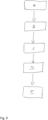
- FIG. 1 The embodiment of a cargo container 9 shown in figures 2 to 6 can be operated as follows wherein it is also referred to the figure 11 depicting the steps of a corresponding method of operating the cargo transport platform 11 of the container.
- the cargo transport platform 11 and that the support member 19 are coupled with each other and cargo elements are positioned on the support surface 21 within the receiving space 25 defined by the casing 25.
- the container 9 may be transferred into the cabin 5 or the cargo hold 7 of the aircraft 1.
- a user may input either direct control commands into the user interface 77, such as steering commands or a desired position to which the cargo container 9 shall be moved within the cabin 5 or the cargo hold 7 (step A).
- direct control commands such as steering commands or a desired position to which the cargo container 9 shall be moved within the cabin 5 or the cargo hold 7 (step A).
- the respective commands are input into the control unit 63 on a different way such as a wireless connection.
- the present invention is not limited to inputting the commands via a user interface.
- control unit 63 Based on the commands input to the control unit 63 it determines the predetermined path, i.e., the direction in which the cargo transport platform 11 is to be moved or the path how to reach the final position determined by the input (step B).
- control unit 63 determines for each of the steerable wheel devices 31 the rotational positions of the carriers 33 and the required velocities, with which the wheels 37, 39 are to be driven, in order to obtain that the cargo transport platform 11 is moved along the desired predetermined path resulting from the input of the user into the user interface 77 (step C).
- control unit 63 determines for each of the steerable wheel devices 31 the required rotational position of the carrier 33 and the velocity with which it shall move. Based on this it provides control signals to the first and second hub drives 59, 61 so that the respective carrier 33 is rotated into the desired position and then moved along the desired direction.
- a path is determined by the control unit 63 along which the cargo transport platform 11 shall be moved. Based on this path the control unit 63 conducts the aforementioned step for each of the steerable wheel devices 31, i.e., it determines the rotational position of the carrier 33 as well as the required velocity along the resulting direction.
- control unit 63 provides corresponding control signals to the first and second hub drives 59, 61 of each of the steerable wheel devices 31 (step D). Based on these control signals the hub drives 59, 61 are operated such that the rotational position of the carriers 33 as well as the required velocities are indeed obtained (step E) wherein the sensor elements 65, 67 are used to provide feedback signals to the control unit 63 so as to enable a complete control process for each of the steerable wheel devices 31.
- control unit 63 effects that the cargo transport platform is actually moved along the predetermined path initially determined by the user input or other input.
- Such predetermined path may also encompass that the user simply wishes that the cargo transport platform 11 is turned around at the position where it is actually located.
- the control unit 63 effects that by correspondingly controlling the hub drives 59, 61 of the individual wheels 37, 39 of each of the steerable wheel devices 31 that the carriers 33 are aligned and the wheels 37, 39 are driven such that the required turn is conducted.
- the final position the cargo transport platform shall reach is input either directly by a user or by means of a wireless connection into in the control unit and the control unit autonomously determines the predetermined path along which the platform 11 is moved. This also includes that at an intermediate position before reaching the final position the control unit changes the predetermined path so as to consider obstacles or the like.
- the GPS sensor 75 may be used for control purposes.
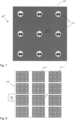
- FIG. 7 and 8 another embodiment of a cargo transfer platform 11' is schematically shown which at its lower surface 29 also comprises a plurality of steerable wheel devices 31 being configured in the same manner as depicted in figure 6 .
- the steerable wheel devices 31 and the first and second hub drives 59, 61, respectively, are connected to a control unit 63 mounted on the base member and 13 of the cargo transport platform 11'.
- a plurality of the cargo transport platforms 11' can be mounted on the lower surface 17 of the support member 19 of a cargo container (not shown in figures 7 and 8 ) with the control unit 63 of each of the cargo transport platforms 11' being connected to a central unit 79 mounted on the support member 19.
- the central unit 79 is adapted to receive an input as to the direction or final position the container with the support member 19 shall obtain. Based on this input the central unit 79 determines for each of the cargo transport platforms 11' the direction along which it shall remove and based on this individual direction, an input signal to the respective control unit 63 of each of the cargo transport platforms 11', this input signal being the input for the individual control unit 63 of the platforms 11'. Based on this input signal the control unit 63 of the individual cargo transport platforms 11' operate as explained in relation to the first embodiment, i.e., the control unit processes as described with respect to figure 9 and provide control signals to the individual steerable wheel devices 31.
- this modular configuration also allows for the container being provided with a plurality of cargo transport platforms to be moved in a controlled and driven manner along a predetermined path and to a desired position, respectively, on the floor 23 of the cabin or a cargo hold of an aircraft.
Landscapes
- Engineering & Computer Science (AREA)
- Mechanical Engineering (AREA)
- Aviation & Aerospace Engineering (AREA)
- Handcart (AREA)
Priority Applications (1)
| Application Number | Priority Date | Filing Date | Title |
|---|---|---|---|
| EP21200997.1A EP4163205A1 (fr) | 2021-10-05 | 2021-10-05 | Plate-forme mobile de transport de cargaison destinée à être reçue dans la soute ou la cabine d'un aéronef comportant des ensembles roues orientables séparément et système de transport de cargaison |
Applications Claiming Priority (1)
| Application Number | Priority Date | Filing Date | Title |
|---|---|---|---|
| EP21200997.1A EP4163205A1 (fr) | 2021-10-05 | 2021-10-05 | Plate-forme mobile de transport de cargaison destinée à être reçue dans la soute ou la cabine d'un aéronef comportant des ensembles roues orientables séparément et système de transport de cargaison |
Publications (1)
| Publication Number | Publication Date |
|---|---|
| EP4163205A1 true EP4163205A1 (fr) | 2023-04-12 |
Family
ID=78078140
Family Applications (1)
| Application Number | Title | Priority Date | Filing Date |
|---|---|---|---|
| EP21200997.1A Pending EP4163205A1 (fr) | 2021-10-05 | 2021-10-05 | Plate-forme mobile de transport de cargaison destinée à être reçue dans la soute ou la cabine d'un aéronef comportant des ensembles roues orientables séparément et système de transport de cargaison |
Country Status (1)
| Country | Link |
|---|---|
| EP (1) | EP4163205A1 (fr) |
Citations (5)
| Publication number | Priority date | Publication date | Assignee | Title |
|---|---|---|---|---|
| US5020657A (en) * | 1990-02-21 | 1991-06-04 | Bavaria Cargo Technologie Gmbh | Drive roller unit |
| EP0464981A1 (fr) * | 1990-06-25 | 1992-01-08 | Teleflex Incorporated | Unité d'entraînement orientable surbaissée |
| US20080310944A1 (en) * | 2007-06-14 | 2008-12-18 | Goodrich Corporation | Power drive unit with eccentric roller lift system |
| WO2014049590A1 (fr) * | 2012-09-27 | 2014-04-03 | Israel Aerospace Industries Ltd. | Système, procédé et appareil de manipulation de chargement |
| US10947036B2 (en) * | 2017-01-11 | 2021-03-16 | Biosphere Aerospace, Llc | Modular container transport systems |
-
2021
- 2021-10-05 EP EP21200997.1A patent/EP4163205A1/fr active Pending
Patent Citations (5)
| Publication number | Priority date | Publication date | Assignee | Title |
|---|---|---|---|---|
| US5020657A (en) * | 1990-02-21 | 1991-06-04 | Bavaria Cargo Technologie Gmbh | Drive roller unit |
| EP0464981A1 (fr) * | 1990-06-25 | 1992-01-08 | Teleflex Incorporated | Unité d'entraînement orientable surbaissée |
| US20080310944A1 (en) * | 2007-06-14 | 2008-12-18 | Goodrich Corporation | Power drive unit with eccentric roller lift system |
| WO2014049590A1 (fr) * | 2012-09-27 | 2014-04-03 | Israel Aerospace Industries Ltd. | Système, procédé et appareil de manipulation de chargement |
| US10947036B2 (en) * | 2017-01-11 | 2021-03-16 | Biosphere Aerospace, Llc | Modular container transport systems |
Similar Documents
| Publication | Publication Date | Title |
|---|---|---|
| EP4115491B1 (fr) | Dispositif de levage avec bloc-batterie divisé | |
| US6420846B1 (en) | Power drive unit with stall sensor | |
| US10427790B2 (en) | Adaptive aerial vehicle | |
| EP2590879B1 (fr) | Système de véhicule guidé automatisé (agv) | |
| EP3400171B1 (fr) | Aéronef à rotors multiples | |
| US9499198B2 (en) | Steering system for a vehicle and steering method for a vehicle | |
| CN112262076A (zh) | 具有用于无人驾驶飞行器的系绳引导件的装载结构 | |
| EP3594129B1 (fr) | Système de déplacement de plate-forme de travail | |
| WO2017091596A1 (fr) | Ensemble d'inclinaison mécanique pour une unité d'entraînement mobile d'un système d'inventaire | |
| KR20130130116A (ko) | 멀티로터 항공기 | |
| EP3611042B1 (fr) | Systèmes, procédés et appareils pour engager et transporter des objets | |
| US20090205908A1 (en) | Omni-directional aircraft and ordinance handling vehicle | |
| EP4163205A1 (fr) | Plate-forme mobile de transport de cargaison destinée à être reçue dans la soute ou la cabine d'un aéronef comportant des ensembles roues orientables séparément et système de transport de cargaison | |
| US10752445B2 (en) | Modular conveying unit | |
| KR20250111356A (ko) | 차량 | |
| CN110667713B (zh) | 自驱物流移动平台 | |
| KR20220080097A (ko) | 객체를 운반하기 위한 무인 운반 장치 및 무인 운반 시스템 및 객체를 운반하기 위한 무인 운반 장치 및 무인 운반 시스템의 운영 방법 | |
| JP5073424B2 (ja) | 航空機の地上操向装置及び地上操向方法 | |
| EP1795433A1 (fr) | Système de direction pour véhicule | |
| KR102948979B1 (ko) | 비행체 이송용 무인운반차 | |
| US11993352B1 (en) | Seating system and seat assembly for marine vessel | |
| US20190168865A1 (en) | Nose gear steering apparatus for shipboard operations | |
| KR102454669B1 (ko) | 운반장치 | |
| EP4163206A1 (fr) | Plate-forme de cargaison mobile destinée à être reçue dans la soute ou la cabine d'un aéronef comportant des ensembles roues orientables et extensibles | |
| CN211196413U (zh) | 自驱物流移动平台及其万向轮装置 |
Legal Events
| Date | Code | Title | Description |
|---|---|---|---|
| PUAI | Public reference made under article 153(3) epc to a published international application that has entered the european phase |
Free format text: ORIGINAL CODE: 0009012 |
|
| STAA | Information on the status of an ep patent application or granted ep patent |
Free format text: STATUS: THE APPLICATION HAS BEEN PUBLISHED |
|
| AK | Designated contracting states |
Kind code of ref document: A1 Designated state(s): AL AT BE BG CH CY CZ DE DK EE ES FI FR GB GR HR HU IE IS IT LI LT LU LV MC MK MT NL NO PL PT RO RS SE SI SK SM TR |
|
| STAA | Information on the status of an ep patent application or granted ep patent |
Free format text: STATUS: REQUEST FOR EXAMINATION WAS MADE |
|
| 17P | Request for examination filed |
Effective date: 20231010 |
|
| RBV | Designated contracting states (corrected) |
Designated state(s): AL AT BE BG CH CY CZ DE DK EE ES FI FR GB GR HR HU IE IS IT LI LT LU LV MC MK MT NL NO PL PT RO RS SE SI SK SM TR |
|
| STAA | Information on the status of an ep patent application or granted ep patent |
Free format text: STATUS: EXAMINATION IS IN PROGRESS |
|
| 17Q | First examination report despatched |
Effective date: 20241002 |