EP4163702B1 - Dispositif de reproduction multiouverture, système de reproduction et procédé de préparation d'un dispositif de reproduction multiouverture - Google Patents
Dispositif de reproduction multiouverture, système de reproduction et procédé de préparation d'un dispositif de reproduction multiouverture Download PDFInfo
- Publication number
- EP4163702B1 EP4163702B1 EP22209251.2A EP22209251A EP4163702B1 EP 4163702 B1 EP4163702 B1 EP 4163702B1 EP 22209251 A EP22209251 A EP 22209251A EP 4163702 B1 EP4163702 B1 EP 4163702B1
- Authority
- EP
- European Patent Office
- Prior art keywords
- image
- optical
- channel
- beam deflection
- array
- Prior art date
- Legal status (The legal status is an assumption and is not a legal conclusion. Google has not performed a legal analysis and makes no representation as to the accuracy of the status listed.)
- Active
Links
Images







Classifications
-
- H—ELECTRICITY
- H04—ELECTRIC COMMUNICATION TECHNIQUE
- H04N—PICTORIAL COMMUNICATION, e.g. TELEVISION
- H04N23/00—Cameras or camera modules comprising electronic image sensors; Control thereof
- H04N23/60—Control of cameras or camera modules
- H04N23/68—Control of cameras or camera modules for stable pick-up of the scene, e.g. compensating for camera body vibrations
- H04N23/682—Vibration or motion blur correction
-
- G—PHYSICS
- G02—OPTICS
- G02B—OPTICAL ELEMENTS, SYSTEMS OR APPARATUS
- G02B27/00—Optical systems or apparatus not provided for by any of the groups G02B1/00 - G02B26/00, G02B30/00
- G02B27/64—Imaging systems using optical elements for stabilisation of the lateral and angular position of the image
- G02B27/646—Imaging systems using optical elements for stabilisation of the lateral and angular position of the image compensating for small deviations, e.g. due to vibration or shake
-
- G—PHYSICS
- G03—PHOTOGRAPHY; CINEMATOGRAPHY; ANALOGOUS TECHNIQUES USING WAVES OTHER THAN OPTICAL WAVES; ELECTROGRAPHY; HOLOGRAPHY
- G03B—APPARATUS OR ARRANGEMENTS FOR TAKING PHOTOGRAPHS OR FOR PROJECTING OR VIEWING THEM; APPARATUS OR ARRANGEMENTS EMPLOYING ANALOGOUS TECHNIQUES USING WAVES OTHER THAN OPTICAL WAVES; ACCESSORIES THEREFOR
- G03B30/00—Camera modules comprising integrated lens units and imaging units, specially adapted for being embedded in other devices, e.g. mobile phones or vehicles
-
- H—ELECTRICITY
- H04—ELECTRIC COMMUNICATION TECHNIQUE
- H04N—PICTORIAL COMMUNICATION, e.g. TELEVISION
- H04N23/00—Cameras or camera modules comprising electronic image sensors; Control thereof
- H04N23/45—Cameras or camera modules comprising electronic image sensors; Control thereof for generating image signals from two or more image sensors being of different type or operating in different modes, e.g. with a CMOS sensor for moving images in combination with a charge-coupled device [CCD] for still images
-
- H—ELECTRICITY
- H04—ELECTRIC COMMUNICATION TECHNIQUE
- H04N—PICTORIAL COMMUNICATION, e.g. TELEVISION
- H04N23/00—Cameras or camera modules comprising electronic image sensors; Control thereof
- H04N23/60—Control of cameras or camera modules
- H04N23/68—Control of cameras or camera modules for stable pick-up of the scene, e.g. compensating for camera body vibrations
- H04N23/682—Vibration or motion blur correction
- H04N23/685—Vibration or motion blur correction performed by mechanical compensation
-
- G—PHYSICS
- G02—OPTICS
- G02B—OPTICAL ELEMENTS, SYSTEMS OR APPARATUS
- G02B13/00—Optical objectives specially designed for the purposes specified below
- G02B13/001—Miniaturised objectives for electronic devices, e.g. portable telephones, webcams, PDAs, small digital cameras
Definitions
- the present invention relates to a multi-aperture imaging device, to an imaging system and to a method for providing a multi-aperture imaging device.
- the present invention further relates to multi-aperture imaging systems with a linear channel arrangement and a small or very small size.
- Multi-aperture imaging systems with a linear channel arrangement consist of several imaging channels, each of which only captures a part of the object and contains a deflection mirror.
- DE 10 2015 215840 A1 is to describe a multi-aperture imaging device comprising an image sensor and an array of optical channels, each optical channel comprising optics for imaging a partial field of view of a total field of view onto an image sensor region of the image sensor.
- US 2016/360111 A1 refers to techniques designed to improve the ability of a digital image capture device to stabilize a video stream.
- US 9,232,138 B1 refers to approaches that enable a computing device, such as a phone or tablet computer, to apply electronic image stabilization (EIS) and optical image stabilization (OIS) in their respective areas of effectiveness.
- EIS electronic image stabilization
- OIS optical image stabilization
- US 2010/328471 A1 refers to a multi-channel camera system for capturing still images or video images that includes multiple fixed focal length lenses and multiple digital sensors in a compact housing.
- the object of the present invention is therefore to provide a multi-aperture imaging device and a method for providing a multi-aperture imaging device which enables a compact, i.e. space-saving, implementation with a high image quality.
- One finding of the present invention is that it has been recognized that the above object can be achieved by obtaining optical image stabilization of an image captured by the multi-aperture imaging device by a relative movement between the image sensor, an array of optical channels and a beam deflection device, so that existing components can be used, which enables a compact structure and provides high image quality. Any deviations between optical channels are additionally compensated by an electronic image stabilizer, so that the channel-global optical image stabilization is improved by an electronic correction that differs between optical channels.
- a multi-aperture imaging device comprises an image sensor, an array of optical channels, a beam deflection device and an optical image stabilizer.
- Each optical channel of the array of optical channels comprises an optic for imaging a partial field of view of a total field of view onto an image sensor region of the image sensor.
- the beam deflection device is designed to deflect a beam path of the optical channels.
- the optical image stabilizer is configured to provide image stabilization along a first image axis by generating a first relative movement between the image sensor, the array and the beam deflection device and image stabilization along a second image axis by generating a second relative movement between the image sensor, the array and the beam deflection device.
- the multi-aperture imaging device comprises an electronic image stabilizer for image stabilization of a first optical channel of the array along the first and second image axes.
- Fig. 1a shows a schematic view of a multi-aperture imaging device 10 according to an embodiment.
- the multi-aperture imaging device 10 comprises an image sensor 12, an array 14 of optical channels 16a-h, a beam deflection device 18 and an optical image stabilizer 22.
- Each optical channel 16a-h comprises an optic 64a-h for imaging a partial field of view of an overall field of view onto an image sensor area 24a-h of the image sensor 12.
- Optical channels can be understood as a course of beam paths.
- the beam paths can be influenced by the optics 64a-h arranged in the array 14, for example by scattering or bundling.
- the individual optical channels can each form a complete imaging optics and have at least one optical component or optics, such as a refractive, diffractive or hybrid lens, and can image a section of the overall object recorded as a whole with the multi-aperture imaging device.
- An aperture stop can be arranged with respect to one, several or all of the optical channels.
- the image sensor areas 24a-h can, for example, each be formed from a chip that includes a corresponding pixel array, wherein the image sensor areas can be mounted on a common substrate or a common circuit carrier such as a common circuit board or a common flexboard.
- the image sensor areas 24a-h can each be formed from a part of a common pixel array that extends continuously over the image sensor areas 24a-h, wherein the common pixel array is formed, for example, on a single chip. For example, only the pixel values of the common pixel array in the image sensor areas 24a-h are then read out.
- the beam deflection device 18 is designed to deflect a beam path 26 of the optical channels 16a-h.
- the image stabilizer 22 is designed to enable optical image stabilization along a first image axis 28 and along a second image axis 32 based on a relative movement between the image sensor 12, the array 14 and the deflection device 18.
- the first image axis 28 and the second image axis 32 can depend on an arrangement or orientation of the image sensor areas 24a-h or the Image sensor 12.
- the image axes 28 and 32 are arranged perpendicular to one another and/or correspond to extension directions of pixels of the image sensor areas 24a-d.
- the image axes 28 and 32 can alternatively or additionally indicate an orientation along which a partial field of view or the entire field of view is scanned or captured.
- the image axes 28 and 32 can be a first or second direction in an image captured by the multi-aperture imaging device 10.
- the image axes 28 and 32 have, for example, an angle of ⁇ 0° to one another, for example they can be arranged perpendicular to one another in space.
- Optical image stabilization can be advantageous if, during a capture process during which partial fields of view or the entire field of view are captured, the multi-aperture imaging device 10 is moved relative to the object region whose field of view is being captured.
- the optical image stabilizer 22 can be designed to at least partially counteract this movement in order to reduce or prevent blurring of the image.
- the optical image stabilizer 22 can be designed to generate a first relative movement 34 between the image sensor 12, the array 14, and the beam deflection device 18.
- the optical image stabilizer 22 is designed to generate a second relative movement between the image sensor 12, the array 14, and the beam deflection device 18.
- the optical image stabilizer 22 can comprise an actuator 36 and/or an actuator 37 for generating the relative movement 34 by displacing the array 14 or the image sensor 12 along the image axis 28.
- the actuator 36 is shown as translating or moving the array 14, according to further embodiments the actuator 36 can alternatively or additionally be connected to the image sensor 12 and be designed to move the image sensor 12 relative to the array 14.
- the optical image stabilizer can comprise an actuator 42 which is designed to generate a translational movement 39a of the beam deflection device 18 along the image axis 28.
- the optical image stabilizer 22 is configured in such a way that it executes the movements of the actuators 36, 37 and/or 42 so that the relative movement 34 is created between the image sensor 12, the array 14 and the beam deflection device 18. This means that although the relative movement 34 in Fig. 1a on the array 14, other components can alternatively or additionally be moved.
- the relative movement 34 can be carried out parallel to a line extension direction 35 and perpendicular to the beam paths 26. It However, it may be advantageous to set the array 14 in translational motion relative to the image sensor 12 in order, for example, to place little or no mechanical stress on an electrical circuit of the image sensor 12 relative to other components.
- the optical image stabilizer 22 can be designed to generate or enable a rotational movement 38 of the beam deflection device 18 and/or to provide a translational relative movement between the image sensor 12 and the array 14 along the image axis 32 and/or a translational relative movement between the array 14 and the beam deflection device 18, wherein the actuators 36, 37 and/or 42 can be arranged for this purpose.
- the optical image stabilizer 22 can, for example, comprise the actuator 42, which is designed to generate the rotational movement 38.
- the optical image stabilizer 22 can be designed to generate a translational movement 39b along the image axis 32 using the actuator 42.
- an optical image stabilization can be obtained along an image direction parallel thereto, for example along or opposite to the image axis 28.
- an optical image stabilization can be obtained along an image direction that is arranged perpendicular to a rotation axis 44 of the rotation movement 38 in a main side plane of the image sensor 12, for example along the image axis 32.
- a main side can be understood as a side that has a large or largest dimension compared to other sides.
- a focusing device as described, for example, in connection with Fig. 3 described, which is designed to change a focus of the multi-aperture imaging device.
- an embodiment of the optical image stabilizer 22 such that it controls the first and second relative movements as translational relative movements is possible for obtaining the optical image stabilization
- an embodiment of the second relative movement as a rotational movement 38 can be advantageous since in this case a translational movement of components along the second image axis 32 can be avoided.
- This direction can be parallel to a thickness direction of the multi-aperture imaging device 10, which according to some embodiments should be kept as small as possible. Such an objective can be achieved by the rotational movement.
- the rotational movement 38 can be used to obtain the optical image stabilization along the second image axis 32.
- the translational relative movement can be arranged perpendicular to a thickness direction of the device, so that the device can be designed with a small thickness, i.e. thin. This offers advantages in particular in the field of mobile devices, since these can be designed with a flat housing.
- the multi-aperture imaging device 10 has an electronic image stabilizer 41 which is designed to electronically stabilize the partial images that are imaged onto the image sensor areas 24a-h, i.e. by manipulating the image data.
- electronic image stabilizer 41 is designed to stabilize a first partial image of the image sensor areas 24a-h of a first optical channel 16a-h of the array 14 to a first extent.
- the electronic image stabilizer 41 can be designed to additionally stabilize a second partial image of the image sensor areas 24a-h of a second optical channel 16a-h of the array 14 in a second scope that is different from the first scope, i.e., channel-specifically.
- the scope refers to an image correction that is carried out along the first and second image axes 28 and 32, wherein rotations about image axes and the like are also included here.
- the electronic image stabilizer 41 is designed to carry out the electronic image stabilization individually for each optical channel, i.e. for each of the partial images of the image sensor areas 24a-h. This makes it possible to correct different imaging errors or even channel-specific imaging errors for the first and second optical channels 16a-h.
- the optics 64a-h of the optical channels can have different optical properties from one another.
- a different optical property is obtained, for example, by manufacturing tolerances, so that the optics 64a-h are in a tolerance range of at most ⁇ 10%, at most ⁇ 5% or at most ⁇ 3% with respect to a or several optical properties, such as a focal length, a field of view angle, an optical diameter or the like.
- the different focal lengths of the channels in particular result in different image shifts for each channel with relative movements between the beam deflection unit and/or array and/or image sensor that act in the same way for all channels.
- This can be reduced, i.e. at least partially balanced or compensated for, by electronic image stabilization combined with optical image stabilization.
- This is illustrated using the optical property of focal length. If two optical focal lengths differ from one another in optics that are aimed at the same overall field of view, the relative movement within the framework of optical image stabilization leads to the viewing axis and/or direction of the optical channels being changed equally.
- the different focal lengths in the optics 64a-h the partial images in the image sensor areas 24a-h move differently, which can lead to high computing costs or even image errors when stitching the partial images together.
- the array 14 can, for example, have a carrier 47 through which the optical channels 16a-h run.
- the carrier 47 can, for example, be opaque and have transparent areas for the optical channels 16a-h.
- the optics 64a-h of the optical channels 16a-h can be arranged within or adjacent to the transparent areas and/or at end areas thereof.
- the carrier 47 can be transparent and, for example, have a polymer material and/or a glass material.
- the optics (lenses) 64a-h can be arranged on a surface of the carrier 47, which image the respective partial field of view. of the overall field of view on the respective image sensor area 24a-h of the image sensor.
- the actuators 36 and/or 42 can be formed, for example, as a pneumatic actuator, as a hydraulic actuator, as a piezoelectric actuator, as a DC motor, as a stepper motor, as a thermally actuated actuator, as an electrostatic actuator, as an electrostrictive actuator, as a magnetostrictive actuator or as a moving coil drive.
- the beam deflection device 18 can be designed to be reflective in some areas.
- the beam deflection device 18 can comprise areas or beam deflection elements 46a-d that are designed to deflect the beam paths 26 such that the deflected beam paths have a different angle from one another and capture a different partial field of view of an overall field of view.
- the different angles can be generated by the beam deflection device 18 and/or the optics 64a-h of the optical channels 16a-h.
- the areas 46a-d can be formed as facets of a facet mirror. The facets can have a different inclination with respect to the array 14. This can enable deflection, influencing, control and/or scattering of the beam paths 26 towards partial fields of view that are arranged differently from one another.
- the beam deflection device 18 can be designed as a surface that is reflective on one side or both sides, for example as a mirror.
- the surface can be flat or continuously curved or flat in sections and/or discontinuously curved or flat in sections.
- a deflection of the beam paths 26 can alternatively or additionally be achieved by means of the optics 64a-h of the optical channels 16a-h.
- a relative movement to the optical image stabilization causes the same mechanical deflection in all channels of the multi-aperture camera.
- the image shift achieved which is the actual mechanism of action of the optical image stabilization, also depends on the focal length of the imaging optics of each channel.
- a channel-specific electronic image stabilization is also introduced.
- the beam deflection device can be used both to deflect the viewing direction and for optical image stabilization.
- the beam deflection device can be flat over the area of all channels, have a continuous or discontinuous profile and/or be flat in parts, i.e. faceted, whereby the transitions between individual continuous or discontinuous profiles can additionally have local masking to reduce the reflectivity or mechanical structures to reduce image errors or to enable stiffening of the structure so that motion-induced or thermally induced image errors can be minimal.
- Switching between the first position and the second position of the beam deflection device can be carried out translationally along the rotation axis 44.
- a movement along the rotation axis 44 can be continuous or discontinuous, for example bistable or multiply stable. This can be understood, for example, as position-discrete positions between which the beam deflection device 18 is moved. Single stable, bistable or multiply stable positions can be obtained, for example, by designing the actuator 42 or another actuator as a stepper motor. If the beam deflection device 18 is designed, for example, to be moved back and forth between two positions, one of the positions can be, for example, a rest position of the actuator or be based on this.
- the actuator can, for example, be designed to carry out the translational movement against a spring force which, when the other position is reached, exerts a counterforce which, when the force of the actuator is removed, moves the beam deflection device back to its starting position.
- a stable position can also be obtained in areas of a force diagram that do not have a local force minimum. For example, it can be a force maximum.
- a stable position can be obtained based on magnetic or mechanical forces between the beam deflection device 18 and an adjacent housing or substrate.
- the actuator 42 or the other actuator for translationally moving the beam deflection device can be designed to move the beam deflection device into a bistable or multiply stable position.
- simple mechanical stops can be provided that define two end positions between which a position switch takes place in the defined end positions.
- Fig. 1b shows a schematic view of a multi-aperture imaging device 10' according to an embodiment.
- the multi-aperture imaging device 10' is modified compared to the multi-aperture imaging device 10 in that the actuator 36 with is mechanically connected to the image sensor 12 and is designed to move the image sensor 12 relative to the array 14.
- the relative movement 34 can be carried out parallel to the line extension direction 35 and perpendicular to the beam paths 26.
- Fig. 2a shows a schematic side sectional view of a multi-aperture imaging device 20 according to an embodiment.
- the multi-aperture imaging device 20 can, for example, modify the multi-aperture imaging device 10 in such a way that the actuators 36 and/or 42 are arranged such that they are at least partially arranged between two planes 52a and 52b, which are spanned by sides 53a and 53b of a cuboid 55.
- the sides 53a and 53b of the cuboid 55 can be aligned parallel to one another and parallel to the line extension direction of the array and a part of the beam path of the optical channels between the image sensor and the beam deflection device.
- the volume of the cuboid 55 is minimal and yet includes the image sensor 12, the array 14 and the beam deflection device 18 as well as their operational movements.
- Optical channels of the array 14 have an optic 64, which can be formed identically or differently from one another for each optical channel.
- a volume of the multi-aperture imaging device can have a small or minimal installation space between the planes 52a and 52b.
- an installation space of the multi-aperture imaging device can be large or arbitrarily large.
- the volume of the virtual cuboid is influenced, for example, by an arrangement of the image sensor 12, the single-row array 14 and the beam deflection device, wherein the arrangement of these components according to the embodiments described here can be such that the installation space of these components along the direction perpendicular to the planes and thus the distance between the planes 52a and 52b is small or minimal.
- a design of the multi-aperture imaging device that is as thin as possible is desired in particular in the field of mobile applications, for example for mobile phones or tablets. Compared to other arrangements of the components, the volume and/or the distance between other sides of the virtual cuboid can be increased.
- the virtual cuboid 55 is shown by dotted lines.
- the planes 52a and 52b can encompass two sides of the virtual cuboid 55 or can be spanned thereby.
- a thickness direction 57 of the multi-aperture imaging device 20 can be arranged normal to the planes 52a and/or 52b and/or parallel to the y-direction.
- the image sensor 12, the array 14 and the beam deflection device 18 can be arranged such that a vertical distance between the planes 52a and 52b along the thickness direction 57, which can be referred to as the height of the cuboid for simplicity but without any restrictive effect, is minimal, whereby minimizing the volume, i.e. the other dimensions of the cuboid, can be dispensed with.
- An extension of the cuboid 55 along the direction 57 can be minimal and essentially predetermined by the extension of the optical components of the imaging channels, i.e. the array 14, the image sensor 12 and the beam deflection device 18 along the direction 57.
- a volume of the multi-aperture imaging device can have a small or minimal installation space between the planes 52a and 52b.
- an installation space of the multi-aperture imaging device can be large or arbitrarily large.
- the volume of the virtual cuboid is influenced, for example, by an arrangement of the image sensor 12, the single-row array 14 and the beam deflection device, wherein the arrangement of these components according to the embodiments described here can be such that the installation space of these components along the direction perpendicular to the planes and thus the distance between the planes 52a and 52b is small or minimal. Compared to other arrangements of the components, the volume and/or the distance between other sides of the virtual cuboid can be increased.
- the actuators such as the actuator 36 and/or 42 of the multi-aperture imaging device, can have a dimension or extension parallel to the direction 57.
- a proportion of at most 50%, at most 30% or at most 10% of the dimension of the actuator or actuators can protrude beyond the plane 52a and/or 52b or protrude from the area starting from an area between the planes 52a and 52b. This means that the actuators protrude at most insignificantly beyond the plane 52a and/or 52b. According to embodiments, the actuators do not protrude beyond the planes 52a and 52b.
- the advantage of this is that an extension of the multi-aperture imaging device 10 along the thickness direction or direction 57 is not increased by the actuators.
- the image stabilizer 22 or the actuators 36 and/or 42 can have a dimension or extension parallel to the thickness direction 57.
- a proportion of at most 50%, at most 30% or at most 10% of the dimension can be based on a range between the planes 52a and 52b protrude beyond the plane 52a and/or 52b or protrude from the area, as is shown for example for the actuator 42 ⁇ , which indicates an offset arrangement of the actuator 42.
- the actuators 36 and/or 42 protrude at most insignificantly beyond the plane 52a and/or 52b.
- the actuators 36 and/or 42 do not protrude beyond the planes 52a and 52b.
- the advantage of this is that an extension of the multi-aperture imaging device 20 along the thickness direction 57 is not increased by the actuators 36 or 42.
- the image stabilizer can comprise at least one actuator 36 or 42.
- the at least one actuator 36 and/or 42 can be arranged in the plane 48 or between the planes 52a and 52b.
- the actuators 36 and/or 42 can be arranged in front of, behind or next to the image sensor 12, the array 14 and/or the beam deflection device 18.
- the actuators 36 and 42 are arranged with a maximum extent of 50%, 30% or 10% outside the area between the planes 52a and 52b. This means that the at least one actuator 36 and/or the image stabilizer 22 protrudes along the thickness direction 57 perpendicular to the plane 48 by at most 50% of the dimension of the actuator 36 or 42 of the image stabilizer along the thickness direction 57 from the plane or the area between the maximum dimensions 52a-52b. This enables a small dimension of the multi-aperture imaging device 20 along the thickness direction 57.
- Fig. 2b shows a schematic side sectional view of the multi-aperture imaging device 20, wherein the beam paths 26 and 26' indicate different viewing directions of the multi-aperture imaging device 20.
- the multi-aperture imaging device can be designed to tilt the beam deflection device by an angle ⁇ . change so that alternately different main sides of the beam deflection device 18 are arranged facing the array 14.
- the multi-aperture imaging device 20 can comprise an actuator which is designed to tilt the beam deflection device 18 about the axis of rotation 44.
- the actuator can be designed to move the beam deflection device 18 into a first position in which the beam deflection device 18 deflects the beam path 26 of the optical channels of the array 14 in the positive y-direction.
- the beam deflection device 18 in the first position can have, for example, an angle ⁇ of > 0° and ⁇ 90°, of at least 10° and at most 80° or of at least 30° and at most 50°, for example 45°.
- the actuator can be designed to deflect the beam deflection device in a second position about the rotation axis 44 such that the beam deflection device 18 deflects the beam path of the optical channels of the array 14 towards the negative y-direction, as shown by the beam path 26' and the dashed representation of the beam deflection device 18.
- the beam deflection device 18 can be designed to reflect on both sides, so that in the first position a first beam path 26 or 26' is deflected or reflected.
- the multi-aperture imaging device 20 is designed to switch between the first position and the second position such that between the two positions a secondary side is assigned to the array 14, but an orientation according to which a main side is completely facing the array 14 is avoided.
- a surface normal 51a of the first main side and a second surface normal 51b of the second main side have an angle ⁇ 1 and ⁇ 2 of at least 10° in relation to a direction towards the image sensor and possibly parallel to a surface normal of the image sensor 12 at any time.
- Fig. 3 shows a schematic plan view of a multi-aperture imaging device 30 according to an embodiment.
- the multi-aperture imaging device 30 can be modified compared to the multi-aperture imaging device 10 and/or 20 in that the multi-aperture imaging device 30 comprises a focusing device 54 which is designed to change a focus of the multi-aperture imaging device 30. This can be done based on a variable distance 56 between the image sensor 12 and the array 14, as shown by the distance 56'.
- the focusing device 54 can comprise an actuator 58 that is designed to deform upon actuation and/or to provide a relative movement between the image sensor 12 and the array 14.
- the actuator 58 is designed to displace the array 14 along the positive and/or negative x-direction relative to the image sensor 12.
- the array 14 can be mounted on one side such that it experiences a movement along a positive or negative x-direction based on an actuation of the actuator 58 and remains substantially stationary along a positive and/or negative z-direction.
- An additional movement along the positive and/or negative z-direction for optical image stabilization can be obtained, for example, based on an actuation of the actuator 36.
- the actuator 58 or the focusing device 54 is designed to obtain the relative movement between the image sensor 12 and the array 14 along the x-axis based on a translational displacement of the image sensor 12 relative to the array 14.
- the image sensor 12 and the array 14 can be moved.
- the focusing device 54 can have at least one further actuator.
- a first actuator and a second actuator can be arranged in two opposite areas of the array 14, so that when the actuators are actuated, a requirement for mounting the moving array 14 (alternatively or in addition to the image sensor 12) is reduced.
- the actuator 58 or another actuator can be designed to keep a distance between the single-row array 14 and the beam deflection device 18 essentially constant or even when no additional actuator is used, i.e. to move the beam deflection device 18 to the same extent as the single-row array 14.
- the focusing device 54 can be designed to enable an autofocus function through a relative translational movement (focusing movement) between the image sensor 12 and the array 14 along a surface normal of the image sensor 12.
- the beam deflection device 18 can be moved simultaneously with the focusing movement by appropriate structural design or use of the actuator 42 or another actuator.
- a distance between the array 14 and the beam deflection device remains unchanged and/or that the beam deflection device 18 is moved simultaneously or with a time delay to an equal or comparable extent as the focusing movement, so that at least at one point in time a recording of the field of view by the multi-aperture imaging device is unchanged compared to a distance before a change in focus.
- This can be carried out in such a way that the beam deflection device 18 is moved together, ie simultaneously with the actuator 42, so that a distance between the array 14 and the beam deflection device remains constant or is compensated.
- a distance between the array 14 and the beam deflection device 18 can remain unchanged and/or that the beam deflection device 18 is moved simultaneously or with a time delay to an equal or comparable extent as the focusing movement, so that the distance between the array 14 and the beam deflection device 18 is unchanged at least at a time of recording the field of view by the multi-aperture imaging device compared to a distance before a change in focus.
- the beam deflection device 18 can be stationary or excluded from the autofocus movement.
- the actuator 58 can be designed, for example, as a piezoelectric actuator, such as a bending beam (such as a bimorph, trimorph or the like).
- the focusing device 54 can comprise a moving coil drive, a pneumatic actuator, a hydraulic actuator, a DC motor, a stepper motor, a thermally actuatable actuator or bending beam, an electrostatic actuator, an electrostrictive and/or a magnetostrictive drive.
- the at least one actuator 58 of the focusing device 54 can be arranged at least partially between the planes 52a and 52b.
- the at least one actuator 58 can be arranged in a plane in which the image sensor 12, the array 14 and the beam deflection device 18 are arranged.
- the actuator 58 of the focusing device 54 can protrude from the region between the planes 52a and 52b along the thickness direction 57 perpendicular to the plane 48 in which the image sensor 12, the array 14 and the beam deflection device 18 are arranged by at most 50% of the dimension of the actuator 58 of the focusing device 54 along the thickness direction 57.
- the actuator protrudes by a maximum of 30% from the area between the planes 52a and 52b.
- the actuator 54 protrudes by a maximum of 10% from the area or is located completely within the area. This means that no additional installation space is required for the focusing device 54 along the thickness direction 57, which is advantageous.
- the array 14 has a transparent substrate (carrier) 62 with lenses 64a-d arranged thereon, a dimension of the array 14 and if applicable, the multi-aperture imaging device 30 along the thickness direction 57 may be small or minimal. With reference to Fig. 2a this may mean that the cuboid 55 has a small thickness along the direction 57 or that the thickness is unaffected by the substrate 62.
- the substrate 62 can be passed through by the optical beam paths used for imaging in the individual optical channels.
- the optical channels of the multi-aperture imaging device can traverse the substrate 62 between the beam deflection device 18 and an image sensor 12.
- the lenses 64a-d can be liquid lenses, for example, i.e. an actuator can be designed to control the lenses 64a-d.
- Liquid lenses can be designed to adjust and vary the refractive power and thus the focal length and image position individually for each channel.
- Fig. 4a shows a schematic perspective view of a multi-aperture imaging device 40 according to an embodiment.
- the array 14 is designed, for example, in a single row, which means that all optical channels 16a-d can be arranged in a single row along a row extension direction of the array 14.
- the term single-row can mean an absence of further rows.
- a single-row design of the array 14 enables a small dimension of the array and possibly of the multi-aperture imaging device 40 along the thickness direction 57.
- the optical image stabilizer comprises actuators 36a and 36b, which together form the actuator 36, which means that an actuator described herein can also be implemented by several actuators or actuators and/or several actuators can be combined to form a common actuator.
- the multi-aperture imaging device 40 can be designed to capture fields of view in different directions based on the beam deflection device 18.
- the beam deflection device can have a first position or position Pos1 and a second position or position Pos2.
- the beam deflection device can be switchable between the first position Pos1 and the second position Pos2 based on a translational or rotational movement.
- the beam deflection device 18 can be translationally movable along the line extension direction z of the single-line array 14, as indicated by a translational movement 66.
- the translational movement 66 can, for example, be arranged substantially parallel to a line extension direction 65 along which the at least one Row of the array 14.
- the translational movement can be used, for example, to place different facets in front of the optics of the optical channels 16a-d in order to obtain different viewing directions of the multi-aperture imaging device 40.
- the beam deflection device 18 can be designed to deflect the beam paths 26a-d in a first direction in the first position Pos1, for example at least partially in a positive y-direction.
- the beam deflection device 18 can be designed to deflect the beam paths 26a-d, ie of each optical channel 16a-d, in a different direction in the second position Pos2, for example at least partially along the negative y-direction.
- the actuator 42 can be designed to move the beam deflection device 18 from the first position Pos1 to the second position Pos2 based on a movement of the beam deflection device 18 along the direction of movement 66.
- the actuator 42 can be designed to superimpose the translational movement along the direction of movement 66 with the rotational movement 38.
- the multi-aperture imaging device 40 can also comprise a further actuator which is designed to move the beam deflection device along the direction of movement 66 or opposite thereto.
- the actuator 42 can be designed to obtain the first or second position of the beam deflection device 18 based on a rotation of the same.
- the movement between the first position Pos1 and the second position Pos2 can be superimposed on the rotational movement 38 both for a rotational movement for switching between the positions and for the translational movement along the direction 66.
- Fig. 4b shows a schematic representation of an overall field of view 70, as can be captured, for example, with a previously described multi-aperture imaging device, such as the multi-aperture imaging device 10, 20, 340 or 40, wherein the multi-aperture imaging device 10 can also subdivide the overall field of view 70 into a higher or lower number of partial fields of view 72a-d.
- the beam paths of the optical channels of the multi-aperture imaging devices can be directed to different partial fields of view 72a-d, wherein each optical channel can be assigned a partial field of view 72a-d.
- the partial fields of view 72a-d overlap with one another in order to enable individual partial images to be joined together to form an overall image.
- the total field of view 70 can have one of four different numbers of partial fields of view.
- at least one partial field of view 72a-d can be recorded by a second or a higher number of optical channels of a higher number of modules (multi-aperture imaging devices) in order to set up stereo, trio, quattro cameras in order to be able to record three-dimensional object data.
- the modules can be designed individually or as a connected system and can be arranged anywhere in a housing of the multi-aperture imaging device.
- the images of the different modules that together form the stereo, trio or quattro cameras can be shifted by fractions of a pixel and designed to implement super-resolution methods.
- a number of optical channels and/or a number of multi-aperture imaging devices and/or a number of partial fields of view is, for example, arbitrary and can have a number of at least two, at least three, at least four, at least ten, at least 20 or an even higher value.
- the optical channels of the further row can also each record overlapping partial areas and together cover the entire field of view. This makes it possible to obtain a stereo, trio, quattro, etc. setup of array cameras consisting of channels that partially overlap and cover the entire field of view within their sub-grouping.
- Fig. 4c is a schematic perspective view of the multi-aperture imaging device 40, which is used to explain an advantageous embodiment of a combination of optical image stabilization and electronic image stabilization.
- the optical image stabilizer 22 comprises actuators 36a, 36b and 42, wherein the actuators 36a and 36b are designed to achieve the optical image stabilization of the images of the partial fields of view in the image sensor areas 24a to 24d by shifting the array 14 along the line extension direction 65.
- the optical image stabilizer is designed, for example, to obtain optical image stabilization along the image axis 32 by the rotational movement 38.
- the optics 64a-d of the array 14 have a focal length f 1 to f 4 that differs from one another within a tolerance range of at most 10%, at most 5% or at most 3%.
- the channel-global rotational movement 38 in conjunction with the different focal lengths f 1 to f 4, leads to a different shift 69 1 to 69 4 of the images in the image sensor areas 24a-d.
- This means that the optical image stabilizer 22 achieves different effects in the images through the channel-global rotational movement 38, so that at least one, several or all images deviate from a theoretical error-free state.
- the optical image stabilizer 22 can be designed to globally minimize the deviations of all images, which can, however, lead to the fact that in each of the images Errors arise.
- the optical image stabilizer 22 can be designed to select a reference image in one of the image sensor areas 22 and to control the actuator 42 in such a way that the image in the reference image or reference channel is as exact as possible, which can also be referred to as error-free.
- error-free the channel-global optical image stabilization can keep one channel error-free with regard to the influenced image direction, while the other channels deviate from this reference image due to the different focal lengths f 1 to f 4.
- one channel is corrected with the mechanically implemented optical image stabilizer, which has an effect on all channels but does not keep all channels stable. These other channels are additionally corrected with the electronic image stabilizer.
- the electronic image stabilizer 41 can be designed to carry out channel-specific electronic image stabilization in each channel according to a defined functional relationship that depends on the relative movements between the image sensor 12, the array 14 and the beam deflection device 18.
- the electronic image stabilizer 41 can be designed to stabilize each image individually and individually.
- the electronic image stabilizer 41 can use global values for this purpose, such as the camera movement or the like, in order to increase the optical quality of the images. It is particularly advantageous if the electronic image stabilizer 41 is designed to carry out electronic image correction based on a reference image of the optical image stabilizer 22.
- the electronic image stabilizer 41 can link an extent or relative movement between the image sensor 12, array 14 and beam deflection device 18 with the focal lengths f 1 to f 4 or focal length differences in relation to the reference channel in order to obtain reliable information about the electronic image stabilization to be carried out and to establish and/or exploit the functional connection.
- the required data the optical properties and/or the functional relationship can be obtained during calibration.
- the alignment of images to one another to determine a shift of one image compared to another image can also be carried out by determining a matching feature in the images of the partial fields of view, such as edge profiles, object sizes or the like. This can be identified, for example, by the electronic image sensor 41, which can also be designed to provide the electronic image stabilization based on a comparison of movements of the feature in the first and second images.
- the channel-specific electronic image stabilization can thus be carried out by a channel-specific image evaluation of the movement of image details.
- a comparison of the feature can also be made within the same image, in particular with two temporally spaced recordings or frames.
- the optical image stabilizer 41 can be designed to identify a matching feature in the corresponding partial image at a first point in time and at a point in time, and to provide the electronic image stabilization based on a comparison of movements of the feature in the first image.
- the comparison can, for example, indicate a displacement by which the feature was displaced by a relative movement and by which the image is to be shifted back in order to at least partially correct the image error.
- the optical image stabilizer can be used to stabilize an image of the imaged partial field of view of a reference channel, for example the image in the image sensor area 24a.
- the electronic image stabilizer is designed, for example, 41, to carry out image stabilization on a channel-specific basis for optical channels that are different from the reference channel and that image onto the image sensor areas 24b, 24c and 24d.
- the multi-aperture imaging device can be designed to stabilize the reference channel exclusively optically. This means that in one embodiment, sufficiently good image stabilization can be achieved in the reference channel by using only the mechanically achieved optical image stabilization.
- electronic image stabilization is also carried out in order to partially or completely compensate for the previously described effect of inadequate optical image stabilization due to differences in focal length, with the electronic stabilization being carried out individually in each channel.
- each channel of the multi-aperture imaging device it is further possible for each channel of the multi-aperture imaging device to have an individual electronic image stabilization
- the electronic image stabilization carried out individually for each channel of the multi-aperture imaging device can be carried out in such a way that a defined functional relationship between the image shifts to be realized in the individual channels is utilized.
- the shift along direction 32 in one channel is 1.1 times, 1.007 times, 1.3 times or 2 or 5 times the shift along direction 32 in another image.
- this channel-specific functional relationship can depend on the relative movements between the beam deflection unit and/or array and/or image sensor, whereby this can be linear or can correspond to an angular function that maps a rotation angle of the beam deflection device to a circumference of the electronic image stabilization along the image direction.
- An identical relationship can be obtained with the same or different numerical values for direction 28.
- the relative movements realized are detected by corresponding additional sensors, such as gyroscopes, etc., or can be derived from the recorded image data of one, several or all channels.
- This data or information can be used for the optical and/or electronic image stabilizer, which means that the multi-aperture imaging device is designed, for example, to receive a sensor signal from a sensor and to evaluate the sensor signal with regard to information that is correlated with a relative movement between the multi-aperture imaging device and the object, and to control the optical and/or electronic image stabilizer using this information.
- the optical image stabilizer can be designed to obtain the optical image stabilization along the image axes 28 and 32 by moving different components, such as the array 14 for stabilization along the direction 28 and the rotation 38 of the beam deflection device for stabilization along the direction 32. In both cases, differences in the optics 64a-d have an effect.
- the preceding statements regarding the electronic image stabilization can be implemented for both relative movements. In particular, considering the directions 28 and 32 separately from one another allows consideration of different deviations between the optics 64a-d along the directions 28 and 32.
- Embodiments described herein may use a common image axis 28 and/or 32 for the partial images in the image sensor areas 24a-d. Alternatively, the directions may also differ and be converted into one another.
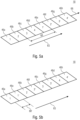
- Fig. 5a shows a schematic representation of a beam deflection device 18, which is formed as an array of facets 46a-h. If the beam deflection device 18 is positioned in the first position, for example, the facets 46a-d, identified by the numbers 1, 2, 3 and 4, can deflect beam paths of four optical channels in a first direction. If the beam deflection device 18 has the second position, the beam path of each optical channel can be deflected in the second direction based on the facets 46e-h, as identified by the numbers 1', 2', 3' and 4', respectively.
- the facets 46a-d and 46e-h can be referred to, for example, as being arranged in blocks.
- a distance 88 can be covered which essentially corresponds to an extension length of the number of optical channels along the line extension direction 65.
- this is, for example, an extension of four optical channels along the line extension direction 65.
- the number of beam deflection elements can be a multiple of the optical channels.
- At least one beam deflection element can be designed or arranged in a position of the beam deflection device in order to deflect beam paths of at least two optical channels.
- Fig. 5b shows a schematic view of the beam deflection device 18, in which the facets 46a-g compared to the representation in Fig. 5a have a different sorting from each other.
- the Fig. 5b The beam deflector 18 shown has an alternating arrangement of the optical channels 46a-g for each optical channel as shown by the order 1, 1', 2, 2', 3, 3', 4 and 4'. This allows a distance 88' along which the beam deflector 18 is moved to be switched between the first position and the second position.
- the distance 88' can be compared to the distance 88 of Fig. 5a be small.
- the distance 88' can essentially correspond to the distance between two adjacent optical channels of the array 14.
- Two optical channels can, for example, have a distance or a gap between them that essentially corresponds to at least one dimension of a facet along the direction of movement 65.
- the distance 88' can also be different from this, for example if a beam deflection element is in a position of the beam deflection device designed or arranged to redirect beam paths of at least two optical channels.
- Fig. 6a-f advantageous embodiments of the beam deflection device 18 are described.
- the embodiments show a series of advantages that can be implemented individually or in any combination with one another, but are not intended to have a restrictive effect.
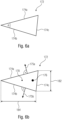
- Fig. 6a shows a schematic side sectional view of a beam deflection element 172 that can be used as one of the beam deflection regions 46 in beam deflection devices described herein.
- the beam deflection element 172 can be effective for one, a plurality or all of the optical channels 16a-d and can have a polygon-like cross-section. Although a triangular cross-section is shown, it can also be any other polygon. Alternatively or additionally, the cross-section can also have at least one curved surface, wherein, in particular in the case of reflective surfaces, a flat design at least in sections can be advantageous in order to avoid imaging errors.
- the two main sides 174a and 174b can be inclined to one another by an angle ⁇ .
- the angle ⁇ can have a value between 1° and 89°, preferably has a value between 5° and 60° and particularly preferably a value between 10° and 30°.
- the main sides 174a and 174b are therefore preferably arranged at an angle of no more than 60° to each other.
- the beam deflection element 172 has, for example, a first side 174a, a second side 174b and a third side 174c. At least two sides, such as sides 174a and 174b, are designed to be reflective, so that the beam deflection element 172 is designed to be reflective on both sides.
- the sides 174a and 174b can be main sides of the beam deflection element 172, i.e. sides whose area is larger than the side 174c.
- the beam deflection element 172 can be wedge-shaped and reflective on both sides. Opposite the surface 174c, i.e. between the surfaces 174a and 174b, a further surface can be arranged, which is, however, significantly smaller than the surface 174c. In other words, the wedge formed by the surfaces 174a, 174b and 174c does not taper to any desired point, but is provided with a surface on the pointed side and is therefore blunt.
- Fig. 6b shows a schematic side sectional view of the beam deflection element 172, in which a suspension or a displacement axis 176 of the beam deflection element 172 is described.
- the displacement axis 176 about which the beam deflection element 172 can be movable rotationally and/or translationally in the beam deflection device 18, can be displaced eccentrically with respect to a center of gravity 178 of the cross section.
- the center of gravity can alternatively also be a point that describes half the dimension of the beam deflection element 172 along a thickness direction 182 and along a direction 184 perpendicular thereto.
- the main side 174a can have a surface normal 175a
- the main side 174b can have a surface normal 175b. If a rotational movement about the displacement axis 176 is used to switch between the first position and the second position of the beam deflection device, the rotational movement of the beam deflection device can be carried out in such a way that an orientation between the two positions according to which a main side 174a or 174b is completely facing the array 14 is avoided, as is the case in connection with Fig. 2b This can also be understood as meaning that during a change between the first and the second operating state or position by the rotary movement, the surface normal 175a and the surface normal 175b of the second main side at any time have a Fig.
- angles ⁇ 1 and ⁇ 2 have angles referred to as angles ⁇ 1 and ⁇ 2 of at least 10° in a direction towards the image sensor and possibly parallel to a surface normal of the image sensor. This avoids one of the angles being 0° or 180°, which can mean a high or approximately maximum extension of the beam deflection device along the thickness direction.
- the displacement axis 176 can, for example, be unchanged along a thickness direction 182 and have any offset in a direction perpendicular thereto. Alternatively, an offset along the thickness direction 182 is also conceivable.
- the displacement can, for example, be carried out in such a way that when the beam deflection element 172 rotates about the displacement axis 176, a greater travel is obtained than when it rotates about the center of gravity 178.
- the path by which the edge between the sides 174a and 174b is moved during a rotation can increase at the same angle of rotation compared to a rotation about the center of gravity 178.
- the beam deflection element 172 is arranged in such a way that the edge, i.e. the pointed side of the wedge-shaped cross section, between the sides 174a and 174b faces the image sensor.
- a respective other side 174a or 174b deflect the beam path of the optical channels. It is clear here that the rotation can be carried out in such a way that the space requirement of the beam deflection device along the thickness direction 182 is small, since a movement of the beam deflection element 172 such that a main side is perpendicular to the image sensor is not necessary.
- the side 174c can also be referred to as the secondary side or the rear side.
- Several beam deflection elements can be connected to one another in such a way that a connecting element is arranged on the side 174c or runs through the cross section of the beam deflection elements, i.e. is arranged inside the beam deflection elements, for example in the area of the displacement axis 176.
- the holding element can be arranged in such a way that it does not protrude beyond the beam deflection element 172 along the direction 182 or only protrudes to a small extent, i.e. at most 50%, at most 30% or at most 10%, so that the holding element does not increase or determine the extent of the overall structure along the direction 182.
- the extent in the thickness direction 182 can alternatively be determined by the lenses of the optical channels, i.e. these have the dimension defining the minimum thickness.
- the beam deflection element 172 can be made of glass, ceramic, glass ceramic, plastic, metal or a combination of these materials and/or other materials.
- the beam deflection element 172 can be arranged such that the tip, i.e. the edge between the main sides 174a and 174b, points towards the image sensor.
- the beam deflection elements can be held in such a way that it only occurs at the back or inside the beam deflection elements, i.e. the main sides are not covered.
- a common holding or connecting element can extend over the back 174c.
- the axis of rotation of the beam deflection element 172 can be arranged eccentrically.
- Fig. 6c shows a schematic perspective view of a multi-aperture imaging device 190, which comprises an image sensor 12 and a single-line array 14 of optical channels 16a-d arranged next to one another.
- the beam deflection device 18 comprises a number of beam deflection elements 172a-d, which can correspond to the number of optical channels. Alternatively, a smaller number of beam deflection elements can be arranged, for example if at least one beam deflection element is used by two optical channels. Alternatively, a higher number can also be arranged, for example if a change in the deflection direction of the beam deflection device 18 is carried out by a translatory movement, as in connection with the Fig.
- Each beam deflection element 172a-d may be associated with an optical channel 16a-d.
- the beam deflection elements 172a-d may be formed as a plurality of elements 172. Alternatively, at least two, several or all of the beam deflection elements 172a-d may be formed integrally with one another.
- Fig. 6d shows a schematic side sectional view of the beam deflection element 172, the cross section of which is formed as a free-form surface.
- the side 174c can have a recess 186 that enables a holding element to be attached, whereby the recess 186 can also be formed as a protruding element, such as a tongue of a tongue-and-groove system.
- the cross section also has a fourth side 174d, which has a smaller surface area than the main sides 174a and 174b and connects them to one another.
- Fig. 6e shows a schematic side sectional view of a first beam deflection element 172a and a second beam deflection element 172b located behind it in the direction of the illustration.
- the recesses 186a and 186b can be arranged such that they are essentially congruent, so that an arrangement of a connecting element in the recesses is possible.
- Fig. 6f shows a schematic perspective view of the beam deflection device 18, which comprises, for example, four beam deflection elements 172a-d, which are connected to a connecting element 188.
- the connecting element can be used to be movable in a translational and/or rotational manner by an actuator.
- the connecting element 188 can be formed in one piece and run along an extension direction, for example the y-direction, on or in the beam deflection elements 172a-d.
- the connecting element 188 can also be connected only to at least one side of the beam deflection device 18, for example if the beam deflection elements 172a-d are formed in one piece.
- a connection to an actuator and/or a connection of the beam deflection elements 172a-d can also be made in any other way, for example by means of gluing, wringing or soldering.
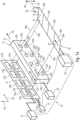
- Fig. 7 shows a schematic perspective view of an imaging system 60 according to an embodiment.
- the imaging system 60 comprises the multi-aperture imaging device 10.
- the imaging system comprises 60 alternatively or in addition to the multi-aperture imaging device 10, at least one multi-aperture imaging device 10', 20, 30 40.
- the imaging system 60 comprises a flat housing 92.
- the flat housing 92 comprises a first extension 94a along a first housing direction a.
- the flat housing 92 further comprises a second extension 94b along a second housing direction b and a third extension 94c along a third housing direction c.
- the housing direction a can be arranged parallel to the thickness direction 57 in space.
- the extension 94a of the flat housing 92 along the housing direction a can be understood as the smallest dimension of the flat housing 92.
- other extents 94b and/or 94c along other housing directions b and c may have at least a three-fold value, at least a five-fold value or at least a seven-fold value compared to the extent 94a along the housing direction a.
- the extent 94a may be smaller, significantly smaller or possibly an order of magnitude smaller than other extents 94b and 94c along other housing directions b and c.
- the flat housing 92 can comprise one or more apertures 96a-b through which the beam path 26 and/or 26' can be deflected, for example based on the beam deflection device of the multi-aperture imaging device 10.
- the apertures can be, for example, electrochromic apertures and/or arranged in an area of the display.
- the imaging system 60 can be designed as a portable device.
- the imaging system 60 can be a portable communication device, such as a mobile phone or a so-called smartphone, a tablet computer or a portable music player.
- the imaging system 60 can be implemented as a monitor, for example for use in a navigation, multimedia or television system.
- the imaging system 60 can also be arranged behind reflective surfaces, such as a mirror.
- an arrangement of a multi-aperture imaging device 10, 10', 20, 30 and/or 40 can be advantageous because, based on the arrangement of the components along the long housing sides 94b and/or 94c, an extension of the multi-aperture imaging device along the housing direction 94a can be small, so that the imaging system 60 can have a small extension 94a.
- a relative, two-dimensional lateral movement of Image sensor and lens which in conventional systems cause a two-dimensional angular change in the field of view (corresponds to scanning), are replaced by a one-dimensional change in the viewing direction and a rotational movement.
- a one-dimensional change in the viewing direction can be achieved by changing the alignment of the mirror (beam deflection device) with respect to the optical axis (line extension direction) of the imaging channels by moving the rotatably mounted mirror into a different orientation, whereby the axis of rotation of the mirror can run perpendicular or almost perpendicular to the optical axes of the imaging channels.
- the image sensor and/or array lens array of optical channels
- the interaction of both movements can achieve two-dimensional optical image stabilization.
- the components (for example actuators) and subsystems such as image processing arranged to implement the movement can optionally be arranged exclusively next to, in front of and/or behind the installation space defined by the imaging beam path, ie, arranged between the planes 52a and 52b, and according to embodiments not above or below.
- This enables a spatial separation of movement units (actuators) for the optical image stabilization.
- This can reduce the number of required components and thus the manufacturing price of camera systems can be low and a significant reduction in installation height can be achieved compared to conventional structures.
- the lenses (optics) of the optical channels can essentially define the distance between the planes 52a and 52b. This allows a low overall height of the device, which is advantageous.
- a main plane of the lenses is parallel to the planes 52a and 52b, whereas the main plane of the optics of the array is arranged orthogonally thereto.
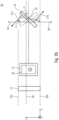
- Fig. 8 shows a schematic perspective view of a device 80, which comprises a housing 72 and a first multi-aperture imaging device 10a and a second multi-aperture imaging device 10b arranged in the housing 72.
- the device 80 is designed to capture the total field of view 70 at least partially, for example in the overlap area of the detection areas, stereoscopically with the multi-aperture imaging devices.
- the total field of view 70 is arranged, for example, on a main side 74b of the housing facing away from the main side 74a.
- the multi-aperture imaging devices 10a and 10b capture the total field of view 70 through transparent areas 68a and 68c, respectively, wherein apertures 78a and 78c arranged in the main side 74b are at least partially transparent.
- Apertures 78b and 78d arranged in the main side 74a can at least partially optically close transparent areas 68b and 68d, respectively, so that an amount of stray light from a side facing the main side 74a, which can distort the images of the multi-aperture imaging devices 10a and/or 10b, is at least reduced.
- the multi-aperture imaging devices 10a and 10b are shown arranged spatially spaced apart from one another, the multi-aperture imaging devices 10a and 10b can also be arranged spatially adjacent or combined.
- the single-row arrays of the imaging devices 10a and 10b can be arranged next to one another or parallel to one another.
- the single-row arrays can form rows with respect to one another, with each multi-aperture imaging device 10a and 10b having a single-row array.
- the imaging devices 10a and 10b can have a common beam deflection device, and/or a common carrier 62 and/or a common image sensor 12.
- the multi-aperture imaging device 10, 10', 20, 30 and/or 40 can be arranged.
- Such common elements such as the beam deflection device or the array, can be used by a common optical image stabilizer, since, for example, a movement of the beam deflection device for optical channels of several modules can act as optical image stabilization. Accordingly, the optical image stabilizer can be implemented jointly for several modules and/or a common reference channel can be used for several modules.
- the transparent areas 68a-d can additionally be equipped with a switchable shutter 78a-d, which covers the optical structure when not in use.
- the shutter 78a-d can comprise a mechanically moving part. The movement of the mechanically moving part can take place using an actuator, as described for example for the actuators 36 and 45.
- the shutter 78a-d can alternatively or additionally be electrically controllable and comprise an electrochromic layer or an electrochromic layer sequence, i.e., be formed as an electrochromic shutter.
- Fig. 9 shows a schematic structure comprising a first multi-aperture imaging device 10a and a second multi-aperture imaging device 10b, as can be arranged, for example, in the imaging system 80.
- the arrays 14a and 14b are formed in one row and form a common row.
- the image sensors 12a and 12b can be a common substrate or on a common circuit carrier such as a common circuit board or a common flexboard. Alternatively, the image sensors 12a and 12b can also comprise different substrates.
- multi-aperture imaging devices comprising a common image sensor, a common array and/or a common beam deflection device 18 as well as further multi-aperture imaging devices that have separate components.
- a common image sensor, a common array and/or a common beam deflection device is that a movement of a respective component can be achieved with great precision by controlling a small number of actuators and synchronization between actuators can be reduced or avoided. Furthermore, a high thermal stability can be achieved.
- other and/or different multi-aperture imaging devices 10, 10', 20, 30 and/or 40 can also have a common array, a common image sensor and/or a common beam deflection device.
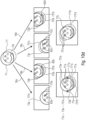
- Fig. 10a is a schematic representation of an initial situation of an embodiment of the electronic image stabilization, such as can be achieved by imaging systems described herein, wherein the statements with regard to the electronic image stabilization can also be related to individual multi-aperture imaging devices without restrictions.
- the imaging system uses a common optical image stabilizer and a common electronic image stabilizer.
- each module has two optical channels 16a and 16b or 16c and 16d in order to image the entire field of view with an object 71.
- the images 73a and 73b of the optical channels 16a and 16b in the associated image sensor areas are referred to as the left image 75a and images 73c and 73d of the optical channels 16c and 16d as the right image of a stereoscopic detection of the object 71.
- Fig. 10a now shows a fault-free state in which the object 71 is imaged onto the image sensor areas in order to obtain the images 73a-d.
- the images 73a and 73b can be combined by the multi-aperture imaging device to form a left overall image 77a, for example by means of stitching.
- the images 73c and 73d can be combined in a comparable manner by the multi-aperture imaging device to form a right overall image 77b, so that stereoscopic information regarding the object 71 can be determined from the two overall images 75a and 75b.
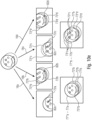
- Fig. 10b now shows the case Fig. 10a , in which a relative movement of the imaging system with respect to the object 71 leads to a changed relative position of the object 71 with respect to the imaging system, represented by the object 71'.
- This can be, for example, a movement of the object 71 and/or a shaking of the imaging system. If image corrections are neglected, the relative movement leads to a changed image position of the image of the object 71 in the image sensor areas, which is represented by the dashed lines of the images 73'ad.
- the aim is now to preserve images 77a and 77b, which are in Fig. 10a are shown, i.e. error-compensated images.
- the aim is to compensate for camera shake, i.e. to achieve optimal image stabilization. In this consideration, deviations in the optics of the optical channels are not taken into account.
- Fig. 10c shows the basics for the optical image stabilization in the images under the unchanged assumption that a pure optical image stabilization of all optical channels that have identical optical parameters, i.e. an identical focal length, leads to optimal image stabilization.
- the displacement of the object 71 is shown by an arrow 79, which points in the positive direction 28 and the negative direction 32.
- the directions represented by arrows 84a-d and 77a-b are arranged in space opposite to arrow 79, for example at prominent points in the respective partial image, such as an eye or the corner of the mouth, which means, for example, edges in the image.
- Fig. 10d The partial images 73"ad obtained after optical image stabilization and taking into account the actual deviations in the optical properties are shown.
- the optical image stabilization is carried out, for example, in such a way that the image 73a is optimally corrected, which means that the optically image-stabilized image 73"a corresponds to the error-free image 73a, at least within a tolerance range that indicates the capabilities of the optical image stabilizer.
- the image stabilization in the optical channel 16a now has a different effect in the channels 16b-d, which means that the deviations in the optical properties mean, for example, that the arrows 82a-d, which indicate the displacement of the images based on the optical stabilization, can be different in their length and/or direction.
- Fig. 10e shows in the images of the channels 16b-c the optical image stabilization now carried out compared to the reference channel 16a, which is indicated by the images 73" ⁇ bd.
- electronic image stabilization in the channels 16b-d away from the channel 16a their deviations compared to the optical image stabilization in the optical channel 16a are at least partially compensated, so that error-reduced or even error-free images 77" ⁇ a and 77" ⁇ b can be obtained, which can correspond to the images 77a and 77b respectively.
- This means that partially compensated image positions are obtained by optical image stabilization and compensated image positions by additional electronic image stabilization.
- the extent of the electronic image stabilization can be carried out by the electronic image stabilizer using the functional relationship between the optical channels 16a-d.
- the electronic image stabilizer such as the image stabilizer 41, can be designed to determine the extent of the shift in the images, for example, by looking at a matching feature in two temporally different or consecutive frames.
- Fig. 11 shows a schematic flow diagram of a method 1100 for providing a multi-aperture imaging device.
- an image sensor is provided.
- an array of optical channels is provided, so that each optical channel comprises an optic for imaging a partial field of view of an overall field of view onto an image sensor region of the image sensor.
- a beam deflection device is arranged to deflect a beam path of the optical channels.
- an optical image stabilizer is arranged for image stabilization along a first image axis by generating a first relative movement between the image sensor, the array and the beam deflection device and for image stabilization along a second image axis by generating a second relative movement between the image sensor, the array and the beam deflection device.
- an electronic image stabilizer is arranged for image stabilization of a first optical channel of the array along the first and second image axes.
- Embodiments described herein enable multi-aperture imaging systems with a linear channel arrangement, i.e. single-line or multi-line along a line extension direction, with optical image stabilization using uniaxial translational movement between image sensor and imaging optics as well as uniaxial rotational movement of a beam-deflecting mirror array.
- multi-aperture imaging devices may comprise any number of optical channels, for example at least two, at least three, at least four, at least ten or a higher number of optical channels may be arranged.
- the actuators 36 and 42 can also be designed as a common actuator.
- a movement generated by the actuator can be guided to the image sensor 12, the optical array 14 and/or the beam deflection device 18 by means of a force and/or displacement converter (gear) in order to obtain a respective movement.
- a force and/or displacement converter gear
- one or more components can also be moved by several actuators, as is described, for example, in connection with the multi-aperture imaging device 40.
- the image sensor can be designed, for example, as a complementary metal-oxide-semiconductor (CMOS) or a different technology.
- CMOS complementary metal-oxide-semiconductor
- the optical channels of a respective array can be understood as that they define an area in which a beam path that is guided to a respective image sensor area is optically changed. A beam path assigned to an image sensor area can thus travel through the optical channel of the array.
- the beam paths or optical axes can be directed in different directions from the beam deflection device. This can be achieved by directing the beam paths during deflection at the beam deflection device and/or through the optics in a way that deviates from parallelism to one another.
- the beam paths or optical axes can deviate from parallelism before or without beam deflection. This circumstance is described below as the fact that the channels can be provided with a type of pre-divergence.
- the optical axes it would be possible, for example, that not all facet inclinations of facets of the beam deflection device differ from one another, but that some groups of channels, for example, have facets with the same inclination or are directed to them.
- the latter can then be formed integrally or continuously merging into one another, as if it were a facet that is assigned to this group of channels adjacent in the direction of the line extension.
- the divergence of the optical axes of these channels could then originate from the divergence of these optical axes as achieved by a lateral offset between optical centers of the optics of the optical channels and image sensor areas of the channels.
- the pre-divergence could, for example, be limited to one plane.
- the optical axes could, for example, run in a common plane before or without beam deflection, but divergently in this plane, and the facets only cause an additional divergence in the other transverse plane, i.e. they are all parallel to the line extension direction and only inclined differently to one another in relation to the aforementioned common plane of the optical axes, whereby here again several facets can have the same inclination or can be assigned to a group of channels whose optical axes, for example, already differ in pairs in the aforementioned common plane of the optical axes before or without beam deflection.
- the optics can enable a (preliminary) divergence of the beam paths along a first (image) direction and the beam deflection device can enable a divergence of the beam paths along a second (image) direction.
- the aforementioned possibly existing pre-divergence can be achieved, for example, by having the optical centers of the optics lie on a straight line along the line extension direction, while the centers of the image sensor regions are arranged deviating from the projection of the optical centers along the normal of the plane of the image sensor regions onto points on a straight line in the image sensor plane, such as, for example, at points that deviate from the points on the aforementioned straight line in the image sensor plane on a channel-specific basis along the line extension direction and/or along the direction perpendicular to both the line extension direction and the image sensor normal.
- pre-divergence can be achieved by having the centers of the image sensors lie on a straight line along the line extension direction, while the centers of the optics are arranged so as to deviate from the projection of the optical centers of the image sensors along the normal to the plane of the optical centers of the optics onto points on a straight line in the optics center plane, such as at points that deviate from the points on the aforementioned straight line in the optics center plane for each channel along the line extension direction and/or along the direction perpendicular to both the line extension direction and the normal to the optics center plane. It is preferred if the aforementioned channel-specific deviation from the respective projection only runs in the line extension direction, i.e.
- optical axes are only in a common plane with a pre-divergence. Both optical centers and image sensor area centers then lie on a straight line parallel to the line extension direction, but with different spacing between them.
- a lateral offset between lenses and image sensors in a perpendicular lateral direction to the line extension direction leads to an increase in the overall height.
- a pure in-plane offset in the line extension direction does not change the overall height, but may result in fewer facets and/or the facets only have a tilt in one angular orientation, which simplifies the structure.
- adjacent optical channels can have optical axes running in the common plane, squinting at each other, i.e. provided with a pre-divergence.
- a facet can be arranged with respect to a group of optical channels, only tilted in one direction and parallel to the line extension direction.
- optical channels are assigned to the same partial field of view, for example for the purpose of super-resolution or to increase the resolution with which the corresponding partial field of view is scanned by these channels.
- the optical channels within such a group would then run parallel before beam deflection, for example, and would be directed to a partial field of view by a facet.
- pixel images of the image sensor of one channel of a group would be located in intermediate positions between images of the pixels of the image sensor of another channel of this group.
- the above embodiments can therefore be implemented in the form of a multi-aperture imaging device and/or an imaging system comprising such a multi-aperture imaging device, with a single-line channel arrangement, each channel transmitting a partial field of view of an overall field of view and the partial fields of view partially overlapping.
- a structure with several such multi-aperture imaging devices for stereo, trio, quattro, etc. structures for 3D image recording is possible.
- the majority of modules can be designed as a continuous line.
- the continuous line could use identical actuators and a common beam deflection element.
- One or more amplifying substrates that may be present in the beam path can extend over the entire line, which can form a stereo, trio, quattro structure.
- the optical axes can also run divergently without a beam deflection device, so that fewer facets are required on the beam deflection unit.
- the facets then advantageously have only one angular component.
- the image sensor can be one-piece, have only one continuous pixel matrix or several interrupted ones.
- the image sensor can be made up of many partial sensors, which are arranged next to each other on a circuit board, for example.
- An autofocus drive can be designed so that the beam deflection element is moved synchronously with the optics, or is stationary.
- aspects have been described in connection with a device, it is to be understood that these aspects also represent a description of the corresponding method, so that a block or a component of a device can also be understood as a corresponding method step or as a feature of a method step. Analogously, aspects that are described in connection with or as a method step also represents a description of a corresponding block or detail or feature of a corresponding device.
Landscapes
- Physics & Mathematics (AREA)
- Engineering & Computer Science (AREA)
- General Physics & Mathematics (AREA)
- Multimedia (AREA)
- Signal Processing (AREA)
- Optics & Photonics (AREA)
- Human Computer Interaction (AREA)
- Studio Devices (AREA)
- Adjustment Of Camera Lenses (AREA)
- Cameras In General (AREA)
- Stereoscopic And Panoramic Photography (AREA)
Claims (15)
- Dispositif d'imagerie à ouvertures multiples (10; 10'; 20; 30; 40) avec:un capteur d'image (12);un réseau (14) de canaux optiques (16a à h), où chaque canal optique (16a à h) comporte une optique (17) destinée à reproduire un champ de vision partiel (72a à d) d'un champ de vision global (70) sur un zone de capteur d'image (24a à h) du capteur d'image (12);un moyen de déviation de faisceau (18) destiné à dévier un trajet de faisceau (26a à h) des canaux optiques (16a à h); etun stabilisateur d'image optique (22) destiné à la stabilisation d'image le long d'un premier axe d'image (28) en générant un premier mouvement relatif (34; 39a) entre le capteur d'image (12), le réseau (14) et le moyen de déviation de faisceau (18), et à la stabilisation d'image le long d'un deuxième axe d'image (32) en générant un deuxième mouvement relatif (38; 39b) entre le capteur d'image (12), le réseau (14) et le moyen de déviation de faisceau (18);un stabilisateur d'image électronique (41) destiné à la stabilisation d'image d'un premier canal optique (16a à h) du réseau (14) le long du premier et du deuxième axe d'image (28, 32);dans lequel le stabilisateur d'image électronique (41) est conçu pour effectuer une stabilisation d'image de manière individuelle par canal et différente l'une de l'autre pour chaque canal optique (16a à h) pour corriger les erreurs de reproduction (z) individuelles par canal; et le stabilisateur d'image électronique (41) est conçu pour réaliser la stabilisation d'image électronique individuelle par canal dans chaque canal selon un rapport fonctionnel fixé qui décrit l'erreur de reproduction individuelle par canal comme étant fonction d'une distance focale respective de l'optique du canal optique et des mouvements relatifs entre le capteur d'image (12), le réseau (14) et le moyen de déviation de faisceau (18); ou le stabilisateur d'image électronique (41) est conçu pour identifier, dans une première image partielle d'un premier champ de vision partiel (72a à d) et dans une deuxième reproduction d'un deuxième champ de vision partiel (72a à d), une caractéristique correspondante et pour fournir la stabilisation d'image électronique sur base d'une comparaison des mouvements de la caractéristique dans la première et la deuxième reproduction.
- Dispositif d'imagerie à ouvertures multiples selon la revendication 1, dans lequel le stabilisateur d'image électronique (41) est conçu pour stabiliser le premier canal optique (16a à h) et le deuxième canal optique (16a à h) par rapport à un canal de référence des canaux optiques et/ou par une évaluation d'image individuelle par canal du mouvement des détails d'image de manière individuelle par canal et différente l'une de l'autre le long du premier et du deuxième axe d'image (28, 32).
- Dispositif d'imagerie à ouvertures multiples selon la revendication 1 ou 2, dans lequel le stabilisateur d'image électronique (41) est conçu pour effectuer la stabilisation d'image électronique individuelle par canal dans chaque canal selon un rapport fonctionnel fixé qui décrit l'erreur de reproduction individuelle par canal comme étant fonction d'une distance focale respective de l'optique du canal optique et des mouvements relatifs entre le capteur d'image (12), le réseau (14) et le moyen de déviation de faisceau (18);
dans lequel le rapport fonctionnel est une fonction linéaire. - Dispositif d'imagerie à ouvertures multiples selon l'une des revendications précédentes, dans lequel le stabilisateur d'image électronique (41) est conçu pour effectuer la stabilisation d'image électronique individuelle par canal dans chaque canal selon un rapport fonctionnel fixé qui décrit l'erreur de reproduction individuelle par canal comme étant fonction d'une distance focale respective de l'optique du canal optique et des mouvements relatifs entre le capteur d'image (12), le réseau (14) et le moyen de déviation de faisceau (18); et dans lequel le stabilisateur d'image optique (22) est conçu pour fournir la stabilisation d'image optique dans l'une des directions d'image sur base d'un mouvement de rotation du moyen de déviation de faisceau, dans lequel le rapport fonctionnel est une fonction angulaire qui reproduit un angle de rotation du mouvement de rotation du moyen de déviation de faisceau (18) sur un pourtour de la stabilisation d'image électronique dans la direction d'image.
- Dispositif d'imagerie à ouvertures multiples selon l'une des revendications précédentes, dans lequel le stabilisateur d'image électronique (41) est conçu pour identifier, dans une première image partielle d'un premier champ de vision partiel (72a à d) et dans une deuxième image d'un deuxième champ de vision partiel (72a à d), une caractéristique correspondante et pour fournir la stabilisation d'image électronique sur base d'une comparaison des mouvements de la caractéristique dans la première et la deuxième reproduction.
- Dispositif d'imagerie à ouvertures multiples selon l'une des revendications précédentes, dans lequel les distances focales des optiques (64a à d) de différents canaux optiques (16a à h) diffèrent l'une de l'autre et un mouvement du moyen de déviation de faisceau (18) conduit à une modification différente l'une de l'autre des reproductions sur les zones de capteur d'image (24a à h), dans lequel le stabilisateur d'image électronique (41) est conçu pour compenser, par une stabilisation d'image individuelle par canal et différente l'une de l'autre comportant une évaluation d'image individuelle par canal des détails de l'image, les différences entre les différentes modifications des reproductions.
- Dispositif d'imagerie à ouvertures multiples selon l'une des revendications précédentes, dans lequel les distances focales des optiques (64a à d) de différents canaux optiques (16a à h) diffèrent l'une de l'autre et un mouvement du moyen de déviation de faisceau (18) conduit à une modification différente des reproductions sur les zones de capteur d'image (24a à h), dans lequel le stabilisateur d'image électronique (41) esL conçu pour compenser, par une stabilisation d'image individuelle par canal et différente l'une de l'autre, les différences entre les différentes modifications des reproductions.
- Dispositif d'imagerie à ouvertures multiples selon l'une des revendications précédentes, dans lequel une première optique (64a) associée à un premier canal optique (16a) et une deuxième optique (64b) associée à un deuxième canal optique (16b) sont formées de manière identique dans les limites d'une plage de tolérance de tout au plus 10%.
- Dispositif d'imagerie à ouvertures multiples selon l'une des revendications précédentes, dans lequel le premier mouvement relatif (34; 39a) comporte au moins l'un parmi un mouvement de translation relatif (34) entre le capteur d'image (12) et le réseau (14), un mouvement de translation relatif (39a) entre le capteur d'image (12) et le moyen de déviation de faisceau (18) et un mouvement de translation relatif (39a) entre le réseau (14) et le moyen de déviation de faisceau (18), et dans lequel le deuxième mouvement relatif (38; 39b) comporte au moins l'un parmi un mouvement de rotation (38) du moyen de déviation de faisceau (18), un mouvement de translation relatif entre le capteur d'image (12) et le réseau (14) et un mouvement de translation relatif (39b) entre le réseau (14) et le moyen de déviation de faisceau (18).
- Dispositif d'imagerie à ouvertures multiples selon l'une des revendications précédentes, dans lequel le stabilisateur d'image optique (22) comporte au moins un actionneur (36, 37, 42) et est disposé de sorte qu'il soit disposé au moins partiellement entre deux plans (52a, 52b) qui sont définis par les côtés d'un parallélépipède (55), dans lequel les côtés du parallélépipède sont orientés de manière parallèle l'un à l'autre ainsi qu'à une direction d'extension de rangées (35, 65, z) du réseau (14) et d'une partie du trajet de faisceau des canaux optiques (16a à h) entre le capteur d'image (12) et les optiques (64a à h) et dont le volume est minimum et comporte néanmoins le capteur d'image (12) et le réseau (14).
- Dispositif d'imagerie à ouvertures multiples selon l'une des revendications précédentes, dans lequel le moyen de déviation de faisceau (18) présente une première face principale (174a) et une deuxième face principale (174b) et est conçu pour diriger, dans un premier état de fonctionnement, les trajets de faisceau des canaux optiques (64a à h) avec la première face principale (174a) dans une première direction de vision du dispositif d'imagerie à ouvertures multiples, et pour diriger, dans un deuxième état de fonctionnement, les trajets optiques des canaux optiques (64a à h) avec la deuxième face principale (174b) dans une deuxième direction de vision du dispositif d'imagerie à ouvertures multiples.
- Dispositif d'imagerie multi-ouvertures selon la revendication 11, qui est conçu pour effectuer un changement entre le premier et le deuxième état de fonctionnement par un mouvement de rotation (38), dans lequel, pendant le mouvement de rotation, une première normale à la surface (51a) du premier côté principal et une deuxième surface normale (51b), le deuxième côté principal présente à tout moment un angle (y1, y2) d'au moins 10° par rapport à une direction vers le capteur d'image (12).
- Dispositif d'imagerie à ouvertures multiples selon l'une des revendications précédentes, qui est conçu pour recevoir un signal de capteur d'un capteur et pour évaluer le signal de capteur en ce qui concerne une information qui est corrélée avec un mouvement relatif entre le dispositif d'imagerie à ouvertures multiples et l'objet, et pour effectuer une commande du stabilisateur d'image optique ou électronique (22; 41) à l'aide de l'information.
- Système d'imagerie (60; 80) avec un premier et un deuxième dispositif d'imagerie à ouvertures multiples (10; 10'; 20; 30; 40) selon l'une des revendications précédentes, qui est conçu pour capturer un champ de vision global (70) au moins partiellement de manière stéréoscope.
- Procédé (1100) pour créer un dispositif d'imagerie à ouvertures multiples (10; 10'; 20; 30; 40), aux étapes suivantes consistant à:prévoir (1110) un capteur d'image;prévoir (1120) un réseau de canaux optiques, de sorte que chaque canal optique comporte une optique destinée à la reproduction d'un champ de vision partiel d'un champ de vision global sur une zone de capteur d'image du capteur d'image;disposer (1130) un moyen de déviation de faisceau destiné à dévier un trajet de faisceau des canaux optiques; etdisposer (1140) un stabilisateur d'image optique destiné à la stabilisation d'image le long d'un premier axe d'image en générant un premier mouvement relatif entre le capteur d'image, le réseau et le dispositif de déviation de faisceau et à la stabilisation d'image le long d'un deuxième axe d'image en générant un deuxième mouvement relatif entre le capteur d'image, le réseau et le dispositif de déviation de faisceau;disposer (1150) un stabilisateur d'image électronique destiné à la stabilisation d'image d'un premier canal optique du réseau le long du premier et du deuxième axe d'image;de sorte que le stabilisateur d'image électronique (41) soit conçu pour effectuer une stabilisation d'image de manière individuelle par canal et différente l'une de l'autre pour chaque canal optique (16a à h) pour corriger les erreurs de reproduction individuelles par canal (z); et que le stabilisateur d'image électronique (41) soit conçu pour réaliser la stabilisation d'image électronique individuelle par canal dans chaque canal selon un rapport fonctionnel fixé qui décrit l'erreur de reproduction individuelle par canal comme étant fonction d'une distance focale respective de l'optique du canal optique et des mouvements relatifs entre le capteur d'image (12), le réseau (14) et le dispositif de déviation de faisceau (18); ou que le stabilisateur d'image électronique (41) soit conçu pour identifier, dans une première image partielle d'un premier champ de vision partiel (72a à d) et, dans une deuxième image d'un deuxième champ de vision partiel (72a à d), une caractéristique correspondante, et pour fournir la stabilisation d'image électronique sur base d'une comparaison des mouvements de la caractéristique dans la première et la deuxième reproduction.
Applications Claiming Priority (3)
| Application Number | Priority Date | Filing Date | Title |
|---|---|---|---|
| DE102017204035.1A DE102017204035B3 (de) | 2017-03-10 | 2017-03-10 | Multiaperturabbildungsvorrichtung, Abbildungssystem und Verfahren zum Bereitstellen einer Multiaperturabbildungsvorrichtung |
| EP18708968.5A EP3593201B1 (fr) | 2017-03-10 | 2018-03-01 | Dispositif de reproduction multiouverture, système de reproduction et procédé de fourniture d'un dispositif de reproduction multi-ouverture |
| PCT/EP2018/054997 WO2018162304A1 (fr) | 2017-03-10 | 2018-03-01 | Dispositif de reproduction multiouverture, système de reproduction et procédé de fourniture d'un dispositif de reproduction multi-ouverture |
Related Parent Applications (1)
| Application Number | Title | Priority Date | Filing Date |
|---|---|---|---|
| EP18708968.5A Division EP3593201B1 (fr) | 2017-03-10 | 2018-03-01 | Dispositif de reproduction multiouverture, système de reproduction et procédé de fourniture d'un dispositif de reproduction multi-ouverture |
Publications (2)
| Publication Number | Publication Date |
|---|---|
| EP4163702A1 EP4163702A1 (fr) | 2023-04-12 |
| EP4163702B1 true EP4163702B1 (fr) | 2024-10-09 |
Family
ID=61569252
Family Applications (2)
| Application Number | Title | Priority Date | Filing Date |
|---|---|---|---|
| EP22209251.2A Active EP4163702B1 (fr) | 2017-03-10 | 2018-03-01 | Dispositif de reproduction multiouverture, système de reproduction et procédé de préparation d'un dispositif de reproduction multiouverture |
| EP18708968.5A Active EP3593201B1 (fr) | 2017-03-10 | 2018-03-01 | Dispositif de reproduction multiouverture, système de reproduction et procédé de fourniture d'un dispositif de reproduction multi-ouverture |
Family Applications After (1)
| Application Number | Title | Priority Date | Filing Date |
|---|---|---|---|
| EP18708968.5A Active EP3593201B1 (fr) | 2017-03-10 | 2018-03-01 | Dispositif de reproduction multiouverture, système de reproduction et procédé de fourniture d'un dispositif de reproduction multi-ouverture |
Country Status (9)
| Country | Link |
|---|---|
| US (1) | US11070731B2 (fr) |
| EP (2) | EP4163702B1 (fr) |
| JP (2) | JP7214643B2 (fr) |
| KR (1) | KR102399688B1 (fr) |
| CN (1) | CN110612472B (fr) |
| CA (1) | CA3055816C (fr) |
| DE (1) | DE102017204035B3 (fr) |
| TW (1) | TWI710804B (fr) |
| WO (1) | WO2018162304A1 (fr) |
Families Citing this family (8)
| Publication number | Priority date | Publication date | Assignee | Title |
|---|---|---|---|---|
| DE102017204035B3 (de) * | 2017-03-10 | 2018-09-13 | Fraunhofer-Gesellschaft zur Förderung der angewandten Forschung e.V. | Multiaperturabbildungsvorrichtung, Abbildungssystem und Verfahren zum Bereitstellen einer Multiaperturabbildungsvorrichtung |
| DE102017206442B4 (de) | 2017-04-13 | 2021-01-28 | Fraunhofer-Gesellschaft zur Förderung der angewandten Forschung e.V. | Vorrichtung zur Abbildung von Teilgesichtsfeldern, Multiaperturabbildungsvorrichtung und Verfahren zum Bereitstellen derselben |
| DE102017211586A1 (de) | 2017-07-06 | 2019-01-10 | Fraunhofer-Gesellschaft zur Förderung der angewandten Forschung e.V. | Multiaperturabbildungsvorrichtung mit geringer falschlichtempfindlichkeit, abbildungssystem und verfahren zum bereitstellen einer multiaperturabbildungsvorrichtung |
| DE102017216172A1 (de) | 2017-09-13 | 2019-03-14 | Fraunhofer-Gesellschaft zur Förderung der angewandten Forschung e.V. | Multiaperturabbildungsvorrichtung mit geringer bauhöhe und umschaltbarer blickrichtung, abbildungssystem und verfahren zum bereitstellen einer multiaperturabbildungsvorrichtung |
| KR102749546B1 (ko) * | 2020-03-04 | 2025-01-03 | 에스케이하이닉스 주식회사 | 이미지 센서 |
| KR102345118B1 (ko) * | 2020-07-24 | 2021-12-30 | 삼성전기주식회사 | 카메라 모듈 및 이를 포함하는 휴대 단말기 |
| DE102022104184A1 (de) * | 2022-02-22 | 2023-08-24 | Kurtz Gmbh & Co. Kg | Vorrichtung, System und Verfahren zum Kalibrieren einer Lasereinrichtung |
| CN119882220A (zh) * | 2025-03-31 | 2025-04-25 | 中国科学院上海技术物理研究所 | 一种分布式像移补偿机构及方法 |
Family Cites Families (60)
| Publication number | Priority date | Publication date | Assignee | Title |
|---|---|---|---|---|
| JP4071793B2 (ja) * | 2003-10-22 | 2008-04-02 | 松下電器産業株式会社 | 撮像装置とその製造方法、及び携帯機器 |
| JP5934459B2 (ja) | 2006-04-17 | 2016-06-15 | オムニビジョン テクノロジーズ, インコーポレイテッド | アレイ化撮像システムおよび関連方法 |
| JP2008026712A (ja) * | 2006-07-24 | 2008-02-07 | Eastman Kodak Co | 複数光学系を有する撮像装置 |
| US20080030592A1 (en) | 2006-08-01 | 2008-02-07 | Eastman Kodak Company | Producing digital image with different resolution portions |
| US8243127B2 (en) * | 2006-10-27 | 2012-08-14 | Zecotek Display Systems Pte. Ltd. | Switchable optical imaging system and related 3D/2D image switchable apparatus |
| KR100871566B1 (ko) | 2006-12-04 | 2008-12-02 | 삼성전자주식회사 | 이미지 촬상 장치의 손떨림 보상을 위한 장치 및 방법 |
| US7643063B2 (en) | 2006-12-29 | 2010-01-05 | The Boeing Company | Dual loop stabilization of video camera images |
| US20090122195A1 (en) | 2007-11-09 | 2009-05-14 | Van Baar Jeroen | System and Method for Combining Image Sequences |
| CN102356630B (zh) | 2009-03-19 | 2016-01-27 | 数字光学公司 | 双传感器照相机 |
| AU2009201637B2 (en) | 2009-04-24 | 2011-08-11 | Canon Kabushiki Kaisha | Processing multi-view digital images |
| US9144714B2 (en) | 2009-05-02 | 2015-09-29 | Steven J. Hollinger | Ball with camera for reconnaissance or recreation and network for operating the same |
| US20100328471A1 (en) * | 2009-06-24 | 2010-12-30 | Justin Boland | Wearable Multi-Channel Camera |
| JP5553597B2 (ja) | 2009-12-25 | 2014-07-16 | キヤノン株式会社 | 撮像装置及びその制御方法 |
| JP5506504B2 (ja) | 2010-03-31 | 2014-05-28 | キヤノン株式会社 | 撮像装置及び撮像方法 |
| US20120075489A1 (en) * | 2010-09-24 | 2012-03-29 | Nishihara H Keith | Zoom camera image blending technique |
| US20120098971A1 (en) | 2010-10-22 | 2012-04-26 | Flir Systems, Inc. | Infrared binocular system with dual diopter adjustment |
| JP5830662B2 (ja) | 2010-12-09 | 2015-12-09 | パナソニックIpマネジメント株式会社 | 撮像装置 |
| US10412367B2 (en) | 2011-08-05 | 2019-09-10 | 3D Media Ltd | Multi-lens camera with a single image sensor |
| JP2013045032A (ja) | 2011-08-26 | 2013-03-04 | Fujifilm Corp | 多眼撮像装置 |
| EP2582128A3 (fr) | 2011-10-12 | 2013-06-19 | Canon Kabushiki Kaisha | Dispositif de capture d'image |
| JP6004785B2 (ja) | 2012-06-29 | 2016-10-12 | キヤノン株式会社 | 撮像装置、光学機器、撮像システムおよび制御方法 |
| US20140002674A1 (en) * | 2012-06-30 | 2014-01-02 | Pelican Imaging Corporation | Systems and Methods for Manufacturing Camera Modules Using Active Alignment of Lens Stack Arrays and Sensors |
| US9398264B2 (en) | 2012-10-19 | 2016-07-19 | Qualcomm Incorporated | Multi-camera system using folded optics |
| CN113259565B (zh) | 2012-11-28 | 2023-05-19 | 核心光电有限公司 | 多孔径成像系统 |
| JP6172161B2 (ja) | 2012-12-11 | 2017-08-02 | コニカミノルタ株式会社 | 複眼光学系とそれを用いた撮像装置 |
| US20140160231A1 (en) | 2012-12-12 | 2014-06-12 | Daniel C. Middleton | Multi-focal image capture and display |
| JP6100089B2 (ja) | 2013-05-17 | 2017-03-22 | キヤノン株式会社 | 画像処理装置、画像処理方法およびプログラム |
| US9232138B1 (en) * | 2013-06-03 | 2016-01-05 | Amazon Technologies, Inc. | Image stabilization techniques |
| JP6429440B2 (ja) | 2013-09-18 | 2018-11-28 | キヤノン株式会社 | 撮像装置、その制御方法、および制御プログラム |
| US9423588B2 (en) | 2013-10-18 | 2016-08-23 | The Lightco Inc. | Methods and apparatus for supporting zoom operations |
| DE102013222780B3 (de) * | 2013-11-08 | 2015-04-16 | Fraunhofer-Gesellschaft zur Förderung der angewandten Forschung e.V. | Multiaperturvorrichtung und verfahren zur erfassung eines objektbereichs |
| US20160292842A1 (en) * | 2013-11-18 | 2016-10-06 | Nokia Technologies Oy | Method and Apparatus for Enhanced Digital Imaging |
| KR102163045B1 (ko) | 2014-02-17 | 2020-10-08 | 삼성전기주식회사 | 이미지 보정 장치 및 그 방법 |
| JP2015185947A (ja) | 2014-03-20 | 2015-10-22 | 株式会社東芝 | 撮像システム |
| US9383550B2 (en) | 2014-04-04 | 2016-07-05 | Qualcomm Incorporated | Auto-focus in low-profile folded optics multi-camera system |
| DE102014213371B3 (de) * | 2014-07-09 | 2015-08-06 | Fraunhofer-Gesellschaft zur Förderung der angewandten Forschung e.V. | Vorrichtung und verfahren zur erfassung eines objektbereichs |
| US9596411B2 (en) * | 2014-08-25 | 2017-03-14 | Apple Inc. | Combined optical and electronic image stabilization |
| US20160173869A1 (en) | 2014-12-15 | 2016-06-16 | Nokia Corporation | Multi-Camera System Consisting Of Variably Calibrated Cameras |
| JP6436783B2 (ja) | 2015-01-09 | 2018-12-12 | キヤノン株式会社 | 画像処理装置、撮像装置、画像処理方法、プログラム、および、記憶媒体 |
| JP6659086B2 (ja) | 2015-03-16 | 2020-03-04 | キヤノン株式会社 | 像ブレ補正装置、光学機器、撮像装置および制御方法 |
| KR102088603B1 (ko) * | 2015-04-16 | 2020-03-13 | 코어포토닉스 리미티드 | 소형 접이식 카메라의 오토 포커스 및 광학 이미지 안정화 |
| DE102015215845B4 (de) | 2015-08-19 | 2017-06-22 | Fraunhofer-Gesellschaft zur Förderung der angewandten Forschung e.V. | Multiaperturabbildungsvorrichtung mit kanalindividueller Einstellbarkeit |
| DE102015215844B4 (de) | 2015-08-19 | 2017-05-18 | Fraunhofer-Gesellschaft zur Förderung der angewandten Forschung e.V. | Multiaperturabbildungsvorrichtung, tragbare Vorrichtung und Verfahren zum Herstellen einer Multiaperturabbildungsvorrichtung |
| DE102015215836B4 (de) | 2015-08-19 | 2017-05-18 | Fraunhofer-Gesellschaft zur Förderung der angewandten Forschung e.V. | Multiaperturabbildungsvorrichtung mit einer reflektierende Facetten aufweisenden Strahlumlenkvorrichtung |
| DE102015215840B4 (de) * | 2015-08-19 | 2017-03-23 | Fraunhofer-Gesellschaft zur Förderung der angewandten Forschung e.V. | Multiaperturabbildungsvorrichtung, Abbildungssystem und Verfahren zum Bereitstellen einer Multiaperturabbildungsvorrichtung |
| DE102015215837A1 (de) | 2015-08-19 | 2017-02-23 | Fraunhofer-Gesellschaft zur Förderung der angewandten Forschung e.V. | Multiaperturabbildungsvorrichtung, Verfahren zum Herstellen derselben und Abbildungssystem |
| DE102015215833A1 (de) | 2015-08-19 | 2017-02-23 | Fraunhofer-Gesellschaft zur Förderung der angewandten Forschung e.V. | Multiaperturabbildungsvorrichtung mit Optiksubstrat |
| DE102015215841B4 (de) * | 2015-08-19 | 2017-06-01 | Fraunhofer-Gesellschaft zur Förderung der angewandten Forschung e.V. | Vorrichtung mit einer Multikanalabbildungsvorrichtung und Verfahren zum Herstellen derselben |
| DE102015216140A1 (de) | 2015-08-24 | 2017-03-02 | Fraunhofer-Gesellschaft zur Förderung der angewandten Forschung e.V. | 3D-Multiaperturabbildungsvorrichtung |
| ITUB20154043A1 (it) | 2015-09-30 | 2017-03-30 | Datalogic IP Tech Srl | Sistema e metodo di lettura di informazioni codificate |
| DE102015220566B4 (de) | 2015-10-21 | 2021-03-18 | Fraunhofer-Gesellschaft zur Förderung der angewandten Forschung e.V. | Vorrichtung mit einer Multiaperturabbildungsvorrichtung, Verfahren zum Bereitstellen derselben und Verfahren zum Erfassen eines Gesamtgesichtsfeldes |
| DE102016200285A1 (de) | 2016-01-13 | 2017-07-13 | Fraunhofer-Gesellschaft zur Förderung der angewandten Forschung e.V. | Multiaperturabbildungsvorrichtung, Abbildungssystem und Verfahren zum Erfassen eines Objektbereichs |
| DE102016200287A1 (de) | 2016-01-13 | 2017-07-13 | Fraunhofer-Gesellschaft zur Förderung der angewandten Forschung e.V. | Multiaperturabbildungsvorrichtungen, Verfahren zum Herstellen derselben und Abbildungssystem |
| DE102016204148A1 (de) | 2016-03-14 | 2017-09-14 | Fraunhofer-Gesellschaft zur Förderung der angewandten Forschung e.V. | Multiaperturabbildungsvorrichtung, Abbildungssystem und Verfahren zum Erfassen eines Objektbereichs |
| DE102016208210A1 (de) | 2016-05-12 | 2017-11-16 | Fraunhofer-Gesellschaft zur Förderung der angewandten Forschung e.V. | 3d-multiaperturabbildungsvorrichtungen, multiaperturabbildungsvorrichtung, verfahren zum bereitstellen eines ausgangssignals einer 3d-multiaperturabbildungsvorrichtung und verfahren zum erfassen eines gesamtgesichtsfeldes |
| US10291866B2 (en) * | 2016-06-24 | 2019-05-14 | Moondog Optics, Inc. | Lens attachment for multi-camera device |
| CN106791377B (zh) * | 2016-11-29 | 2019-09-27 | Oppo广东移动通信有限公司 | 控制方法、控制装置及电子装置 |
| KR102354134B1 (ko) * | 2017-02-23 | 2022-01-21 | 코어포토닉스 리미티드 | 폴디드 카메라 렌즈 설계 |
| DE102017204035B3 (de) | 2017-03-10 | 2018-09-13 | Fraunhofer-Gesellschaft zur Förderung der angewandten Forschung e.V. | Multiaperturabbildungsvorrichtung, Abbildungssystem und Verfahren zum Bereitstellen einer Multiaperturabbildungsvorrichtung |
| CN114137791A (zh) * | 2017-03-15 | 2022-03-04 | 核心光电有限公司 | 具有全景扫瞄范围的照相装置及移动装置 |
-
2017
- 2017-03-10 DE DE102017204035.1A patent/DE102017204035B3/de not_active Expired - Fee Related
-
2018
- 2018-03-01 KR KR1020197029738A patent/KR102399688B1/ko active Active
- 2018-03-01 CN CN201880030802.3A patent/CN110612472B/zh active Active
- 2018-03-01 WO PCT/EP2018/054997 patent/WO2018162304A1/fr not_active Ceased
- 2018-03-01 EP EP22209251.2A patent/EP4163702B1/fr active Active
- 2018-03-01 JP JP2019548902A patent/JP7214643B2/ja active Active
- 2018-03-01 CA CA3055816A patent/CA3055816C/fr active Active
- 2018-03-01 EP EP18708968.5A patent/EP3593201B1/fr active Active
- 2018-03-07 TW TW107107731A patent/TWI710804B/zh active
-
2019
- 2019-08-30 US US16/556,279 patent/US11070731B2/en active Active
-
2021
- 2021-12-03 JP JP2021196895A patent/JP7361088B2/ja active Active
Also Published As
| Publication number | Publication date |
|---|---|
| CN110612472B (zh) | 2022-06-24 |
| CA3055816A1 (fr) | 2018-09-13 |
| TW201901246A (zh) | 2019-01-01 |
| JP2022033897A (ja) | 2022-03-02 |
| US11070731B2 (en) | 2021-07-20 |
| JP7214643B2 (ja) | 2023-01-30 |
| EP4163702A1 (fr) | 2023-04-12 |
| US20190394398A1 (en) | 2019-12-26 |
| EP3593201A1 (fr) | 2020-01-15 |
| KR102399688B1 (ko) | 2022-05-18 |
| DE102017204035B3 (de) | 2018-09-13 |
| WO2018162304A1 (fr) | 2018-09-13 |
| KR20190121853A (ko) | 2019-10-28 |
| JP2020510875A (ja) | 2020-04-09 |
| CA3055816C (fr) | 2022-02-15 |
| JP7361088B2 (ja) | 2023-10-13 |
| CN110612472A (zh) | 2019-12-24 |
| TWI710804B (zh) | 2020-11-21 |
| EP3593201B1 (fr) | 2022-12-21 |
Similar Documents
| Publication | Publication Date | Title |
|---|---|---|
| EP4163702B1 (fr) | Dispositif de reproduction multiouverture, système de reproduction et procédé de préparation d'un dispositif de reproduction multiouverture | |
| EP4242719B1 (fr) | Dispositif de reproduction multi-ouverture, système de reproduction et procédé de fourniture d'un dispositif de reproduction multi-ouverture | |
| EP3225021B1 (fr) | Dispositif de reproduction multiouverture, système de reproduction et procédé de fourniture d'un dispositif de reproduction multiouverture | |
| EP3338133B1 (fr) | Dispositif comprenant un dispositif de reproduction à multiples canaux et son procédé de fabrication | |
| DE102015215836B4 (de) | Multiaperturabbildungsvorrichtung mit einer reflektierende Facetten aufweisenden Strahlumlenkvorrichtung | |
| EP3632094B1 (fr) | Dispositif de reproduction multi-ouverture, système de reproduction et procédé de fourniture d'un dispositif de reproduction multi-ouverture | |
| EP3338132B1 (fr) | Dispositif d'imagerie à ouverture multiple, dispositif portatif et procédé de fabrication d'un dispositif d'imagerie à ouverture multiple | |
| DE102015215833A1 (de) | Multiaperturabbildungsvorrichtung mit Optiksubstrat | |
| DE102015215845A1 (de) | Multiaperturabbildungsvorrichtung mit kanalindividueller Einstellbarkeit | |
| DE102015215837A1 (de) | Multiaperturabbildungsvorrichtung, Verfahren zum Herstellen derselben und Abbildungssystem | |
| EP3682626B1 (fr) | Dispositif d'imagerie à ouvertures multiples ayant un faible encombrement en hauteur et une direction d'observation commutable, système d'imagerie et procédé de fabrication d'un dispositif d'imagerie à ouvertures multiples | |
| EP3981145B1 (fr) | Dispositif de reproduction multi-canaux et appareil comportant un dispositif de reproduction multi-ouvertures | |
| EP3649773B1 (fr) | Dispositif d'imagerie multi-ouverture ayant une faible sensibilité à la lumière parasite, système et procédé d'imagerie permettant d'obtenir un dispositif d'imagerie multi-ouverture | |
| DE102017012197B4 (de) | Multiaperturabbildungsvorrichtung, Abbildungssystem und Verfahren zum Bereitstellen einer Multiaperturabbildungsvorrichtung | |
| EP3894925A1 (fr) | Dispositif de reproduction multi-canaux et appareil comportant un dispositif de reproduction multi-ouvertures |
Legal Events
| Date | Code | Title | Description |
|---|---|---|---|
| PUAI | Public reference made under article 153(3) epc to a published international application that has entered the european phase |
Free format text: ORIGINAL CODE: 0009012 |
|
| STAA | Information on the status of an ep patent application or granted ep patent |
Free format text: STATUS: THE APPLICATION HAS BEEN PUBLISHED |
|
| AC | Divisional application: reference to earlier application |
Ref document number: 3593201 Country of ref document: EP Kind code of ref document: P |
|
| AK | Designated contracting states |
Kind code of ref document: A1 Designated state(s): AL AT BE BG CH CY CZ DE DK EE ES FI FR GB GR HR HU IE IS IT LI LT LU LV MC MK MT NL NO PL PT RO RS SE SI SK SM TR |
|
| STAA | Information on the status of an ep patent application or granted ep patent |
Free format text: STATUS: REQUEST FOR EXAMINATION WAS MADE |
|
| 17P | Request for examination filed |
Effective date: 20231011 |
|
| RBV | Designated contracting states (corrected) |
Designated state(s): AL AT BE BG CH CY CZ DE DK EE ES FI FR GB GR HR HU IE IS IT LI LT LU LV MC MK MT NL NO PL PT RO RS SE SI SK SM TR |
|
| GRAP | Despatch of communication of intention to grant a patent |
Free format text: ORIGINAL CODE: EPIDOSNIGR1 |
|
| STAA | Information on the status of an ep patent application or granted ep patent |
Free format text: STATUS: GRANT OF PATENT IS INTENDED |
|
| RIC1 | Information provided on ipc code assigned before grant |
Ipc: G02B 13/00 20060101ALI20240202BHEP Ipc: H04N 23/68 20230101ALI20240202BHEP Ipc: G02B 27/64 20060101AFI20240202BHEP |
|
| GRAJ | Information related to disapproval of communication of intention to grant by the applicant or resumption of examination proceedings by the epo deleted |
Free format text: ORIGINAL CODE: EPIDOSDIGR1 |
|
| STAA | Information on the status of an ep patent application or granted ep patent |
Free format text: STATUS: REQUEST FOR EXAMINATION WAS MADE |
|
| INTG | Intention to grant announced |
Effective date: 20240313 |
|
| GRAP | Despatch of communication of intention to grant a patent |
Free format text: ORIGINAL CODE: EPIDOSNIGR1 |
|
| STAA | Information on the status of an ep patent application or granted ep patent |
Free format text: STATUS: GRANT OF PATENT IS INTENDED |
|
| INTC | Intention to grant announced (deleted) | ||
| RIC1 | Information provided on ipc code assigned before grant |
Ipc: G02B 13/00 20060101ALI20240410BHEP Ipc: H04N 23/68 20230101ALI20240410BHEP Ipc: G02B 27/64 20060101AFI20240410BHEP |
|
| INTG | Intention to grant announced |
Effective date: 20240430 |
|
| GRAS | Grant fee paid |
Free format text: ORIGINAL CODE: EPIDOSNIGR3 |
|
| GRAA | (expected) grant |
Free format text: ORIGINAL CODE: 0009210 |
|
| STAA | Information on the status of an ep patent application or granted ep patent |
Free format text: STATUS: THE PATENT HAS BEEN GRANTED |
|
| P01 | Opt-out of the competence of the unified patent court (upc) registered |
Free format text: CASE NUMBER: APP_47499/2024 Effective date: 20240816 |
|
| AC | Divisional application: reference to earlier application |
Ref document number: 3593201 Country of ref document: EP Kind code of ref document: P |
|
| AK | Designated contracting states |
Kind code of ref document: B1 Designated state(s): AL AT BE BG CH CY CZ DE DK EE ES FI FR GB GR HR HU IE IS IT LI LT LU LV MC MK MT NL NO PL PT RO RS SE SI SK SM TR |
|
| REG | Reference to a national code |
Ref country code: CH Ref legal event code: EP |
|
| REG | Reference to a national code |
Ref country code: DE Ref legal event code: R096 Ref document number: 502018015223 Country of ref document: DE |
|
| REG | Reference to a national code |
Ref country code: IE Ref legal event code: FG4D Free format text: LANGUAGE OF EP DOCUMENT: GERMAN |
|
| REG | Reference to a national code |
Ref country code: NL Ref legal event code: FP |
|
| REG | Reference to a national code |
Ref country code: LT Ref legal event code: MG9D |
|
| PG25 | Lapsed in a contracting state [announced via postgrant information from national office to epo] |
Ref country code: PT Free format text: LAPSE BECAUSE OF FAILURE TO SUBMIT A TRANSLATION OF THE DESCRIPTION OR TO PAY THE FEE WITHIN THE PRESCRIBED TIME-LIMIT Effective date: 20250210 Ref country code: IS Free format text: LAPSE BECAUSE OF FAILURE TO SUBMIT A TRANSLATION OF THE DESCRIPTION OR TO PAY THE FEE WITHIN THE PRESCRIBED TIME-LIMIT Effective date: 20250209 Ref country code: HR Free format text: LAPSE BECAUSE OF FAILURE TO SUBMIT A TRANSLATION OF THE DESCRIPTION OR TO PAY THE FEE WITHIN THE PRESCRIBED TIME-LIMIT Effective date: 20241009 |
|
| PG25 | Lapsed in a contracting state [announced via postgrant information from national office to epo] |
Ref country code: FI Free format text: LAPSE BECAUSE OF FAILURE TO SUBMIT A TRANSLATION OF THE DESCRIPTION OR TO PAY THE FEE WITHIN THE PRESCRIBED TIME-LIMIT Effective date: 20241009 |
|
| PG25 | Lapsed in a contracting state [announced via postgrant information from national office to epo] |
Ref country code: BG Free format text: LAPSE BECAUSE OF FAILURE TO SUBMIT A TRANSLATION OF THE DESCRIPTION OR TO PAY THE FEE WITHIN THE PRESCRIBED TIME-LIMIT Effective date: 20241009 |
|
| PG25 | Lapsed in a contracting state [announced via postgrant information from national office to epo] |
Ref country code: ES Free format text: LAPSE BECAUSE OF FAILURE TO SUBMIT A TRANSLATION OF THE DESCRIPTION OR TO PAY THE FEE WITHIN THE PRESCRIBED TIME-LIMIT Effective date: 20241009 |
|
| PG25 | Lapsed in a contracting state [announced via postgrant information from national office to epo] |
Ref country code: NO Free format text: LAPSE BECAUSE OF FAILURE TO SUBMIT A TRANSLATION OF THE DESCRIPTION OR TO PAY THE FEE WITHIN THE PRESCRIBED TIME-LIMIT Effective date: 20250109 |
|
| PG25 | Lapsed in a contracting state [announced via postgrant information from national office to epo] |
Ref country code: LV Free format text: LAPSE BECAUSE OF FAILURE TO SUBMIT A TRANSLATION OF THE DESCRIPTION OR TO PAY THE FEE WITHIN THE PRESCRIBED TIME-LIMIT Effective date: 20241009 Ref country code: GR Free format text: LAPSE BECAUSE OF FAILURE TO SUBMIT A TRANSLATION OF THE DESCRIPTION OR TO PAY THE FEE WITHIN THE PRESCRIBED TIME-LIMIT Effective date: 20250110 |
|
| PG25 | Lapsed in a contracting state [announced via postgrant information from national office to epo] |
Ref country code: PL Free format text: LAPSE BECAUSE OF FAILURE TO SUBMIT A TRANSLATION OF THE DESCRIPTION OR TO PAY THE FEE WITHIN THE PRESCRIBED TIME-LIMIT Effective date: 20241009 |
|
| PG25 | Lapsed in a contracting state [announced via postgrant information from national office to epo] |
Ref country code: RS Free format text: LAPSE BECAUSE OF FAILURE TO SUBMIT A TRANSLATION OF THE DESCRIPTION OR TO PAY THE FEE WITHIN THE PRESCRIBED TIME-LIMIT Effective date: 20250109 |
|
| PG25 | Lapsed in a contracting state [announced via postgrant information from national office to epo] |
Ref country code: SM Free format text: LAPSE BECAUSE OF FAILURE TO SUBMIT A TRANSLATION OF THE DESCRIPTION OR TO PAY THE FEE WITHIN THE PRESCRIBED TIME-LIMIT Effective date: 20241009 |
|
| PG25 | Lapsed in a contracting state [announced via postgrant information from national office to epo] |
Ref country code: DK Free format text: LAPSE BECAUSE OF FAILURE TO SUBMIT A TRANSLATION OF THE DESCRIPTION OR TO PAY THE FEE WITHIN THE PRESCRIBED TIME-LIMIT Effective date: 20241009 |
|
| REG | Reference to a national code |
Ref country code: DE Ref legal event code: R097 Ref document number: 502018015223 Country of ref document: DE |
|
| PGFP | Annual fee paid to national office [announced via postgrant information from national office to epo] |
Ref country code: IT Payment date: 20250331 Year of fee payment: 8 |
|
| PG25 | Lapsed in a contracting state [announced via postgrant information from national office to epo] |
Ref country code: EE Free format text: LAPSE BECAUSE OF FAILURE TO SUBMIT A TRANSLATION OF THE DESCRIPTION OR TO PAY THE FEE WITHIN THE PRESCRIBED TIME-LIMIT Effective date: 20241009 |
|
| PG25 | Lapsed in a contracting state [announced via postgrant information from national office to epo] |
Ref country code: RO Free format text: LAPSE BECAUSE OF FAILURE TO SUBMIT A TRANSLATION OF THE DESCRIPTION OR TO PAY THE FEE WITHIN THE PRESCRIBED TIME-LIMIT Effective date: 20241009 |
|
| PG25 | Lapsed in a contracting state [announced via postgrant information from national office to epo] |
Ref country code: SK Free format text: LAPSE BECAUSE OF FAILURE TO SUBMIT A TRANSLATION OF THE DESCRIPTION OR TO PAY THE FEE WITHIN THE PRESCRIBED TIME-LIMIT Effective date: 20241009 |
|
| PG25 | Lapsed in a contracting state [announced via postgrant information from national office to epo] |
Ref country code: CZ Free format text: LAPSE BECAUSE OF FAILURE TO SUBMIT A TRANSLATION OF THE DESCRIPTION OR TO PAY THE FEE WITHIN THE PRESCRIBED TIME-LIMIT Effective date: 20241009 |
|
| PLBE | No opposition filed within time limit |
Free format text: ORIGINAL CODE: 0009261 |
|
| STAA | Information on the status of an ep patent application or granted ep patent |
Free format text: STATUS: NO OPPOSITION FILED WITHIN TIME LIMIT |
|
| PG25 | Lapsed in a contracting state [announced via postgrant information from national office to epo] |
Ref country code: SE Free format text: LAPSE BECAUSE OF FAILURE TO SUBMIT A TRANSLATION OF THE DESCRIPTION OR TO PAY THE FEE WITHIN THE PRESCRIBED TIME-LIMIT Effective date: 20241009 |
|
| 26N | No opposition filed |
Effective date: 20250710 |
|
| PG25 | Lapsed in a contracting state [announced via postgrant information from national office to epo] |
Ref country code: MC Free format text: LAPSE BECAUSE OF FAILURE TO SUBMIT A TRANSLATION OF THE DESCRIPTION OR TO PAY THE FEE WITHIN THE PRESCRIBED TIME-LIMIT Effective date: 20241009 |
|
| REG | Reference to a national code |
Ref country code: CH Ref legal event code: H13 Free format text: ST27 STATUS EVENT CODE: U-0-0-H10-H13 (AS PROVIDED BY THE NATIONAL OFFICE) Effective date: 20251023 |
|
| PG25 | Lapsed in a contracting state [announced via postgrant information from national office to epo] |
Ref country code: LU Free format text: LAPSE BECAUSE OF NON-PAYMENT OF DUE FEES Effective date: 20250301 |
|
| REG | Reference to a national code |
Ref country code: BE Ref legal event code: MM Effective date: 20250331 |
|
| PG25 | Lapsed in a contracting state [announced via postgrant information from national office to epo] |
Ref country code: BE Free format text: LAPSE BECAUSE OF NON-PAYMENT OF DUE FEES Effective date: 20250331 |
|
| PG25 | Lapsed in a contracting state [announced via postgrant information from national office to epo] |
Ref country code: CH Free format text: LAPSE BECAUSE OF NON-PAYMENT OF DUE FEES Effective date: 20250331 |
|
| PG25 | Lapsed in a contracting state [announced via postgrant information from national office to epo] |
Ref country code: IE Free format text: LAPSE BECAUSE OF NON-PAYMENT OF DUE FEES Effective date: 20250301 |
|
| PGFP | Annual fee paid to national office [announced via postgrant information from national office to epo] |
Ref country code: GB Payment date: 20260324 Year of fee payment: 9 |
|
| PGFP | Annual fee paid to national office [announced via postgrant information from national office to epo] |
Ref country code: DE Payment date: 20260320 Year of fee payment: 9 |
|
| PGFP | Annual fee paid to national office [announced via postgrant information from national office to epo] |
Ref country code: NL Payment date: 20260323 Year of fee payment: 9 |
|
| PGFP | Annual fee paid to national office [announced via postgrant information from national office to epo] |
Ref country code: FR Payment date: 20260325 Year of fee payment: 9 |