EP4164307A1 - Procédé et appareil de commande de wi-fi et dispositif électronique - Google Patents
Procédé et appareil de commande de wi-fi et dispositif électronique Download PDFInfo
- Publication number
- EP4164307A1 EP4164307A1 EP21818914.0A EP21818914A EP4164307A1 EP 4164307 A1 EP4164307 A1 EP 4164307A1 EP 21818914 A EP21818914 A EP 21818914A EP 4164307 A1 EP4164307 A1 EP 4164307A1
- Authority
- EP
- European Patent Office
- Prior art keywords
- vowifi
- disconnect
- electronic device
- notification message
- message
- Prior art date
- Legal status (The legal status is an assumption and is not a legal conclusion. Google has not performed a legal analysis and makes no representation as to the accuracy of the status listed.)
- Granted
Links
Images



Classifications
-
- H—ELECTRICITY
- H04—ELECTRIC COMMUNICATION TECHNIQUE
- H04W—WIRELESS COMMUNICATION NETWORKS
- H04W76/00—Connection management
- H04W76/30—Connection release
-
- H—ELECTRICITY
- H04—ELECTRIC COMMUNICATION TECHNIQUE
- H04W—WIRELESS COMMUNICATION NETWORKS
- H04W60/00—Affiliation to network, e.g. registration; Terminating affiliation with the network, e.g. de-registration
- H04W60/06—De-registration or detaching
-
- H—ELECTRICITY
- H04—ELECTRIC COMMUNICATION TECHNIQUE
- H04L—TRANSMISSION OF DIGITAL INFORMATION, e.g. TELEGRAPHIC COMMUNICATION
- H04L65/00—Network arrangements, protocols or services for supporting real-time applications in data packet communication
- H04L65/10—Architectures or entities
- H04L65/1016—IP multimedia subsystem [IMS]
-
- H—ELECTRICITY
- H04—ELECTRIC COMMUNICATION TECHNIQUE
- H04L—TRANSMISSION OF DIGITAL INFORMATION, e.g. TELEGRAPHIC COMMUNICATION
- H04L65/00—Network arrangements, protocols or services for supporting real-time applications in data packet communication
- H04L65/1066—Session management
- H04L65/1073—Registration or de-registration
-
- H—ELECTRICITY
- H04—ELECTRIC COMMUNICATION TECHNIQUE
- H04W—WIRELESS COMMUNICATION NETWORKS
- H04W4/00—Services specially adapted for wireless communication networks; Facilities therefor
- H04W4/50—Service provisioning or reconfiguring
-
- H—ELECTRICITY
- H04—ELECTRIC COMMUNICATION TECHNIQUE
- H04W—WIRELESS COMMUNICATION NETWORKS
- H04W12/00—Security arrangements; Authentication; Protecting privacy or anonymity
- H04W12/04—Key management, e.g. using generic bootstrapping architecture [GBA]
- H04W12/041—Key generation or derivation
-
- H—ELECTRICITY
- H04—ELECTRIC COMMUNICATION TECHNIQUE
- H04W—WIRELESS COMMUNICATION NETWORKS
- H04W76/00—Connection management
- H04W76/30—Connection release
- H04W76/32—Release of transport tunnels
-
- H—ELECTRICITY
- H04—ELECTRIC COMMUNICATION TECHNIQUE
- H04W—WIRELESS COMMUNICATION NETWORKS
- H04W84/00—Network topologies
- H04W84/02—Hierarchically pre-organised networks, e.g. paging networks, cellular networks, WLAN [Wireless Local Area Network] or WLL [Wireless Local Loop]
- H04W84/10—Small scale networks; Flat hierarchical networks
- H04W84/12—WLAN [Wireless Local Area Networks]
Definitions
- This application relates to the field of communication technologies, and specifically, to a Wi-Fi control method and apparatus and an electronic device.
- VoWiFi voice services through wireless fidelity (Wireless Fidelity, Wi-Fi) hotspots, and the users can access VoWiFi through Wi-Fi, so that the users can make and receive voice or video calls while using the mobile internet.
- Wi-Fi Wireless Fidelity
- a network device detects, only after a dead peer detection (Dead Peer Detection, DPD) timer expires, that the electronic device is disconnected from Wi-Fi. Before the DPD timer expires, the network device is unable to know a connection status of the electronic device, and therefore still retains previous registration information and connection information of the electronic device. If the electronic device initiates a new connection request, the network device may possibly not respond to or directly reject the request, resulting in failure to register VoWiFi.
- DPD Dead Peer Detection
- the purpose of the embodiments of this application is to provide a Wi-Fi control method and apparatus and an electronic device, which can resolve the problem of poor user experience in the prior art caused by failure to register VoWiFi in a timely manner after the electronic device is disconnected from Wi-Fi.
- an embodiment of this application provides a Wi-Fi control method, where the method includes:
- an embodiment of this application provides a Wi-Fi control apparatus, where the apparatus includes:
- an embodiment of this application provides an electronic device, where the electronic device includes a processor, a memory, and a program or an instruction stored in the memory and capable of running on the processor, where when the program or the instruction is executed by the processor, the steps of the method according to the first aspect are implemented.
- an embodiment of this application provides a readable storage medium, where the readable storage medium stores a program or an instruction, and when the program or the instruction is executed by a processor, the steps of the method according to the first aspect are implemented.
- an embodiment of this application provides a chip, including a processor and a communication interface, where the communication interface is coupled to the processor, and the processor is configured to run a program or an instruction to implement the method according to the first aspect.
- the Wi-Fi disconnect request message is received; in response to the Wi-Fi disconnect request message, the notification message is sent to the target network device, where the notification message indicates that the VoWiFi de-registration operation has been completed and that the internet key exchange IKE connection has been disconnected; and in the case that a response message for responding to the notification message is received, control is performed to disconnect from Wi-Fi.
- the notification message indicating that the IKE connection has been disconnected and that the VoWiFi de-registration operation has been completed is sent to the target network device, so as to notify, in a timely manner, the target network device to release previously stored connection information and registration information. After that, whenever the electronic device reconnects to Wi-Fi, the electronic device can establish a new network connection with the target network device in a timely manner and register VoWiFi in a timely manner, thereby improving user experience.
- first”, second, and the like are intended to distinguish between similar objects rather than to describe a specific order or sequence. It should be understood that the terms used in this way are interchangeable in appropriate circumstances so that the embodiments of this application can be implemented in other orders than the order illustrated or described herein.
- the objects distinguished by “first”, “second”, and the like are usually classified into one type, and the number of objects is not limited. For example, there may be one or more first objects.
- "and/or" represents at least one of connected objects, and the character “/" generally indicates an "or” relationship between contextually associated objects.
- FIG. 1 is a flowchart of a Wi-Fi control method according to an embodiment of this application.
- the method may be applied to an electronic device, where the electronic device is user equipment (User Equipment, UE), including mobile call devices such as a mobile phone, smart devices such as a home voice assistant, multimedia devices, streaming media devices, or the like, which is not specifically limited in the embodiments of this application.
- UE user equipment
- mobile call devices such as a mobile phone
- smart devices such as a home voice assistant
- multimedia devices such as streaming media devices, or the like
- the method includes the following steps.
- Step 101 Receive a Wi-Fi disconnect request message.
- the Wi-Fi disconnect request message received by the electronic device may be triggered by a Wi-Fi disconnect operation performed by a user.
- the Wi-Fi disconnect request message may be triggered by an operation performed by a user for directly turning off a Wi-Fi function, such as turning off a Wi-Fi control through clicking or tapping, or may be triggered by an operation performed by a user for indirectly turning off a Wi-Fi function, such as turning on an off-line mode, turning on an airplane mode, or turning off the electronic device, which is not specifically limited in the embodiments of this application.
- Step 102 In response to the Wi-Fi disconnect request message, send a notification message to a target network device, where the notification message indicates that a VoWiFi de-registration operation has been completed and that an internet key exchange IKE connection has been disconnected.
- the target network device is a device that provides network services for the electronic device for accessing an IP multimedia subsystem (IP Multimedia Subsystem, IMS) core network to perform VoWiFi services.
- the target network device may be a network device dedicated to providing VoWiFi network services, for example, an evolved packet data gateway (Evolved Packet Data Gateway, ePDG), where the ePDG is a network device suitable for a 4G network environment.
- ePDG evolved packet data gateway
- the target network device may also be a network device suitable for 5G and other communication technologies, which is not specifically limited in the embodiments of this application.
- the electronic device When using the Wi-Fi technology to access the VoWiFi service, the electronic device needs to register the VoWiFi service first. Specifically, the electronic device can establish an internet key exchange (Internet key exchange, IKE) connection with the network device through a Wi-Fi function of the electronic device, and successfully establish an IP security (Internet Protocol Security, IPSec) tunnel. Based on the IPSec tunnel, the electronic device can access the IMS core network through the network device to complete registration of the VoWiFi service.
- IKE internet key exchange
- IPSec Internet Protocol Security
- the network device After the IPSec tunnel is successfully established, the network device starts a DPD timer to help detect a connection status of the electronic device.
- the network device sends, only after the DPD timer expires, an IKE message to the electronic device to detect whether the electronic device is in a connected status.
- the network device Before the DPD timer expires, if the electronic device is disconnected from Wi-Fi, the network device is unable to know this. In this case, if the electronic device initiates a new connection request to the network device because the Wi-Fi connection is disconnected and then resumed, the network device may no longer respond to the connection request or directly reject the connection request based on previously retained registration information and connection information. As a result, the electronic device fails to re-register the VoWiFi service.
- the electronic device in a case that the electronic device receives the Wi-Fi disconnect request message, the electronic device does not immediately perform control to disconnect from Wi-Fi, but does this with a slight delay.
- the electronic device sends the notification message to the target network device to notify the target network device that the network connection between the target network device and the current electronic device has been disconnected and that the VoWiFi service de-registration operation has been completed.
- the target network device can delete the previously stored registration information and connection information of the electronic device, so that the electronic device can subsequently establish a new connection with the target network device in a timely manner and register VoWiFi in a timely manner.
- Step 103 In a case that a response message for responding to the notification message is received, perform control to disconnect from Wi-Fi.
- the response message for responding to the notification message may be a sending completion flag automatically returned when the notification message arrives at the target network device, or may be a response message returned by the target network device upon receiving of the notification message, which is not specifically limited in this embodiment of this application.
- the electronic device performs control to disconnect from Wi-Fi, and then reflects this on an operation screen of a user to let the user know that the Wi-Fi connection of the current electronic device has been disconnected.
- the target network device has deleted the previously stored connection information and registration information of the electronic device.
- the target network device can respond to a connection request of the electronic device in a timely manner, so that the electronic device can establish a new network connection with the target network device in a timely manner and register the VoWiFi service in a timely manner.
- the Wi-Fi disconnect request message is received; in response to the Wi-Fi disconnect request message, the notification message is sent to the target network device, where the notification message indicates that the VoWiFi de-registration operation has been completed and that the internet key exchange IKE connection has been disconnected; and in the case that a response message for responding to the notification message is received, control is performed to disconnect from Wi-Fi.
- the notification message indicating that the IKE connection has been disconnected and that the VoWiFi de-registration operation has been completed is sent to the target network device, so as to notify, in a timely manner, the target network device to release previously stored connection information and registration information. After that, whenever the electronic device reconnects to Wi-Fi, the electronic device can establish a new network connection with the target network device in a timely manner and register VoWiFi in a timely manner, thereby improving user experience.
- FIG. 2 is a flowchart of another Wi-Fi control method according to an embodiment of this application. It should be noted that the method may be applied to an electronic device, where the electronic device is user equipment (User Equipment, UE), including mobile call devices such as a mobile phone, smart devices such as a home voice assistant, multimedia devices, streaming media devices, or the like, which is not specifically limited in the embodiments of this application.
- UE User Equipment
- the method includes the following steps.
- Step 201 Receive a Wi-Fi disconnect request message.
- step 101 For a specific implementation form of this step, reference may be made to the description of step 101 in the embodiment shown in FIG. 1 , and details are not described herein to avoid repetition.
- Step 202 In response to the Wi-Fi disconnect request message, start a delay timer.
- the electronic device After receiving the Wi-Fi disconnect request message, the electronic device does not immediately perform control to disconnect from Wi-Fi, but does this with a slight delay. Therefore, in order to prevent a user from perceiving the delayed operation while such perception will affects user experience, in this embodiment of this application, when the electronic device receives the Wi-Fi disconnect request message, the electronic device can start the delay timer to delay, so as to ensure that after the electronic device responds to the Wi-Fi disconnect request message, a time for completing a VoWiFi service de-registration operation, an operation of disconnecting an IKE connection between the electronic device and a target network device, and sending a notification message to the target network device is not so long and thus not perceived by the user.
- the delay timer can preset a maximum delay time as a delay upper limit.
- the maximum delay time may be a maximum tolerable delay time that is not easily perceived by the user, for example, 500 milliseconds.
- the delay timer can give an alert or automatically shut down to remind the electronic device to perform a next operation.
- the delay timer may alternatively not preset the delay upper limit, and the electronic device performs a next operation when detecting that the delay timer delays to the maximum tolerable delay time that is not easily perceived by the user, for example, 500 milliseconds. This is not specifically limited in this embodiment of this application.
- Step 203 Send the notification message to the target network device, where the notification message indicates that the VoWiFi de-registration operation has been completed and that the internet key exchange IKE connection has been disconnected.
- the target network device is a device that provides network services for the electronic device to access an IP multimedia subsystem (IP Multimedia Subsystem, IMS) core network and perform VoWiFi services.
- the target network device may be a network device providing VoWiFi network services, for example, an evolved packet data gateway (Evolved Packet Data Gateway, ePDG), where the ePDG is a network device suitable for a 4G network environment.
- ePDG evolved packet data gateway
- the target network device may also be a network device suitable for 5G and other communication technologies, which is not specifically limited in the embodiments of this application.
- the electronic device in a case that the Wi-Fi disconnect request message is received, the electronic device starts the delay timer to delay. In a case that the VoWiFi service de-registration operation is completed and that the IKE connection between the electronic device and the target network device is disconnected, the electronic device sends the notification message to the target network device to notify the target network device that the electronic device has been currently disconnected from Wi-Fi and that the VoWiFi service de-registration operation has been completed. Based on this, the target network device can delete the previously stored registration information and connection information of the electronic device, so that the electronic device can subsequently establish a new network connection with the target network device in a timely manner and register VoWiFi in a timely manner.
- Step 204 In a case that a response message for responding to the notification message is received within a preset delay time, turn off the delay timer and perform control to disconnect from Wi-Fi.
- the response message for responding to the notification message may be a sending completion flag automatically returned when the notification message arrives at the target network device, or may be a response message returned by the target network device upon receiving of the notification message, which is not specifically limited in this embodiment of this application.
- the preset delay time may be the maximum delay time preset by the delay timer in step 202, for example, 500 milliseconds.
- the electronic device Before the delay timer gives an alert or automatically shuts down, if the electronic device has received the response message for responding to the notification message, the electronic device can directly control the delay timer to shut down, and perform control to disconnect from Wi-Fi.
- the preset delay time may alternatively be a delay time preset by the electronic device. Before the delay time of the delay timer reaches the preset delay time, if the electronic device has received the response message for responding to the notification message, the electronic device can directly control the delay timer to shut down, and perform control to disconnect from Wi-Fi.
- the delay timer is started and the delay time is preset, ensuring that after the electronic device responds to the Wi-Fi disconnect request message, the time for completing the VoWiFi service de-registration operation and the operation of disconnecting the IKE connection between the electronic device and the target network device is not so long and thus not perceived by the user, thereby not affecting user experience.
- the method further includes: in a case that no response message for responding to the notification message is received within the preset delay time, performing control to disconnect from Wi-Fi.
- no response message for responding to the notification message being received within the preset delay time can be understood as follows: in an implementation that the delay timer presets the maximum delay time, when the delay timer gives an alert or automatically shuts down, the electronic device has not received the response message for responding to the notification message; or in an implementation that the delay timer does not preset the maximum delay time but the electronic device presets the preset delay time, when the delay time of the delay timer reaches the preset delay time, the electronic device has not received the response message for responding to the notification message.
- the electronic device may set the preset delay time to 500 milliseconds or other empirical values. Then, in a case that the electronic device is in a normal state, or in other words, a Wi-Fi function of the electronic device is in a normal state, the electronic device can receive the response message within the preset delay time.
- the delay timer is started and the preset delay time, that is, the maximum tolerable delay time that is not easily perceived by the user, is preset. If the preset delay time is exceeded, to ensure that the user does not perceive the delayed operation of disconnecting from Wi-Fi, even if the notification message does not reach the target network device, the electronic device still performs control to disconnect from Wi-Fi, to not affect user experience.
- the method further includes:
- the electronic device in a case that the Wi-Fi disconnect request message is received, the electronic device first determines whether the VoWiFi service has been registered. Because this embodiment of this application is implemented in a scenario in which a network connection between the electronic device and the target network device is implemented by the VoWiFi service, if the electronic device does not register the VoWiFi service, the electronic device may perform processing based on a prior-art implementation of performing control to disconnect from Wi-Fi, which is not be described in detail herein.
- the electronic device after the electronic device starts the delay timer to delay, in a case that the electronic device has registered VoWiFi, the electronic device first completes the VoWiFi de-registration operation and disconnects the IKE connection.
- the electronic device can perform control through its own IMS module, to complete the VoWiFi de-registration operation and disconnect the IKE connection. After that, the electronic device can send, to the target network device, the notification message indicating that the VoWiFi de-registration operation has been completed and that the internet key exchange IKE connection has been disconnected.
- the completing the VoWiFi de-registration operation and disconnecting the IKE connection includes:
- the electronic device accesses the IMS core network through the target network device to perform the VoWiFi service.
- the electronic device performs registration and de-registration operations related to the VoWiFi service and operations of establishing and disconnecting the IKE connection with the target network device. Such operations are all performed and managed through the IMS core network.
- the electronic device may include, for example, the IMS module for communicating with the IMS core network, so as to manage the connection and registration related to the VoWiFi service of the electronic device.
- the electronic device sends the VoWiFi de-registration request message to the IMS server to cause the IMS server to perform the VoWiFi de-registration operation and release the VoWiFi registration information of the electronic device after receiving the request message.
- the releasing the VoWiFi registration information may be understood as that the IMS server deletes registration information related to the electronic device and clears registration memories for the electronic device from the IMS server, so that the electronic device can successfully register the VoWiFi service when reconnecting to Wi-Fi subsequently, instead of suffering registration failure due to previous registration information still retained by the IMS server.
- the electronic device further sends the IKE connection disconnect request message to the IMS server to cause the IMS server to disconnect the IKE connection and release the IKE connection information after receiving the request message.
- the releasing the IKE connection information may be understood as that the IMS server disconnects the IKE connection between the electronic device and the target network device, releases an IPSec tunnel between the electronic device and the target network device, deletes connection information related to the electronic device, and clears connection memories for the electronic device from the IMS server, so that the electronic device can successfully establish an IKE connection with the target network device when reconnecting to Wi-Fi subsequently.
- the IMS server after completing the foregoing operations, the IMS server returns a response message to the electronic device to indicate that the VoWiFi de-registration operation has been completed and that the IKE connection has been disconnected.
- the electronic device can send the response message returned by the IMS server as a notification message to the target network device, to notify the target network device to release the previously stored connection information and registration information.
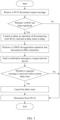
- a user triggers a Wi-Fi disconnect operation such that an electronic device receives a Wi-Fi disconnect request message.
- the electronic device first determines whether a VoWiFi service has been currently registered.
- the electronic device controls to delay an operation of disconnecting from Wi-Fi, and starts a delay timer to delay. In addition, the electronic device starts to perform a VoWiFi de-registration operation and disconnect an IKE connection. In a case that no VoWiFi service is registered, the electronic device can directly perform control to disconnect from Wi-Fi.
- the electronic device performs the VoWiFi de-registration operation and disconnects the IKE connection. Specifically, the electronic device sends a VoWiFi deregistration request message and an IKE connection disconnect request message to an IMS server, and then waits for the IMS server to return a response message indicating that the VoWiFi de-registration operation has been completed and that the internet key exchange IKE connection has been disconnected.
- the electronic device sends a notification message to a target network device and waits for the target network device to return a response message.
- the delay timer is canceled and control is performed to disconnect from Wi-Fi. Specifically, if the electronic device receives, within the maximum delay time of the delay timer, the response message returned by the target network device, the electronic device cancels the delay timer and controls to disconnect the Wi-Fi connection; and if the electronic device receives, within the maximum delay time of the delay timer, no response message returned by the target network device, the electronic device directly controls to disconnect the Wi-Fi connection.
- the Wi-Fi control method provided in the embodiments of this application may be performed by a Wi-Fi control apparatus, or a control module configured to perform the Wi-Fi control method in the Wi-Fi control method.
- the Wi-Fi control apparatus provided in the embodiments of this application is described by using an example in which the Wi-Fi control apparatus performs the Wi-Fi control method.
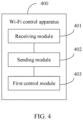
- FIG. 4 is a schematic structural diagram of a Wi-Fi control apparatus according to an embodiment of this application.
- the Wi-Fi control apparatus 400 includes:
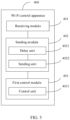
- the sending module 402 includes:
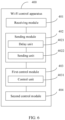
- the Wi-Fi control apparatus 400 further includes: a second control module 404, configured to: in a case that no response message for responding to the notification message is received within the preset delay time, perform control to disconnect from Wi-Fi.
- a second control module 404 configured to: in a case that no response message for responding to the notification message is received within the preset delay time, perform control to disconnect from Wi-Fi.
- the Wi-Fi control apparatus 400 further includes:
- the processing module 406 includes:
- the Wi-Fi control apparatus can receive the Wi-Fi disconnect request message; send the notification message to the target network device in response to the Wi-Fi disconnect request message, where the notification message indicates that the VoWiFi de-registration operation has been completed and that the internet key exchange IKE connection has been disconnected; and in the case that a response message for responding to the notification message is received, perform control to disconnect from Wi-Fi.
- the notification message indicating that the IKE connection has been disconnected and that the VoWiFi deregistration operation has been completed is sent to the target network device, so as to notify, in a timely manner, the target network device to release previously stored connection information and registration information. After that, whenever the electronic device reconnects to Wi-Fi, the electronic device can establish a new network connection with the target network device in a timely manner and register VoWiFi in a timely manner, thereby improving user experience.
- the Wi-Fi control apparatus in the embodiments of this application may be a device, or may be a component, an integrated circuit, or a chip in a terminal.
- the apparatus may be a mobile electronic device or a non-mobile electronic device.
- the mobile electronic device may be a mobile phone, a tablet computer, a notebook computer, a palmtop computer, a vehicle-mounted electronic device, a wearable device, an ultra-mobile personal computer (ultra-mobile personal computer, UMPC), a netbook, a personal digital assistant (personal digital assistant, PDA), or the like.
- the non-mobile electronic device may be a server, a network attached storage (Network Attached Storage, NAS), a personal computer (personal computer, PC), a television (television, TV), a teller machine, a self-service machine, or the like. This is not specifically limited in the embodiments of this application.
- the Wi-Fi control apparatus in the embodiments of this application may be an apparatus with an operating system.
- the operating system may be an Android (Android) operating system, may be an iOS operating system, or may be other possible operating systems, which is not specifically limited in the embodiments of this application.
- the Wi-Fi control apparatus provided in the embodiments of this application is capable of implementing various processes implemented in the method embodiments of FIG. 1 to FIG. 3 . To avoid repetition, details are not described again herein.
- an embodiment of this application further provides an electronic device, including a processor 1010, a memory 1009, and a program or an instruction stored in the memory 1009 and capable of running on the processor 1010.
- the program or the instruction is executed by the processor 1010, the processes of the foregoing Wi-Fi control method embodiments are implemented, with the same technical effects achieved. To avoid repetition, details are not described again herein.
- the electronic device in this embodiment of this application includes the mobile electronic device and non-mobile electronic device described above.
- FIG. 10 is a schematic diagram of a hardware structure of an electronic device according to an embodiment of this application.
- the electronic device 1000 includes but is not limited to components such as a radio frequency unit 1001, a network module 1002, an audio output unit 1003, an input unit 1004, a sensor 1005, a display unit 1006, a user input unit 1007, an interface unit 1008, a memory 1009, and a processor 1010.
- the electronic device 1000 may further include a power supply (such as a battery) that supplies power to the components.
- the power supply may be logically connected to the processor 1010 via a power management system, so that functions such as charge and discharge management and power consumption management are implemented via the power management system.
- the structure of the electronic device shown in FIG. 10 does not constitute a limitation on the electronic device.
- the electronic device may include more or fewer components than shown in the figure, or combination of some components, or the components disposed differently. Details are not described herein.
- the processor 1010 is configured to: receive a Wi-Fi disconnect request message; in response to the Wi-Fi disconnect request message, send a notification message to a target network device, where the notification message indicates that a VoWiFi de-registration operation has been completed and that an internet key exchange IKE connection has been disconnected; and in a case that a response message for responding to the notification message is received, perform control to disconnect from Wi-Fi.
- the processor 1010 is further configured to: in response to the Wi-Fi disconnect request message, start a delay timer; and
- the processor 1010 is further configured to: in a case that no response message for responding to the notification message is received within the preset delay time, perform control to disconnect from Wi-Fi.
- the processor 1010 is further configured to: determine whether VoWiFi has been registered; and in a case that it is determined that VoWiFi has been registered, complete the VoWiFi de-registration operation and disconnect the IKE connection.
- the processor 1010 is further configured to send a VoWiFi deregistration request message to an IP multimedia subsystem IMS server to cause the IMS server to release VoWiFi registration information, so as to complete the VoWiFi de-registration operation; and send an IKE connection disconnect request message to the IMS server to cause the IMS server to release IKE connection information, so as to disconnect the IKE connection.
- the electronic device provided in this embodiment of this application sends the notification message indicating that the IKE connection has been disconnected and that the VoWiFi de-registration operation has been completed to the target network device, so as to notify, in a timely manner, the target network device to release previously stored connection information and registration information. After that, whenever the electronic device reconnects to Wi-Fi, the electronic device can establish a new network connection with the target network device in a timely manner and register VoWiFi in a timely manner, thereby improving user experience.
- the input unit 1004 may include a graphics processing unit (Graphics Processing Unit, GPU) 10041 and a microphone 10042.
- the graphics processing unit 10041 processes image data of a static picture or a video obtained by an image capture apparatus (for example, a camera) in a video capture mode or an image capture mode.
- the display unit 1006 may include a display panel 10061.
- the display panel 10061 may be configured in a form of a liquid crystal display, an organic light-emitting diode, or the like.
- the user input unit 1007 includes a touch panel 10071 and other input devices 10072.
- the touch panel 10071 is also referred to as a touchscreen.
- the touch panel 10071 may include two parts: a touch detection apparatus and a touch controller.
- the other input devices 10072 may include but are not limited to a physical keyboard, a function key (such as a volume control key or a switch key), a trackball, a mouse, and a joystick. Details are not described herein.
- the memory 1009 may be configured to store software programs and various data, including but not limited to application programs and operating systems.
- the processor 1010 may integrate an application processor and a modem processor.
- the application processor mainly processes an operating system, a user interface, an application program, and the like.
- the modem processor mainly processes wireless communication. It can be understood that the modem processor may alternatively not be integrated in the processor 1010.
- An embodiment of this application further provides a readable storage medium, where the readable storage medium stores a program or an instruction, and when the program or the instruction is executed by a processor, the processes of the foregoing Wi-Fi control method embodiments are implemented, with the same technical effects achieved. To avoid repetition, details are not described again herein.
- the processor is the processor in the electronic device described in the foregoing embodiments.
- the readable storage medium includes a computer-readable storage medium such as a computer read-only memory (Read-Only Memory, ROM), a random access memory (Random Access Memory, RAM), a magnetic disk, or an optical disc.
- An embodiment of this application further provides a chip, including a processor and a communication interface, where the communication interface is coupled to the processor, and the processor is configured to run a program or an instruction to implement the processes of the foregoing Wi-Fi control method embodiments, with the same technical effects achieved. To avoid repetition, details are not described again herein.
- chip mentioned in this embodiment of this application may also be referred to as a system-on-chip, a system chip, a chip system, or the like.
- the terms “include”, “comprise”, or any of their variants are intended to cover a non-exclusive inclusion such that a process, method, article, or apparatus that includes a list of elements not only includes those elements but also includes other elements that are not expressly listed, or also includes elements inherent to such process, method, article, or apparatus.
- an element preceded by “includes a/an... " does not preclude the presence of other identical elements in the process, method, article, or apparatus that includes the element.
- the method and apparatus in the embodiments of this application are not limited to performing functions in the order shown or discussed, but may also include performing the functions at substantially the same time or in reverse order depending on the functions involved. For example, the method described may be performed in an order different from that described, where various steps may be also added, omitted, or combined.
- features described with reference to some examples may be combined in other examples.
- the method in the foregoing embodiments may be implemented by software in combination with a necessary common hardware platform, and certainly may alternatively be implemented by hardware. However, in most cases, the former is a more preferred implementation.
- the technical solutions of this application essentially, or the part contributing to the prior art may be implemented in a form of a software product.
- the computer software product is stored in a storage medium (such as a ROM/RAM, a magnetic disk, or an optical disc), and includes several instructions for instructing a terminal (which may be a mobile phone, a computer, a server, an air conditioner, a network device, or the like) to perform the method described in the embodiments of this application.
Landscapes
- Engineering & Computer Science (AREA)
- Computer Networks & Wireless Communication (AREA)
- Signal Processing (AREA)
- Multimedia (AREA)
- Business, Economics & Management (AREA)
- General Business, Economics & Management (AREA)
- Mobile Radio Communication Systems (AREA)
Applications Claiming Priority (2)
| Application Number | Priority Date | Filing Date | Title |
|---|---|---|---|
| CN202010493976.2A CN111669818B (zh) | 2020-06-03 | 2020-06-03 | Wi-Fi控制方法、装置及电子设备 |
| PCT/CN2021/097640 WO2021244519A1 (fr) | 2020-06-03 | 2021-06-01 | Procédé et appareil de commande de wi-fi et dispositif électronique |
Publications (3)
| Publication Number | Publication Date |
|---|---|
| EP4164307A1 true EP4164307A1 (fr) | 2023-04-12 |
| EP4164307A4 EP4164307A4 (fr) | 2023-11-01 |
| EP4164307B1 EP4164307B1 (fr) | 2025-12-10 |
Family
ID=72385710
Family Applications (1)
| Application Number | Title | Priority Date | Filing Date |
|---|---|---|---|
| EP21818914.0A Active EP4164307B1 (fr) | 2020-06-03 | 2021-06-01 | Procédé et appareil de commande de wi-fi |
Country Status (7)
| Country | Link |
|---|---|
| US (1) | US12396058B2 (fr) |
| EP (1) | EP4164307B1 (fr) |
| JP (1) | JP7373679B2 (fr) |
| KR (1) | KR20230010744A (fr) |
| CN (1) | CN111669818B (fr) |
| ES (1) | ES3058919T3 (fr) |
| WO (1) | WO2021244519A1 (fr) |
Families Citing this family (3)
| Publication number | Priority date | Publication date | Assignee | Title |
|---|---|---|---|---|
| CN111669818B (zh) * | 2020-06-03 | 2022-08-02 | 维沃移动通信有限公司 | Wi-Fi控制方法、装置及电子设备 |
| CN115484296B (zh) * | 2022-07-28 | 2024-11-19 | 深圳绿米联创科技有限公司 | 设备控制方法、装置、电子设备及存储介质 |
| CN119254755B (zh) * | 2024-02-29 | 2025-11-28 | 荣耀终端股份有限公司 | Ims注册方法和电子设备 |
Family Cites Families (21)
| Publication number | Priority date | Publication date | Assignee | Title |
|---|---|---|---|---|
| CN1232079C (zh) * | 2002-09-30 | 2005-12-14 | 华为技术有限公司 | 无线局域网与移动通信系统互通时的用户主动下线处理方法 |
| KR101272576B1 (ko) | 2010-12-23 | 2013-06-10 | 주식회사 케이티 | I-wlan에 접속할 수 있는 안드로이드 단말,및 안드로이드 단말의 i-wlan 접속 방법 |
| WO2016172839A1 (fr) * | 2015-04-28 | 2016-11-03 | Telefonaktiebolaget Lm Ericsson (Publ) | Vérification d'état de pair adaptative sur des réseaux locaux sans fil |
| CN105049442B (zh) * | 2015-08-11 | 2018-06-15 | 宇龙计算机通信科技(深圳)有限公司 | 一种网络切换方法及终端 |
| CN105657735B (zh) * | 2016-02-29 | 2019-08-02 | 宇龙计算机通信科技(深圳)有限公司 | 一种移动终端、网络接入控制器、网络切换方法与系统 |
| WO2017167694A1 (fr) * | 2016-03-31 | 2017-10-05 | British Telecommunications Public Limited Company | Dispositif de client de service vocal |
| US9998970B2 (en) * | 2016-04-28 | 2018-06-12 | Samsung Electronics Co., Ltd. | Fast VoWiFi handoff using IKE v2 optimization |
| EP3547769B1 (fr) * | 2016-11-27 | 2021-05-12 | LG Electronics Inc. | Procédé de désenregistrement dans un système de communication sans fil et dispositif correspondant |
| US10390277B2 (en) * | 2016-11-30 | 2019-08-20 | Samsung Electronics Co., Ltd. | MOBIKE aware LTE to Wi-Fi handoff optimization |
| JP6834482B2 (ja) * | 2016-12-28 | 2021-02-24 | ブラザー工業株式会社 | 通信装置のためのコンピュータプログラム |
| WO2018152961A1 (fr) * | 2017-02-22 | 2018-08-30 | 华为技术有限公司 | Procédé et dispositif de transmission d'informations |
| CN107026857B (zh) * | 2017-03-30 | 2023-07-14 | 京信网络系统股份有限公司 | 一种信息处理方法及网关设备 |
| CN109429253B (zh) * | 2017-07-17 | 2022-04-29 | 展讯通信(上海)有限公司 | VoWiFi业务下WiFi接入点掉网检测的方法、装置及终端 |
| US10582435B2 (en) * | 2017-07-28 | 2020-03-03 | Samsung Electronics Co., Ltd. | Method and system for handling wireless communication in voice over wireless fidelity system |
| US11128673B2 (en) * | 2017-08-04 | 2021-09-21 | Blackberry Limited | Method and system for access and use of multiple ISIM or ISIM credentials |
| CN108965306B (zh) * | 2018-07-25 | 2021-03-02 | 维沃移动通信有限公司 | 一种通话处理方法及移动终端 |
| CN110266576B (zh) * | 2019-05-06 | 2021-03-16 | 中国联合网络通信集团有限公司 | 语音通话方法及装置 |
| US11477701B2 (en) * | 2019-07-22 | 2022-10-18 | Mediatek Inc. | Apparatuses and methods for voice call service provision |
| CN113038507B (zh) * | 2019-11-28 | 2023-05-19 | 华为技术有限公司 | 一种ims注册时长管理系统及终端设备 |
| CN111147493B (zh) * | 2019-12-27 | 2022-10-21 | 宇龙计算机通信科技(深圳)有限公司 | Ims网络的注册方法、装置、存储介质及终端设备 |
| CN111669818B (zh) * | 2020-06-03 | 2022-08-02 | 维沃移动通信有限公司 | Wi-Fi控制方法、装置及电子设备 |
-
2020
- 2020-06-03 CN CN202010493976.2A patent/CN111669818B/zh active Active
-
2021
- 2021-06-01 EP EP21818914.0A patent/EP4164307B1/fr active Active
- 2021-06-01 JP JP2022573372A patent/JP7373679B2/ja active Active
- 2021-06-01 KR KR1020227044070A patent/KR20230010744A/ko active Pending
- 2021-06-01 WO PCT/CN2021/097640 patent/WO2021244519A1/fr not_active Ceased
- 2021-06-01 ES ES21818914T patent/ES3058919T3/es active Active
-
2022
- 2022-11-30 US US18/071,766 patent/US12396058B2/en active Active
Also Published As
| Publication number | Publication date |
|---|---|
| KR20230010744A (ko) | 2023-01-19 |
| EP4164307B1 (fr) | 2025-12-10 |
| WO2021244519A1 (fr) | 2021-12-09 |
| EP4164307A4 (fr) | 2023-11-01 |
| ES3058919T3 (en) | 2026-03-13 |
| CN111669818A (zh) | 2020-09-15 |
| US12396058B2 (en) | 2025-08-19 |
| US20230088033A1 (en) | 2023-03-23 |
| CN111669818B (zh) | 2022-08-02 |
| JP7373679B2 (ja) | 2023-11-02 |
| JP2023527858A (ja) | 2023-06-30 |
Similar Documents
| Publication | Publication Date | Title |
|---|---|---|
| US12396058B2 (en) | Wi-Fi control method and apparatus and electronic device | |
| US20240089304A1 (en) | Voice Call Method and User Equipment | |
| CN109803347B (zh) | 一种业务处理方法及移动通信终端 | |
| US12185097B2 (en) | Method of controlling location acquisition, user terminal and device | |
| WO2020057361A1 (fr) | Procédé de rapport d'informations, procédé de réception d'informations, terminal et dispositif de réseau | |
| CN105916100A (zh) | 代理心跳包的方法、装置和通信系统 | |
| CN113365234B (zh) | 呼叫方法、装置及电子设备 | |
| CN110062372A (zh) | 一种sim卡控制方法及终端设备 | |
| KR20220103146A (ko) | 멀티캐스트 서비스의 전송 방법, 전송 처리 방법 및 관련 장치 | |
| CN111436090A (zh) | Plmn同步方法、终端及存储介质 | |
| JP2023508739A5 (fr) | ||
| CN111800835A (zh) | 切换配置方法、网络设备、终端设备及存储介质 | |
| CN111246449A (zh) | 一种通信状态更新方法及设备 | |
| US20250220535A1 (en) | Network connection method and apparatus, electronic device, and readable storage medium | |
| US20250240690A1 (en) | Paging method and apparatus, electronic device, and storage medium | |
| US20250168915A1 (en) | Network connection method, electronic device, readable storage medium, and chip | |
| WO2019237954A1 (fr) | Procédé et dispositif de connexion à un réseau, support de stockage lisible et terminal intelligent | |
| CN113079500B (zh) | 一种终端激活方法、装置、存储介质及电子设备 | |
| KR102929389B1 (ko) | 통화 처리 방법, 장치, 전자기기 및 저장매체 | |
| CN112770388A (zh) | 一种信息管理系统注册方法、终端及计算机可读存储介质 | |
| CN116962356A (zh) | 通信异常恢复方法、装置、介质及设备 | |
| WO2023185929A1 (fr) | Procédé et appareil de commande de ressources, terminal et dispositif côté réseau | |
| CN117221863A (zh) | 一种快速建立紧急呼叫方法、装置、电子设备和存储介质 | |
| CN112153723B (zh) | 网络接入方法及装置 | |
| CN112566205B (zh) | 通信业务的处理方法及装置 |
Legal Events
| Date | Code | Title | Description |
|---|---|---|---|
| STAA | Information on the status of an ep patent application or granted ep patent |
Free format text: STATUS: THE INTERNATIONAL PUBLICATION HAS BEEN MADE |
|
| PUAI | Public reference made under article 153(3) epc to a published international application that has entered the european phase |
Free format text: ORIGINAL CODE: 0009012 |
|
| STAA | Information on the status of an ep patent application or granted ep patent |
Free format text: STATUS: REQUEST FOR EXAMINATION WAS MADE |
|
| 17P | Request for examination filed |
Effective date: 20221215 |
|
| AK | Designated contracting states |
Kind code of ref document: A1 Designated state(s): AL AT BE BG CH CY CZ DE DK EE ES FI FR GB GR HR HU IE IS IT LI LT LU LV MC MK MT NL NO PL PT RO RS SE SI SK SM TR |
|
| DAV | Request for validation of the european patent (deleted) | ||
| DAX | Request for extension of the european patent (deleted) | ||
| A4 | Supplementary search report drawn up and despatched |
Effective date: 20231005 |
|
| RIC1 | Information provided on ipc code assigned before grant |
Ipc: H04W 84/12 20090101ALN20230928BHEP Ipc: H04W 76/32 20180101ALN20230928BHEP Ipc: H04W 12/041 20210101ALN20230928BHEP Ipc: H04W 60/06 20090101AFI20230928BHEP |
|
| GRAP | Despatch of communication of intention to grant a patent |
Free format text: ORIGINAL CODE: EPIDOSNIGR1 |
|
| RIC1 | Information provided on ipc code assigned before grant |
Ipc: H04W 60/06 20090101AFI20250822BHEP Ipc: H04W 12/041 20210101ALN20250822BHEP Ipc: H04W 76/32 20180101ALN20250822BHEP Ipc: H04W 84/12 20090101ALN20250822BHEP |
|
| STAA | Information on the status of an ep patent application or granted ep patent |
Free format text: STATUS: GRANT OF PATENT IS INTENDED |
|
| RIC1 | Information provided on ipc code assigned before grant |
Ipc: H04W 60/06 20090101AFI20250901BHEP Ipc: H04W 12/041 20210101ALN20250901BHEP Ipc: H04W 76/32 20180101ALN20250901BHEP Ipc: H04W 84/12 20090101ALN20250901BHEP |
|
| RIC1 | Information provided on ipc code assigned before grant |
Ipc: H04W 60/06 20090101AFI20250908BHEP Ipc: H04W 12/041 20210101ALN20250908BHEP Ipc: H04W 76/32 20180101ALN20250908BHEP Ipc: H04W 84/12 20090101ALN20250908BHEP |
|
| RIC1 | Information provided on ipc code assigned before grant |
Ipc: H04W 60/06 20090101AFI20250918BHEP Ipc: H04W 12/041 20210101ALN20250918BHEP Ipc: H04W 76/32 20180101ALN20250918BHEP Ipc: H04W 84/12 20090101ALN20250918BHEP |
|
| GRAS | Grant fee paid |
Free format text: ORIGINAL CODE: EPIDOSNIGR3 |
|
| INTG | Intention to grant announced |
Effective date: 20251001 |
|
| GRAA | (expected) grant |
Free format text: ORIGINAL CODE: 0009210 |
|
| STAA | Information on the status of an ep patent application or granted ep patent |
Free format text: STATUS: THE PATENT HAS BEEN GRANTED |
|
| AK | Designated contracting states |
Kind code of ref document: B1 Designated state(s): AL AT BE BG CH CY CZ DE DK EE ES FI FR GB GR HR HU IE IS IT LI LT LU LV MC MK MT NL NO PL PT RO RS SE SI SK SM TR |
|
| REG | Reference to a national code |
Ref country code: CH Ref legal event code: F10 Free format text: ST27 STATUS EVENT CODE: U-0-0-F10-F00 (AS PROVIDED BY THE NATIONAL OFFICE) Effective date: 20251210 Ref country code: GB Ref legal event code: FG4D |
|
| REG | Reference to a national code |
Ref country code: DE Ref legal event code: R096 Ref document number: 602021044254 Country of ref document: DE |
|
| REG | Reference to a national code |
Ref country code: IE Ref legal event code: FG4D |
|
| REG | Reference to a national code |
Ref country code: NL Ref legal event code: FP |
|
| REG | Reference to a national code |
Ref country code: ES Ref legal event code: FG2A Ref document number: 3058919 Country of ref document: ES Kind code of ref document: T3 Effective date: 20260313 |
|
| REG | Reference to a national code |
Ref country code: LT Ref legal event code: MG9D |
|
| PG25 | Lapsed in a contracting state [announced via postgrant information from national office to epo] |
Ref country code: NO Free format text: LAPSE BECAUSE OF FAILURE TO SUBMIT A TRANSLATION OF THE DESCRIPTION OR TO PAY THE FEE WITHIN THE PRESCRIBED TIME-LIMIT Effective date: 20260310 |
|
| PG25 | Lapsed in a contracting state [announced via postgrant information from national office to epo] |
Ref country code: HR Free format text: LAPSE BECAUSE OF FAILURE TO SUBMIT A TRANSLATION OF THE DESCRIPTION OR TO PAY THE FEE WITHIN THE PRESCRIBED TIME-LIMIT Effective date: 20251210 Ref country code: FI Free format text: LAPSE BECAUSE OF FAILURE TO SUBMIT A TRANSLATION OF THE DESCRIPTION OR TO PAY THE FEE WITHIN THE PRESCRIBED TIME-LIMIT Effective date: 20251210 |
|
| PG25 | Lapsed in a contracting state [announced via postgrant information from national office to epo] |
Ref country code: RS Free format text: LAPSE BECAUSE OF FAILURE TO SUBMIT A TRANSLATION OF THE DESCRIPTION OR TO PAY THE FEE WITHIN THE PRESCRIBED TIME-LIMIT Effective date: 20260310 |
|
| PG25 | Lapsed in a contracting state [announced via postgrant information from national office to epo] |
Ref country code: LV Free format text: LAPSE BECAUSE OF FAILURE TO SUBMIT A TRANSLATION OF THE DESCRIPTION OR TO PAY THE FEE WITHIN THE PRESCRIBED TIME-LIMIT Effective date: 20251210 |