EP4165015B1 - Aminosäurebasierte polymerisierbare verbindungen und daraus hergestellte ophthalmische vorrichtungen - Google Patents
Aminosäurebasierte polymerisierbare verbindungen und daraus hergestellte ophthalmische vorrichtungen Download PDFInfo
- Publication number
- EP4165015B1 EP4165015B1 EP21731298.2A EP21731298A EP4165015B1 EP 4165015 B1 EP4165015 B1 EP 4165015B1 EP 21731298 A EP21731298 A EP 21731298A EP 4165015 B1 EP4165015 B1 EP 4165015B1
- Authority
- EP
- European Patent Office
- Prior art keywords
- alkylene
- ophthalmic device
- alkyl
- vinyl
- meth
- Prior art date
- Legal status (The legal status is an assumption and is not a legal conclusion. Google has not performed a legal analysis and makes no representation as to the accuracy of the status listed.)
- Active
Links
Classifications
-
- C—CHEMISTRY; METALLURGY
- C07—ORGANIC CHEMISTRY
- C07C—ACYCLIC OR CARBOCYCLIC COMPOUNDS
- C07C279/00—Derivatives of guanidine, i.e. compounds containing the group, the singly-bound nitrogen atoms not being part of nitro or nitroso groups
- C07C279/04—Derivatives of guanidine, i.e. compounds containing the group, the singly-bound nitrogen atoms not being part of nitro or nitroso groups having nitrogen atoms of guanidine groups bound to acyclic carbon atoms of a carbon skeleton
- C07C279/14—Derivatives of guanidine, i.e. compounds containing the group, the singly-bound nitrogen atoms not being part of nitro or nitroso groups having nitrogen atoms of guanidine groups bound to acyclic carbon atoms of a carbon skeleton being further substituted by carboxyl groups
-
- A—HUMAN NECESSITIES
- A61—MEDICAL OR VETERINARY SCIENCE; HYGIENE
- A61F—FILTERS IMPLANTABLE INTO BLOOD VESSELS; PROSTHESES; DEVICES PROVIDING PATENCY TO, OR PREVENTING COLLAPSING OF, TUBULAR STRUCTURES OF THE BODY, e.g. STENTS; ORTHOPAEDIC, NURSING OR CONTRACEPTIVE DEVICES; FOMENTATION; TREATMENT OR PROTECTION OF EYES OR EARS; BANDAGES, DRESSINGS OR ABSORBENT PADS; FIRST-AID KITS
- A61F2/00—Filters implantable into blood vessels; Prostheses, i.e. artificial substitutes or replacements for parts of the body; Appliances for connecting them with the body; Devices providing patency to, or preventing collapsing of, tubular structures of the body, e.g. stents
- A61F2/02—Prostheses implantable into the body
- A61F2/14—Eye parts, e.g. lenses or corneal implants; Artificial eyes
- A61F2/16—Intraocular lenses
-
- C—CHEMISTRY; METALLURGY
- C07—ORGANIC CHEMISTRY
- C07C—ACYCLIC OR CARBOCYCLIC COMPOUNDS
- C07C233/00—Carboxylic acid amides
- C07C233/01—Carboxylic acid amides having carbon atoms of carboxamide groups bound to hydrogen atoms or to acyclic carbon atoms
- C07C233/45—Carboxylic acid amides having carbon atoms of carboxamide groups bound to hydrogen atoms or to acyclic carbon atoms having the nitrogen atom of at least one of the carboxamide groups bound to a carbon atom of a hydrocarbon radical substituted by carboxyl groups
- C07C233/46—Carboxylic acid amides having carbon atoms of carboxamide groups bound to hydrogen atoms or to acyclic carbon atoms having the nitrogen atom of at least one of the carboxamide groups bound to a carbon atom of a hydrocarbon radical substituted by carboxyl groups with the substituted hydrocarbon radical bound to the nitrogen atom of the carboxamide group by an acyclic carbon atom
- C07C233/49—Carboxylic acid amides having carbon atoms of carboxamide groups bound to hydrogen atoms or to acyclic carbon atoms having the nitrogen atom of at least one of the carboxamide groups bound to a carbon atom of a hydrocarbon radical substituted by carboxyl groups with the substituted hydrocarbon radical bound to the nitrogen atom of the carboxamide group by an acyclic carbon atom having the carbon atom of the carboxamide group bound to a carbon atom of an acyclic unsaturated carbon skeleton
-
- C—CHEMISTRY; METALLURGY
- C07—ORGANIC CHEMISTRY
- C07C—ACYCLIC OR CARBOCYCLIC COMPOUNDS
- C07C237/00—Carboxylic acid amides, the carbon skeleton of the acid part being further substituted by amino groups
- C07C237/02—Carboxylic acid amides, the carbon skeleton of the acid part being further substituted by amino groups having the carbon atoms of the carboxamide groups bound to acyclic carbon atoms of the carbon skeleton
- C07C237/22—Carboxylic acid amides, the carbon skeleton of the acid part being further substituted by amino groups having the carbon atoms of the carboxamide groups bound to acyclic carbon atoms of the carbon skeleton having nitrogen atoms of amino groups bound to the carbon skeleton of the acid part, further acylated
-
- C—CHEMISTRY; METALLURGY
- C07—ORGANIC CHEMISTRY
- C07C—ACYCLIC OR CARBOCYCLIC COMPOUNDS
- C07C309/00—Sulfonic acids; Halides, esters, or anhydrides thereof
- C07C309/01—Sulfonic acids
- C07C309/02—Sulfonic acids having sulfo groups bound to acyclic carbon atoms
- C07C309/03—Sulfonic acids having sulfo groups bound to acyclic carbon atoms of an acyclic saturated carbon skeleton
- C07C309/13—Sulfonic acids having sulfo groups bound to acyclic carbon atoms of an acyclic saturated carbon skeleton containing nitrogen atoms, not being part of nitro or nitroso groups, bound to the carbon skeleton
- C07C309/14—Sulfonic acids having sulfo groups bound to acyclic carbon atoms of an acyclic saturated carbon skeleton containing nitrogen atoms, not being part of nitro or nitroso groups, bound to the carbon skeleton containing amino groups bound to the carbon skeleton
- C07C309/15—Sulfonic acids having sulfo groups bound to acyclic carbon atoms of an acyclic saturated carbon skeleton containing nitrogen atoms, not being part of nitro or nitroso groups, bound to the carbon skeleton containing amino groups bound to the carbon skeleton the nitrogen atom of at least one of the amino groups being part of any of the groups, X being a hetero atom, Y being any atom
-
- C—CHEMISTRY; METALLURGY
- C07—ORGANIC CHEMISTRY
- C07C—ACYCLIC OR CARBOCYCLIC COMPOUNDS
- C07C309/00—Sulfonic acids; Halides, esters, or anhydrides thereof
- C07C309/01—Sulfonic acids
- C07C309/02—Sulfonic acids having sulfo groups bound to acyclic carbon atoms
- C07C309/03—Sulfonic acids having sulfo groups bound to acyclic carbon atoms of an acyclic saturated carbon skeleton
- C07C309/17—Sulfonic acids having sulfo groups bound to acyclic carbon atoms of an acyclic saturated carbon skeleton containing carboxyl groups bound to the carbon skeleton
- C07C309/18—Sulfonic acids having sulfo groups bound to acyclic carbon atoms of an acyclic saturated carbon skeleton containing carboxyl groups bound to the carbon skeleton containing amino groups bound to the same carbon skeleton
-
- C—CHEMISTRY; METALLURGY
- C07—ORGANIC CHEMISTRY
- C07C—ACYCLIC OR CARBOCYCLIC COMPOUNDS
- C07C323/00—Thiols, sulfides, hydropolysulfides or polysulfides substituted by halogen, oxygen or nitrogen atoms, or by sulfur atoms not being part of thio groups
- C07C323/50—Thiols, sulfides, hydropolysulfides or polysulfides substituted by halogen, oxygen or nitrogen atoms, or by sulfur atoms not being part of thio groups containing thio groups and carboxyl groups bound to the same carbon skeleton
- C07C323/51—Thiols, sulfides, hydropolysulfides or polysulfides substituted by halogen, oxygen or nitrogen atoms, or by sulfur atoms not being part of thio groups containing thio groups and carboxyl groups bound to the same carbon skeleton having the sulfur atoms of the thio groups bound to acyclic carbon atoms of the carbon skeleton
- C07C323/57—Thiols, sulfides, hydropolysulfides or polysulfides substituted by halogen, oxygen or nitrogen atoms, or by sulfur atoms not being part of thio groups containing thio groups and carboxyl groups bound to the same carbon skeleton having the sulfur atoms of the thio groups bound to acyclic carbon atoms of the carbon skeleton the carbon skeleton being further substituted by nitrogen atoms, not being part of nitro or nitroso groups
- C07C323/58—Thiols, sulfides, hydropolysulfides or polysulfides substituted by halogen, oxygen or nitrogen atoms, or by sulfur atoms not being part of thio groups containing thio groups and carboxyl groups bound to the same carbon skeleton having the sulfur atoms of the thio groups bound to acyclic carbon atoms of the carbon skeleton the carbon skeleton being further substituted by nitrogen atoms, not being part of nitro or nitroso groups with amino groups bound to the carbon skeleton
-
- C—CHEMISTRY; METALLURGY
- C07—ORGANIC CHEMISTRY
- C07C—ACYCLIC OR CARBOCYCLIC COMPOUNDS
- C07C323/00—Thiols, sulfides, hydropolysulfides or polysulfides substituted by halogen, oxygen or nitrogen atoms, or by sulfur atoms not being part of thio groups
- C07C323/50—Thiols, sulfides, hydropolysulfides or polysulfides substituted by halogen, oxygen or nitrogen atoms, or by sulfur atoms not being part of thio groups containing thio groups and carboxyl groups bound to the same carbon skeleton
- C07C323/51—Thiols, sulfides, hydropolysulfides or polysulfides substituted by halogen, oxygen or nitrogen atoms, or by sulfur atoms not being part of thio groups containing thio groups and carboxyl groups bound to the same carbon skeleton having the sulfur atoms of the thio groups bound to acyclic carbon atoms of the carbon skeleton
- C07C323/57—Thiols, sulfides, hydropolysulfides or polysulfides substituted by halogen, oxygen or nitrogen atoms, or by sulfur atoms not being part of thio groups containing thio groups and carboxyl groups bound to the same carbon skeleton having the sulfur atoms of the thio groups bound to acyclic carbon atoms of the carbon skeleton the carbon skeleton being further substituted by nitrogen atoms, not being part of nitro or nitroso groups
- C07C323/58—Thiols, sulfides, hydropolysulfides or polysulfides substituted by halogen, oxygen or nitrogen atoms, or by sulfur atoms not being part of thio groups containing thio groups and carboxyl groups bound to the same carbon skeleton having the sulfur atoms of the thio groups bound to acyclic carbon atoms of the carbon skeleton the carbon skeleton being further substituted by nitrogen atoms, not being part of nitro or nitroso groups with amino groups bound to the carbon skeleton
- C07C323/59—Thiols, sulfides, hydropolysulfides or polysulfides substituted by halogen, oxygen or nitrogen atoms, or by sulfur atoms not being part of thio groups containing thio groups and carboxyl groups bound to the same carbon skeleton having the sulfur atoms of the thio groups bound to acyclic carbon atoms of the carbon skeleton the carbon skeleton being further substituted by nitrogen atoms, not being part of nitro or nitroso groups with amino groups bound to the carbon skeleton with acylated amino groups bound to the carbon skeleton
-
- C—CHEMISTRY; METALLURGY
- C07—ORGANIC CHEMISTRY
- C07D—HETEROCYCLIC COMPOUNDS
- C07D209/00—Heterocyclic compounds containing five-membered rings, condensed with other rings, with one nitrogen atom as the only ring hetero atom
- C07D209/02—Heterocyclic compounds containing five-membered rings, condensed with other rings, with one nitrogen atom as the only ring hetero atom condensed with one carbocyclic ring
- C07D209/04—Indoles; Hydrogenated indoles
- C07D209/10—Indoles; Hydrogenated indoles with substituted hydrocarbon radicals attached to carbon atoms of the hetero ring
- C07D209/18—Radicals substituted by carbon atoms having three bonds to hetero atoms with at the most one bond to halogen, e.g. ester or nitrile radicals
- C07D209/20—Radicals substituted by carbon atoms having three bonds to hetero atoms with at the most one bond to halogen, e.g. ester or nitrile radicals substituted additionally by nitrogen atoms, e.g. tryptophane
-
- C—CHEMISTRY; METALLURGY
- C07—ORGANIC CHEMISTRY
- C07D—HETEROCYCLIC COMPOUNDS
- C07D233/00—Heterocyclic compounds containing 1,3-diazole or hydrogenated 1,3-diazole rings, not condensed with other rings
- C07D233/54—Heterocyclic compounds containing 1,3-diazole or hydrogenated 1,3-diazole rings, not condensed with other rings having two double bonds between ring members or between ring members and non-ring members
- C07D233/64—Heterocyclic compounds containing 1,3-diazole or hydrogenated 1,3-diazole rings, not condensed with other rings having two double bonds between ring members or between ring members and non-ring members with substituted hydrocarbon radicals attached to ring carbon atoms, e.g. histidine
-
- C—CHEMISTRY; METALLURGY
- C07—ORGANIC CHEMISTRY
- C07F—ACYCLIC, CARBOCYCLIC OR HETEROCYCLIC COMPOUNDS CONTAINING ELEMENTS OTHER THAN CARBON, HYDROGEN, HALOGEN, OXYGEN, NITROGEN, SULFUR, SELENIUM OR TELLURIUM
- C07F7/00—Compounds containing elements of Groups 4 or 14 of the Periodic Table
- C07F7/02—Silicon compounds
- C07F7/08—Compounds having one or more C—Si linkages
- C07F7/0834—Compounds having one or more O-Si linkage
- C07F7/0838—Compounds with one or more Si-O-Si sequences
-
- C—CHEMISTRY; METALLURGY
- C07—ORGANIC CHEMISTRY
- C07F—ACYCLIC, CARBOCYCLIC OR HETEROCYCLIC COMPOUNDS CONTAINING ELEMENTS OTHER THAN CARBON, HYDROGEN, HALOGEN, OXYGEN, NITROGEN, SULFUR, SELENIUM OR TELLURIUM
- C07F7/00—Compounds containing elements of Groups 4 or 14 of the Periodic Table
- C07F7/02—Silicon compounds
- C07F7/08—Compounds having one or more C—Si linkages
- C07F7/18—Compounds having one or more C—Si linkages as well as one or more C—O—Si linkages
- C07F7/1804—Compounds having Si-O-C linkages
-
- C—CHEMISTRY; METALLURGY
- C08—ORGANIC MACROMOLECULAR COMPOUNDS; THEIR PREPARATION OR CHEMICAL WORKING-UP; COMPOSITIONS BASED THEREON
- C08F—MACROMOLECULAR COMPOUNDS OBTAINED BY REACTIONS ONLY INVOLVING CARBON-TO-CARBON UNSATURATED BONDS
- C08F230/00—Copolymers of compounds having one or more unsaturated aliphatic radicals, each having only one carbon-to-carbon double bond, and containing phosphorus, selenium, tellurium or a metal
- C08F230/04—Copolymers of compounds having one or more unsaturated aliphatic radicals, each having only one carbon-to-carbon double bond, and containing phosphorus, selenium, tellurium or a metal containing a metal
- C08F230/08—Copolymers of compounds having one or more unsaturated aliphatic radicals, each having only one carbon-to-carbon double bond, and containing phosphorus, selenium, tellurium or a metal containing a metal containing silicon
-
- C—CHEMISTRY; METALLURGY
- C08—ORGANIC MACROMOLECULAR COMPOUNDS; THEIR PREPARATION OR CHEMICAL WORKING-UP; COMPOSITIONS BASED THEREON
- C08F—MACROMOLECULAR COMPOUNDS OBTAINED BY REACTIONS ONLY INVOLVING CARBON-TO-CARBON UNSATURATED BONDS
- C08F283/00—Macromolecular compounds obtained by polymerising monomers on to polymers provided for in subclass C08G
- C08F283/12—Macromolecular compounds obtained by polymerising monomers on to polymers provided for in subclass C08G on to polysiloxanes
-
- G—PHYSICS
- G02—OPTICS
- G02B—OPTICAL ELEMENTS, SYSTEMS OR APPARATUS
- G02B1/00—Optical elements characterised by the material of which they are made; Optical coatings for optical elements
- G02B1/04—Optical elements characterised by the material of which they are made; Optical coatings for optical elements made of organic materials, e.g. plastics
- G02B1/041—Lenses
- G02B1/043—Contact lenses
-
- G—PHYSICS
- G02—OPTICS
- G02C—SPECTACLES; SUNGLASSES OR GOGGLES INSOFAR AS THEY HAVE THE SAME FEATURES AS SPECTACLES; CONTACT LENSES
- G02C7/00—Optical parts
- G02C7/02—Lenses; Lens systems ; Methods of designing lenses
- G02C7/04—Contact lenses for the eyes
- G02C7/049—Contact lenses having special fitting or structural features achieved by special materials or material structures
Definitions
- the invention relates to ophthalmic devices made from amino acid-based polymerizable compounds.
- WO2013/142058A1 relates to fast curable, alpha, beta-unsaturated amido-containing organosilicon compositions useful for the production of biomedical devices, especially contact lenses, therefrom.
- WO2013/096604A1 relates to ionic silicone hydrogels having an exceptional balance of properties which are generated by controlling the reaction kinetics of the components of the reaction mixture.
- WO2018/009311A1 relates to ionic silicone hydrogels displaying improved biocompatibility.
- the invention is defined by the appended claims.
- the invention relates to ophthalmic devices, such as contact lenses, comprising amino acid-based polymerizable compounds.
- the compounds may, for instance, be incorporated into the covalent structure of an ophthalmic device, or they be polymerized and used as coatings or non-covalently linked additives to the ophthalmic device.
- Resultant ophthalmic devices exhibit favorable properties, including increased water content, which is particularly desirable in hydrogel contact lenses.
- the amino acid-based polymerizable compound is incorporated in the ophthalmic device via grafting.
- (meth) designates optional methyl substitution.
- a term such as “(meth)acrylates” denotes both methacrylates and acrylates.
- the term "individual” includes humans and vertebrates.
- ophthalmic device refers to any device which resides in or on the eye or any part of the eye, including the ocular surface. These devices can provide optical correction, cosmetic enhancement, vision enhancement, therapeutic benefit (for example as bandages) or delivery of active components such as pharmaceutical and nutraceutical components, or a combination of any of the foregoing. Examples of ophthalmic devices include but are not limited to lenses, optical and ocular inserts, including but not limited to punctal plugs, and the like. "Lenses" include soft contact lenses, hard contact lenses, hybrid contact lenses, intraocular lenses, and overlay lenses. The ophthalmic device may comprise a contact lens.
- contact lens refers to an ophthalmic device that can be placed on the cornea of an individual's eye.
- the contact lens may provide corrective, cosmetic, or therapeutic benefit, including wound healing, the delivery of drugs or nutraceuticals, diagnostic evaluation or monitoring, ultraviolet light absorbing, visible light or glare reduction, or any combination thereof.
- a contact lens can be of any appropriate material known in the art and can be a soft lens, a hard lens, or a hybrid lens containing at least two distinct portions with different physical, mechanical, or optical properties, such as modulus, water content, light transmission, or combinations thereof.
- the ophthalmic devices of the present invention may be comprised of silicone hydrogels or conventional hydrogels.
- Silicone hydrogels typically contain at least one hydrophilic monomer and at least one silicone-containing component that are covalently bound to one another in the cured device.
- Target macromolecule means the macromolecule being synthesized from the reactive monomer mixture comprising monomers, macromers, prepolymers, cross-linkers, initiators, additives, diluents, and the like.
- polymerizable compound means a compound containing one or more polymerizable groups.
- the term encompasses, for instance, monomers, macromers, oligomers, prepolymers, cross-linkers, and the like.
- Polymerizable groups are groups that can undergo chain growth polymerization, such as free radical and/or cationic polymerization, for example a carbon-carbon double bond which can polymerize when subjected to radical polymerization initiation conditions.
- free radical polymerizable groups include (meth)acrylates, styrenes, vinyl ethers, (meth)acrylamides, N -vinyllactams, N -vinylamides, O-vinylcarbamates, O-vinylcarbonates, and other vinyl groups.
- the free radical polymerizable groups comprise (meth)acrylate, (meth)acrylamide, N-vinyl lactam, N-vinylamide, and styryl functional groups, and mixtures of any of the foregoing. More preferably, the free radical polymerizable groups comprise (meth)acrylates, (meth)acrylamides, and mixtures thereof.
- the polymerizable group may be optionally substituted. For instance, the nitrogen atom in (meth)acrylamide may be bonded to a hydrogen, or the hydrogen may be replaced with alkyl or cycloalkyl (which themselves may be further substituted).
- Any type of free radical polymerization may be used including but not limited to bulk, solution, suspension, and emulsion as well as any of the controlled radical polymerization methods such as stable free radical polymerization, nitroxide-mediated living polymerization, atom transfer radical polymerization, reversible addition fragmentation chain transfer polymerization, organotellurium mediated living radical polymerization, and the like.
- a “monomer” is a mono-functional molecule which can undergo chain growth polymerization, and in particular, free radical polymerization, thereby creating a repeating unit in the chemical structure of the target macromolecule. Some monomers have di-functional impurities that can act as cross-linking agents.
- a “hydrophilic monomer” is also a monomer which yields a clear single phase solution when mixed with deionized water at 25°C at a concentration of 5 weight percent.
- a “hydrophilic component” is a monomer, macromer, prepolymer, initiator, cross-linker, additive, or polymer which yields a clear single phase solution when mixed with deionized water at 25°C at a concentration of 5 weight percent.
- a “hydrophobic component” is a monomer, macromer, prepolymer, initiator, cross-linker, additive, or polymer which is slightly soluble or insoluble in deionized water at 25°C.
- a “macromolecule” is an organic compound having a number average molecular weight of greater than 1500, and may be reactive or non-reactive.
- a “macromonomer” or “macromer” is a macromolecule that has one group that can undergo chain growth polymerization, and in particular, free radical polymerization, thereby creating a repeating unit in the chemical structure of the target macromolecule.
- the chemical structure of the macromer is different than the chemical structure of the target macromolecule, that is, the repeating unit of the macromer's pendent group is different than the repeating unit of the target macromolecule or its mainchain.
- the difference between a monomer and a macromer is merely one of chemical structure, molecular weight, and molecular weight distribution of the pendent group.
- monomers as polymerizable compounds having relatively low molecular weights of about 1,500 Daltons or less, which inherently includes some macromers.
- a "silicone-containing component” is a monomer, macromer, prepolymer, cross-linker, initiator, additive, or polymer in the reactive mixture with at least one silicon-oxygen bond, typically in the form of siloxy groups, siloxane groups, carbosiloxane groups, and mixtures thereof.
- silicone-containing components which are useful in this invention may be found in U.S. Patent Nos. 3,808,178 , 4,120,570 , 4,136,250 , 4,153,641 , 4,740,533 , 5,034,461 , 5,070,215 , 5,244,981 , 5,314,960 , 5,331,067 , 5,371,147 , 5,760,100 , 5,849,811 , 5,962,548 , 5,965,631 , 5,998,498 , 6,367,929 , 6,822,016 , 6,943,203 , 6,951,894 , 7,052,131 , 7,247,692 , 7,396,890 , 7,461,937 , 7,468,398 , 7,538,146 , 7,553,880 , 7,572,841 , 7,666,921 , 7,691,916 , 7,786,185 , 7,825,170 , 7,915,323 , 7,994,356
- a "polymer” is a target macromolecule composed of the repeating units of the monomers used during polymerization.
- a “homopolymer” is a polymer made from one monomer; a “copolymer” is a polymer made from two or more monomers; a “terpolymer” is a polymer made from three monomers.
- a “block copolymer” is composed of compositionally different blocks or segments. Diblock copolymers have two blocks. Triblock copolymers have three blocks. "Comb or graft copolymers” are made from at least one macromer.
- a “repeating unit” is the smallest group of atoms in a polymer that corresponds to the polymerization of a specific monomer or macromer.
- an “initiator” is a molecule that can decompose into radicals which can subsequently react with a monomer to initiate a free radical polymerization reaction.
- a thermal initiator decomposes at a certain rate depending on the temperature; typical examples are azo compounds such as 1,1'-azobisisobutyronitrile and 4,4'-azobis(4-cyanovaleric acid), peroxides such as benzoyl peroxide, tert-butyl peroxide, tert-butyl hydroperoxide, tert-butyl peroxybenzoate, dicumyl peroxide, and lauroyl peroxide, peracids such as peracetic acid and potassium persulfate as well as various redox systems.
- a photo-initiator decomposes by a photochemical process; typical examples are derivatives of benzil, benzoin, acetophenone, benzophenone, camphorquinone, and mixtures thereof as well as various monoacyl and bisacyl phosphine oxides and combinations thereof.
- a "cross-linking agent” is a di-functional or multi-functional monomer or macromer which can undergo free radical polymerization at two or more locations on the molecule, thereby creating branch points and a polymeric network.
- Common examples are ethylene glycol dimethacrylate, tetraethylene glycol dimethacrylate, trimethylolpropane trimethacrylate, methylene bisacrylamide, triallyl cyanurate, and the like.
- a "prepolymer” is a reaction product of monomers which contains remaining polymerizable groups capable of undergoing further reaction to form a polymer.
- a “polymeric network” is a cross-linked macromolecule that can swell but cannot dissolve in solvents.
- “Hydrogels” are polymeric networks that swell in water or aqueous solutions, typically absorbing at least 10 weight percent water.
- “Silicone hydrogels” are hydrogels that are made from at least one silicone-containing component with at least one hydrophilic component. Hydrophilic components may also include non-reactive polymers.
- Conventional hydrogels refer to polymeric networks made from components without any siloxy, siloxane or carbosiloxane groups.
- Conventional hydrogels are prepared from reactive mixtures comprising hydrophilic monomers. Examples include 2-hydroxyethyl methacrylate (“HEMA”), N-vinyl pyrrolidone (“NVP”), N, N-dimethylacrylamide (“DMA”) or vinyl acetate.
- HEMA 2-hydroxyethyl methacrylate
- NDP N-vinyl pyrrolidone
- DMA N-dimethylacrylamide
- Conventional hydrogels may include additives such as polyvinyl pyrrolidone, and comonomers including polymerizable derivatives of phosphoryl choline, methacrylic acid and the like.
- Commercially available conventional hydrogels include, but are not limited to, etafilcon, genfilcon, hilafilcon, lenefilcon, nesofilcon, omafilcon, polymacon, and vifilcon, including all of their variants.
- Silicone hydrogels refer to polymeric networks made from at least one hydrophilic component and at least one silicone-containing component.
- suitable families of hydrophilic components that may be present in the reactive mixture include (meth)acrylates, styrenes, vinyl ethers, (meth)acrylamides, N-vinyl lactams, N-vinyl amides, N-vinyl imides, N-vinyl ureas, O-vinyl carbamates, O-vinyl carbonates, other hydrophilic vinyl compounds, and mixtures thereof. Silicone-containing components are well known and have been extensively described in the patent literature.
- the silicone-containing component may comprise at least one polymerizable group (e.g., a (meth)acrylate, a styryl, a vinyl ether, a (meth)acrylamide, an N-vinyl lactam, an N-vinylamide, an O-vinylcarbamate, an O-vinylcarbonate, a vinyl group, or mixtures of the foregoing), at least one siloxane group, and one or more linking groups (which may be a bond) connecting the polymerizable group(s) to the siloxane group(s).
- the silicone-containing components may, for instance, contain from 1 to 220 siloxane repeat units.
- the silicone-containing component may also contain at least one fluorine atom.
- Silicone hydrogel lenses may contain a coating, and the coating may be the same or different material from the substrate.
- silicone hydrogels examples include acquafilcon, asmofilcon, balafilcon, comfilcon, delefilcon, enfilcon, fanfilcon, formofilcon, galyfilcon, lotrafilcon, narafilcon, riofilcon, samfilcon, senofilcon, somofilcon, and stenfilcon, including all of their variants, as well as silicone hydrogels as prepared in US Patent Nos.
- An “interpenetrating polymeric network” comprises two or more networks which are at least partially interlaced on the molecular scale but not covalently bonded to each other and which cannot be separated without braking chemical bonds.
- a “semi-interpenetrating polymeric network” comprises one or more networks and one or more polymers characterized by some mixing on the molecular level between at least one network and at least one polymer. A mixture of different polymers is a "polymer blend.”
- a semi-interpenetrating network is technically a polymer blend, but in some cases, the polymers are so entangled that they cannot be readily removed.
- reactive mixture and “reactive monomer mixture” refer to the mixture of components (both reactive and non-reactive) which are mixed together and, when subjected to polymerization conditions, form the polymeric networks which make the ophthalmic devices and contact lenses of the present invention.
- the reactive monomer mixture may comprise reactive components such as monomers, macromers, prepolymers, cross-linkers, and initiators, additives such as wetting agents, polymers, dyes, light absorbing compounds such as UV absorbers, pigments, dyes and photochromic compounds, any of which may be reactive or non-reactive but are capable of being retained within the resulting contact lens, as well as pharmaceutical and nutraceutical compounds, and any diluents.
- Concentrations of components of the reactive mixture are expressed as weight percentages of all components in the reactive mixture, excluding diluent. When diluents are used, their concentrations are expressed as weight percentages based upon the amount of all components in the reactive mixture and the diluent.
- Reactive components are the components in the reactive mixture which become part of the chemical structure of the polymeric network of the resulting hydrogel by covalent bonding, hydrogen bonding, electrostatic interactions, the formation of interpenetrating polymeric networks, or any other means.
- silicon hydrogel contact lens refers to a hydrogel contact lens that is made from at least one silicone-containing compound. Silicone hydrogel contact lenses generally have increased oxygen permeability compared to conventional hydrogels. Silicone hydrogel contact lenses use both their water and polymer content to transmit oxygen to the eye.
- multi-functional refers to a component having two or more polymerizable groups.
- mono-functional refers to a component having one polymerizable group.
- halogen or halo indicate fluorine, chlorine, bromine, and iodine.
- Alkyl refers to an optionally substituted linear or branched alkyl group containing the indicated number of carbon atoms. If no number is indicated, then alkyl (including any optional substituents on alkyl) may contain 1 to 16 carbon atoms. Preferably, the alkyl group contains 1 to 10 carbon atoms, alternatively 1 to 8 carbon atoms, alternatively 1 to 6 carbon atoms, or alternatively 1 to 4 carbon atoms. Examples of alkyl include methyl, ethyl, propyl, isopropyl, butyl, iso-, sec- and tert-butyl, pentyl, hexyl, heptyl, 3-ethylbutyl, and the like.
- Preferred substituents include hydroxy, alkoxy, halo, alkoxyalkyl, or oxo groups.
- Alkylene means a divalent alkyl group, such as -CH 2 -, -CH 2 CH 2 -, -CH 2 CH 2 CH 2 -, -CH 2 CH(CH 3 )CH 2 -, and -CH 2 CH 2 CH 2 CH 2 -.
- Haloalkyl refers to an alkyl group as defined above substituted with one or more halogen atoms, where each halogen is independently F, Cl, Br or I. A preferred halogen is F. Preferred haloalkyl groups contain 1-6 carbons, more preferably 1-4 carbons, and still more preferably 1-2 carbons. "Haloalkyl” includes perhaloalkyl groups, such as -CF 3 - or -CF 2 CF 3 -. “Haloalkylene” means a divalent haloalkyl group, such as -CH 2 CF 2 -.
- Cycloalkyl refers to an optionally substituted cyclic hydrocarbon containing the indicated number of ring carbon atoms. If no number is indicated, then cycloalkyl may contain 3 to 12 ring carbon atoms. Preferred are C 3 -C 8 cycloalkyl groups, C 3 -C 7 cycloalkyl, more preferably C 4 -C 7 cycloalkyl, and still more preferably C 5 -C 6 cycloalkyl. Examples of cycloalkyl include cyclopropyl, cyclobutyl, cyclopentyl, cyclohexyl, cycloheptyl and cyclooctyl.
- cycloalkyl are 1, 2, or 3 groups independently selected from alkyl, hydroxy, amino, amido, alkoxyalkyl, carbonyl, alkoxy, thioalkyl, amido, carbamate, carbonate, halo, phenyl, benzyl, and combinations thereof. Preferred substituents include hydroxy, alkoxy, halo, alkoxyalkyl, or oxo groups.
- Cycloalkylene means a divalent cycloalkyl group, such as 1,2-cyclohexylene, 1,3- cyclohexylene, or 1,4- cyclohexylene.
- Heterocycloalkyl refers to a cycloalkyl ring or ring system as defined above in which at least one ring carbon has been replaced with a heteroatom selected from nitrogen, oxygen, and sulfur.
- the heterocycloalkyl ring is optionally fused to or otherwise attached to other heterocycloalkyl rings and/or non-aromatic hydrocarbon rings and/or phenyl rings.
- Preferred heterocycloalkyl groups have from 5 to 7 members. More preferred heterocycloalkyl groups have 5 or 6 members.
- Heterocycloalkylene means a divalent heterocycloalkyl group.
- Aryl refers to an optionally substituted aromatic hydrocarbon ring system containing at least one aromatic ring.
- the aryl group contains the indicated number of ring carbon atoms. If no number is indicated, then aryl may contain 6 to 14 ring carbon atoms.
- the aromatic ring may optionally be fused or otherwise attached to other aromatic hydrocarbon rings or non-aromatic hydrocarbon rings. Examples of aryl groups include phenyl, naphthyl, and biphenyl. Preferred examples of aryl groups include phenyl.
- substituents on aryl include 1, 2, or 3 groups independently selected from alkyl, hydroxy, amino, amido, alkoxyalkyl, carboxy, alkyl carboxy, carbonyl, alkoxy, thioalkyl, carbamate, carbonate, halo, phenyl, benzyl, and combinations thereof.
- “Arylene” means a divalent aryl group, for example 1,2-phenylene, 1,3-phenylene, or 1,4-phenylene.
- Heteroaryl refers to an aryl ring or ring system, as defined above, in which at least one ring carbon atom has been replaced with a heteroatom selected from nitrogen, oxygen, and sulfur.
- the heteroaryl ring may be fused or otherwise attached to one or more heteroaryl rings, aromatic or nonaromatic hydrocarbon rings or heterocycloalkyl rings. Examples of heteroaryl groups include pyridyl, furyl, and thienyl.
- Heteroarylene means a divalent heteroaryl group.
- Alkoxy refers to an alkyl group attached to the parent molecular moiety through an oxygen bridge. Examples of alkoxy groups include, for instance, methoxy, ethoxy, propoxy and isopropoxy.
- Thioalkyl means an alkyl group attached to the parent molecule through a sulfur bridge. Examples of thioalkyl groups include, for instance, methylthio, ethylthio, n-propylthio and iso-propylthio.
- Aryloxy refers to an aryl group attached to a parent molecular moiety through an oxygen bridge. Examples include phenoxy.
- Cyclic alkoxy means a cycloalkyl group attached to the parent moiety through an oxygen bridge.
- Alkylamine refers to an alkyl group attached to the parent molecular moiety through an -NH bridge.
- Alkyleneamine means a divalent alkylamine group, such as -CH 2 CH 2 NH-.
- siloxanyl refers to a structure having at least one Si-O-Si bond.
- siloxanyl group means a group having at least one Si-O-Si group (i.e. a siloxane group)
- siloxanyl compound means a compound having at least one Si-O-Si group.
- Siloxanyl encompasses monomeric (e.g., Si-O-Si) as well as oligomeric/polymeric structures (e.g., -[Si-O] n -, where n is 2 or more). Each silicon atom in the siloxanyl group is substituted with independently selected R A groups (where R A is as defined in formula A options (b)-(i)) to complete their valence.
- silyl refers to a structure of formula R 3 Si- and "siloxy” refers to a structure of formula R 3 Si-O-, where each R in silyl or siloxy is independently selected from trimethylsiloxy, Ci-Cs alkyl (preferably C 1 -C 3 alkyl, more preferably ethyl or methyl), and C 3 -C 8 cycloalkyl.
- Alkyleneoxy refers to groups of the general formula -(alkylene-O) p - or -(O-alkylene) p -, wherein alkylene is as defined above, and p is from 1 to 200, or from 1 to 100, or from 1 to 50, or from 1 to 25, or from 1 to 20, or from 1 to 10, wherein each alkylene is independently optionally substituted with one or more groups independently selected from hydroxyl, halo (e.g., fluoro), amino, amido, ether, carbonyl, carboxyl, and combinations thereof. If p is greater than 1, then each alkylene may be the same or different and the alkyleneoxy may be in block or random configuration.
- alkyleneoxy forms a terminal group in a molecule
- the terminal end of the alkyleneoxy may, for instance, be a hydroxy or alkoxy (e.g., HO-[CH 2 CH 2 O] p - or CH 3 O-[CH 2 CH 2 O] p -).
- alkyleneoxy include polyethyleneoxy, polypropyleneoxy, polybutyleneoxy, and poly(ethyleneoxy-co-propyleneoxy).
- Oxaalkylene refers to an alkylene group as defined above where one or more non-adjacent CH 2 groups have been substituted with an oxygen atom, such as -CH 2 CH 2 OCH(CH 3 )CH 2 -.
- Thiaalkylene refers to an alkylene group as defined above where one or more non-adjacent CH 2 groups have been substituted with a sulfur atom, such as -CH 2 CH 2 SCH(CH 3 )CH 2 -.
- linking group refers to a moiety that links a polymerizable group to the parent molecule.
- the linking group may be any moiety that is compatible with the compound of which it is a part, and that does not undesirably interfere with the polymerization of the compound, and is stable under the polymerization conditions as well as the conditions for the processing and storage of the final product.
- the linking group may be a bond, or it may comprise one or more alkylene, haloalkylene, amide, amine, alkyleneamine, carbamate, ester (-CO 2 -), arylene, heteroarylene, cycloalkylene, heterocycloalkylene, alkyleneoxy, oxaalkylene, thiaalkylene, haloalkyleneoxy (alkyleneoxy substituted with one or more halo groups, e.g., - OCF 2 -, -OCF 2 CF 2 -, -OCF 2 CH 2 -), siloxanyl, alkylenesiloxanyl, or combinations thereof.
- the linking group may optionally be substituted with 1 or more substituent groups.
- Suitable substituent groups may include those independently selected from alkyl, halo (e.g., fluoro), hydroxyl, HO-alkyleneoxy, MeO-alkyleneoxy, siloxanyl, siloxy, siloxy-alkyleneoxy-, siloxy-alkylene-alkyleneoxy- (where more than one alkyleneoxy groups may be present and wherein each methylene in alkylene and alkyleneoxy is independently optionally substituted with hydroxyl), ether, amine, carbonyl, carbamate, and combinations thereof.
- the linking group may also be substituted with a polymerizable group, such as (meth)acrylate (in addition to the polymerizable group to which the linking group is linked).
- Preferred linking groups include alkylene, cycloalkylene, heterocycloalkylene, arylene (e.g., phenylene), heteroarylene, oxaalkylene, alkylene-amide-alkylene, alkylene-amine-alkylene, or combinations of any of the foregoing groups.
- Preferred linking groups also include Ci-Cs alkylene (preferably C 2 -C 6 alkylene, such as ethylene or propylene), Ci-Cs oxaalkylene (preferably C 2 -C 6 oxaalkylene), Ci-Cs alkylene-amide-Ci-Cs alkylene, and Ci-Cs alkylene-amine-C 1 -C 8 alkylene, each of which is optionally substituted with 1 or 2 groups independently selected from hydroxyl and siloxy.
- Preferred linking groups further include carboxylate, amide, Ci-Cs alkylene-carboxylate-Ci-Cs alkylene, or Ci-Cs alkylene-amide-Ci-Cs alkylene.
- the linking group is comprised of combinations of moieties (e.g., alkylene-cycloalkylene)
- the moieties may be present in any order. Notwithstanding this, the listing order represents the preferred order in which the moieties appear in the compound starting from the terminal polymerizable group to which the linking group is attached.
- Optionally substituted means that a moiety may contain one or more optional substituents.
- optional substituent means that a hydrogen atom in the underlying moiety is optionally replaced by a substituent. Any substituent may be used that is sterically practical at the substitution site and is synthetically feasible. Identification of suitable optional substituents is well within the capabilities of an ordinarily skilled artisan.
- an "optional substituent” examples include, without limitation, C 1 -C 6 alkyl, C 1 -C 6 alkoxy, C 1 -C 6 thioalkyl, C 3 -C 7 cycloalkyl, aryl, halo, hydroxy, amino, NR 4 R 5 , benzyl, SO 3 H, SO 3 Na, or -Y-P g , wherein R 4 and R 5 are independently H or C 1 -C 6 alkyl, Y is a linking group; and P g is a polymerizable group.
- the foregoing substituents may be optionally substituted by an optional substituent (which, unless otherwise indicated, is preferably not further substituted). For instance, alkyl may be substituted by halo (resulting, for instance, in CF 3 ).
- amino acid residue refers to the non-hydrogen group attached to the alpha carbon of a natural alpha amino acid, which may be represented by "R R " in the following structure:
- Preferred amino acid residues include the residues of arginine (arg), asparagine (asn), histidine (his), alanine (ala), lysine (lys), glutamine (gln), glutamic acid (glu), tyrosine (tyr), tryptophan (trp), aspartic acid (asp), methionine (met), glycine (gly), valine (val), leucine (leu), isoleucine (ile), proline (pro), phenylalanine (phe), serine (ser), and threonine (thr).
- amino acid residues include the residues of arginine (arg), asparagine (asn), histidine (his), alanine (ala), lysine (lys), glutamine (gln), glutamic acid (glu), tyrosine (tyr), tryptophan (trp), aspartic acid (asp), and methionine (met).
- amino acid residues include the residues of arginine (arg), asparagine (asn), and histidine (his).
- a "derivative of an amino acid residue” means that the residue has been chemically modified, for instance by replacing a hydrogen atom in the residue with another group.
- ratios, percentages, parts, and the like are by weight.
- numeric ranges for instance as in “from 2 to 10,” are inclusive of the numbers defining the range (e.g., 2 and 10).
- the invention provides an ophthalmic device comprising an amino acid-based polymerizable compounds.
- the amino acid-based polymerizable compound is incorporated in the ophthalmic device via grafting.
- Compounds of formula I may include compounds of formula I-1, which are compounds of formula I wherein R 1 is an amino acid residue of arginine (arg), asparagine (asn), or histidine (his).
- Compounds of formula I may include compounds of formula I-2, which are compounds of formula I wherein R 1 is a derivative of a cysteine (cys) amino acid residue.
- Compounds of formula I-2 may include compounds of formula I-3, which are compounds of formula I-2 wherein R 1 is -CH 2 -SO 3 R 5 and R 5 is H, a metal cation (e.g., Na or K), or C 1 -C 6 alkyl.
- R 5 is Na.
- Compounds of formula I-2 may include compounds of formula I-4, which are compounds of formula I-2 wherein R 1 is -CH 2 -S-L-P g , where L is a linking group and P g is a polymerizable group.
- Compounds of formula I-4 may include compounds of formula I-5, which are compounds of formula I-4 wherein L is alkylene, cycloalkylene, heterocycloalkylene, arylene, heteroarylene, oxaalkylene, alkylene-amide-alkylene, alkylene-amine-alkylene, or alkylene-ester-alkylene.
- L in formula I-5 is alkylene-ester-alkylene.
- Compounds of formulae I-4 and I-5 may include compounds of formula I-6, which are compounds of formula I-4 or I-5 wherein P g comprises styryl, vinyl carbonate, vinyl ether, vinyl carbamate, N-vinyl lactam, N-vinylamide, (meth)acrylate, or (meth)acrylamide.
- P g in formula I-6 comprises (meth)acrylate or (meth)acrylamide. More preferably, P g in formula I-6 comprises methacrylate or methacrylamide. Further preferably, P g in formula I-6 comprises methacrylate.
- Compounds of formulae I, I-1, I-2, I-3, I-4, I-5, and I-6 may include compounds of formula I-7, which are compounds of formula I, I-1, I-2, I-3, I-4, I-5, or I-6 wherein R is H.
- R 3 is C 7 to C 15 alkyl, more preferably C 8 -C 12 alkyl.
- Compounds of formulae I, I-1, I-2, I-3, I-4, I-5, and I-6 may include compounds of formula I-9, which are compounds of formula I, I-1, I-2, I-3, I-4, I-5, or I-6 wherein R, together with the nitrogen to which it is attached, forms a polymerizable group.
- R, together with the nitrogen to which it is attached forms a (meth)acrylamide group, more preferably a methacrylamide group.
- Compounds of formulae I, I-1, I-2, I-3, I-4, I-5, I-6, I-7, I-8, and I-9 may include compounds of formula I-10, which are compounds of formula I, I-1, I-2, I-3, I-4, I-5, I-6, I-7, I-8, or I-9 wherein R 2 is OR 4 and R 4 is H or C 1 -C 6 alkyl.
- Compounds of formulae I, I-1, I-2, I-3, I-4, I-5, I-6, I-7, I-8, and I-9 may include compounds of formula I-11, which are compounds of formula I, I-1, I-2, I-3, I-4, I-5, I-6, I-7, I-8, or I-9 wherein R 2 is N(H)-L-P g .
- Compounds of formula I-11 may include compounds of formula I-12, which are compounds of formula I-11 wherein L is alkylene, cycloalkylene, heterocycloalkylene, arylene, heteroarylene, oxaalkylene, alkylene-amide-alkylene, alkylene-amine-alkylene, or alkylene-ester-alkylene.
- L in formula I-12 is alkylene, more preferably ethylene.
- Compounds of formulae I-11 and I-12 may include compounds of formula I-13, which are compounds of formula I-11 or I-12 wherein P g comprises styryl, vinyl carbonate, vinyl ether, vinyl carbamate, N-vinyl lactam, N-vinylamide, (meth)acrylate, or (meth)acrylamide.
- P g in formula I-13 comprises (meth)acrylate or (meth)acrylamide. More preferably, P g in formula I-13 comprises methacrylate or methacrylamide. Further preferably, P g in formula I-13 comprises methacrylate.
- Compounds of formula I may include compounds of formula II: wherein R 4 is H, a metal cation, or C 1 -C 6 alkyl; and R 6 is H or methyl.
- R 4 is H.
- R 6 is methyl.
- Compounds of formula I may include compounds of formula III: wherein R 4 is H, a metal cation, C 1 -C 6 alkyl and R 6 is H or methyl.
- R 4 is H.
- R 6 is methyl.
- Compounds of formula I may include compounds of formula IV: wherein R 4 is H, metal cation, C 1 -C 6 alkyl; and R 6 is H or methyl.
- R 4 is C 1 -C 6 alkyl, more preferably C 1 -C 3 alkyl, more preferably methyl.
- R 6 is methyl.
- Compounds of formula I may include compounds of formula V: wherein R 3 is C 1 -C 25 alkyl, or cycloalkyl; R 5 is H, a metal cation, C 1 -C 6 alkyl; and R 6 is H or methyl.
- R 3 is C 8 -C 12 alkyl.
- R 5 is a metal cation, more preferably Na.
- R 6 is methyl.
- Compounds of formula I may include compounds of formula VI: wherein R 4 is H, a metal cation, or C 1 -C 6 alkyl; and R 6 is H or methyl.
- R 4 is H.
- R 6 is methyl.
- Table 1 methacryloylarginine methacryloylasparagine methyl methacryloylhistidinate sodium 2-decanamido-3-((2-methacryloxyethyl)amino)-3-oxopropane-1-sulfonate S-(3-(2-hydroxy-3-(methacryloyloxy)propoxy)-3-oxopropyl)-L-cysteine methacryloylphenylalanine methacryloyllysine methacryloylglutamine methacryloylglutamic acid methacryloyltyrosine acryloyltryptophan acryloylaspartic acid acryloylmethionine
- Preferred compounds include: methacryloylarginine; methacryloylasparagine; methyl methacryloylhistidinate; sodium 2-decanamido-3-((2-methacryloxyethyl)amino)-3-oxopropane-1-sulfonate; and S-(3-(2-hydroxy-3-(methacryloyloxy)propoxy)-3-oxopropyl)-L-cysteine.
- the amino acid-based polymerizable compounds for use in the invention may be formed into polymers for incorporation in ophthalmic devices by a variety of techniques.
- the compounds may be homo- or co-polymerized into polymers that are then coated onto an ophthalmic device or added to the reactive monomer mixture from which the ophthalmic device is made (to, for instance, form a semi interpenetrating network with the other components of the reactive monomer mixture).
- the amino acid-based polymerizable compound is incorporated in an ophthalmic device via grafting, as further demonstrated by the Examples.
- grafting as further demonstrated by the Examples.
- Exemplary grafting techniques are described in U.S. pre-grant publication 20180037690 .
- an amino acid-based polymerizable compound for use in the invention may be included in a reactive monomer mixture containing other monomers suitable for making the ophthalmic device and reacted therewith under free radical polymerization conditions to form polymers from which the ophthalmic device may be made.
- Such reactive mixtures may comprise, in a ddition to an amino acid-based polymerizable compound as described above, one or more monomers suitable for making the desired ophthalmic device, as well as optional ingredients.
- the reactive mixture may, for instance, contain: hydrophilic components, hydrophobic components, silicone-containing components, wetting agents such as polyamides, crosslinking agents, and further components such as diluents and initiators.
- hydrophilic monomers examples include (meth)acrylates, styrenes, vinyl ethers, (meth)acrylamides, N-vinyl lactams, N-vinyl amides, N-vinyl imides, N-vinyl ureas, O-vinyl carbamates, O-vinyl carbonates, other hydrophilic vinyl compounds, and mixtures thereof.
- Non-limiting examples of hydrophilic (meth)acrylate and (meth)acrylamide monomers include: acrylamide, N-isopropyl acrylamide, N,N-dimethylaminopropyl (meth)acrylamide, N,N-dimethyl acrylamide (DMA), 2-hydroxyethyl methacrylate (HEMA), 2-hydroxypropyl (meth)acrylate, 3-hydroxypropyl (meth)acrylate, 2,3-dihydroxypropyl (meth)acrylate, 2-hydroxybutyl (meth)acrylate, 3-hydroxybutyl (meth)acrylate, 4-hydroxybutyl (meth)acrylate, N-(2-hydroxyethyl) (meth)acrylamide, N,N-bis(2-hydroxyethyl) (meth)acrylamide, N-(2-hydroxypropyl) (meth)acrylamide, N,N-bis(2-hydroxypropyl) (meth)acrylamide, N-(3-hydroxypropyl) (meth)acrylamide, N
- Hydrophilic monomers may also be ionic, including anionic, cationic, zwitterions, betaines, and mixtures thereof.
- charged monomers include (meth)acrylic acid, N-[(ethenyloxy)carbonyl]- ⁇ -alanine (VINAL), 3-acrylamidopropanoic acid (ACA1), 5-acrylamidopentanoic acid (ACA2), 3-acrylamido-3-methylbutanoic acid (AMBA), 2-(methacryloyloxy)ethyl trimethylammonium chloride (Q Salt or METAC), 2-acrylamido-2-methylpropane sulfonic acid (AMPS), 1-propanaminium, N-(2-carboxyethyl)-N,N-dimethyl-3-[(1-oxo-2-propen-1-yl)amino]-, inner salt (CBT), 1-propanaminium, N,N-dimethyl-N-[3-[(1-oxo
- Non-limiting examples of hydrophilic N-vinyl lactam and N-vinyl amide monomers include: N-vinyl pyrrolidone (NVP), N-vinyl-2-piperidone, N-vinyl-2-caprolactam, N-vinyl-3-methyl-2-caprolactam, N-vinyl-3-methyl-2-piperidone, N-vinyl-4-methyl-2-piperidone, N-vinyl-4-methyl-2-caprolactam, N-vinyl-3-ethyl-2- pyrrolidone, N-vinyl-4,5-dimethyl-2-pyrrolidone, N-vinyl acetamide (NVA), N-vinyl-N-methylacetamide (VMA), N-vinyl-N-ethyl acetamide, N-vinyl-N-ethyl formamide, N-vinyl formamide, N-vinyl-N-methylpropionamide, N-vinyl-N-methyl
- Non-limiting examples of hydrophilic O-vinyl carbamates and O-vinyl carbonates monomers include N-2-hydroxyethyl vinyl carbamate and N-carboxy- ⁇ -alanine N-vinyl ester. Further examples of hydrophilic vinyl carbonate or vinyl carbamate monomers are disclosed in U.S. Patent No. 5,070,215 . Hydrophilic oxazolone monomers are disclosed in U.S. Patent No. 4,910,277 .
- hydrophilic vinyl compounds include ethylene glycol vinyl ether (EGVE), di(ethylene glycol) vinyl ether (DEGVE), allyl alcohol, and 2-ethyl oxazoline.
- the hydrophilic monomers may also be macromers or prepolymers of linear or branched poly(ethylene glycol), polypropylene glycol), or statistically random or block copolymers of ethylene oxide and propylene oxide, having polymerizable moieties such as (meth)acrylates, styrenes, vinyl ethers, (meth)acrylamides, N-vinylamides, and the like.
- the macromers of these polyethers have one polymerizable group; the prepolymers may have two or more polymerizable groups.
- the preferred hydrophilic monomers of the present invention are DMA, NVP, HEMA, VMA, NVA, and mixtures thereof.
- Preferred hydrophilic monomers include mixtures of DMA and HEMA.
- Other suitable hydrophilic monomers will be apparent to one skilled in the art.
- the amount of the hydrophilic monomer that may be present in the reactive monomer mixture may be selected based upon the desired characteristics of the resulting hydrogel, including water content, clarity, wettability, protein uptake, and the like. Wettability may be measured by contact angle, and desirable contact angles are less than about 100°, less than about 80°, and less than about 60°.
- the hydrophilic monomer may be present in an amount in the range of, for instance, about 0.1 to about 100 weight percent, alternatively in the range of about 1 to about 80 weight percent, alternatively about 5 to about 65 weight percent, alternatively in the range of about 40 to about 60 weight percent, or alternatively about 55 to about 60 weight percent, based on the total weight of the reactive components in the reactive monomer mixture.
- Silicone-containing components suitable for use in the invention comprise one or more polymerizable compounds, where each compound independently comprises at least one polymerizable group, at least one siloxane group, and one or more linking groups connecting the polymerizable group(s) to the siloxane group(s).
- the silicone-containing components may, for instance, contain from 1 to 220 siloxane repeat units, such as the groups defined below.
- the silicone-containing component may also contain at least one fluorine atom.
- the silicone-containing component may comprise: one or more polymerizable groups as defined above; one or more optionally repeating siloxane units; and one or more linking groups connecting the polymerizable groups to the siloxane units.
- the silicone-containing component may comprise: one or more polymerizable groups that are independently a (meth)acrylate, a styryl, a vinyl ether, a (meth)acrylamide, an N-vinyl lactam, an N-vinylamide, an O-vinylcarbamate, an O-vinylcarbonate, a vinyl group, or mixtures of the foregoing; one or more optionally repeating siloxane units; and one or more linking groups connecting the polymerizable groups to the siloxane units.
- the silicone-containing component may comprise: one or more polymerizable groups that are independently a (meth)acrylate, a (meth)acrylamide, an N-vinyl lactam, an N-vinylamide, a styryl, or mixtures of the foregoing; one or more optionally repeating siloxane units; and one or more linking groups connecting the polymerizable groups to the siloxane units.
- the silicone-containing component may comprise: one or more polymerizable groups that are independently a (meth)acrylate, a (meth)acrylamide, or mixtures of the foregoing; one or more optionally repeating siloxane units; and one or more linking groups connecting the polymerizable groups to the siloxane units.
- the silicone-containing component may comprise one or more polymerizable compounds of Formula A: wherein:
- three R A may each comprise a polymerizable group, alternatively two R A may each comprise a polymerizable group, or alternatively one R A may comprise a polymerizable group.
- silicone-containing components suitable for use in the invention include, but are not limited to, compounds listed in Table A. Where the compounds in Table A contain polysiloxane groups, the number of SiO repeat units in such compounds, unless otherwise indicated, is preferably from 3 to 100, more preferably from 3 to 40, or still more preferably from 3 to 20.
- j2 where applicable is preferably from 1 to 100, more preferably from 3 to 40, or still more preferably from 3 to 15.
- the sum of j1 and j2 is preferably from 2 to 100, more preferably from 3 to 40, or still more preferably from 3 to 15.
- Table B 25 26 27 28 29 30 1,3-bis[4-(vinyloxycarbonyloxy)but-1-yl]tetramethyl-disiloxane 31 3-(vinyloxycarbonylthio) propyl-[tris (trimethylsiloxy)silane] 32 3-[tris(trimethylsiloxy)silyl] propyl allyl carbamate 33 3-[tris(trimethylsiloxy)silyl] propyl vinyl carbamate 34 tris(trimethylsiloxy)silylstyrene (Styryl-TRIS) 35 36 37 38 39 40 41
- suitable mixtures may include, but are not limited to: a mixture of mono-(2-hydroxy-3-methacryloxypropyloxy)-propyl terminated mono-n-butyl terminated polydimethylsiloxane (OH-mPDMS) having different molecular weights, such as a mixture of OH-mPDMS containing 4 and 15 SiO repeat units; a mixture of OH-mPDMS with different molecular weights (e.g., containing 4 and 15 repeat SiO repeat units) together with a silicone based crosslinker, such as bis-3-acryloxy-2-hydroxypropyloxypropyl polydimethylsiloxane (ac-PDMS); a mixture of 2-hydroxy-3-[3-methyl-3,3-di(trimethylsiloxy)silylpropoxy]-propyl methacrylate (SiMAA) and mono-methacryloxypropyl terminated mono-n-butyl terminated polyd
- Silicone-containing components for use in the invention may have an average molecular weight of from about 400 to about 4000 daltons.
- the silicone containing component(s) may be present in amounts up to about 95 weight %, or from about 10 to about 80 weight %, or from about 20 to about 70 weight %, based upon all reactive components of the reactive mixture (excluding diluents).
- the reactive mixture may include at least one polyamide.
- polyamide refers to polymers and copolymers comprising repeating units containing amide groups.
- the polyamide may comprise cyclic amide groups, acyclic amide groups and combinations thereof and may be any polyamide known to those of skill in the art.
- Acyclic polyamides comprise pendant acyclic amide groups and are capable of association with hydroxyl groups.
- Cyclic polyamides comprise cyclic amide groups and are capable of association with hydroxyl groups.
- Suitable acyclic polyamides include polymers and copolymers comprising repeating units of Formulae G and G1: wherein X is a direct bond, -(CO)-, or -(CONHR 44 )-, wherein R 44 is a C 1 to C 3 alkyl group; R 40 is selected from H, straight or branched, substituted or unsubstituted C 1 to C 4 alkyl groups; R 41 is selected from H, straight or branched, substituted or unsubstituted C 1 to C 4 alkyl groups, amino groups having up to two carbon atoms, amide groups having up to four carbon atoms, and alkoxy groups having up to two carbon groups; R 42 is selected from H, straight or branched, substituted or unsubstituted C 1 to C 4 alkyl groups; or methyl, ethoxy, hydroxyethyl, and hydroxymethyl; R 43 is selected from H, straight or branched, substituted or unsubstituted C 1 to C 4
- substituted alkyl groups include alkyl groups substituted with an amine, amide, ether, hydroxyl, carbonyl or carboxy groups or combinations thereof.
- R 40 and R 41 may be independently selected from H, substituted or unsubstituted C 1 to C 2 alkyl groups.
- X may be a direct bond, and R 40 and R 41 may be independently selected from H, substituted or unsubstituted C 1 to C 2 alkyl groups.
- R 42 and R 43 can be independently selected from H, substituted or unsubstituted C 1 to C 2 alkyl groups, methyl, ethoxy, hydroxyethyl, and hydroxymethyl.
- the acyclic polyamides for use in the present invention may comprise a majority of the repeating units of Formula G or Formula G1, or the acyclic polyamides can comprise at least 50 mole percent of the repeating unit of Formula G or Formula G1, including at least 70 mole percent, and at least 80 mole percent.
- repeating units of Formula G and Formula G1 include repeating units derived from N-vinyl-N-methylacetamide, N-vinylacetamide, N-vinyl-N-methylpropionamide, N-vinyl-N-methyl-2-methylpropionamide, N-vinyl-2-methylpropionamide, N-vinyl-N,N'-dimethylurea, N, N-dimethylacrylamide, methacrylamide, and acyclic amides of Formulae G2 and G3:
- Suitable cyclic amides that can be used to form the cyclic polyamides of include ⁇ -lactam, ⁇ -lactam, ⁇ -lactam, ⁇ -lactam, and ⁇ -lactam.
- suitable cyclic polyamides include polymers and copolymers comprising repeating units of Formula G4: wherein R 45 is a hydrogen atom or methyl group; wherein f is a number from 1 to 10; wherein X is a direct bond, -(CO)-, or -(CONHR 46 )-, wherein R 46 is a C 1 to C 3 alkyl group.
- f may be 8 or less, including 7, 6, 5, 4, 3, 2, or 1.
- f may be 6 or less, including 5, 4, 3, 2, or 1. In Formula G4, f may be from 2 to 8, including 2, 3, 4, 5, 6, 7, or 8. In Formula G4, f may be 2 or 3. When X is a direct bond, f may be 2. In such instances, the cyclic polyamide may be polyvinylpyrrolidone (PVP).
- PVP polyvinylpyrrolidone
- the cyclic polyamides for use in the present invention may comprise 50 mole percent or more of the repeating unit of Formula G4, or the cyclic polyamides can comprise at least 50 mole percent of the repeating unit of Formula G4, including at least 70 mole percent, and at least 80 mole percent.
- the polyamides may also be copolymers comprising repeating units of both cyclic and acyclic amides. Additional repeating units may be formed from monomers selected from hydroxyalkyl(meth)acrylates, alkyl(meth)acrylates, other hydrophilic monomers and siloxane substituted (meth)acrylates. Any of the monomers listed as suitable hydrophilic monomers may be used as co-monomers to form the additional repeating units.
- additional monomers which may be used to form polyamides include 2-hydroxyethyl (meth)acrylate, vinyl acetate, acrylonitrile, hydroxypropyl (meth)acrylate, methyl (meth)acrylate and hydroxybutyl (meth)acrylate, dihydroxypropyl (meth)acrylate, polyethylene glycol mono(meth)acrylate, and the like and mixtures thereof. Ionic monomers may also be included.
- ionic monomers include (meth)acrylic acid, N-[(ethenyloxy)carbonyl]- ⁇ -alanine (VINAL, CAS #148969-96-4 ), 3-acrylamidopropanoic acid (ACA1), 5-acrylamidopentanoic acid (ACA2), 3-acrylamido-3-methylbutanoic acid (AMBA), 2-(methacryloyloxy)ethyl trimethylammonium chloride (Q Salt or METAC), 2-acrylamido-2-methylpropane sulfonic acid (AMPS), 1-propanaminium, N-(2-carboxyethyl)-N,N-dimethyl-3-[(1-oxo-2-propen-1-yl)amino]-, inner salt (CBT, carboxybetaine; CAS 79704-35-1 ), 1-propanaminium, N,N-dimethyl-N-[3-[(1-oxo-2-propen-1-yl)
- the reactive monomer mixture may comprise both an acyclic polyamide and a cyclic polyamide or copolymers thereof.
- the acyclic polyamide can be any of those acyclic polyamides described herein or copolymers thereof, and the cyclic polyamide can be any of those cyclic polyamides described herein or copolymers thereof.
- the polyamide may be selected from the group polyvinylpyrrolidone (PVP), polyvinylmethyacetamide (PVMA), polydimethylacrylamide (PDMA), polyvinylacetamide (PNVA), poly(hydroxyethyl(meth)acrylamide), polyacrylamide, and copolymers and mixtures thereof.
- the polyamide may be a mixture of PVP (e.g., PVP K90) and PVMA (e.g., having a M w of about 570 KDa).
- the total amount of all polyamides in the reactive mixture may be in the range of between 1 weight percent and about 35 weight percent, including in the range of about 1 weight percent to about 15 weight percent, and in the range of about 5 weight percent to about 15 weight percent, in all cases, based on the total weight of the reactive components of the reactive monomer mixture.
- the polyamide when used with a silicone hydrogel, the polyamide functions as an internal wetting agent.
- the polyamides for use in the present invention may be non-polymerizable, and in this case, are incorporated into the silicone hydrogels as semi-interpenetrating networks. The polyamides are entrapped or physically retained within the silicone hydrogels.
- the polyamides for use in the present invention may be polymerizable, for example as polyamide macromers or prepolymers, and in this case, are covalently incorporated into the silicone hydrogels. Mixtures of polymerizable and non-polymerizable polyamides may also be used.
- the polyamides When the polyamides are incorporated into the reactive monomer mixture they may have a weight average molecular weight of at least 100,000 daltons; greater than about 150,000; between about 150,000 to about 2,000,000 daltons; between about 300,000 to about 1,800,000 daltons. Higher molecular weight polyamides may be used if they are compatible with the reactive monomer mixture.
- cross-linking agents also referred to as cross-linking monomers, multi-functional macromers, and prepolymers
- the cross-linking agents may be selected from bifunctional crosslinkers, trifunctional crosslinkers, tetrafunctional crosslinkers, and mixtures thereof, including silicone-containing and non-silicone containing cross-linking agents.
- Non-silicone-containing cross-linking agents include ethylene glycol dimethacrylate (EGDMA), tetraethylene glycol dimethacrylate (TEGDMA), trimethylolpropane trimethacrylate (TMPTMA), triallyl cyanurate (TAC), glycerol trimethacrylate, methacryloxyethyl vinylcarbonate (HEMAVc), allylmethacrylate, methylene bisacrylamide (MBA), and polyethylene glycol dimethacrylate wherein the polyethylene glycol has a molecular weight up to about 5000 Daltons.
- cross-linking agents are used in the usual amounts, e.g., from about 0.000415 to about 0.0156 mole per 100 grams of reactive Formulas in the reactive mixture.
- hydrophilic monomers and/or the silicone-containing components are multifunctional by molecular design or because of impurities, the addition of a cross-linking agent to the reactive mixture is optional.
- hydrophilic monomers and macromers which can act as the cross-linking agents and when present do not require the addition of an additional cross-linking agent to the reactive mixture include (meth)acrylate and (meth)acrylamide endcapped polyethers.
- Other cross-linking agents will be known to one skilled in the art and may be used to make the silicone hydrogel of the present invention.
- crosslinking agents may be desirable to select crosslinking agents with similar reactivity to one or more of the other reactive components in the formulation. In some cases, it may be desirable to select a mixture of crosslinking agents with different reactivity in order to control some physical, mechanical or biological property of the resulting silicone hydrogel.
- the structure and morphology of the silicone hydrogel may also be influenced by the diluent(s) and cure conditions used.
- Multifunctional silicone-containing components including macromers, cross-linking agents, and prepolymers, may also be included to further increase the modulus and retain tensile strength.
- the silicone containing cross-linking agents may be used alone or in combination with other cross-linking agents.
- An example of a silicone containing component which can act as a cross-linking agent and, when present, does not require the addition of a crosslinking monomer to the reactive mixture includes ⁇ , ⁇ -bismethacryloxypropyl polydimethylsiloxane.
- Another example is bis-3-acryloxy-2-hydroxypropyloxypropyl polydimethylsiloxane (ac-PDMS).
- Cross-linking agents that have rigid chemical structures and polymerizable groups that undergo free radical polymerization may also be used.
- suitable rigid structures include cross-linking agents comprising phenyl and benzyl ring, such are 1,4-phenylene diacrylate, 1,4-phenylene dimethacrylate, 2,2-bis(4-methacryloxyphenyl)-propane, 2,2-bis[4-(2-acryloxyethoxy)phenyl]propane, 2,2-bis[4-(2-hydroxy-3-methacryloxypropoxy)-phenyl]propane, and 4-vinylbenzyl methacrylate, and combinations thereof.
- Rigid crosslinking agents may be included in amounts between about 0.5 and about 15, or 2-10, 3-7 based upon the total weight of all of the reactive components.
- the physical and mechanical properties of the silicone hydrogels of the present invention may be optimized for a particular use by adjusting the components in the reactive mixture.
- Non-limiting examples of silicone cross-linking agents also include the multi-functional silicone-containing components described above, such as the multi-functional compounds shown in Table B.
- the reactive mixture may contain additional components such as, but not limited to, diluents, initiators, UV absorbers, visible light absorbers, photochromic compounds, pharmaceuticals, nutraceuticals, antimicrobial substances, tints, pigments, copolymerizable dyes, nonpolymerizable dyes, release agents, and combinations thereof.
- additional components such as, but not limited to, diluents, initiators, UV absorbers, visible light absorbers, photochromic compounds, pharmaceuticals, nutraceuticals, antimicrobial substances, tints, pigments, copolymerizable dyes, nonpolymerizable dyes, release agents, and combinations thereof.
- Classes of suitable diluents for silicone hydrogel reactive mixtures include alcohols having 2 to 20 carbon atoms, amides having 10 to 20 carbon atoms derived from primary amines and carboxylic acids having 8 to 20 carbon atoms.
- the diluents may be primary, secondary, and tertiary alcohols.
- the reactive components are mixed in a diluent to form a reactive mixture.
- Suitable diluents are known in the art.
- suitable diluents are disclosed in WO 03/022321 and US 6020445 .
- Classes of suitable diluents for silicone hydrogel reactive mixtures include alcohols having 2 to 20 carbons, amides having 10 to 20 carbon atoms derived from primary amines, and carboxylic acids having 8 to 20 carbon atoms. Primary and tertiary alcohols may be used. Preferred classes include alcohols having 5 to 20 carbons and carboxylic acids having 10 to 20 carbon atoms.
- diluents which may be used include 1-ethoxy-2-propanol, diisopropylaminoethanol, isopropanol, 3,7-dimethyl-3-octanol, 1-decanol, 1-dodecanol, 1-octanol, 1-pentanol, 2-pentanol, 1-hexanol, 2-hexanol, 2-octanol, 3-methyl-3-pentanol, tert-amyl alcohol, tert-butanol, 2-butanol, 1-butanol, 2-methyl-2-pentanol, 2-propanol, 1-propanol, ethanol, 2-ethyl-1-butanol, (3-acetoxy-2-hydroxypropyloxy)-propylbis(trimethylsiloxy) methylsilane, 1-tert-butoxy-2-propanol, 3,3-dimethyl-2-butanol, tert-butoxyethanol,
- Preferred diluents include 3,7-dimethyl-3-octanol, 1-dodecanol, 1-decanol, 1-octanol, 1-pentanol, 1-hexanol, 2-hexanol, 2-octanol, 3-methyl-3-pentanol, 2-pentanol, t-amyl alcohol, tert-butanol, 2-butanol, 1-butanol, 2-methyl-2-pentanol, 2-ethyl-1-butanol, ethanol, 3,3-dimethyl-2-butanol, 2-octyl-1-dodecanol, decanoic acid, octanoic acid, dodecanoic acid, mixtures thereof and the like.
- More preferred diluents include 3,7-dimethyl-3-octanol, 1-dodecanol, 1-decanol, 1-octanol, 1-pentanol, 1-hexanol, 2-hexanol, 2-octanol, 1-dodecanol, 3-methyl-3-pentanol, 1-pentanol, 2-pentanol, t-amyl alcohol, tert-butanol, 2-butanol, 1-butanol, 2-methyl-2-pentanol, 2-ethyl-1-butanol, 3,3-dimethyl-2-butanol, 2-octyl-1-dodecanol, mixtures thereof and the like.
- a diluent is present, generally there are no particular restrictions with respect to the amount of diluent present.
- the diluent may be present in an amount in the range of about 2 to about 70 weight percent, including in the range of about 5 to about 50 weight percent, and in the range of about 15 to about 40 weight percent, based on the total weight of the reactive mixtures (including reactive and nonreactive Formulas). Mixtures of diluents may be used.
- a polymerization initiator may be used in the reactive mixture.
- the polymerization initiator may include, for instance, at least one of lauroyl peroxide, benzoyl peroxide, iso- propyl percarbonate, azobisisobutyronitrile, and the like, that generate free radicals at moderately elevated temperatures, and photoinitiator systems such as aromatic alpha-hydroxy ketones, alkoxyoxybenzoins, acetophenones, acylphosphine oxides, bisacylphosphine oxides, and a tertiary amine plus a diketone, mixtures thereof and the like.
- Photoinitiators are 1-hydroxycyclohexyl phenyl ketone, 2-hydroxy-2-methyl-1-phenyl-propan-1-one, bis(2,6-dimethoxybenzoyl)-2,4-4-trimethylpentyl phosphine oxide (DMBAPO), bis(2,4,6-trimethylbenzoyl)-phenyl phosphine oxide (Irgacure 819), 2,4,6-trimethylbenzyldiphenyl phosphine oxide and 2,4,6-trimethylbenzoyl diphenylphosphine oxide, benzoin methyl ester and a combination of cam- phorquinone and ethyl 4-(N,N-dimethylamino)benzoate.
- DMBAPO bis(2,6-dimethoxybenzoyl)-2,4-4-trimethylpentyl phosphine oxide
- Irgacure 819 bis(2,4,6-trimethylbenzoyl)-phenyl
- visible light initiator systems include Irgacure ® 819, Irgacure ® 1700, Irgacure ® 1800, Irgacure ® 819, Irgacure ® 1850 and Goalin ® TPO initiator.
- UV photoinitiators include Darocur ® 1173 and Darocur ® 2959. These and other photoinitiators which may be used are disclosed in Volume III, Photoinitiators for Free Radical Cationic & Anionic Photopolymerization, 2nd Edition by J. V. Crivello & K. Dietliker; edited by G.
- the initiator is used in the reactive mixture in effective amounts to initiate photopolymerization of the reactive mixture, e.g., from about 0.1 to about 2 parts by weight per 100 parts of reactive monomer mixture.
- Polymerization of the reactive mixture can be initiated using the appropriate choice of heat or visible or ultraviolet light or other means depending on the polymerization initiator used. Alternatively, initiation can be conducted using e-beam without a photoinitiator.
- the preferred initiators are bisacylphosphine oxides, such as bis(2,4,6-tri-methylbenzoyl)-phenyl phosphine oxide (Irgacure ® 819) or a combination of 1-hydroxycyclohexyl phenyl ketone and bis(2,6-dimethoxybenzoyl)-2,4-4-trimethylpentyl phosphine oxide (DMBAPO).
- bisacylphosphine oxides such as bis(2,4,6-tri-methylbenzoyl)-phenyl phosphine oxide (Irgacure ® 819) or a combination of 1-hydroxycyclohexyl phenyl ketone and bis(2,6-dimethoxybenzoyl)-2,4-4-trimethylpentyl phosphine oxide (DMBAPO).
- the reactive mixture for making the ophthalmic devices of the invention may comprise, in addition to an amino acid-based polymerizable compound of formula I, any of the other polymerizable compounds and optional components described above.
- Preferred reactive mixtures may comprise: an amino acid-based polymerizable compound of formula I, and a hydrophilic component.
- Preferred reactive mixtures may comprise: an amino acid-based polymerizable compound of formula I, and a hydrophilic component selected from DMA, NVP, HEMA, VMA, NVA, methacrylic acid, and mixtures thereof. Preferred are mixtures of HEMA and methacrylic acid.
- Preferred reactive mixtures may comprise: an amino acid-based polymerizable compound of formula I, a hydrophilic component, and a silicone-containing component.
- Preferred reactive mixtures may comprise: an amino acid-based polymerizable compound of formula I, a hydrophilic component, and a silicone-containing component comprising a compound of formula A.
- Preferred reactive mixtures may comprise: an amino acid-based polymerizable compound of formula I, a hydrophilic component selected from DMA, NVP, HEMA, VMA, NVA, and mixtures thereof; a silicone-containing component such as a compound of formula A; and an internal wetting agent.
- Preferred reactive mixtures may comprise: an amino acid-based polymerizable compound of formula I, a hydrophilic component selected from DMA, HEMA and mixtures thereof; a silicone-containing component selected from 2-hydroxy-3-[3-methyl-3,3-di(trimethylsiloxy)silylpropoxy]-propyl methacrylate (SiMAA), mono-methacryloxypropyl terminated mono-n-butyl terminated polydimethylsiloxane (mPDMS), mono-(2-hydroxy-3-methacryloxypropyl)-propyl ether terminated mono-n-butyl terminated polydimethylsiloxane (OH-mPDMS), and mixtures thereof; and a wetting agent (preferably PVP or PVMA).
- a hydrophilic component mixtures of DMA and HEMA are preferred.
- silicone containing component mixtures of SiMAA and mPDMS are preferred.
- Preferred reactive mixtures may comprise: an amino acid-based polymerizable compound of formula I, a hydrophilic component comprising a mixture of DMA and HEMA; a silicone-containing component comprising a mixture of OH-mPDMS having from 2 to 20 repeat units (preferably a mixture of 4 and 15 repeat units).
- the reactive mixture further comprises a silicone-containing crosslinker, such as ac-PDMS.
- the reactive mixture contains a wetting agent (preferably DMA, PVP, PVMA or mixtures thereof).
- Preferred reactive mixtures may comprise: an amino acid-based polymerizable compound of formula I; between about 1 and about 15 wt% of at least one polyamide (e.g., an acyclic polyamide, a cyclic polyamide, or mixtures thereof); at least one first mono-functional, hydroxyl substituted poly(disubstituted siloxane) having 4 to 8 siloxane repeating units (e.g., OH-mPDMS where n is 4 to 8, preferably n is 4); at least one second hydroxyl substituted poly(disubstituted siloxane) that is a mono-functional hydroxyl substituted poly(disubstituted siloxane)s having 10 to 200 or 10-100 or 10-50 or 10-20 siloxane repeating units (e.g., OH-mPDMS where n is 10 to 200 or 10-100 or 10-50 or 10-20, preferably n is 15); about 5 to about 35 wt% of at least one hydrophilic monomer;
- the first mono-functional, hydroxyl substituted poly(disubstituted siloxane) and the second hydroxyl substituted poly(disubstituted siloxane) are present in concentrations to provide a ratio of weight percent of the first mono-functional, hydroxyl substituted poly(disubstituted siloxane) to weight percent of the second hydroxyl substituted poly(disubstituted siloxane) of 0.4-1.3, or 0.4-1.0.
- the foregoing reactive mixtures may contain optional ingredients such as, but not limited to, one or more initiators, internal wetting agents, crosslinkers, UV or high energy visible light absorbers, and diluents.
- the reactive mixtures may be formed by any of the methods known in the art, such as shaking or stirring, and used to form polymeric articles or devices by known methods.
- the reactive components are mixed together either with or without a diluent to form the reactive mixture.
- ophthalmic devices may be prepared by mixing reactive components, and, optionally, diluent(s), with a polymerization initiator and curing by appropriate conditions to form a product that can be subsequently formed into the appropriate shape by lathing, cutting, and the like.
- the reactive mixture may be placed in a mold and subsequently cured into the appropriate article.
- a method of making a molded ophthalmic device may comprise: preparing a reactive monomer mixture; transferring the reactive monomer mixture onto a first mold; placing a second mold on top the first mold filled with the reactive monomer mixture; and curing the reactive monomer mixture by free radical copolymerization to form the silicone hydrogel in the shape of a contact lens.
- the reactive mixture may be cured via any known process for molding the reactive mixture in the production of contact lenses, including spincasting and static casting. Spincasting methods are disclosed in U.S. Patents Nos. 3,408,429 and 3,660,545 , and static casting methods are disclosed in U.S. Patents Nos. 4,113,224 and 4,197,266 .
- the contact lenses of this invention may be formed by the direct molding of the silicone hydrogels, which is economical, and enables precise control over the final shape of the hydrated lens. For this method, the reactive mixture is placed in a mold having the shape of the final desired silicone hydrogel and the reactive mixture is subjected to conditions whereby the monomers polymerize, thereby producing a polymer in the approximate shape of the final desired product.
- the lens may be subjected to extraction to remove unreacted components and release the lens from the lens mold.
- the extraction may be done using conventional extraction fluids, such organic solvents, such as alcohols or may be extracted using aqueous solutions.
- Aqueous solutions are solutions which comprise water.
- the aqueous solutions for use with the present invention may comprise at least about 20 weight percent water, or at least about 50 weight percent water, or at least about 70 weight percent water, or at least about 95 weight percent water.
- Aqueous solutions may also include additional water soluble Formulas such as inorganic salts or release agents, wetting agents, slip agents, pharmaceutical and nutraceutical Formulas, combinations thereof and the like.
- Release agents are compounds or mixtures of compounds which, when combined with water, decrease the time required to release a contact lens from a mold, as compared to the time required to release such a lens using an aqueous solution that does not comprise the release agent.
- the aqueous solutions may not require special handling, such as purification, recycling or special disposal procedures.
- Extraction may be accomplished, for example, via immersion of the lens in an aqueous solution or exposing the lens to a flow of an aqueous solution. Extraction may also include, for example, one or more of: heating the aqueous solution; stirring the aqueous solution; increasing the level of release aid in the aqueous solution to a level sufficient to cause release of the lens; mechanical or ultrasonic agitation of the lens; and incorporating at least one leaching or extraction aid in the aqueous solution to a level sufficient to facilitate adequate removal of unreacted components from the lens.
- the foregoing may be conducted in batch or continuous processes, with or without the addition of heat, agitation or both.
- the lens mold part to which a lens is adhered can be vibrated or caused to move back and forth within an aqueous solution.
- Other methods may include ultrasonic waves through the aqueous solution.
- the lenses may be sterilized by known means such as, but not limited to, autoclaving.
- Silicone hydrogel ophthalmic devices e.g., contact lenses
- Silicone hydrogel ophthalmic devices e.g., contact lenses
- All values are prefaced by "about,” and the devices may have any combination of the listed properties.
- the properties may be determined by methods known to those skilled in the art, for instance as described in United States pre-grant publication US20180037690 .
- a blister package may be provided that includes an ophthalmic device and a packaging solution, wherein the packaging solution comprises a polymer derived from a polymerizable amino acid-based compound as described above.
- Blister packages generally comprise a bowl portion and a foil top. These packages house the soft contact lens and its aqueous packaging solution.
- the bowl portion may be made from any suitable material.
- the bowl portion is made from a hydrophobic material such as polypropylene.
- Polypropylene is a commonly used material for contact lens packages. Polypropylene is resilient enough to withstand the sterilization steps of contact lens manufacture, and can be injection molded into a number suitable shapes and sizes. See, U.S. Patent Nos.
- Packaging solutions for use with ophthalmic devices are well known. Suitable solutions include, without limitation, saline solutions, other buffered solutions, and deionized water.
- the packaging solution may be a saline solution containing salts including, without limitation, sodium chloride, sodium borate, sodium phosphate, sodium hydrogenphosphate, sodium dihydrogenphosphate, or the corresponding potassium salts of the same.
- salts including, without limitation, sodium chloride, sodium borate, sodium phosphate, sodium hydrogenphosphate, sodium dihydrogenphosphate, or the corresponding potassium salts of the same.
- the buffered solutions may additionally include 2-(N-morpholino)ethanesulfonic acid (MES), sodium hydroxide, 2,2-bis(hydroxymethyl)-2,2',2"-nitrilotriethanol, n-tris(hydroxymethyl)methyl-2-aminoethanesulfonic acid, citric acid, sodium citrate, sodium carbonate, sodium bicarbonate, acetic acid, sodium acetate, ethylenediamine tetraacetic acid and the like and combinations thereof.
- the solution is a borate buffered or phosphate buffered saline solution.
- the contact lens diameter (DM) was measured on a calibrated Van Keuren micro optical comparator equipment equipped with Mitutoyo digimatic micrometer heads.
- the contact lens was placed concave side down into a crystal cell filled completely with borate buffered packing solution. A cap was placed onto the cell ensuring that no air is trapped underneath.
- the cell was then placed on the comparator stage and the lens image brought into focus and aligned so that one edge of the lens touched the center line on the screen. The first edge was marked, the lens moved along its diameter until the second edge is touching the center line on the screen, and then, the second edge is marked by pushing the data button again.
- two diameter measurements are made, and the average value reported typically in millimeters and utilized in calculating the lens expansion factor.
- the expansion factor (EP) of a lens is the ratio of the measured diameter of the lens after hydration and sterilization to the theoretical diameter of the front curve mold. Lenses that expand on hydration and sterilization have expansion factors greater than one; lenses that shrink on hydration and sterilization have expansion factors less than one; lenses that do not change diameters on hydration and sterilization have expansion factors of one. Expansion factors are dimensionless.
- the relative expansion factor is the ratio of the measured diameter of the grafted lens after hydration and sterilization to the measured diameter of the un-grafted base lens in deionized water.
- Water content was measured gravimetrically.
- Three test lenses were equilibrated in packing solution for 24 hours. Each test lens was removed from packing solution using a sponge tipped swab and placed on blotting wipes which have been dampened with packing solution. Both sides of the lens were contacted with the wipe. Using tweezers, each test lens was placed in a tared weighing pan and weighed. All weight measurements were done in triplicate, and the average of those values used in the calculations. The wet weight is defined as the combined weight of the pan and wet lenses minus the weight of the weighing pan alone.
- the dry weight was measured by placing the sample pans in a vacuum oven which has been preheated to 60°C for 30 minutes. Vacuum was applied until the pressure reaches at least 1 inch of Hg is attained; lower pressures were allowed. The vacuum valve and pump were turned off, and the lenses were dried for at least 12 hours, typically overnight. The purge valve was opened allowing dry air or dry nitrogen gas to enter. Once the oven reached atmospheric pressure, then the pans were removed and weighed. The dry weight is defined as the combined weight of the pan and dry lenses minus the weight of the weighing pan alone.
- the percent grafted weight gain was calculated as follows: (dry weight of the grafted lens - dry weight of the substrate lens)/dry weight of the substrate lens ⁇ 100. Both the grafted lens and the substrate lens were equilibrated in deionized water for several hours to remove any residual salts prior to vacuum drying. Typically, at least three lenses are weighed and averaged for each sample.
- the refractive index (RI) of a contact lens was measured by a Leica ARIAS 500 Abbe refractometer in manual mode or by a Reichert ARIAS 500 Abbe refractometer in automatic mode with a prism gap distance of 100 microns.
- the instrument was calibrated using deionized water at 20°C (+/- 0.2°C).
- the prism assembly was opened, and the test lens placed on the lower prism between the magnetic dots closest to the light source. If the prism is dry, a few drops of saline were applied to the bottom prism. The front curve of the lens was against the bottom prism. The prism assembly was then closed. After adjusting the controls so that the shadow line appeared in the reticle field, the refractive index was measured.
- the RI measurement was made on five test lenses. The average RI calculated from the five measurements was recorded as the refractive index as well as its standard deviation.
- Oxygen permeability (D k ) was determined by the polarographic method generally described in ISO 9913-1:1996 and ISO 18369-4:2006, but with the following modifications. The measurement was conducted at an environment containing 2.1% oxygen created by equipping the test chamber with nitrogen and air inputs set at the appropriate ratio, for example, 1800 mL/min of nitrogen and 200 mL/min of air. The t/D k is calculated using the adjusted oxygen concentration. Borate buffered saline was used. The dark current was measured by using a pure humidified nitrogen environment instead of applying MMA lenses. The lenses were not blotted before measuring. Four lenses were stacked instead of using lenses of various thickness (t) measured in centimeters. A curved sensor was used in place of a flat sensor; radius was 7.8 mm. The calculations for a 7.8 mm radius sensor and 10% (v/v) air flow are as follows:
- Non-edge corrected D k was calculated from the reciprocal of the slope obtained from the linear regression analysis of the data wherein the x variable was the center thickness in centimeters and the y variable was the t/D k value.
- edge corrected D k (EC D k ) was calculated from the reciprocal of the slope obtained from the linear regression analysis of the data wherein the x variable was the center thickness in centimeters and the y variable was the edge corrected t/D k value. The resulting D k value was reported in barrers.
- Wettability of lenses was determined using the method below.
- Dynamic contact angle (Cahn DCA) was determined by a Wilhelmy plate method using a Cahn DCA-315 instrument at room temperature and using deionized water as the probe solution. The experiment was performed by dipping the lens specimen of known parameter into the packing solution of known surface tension while measuring the force exerted on the sample due to wetting by a sensitive balance. The advancing contact angle of the packing solution on the lens is determined from the force data collected during sample dipping. The receding contact angle is likewise determined from force data while withdrawing the sample from the liquid.
- Four test strips were cut from the central area of the contact lens. Each strip was approximately 5 mm in width and equilibrated in packing solution.
- CAH Contact angle hysteresis
- the mechanical properties of the contact lenses were measured by using a tensile testing machine such as an Instron model 1122 or 5542 equipped with a load cell and pneumatic grip controls.
- Minus one diopter lens is the preferred lens geometry because of its central uniform thickness profile.
- a dog-bone shaped sample cut from a -1.00 D power lens having a 0.522 inch length, 0.276 inch "ear” width and 0.213 inch “neck” width was loaded into the grips and elongated at a constant rate of strain of 2 inches per minute until it breaks.
- the center thickness of the dog-bone sample was measured using an electronic thickness gauge prior to testing. The initial gauge length of the sample (L o ) and sample length at break (Lf) were measured.
- percent elongation [(L f - L o )/L o ] ⁇ 100.
- the tensile modulus (TM) was calculated as the slope of the initial linear portion of the stress-strain curve; the units of modulus are pounds per square inch (psi) or kilo Pascal (kPa).
- the elongation to break (ETB) was also recorded as the percent strain at break.
- the amount of lysozyme uptake by a contact lens was measured by a HPLC-UV method. Lysozyme uptake was determined as the difference of lysozyme content in phosphate-buffered saline solution (PBS) before contact lenses are immersed and the concentration in the test solution after 72 hours of lens immersion at 37°C.
- PBS phosphate-buffered saline solution
- the resulting lysozyme soak solution was filtered/sterilized using a Millipore Stericup filtration device.
- the concentration of the lysozyme soak solution is approximately 2000 ⁇ g/mL.
- the mass of lysozyme may be adjusted to account for lot-to-lot purity variability so that a 2000 ⁇ g/mL concentration can be achieved.
- a diluent was prepared by mixing 900 mL water, 100 mL acetonitrile and 1 mL trifluoroacetic acid into a 1L glass bottle.
- a 10% (v/v) solution was prepared by adding 1 mL of trifluoroacetic acid into a 10 mL glass volumetric flask followed by dilution with HPLC water.
- Samples for HPLC-UV analysis were prepared as follows: (1) by placing 1000 ⁇ L of test sample and 10 ⁇ L of the 10% TFA solution into an autosampler vial or (2) by placing 1000 ⁇ L of reference standard and 10 ⁇ L of reference standard diluent into an autosampler vial.
- the RSD% of the peak areas and retention times must be ⁇ 0.5% to pass system suitability.
- Inject working standards 1-6 to create a calibration curve.
- the square of the correlation coefficient (r 2 ) must be > 0.99.
- Inject test samples followed by a bracketing standard (Std4) The peak area of the bracketing standard must be ⁇ 1% of the averaged peak areas from the system suitability injections.
- a calibration curve was constructed by plotting the peak area value that corresponds to the concentration of each lysozyme working standard solution.
- the concentration of lysozyme in the test samples was calculated by solving a linear equation.
- the units of lysozyme update are micrograms/milliliter or ⁇ g/mL. Typical equipment and their settings are listed below or shown in Table D.
- Cysteic acid monohydrate (40.0 g, 0.21 mol) was charged into a three neck, 1000 mL round bottom flask equipped with a magnetic stir bar and a reflux condenser. The system was placed under a nitrogen blanket and 600 mL of methanol was added to it via a syringe. Thionyl chloride (75 mL,1.04 mol) was added to the stirred suspension in a drop wise fashion, and the mixture was then heated to reflux for 5 hours. The product crystallized from the mixture as the reaction progressed. The reaction mixture was stored in a refrigerator overnight.
- a reactive monomer mixture was prepared composed of 75 weight percent of the formulation listed in Table 2, and 25 weight percent of the diluent D3O.
- the reactive monomer mixture was filtered through a 3 ⁇ m filter using a stainless-steel syringe under pressure and subsequently degassed under reduce pressure for about thirty minutes.
- a glove box with a nitrogen gas atmosphere and less than 0.2 percent oxygen gas (v/v) about 75-100 ⁇ L of the reactive mixture were dosed using an Eppendorf pipet at room temperature into the front curve mold made of Zeonor.
- the base curve mold made of a 55:45 (w/w) blend of Zeonor and polypropylene was then placed onto the front curve mold.
- the molds were equilibrated for a minimum of twelve hours in the glove box prior to dosing.
- a plate containing about four pallets, each pallet containing eight lens mold assemblies, was transferred into an adjacent glove box maintained at about 62°C, and the lenses were cured from the top for 12 minutes using 435 nm LED lights having intensity of 4 mW/cm 2 .
- the lenses were manually de-molded with most lenses adhering to the front curve mold and released by suspending the lenses in 70 percent isopropanol for about one or two hours (about one lens per 15 mL), sometimes overnight, followed by washing two times with 70 percent isopropanol, two times with deionized water, and finally stored in deionized water in the refrigerator in aluminum foil covered containers.
- These lenses (7-Base) comprised covalently bound monoacylphosphine oxide groups from which chemical grafting reactions may be initiated. Each washing step lasted about 30 minutes.
- lens release process can be varied depending on the lens formulation and mold materials, regarding the concentrations of the aqueous isopropanol solutions, the number of washings with each solvent, and the duration of each step.
- the purpose of the lens release process is to release all lenses without defects and transition from diluent swollen networks to the deionized water or packaging solution swollen hydrogels.
- the cap was replaced by a clear plastic cover, and the suspension was irradiated using 420 LEDs from the top while still being shaken.
- the grafting conditions for each experiment are listed in Table 3 regarding the grafting monomer, its concentration in the grafting solution, the intensity of the grafting irradiation, and the grafting time.
- the lenses were removed and washed two times with deionized water and two times with borate buffered packing solution. The lenses were stored in vials. After one day of equilibration, the lenses were inspected and sterilized by autoclaving at 122°C for 30 minutes.
- a series of reactive monomer mixtures were prepared by first making a "Master Batch" composed of about 52 weight percent of the formulation components listed in Table 5, and 48 weight percent of the diluent BAGE and then adding either MAA, CYS-M, HIS-M, ARG-M, or ASN-M to 25 gram aliquots of the master batch in amounts equivalent to the molar equivalent of 1.95 weight percent of MAA.
- the formulation containing MAA is generally known as etafilcon.
- the resulting hydrogels contained the same number of repeating units of these monomers so that changes in physical and mechanical properties may be attributed to their incorporation into the polymeric network.
- Each reactive monomer mixture was mixed thoroughly and filtered through a 3 ⁇ m filter using a stainless-steel syringe under pressure and subsequently degassed under reduce pressure for about fifteen minutes.
- a glove box with a nitrogen gas atmosphere and less than 0.2 percent oxygen gas (v/v) about 75-100 ⁇ L of the reactive mixture were dosed using an Eppendorf pipet at room temperature into the front curve mold made of Zeonor.
- the base curve mold made of polypropylene was then placed onto the front curve mold. The molds were equilibrated for a minimum of twelve hours in the glove box prior to dosing.
- the lenses were manually de-molded with most lenses adhering to the front curve mold and released by suspending the lenses in 80 percent isopropanol for about one or two hours (about one lens per 15 mL), followed by washing two times with deionized water, and finally stored in borate buffered packing solution. Each washing step lasted about 30 minutes.
- the purpose of the lens release process is to release all lenses without defects and transition from diluent swollen networks to the deionized water or packaging solution swollen hydrogels.
- the acetone is decanted off and discarded.
- the crude product is rinsed for two additional hours in acetone at room temperature with stirring.
- the acetone is decanted off and discarded.
- the copolymer is then vacuum dried at 60-65°C to constant weight.
- ASN-M is dissolved in 30 mL of 1-propanol, degassed by bubbling nitrogen gas through the system for 15 minutes at room temperature, charged into the reaction vessel, and heated at 60-62°C with constant stirring for about 4 hours.
- the volatile components of the reaction mixture are removed under reduced pressure in a rotary evaporator.
- the crude product is re-dissolved in 400 mL of toluene at 60°C and cooled down to room temperature.
- the mixed solvent system is removed by rotary evaporation to yield a crude product free of 1-propanol.
- the crude product contains a methyl tellurium end group.
- To remove this organometallic end group the crude product is dissolved in 250 mL toluene containing an amount of TEMPO representing 3.5 times the theoretical molar amount of methyl tellurium. This solution is heated at 88°C for 4 hours.
- the reaction mixture is cool down to room temperature, and then the volatile components are evaporated at 60-65°C on a rotary evaporator.
- the residue is dissolved in 1000 mL of acetonitrile at 72°C for 30 minutes, forming a cloudy solution.
- the cloudy solution was cooled to room temperature. After standing for some time allowing the insoluble solids to settle, the solvent is decanted off.
- the triblock copolymer is isolated by evaporating off the acetonitrile and vacuum drying at 60-65°C to constant weight.
- the triblock copolymer may be further purified by precipitation or extraction.
Landscapes
- Chemical & Material Sciences (AREA)
- Organic Chemistry (AREA)
- Health & Medical Sciences (AREA)
- Ophthalmology & Optometry (AREA)
- Physics & Mathematics (AREA)
- Chemical Kinetics & Catalysis (AREA)
- Medicinal Chemistry (AREA)
- Polymers & Plastics (AREA)
- General Health & Medical Sciences (AREA)
- General Physics & Mathematics (AREA)
- Optics & Photonics (AREA)
- Oral & Maxillofacial Surgery (AREA)
- Life Sciences & Earth Sciences (AREA)
- Transplantation (AREA)
- Engineering & Computer Science (AREA)
- Biomedical Technology (AREA)
- Heart & Thoracic Surgery (AREA)
- Vascular Medicine (AREA)
- Cardiology (AREA)
- Animal Behavior & Ethology (AREA)
- Public Health (AREA)
- Veterinary Medicine (AREA)
- Addition Polymer Or Copolymer, Post-Treatments, Or Chemical Modifications (AREA)
- Eyeglasses (AREA)
- Materials For Medical Uses (AREA)
- Organic Low-Molecular-Weight Compounds And Preparation Thereof (AREA)
- Prostheses (AREA)
Claims (15)
- Ophthalmische Vorrichtung, umfassend eine aminosäurebasierte polymerisierbare Verbindung der Formel I:
 wobei R für H oder C(=O)R3 steht oder R zusammen mit dem Stickstoff, an den es gebunden ist, eine polymerisierbare Gruppe bildet, wobei R3 für C1-C25-Alkyl oder Cycloalkyl steht;R1 für einen Aminosäurerest oder ein Derivat eines Aminosäurerests steht, wobei das Derivat gegebenenfalls eine polymerisierbare Gruppe umfasst; undR2 für OR4 oder N(H)-L-Pg steht, wobei R4 für H, ein Metallkation oder C1-C6-Alkyl steht, L für eine Verknüpfungsgruppe steht und Pg für eine polymerisierbare Gruppe steht,wobei die Verbindung mindestens eine polymerisierbare Gruppe enthält;wobei die aminosäurebasierte polymerisierbare Verbindung mittels Pfropfen in die ophthalmische Vorrichtung inkorporiert ist;wobei Alkyl eine gegebenenfalls substituierte lineare oder verzweigte Alkylgruppe ist;wobei die fakultative Substitution mit 1, 2 oder 3 Gruppen erfolgt, die unabhängig aus Hydroxy, Amino, Amido, Alkoxyalkyl, Oxo ((=O)), Carboxy, Alkylcarboxy, Carbonyl, Alkoxy, Thioalkyl, Carbamat, Carbonat, Halogen, Phenyl, Benzyl und Kombinationen davon ausgewählt sind;und wobei Cycloalkyl ein gegebenenfalls substituierter cyclischer Kohlenwasserstoff ist;wobei die fakultative Substitution mit 1, 2 oder 3 Gruppen erfolgt, die unabhängig aus Alkyl, Hydroxy, Amino, Amido, Alkoxyalkyl, Carbonyl, Alkoxy, Thioalkyl, Carbamat, Carbonat, Halogen, Phenyl, Benzyl und Kombinationen davon ausgewählt sind.
 - Ophthalmische Vorrichtung nach Anspruch 1, wobei R1 für einen Arginin(Arg)-, Asparagin(Asn)- oder Histidin(His)-Aminosäurerest steht.
- Ophthalmische Vorrichtung nach Anspruch 1, wobei R1 für ein Derivat eines Cystein(Cys)-Aminosäurerests steht.
- Ophthalmische Vorrichtung nach Anspruch 3, wobei R1 für -CH2-SO3R5 steht und R5 für H, ein Metallkation oder C1-C6-Alkyl steht.
- Ophthalmische Vorrichtung nach Anspruch 3, wobei R1 für -CH2-S-L-Pg steht, L für eine Verknüpfungsgruppe steht und Pg für eine polymerisierbare Gruppe steht.
- Ophthalmische Vorrichtung nach Anspruch 5, wobei L für Alkylen, Cycloalkylen, Heterocycloalkylen, Arylen, Heteroarylen, Oxaalkylen, Alkylen-amid-alkylen, Alkylen-amin-alkylen oder Alkylen-ester-alkylen steht.
- Ophthalmische Vorrichtung nach einem der Ansprüche 5 bis 6, wobei Pg Styryl, Vinylcarbonat, Vinylether, Vinylcarbamat, N-Vinyllactam, N-Vinylamid, (Meth)acrylat oder (Meth)acrylamid umfasst.
- Ophthalmische Vorrichtung nach einem der Ansprüche 1 bis 7:i) wobei R für H steht; oderii) wobei R für C(=O)R3 steht und R3 für C5-C20-Alkyl oder C7- bis C15-Alkyl steht.
- Ophthalmische Vorrichtung nach einem der Ansprüche 1 bis 7, wobei R zusammen mit dem Stickstoff, an den es gebunden ist, eine polymerisierbare Gruppe bildet; gegebenenfalls wobei R zusammen mit dem Stickstoff, an den es gebunden ist, eine (Meth)acrylamidgruppe bildet.
- Ophthalmische Vorrichtung nach einem der Ansprüche 1 bis 9, wobei R2 für OR4 steht und R4 für H oder C1-C6-Alkyl steht.
- Ophthalmische Vorrichtung nach einem der Ansprüche 1 bis 9, wobei R2 für N(H)-L-Pg steht; gegebenenfallsi) wobei L für Alkylen, Cycloalkylen, Heterocycloalkylen, Arylen, Heteroarylen, Oxaalkylen, Alkylen-amid-alkylen, Alkylen-amin-alkylen oder Alkylen-ester-alkylen steht; und/oderii) wobei Pg Styryl, Vinylcarbonat, Vinylether, Vinylcarbamat, N-Vinyllactam, N-Vinylamid, (Meth)acrylat oder (Meth)acrylamid umfasst.
- Ophthalmische Vorrichtung nach Anspruch 1, wobei die Verbindung die Formel II, III, IV, V oder VI aufweist:


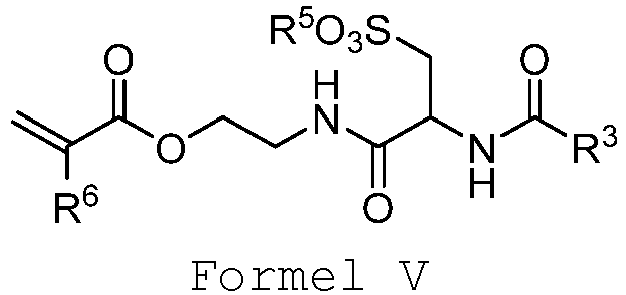

- Ophthalmische Vorrichtung nach Anspruch 1, wobei es sich bei der Verbindung um Folgendes handelt:Methacryloylarginin;Methacryloylasparagin;Methacryloylhistidinmethylester;Natrium-2-decanamido-3-((2-methacryloxyethyl)amino)-3-oxopropan-1-sulfonat;S-(3-(2-Hydroxy-3-(methacryloyloxy)propoxy)-3-oxopropyl)-L-cystein;Methacryloylphenylalanin;Methacryloyllysin;Methacryloylglutamin;Methacryloylglutaminsäure;Methacryloyltyrosin;Acryloyltryptophan;Acryloylasparaginsäure oderAcryloylmethionin.
- Ophthalmische Vorrichtung nach einem der vorhergehenden Ansprüche, umfassend ein Radikalreaktionsprodukt der Verbindung nach einem der Ansprüche 1 bis 13 und eines oder mehrerer Monomere, die für die Herstellung der ophthalmischen Vorrichtung geeignet sind; gegebenenfalls wobei das Monomer, das für die Herstellung der ophthalmischen Vorrichtung geeignet ist, aus einer hydrophilen Komponente, einer hydrophoben Komponente, einer silikonhaltigen Komponente und Mischungen von zwei oder mehr davon ausgewählt ist.
- Ophthalmische Vorrichtung nach einem der vorhergehenden Ansprüche, bei der es sich um eine Intraokularlinse oder eine weiche Kontaktlinse handelt; gegebenenfalls wobei es sich bei der ophthalmischen Vorrichtung um eine Hydrogel-Kontaktlinse handelt; gegebenenfalls wobei es sich bei der ophthalmischen Vorrichtung um ein herkömmliches Hydrogel (Nicht-Silikon-Hydrogel) oder ein Silikonhydrogel handelt.
Applications Claiming Priority (3)
| Application Number | Priority Date | Filing Date | Title |
|---|---|---|---|
| US202063039493P | 2020-06-16 | 2020-06-16 | |
| US17/317,287 US12116443B2 (en) | 2020-06-16 | 2021-05-11 | Amino acid-based polymerizable compounds and ophthalmic devices prepared therefrom |
| PCT/IB2021/054497 WO2021255552A1 (en) | 2020-06-16 | 2021-05-24 | Amino acid-based polymerizable compounds and ophthalmic devices prepared therefrom |
Publications (4)
| Publication Number | Publication Date |
|---|---|
| EP4165015A1 EP4165015A1 (de) | 2023-04-19 |
| EP4165015C0 EP4165015C0 (de) | 2024-08-07 |
| EP4165015B1 true EP4165015B1 (de) | 2024-08-07 |
| EP4165015B9 EP4165015B9 (de) | 2024-11-27 |
Family
ID=79019407
Family Applications (1)
| Application Number | Title | Priority Date | Filing Date |
|---|---|---|---|
| EP21731298.2A Active EP4165015B9 (de) | 2020-06-16 | 2021-05-24 | Aminosäurebasierte polymerisierbare verbindungen und daraus hergestellte ophthalmische vorrichtungen |
Country Status (5)
| Country | Link |
|---|---|
| EP (1) | EP4165015B9 (de) |
| JP (1) | JP7740659B2 (de) |
| KR (1) | KR20230023541A (de) |
| CN (1) | CN114096514B (de) |
| AU (1) | AU2021258020A1 (de) |
Families Citing this family (2)
| Publication number | Priority date | Publication date | Assignee | Title |
|---|---|---|---|---|
| CN115353583B (zh) * | 2022-07-28 | 2025-03-21 | 南京睿远医疗技术有限公司 | 一种硅水凝胶接触镜材料及其制备方法和应用 |
| CN115894906B (zh) * | 2022-11-21 | 2025-07-25 | 深圳市罗湖区人民医院 | 一种碱性粘多糖、改性明胶及其制备方法与应用 |
Family Cites Families (9)
| Publication number | Priority date | Publication date | Assignee | Title |
|---|---|---|---|---|
| US4157418A (en) * | 1978-02-08 | 1979-06-05 | Minnesota Mining And Manufacturing Company | Acrylic functional aminocarboxylic acids and derivatives as components of pressure sensitive adhesives |
| JPH05222133A (ja) * | 1992-02-12 | 1993-08-31 | Seed:Kk | アミノ酸またはそのオリゴマーを側鎖にもつ共重合体およびそれよりなるコンタクトレンズ |
| JP2007302745A (ja) | 2006-05-09 | 2007-11-22 | Institute Of Physical & Chemical Research | 共重合体、表面改質剤、物質吸着抑制剤および親水化処理剤 |
| US20110311505A1 (en) * | 2009-12-11 | 2011-12-22 | Ridvan Say | Photosensitive Aminoacid-Monomer Linkage and Bioconjugation Applications in Life Sciences and Biotechnology |
| EP2665736B1 (de) * | 2011-01-21 | 2015-09-16 | Universita' Degli Studi Di Padova | Coronaartige (guanidyl)-oligosaccharid-derivate als zellenpenetrierende verstärker für die intrazelluläre verabreichung von kolloidalen therapeutischen systemen |
| US9140825B2 (en) * | 2011-12-23 | 2015-09-22 | Johnson & Johnson Vision Care, Inc. | Ionic silicone hydrogels |
| CN104321352B (zh) * | 2012-03-22 | 2017-09-26 | 莫门蒂夫性能材料股份有限公司 | 可聚合的含酰胺基的有机硅化合物、含硅聚合物以及由其制备的生物医学装置 |
| ES2758379T3 (es) | 2015-10-02 | 2020-05-05 | Cis Pharma Ag | Nuevos materiales de polímero para aplicaciones de lentes de contacto |
| US10371865B2 (en) * | 2016-07-06 | 2019-08-06 | Johnson & Johnson Vision Care, Inc. | Silicone hydrogels comprising polyamides |
-
2021
- 2021-05-24 AU AU2021258020A patent/AU2021258020A1/en not_active Abandoned
- 2021-05-24 EP EP21731298.2A patent/EP4165015B9/de active Active
- 2021-05-24 CN CN202180003491.3A patent/CN114096514B/zh active Active
- 2021-05-24 KR KR1020217038324A patent/KR20230023541A/ko active Pending
- 2021-05-24 JP JP2021568562A patent/JP7740659B2/ja active Active
Also Published As
| Publication number | Publication date |
|---|---|
| JP7740659B2 (ja) | 2025-09-17 |
| EP4165015B9 (de) | 2024-11-27 |
| CN114096514A (zh) | 2022-02-25 |
| KR20230023541A (ko) | 2023-02-17 |
| CN114096514B (zh) | 2025-06-17 |
| EP4165015C0 (de) | 2024-08-07 |
| AU2021258020A1 (en) | 2022-01-06 |
| JP2023530531A (ja) | 2023-07-19 |
| EP4165015A1 (de) | 2023-04-19 |
Similar Documents
| Publication | Publication Date | Title |
|---|---|---|
| EP3645517B9 (de) | Polymerisierbare benzotriazol abkömmlinge als blocker von hochenergetischem licht | |
| US10526296B2 (en) | Hydroxyphenyl naphthotriazoles as polymerizable blockers of high energy light | |
| TWI869440B (zh) | 顯示改善的視覺屬性之隱形眼鏡 | |
| EP3523338B9 (de) | Tri-block-präpolymere und deren verwendung in silikonhydrogelen | |
| CA2860222A1 (en) | Ionic silicone hydrogels | |
| EP4165015B9 (de) | Aminosäurebasierte polymerisierbare verbindungen und daraus hergestellte ophthalmische vorrichtungen | |
| US12180318B2 (en) | Imidazolium zwitterion polymerizable compounds and ophthalmic devices incorporating them | |
| US12116443B2 (en) | Amino acid-based polymerizable compounds and ophthalmic devices prepared therefrom | |
| RU2855934C1 (ru) | Полимеризуемые соединения на основе аминокислоты и офтальмологические средства, полученные из них | |
| TWI918665B (zh) | 基於胺基酸之可聚合化合物及由其製備之眼用裝置 | |
| HK40090680B (en) | Amino acid-based polymerizable compounds and ophthalmic devices prepared therefrom | |
| HK40090680A (en) | Amino acid-based polymerizable compounds and ophthalmic devices prepared therefrom | |
| EP4165446B9 (de) | Polymerisierbare imidazolium-zwitterion-verbindungen und ophthalmische vorrichtungen damit | |
| HK40071111A (en) | Amino acid-based polymerizable compounds and ophthalmic devices prepared therefrom | |
| RU2840670C1 (ru) | Имидазолиевые цвиттер-ионные полимеризуемые соединения и содержащие их офтальмологические устройства | |
| HK40090481B (en) | Imidazolium zwitterion polymerizable compounds and ophthalmic devices incorporating them | |
| HK40090481A (en) | Imidazolium zwitterion polymerizable compounds and ophthalmic devices incorporating them | |
| US20260043940A1 (en) | N-vinyl oxazolidinone monomers, polymers therefrom, and use in ophthalmic devices | |
| TW202202487A (zh) | 作為高能可見光過濾器之含有過渡金屬錯合物之眼用裝置 | |
| HK40011816B (en) | Tri-block prepolymers and their use in silicone hydrogels | |
| HK40011816A (en) | Tri-block prepolymers and their use in silicone hydrogels |
Legal Events
| Date | Code | Title | Description |
|---|---|---|---|
| STAA | Information on the status of an ep patent application or granted ep patent |
Free format text: STATUS: UNKNOWN |
|
| STAA | Information on the status of an ep patent application or granted ep patent |
Free format text: STATUS: THE INTERNATIONAL PUBLICATION HAS BEEN MADE |
|
| PUAI | Public reference made under article 153(3) epc to a published international application that has entered the european phase |
Free format text: ORIGINAL CODE: 0009012 |
|
| STAA | Information on the status of an ep patent application or granted ep patent |
Free format text: STATUS: REQUEST FOR EXAMINATION WAS MADE |
|
| 17P | Request for examination filed |
Effective date: 20211103 |
|
| AK | Designated contracting states |
Kind code of ref document: A1 Designated state(s): AL AT BE BG CH CY CZ DE DK EE ES FI FR GB GR HR HU IE IS IT LI LT LU LV MC MK MT NL NO PL PT RO RS SE SI SK SM TR |
|
| DAV | Request for validation of the european patent (deleted) | ||
| DAX | Request for extension of the european patent (deleted) | ||
| REG | Reference to a national code |
Ref country code: HK Ref legal event code: DE Ref document number: 40090680 Country of ref document: HK |
|
| GRAP | Despatch of communication of intention to grant a patent |
Free format text: ORIGINAL CODE: EPIDOSNIGR1 |
|
| STAA | Information on the status of an ep patent application or granted ep patent |
Free format text: STATUS: GRANT OF PATENT IS INTENDED |
|
| RIC1 | Information provided on ipc code assigned before grant |
Ipc: G02C 7/04 20060101ALI20240214BHEP Ipc: C07D 233/64 20060101ALI20240214BHEP Ipc: C07C 323/59 20060101ALI20240214BHEP Ipc: C07C 323/58 20060101ALI20240214BHEP Ipc: C07C 309/18 20060101ALI20240214BHEP Ipc: C07C 279/14 20060101ALI20240214BHEP Ipc: C07C 237/22 20060101AFI20240214BHEP |
|
| INTG | Intention to grant announced |
Effective date: 20240305 |
|
| GRAS | Grant fee paid |
Free format text: ORIGINAL CODE: EPIDOSNIGR3 |
|
| GRAA | (expected) grant |
Free format text: ORIGINAL CODE: 0009210 |
|
| STAA | Information on the status of an ep patent application or granted ep patent |
Free format text: STATUS: THE PATENT HAS BEEN GRANTED |
|
| AK | Designated contracting states |
Kind code of ref document: B1 Designated state(s): AL AT BE BG CH CY CZ DE DK EE ES FI FR GB GR HR HU IE IS IT LI LT LU LV MC MK MT NL NO PL PT RO RS SE SI SK SM TR |
|
| REG | Reference to a national code |
Ref country code: GB Ref legal event code: FG4D |
|
| REG | Reference to a national code |
Ref country code: CH Ref legal event code: EP |
|
| REG | Reference to a national code |
Ref country code: IE Ref legal event code: FG4D |
|
| REG | Reference to a national code |
Ref country code: DE Ref legal event code: R096 Ref document number: 602021016857 Country of ref document: DE |
|
| U01 | Request for unitary effect filed |
Effective date: 20240821 |
|
| U07 | Unitary effect registered |
Designated state(s): AT BE BG DE DK EE FI FR IT LT LU LV MT NL PT RO SE SI Effective date: 20240902 |
|
| REG | Reference to a national code |
Ref country code: CH Ref legal event code: PK Free format text: BERICHTIGUNG B9 |
|
| PG25 | Lapsed in a contracting state [announced via postgrant information from national office to epo] |
Ref country code: NO Free format text: LAPSE BECAUSE OF FAILURE TO SUBMIT A TRANSLATION OF THE DESCRIPTION OR TO PAY THE FEE WITHIN THE PRESCRIBED TIME-LIMIT Effective date: 20241107 |
|
| PG25 | Lapsed in a contracting state [announced via postgrant information from national office to epo] |
Ref country code: PL Free format text: LAPSE BECAUSE OF FAILURE TO SUBMIT A TRANSLATION OF THE DESCRIPTION OR TO PAY THE FEE WITHIN THE PRESCRIBED TIME-LIMIT Effective date: 20240807 Ref country code: GR Free format text: LAPSE BECAUSE OF FAILURE TO SUBMIT A TRANSLATION OF THE DESCRIPTION OR TO PAY THE FEE WITHIN THE PRESCRIBED TIME-LIMIT Effective date: 20241108 |
|
| PG25 | Lapsed in a contracting state [announced via postgrant information from national office to epo] |
Ref country code: IS Free format text: LAPSE BECAUSE OF FAILURE TO SUBMIT A TRANSLATION OF THE DESCRIPTION OR TO PAY THE FEE WITHIN THE PRESCRIBED TIME-LIMIT Effective date: 20241207 |
|
| PG25 | Lapsed in a contracting state [announced via postgrant information from national office to epo] |
Ref country code: HR Free format text: LAPSE BECAUSE OF FAILURE TO SUBMIT A TRANSLATION OF THE DESCRIPTION OR TO PAY THE FEE WITHIN THE PRESCRIBED TIME-LIMIT Effective date: 20240807 |
|
| PG25 | Lapsed in a contracting state [announced via postgrant information from national office to epo] |
Ref country code: RS Free format text: LAPSE BECAUSE OF FAILURE TO SUBMIT A TRANSLATION OF THE DESCRIPTION OR TO PAY THE FEE WITHIN THE PRESCRIBED TIME-LIMIT Effective date: 20241107 Ref country code: ES Free format text: LAPSE BECAUSE OF FAILURE TO SUBMIT A TRANSLATION OF THE DESCRIPTION OR TO PAY THE FEE WITHIN THE PRESCRIBED TIME-LIMIT Effective date: 20240807 |
|
| PG25 | Lapsed in a contracting state [announced via postgrant information from national office to epo] |
Ref country code: RS Free format text: LAPSE BECAUSE OF FAILURE TO SUBMIT A TRANSLATION OF THE DESCRIPTION OR TO PAY THE FEE WITHIN THE PRESCRIBED TIME-LIMIT Effective date: 20241107 Ref country code: PL Free format text: LAPSE BECAUSE OF FAILURE TO SUBMIT A TRANSLATION OF THE DESCRIPTION OR TO PAY THE FEE WITHIN THE PRESCRIBED TIME-LIMIT Effective date: 20240807 Ref country code: NO Free format text: LAPSE BECAUSE OF FAILURE TO SUBMIT A TRANSLATION OF THE DESCRIPTION OR TO PAY THE FEE WITHIN THE PRESCRIBED TIME-LIMIT Effective date: 20241107 Ref country code: IS Free format text: LAPSE BECAUSE OF FAILURE TO SUBMIT A TRANSLATION OF THE DESCRIPTION OR TO PAY THE FEE WITHIN THE PRESCRIBED TIME-LIMIT Effective date: 20241207 Ref country code: HR Free format text: LAPSE BECAUSE OF FAILURE TO SUBMIT A TRANSLATION OF THE DESCRIPTION OR TO PAY THE FEE WITHIN THE PRESCRIBED TIME-LIMIT Effective date: 20240807 Ref country code: GR Free format text: LAPSE BECAUSE OF FAILURE TO SUBMIT A TRANSLATION OF THE DESCRIPTION OR TO PAY THE FEE WITHIN THE PRESCRIBED TIME-LIMIT Effective date: 20241108 Ref country code: ES Free format text: LAPSE BECAUSE OF FAILURE TO SUBMIT A TRANSLATION OF THE DESCRIPTION OR TO PAY THE FEE WITHIN THE PRESCRIBED TIME-LIMIT Effective date: 20240807 |
|
| PG25 | Lapsed in a contracting state [announced via postgrant information from national office to epo] |
Ref country code: SM Free format text: LAPSE BECAUSE OF FAILURE TO SUBMIT A TRANSLATION OF THE DESCRIPTION OR TO PAY THE FEE WITHIN THE PRESCRIBED TIME-LIMIT Effective date: 20240807 |
|
| PG25 | Lapsed in a contracting state [announced via postgrant information from national office to epo] |
Ref country code: CZ Free format text: LAPSE BECAUSE OF FAILURE TO SUBMIT A TRANSLATION OF THE DESCRIPTION OR TO PAY THE FEE WITHIN THE PRESCRIBED TIME-LIMIT Effective date: 20240807 |
|
| PG25 | Lapsed in a contracting state [announced via postgrant information from national office to epo] |
Ref country code: SK Free format text: LAPSE BECAUSE OF FAILURE TO SUBMIT A TRANSLATION OF THE DESCRIPTION OR TO PAY THE FEE WITHIN THE PRESCRIBED TIME-LIMIT Effective date: 20240807 |
|
| U20 | Renewal fee for the european patent with unitary effect paid |
Year of fee payment: 5 Effective date: 20250407 |
|
| PLBE | No opposition filed within time limit |
Free format text: ORIGINAL CODE: 0009261 |
|
| STAA | Information on the status of an ep patent application or granted ep patent |
Free format text: STATUS: NO OPPOSITION FILED WITHIN TIME LIMIT |
|
| 26N | No opposition filed |
Effective date: 20250508 |
|
| PGFP | Annual fee paid to national office [announced via postgrant information from national office to epo] |
Ref country code: IE Payment date: 20250402 Year of fee payment: 5 |
|
| REG | Reference to a national code |
Ref country code: CH Ref legal event code: H13 Free format text: ST27 STATUS EVENT CODE: U-0-0-H10-H13 (AS PROVIDED BY THE NATIONAL OFFICE) Effective date: 20251223 |
|
| PG25 | Lapsed in a contracting state [announced via postgrant information from national office to epo] |
Ref country code: CH Free format text: LAPSE BECAUSE OF NON-PAYMENT OF DUE FEES Effective date: 20250531 |
|
| PG25 | Lapsed in a contracting state [announced via postgrant information from national office to epo] |
Ref country code: MC Free format text: LAPSE BECAUSE OF FAILURE TO SUBMIT A TRANSLATION OF THE DESCRIPTION OR TO PAY THE FEE WITHIN THE PRESCRIBED TIME-LIMIT Effective date: 20240807 |
|
| PGFP | Annual fee paid to national office [announced via postgrant information from national office to epo] |
Ref country code: GB Payment date: 20260324 Year of fee payment: 6 |