EP4166520A1 - Composition de verre, charge de verre et son procédé de production, et composition de résine contenant une charge de verre - Google Patents
Composition de verre, charge de verre et son procédé de production, et composition de résine contenant une charge de verre Download PDFInfo
- Publication number
- EP4166520A1 EP4166520A1 EP21820877.5A EP21820877A EP4166520A1 EP 4166520 A1 EP4166520 A1 EP 4166520A1 EP 21820877 A EP21820877 A EP 21820877A EP 4166520 A1 EP4166520 A1 EP 4166520A1
- Authority
- EP
- European Patent Office
- Prior art keywords
- glass
- mgo
- less
- cao
- glass composition
- Prior art date
- Legal status (The legal status is an assumption and is not a legal conclusion. Google has not performed a legal analysis and makes no representation as to the accuracy of the status listed.)
- Pending
Links
- 239000011521 glass Substances 0.000 title claims abstract description 352
- 239000000203 mixture Substances 0.000 title claims abstract description 129
- 239000000945 filler Substances 0.000 title claims abstract description 86
- 238000004519 manufacturing process Methods 0.000 title claims abstract description 31
- 239000011342 resin composition Substances 0.000 title claims description 30
- VYPSYNLAJGMNEJ-UHFFFAOYSA-N Silicium dioxide Chemical compound O=[Si]=O VYPSYNLAJGMNEJ-UHFFFAOYSA-N 0.000 claims abstract description 72
- FUJCRWPEOMXPAD-UHFFFAOYSA-N Li2O Inorganic materials [Li+].[Li+].[O-2] FUJCRWPEOMXPAD-UHFFFAOYSA-N 0.000 claims abstract description 51
- KKCBUQHMOMHUOY-UHFFFAOYSA-N Na2O Inorganic materials [O-2].[Na+].[Na+] KKCBUQHMOMHUOY-UHFFFAOYSA-N 0.000 claims abstract description 48
- XUCJHNOBJLKZNU-UHFFFAOYSA-M dilithium;hydroxide Chemical compound [Li+].[Li+].[OH-] XUCJHNOBJLKZNU-UHFFFAOYSA-M 0.000 claims abstract description 39
- 239000000377 silicon dioxide Substances 0.000 claims abstract description 35
- PNEYBMLMFCGWSK-UHFFFAOYSA-N aluminium oxide Inorganic materials [O-2].[O-2].[O-2].[Al+3].[Al+3] PNEYBMLMFCGWSK-UHFFFAOYSA-N 0.000 claims abstract description 34
- 229910052681 coesite Inorganic materials 0.000 claims abstract description 34
- 229910052906 cristobalite Inorganic materials 0.000 claims abstract description 34
- 229910052682 stishovite Inorganic materials 0.000 claims abstract description 34
- 229910052905 tridymite Inorganic materials 0.000 claims abstract description 34
- 229910052593 corundum Inorganic materials 0.000 claims abstract description 32
- 229910001845 yogo sapphire Inorganic materials 0.000 claims abstract description 32
- NOTVAPJNGZMVSD-UHFFFAOYSA-N potassium monoxide Inorganic materials [K]O[K] NOTVAPJNGZMVSD-UHFFFAOYSA-N 0.000 claims abstract description 5
- GWEVSGVZZGPLCZ-UHFFFAOYSA-N Titan oxide Chemical compound O=[Ti]=O GWEVSGVZZGPLCZ-UHFFFAOYSA-N 0.000 claims description 43
- 238000004031 devitrification Methods 0.000 claims description 41
- MCMNRKCIXSYSNV-UHFFFAOYSA-N Zirconium dioxide Chemical compound O=[Zr]=O MCMNRKCIXSYSNV-UHFFFAOYSA-N 0.000 claims description 34
- 239000000835 fiber Substances 0.000 claims description 33
- 239000003513 alkali Substances 0.000 claims description 31
- 238000004090 dissolution Methods 0.000 claims description 29
- 238000002844 melting Methods 0.000 claims description 29
- 230000008018 melting Effects 0.000 claims description 29
- 239000000843 powder Substances 0.000 claims description 10
- 239000011324 bead Substances 0.000 claims description 9
- 239000006060 molten glass Substances 0.000 claims description 9
- 229920005992 thermoplastic resin Polymers 0.000 claims description 9
- 238000007493 shaping process Methods 0.000 claims description 7
- 238000007922 dissolution test Methods 0.000 claims description 2
- XLYOFNOQVPJJNP-UHFFFAOYSA-N water Substances O XLYOFNOQVPJJNP-UHFFFAOYSA-N 0.000 abstract description 33
- 239000002245 particle Substances 0.000 description 32
- -1 fatty acid salt Chemical class 0.000 description 24
- 238000000034 method Methods 0.000 description 19
- JEIPFZHSYJVQDO-UHFFFAOYSA-N iron(III) oxide Inorganic materials O=[Fe]O[Fe]=O JEIPFZHSYJVQDO-UHFFFAOYSA-N 0.000 description 17
- BASFCYQUMIYNBI-UHFFFAOYSA-N platinum Substances [Pt] BASFCYQUMIYNBI-UHFFFAOYSA-N 0.000 description 17
- 230000000052 comparative effect Effects 0.000 description 16
- 239000011230 binding agent Substances 0.000 description 15
- 239000002994 raw material Substances 0.000 description 14
- 230000007423 decrease Effects 0.000 description 10
- 239000003365 glass fiber Substances 0.000 description 10
- XEEYBQQBJWHFJM-UHFFFAOYSA-N iron Substances [Fe] XEEYBQQBJWHFJM-UHFFFAOYSA-N 0.000 description 10
- 229910052697 platinum Inorganic materials 0.000 description 9
- 238000005469 granulation Methods 0.000 description 7
- 230000003179 granulation Effects 0.000 description 7
- 238000010348 incorporation Methods 0.000 description 7
- 239000008188 pellet Substances 0.000 description 6
- 235000014113 dietary fatty acids Nutrition 0.000 description 5
- 239000000194 fatty acid Substances 0.000 description 5
- 229930195729 fatty acid Natural products 0.000 description 5
- 239000010408 film Substances 0.000 description 5
- 238000005259 measurement Methods 0.000 description 5
- 230000008569 process Effects 0.000 description 5
- 230000001603 reducing effect Effects 0.000 description 5
- 230000009467 reduction Effects 0.000 description 5
- 229920003171 Poly (ethylene oxide) Polymers 0.000 description 4
- 239000006087 Silane Coupling Agent Substances 0.000 description 4
- QAOWNCQODCNURD-UHFFFAOYSA-N Sulfuric acid Chemical compound OS(O)(=O)=O QAOWNCQODCNURD-UHFFFAOYSA-N 0.000 description 4
- 239000002585 base Substances 0.000 description 4
- 238000005520 cutting process Methods 0.000 description 4
- 230000003247 decreasing effect Effects 0.000 description 4
- 238000010586 diagram Methods 0.000 description 4
- 239000003822 epoxy resin Substances 0.000 description 4
- 230000006872 improvement Effects 0.000 description 4
- 229920000647 polyepoxide Polymers 0.000 description 4
- 239000002904 solvent Substances 0.000 description 4
- 229920002803 thermoplastic polyurethane Polymers 0.000 description 4
- 238000010521 absorption reaction Methods 0.000 description 3
- 229910000272 alkali metal oxide Inorganic materials 0.000 description 3
- 239000003795 chemical substances by application Substances 0.000 description 3
- 230000001186 cumulative effect Effects 0.000 description 3
- 238000009826 distribution Methods 0.000 description 3
- 238000011156 evaluation Methods 0.000 description 3
- 239000012535 impurity Substances 0.000 description 3
- 239000011256 inorganic filler Substances 0.000 description 3
- 229910003475 inorganic filler Inorganic materials 0.000 description 3
- 229910000510 noble metal Inorganic materials 0.000 description 3
- 230000003014 reinforcing effect Effects 0.000 description 3
- 229920005989 resin Polymers 0.000 description 3
- 239000011347 resin Substances 0.000 description 3
- 238000000790 scattering method Methods 0.000 description 3
- 239000012756 surface treatment agent Substances 0.000 description 3
- 239000004094 surface-active agent Substances 0.000 description 3
- RFVNOJDQRGSOEL-UHFFFAOYSA-N 2-hydroxyethyl octadecanoate Chemical compound CCCCCCCCCCCCCCCCCC(=O)OCCO RFVNOJDQRGSOEL-UHFFFAOYSA-N 0.000 description 2
- GOLCXWYRSKYTSP-UHFFFAOYSA-N Arsenious Acid Chemical compound O1[As]2O[As]1O2 GOLCXWYRSKYTSP-UHFFFAOYSA-N 0.000 description 2
- RTZKZFJDLAIYFH-UHFFFAOYSA-N Diethyl ether Chemical compound CCOCC RTZKZFJDLAIYFH-UHFFFAOYSA-N 0.000 description 2
- LFQSCWFLJHTTHZ-UHFFFAOYSA-N Ethanol Chemical compound CCO LFQSCWFLJHTTHZ-UHFFFAOYSA-N 0.000 description 2
- UQSXHKLRYXJYBZ-UHFFFAOYSA-N Iron oxide Chemical compound [Fe]=O UQSXHKLRYXJYBZ-UHFFFAOYSA-N 0.000 description 2
- 239000002202 Polyethylene glycol Substances 0.000 description 2
- 229920002472 Starch Polymers 0.000 description 2
- 150000008051 alkyl sulfates Chemical class 0.000 description 2
- 239000007822 coupling agent Substances 0.000 description 2
- QDOXWKRWXJOMAK-UHFFFAOYSA-N dichromium trioxide Chemical compound O=[Cr]O[Cr]=O QDOXWKRWXJOMAK-UHFFFAOYSA-N 0.000 description 2
- 230000000694 effects Effects 0.000 description 2
- LYCAIKOWRPUZTN-UHFFFAOYSA-N ethylene glycol Natural products OCCO LYCAIKOWRPUZTN-UHFFFAOYSA-N 0.000 description 2
- 230000005484 gravity Effects 0.000 description 2
- LNEPOXFFQSENCJ-UHFFFAOYSA-N haloperidol Chemical compound C1CC(O)(C=2C=CC(Cl)=CC=2)CCN1CCCC(=O)C1=CC=C(F)C=C1 LNEPOXFFQSENCJ-UHFFFAOYSA-N 0.000 description 2
- WGCNASOHLSPBMP-UHFFFAOYSA-N hydroxyacetaldehyde Natural products OCC=O WGCNASOHLSPBMP-UHFFFAOYSA-N 0.000 description 2
- NUJOXMJBOLGQSY-UHFFFAOYSA-N manganese dioxide Chemical compound O=[Mn]=O NUJOXMJBOLGQSY-UHFFFAOYSA-N 0.000 description 2
- 230000007246 mechanism Effects 0.000 description 2
- JKQOBWVOAYFWKG-UHFFFAOYSA-N molybdenum trioxide Chemical compound O=[Mo](=O)=O JKQOBWVOAYFWKG-UHFFFAOYSA-N 0.000 description 2
- 238000000465 moulding Methods 0.000 description 2
- ZKATWMILCYLAPD-UHFFFAOYSA-N niobium pentoxide Chemical compound O=[Nb](=O)O[Nb](=O)=O ZKATWMILCYLAPD-UHFFFAOYSA-N 0.000 description 2
- 239000002736 nonionic surfactant Substances 0.000 description 2
- 230000003287 optical effect Effects 0.000 description 2
- 229920001707 polybutylene terephthalate Polymers 0.000 description 2
- 229920001223 polyethylene glycol Polymers 0.000 description 2
- 230000002787 reinforcement Effects 0.000 description 2
- 239000007787 solid Substances 0.000 description 2
- 239000000243 solution Substances 0.000 description 2
- 238000009987 spinning Methods 0.000 description 2
- 239000008107 starch Substances 0.000 description 2
- 235000019698 starch Nutrition 0.000 description 2
- 238000003756 stirring Methods 0.000 description 2
- 239000000126 substance Substances 0.000 description 2
- 239000010409 thin film Substances 0.000 description 2
- XOLBLPGZBRYERU-UHFFFAOYSA-N tin dioxide Chemical compound O=[Sn]=O XOLBLPGZBRYERU-UHFFFAOYSA-N 0.000 description 2
- WYTZZXDRDKSJID-UHFFFAOYSA-N (3-aminopropyl)triethoxysilane Chemical compound CCO[Si](OCC)(OCC)CCCN WYTZZXDRDKSJID-UHFFFAOYSA-N 0.000 description 1
- 125000003903 2-propenyl group Chemical group [H]C([*])([H])C([H])=C([H])[H] 0.000 description 1
- CDOUZKKFHVEKRI-UHFFFAOYSA-N 3-bromo-n-[(prop-2-enoylamino)methyl]propanamide Chemical compound BrCCC(=O)NCNC(=O)C=C CDOUZKKFHVEKRI-UHFFFAOYSA-N 0.000 description 1
- XDLMVUHYZWKMMD-UHFFFAOYSA-N 3-trimethoxysilylpropyl 2-methylprop-2-enoate Chemical compound CO[Si](OC)(OC)CCCOC(=O)C(C)=C XDLMVUHYZWKMMD-UHFFFAOYSA-N 0.000 description 1
- XZIIFPSPUDAGJM-UHFFFAOYSA-N 6-chloro-2-n,2-n-diethylpyrimidine-2,4-diamine Chemical compound CCN(CC)C1=NC(N)=CC(Cl)=N1 XZIIFPSPUDAGJM-UHFFFAOYSA-N 0.000 description 1
- 229920000178 Acrylic resin Polymers 0.000 description 1
- 239000004925 Acrylic resin Substances 0.000 description 1
- 229920002134 Carboxymethyl cellulose Polymers 0.000 description 1
- RYGMFSIKBFXOCR-UHFFFAOYSA-N Copper Chemical compound [Cu] RYGMFSIKBFXOCR-UHFFFAOYSA-N 0.000 description 1
- 241000219122 Cucurbita Species 0.000 description 1
- 235000009852 Cucurbita pepo Nutrition 0.000 description 1
- 229920000663 Hydroxyethyl cellulose Polymers 0.000 description 1
- 239000004354 Hydroxyethyl cellulose Substances 0.000 description 1
- 229920002153 Hydroxypropyl cellulose Polymers 0.000 description 1
- 229910019142 PO4 Inorganic materials 0.000 description 1
- 239000004952 Polyamide Substances 0.000 description 1
- 239000004698 Polyethylene Substances 0.000 description 1
- 239000004743 Polypropylene Substances 0.000 description 1
- 229920001213 Polysorbate 20 Polymers 0.000 description 1
- 239000004793 Polystyrene Substances 0.000 description 1
- 239000004372 Polyvinyl alcohol Substances 0.000 description 1
- XUIMIQQOPSSXEZ-UHFFFAOYSA-N Silicon Chemical compound [Si] XUIMIQQOPSSXEZ-UHFFFAOYSA-N 0.000 description 1
- QAOWNCQODCNURD-UHFFFAOYSA-L Sulfate Chemical compound [O-]S([O-])(=O)=O QAOWNCQODCNURD-UHFFFAOYSA-L 0.000 description 1
- ULUAUXLGCMPNKK-UHFFFAOYSA-N Sulfobutanedioic acid Chemical compound OC(=O)CC(C(O)=O)S(O)(=O)=O ULUAUXLGCMPNKK-UHFFFAOYSA-N 0.000 description 1
- RTAQQCXQSZGOHL-UHFFFAOYSA-N Titanium Chemical compound [Ti] RTAQQCXQSZGOHL-UHFFFAOYSA-N 0.000 description 1
- XTXRWKRVRITETP-UHFFFAOYSA-N Vinyl acetate Chemical compound CC(=O)OC=C XTXRWKRVRITETP-UHFFFAOYSA-N 0.000 description 1
- 239000002253 acid Substances 0.000 description 1
- 239000000654 additive Substances 0.000 description 1
- 230000000996 additive effect Effects 0.000 description 1
- 239000000853 adhesive Substances 0.000 description 1
- 230000001070 adhesive effect Effects 0.000 description 1
- 238000005054 agglomeration Methods 0.000 description 1
- 230000002776 aggregation Effects 0.000 description 1
- 150000008055 alkyl aryl sulfonates Chemical class 0.000 description 1
- 125000000217 alkyl group Chemical group 0.000 description 1
- 150000008052 alkyl sulfonates Chemical class 0.000 description 1
- 239000002280 amphoteric surfactant Substances 0.000 description 1
- 238000004458 analytical method Methods 0.000 description 1
- 125000000129 anionic group Chemical group 0.000 description 1
- 239000003945 anionic surfactant Substances 0.000 description 1
- GHPGOEFPKIHBNM-UHFFFAOYSA-N antimony(3+);oxygen(2-) Chemical compound [O-2].[O-2].[O-2].[Sb+3].[Sb+3] GHPGOEFPKIHBNM-UHFFFAOYSA-N 0.000 description 1
- 239000003990 capacitor Substances 0.000 description 1
- 229910002091 carbon monoxide Inorganic materials 0.000 description 1
- 239000001768 carboxy methyl cellulose Substances 0.000 description 1
- 235000010948 carboxy methyl cellulose Nutrition 0.000 description 1
- 125000002057 carboxymethyl group Chemical group [H]OC(=O)C([H])([H])[*] 0.000 description 1
- 239000008112 carboxymethyl-cellulose Substances 0.000 description 1
- 125000002091 cationic group Chemical group 0.000 description 1
- 239000003093 cationic surfactant Substances 0.000 description 1
- CETPSERCERDGAM-UHFFFAOYSA-N ceric oxide Chemical compound O=[Ce]=O CETPSERCERDGAM-UHFFFAOYSA-N 0.000 description 1
- 229910000422 cerium(IV) oxide Inorganic materials 0.000 description 1
- 239000008119 colloidal silica Substances 0.000 description 1
- 238000004040 coloring Methods 0.000 description 1
- 239000000470 constituent Substances 0.000 description 1
- 239000000498 cooling water Substances 0.000 description 1
- 229920001577 copolymer Polymers 0.000 description 1
- 229910052802 copper Inorganic materials 0.000 description 1
- 239000010949 copper Substances 0.000 description 1
- 239000013078 crystal Substances 0.000 description 1
- 235000019329 dioctyl sodium sulphosuccinate Nutrition 0.000 description 1
- USIUVYZYUHIAEV-UHFFFAOYSA-N diphenyl ether Natural products C=1C=CC=CC=1OC1=CC=CC=C1 USIUVYZYUHIAEV-UHFFFAOYSA-N 0.000 description 1
- 238000007598 dipping method Methods 0.000 description 1
- 238000002845 discoloration Methods 0.000 description 1
- 239000012153 distilled water Substances 0.000 description 1
- 238000005516 engineering process Methods 0.000 description 1
- FWDBOZPQNFPOLF-UHFFFAOYSA-N ethenyl(triethoxy)silane Chemical compound CCO[Si](OCC)(OCC)C=C FWDBOZPQNFPOLF-UHFFFAOYSA-N 0.000 description 1
- 238000001704 evaporation Methods 0.000 description 1
- 230000008020 evaporation Effects 0.000 description 1
- 238000001125 extrusion Methods 0.000 description 1
- 239000012530 fluid Substances 0.000 description 1
- 239000000446 fuel Substances 0.000 description 1
- 230000006870 function Effects 0.000 description 1
- 239000000156 glass melt Substances 0.000 description 1
- 229910052737 gold Inorganic materials 0.000 description 1
- 229910052736 halogen Inorganic materials 0.000 description 1
- 235000019447 hydroxyethyl cellulose Nutrition 0.000 description 1
- 239000001863 hydroxypropyl cellulose Substances 0.000 description 1
- 235000010977 hydroxypropyl cellulose Nutrition 0.000 description 1
- 238000002347 injection Methods 0.000 description 1
- 239000007924 injection Substances 0.000 description 1
- 239000012212 insulator Substances 0.000 description 1
- 229910052742 iron Inorganic materials 0.000 description 1
- MRELNEQAGSRDBK-UHFFFAOYSA-N lanthanum oxide Inorganic materials [O-2].[O-2].[O-2].[La+3].[La+3] MRELNEQAGSRDBK-UHFFFAOYSA-N 0.000 description 1
- 239000007788 liquid Substances 0.000 description 1
- 239000004973 liquid crystal related substance Substances 0.000 description 1
- 239000000463 material Substances 0.000 description 1
- 229920000609 methyl cellulose Polymers 0.000 description 1
- 239000001923 methylcellulose Substances 0.000 description 1
- 235000010981 methylcellulose Nutrition 0.000 description 1
- 238000002156 mixing Methods 0.000 description 1
- DVEKCXOJTLDBFE-UHFFFAOYSA-N n-dodecyl-n,n-dimethylglycinate Chemical compound CCCCCCCCCCCC[N+](C)(C)CC([O-])=O DVEKCXOJTLDBFE-UHFFFAOYSA-N 0.000 description 1
- 229920002114 octoxynol-9 Polymers 0.000 description 1
- 229910052762 osmium Inorganic materials 0.000 description 1
- KTUFCUMIWABKDW-UHFFFAOYSA-N oxo(oxolanthaniooxy)lanthanum Chemical compound O=[La]O[La]=O KTUFCUMIWABKDW-UHFFFAOYSA-N 0.000 description 1
- 239000005011 phenolic resin Substances 0.000 description 1
- 229920001568 phenolic resin Polymers 0.000 description 1
- 239000010452 phosphate Substances 0.000 description 1
- 229920002647 polyamide Polymers 0.000 description 1
- 229920001748 polybutylene Polymers 0.000 description 1
- 239000004417 polycarbonate Substances 0.000 description 1
- 229920000515 polycarbonate Polymers 0.000 description 1
- 229920000728 polyester Polymers 0.000 description 1
- 229920000573 polyethylene Polymers 0.000 description 1
- 229920000259 polyoxyethylene lauryl ether Polymers 0.000 description 1
- 239000000256 polyoxyethylene sorbitan monolaurate Substances 0.000 description 1
- 235000010486 polyoxyethylene sorbitan monolaurate Nutrition 0.000 description 1
- 229920001155 polypropylene Polymers 0.000 description 1
- 229920002223 polystyrene Polymers 0.000 description 1
- 229920002451 polyvinyl alcohol Polymers 0.000 description 1
- 235000019422 polyvinyl alcohol Nutrition 0.000 description 1
- 239000004800 polyvinyl chloride Substances 0.000 description 1
- 229920000915 polyvinyl chloride Polymers 0.000 description 1
- 235000019353 potassium silicate Nutrition 0.000 description 1
- 238000003825 pressing Methods 0.000 description 1
- 238000012545 processing Methods 0.000 description 1
- 150000003242 quaternary ammonium salts Chemical class 0.000 description 1
- 230000001172 regenerating effect Effects 0.000 description 1
- 229910052703 rhodium Inorganic materials 0.000 description 1
- 150000003839 salts Chemical class 0.000 description 1
- 239000004576 sand Substances 0.000 description 1
- 238000007873 sieving Methods 0.000 description 1
- FZHAPNGMFPVSLP-UHFFFAOYSA-N silanamine Chemical compound [SiH3]N FZHAPNGMFPVSLP-UHFFFAOYSA-N 0.000 description 1
- 229910052710 silicon Inorganic materials 0.000 description 1
- 239000010703 silicon Substances 0.000 description 1
- 238000004513 sizing Methods 0.000 description 1
- 229940035044 sorbitan monolaurate Drugs 0.000 description 1
- 239000007921 spray Substances 0.000 description 1
- 238000005507 spraying Methods 0.000 description 1
- 230000006641 stabilisation Effects 0.000 description 1
- 238000011105 stabilization Methods 0.000 description 1
- PBCFLUZVCVVTBY-UHFFFAOYSA-N tantalum pentoxide Inorganic materials O=[Ta](=O)O[Ta](=O)=O PBCFLUZVCVVTBY-UHFFFAOYSA-N 0.000 description 1
- 238000010998 test method Methods 0.000 description 1
- 239000010936 titanium Substances 0.000 description 1
- 229910052719 titanium Inorganic materials 0.000 description 1
- 238000004448 titration Methods 0.000 description 1
- ZNOKGRXACCSDPY-UHFFFAOYSA-N tungsten(VI) oxide Inorganic materials O=[W](=O)=O ZNOKGRXACCSDPY-UHFFFAOYSA-N 0.000 description 1
- RUDFQVOCFDJEEF-UHFFFAOYSA-N yttrium(III) oxide Inorganic materials [O-2].[O-2].[O-2].[Y+3].[Y+3] RUDFQVOCFDJEEF-UHFFFAOYSA-N 0.000 description 1
Images



Classifications
-
- C—CHEMISTRY; METALLURGY
- C03—GLASS; MINERAL OR SLAG WOOL
- C03C—CHEMICAL COMPOSITION OF GLASSES, GLAZES OR VITREOUS ENAMELS; SURFACE TREATMENT OF GLASS; SURFACE TREATMENT OF FIBRES OR FILAMENTS MADE FROM GLASS, MINERALS OR SLAGS; JOINING GLASS TO GLASS OR OTHER MATERIALS
- C03C3/00—Glass compositions
- C03C3/04—Glass compositions containing silica
- C03C3/076—Glass compositions containing silica with 40% to 90% silica, by weight
- C03C3/089—Glass compositions containing silica with 40% to 90% silica, by weight containing boron
- C03C3/091—Glass compositions containing silica with 40% to 90% silica, by weight containing boron containing aluminium
-
- C—CHEMISTRY; METALLURGY
- C03—GLASS; MINERAL OR SLAG WOOL
- C03C—CHEMICAL COMPOSITION OF GLASSES, GLAZES OR VITREOUS ENAMELS; SURFACE TREATMENT OF GLASS; SURFACE TREATMENT OF FIBRES OR FILAMENTS MADE FROM GLASS, MINERALS OR SLAGS; JOINING GLASS TO GLASS OR OTHER MATERIALS
- C03C12/00—Powdered glass; Bead compositions
-
- C—CHEMISTRY; METALLURGY
- C03—GLASS; MINERAL OR SLAG WOOL
- C03C—CHEMICAL COMPOSITION OF GLASSES, GLAZES OR VITREOUS ENAMELS; SURFACE TREATMENT OF GLASS; SURFACE TREATMENT OF FIBRES OR FILAMENTS MADE FROM GLASS, MINERALS OR SLAGS; JOINING GLASS TO GLASS OR OTHER MATERIALS
- C03C13/00—Fibre or filament compositions
-
- C—CHEMISTRY; METALLURGY
- C03—GLASS; MINERAL OR SLAG WOOL
- C03C—CHEMICAL COMPOSITION OF GLASSES, GLAZES OR VITREOUS ENAMELS; SURFACE TREATMENT OF GLASS; SURFACE TREATMENT OF FIBRES OR FILAMENTS MADE FROM GLASS, MINERALS OR SLAGS; JOINING GLASS TO GLASS OR OTHER MATERIALS
- C03C3/00—Glass compositions
- C03C3/04—Glass compositions containing silica
- C03C3/076—Glass compositions containing silica with 40% to 90% silica, by weight
- C03C3/089—Glass compositions containing silica with 40% to 90% silica, by weight containing boron
- C03C3/091—Glass compositions containing silica with 40% to 90% silica, by weight containing boron containing aluminium
- C03C3/093—Glass compositions containing silica with 40% to 90% silica, by weight containing boron containing aluminium containing zinc or zirconium
-
- C—CHEMISTRY; METALLURGY
- C03—GLASS; MINERAL OR SLAG WOOL
- C03C—CHEMICAL COMPOSITION OF GLASSES, GLAZES OR VITREOUS ENAMELS; SURFACE TREATMENT OF GLASS; SURFACE TREATMENT OF FIBRES OR FILAMENTS MADE FROM GLASS, MINERALS OR SLAGS; JOINING GLASS TO GLASS OR OTHER MATERIALS
- C03C3/00—Glass compositions
- C03C3/04—Glass compositions containing silica
- C03C3/076—Glass compositions containing silica with 40% to 90% silica, by weight
- C03C3/097—Glass compositions containing silica with 40% to 90% silica, by weight containing phosphorus, niobium or tantalum
-
- C—CHEMISTRY; METALLURGY
- C08—ORGANIC MACROMOLECULAR COMPOUNDS; THEIR PREPARATION OR CHEMICAL WORKING-UP; COMPOSITIONS BASED THEREON
- C08K—Use of inorganic or non-macromolecular organic substances as compounding ingredients
- C08K7/00—Use of ingredients characterised by shape
-
- C—CHEMISTRY; METALLURGY
- C03—GLASS; MINERAL OR SLAG WOOL
- C03C—CHEMICAL COMPOSITION OF GLASSES, GLAZES OR VITREOUS ENAMELS; SURFACE TREATMENT OF GLASS; SURFACE TREATMENT OF FIBRES OR FILAMENTS MADE FROM GLASS, MINERALS OR SLAGS; JOINING GLASS TO GLASS OR OTHER MATERIALS
- C03C2203/00—Production processes
- C03C2203/10—Melting processes
Definitions
- the present invention relates to a glass composition.
- the present invention also relates to a glass filler, a method for manufacturing a glass filler, and a resin composition including a glass filler.
- the electrically-insulating member include: a connector housing used for surface mount technology (SMT), flexible printed circuits (FPCs), board-to-board, central processing unit (CPU) sockets, memory cards, card edges, optical connectors, and the like; a reactance bobbin used for liquid crystal display (LCD) backlights, coils, flats, transformers, magnetic heads, and the like; a switch unit used for relay cases, relay base switches, reflow DIP switches, tact switches, and the like; a sensor case; a capacitor casing; a volume casing; and a trimmer casing.
- SMT surface mount technology
- FPCs flexible printed circuits
- CPU central processing unit
- LCD liquid crystal display
- switch unit used for relay cases, relay base switches, reflow DIP switches, tact switches, and the like
- a sensor case a capacitor casing; a volume casing; and a trimmer casing.
- the mechanism member examples include a lens holder and a pickup base for optical pickup, an insulator and a terminal for micromotors, and a drum for laser printers.
- Resin compositions are used also as a film such as a base film for FPC and a base film for copper clad laminates.
- some printed circuit boards mounted in electronic devices also include a board formed of a resin composition.
- Some printed wiring boards, which have no electronic components installed, also include a board formed of a resin composition.
- both printed circuit boards and printed wiring boards are referred to collectively as "printed boards”.
- the above resin compositions commonly include a thermoplastic resin and an inorganic filler, and further include a curing agent, a modifying agent, or the like as necessary.
- a glass filler is sometimes used as the inorganic filler.
- a typical glass filler is a glass flake.
- Some printed boards further include a glass fiber.
- the glass fiber is also required to have a low permittivity. Glass fibers formed of low-permittivity glass compositions are disclosed in Patent Literatures 1 to 3.
- Glass fillers used as inorganic fillers are required to have a low permittivity and an excellent water resistance. However, it is difficult to enhance the water resistance of low-permittivity glass compositions. Additionally, water resistance is not considered in Patent Literatures 1 to 3.
- the present invention aims to provide a glass composition suitable for manufacturing a glass filler that has a low permittivity and that can exhibit an excellent water resistance.
- the present invention provides a glass composition including, in mass%: 50 ⁇ SiO 2 ⁇ 65; 20 ⁇ B 2 O 3 ⁇ 30; and 5 ⁇ Al 2 O 3 ⁇ 20, and further including:
- the present invention provides a glass filler including the above glass composition of the present invention.
- the present invention provides a resin composition including the above glass filler of the present invention and a thermoplastic resin.
- the present invention provides a glass filler manufacturing method including:
- a glass composition suitable for manufacturing a glass filler that has a low permittivity and that can exhibit an excellent water resistance.
- the glass composition of the present invention can be manufactured, for example, a glass filler suitable for decreasing a permittivity of a resin composition, the glass filler being suitable for improving various properties of the resin composition by incorporation of the glass filler.
- the improvement of various properties includes, for example: enhancement in strength, heat resistance, and dimensional stability; decrease in linear thermal expansion coefficient and reduction in its anisotropy; and reduction in anisotropy of the shrinkage factor at molding.
- Every symbol "%” used hereinafter to indicate the content of a component is “mass%”.
- the phrase “substantially free” of a component means that the content of the component is less than 0.1 mass%, preferably less than 0.07 mass%, more preferably less than 0.05 mass%, particularly preferably less than 0.01 mass%, and most preferably less than 0.005 mass%.
- the term “substantially” in this phrase is intended to allow impurities inevitably introduced from an industrial raw material, a glass manufacturing apparatus, a glass shaped body manufacturing apparatus, and the like within the above limits. Preferred ranges of the contents, properties, etc. of components, can be determined by combining the upper and lower limits described below individually.
- permittivity refers to "relative permittivity" (dielectric constant) in a strict sense.
- "relative permittivity” is expressed simply as “permittivity”, as is conventional. A permittivity is obtained at room temperature (25°C).
- SiO 2 is a component for forming a glass network structure, and is a main component (a component whose content is highest). SiO 2 acts to adjust the devitrification temperature and the viscosity at forming of the glass and acts to decrease the permittivity of the glass.
- SiO 2 content is 50% or more and 65% or less, it is possible to prevent the devitrification temperature from increasing to such an extent that it is difficult to manufacture a glass filler, and it is possible to adjust the permittivity within a range suitable for incorporation into a resin composition.
- the SiO 2 content in the above range does not excessively increase the melting point of the glass and increases homogeneity at melting of raw materials.
- the lower limit of the SiO 2 content may be 51% or more, 52% or more, 53% or more, 54% or more, 55% or more, or even more than 55%.
- the upper limit of the SiO 2 content may be less than 64%, 63% or less, 62% or less, less than 62%, 61% or less, 60% or less, 59% or less, or even 58% or less.
- B 2 O 3 is a component for forming a glass network structure.
- B 2 O 3 acts to adjust the devitrification temperature and the viscosity at forming of the glass and acts to decrease the permittivity of the glass.
- B 2 O 3 is prone to volatilization at melting of the glass.
- An excessively high B 2 O 3 content makes it difficult to achieve a sufficient homogeneity of the glass.
- Inclusion of an excessive amount of B 2 O 3 decreases the water resistance of the glass.
- the B 2 O 3 content is 20% or more and 30% or less, it is possible to prevent the devitrification temperature of the glass from increasing to such an extent that it is difficult to manufacture a glass filler, and it is possible to adjust the permittivity within a range suitable for incorporation into a resin composition.
- the B 2 O 3 content in the above range does not excessively increase the melting point of the glass and increases homogeneity at melting of the raw materials.
- the B 2 O 3 content in the above range increases the water resistance of the glass.
- the lower limit of the B 2 O 3 content may be more than 20%, 21% or more, 22% or more, 23% or more, 24% or more, 25% or more, 26% or more, or even more than 26%.
- the upper limit of the B 2 O 3 content may be less than 30%, 29.5% or less, 29% or less, 28.5% or less, or even 28% or less.
- SiO 2 - B 2 O 3 which is a value obtained by subtracting the B 2 O 3 content from the SiO 2 content, may be adjusted to 26% or more, 27% or more, 28% or more, 29% or more, or even 30% or more.
- Al 2 O 3 is a component for forming a glass network structure.
- Al 2 O 3 acts to adjust the devitrification temperature and the viscosity at forming of the glass and acts to improve the water resistance of the glass.
- Al 2 O 3 is also a component for adjusting the permittivity of the glass.
- the Al 2 O 3 content is 5% or more and 20% or less, it is possible to prevent the devitrification temperature of the glass from increasing to such an extent that it is difficult to manufacture a glass filler, and the water resistance of the glass increases.
- the Al 2 O 3 content in the above range does not excessively increase the melting point of the glass and increases homogeneity at melting of the raw materials.
- the lower limit of the Al 2 O 3 content may be 6% or more, 8% or more, 9% or more, or even 10% or more.
- the upper limit of the Al 2 O 3 content may be 18% or less, 16% or less, 15.5% or less, 15.3% or less, 15% or less, 14.5% or less, 14% or less, 13.5% or less, or even 13% or less.
- a suitable Al 2 O 3 content is 13% or less. It should be noted that the greater the temperature difference ⁇ T is, the better ease of shaping a glass filler has.
- MgO and CaO maintain the heat resistance of the glass and act to adjust the devitrification temperature and the viscosity at forming of the glass. Additionally, MgO and CaO are components acting to improve the water resistance of the glass and adjusting the permittivity of the glass.
- MgO + CaO which is the sum of the contents of MgO and CaO
- MgO + CaO 0.1% or more and less than 5%
- MgO + CaO in the above range does not excessively increase the melting point of the glass and increases homogeneity at melting of the raw materials.
- MgO + CaO in the above range increases the water resistance of the glass.
- the lower limit of MgO + CaO may be 0.5% or more, 1% or more, 1.5% or more, 2% or more, 2.2% or more, 2.4% or more, 2.5% or more, 2.8% or more, 2.9% or more, 3% or more, 3.2% or more, 3.5% or more, or even more than 3.5%.
- the upper limit of MgO + CaO may be 4.5% or less, or even 4% or less.
- MgO/(MgO + CaO) which is a ratio (on a mass basis) of MgO to MgO + CaO, is more than 0.50 and 1.00 or less.
- MgO/(MgO + CaO) is more than 0.50, it is possible to prevent the devitrification temperature of the glass from increasing to such an extent that it is difficult to manufacture a glass filler, and it is possible to adjust the permittivity within a range suitable for incorporation into a resin composition.
- MgO/(MgO + CaO) in the above range does not excessively increase the melting point of the glass and increases homogeneity at melting of the raw materials. Moreover, MgO/(MgO + CaO) in the above range increases the water resistance of the glass.
- the lower limit of MgO/(MgO + CaO) may be 0.55 or more, 0.60 or more, 0.65 or more, 0.70 or more, 0.75 or more, 0.80 or more, or even 0.85 or more.
- the upper limit of MgO/(MgO + CaO) may be 0.99 or less, or even 0.95 or less.
- a suitable range of MgO/(MgO + CaO) is 0.85 or more and may be 0.90 or more.
- MgO content is, for example, 0.1% or more and less than 5%.
- MgO is in the above range, it is possible to more reliably prevent the devitrification temperature of the glass from increasing to such an extent that it is difficult to manufacture a glass filler, and it is possible to more reliably adjust the permittivity within a range suitable for incorporation into a resin composition.
- the MgO content in the above range can prevent an excessive increase in the melting point of the glass and can more reliably improve the homogeneity at melting the raw materials. Moreover, the MgO content in the above range can more reliably improve the water resistance of the glass.
- the lower limit of the MgO content may be 1% or more, 1.5% or more, 1.8% or more, 2% or more, 2.1% or more, 2.3% or more, 2.5% or more, 2.7% or more, or even 3% or more.
- the upper limit of the MgO content may be 4.5% or less, 4% or less, or even 3.5% or less.
- the lower limit of the CaO content may be 0.1% or more, or even 0.2% or more.
- the upper limit of the CaO content may be less than 2.5%, 2% or less, 1.5% or less, 1.2% or less, 1% or less, 0.75% or less, 0.7% or less, or even 0.5% or less.
- a suitable range of CaO is 0.5% or less.
- the glass composition can include SrO.
- SrO can act to adjust the devitrification temperature and the viscosity at forming of the glass.
- inclusion of an excessive amount of SrO increases the permittivity of the glass.
- the upper limit of the SrO content may be 5% or less, 3.5% or less, 2% or less, 1.5% or less, 1% or less, 0.5% or less, less than 0.5%, or even 0.1% or less.
- the glass composition may be substantially free of SrO.
- the glass composition can include BaO.
- BaO can act to adjust the devitrification temperature and the viscosity at forming of the glass.
- inclusion of an excessive amount of BaO increases the permittivity of the glass.
- the upper limit of the BaO content may be 5% or less, 2% or less, 1% or less, less than 1%, 0.5% or less, or even 0.1% or less.
- the glass composition may be substantially free of BaO. When homogeneous melting of the glass raw materials and stable manufacturing of the glass composition are particularly important, the lower limit of the BaO content may be 0.1% or more.
- the glass composition can include ZnO.
- ZnO can act to adjust the devitrification temperature and the viscosity at forming of the glass. Additionally, ZnO can act to adjust the permittivity of the glass. On the other hand, inclusion of an excessive amount of ZnO increases the permittivity of the glass.
- the lower limit of the ZnO content may be 0.1 % or more.
- the upper limit of the ZnO content may be 5% or less, 4% or less, 3.5% or less, 3% or less, 2% or less, 1.5% or less, 1% or less, less than 1%, 0.5% or less, or even 0.1% or less.
- the glass composition may be substantially free of ZnO.
- MgO + CaO + ZnO which is the sum of the contents of MgO, CaO, and ZnO, may be controlled from the viewpoint of putting an emphasis on the permittivity of a glass filler.
- MgO + CaO + ZnO may be 0.1% or more and 6% or less.
- MgO + CaO + ZnO in the above range can prevent an excessive increase in the melting point of the glass and can more reliably improve the homogeneity at melting the raw materials.
- the lower limit of MgO + CaO + ZnO may be 1% or more, 1.5% or more, 2% or more, 2.5% or more, 2.8% or more, 2.9% or more, 3% or more, 3.2% or more, 3.3% or more, or even 3.5% or more.
- the upper limit of MgO + CaO + ZnO may be 6% or less, 5.5% or less, less than 5%, 4.5% or less, or even 4% or less.
- Li 2 O, Na 2 O, and K 2 O which are alkali metal oxides, maintain the heat resistance of the glass and act to adjust the devitrification temperature and the viscosity at forming of the glass.
- inclusion of an excessive amount of the alkali metal oxides increases the permittivity of the glass and decreases the water resistance thereof. Therefore, Li 2 O + Na 2 O + K 2 O, which is the sum of the contents of the alkali metal oxides, is 0% or more and 4% or less.
- the lower limit of Li 2 O + Na 2 O + K 2 O may be 0.1% or more, 0.2% or more, 0.3% or more, 0.4% or more, 0.5% or more, more than 0.5%, 0.6% or more, 0.7% or more, or even more than 0.7%.
- the upper limit of Li 2 O + Na 2 O + K 2 O may be 4% or less, 3% or less, 2% or less, 1.5% or less, 1% or less, or even 0.9% or less.
- the lower limit of the Li 2 O content may be 0.1% or more, 0.2% or more, 0.3% or more, 0.4% or more, or even 0.5% or more.
- the upper limit of the Li 2 O content may be 4% or less, 3% or less, 2% or less, 1.5% or less, 1% or less, or even 0.9% or less.
- Na 2 O increases the permittivity of the glass and decreases the water resistance thereof. Additionally, Na 2 O increases the permittivity by a larger amount than Li 2 O.
- the upper limit of the Na 2 O content may be 4% or less, 2% or less, 1.5% or less, 1% or less, 0.5% or less, 0.3% or less, or even 0.2% or less.
- K 2 O increases the permittivity of the glass and decreases the water resistance thereof. Additionally, K 2 O increases the permittivity by a larger amount than Li 2 O.
- the upper limit of the K 2 O content may be 4% or less, 2% or less, 1 % or less, 0.5% or less, 0.2% or less, or even less than 0.1%.
- the glass composition may be substantially free of K 2 O.
- the glass composition can include TiO 2 .
- TiO 2 improves the meltability of the glass and the chemical resistance thereof and can act to improve the UV-absorption property of the glass.
- inclusion of an excessive amount of TiO 2 increases the permittivity of the glass.
- the lower limit of the TiO 2 content may be 0.1% or more.
- the upper limit of the TiO 2 content may be 5% or less, 2% or less, less than 1%, 0.9% or less, 0.8% or less, 0.7% or less, less than 0.5%, 0.4% or less, 0.3% or less, 0.2% or less, or even 0.1% or less.
- the TiO 2 content in the above range can reduce an increase in the devitrification temperature of the molten glass attributable to inclusion of TiO 2 , the increase affecting manufacturing of a glass filler.
- the glass composition may be substantially free of TiO 2 .
- the glass composition can include ZrO 2 .
- ZrO 2 can act to adjust the devitrification temperature and the viscosity at forming of the glass.
- inclusion of an excessive amount of ZrO 2 increases the permittivity of the glass.
- the upper limit of the ZrO 2 content may be 5% or less, 2% or less, less than 1%, less than 0.5%, 0.2% or less, or even 0.1% or less.
- the ZrO 2 content in the above range can reduce an increase in the devitrification temperature of the molten glass attributable to inclusion of ZrO 2 , the increase affecting manufacturing of a glass filler.
- the lower limit of the ZrO 2 content may be 0.1% or more, or even 0.15% or more.
- the glass composition may be substantially free of ZrO 2 .
- the glass composition can include Fe.
- Fe in the glass is commonly present as Fe 2+ and/or Fe 3+ .
- Fe 3+ can act to increase the UV-absorption property of the glass.
- Fe 2+ can act to increase the heat absorption property of the glass.
- Fe can be introduced in some cases not intentionally but inevitably from an industrial raw material. Inclusion of a small amount of Fe can prevent coloring of the glass.
- the upper limit of the Fe content may be 5% or less, 2% or less, less than 1.8%, 1.5% or less, less than 1%, less than 0.5%, or even 0.2% or less in terms as T-Fe 2 O 3 (T-Fe 2 O 3 represents total iron oxide calculated as Fe 2 O 3 ).
- the lower limit of the Fe content may be 0.1% or more in terms of T-Fe 2 O 3 .
- the glass composition may be substantially free of Fe in terms of T-Fe 2 O 3 .
- the glass composition can include P 2 O 5 .
- P 2 O 5 is a component for forming a glass network structure, and can act to adjust the devitrification temperature and the viscosity at forming of the glass. Additionally, P 2 O 5 can act to adjust the permittivity of the glass. However, it is commonly said that when the P 2 O 5 content is more than 2%, a furnace wall of a melting furnace or a regenerative furnace is eroded during melting of glass and the life span of the furnace is drastically decreased.
- the upper limit of the P 2 O 5 content may be 5% or less, 2% or less, less than 1%, less than 0.5%, 0.3% or less, 0.2% or less, or even less than 0.1%.
- the glass composition may be substantially free of P 2 O 5 .
- the glass composition can include F 2 and/or Cl 2 .
- F 2 and Cl 2 included in the glass composition can improve the homogeneity of the glass at melting of the raw materials without excessively increasing the melting point of the glass. However, since F 2 and Cl 2 easily volatilize, F 2 and Cl 2 can scatter during melting thereof and it is difficult to control the amounts thereof in the glass.
- the upper limit of the F 2 content may be 5% or less, 2% or less, 1% or less, 0.5% or less, 0.2% or less, or even 0.1% or less.
- the glass composition may be substantially free of F 2 .
- the upper limit of the Cl 2 content may be 5% or less, 2% or less, 1% or less, 0.5% or less, 0.2% or less, or even 0.1% or less.
- the glass composition may be substantially free of Cl 2 .
- the glass composition can include, as an additional component(s), at least one selected from the group consisting of La 2 O 3 , WO 3 , Nb 2 O 5 , Y 2 O 3 , MoO 3 , Ta 2 O 5 , MnO 2 , and Cr 2 O 3 , and the content of each component can be 0% or more and 5% or less.
- the acceptable upper limit of the content of each component may be less than 2%, less than 1%, less than 0.5%, or even 0.1% or less.
- the acceptable upper limit of the total content of the components may be 5% or less, less than 2%, less than 1%, less than 0.5%, or even 0.1 % or less.
- the glass composition may be substantially free of any one component selected from the above group. Moreover, the glass composition may be substantially free of two or more components selected from the above group in any combination.
- the glass composition can include, as an additive(s), at least one selected from the group consisting of Br 2 , I 2 , SnO 2 , CeO 2 , As 2 O 3 , and Sb 2 O 3 , and the content of each component can be 0% or more and 1% or less.
- the acceptable upper limit of the content of each component may be less than 0.5%, less than 0.2%, or even less than 0.1%.
- the acceptable upper limit of the total content of the components may be 1% or less, less than 0.5%, less than 0.2%, or even less than 0.1%.
- the glass composition may be substantially free of any one component selected from the above group. Moreover, the glass composition may be substantially free of two or more components selected from the above group in any combination.
- the glass composition can include at least one selected from the group consisting of H 2 O, OH, H 2 , CO 2 , CO, He, Ne, Ar, and N 2 , and the content of each component can be 0% or more and 0.1 % or less.
- the acceptable upper limit of the content of each component may be less than 0.05%, less than 0.03%, or even less than 0.01%.
- the acceptable upper limit of the total content of the components may be 0.1 % or less, less than 0.05%, less than 0.03%, or even less than 0.01%.
- the glass composition may be substantially free of any one component selected from the above group. Moreover, the glass composition may be substantially free of two or more components selected from the above group in any combination.
- the glass composition can include a small amount of a noble metal element.
- the noble metal element include Pt, Rh, Au, and Os.
- the content of each noble metal element is 0% or more and 0.1% or less.
- the acceptable upper limit of the content of each component may be less than 0.1%, less than 0.05%, less than 0.03%, or even less than 0.01%.
- the acceptable upper limit of the total content of the components may be less than 0.1%, less than 0.05%, less than 0.03%, or even less than 0.01%.
- the glass composition may be substantially free of these components.
- the glass composition may substantially consist of the above components in any combination, and the above contents may be combined in any combination.
- the term “substantially” in “substantially consist” is intended to mean that inclusion of impurities is allowed as long as the content of the impurities is less than 0.1 mass%, preferably less than 0.07 mass%, more preferably less than 0.05 mass%, particularly preferably less than 0.01 mass%, most preferably less than 0.005 mass%.
- the glass composition according to a preferred embodiment includes, in mass%: 55 ⁇ SiO 2 ⁇ 65; 20 ⁇ B 2 O 3 ⁇ 30; and 5 ⁇ Al 2 O 3 ⁇ 20, wherein 0.1 ⁇ (MgO + CaO) ⁇ 5, 0 ⁇ (Li 2 O + Na 2 O + K 2 O) ⁇ 4, and 0.75 ⁇ MgO/(MgO + CaO) ⁇ 1.00 are satisfied.
- the glass composition according to another preferred embodiment includes, in mass%: 50 ⁇ SiO 2 ⁇ 65; 20 ⁇ B 2 O 3 ⁇ 30; 5 ⁇ Al 2 O 3 ⁇ 20; and 0 ⁇ F 2 ⁇ 0.5, wherein 0.1 ⁇ (MgO + CaO) ⁇ 5, 0.1 ⁇ (Li 2 O + Na 2 O + K 2 O) ⁇ 4, and 0.50 ⁇ MgO/(MgO + CaO) ⁇ 1.00 are satisfied.
- the glass composition according to another preferred embodiment includes, in mass%: 50 ⁇ SiO 2 ⁇ 65; 20 ⁇ B 2 O 3 ⁇ 30; and 5 ⁇ Al 2 O 3 ⁇ 15, wherein 0.1 ⁇ (MgO + CaO) ⁇ 5, 0 ⁇ (Li 2 O + Na 2 O + K 2 O) ⁇ 4, and 0.50 ⁇ MgO/(MgO + CaO) ⁇ 1.00 are satisfied.
- the glass composition according to another preferred embodiment includes, in mass%: 50 ⁇ SiO 2 ⁇ 65; 20 ⁇ B 2 O 3 ⁇ 30; 5 ⁇ Al 2 O 3 ⁇ 20; and 0.1 ⁇ TiO 2 ⁇ 5, wherein 0.1 ⁇ (MgO + CaO) ⁇ 5, 0.1 ⁇ (MgO + CaO + ZnO) ⁇ 6, 0 ⁇ (Li 2 O + Na 2 O + K 2 O) ⁇ 4, and 0.50 ⁇ MgO/(MgO + CaO) ⁇ 1.00 are satisfied.
- the glass composition according to another preferred embodiment includes, in mass%, 0.1 ⁇ Li 2 O ⁇ 4.
- the glass composition according to this embodiment may be the glass composition according to one of the above preferred embodiments.
- the glass composition according to another preferred embodiment further includes, in mass%, 0 ⁇ P 2 O 5 ⁇ 5.
- the glass composition according to this embodiment may be the glass composition according to one of the above preferred embodiments.
- the glass composition according to another preferred embodiment is substantially free of F 2 .
- the glass composition according to this embodiment may be the glass composition according to one of the above preferred embodiments.
- the glass composition according to another preferred embodiment further includes, in mass%, 0 ⁇ ZnO ⁇ 5.
- the glass composition according to this embodiment may be the glass composition according to one of the above preferred embodiments.
- the glass composition according to another preferred embodiment further includes, in mass%, 0 ⁇ BaO ⁇ 5.
- the glass composition according to this embodiment may be the glass composition according to one of the above preferred embodiments.
- the glass composition according to another preferred embodiment further includes, in mass%, 0 ⁇ SrO ⁇ 5.
- the glass composition according to this embodiment may be the glass composition according to one of the above preferred embodiments.
- the glass composition according to another preferred embodiment further includes, in mass%, 0 ⁇ ZrO 2 ⁇ 5.
- the glass composition according to this embodiment may be the glass composition according to one of the above preferred embodiments.
- a glass filler including the glass composition of the present invention can have the following properties.
- the glass filler is incorporated in a resin composition
- a loss of permittivity properties of the resin composition can be reduced when the glass composition forming the glass filler has a permittivity of 4.6 or less at a frequency of 1 GHz.
- the glass composition may have a permittivity of 4.6 or less, 4.5 or less, 4.4 or less, or even 4.3 or less at a frequency of 1 GHz.
- the lower limit of the permittivity at a frequency of 1 GHz may be 3.5 or more, 3.8 or more, 3.9 or more, or even 4.0 or more.
- a permittivity of 3.5 or more at a frequency of 1 GHz makes it relatively easy to adjust glass composition.
- a temperature at which the viscosity of a molten glass is 1000 dPa•sec (1000 poise) is called a working temperature, and is a temperature most suitable for shaping a glass.
- a working temperature In the case where a glass flake or a glass fiber is manufactured as the glass filler, a variation of the thickness of the glass flake or a variation of the diameter of the glass fiber can be reduced when the glass has a working temperature of 1100°C or higher.
- the working temperature is 1450°C or lower, the fuel cost required for glass melting can be reduced, and a glass manufacturing apparatus is less likely to be thermally eroded and accordingly a life span of the apparatus is extended.
- the lower limit of the working temperature of the glass composition may be 1100°C or higher, 1150°C or higher, 1200°C or higher, 1250°C or higher, 1300°C or higher, or even 1320°C or higher.
- the upper limit of the working temperature may be 1450°C or lower, 1420°C or lower, 1410°C or lower, 1400°C or lower, 1390°C or lower, or even 1380°C or lower.
- the temperature difference ⁇ T is obtained by subtracting the devitrification temperature from the working temperature.
- a greater temperature difference ⁇ T makes devitrification less likely to occur at shaping of the glass, and, consequently, a homogeneous glass filler can be manufactured in a high yield rate.
- the greater the temperature difference ⁇ T is, the better ease of shaping (mass production efficiency) the glass filler has.
- the temperature difference ⁇ T of the glass composition may be 0°C or higher, 17°C or higher, 20°C or higher, 30°C or higher, 40°C or higher, 50°C or higher, 60°C or higher, 70°C or higher, 75°C or higher, 80°C or higher, 90°C or higher, 100°C or higher, 125°C or higher, 150°C or higher, 170°C or higher, 190°C or higher, or even 200°C or higher.
- a temperature difference ⁇ T of 500°C or lower makes it relatively easy to adjust glass composition.
- the temperature difference ⁇ T may be 500°C or lower, 400°C or lower, 300°C or lower, 250°C or lower, or even 200°C or lower.
- an amount of alkali dissolution can be employed as a measure of water resistance. The smaller the amount of alkali dissolution is, the higher water resistance the glass has. In the case where the glass filler is incorporated in a resin composition, when the amount of alkali dissolution of the glass composition is 0.40 mg or less, the strength of the resin composition is less decreased by water. In a preferred embodiment, the upper limit of the amount of alkali dissolution of the glass composition may be 0.40 mg or less, 0.37 mg or less, 0.35 mg or less, 0.34 mg or less, or even 0.33 mg or less. The lower limit of the amount of alkali dissolution is commonly about 0.001 mg, and may be 0.01 mg or more, or even 0.03 mg or more.
- the glass filler of the present invention includes the glass composition of the present invention.
- Examples of the form of the glass filler include at least one selected from the group consisting of a glass flake, a chopped strand, a milled fiber, a glass powder, a glass bead, a flat fiber, and a fine flake.
- the form of the glass filler is not limited to the above examples. It should be noted that these forms are not strictly distinguished from each other. Two or more glass fillers having different forms may be combined, and, for example, the mixture of the two or more glass fillers may be used as the filler. Each of the forms will be described below.
- the glass flake is typically a flaky particle having an average thickness t of 0.1 ⁇ m or more and 15 ⁇ m or less, an average particle diameter a of 0.2 ⁇ m or more and 15000 ⁇ m or less, an aspect ratio (average particle diameter a/average thickness t) of 2 or more and 1000 or less (refer to FIGS. 1A and 1B; FIGS. 1A and 1B show an example of a glass flake 1).
- the average thickness t of the glass flakes can be evaluated by taking out at least 100 glass flakes, measuring a thickness of each glass flake by a means, such as a scanning electron microscope (SEM), for observation under magnification, and calculating the average of the measured thicknesses.
- the average particle diameter a of the glass flakes can be determined by a particle diameter (D50) at a cumulative volume percentage of 50% in a particle size distribution measured by a laser diffraction scattering method.
- the glass flake can be obtained by a known blow process, cup process, or the like.
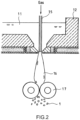
- FIG. 2 shows a manufacturing apparatus using the blow process.
- a raw glass 11 having predetermined composition and molten in a refractory furnace 12 is inflated into a balloon by a gas delivered into a blow nozzle 15, and thus a hollow glass film 16 is formed.
- This hollow glass film 16 is crushed by a pair of pressing rolls 17 to give the glass flakes 1.
- FIG. 3 shows a manufacturing apparatus using the cup process.
- a molten raw glass 11 is poured into a rotary cup 22 through a nozzle 21, flows out from the upper edge of the rotary cup 22 in a radial manner by a centrifugal force generated by rotation of the rotary cup 22.
- the raw glass 11 having flown out of the rotary cup 22 is drawn by an air stream and introduced into an annular cyclone collector 24 through upper and lower annular plates 23 and 23.
- the glass cools and solidifies into a thin film while passing through the annular plates 23 and 23, and the thin film is crushed into fines pieces to give the glass flakes 1.
- the chopped strand has a shape obtained by cutting the glass fiber into short pieces.
- the chopped strand has a fiber diameter of, for example, 1 to 50 ⁇ m and has an aspect ratio of, for example, 2 to 1000.
- the shape of a cross-section of the chopped strand may or may not be circular, and may be, for example, flattened.
- the fiber diameter of the chopped strand is defined as the diameter of a circle having the same area as that of a cross-section of the strand.
- the aspect ratio of the chopped strand can be determined by dividing the fiber length by the fiber diameter.
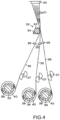
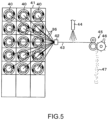
- the chopped strand can be manufactured, for example, using the apparatuses shown in FIGS. 4 and 5 .
- a raw glass having predetermined composition and molten in a refractory furnace is drawn through a bushing 30 having a large number of (for example, 2400) nozzles in the bottom, and drawn out as a large number of glass filaments 31.
- the glass filaments 31 are sprayed with cooling water, and then a binder (sizing agent) 34 is applied to the glass filaments 31 by an application roller 33 of a binder applicator 32.
- the large number of glass filaments 31 on which the binder 34 is applied are bundled, through reinforcing pads 35, into three strands 36 each composed of, for example, about 800 glass filaments 31.
- each of the strands 36 While being traversed by a traverse finger 37, each of the strands 36 is wound on a cylindrical tube 39 mounted on a collet 38.
- the cylindrical tube 39 on which the strand 36 is wound is detached from the collet 38, and thus a cake (wound strand body) 40 is obtained.
- the cakes 40 are placed in a creel 41, and the strands 36 are drawn out from the cakes 40 and bundled into a strand bundle 43 through a bundle guide 42.
- the strand bundle 43 is sprayed with water or a treatment liquid by a spraying apparatus 44.
- the strand bundle 43 is cut by a rotating blade 46 of a cutting apparatus 45, and thus chopped strands 47 are obtained.
- the milled fiber has a shape obtained by cutting the glass fiber into powder.
- the milled fiber has a fiber diameter of, for example, 1 to 50 ⁇ m and have an aspect ratio of, for example, 2 to 500.
- the shape of a cross-section of the milled fiber may or may not be circular, and may be, for example, flattened.
- the fiber diameter of the milled fiber is defined as the diameter of a circle having the same area as that of a cross-section of the strand.
- the aspect ratio of the milled fiber can be obtained by dividing the fiber length by the fiber diameter.
- the milled fiber can be obtained by a known method.
- the glass powder can be manufactured by crushing the glass.
- the glass powder has an average particle diameter of, for example, 1 to 500 ⁇ m.
- the particle diameter of the glass powder is defined as the diameter of a sphere having the same volume as a particle of the glass powder.
- the average particle diameter of the glass powder can be determined by D50 (a particle diameter at a cumulative volume percentage of 50%) evaluated by particle size distribution measurement of at least 0.1 g of the glass powder by a laser diffraction scattering method.
- the glass powder can be obtained by a known method.
- the glass bead has a spherical shape or an approximately spherical shape.
- the glass bead has an average particle diameter of, for example, 1 to 500 ⁇ m.
- the particle diameter of the glass bead is defined as the diameter of a sphere having the same volume as a particle of the glass bead.
- the average particle diameter of the glass bead can be determined by D50 (a particle diameter at a cumulative volume percentage of 50%) evaluated by particle size distribution measurement of at least 0.1 g of the glass bead by a laser diffraction scattering method.
- the glass bead can be obtained by a known method.
- the flat fiber has a shape obtained by cutting a glass fiber having a cross-section with a flat shape such as an elliptical shape.
- a major axis D2 is larger than a minor axis D1 in a cross-section of the flat fiber, and D2/D1 is, for example, 1.2 or more.
- the minor axis D1 is, for example, 0.5 to 25 ⁇ m.
- the major axis D2 is, for example, 0.6 to 300 ⁇ m.
- a length L of the flat fiber is, for example, 10 to 1000 ⁇ m.
- a cross-section of a flat fiber 60 may be narrow in the middle.
- the cross-sectional shape of the flat fiber 60 may be a recessed shape in which a surface extending along the major axis D2 recedes in a central portion with respect to end portions.
- the cross-section has an approximate gourd shape or an approximate hourglass shape in which both sides of a central portion defined along the major axis D2 direction recede.
- the fine flake is a thin glass flake.
- the fine flake may be formed of, for example, a glass flake having an average thickness of 0.1 to 2.0 ⁇ m, or may contain, for example, a glass flake having a thickness of 0.01 to 2.0 ⁇ m in an amount of 90 mass% or more.
- the fine flake having such a small average thickness and having a small variation in thickness exhibits a high reinforcing effect on a resin and also exhibits an excellent decreasing effect on a mold shrinkage factor of a resin.
- the fine flake can be obtained by the above-described method.
- the glass filler can be manufactured by a method including: melting the above-described glass composition; and shaping the molten glass composition into a desired glass filler.
- the temperature for melting the glass composition is, for example, 1400°C or higher.
- At least a portion of the glass filler may be granulated.
- Granulation is a process in which glass fillers are subjected to a binder treatment such that the individual glass fillers are bonded to each other by a binder to be granulated.
- the granular glass filler hardly scatters and accordingly is excellent in workability, and is also excellent in dispersibility in a resin.
- the use of the granular glass filler improves the feeding efficiency, thereby allowing more reliable quantitative feeding.
- the binder used in the granulation will be described hereinafter.
- the binder preferably contains a surfactant and a binding component.
- the surfactant may be anionic, cationic, amphoteric, or nonionic.
- a nonionic surfactant is preferably used in the case where the binding component contains an epoxy resin or a urethane resin. This is because agglomeration of the binder can be reduced for stabilization.
- an anionic surfactant examples include dioctyl sodium sulfosuccinate, fatty acid salt, alkyl sulfate, alkyl sulfonate, alkyl aryl sulfonate, alkyl naphthalene sulfonate, alkyl sulfosuccinate, alkyl diphenyl ether disulfonate, alkyl phosphate, polyoxyethylene alkyl sulfate, polyoxyethylene alkyl allyl sulfate, and sulfosuccinate.
- a cationic surfactant examples include higher amine halogen acid salt, alkyl pyridinium halide, and quaternary ammonium salt.
- amphoteric surfactant examples include lauryl amino propionate and lauryl dimethyl betaine.
- a nonionic surfactant include: polyoxyethylene glycol alkyl ethers such as polyoxyethylene lauryl ether, polyoxyethylene higher alcohol ether, and polyoxyethylene octyl phenyl ether; polyethylene glycol fatty acid esters such as polyethylene glycol monostearate; sorbitan fatty acid esters such as sorbitan monolaurate and polyoxyethylene sorbitan monolaurate; glycol fatty acid esters such as glycol monostearate; and fatty acid monoglycerides. Two or more of these may be used in combination.
- the binding component of the binder is not particularly limited, and an organic or inorganic component can be used.
- the organic binding component include methylcellulose, carboxymethyl cellulose, starch, carboxymethyl starch, hydroxyethyl cellulose, hydroxypropyl cellulose, polyvinyl alcohol, silane coupling agents, acrylic resins, epoxy resins, phenolic resins, vinyl acetate, and urethane resins.
- the inorganic binding component include liquid glass, colloidal silica, colloidal alumina, and amino silane.
- the binding component preferably contains at least one selected from a silane coupling agent, an epoxy resin, and an urethane resin.
- the silane coupling agent has two or more reactive groups in a molecule, one of which reacts with the surface of the glass filler, and another one of which reacts with the organic binding component and a thermoplastic resin. Accordingly, the affinity between the glass filler and the thermoplastic resin is improved. Epoxy resins and urethane resins have a good affinity for silane coupling agents and thermoplastic resins.
- the concentration of the binder is preferably adjusted using water or an alcohol as a solvent so that the components can be uniformly present on the surface of the glass filler.
- the concentration of the binder is preferably 1 to 10 mass% in terms of total solid concentration.
- the binder can be manufactured, for example, by appropriately adding the binding component, the surfactant, etc. to the solvent at ordinary temperature and atmospheric pressure and stirring the resulting solution to homogeneity.
- a ratio of the binder in the granulated glass filler i.e., a deposit ratio of the binder
- a deposit ratio of the binder is, for example, 0.1 to 2 mass% in terms of a mass ratio of solids.
- a deposit ratio of 0.1 mass% or more is suitable for sufficiently reducing scattering of the glass filler.
- a deposit ratio of 2 mass% or less is suitable for reducing gas generation and thus discoloration of a resin composition at extrusion molding of the resin composition.
- the method for granulating the glass filler is not particularly limited, and, for example, stirring granulation, fluidized bed granulation, injection granulation, or rotary granulation can be used. Specifically, a method is applicable in which the glass fillers on which an appropriate amount of the binder is deposited using a spray or the like are spread in a rotating drum or on a vibrating tray and the glass fillers are granulated while being heated to evaporate the solvent.
- the granular glass filler having a desired size can be manufactured by appropriately adjusting the rotational rate of the rotating drum or the vibration frequency of the vibration tray and the evaporation rate of the solvent.
- the glass filler may have a surface treated with a surface treatment agent. This treatment may improve the reinforcing effect of the glass filler.
- a surface treatment agent include silicon coupling agents, such as ⁇ -aminopropyltriethoxysilane, vinyltriethoxysilane, and ⁇ -methacryloxypropyltrimethoxysilane, and titanium coupling agents.
- the amount of the surface treatment agent used is, for example, 0.05 to 0.20 mass% of the glass filler.
- a resin composition according to the present invention includes a thermoplastic resin as well as the glass filler according to the present invention.
- the thermoplastic resin is not limited to a particular one, and is, for example, polyvinyl chloride, polypropylene, polyethylene, polystyrene, polyester, polyamide, polycarbonate, polybutylene, polybutylene terephthalate, or a copolymer of these.
- polybutylene terephthalate enhances a reducing effect on warpage of a molded article made by mixing with the glass filler and an improvement effect on dimensional stability thereof.
- the content of the glass filler such as the glass flake in the resin composition is preferably 5 to 70 mass%. Setting the content to 5 mass% or more facilitates the glass filler to sufficiently exhibit its function as a reinforcement. Setting the content to 70 mass% or less facilitates the glass filler to be uniformly dispersed in the resin composition. To sufficiently reduce the mold shrinkage factor, the content of the glass filler is more preferably 30 mass% or more.
- the resin composition may appropriately include a reinforcement other than the glass filler.
- a glass fiber may be included.
- the content of the glass fiber added may be nearly equal to that of the glass filler.
- the glass flake, the flat fiber, and the fine flake have relatively large specific surface areas, and are suitable for ensuring the adhesive force with the thermoplastic resin.
- the flat fiber as shown in FIG. 7 is preferred because its recessed surface shape contributes to an increase in specific surface area.
- the resin composition according to the present invention has a low permittivity, and is suitable for improving various properties.
- the improvement in various properties includes, for example: enhancement in strength, heat resistance, and dimensional stability; decrease in linear thermal expansion coefficient and reduction in its anisotropy; and reduction in anisotropy of the shrinkage factor at molding.
- Each glass specimen thus produced was evaluated for the working temperature, the devitrification temperature, the temperature difference ⁇ T, the amount of alkali dissolution, and the permittivity at a frequency of 1 GHz.
- the evaluation methods are as follows.
- the viscosity was measured by a platinum ball-drawing method, and a temperature at which the thus-measured viscosity was 1000 dPa•sec was defined as the working temperature.
- the platinum ball-drawing method is a method for measuring the viscosity of a molten glass by dipping a platinum ball in the molten glass, drawing the platinum ball upward in a uniform motion, determining a relation between the load (friction) during the drawing of the platinum ball and the gravity or buoyancy acting on the platinum ball, and applying the determined relationship to Stokes' law which states a relationship between the viscosity of a fluid in which a small particle settles down and the fall velocity of the small particle.
- An amount of 25 g of the glass specimen crushed to a particle diameter of 1.0 to 2.8 mm was put in a platinum boat (a lidless rectangular platinum container), held for 2 hours in an electric furnace with a temperature gradient (800 to 1400°C), and then taken out of the electric furnace.
- the highest temperature in the electric furnace was defined as the devitrification temperature of the glass specimen, the highest temperature corresponding to a location where a crystal was observed in the glass.
- the particles having a diameter in the above range are obtained by sieving.
- the glass specimen was crushed into particles, which were sieved to obtain particles that pass through a sieve (mesh sieve; the same can be said to sieves below) having an opening size of 2.8 mm and are left on a sieve having an opening size of 1.0 mm.
- the value obtained by subtracting the devitrification temperature from the working temperature was defined as the temperature difference ⁇ T.
- the amount of alkali dissolution was measured according to an alkali dissolution test defined in JIS R 3502: 1995 "Test method of glass apparatus for chemical analysis”.
- the measurement was specifically as follows.
- the glass specimen was crushed into particles, which were sieved to obtain particles that pass through a sieve having an opening size of 420 ⁇ m and are left on a sieve having an opening size of 250 ⁇ m.
- particles having the same mass as that of the specific gravity of the glass specimen were weighed out from the sieved-out particles.
- the weighed-out particles were immersed in 50 mL of distilled water at 100°C for 1 hour, after which alkaline components in the water in which the particles had been immersed were titrated with 0.01 N sulfuric acid.
- the milliliters of the sulfuric acid consumed for the titration were multiplied by 0.31 to determine the milligrams of the alkaline components calculated as Na 2 O.
- the determined milligrams were defined as the amount of alkali dissolution. The smaller the amount of alkali dissolution is, the higher water resistance the glass specimen has.
- the permittivity at a frequency of 1 GHz was measured using a permittivity measuring apparatus by a cavity resonator perturbation method.
- the measurement temperature was set to 25°C, and the dimensions of the sample for the measurement were set to a rectangular parallelepiped having a height of 100 mm and having a square bottom face of side 1.5 mm.
- Tables 1 to 12 show evaluation results.
- Component (mass%) or property Example 1
- Example 2 Example 3
- Example 4 Example 5 SiO 2 57.51 55.49 56.19 57.20 56.49 B 2 O 3 27.30 26.78 27.12 26.08 25.75 Al 2 O 3 10.72 13.65 12.24 12.26 13.67 P 2 O 5 - - - - - MgO 3.43 3.06 3.41 3.42 3.07 CaO 0.24 0.74 0.24 0.24 0.74 SrO - - - - - BaO - - - - - ZnO - - - - - MgO + CaO 3.67 3.80 3.65 3.66 3.81 MgO/(MgO + CaO) 0.93 0.81 0.93 0.93 0.81 MgO + CaO + ZnO 3.67 3.80 3.65 3.66 3.81 Li 2 O 0.70 0.18 0.70 0.70 0.18 Na 2 O 0.10 0.10 0.10 0.10 0.10 K 2 O - -
- the working temperature is 1340 to 1441°C
- the amount of alkali dissolution is 0.03 to 0.33 mg
- the permittivity at a frequency of 1 GHz is 4.1 to 4.5.
- Comparative Example 1 having glass composition of a conventional E-glass exhibits a high permittivity, namely, more than 6.0.
- Comparative Example 2 having glass composition of a conventional D-glass exhibits a larger amount of alkali dissolution than those of Examples 1 to 53.
- Comparative Example 3 the contents of SiO 2 and B 2 O 3 are out of the ranges defined in the present invention. Comparative Example 3 exhibits a large amount of alkali dissolution, namely, more than 1.0 mg.
- Comparative Example 4 does not include MgO and CaO and exhibits a large amount of alkali dissolution, namely, more than 1.0 mg.
- Comparative Example 5 MgO/(MgO + CaO) is out of the range defined in the present invention. Comparative Example 5 exhibits a larger amount of alkali dissolution than those of Examples 1 to 53.
- Comparative Example 6 Li 2 O + Na 2 O + K 2 O is out of the range defined in the present invention. Comparative Example 6 exhibits a large amount of alkali dissolution, namely, more than 1.0 mg.
- Glass flakes were produced using the glass compositions of Examples 1 to 53. Specifically, each glass composition was molten again in an electric furnace, and was subsequently cooled and shaped into a pellet. The obtained pellet was put in a melting furnace to produce a glass flake having an average thickness of 1 to 2 ⁇ m and an average particle diameter of 100 to 500 ⁇ m.
- Chopped strands that can be used as glass fillers were produced using the glass compositions of Examples 1 to 53. Specifically, each glass composition was molten again in an electric furnace, and was subsequently cooled and shaped into a pellet. The obtained pellet was put in manufacturing apparatuses as shown in FIGS. 4 and 5 to produce a chopped strand having an average fiber diameter of 10 to 20 ⁇ m and a length of 3 mm.
- Milled fibers were produced using the chopped strands produced in Examples 107 to 159. Specifically, each chopped strand having an average fiber diameter of 10 to 20 ⁇ m and a length of 3 mm was crushed using an alumina ball mill to produce a milled fiber having an average fiber diameter of 10 to 20 ⁇ m and an average length of 50 to 100 ⁇ m.
- Fine flakes were produced using the glass compositions produced in Examples 1 to 53. Specifically, each glass composition was molten again in an electric furnace, and was subsequently cooled and shaped into a pellet. The obtained pellet was put in a melting furnace to produce a fine flake having an average thickness of 0.5 to 1 ⁇ m and an average particle diameter of 100 to 300 ⁇ m.
- the glass composition of the present invention can be used, for example, for manufacturing a glass filler.
- the glass filler of the present invention can be used in the same applications as conventional glass fillers.
Landscapes
- Chemical & Material Sciences (AREA)
- Chemical Kinetics & Catalysis (AREA)
- Organic Chemistry (AREA)
- Materials Engineering (AREA)
- General Chemical & Material Sciences (AREA)
- Geochemistry & Mineralogy (AREA)
- Life Sciences & Earth Sciences (AREA)
- Engineering & Computer Science (AREA)
- Health & Medical Sciences (AREA)
- Medicinal Chemistry (AREA)
- Polymers & Plastics (AREA)
- Ceramic Engineering (AREA)
- Glass Compositions (AREA)
Applications Claiming Priority (2)
| Application Number | Priority Date | Filing Date | Title |
|---|---|---|---|
| JP2020100720 | 2020-06-10 | ||
| PCT/JP2021/021815 WO2021251399A1 (fr) | 2020-06-10 | 2021-06-08 | Composition de verre, charge de verre et son procédé de production, et composition de résine contenant une charge de verre |
Publications (2)
| Publication Number | Publication Date |
|---|---|
| EP4166520A1 true EP4166520A1 (fr) | 2023-04-19 |
| EP4166520A4 EP4166520A4 (fr) | 2024-06-19 |
Family
ID=78845725
Family Applications (1)
| Application Number | Title | Priority Date | Filing Date |
|---|---|---|---|
| EP21820877.5A Pending EP4166520A4 (fr) | 2020-06-10 | 2021-06-08 | Composition de verre, charge de verre et son procédé de production, et composition de résine contenant une charge de verre |
Country Status (5)
| Country | Link |
|---|---|
| US (1) | US20230234882A1 (fr) |
| EP (1) | EP4166520A4 (fr) |
| JP (1) | JP7576091B2 (fr) |
| CN (1) | CN115697931B (fr) |
| WO (1) | WO2021251399A1 (fr) |
Families Citing this family (3)
| Publication number | Priority date | Publication date | Assignee | Title |
|---|---|---|---|---|
| US12534397B2 (en) * | 2019-06-21 | 2026-01-27 | Nippon Sheet Glass Company, Limited | Glass filler and method for producing the same, and resin composition including glass filler |
| CN114349333A (zh) * | 2022-01-20 | 2022-04-15 | 清远南玻节能新材料有限公司 | 粘结剂、高铝硅酸盐玻璃及其制备方法与应用 |
| CN116768469A (zh) * | 2023-04-13 | 2023-09-19 | 河北光兴半导体技术有限公司 | 一种低介电常数玻璃的制备方法 |
Family Cites Families (18)
| Publication number | Priority date | Publication date | Assignee | Title |
|---|---|---|---|---|
| JPS599992A (ja) * | 1982-07-08 | 1984-01-19 | 株式会社日立製作所 | 多層配線基板の製造方法 |
| JPS62226839A (ja) | 1986-03-27 | 1987-10-05 | Nippon Sheet Glass Co Ltd | 低誘電率ガラス繊維 |
| JPH092839A (ja) * | 1995-06-15 | 1997-01-07 | Nitto Boseki Co Ltd | 低誘電正接ガラス繊維 |
| JP3954130B2 (ja) * | 1996-04-03 | 2007-08-08 | 日東紡績株式会社 | 低誘電率ガラスパウダー及びそれを用いたプリント配線基板並びに樹脂混合材料物 |
| JP2003137590A (ja) * | 2001-05-09 | 2003-05-14 | Nippon Electric Glass Co Ltd | 低誘電率低誘電正接ガラス、それを用いたガラス繊維及びガラス繊維織物 |
| JP2004107112A (ja) | 2002-09-17 | 2004-04-08 | Nippon Electric Glass Co Ltd | 低誘電率低誘電正接ガラス繊維 |
| JP4907850B2 (ja) * | 2003-06-11 | 2012-04-04 | 日本特殊陶業株式会社 | 低温焼成誘電体磁器組成物及びその製造方法 |
| WO2012017694A1 (fr) | 2010-08-05 | 2012-02-09 | 日本板硝子株式会社 | Matière de charge de verre |
| JP2012153582A (ja) * | 2011-01-27 | 2012-08-16 | Nippon Sheet Glass Co Ltd | ガラス組成物及びその用途 |
| JP5809900B2 (ja) * | 2011-09-20 | 2015-11-11 | 日本板硝子株式会社 | ガラス組成物、並びにこれを用いたポリカーボネート樹脂用ガラスフィラー及びポリカーボネート樹脂組成物 |
| CN108290769A (zh) * | 2015-05-13 | 2018-07-17 | 电子玻璃纤维美国有限责任公司 | 用于制造具有改进的低热膨胀系数的改进的低介电纤维的MgO、ZnO和稀土氧化物用于高硼铝硅酸盐组合物的用途 |
| WO2017187471A1 (fr) | 2016-04-28 | 2017-11-02 | 日本板硝子株式会社 | Composition de verre, fibre de verre, tissu de verre, et procédé de fabrication de fibre de verre |
| US11440832B2 (en) * | 2016-11-10 | 2022-09-13 | Nippon Sheet Glass Company, Limited | Glass filler and method for producing the same |
| US11174191B2 (en) | 2017-05-26 | 2021-11-16 | Nippon Sheet Glass Company, Limited | Glass composition, glass fibers, glass cloth, and method for producing glass fibers |
| JP2020535237A (ja) * | 2017-08-02 | 2020-12-03 | ソルベイ スペシャルティ ポリマーズ ユーエスエー, エルエルシー | 低誘電平坦ガラス繊維を含有する強化熱可塑性ポリマー組成物及び相当する物品 |
| JP7410450B2 (ja) * | 2018-12-14 | 2024-01-10 | 日本電気硝子株式会社 | ガラス繊維及びその製造方法 |
| US12534397B2 (en) * | 2019-06-21 | 2026-01-27 | Nippon Sheet Glass Company, Limited | Glass filler and method for producing the same, and resin composition including glass filler |
| US20240228362A9 (en) * | 2021-02-05 | 2024-07-11 | Nippon Sheet Glass Company, Limited | Glass composition, glass filler, and method for manufacturing the same |
-
2021
- 2021-06-08 WO PCT/JP2021/021815 patent/WO2021251399A1/fr not_active Ceased
- 2021-06-08 JP JP2022530591A patent/JP7576091B2/ja active Active
- 2021-06-08 US US18/001,198 patent/US20230234882A1/en active Pending
- 2021-06-08 EP EP21820877.5A patent/EP4166520A4/fr active Pending
- 2021-06-08 CN CN202180040260.XA patent/CN115697931B/zh active Active
Also Published As
| Publication number | Publication date |
|---|---|
| EP4166520A4 (fr) | 2024-06-19 |
| CN115697931A (zh) | 2023-02-03 |
| JP7576091B2 (ja) | 2024-10-30 |
| JPWO2021251399A1 (fr) | 2021-12-16 |
| WO2021251399A1 (fr) | 2021-12-16 |
| CN115697931B (zh) | 2025-05-30 |
| US20230234882A1 (en) | 2023-07-27 |
Similar Documents
| Publication | Publication Date | Title |
|---|---|---|
| US12534397B2 (en) | Glass filler and method for producing the same, and resin composition including glass filler | |
| EP4289802A1 (fr) | Composition de verre et charge de verre et procédé pour sa production | |
| EP4166520A1 (fr) | Composition de verre, charge de verre et son procédé de production, et composition de résine contenant une charge de verre | |
| JP7410450B2 (ja) | ガラス繊維及びその製造方法 | |
| CN102333735B (zh) | 玻璃纤维用玻璃组合物、玻璃纤维及玻璃纤维片状物 | |
| JP5655293B2 (ja) | ガラス繊維用ガラス組成物、ガラス繊維及びガラス製シート状物 | |
| JP7289358B2 (ja) | ガラスフィラーとその製造方法、及びガラスフィラーを含む樹脂含有組成物 | |
| JP2010260781A (ja) | 無機充填材及びその製造方法 | |
| US6762219B2 (en) | Glass/plastic compounds | |
| EP4289801A1 (fr) | Composition de verre et fibre de verre, et procédé de production associé | |
| US20260125311A1 (en) | Glass filler and method for producing the same, and resin composition including glass filler | |
| CN120202171B (zh) | 玻璃组合物、玻璃纤维和玻璃填料 | |
| JP7817489B1 (ja) | ガラス組成物、ガラス繊維、及びガラスフィラー | |
| EP4620932A1 (fr) | Fibres de verre, et composition pour fibres de verre | |
| CN121974560A (en) | Glass composition, glass fiber and glass filler | |
| EP3372727A1 (fr) | Charge de fibre de verre revêtue de métal à blindage électromagnétique, procédé de fabrication de charge de fibre de verre revêtue de métal à blindage électromagnétique, et article de résine de blindage électromagnétique | |
| CN121426441A (zh) | 一种低介电常数、超低介电损耗的玻璃纤维及制备方法、玻璃纤维制品、复合材料及应用 | |
| TW202400538A (zh) | 玻璃纖維 |
Legal Events
| Date | Code | Title | Description |
|---|---|---|---|
| STAA | Information on the status of an ep patent application or granted ep patent |
Free format text: STATUS: THE INTERNATIONAL PUBLICATION HAS BEEN MADE |
|
| PUAI | Public reference made under article 153(3) epc to a published international application that has entered the european phase |
Free format text: ORIGINAL CODE: 0009012 |
|
| STAA | Information on the status of an ep patent application or granted ep patent |
Free format text: STATUS: REQUEST FOR EXAMINATION WAS MADE |
|
| 17P | Request for examination filed |
Effective date: 20221216 |
|
| AK | Designated contracting states |
Kind code of ref document: A1 Designated state(s): AL AT BE BG CH CY CZ DE DK EE ES FI FR GB GR HR HU IE IS IT LI LT LU LV MC MK MT NL NO PL PT RO RS SE SI SK SM TR |
|
| P01 | Opt-out of the competence of the unified patent court (upc) registered |
Effective date: 20230516 |
|
| DAV | Request for validation of the european patent (deleted) | ||
| DAX | Request for extension of the european patent (deleted) | ||
| A4 | Supplementary search report drawn up and despatched |
Effective date: 20240523 |
|
| RIC1 | Information provided on ipc code assigned before grant |
Ipc: C03C 13/02 20060101ALI20240516BHEP Ipc: C03C 13/00 20060101AFI20240516BHEP |