EP4169927A1 - Verfahren zur herstellung einer organozinkverbindung, kettenübertragungsmittel, blockcopolymer und harzzusammensetzung - Google Patents
Verfahren zur herstellung einer organozinkverbindung, kettenübertragungsmittel, blockcopolymer und harzzusammensetzung Download PDFInfo
- Publication number
- EP4169927A1 EP4169927A1 EP21850405.8A EP21850405A EP4169927A1 EP 4169927 A1 EP4169927 A1 EP 4169927A1 EP 21850405 A EP21850405 A EP 21850405A EP 4169927 A1 EP4169927 A1 EP 4169927A1
- Authority
- EP
- European Patent Office
- Prior art keywords
- carbon atoms
- block copolymer
- formula
- compound
- chain transfer
- Prior art date
- Legal status (The legal status is an assumption and is not a legal conclusion. Google has not performed a legal analysis and makes no representation as to the accuracy of the status listed.)
- Pending
Links
Images
Classifications
-
- C—CHEMISTRY; METALLURGY
- C07—ORGANIC CHEMISTRY
- C07F—ACYCLIC, CARBOCYCLIC OR HETEROCYCLIC COMPOUNDS CONTAINING ELEMENTS OTHER THAN CARBON, HYDROGEN, HALOGEN, OXYGEN, NITROGEN, SULFUR, SELENIUM OR TELLURIUM
- C07F7/00—Compounds containing elements of Groups 4 or 14 of the Periodic Table
- C07F7/02—Silicon compounds
- C07F7/08—Compounds having one or more C—Si linkages
- C07F7/0803—Compounds with Si-C or Si-Si linkages
-
- C—CHEMISTRY; METALLURGY
- C08—ORGANIC MACROMOLECULAR COMPOUNDS; THEIR PREPARATION OR CHEMICAL WORKING-UP; COMPOSITIONS BASED THEREON
- C08F—MACROMOLECULAR COMPOUNDS OBTAINED BY REACTIONS ONLY INVOLVING CARBON-TO-CARBON UNSATURATED BONDS
- C08F2/00—Processes of polymerisation
- C08F2/38—Polymerisation using regulators, e.g. chain terminating agents, e.g. telomerisation
-
- C—CHEMISTRY; METALLURGY
- C07—ORGANIC CHEMISTRY
- C07F—ACYCLIC, CARBOCYCLIC OR HETEROCYCLIC COMPOUNDS CONTAINING ELEMENTS OTHER THAN CARBON, HYDROGEN, HALOGEN, OXYGEN, NITROGEN, SULFUR, SELENIUM OR TELLURIUM
- C07F3/00—Compounds containing elements of Groups 2 or 12 of the Periodic Table
- C07F3/06—Zinc compounds
-
- C—CHEMISTRY; METALLURGY
- C07—ORGANIC CHEMISTRY
- C07F—ACYCLIC, CARBOCYCLIC OR HETEROCYCLIC COMPOUNDS CONTAINING ELEMENTS OTHER THAN CARBON, HYDROGEN, HALOGEN, OXYGEN, NITROGEN, SULFUR, SELENIUM OR TELLURIUM
- C07F7/00—Compounds containing elements of Groups 4 or 14 of the Periodic Table
- C07F7/02—Silicon compounds
- C07F7/08—Compounds having one or more C—Si linkages
- C07F7/0803—Compounds with Si-C or Si-Si linkages
- C07F7/0825—Preparations of compounds not comprising Si-Si or Si-cyano linkages
- C07F7/083—Syntheses without formation of a Si-C bond
-
- C—CHEMISTRY; METALLURGY
- C08—ORGANIC MACROMOLECULAR COMPOUNDS; THEIR PREPARATION OR CHEMICAL WORKING-UP; COMPOSITIONS BASED THEREON
- C08F—MACROMOLECULAR COMPOUNDS OBTAINED BY REACTIONS ONLY INVOLVING CARBON-TO-CARBON UNSATURATED BONDS
- C08F297/00—Macromolecular compounds obtained by successively polymerising different monomer systems using a catalyst of the ionic or coordination type without deactivating the intermediate polymer
-
- C—CHEMISTRY; METALLURGY
- C08—ORGANIC MACROMOLECULAR COMPOUNDS; THEIR PREPARATION OR CHEMICAL WORKING-UP; COMPOSITIONS BASED THEREON
- C08F—MACROMOLECULAR COMPOUNDS OBTAINED BY REACTIONS ONLY INVOLVING CARBON-TO-CARBON UNSATURATED BONDS
- C08F297/00—Macromolecular compounds obtained by successively polymerising different monomer systems using a catalyst of the ionic or coordination type without deactivating the intermediate polymer
- C08F297/02—Macromolecular compounds obtained by successively polymerising different monomer systems using a catalyst of the ionic or coordination type without deactivating the intermediate polymer using a catalyst of the anionic type
-
- C—CHEMISTRY; METALLURGY
- C08—ORGANIC MACROMOLECULAR COMPOUNDS; THEIR PREPARATION OR CHEMICAL WORKING-UP; COMPOSITIONS BASED THEREON
- C08F—MACROMOLECULAR COMPOUNDS OBTAINED BY REACTIONS ONLY INVOLVING CARBON-TO-CARBON UNSATURATED BONDS
- C08F297/00—Macromolecular compounds obtained by successively polymerising different monomer systems using a catalyst of the ionic or coordination type without deactivating the intermediate polymer
- C08F297/06—Macromolecular compounds obtained by successively polymerising different monomer systems using a catalyst of the ionic or coordination type without deactivating the intermediate polymer using a catalyst of the coordination type
-
- C—CHEMISTRY; METALLURGY
- C08—ORGANIC MACROMOLECULAR COMPOUNDS; THEIR PREPARATION OR CHEMICAL WORKING-UP; COMPOSITIONS BASED THEREON
- C08F—MACROMOLECULAR COMPOUNDS OBTAINED BY REACTIONS ONLY INVOLVING CARBON-TO-CARBON UNSATURATED BONDS
- C08F4/00—Polymerisation catalysts
- C08F4/42—Metals; Metal hydrides; Metallo-organic compounds; Use thereof as catalyst precursors
- C08F4/44—Metals; Metal hydrides; Metallo-organic compounds; Use thereof as catalyst precursors selected from light metals, zinc, cadmium, mercury, copper, silver, gold, boron, gallium, indium, thallium, rare earths or actinides
- C08F4/60—Metals; Metal hydrides; Metallo-organic compounds; Use thereof as catalyst precursors selected from light metals, zinc, cadmium, mercury, copper, silver, gold, boron, gallium, indium, thallium, rare earths or actinides together with refractory metals, iron group metals, platinum group metals, manganese, rhenium technetium or compounds thereof
- C08F4/62—Refractory metals or compounds thereof
- C08F4/64—Titanium, zirconium, hafnium or compounds thereof
- C08F4/64003—Titanium, zirconium, hafnium or compounds thereof the metallic compound containing a multidentate ligand, i.e. a ligand capable of donating two or more pairs of electrons to form a coordinate or ionic bond
- C08F4/64082—Tridentate ligand
- C08F4/64141—Dianionic ligand
- C08F4/64144—NN(R)C
-
- C—CHEMISTRY; METALLURGY
- C08—ORGANIC MACROMOLECULAR COMPOUNDS; THEIR PREPARATION OR CHEMICAL WORKING-UP; COMPOSITIONS BASED THEREON
- C08L—COMPOSITIONS OF MACROMOLECULAR COMPOUNDS
- C08L23/00—Compositions of homopolymers or copolymers of unsaturated aliphatic hydrocarbons having only one carbon-to-carbon double bond; Compositions of derivatives of such polymers
- C08L23/02—Compositions of homopolymers or copolymers of unsaturated aliphatic hydrocarbons having only one carbon-to-carbon double bond; Compositions of derivatives of such polymers not modified by chemical after-treatment
- C08L23/10—Homopolymers or copolymers of propene
- C08L23/12—Polypropene
-
- C—CHEMISTRY; METALLURGY
- C08—ORGANIC MACROMOLECULAR COMPOUNDS; THEIR PREPARATION OR CHEMICAL WORKING-UP; COMPOSITIONS BASED THEREON
- C08F—MACROMOLECULAR COMPOUNDS OBTAINED BY REACTIONS ONLY INVOLVING CARBON-TO-CARBON UNSATURATED BONDS
- C08F212/00—Copolymers of compounds having one or more unsaturated aliphatic radicals, each having only one carbon-to-carbon double bond, and at least one being terminated by an aromatic carbocyclic ring
- C08F212/02—Monomers containing only one unsaturated aliphatic radical
- C08F212/04—Monomers containing only one unsaturated aliphatic radical containing one ring
- C08F212/06—Hydrocarbons
- C08F212/08—Styrene
-
- C—CHEMISTRY; METALLURGY
- C08—ORGANIC MACROMOLECULAR COMPOUNDS; THEIR PREPARATION OR CHEMICAL WORKING-UP; COMPOSITIONS BASED THEREON
- C08F—MACROMOLECULAR COMPOUNDS OBTAINED BY REACTIONS ONLY INVOLVING CARBON-TO-CARBON UNSATURATED BONDS
- C08F4/00—Polymerisation catalysts
- C08F4/42—Metals; Metal hydrides; Metallo-organic compounds; Use thereof as catalyst precursors
- C08F4/44—Metals; Metal hydrides; Metallo-organic compounds; Use thereof as catalyst precursors selected from light metals, zinc, cadmium, mercury, copper, silver, gold, boron, gallium, indium, thallium, rare earths or actinides
- C08F4/60—Metals; Metal hydrides; Metallo-organic compounds; Use thereof as catalyst precursors selected from light metals, zinc, cadmium, mercury, copper, silver, gold, boron, gallium, indium, thallium, rare earths or actinides together with refractory metals, iron group metals, platinum group metals, manganese, rhenium technetium or compounds thereof
- C08F4/62—Refractory metals or compounds thereof
- C08F4/64—Titanium, zirconium, hafnium or compounds thereof
- C08F4/659—Component covered by group C08F4/64 containing a transition metal-carbon bond
- C08F4/65908—Component covered by group C08F4/64 containing a transition metal-carbon bond in combination with an ionising compound other than alumoxane, e.g. (C6F5)4B-X+
Definitions
- the present invention relates to an organozinc compound preparation method, a chain transfer agent, a block copolymer, and a resin composition, and specifically, to a method for preparing an organozinc compound having styrene residues which may be used for coordination chain transfer polymerization (CCTP) in the preparation of a block copolymer, the method for preparing an organozinc compound synthesized as a single compound without side reactions, thereby having excellent synthesis reproducibility and polymerization reproducibility, a chain transfer agent including an organozinc compound prepared thereby, a block copolymer polymerized using the same, and a resin composition including the block copolymer.
- CCTP coordination chain transfer polymerization
- a representative block copolymer is PS-Block-Polybutadiene-Block-PS (SBS, wherein PS is polystyrene), which is produced at a scale of 2 million tons per year worldwide through controlled anionic polymerization, as shown in Reaction Equation 1 below.
- SBS PS-Block-Polybutadiene-Block-PS
- the hydrogenation of the intermediate block segment (i.e., polybutadiene block) of the SBS provides a value-added product, PS-block-poly (ethylene-co-1-butene)-block-PS (SEBS), which is commercialized at a scale of 300,000 tons per year worldwide.
- SEBS PS-block-poly (ethylene-co-1-butene)-block-PS
- SBS is excellent in all of weather resistance, heat resistance, abrasion resistance, impact resistance, adhesiveness, transparency, and recyclability, and thus, there is a growing demand for SEBS.
- the hydrogenation of a polymer requires a catalytic reaction in the molten state of the polymer, and accordingly, a complex process such as a catalyst removal process is necessarily accompanied, so that SEBS is sold at a price that is at least three times higher than the price of SBS, and the high resin price poses as an obstacle to market expansion.
- SEBS heat treatment of SEBS
- Commercial grade SEBS is prepared through controlled anionic polymerization, and thus, exhibits a very narrow molecular weight distribution, and accordingly, does not flow in molten state.
- SEBS is usually used in combination with other polymers rather than being used alone. While most bulk polymers are pelletized, and thus, are conveniently supplied, SEBS is only obtained in the form of a lumpy powder, and thus, is not conveniently supplied.
- Patent Document 1 proposes a one-pot synthesis of a triblock copolymer which is similar to SEBS. Specifically, Patent Document 1 discloses that a polyolefin (PO) chain is grown through coordinative chain transfer polymerization (CCTP) from a diorganozinc compound having styrene residues, and then the polystyrene (PS) chain is grown through anionic polymerization in one-pot from a Zn-C binding site and the styrene residues.
- CCTP coordinative chain transfer polymerization
- PS polystyrene
- Patent Document 1 discloses a method for preparing a diorganozinc compound through hydroboration of divinylbenzene, as shown in Reaction Equation 2 below.
- triethyl borane Et 3 B
- diethyl zinc Et 2 Zn
- triethyl borane is continuously generated as a reaction intermediate, and if triethyl borane remains in the CCTP stage, it acts as a catalyst poison, and thus, should be continuously removed.
- divinylbenzene which is used as a reactant has a low purity.
- divinylbenzene generally contains about 20 mol% of ethylvinylbenzene
- CCTP when CCTP is performed using a diorganozinc compound, polystyrene cannot be grown from an ethyl group by anionic polymerization, which causes the generation of a diblock copolymer.
- divinylbenzene since divinylbenzene includes two vinyl groups, when the hydroboration proceeds simultaneously in the two vinyl groups, a dimer, a trimer, and the like containing two or more zinc are inevitably generated. Therefore, in order to reduce the generation of a dimer, a trimer, and the like, divinylbenzene should be used in a large amount, which is about three times or more than that of triethyl borane.
- the prepared diorganozinc compound is obtained as a mixture including, on average, about 82.4 mol% of a compound having a vinyl group as a terminal, about 9.2 mol% of a compound having an ethyl group as a terminal, and about 8.5 mol% of a compound which is a dimer, wherein even if only the compound having a vinyl group as a terminal is selectively purified, since divinylbenzene is a mixture of an ortho isomer, a meta isomer, and a para isomer, the terminal vinyl group of the prepared diorganozinc compound is present in all of ortho, meta, and para positions, so that when CCTP is performed using the prepared diorganozinc compound, it cannot be guaranteed that block connection structures of block copolymers to be prepared all represents the same structure.
- Patent Document 2 also proposes a one-pot synthesis of a triblock copolymer which is similar to SEBS, as shown in the above Patent Document 2.
- Patent Document 2 discloses that a polyolefin (PO) chain is grown through coordinative chain transfer polymerization (CCTP) from a diorganozinc compound having ⁇ -methylstyrene residues, and then the polystyrene (PS) chain is grown through anionic polymerization in one-pot from a Zn-C binding site and the ⁇ -methylstyrene residues.
- PO polyolefin
- CCTP coordinative chain transfer polymerization
- PS polystyrene
- Patent Document 2 discloses a method in which magnesium metal powder is introduced to 1-chloromethyl-4-isopropenylbenzene to prepare a Grignard reagent, and then a diorganozinc compound having ⁇ -methylstyrene residues is prepared through a metathesis reaction with zinc chloride (ZnCl 2 ).
- a diorganozinc compound in order to perform CCTP, should be used in excess with respect to a catalyst (e.g., hafnium complex, etc.) for performing the CCTP.
- a catalyst e.g., hafnium complex, etc.
- the catalyst is inactivated even with a trace amount of the impurities, so that in some cases, the CCTP may not be performed.
- An aspect of the present invention provides a method for preparing an organozinc compound containing styrene residues, when preparing a block copolymer, which may be used for coordinative chain transfer polymerization (CCCP), does not use triethyl borane, thereby ensuring work safety, is synthesized as a single compound, thereby not including a side reaction product such as a dimer, and furthermore, does not include impurities containing chlorine which may act as a catalytic poison, and also facilitates the removal of impurities containing magnesium which may act as a catalyst poison.
- CCCP coordinative chain transfer polymerization
- Another aspect of the present invention provides a chain transfer agent for preparing a block copolymer by coordinative chain transfer polymerization, which includes an organozinc compound prepared according to the method for preparing an organozinc compound, and thus has excellent synthesis reproducibility and polymerization reproducibility.
- Another aspect of the present invention provides a polystyrene-polyolefin block copolymer prepared by coordinative chain transfer polymerization and anionic polymerization using the chain transfer agent, thereby having a wide molecular weight distribution and excellent mechanical properties.
- Another aspect of the present invention provides a resin composition including the block copolymer, thereby having excellent dispersibility for polypropylene, and thus, excellent mechanical physical properties.
- a method for preparing an organozinc compound including preparing a Grignard reagent containing styrene residues, and reacting the prepared Grignard reagent with a zinc compound to prepare an organozinc compound represented by Formula 1 below, wherein the zinc compound is alkyl zinc alkoxide.
- R 1 and R 3 are each independently a single bond or an alkylene group having 1 to 10 carbon atoms
- R 2 is an alkylene group having 1 to 10 carbon atoms or -SiR 4 R 5 -
- R 4 and R 5 are each independently an alkyl group having 1 to 10 carbon atoms.
- a chain transfer agent including an organozinc compound represented by Formula 1 above, wherein the chain transfer agent includes 96 mol% or more of the organozinc compound represented by Formula 1 above in the chain transfer agent.
- a block copolymer including an aromatic vinyl-based polymer block and an olefin-based polymer block, wherein the block polymer has a molecular weight distribution (Mw/Mn) of 1.2 or greater.
- a resin composition including the block copolymer and polypropylene.
- an organozinc compound is prepared according to the method for preparing an organozinc compound according to the present invention, triethyl borane is not used so that work safety is ensured, and there are effects in that a single compound is synthesized so that a side reaction product such as a dimer is not included, impurities containing chlorine which may act as a catalytic poison are not included, and the removal of impurities containing magnesium which may act as a catalyst poison is facilitated.
- a chain transfer agent including an organozinc compound prepared according to the method for preparing an organozinc compound according to the present invention is excellent in synthesis reproducibility and polymerization reproducibility.
- a block copolymer prepared by coordinative chain transfer polymerization and anionic polymerization using the chain transfer agent according to the present invention has a wide molecular weight distribution and excellent mechanical properties.
- a resin composition according to the present invention includes the above block copolymer, thereby having excellent dispersibility for polypropylene, and thus, excellent mechanical physical properties.
- the term 'monomer unit' may refer to a component, structure, or material itself derived from a monomer.
- a specific example thereof may be a repeating unit which is formed in a polymer by a monomer introduced and participating in a polymerization reaction during the polymerization of the polymer.
- the term 'polymer' used herein may refer to a homopolymer formed by being polymerized from one type of monomer, and the term 'copolymer' may refer to a copolymer formed by being polymerized from two or more types of co-monomers.
- the ⁇ copolymer' may refer to a ⁇ random copolymer' in which two or more types of co-monomers are randomly co-polymerized unless otherwise unless otherwise states as a 'block.'
- 'block' used herein may refer to a group of repeating units composed of only repeating units derived from the same monomer or repeating units derived from the same co-monomer since only the same monomer or the same co-monomer has participated in a polymerization reaction in a copolymer.
- an aromatic vinyl-based polymer block may mean a block formed of only an aromatic vinyl monomer unit
- an olefin-based polymer block may mean a block formed of only one or more olefin-based monomer units.
- anionic active polymer' used herein refers to a polymer formed by an anionic polymerization reaction, and may refer to a polymer capable of additional polymerization or reaction since a terminal on one side of the polymer maintains an anionic state.
- a specific example thereof may be a living anionic polymer.
- composition' used herein includes not only a reaction product and a decomposition product formed from materials of a corresponding composition but also a mixture of materials including the corresponding composition.
- the present invention provides a method for preparing an organozinc compound.
- the method for preparing an organozinc compound includes preparing a Grignard reagent containing styrene residues, and reacting the prepared Grignard reagent with a zinc compound to prepare an organozinc compound represented by Formula 1 below, wherein the zinc compound may be alkyl zinc alkoxide.
- R 1 and R 3 may each independently be a single bond or an alkylene group having 1 to 10 carbon atoms
- R 2 may be an alkylene group having 1 to 10 carbon atoms or -SiR 4 R 5 -
- R 4 and R 5 may each independently be an alkyl group having 1 to 10 carbon atoms.
- R 1 and R 3 may each independently be a single bond or an alkylene group having 1 to 3 carbon atoms
- R 2 may be an alkylene group having 1 to 3 carbon atoms or - SiR 4 R 5 -
- R 4 and R 5 may each independently be an alkyl group having 1 to 3 carbon atoms.
- R 1 and R 3 may each independently be a single bond or an alkylene group having 1 carbon atom
- R 2 may be an alkylene group having 1 carbon atom or -SiR 4 R 5 -
- R 4 and R 5 may each independently be an alkyl group having 1 carbon atom.
- the organozinc compound represented by Formula 1 above may be one or more selected from the group consisting of organozinc compounds represented by Formulas 1-1 to 1-4 below, and may preferably be any one of Formulas 1-3 and 1-4.
- the organozinc compound represented by Formula 1 above prepared according to the method for preparing an organozinc compound is synthesized as a single compound, and thus, does not include a side reaction product such as a dimer, and furthermore, does not include impurities containing chlorine which may act as a catalyst poison, for example, organic zinc chloride (R-Zn-Cl).
- the organozinc compound represented by Formula 1 above is prepared according to the method for preparing an organozinc compound, the organozinc compound is synthesized as a single compound, and thus, has excellent synthesis reproducibility.
- the Grignard reagent containing styrene residues may be represented by Formula 2 below.
- R 1 and R 3 may each independently be a single bond or an alkylene group having 1 to 10 carbon atoms
- R 2 may be an alkylene group having 1 to 10 carbon atoms or -SiR 4 R 5 -
- R 4 and R 5 may each independently be an alkyl group having 1 to 10 carbon atoms
- X may be a halogen group.
- R 1 and R 3 may each independently be a single bond or an alkylene group having 1 to 3 carbon atoms
- R 2 may be an alkylene group having 1 to 3 carbon atoms or - SiR 4 R 5 -
- R 4 and R 5 may each independently be an alkyl group having 1 to 3 carbon atoms
- X may be a halogen group.
- R 1 and R 3 may each independently be a single bond or an alkylene group having 1 carbon atom
- R 2 may be an alkylene group having 1 carbon atom or -SiR 4 R 5 -
- R 4 and R 5 may each independently be an alkyl group having 1 carbon atom
- X may be a halogen group selected from the group consisting of Cl, Br, and I.
- the Grignard reagent containing styrene residues and represented by Formula 2 above may be one selected from the group consisting of Grignard reagents containing styrene residues and represented by Formula 2-1 to 2-4 below.
- the Grignard reagent containing styrene residues and represented by Formula 2 above may be prepared through the reaction between a halide in which halide(-X) is substituted with R 1 and magnesium, specifically, magnesium powder or magnesium metal.
- the Grignard reagent containing styrene residues and represented by Formula 2 above may be prepared through the reaction of a compound represented by Formula 3 below and magnesium, specifically, magnesium powder or magnesium metal.
- R 1 and R 3 may each independently be a single bond or an alkylene group having 1 to 10 carbon atoms
- R 2 may be an alkylene group having 1 to 10 carbon atoms or -SiR 4 R 5 -
- R 4 and R 5 may each independently be an alkyl group having 1 to 10 carbon atoms
- X may be a halogen group.
- R 1 and R 3 may each independently be a single bond or an alkylene group having 1 to 3 carbon atoms
- R 2 may be an alkylene group having 1 to 3 carbon atoms or - SiR 4 R 5 -
- R 4 and R 5 may each independently be an alkyl group having 1 to 3 carbon atoms
- X may be a halogen group.
- R 1 and R 3 may each independently be a single bond or an alkylene group having 1 carbon atom
- R 2 may be an alkylene group having 1 carbon atom or -SiR 4 R 5 -
- R 4 and R 5 may each independently be an alkyl group having 1 carbon atom
- X may be a halogen group selected from the group consisting of Cl, Br, and I.
- the compound represented by Formula 3 above may be one selected from the group consisting of compounds represented by Formulas 3-1 to 3-4 below.
- the reaction between the compound represented by Formula 3 and the magnesium powder or magnesium metal may be performed in a molar ratio of the magnesium powder or magnesium metal in excess to 1 mole of the compound represented by Formula 3 based on the molar ratio, that is, a molar ratio of greater than 1 mole.
- At least 50 mol%, at least 60 mol%, at least 70 mol%, at least 80 mol%, at least 90 mol%, at least 95 mol%, or at least 99 mol% of the compound represented by Formula 3 above may be converted to the Grignard reagent containing styrene residues and represented by Formula 2 above.
- the reaction between the compound represented by Formula 3 above and the magnesium powder or magnesium metal may be performed in a molar ratio of greater than 1:1 to 1:10, greater than 1:1 to 1:5, greater than 1:1 to 1:2, or 1:1.01 to 1:1.60, based on the molar ratio.
- the conversion rate to the Grignard reagent containing styrene residues and represented by Formula 2 is high, and the content of residual magnesium after the reaction may be minimized to facilitate the removal of residual magnesium powder or magnesium metal.
- the zinc compound it is necessary for the zinc compound to be a zinc compound capable of inducing two organic groups of the same type to be substituted with zinc in the preparation of an organozinc compound. Therefore, as described above, zinc chloride (ZnCl 2 ) may be easily considered.
- zinc chloride ZnCl 2
- impurities e.g., alkyl zinc chloride
- the present invention uses alkyl zinc alkoxide as the zinc compound.
- the alkyl group of the alkyl zinc alkoxide may be an alkyl group having 1 to 10 carbon atoms, an alkyl group having 1 to 5 carbon atoms, an alkyl group having 1 to 3 carbon atoms, or an ethyl group
- the alkoxide group may be an alkoxide group having 1 to 10 carbon atoms, an alkoxide group having 1 to 5 carbon atoms, an alkoxide group having 1 to 3 carbon atoms, or a methoxide group.
- the zinc compound may be ethyl zinc methoxide.
- the alkyl zinc alkoxide may be prepared from dialkyl zinc.
- the alkyl zinc alkoxide may be prepared by reacting dialkyl zinc with alcohol in situ.
- the alkyl group of the dialkyl zinc may be the same as the alkyl group of the alkyl zinc alkoxide described above, and the alcohol may be an alcohol in which hydrogen is bonded to the alkoxide group of the alkyl zinc alkoxide described above.
- the alkyl zinc alkoxide when used as the zinc compound, during the reaction between the Grignard reagent and the zinc compound, halogenated magnesium alkoxide is generated, which is an insoluble salt, so that filtration is facilitated to prevent impurities from remaining.
- the reaction between the Grignard reagent and the zinc compound may be performed in a molar ratio of 10:1 to 1:10, 5:1 to 1:5, 3:1 to 1:3, 2:1 to 1:2, 1.5:1 to 1:1.5, or 1:1 based on the molar ratio.
- a molar ratio 10:1 to 1:10, 5:1 to 1:5, 3:1 to 1:3, 2:1 to 1:2, 1.5:1 to 1:1.5, or 1:1 based on the molar ratio.
- all steps and all reactions of the method for preparing a zinc compound may be performed in an organic solvent, and the reaction temperature and reaction pressure may be adjusted according to the purpose of increasing yield and purity.
- a typical borane-based compound including styrene residues is replaced by a Grignard reagent including styrene residues, and alkyl zinc or zinc chloride is replaced with an alkyl zinc alkoxide, so that a catalyst poison may be completely removed.
- a compound in the form of a monomer having a fully preserved terminal vinyl may be obtained as a single compound, so that not only the storage stability of a zinc compound, but also the physical properties of a copolymer to be finally produced may be improved, and it is possible to achieve the effect of greatly reducing the generation amount of diblock copolymers, which not a triblock.
- the present invention provides a chain transfer agent including an organozinc compound prepared by the method for preparing an organozinc compound.
- the chain transfer agent may be a chain transfer agent for preparing a block copolymer by coordinative chain transfer polymerization.
- the chain transfer agent includes an organozinc compound represented by Formula 1 below, and the chain transfer agent includes 96 mol% or more of the organozinc compound represented by Formula 1 below, and preferably, may not include a side reaction product other than the organozinc compound represented by Formula 1 below.
- R 1 and R 3 may each independently be a single bond or an alkylene group having 1 to 10 carbon atoms
- R 2 may be an alkylene group having 1 to 10 carbon atoms or -SiR 4 R 5 -
- R 4 and R 5 may each independently be an alkyl group having 1 to 10 carbon atoms.
- the chain transfer agent is prepared by the method for preparing an organozinc compound, and thus, the organozinc compound represented by Formula 1 above may be the same as the organozinc compound represented by Formula 1 described in the method for preparing an organozinc compound above.
- the chain transfer agent may include preferably 97 mol% or more, more preferably 98 mol% or more, or 99 mol% or more of the organozinc compound of Formula 1 above, and most preferably, may not include a side reaction product other than the organozinc compound.
- a side reaction product such as a dimer as well as impurities containing chlorine or magnesium are not included.
- the chain transfer agent may include only the organozinc compound represented by Formula 1 above.
- the chain transfer agent is prepared according to the method for preparing an organozinc compound, and thus, is synthesized as a single compound of the organozinc compound represented by Formula 1 above, and does not include a side reaction product such as a dimer, and furthermore, does not include impurities containing chlorine which may act as a catalyst poison, and also, does not include impurities containing magnesium which may act as a catalyst poison since the impurities are all removed therefrom.
- the chain transfer agent has excellent polymerization reproducibility during coordinative chain transfer polymerization for the preparation of a block copolymer, and may improve processability by inducing a high molecular weight distribution during the preparation of the block copolymer.
- the present invention provides a block copolymer polymerized using the chain transfer agent, and a preparation method thereof.
- the block copolymer includes an aromatic vinyl-based polymer block and an olefin-based polymer block, wherein the block polymer may have a molecular weight distribution (Mw/Mn) of 1.2 or greater.
- the block copolymer may be a triblock copolymer including an aromatic vinyl-based polymer block-olefin-based polymer block-aromatic vinyl-based polymer block.
- a specific example thereof may be polystyrene-block-poly(ethylene-co-olefin)-block-polystyrene.
- the block copolymer may include a repeating unit represented by Formula 6 below.
- R 1 and R 3 may each independently be a single bond or an alkylene group having 1 to 10 carbon atoms
- R 2 may be an alkylene group having 1 to 10 carbon atoms or -SiR 4 R 5 -
- R 4 and R 5 may each independently be an alkyl group having 1 to 10 carbon atoms
- PO is an olefin-based polymer block
- PS is an aromatic vinyl-based polymer block
- * is a portion connected in a repeating unit or a terminal of a repeating unit, wherein when * is a terminal of a repeating unit, * may be a functional group derived from hydrogen or an anionic polymerization initiator.
- the aromatic vinyl-based polymer block may be a block formed by the polymerization of an aromatic vinyl-based monomer
- the aromatic vinyl-based monomer for forming the aromatic vinyl-based polymer block may be one selected from the group consisting of styrene, ⁇ -methylstyrene, 3-methylstyrene, 4-methylstyrene, 4-propylstyrene, 1-vinylnaphthalene, 4-cyclohexylstyrene, 4-(p-methylphenyl)styrene, and 1-vinyl-5-hexylnaphthalene.
- a specific example thereof may be styrene.
- the content of the aromatic vinyl-based polymer block based on the total content of the block copolymer may be 10 wt% to 60 wt%, 15 wt% to 40 wt%, or 20 wt% to 35 wt%. Within this range, there is an effect in that the mechanical physical properties and processibility of the block copolymer are excellent.
- the olefin-based polymer block (i.e., poly(ethylene-co-olefin)) may include an ethylene monomer unit and an ⁇ -olefin-based monomer unit having 3 to 20 carbon atoms. Specific examples thereof may include an ethylene monomer unit and an ⁇ -olefin-based monomer unit having 6 to 8 carbon atoms.
- the olefin-based polymer block includes an ethylene monomer unit and an ⁇ -olefin-based monomer unit having 3 to 20 carbon atoms or 6 to 8 carbon atoms
- the weather resistance, heat resistance, abrasion resistance, impact resistance, adhesiveness, transparency, and recyclability of the block copolymer are excellent, and there is an effect of improving the mechanical physical properties of a resin composition including the block copolymer.
- an ⁇ -olefin-based monomer for forming the ⁇ -olefin-based monomer unit having 3 to 20 carbon atoms may be one or more selected from the group consisting of propylene, 1-butene, 1-pentene, 3-methyl-1-butene, 1-hexene, 4-methyl-1- pentene, 3-methyl-1-pentene, 1-heptene, 1-octene, 1-decene, 1-undecene, 1-dodecene, 1-tetradecene, 1-hexadecene, 1-icocene, 4,4-dimethyl-1-pentene, 4,4-diethyl-1-hexene, and 3,4-dimethyl-1-hexene.
- an ⁇ -olefin-based monomer for forming the ⁇ -olefin-based monomer unit having 6 to 8 carbon atoms may be one or more selected from the group consisting of 1-hexene, 4-methyl-1-pentene, 3-methyl-1-pentene, 1-heptene, 1-octene, 4,4-dimethyl-1-pentene, and 3,4-dimethyl-1-hexene.
- a specific example thereof may be 1-hexene.
- the content of the olefin-based polymer block based on the total content of the block copolymer may be 40 wt% to 90 wt%, 60 wt% to 85 wt%, or 65 wt% to 80 wt%. Within this range, there is an effect in that the mechanical physical properties and processibility of the block copolymer are excellent.
- the content of the ethylene monomer unit based on the total content of the block copolymer may be 20 wt% to 70 wt%, 30 wt% to 60 wt%, or 35 wt% to 50 wt%. Within this range, there is an effect in that the mechanical physical properties and processibility of the block copolymer are excellent.
- the content of the ⁇ -olefin-based monomer unit based on the total content of the block copolymer may be 10 wt% to 50 wt%, 15 wt% to 45 wt%, or 20 wt% to 40 wt%. Within this range, there is an effect in that the mechanical physical properties and processibility of the block copolymer are excellent.
- the block copolymer may have a molecular weight distribution (Mw/Mn) of 1.2 or greater, 1.2 to 5.0, 1.5 to 4.0, 1.5 to 3.0, 1.5 to 2.5, or 1.6 to 2.2. Within this range, there is an effect in that the mechanical physical properties and processibility of the block copolymer are excellent.
- the molecular weight distribution (Mw/Mn) may refer to a polydispersity index (PDI).
- the block copolymer may have a weight average molecular weight (Mw) of 20,000 g/mol to 1,000,000 g/mol, 30,000 g/mol to 800,000 g/mol, 40,000 g/mol to 500,000 g/mol, 50,000 g/mol to 400,000 g/mol, or 53,000 g/mol to 357,000 g/mol.
- Mw weight average molecular weight
- the weight average molecular weight may be measured using polystyrene (PS) standard gel permeation chromatography (GPC).
- the block copolymer may have a tensile strength of 5 MPa to 50 MPa, 6 MPa to 40 MPa, or 7 MPa to 35 MPa. Within this range, there is an effect of securing the mechanical physical properties of a resin composition including the block copolymer.
- the block copolymer may have an elongation at break of 1,000% to 3,000%, 1,200% to 2,800%, or 1,300% to 2,500%. Within this range, there is an effect of securing the mechanical physical properties of a resin composition including the block copolymer.
- a method for preparing the block copolymer includes (S10) polymerizing one or more olefin-based monomers using a transition metal catalyst in the presence of a chain transfer agent to prepare an olefin-based polymer block intermediate represented by Formula 4 below, (S20) introducing and polymerizing an anionic polymerization initiator and an aromatic vinyl-based monomer in the presence of the olefin-based polymer block intermediate represented by Formula 4 below prepared in Step (S10) to prepare a block copolymer intermediate represented by Formula 5 below, and (S30) obtaining a block copolymer including a repeating unit represented by Formula 6 below from the block copolymer intermediate represented by Formula 5 prepared in Step (S20), wherein the chain transfer agent includes an organozinc compound represented by Formula 1 below, and the chain transfer agent may not include a side reaction product other than the organozinc compound represented by Formula 1 below.
- R 1 and R 3 may each independently be a single bond or an alkylene group having 1 to 10 carbon atoms
- R 2 may be an alkylene group having 1 to 10 carbon atoms or -SiR 4 R 5 -
- R 4 and R 5 may each independently be an alkyl group having 1 to 10 carbon atoms.
- R 1 and R 3 may each independently be a single bond or an alkylene group having 1 to 10 carbon atoms
- R 2 may be an alkylene group having 1 to 10 carbon atoms or -SiR 4 R 5 -
- R 4 and R 5 may each independently be an alkyl group having 1 to 10 carbon atoms
- PO may be an olefin-based polymer block.
- R 1 and R 3 may each independently be a single bond or an alkylene group having 1 to 10 carbon atoms
- R 2 may be an alkylene group having 1 to 10 carbon atoms or -SiR 4 R 5 -
- R 4 and R 5 may each independently be an alkyl group having 1 to 10 carbon atoms
- PO is an olefin-based polymer block
- PS is an aromatic vinyl-based polymer block
- * is a portion connected in a repeating unit or a terminal of a repeating unit, wherein when * is a terminal of a repeating unit, * may be a functional group derived from hydrogen or an anionic polymerization initiator.
- R 1 and R 3 may each independently be a single bond or an alkylene group having 1 to 10 carbon atoms
- R 2 may be an alkylene group having 1 to 10 carbon atoms or -SiR 4 R 5 -
- R 4 and R 5 may each independently be an alkyl group having 1 to 10 carbon atoms
- PO is an olefin-based polymer block
- PS is an aromatic vinyl-based polymer block
- * is a portion connected in a repeating unit or a terminal of a repeating unit, wherein when * is a terminal of a repeating unit, * may be a functional group derived from hydrogen or an anionic polymerization initiator.
- Step (S10) above may be a step of growing an olefin-based polymer chain from a chain transfer agent including the organic zinc compound represented by Formula 1 above through coordinative chain transfer polymerization (CCTP) using a transition metal catalyst to prepare an olefin-based polymer block intermediate.
- CCTP coordinative chain transfer polymerization
- the transition metal catalyst is a catalyst for growing an olefin-based polymer through coordinative chain transfer polymerization, and may be a catalyst composition including a transition metal catalyst as a main catalyst and a co-catalyst, wherein the co-catalyst may be an organoaluminum or a boron compound.
- the catalyst composition including the transition metal catalyst may be a homogeneous (metallocene) catalyst or a heterogeneous (Ziegler) catalyst, and more specifically, may be a homogeneous (metallocene) catalyst.
- the transition metal catalyst may be a pyridylamido hafnium complex activated with [(C 18 H 37 ) 2 N(H)Me] + [B(C 6 F 5 ) 4 ] - , in which case, there is an effect of preventing a polyolefin chain which is not bonded to the zinc of the chain transfer agent.
- the one or more olefin-based monomers may be the same as the olefin-based monomer for forming the olefin-based polymer block described above.
- Specific examples thereof may include one or more ⁇ -olefin-based monomers selected from the group consisting of an ethylene monomer and an ⁇ -olefin-based monomer having 3 to 20 carbon atoms.
- the olefin-based monomer may be introduced in a content for satisfying the content of the olefin-based polymer block described above.
- the ethylene monomer may be introduced in the form of a gaseous phase
- the ⁇ -olefin-based monomer having 3 to 20 carbon atoms may be introduced in the form of a gaseous or liquid phase.
- Step (S20) above may be a step of introducing and polymerizing an anionic polymerization initiator and an aromatic vinyl-based monomer in the presence of the olefin-based polymer block intermediate represented by Formula 4 above prepared in Step (S10) to initiate anionic polymerization from the Zn-C bonding site and styrene residues of the olefin-based polymer block intermediate represented by Formula 4 above, and to grow an aromatic vinyl-based monomer, thereby preparing a block copolymer intermediate represented by Formula 5 above.
- Step (S20) above may be performed in one-pot with Step (S10).
- the anionic polymerization initiator may be an initiator composition including an organolithium compound, and a specific example thereof may be an initiator composition including an organolithium compound and a triamine compound.
- the organolithium compound may be one or more selected from the group consisting of n-butyllithium, sec-butyllithium, tert-butyllithium, methyllithium, ethyllithium, isopropyllithium, cyclohexyllithium, allyllithium, vinyllithium, phenyllithium, benzyllithium, pentylallylithium, and (trimethylsilyl)methyllithium.
- the organolithium compound may be introduced in a molar ratio of 1:0.1 to 2.0, 1:0.5 to 1.5, or 1:0.8 to 1.2 based on the molar ratio of the chain transfer agent and the organolithium compound.
- the triamine compound is an additive for initiating anionic polymerization from the Zn-C bonding site and styrene residues of an olefin-based polymer block intermediate and efficiently growing an aromatic vinyl-based monomer, which has an effect of efficiently growing the aromatic vinyl-based monomer when included together with the organolithium compound in the initiator composition.
- the triamine compound may be N,N,N',N",N"-pentamethyldiethylenetriamine (PMDTA).
- the triamine compound may be introduced in a molar ratio of 0.5:1 to 1:1 based on the molar ratio of the organolithium compound and the triamine compound.
- the block copolymer intermediate represented by Formula 5 above prepared in Step (S20) above may be one in which a triblock copolymer of aromatic vinyl-based polymer block-olefin-based polymer block-aromatic vinyl-based polymer block is symmetrically formed around zinc.
- the aromatic vinyl-based monomer may be the same as the aromatic vinyl-based monomer for forming the aromatic vinyl-based polymer block described above.
- the aromatic vinyl-based monomer may be introduced in a content for satisfying the content of the aromatic vinyl-based polymer block described above.
- Step (S30) above may be a step of obtaining a block copolymer including a repeating unit represented by Formula 6 above from the block copolymer intermediate represented by Formula 5 above prepared in Step (S20), and may be performed by the reaction with water, oxygen or an organic acid.
- the organic acid may be ethylhexanoic acid.
- all steps and all reactions of the method for preparing a block copolymer may be performed in an organic solvent, and the reaction temperature and reaction pressure may be adjusted as needed.
- the present invention provides a resin composition including the block copolymer.
- the resin composition may include the block copolymer and polypropylene, and as a specific example, may include the block copolymer, and polypropylene and/or a rubber polymer.
- the resin composition may include 5 wt% to 90 wt% of a block copolymer, 0 wt% to 95 wt% of polypropylene, and 0 wt% to 80 wt% of a rubber polymer, and as a specific example, may include 5 wt% to 90 wt%, 5 wt% to 70 wt%, 5 wt% to 50 wt%, or 10 wt% to 30 wt% of the block copolymer, 0 wt% to 95 wt%, 20 wt% to 90 wt%, 40 wt% to 90 wt%, or 70 wt% to 90 wt% of the polypropylene, and 0 wt% to 80 wt%, 0 wt% to 60 wt% , 0 wt% to 40 wt%, or 0 wt% to 20 wt% of the rubber polymer.
- the rubber polymer may be one or more selected from the group consisting of solution-polymerized styrene-butadiene rubber and ethylene-propylene rubber.
- the resin composition may include a process oil.
- the resin composition may have a tensile strength of 15 MPa to 40 MPa, 20 MPa to 30 MPa, or 24 MPa to 28 MPa. Within this range, there is an effect in that the mechanical physical properties of the resin composition are excellent.
- the resin composition may have an elongation at break of 100% to 1,500%, 300% to 1,000%, or 390% to 980%. Within this range, there is an effect in that the mechanical physical properties of the resin composition are excellent.
- the resin composition may have an impact strength of greater than or equal to 5 kgf ⁇ m/m, greater than or equal to 7 kgf ⁇ m/m, or greater than or equal to 10 kgf ⁇ m/m. Within this range, there is an effect in that the mechanical physical properties of the resin composition are excellent.
- the resin composition may have a low-temperature (-40°C) impact strength of greater than or equal to 4 kgf ⁇ m/m, greater than or equal to 4.5 kgf ⁇ m/m, or 4.5 kgf ⁇ m/m to 15.0 kgf ⁇ m/. Within this range, there is an effect in that the mechanical physical properties of the resin composition are excellent.
- the resin composition may have a melt flow index (230°C and 2.16 kg) of greater than or equal to 10 g/10 min, greater than or equal to 11.8 g/10 min, or 11.8 g/10 min to 40.0 g/10 min. Within this range, there is an effect in that the processability of the resin composition are excellent.
- the resin composition may have a melt flow index (230°C and 5 kg) of 0.5 g/10 min to 2.0 g/10 min, 0.7 to 1.5 g/10 min, or 0.95 to 1.00 g/10 min.
- the resin composition may have a melt flow index (230°C and 10 kg) of greater than or equal to 5 g/10 min, greater than or equal to 6 g/10 min, or 6 g/10 min to 8 g/10 min.
- the resin composition may have a shore A hardness of 10 to 60, 30 to 50, or 45 to 50.
- GPC Gel Permeation Chromatography
- the generated Grignard reagent was added to ethyl zinc methoxide (EtZn(OMe)) prepared by reacting 4.05 g (32.8 mmol) of diethyl zinc (Et 2 Zn) and 1.05 g (32.8 mmol) of methanol in 30 ml of toluene in situ at room temperature for 1.0 hour. After stirring was performed at room temperature for 1.0 hour, magnesium chloride methoxide (MgCl(OMe)), which is an insoluble salt, was removed on celite. The filtered filter cake was washed using 20 ml of diethyl ether. Thereafter, the solvent was removed using a high vacuum line, and an oily compound was obtained.
- EtZn(OMe) ethyl zinc methoxide
- the generated Grignard reagent was added to ethyl zinc methoxide (EtZn(OMe)) prepared by reacting 2.75 g (22.2 mmol) of diethyl zinc (Et 2 Zn) and 0.71 g (22.2 mmol) of methanol in 30 ml of toluene in situ at room temperature for 1.0 hour. After stirring was performed at room temperature for 1.0 hour, magnesium chloride methoxide (MgCl(OMe)), which is an insoluble salt, was removed on celite. The filtered filter cake was washed using 20 ml of diethyl ether. Thereafter, the solvent was removed using a high vacuum line, and an oily compound was obtained.
- EtZn(OMe) ethyl zinc methoxide
- the organozinc compound represented by Formula 1-1 above was prepared in the same manner as in Preparation Example 1, except that zinc chloride (ZnCl 2 ) was used instead of ethyl zinc methoxide (EtZn(OMe)) in Preparation Example 1.
- the content (purity) of a target organozinc compound and the content of alkyl zinc chloride (R-Zn-Cl) and a borane-based compound (triethyl borane or diethyl borane hydride) acting as catalyst poisons were measured.
- Comparative Preparation Example 1 had about 20 mol% of terminal-saturated zinc compounds and side reaction products. A terminal-saturated compound cannot cause anionic polymerization, thereby having a problem of increasing the content of a diblock copolymer in a polymer to be finally produced.
- a side reaction product is an intermediate which is converted into a compound in the form of an oligomer of a dimer or more, and when such an organozinc compound in the form of such an oligomer is present, a chain transfer reaction cannot be induced due to the increase in viscosity, so that there is a problem in that the synthesis reaction into a polymer is inhibited. That is, it can be seen that the organozinc compound of Comparative Preparation Example 1 has the above problem.
- MMAO-3A modified methylaluminoxane-3A
- the solution was removed using a cannula, and to the reactor in an inert atmosphere, 1,200 g of methylcyclohexane, 560 g of 1-hexene, and a solution in which 3.50 mmol of the compound prepared in Preparation Example 1 above was dissolved in 1.00 mmol-Al (radical scavenger) of methylaluminoxane-3A (MMAO-3A) and methylcyclohexane were introduced.
- the temperature of the solution was set to 90°C.
- a catalyst solution containing 10.0 ⁇ mol of a pyridylamido hafnium complex activated with 10.0 ⁇ mol of [(C 18 H 37 ) 2 N(H)Me] + [B(C 6 F 5 ) 4 ] - in methylcyclohexane was injected into the reactor.
- ethylene gas was immediately introduced at a pressure of 25 bar, and the pressure of 25 bar was maintained constant during the supply.
- cooling was performed by an inner coil, the temperature was increased to 115°C within 5 minutes due to an exothermic reaction. After the initial temperature increase, the temperature started to slowly decrease due to catalyst deactivation, and was maintained at 90°C.
- MMAO-3A modified methylaluminoxane-3A
- the solution was removed using a cannula, and to the reactor in an inert atmosphere, 1,200 g of methylcyclohexane, 560 g of 1-hexene, and a solution in which 3.50 mmol of the compound prepared in Preparation Example 4 above was dissolved in 1.00 mmol-Al (radical scavenger) of methylaluminoxane-3A (MMAO-3A) and methylcyclohexane were introduced.
- the temperature of the solution was set to 90°C.
- a catalyst solution containing 10.0 ⁇ mol of a pyridylamido hafnium complex activated with 10.0 ⁇ mol of [(C 18 H 37 ) 2 N(H)Me] + [B(C 6 F 5 ) 4 ] - in methylcyclohexane was injected into the reactor.
- ethylene gas was immediately introduced at a pressure of 25 bar, and the pressure of 25 bar was maintained constant during the supply.
- cooling was performed by an inner coil, the temperature was increased to 115°C within 5 minutes due to an exothermic reaction. After the initial temperature increase, the temperature started to slowly decrease due to catalyst deactivation, and was maintained at 90°C.
- a polymer was prepared in the same manner as in Example 1-1, except that the organozinc compound of Comparative Preparation Example 1 was used instead of the organozinc compound of Preparation Example 1 in Example 1-1.
- a polymer was prepared in the same manner as in Example 1-1, except that the organozinc compound of Comparative Preparation Example 2 was used instead of the organozinc compound of Preparation Example 1 in Example 1-1.
- a polymer was prepared in the same manner as in Example 1-1, except that dihexyl zinc was used instead of the organozinc compound of Preparation Example 1 in Example 1-1.
- the block copolymers prepared in Examples 1-1 to 1-5 showed a wider molecular weight distribution than the block copolymer of Comparative Example 1-4, and thus, were confirmed to have excellent processability.
- the block copolymer according to Example 1-5 were able to be synthesized on a large scale, it still exhibited physical properties equivalent to those of the block copolymer of Comparative Example 1-4.
- the block copolymer according to Example 1-7 had a viscosity of 955 Pa ⁇ s measured with 500 rad/s at 160°C using a rotary rheometer, but the viscosity of the block copolymer of Comparative Example 1-4 could not be measured.
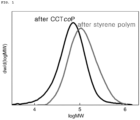
- FIG. 1 GPC curves of the polymer (i.e., poly(ethylene-co-1-hexene)) according to chain transfer coordinative polymerization and the block copolymer according to anionic polymerization during the polymerization of a block copolymer in accordance with Examples 1 to 5 are shown in FIG. 1 , and from FIG. 1 , it was clearly confirmed that a block copolymer was generated by the shift of the GPC curve after the styrene polymerization by anionic polymerization.
- the polymer i.e., poly(ethylene-co-1-hexene)
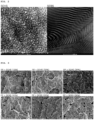
- the block copolymer (SEHS) prepared according to Example 1-5 and the block copolymer (SEES) of Comparative Example 1-4 were each photographed by TEM, and the TEM photographs are shown in FIG. 2 .
- the block copolymer of Example 1-5 and the block copolymer of Comparative Example 1-4 were dissolved in toluene at 100°C to 10 wt%, and the solution was poured into a frame. The solvent was slowly evaporated at room temperature for 5 days, and then was vacuumed overnight at 80°C. Before being dyed with RuO 4 , the prepared specimen was annealed in an oven at 150°C for 6 hours, and then photographed with TEM.
- Examples 2-1 to 2-4 were confirmed to have significantly excellent tensile strength as well as room temperature and low-temperature impact strength compared to Comparative Examples 2-1 to 2-3, and were also confirmed to have maintained an equivalent level or higher of elongation at break and melt flow index.
- the block copolymer prepared in Example 1-5 and the block copolymer of Comparative Example 1-4 were mixed with polypropylene (product name CB5230) in the ratio set forth in Tables 4 to 6 below to prepare a resin composition.
- the block copolymer prepared in each of Examples 2-5 to 2-7 and Comparative Examples 2-4 to 2-6 was mixed with polypropylene (product name CB5230) in the ratio set forth in Tables 4 to 6 above, and then precipitated in ethanol to recover a resin composition from the solution.
- the recovered resin composition was dried in a vacuum oven, and then injected into a mold at 210°C for 10 seconds at a pressure of 6 bar to be molded into a dog bone shape.
- the impact strength was measured at -40°C from the specimen in the dog bone shape, and then broken surfaces were treated with a xylene at room temperature for 4 hours to etch SEHS or SEES, and then photographed with SEM.
- a chain transfer agent including an organozinc compound prepared according to the method for preparing an organozinc compound according to the present invention was excellent in synthesis reproducibility and polymerization reproducibility.
- a block copolymer prepared by coordinative chain transfer polymerization and anionic polymerization using the chain transfer agent according to the present invention had a wide molecular weight distribution and excellent mechanical properties.
- a resin composition according to the present invention included the above block copolymer, thereby having excellent dispersibility for polypropylene, and thus, excellent mechanical physical properties.
Landscapes
- Chemical & Material Sciences (AREA)
- Organic Chemistry (AREA)
- Health & Medical Sciences (AREA)
- Chemical Kinetics & Catalysis (AREA)
- Medicinal Chemistry (AREA)
- Polymers & Plastics (AREA)
- Inorganic Chemistry (AREA)
- Engineering & Computer Science (AREA)
- Materials Engineering (AREA)
- Graft Or Block Polymers (AREA)
- Polymerisation Methods In General (AREA)
Applications Claiming Priority (3)
| Application Number | Priority Date | Filing Date | Title |
|---|---|---|---|
| KR20200096160 | 2020-07-31 | ||
| KR1020210100045A KR102869583B1 (ko) | 2020-07-31 | 2021-07-29 | 유기 아연 화합물 제조방법, 사슬 전달제, 블록 공중합체 및 수지 조성물 |
| PCT/KR2021/009967 WO2022025701A1 (ko) | 2020-07-31 | 2021-07-30 | 유기 아연 화합물 제조방법, 사슬 전달제, 블록 공중합체 및 수지 조성물 |
Publications (2)
| Publication Number | Publication Date |
|---|---|
| EP4169927A1 true EP4169927A1 (de) | 2023-04-26 |
| EP4169927A4 EP4169927A4 (de) | 2024-01-17 |
Family
ID=80035933
Family Applications (1)
| Application Number | Title | Priority Date | Filing Date |
|---|---|---|---|
| EP21850405.8A Pending EP4169927A4 (de) | 2020-07-31 | 2021-07-30 | Verfahren zur herstellung einer organozinkverbindung, kettenübertragungsmittel, blockcopolymer und harzzusammensetzung |
Country Status (5)
| Country | Link |
|---|---|
| US (1) | US20230295189A1 (de) |
| EP (1) | EP4169927A4 (de) |
| KR (1) | KR20250151281A (de) |
| CN (1) | CN116134040A (de) |
| WO (1) | WO2022025701A1 (de) |
Cited By (5)
| Publication number | Priority date | Publication date | Assignee | Title |
|---|---|---|---|---|
| EP4299667A4 (de) * | 2021-10-01 | 2024-10-09 | LG Chem, Ltd. | Thermoplastische harzzusammensetzung |
| EP4372023A4 (de) * | 2021-10-01 | 2024-11-13 | LG Chem, Ltd. | Multiblockcopolymer und herstellungsverfahren dafür |
| EP4372022A4 (de) * | 2021-10-01 | 2024-11-20 | LG Chem, Ltd. | Multiblockcopolymer und herstellungsverfahren dafür |
| EP4375306A4 (de) * | 2021-10-01 | 2024-11-20 | LG Chem, Ltd. | Multiblockcopolymer, harzzusammensetzung damit und verfahren zur herstellung davon |
| EP4372046A4 (de) * | 2021-10-01 | 2024-11-20 | LG Chem, Ltd. | Multiblockcopolymer, harzzusammensetzung und verfahren zur herstellung davon |
Families Citing this family (3)
| Publication number | Priority date | Publication date | Assignee | Title |
|---|---|---|---|---|
| CN117794998A (zh) * | 2021-10-01 | 2024-03-29 | 株式会社Lg化学 | 多嵌段共聚物、树脂组合物以及用于制备该多嵌段共聚物的方法 |
| KR20240064575A (ko) * | 2022-11-04 | 2024-05-13 | 주식회사 엘지화학 | 수지 조성물 및 수지 조성물 제조방법 |
| KR20250175876A (ko) * | 2024-06-11 | 2025-12-18 | 주식회사 엘지화학 | 블록 공중합체 및 이를 포함하는 수지 조성물 |
Family Cites Families (11)
| Publication number | Priority date | Publication date | Assignee | Title |
|---|---|---|---|---|
| JP5179430B2 (ja) * | 2009-02-27 | 2013-04-10 | 国立大学法人名古屋大学 | 光学活性アルコールの製造方法 |
| KR101732418B1 (ko) | 2016-03-15 | 2017-05-24 | 아주대학교 산학협력단 | 폴리올레핀-폴리스티렌 다중블록 공중합체 및 그 제조 방법 |
| KR101834829B1 (ko) * | 2016-03-15 | 2018-03-06 | 아주대학교 산학협력단 | 유기 아연 화합물 및 그 제조 방법 |
| KR101829382B1 (ko) | 2017-08-17 | 2018-02-20 | 아주대학교 산학협력단 | 폴리올레핀-폴리스티렌계 다중블록 공중합체, 이를 제조하기 위한 유기 아연 화합물 및 폴리올레핀-폴리스티렌계 다중블록 공중합체 제조 방법 |
| WO2019190292A1 (ko) * | 2018-03-30 | 2019-10-03 | 주식회사 엘지화학 | 블록 공중합체 조성물의 제조방법 |
| WO2019190289A1 (ko) * | 2018-03-30 | 2019-10-03 | 주식회사 엘지화학 | 블록 공중합체 조성물 |
| WO2019190287A1 (ko) * | 2018-03-30 | 2019-10-03 | 주식회사 엘지화학 | 블록 공중합체 조성물 |
| WO2019190288A1 (ko) * | 2018-03-30 | 2019-10-03 | 주식회사 엘지화학 | 블록 공중합체 조성물 |
| KR102373305B1 (ko) * | 2018-03-30 | 2022-03-11 | 주식회사 엘지화학 | 블록 공중합체 조성물 |
| KR20200096040A (ko) | 2019-02-01 | 2020-08-11 | 엘지전자 주식회사 | 의류처리장치 |
| KR20210100045A (ko) | 2021-07-21 | 2021-08-13 | 정중근 | 공압 수압 양방향 청소기 |
-
2021
- 2021-07-30 US US18/017,205 patent/US20230295189A1/en active Pending
- 2021-07-30 WO PCT/KR2021/009967 patent/WO2022025701A1/ko not_active Ceased
- 2021-07-30 CN CN202180060293.0A patent/CN116134040A/zh active Pending
- 2021-07-30 EP EP21850405.8A patent/EP4169927A4/de active Pending
-
2025
- 2025-09-30 KR KR1020250141986A patent/KR20250151281A/ko active Pending
Cited By (5)
| Publication number | Priority date | Publication date | Assignee | Title |
|---|---|---|---|---|
| EP4299667A4 (de) * | 2021-10-01 | 2024-10-09 | LG Chem, Ltd. | Thermoplastische harzzusammensetzung |
| EP4372023A4 (de) * | 2021-10-01 | 2024-11-13 | LG Chem, Ltd. | Multiblockcopolymer und herstellungsverfahren dafür |
| EP4372022A4 (de) * | 2021-10-01 | 2024-11-20 | LG Chem, Ltd. | Multiblockcopolymer und herstellungsverfahren dafür |
| EP4375306A4 (de) * | 2021-10-01 | 2024-11-20 | LG Chem, Ltd. | Multiblockcopolymer, harzzusammensetzung damit und verfahren zur herstellung davon |
| EP4372046A4 (de) * | 2021-10-01 | 2024-11-20 | LG Chem, Ltd. | Multiblockcopolymer, harzzusammensetzung und verfahren zur herstellung davon |
Also Published As
| Publication number | Publication date |
|---|---|
| KR20250151281A (ko) | 2025-10-21 |
| WO2022025701A1 (ko) | 2022-02-03 |
| US20230295189A1 (en) | 2023-09-21 |
| EP4169927A4 (de) | 2024-01-17 |
| CN116134040A (zh) | 2023-05-16 |
Similar Documents
| Publication | Publication Date | Title |
|---|---|---|
| EP4169927A1 (de) | Verfahren zur herstellung einer organozinkverbindung, kettenübertragungsmittel, blockcopolymer und harzzusammensetzung | |
| US11292863B2 (en) | Polyolefin-polystyrene multi-block copolymer, organozinc compound for preparing same, and method for preparing polyolefin-polystyrene multi-block copolymer | |
| TWI827844B (zh) | 聚烯烴-聚苯乙烯多嵌段共聚物及其製造方法 | |
| KR102731571B1 (ko) | 폴리올레핀-폴리스티렌계 다중블록 공중합체 및 이의 제조방법 | |
| US12122905B2 (en) | Polyolefin-polystyrene multi-block copolymer and method for producing same | |
| CN116134090B (zh) | 热塑性树脂组合物 | |
| TW202440780A (zh) | 樹脂組成物及製備樹脂組成物的方法 | |
| KR102869583B1 (ko) | 유기 아연 화합물 제조방법, 사슬 전달제, 블록 공중합체 및 수지 조성물 | |
| CN116209719B (zh) | 热塑性树脂组合物 | |
| TWI921366B (zh) | 有機鋅化合物製備方法、鏈轉移劑、嵌段共聚物及樹脂組成物 | |
| TWI887464B (zh) | 熱塑性樹脂組成物 | |
| KR102942736B1 (ko) | 다중블록 공중합체 및 이의 제조방법 | |
| KR102939134B1 (ko) | 다중블록 공중합체 및 이의 제조방법 | |
| KR20240112215A (ko) | 블록 공중합체, 블록 공중합체 제조방법 및 수지 조성물 | |
| US20230340243A1 (en) | Thermoplastic resin composition | |
| KR20250175876A (ko) | 블록 공중합체 및 이를 포함하는 수지 조성물 |
Legal Events
| Date | Code | Title | Description |
|---|---|---|---|
| STAA | Information on the status of an ep patent application or granted ep patent |
Free format text: STATUS: THE INTERNATIONAL PUBLICATION HAS BEEN MADE |
|
| PUAI | Public reference made under article 153(3) epc to a published international application that has entered the european phase |
Free format text: ORIGINAL CODE: 0009012 |
|
| STAA | Information on the status of an ep patent application or granted ep patent |
Free format text: STATUS: REQUEST FOR EXAMINATION WAS MADE |
|
| 17P | Request for examination filed |
Effective date: 20230118 |
|
| AK | Designated contracting states |
Kind code of ref document: A1 Designated state(s): AL AT BE BG CH CY CZ DE DK EE ES FI FR GB GR HR HU IE IS IT LI LT LU LV MC MK MT NL NO PL PT RO RS SE SI SK SM TR |
|
| DAV | Request for validation of the european patent (deleted) | ||
| DAX | Request for extension of the european patent (deleted) | ||
| REG | Reference to a national code |
Ref country code: DE Ref legal event code: R079 Free format text: PREVIOUS MAIN CLASS: C07F0003000000 Ipc: C07F0003060000 |
|
| A4 | Supplementary search report drawn up and despatched |
Effective date: 20231215 |
|
| RIC1 | Information provided on ipc code assigned before grant |
Ipc: C08F 297/06 20060101ALI20231211BHEP Ipc: C08F 4/64 20060101ALI20231211BHEP Ipc: C08F 210/16 20060101ALI20231211BHEP Ipc: C08F 212/08 20060101ALI20231211BHEP Ipc: C08L 91/00 20060101ALI20231211BHEP Ipc: C08L 23/16 20060101ALI20231211BHEP Ipc: C08L 23/12 20060101ALI20231211BHEP Ipc: C08F 297/02 20060101ALI20231211BHEP Ipc: C07F 7/08 20060101ALI20231211BHEP Ipc: C07F 3/06 20060101AFI20231211BHEP |
|
| STAA | Information on the status of an ep patent application or granted ep patent |
Free format text: STATUS: EXAMINATION IS IN PROGRESS |
|
| 17Q | First examination report despatched |
Effective date: 20250513 |