EP4169967A1 - Flammhemmender tröpfchenbeständiger copolyester auf hochtemperaturselbstvernetzungsbasis sowie herstellungsverfahren dafür und anwendung davon - Google Patents
Flammhemmender tröpfchenbeständiger copolyester auf hochtemperaturselbstvernetzungsbasis sowie herstellungsverfahren dafür und anwendung davon Download PDFInfo
- Publication number
- EP4169967A1 EP4169967A1 EP21825036.3A EP21825036A EP4169967A1 EP 4169967 A1 EP4169967 A1 EP 4169967A1 EP 21825036 A EP21825036 A EP 21825036A EP 4169967 A1 EP4169967 A1 EP 4169967A1
- Authority
- EP
- European Patent Office
- Prior art keywords
- copolyester
- ester group
- atom
- esterification
- test
- Prior art date
- Legal status (The legal status is an assumption and is not a legal conclusion. Google has not performed a legal analysis and makes no representation as to the accuracy of the status listed.)
- Pending
Links
Images

Classifications
-
- C—CHEMISTRY; METALLURGY
- C08—ORGANIC MACROMOLECULAR COMPOUNDS; THEIR PREPARATION OR CHEMICAL WORKING-UP; COMPOSITIONS BASED THEREON
- C08G—MACROMOLECULAR COMPOUNDS OBTAINED OTHERWISE THAN BY REACTIONS ONLY INVOLVING UNSATURATED CARBON-TO-CARBON BONDS
- C08G63/00—Macromolecular compounds obtained by reactions forming a carboxylic ester link in the main chain of the macromolecule
- C08G63/68—Polyesters containing atoms other than carbon, hydrogen and oxygen
- C08G63/692—Polyesters containing atoms other than carbon, hydrogen and oxygen containing phosphorus
-
- D—TEXTILES; PAPER
- D01—NATURAL OR MAN-MADE THREADS OR FIBRES; SPINNING
- D01F—CHEMICAL FEATURES IN THE MANUFACTURE OF ARTIFICIAL FILAMENTS, THREADS, FIBRES, BRISTLES OR RIBBONS; APPARATUS SPECIALLY ADAPTED FOR THE MANUFACTURE OF CARBON FILAMENTS
- D01F6/00—Monocomponent artificial filaments or the like of synthetic polymers; Manufacture thereof
- D01F6/78—Monocomponent artificial filaments or the like of synthetic polymers; Manufacture thereof from copolycondensation products
- D01F6/84—Monocomponent artificial filaments or the like of synthetic polymers; Manufacture thereof from copolycondensation products from copolyesters
-
- B—PERFORMING OPERATIONS; TRANSPORTING
- B33—ADDITIVE MANUFACTURING TECHNOLOGY
- B33Y—ADDITIVE MANUFACTURING, i.e. MANUFACTURING OF THREE-DIMENSIONAL [3D] OBJECTS BY ADDITIVE DEPOSITION, ADDITIVE AGGLOMERATION OR ADDITIVE LAYERING, e.g. BY 3D PRINTING, STEREOLITHOGRAPHY OR SELECTIVE LASER SINTERING
- B33Y70/00—Materials specially adapted for additive manufacturing
-
- C—CHEMISTRY; METALLURGY
- C08—ORGANIC MACROMOLECULAR COMPOUNDS; THEIR PREPARATION OR CHEMICAL WORKING-UP; COMPOSITIONS BASED THEREON
- C08G—MACROMOLECULAR COMPOUNDS OBTAINED OTHERWISE THAN BY REACTIONS ONLY INVOLVING UNSATURATED CARBON-TO-CARBON BONDS
- C08G63/00—Macromolecular compounds obtained by reactions forming a carboxylic ester link in the main chain of the macromolecule
- C08G63/02—Polyesters derived from hydroxycarboxylic acids or from polycarboxylic acids and polyhydroxy compounds
- C08G63/12—Polyesters derived from hydroxycarboxylic acids or from polycarboxylic acids and polyhydroxy compounds derived from polycarboxylic acids and polyhydroxy compounds
- C08G63/16—Dicarboxylic acids and dihydroxy compounds
- C08G63/18—Dicarboxylic acids and dihydroxy compounds the acids or hydroxy compounds containing carbocyclic rings
- C08G63/181—Acids containing aromatic rings
- C08G63/183—Terephthalic acids
-
- C—CHEMISTRY; METALLURGY
- C08—ORGANIC MACROMOLECULAR COMPOUNDS; THEIR PREPARATION OR CHEMICAL WORKING-UP; COMPOSITIONS BASED THEREON
- C08G—MACROMOLECULAR COMPOUNDS OBTAINED OTHERWISE THAN BY REACTIONS ONLY INVOLVING UNSATURATED CARBON-TO-CARBON BONDS
- C08G63/00—Macromolecular compounds obtained by reactions forming a carboxylic ester link in the main chain of the macromolecule
- C08G63/02—Polyesters derived from hydroxycarboxylic acids or from polycarboxylic acids and polyhydroxy compounds
- C08G63/12—Polyesters derived from hydroxycarboxylic acids or from polycarboxylic acids and polyhydroxy compounds derived from polycarboxylic acids and polyhydroxy compounds
- C08G63/52—Polycarboxylic acids or polyhydroxy compounds in which at least one of the two components contains aliphatic unsaturation
- C08G63/54—Polycarboxylic acids or polyhydroxy compounds in which at least one of the two components contains aliphatic unsaturation the acids or hydroxy compounds containing carbocyclic rings
-
- C—CHEMISTRY; METALLURGY
- C08—ORGANIC MACROMOLECULAR COMPOUNDS; THEIR PREPARATION OR CHEMICAL WORKING-UP; COMPOSITIONS BASED THEREON
- C08G—MACROMOLECULAR COMPOUNDS OBTAINED OTHERWISE THAN BY REACTIONS ONLY INVOLVING UNSATURATED CARBON-TO-CARBON BONDS
- C08G63/00—Macromolecular compounds obtained by reactions forming a carboxylic ester link in the main chain of the macromolecule
- C08G63/68—Polyesters containing atoms other than carbon, hydrogen and oxygen
- C08G63/685—Polyesters containing atoms other than carbon, hydrogen and oxygen containing nitrogen
-
- C—CHEMISTRY; METALLURGY
- C08—ORGANIC MACROMOLECULAR COMPOUNDS; THEIR PREPARATION OR CHEMICAL WORKING-UP; COMPOSITIONS BASED THEREON
- C08G—MACROMOLECULAR COMPOUNDS OBTAINED OTHERWISE THAN BY REACTIONS ONLY INVOLVING UNSATURATED CARBON-TO-CARBON BONDS
- C08G63/00—Macromolecular compounds obtained by reactions forming a carboxylic ester link in the main chain of the macromolecule
- C08G63/68—Polyesters containing atoms other than carbon, hydrogen and oxygen
- C08G63/685—Polyesters containing atoms other than carbon, hydrogen and oxygen containing nitrogen
- C08G63/6854—Polyesters containing atoms other than carbon, hydrogen and oxygen containing nitrogen derived from polycarboxylic acids and polyhydroxy compounds
- C08G63/6856—Dicarboxylic acids and dihydroxy compounds
-
- C—CHEMISTRY; METALLURGY
- C08—ORGANIC MACROMOLECULAR COMPOUNDS; THEIR PREPARATION OR CHEMICAL WORKING-UP; COMPOSITIONS BASED THEREON
- C08G—MACROMOLECULAR COMPOUNDS OBTAINED OTHERWISE THAN BY REACTIONS ONLY INVOLVING UNSATURATED CARBON-TO-CARBON BONDS
- C08G63/00—Macromolecular compounds obtained by reactions forming a carboxylic ester link in the main chain of the macromolecule
- C08G63/68—Polyesters containing atoms other than carbon, hydrogen and oxygen
- C08G63/685—Polyesters containing atoms other than carbon, hydrogen and oxygen containing nitrogen
- C08G63/6854—Polyesters containing atoms other than carbon, hydrogen and oxygen containing nitrogen derived from polycarboxylic acids and polyhydroxy compounds
- C08G63/6858—Polycarboxylic acids and polyhydroxy compounds in which at least one of the two components contains aliphatic unsaturation
-
- C—CHEMISTRY; METALLURGY
- C08—ORGANIC MACROMOLECULAR COMPOUNDS; THEIR PREPARATION OR CHEMICAL WORKING-UP; COMPOSITIONS BASED THEREON
- C08G—MACROMOLECULAR COMPOUNDS OBTAINED OTHERWISE THAN BY REACTIONS ONLY INVOLVING UNSATURATED CARBON-TO-CARBON BONDS
- C08G63/00—Macromolecular compounds obtained by reactions forming a carboxylic ester link in the main chain of the macromolecule
- C08G63/68—Polyesters containing atoms other than carbon, hydrogen and oxygen
- C08G63/688—Polyesters containing atoms other than carbon, hydrogen and oxygen containing sulfur
-
- C—CHEMISTRY; METALLURGY
- C08—ORGANIC MACROMOLECULAR COMPOUNDS; THEIR PREPARATION OR CHEMICAL WORKING-UP; COMPOSITIONS BASED THEREON
- C08G—MACROMOLECULAR COMPOUNDS OBTAINED OTHERWISE THAN BY REACTIONS ONLY INVOLVING UNSATURATED CARBON-TO-CARBON BONDS
- C08G63/00—Macromolecular compounds obtained by reactions forming a carboxylic ester link in the main chain of the macromolecule
- C08G63/68—Polyesters containing atoms other than carbon, hydrogen and oxygen
- C08G63/688—Polyesters containing atoms other than carbon, hydrogen and oxygen containing sulfur
- C08G63/6884—Polyesters containing atoms other than carbon, hydrogen and oxygen containing sulfur derived from polycarboxylic acids and polyhydroxy compounds
- C08G63/6886—Dicarboxylic acids and dihydroxy compounds
-
- C—CHEMISTRY; METALLURGY
- C08—ORGANIC MACROMOLECULAR COMPOUNDS; THEIR PREPARATION OR CHEMICAL WORKING-UP; COMPOSITIONS BASED THEREON
- C08G—MACROMOLECULAR COMPOUNDS OBTAINED OTHERWISE THAN BY REACTIONS ONLY INVOLVING UNSATURATED CARBON-TO-CARBON BONDS
- C08G63/00—Macromolecular compounds obtained by reactions forming a carboxylic ester link in the main chain of the macromolecule
- C08G63/68—Polyesters containing atoms other than carbon, hydrogen and oxygen
- C08G63/688—Polyesters containing atoms other than carbon, hydrogen and oxygen containing sulfur
- C08G63/6884—Polyesters containing atoms other than carbon, hydrogen and oxygen containing sulfur derived from polycarboxylic acids and polyhydroxy compounds
- C08G63/6888—Polycarboxylic acids and polyhydroxy compounds in which at least one of the two components contains aliphatic unsaturation
-
- C—CHEMISTRY; METALLURGY
- C08—ORGANIC MACROMOLECULAR COMPOUNDS; THEIR PREPARATION OR CHEMICAL WORKING-UP; COMPOSITIONS BASED THEREON
- C08G—MACROMOLECULAR COMPOUNDS OBTAINED OTHERWISE THAN BY REACTIONS ONLY INVOLVING UNSATURATED CARBON-TO-CARBON BONDS
- C08G63/00—Macromolecular compounds obtained by reactions forming a carboxylic ester link in the main chain of the macromolecule
- C08G63/68—Polyesters containing atoms other than carbon, hydrogen and oxygen
- C08G63/692—Polyesters containing atoms other than carbon, hydrogen and oxygen containing phosphorus
- C08G63/6924—Polyesters containing atoms other than carbon, hydrogen and oxygen containing phosphorus derived from polycarboxylic acids and polyhydroxy compounds
- C08G63/6926—Dicarboxylic acids and dihydroxy compounds
-
- C—CHEMISTRY; METALLURGY
- C08—ORGANIC MACROMOLECULAR COMPOUNDS; THEIR PREPARATION OR CHEMICAL WORKING-UP; COMPOSITIONS BASED THEREON
- C08G—MACROMOLECULAR COMPOUNDS OBTAINED OTHERWISE THAN BY REACTIONS ONLY INVOLVING UNSATURATED CARBON-TO-CARBON BONDS
- C08G63/00—Macromolecular compounds obtained by reactions forming a carboxylic ester link in the main chain of the macromolecule
- C08G63/68—Polyesters containing atoms other than carbon, hydrogen and oxygen
- C08G63/692—Polyesters containing atoms other than carbon, hydrogen and oxygen containing phosphorus
- C08G63/6924—Polyesters containing atoms other than carbon, hydrogen and oxygen containing phosphorus derived from polycarboxylic acids and polyhydroxy compounds
- C08G63/6928—Polycarboxylic acids and polyhydroxy compounds in which at least one of the two components contains aliphatic unsaturation
-
- C—CHEMISTRY; METALLURGY
- C08—ORGANIC MACROMOLECULAR COMPOUNDS; THEIR PREPARATION OR CHEMICAL WORKING-UP; COMPOSITIONS BASED THEREON
- C08G—MACROMOLECULAR COMPOUNDS OBTAINED OTHERWISE THAN BY REACTIONS ONLY INVOLVING UNSATURATED CARBON-TO-CARBON BONDS
- C08G63/00—Macromolecular compounds obtained by reactions forming a carboxylic ester link in the main chain of the macromolecule
- C08G63/78—Preparation processes
- C08G63/82—Preparation processes characterised by the catalyst used
- C08G63/85—Germanium, tin, lead, arsenic, antimony, bismuth, titanium, zirconium, hafnium, vanadium, niobium, tantalum, or compounds thereof
-
- C—CHEMISTRY; METALLURGY
- C08—ORGANIC MACROMOLECULAR COMPOUNDS; THEIR PREPARATION OR CHEMICAL WORKING-UP; COMPOSITIONS BASED THEREON
- C08G—MACROMOLECULAR COMPOUNDS OBTAINED OTHERWISE THAN BY REACTIONS ONLY INVOLVING UNSATURATED CARBON-TO-CARBON BONDS
- C08G63/00—Macromolecular compounds obtained by reactions forming a carboxylic ester link in the main chain of the macromolecule
- C08G63/78—Preparation processes
- C08G63/82—Preparation processes characterised by the catalyst used
- C08G63/85—Germanium, tin, lead, arsenic, antimony, bismuth, titanium, zirconium, hafnium, vanadium, niobium, tantalum, or compounds thereof
- C08G63/86—Germanium, antimony, or compounds thereof
- C08G63/866—Antimony or compounds thereof
-
- C—CHEMISTRY; METALLURGY
- C08—ORGANIC MACROMOLECULAR COMPOUNDS; THEIR PREPARATION OR CHEMICAL WORKING-UP; COMPOSITIONS BASED THEREON
- C08J—WORKING-UP; GENERAL PROCESSES OF COMPOUNDING; AFTER-TREATMENT NOT COVERED BY SUBCLASSES C08B, C08C, C08F, C08G or C08H
- C08J5/00—Manufacture of articles or shaped materials containing macromolecular substances
- C08J5/18—Manufacture of films or sheets
-
- C—CHEMISTRY; METALLURGY
- C09—DYES; PAINTS; POLISHES; NATURAL RESINS; ADHESIVES; COMPOSITIONS NOT OTHERWISE PROVIDED FOR; APPLICATIONS OF MATERIALS NOT OTHERWISE PROVIDED FOR
- C09D—COATING COMPOSITIONS, e.g. PAINTS, VARNISHES OR LACQUERS; FILLING PASTES; CHEMICAL PAINT OR INK REMOVERS; INKS; CORRECTING FLUIDS; WOODSTAINS; PASTES OR SOLIDS FOR COLOURING OR PRINTING; USE OF MATERIALS THEREFOR
- C09D167/00—Coating compositions based on polyesters obtained by reactions forming a carboxylic ester link in the main chain; Coating compositions based on derivatives of such polymers
- C09D167/02—Polyesters derived from dicarboxylic acids and dihydroxy compounds
-
- C—CHEMISTRY; METALLURGY
- C09—DYES; PAINTS; POLISHES; NATURAL RESINS; ADHESIVES; COMPOSITIONS NOT OTHERWISE PROVIDED FOR; APPLICATIONS OF MATERIALS NOT OTHERWISE PROVIDED FOR
- C09D—COATING COMPOSITIONS, e.g. PAINTS, VARNISHES OR LACQUERS; FILLING PASTES; CHEMICAL PAINT OR INK REMOVERS; INKS; CORRECTING FLUIDS; WOODSTAINS; PASTES OR SOLIDS FOR COLOURING OR PRINTING; USE OF MATERIALS THEREFOR
- C09D167/00—Coating compositions based on polyesters obtained by reactions forming a carboxylic ester link in the main chain; Coating compositions based on derivatives of such polymers
- C09D167/06—Unsaturated polyesters having carbon-to-carbon unsaturation
-
- C—CHEMISTRY; METALLURGY
- C08—ORGANIC MACROMOLECULAR COMPOUNDS; THEIR PREPARATION OR CHEMICAL WORKING-UP; COMPOSITIONS BASED THEREON
- C08J—WORKING-UP; GENERAL PROCESSES OF COMPOUNDING; AFTER-TREATMENT NOT COVERED BY SUBCLASSES C08B, C08C, C08F, C08G or C08H
- C08J2367/00—Characterised by the use of polyesters obtained by reactions forming a carboxylic ester link in the main chain; Derivatives of such polymers
- C08J2367/02—Polyesters derived from dicarboxylic acids and dihydroxy compounds
-
- C—CHEMISTRY; METALLURGY
- C08—ORGANIC MACROMOLECULAR COMPOUNDS; THEIR PREPARATION OR CHEMICAL WORKING-UP; COMPOSITIONS BASED THEREON
- C08J—WORKING-UP; GENERAL PROCESSES OF COMPOUNDING; AFTER-TREATMENT NOT COVERED BY SUBCLASSES C08B, C08C, C08F, C08G or C08H
- C08J2367/00—Characterised by the use of polyesters obtained by reactions forming a carboxylic ester link in the main chain; Derivatives of such polymers
- C08J2367/06—Unsaturated polyesters
Definitions
- the present disclosure belongs to the field of polymer materials.
- the present disclosure relates to a class of copolyesters with high-temperature self-crosslinking, flame-retardant and anti-dripping properties, and their preparation method and use.
- polyester for short Semi-aromatic polyester
- PET polyethylene terephthalate
- PBT polybutylene terephthalate
- polyester is an extremely flammable polymer, which not only emits a lot of heat and smoke when burning, but also is accompanied by severe flammable molten dripping behavior. In the event of a fire incident, the heat released by the combustion of polyester will accelerate the spread of the flame. The molten dripping will cause burns and secondary fires.
- the thick smoke not only brings inconvenience to rescue and escape, but also easily leads to suffocation of people.
- the most commonly used flame retardant method for polyester is melt blending or copolymerization with halogen-based flame retardants or phosphorus-based flame retardants.
- Halogen-based flame retardants are gradually eliminated by the market due to the generation of toxic and corrosive gases such as hydrogen halide and dioxin during combustion, which endanger personal safety.
- phosphorus-based flame retardants are highefficiency flame retardants used for polyesters, almost all commercially available phosphorus-containing flame retardants achieve flame retardant effects by promoting the mode of "melt dripping to take away heat", which leads to an irreconcilable contradiction between flame retardancy and anti-dripping of polyesters.
- many phosphorus-containing flame retardants can also worsen the smoke release behavior of polyesters. Therefore, how to realize both flame-retardancy and anti-dripping of polyesters is an urgent problem to be solved in the industry and academia.
- Some research results disclosed at present are mainly addition of anti-dripping agents, such as polytetrafluoroethylene and its derivatives, glass fiber, and silica into polyester.
- anti-dripping agents such as polytetrafluoroethylene and its derivatives, glass fiber, and silica
- these additives can improve flame retardant properties and anti-dripping effect of polyester to a certain extent, but in addition to greatly destroying the mechanical properties and spinnability of polyester, it cannot solve the serious problem of smoke release when polyester is burned. During use, these additives may also migrate from polyester and be released to the environment. Therefore, there is a problem that the flame retardant effect is not long-lasting, and long-term use will also bring potential environmental pollution and health problems.
- a first aspect of the present disclosure provides a class of copolyesters comprising structural units represented by the following [I], [II], [III] and [IV]:
- the copolyester has intrinsic viscosity [ ⁇ ] of 0.20-3.50 dL/g, limiting oxygen index of 23.0-60.0%, and vertical combustion grade of V-2 to V-0.
- the number of structural units of [III] in the copolyester is 2-60% of the number of structural units of [I]
- the number of structural units of [IV] in the copolyester is 0.1-60% of the number of structural units of [I]
- the copolyester has intrinsic viscosity [ ⁇ ] of 0.30-3.20 dL/g, limiting oxygen index of 24.0-55.0% and vertical combustion grade of V-2 to V-0.
- a second aspect of the present disclosure provides a method for preparing the above copolyester, which comprises: esterifying polyester monomers of diacid/diester and dihydric alcohol with a catalyst in proportion by direct esterification method or transesterification method, and then carrying out polycondensation reaction to obtain the copolyester product, wherein 1-99% of monomers derived from structural unit [III] and 0-99% of monomers derived from structural unit [IV] based on the molar number of diacid or diester in the polyester monomers are introduced into the reaction system before the esterification reaction or between the esterification reaction and the polycondensation reaction.
- the monomer derived from structural unit [III] used in the above preparation method is at least one of the following general structural formulae: in the formulae, Z 1 and Z 2 are the same or different and are any one of carboxyl group, ester group, hydroxyl group or wherein a is an integer of 2 to 12; X 1 and X 2 are the same or different and are any one of H atom, hydroxyl, methyl, ethyl, cyano, methoxy, phenylacetylenyl or phenyl; Y 1 is O atom or S atom.
- the monomer derived from structural unit [IV] used in the above preparation method is at least one of the following general structural formulae: in the formulae, Z 1 and Z 2 are the same or different and are any one of carboxyl group, ester group, hydroxyl group or wherein a is an integer of 2 to 12; Z 3 is C 2 -C 8 alkylene; R 7 is C 1 -C 12 alkyl, aryl or benzyl; R 8 is C 1 -C 8 alkylene or arylene; Y 2 is O atom or S atom; Y 3 is any one of O atom, S atom, imino, methylimino or ethylimino; M is any one of metal atoms Li, Na, K, Mg, Ca, Mn, Co, Ni, Ba, Fe, Cs or Zn; n is an integer of 1 to 3.
- ester groups derived from the monomers of the structural units [III] and [IV] are any one of methyl ester group or ethyl ester group after esterification of monohydric alcohols, or ethylene glycol ester group, propylene glycol ester group, butanediol ester group, pentanediol ester group, glycerol ester group or pentaerythritol ester group after esterification of polyhydric alcohols.
- the third aspect of the present disclosure provides a use of the above copolyester, which can not only be used alone in the fields of fibers, non-woven fabrics, engineering plastics, film materials, container materials, self-healing materials, shape memory materials or 3D printing materials, and can also be used as a functional additive for modification of polymer materials.
- the high-temperature self-crosslinking flame-retardant monomer in the present disclosure refers to a monomer that can undergo a chemical crosslinking reaction by itself or a chemical crosslinking reaction with polyester structural units.
- the high-temperature self-crosslinking flame-retardant monomer is a monomer derived from the structural unit [III], i.e. the high-temperature self-crosslinking flame-retardant monomer is reacted to produce the structural unit [III] in the polymer.
- the high-temperature self-crosslinking flame-retardant monomer is a diphenylacetylene monomer containing an unsaturated triple bond.
- Ionic monomer in the present disclosure refers to an ionic monomer composed of organic anion and metal cation.
- the ionic monomer is a monomer derived from structural unit [IV], i.e. the ionic monomer is reacted to produce structural unit [IV] in the polymer.
- Diester in the present disclosure refers to an ester of diacid, such as dimethyl ester of diacid, or diethyl ester of diacid.
- aryl refers to a cyclic aromatic hydrocarbon group having 1 to 3 aromatic rings, especially a monocyclic or bicyclic group, such as phenyl or naphthyl.
- Bicyclic or tricyclic aryl must contain at least one fully aromatic carbocyclic ring, but other fused ring may be aromatic or non-aromatic and may optionally contain a heteroatom, with the proviso that in the above case the point of attachment should be on an aromatic carbocyclic ring.
- arylene refers to a divalent aryl group, i.e. an aryl group as defined above having two points of attachment to two other groups at any available point of attachment on the aryl ring, e.g. phenylene and naphthylene.
- An arylene group can also be substituted with any group suitable for substitution on an aryl group as defined herein.
- alkyl or “alkylene” in the present disclosure is meant to include branched and straight chain saturated aliphatic hydrocarbon groups having a specified number of carbon atoms.
- C 1-8 alkyl (or alkylene) is intended to include C 1 , C 2 , C 3 , C 4 , C 5 , C 6 , C 7 , and Cs alkyl (or alkylene).
- An alkyl group (or alkylene group) can be unsubstituted, or an alkyl group (or alkylene group) can be substituted wherein at least one hydrogen is replaced by another chemical group.
- the inventive copolyester has better flame-retardant and anti-dripping performances, compared with copolyesters containing only self-crosslinking functional group or only ionic group.
- the copolyester of the present disclosure not only increases the melt viscosity and melt strength through chemical crosslinking and physical crosslinking at high temperature, but also greatly enhances the char-forming ability during combustion, thereby showing excellent flame-retardant and anti-dripping performances.
- copolyester comprising structural units represented by the following [I], [II], [III] and [IV]:
- the number of structural units of [III] in the copolyester is 2-60% of the number of structural units of [I]
- the number of structural units of [IV] in the copolyester is 0.1-60% of the number of structural units of [I].
- the copolyester has intrinsic viscosity [ ⁇ ] of 0.20-3.50 dL/g, limiting oxygen index of 23.0-60.0%, and vertical combustion grade of V-2 to V-0.
- the copolyester has intrinsic viscosity [ ⁇ ] of 0.30-3.20 dL/g, limiting oxygen index of 24.0-55.0%, and vertical combustion grade of V-2 to V-0.
- the monomer containing an arylene group of R 1 is selected from terephthalic acid, isophthalic acid, o -phthalic acid, dimethyl terephthalate, dimethyl isophthalate, diethyl terephthalate, diethyl isophthalate, dipropyl terephthalate, dipropyl isophthalate, dibutyl terephthalate, dibutyl isophthalate, 2,6-naphthalenedicarboxylic acid, 2,7-naphthalenedicarboxylic acid, 1,4-naphthalenedicarboxylic acid, dimethyl 2,6-naphthalenedicarboxylate, dimethyl 2,7-naphthalenedicarboxylate, dimethyl 1,4-naphthalenedicarboxylate, etc.
- the monomer containing an alkylene group of R 2 is selected from ethylene glycol, propylene glycol (e.g., 1,3-propanediol), butanediol (e.g., 1,4-butanediol), pentanediol (e.g., neopentyl glycol), hexylene glycol, glycerol, pentaerythritol, etc.
- the monomer derived from structural unit [III] is selected from at least one of: in the formulae, Z 1 and Z 2 are the same or different and are any one of carboxyl group, ester group, hydroxyl group or wherein a is an integer of 2 to 12; X 1 and X 2 are the same or different and are any one of H atom, hydroxyl, methyl, ethyl, cyano, methoxy, phenylacetylenyl or phenyl; and Y 1 is O atom or S atom.
- the monomer derived from structural unit [IV] is selected from at least one of: in the formulae, Z 1 and Z 2 are the same or different and are any one of carboxyl group, ester group, hydroxyl group or wherein a is an integer of 2 to 12; Z 3 is C 2 -C 8 alkylene; R 7 is C 1 -C 12 alkyl, aryl or benzyl; R 8 is C 1 -C 8 alkylene or arylene; Y 2 is O atom or S atom; Y 3 is any one of O atom, S atom, imino, methylimino or ethylimino; M is any one of metal atoms Li, Na, K, Mg, Ca, Mn, Co, Ni, Ba, Fe, Cs or Zn; and n is an integer of 1 to 3.
- the monomer derived from structural unit [III] is selected from at least one of: 4-(phenylacetylenyl)-1,2-benzenedicarboxylic acid, dimethyl 5-(phenylacetylenyl)-1,3-benzenedicarboxylate, dimethyl 5-(1,3-dioxo-5-(phenylethynyl)isoindolin-2-yl)isophthalate, dimethyl 5-benzamido-1,3-benzenedicarboxylate, 5-(1,3-dioxo-5-(phenylethynyl)isoindolin-2-yl)isophthalic acid, (E)-5-(benzylideneamino)benzene-1,3-diol, dimethyl (E)-5-(benzylideneamino)phenyl-1,3-benzenedicarboxylate, dimethyl 5-(2,5-dioxo-3-phenyl-2,5-dihydro-1H
- the monomer derived from structural unit [IV] is selected from at least one of: potassium 2,8-bis((2-hydroxyethoxy)carbonyl)phenoxaphosphinin-10-olate 10-oxide, sodium (3-(2-hydroxyethoxy)-3-oxopropyl)(phenyl)phosphinate, potassium (3,5-bis(methoxycarbonyl)phenyl)phosphonate, sodium 3,5-dicarboxybenzenesulfonate, sodium 2,8-bis((2-hydroxyethoxy)carbonyl)phenoxaphosphinin-10-olate 10-oxide, sodium 3,5-bis(6-(methoxycarbonyl)-1H-benzimidazol-2-yl)benzenesulfonate, sodium 2,8-bis(5-(methoxycarbonyl)-1 H -benzo[ d ]imidazol-2-yl)phenoxaphosphinin-10-olate 10-oxide, potassium 3,5-dicarboxybenzene
- the high-temperature self-crosslinking flame-retardant monomers used in the above methods can be prepared with reference to the methods disclosed in Journal of Materials Chemistry, 2012, 22, 19849-19857 ; Polymer Chemistry, 2016, 7, 2698-2708 ; Chemical Engineering Journal, 2019, 374, 694-705 , etc.; the ionic monomers used in the above methods can be prepared with reference to the methods disclosed in Polymer Chemistry, 2014, 5, 1982-1991 ; Polymer, 2015, 60, 50-61 , etc.
- the ester group in the high-temperature self-crosslinking flame-retardant monomer and the ionic monomer is any one of methyl ester group or ethyl ester group after esterification of monohydric alcohols, or ethylene glycol ester group, propylene glycol ester group, butanediol ester group, pentanediol ester group, glycerol ester group or pentaerythritol ester group after esterification of polyhydric alcohols.
- Direct esterification method diacid, dihydric alcohol, catalyst, high-temperature self-crosslinking flame-retardant monomer and ionic monomer are added in a reaction kettle in proportion; the mixture is subjected to esterification reaction for 2-5 hours by being heated to 190-240 °C under increased pressure; after the esterification, a polycondensation reaction is carried out at 240-250 °C under low vacuum for 0.5-2 hours, and then a polycondensation reaction is carried out at 250-280 °C under high vacuum for 1-4 hours.
- the melt of copolymer is extruded with an inert gas (preferably nitrogen) and cooled with water to obtain the target copolyester.
- the high-temperature self-crosslinking flame-retardant monomer and ionic monomer can be added to the reaction kettle before the esterification reaction or between the esterification reaction and the polycondensation reaction.
- Transesterification method diester, dihydric alcohol, catalyst, high-temperature self-crosslinking flame-retardant monomer and ionic monomer are added in a reaction kettle in proportion; a transesterification reaction is carried out at 180-220 °C under normal pressure for 3-6 hours; after the transesterification, a polycondensation reaction is carried out at 240-250 °C under low vacuum for 0.5-2 hours, and then a polycondensation reaction is carried out at 250-280 °C under high vacuum for 1-4 hours.
- the melt of copolymer is extruded with an inert gas (preferably nitrogen) and cooled with water to obtain the target copolyester.
- the high-temperature self-crosslinking flame-retardant monomer and ionic monomer can be added to the reaction kettle before transesterification reaction or between transesterification reaction and polycondensation reaction.
- the catalyst selected in the preparation method is at least one of germanium-based catalysts, titanium-based catalysts, antimony-based catalysts, aluminum-based catalysts, tinbased catalysts, etc.; for example germanium dioxide, antimony acetate, antimony trioxide, antimony glycolate, titanium oxide, potassium titanium oxalate, potassium hexafluorotitanate, titanate, titanium alkoxide, titanium complex, tin oxide, aluminum hydroxide, aluminum acetate, silicon dioxide, zinc acetate, manganese acetate or magnesium acetate, etc.
- the above flame-retardant anti-dripping copolyester based on high-temperature self-crosslinking may not only be used alone in the fields of fibers, non-woven fabrics, engineering plastics, film materials, container materials, self-healing materials, shape memory materials or 3D printing materials, but also be used as a functional additive for the modification of polymer materials.
- the present disclosure has one or more of the following advantages:
- Test method for complex viscosity of copolyester TA DHR-2 rotational rheometer was used.
- the copolyester sample was a sheet with a diameter of 25 mm and a thickness of 1 mm.
- the shear rate of the test was 1 rad s -1 , and the heating rate was 5 °C min -1 .
- the higher the complex viscosity of the copolyester at high temperature the higher the melt viscosity and melt strength during combustion, and the stronger the corresponding anti-dripping ability.
- Thermogravimetric analysis of copolyester The thermal stability of copolyester under nitrogen atmosphere and air atmosphere was tested using a NETZSCH TG 209 F1 thermogravimetric analyzer (TGA) with a heating rate of 10 K/min and a test temperature range of 40-700 °C.
- TGA thermogravimetric analyzer
- Copolyesters were all formulated into a solution with a concentration of 5 g/L using phenol/1,1,2,2-tetrachloroethane (1:1, v:v) as a solvent and tested for intrinsic viscosity [ ⁇ ] at 25 °C with a Ubbelohde viscometer.
- Copolyesters were all made into strips of 120 ⁇ 6.5 ⁇ 3.2 mm 3 for standard oxygen index test and tested for limiting oxygen index on a HC-2 oxygen index meter according to ASTM D2863-97 standard.
- the limiting oxygen index (LOI) characterizes the self-extinguishing ability of materials. The higher the LOI value, the better the flame-retardant performance of materials. In general, materials with a LOI greater than 26% are considered self-extinguishing.
- Copolyester was made into a standard strip of 125 ⁇ 12.7 ⁇ 3.2 mm 3 , and tested with a CZF-2 vertical burning instrument (UL-94) according to the UL-94 standard.
- the test grade is divided into no grade, grade V-2, grade V-1 and grade V-0. No grade means that the material is extremely flammable, and the flame-retardant performance of the material is: V-2 grade ⁇ V-1 grade ⁇ V-0 grade.
- the heat release rate (HRR) and total smoke release TSR of copolyester were tested using cone calorimetry.
- the cone calorimetry test was made by making the copolyester into a standard sample of 100 ⁇ 100 ⁇ 3 mm 3 , and testing in a FTT cone calorimeter with a power of 50 kW/m 2 according to ISO 5660-1 standard.
- the heat release rate (HRR), especially the peak heat release rate (p-HRR) is an important parameter for judging flame-retardant properties of materials in the cone calorimetry test, wherein the lower the value, the better the flame retardancy of the material, and vice versa.
- the smaller the TSR the smaller the smoke release of the material in a fire.
- terephthalic acid 498.0 g of terephthalic acid, 220.0 g of ethylene glycol, 7.98 g of 4-(phenylacetylenyl)-1,2-benzenedicarboxylic acid, 36.6 g of potassium 2,8-bis((2-hydroxyethoxy)carbonyl)phenoxaphosphinin-10-olate 10-oxide, and 0.3 g of antimony trioxide were added to a reaction kettle, which was filled with nitrogen gas to remove the air in the kettle. The system was pressurized to 0.1 MPa, and heated to 240 °C within 2 hours to start the esterification reaction. The pressure in the kettle was controlled to be 0.3-0.4 MPa.
- the intrinsic viscosity [ ⁇ ] of the copolyester was 0.85 dL/g; the limiting oxygen index was 27.0%; the vertical combustion grade was V-2; the peak heat release rate p-HRR in the cone calorimetry test was 320 kW/m 2 , the total smoke release TSR was 683 m 2 /m 2 .
- Polycondensation reaction was then carried out at 240-250 °C under low vacuum for 0.5 to 2 hours, and then carried out at 250 to 270 °C under high vacuum (pressure ⁇ 80 Pa) for 1 to 4 hours.
- the material was discharged and cooled with water.
- the intrinsic viscosity [ ⁇ ] of the copolyester was 0.62 dL/g; the limiting oxygen index was 30.5%; the vertical combustion grade was V-2; the peak heat release rate p-HRR in the cone calorimetry test was 312 kW/m 2 , the total smoke release TSR was 801 m 2 /m 2 .
- the intrinsic viscosity [ ⁇ ] of the copolyester was 0.90 dL/g; the limiting oxygen index was 31.0%; the vertical combustion grade was V-0, and no melt dripping was produced in the test; p-HRR in the cone calorimetry test was 222 kW/m 2 , and TSR was 640 m 2 /m 2 .
- the intrinsic viscosity [ ⁇ ] of the copolyester was 0.88 dL/g; the limiting oxygen index was 31.0%; the vertical combustion grade was V-0, and no melt dripping was produced in the test; p-HRR in the cone calorimetry test was 298 kW/m 2 , and TSR was 728 m 2 /m 2 .
- the intrinsic viscosity [ ⁇ ] of the copolyester was 0.70 dL/g; the limiting oxygen index was 32.0%; the vertical combustion grade was V-0, and no melt dripping was produced in the test; p-HRR in the cone calorimetry test was 238 kW/m 2 , and TSR was 709 m 2 /m 2 .
- the intrinsic viscosity [ ⁇ ] of the copolyester was 1.27 dL/g; the limiting oxygen index was 30.0%; the vertical combustion grade was V-2; p-HRR in the cone calorimetry test was 434 kW/m 2 , and TSR was 1473 m 2 /m 2 .
- the intrinsic viscosity [ ⁇ ] of the copolyester was 0.80 dL/g; the limiting oxygen index was 29.4%; the vertical combustion grade was V-2; p-HRR in the cone calorimetry test was 266 kW/m 2 , and TSR was 770 m 2 /m 2 .
- the intrinsic viscosity [ ⁇ ] of the copolyester was 0.95 dL/g; the limiting oxygen index was 33.0%; the vertical combustion grade was V-0, and no melt dripping was produced in the test; p-HRR in the cone calorimetry test was 248 kW/m 2 , and TSR was 690 m 2 /m 2 .
- terephthalic acid 498.0 g of terephthalic acid, 220.0 g of ethylene glycol, 123.3 g of 5-(1,3-dioxo-5-(phenylethynyl)isoindolin-2-yl)isophthalic acid, 42.6 g of potassium 3,5-dicarboxybenzenesulfonate, and 0.3 g of antimony glycolate were added to a reaction kettle, and esterification and polycondensation were carried out according to the steps and conditions given in Example 1. The material was then discharged.
- the intrinsic viscosity [ ⁇ ] of the copolyester was 0.76 dL/g; the limiting oxygen index was 34.6%; the vertical combustion grade was V-0, and no melt dripping was produced in the test; p-HRR in the cone calorimetry test was 202 kW/m 2 , and TSR was 688 m 2 /m 2 .
- the intrinsic viscosity [ ⁇ ] of the copolyester was 0.84 dL/g; the limiting oxygen index was 46.0%; the vertical combustion grade was V-0, and no melt dripping was produced in the test; p-HRR in the cone calorimetry test was 186 kW/m 2 , and TSR was 440 m 2 /m 2 .
- the intrinsic viscosity [ ⁇ ] of the copolyester was 0.60 dL/g; the limiting oxygen index was 32.5%; the vertical combustion grade was V-0, and no melt dripping was produced in the test; p-HRR in the cone calorimetry test was 482 kW/m 2 , and TSR was 917 m 2 /m 2 .
- the intrinsic viscosity [ ⁇ ] of the copolyester was 0.75 dL/g; the limiting oxygen index was 29.5%; the vertical combustion grade was V-2; p-HRR in the cone calorimetry test was 412 kW/m 2 , and TSR was 1055 m 2 /m 2 .
- the intrinsic viscosity [ ⁇ ] of the copolyester was 0.77 dL/g; the limiting oxygen index was 36.2%; the vertical combustion grade was V-0, and no melt dripping was produced in the test; p-HRR in the cone calorimetry test was 346 kW/m 2 , and TSR was 744 m 2 /m 2 .
- terephthalic acid 498.0 g of terephthalic acid, 220.0 g of ethylene glycol, 109.5 g of dimethyl 5-(2,5-dioxo-3-phenyl-2,5-dihydro-1H-pyrrol-1-yl)isophthalate, 25.8 g of sodium 2,8-bis((2-hydroxyethoxy)carbonyl)phenoxaphosphinin-10-olate 10-oxide, and 0.25 g of tetraethyl titanate were added to a reaction kettle, and esterification and polycondensation were carried out according to the steps and conditions given in Example 1. The material was then discharged.
- the intrinsic viscosity [ ⁇ ] of the copolyester was 0.80 dL/g; the limiting oxygen index was 33.4%; the vertical combustion grade was V-0, and no melt dripping was produced in the test; p-HRR in the cone calorimetry test was 302 kW/m 2 , and TSR was 855 m 2 /m 2 .
- the intrinsic viscosity [ ⁇ ] of the copolyester was 0.78 dL/g; the limiting oxygen index was 32.0%; the vertical combustion grade was V-0, and no melt dripping was produced in the test; p-HRR in the cone calorimetry test was 398 kW/m 2 , and TSR was 926 m 2 /m 2 .
- the intrinsic viscosity [ ⁇ ] of the copolyester was 1.2 dL/g; the limiting oxygen index was 28.6%; the vertical combustion grade was V-2; p-HRR in the cone calorimetry test was 465 kW/m 2 , and TSR was 970 m 2 /m 2 .
- the intrinsic viscosity [ ⁇ ] of the copolyester was 0.90 dL/g; the limiting oxygen index was 42.8%; the vertical combustion grade was V-0, and no melt dripping was produced in the test; p-HRR in the cone calorimetry test was 195 kW/m 2 , and TSR was 468 m 2 /m 2 .
- the intrinsic viscosity [ ⁇ ] of the copolyester was 1.12 dL/g; the limiting oxygen index was 33.8%; the vertical combustion grade was V-0, and no melt dripping was produced in the test; p-HRR in the cone calorimetry test was 244 kW/m 2 , and TSR was 787 m 2 /m 2 .
- the intrinsic viscosity [ ⁇ ] of the copolyester was 1.03 dL/g; the limiting oxygen index was 30.5%; the vertical combustion grade was V-0, and no melt dripping was produced in the test; p-HRR in the cone calorimetry test was 290 kW/m 2 , and TSR was 733 m 2 /m 2 .
- the intrinsic viscosity [ ⁇ ] of the copolyester was 0.80 dL/g; the limiting oxygen index was 33.4%; the vertical combustion grade was V-0, and no melt dripping was produced in the test; p-HRR in the cone calorimetry test was 269 kW/m 2 , and TSR was 676 m 2 /m 2 .
- the intrinsic viscosity [ ⁇ ] of the copolyester was 0.74 dL/g; the limiting oxygen index was 34.0%; the vertical combustion grade was V-0, and no melt dripping was produced in the test; p-HRR in the cone calorimetry test was 241 kW/m 2 , and TSR was 532 m 2 /m 2 .
- the intrinsic viscosity [ ⁇ ] of the copolyester was 0.79 dL/g; the limiting oxygen index was 34.0%; the vertical combustion grade was V-0, and no melt dripping was produced in the test; p-HRR in the cone calorimetry test was 235 kW/m 2 , and TSR was 664 m 2 /m 2 .
- the intrinsic viscosity [ ⁇ ] of the copolyester was 0.90 dL/g; the limiting oxygen index was 36.5%; the vertical combustion grade was V-0, and no melt dripping was produced in the test; p-HRR in the cone calorimetry test was 202 kW/m 2 , and TSR was 529 m 2 /m 2 .
- the intrinsic viscosity [ ⁇ ] of the copolyester was 0.66 dL/g; the limiting oxygen index was 36.0%; the vertical combustion grade was V-0, and no melt dripping was produced in the test; p-HRR in the cone calorimetry test was 250 kW/m 2 , and TSR was 761 m 2 /m 2 .
- the intrinsic viscosity [ ⁇ ] of the copolyester was 0.88 dL/g; the limiting oxygen index was 30.0%; the vertical combustion grade was V-2; p-HRR in the cone calorimetry test was 302 kW/m 2 , and TSR was 893 m 2 /m 2 .
- the intrinsic viscosity [ ⁇ ] of the copolyester was 0.75 dL/g; the limiting oxygen index was 39.0%; the vertical combustion grade was V-0, and no melt dripping was produced in the test; p-HRR in the cone calorimetry test was 242 kW/m 2 , and TSR was 598 m 2 /m 2 .
- the intrinsic viscosity [ ⁇ ] of the copolyester was 0.82 dL/g; the limiting oxygen index was 36.8%; the vertical combustion grade was V-0, and no melt dripping was produced in the test; p-HRR in the cone calorimetry test was 252 kW/m 2 , and TSR was 770 m 2 /m 2 .
- the intrinsic viscosity [ ⁇ ] of the copolyester was 0.65 dL/g; the limiting oxygen index was 30.2%; the vertical combustion grade was V-2; p-HRR in the cone calorimetry test was 268 kW/m 2 , and TSR was 690 m 2 /m 2 .
- the intrinsic viscosity [ ⁇ ] of the copolyester was 0.82 dL/g; the limiting oxygen index was 38.0%; the vertical combustion grade was V-0, and no melt dripping was produced in the test; p-HRR in the cone calorimetry test was 216 kW/m 2 , and TSR was 582 m 2 /m 2 .
- the intrinsic viscosity [ ⁇ ] of the copolyester was 0.76 dL/g; the limiting oxygen index was 32.0%; the vertical combustion grade was V-0, and no melt dripping was produced in the test; p-HRR in the cone calorimetry test was 331 kW/m 2 , and TSR was 877 m 2 /m 2 .
- terephthalic acid 498.0 g of terephthalic acid, 220.0 g of ethylene glycol, 314.1 g of dimethyl 5-(N-phenylsulfamoyl)isophthalate, 95.4 g of sodium (3,5-bis(methoxycarbonyl)phenyl)phosphonate, 0.2 g of antimony acetate and 0.1 g of titanium dioxide were added to a reaction kettle, and esterification and polycondensation were carried out according to the steps and conditions given in Example 1. The material was then discharged.
- the intrinsic viscosity [ ⁇ ] of the copolyester was 0.94 dL/g; the limiting oxygen index was 40.5%; the vertical combustion grade was V-0, and no melt dripping was produced in the test; p-HRR in the cone calorimetry test was 177 kW/m 2 , and TSR was 530 m 2 /m 2 .
- the intrinsic viscosity [ ⁇ ] of the copolyester was 0.79 dL/g; the limiting oxygen index was 29.5%; the vertical combustion grade was V-0, and no melt dripping was produced in the test; p-HRR in the cone calorimetry test was 401 kW/m 2 , and TSR was 933 m 2 /m 2 .
- the intrinsic viscosity [ ⁇ ] of the copolyester was 1.10 dL/g; the limiting oxygen index was 29.5%; the vertical combustion grade was V-0, and no melt dripping was produced in the test; p-HRR in the cone calorimetry test was 266 kW/m 2 , and TSR was 881 m 2 /m 2 .
- the intrinsic viscosity [ ⁇ ] of the copolyester was 0.88 dL/g; the limiting oxygen index was 35.5%; the vertical combustion grade was V-0, and no melt dripping was produced in the test; p-HRR in the cone calorimetry test was 320 kW/m 2 , and TSR was 686 m 2 /m 2 .
- the intrinsic viscosity [ ⁇ ] of the copolyester was 1.30 dL/g; the limiting oxygen index was 44.0%; the vertical combustion grade was V-0, and no melt dripping was produced in the test; p-HRR in the cone calorimetry test was 155 kW/m 2 , and TSR was 443 m 2 /m 2 .
- the intrinsic viscosity [ ⁇ ] of the copolyester was 0.70 dL/g; the limiting oxygen index was 30.0%; the vertical combustion grade was V-2; p-HRR in the cone calorimetry test was 402 kW/m 2 , and TSR was 850 m 2 /m 2 .
- the intrinsic viscosity [ ⁇ ] of the copolyester was 0.76 dL/g; the limiting oxygen index was 33.8%; the vertical combustion grade was V-0, and no melt dripping was produced in the test; p-HRR in the cone calorimetry test was 220 kW/m 2 , and TSR was 617 m 2 /m 2 .
- the intrinsic viscosity [ ⁇ ] of the copolyester was 0.66 dL/g; the limiting oxygen index was 33.8%; the vertical combustion grade was V-0, and no melt dripping was produced in the test; p-HRR in the cone calorimetry test was 322 kW/m 2 , and TSR was 885 m 2 /m 2 .
- the intrinsic viscosity [ ⁇ ] of the copolyester was 0.65 dL/g; the limiting oxygen index was 34.2%; the vertical combustion grade was V-0, and no melt dripping was produced in the test; p-HRR in the cone calorimetry test was 269 kW/m 2 , and TSR was 764 m 2 /m 2 .
- the intrinsic viscosity [ ⁇ ] of the copolyester was 0.80 dL/g; the limiting oxygen index was 30.0%; the vertical combustion grade was V-0, and no melt dripping was produced in the test; p-HRR in the cone calorimetry test was 517 kW/m 2 , and TSR was 1295 m 2 /m 2 .
- the intrinsic viscosity [ ⁇ ] of the copolyester was 0.76 dL/g; the limiting oxygen index was 32.5%; the vertical combustion grade was V-0, and no melt dripping was produced in the test; p-HRR in the cone calorimetry test was 468 kW/m 2 , and TSR was 946 m 2 /m 2 .
- the intrinsic viscosity [ ⁇ ] of the copolyester was 0.77 dL/g; the limiting oxygen index was 50.0%; the vertical combustion grade was V-0, and no melt dripping was produced in the test; p-HRR in the cone calorimetry test was 166 kW/m 2 , and TSR was 458 m 2 /m 2 .
- the intrinsic viscosity [ ⁇ ] of the copolyester was 0.80 dL/g; the limiting oxygen index was 34.6%; the vertical combustion grade was V-0, and no melt dripping was produced in the test; p-HRR in the cone calorimetry test was 270 kW/m 2 , and TSR was 701 m 2 /m 2 .
- the intrinsic viscosity [ ⁇ ] of the copolyester was 0.99 dL/g; the limiting oxygen index was 28.0%; the vertical combustion grade was V-2; p-HRR in the cone calorimetry test was 556 kW/m 2 , and TSR was 1252 m 2 /m 2 .
- the intrinsic viscosity [ ⁇ ] of the copolyester was 1.23 dL/g; the limiting oxygen index was 30.2%; the vertical combustion grade was V-2; p-HRR in the cone calorimetry test was 309 kW/m 2 , and TSR was 956 m 2 /m 2 .
- the intrinsic viscosity [ ⁇ ] of the copolyester was 1.04 dL/g; the limiting oxygen index was 35.2%; the vertical combustion grade was V-0, and no melt dripping was produced in the test; p-HRR in the cone calorimetry test was 253 kW/m 2 , and TSR was 858 m 2 /m 2 .
- the intrinsic viscosity [ ⁇ ] of the copolyester was 0.89 dL/g; the limiting oxygen index was 34.6%; the vertical combustion grade was V-0, and no melt dripping was produced in the test; p-HRR in the cone calorimetry test was 233 kW/m 2 , and TSR was 651 m 2 /m 2 .
- the intrinsic viscosity [ ⁇ ] of the copolyester was 0.96 dL/g; the limiting oxygen index was 41.0%; the vertical combustion grade was V-0, and no melt dripping was produced in the test; p-HRR in the cone calorimetry test was 173 kW/m 2 , and TSR was 593 m 2 /m 2 .
- the intrinsic viscosity [ ⁇ ] of the copolyester was 1.69 dL/g; the limiting oxygen index was 34.8%; the vertical combustion grade was V-0, and no melt dripping was produced in the test; p-HRR in the cone calorimetry test was 311 kW/m 2 , and TSR was 903 m 2 /m 2 .
- the intrinsic viscosity [ ⁇ ] of the copolyester was 1.04 dL/g; the limiting oxygen index was 40.8%; the vertical combustion grade was V-0, and no melt dripping was produced in the test; p-HRR in the cone calorimetry test was 199 kW/m 2 , and TSR was 620 m 2 /m 2 .
- the intrinsic viscosity [ ⁇ ] of the copolyester was 1.22 dL/g; the limiting oxygen index was 34.0%; the vertical combustion grade was V-0, and no melt dripping was produced in the test; p-HRR in the cone calorimetry test was 292 kW/m 2 , and TSR was 1332 m 2 /m 2 .
- the intrinsic viscosity [ ⁇ ] of the copolyester was 0.72 dL/g; the limiting oxygen index was 30.8%; the vertical combustion grade was V-0, and no melt dripping was produced in the test; p-HRR in the cone calorimetry test was 369 kW/m 2 , and TSR was 946 m 2 /m 2 .
- the intrinsic viscosity [ ⁇ ] of the copolyester was 0.91 dL/g; the limiting oxygen index was 32.0%; the vertical combustion grade was V-0, and no melt dripping was produced in the test; p-HRR in the cone calorimetry test was 321 kW/m 2 , and TSR was 1257 m 2 /m 2 .
- the intrinsic viscosity [ ⁇ ] of the copolyester was 0.68 dL/g; the limiting oxygen index was 31.0%; the vertical combustion grade was V-0, and no melt dripping was produced in the test; p-HRR in the cone calorimetry test was 312 kW/m 2 , and TSR was 1076 m 2 /m 2 .
- the intrinsic viscosity [ ⁇ ] of the copolyester was 0.76 dL/g; the limiting oxygen index was 31.8%; the vertical combustion grade was V-0, and no melt dripping was produced in the test; p-HRR in the cone calorimetry test was 284 kW/m 2 , and TSR was 1105 m 2 /m 2 .
- the intrinsic viscosity [ ⁇ ] of the copolyester was 0.95 dL/g; the limiting oxygen index was 28.0%; the vertical combustion grade was V-2, and a small amount of melt dripping were produced in the test; p-HRR in the cone calorimetry test was 471 kW/m 2 ; and TSR was 1939 m 2 /m 2 .
- the intrinsic viscosity [ ⁇ ] of the copolyester was 0.84 dL/g; the limiting oxygen index was 25.5%; the vertical combustion grade was no grade, and many melt dripping were produced in the test; p-HRR in the cone calorimetry test was 392 kW/m 2 ; and TSR was 1077 m 2 /m 2 .
- the intrinsic viscosity [ ⁇ ] of the copolyester was 0.60 dL/g; the limiting oxygen index was 24.0%; the vertical combustion grade was no grade, and many melt dripping were produced in the test; the peak heat release rate p-HRR in the cone calorimetry test was 655 kW/m 2 and the total smoke release TSR was 1634 m 2 /m 2 .
- the intrinsic viscosity [ ⁇ ] of the copolyester was 0.80 dL/g; the limiting oxygen index was 25.0%; the vertical combustion grade was V-2, and melt dripping were produced in the test; p-HRR in the cone calorimetry test was 605 kW/m 2 , and TSR was 1764 m 2 /m 2 .
- the intrinsic viscosity [ ⁇ ] of the copolyester was 0.82 dL/g; the limiting oxygen index was 27.5%; the vertical combustion grade was V-2, and melt dripping were produced in the test; p-HRR in the cone calorimetry test was 484 kW/m 2 , and TSR was 1062 m 2 /m 2 .
- the intrinsic viscosity [ ⁇ ] of the copolyester was 0.80 dL/g; the limiting oxygen index was 30.0%; the vertical combustion grade was V-2, and melt dripping were produced in the test; p-HRR in the cone calorimetry test was 436 kW/m 2 , and TSR was 1240 m 2 /m 2 .
- the intrinsic viscosity [ ⁇ ] of the copolyester was 0.74 dL/g; the limiting oxygen index was 26.0%; the vertical combustion grade was V-2, and melt dripping were produced in the test; p-HRR in the cone calorimetry test was 488 kW/m 2 , and TSR was 1055 m 2 /m 2 .
- the intrinsic viscosity [ ⁇ ] of the copolyester was 0.74 dL/g; the limiting oxygen index was 31.0%; the vertical combustion grade was V-0, and no melt dripping was produced in the test; p-HRR in the cone calorimetry test was 458 kW/m 2 , and TSR was 1221 m 2 /m 2 .
- the intrinsic viscosity [ ⁇ ] of the copolyester was 0.78 dL/g; the limiting oxygen index was 28.0%; the vertical combustion grade was V-2, and melt dripping were produced in the test; p-HRR in the cone calorimetry test was 505 kW/m 2 , and TSR was 1174 m 2 /m 2 .
- the intrinsic viscosity [ ⁇ ] of this copolyester was 0.70 dL/g;
- the limiting oxygen index was 28.5%;
- the vertical combustion grade was V-2, and melt dripping were produced in the test;
- p-HRR in the cone calorimetry test was 480 kW/m 2 , and the TSR was 1335 m 2 /m 2 .
- the intrinsic viscosity [ ⁇ ] of the copolyester was 0.75 dL/g; the limiting oxygen index was 24.0%; the vertical combustion grade was no grade, and a large number of melt dripping were produced in the test; p-HRR in the cone calorimetry test was 652 kW/m 2 , and TSR was 1486 m 2 /m 2 .
- the intrinsic viscosity [ ⁇ ] of the copolyester was 0.92 dL/g; the limiting oxygen index was 29.5%; the vertical combustion grade was V-2, and melt dripping were produced in the test; p-HRR in the cone calorimetry test was 388 kW/m 2 , and TSR was 1065 m 2 /m 2 .
- the intrinsic viscosity [ ⁇ ] of the copolyester was 0.70 dL/g; the limiting oxygen index was 28.0%; the vertical combustion grade was V-2, and melt dripping were produced in the test; p-HRR in the cone calorimetry test was 480 kW/m 2 , and TSR was 1153 m 2 /m 2 .
- the intrinsic viscosity [ ⁇ ] of the copolyester was 0.72 dL/g; the limiting oxygen index was 28.0%; the vertical combustion grade was V-2, and melt dripping were produced in the test; p-HRR in the cone calorimetry test was 536 kW/m 2 , and TSR was 1159 m 2 /m 2 .
- the intrinsic viscosity [ ⁇ ] of the copolyester was 0.70 dL/g; the limiting oxygen index was 26.0%; the vertical combustion grade was V-2, and melt dripping were produced in the test; p-HRR in the cone calorimetry test was 492 kW/m 2 , and TSR was 1204 m 2 /m 2 .
- the intrinsic viscosity [ ⁇ ] of the copolyester was 0.80 dL/g; the limiting oxygen index was 27.5%; the vertical combustion grade was V-2, and melt dripping were produced in the test; p-HRR in the cone calorimetry test was 510 kW/m 2 , and TSR was 1126 m 2 /m 2 .
- the intrinsic viscosity [ ⁇ ] of the copolyester was 0.63 dL/g; the limiting oxygen index was 24.0%; the vertical combustion grade was no grade, and a large number of melt dripping were produced in the test; p-HRR in the cone calorimetry test was 651 kW/m 2 , and TSR was 1247 m 2 /m 2 .
- the intrinsic viscosity [ ⁇ ] of the copolyester was 0.76 dL/g; the limiting oxygen index was 34.0%; the vertical combustion grade was V-0, and no melt dripping was produced in the test; p-HRR in the cone calorimetry test was 805 kW/m 2 , and TSR was 956 m 2 /m 2 .
- the intrinsic viscosity [ ⁇ ] of the copolyester was 0.77 dL/g; the limiting oxygen index was 27.0%; the vertical combustion grade was V-2, and melt dripping were produced in the test; p-HRR in the cone calorimetry test was 963 kW/m 2 , and TSR was 1022 m 2 /m 2 .
- the intrinsic viscosity [ ⁇ ] of the copolyester was 0.70 dL/g; the limiting oxygen index was 25.0%; the vertical combustion grade was V-2, and melt dripping were produced in the test; p-HRR in the cone calorimetry test was 956 kW/m 2 , and TSR was 1350 m 2 /m 2 .
- the intrinsic viscosity [ ⁇ ] of the copolyester was 0.74 dL/g; the limiting oxygen index was 30.0%; the vertical combustion grade was V-2, and melt dripping were produced in the test; p-HRR in the cone calorimetry test was 743 kW/m 2 , and TSR was 967 m 2 /m 2 .
- the intrinsic viscosity [ ⁇ ] of the copolyester was 0.65 dL/g; the limiting oxygen index was 27.0%; the vertical combustion grade was V-2, and melt dripping were produced in the test; p-HRR in the cone calorimetry test was 565 kW/m 2 , and TSR was 1239 m 2 /m 2 .
- the intrinsic viscosity [ ⁇ ] of the copolyester was 0.70 dL/g; the limiting oxygen index was 28.5%; the vertical combustion grade was V-2, and melt dripping were produced in the test; p-HRR in the cone calorimetry test was 650 kW/m 2 , and TSR was 1422 m 2 /m 2 .
- the intrinsic viscosity [ ⁇ ] of the copolyester was 0.79 dL/g; the limiting oxygen index was 26.0%; the vertical combustion grade was V-2, and melt dripping were produced in the test; p-HRR in the cone calorimetry test was 741 kW/m 2 , and TSR was 1255 m 2 /m 2 .
- the intrinsic viscosity [ ⁇ ] of the copolyester was 0.84 dL/g; the limiting oxygen index was 28.0%; the vertical combustion grade was V-2, and melt dripping were produced in the test; p-HRR in the cone calorimetry test was 502 kW/m 2 , and TSR was 1231 m 2 /m 2 .
- the intrinsic viscosity [ ⁇ ] of the copolyester was 0.75 dL/g; the limiting oxygen index was 26.5%; the vertical combustion grade was V-2, and melt dripping were produced in the test; p-HRR in the cone calorimetry test was 540 kW/m 2 , and TSR was 1147 m 2 /m 2 .
- the intrinsic viscosity [ ⁇ ] of the copolyester was 0.81dL/g; the limiting oxygen index was 33.0%; the vertical combustion grade was V-0, and no melt dripping was produced in the test; p-HRR in the cone calorimetry test was 386 kW/m 2 , and TSR was 977 m 2 /m 2 .
- the intrinsic viscosity [ ⁇ ] of the copolyester was 0.84 dL/g; the limiting oxygen index was 27.0%; the vertical combustion grade was V-2, and melt dripping were produced in the test; p-HRR in the cone calorimetry test was 598 kW/m 2 , and TSR was 1425 m 2 /m 2 .
- the intrinsic viscosity [ ⁇ ] of the copolyester was 0.70 dL/g; the limiting oxygen index was 25.0%; the vertical combustion grade was V-2, and melt dripping were produced in the test; p-HRR in the cone calorimetry test was 624 kW/m 2 , and TSR was 1244 m 2 /m 2 .
- FIGs. 1-5 further illustrate Example 4 of the present disclosure.
- FIG. 1 is a dynamic rheological diagram of the copolyester prepared in Example 4 of the present disclosure and pure PET prepared in Comparative Example 1 at variable temperature.
- the complex viscosity of the pure PET gradually decreased with the increase of temperature, showing shear-thinning rheological behavior.
- the complex viscosity of the copolyester showed a "U"-shaped change curve that first decreased and then increased with the increase of temperature, indicating that the copolyester underwent self-crosslinking reaction at high temperature. The self-crosslinking reaction can effectively increase the melt viscosity and strength of the copolyester when it is burned, thereby playing anti-dripping role.
- FIG. 2 shows a thermogravimetric curve of copolyester containing phenylacetylene self-crosslinking functional group and sodium phosphinate ionic group prepared in Example 4 of the present disclosure, pure PET prepared in Comparative Example 1, copolyester containing only phenylacetylene self-crosslinking functional group prepared in Comparative Example 2, and copolyester containing only sodium phosphinate ionic group prepared in Comparative Example 3.
- FIG. 2 shows a thermogravimetric curve of copolyester containing phenylacetylene self-crosslinking functional group and sodium phosphinate ionic group prepared in Example 4 of the present disclosure, pure PET prepared in Comparative Example 1, copolyester containing only phenylacetylene self-crosslinking functional group prepared in Comparative Example 2, and copolyester containing only sodium phosphinate ionic group prepared in Comparative Example 3.
- the copolyester of Example 4 of the present disclosure in a nitrogen atmosphere, not only maintained good thermal stability, but also had a much higher char residue (26.6 wt%) at high temperature (700 °C) compared with those of pure PET (11.8 wt%), Comparative Example 2 (14.9 wt%) and Comparative Example 3 (17.5 wt%).
- Example 4 Although the char residues of Example 4, Comparative Example 2 and Comparative Example 3 were increased by 14.8 wt%, 3.1 wt% and 5.7 wt% respectively compared with that of pure PET, the increased char residue of Example 4 was greater than the sum of the increased char residue of Comparative Example 2 and the increased char residue of Comparative Example 3, indicating that the char-forming ability of the copolyester prepared by the present disclosure is further increased due to the synergistic flame-retardant effect of the high-temperature self-crosslinking functional group and the ionic group.
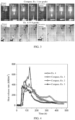
- FIG. 3 shows a digital photograph of the copolyester prepared in Example 4 of the present disclosure and pure PET prepared in Comparative Example 1 in the vertical burning test. It can be seen from the photograph that PET would not be self-extinguished after being ignited; moreover, combustion was accompanied by a large number of melt dripping, and the test grade was no grade. In contrast, the copolyester prepared by the present disclosure would be quickly self-extinguished within 10 s after being ignited; moreover, no melt dripping was produced, and the test grade was V-0.
- the Comparative Example 2 can only pass the V-2 grade, and the Comparative Example 3 is no grade, that is, melt dripping were still produced during the test. It is indicated that the copolyester prepared by the present disclosure can have better flame-retardant anti-dripping properties compared with the copolyester containing only high-temperature self-crosslinking functional group or only ionic group.
- FIG. 4 shows a heat release rate curve of the copolyester prepared in Example 4 of the present disclosure and the pure PET, the copolyester containing only high-temperature self-crosslinking functional group, or the copolyester containing only ionic group prepared in Comparative Examples 1-3 in a cone calorimetry test.
- Peak heat release rate (p-HRR) is an important parameter for judging the flame-retardant properties of materials. The lower the value of p-HRR, the better the flame-retardant properties of the materials.
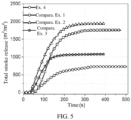
- FIG. 5 shows a total smoke release (TSR) curve of the copolyester prepared in Example 4 of the present disclosure and the pure PET, the copolyester containing only high-temperature self-crosslinking functional group, or the copolyester containing only ionic group prepared in Comparative Examples 1-3 in a cone calorimetry test.
- TSR total smoke release
- the TSR of the copolyester of the present disclosure was 728 m 2 /m 2 , which was not only 58.5% lower than that of pure PET, but also much lower than 1939 m 2 /m 2 of Comparative Example 2 and 1077 m 2 /m 2 of Comparative Example 3, indicating that the copolyester prepared by the present disclosure exhibits better smoke suppression property.
Landscapes
- Chemical & Material Sciences (AREA)
- Chemical Kinetics & Catalysis (AREA)
- Organic Chemistry (AREA)
- Polymers & Plastics (AREA)
- Medicinal Chemistry (AREA)
- Health & Medical Sciences (AREA)
- Engineering & Computer Science (AREA)
- Materials Engineering (AREA)
- Manufacturing & Machinery (AREA)
- Wood Science & Technology (AREA)
- Life Sciences & Earth Sciences (AREA)
- Textile Engineering (AREA)
- General Chemical & Material Sciences (AREA)
- Polyesters Or Polycarbonates (AREA)
Applications Claiming Priority (3)
| Application Number | Priority Date | Filing Date | Title |
|---|---|---|---|
| CN202010568973.0A CN113817152B (zh) | 2020-06-19 | 2020-06-19 | 基于高温自交联的阻燃抗熔滴共聚酯及其制备方法和应用 |
| CN202110655645 | 2021-06-11 | ||
| PCT/CN2021/100356 WO2021254391A1 (zh) | 2020-06-19 | 2021-06-16 | 基于高温自交联的阻燃抗熔滴共聚酯及其制备方法和应用 |
Publications (2)
| Publication Number | Publication Date |
|---|---|
| EP4169967A1 true EP4169967A1 (de) | 2023-04-26 |
| EP4169967A4 EP4169967A4 (de) | 2025-01-01 |
Family
ID=79268511
Family Applications (1)
| Application Number | Title | Priority Date | Filing Date |
|---|---|---|---|
| EP21825036.3A Pending EP4169967A4 (de) | 2020-06-19 | 2021-06-16 | Flammhemmender tröpfchenbeständiger copolyester auf hochtemperaturselbstvernetzungsbasis sowie herstellungsverfahren dafür und anwendung davon |
Country Status (6)
| Country | Link |
|---|---|
| US (1) | US12559589B2 (de) |
| EP (1) | EP4169967A4 (de) |
| JP (1) | JP7780204B2 (de) |
| KR (1) | KR20230028312A (de) |
| TW (1) | TWI902824B (de) |
| WO (1) | WO2021254391A1 (de) |
Families Citing this family (4)
| Publication number | Priority date | Publication date | Assignee | Title |
|---|---|---|---|---|
| CN114989406B (zh) * | 2022-07-11 | 2024-01-12 | 青岛大学 | 一种非金属有机化合物在dmt法合成聚酯中的应用、dmt法功能共聚酯及其制法 |
| CN119931014A (zh) * | 2024-04-29 | 2025-05-06 | 青岛大学 | 非金属有机化合物在催化合成聚酯中的应用、所述聚酯及其制备方法 |
| CN119505049A (zh) * | 2024-12-12 | 2025-02-25 | 济南大学 | 一种纳米金属凝胶外加剂及其制备方法与应用 |
| CN121378703A (zh) * | 2025-11-24 | 2026-01-23 | 四川大学 | 一种含氮化合物基抗紫外抗蓝光阻燃共聚酯及其制备方法和应用 |
Family Cites Families (21)
| Publication number | Priority date | Publication date | Assignee | Title |
|---|---|---|---|---|
| GB982584A (en) * | 1960-07-19 | 1965-02-10 | Teikoku Jinzo Kenshi Kk | Polyester compositions |
| CN103756275A (zh) * | 2004-03-23 | 2014-04-30 | 索尼株式会社 | 阻燃剂、阻燃树脂组合物和生产该阻燃剂的方法 |
| JP2008088193A (ja) * | 2006-09-29 | 2008-04-17 | Teijin Fibers Ltd | 難燃性ポリエステル共重合体および難燃性ポリエステル繊維 |
| JP2008179714A (ja) * | 2007-01-25 | 2008-08-07 | Teijin Fibers Ltd | 難燃性ポリエステル共重合体組成物及び難燃性ポリエステル繊維 |
| JP2008308644A (ja) * | 2007-06-18 | 2008-12-25 | Teijin Fibers Ltd | 難燃性ポリエステル共重合体組成物および難燃性ポリエステル繊維 |
| CN101225158B (zh) * | 2008-02-03 | 2010-09-29 | 四川大学 | 含磷阻燃共聚酯离聚物及其制备方法 |
| CN102174183B (zh) | 2011-02-23 | 2012-07-25 | 四川大学 | 高温自交联阻燃抗熔滴共聚酯及其制备方法 |
| CN102863611B (zh) * | 2012-10-10 | 2014-08-20 | 四川大学 | 基于偶氮苯结构的高温自交联膨胀阻燃抗熔滴共聚酯及其制备方法 |
| CN102924702B (zh) * | 2012-11-06 | 2014-04-16 | 四川大学 | 含磷杂环阻燃共聚酯离聚物及其制备方法 |
| CN104045821B (zh) * | 2014-06-17 | 2016-04-06 | 四川大学 | 含磷阻燃共聚酯离聚物/纳米复合材料及其制备方法 |
| CN104478789B (zh) * | 2014-11-28 | 2016-08-24 | 四川大学 | 一种共聚酯交联单体和基于该单体的共聚酯及其制备方法 |
| CN104592094B (zh) * | 2015-02-10 | 2017-05-17 | 四川大学 | 含苯酰亚胺苯乙炔结构的单体和高温自交联共聚酯及其制备方法 |
| CN105273173B (zh) * | 2015-11-20 | 2016-11-30 | 四川大学 | 基于席夫碱结构的高温自交联阻燃抗熔滴共聚酯及其制备方法 |
| CN107189048B (zh) * | 2017-06-06 | 2019-01-01 | 四川大学 | 基于芳腈结构的低烟阻燃抗熔滴共聚酯及其制备方法 |
| CN109517152B (zh) * | 2017-09-20 | 2020-08-11 | 四川大学 | 基于苯酰胺结构的高温自交联阻燃抑烟抗熔滴共聚酯及其制备方法和应用 |
| CN108359084B (zh) * | 2018-02-09 | 2020-09-18 | 四川大学 | 一种基于苯酰亚胺结构的高温自交联阻燃抑烟抗熔滴共聚酯及其制备方法 |
| CN108395526B (zh) | 2018-02-09 | 2020-03-10 | 四川大学 | 基于苯并咪唑结构的阻燃抗熔滴共聚酯及其制备方法 |
| CN109467687B (zh) * | 2018-11-14 | 2021-02-19 | 银金达(上海)新材料有限公司 | 一种用于汽车内饰的阻燃共聚酯材料的制备方法 |
| CN110066389B (zh) * | 2019-03-15 | 2022-03-15 | 四川大学 | 含苯并杂环磺酸盐结构的离子单体、用其阻燃抗熔滴的离聚物及它们的制备方法和应用 |
| CN110016054B (zh) * | 2019-03-15 | 2021-10-22 | 四川大学 | 含磷氮苯并杂环结构的离子单体、用其阻燃的共聚酯型离聚物及它们的制备方法和应用 |
| CN110746457B (zh) * | 2019-11-12 | 2021-10-22 | 四川大学 | 含膦酸盐结构的离子单体、用其催化合成的阻燃抑烟离聚物及它们的制备方法和应用 |
-
2021
- 2021-06-16 JP JP2022578764A patent/JP7780204B2/ja active Active
- 2021-06-16 EP EP21825036.3A patent/EP4169967A4/de active Pending
- 2021-06-16 WO PCT/CN2021/100356 patent/WO2021254391A1/zh not_active Ceased
- 2021-06-16 US US18/011,333 patent/US12559589B2/en active Active
- 2021-06-16 TW TW110121950A patent/TWI902824B/zh active
- 2021-06-16 KR KR1020227045495A patent/KR20230028312A/ko active Pending
Also Published As
| Publication number | Publication date |
|---|---|
| JP7780204B2 (ja) | 2025-12-04 |
| US20230235116A1 (en) | 2023-07-27 |
| TW202210551A (zh) | 2022-03-16 |
| JP2023531467A (ja) | 2023-07-24 |
| KR20230028312A (ko) | 2023-02-28 |
| EP4169967A4 (de) | 2025-01-01 |
| TWI902824B (zh) | 2025-11-01 |
| US12559589B2 (en) | 2026-02-24 |
| WO2021254391A1 (zh) | 2021-12-23 |
Similar Documents
| Publication | Publication Date | Title |
|---|---|---|
| EP4169967A1 (de) | Flammhemmender tröpfchenbeständiger copolyester auf hochtemperaturselbstvernetzungsbasis sowie herstellungsverfahren dafür und anwendung davon | |
| Wu et al. | New application for aromatic Schiff base: High efficient flame-retardant and anti-dripping action for polyesters | |
| TWI614279B (zh) | 聚酯-共-膦酸酯 | |
| CA1045269A (en) | Flame retardant and drip resistant thermoplastics | |
| CN108395526B (zh) | 基于苯并咪唑结构的阻燃抗熔滴共聚酯及其制备方法 | |
| CN102863611B (zh) | 基于偶氮苯结构的高温自交联膨胀阻燃抗熔滴共聚酯及其制备方法 | |
| CN102174183B (zh) | 高温自交联阻燃抗熔滴共聚酯及其制备方法 | |
| CN105273173B (zh) | 基于席夫碱结构的高温自交联阻燃抗熔滴共聚酯及其制备方法 | |
| CN110016054B (zh) | 含磷氮苯并杂环结构的离子单体、用其阻燃的共聚酯型离聚物及它们的制备方法和应用 | |
| CN104592094B (zh) | 含苯酰亚胺苯乙炔结构的单体和高温自交联共聚酯及其制备方法 | |
| CN104710604B (zh) | 基于三嗪环结构的支化交联膨胀抗熔滴阻燃共聚酯及其制备方法 | |
| CN107325271A (zh) | 一种大分子阻燃聚酯及其制备与应用 | |
| CN101805444B (zh) | 耐熔滴阻燃聚酯及其纳米复合材料和它们的制备方法 | |
| CN113817152B (zh) | 基于高温自交联的阻燃抗熔滴共聚酯及其制备方法和应用 | |
| CN114989406B (zh) | 一种非金属有机化合物在dmt法合成聚酯中的应用、dmt法功能共聚酯及其制法 | |
| CN110066389A (zh) | 含苯并杂环磺酸盐结构的离子单体、用其阻燃抗熔滴的离聚物及它们的制备方法和应用 | |
| CN110746457A (zh) | 含膦酸盐结构的离子单体、用其催化合成的阻燃抑烟离聚物及它们的制备方法和应用 | |
| CN108359084B (zh) | 一种基于苯酰亚胺结构的高温自交联阻燃抑烟抗熔滴共聚酯及其制备方法 | |
| CN109517152B (zh) | 基于苯酰胺结构的高温自交联阻燃抑烟抗熔滴共聚酯及其制备方法和应用 | |
| CN113817150B (zh) | 含芳香仲胺结构的共聚酯及其制备方法和应用 | |
| TW528777B (en) | Flame retardant polybutyleneterephthalate resin | |
| CN119505204A (zh) | 一种多功能的阻燃抗熔滴共聚酯及其制备方法和应用 | |
| TW202436436A (zh) | 共聚合聚酯樹脂之製造方法 | |
| CN104710603B (zh) | 基于多苯醚结构的膨胀成炭阻燃耐熔滴共聚酯及其制备方法 | |
| JPH04226543A (ja) | 難燃性ポリオレフィン繊維及びフィルム |
Legal Events
| Date | Code | Title | Description |
|---|---|---|---|
| STAA | Information on the status of an ep patent application or granted ep patent |
Free format text: STATUS: THE INTERNATIONAL PUBLICATION HAS BEEN MADE |
|
| PUAI | Public reference made under article 153(3) epc to a published international application that has entered the european phase |
Free format text: ORIGINAL CODE: 0009012 |
|
| STAA | Information on the status of an ep patent application or granted ep patent |
Free format text: STATUS: REQUEST FOR EXAMINATION WAS MADE |
|
| 17P | Request for examination filed |
Effective date: 20221216 |
|
| AK | Designated contracting states |
Kind code of ref document: A1 Designated state(s): AL AT BE BG CH CY CZ DE DK EE ES FI FR GB GR HR HU IE IS IT LI LT LU LV MC MK MT NL NO PL PT RO RS SE SI SK SM TR |
|
| DAV | Request for validation of the european patent (deleted) | ||
| DAX | Request for extension of the european patent (deleted) | ||
| A4 | Supplementary search report drawn up and despatched |
Effective date: 20241127 |
|
| RIC1 | Information provided on ipc code assigned before grant |
Ipc: C08G 63/54 20060101ALI20241122BHEP Ipc: C08G 63/183 20060101ALI20241122BHEP Ipc: C07D 209/48 20060101ALI20241122BHEP Ipc: C08L 67/02 20060101ALI20241122BHEP Ipc: C07D 235/18 20060101ALI20241122BHEP Ipc: C08J 5/18 20060101ALI20241122BHEP Ipc: D01F 6/84 20060101ALI20241122BHEP Ipc: C08G 63/85 20060101ALI20241122BHEP Ipc: C08G 63/86 20060101ALI20241122BHEP Ipc: C08G 63/688 20060101ALI20241122BHEP Ipc: C08G 63/692 20060101ALI20241122BHEP Ipc: C08G 63/685 20060101AFI20241122BHEP |
|
| STAA | Information on the status of an ep patent application or granted ep patent |
Free format text: STATUS: EXAMINATION IS IN PROGRESS |
|
| 17Q | First examination report despatched |
Effective date: 20250903 |
|
| GRAP | Despatch of communication of intention to grant a patent |
Free format text: ORIGINAL CODE: EPIDOSNIGR1 |
|
| STAA | Information on the status of an ep patent application or granted ep patent |
Free format text: STATUS: GRANT OF PATENT IS INTENDED |
|
| INTG | Intention to grant announced |
Effective date: 20260217 |