EP4170480B1 - Verfahren und vorrichtung zur quantenzufallszahlerzeugung - Google Patents
Verfahren und vorrichtung zur quantenzufallszahlerzeugung Download PDFInfo
- Publication number
- EP4170480B1 EP4170480B1 EP21203708.9A EP21203708A EP4170480B1 EP 4170480 B1 EP4170480 B1 EP 4170480B1 EP 21203708 A EP21203708 A EP 21203708A EP 4170480 B1 EP4170480 B1 EP 4170480B1
- Authority
- EP
- European Patent Office
- Prior art keywords
- quantum
- output
- bit
- random
- entropy
- Prior art date
- Legal status (The legal status is an assumption and is not a legal conclusion. Google has not performed a legal analysis and makes no representation as to the accuracy of the status listed.)
- Active
Links
Images

Classifications
-
- G—PHYSICS
- G06—COMPUTING OR CALCULATING; COUNTING
- G06F—ELECTRIC DIGITAL DATA PROCESSING
- G06F7/00—Methods or arrangements for processing data by operating upon the order or content of the data handled
- G06F7/58—Random or pseudo-random number generators
- G06F7/588—Random number generators, i.e. based on natural stochastic processes
-
- G—PHYSICS
- G06—COMPUTING OR CALCULATING; COUNTING
- G06F—ELECTRIC DIGITAL DATA PROCESSING
- G06F7/00—Methods or arrangements for processing data by operating upon the order or content of the data handled
- G06F7/58—Random or pseudo-random number generators
-
- G—PHYSICS
- G06—COMPUTING OR CALCULATING; COUNTING
- G06N—COMPUTING ARRANGEMENTS BASED ON SPECIFIC COMPUTATIONAL MODELS
- G06N10/00—Quantum computing, i.e. information processing based on quantum-mechanical phenomena
- G06N10/40—Physical realisations or architectures of quantum processors or components for manipulating qubits, e.g. qubit coupling or qubit control
Definitions
- the present invention pertains to a device and method for generating quantum random numbers, which offers the possibility to precisely quantify the amount of entropy of a raw output stream due to the quantum nature of the process in an improved manner.
- the present invention is in the context of the generation of random numbers.
- Many tasks in modern science and technology make use of random numbers, including simulation, statistical sampling, gaming applications, and cryptography, both classical and quantum.
- a good random number generator should produce a chain of bits with high entropy at a high rate.
- high entropy it is meant that nobody can predict the value of the bit before the bit is revealed, entropy can also be understood as randomness. This is an essential requirement in most of the modern methods of data encryption.
- Pseudo random number generation can be used advantageously for some applications such as numerical simulation, making results reproducible, but limitations need to be taken into account. For other applications, however, different methods need to be employed to avoid loopholes. For this reason, random number generators based on physical systems were developed, which in principle ensure the uniqueness and, most importantly, the randomness of the generated bit string. Example are given by C. H. Vincent in “The generation of truly random binary numbers", Journal of Physics E: Scientific Instruments, 3(8):594, 1970 , Y. Saitoh, J. Hori, and T. Kiryu, in “Generation of physical random number using frequency-modulated oscillation circuit with shot noise", Electron Comm. Jpn. 3, 88(5):12-19, 2005 .
- QRNGs quantum random number generators
- quantum random number generators can, in theory, generate perfect randomness and therefore high entropy; in practice, their implementation is prone to loopholes due to unavoidable technical imperfections of the devices that inherently generate technical noise.
- the main difficulty consists in estimating the entropy generated by a quantum process, and separating it from the entropy due to technical noise (such as thermal noise or the like).
- technical noise such as thermal noise or the like.
- This requires a precise theoretical modeling of the device, which is usually difficult to establish and analyze because modeling is inherently based on theoretical assumptions in the equations, which are not exactly representing the reality.
- a further limitation comes from the fact that the properties of the device may change during its lifetime. In particular, if the device malfunctions, or even breaks, low quality randomness is generated without the user being aware of it. Therefore, it is valuable to have a real-time evaluation of the entropy contained in bit streams provided by QRNGs.
- the present approach offered ease of implementation, as it only required standard components that may be implemented in a standalone device, thus providing an integrated system that is far less complex than the existing ones, and having a reduced size and cost.
- This approach offered also high bit rates in the range of few Mbit/s, sufficient for many applications based on random numbers.
- the random bit entropy was computed/monitored in real-time at the contrary of all previous solutions where random bit entropy is estimated during the QRNG conception.
- QRNG semi-Device-Independent or Self-Testing QRNG
- the main problem with these devices is that the extraction part requests extracting a huge number of bits, e.g., in the order of a million, and therefore necessitates a powerful FPGA or GPU when carried out at real time at high rates. Indeed, for good statistics the entropy must be estimated over big block sizes (over 10 5 ) and the extraction (using e.g. a Toeplitz matrix) is demanding at high rates (over 10Mb/s).
- An object of the present invention is therefore of providing an improved self-testing QRNG system and method permitting to provide an improved randomness/entropy extraction at high rates with low cost FGPA embedded in it.
- the invention is directed to a device and a method carrying out a hybrid approach where a high speed QRNG generates a raw bit stream at a rate of up to 10 Gb/s and where the entropy is estimated based on a fraction of these bits.
- a big block size (>10 5 bits) extractor delivers certified random bits at rate of up to 10 Mb/s and in parallel a fast, small block size extractor (e.g. 512 bits) supplies random bits at rates of up to 1Gb/s.
- This hybrid approach for extraction can be applied to any self-testing QRNG, independent of his architecture and maximal raw bit rate. It is foreseeable that using integrated photonic chips, the cost of the entropy source itself becomes negligible with respect to the readout electronics and logic.
- the invention permits to have with less resources full self-testing certification at reasonable rates, and at the same time a high rate QRNG still with improved quality with respect to a totally device dependent approach.
- a first aspect of the invention relates to a Quantum Random Number Generator comprising an emitting device adapted to be triggered by a signal representing an input bit x and adapted to generate and send a stream of one of two possible non-orthogonal quantum states determined by a plurality of said input bit x at a rate in the range of Mb/s up to 10 Gb/s, a measurement device adapted to detect each quantum state of the stream of quantum states sent by the emitting device and to generate an output b based on the detected quantum state, a random selection device adapted to receive said output b and carries out a random selection on said output b so as to select and pick out a first fraction of the bits b' and a second fraction of the bit b-b' sent to an entropy H min Q estimation module, wherein the entropy H min Q estimation module is adapted to receive the input x, the output b' and the output b-b' over a certain number of rounds N and to estimate the entropy
- the first extractor is a "slow” extractor which extracts the first fraction of the bits b' with block sizes in the range of 10 ⁇ 5-10 ⁇ 7 bits and generates a string of certified random bits r' at a rate in the order of 1 Mb/s; and the second extractor is a "fast” extractor which extracts the second fraction of the bits b-b' with block sizes in the range of 2 8 -2 10 bits and generating a string of true random bits r at a rate in the order of 100 Mb/s.
- the measurement device is an unambiguous state discrimination measurement, where the output b represents whether the quantum state has been identified or not and, if it has been identified, which quantum state among the two possible quantum states to a processing device.
- the entropy H min Q estimation module comprises a first processing device adapted to estimates the entropy H min Q of the output b' and a second processing device adapted to estimates the entropy H min Q of the output b-b'.
- the processing devices estimate the probabilities p(b'
- the two possible non-orthogonal quantum states are encoded in one of the temporal mode of photons, the polarization of photons, the frequency mode of photons, the photon number degree of freedom of light, the spatial mode of photons, the path degree of freedom of photons, or the phase of weak coherent pulses.
- the two possible non-orthogonal quantum states are encoded using a combination of two or more encodings listed above or using other quantum systems such as atomic systems and superconducting systems.
- the random selection device carries out the random selection using a pseudorandom number generator.
- the raw key is 0 if the output b is conclusive or 1 if the output b is inconclusive.
- x) as follows: p g ⁇ x,b v x,b p ( b
- SDP semi-definite program
- the randomness extraction is realized by a vector-matrix multiplication between a vector formed by the raw bit value generated at the output of the unambiguous quantum state discrimination measurement device and a random matrix M where the dimension is adapted as a function of the quantity of entropy H min Q estimated.
- a second aspect of the invention relates to a Quantum Key Distribution System comprising at least one Quantum Random Number Generator of the first aspect.
- a third aspect of the invention relates to a self-testing method carried out by a Quantum Random Number Generator comprising the steps of: preparing and sending a stream of one of two possible non-orthogonal quantum states determined by a plurality of input bit x at a rate in the range of Mb/s up to 10 Gb/s, detecting and measuring each quantum state of the stream of quantum states sent and generating an output b based on the detected quantum state, carrying out a random selection on the output b so as to select and pick out a first fraction of the bits b' and a second fraction of the bit b-b' sent to an entropy estimation module, estimating the entropy H min Q of each the output b' and the output b-b' for each quantum state of the stream of quantum states and validating or not an extraction ratio, and randomness extracting via two parallel randomness extraction procedures adapted to carry out a hybrid extraction protocol generating two final random output bit strings via a first extraction which extracts the first fraction of the bits b'
- the first extraction is a "slow” extraction which extracts the first fraction of the bits b' with block sizes in the range of 10 ⁇ 5-10 ⁇ 7 bits and generates a string of certified random bits r' at a rate in the order of 1 Mb/s; and the second extraction is a "fast” extraction which extracts the second fraction of the bits b-b' with block sizes in the range of 2 8 -2 10 bits and generating a string of true random bits r at a rate in the order of 100 Mb/s.
- the preparation device prepares and sends a physical system prepare in any number of non-orthogonal quantum states and the measurement device consists in an adapted unambiguous state discrimination measurement.
- Figure 1 schematically illustrates the principle of the quantum random number generator and its conceptual scheme where a source 110 prepares a physical system 130 in one of two possible non-orthogonal quantum states according to an input bit x and sends it to the measurement device 120.
- the measurement device 120 performs a quantum measurement to try to determine the received states, preferably an unambiguous state discrimination (USD) measurement, and gives an output b.
- USD unambiguous state discrimination
- the output b is either conclusive, indicating which state was prepared by the source, or inconclusive if it does not succeed to discriminate between the two possible states.
- the setup comprises two devices: a “non-orthogonal state preparation device” 110 and a “USD measurement device” 120, respectively.
- the “non-orthogonal state preparation device” 110 sends a physical system, prepared in one out of two possible quantum states, to the "USD measurement device” 120.
- the “USD measurement device” 120 attempts to identify which state was sent. Thus, it implements a quantum measurement able to distinguish between the two quantum states.
- the setup permits to identify which state is being sent with as little error as possible. If the two states are non-orthogonal, i.e. with a non-zero overlap, it is impossible, according to the laws of quantum theory, to continuously discriminate them with certainty. Nevertheless, probabilistically it is possible to perfectly discriminate them.
- the entropy of the output bits is quantified by verifying that the measurement distinguishes the two states without error. Therefore, based on a promise on how non-orthogonal the states are (i.e. what their overlap is), it is possible to estimate the entropy contained in the output data in real time 140. Then, based on this entropy estimate, a final string of random bits is generated via an adapted procedure of randomness extraction 150.
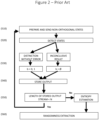
- FIG. 2 is a detailed description of the method associated to the prior art apparatus presented in Figure 1 .
- the first step 510 consists in preparing and sending one out of two possible non-orthogonal states
- the quantum state sent is detected and measured by the "USD measurement device” 120 that implements a USD measurement.
- the value of the output bit stored and the detection is counted as an event and added to the statistics in a further step 540.
- the stored output is added to the output stream. If output stream size is bigger than N, with N being an output stream size with sufficient statistical event then the apparatus proceeds with the entropy estimation 550 and randomness extraction process 560. Otherwise, another input bit x is generated, and the corresponding state is prepared and sent by the "non-orthogonal state preparation device" 110 and another 510 to 540 step cycle is achieved.
- the last step 560 consists in randomness extraction procedure, which provides a final random output bit stream with entropy close to one for each bit.
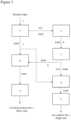
- FIG. 3 is a detailed description of the method and the apparatus associated to the invention. As we can see, the first steps S101 and S102 are quite similar to the ones described in figure.2 .
- an emitting device 1, preferably a non-orthogonal state preparation device, is triggered by a random input bit x and adapted to generate and send a stream of one of two possible non-orthogonal quantum states
- This quantum state refers to one degree of freedom of the emitted system.
- ⁇ x ⁇ may represent the state of polarization of photons, a temporal mode of photons, or the phase of a weak coherent state.
- the two possible non-orthogonal quantum states are encoded in one of the temporal mode of photons, the polarization of photons, the frequency mode of photons, the photon number degree of freedom of light, the spatial mode of photons, the path degree of freedom of photons, or the phase of weak coherent pulses.
- the two possible non-orthogonal quantum states can be encoded using a combination of two or more encodings listed above or using other quantum systems such as atomic systems and superconducting systems.
- the emitting device 1 also transfers, in step S102, the random input bit x to a processing device 4' (and 4) in order to compare the output of the receiver (Bob) with the input of the emitter (Alice) and calculate the entropy on that basis.
- Bob comprises the measurement device 2 and the random selection device 3 while Alice comprises the emitting device 1.
- a measurement device 2 adapted to detect each quantum state of the stream of quantum states
- the appearances of inconclusive and conclusive results are random and can be used to generate random numbers.
- This random selection device 3 carries out a random selection using a pseudorandom number generator.
- the random selection device 3 is adapted to divide (or separate) the output b into two fractions. More particularly, the random selection device 3 randomly selects and pick out a first fraction of the bits b to form a first group of bits b' and sends this group (or fraction) through step S104, to the processing device 4' for an entropy estimation and sends, through step S106, the remaining group (or second fraction) b-b' to a processing device 4 for an entropy estimation.
- the processing devices 4' and 4 which receive the input x from the emitting device 1 and the output b' and b-b', respectively, from random selection device 3 over a certain number of rounds N, estimate the entropy H min Q of the output b' for each quantum state of the stream of quantum states and the entropy H min Q of the output b-b' for each quantum state of the stream of quantum states .
- the processing device estimates the probabilities p(b'
- the device therefore comprises at least two randomness extraction devices 5 and 5' which have been prepared for a given extraction ratio. If the estimated entropy H min Q is higher than this fraction, then one can proceed to the extraction step (S105). If not then, the process is aborted and repeated.
- the randomness extractors 5' and 5 are realized by a vector-matrix multiplication between a vector formed by the raw bit value generated at the output of the measurement device and a random matrix M where the dimension is adapted as a function of the quantity of entropy H min Q estimated.
- SDP semi-definite program
- the invention also relates to a quantum Key Distribution System comprising at least one Quantum Random Number Generator defined above.
Landscapes
- Engineering & Computer Science (AREA)
- General Physics & Mathematics (AREA)
- Theoretical Computer Science (AREA)
- Physics & Mathematics (AREA)
- General Engineering & Computer Science (AREA)
- Mathematical Analysis (AREA)
- Mathematical Optimization (AREA)
- Pure & Applied Mathematics (AREA)
- Computational Mathematics (AREA)
- Data Mining & Analysis (AREA)
- Evolutionary Computation (AREA)
- Condensed Matter Physics & Semiconductors (AREA)
- Computing Systems (AREA)
- Mathematical Physics (AREA)
- Software Systems (AREA)
- Artificial Intelligence (AREA)
- Optical Modulation, Optical Deflection, Nonlinear Optics, Optical Demodulation, Optical Logic Elements (AREA)
Claims (15)
- Quantenzufallszahlengenerator, umfassend:eine Sendevorrichtung (1), die dazu ausgelegt ist, durch ein Signal ausgelöst zu werden, das ein Eingangsbit x darstellt, und dazu ausgelegt ist, einen Strom eines von zwei möglichen nicht orthogonalen Quantenzuständen, die durch eine Mehrzahl der Eingangsbits x bestimmt werden, mit einer Rate im Bereich von Mbit/s bis zu 10 Gbit/s zu erzeugen und zu senden,eine Messvorrichtung (2), die dazu ausgelegt ist, jeden Quantenzustand des von der Sendevorrichtung (1) gesendeten Stroms von Quantenzuständen zu erkennen und eine Ausgabe b basierend auf dem erkannten Quantenzustand zu erzeugen,eine Zufallsauswahlvorrichtung (3), die dazu ausgelegt ist, die Ausgabe b zu empfangen und eine Zufallsauswahl an der Ausgabe b durchzuführen, um eine erste Bitfraktion b' der Ausgabe b und eine zweite Bitfraktion b - b' der Ausgabe b auszuwählen und auszusuchen, die an ein Modul (4, 4') zum Schätzen der Entropie
 wobei das Modul (4, 4') zum Schätzen der Entropie
 mindestens zwei Vorrichtungen (5, 5') zur parallelen Zufälligkeitsextraktion, die dazu ausgelegt sind, ein hybrides Extraktionsprotokoll auszuführen, das zwei endgültige Zufallsausgabebitfolgen erzeugt durcheinen ersten Extraktor (5'), der dazu ausgelegt ist, die erste Bitfraktion b' mit Bitblockgrößen in einem ersten Bereich zu extrahieren und eine Folge zertifizierter Zufallsbits r' mit einer ersten Rate zu erzeugen; undeinen zweiten Extraktor (5), der dazu ausgelegt ist, die zweite Bitfraktion b - b' mit Bitblockgrößen in einem zweiten Bereich zu extrahieren, der niedriger als der erste Bereich ist, und eine Folge von echten Zufallsbits r mit einer zweiten Rate zu erzeugen, die höher als die erste Rate ist.
 - Quantenzufallszahlengenerator nach Anspruch 1, dadurch gekennzeichnet, dass der erste Extraktor ein "langsamer" Extraktor (5') ist, der die erste Bitfraktion b' mit Blockgrößen in einem Bereich von 10^5 bis 10^7 Bits extrahiert und eine Folge von zertifizierten Zufallsbits r' mit einer Rate in der Größenordnung von 1 Mbit/s erzeugt; und der zweite Extraktor ein "schneller" Extraktor (5) ist, der die zweite Bitfraktion b - b' mit Blockgrößen im Bereich von 28 bis 210 Bits extrahiert und eine Folge von echten Zufallsbits r mit einer Rate in der Größenordnung von 100 Mbit/s erzeugt.
- Quantenzufallszahlengenerator nach Anspruch 1 oder 2, dadurch gekennzeichnet, dass die Messvorrichtung eine Messung einer eindeutigen Zustandsunterscheidung ist, wobei die Ausgabe b darstellt, ob der Quantenzustand identifiziert wurde oder nicht, und, wenn er identifiziert wurde, welcher Quantenzustand unter den zwei möglichen Quantenzuständen an eine Verarbeitungsvorrichtung.
- Quantenzufallszahlengenerator nach einem der Ansprüche 1 bis 3, dadurch gekennzeichnet, dass das Modul zum Schätzen der Entropie


- Quantenzufallszahlengenerator nach Anspruch 4, dadurch gekennzeichnet, dass die Verarbeitungsvorrichtungen (4', 4) die Wahrscheinlichkeiten p(b'|x) und p(b - b'|x) schätzen, die die Wahrscheinlichkeit einer Beobachtung der Ausgabefraktionen b' und b - b' für ein Eingangsbit x darstellen, und die Entropie

- Quantenzufallszahlengenerator nach einem der Ansprüche 1 bis 5, dadurch gekennzeichnet, dass die zwei möglichen nicht orthogonalen Quantenzustände in einem von dem zeitlichen Modus von Photonen, der Polarisation von Photonen, dem Frequenzmodus von Photonen, dem Photonenanzahl-Freiheitsgrad von Licht, dem räumlichen Modus von Photonen, dem Pfadfreiheitsgrad von Photonen oder der Phase von schwachen kohärenten Impulsen codiert sind.
- Quantenzufallszahlengenerator nach einem der Ansprüche 1 bis 6, dadurch gekennzeichnet, dass die zwei möglichen nicht orthogonalen Quantenzustände unter Verwendung einer Kombination aus zwei oder mehr der in Anspruch 6 aufgeführten Codierungen oder unter Verwendung anderen Quantensysteme wie Atomsystemen und supraleitenden Systemen codiert sind.
- Quantenzufallszahlengenerator nach einem der Ansprüche 1 bis 7, dadurch gekennzeichnet, dass die Zufallsauswahlvorrichtung (3) die Zufallsauswahl unter Verwendung eines Pseudozufallszahlengenerators durchführt.
- Quantenzufallszahlengenerator nach einem der Ansprüche 1 bis 8, dadurch gekennzeichnet, dass der Rohschlüssel, wenn die Ausgabe b schlüssig ist, 0 oder, wenn die Ausgabe b nicht schlüssig ist, 1 ist.
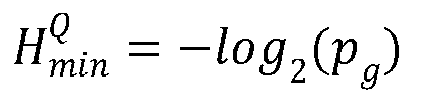
- Quantenzufallszahlengenerator nach einem der Ansprüche 1 bis 9, dadurch gekennzeichnet, dass die Entropieschätzung gemäß
- Quantenzufallszahlengenerator nach einem der Ansprüche 1 bis 10, dadurch gekennzeichnet, dass die Zufälligkeitsextraktion durch eine Vektor-Matrix-Multiplikation zwischen einem Vektor, der durch den Rohbitwert gebildet wird, der am Ausgang der Vorrichtung zur Messung der eindeutigen Quantenzustandsunterscheidung erzeugt wird, und einer Zufallsmatrix M realisiert wird, wobei die Dimension als eine Funktion der geschätzten Menge der Entropie

- Quantenschlüsselverteilungssystem, umfassend mindestens einen Quantenzufallszahlengenerator nach einem der vorhergehenden Ansprüche.
- Selbsttestverfahren, das von einem Quantenzufallszahlengenerator durchgeführt wird und die folgenden Schritte umfasst:Vorbereiten und Senden (S101, S102) eines Stroms eines von zwei möglichen nicht orthogonalen Quantenzuständen, die durch eine Mehrzahl der Eingangsbits x bestimmt werden, mit einer Rate im Bereich von Mbit/s bis zu 10 Gbit/s,Erkennen und Messen (520) jedes Quantenzustands des gesendeten Stroms von Quantenzuständen und Erzeugen einer Ausgabe b basierend auf dem erkannten Quantenzustand,Durchführen einer Zufallsauswahl (S104, S196) an der Ausgabe b, um eine erste Bitfraktion b' der Ausgabe b und eine zweite Bitfraktion b - b' der Ausgabe b auszuwählen und auszusuchen, die an ein Entropieschätzmodul (4, 4') gesendet werden,Schätzen (550) der Entropie
 Zufälligkeitsextrahieren (560) durch zwei parallele Zufälligkeitsextraktionsprozeduren, die dazu ausgelegt sind, ein hybrides Extraktionsprotokoll auszuführen, das zwei endgültige Zufallsausgabebitfolgen erzeugt durcheine erste Extraktion (5'), die die erste Bitfraktion b' mit Bitblockgrößen in einem ersten Bereich extrahiert und eine Folge zertifizierter Zufallsbits r' mit einer ersten Rate erzeugt; undeine zweite Extraktion (5), die die zweite Bitfraktion b-b' mit Bitblockgrößen in einem zweiten Bereich extrahiert, der niedriger als der erste Bereich ist, und eine Folge von echten Zufallsbits r mit einer zweiten Rate zu erzeugt, die höher als die erste Rate ist.
 - Selbsttestverfahren nach Anspruch 13, dadurch gekennzeichnet, dass die erste Extraktion eine "langsame" Extraktion (5') ist, die die erste Bitfraktion b' mit Blockgrößen in einem Bereich von 10^5 bis 10^7 Bits extrahiert und eine Folge von zertifizierten Zufallsbits r' mit einer Rate in der Größenordnung von 1 Mbit/s erzeugt; und
die zweite Extraktion eine "schnelle" Extraktion (5) ist, die die zweite Bitfraktion b - b' mit Blockgrößen im Bereich von 28 bis 210 Bits extrahiert und eine Folge von echten Zufallsbits r mit einer Rate von 100 Mbit/s erzeugt. - Selbsttestverfahren nach Anspruch 13 oder 14, dadurch gekennzeichnet, dass die Vorbereitungsvorrichtung ein physikalisches System in einer beliebigen Anzahl nicht orthogonaler Quantenzustände vorbereitet und sendet und die Messvorrichtung aus einer angepassten Messung einer eindeutigen Zustandsunterscheidung besteht.
Priority Applications (3)
| Application Number | Priority Date | Filing Date | Title |
|---|---|---|---|
| EP21203708.9A EP4170480B1 (de) | 2021-10-20 | 2021-10-20 | Verfahren und vorrichtung zur quantenzufallszahlerzeugung |
| US18/701,420 US20250094129A1 (en) | 2021-10-20 | 2022-10-20 | Method and device for quantum random number generation |
| PCT/EP2022/079215 WO2023067065A1 (en) | 2021-10-20 | 2022-10-20 | Method and device for quantum random number generation |
Applications Claiming Priority (1)
| Application Number | Priority Date | Filing Date | Title |
|---|---|---|---|
| EP21203708.9A EP4170480B1 (de) | 2021-10-20 | 2021-10-20 | Verfahren und vorrichtung zur quantenzufallszahlerzeugung |
Publications (2)
| Publication Number | Publication Date |
|---|---|
| EP4170480A1 EP4170480A1 (de) | 2023-04-26 |
| EP4170480B1 true EP4170480B1 (de) | 2024-06-12 |
Family
ID=78332641
Family Applications (1)
| Application Number | Title | Priority Date | Filing Date |
|---|---|---|---|
| EP21203708.9A Active EP4170480B1 (de) | 2021-10-20 | 2021-10-20 | Verfahren und vorrichtung zur quantenzufallszahlerzeugung |
Country Status (3)
| Country | Link |
|---|---|
| US (1) | US20250094129A1 (de) |
| EP (1) | EP4170480B1 (de) |
| WO (1) | WO2023067065A1 (de) |
Family Cites Families (13)
| Publication number | Priority date | Publication date | Assignee | Title |
|---|---|---|---|---|
| CA2217916A1 (en) | 1996-10-09 | 1998-04-09 | Dew Engineering And Development Limited | Random number generator and method for same |
| US6831980B1 (en) | 1996-10-09 | 2004-12-14 | Activcard Ireland Limited | Random number generator and method for same |
| DE19641754A1 (de) | 1996-10-10 | 1998-04-16 | Deutsche Telekom Ag | Optischer Zufallsgenerator basierend auf der Einzelphotonenstatistik am optischen Strahlteiler |
| SE516567C2 (sv) | 2000-06-07 | 2002-01-29 | Anoto Ab | Förfarande och anordning för säker trådlös överföring av information |
| US7197523B2 (en) | 2001-05-09 | 2007-03-27 | Magiq Technologies, Inc. | Efficient use of detectors for random number generation |
| US7284024B1 (en) | 2003-02-07 | 2007-10-16 | Magiq Technologies, Inc. | Quantum noise random number generator |
| EP1821196B1 (de) | 2006-02-15 | 2008-08-13 | Jaycrypto Limited | Verfahren und Vorrichtung zum Erzeugen von Initialwerten für einen Zufallszahlengenerator |
| JP4952461B2 (ja) | 2007-09-12 | 2012-06-13 | ソニー株式会社 | 乱数生成装置および乱数生成方法 |
| GB0915000D0 (en) | 2009-08-27 | 2009-09-30 | Univ Bruxelles | Quantum random number generation |
| US8554814B2 (en) | 2010-08-20 | 2013-10-08 | The Governing Council Of The University Of Toronto | Random signal generator using quantum noise |
| US8379848B2 (en) | 2011-07-07 | 2013-02-19 | Cape Light Institute, Inc. | Method of providing a portable true random number generator based on the microstructure and noise found in digital images |
| EP2592547A1 (de) | 2011-11-09 | 2013-05-15 | Novomatic AG | Vorrichtung zur Erzeugung echter Zufallszahlen und Spielsystem |
| EP3306464B1 (de) | 2016-10-09 | 2021-09-29 | Université de Genève | Verfahren und vorrichtung zur quantenzufallszahlerzeugung |
-
2021
- 2021-10-20 EP EP21203708.9A patent/EP4170480B1/de active Active
-
2022
- 2022-10-20 US US18/701,420 patent/US20250094129A1/en active Pending
- 2022-10-20 WO PCT/EP2022/079215 patent/WO2023067065A1/en not_active Ceased
Also Published As
| Publication number | Publication date |
|---|---|
| EP4170480A1 (de) | 2023-04-26 |
| WO2023067065A1 (en) | 2023-04-27 |
| US20250094129A1 (en) | 2025-03-20 |
Similar Documents
| Publication | Publication Date | Title |
|---|---|---|
| US11620107B2 (en) | Method and device for quantum random number generation | |
| Vazirani et al. | Fully device independent quantum key distribution | |
| US9306739B1 (en) | Quantum key distribution protocol process | |
| Stipcevic | Quantum random number generators and their applications in cryptography | |
| Lunghi et al. | Self-testing quantum random number generator | |
| Farajallah et al. | Fast and secure chaos-based cryptosystem for images | |
| US10095661B2 (en) | String processor | |
| Abbott et al. | A quantum random number generator certified by value indefiniteness | |
| CN105164943A (zh) | 在量子密钥分配协议的实现中使用双缓冲方案生成原始密钥的方法及装置 | |
| Marton et al. | Generation and testing of random numbers for cryptographic applications | |
| Cañas et al. | Experimental quantum randomness generation invulnerable to the detection loophole | |
| CN112511298B (zh) | 基于玻色采样的随机数生成方法及量子密钥分发方法 | |
| Stipčević | Quantum random number generators and their use in cryptography | |
| EP4170480B1 (de) | Verfahren und vorrichtung zur quantenzufallszahlerzeugung | |
| Babu et al. | Higher dimensional chaos for Audio encryption | |
| Ur Rehman et al. | Security of a control key in quantum key distribution | |
| Chauhan et al. | Bidirectional quantum secure direct communication using dense coding of four qubit cluster states | |
| Iavich et al. | Novel quantum random number generator with the improved certification method | |
| Al-Bayati | Enhancing Performance of Hybrid AES, RSA and Quantum Encryption Algorithm | |
| CN117955751A (zh) | 基于物联网的电子设备异常数据检测方法及系统 | |
| Yang et al. | Effect of pseudo-random number on the security of quantum key distribution protocol | |
| Song et al. | Phase-coding self-testing Quantum random number generator | |
| Zakaria et al. | Enhancing the randomness of symmetric key using genetic algorithm | |
| WO2023200344A1 (en) | System for generation of non-classically correlated strings of numbers and a method for confirming non-classical features of the generated strings of numbers | |
| JP2007189517A (ja) | 量子暗号装置 |
Legal Events
| Date | Code | Title | Description |
|---|---|---|---|
| PUAI | Public reference made under article 153(3) epc to a published international application that has entered the european phase |
Free format text: ORIGINAL CODE: 0009012 |
|
| STAA | Information on the status of an ep patent application or granted ep patent |
Free format text: STATUS: THE APPLICATION HAS BEEN PUBLISHED |
|
| AK | Designated contracting states |
Kind code of ref document: A1 Designated state(s): AL AT BE BG CH CY CZ DE DK EE ES FI FR GB GR HR HU IE IS IT LI LT LU LV MC MK MT NL NO PL PT RO RS SE SI SK SM TR |
|
| P01 | Opt-out of the competence of the unified patent court (upc) registered |
Effective date: 20230526 |
|
| STAA | Information on the status of an ep patent application or granted ep patent |
Free format text: STATUS: REQUEST FOR EXAMINATION WAS MADE |
|
| 17P | Request for examination filed |
Effective date: 20231026 |
|
| RBV | Designated contracting states (corrected) |
Designated state(s): AL AT BE BG CH CY CZ DE DK EE ES FI FR GB GR HR HU IE IS IT LI LT LU LV MC MK MT NL NO PL PT RO RS SE SI SK SM TR |
|
| GRAP | Despatch of communication of intention to grant a patent |
Free format text: ORIGINAL CODE: EPIDOSNIGR1 |
|
| STAA | Information on the status of an ep patent application or granted ep patent |
Free format text: STATUS: GRANT OF PATENT IS INTENDED |
|
| INTG | Intention to grant announced |
Effective date: 20240111 |
|
| GRAS | Grant fee paid |
Free format text: ORIGINAL CODE: EPIDOSNIGR3 |
|
| GRAA | (expected) grant |
Free format text: ORIGINAL CODE: 0009210 |
|
| STAA | Information on the status of an ep patent application or granted ep patent |
Free format text: STATUS: THE PATENT HAS BEEN GRANTED |
|
| AK | Designated contracting states |
Kind code of ref document: B1 Designated state(s): AL AT BE BG CH CY CZ DE DK EE ES FI FR GB GR HR HU IE IS IT LI LT LU LV MC MK MT NL NO PL PT RO RS SE SI SK SM TR |
|
| REG | Reference to a national code |
Ref country code: GB Ref legal event code: FG4D |
|
| REG | Reference to a national code |
Ref country code: CH Ref legal event code: EP |
|
| REG | Reference to a national code |
Ref country code: IE Ref legal event code: FG4D |
|
| REG | Reference to a national code |
Ref country code: DE Ref legal event code: R096 Ref document number: 602021014284 Country of ref document: DE |
|
| PG25 | Lapsed in a contracting state [announced via postgrant information from national office to epo] |
Ref country code: BG Free format text: LAPSE BECAUSE OF FAILURE TO SUBMIT A TRANSLATION OF THE DESCRIPTION OR TO PAY THE FEE WITHIN THE PRESCRIBED TIME-LIMIT Effective date: 20240612 |
|
| PG25 | Lapsed in a contracting state [announced via postgrant information from national office to epo] |
Ref country code: HR Free format text: LAPSE BECAUSE OF FAILURE TO SUBMIT A TRANSLATION OF THE DESCRIPTION OR TO PAY THE FEE WITHIN THE PRESCRIBED TIME-LIMIT Effective date: 20240612 Ref country code: FI Free format text: LAPSE BECAUSE OF FAILURE TO SUBMIT A TRANSLATION OF THE DESCRIPTION OR TO PAY THE FEE WITHIN THE PRESCRIBED TIME-LIMIT Effective date: 20240612 |
|
| REG | Reference to a national code |
Ref country code: LT Ref legal event code: MG9D |
|
| PG25 | Lapsed in a contracting state [announced via postgrant information from national office to epo] |
Ref country code: GR Free format text: LAPSE BECAUSE OF FAILURE TO SUBMIT A TRANSLATION OF THE DESCRIPTION OR TO PAY THE FEE WITHIN THE PRESCRIBED TIME-LIMIT Effective date: 20240913 |
|
| REG | Reference to a national code |
Ref country code: NL Ref legal event code: MP Effective date: 20240612 |
|
| PG25 | Lapsed in a contracting state [announced via postgrant information from national office to epo] |
Ref country code: ES Free format text: LAPSE BECAUSE OF FAILURE TO SUBMIT A TRANSLATION OF THE DESCRIPTION OR TO PAY THE FEE WITHIN THE PRESCRIBED TIME-LIMIT Effective date: 20240612 |
|
| PG25 | Lapsed in a contracting state [announced via postgrant information from national office to epo] |
Ref country code: LV Free format text: LAPSE BECAUSE OF FAILURE TO SUBMIT A TRANSLATION OF THE DESCRIPTION OR TO PAY THE FEE WITHIN THE PRESCRIBED TIME-LIMIT Effective date: 20240612 |
|
| PG25 | Lapsed in a contracting state [announced via postgrant information from national office to epo] |
Ref country code: NO Free format text: LAPSE BECAUSE OF FAILURE TO SUBMIT A TRANSLATION OF THE DESCRIPTION OR TO PAY THE FEE WITHIN THE PRESCRIBED TIME-LIMIT Effective date: 20240912 Ref country code: LV Free format text: LAPSE BECAUSE OF FAILURE TO SUBMIT A TRANSLATION OF THE DESCRIPTION OR TO PAY THE FEE WITHIN THE PRESCRIBED TIME-LIMIT Effective date: 20240612 Ref country code: HR Free format text: LAPSE BECAUSE OF FAILURE TO SUBMIT A TRANSLATION OF THE DESCRIPTION OR TO PAY THE FEE WITHIN THE PRESCRIBED TIME-LIMIT Effective date: 20240612 Ref country code: GR Free format text: LAPSE BECAUSE OF FAILURE TO SUBMIT A TRANSLATION OF THE DESCRIPTION OR TO PAY THE FEE WITHIN THE PRESCRIBED TIME-LIMIT Effective date: 20240913 Ref country code: FI Free format text: LAPSE BECAUSE OF FAILURE TO SUBMIT A TRANSLATION OF THE DESCRIPTION OR TO PAY THE FEE WITHIN THE PRESCRIBED TIME-LIMIT Effective date: 20240612 Ref country code: ES Free format text: LAPSE BECAUSE OF FAILURE TO SUBMIT A TRANSLATION OF THE DESCRIPTION OR TO PAY THE FEE WITHIN THE PRESCRIBED TIME-LIMIT Effective date: 20240612 Ref country code: BG Free format text: LAPSE BECAUSE OF FAILURE TO SUBMIT A TRANSLATION OF THE DESCRIPTION OR TO PAY THE FEE WITHIN THE PRESCRIBED TIME-LIMIT Effective date: 20240612 Ref country code: RS Free format text: LAPSE BECAUSE OF FAILURE TO SUBMIT A TRANSLATION OF THE DESCRIPTION OR TO PAY THE FEE WITHIN THE PRESCRIBED TIME-LIMIT Effective date: 20240912 |
|
| PG25 | Lapsed in a contracting state [announced via postgrant information from national office to epo] |
Ref country code: NL Free format text: LAPSE BECAUSE OF FAILURE TO SUBMIT A TRANSLATION OF THE DESCRIPTION OR TO PAY THE FEE WITHIN THE PRESCRIBED TIME-LIMIT Effective date: 20240612 |
|
| REG | Reference to a national code |
Ref country code: AT Ref legal event code: MK05 Ref document number: 1694804 Country of ref document: AT Kind code of ref document: T Effective date: 20240612 |
|
| PG25 | Lapsed in a contracting state [announced via postgrant information from national office to epo] |
Ref country code: NL Free format text: LAPSE BECAUSE OF FAILURE TO SUBMIT A TRANSLATION OF THE DESCRIPTION OR TO PAY THE FEE WITHIN THE PRESCRIBED TIME-LIMIT Effective date: 20240612 |
|
| PG25 | Lapsed in a contracting state [announced via postgrant information from national office to epo] |
Ref country code: PT Free format text: LAPSE BECAUSE OF FAILURE TO SUBMIT A TRANSLATION OF THE DESCRIPTION OR TO PAY THE FEE WITHIN THE PRESCRIBED TIME-LIMIT Effective date: 20241014 |
|
| PG25 | Lapsed in a contracting state [announced via postgrant information from national office to epo] |
Ref country code: PT Free format text: LAPSE BECAUSE OF FAILURE TO SUBMIT A TRANSLATION OF THE DESCRIPTION OR TO PAY THE FEE WITHIN THE PRESCRIBED TIME-LIMIT Effective date: 20241014 |
|
| PG25 | Lapsed in a contracting state [announced via postgrant information from national office to epo] |
Ref country code: PL Free format text: LAPSE BECAUSE OF FAILURE TO SUBMIT A TRANSLATION OF THE DESCRIPTION OR TO PAY THE FEE WITHIN THE PRESCRIBED TIME-LIMIT Effective date: 20240612 |
|
| PG25 | Lapsed in a contracting state [announced via postgrant information from national office to epo] |
Ref country code: EE Free format text: LAPSE BECAUSE OF FAILURE TO SUBMIT A TRANSLATION OF THE DESCRIPTION OR TO PAY THE FEE WITHIN THE PRESCRIBED TIME-LIMIT Effective date: 20240612 |
|
| PG25 | Lapsed in a contracting state [announced via postgrant information from national office to epo] |
Ref country code: IS Free format text: LAPSE BECAUSE OF FAILURE TO SUBMIT A TRANSLATION OF THE DESCRIPTION OR TO PAY THE FEE WITHIN THE PRESCRIBED TIME-LIMIT Effective date: 20241012 Ref country code: AT Free format text: LAPSE BECAUSE OF FAILURE TO SUBMIT A TRANSLATION OF THE DESCRIPTION OR TO PAY THE FEE WITHIN THE PRESCRIBED TIME-LIMIT Effective date: 20240612 |
|
| PG25 | Lapsed in a contracting state [announced via postgrant information from national office to epo] |
Ref country code: CZ Free format text: LAPSE BECAUSE OF FAILURE TO SUBMIT A TRANSLATION OF THE DESCRIPTION OR TO PAY THE FEE WITHIN THE PRESCRIBED TIME-LIMIT Effective date: 20240612 |
|
| PG25 | Lapsed in a contracting state [announced via postgrant information from national office to epo] |
Ref country code: RO Free format text: LAPSE BECAUSE OF FAILURE TO SUBMIT A TRANSLATION OF THE DESCRIPTION OR TO PAY THE FEE WITHIN THE PRESCRIBED TIME-LIMIT Effective date: 20240612 Ref country code: SK Free format text: LAPSE BECAUSE OF FAILURE TO SUBMIT A TRANSLATION OF THE DESCRIPTION OR TO PAY THE FEE WITHIN THE PRESCRIBED TIME-LIMIT Effective date: 20240612 |
|
| PG25 | Lapsed in a contracting state [announced via postgrant information from national office to epo] |
Ref country code: SM Free format text: LAPSE BECAUSE OF FAILURE TO SUBMIT A TRANSLATION OF THE DESCRIPTION OR TO PAY THE FEE WITHIN THE PRESCRIBED TIME-LIMIT Effective date: 20240612 |
|
| PG25 | Lapsed in a contracting state [announced via postgrant information from national office to epo] |
Ref country code: SM Free format text: LAPSE BECAUSE OF FAILURE TO SUBMIT A TRANSLATION OF THE DESCRIPTION OR TO PAY THE FEE WITHIN THE PRESCRIBED TIME-LIMIT Effective date: 20240612 Ref country code: SK Free format text: LAPSE BECAUSE OF FAILURE TO SUBMIT A TRANSLATION OF THE DESCRIPTION OR TO PAY THE FEE WITHIN THE PRESCRIBED TIME-LIMIT Effective date: 20240612 Ref country code: RO Free format text: LAPSE BECAUSE OF FAILURE TO SUBMIT A TRANSLATION OF THE DESCRIPTION OR TO PAY THE FEE WITHIN THE PRESCRIBED TIME-LIMIT Effective date: 20240612 Ref country code: PL Free format text: LAPSE BECAUSE OF FAILURE TO SUBMIT A TRANSLATION OF THE DESCRIPTION OR TO PAY THE FEE WITHIN THE PRESCRIBED TIME-LIMIT Effective date: 20240612 Ref country code: IS Free format text: LAPSE BECAUSE OF FAILURE TO SUBMIT A TRANSLATION OF THE DESCRIPTION OR TO PAY THE FEE WITHIN THE PRESCRIBED TIME-LIMIT Effective date: 20241012 Ref country code: EE Free format text: LAPSE BECAUSE OF FAILURE TO SUBMIT A TRANSLATION OF THE DESCRIPTION OR TO PAY THE FEE WITHIN THE PRESCRIBED TIME-LIMIT Effective date: 20240612 Ref country code: CZ Free format text: LAPSE BECAUSE OF FAILURE TO SUBMIT A TRANSLATION OF THE DESCRIPTION OR TO PAY THE FEE WITHIN THE PRESCRIBED TIME-LIMIT Effective date: 20240612 Ref country code: AT Free format text: LAPSE BECAUSE OF FAILURE TO SUBMIT A TRANSLATION OF THE DESCRIPTION OR TO PAY THE FEE WITHIN THE PRESCRIBED TIME-LIMIT Effective date: 20240612 |
|
| REG | Reference to a national code |
Ref country code: DE Ref legal event code: R097 Ref document number: 602021014284 Country of ref document: DE |
|
| PG25 | Lapsed in a contracting state [announced via postgrant information from national office to epo] |
Ref country code: DK Free format text: LAPSE BECAUSE OF FAILURE TO SUBMIT A TRANSLATION OF THE DESCRIPTION OR TO PAY THE FEE WITHIN THE PRESCRIBED TIME-LIMIT Effective date: 20240612 |
|
| PLBE | No opposition filed within time limit |
Free format text: ORIGINAL CODE: 0009261 |
|
| STAA | Information on the status of an ep patent application or granted ep patent |
Free format text: STATUS: NO OPPOSITION FILED WITHIN TIME LIMIT |
|
| 26N | No opposition filed |
Effective date: 20250313 |
|
| PG25 | Lapsed in a contracting state [announced via postgrant information from national office to epo] |
Ref country code: MC Free format text: LAPSE BECAUSE OF FAILURE TO SUBMIT A TRANSLATION OF THE DESCRIPTION OR TO PAY THE FEE WITHIN THE PRESCRIBED TIME-LIMIT Effective date: 20240612 |
|
| PG25 | Lapsed in a contracting state [announced via postgrant information from national office to epo] |
Ref country code: LU Free format text: LAPSE BECAUSE OF NON-PAYMENT OF DUE FEES Effective date: 20241020 Ref country code: BE Free format text: LAPSE BECAUSE OF NON-PAYMENT OF DUE FEES Effective date: 20241031 |
|
| REG | Reference to a national code |
Ref country code: BE Ref legal event code: MM Effective date: 20241031 |
|
| PG25 | Lapsed in a contracting state [announced via postgrant information from national office to epo] |
Ref country code: SE Free format text: LAPSE BECAUSE OF FAILURE TO SUBMIT A TRANSLATION OF THE DESCRIPTION OR TO PAY THE FEE WITHIN THE PRESCRIBED TIME-LIMIT Effective date: 20240612 |
|
| PG25 | Lapsed in a contracting state [announced via postgrant information from national office to epo] |
Ref country code: IE Free format text: LAPSE BECAUSE OF NON-PAYMENT OF DUE FEES Effective date: 20241020 |
|
| REG | Reference to a national code |
Ref country code: CH Ref legal event code: U11 Free format text: ST27 STATUS EVENT CODE: U-0-0-U10-U11 (AS PROVIDED BY THE NATIONAL OFFICE) Effective date: 20251101 |
|
| PGFP | Annual fee paid to national office [announced via postgrant information from national office to epo] |
Ref country code: DE Payment date: 20251020 Year of fee payment: 5 |
|
| PGFP | Annual fee paid to national office [announced via postgrant information from national office to epo] |
Ref country code: GB Payment date: 20251024 Year of fee payment: 5 |
|
| PGFP | Annual fee paid to national office [announced via postgrant information from national office to epo] |
Ref country code: IT Payment date: 20251031 Year of fee payment: 5 |
|
| PGFP | Annual fee paid to national office [announced via postgrant information from national office to epo] |
Ref country code: FR Payment date: 20251029 Year of fee payment: 5 |
|
| PGFP | Annual fee paid to national office [announced via postgrant information from national office to epo] |
Ref country code: CH Payment date: 20251101 Year of fee payment: 5 |
|
| PG25 | Lapsed in a contracting state [announced via postgrant information from national office to epo] |
Ref country code: CY Free format text: LAPSE BECAUSE OF FAILURE TO SUBMIT A TRANSLATION OF THE DESCRIPTION OR TO PAY THE FEE WITHIN THE PRESCRIBED TIME-LIMIT; INVALID AB INITIO Effective date: 20211020 |
|
| PG25 | Lapsed in a contracting state [announced via postgrant information from national office to epo] |
Ref country code: HU Free format text: LAPSE BECAUSE OF FAILURE TO SUBMIT A TRANSLATION OF THE DESCRIPTION OR TO PAY THE FEE WITHIN THE PRESCRIBED TIME-LIMIT; INVALID AB INITIO Effective date: 20211020 |