EP4170567A1 - System und verfahren zur kohlenstoffbeurteilung - Google Patents
System und verfahren zur kohlenstoffbeurteilung Download PDFInfo
- Publication number
- EP4170567A1 EP4170567A1 EP21825073.6A EP21825073A EP4170567A1 EP 4170567 A1 EP4170567 A1 EP 4170567A1 EP 21825073 A EP21825073 A EP 21825073A EP 4170567 A1 EP4170567 A1 EP 4170567A1
- Authority
- EP
- European Patent Office
- Prior art keywords
- amount
- ghg
- reduction
- ghg reduction
- emission
- Prior art date
- Legal status (The legal status is an assumption and is not a legal conclusion. Google has not performed a legal analysis and makes no representation as to the accuracy of the status listed.)
- Pending
Links
Images
Classifications
-
- G—PHYSICS
- G06—COMPUTING OR CALCULATING; COUNTING
- G06Q—INFORMATION AND COMMUNICATION TECHNOLOGY [ICT] SPECIALLY ADAPTED FOR ADMINISTRATIVE, COMMERCIAL, FINANCIAL, MANAGERIAL OR SUPERVISORY PURPOSES; SYSTEMS OR METHODS SPECIALLY ADAPTED FOR ADMINISTRATIVE, COMMERCIAL, FINANCIAL, MANAGERIAL OR SUPERVISORY PURPOSES, NOT OTHERWISE PROVIDED FOR
- G06Q10/00—Administration; Management
- G06Q10/06—Resources, workflows, human or project management; Enterprise or organisation planning; Enterprise or organisation modelling
- G06Q10/063—Operations research, analysis or management
- G06Q10/0631—Resource planning, allocation, distributing or scheduling for enterprises or organisations
-
- G—PHYSICS
- G06—COMPUTING OR CALCULATING; COUNTING
- G06Q—INFORMATION AND COMMUNICATION TECHNOLOGY [ICT] SPECIALLY ADAPTED FOR ADMINISTRATIVE, COMMERCIAL, FINANCIAL, MANAGERIAL OR SUPERVISORY PURPOSES; SYSTEMS OR METHODS SPECIALLY ADAPTED FOR ADMINISTRATIVE, COMMERCIAL, FINANCIAL, MANAGERIAL OR SUPERVISORY PURPOSES, NOT OTHERWISE PROVIDED FOR
- G06Q10/00—Administration; Management
- G06Q10/06—Resources, workflows, human or project management; Enterprise or organisation planning; Enterprise or organisation modelling
- G06Q10/063—Operations research, analysis or management
- G06Q10/0639—Performance analysis of employees; Performance analysis of enterprise or organisation operations
-
- G—PHYSICS
- G06—COMPUTING OR CALCULATING; COUNTING
- G06Q—INFORMATION AND COMMUNICATION TECHNOLOGY [ICT] SPECIALLY ADAPTED FOR ADMINISTRATIVE, COMMERCIAL, FINANCIAL, MANAGERIAL OR SUPERVISORY PURPOSES; SYSTEMS OR METHODS SPECIALLY ADAPTED FOR ADMINISTRATIVE, COMMERCIAL, FINANCIAL, MANAGERIAL OR SUPERVISORY PURPOSES, NOT OTHERWISE PROVIDED FOR
- G06Q10/00—Administration; Management
- G06Q10/06—Resources, workflows, human or project management; Enterprise or organisation planning; Enterprise or organisation modelling
-
- G—PHYSICS
- G06—COMPUTING OR CALCULATING; COUNTING
- G06Q—INFORMATION AND COMMUNICATION TECHNOLOGY [ICT] SPECIALLY ADAPTED FOR ADMINISTRATIVE, COMMERCIAL, FINANCIAL, MANAGERIAL OR SUPERVISORY PURPOSES; SYSTEMS OR METHODS SPECIALLY ADAPTED FOR ADMINISTRATIVE, COMMERCIAL, FINANCIAL, MANAGERIAL OR SUPERVISORY PURPOSES, NOT OTHERWISE PROVIDED FOR
- G06Q10/00—Administration; Management
- G06Q10/06—Resources, workflows, human or project management; Enterprise or organisation planning; Enterprise or organisation modelling
- G06Q10/063—Operations research, analysis or management
- G06Q10/0637—Strategic management or analysis, e.g. setting a goal or target of an organisation; Planning actions based on goals; Analysis or evaluation of effectiveness of goals
-
- G—PHYSICS
- G06—COMPUTING OR CALCULATING; COUNTING
- G06Q—INFORMATION AND COMMUNICATION TECHNOLOGY [ICT] SPECIALLY ADAPTED FOR ADMINISTRATIVE, COMMERCIAL, FINANCIAL, MANAGERIAL OR SUPERVISORY PURPOSES; SYSTEMS OR METHODS SPECIALLY ADAPTED FOR ADMINISTRATIVE, COMMERCIAL, FINANCIAL, MANAGERIAL OR SUPERVISORY PURPOSES, NOT OTHERWISE PROVIDED FOR
- G06Q10/00—Administration; Management
- G06Q10/06—Resources, workflows, human or project management; Enterprise or organisation planning; Enterprise or organisation modelling
- G06Q10/063—Operations research, analysis or management
- G06Q10/0637—Strategic management or analysis, e.g. setting a goal or target of an organisation; Planning actions based on goals; Analysis or evaluation of effectiveness of goals
- G06Q10/06375—Prediction of business process outcome or impact based on a proposed change
-
- G—PHYSICS
- G06—COMPUTING OR CALCULATING; COUNTING
- G06Q—INFORMATION AND COMMUNICATION TECHNOLOGY [ICT] SPECIALLY ADAPTED FOR ADMINISTRATIVE, COMMERCIAL, FINANCIAL, MANAGERIAL OR SUPERVISORY PURPOSES; SYSTEMS OR METHODS SPECIALLY ADAPTED FOR ADMINISTRATIVE, COMMERCIAL, FINANCIAL, MANAGERIAL OR SUPERVISORY PURPOSES, NOT OTHERWISE PROVIDED FOR
- G06Q10/00—Administration; Management
- G06Q10/30—Administration of product recycling or disposal
-
- G—PHYSICS
- G06—COMPUTING OR CALCULATING; COUNTING
- G06Q—INFORMATION AND COMMUNICATION TECHNOLOGY [ICT] SPECIALLY ADAPTED FOR ADMINISTRATIVE, COMMERCIAL, FINANCIAL, MANAGERIAL OR SUPERVISORY PURPOSES; SYSTEMS OR METHODS SPECIALLY ADAPTED FOR ADMINISTRATIVE, COMMERCIAL, FINANCIAL, MANAGERIAL OR SUPERVISORY PURPOSES, NOT OTHERWISE PROVIDED FOR
- G06Q30/00—Commerce
- G06Q30/02—Marketing; Price estimation or determination; Fundraising
- G06Q30/0201—Market modelling; Market analysis; Collecting market data
- G06Q30/0206—Price or cost determination based on market factors
-
- G—PHYSICS
- G06—COMPUTING OR CALCULATING; COUNTING
- G06Q—INFORMATION AND COMMUNICATION TECHNOLOGY [ICT] SPECIALLY ADAPTED FOR ADMINISTRATIVE, COMMERCIAL, FINANCIAL, MANAGERIAL OR SUPERVISORY PURPOSES; SYSTEMS OR METHODS SPECIALLY ADAPTED FOR ADMINISTRATIVE, COMMERCIAL, FINANCIAL, MANAGERIAL OR SUPERVISORY PURPOSES, NOT OTHERWISE PROVIDED FOR
- G06Q30/00—Commerce
- G06Q30/02—Marketing; Price estimation or determination; Fundraising
- G06Q30/0207—Discounts or incentives, e.g. coupons or rebates
-
- G—PHYSICS
- G06—COMPUTING OR CALCULATING; COUNTING
- G06Q—INFORMATION AND COMMUNICATION TECHNOLOGY [ICT] SPECIALLY ADAPTED FOR ADMINISTRATIVE, COMMERCIAL, FINANCIAL, MANAGERIAL OR SUPERVISORY PURPOSES; SYSTEMS OR METHODS SPECIALLY ADAPTED FOR ADMINISTRATIVE, COMMERCIAL, FINANCIAL, MANAGERIAL OR SUPERVISORY PURPOSES, NOT OTHERWISE PROVIDED FOR
- G06Q30/00—Commerce
- G06Q30/06—Buying, selling or leasing transactions
-
- G—PHYSICS
- G06—COMPUTING OR CALCULATING; COUNTING
- G06Q—INFORMATION AND COMMUNICATION TECHNOLOGY [ICT] SPECIALLY ADAPTED FOR ADMINISTRATIVE, COMMERCIAL, FINANCIAL, MANAGERIAL OR SUPERVISORY PURPOSES; SYSTEMS OR METHODS SPECIALLY ADAPTED FOR ADMINISTRATIVE, COMMERCIAL, FINANCIAL, MANAGERIAL OR SUPERVISORY PURPOSES, NOT OTHERWISE PROVIDED FOR
- G06Q40/00—Finance; Insurance; Tax strategies; Processing of corporate or income taxes
- G06Q40/04—Trading; Exchange, e.g. stocks, commodities, derivatives or currency exchange
-
- G—PHYSICS
- G06—COMPUTING OR CALCULATING; COUNTING
- G06Q—INFORMATION AND COMMUNICATION TECHNOLOGY [ICT] SPECIALLY ADAPTED FOR ADMINISTRATIVE, COMMERCIAL, FINANCIAL, MANAGERIAL OR SUPERVISORY PURPOSES; SYSTEMS OR METHODS SPECIALLY ADAPTED FOR ADMINISTRATIVE, COMMERCIAL, FINANCIAL, MANAGERIAL OR SUPERVISORY PURPOSES, NOT OTHERWISE PROVIDED FOR
- G06Q40/00—Finance; Insurance; Tax strategies; Processing of corporate or income taxes
- G06Q40/06—Asset management; Financial planning or analysis
-
- G—PHYSICS
- G06—COMPUTING OR CALCULATING; COUNTING
- G06Q—INFORMATION AND COMMUNICATION TECHNOLOGY [ICT] SPECIALLY ADAPTED FOR ADMINISTRATIVE, COMMERCIAL, FINANCIAL, MANAGERIAL OR SUPERVISORY PURPOSES; SYSTEMS OR METHODS SPECIALLY ADAPTED FOR ADMINISTRATIVE, COMMERCIAL, FINANCIAL, MANAGERIAL OR SUPERVISORY PURPOSES, NOT OTHERWISE PROVIDED FOR
- G06Q50/00—Information and communication technology [ICT] specially adapted for implementation of business processes of specific business sectors, e.g. utilities or tourism
- G06Q50/06—Energy or water supply
-
- G—PHYSICS
- G06—COMPUTING OR CALCULATING; COUNTING
- G06Q—INFORMATION AND COMMUNICATION TECHNOLOGY [ICT] SPECIALLY ADAPTED FOR ADMINISTRATIVE, COMMERCIAL, FINANCIAL, MANAGERIAL OR SUPERVISORY PURPOSES; SYSTEMS OR METHODS SPECIALLY ADAPTED FOR ADMINISTRATIVE, COMMERCIAL, FINANCIAL, MANAGERIAL OR SUPERVISORY PURPOSES, NOT OTHERWISE PROVIDED FOR
- G06Q50/00—Information and communication technology [ICT] specially adapted for implementation of business processes of specific business sectors, e.g. utilities or tourism
- G06Q50/10—Services
- G06Q50/26—Government or public services
-
- G—PHYSICS
- G06—COMPUTING OR CALCULATING; COUNTING
- G06Q—INFORMATION AND COMMUNICATION TECHNOLOGY [ICT] SPECIALLY ADAPTED FOR ADMINISTRATIVE, COMMERCIAL, FINANCIAL, MANAGERIAL OR SUPERVISORY PURPOSES; SYSTEMS OR METHODS SPECIALLY ADAPTED FOR ADMINISTRATIVE, COMMERCIAL, FINANCIAL, MANAGERIAL OR SUPERVISORY PURPOSES, NOT OTHERWISE PROVIDED FOR
- G06Q40/00—Finance; Insurance; Tax strategies; Processing of corporate or income taxes
-
- Y—GENERAL TAGGING OF NEW TECHNOLOGICAL DEVELOPMENTS; GENERAL TAGGING OF CROSS-SECTIONAL TECHNOLOGIES SPANNING OVER SEVERAL SECTIONS OF THE IPC; TECHNICAL SUBJECTS COVERED BY FORMER USPC CROSS-REFERENCE ART COLLECTIONS [XRACs] AND DIGESTS
- Y02—TECHNOLOGIES OR APPLICATIONS FOR MITIGATION OR ADAPTATION AGAINST CLIMATE CHANGE
- Y02P—CLIMATE CHANGE MITIGATION TECHNOLOGIES IN THE PRODUCTION OR PROCESSING OF GOODS
- Y02P90/00—Enabling technologies with a potential contribution to greenhouse gas [GHG] emissions mitigation
- Y02P90/80—Management or planning
- Y02P90/84—Greenhouse gas [GHG] management systems
-
- Y—GENERAL TAGGING OF NEW TECHNOLOGICAL DEVELOPMENTS; GENERAL TAGGING OF CROSS-SECTIONAL TECHNOLOGIES SPANNING OVER SEVERAL SECTIONS OF THE IPC; TECHNICAL SUBJECTS COVERED BY FORMER USPC CROSS-REFERENCE ART COLLECTIONS [XRACs] AND DIGESTS
- Y02—TECHNOLOGIES OR APPLICATIONS FOR MITIGATION OR ADAPTATION AGAINST CLIMATE CHANGE
- Y02P—CLIMATE CHANGE MITIGATION TECHNOLOGIES IN THE PRODUCTION OR PROCESSING OF GOODS
- Y02P90/00—Enabling technologies with a potential contribution to greenhouse gas [GHG] emissions mitigation
- Y02P90/90—Financial instruments for climate change mitigation, e.g. environmental taxes, subsidies or financing
Definitions
- the present relates to a carbon valuation system and method for assessment of a value of greenhouse gas reduction presumed to be induced by a technology project.
- the European Union and the United States have begun discussing the introduction of a carbon border tax in earnest, and the European Union has raised automobile emission regulations and is strengthening environmental regulations such as establishment of a new plastic tax.
- the carbon border tax is a system that imposes a tax when exporting goods from countries with weak greenhouse gas emission regulations to countries with strong regulations.
- IMF International Monetary Fund
- BIS Bank for International Settlements
- RE100 is a voluntary campaign that 100% of the company's electricity will be supplied with renewable energy and, in recent years, about 260 companies have declared their participation.
- ESG is to evaluate non-financial factors such as contribution of a company on environment and society, transparency of management structure, etc.
- GSIA Global System for Mobile Communications
- the carbon value is an amount of greenhouse gas reduction estimated to be caused by the technology project, which is converted into a value amount.
- a method for assessment or evaluation of carbon value is proposed.
- An object of the present invention is to provide a carbon value assessment system and method that can evaluate and calculate an amount of greenhouse gas reduction estimated to be induced by a technology project as a value amount, so as to be utilized for finance or the like.
- estimated GHG reduction amount which is an amount of greenhouse gas (“GHG”) reduction presumed to be induced by a technology project that is a target to be assessed; a calculation period of the GHG reduction during which the GHG reduction occurs due to the technology project; a discount rate that quantifies possible risks occurring in the technology project; and an emission permit price
- carbon valuation carbon value assessment
- the technology project refers to a business in which a subject of this business executes a GHG reduction project, otherwise, develops, produces, sells or services a GHG reduction product, wherein the GHG reduction project includes an activity for the subject of the technology project to directly generate GHG reduction effects, while the GHG reduction product includes a product or service to be provided for execution of the GHG reduction project so as to indirectly contribute to the GHG reduction.
- an amount of GHG reduction by the GHG reduction product may be a reduction amount estimated while reflecting a contribution extent of the product to the GHG reduction amount by the GHG reduction project.
- the information processing device may evaluate a value of the GHG reduction amount according to the following equation, additionally based on a technical contribution extent indicating contribution of key technology constituting the technology project to the GHG reduction.
- n may be an economic lifespan of the technology constituting the technology project, while r may be the discount rate.
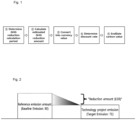
- the information processing device may calculate the estimated GHG reduction amount, on the basis of a difference between a baseline emission amount indicating a GHG emission amount according to an alternative scenario, which is most likely to occur if the technology project was not commercialized, and a target emission amount indicating a GHG emission amount caused by a commercialization of the technology project.
- the information processing device may estimate each of the baseline emission amount and the target emission amount, respectively, by multiplying an activity amount to quantify a size of human activity causing GHG emission, an emission factor to quantify an GHG emission amount for unit activity, and a global warming potential, which is a numerical expression of information on the contribution of each greenhouse gas to global warming in terms of carbon dioxide.
- the activity amount may be calculated from product sales (or sales amount), a production volume, a waste incineration amount or a product use amount by the subject of the technology project, wherein a change over time may be reflected.
- the information processing device may calculate the estimated GHG reduction amount while reflecting a contribution extent of the GHG reduction product among an estimated annual GHG reduction amount in the project, to which the GHG reduction product is expected to be applied.
- the emission permit price is a value received from an external emission permit trading server, which may be a price estimated on the basis of an evaluation reference date, an average price for a predetermined period, or a price for the predetermined period.
- the emission permit price may be an average value of emission permit prices actually traded for 1 year from a start date to an end date of the previous year prior to a year, in which the evaluation reference date belongs, with weighting a trading volume.
- the present invention provides a carbon valuation method, which includes evaluating an amount of GHG reduction expected to occur through the above technology project in a currency value by means of an information processing device.
- the carbon valuation system and method according to the present invention may estimate and calculate an expected amount of GHG reduction presumed to be induced in a technology project as a value amount, thereby being effectively utilized for finance, or the like.
- the carbon valuation system may include an information processing device that evaluates an amount of GHG reduction expected to occur in a technology project in currency value, on the basis of: an estimated GHG reduction amount, which is an amount of GHG reduction presumed to be induced by the technology project that is a target to be assessed; a calculation period of the GHG reduction during which the GHG reduction occurs due to the technology project; a discount rate that quantifies possible risks occurring in the technology project; and an emission permit price.
- the carbon value refers to a value obtained by converting the GHG reduction amount presumed to be induced by the technology project into a currency value, wherein the technology project indicates a business in which a subject of this business executes a GHG reduction project, or in which the subject develops, produces, sells or services GHG reduction products.
- the information processing device is a device that executes various calculations or processing of different types of information for carbon valuation according to an embodiment of the present invention, and types of the above device are not particularly limited.
- the above device may be implemented in the form of not only fixed terminals such as a digital TV or a desktop computer, but also portable terminals such as mobile phones, smart phones, laptop computers, digital broadcasting terminals, PDA (personal digital assistants), PMP (portable multimedia player), navigation, slate PC, tablet PC, ultrabook, etc.
- the information processing device may evaluate an amount of GHG reduction expected to occur through the technology project in a currency value, using an estimated reduction amount, an economic lifespan, a discount rate and an emission permit price, so as to calculate the expected GHG reduction amount presumed to be induced in the technology project as a value amount, thereby being utilized in various fields such as finance.
- the GHG reduction calculation period refers to a period during which GHG reduction occurs due to the technology project as a target to be assessed, while the estimated GHG reduction amount refers to an amount of future GHG reduction presumed to be induced by the technology project, which is estimated and calculated in a scenario mode.
- the information processing device may determine the GHG reduction calculation period and calculate the estimated GHG reduction amount.
- the information processing device may multiply the estimated GHG reduction amount by an emission permit price to convert it into a currency value, apply a discount rate thereto in order to make the converted currency value into the present value, followed by adding up the present value to which the discount rate is applied, thereby evaluating a carbon value thereof.
- the information processing device evaluates a value of the GHG reduction amount, it may be based on Equation 1 below.
- n is a GHG reduction calculation period
- the estimated GHG reduction amount refers to an estimated amount of GHG reduction in t-th year
- r denotes a discount rate
- Factors to be considered in evaluating the carbon value by the information processing device may be divided into a case where the subject of the technology project executes a GHG reduction project and another case where the subject of the technology project produces and sells products (including services) that induce GHG reduction, and can be calculated differently.
- the concept of carbon value in a project refers to a reduction activity occurring direct GHG reduction, and may include, for example, a renewable energy power generation project.
- the concept of carbon value in products refers to products that are used as a component of GHG activities (projects) and thus indirectly induce GHG reduction, and may include, for example, products for GHG reduction activities (projects) such as a solar cell, module, turbine, etc.
- the GHG reduction contribution extent may be a ratio of unit prices or added values between products contributing to the GHG reduction. For example, assuming that the carbon value of the project is 100, product “g", product “h” and product “I” may have carbon values of 50, 30 and 20, respectively.
- the GHG reduction calculation period which may be a period of annual units in comprehensive consideration of the legal, institutional, physical (or mechanical), technical, economic and social requirements necessary for normal implementation of the project.
- the estimated GHG reduction amount as one of the considered factors may be represented by a difference between a baseline emission amount (Baseline Emission: BE), which was calculated by assuming an alternative situation most likely to occur when the technology project to be assessed was not commercialized, and a target emission amount (Target Emission: TE), which was calculated by assuming a case where the technology project to be assessed has been commercialized.
- Baseline Emission: BE Baseline Emission
- Tiget Emission TE
- the amount of activity indicates a size of human activities (fuel consumption, product usage, product sales, operation amount, productivity, waste incineration etc.) that lead to GHG emission
- the emission factor is a coefficient that quantifies the GHG emission amount (CO 2 emission/unit fuel consumption, calorific value, oxidation rate, enteric fermentation emission factor, biomass emission factor, methane correction factor, etc.).
- GWP may represent an extent of contribution of each greenhouse gas to global warming in a numerical value in terms of carbon dioxide (see Table 1 below).
- the estimated GHG reduction amount may be calculated using the target emission (TE) and the baseline emission (BE) calculated above.
- EER refers to an estimated GHG reduction amount presumed to occur in a process of commercialization of the technology project to be assessed, and may be calculated by subtracting TE from BE as shown in the following Equation 3.
- Estimated GHG reduction amount EER t Baseline Emission BE t ⁇ Target Emission TE t
- the emission permit price as one of the factors considered when evaluating the carbon value by the information processing device, is used to convert the EER into a currency value, therefore, the carbon value may be calculated through conversion by multiplying the EER calculated as above for each year by the emission permit price (see the following Equation 4).
- Currency value converted amount in t-th year EER t ⁇ emission permit price
- the emission permit price is a means for converting the EER (tCO 2 -eq) into an amount (price), wherein it may be transaction price information provided by the emission permit trading exchange (KRX), a market in which emission permits are traded between independent parties.
- KRX emission permit trading exchange
- the information processing device may set the emission permit price based on the value received from an emission permit trading exchange server operated by the emission permit trading exchange.
- the emission permit price is a transaction price provided by the emission permit trading exchange and, when evaluating a value of the estimated GHG reduction amount, it may be a price based on the corresponding evaluation reference date.
- the emission permit price is variable and, when considering the variability, an emission permit price to be considered when evaluating a carbon value may be an average price for a predetermined period, preferably the average of emission permit prices for the last 1 year. Alternatively, it may be a price estimated according to a trend due to price fluctuations, on the basis of prices over a predetermined period of time.
- the discount rate which is one of the factors considered when the carbon value is evaluated by the information processing device, is used for changing the converted currency value for the estimated GHG reduction amount into the present value.
- a technology project risk there is a close relationship between a technology project risk and a reduction occurring risk, therefore, if the technology project is not normally operated, there is high possibility that GHG reduction does not occur or GHG reduction amount may be reduced. Therefore, it is desirable to apply different risks inherent in a technology commercialization process to the discount rate when changing the estimated GHG reduction amount into the current price.
- the carbon valuation it is preferable to reflect a commercialization risk according to a commercialization subject, which is the same as in technology value assessment. Therefore, in the same manner as a discount rate calculation method used in the technology value assessment, the discount rate may be calculated using a capital asset pricing model (CAPM). However, it is preferable to additionally reflect factors affecting success/failure of commercialization of GHG reduction technologies (climate environment contribution, environmental and social impact, policy conformity, climate industry ripple effect, etc.) in the commercialization risk.
- CAM capital asset pricing model
- the information processing device may apply a discount rate to an annual currency value conversion amount obtained by multiplying the estimated GHG reduction amount by the emission permit price, thereby calculating a sum of the present value for each year (see Equation 1 above).
- the information processing device calculates a value of the GHG reduction amount presumed to be induced by a corresponding technology project, if the subject of the technology project produces and sells products (including services) that induce GHG reduction, this is substantially the same as the case where the subject of the technology project performs GHG reduction project.
- the GHG reduction calculation period, calculation of the estimated GHG reduction amount, application of the discount rate, etc. may vary according to product assessment characteristics.
- GHG reduction calculation period which is one of the factors considered when the information processing device evaluates a carbon value
- an economic lifespan of the key technology constituting a product as a target to be assessed may become the GHG reduction calculation period.
- the economic lifespan refers to a period during which a technology project maintains a competitive advantage in the market, and may be not only a simple technology lifespan but also a period defined by considering environmental factors under which the corresponding technology is used.
- the estimated GHG reduction amount which is one of factors considered when the information processing device evaluates a carbon value
- a value summed with a reduction amount contributed by an evaluation target product among the estimated annual GHG reduction amount of a project, to which the evaluation target product is expected to be applied may be used as the estimated GHG reduction amount induced by the product.
- the carbon value of a technology to which a technical contribution extent is applied may be evaluated by considering the contribution of a key technology constituting an evaluation target product.
- the technical contribution extent refers to a level for contribution of the key technology constituting the evaluation target product to GHG reduction, and may be calculated by multiplying the estimated GHG reduction amount induced due to the product by the technical contribution extent.
- the information processing device may evaluate a value of the GHG reduction amount based on the technical contribution extent according to the following Equation 5.
- n is an economic lifespan of the key technology
- the estimated GHG reduction amount is an estimated GHG reduction amount in t-th year
- r may be the discount rate
- the carbon valuation method may include evaluating an amount of GHG reduction expected to occur through a technology project in a currency value by an information processing device, on the basis of: an estimated GHG reduction amount indicating an amount of GHG reduction presumed to be induced by the technology project that is a target to be assessed; a GHG reduction calculation period during which the GHG reduction occurs due to the technology project; a discount rate that quantifies possible risks occurring in the technology project; and an emission permit price.
- the estimated GHG reduction amount presumed to be induced due to the technology project may be assessed and evaluated as a value amount, thereby being utilized for finance or the like.
- the carbon valuation method according to an embodiment of the present invention described above may be implemented in the form of program instructions that can be executed through various computer components and recorded in a computer-readable recording medium.
- the computer-readable recording medium may be provided with program instructions, data files, data structures, etc. alone or in combination.
- the program instructions recorded on the computer-readable recording medium may be specially designed and configured for the present invention, or may be known and available to those skilled in the computer software field.
- Examples of the computer-readable recording medium may include magnetic media such as hard disks, floppy disks, and magnetic tapes, etc, optical recording media such as CD-ROMs and DVDs, magnetooptical media such as floptical disk, and hardware devices specially configured to store and execute program instructions, such as ROM, RAM, flash memory, and the like.
- Examples of the program instructions may include not only machine language codes such as those generated by a compiler, but also high-level language codes that can be executed by a computer using an interpreter or the like.
- the hardware device may be configured to operate as one or more software modules for executing the processing according to the present invention, and vice versa.
Landscapes
- Business, Economics & Management (AREA)
- Engineering & Computer Science (AREA)
- Human Resources & Organizations (AREA)
- Strategic Management (AREA)
- Economics (AREA)
- Development Economics (AREA)
- Entrepreneurship & Innovation (AREA)
- General Physics & Mathematics (AREA)
- Marketing (AREA)
- Physics & Mathematics (AREA)
- General Business, Economics & Management (AREA)
- Theoretical Computer Science (AREA)
- Educational Administration (AREA)
- Finance (AREA)
- Accounting & Taxation (AREA)
- Tourism & Hospitality (AREA)
- Game Theory and Decision Science (AREA)
- Operations Research (AREA)
- Quality & Reliability (AREA)
- Health & Medical Sciences (AREA)
- General Health & Medical Sciences (AREA)
- Primary Health Care (AREA)
- Technology Law (AREA)
- Data Mining & Analysis (AREA)
- Life Sciences & Earth Sciences (AREA)
- Sustainable Development (AREA)
- Public Health (AREA)
- Water Supply & Treatment (AREA)
- Management, Administration, Business Operations System, And Electronic Commerce (AREA)
Applications Claiming Priority (3)
| Application Number | Priority Date | Filing Date | Title |
|---|---|---|---|
| KR20200074460 | 2020-06-18 | ||
| KR1020210000603A KR102645484B1 (ko) | 2020-06-18 | 2021-01-05 | 탄소가치평가시스템 및 방법 |
| PCT/KR2021/006682 WO2021256727A1 (ko) | 2020-06-18 | 2021-05-28 | 탄소가치평가시스템 및 방법 |
Publications (2)
| Publication Number | Publication Date |
|---|---|
| EP4170567A1 true EP4170567A1 (de) | 2023-04-26 |
| EP4170567A4 EP4170567A4 (de) | 2024-06-12 |
Family
ID=79177367
Family Applications (1)
| Application Number | Title | Priority Date | Filing Date |
|---|---|---|---|
| EP21825073.6A Pending EP4170567A4 (de) | 2020-06-18 | 2021-05-28 | System und verfahren zur kohlenstoffbeurteilung |
Country Status (4)
| Country | Link |
|---|---|
| US (1) | US20230237410A1 (de) |
| EP (1) | EP4170567A4 (de) |
| KR (1) | KR102645484B1 (de) |
| WO (1) | WO2021256727A1 (de) |
Families Citing this family (8)
| Publication number | Priority date | Publication date | Assignee | Title |
|---|---|---|---|---|
| KR102407451B1 (ko) * | 2021-12-31 | 2022-06-14 | 에이티알 주식회사 | 개인의 탄소중립 플랫폼 시스템 및 그 운영방법 |
| KR102511931B1 (ko) | 2022-11-15 | 2023-03-20 | 이온어스(주) | 태양광 발전 설치 및 관리 방법 |
| KR102898594B1 (ko) * | 2023-05-10 | 2025-12-16 | (주)띵스파이어 | 탄소배출권 거래 분석 및 예측시스템 |
| KR102758997B1 (ko) * | 2023-08-31 | 2025-01-23 | (주)디엠솔루텍 | 기타 간접배출을 반영하여 탄소배출권을 거래하는 탄소배출권 거래 플랫폼서버 및 그 탄소배출권 거래방법 |
| KR102685587B1 (ko) | 2023-11-02 | 2024-07-17 | 기술보증기금 | 탄소감축활동 평가시스템 |
| KR102807710B1 (ko) * | 2023-12-28 | 2025-05-16 | 한국과학기술연구원 | 연구개발 사업의 탄소감축ㆍ영향평가 장치 및 방법 |
| WO2025182434A1 (ja) * | 2024-02-26 | 2025-09-04 | 日本電気株式会社 | 情報処理装置 |
| KR102900163B1 (ko) * | 2024-07-02 | 2025-12-15 | (주)삼우종합건축사사무소 | 탄소가격을 고려한 대안 제품 제시 방법 |
Family Cites Families (16)
| Publication number | Priority date | Publication date | Assignee | Title |
|---|---|---|---|---|
| JP4620858B2 (ja) * | 2000-11-15 | 2011-01-26 | 財団法人日本エネルギー経済研究所 | 二酸化炭素排出権取引システム及び二酸化炭素排出量削減コスト評価システム |
| RU2331924C2 (ru) * | 2002-07-20 | 2008-08-20 | Чикаго Клаймат Иксчендж, Инк. | Торговая система и способы для управления множеством установок, которые производят выбросы газов, вызывающих парниковый эффект |
| US7983929B2 (en) * | 2003-02-10 | 2011-07-19 | South Dakota School Of Mines And Technology | Technique for determining and reporting reduction in emissions of greenhouse gases at a site |
| JP4753704B2 (ja) * | 2005-12-15 | 2011-08-24 | 中国電力株式会社 | エネルギーコストと環境負荷抑制に関するバランス評価システム |
| US20070203722A1 (en) * | 2006-02-28 | 2007-08-30 | Richards Randall R | Method for determining a future value of greenhouse gas credits |
| US20070233616A1 (en) * | 2006-03-30 | 2007-10-04 | Caterpillar Inc. | Method for packaging greenhouse gas credits with a product transaction |
| US20070255457A1 (en) * | 2006-04-28 | 2007-11-01 | Bright Planet Network, Inc. | Consumer Pollution Impact Profile System and Method |
| WO2008070792A2 (en) * | 2006-12-06 | 2008-06-12 | Arcadia Biosciences, Inc. | Trading greenhouse gas emission credits determined based on the use of a genetically modified plant |
| US20100042453A1 (en) * | 2008-08-12 | 2010-02-18 | Efficiency 2.0, LLC. | Methods and apparatus for greenhouse gas footprint monitoring |
| JP5060448B2 (ja) * | 2008-10-08 | 2012-10-31 | 株式会社東芝 | 環境影響評価システムおよび環境影響評価方法 |
| KR101202772B1 (ko) | 2010-09-06 | 2012-11-19 | 아주대학교산학협력단 | 친환경 건축기술의 경제성 평가방법 |
| KR20120095593A (ko) * | 2011-02-21 | 2012-08-29 | 아이피텍코리아 주식회사 | 특허 기술 가치평가 방법 |
| KR101457890B1 (ko) * | 2012-07-27 | 2014-11-07 | 주식회사 에코시안 | 온실가스 감축 잠재량 평가 방법 및 시스템 |
| KR20160140203A (ko) * | 2015-05-29 | 2016-12-07 | 스마클(주) | 배출원별 온실가스 목표감축량 할당 시스템 |
| KR101896773B1 (ko) | 2016-09-29 | 2018-09-07 | 경북대학교 산학협력단 | 친환경 가치 평가 시스템 |
| US20190005578A1 (en) * | 2017-07-03 | 2019-01-03 | Shawn Gagne | System and Method for Transforming, Valuing, and Issuing Carbon Capture Credits |
-
2021
- 2021-01-05 KR KR1020210000603A patent/KR102645484B1/ko active Active
- 2021-05-28 WO PCT/KR2021/006682 patent/WO2021256727A1/ko not_active Ceased
- 2021-05-28 EP EP21825073.6A patent/EP4170567A4/de active Pending
- 2021-05-28 US US18/008,949 patent/US20230237410A1/en not_active Abandoned
Also Published As
| Publication number | Publication date |
|---|---|
| KR102645484B1 (ko) | 2024-03-08 |
| US20230237410A1 (en) | 2023-07-27 |
| EP4170567A4 (de) | 2024-06-12 |
| WO2021256727A1 (ko) | 2021-12-23 |
| KR20210156715A (ko) | 2021-12-27 |
Similar Documents
| Publication | Publication Date | Title |
|---|---|---|
| EP4170567A1 (de) | System und verfahren zur kohlenstoffbeurteilung | |
| Hunter et al. | Techno-economic analysis of long-duration energy storage and flexible power generation technologies to support high-variable renewable energy grids | |
| Schmidt et al. | Projecting the future levelized cost of electricity storage technologies | |
| Zhang et al. | Optimal subsidy reduction strategies for photovoltaic poverty alleviation in China: a cost-benefit analysis | |
| Thepkhun et al. | Thailand's Low-Carbon Scenario 2050: The AIM/CGE analyses of CO2 mitigation measures | |
| Lin et al. | Driving green technology innovation in renewable energy: Does venture capital matter? | |
| Pollitt et al. | An economic and environmental assessment of future electricity generation mixes in Japan–an assessment using the E3MG macro-econometric model | |
| Yang et al. | Green hydrogen credit subsidized renewable energy-hydrogen business models for achieving the carbon neutral future | |
| Lee et al. | Impact on the power mix and economy of Japan under a 2050 carbon-neutral scenario: Analysis using the E3ME macro-econometric model | |
| Shang et al. | Bank or retailer? Manufacturer financing for carbon emission reduction using the carbon emission quota as a pledge | |
| Luthi | Modelling an international market of CO2 emission permits | |
| Pan et al. | Cooperative electricity-hydrogen trading model for optimizing low-carbon travel using nash bargaining theory | |
| Xu | The impacts on China's economic growth and carbon reduction by renewable energy subsidy policy | |
| Wang et al. | Green bonds and carbon prices: a dynamic relationship revealed | |
| Wang et al. | A game‐theory analysis of the subsidy withdrawal policy for China's photovoltaic power generation industry | |
| Gharieh et al. | Investment in hydrogen tri-generation for wastewater treatment plants under uncertainties | |
| KR102688731B1 (ko) | 수소/전기차 전환으로 인한 탄소절감에 대한 개인별 경제적 효용성을 산출하는 시스템 및 방법 | |
| Dorokhina et al. | India’s climate mitigation policy: Challenges and prospects | |
| Garg | Renewable energy investment surges in India | |
| Karmaker et al. | Electrification or Hydrogen? A strategic pathway for Japan's energy transition | |
| Nguyen | CO2 Emissions, Financial Development, and Renewable Energy Consumption (REC): A Metadata Analysis | |
| Hsu et al. | Effects of Taiwan’s Promotion of Solar PV on its Economy and for Net-zero Emissions | |
| Zhang et al. | Cooperative operation strategy of electricity-carbon market considering randomness and correlation of electricity-carbon price | |
| Asuka | Japanese Debates over the Energy Transformation (GX) | |
| Bennett | The Siren Song that Never Ends: Federal Energy Subsidies and Support from 2010 to 2023 |
Legal Events
| Date | Code | Title | Description |
|---|---|---|---|
| STAA | Information on the status of an ep patent application or granted ep patent |
Free format text: STATUS: THE INTERNATIONAL PUBLICATION HAS BEEN MADE |
|
| PUAI | Public reference made under article 153(3) epc to a published international application that has entered the european phase |
Free format text: ORIGINAL CODE: 0009012 |
|
| STAA | Information on the status of an ep patent application or granted ep patent |
Free format text: STATUS: REQUEST FOR EXAMINATION WAS MADE |
|
| 17P | Request for examination filed |
Effective date: 20221214 |
|
| AK | Designated contracting states |
Kind code of ref document: A1 Designated state(s): AL AT BE BG CH CY CZ DE DK EE ES FI FR GB GR HR HU IE IS IT LI LT LU LV MC MK MT NL NO PL PT RO RS SE SI SK SM TR |
|
| DAV | Request for validation of the european patent (deleted) | ||
| DAX | Request for extension of the european patent (deleted) | ||
| A4 | Supplementary search report drawn up and despatched |
Effective date: 20240514 |
|
| RIC1 | Information provided on ipc code assigned before grant |
Ipc: G06Q 50/06 20120101ALI20240507BHEP Ipc: G06Q 40/06 20120101ALI20240507BHEP Ipc: G06Q 10/0637 20230101ALI20240507BHEP Ipc: G06Q 30/06 20120101ALI20240507BHEP Ipc: G06Q 50/26 20120101ALI20240507BHEP Ipc: G06Q 10/06 20120101AFI20240507BHEP |
|
| GRAP | Despatch of communication of intention to grant a patent |
Free format text: ORIGINAL CODE: EPIDOSNIGR1 |
|
| STAA | Information on the status of an ep patent application or granted ep patent |
Free format text: STATUS: GRANT OF PATENT IS INTENDED |
|
| RIC1 | Information provided on ipc code assigned before grant |
Ipc: G06Q 10/06 20230101AFI20260114BHEP Ipc: G06Q 50/26 20120101ALI20260114BHEP Ipc: G06Q 30/06 20230101ALI20260114BHEP Ipc: G06Q 10/0637 20230101ALI20260114BHEP Ipc: G06Q 40/06 20120101ALI20260114BHEP Ipc: G06Q 50/06 20120101ALI20260114BHEP |
|
| INTG | Intention to grant announced |
Effective date: 20260130 |
|
| RIN1 | Information on inventor provided before grant (corrected) |
Inventor name: YOU, WANG HEE Inventor name: LEE, JI MIN Inventor name: LIM, SUN HYUNG Inventor name: PARK, HA YOUNG Inventor name: KIM, EUN JU |
|
| GRAS | Grant fee paid |
Free format text: ORIGINAL CODE: EPIDOSNIGR3 |