EP4170603A1 - Automatisches verfahren zur detektion von objekten in einem bildstrom - Google Patents
Automatisches verfahren zur detektion von objekten in einem bildstrom Download PDFInfo
- Publication number
- EP4170603A1 EP4170603A1 EP22203071.0A EP22203071A EP4170603A1 EP 4170603 A1 EP4170603 A1 EP 4170603A1 EP 22203071 A EP22203071 A EP 22203071A EP 4170603 A1 EP4170603 A1 EP 4170603A1
- Authority
- EP
- European Patent Office
- Prior art keywords
- image
- images
- objects
- initial
- final
- Prior art date
- Legal status (The legal status is an assumption and is not a legal conclusion. Google has not performed a legal analysis and makes no representation as to the accuracy of the status listed.)
- Granted
Links
Images
Classifications
-
- G—PHYSICS
- G06—COMPUTING OR CALCULATING; COUNTING
- G06V—IMAGE OR VIDEO RECOGNITION OR UNDERSTANDING
- G06V20/00—Scenes; Scene-specific elements
- G06V20/50—Context or environment of the image
- G06V20/52—Surveillance or monitoring of activities, e.g. for recognising suspicious objects
Definitions
- the technical field of the invention is that of the detection of objects in a stream of images, and more particularly that of the detection of objects in a stream of images in an on-board context.
- the present invention relates to a method for detecting objects in a stream of images, and in particular an automatic method for detecting objects in a stream of images that can be implemented on a microprocessor.
- the present invention also relates to a computer, a device embedding the computer, a computer program product and a recording medium for implementing the method according to the invention.
- Detecting objects in a stream of images then consists in detecting the objects comprised in each image constituting the stream of images.
- the invention offers a solution to the problems mentioned above, by making it possible to precisely detect objects in a stream of images thanks to an algorithm that can be implemented on a microprocessor having a high integration capacity.
- the stream of images is processed per set of images and the detection by the artificial neural network is initially performed only for the first image and the last image of the set of pictures. If the same number of objects are detected in the first image and in the last image and each object detected in the first image can be coupled to a different object in the last image, each object detected in the first image is considered to be also detected in the last frame and that no objects appeared between the first frame and the last frame. The position of each object is then linearly interpolated in each image of the set of images between the first image and the last image, from its position in the first image and its position in the last image, and no other detection is then performed by the artificial neural network for the set of images.
- the number of objects detected in the first image is different from the number of objects detected in the last image or if at least one object detected in the first image cannot be coupled to an object in the last image, it is considered that at least one object appeared, disappeared or moved between the first image and the last image and therefore information concerning the appearance, disappearance or movement of an object is missing.
- Detection by the artificial neural network is then performed on an intermediate image of the set of images and the same conditions are verified between the first image and the intermediate image on the one hand, and between the intermediate image and the last image on the other hand, and the same steps as previously described are carried out according to the result of the verification until all the images of the set of images are assigned a set of objects obtained either by detection or either by interpolation.
- the detection by the artificial neural network is only carried out when information concerning the appearance, the disappearance or the displacement of an object seems to be missing by considering the sets of objects already obtained by the neural network.
- artificial which makes it possible to reduce the calculation resources used and to increase the processing speed, and thus makes the method implementable on a microprocessor, while maintaining a high detection rate specific to the use of a neural network artificial.
- the artificial neural network is used on the intermediate image of the subset of images to obtain an intermediate set of objects.
- the subset of images is the first subset of images, it is checked whether the same number of objects is detected in the first image and in the image intermediate and whether each object detected in the first image can be coupled to a different object in the intermediate image. If the subset of images is the second subset of images, it is checked whether the same number of objects are detected in the intermediate image and in the last image and whether each object detected in the intermediate image can be coupled to a different last frame object.
- each object detected in the first image is also detected in the intermediate image or that each object detected in the intermediate image is also detected in the last image and therefore that no information concerning the appearance, disappearance or movement of an object is ultimately missing and there is therefore no need to perform a new cutting step.
- the number of detection steps by the artificial neural network is therefore even more limited.
- a step of detection by the artificial neural network is carried out for the first image of a first set of images and as long as a visual criterion between the first image of the first set of images and the last image of a second set of images equal to or following the first set of images is less than a threshold, the set of objects obtained for the first image is assigned to each image between the first image of the first set of images and the last image of the second set of images in the image stream.
- the steps of the first embodiment of the method according to the invention are carried out for the second set of images.
- the number of detection steps by the artificial neural network is therefore further limited
- the objects to be detected are road users.
- the method according to the invention makes it possible to obtain a calculation time saving of 90% without deterioration of the detection rate if the users to be detected are on a one- or two-lane road with light traffic, c i.e. less than 300 users per hour, a calculation time saving of 50% without deterioration of the detection rate if the users to be detected are in an urban area with average traffic, i.e. of about 1500 users per hour, and a calculation time saving of 20% without deterioration of the detection rate if the users to be detected are on a highway with heavy traffic, that is to say more than 5000 users per hour,.
- the computer according to the invention is a microprocessor.
- the computer according to the invention further comprises a visual detection module configured to calculate a visual criterion from images provided by the image reading module and to provide the visual criterion calculated in the analysis module.
- a third aspect of the invention relates to a device embedding a computer according to the invention.
- a fourth aspect of the invention relates to a computer program product comprising instructions which, when the program is executed by a computer, lead the latter to implement the steps of the method according to the first embodiment or the second embodiment of the invention.
- a fifth aspect of the invention relates to a computer-readable recording medium comprising instructions which, when executed by a computer, cause the latter to implement the steps of the method according to the first embodiment or the second embodiment of the invention.
- a first aspect of the invention relates to a method for detecting objects in a stream of images, the stream of images consisting of a succession of sets of images each comprising a plurality of images.
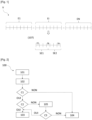
- FIG. 1 shows a schematic representation of the V frame stream.
- the stream of images V comprises N sets of images among which a first set of images E1, an i-th set of images Ei and a last set of images EN.
- each set of images Ei comprises the same number of images.
- each set of images Ei comprises n images, among which a first image I1 and a last image In.
- n is for example 8.
- Detection of objects in a stream of images means the detection of each object in each image constituting the stream of images V, and “detection of each object in an image” means the determination of the position of each object to be detected in the image, for example by identifying the coordinates of a window encompassing the object.
- the window is for example a rectangle, each side of which is in contact with at least one point of the outer contour of the object and the coordinates of the window are for example the coordinates of the upper left corner and of the lower right corner of the window.
- the method according to the invention therefore aims to obtain for each image of the image stream V, the position in the image of each object present in the image.
- the objects to be detected can be animate objects, for example people or animals, or inanimate objects, for example vehicles or parcels.
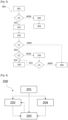
- FIG. 2 There picture 2 is a block diagram illustrating the sequence of steps of a first embodiment of the method 100 according to the invention.
- the first embodiment of the method 100 according to the invention comprises steps carried out for each set of images Ei of the stream of images V by considering the first image I1 of the set of images Ei as the initial image and the last image In of the set of images Ei as the final image.
- a first step 101 of the first embodiment of the method 100 according to the invention consists in detecting each object present in the initial image of the set of images Ei using a trained artificial neural network, and allows to obtain an initial set of objects, each object of the initial set of objects being associated with its position in the initial image, for example with the coordinates of a window encompassing the object.
- the initial object set is assigned to the initial image.
- the artificial neural network was previously trained in a supervised manner on a training database to obtain a trained artificial neural network capable of detecting from an image, each object in the image, i.e. i.e. capable of providing for each object present in the image, its position in the image.
- the artificial neural network used is for example an artificial neural network for detecting objects that can integrate image convolution layers, such as the artificial neural networks YOLO, Faster RCNN, RetinaNet or SSD.
- Supervised training makes it possible to train the artificial neural network on a predefined task, by updating the parameters or weights of the artificial neural network so as to minimize a cost function corresponding to the error between the output datum provided by the artificial neural network and the true output datum, i.e. what the artificial neural network should output to fulfill the predefined task on a certain datum 'entrance.
- a training database therefore comprises input data, each associated with a real output data.
- the training database comprises a plurality of images and for each image, the position of each object in the image, for example the coordinates of a bounding window for each object present in the image.
- the input data are the images and the real output data are the positions of the objects.
- the supervised learning of the artificial neural network therefore consists in updating the parameters so as to minimize a cost function corresponding to the error between each position provided by the artificial neural network from an image of the base of training data and the real position associated with the image in the training database.
- the first step 101 is carried out only if no detection has yet been carried out for the initial image of the set of images Ei.
- a second step 102 of the first embodiment of the method 100 according to the invention consists in detecting each object present in the final image of the set of images Ei using the trained artificial neural network and makes it possible to obtain a final set of objects, each object of the final set of objects being associated with its position in the final image, for example with the coordinates of a window encompassing the object.
- the final object set is assigned to the final image.
- the second step 102 is carried out only if no detection has yet been carried out for the final image of the set of images Ei.
- a third step 103 of the first embodiment of the method 100 according to the invention is carried out.
- the first condition C1 is verified if the initial set of objects obtained in the first step 101 has the same cardinality as the final set of objects obtained in the second step 102, that is to say that the set initial object set has the same number of objects as the final object set.
- cardinal of a set means the number of elements comprised in the set.
- the second condition C2 is verified if each object of the initial set of objects meets a first coupling condition with an object of the different final set of objects, i.e. if each object of the initial object set can be associated with an object in the final object set and not associated with another object in the initial object set.
- an object of the initial set of objects responds for example to the first condition of coupling with an object of the set of final objects if the intersection on the union or IoU (for "Intersection over Union” in English), between the bounding window associated with the object of the set of initial objects and the bounding window of the object of the final set of objects is greater than a first threshold. More generally, one of the objects of the initial set of objects is associated with one of the objects of the final set of objects if a calculated geometric distance between these two objects is less than the first threshold, the geometric distance being preferably calculated between the bounding window of each of the two objects.
- the first threshold is for example 80%.
- intersection on the union between a first window and a second window means the ratio between the surface of intersection between the first window and the second window, and the surface of union between the first window and the second window .
- the third step 103 consists in assigning a set of objects to each image of the set of images Ei included between the initial image and the final image.
- Each set of objects is calculated by linear interpolation from the initial set of objects and the final set of objects.
- Each set of objects therefore comprises the same number of objects as the initial set of objects and the final set of objects and the third step 103 then consists in creating one object from the set of objects per object of the initial set of objects and to associate the object with a position in the image obtained by linear interpolation between the position in the initial image of the object of the initial set of objects and the position in the final image of the object of the corresponding final image set, i.e. of the object of the final image set satisfying the first coupling condition with the object of the set of initial images.
- a set of objects is assigned to each image of the set of images Ei, and therefore each object present in the set of images Ei has been detected.
- a fourth step 104 of the first embodiment of the method 100 according to the invention is carried out.
- the fourth step 104 consists in dividing the set of images Ei into a first subset of images SE1 having as initial image the first image I1 of the set of images Ei and as final image an intermediate image Ik of the set of images Ei and in a second subset of images SE2 having as initial image the intermediate image Ik and as final image the last image In of the set of images Ei.
- Intermediate image means any image between the initial image and the final image of the set of images Ei, for example the middle image of the set of images Ei.
- the intermediate image Ik of the set of images Ei is included between the initial image and the final image of the set of images Ei, as illustrated in the figure 1 .
- the first subset of images SE1 comprises for example the same number of images as the second subset SE2.
- the first embodiment of the method 100 according to the invention may comprise a fifth step 105 if the first condition C1 is verified but the second condition C2 is not verified.
- the fifth step 105 consists in detecting each object present in the intermediate image Ik of the subset of images using the trained artificial neural network and makes it possible to obtain a set of intermediate objects, each object of the the intermediate set of objects being associated with its position in the intermediate image Ik, for example with the coordinates of a window encompassing the object.
- the third condition C3 is verified if the initial set of objects comprises the same number of objects as the intermediate set of objects and if each object of the initial set of objects meets a second coupling condition with an object of the different intermediate set of objects.
- an object of the initial set of objects responds for example to the second coupling condition with an object of the intermediate object set if the IoU between the bounding window associated with the object of the initial object set and the bounding window of the object of the set of intermediate objects is greater than a second threshold.
- the second threshold is for example 90%.
- the third condition C3 is verified if the intermediate set of objects comprises the same number of objects as the final set of objects and if each object of the intermediate set of objects meets the second coupling condition with an object of the different final set of objects.
- FIG. 3 There picture 3 is a block diagram illustrating the sequence of steps of a second embodiment of the method 300 according to the invention.
- the second embodiment of the method 300 according to the invention comprises steps carried out for each set of images Ei comprising at least one image to which no set of objects is assigned.
- a first step 301 of the second embodiment of the method 300 according to the invention consists in calculating a visual criterion between the first image I1 of the set of images Ei and the last image In of the set of images Ei.
- the visual criterion is therefore a similarity indicator, preferably calculated by means of a distance, a difference or a correlation between the first image I1 of the set of images Ei and the last image In of the set of Ei pictures.
- a processing for example a Gaussian filtering, can be applied to the first image I1 of the set of images Ei and the last image In of the set of images Ei prior to the calculation of the visual criterion.
- the visual criterion then depends on the value of the pixels of the first image I1 and of the last image In after processing.
- a second step 302 and a third step 303 of the second embodiment of the method 300 according to the invention are carried out.
- the fourth condition C4 is not verified if the visual criterion calculated in the first step 301 meets a similarity condition.
- the visual criterion meets the similarity condition if it is below a similarity threshold.
- the similarity threshold is for example equal to 0.1.
- the second step 302 consists in detecting each object present in the first image I1 of the set of images Ei using the trained artificial neural network, and makes it possible to obtain a first set of objects, each object of the first set of objects being associated with its position in the first image I1, for example with the coordinates of a window encompassing the object.
- the first set of objects is assigned to the first image I1.
- the second step 302 is carried out only if no detection has yet been carried out for the first image I1 of the set of images Ei.
- the third step 303 then consists in assigning the first set of objects to each image of the set of images Ei.
- a set of objects is assigned to each image of the set of images Ei, and therefore each object present in the set of images Ei has been detected.
- the steps of the first embodiment of the method 100 according to the invention are carried out for the set of images Ei having the last image In, the last image In having been used to calculate the visual criterion verifying the fourth condition C4.
- a first visual criterion is calculated between the first image I1 and the last image In of the first set of images E1 in the first step 301. If the fourth condition C4 is not verified for the first visual criterion, the second step 302 and the third step 303 are carried out, then the previous steps are carried out for the last image In of the second set of images of the stream of images V, that is to say that a second visual criterion is calculated between the first image I1 of the first set of images E1 and the last image In of the second set of images in the first step 301.
- the steps are then carried out for the last image In of the third set of images and if the fourth condition C4 is verified, the steps of the first embodiment of the method 100 according to the invention are carried out for the second set of images.
- the method 100, 300 according to the invention is a method for detecting road users, that is to say that the objects to be detected are road users comprising for example pedestrians, bicycles, cars, trucks and buses, and is for example intended for counting, that is to say that the detection carried out by the method 100, 300 according to the invention is then used to count the number of road users appearing in the stream of images V.
- the counting data can then be used for example for the dimensioning of infrastructures.
- a second aspect of the invention relates to a computer for implementing the method 100, 300 according to the invention.
- FIG. 4 shows a schematic representation of a computer 200 according to the invention.
- the detection module 202 therefore performs the first step 101 of the first embodiment of the method 100 according to the invention from the initial image provided by the image reading module 201, the second step 102 of the first embodiment of the method 100 according to the invention from the final image provided by the image reading module 201, the fifth step 105 of the first embodiment of the method 100 according to the invention from the intermediate image provided by the analysis module 203, and the second step 302 of the second embodiment of the method 300 according to the invention from the first image provided by the image reading module 201, and sends each set of objects obtained to the analysis module 203.
- the analysis module 203 verifies the first condition C1, the second condition C2 and the third condition C3, the third step 103 of the first embodiment of the method 100 according to the invention for each image of the set of images Ei supplied by the image reading module 201 from the initial set of objects and the final set of objects supplied by the detection module 202, supplies the intermediate image Ik to the detection 202 when the fourth step 104 or the fifth step 105 is carried out, carries out the verification of the fourth condition C4 and the third step 303 of the second embodiment of the method 300 according to the invention from the first set of objects provided by the detection module 202 and for each image of the set of images Ei provided by the image reading module 201.
- the computer 200 can also include a visual detection module 204 configured to calculate the visual criterion from images supplied by the image reading module 201 and supply the calculated visual criterion to the analysis module 203.
- a visual detection module 204 configured to calculate the visual criterion from images supplied by the image reading module 201 and supply the calculated visual criterion to the analysis module 203.
- the visual detection module 204 performs the first step 301 of the second embodiment of the method 300 according to the invention from the first image I1 and the last image In provided by the image reading module 201.
- the computer 200 is for example a microprocessor, the method 100, 300 then being implementable on a microprocessor.
- the computer 200 is for example included in a device, such as an autonomous camera.
- the artificial neural network is also trained to produce one or more category scores.
- the category score is, for example, a probability of an object to belong to a specific category.
- the artificial neural network is thus previously trained in a supervised manner on a classification database to obtain a trained artificial neural network capable of classifying each object detected in the image.
- the classification is based on the classification into several categories.
- the artificial neural network produces a category score for each category of the classification for each identified object.
- the categories of the classification are defined beforehand by an operator according to the desired application. For example, in the case of an image comprising users of the public highway, the artificial neural network produces a probability of belonging to the following classes for each object identified in the image: car, bus/coach, van, weight heavy, bicycle, pedestrian. Each object of the image is thus classified in the category for which the category score of said object is the highest.
- the training database also includes a plurality of classification images and for each image, the category of each object in the image, such that each category of the classification is comprised by at least one of the images of classification.
- the advantage of such an alternative is to take into account a possible change of category of one or more of the objects in the image.
- a user can switch from the "pedestrian” category to the "cyclist" category between the initial image and the final image, for example because from afar or from behind the cyclist can look like a pedestrian.
- Such a change of category is, among other things, related to variations in the environment in which the objects are located such as lighting, distance from the object, its orientation, partial masking of the object, the position in the scene, etc.
- This change of category can also be dependent on characteristics of the image acquisition means, such as the depth of field, the focal length, the resolution, the contrast, the sensitivity of the lens, etc.
- the category scores are normalized so that the sum of the category scores for each object of one of the images is equal to 1. That is to say that the sum of the probabilities of belonging to each category d one of the objects of one of the images is unitary.
- the linear interpolation makes it possible to preserve this property for each object of each image comprised between the initial image and the final image.
- a classification tool other than the trained artificial neural network can be used to determine the category score(s).
Landscapes
- Engineering & Computer Science (AREA)
- Physics & Mathematics (AREA)
- General Physics & Mathematics (AREA)
- Multimedia (AREA)
- Theoretical Computer Science (AREA)
- Image Analysis (AREA)
- Image Processing (AREA)
- Compression Or Coding Systems Of Tv Signals (AREA)
Applications Claiming Priority (1)
| Application Number | Priority Date | Filing Date | Title |
|---|---|---|---|
| FR2111235A FR3128565B1 (fr) | 2021-10-22 | 2021-10-22 | Procédé automatique de détection d’objets dans un flux d’images |
Publications (3)
| Publication Number | Publication Date |
|---|---|
| EP4170603A1 true EP4170603A1 (de) | 2023-04-26 |
| EP4170603C0 EP4170603C0 (de) | 2025-12-10 |
| EP4170603B1 EP4170603B1 (de) | 2025-12-10 |
Family
ID=80446615
Family Applications (1)
| Application Number | Title | Priority Date | Filing Date |
|---|---|---|---|
| EP22203071.0A Active EP4170603B1 (de) | 2021-10-22 | 2022-10-21 | Automatisches verfahren zur detektion von objekten in einem bildstrom |
Country Status (2)
| Country | Link |
|---|---|
| EP (1) | EP4170603B1 (de) |
| FR (1) | FR3128565B1 (de) |
Citations (2)
| Publication number | Priority date | Publication date | Assignee | Title |
|---|---|---|---|---|
| EP2891990A1 (de) * | 2012-08-30 | 2015-07-08 | ZTE Corporation | Verfahren und vorrichtung zur überwachung eines videoauszuges |
| US20210264153A1 (en) * | 2020-02-21 | 2021-08-26 | CACI, Inc.- Federal | Machine learning method and apparatus for detection and continuous feature comparison |
-
2021
- 2021-10-22 FR FR2111235A patent/FR3128565B1/fr active Active
-
2022
- 2022-10-21 EP EP22203071.0A patent/EP4170603B1/de active Active
Patent Citations (2)
| Publication number | Priority date | Publication date | Assignee | Title |
|---|---|---|---|---|
| EP2891990A1 (de) * | 2012-08-30 | 2015-07-08 | ZTE Corporation | Verfahren und vorrichtung zur überwachung eines videoauszuges |
| US20210264153A1 (en) * | 2020-02-21 | 2021-08-26 | CACI, Inc.- Federal | Machine learning method and apparatus for detection and continuous feature comparison |
Non-Patent Citations (2)
| Title |
|---|
| CHENGE LI ET AL: "TrackNet: Simultaneous Object Detection and Tracking and Its Application in Traffic Video Analysis", ARXIV.ORG, CORNELL UNIVERSITY LIBRARY, 201 OLIN LIBRARY CORNELL UNIVERSITY ITHACA, NY 14853, 4 February 2019 (2019-02-04), XP081025313 * |
| HONGLIANG LI ET AL: "Automatic video segmentation and tracking for content-based applications", IEEE COMMUNICATIONS MAGAZINE, IEEE SERVICE CENTER, PISCATAWAY, US, vol. 44, no. 1, 1 January 2007 (2007-01-01), pages 27 - 33, XP011156145, ISSN: 0163-6804 * |
Also Published As
| Publication number | Publication date |
|---|---|
| FR3128565B1 (fr) | 2023-10-27 |
| EP4170603C0 (de) | 2025-12-10 |
| FR3128565A1 (fr) | 2023-04-28 |
| EP4170603B1 (de) | 2025-12-10 |
Similar Documents
| Publication | Publication Date | Title |
|---|---|---|
| EP3137355B1 (de) | Vorrichtung zur objekt bestimmung an einem navigationsmodul von einem fahrzeug ausgerüstet mit dieser vorrichtung | |
| CN108388834A (zh) | 利用循环神经网络和级联特征映射的对象检测 | |
| CN112785610B (zh) | 一种融合低层特征的车道线语义分割方法 | |
| EP2593907B1 (de) | Verfahren für den nachweis eines ziels auf stereoskopischen bildern mittels lernen und statistischer klassifizierung auf der basis eines wahrscheinlichleitsgesetzes | |
| KR102574770B1 (ko) | 인공지능 모델을 이용한 블랙박스 영상 기반의 교통사고 영상 처리 서버 및 방법 | |
| US11935306B2 (en) | Data collection apparatus for estimating emotion of a person watching vehicle | |
| FR3076377A1 (fr) | Prediction de deplacement et de topologie pour un reseau de cameras. | |
| KR102685593B1 (ko) | 인공신경망을 활용한 객체 검지 기술 기반의 주행 법규 위반 차량 단속 방법 및 장치 | |
| WO2020165544A1 (fr) | Identification de zones roulables avec prise en compte de l'incertitude par une méthode d'apprentissage profond | |
| EP4170603B1 (de) | Automatisches verfahren zur detektion von objekten in einem bildstrom | |
| Afdhal et al. | Evaluation of benchmarking pre-trained CNN model for autonomous vehicles object detection in mixed traffic | |
| CN115601730A (zh) | 识别交通灯的方法、装置和电子设备 | |
| US20220324477A1 (en) | Method and system for recognizing activities in surrounding environment for controlling navigation of autonomous vehicle | |
| FR3067144A1 (fr) | Procede de determination du type de route sur laquelle evolue un vehicule | |
| Phuong et al. | Estimating the traffic density from traffic cameras | |
| EP3926529B1 (de) | Systeme und methoden zur bestimmung einer anzahl von personen in einem fahrzeug | |
| WO2024023146A1 (fr) | Procédé de détermination d'une vitesse limite autorisée où circule un véhicule automobile. | |
| Saffarini et al. | Survey of road anomalies detection methods | |
| Bezawada et al. | Modeling lane and road characteristics for drive quality rating | |
| Bisht et al. | Safe and Reliable Live-Streaming Traffic Monitoring System using OpenCV and Yolov8 | |
| WO2021122649A1 (fr) | Procédé de reconnaissance automatique de signalisation routière pour véhicule autonome | |
| EP2489548A1 (de) | Steuerungsverfahren zum adaptativen Umschalten des Beleuchtungsmodus der vorderen Scheinwerfer eines Kraftfahrzeugs | |
| Nisha et al. | Detection of Vehicle and Pedestrian in Indian Challenging Scenarios | |
| Srivastava | Traffic Light Detection in Autonomous Driving Vehicles | |
| Amarii et al. | Obstacles and Traffic Signs Tracking System |
Legal Events
| Date | Code | Title | Description |
|---|---|---|---|
| PUAI | Public reference made under article 153(3) epc to a published international application that has entered the european phase |
Free format text: ORIGINAL CODE: 0009012 |
|
| STAA | Information on the status of an ep patent application or granted ep patent |
Free format text: STATUS: THE APPLICATION HAS BEEN PUBLISHED |
|
| AK | Designated contracting states |
Kind code of ref document: A1 Designated state(s): AL AT BE BG CH CY CZ DE DK EE ES FI FR GB GR HR HU IE IS IT LI LT LU LV MC ME MK MT NL NO PL PT RO RS SE SI SK SM TR |
|
| P01 | Opt-out of the competence of the unified patent court (upc) registered |
Effective date: 20230524 |
|
| STAA | Information on the status of an ep patent application or granted ep patent |
Free format text: STATUS: REQUEST FOR EXAMINATION WAS MADE |
|
| 17P | Request for examination filed |
Effective date: 20231010 |
|
| RBV | Designated contracting states (corrected) |
Designated state(s): AL AT BE BG CH CY CZ DE DK EE ES FI FR GB GR HR HU IE IS IT LI LT LU LV MC ME MK MT NL NO PL PT RO RS SE SI SK SM TR |
|
| GRAP | Despatch of communication of intention to grant a patent |
Free format text: ORIGINAL CODE: EPIDOSNIGR1 |
|
| STAA | Information on the status of an ep patent application or granted ep patent |
Free format text: STATUS: GRANT OF PATENT IS INTENDED |
|
| INTG | Intention to grant announced |
Effective date: 20250715 |
|
| GRAS | Grant fee paid |
Free format text: ORIGINAL CODE: EPIDOSNIGR3 |
|
| GRAA | (expected) grant |
Free format text: ORIGINAL CODE: 0009210 |
|
| STAA | Information on the status of an ep patent application or granted ep patent |
Free format text: STATUS: THE PATENT HAS BEEN GRANTED |
|
| AK | Designated contracting states |
Kind code of ref document: B1 Designated state(s): AL AT BE BG CH CY CZ DE DK EE ES FI FR GB GR HR HU IE IS IT LI LT LU LV MC ME MK MT NL NO PL PT RO RS SE SI SK SM TR |
|
| REG | Reference to a national code |
Ref country code: CH Ref legal event code: F10 Free format text: ST27 STATUS EVENT CODE: U-0-0-F10-F00 (AS PROVIDED BY THE NATIONAL OFFICE) Effective date: 20251210 Ref country code: GB Ref legal event code: FG4D Free format text: NOT ENGLISH |
|
| REG | Reference to a national code |
Ref country code: DE Ref legal event code: R096 Ref document number: 602022026505 Country of ref document: DE |
|
| REG | Reference to a national code |
Ref country code: IE Ref legal event code: FG4D Free format text: LANGUAGE OF EP DOCUMENT: FRENCH |
|
| U01 | Request for unitary effect filed |
Effective date: 20260106 |
|
| U07 | Unitary effect registered |
Designated state(s): AT BE BG DE DK EE FI FR IT LT LU LV MT NL PT RO SE SI Effective date: 20260113 |
|
| P04 | Withdrawal of opt-out of the competence of the unified patent court (upc) registered |
Free format text: CASE NUMBER: UPC_APP_301983_1/2023 Effective date: 20260113 |
|
| PG25 | Lapsed in a contracting state [announced via postgrant information from national office to epo] |
Ref country code: ES Free format text: LAPSE BECAUSE OF FAILURE TO SUBMIT A TRANSLATION OF THE DESCRIPTION OR TO PAY THE FEE WITHIN THE PRESCRIBED TIME-LIMIT Effective date: 20251210 |
|
| PG25 | Lapsed in a contracting state [announced via postgrant information from national office to epo] |
Ref country code: NO Free format text: LAPSE BECAUSE OF FAILURE TO SUBMIT A TRANSLATION OF THE DESCRIPTION OR TO PAY THE FEE WITHIN THE PRESCRIBED TIME-LIMIT Effective date: 20260310 |
|
| PG25 | Lapsed in a contracting state [announced via postgrant information from national office to epo] |
Ref country code: HR Free format text: LAPSE BECAUSE OF FAILURE TO SUBMIT A TRANSLATION OF THE DESCRIPTION OR TO PAY THE FEE WITHIN THE PRESCRIBED TIME-LIMIT Effective date: 20251210 |
|
| PG25 | Lapsed in a contracting state [announced via postgrant information from national office to epo] |
Ref country code: RS Free format text: LAPSE BECAUSE OF FAILURE TO SUBMIT A TRANSLATION OF THE DESCRIPTION OR TO PAY THE FEE WITHIN THE PRESCRIBED TIME-LIMIT Effective date: 20260310 |