EP4170959B1 - Verfahren zur konstruktion eines halböffentlichen schlüsselsystems in qap-basierter homomorpher verschlüsselung - Google Patents
Verfahren zur konstruktion eines halböffentlichen schlüsselsystems in qap-basierter homomorpher verschlüsselung Download PDFInfo
- Publication number
- EP4170959B1 EP4170959B1 EP21214815.9A EP21214815A EP4170959B1 EP 4170959 B1 EP4170959 B1 EP 4170959B1 EP 21214815 A EP21214815 A EP 21214815A EP 4170959 B1 EP4170959 B1 EP 4170959B1
- Authority
- EP
- European Patent Office
- Prior art keywords
- key
- qubit
- semi
- homomorphic encryption
- computation
- Prior art date
- Legal status (The legal status is an assumption and is not a legal conclusion. Google has not performed a legal analysis and makes no representation as to the accuracy of the status listed.)
- Active
Links
Images
Classifications
-
- H—ELECTRICITY
- H04—ELECTRIC COMMUNICATION TECHNIQUE
- H04L—TRANSMISSION OF DIGITAL INFORMATION, e.g. TELEGRAPHIC COMMUNICATION
- H04L9/00—Cryptographic mechanisms or cryptographic arrangements for secret or secure communications; Network security protocols
- H04L9/008—Cryptographic mechanisms or cryptographic arrangements for secret or secure communications; Network security protocols involving homomorphic encryption
-
- G—PHYSICS
- G06—COMPUTING OR CALCULATING; COUNTING
- G06F—ELECTRIC DIGITAL DATA PROCESSING
- G06F21/00—Security arrangements for protecting computers, components thereof, programs or data against unauthorised activity
- G06F21/60—Protecting data
- G06F21/602—Providing cryptographic facilities or services
-
- G—PHYSICS
- G06—COMPUTING OR CALCULATING; COUNTING
- G06N—COMPUTING ARRANGEMENTS BASED ON SPECIFIC COMPUTATIONAL MODELS
- G06N10/00—Quantum computing, i.e. information processing based on quantum-mechanical phenomena
- G06N10/60—Quantum algorithms, e.g. based on quantum optimisation, quantum Fourier or Hadamard transforms
-
- H—ELECTRICITY
- H04—ELECTRIC COMMUNICATION TECHNIQUE
- H04L—TRANSMISSION OF DIGITAL INFORMATION, e.g. TELEGRAPHIC COMMUNICATION
- H04L9/00—Cryptographic mechanisms or cryptographic arrangements for secret or secure communications; Network security protocols
- H04L9/08—Key distribution or management, e.g. generation, sharing or updating, of cryptographic keys or passwords
- H04L9/0816—Key establishment, i.e. cryptographic processes or cryptographic protocols whereby a shared secret becomes available to two or more parties, for subsequent use
- H04L9/0852—Quantum cryptography
-
- H—ELECTRICITY
- H04—ELECTRIC COMMUNICATION TECHNIQUE
- H04L—TRANSMISSION OF DIGITAL INFORMATION, e.g. TELEGRAPHIC COMMUNICATION
- H04L9/00—Cryptographic mechanisms or cryptographic arrangements for secret or secure communications; Network security protocols
- H04L9/08—Key distribution or management, e.g. generation, sharing or updating, of cryptographic keys or passwords
- H04L9/0861—Generation of secret information including derivation or calculation of cryptographic keys or passwords
- H04L9/0869—Generation of secret information including derivation or calculation of cryptographic keys or passwords involving random numbers or seeds
-
- H—ELECTRICITY
- H04—ELECTRIC COMMUNICATION TECHNIQUE
- H04L—TRANSMISSION OF DIGITAL INFORMATION, e.g. TELEGRAPHIC COMMUNICATION
- H04L9/00—Cryptographic mechanisms or cryptographic arrangements for secret or secure communications; Network security protocols
- H04L9/08—Key distribution or management, e.g. generation, sharing or updating, of cryptographic keys or passwords
- H04L9/0894—Escrow, recovery or storing of secret information, e.g. secret key escrow or cryptographic key storage
-
- H—ELECTRICITY
- H04—ELECTRIC COMMUNICATION TECHNIQUE
- H04L—TRANSMISSION OF DIGITAL INFORMATION, e.g. TELEGRAPHIC COMMUNICATION
- H04L9/00—Cryptographic mechanisms or cryptographic arrangements for secret or secure communications; Network security protocols
- H04L9/30—Public key, i.e. encryption algorithm being computationally infeasible to invert or user's encryption keys not requiring secrecy
- H04L9/3066—Public key, i.e. encryption algorithm being computationally infeasible to invert or user's encryption keys not requiring secrecy involving algebraic varieties, e.g. elliptic or hyper-elliptic curves
-
- H—ELECTRICITY
- H04—ELECTRIC COMMUNICATION TECHNIQUE
- H04L—TRANSMISSION OF DIGITAL INFORMATION, e.g. TELEGRAPHIC COMMUNICATION
- H04L2209/00—Additional information or applications relating to cryptographic mechanisms or cryptographic arrangements for secret or secure communication H04L9/00
- H04L2209/34—Encoding or coding, e.g. Huffman coding or error correction
Definitions
- the present disclosure generally relates to a method of constructing a semi-public key system, particularly, to a method of constructing a semi-public key system in quotient algebra partition (QAP)-based homomorphic encryption (HE).
- QAP quotient algebra partition
- HE homomorphic encryption
- any plaintext on the internet is desired to be transferred as a completely encrypted state, to be decrypted securely, and moreover to be proceed in an encrypted state.
- current schemes of homomorphic encryption (HE) are built on the so-called lattice-based cryptography, a class of post-quantum cryptosystems allowing to prevent data from attacks of quantum algorithms.
- a proportion of noises would occur in every step of computation for the encryption. It is required to reduce the effect of the noise to avoid computational errors.
- the computation process leads to approximated solutions as an approximation and an exponential overhead of computation is needed to reduce noises during the process.
- the present inventive concept provides a method of constructing a semi-public key system in quotient algebra partition (QAP)-based homomorphic encryption (HE).
- QAP quotient algebra partition
- HE homomorphic encryption
- the schemes of homomorphic encryption are constructed and computed in the framework QAP.
- a plaintext would be encoded into a ciphertext of the same length; arithmetic operation would be encoded, such that the whole homomorphic encryption computation process would achieve as a blind computation.
- the method would provide exact solutions instead of approximated ones with modest overheads and allow a small resource of communication between the data provider and the data receiver to improve the encryption security.
- the present inventive concept further provides a method of constructing a semi-public key system in QAP-based homomorphic encryption to provide an exact solutions rather than approximated ones. It allows applications of delicately-designed invertible gates including spinor, CNOT, Toffoli gate, SWAP, Controlled SEAP, Multi-Control Gate in Hilbert space to conduct homomorphic encryption computations, which are built through a small-resource communication channel between the date provider and the data receiver.
- the present inventive concept further provides a method of constructing a semi-public key system in QAP-based homomorphic encryption. It conducts encoded arithmetic operation and the operators are arranged to attain the design of one-way function as fully blind operators.
- the present inventive concept further provides a method of constructing a semi-public key system in QAP-based homomorphic encryption.
- an overhead of error-correction is not necessary and thereby lowering the computational cost.
- the present inventive concept further provides a method of constructing a semi-public key system in QAP-based homomorphic encryption which is enable to allow problem-dependent optimizations with modest overheads.
- the method of the present inventive concept comprises:
- the semi-public key Key priv randomly generates an arbitrary k-qubit operation from a gigantic number of invertible gates of the same qubits;
- the semi-public key, Key s-pub is published in public space to transforming a plaintext to a ciphertext by anyone; and the private key, Key priv , is retained by the data receiver to decrypt the encrypted ciphertext.
- the method of the present inventive concept further comprises: S12. encoding: data provider provides a k -qubit plaintext,
- ⁇ en ⁇ Q p
- the method of the present inventive concept further comprises: S2.
- the computation provider receives the computational instructions to computes U en
- the method of the present inventive concept further comprises: S3.
- ⁇ en ⁇ and sends the encrypted evaluation to the data receiver; the data receiver decrypts the evaluation by applying the private key Key priv P ⁇ to the state U en
- ⁇ en ⁇ M
- exemplary or “embodiment” is used herein to mean serving as an example, instance, or illustration. Any aspect or design described herein as exemplary or an embodiment is not necessarily to be construed as preferred or advantageous over other aspects or designs. Rather, use of the word “exemplary” or “embodiment” is intended to present concepts and techniques in a concrete fashion.
- the present inventive concept provides a method of constructing a semi-public key system in Quotient Algebra Partition (QAP)-based homomorphic encryption (HE), by an algebraic structure, QAP, and an arithmetic operation of homomorphic encryption.
- QAP Quotient Algebra Partition
- HE Quotient Algebra Partition
- the Encryption, computation and decryption are computed in the framework of QAP by QAP-based fault tolerance quantum computation in an algebraic structure of QAP.
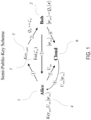
- the method of the present inventive concept comprises: S1. encryption: comprising S11. key generation and S12. encoding by a data receiver (Alice).
- step S11. key generation Alice generates a semi-public key, Key s ⁇ pub (3) for encryption and a private key, Key priv (4) for decryption, wherein the semi-public key Key priv , may randomly generate an arbitrary k-qubit operation chosen from a gigantic number of invertible gates of the same qubits.
- the semi-public key, Key s-pub may be published in public space to transforming a plaintext to a ciphertext by anyone; and the private key, Key priv , is retained by Alice to decrypt the encrypted ciphertext.
- a data provider (Bob) provides k -qubit plaintext,
- ⁇ en ⁇ Q p
- the semi-public key, Key s ⁇ pub (3) encodes a binary string ⁇ p which is 1-to-1 correspondence to Q p according to a given code system, G crypt (for example, any post-quantum code system may be given) into an encrypted message En( ⁇ p ) and sends it to Alice (1) (please refer to (3) in FIG. 1 ).
- Bob (2) sends the cipher
- This step allows a small resource of communication between Bob (2) and Alice (1), which means the semi-public key, Key s ⁇ pub (3) is enable to send any qubit permutation Q P and its encoded encrypted message En ( ⁇ P ) (5) to Alice (1) at the same time.
- the method may comprise step S2. Computation.
- a k-qubit arithmetic operation M is given to be operated and output a homomorphic encryption operation U en enable to be conducted on the encrypted state
- Alice (1) may decrypt and recover the encrypted message En( ⁇ p ) to the original Q P and encodes Q P into the computational instruction U en and sends to the Cloud (6) (please refer to (5) in FIG. 1 ).
- the Cloud (6) may further receive a computational instructions to computes U en
- the method may comprise step S3. Decryption.
- the Cloud (6) conducts the homomorphic encryption computation U en
- ⁇ en ⁇ M
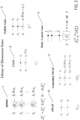
- Each of the spinors , 1 ⁇ j ⁇ n may be represented as a 2 ⁇ 2 matrix.
- CNOT (8) is a binary logic gate operation.
- a binary string, a i a j is given, where a i is a control bit and a j is a target bit.
- a i remain the same and a j is transformed into a j ⁇ a i for the CNOT operation performing on a i a j .
- Toffoli gate (9) is a trinary logic gate operation.
- a trinary string, a i a j a l is given, where a i and a j are control bits and a l is a target bit.
- SWAP is a binary logic gate operation.
- a binary string, a i a j is given.
- the SWAP gate swaps the qubits, a i and a j , to generate a string a j a i .
- CSWAP Controlled SWAP (11) is a trinary logic gate operation.
- a trinary string, a i a j a l is given, where a i is a control bit and a j and a l is target bits.
- Multi-Control gate (12) is a n-nary logical gate operation.
- a n-bit string, a 1 a 2 ⁇ a p a p +1 ⁇ a n is given.
- the method of constructing a semi-public key system in QAP-based homomorphic encryption of the present inventive concept is a method of fault tolerance quantum computation in QAP by an algebraic structure, QAP, and an arithmetic operation of homomorphic encryption.
- the fully homomorphic encryption is naturally achieved in either scheme through delicately-designed invertible gates, acting on the Hilbert space and thereby the present inventive concept may provide an exact solutions rather than approximated ones. It conducts encoded arithmetic operation and the operators are fully blind operators and allows problem-dependent optimizations.
- the present inventive concept allows a communication channel to be built between the data receiver and the data provider with low cost, to improve the encryption efficiency and security and lower the computation cost.
- the ciphertext has the same length during the encryption, so an overhead of error-correction is not necessary in homomorphic encryption computation and thereby it may lower the computational cost.
- the method of constructing a semi-public key system in QAP-based homomorphic encryption of the present inventive concept allows so-called Homomorphic Encryption to be conducted with a small resource of communication between the data provider and the data receiver during encryption without secret disclosures.
- the encrypted ciphertext has the same length without errors. Thereby the encryption time is shorter, the security is higher based on the same security level and same plaintext and the method allows problem-dependent optimizations with modest overheads.
Landscapes
- Engineering & Computer Science (AREA)
- Computer Security & Cryptography (AREA)
- Signal Processing (AREA)
- Computer Networks & Wireless Communication (AREA)
- Theoretical Computer Science (AREA)
- Physics & Mathematics (AREA)
- General Physics & Mathematics (AREA)
- Pure & Applied Mathematics (AREA)
- Mathematical Physics (AREA)
- Software Systems (AREA)
- General Engineering & Computer Science (AREA)
- Computing Systems (AREA)
- Mathematical Optimization (AREA)
- Mathematical Analysis (AREA)
- Computer Hardware Design (AREA)
- Evolutionary Computation (AREA)
- Condensed Matter Physics & Semiconductors (AREA)
- Computational Mathematics (AREA)
- Health & Medical Sciences (AREA)
- Artificial Intelligence (AREA)
- Data Mining & Analysis (AREA)
- General Health & Medical Sciences (AREA)
- Bioethics (AREA)
- Electromagnetism (AREA)
- Algebra (AREA)
- Management, Administration, Business Operations System, And Electronic Commerce (AREA)
- Storage Device Security (AREA)
Claims (1)
- Verfahren zum Aufbau eines halböffentlichen Schlüsselsystems in einer auf Quotient Algebra Partition (QAP) basierenden homomorphen Verschlüsselung (HE) durch eine algebraische Struktur QAP und eine arithmetische Operation der homomorphen Verschlüsselung, wobei das Verfahren Folgendes umfasst:S1. Verschlüsselung: bestehend aus Schlüsselgenerierung und -codierung;S11. Schlüsselgenerierung: Ein Datenempfänger generiert einen halböffentlichen Schlüssel Key s-pub und einen privaten Schlüssel Key priv ;wobei der halböffentliche Schlüssel Key s-pub zufällig eine beliebige k-Qubit-Operation aus einer gigantischen Anzahl invertierbarer Gatter derselben Qubits generiert;der private Schlüssel Key priv für die Entschlüsselung durch Key priv = A † P † dargestellt wird, einem Produkt der beiden k-Qubit-Operatoren A † und P †; wobei der halböffentliche Schlüssel Key s-pub im öffentlichen Raum veröffentlicht wird, um von jedermann einen Klartext in einen Chiffretext umzuwandeln, und der private Schlüssel, Key priv vom Datenempfänger aufbewahrt wird, um den verschlüsselten Chiffretext zu entschlüsseln;S12. Codierung: Ein Datenanbieter stellt einen k-Qubit-Klartext bereit, eine |x〉, a k -Qubit-Operation Qp wird durch den halböffentlichen Schlüssel Key s-pub generiert; ein codierter Zustand des Chiffretextes |ψen 〉 = Qp |x) mit der gleichen Qubit-Länge wird erhalten; der halböffentliche Schlüssel Key s-pub codiert eine Binärzeichenfolge ζp, die gemäß einem gegebenen Codesystem Gcrypt eine 1-zu-1-Entsprechung zu Q p darstellt, in eine verschlüsselte Nachricht En(ζ p ) und sendet diese durch einen Kommunikationskanal mit kleinen Ressourcen zum Datenempfänger; und der Datenanbieter sendet den Chiffretext |ψ en〉 an einen Berechnungsanbieter;S2. Berechnung:S21. Es ist eine k-Qubit-Rechenoperation M gegeben, um eine homomorphe Verschlüsselungsoperation Uen auszuführen und auszugeben, die es ermöglicht, auf dem verschlüsselten Zustand |ψen 〉 durchgeführt zu werden; nach dem Empfang der verschlüsselten Nachricht En(ζ p ) vom Datenanbieter und dem Erhalt der entsprechenden A-Qubit-Operation Qp durch den Entschlüsselungsprozess in Gcrypt erstellt der Datenempfänger eine Rechenanweisung der homomorphen Verschlüsselungsoperation Uen mit einer Form:
 wobei Qp = W 1 W 2 ein Produkt einer Qubit-Permutation W 1 und einer Operation W 2 ist, die aus Elementargattern (CNOTs, SWAPs, Toffolis, CSWAPs) besteht, P j=0,1 und P Qubit-Permutationen sind, die der nullpotenten Bedingung PW 1 P 1 = I 2 n folgen und dann Uen zum Berechnungsanbieter senden.S22. Der Berechnungsanbieter empfängt die Berechnungsanweisungen für die Berechnungen Uen |ψen 〉 und eine verschlüsselte Auswertung wird erhalten;S3. Entschlüsselung:
Der Berechnungsanbieter führt eine homomorphe Verschlüsselungsberechnung Uen |ψen 〉 durch und sendet die verschlüsselte Auswertung zum Datenempfänger; der Datenempfänger entschlüsselt die Auswertung, indem er den privaten Schlüssel Key priv = A † P † auf den Zustand Uen |ψen 〉 anwendet, was als A † P † Uen |ψen 〉 = M|x geschrieben wird, und erhält dann das unverschlüsselte Ergebnis M|x〉.
Applications Claiming Priority (2)
| Application Number | Priority Date | Filing Date | Title |
|---|---|---|---|
| US202163270633P | 2021-10-22 | 2021-10-22 | |
| TW110142066A TWI807479B (zh) | 2021-11-11 | 2021-11-11 | Qap型式同態加密中的半公鑰系統設計的方法 |
Publications (3)
| Publication Number | Publication Date |
|---|---|
| EP4170959A1 EP4170959A1 (de) | 2023-04-26 |
| EP4170959C0 EP4170959C0 (de) | 2024-04-03 |
| EP4170959B1 true EP4170959B1 (de) | 2024-04-03 |
Family
ID=79021733
Family Applications (1)
| Application Number | Title | Priority Date | Filing Date |
|---|---|---|---|
| EP21214815.9A Active EP4170959B1 (de) | 2021-10-22 | 2021-12-15 | Verfahren zur konstruktion eines halböffentlichen schlüsselsystems in qap-basierter homomorpher verschlüsselung |
Country Status (4)
| Country | Link |
|---|---|
| US (1) | US11728966B2 (de) |
| EP (1) | EP4170959B1 (de) |
| JP (1) | JP7257495B1 (de) |
| GB (1) | GB2612141B (de) |
Families Citing this family (5)
| Publication number | Priority date | Publication date | Assignee | Title |
|---|---|---|---|---|
| US12316735B2 (en) * | 2020-12-24 | 2025-05-27 | Intel Corporation | Technologies for memory and I/O efficient operations on homomorphically encrypted data |
| TWI841098B (zh) * | 2021-12-11 | 2024-05-01 | 財團法人國家實驗研究院 | Qap型式同態加密中的單向計算系統設計的方法 |
| TWI826165B (zh) * | 2021-12-11 | 2023-12-11 | 財團法人國家實驗研究院 | Qap型式量子容錯計算的程序閾值方法 |
| CN115333717B (zh) * | 2022-06-27 | 2025-05-13 | 北京量子信息科学研究院 | 用于数据加密标准和高级数据加密标准的攻击方法 |
| CN116684095B (zh) * | 2023-08-02 | 2023-09-29 | 杭州希智电子有限公司 | 基于物联网的传感器数据加密方法及系统 |
Family Cites Families (5)
| Publication number | Priority date | Publication date | Assignee | Title |
|---|---|---|---|---|
| US7752453B2 (en) * | 2004-01-08 | 2010-07-06 | Encryption Solutions, Inc. | Method of encrypting and transmitting data and system for transmitting encrypted data |
| US10594472B2 (en) * | 2015-03-09 | 2020-03-17 | Jintai Ding | Hybrid fully homomorphic encryption (F.H.E.) systems |
| JP2017038336A (ja) * | 2015-08-14 | 2017-02-16 | 公益財団法人九州先端科学技術研究所 | 復号方法 |
| CN106452765A (zh) * | 2016-12-16 | 2017-02-22 | 中国科学院深圳先进技术研究院 | 基于全同态加密算法的硬件木马防御方法及装置 |
| WO2018232603A1 (en) * | 2017-06-20 | 2018-12-27 | Nokia Technologies Oy | SECURE COMPUTERIZED CALCULATION |
-
2021
- 2021-12-10 US US17/547,570 patent/US11728966B2/en active Active
- 2021-12-15 EP EP21214815.9A patent/EP4170959B1/de active Active
- 2021-12-15 GB GB2118125.0A patent/GB2612141B/en active Active
- 2021-12-16 JP JP2021215530A patent/JP7257495B1/ja active Active
Also Published As
| Publication number | Publication date |
|---|---|
| GB2612141B (en) | 2025-01-01 |
| EP4170959A1 (de) | 2023-04-26 |
| EP4170959C0 (de) | 2024-04-03 |
| JP2023063202A (ja) | 2023-05-09 |
| JP7257495B1 (ja) | 2023-04-13 |
| US11728966B2 (en) | 2023-08-15 |
| US20230128727A1 (en) | 2023-04-27 |
| GB2612141A (en) | 2023-04-26 |
| GB202118125D0 (en) | 2022-01-26 |
Similar Documents
| Publication | Publication Date | Title |
|---|---|---|
| EP4170959B1 (de) | Verfahren zur konstruktion eines halböffentlichen schlüsselsystems in qap-basierter homomorpher verschlüsselung | |
| EP4170964B1 (de) | Verfahren zur herstellung eines öffentlichen schlüsselsystems in einer qap-basierten homomorphen verschlüsselung | |
| Agrawal | Indistinguishability obfuscation without multilinear maps: new methods for bootstrapping and instantiation | |
| Ravichandran et al. | DNA chaos blend to secure medical privacy | |
| Wang et al. | A quantum circuit design of AES requiring fewer quantum qubits and gate operations | |
| Kuang et al. | Shannon perfect secrecy in a discrete Hilbert space | |
| JP2011509433A (ja) | 確率的対称暗号化のための方法およびエンティティ | |
| Niederhagen et al. | Practical post-quantum cryptography | |
| CN116644778A (zh) | 量子同态神经网络的构建方法及加密图像分类方法 | |
| CN113132100B (zh) | 一种基于滑窗QC-LDPC码的McEliece体制加解密方法 | |
| Puchinger et al. | Twisted Gabidulin codes in the GPT cryptosystem | |
| Long | Classical solutions for quantum challenges: An introduction to postquantum cryptography | |
| TWI807479B (zh) | Qap型式同態加密中的半公鑰系統設計的方法 | |
| TWI826863B (zh) | Qap型式同態加密中的公鑰系統設計的方法 | |
| Challa et al. | A modified symmetric key fully homomorphic encryption scheme based on Read-Muller Code | |
| CN113259107B (zh) | 一种基于格的双模式加密方法 | |
| Tutoveanu | Active implementation of end-to-end post-quantum encryption | |
| Karn et al. | Code-based cryptography for confidential inference on fpgas: An end-to-end methodology | |
| Ehbali et al. | Comparative study: the emerging of quantum cryptography | |
| Wang et al. | Efficient homomorphic integer polynomial evaluation based on GSW FHE | |
| KR102704079B1 (ko) | Pipo 암호화 장치 및 pipo 암호화 방법 | |
| Goyal et al. | A Novel Quantum Key Distribution Framework with Bit-Stuffed Permutation Matrix Encryption | |
| EP4133679B1 (de) | Verfahren und berechnungseinheit zur durchführung der berechnung einer funktion über verschlüsselte daten | |
| Yang et al. | Quantum McEliece public-key encryption scheme | |
| JP2025118530A (ja) | セキュアなマルチパーティの正確な準同型暗号のためのシステム、及びセキュアなマルチパーティの正確な準同型暗号を行うためのコンピュータ実施方法 |
Legal Events
| Date | Code | Title | Description |
|---|---|---|---|
| PUAI | Public reference made under article 153(3) epc to a published international application that has entered the european phase |
Free format text: ORIGINAL CODE: 0009012 |
|
| STAA | Information on the status of an ep patent application or granted ep patent |
Free format text: STATUS: REQUEST FOR EXAMINATION WAS MADE |
|
| 17P | Request for examination filed |
Effective date: 20220921 |
|
| AK | Designated contracting states |
Kind code of ref document: A1 Designated state(s): AL AT BE BG CH CY CZ DE DK EE ES FI FR GB GR HR HU IE IS IT LI LT LU LV MC MK MT NL NO PL PT RO RS SE SI SK SM TR |
|
| GRAP | Despatch of communication of intention to grant a patent |
Free format text: ORIGINAL CODE: EPIDOSNIGR1 |
|
| STAA | Information on the status of an ep patent application or granted ep patent |
Free format text: STATUS: GRANT OF PATENT IS INTENDED |
|
| RIC1 | Information provided on ipc code assigned before grant |
Ipc: G06N 10/60 20220101ALI20230918BHEP Ipc: G06F 21/60 20130101ALI20230918BHEP Ipc: G06N 10/00 20220101ALI20230918BHEP Ipc: H04L 9/08 20060101ALI20230918BHEP Ipc: H04L 9/00 20220101AFI20230918BHEP |
|
| INTG | Intention to grant announced |
Effective date: 20231020 |
|
| GRAS | Grant fee paid |
Free format text: ORIGINAL CODE: EPIDOSNIGR3 |
|
| GRAA | (expected) grant |
Free format text: ORIGINAL CODE: 0009210 |
|
| STAA | Information on the status of an ep patent application or granted ep patent |
Free format text: STATUS: THE PATENT HAS BEEN GRANTED |
|
| AK | Designated contracting states |
Kind code of ref document: B1 Designated state(s): AL AT BE BG CH CY CZ DE DK EE ES FI FR GB GR HR HU IE IS IT LI LT LU LV MC MK MT NL NO PL PT RO RS SE SI SK SM TR |
|
| REG | Reference to a national code |
Ref country code: CH Ref legal event code: EP |
|
| REG | Reference to a national code |
Ref country code: IE Ref legal event code: FG4D |
|
| REG | Reference to a national code |
Ref country code: DE Ref legal event code: R096 Ref document number: 602021011230 Country of ref document: DE |
|
| U01 | Request for unitary effect filed |
Effective date: 20240403 |
|
| U07 | Unitary effect registered |
Designated state(s): AT BE BG DE DK EE FI FR IT LT LU LV MT NL PT SE SI Effective date: 20240408 |
|
| PG25 | Lapsed in a contracting state [announced via postgrant information from national office to epo] |
Ref country code: IS Free format text: LAPSE BECAUSE OF FAILURE TO SUBMIT A TRANSLATION OF THE DESCRIPTION OR TO PAY THE FEE WITHIN THE PRESCRIBED TIME-LIMIT Effective date: 20240803 |
|
| PG25 | Lapsed in a contracting state [announced via postgrant information from national office to epo] |
Ref country code: HR Free format text: LAPSE BECAUSE OF FAILURE TO SUBMIT A TRANSLATION OF THE DESCRIPTION OR TO PAY THE FEE WITHIN THE PRESCRIBED TIME-LIMIT Effective date: 20240403 |
|
| PG25 | Lapsed in a contracting state [announced via postgrant information from national office to epo] |
Ref country code: GR Free format text: LAPSE BECAUSE OF FAILURE TO SUBMIT A TRANSLATION OF THE DESCRIPTION OR TO PAY THE FEE WITHIN THE PRESCRIBED TIME-LIMIT Effective date: 20240704 |
|
| PG25 | Lapsed in a contracting state [announced via postgrant information from national office to epo] |
Ref country code: ES Free format text: LAPSE BECAUSE OF FAILURE TO SUBMIT A TRANSLATION OF THE DESCRIPTION OR TO PAY THE FEE WITHIN THE PRESCRIBED TIME-LIMIT Effective date: 20240403 |
|
| PG25 | Lapsed in a contracting state [announced via postgrant information from national office to epo] |
Ref country code: CZ Free format text: LAPSE BECAUSE OF FAILURE TO SUBMIT A TRANSLATION OF THE DESCRIPTION OR TO PAY THE FEE WITHIN THE PRESCRIBED TIME-LIMIT Effective date: 20240403 |
|
| PG25 | Lapsed in a contracting state [announced via postgrant information from national office to epo] |
Ref country code: PL Free format text: LAPSE BECAUSE OF FAILURE TO SUBMIT A TRANSLATION OF THE DESCRIPTION OR TO PAY THE FEE WITHIN THE PRESCRIBED TIME-LIMIT Effective date: 20240403 |
|
| PG25 | Lapsed in a contracting state [announced via postgrant information from national office to epo] |
Ref country code: PL Free format text: LAPSE BECAUSE OF FAILURE TO SUBMIT A TRANSLATION OF THE DESCRIPTION OR TO PAY THE FEE WITHIN THE PRESCRIBED TIME-LIMIT Effective date: 20240403 Ref country code: NO Free format text: LAPSE BECAUSE OF FAILURE TO SUBMIT A TRANSLATION OF THE DESCRIPTION OR TO PAY THE FEE WITHIN THE PRESCRIBED TIME-LIMIT Effective date: 20240703 Ref country code: IS Free format text: LAPSE BECAUSE OF FAILURE TO SUBMIT A TRANSLATION OF THE DESCRIPTION OR TO PAY THE FEE WITHIN THE PRESCRIBED TIME-LIMIT Effective date: 20240803 Ref country code: HR Free format text: LAPSE BECAUSE OF FAILURE TO SUBMIT A TRANSLATION OF THE DESCRIPTION OR TO PAY THE FEE WITHIN THE PRESCRIBED TIME-LIMIT Effective date: 20240403 Ref country code: GR Free format text: LAPSE BECAUSE OF FAILURE TO SUBMIT A TRANSLATION OF THE DESCRIPTION OR TO PAY THE FEE WITHIN THE PRESCRIBED TIME-LIMIT Effective date: 20240704 Ref country code: ES Free format text: LAPSE BECAUSE OF FAILURE TO SUBMIT A TRANSLATION OF THE DESCRIPTION OR TO PAY THE FEE WITHIN THE PRESCRIBED TIME-LIMIT Effective date: 20240403 Ref country code: CZ Free format text: LAPSE BECAUSE OF FAILURE TO SUBMIT A TRANSLATION OF THE DESCRIPTION OR TO PAY THE FEE WITHIN THE PRESCRIBED TIME-LIMIT Effective date: 20240403 Ref country code: RS Free format text: LAPSE BECAUSE OF FAILURE TO SUBMIT A TRANSLATION OF THE DESCRIPTION OR TO PAY THE FEE WITHIN THE PRESCRIBED TIME-LIMIT Effective date: 20240703 |
|
| U20 | Renewal fee for the european patent with unitary effect paid |
Year of fee payment: 4 Effective date: 20241112 |
|
| REG | Reference to a national code |
Ref country code: DE Ref legal event code: R097 Ref document number: 602021011230 Country of ref document: DE |
|
| PG25 | Lapsed in a contracting state [announced via postgrant information from national office to epo] |
Ref country code: RO Free format text: LAPSE BECAUSE OF FAILURE TO SUBMIT A TRANSLATION OF THE DESCRIPTION OR TO PAY THE FEE WITHIN THE PRESCRIBED TIME-LIMIT Effective date: 20240403 Ref country code: SK Free format text: LAPSE BECAUSE OF FAILURE TO SUBMIT A TRANSLATION OF THE DESCRIPTION OR TO PAY THE FEE WITHIN THE PRESCRIBED TIME-LIMIT Effective date: 20240403 |
|
| PG25 | Lapsed in a contracting state [announced via postgrant information from national office to epo] |
Ref country code: SM Free format text: LAPSE BECAUSE OF FAILURE TO SUBMIT A TRANSLATION OF THE DESCRIPTION OR TO PAY THE FEE WITHIN THE PRESCRIBED TIME-LIMIT Effective date: 20240403 |
|
| PG25 | Lapsed in a contracting state [announced via postgrant information from national office to epo] |
Ref country code: SM Free format text: LAPSE BECAUSE OF FAILURE TO SUBMIT A TRANSLATION OF THE DESCRIPTION OR TO PAY THE FEE WITHIN THE PRESCRIBED TIME-LIMIT Effective date: 20240403 Ref country code: SK Free format text: LAPSE BECAUSE OF FAILURE TO SUBMIT A TRANSLATION OF THE DESCRIPTION OR TO PAY THE FEE WITHIN THE PRESCRIBED TIME-LIMIT Effective date: 20240403 Ref country code: RO Free format text: LAPSE BECAUSE OF FAILURE TO SUBMIT A TRANSLATION OF THE DESCRIPTION OR TO PAY THE FEE WITHIN THE PRESCRIBED TIME-LIMIT Effective date: 20240403 |
|
| PLBE | No opposition filed within time limit |
Free format text: ORIGINAL CODE: 0009261 |
|
| STAA | Information on the status of an ep patent application or granted ep patent |
Free format text: STATUS: NO OPPOSITION FILED WITHIN TIME LIMIT |
|
| 26N | No opposition filed |
Effective date: 20250106 |
|
| PG25 | Lapsed in a contracting state [announced via postgrant information from national office to epo] |
Ref country code: MC Free format text: LAPSE BECAUSE OF FAILURE TO SUBMIT A TRANSLATION OF THE DESCRIPTION OR TO PAY THE FEE WITHIN THE PRESCRIBED TIME-LIMIT Effective date: 20240403 |
|
| REG | Reference to a national code |
Ref country code: CH Ref legal event code: PL |
|
| PG25 | Lapsed in a contracting state [announced via postgrant information from national office to epo] |
Ref country code: CH Free format text: LAPSE BECAUSE OF NON-PAYMENT OF DUE FEES Effective date: 20241231 |
|
| PG25 | Lapsed in a contracting state [announced via postgrant information from national office to epo] |
Ref country code: IE Free format text: LAPSE BECAUSE OF NON-PAYMENT OF DUE FEES Effective date: 20241215 |
|
| U20 | Renewal fee for the european patent with unitary effect paid |
Year of fee payment: 5 Effective date: 20251201 |
|
| PGFP | Annual fee paid to national office [announced via postgrant information from national office to epo] |
Ref country code: GB Payment date: 20251219 Year of fee payment: 5 |