EP4170975A1 - Baummodellkonstruktionsverfahren, -vorrichtung und -vorrichtung sowie speichermedium - Google Patents
Baummodellkonstruktionsverfahren, -vorrichtung und -vorrichtung sowie speichermedium Download PDFInfo
- Publication number
- EP4170975A1 EP4170975A1 EP21830013.5A EP21830013A EP4170975A1 EP 4170975 A1 EP4170975 A1 EP 4170975A1 EP 21830013 A EP21830013 A EP 21830013A EP 4170975 A1 EP4170975 A1 EP 4170975A1
- Authority
- EP
- European Patent Office
- Prior art keywords
- alarm
- tree model
- data
- correlation
- alarm data
- Prior art date
- Legal status (The legal status is an assumption and is not a legal conclusion. Google has not performed a legal analysis and makes no representation as to the accuracy of the status listed.)
- Pending
Links
Images


Classifications
-
- H—ELECTRICITY
- H04—ELECTRIC COMMUNICATION TECHNIQUE
- H04L—TRANSMISSION OF DIGITAL INFORMATION, e.g. TELEGRAPHIC COMMUNICATION
- H04L41/00—Arrangements for maintenance, administration or management of data switching networks, e.g. of packet switching networks
- H04L41/06—Management of faults, events, alarms or notifications
- H04L41/0631—Management of faults, events, alarms or notifications using root cause analysis; using analysis of correlation between notifications, alarms or events based on decision criteria, e.g. hierarchy, tree or time analysis
-
- H—ELECTRICITY
- H04—ELECTRIC COMMUNICATION TECHNIQUE
- H04L—TRANSMISSION OF DIGITAL INFORMATION, e.g. TELEGRAPHIC COMMUNICATION
- H04L41/00—Arrangements for maintenance, administration or management of data switching networks, e.g. of packet switching networks
- H04L41/06—Management of faults, events, alarms or notifications
- H04L41/0631—Management of faults, events, alarms or notifications using root cause analysis; using analysis of correlation between notifications, alarms or events based on decision criteria, e.g. hierarchy, tree or time analysis
- H04L41/0636—Management of faults, events, alarms or notifications using root cause analysis; using analysis of correlation between notifications, alarms or events based on decision criteria, e.g. hierarchy, tree or time analysis based on a decision tree analysis
-
- G—PHYSICS
- G06—COMPUTING OR CALCULATING; COUNTING
- G06F—ELECTRIC DIGITAL DATA PROCESSING
- G06F18/00—Pattern recognition
- G06F18/10—Pre-processing; Data cleansing
- G06F18/15—Statistical pre-processing, e.g. techniques for normalisation or restoring missing data
-
- G—PHYSICS
- G06—COMPUTING OR CALCULATING; COUNTING
- G06F—ELECTRIC DIGITAL DATA PROCESSING
- G06F18/00—Pattern recognition
- G06F18/20—Analysing
- G06F18/21—Design or setup of recognition systems or techniques; Extraction of features in feature space; Blind source separation
- G06F18/214—Generating training patterns; Bootstrap methods, e.g. bagging or boosting
-
- G—PHYSICS
- G06—COMPUTING OR CALCULATING; COUNTING
- G06F—ELECTRIC DIGITAL DATA PROCESSING
- G06F18/00—Pattern recognition
- G06F18/20—Analysing
- G06F18/24—Classification techniques
- G06F18/243—Classification techniques relating to the number of classes
- G06F18/24323—Tree-organised classifiers
-
- H—ELECTRICITY
- H04—ELECTRIC COMMUNICATION TECHNIQUE
- H04L—TRANSMISSION OF DIGITAL INFORMATION, e.g. TELEGRAPHIC COMMUNICATION
- H04L41/00—Arrangements for maintenance, administration or management of data switching networks, e.g. of packet switching networks
- H04L41/06—Management of faults, events, alarms or notifications
- H04L41/0631—Management of faults, events, alarms or notifications using root cause analysis; using analysis of correlation between notifications, alarms or events based on decision criteria, e.g. hierarchy, tree or time analysis
- H04L41/065—Management of faults, events, alarms or notifications using root cause analysis; using analysis of correlation between notifications, alarms or events based on decision criteria, e.g. hierarchy, tree or time analysis involving logical or physical relationship, e.g. grouping and hierarchies
-
- H—ELECTRICITY
- H04—ELECTRIC COMMUNICATION TECHNIQUE
- H04L—TRANSMISSION OF DIGITAL INFORMATION, e.g. TELEGRAPHIC COMMUNICATION
- H04L41/00—Arrangements for maintenance, administration or management of data switching networks, e.g. of packet switching networks
- H04L41/14—Network analysis or design
- H04L41/142—Network analysis or design using statistical or mathematical methods
-
- H—ELECTRICITY
- H04—ELECTRIC COMMUNICATION TECHNIQUE
- H04L—TRANSMISSION OF DIGITAL INFORMATION, e.g. TELEGRAPHIC COMMUNICATION
- H04L41/00—Arrangements for maintenance, administration or management of data switching networks, e.g. of packet switching networks
- H04L41/12—Discovery or management of network topologies
Definitions
- the present disclosure relates to the field of data analysis and processing, in particular to a tree model building method and apparatus, a device and a storage medium.
- a current solution is to express alarm correlations by means of knowledge graph iterating and updating.
- Common knowledge graph updating methods include a comprehensive updating method and an incremental updating method.
- the comprehensive updating method consumes a lot of resources, and the incremental updating method requires semi-automatic and semi-manual intervention, which requires a large workload.
- Embodiments of the present disclosure provide a tree model building method and apparatus, a device and a storage medium.
- an embodiment of the present disclosure provides a tree model building method.
- the method includes: preprocessing alarm data to obtain a vectorized alarm correlation set; normalizing a first feature of each alarm correlation in the vectorized alarm correlation set; determining a label of each alarm data in the set according to the vectorized alarm correlation set, the normalized first feature and a classification model, where the classification model is obtained through training; and building a tree model according to the label of each alarm data in the set.
- An embodiment of the present disclosure further provides a tree model building apparatus.
- the apparatus includes: a processing module configured to preprocess alarm data to obtain a vectorized alarm correlation set, and further configured to normalize a first feature of each alarm correlation in the vectorized alarm correlation set; a determination module configured to determine a label of each alarm data in the set according to the vectorized alarm correlation set, the normalized first feature and a classification model, where the classification model is obtained through training; and a building module configured to build a tree model according to the label of each alarm data in the set.
- An embodiment of the present disclosure further provides a device.
- the device includes a memory, a processor, a program stored in the memory and executable by the processor, and a data bus configured to implement connection and communication between the processor and the memory, where the program, when executed by the processor, causes the processor to implement the method described above.
- the present disclosure provides a readable/writable storage medium configured for computer storage, where the storage medium stores one or more programs which, when executed by one or more processors, cause the one or more processors to implement the method described above.
- LTE cell out of service a Long-Term Evolution cell
- LTE cell out of service a Long-Term Evolution cell
- Homologous relationship the same fault causes multiple alarms generated by the same network element to be correlated, or the same fault causes multiple alarms generated by multiple network elements connected in the same network to be correlated, or the same fault causes multiple alarms involving multiple network s to be correlated. For example, if a certain network element goes down, alarms "destination signaling point unreachable" from other network elements to this network element may be homologously correlated.
- Parent-child relationship it indicates a primary-secondary relationship of correlated alarm in a tree model.
- the primary alarm is taken as a parent alarm, and the child alarm is unchanged, that is, the primary-secondary relationship is transformed into a parent-child relationship in the tree model.
- the root alarm may be taken as a parent alarm, and other alarms may be taken as child alarms, so the homologous relationship may be transformed into the parent-child relationship in the tree model.
- an embodiment of the present disclosure provides a tree model building method. As shown in Fig. 1 , the method includes following steps S101 to S104.
- alarm data is preprocessed to obtain a vectorized alarm correlation set.
- the alarm data may be preprocessed through data cleaning.
- an implementation of preprocessing alarm data provided by an embodiment of the present disclosure may be as follows: the alarm data is mined to obtain an alarm correlation alternative set, so as to implement the process of alarm data cleaning.
- the alarm data in the alarm correlation alternative set obtained by mining may be one-hot encoded, and then the one-hot encoded alarm data is used as input to train an alarm vector neural network, to obtain a vectorized alarm correlation set.
- an Apriori algorithm, an FP Growth algorithm, an FPMAX algorithm, and the like may be adopted for alarm mining in the above-mentioned process of alarm data preprocessing, and Skip-gram and other network models may be adopted for the alarm vector neural network.
- a first feature of each alarm correlation in the vectorized alarm correlation set is normalized.
- the first feature in this step may include at least one of an alarm topology relationship, an alarm service relationship, an alarm level, an alarm network relationship, an alarm cosine similarity, an alarm support, or an alarm confidence.
- the first feature includes at least one of an alarm topology relationship, an alarm service relationship, an alarm level or an alarm network relationship
- at least one of the alarm topology relationship, the alarm service relationship, the alarm level or the alarm network relationship of each alarm correlation may be normalized according to an actual network structure.
- the topology relationship is taken as an example for normalization. Assuming that A is a parent alarm of B and B is not a parent alarm of A, a dimension that A is the parent alarm of B may be marked as 0, and a dimension that B is not the parent alarm of A may be marked as 1.
- the alarm network relationship, the alarm service relationship and the alarm level may also be normalized according to the actual network structure, where a normalization value of the alarm level may be an actual alarm level value.
- the first feature includes at least one of an alarm support, an alarm confidence or an alarm cosine similarity
- at least one of the alarm support, the alarm confidence or the alarm cosine similarity of each alarm correlation may be normalized according to a normalization threshold.
- a normalization threshold For example, taking the alarm cosine similarity as an example, assuming that the cosine similarity between alarm A and alarm B is 0.9, if a cosine similarity normalization threshold is 0.7, that is, if the cosine similarity between alarm A and alarm B is greater than a corresponding cosine similarity normalization threshold, the dimension may be set to 1; otherwise, if the cosine similarity between alarm A and alarm B is less than the corresponding cosine similarity normalization threshold, the dimension may be set to 0.
- the cosine similarity between alarm data A and alarm data B may be obtained by the alarm vector neural network in S101, and the alarm support and alarm confidence may be obtained in the process of alarm data mining.
- alarm support, alarm confidence and alarm cosine similarity may respectively correspond to corresponding normalization thresholds.
- this feature may be normalized according to a normalization threshold corresponding to the alarm confidence.
- normalization thresholds corresponding to different first features may be identical, which is not limited in the embodiments of the present disclosure.
- first feature includes at least one of an alarm topology relationship, an alarm service relationship, an alarm level or an alarm network relationship, and at least one of an alarm support, an alarm confidence or an alarm cosine similarity
- corresponding first features may be normalized in the above two ways.
- a label of each alarm data in the set is determined according to the vectorized alarm correlation set, the normalized first feature and a classification model.
- the classification model may be obtained by machine learning training, for example, training and optimization through training data and test data.
- the training data and the test data may be selected according to a time period in which alarms occur continuously.
- frequent itemset mining may be performed on the training data and the test data by means of a mining algorithm in advance to narrow a data range.
- a learning effect of the classification model may be evaluated. For example, if a network model has a classification accuracy less than 80% after a certain evaluation based on the test data, the network model may be optimized and relearned by adjusting parameters.
- adjusting parameters may include the following two situations: first, training data is redesigned, for example, the training data is too little and easy to be over-fitted; second, regularization is redefined, for example, the training data has a good training result, but the accuracy of test result of the test data is poor.
- classification and learning may be performed based on the classification model in conjunction with the vectorized alarm correlation set and the normalized first feature obtained in S101 and S102 to determine the label of each alarm data in the vectorized alarm correlation set.
- the label of the alarm data may indicate that the alarm data is a parent node or a child node.
- a tree model is built according to the label of each alarm data in the set.
- a tree model may be built according to the label of the alarm data.
- a sub-tree model may be built according to the label of each alarm data, and the built sub-tree model may be integrated into the original tree model to build a new tree model.
- the tree model based on the tree model, correlations among the alarms can be easily and quickly found, and a continuous growth of the tree model can be achieved dynamically.
- An embodiment of the present disclosure provides a tree model building method.
- the method includes: preprocessing alarm data to obtain a vectorized alarm correlation set; normalizing a first feature of each alarm correlation in the vectorized alarm correlation set; determining a label of each alarm data in the set according to the vectorized alarm correlation set, the normalized first feature and a classification model obtained through training; and building a tree model according to the label of each alarm data in the set.
- a primary-secondary relationship between correlated alarms can be expressed through the tree model, and the alarm data can be learned and analyzed based on the classification model obtained through training, to generate a corresponding tree model dynamically, so as to achieve the continuous growth of the tree model.
- a corresponding alarm dimension may be set to 1, and the other dimensions may be set to 0. That is, when one-hot encoding is adopted in all the mined n types of alarms that may be correlated, only one alarm is set to 1, and all other correlated alarms are set to 0. Accordingly, when data is saved, for example, when an alarm correlation after one-hot encoding is saved in a database, a design may be made according to a dimension of the position where the alarm is 1. As shown in Fig. 3 , since the position where LTE cell out of service is 1 in Fig.
- the one-hot encoding corresponding to the LTE cell out of service is 6; since the position where RRU link disconnection is 1 in Fig. 2 is 3, the one-hot encoding corresponding to the RRU link disconnection is 3; and since the position where optical port receiving link fault is 1 in Fig. 2 is 2, the one-hot encoding corresponding to the optical port receiving link fault is 2.
- an implementation of determining the label of each alarm data in the vectorized alarm correlation set in S103 may include, but is not limited to, the following steps S401 to S402.
- a probability and a cosine similarity corresponding to each alarm correlation are determined according to the vectorized alarm correlation set, the normalized first feature and the classification model.
- the probability in this step may be configured to indicate the probability that any one alarm data is a parent node of the other alarm data in a corresponding correlation
- the cosine similarity may be configured to indicate a magnitude of correlation between any one alarm data and the other alarm data in the corresponding alarm correlation.
- the cosine similarity between every two alarm data in the vectorized alarm correlation set is calculated through vectorization training by the alarm vector neural network, and the probability that any one alarm data is a parent node of the other alarm data is calculated by means of a Sigmoid function in a logistic regression classification model.
- a label of any one alarm data in the corresponding alarm correlation is marked as a parent node, and a label of the other alarm data is marked as a child node.
- the similarity normalization threshold is 0.5
- the probability that alarm data A is a parent node of alarm data B is 0.83, which is greater than a preset value of 0.45
- a label of alarm data A is marked as a parent node
- a label of alarm data B is marked as a child node.
- the label of any one alarm data and the label of the other alarm data in the corresponding alarm correlation are both marked as child nodes.
- the similarity normalization threshold is 0.5
- the cosine similarity between alarm data A and alarm data B calculated based on the classification model is 0.35, which is smaller than the similarity normalization threshold, it is determined that there is no strong correlation between alarm data A and alarm data B. Therefore, the label of alarm data A and the label of alarm data B may both be marked as child nodes.
- the tree model built according to the label of each alarm data in the set in S104 may include the following different situations.
- a sub-tree model is built according to the label of each alarm data. For example, assuming that, of alarm data A and alarm data B, alarm data A is a parent node and alarm data B is a child node, and of alarm data B and alarm data C, alarm data B is a parent node and alarm data C is a child node, that is, alarm data A is a parent node of alarm data B and alarm data B is a parent node of alarm data C, then the sub-tree model shown in Fig. 5 may be built based on the labels of alarm data A, alarm data B and alarm data C.
- the label of each alarm data is updated according to the probability corresponding to the alarm correlation to which each alarm data belongs, and a sub-tree model is built according to the updated label of each alarm data. For example, assuming that, of alarm data A and alarm data B, alarm data A is a parent node and alarm data B is a child node, of alarm data B and alarm data C, alarm data B is a parent node and alarm data C is a child node, of alarm data A and alarm data C, alarm data C is a parent node and alarm data A is a child node, that is, the labels of alarm data A, alarm data B and alarm data C are in conflict and thus the sub-tree model cannot be formed, and the label of each alarm data may be updated based on the probability corresponding to the alarm correlation to which each alarm data belongs.
- an alarm correlation with a probability close to 50% may be selected, namely, the alarm correlation of A and B, and the probability that alarm data B is a parent node of alarm data A may be updated to 47%.
- a label of alarm data A may be updated as a child node
- a label of alarm data B may be updated as a parent node
- the updated labels of all alarm data are as follows: alarm data B is a parent node of C, and alarm data C is a parent node of alarm data A, so that the sub-tree model shown in Fig. 6 can be built based on the updated labels of all alarm data.
- the above examples all show that there is a strong correlation among alarm data. If there is no strong correlation among alarm data, that is, the cosine similarity is less than the similarity normalization threshold, the label of each alarm data may be updated in the following way. For example, assuming that there is no strong correlation between alarm data A and alarm data C in the alarm correlation of A and C, there are strong correlations in the alarm correlation of A and B and the alarm correlation of C and B, the probability that alarm data A is a parent node of alarm data B is 53%, and the probability that alarm data B is a parent node of alarm data C is 85%, then the labels of alarm data A and alarm data C which have no strong correlation may both be marked as child nodes in the above way.
- alarm data A is a parent node and alarm data B is a child node
- alarm data B and alarm data C alarm data B is a parent node and alarm data C is a child node. Because the label of alarm data A is updated as a child node, and the probability that alarm data A is a parent node of alarm data B is 53%, the probability that alarm data B is a parent node of alarm data A is 47%.
- the label of alarm data B may be updated as a parent node, that is, alarm data B may be taken as a parent node, and alarm data A and C may be taken as child nodes, such that the sub-tree model shown in Fig. 7 can be built.
- a tree model can be built according to the built sub-tree models, that is, the growth of the tree model can be achieved.
- a parent node of a sub-tree model presents in an original tree model
- a node in the original tree model which is the same as the parent node of the sub-tree model may be used as a target node, and the sub-tree model may be mounted to the target node of the original tree model.
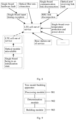
- the parent node of the built sub-tree model is an LTE cell out of service, and there is the same node as the parent node "LTE cell out of service” in the original tree model, then "LTE cell out of service” in the original tree model is used as a target node, and the sub-tree model in the dotted box is mounted to the node "LTE cell out of service” in the original tree model so as to achieve the growth of the tree model.
- the label of each alarm data in the sub-tree model may be updated according to the probability corresponding to the alarm correlation to which each alarm data belongs.
- the updating may be performed according to the above listed way for updating the label of each alarm data, and a sub-tree model may be rebuilt according to the updated label of each alarm data until a parent node of the rebuilt sub-tree model presents in the original tree model.
- a node in the original tree model which is the same as the parent node of the rebuilt sub-tree model may be used as a target node, and the rebuilt sub-tree model can be mounted to the target node of the original tree model to achieve the growth of the tree model.
- Fig. 9 shows a tree model building apparatus provided by an embodiment of the present disclosure. As shown in Fig. 9 , the apparatus includes a processing module 901, a determination module 902 and a building module 903.
- the process module is configured to preprocess alarm data to obtain a vectorized alarm correlation set.
- the process module is further configured to normalize a first feature of each alarm correlation in the vectorized alarm correlation set.
- the determination module is configured to determine a label of each alarm data in the set according to the vectorized alarm correlation set, the normalized first feature and a classification model.
- the classification model is obtained through training.
- the first feature may include at least one of an alarm topology relationship, an alarm service relationship, an alarm level, an alarm network relationship, an alarm cosine similarity, an alarm support, or an alarm confidence.
- the building module is configured to build a tree model according to the label of each alarm data in the set.
- the processing module is configured to mine alarm data to obtain an alarm correlation alternative set, one-hot encode the alarm data in the alarm correlation alternative set, and train an alarm vector neural network according to the one-hot encoded alarm data, to obtain a vectorized alarm correlation set.
- the normalization process of the processing module may be as follows: in the case where the first feature includes at least one of an alarm topology relationship, an alarm service relationship, an alarm level or an alarm network relationship, at least one of the alarm topology relationship, the alarm service relationship, the alarm level or the alarm network relationship of each alarm correlation is normalized according to an actual network structure; and/or in the case where the first feature includes at least one of an alarm support, an alarm confidence or an alarm cosine similarity, at least one of the alarm support, the alarm confidence or the alarm cosine similarity of each alarm correlation is normalized according to a normalization threshold.
- the alarm support, the alarm confidence and the alarm cosine similarity may correspond to respective normalization thresholds.
- the determination module may be configured to determine a probability and a cosine similarity corresponding to each alarm correlation according to the vectorized alarm correlation set, the normalized first feature and the classification model.
- the probability is configured to indicate the probability that any one alarm data is a parent node of the other alarm data in a corresponding correlation
- the cosine similarity is configured to indicate the magnitude of correlation between any one alarm data and the other alarm data in the corresponding alarm correlation.
- the determination module may be configured to mark a label of any one alarm data in the corresponding alarm correlation as a parent node, and a label of the other alarm data as a child node; and in the case where the cosine similarity is less than the similarity normalization threshold, the determination module may be configured to mark both the label of any one alarm data and the label of the other alarm data in the corresponding alarm correlation as child nodes.
- the building module may be configured to build a sub-tree model according to the label of each alarm data in the case where the labels of the alarm data are not in conflict;
- an implementation of the tree model may include, but is not limited to, the following ways:
- the tree model building apparatus provided by this embodiment is used to realize the tree model building method in the embodiment shown in FIG. 1 , and has similar implementation principle and technical effect, which will not be repeated here.
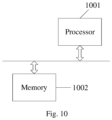
- Fig. 10 is a schematic structural diagram of a device provided by an embodiment. As shown in Fig. 10 , the device includes a processor 1001 and a memory 1002. There may be one or more processors 1001 in the device, and one processor 1001 is taken as an example in Fig. 10 . The processor 1001 and the memory 1002 in the device may be connected by a bus or other means, and the bus connection is taken as an example in Fig. 10 .
- the memory 1002 may be configured to store software programs, computer executable programs and modules, such as program instructions/modules corresponding to the tree model building method in the embodiment in Fig. 1 of the present disclosure (for example, the processing module 901, the determination module 902 and the building module 903 in the tree model building apparatus).
- the processor 1001 implements the above tree model building method by executing software programs, instructions and modules stored in the memory 1002.
- the memory 1002 may mainly include a program storage area and a data storage area.
- the program storage area may store an operating system, and an application program required for at least one function.
- the data storage area may store data, and the like created according to the use of a set-top box.
- the memory 1002 may include a high-speed random access memory, and may further include nonvolatile memory, such as at least one magnetic disk storage device, flash memory device, or other nonvolatile solid state storage device.
- An embodiment of the present disclosure provides a readable/writable storage medium configured for computer storage.
- the storage medium stores one or more programs, which when executed by one or more processors, cause the one or more processors to implement a tree mode building method.
- the method includes:
- Embodiments of the present disclosure provide a tree model building method and apparatus, a device and a storage medium.
- the method includes: preprocessing alarm data to obtain a vectorized alarm correlation set; normalizing a first feature of each alarm correlation in the vectorized alarm correlation set; determining a label of each alarm data in the set according to the vectorized alarm correlation set, the normalized first feature and a classification model obtained through training; and building a tree model according to the label of each alarm data in the set.
- a primary-secondary relationship among alarms can be expressed by the tree model, and the alarm data can be learned and analyzed based on the classification model obtained through training, to generate a corresponding tree model dynamically, thus achieving a continuous growth of the tree model.
- a physical component may have multiple functions, or a function or step may be cooperatively performed by multiple physical components.
- Some or all of the physical components may be implemented as software executed by a processor, such as a central processing unit, a digital signal processor or a microprocessor, or as hardware, or as an integrated circuit, such as an application specific integrated circuit.
- a processor such as a central processing unit, a digital signal processor or a microprocessor, or as hardware, or as an integrated circuit, such as an application specific integrated circuit.
- Such software may be distributed on a computer-readable medium, and the computer-readable medium may include a computer storage medium (or a non-transitory medium) and a communication medium (or a transitory medium).
- the term computer storage medium includes volatile and nonvolatile, removable and non-removable media implemented in any method or technology for storing information such as computer readable instructions, data structures, program modules or other data.
- a computer storage medium may include RAMs, ROMs, EEPROMs, flash memories or other memory technologies, CD-ROMs, digital versatile disks (DVDs) or other optical disk storages, magnetic cassettes, magnetic tapes, magnetic disk storages or other magnetic storage devices, or any other media that can be used to store desired information and can be accessed by a computer.
- the communication medium may generally include computer readable instructions, data structures, program modules or other data in a modulated data signal such as a carrier wave or other transmission mechanism, and may include any information delivery medium.
Landscapes
- Engineering & Computer Science (AREA)
- Theoretical Computer Science (AREA)
- Data Mining & Analysis (AREA)
- Physics & Mathematics (AREA)
- Computer Vision & Pattern Recognition (AREA)
- General Physics & Mathematics (AREA)
- General Engineering & Computer Science (AREA)
- Evolutionary Biology (AREA)
- Evolutionary Computation (AREA)
- Bioinformatics & Computational Biology (AREA)
- Bioinformatics & Cheminformatics (AREA)
- Artificial Intelligence (AREA)
- Life Sciences & Earth Sciences (AREA)
- Computer Networks & Wireless Communication (AREA)
- Signal Processing (AREA)
- Probability & Statistics with Applications (AREA)
- Mathematical Analysis (AREA)
- Mathematical Optimization (AREA)
- Mathematical Physics (AREA)
- Algebra (AREA)
- Pure & Applied Mathematics (AREA)
- Information Retrieval, Db Structures And Fs Structures Therefor (AREA)
- Alarm Systems (AREA)
Applications Claiming Priority (2)
| Application Number | Priority Date | Filing Date | Title |
|---|---|---|---|
| CN202010592638.4A CN113839802B (zh) | 2020-06-24 | 2020-06-24 | 树模型构建方法、装置、设备和存储介质 |
| PCT/CN2021/101572 WO2021259273A1 (zh) | 2020-06-24 | 2021-06-22 | 树模型构建方法、装置、设备和存储介质 |
Publications (2)
| Publication Number | Publication Date |
|---|---|
| EP4170975A1 true EP4170975A1 (de) | 2023-04-26 |
| EP4170975A4 EP4170975A4 (de) | 2023-11-29 |
Family
ID=78965019
Family Applications (1)
| Application Number | Title | Priority Date | Filing Date |
|---|---|---|---|
| EP21830013.5A Pending EP4170975A4 (de) | 2020-06-24 | 2021-06-22 | Baummodellkonstruktionsverfahren, -vorrichtung und -vorrichtung sowie speichermedium |
Country Status (4)
| Country | Link |
|---|---|
| EP (1) | EP4170975A4 (de) |
| JP (1) | JP2023532013A (de) |
| CN (1) | CN113839802B (de) |
| WO (1) | WO2021259273A1 (de) |
Families Citing this family (5)
| Publication number | Priority date | Publication date | Assignee | Title |
|---|---|---|---|---|
| CN114760186B (zh) * | 2022-03-23 | 2024-05-28 | 深信服科技股份有限公司 | 告警分析方法、装置、电子设备及存储介质 |
| CN115243286B (zh) * | 2022-06-20 | 2024-05-03 | 中国联合网络通信集团有限公司 | 一种数据处理方法、装置及存储介质 |
| CN115391151B (zh) * | 2022-10-26 | 2023-04-07 | 腾云悦智科技(长沙)有限责任公司 | 一种基于对象关系进行智能发现告警标签的方法 |
| CN116028798B (zh) * | 2023-02-21 | 2026-02-03 | 煤炭科学技术研究院有限公司 | 水害预警数据处理方法、装置、计算机设备和存储介质 |
| CN118195431B (zh) * | 2024-05-20 | 2024-08-02 | 成都中科合迅科技有限公司 | 一种核电工程物项关系模型的建立方法及系统和应用 |
Family Cites Families (15)
| Publication number | Priority date | Publication date | Assignee | Title |
|---|---|---|---|---|
| US6253339B1 (en) * | 1998-10-28 | 2001-06-26 | Telefonaktiebolaget Lm Ericsson (Publ) | Alarm correlation in a large communications network |
| JP2002149703A (ja) * | 2000-11-15 | 2002-05-24 | Matsushita Electric Ind Co Ltd | Wwwデータサーバ装置 |
| JP5653250B2 (ja) * | 2011-02-21 | 2015-01-14 | 中国電力株式会社 | データ分析支援装置、データ分析支援方法及びプログラム |
| CN102938708B (zh) * | 2012-11-05 | 2016-03-30 | 国网电力科学研究院 | 基于告警传播模式的告警相关性分析系统及其分析方法 |
| US10839312B2 (en) * | 2016-08-09 | 2020-11-17 | International Business Machines Corporation | Warning filter based on machine learning |
| JP6399077B2 (ja) * | 2016-12-15 | 2018-10-03 | オムロン株式会社 | 指示システム、指示装置、方法及びプログラム |
| CN109951306B (zh) * | 2017-12-20 | 2022-04-01 | 中国移动通信集团湖北有限公司 | 告警的处理方法、装置、设备及介质 |
| JP7283105B2 (ja) * | 2018-02-16 | 2023-05-30 | 富士電機株式会社 | 分析装置および分析方法 |
| CN109034521B (zh) * | 2018-06-07 | 2021-11-16 | 国电南瑞科技股份有限公司 | 一种电网调度控制系统的智能运维架构设计方法 |
| CN108880706A (zh) * | 2018-06-14 | 2018-11-23 | 熊猫电子集团有限公司 | 一种卫星信道链路故障的快速诊断方法 |
| CN110609759B (zh) * | 2018-06-15 | 2021-09-14 | 华为技术有限公司 | 一种故障根因分析的方法及装置 |
| CN110929951B (zh) * | 2019-12-02 | 2022-04-19 | 电子科技大学 | 一种用于电网告警信号的关联分析和预测方法 |
| CN111125268B (zh) * | 2019-12-27 | 2024-01-30 | 南京亚信软件有限公司 | 网络告警分析模型创建方法、告警分析方法及装置 |
| CN111209131B (zh) * | 2019-12-30 | 2024-05-14 | 航天信息股份有限公司广州航天软件分公司 | 一种基于机器学习确定异构系统的故障的方法和系统 |
| CN111193627B (zh) * | 2019-12-31 | 2022-08-12 | 中国移动通信集团江苏有限公司 | 信息处理方法、装置、设备及存储介质 |
-
2020
- 2020-06-24 CN CN202010592638.4A patent/CN113839802B/zh active Active
-
2021
- 2021-06-22 WO PCT/CN2021/101572 patent/WO2021259273A1/zh not_active Ceased
- 2021-06-22 EP EP21830013.5A patent/EP4170975A4/de active Pending
- 2021-06-22 JP JP2022580024A patent/JP2023532013A/ja active Pending
Also Published As
| Publication number | Publication date |
|---|---|
| WO2021259273A1 (zh) | 2021-12-30 |
| JP2023532013A (ja) | 2023-07-26 |
| CN113839802A (zh) | 2021-12-24 |
| CN113839802B (zh) | 2024-11-22 |
| EP4170975A4 (de) | 2023-11-29 |
Similar Documents
| Publication | Publication Date | Title |
|---|---|---|
| EP4170975A1 (de) | Baummodellkonstruktionsverfahren, -vorrichtung und -vorrichtung sowie speichermedium | |
| EP3975048B1 (de) | Verfahren zur erstellung eines relationalen cloud-netzwerkalarmursachenbaummodells, vorrichtung und speichermedium | |
| US11438212B2 (en) | Fault root cause analysis method and apparatus | |
| US20220121994A1 (en) | Method and apparatus for implementing model training, and computer storage medium | |
| US12356220B2 (en) | Telecommunications network predictions based on machine learning using aggregated network key performance indicators | |
| US20210019653A1 (en) | Failure analysis device, failure analysis method, and failure analysis program | |
| CN116566846B (zh) | 模型的管理方法、系统以及共享节点、网络节点 | |
| CN120186791B (zh) | 基于大模型算法的低空飞行通信网络资源分配方法 | |
| US20240095588A1 (en) | Methods, apparatus and machine-readable mediums relating to machine learning models | |
| US20240119369A1 (en) | Contextual learning at the edge | |
| CN115460633A (zh) | 6g网络ai信号优化的方法、系统、设备和存储介质 | |
| WO2021254244A1 (zh) | 告警挖掘模型确定方法、装置、设备和存储介质 | |
| CN115271407A (zh) | 基于人工智能的工业互联网数据处理方法及系统 | |
| CN111711930B (zh) | 簇头选举方法、系统、终端设备及计算机可读存储介质 | |
| FI20216315A1 (en) | SYSTEM AND METHOD FOR OPTIMIZING ERROR DETECTION IN INTERNET OF THINGS NETWORKS | |
| CN109684367B (zh) | 一种动态调整多数据源数据集成处理方法与装置 | |
| CN119497136A (zh) | 动态多集群管理 | |
| CN116050508B (zh) | 神经网络训练方法以及装置 | |
| US12229165B2 (en) | Life cycle management | |
| Wrona et al. | A cooperative feature removal mechanism for cell outage detection in wireless telecommunication networks | |
| CN120492546B (zh) | 基于人工智能的应急指挥救援数据分布式存储方法及系统 | |
| CN120561758A (zh) | 基于多维度指标的智能故障自愈方法 | |
| CN120812428A (zh) | 一种fttr-b网络切片方法、装置、介质及设备 | |
| CN121691041A (zh) | 用于配电网的带宽分布拟合方法、系统、设备及介质 | |
| Fu et al. | Matching Under Uncertainty: Toward Robust and Communication-Efficient Perception in Embedded Multi-Agent Systems |
Legal Events
| Date | Code | Title | Description |
|---|---|---|---|
| STAA | Information on the status of an ep patent application or granted ep patent |
Free format text: STATUS: THE INTERNATIONAL PUBLICATION HAS BEEN MADE |
|
| PUAI | Public reference made under article 153(3) epc to a published international application that has entered the european phase |
Free format text: ORIGINAL CODE: 0009012 |
|
| STAA | Information on the status of an ep patent application or granted ep patent |
Free format text: STATUS: REQUEST FOR EXAMINATION WAS MADE |
|
| 17P | Request for examination filed |
Effective date: 20230123 |
|
| AK | Designated contracting states |
Kind code of ref document: A1 Designated state(s): AL AT BE BG CH CY CZ DE DK EE ES FI FR GB GR HR HU IE IS IT LI LT LU LV MC MK MT NL NO PL PT RO RS SE SI SK SM TR |
|
| DAV | Request for validation of the european patent (deleted) | ||
| DAX | Request for extension of the european patent (deleted) | ||
| REG | Reference to a national code |
Ref country code: DE Ref legal event code: R079 Free format text: PREVIOUS MAIN CLASS: H04L0012240000 Ipc: H04L0041142000 |
|
| STAA | Information on the status of an ep patent application or granted ep patent |
Free format text: STATUS: EXAMINATION IS IN PROGRESS |
|
| A4 | Supplementary search report drawn up and despatched |
Effective date: 20231027 |
|
| RIC1 | Information provided on ipc code assigned before grant |
Ipc: H04L 41/12 20220101ALN20231023BHEP Ipc: G06F 18/243 20230101ALI20231023BHEP Ipc: G06F 18/214 20230101ALI20231023BHEP Ipc: H04L 41/0631 20220101ALI20231023BHEP Ipc: H04L 41/142 20220101AFI20231023BHEP |
|
| 17Q | First examination report despatched |
Effective date: 20231109 |