EP4172242B1 - Zusammensetzung und verfahren zur silylhydridreaktion katalysiert durch fluorierte arylboran-lewis-säuren - Google Patents
Zusammensetzung und verfahren zur silylhydridreaktion katalysiert durch fluorierte arylboran-lewis-säuren Download PDFInfo
- Publication number
- EP4172242B1 EP4172242B1 EP21740325.2A EP21740325A EP4172242B1 EP 4172242 B1 EP4172242 B1 EP 4172242B1 EP 21740325 A EP21740325 A EP 21740325A EP 4172242 B1 EP4172242 B1 EP 4172242B1
- Authority
- EP
- European Patent Office
- Prior art keywords
- bis
- trifluoromethyl
- phenyl
- sio
- borane
- Prior art date
- Legal status (The legal status is an assumption and is not a legal conclusion. Google has not performed a legal analysis and makes no representation as to the accuracy of the status listed.)
- Active
Links
Classifications
-
- C—CHEMISTRY; METALLURGY
- C08—ORGANIC MACROMOLECULAR COMPOUNDS; THEIR PREPARATION OR CHEMICAL WORKING-UP; COMPOSITIONS BASED THEREON
- C08G—MACROMOLECULAR COMPOUNDS OBTAINED OTHERWISE THAN BY REACTIONS ONLY INVOLVING UNSATURATED CARBON-TO-CARBON BONDS
- C08G77/00—Macromolecular compounds obtained by reactions forming a linkage containing silicon with or without sulfur, nitrogen, oxygen or carbon in the main chain of the macromolecule
- C08G77/04—Polysiloxanes
- C08G77/12—Polysiloxanes containing silicon bound to hydrogen
-
- C—CHEMISTRY; METALLURGY
- C08—ORGANIC MACROMOLECULAR COMPOUNDS; THEIR PREPARATION OR CHEMICAL WORKING-UP; COMPOSITIONS BASED THEREON
- C08G—MACROMOLECULAR COMPOUNDS OBTAINED OTHERWISE THAN BY REACTIONS ONLY INVOLVING UNSATURATED CARBON-TO-CARBON BONDS
- C08G77/00—Macromolecular compounds obtained by reactions forming a linkage containing silicon with or without sulfur, nitrogen, oxygen or carbon in the main chain of the macromolecule
- C08G77/42—Block-or graft-polymers containing polysiloxane sequences
- C08G77/44—Block-or graft-polymers containing polysiloxane sequences containing only polysiloxane sequences
-
- C—CHEMISTRY; METALLURGY
- C08—ORGANIC MACROMOLECULAR COMPOUNDS; THEIR PREPARATION OR CHEMICAL WORKING-UP; COMPOSITIONS BASED THEREON
- C08G—MACROMOLECULAR COMPOUNDS OBTAINED OTHERWISE THAN BY REACTIONS ONLY INVOLVING UNSATURATED CARBON-TO-CARBON BONDS
- C08G77/00—Macromolecular compounds obtained by reactions forming a linkage containing silicon with or without sulfur, nitrogen, oxygen or carbon in the main chain of the macromolecule
- C08G77/04—Polysiloxanes
- C08G77/06—Preparatory processes
- C08G77/08—Preparatory processes characterised by the catalysts used
Definitions
- a composition includes a silyl hydride (having at least one silicon-bonded hydrogen atom per molecule) and a fluorinated triarylborane Lewis acid.
- the Lewis acid catalyzes reaction of silicon-bonded hydrogen atoms from the silyl hydride and water, thereby forming a siloxane bond in the resulting product.
- the composition and method can be used to form siloxane intermediates and cured networks.
- the catalysts predominantly employed in the preparation of both siloxane intermediates and siloxane-cured networks from Si-H functional silanes and siloxanes are platinum-based catalysts. Due to the increasingly high cost of platinum (Pt) and other drawbacks such as yellowing of cured siloxane compositions or formation of a black precipitate over time, there is an industry need for an alternative to Pt-based catalysts. Furthermore, while Pt-based catalysts are effective, they may also suffer from the drawback of requiring high temperatures (80 °C - 110 °C) to achieve sufficient reactivity to catalyze formation of siloxane bonds.
- fluorinated arylborane catalysts for reacting compounds with SiH groups and compounds with silanol or alkoxysilyl groups is known in the art and disclosed for example in WO 2019/023008 A1 and WO 02/12386 A1 .
- a composition comprises: A) a fluorinated triarylborane Lewis acid according to claim 1 and B) a silyl hydride.
- the composition may be used in a method comprising combining A) the fluorinated triarylborane Lewis acid, B) the silyl hydride, and C) water; thereby forming a product.
- the product has a siloxane bond formed by the reaction of the SiH moiety from the silyl hydride and the water.
- composition comprises: A) a fluorinated triarylborane Lewis acid according to claim 1 and B) a silyl hydride.
- the composition may be free of water.
- the composition may consist essentially of A) the fluorinated triarylborane Lewis acid and B) the silyl hydride.
- the composition may consist of: A) the fluorinated triarylborane Lewis acid and B) the silyl hydride.
- the composition may be stored under conditions that prevent reaction of silicon-bonded hydrogen atoms from the silyl hydride, e.g., anhydrous conditions, before use.
- the method described herein comprises 1) combining starting materials comprising (alternatively, consisting essentially of; alternatively consisting of) A) and B), described above, and C) water. Combining is performed under conditions that will react the silicon-bonded hydrogen atoms of starting material B) to form a siloxane bond and a by-product comprising hydrogen.
- These conditions may comprise mixing, e.g., by any convenient means.
- Mixing may be performed using conventional mixing equipment, such as an agitated batch kettle. Mixing may be performed at any convenient temperature, e.g., RT.
- mixing under shear may be performed, e.g., with an extruder.
- the composition may be formed, e.g., by mixing starting materials A) and B) described above. Starting materials A) and B) may be heated at a temperature of 50 °C to 150 °C, alternatively 100 °C to 125 °C during mixing.
- starting material D) a solvent may be used to facilitate combining starting materials A) and B).
- starting material A) may be dissolved in the solvent before being mixed with starting material D).
- fluorinated triarylborane Lewis acid described herein instead of other catalysts, such as Pt based catalysts or FAB, can provide the benefit of stability of the composition when starting materials A) and B) are present together before step 1) of the method described herein, even when starting materials A) and B) are combined with heating.
- Exposing a composition comprising starting materials A) and B) to C) water in step 1) of the method will begin reacting the silicon-bonded hydrogen atoms and water to form a siloxane bond.
- Water may be mixed with starting materials A) and B) using means as described above, and starting materials A), B), and C) may be combined concurrently in step 1).
- the composition comprising starting materials A) and B) may be prepared before step 1), and thereafter in step 1), the composition may be exposed to water, e.g., by exposure to humid air. Exposure to water may be performed at a temperature of 5 °C to 150 °C, alternatively RT to 150 °C, alternatively 5 °C to 125 °C, and alternatively RT to 125 °C.
- starting material B) comprises, e.g., a silyl functional polyolefin
- higher temperatures e.g., 50 °C to 150 °C
- lower temperatures may be sufficient.
- temperature may alternatively be RT to 70 °C, 5 °C to 70 °C, alternatively 5 °C to 65 °C, alternatively 10 °C to 60 °C, alternatively 15 °C to 50 °C, alternatively 20 °C to 35 °C, alternatively 5 °C to 30 °C, and alternatively 30 °C.
- the method may optionally further comprise one or more additional steps.
- the method may further comprise: step 2) during and/or after step 1), removing the H 2 generated during formation of the product and/or step 3) removing and/or neutralizing residual fluorinated triarylborane Lewis acid in the product.
- By-product H 2 may be removed by any convenient means, such as stripping and/or burning.
- Removing and/or neutralizing may be performed by adding E) a neutralizing agent to the product, or alternatively, adding E) a neutralizing agent to the product and optionally thereafter filtering the product.
- Steps 2) and 3) may be performed in any order. If a particulate by-product is present, e.g., as a result of neutralization, the method may further comprise step 4) removing a particulate such as alumina after neutralization by any convenient means, such as filtration.
- Starting material A) in the composition and method described herein is the fluorinated triarylborane Lewis acid as disclosed in claim 1.
- the fluorinated triarylborane Lewis acid is selected from the group consisting of: A1) tris(3,5-bis(trifluoromethyl)phenyl)borane THF adduct; A2) bis(3,5-bis(trifluoromethyl)phenyl)(4-trifluoromethylphenyl)borane THF adduct; A3) bis(3,5-bis(trifluoromethyl)phenyl)(2,4,6-trifluorophenyl)borane THF adduct; A4) bis(3,5-bis(trifluoromethyl)phenyl)(2,6-difluorophenyl)borane THF adduct; A5) bis(3,5-bis(trifluoromethyl)phenyl)(2,5-bis(trifluoromethyl)phenyl)borane; A6) (3,5-bis(trifluoromethyl)phenyl)bis(2,5- bis(trifluoromethyl)phenyl)borane
- the fluorinated triarylborane Lewis acid may be selected from the group consisting of A2), A3), A4), A5), A6), A7), and a combination of two or more of A2) to A7).
- the fluorinated triarylborane Lewis acid may be selected from the group consisting of A4), A5), A6), and a combination of two or more of A4), A5), and A6).
- the fluorinated triarylborane Lewis acid may be selected from the group consisting of A4), A5), and A6).
- the fluorinated triarylborane Lewis acid may be selected from the group consisting of A4) and A6).
- Fluorinated triarylborane Lewis acids are known in the art, and may be prepared by known methods, for example, the methods disclosed in WO2019/055740 , particularly at paragraphs [0052] to [0096] by varying appropriate starting materials.
- starting material A) will depend on the type and amount of other starting materials used, however, starting material A) may be present in an amount of 0.5 ppm to 5 mol%, alternatively 5 ppm to 6000 ppm based on combined weights of starting materials A) and B) in the composition. Alternatively, the amount may be 5 ppm to 600 ppm, alternatively 5 ppm to 500 ppm, and alternatively 5 ppm to 100 ppm, on the same basis.
- silyl hydride means a molecule that contains at least one silicon-bonded hydrogen atom (SiH) per molecule. Alternatively, the silyl hydride may have more than one SiH per molecule.
- Silyl hydrides used herein are capable of forming a siloxane bond in the presence of A) the fluorinated triarylborane Lewis acid and C) water. Silyl hydrides containing multiple Si-H bonds may be capable of self-crosslinking in the presence of A) the fluorinated triarylborane Lewis acid and C) water.
- Starting material B) can be selected from the group consisting of B1) a silane, B2) a polyorganohydrogensiloxane, B3) a silyl-functional polyolefin, and B4) a combination of two or more of B1), B2), and B3).
- the silyl hydride can be B1) a silane (e.g., with one silicon atom per molecule).
- the silyl hydride may be oligomeric or polymeric.
- Polymeric silyl hydrides can be linear, branched, or resinous.
- the silyl hydride may be B2) a polyorganohydrogensiloxane.
- the silyl hydride may be B3) an organic polymer functionalized with a moiety including the SiH.
- Starting material B1) is a silane of formula H k SiR 5 (4-k) , where each R 5 is independently selected from the group consisting of a monovalent hydrocarbon group and a monovalent halogenated hydrocarbon group, and subscript k is 1 to 3, alternatively 1 or 2, and alternatively 1.
- Suitable monovalent hydrocarbon groups for R 5 include, but are not limited to, alkyl such methyl, ethyl, propyl, butyl, pentyl, hexyl, heptyl, octyl, decyl, dodecyl, undecyl, and octadecyl (and branched isomers thereof); cycloalkyl such as cyclopentyl and cyclohexyl; alkenyl such as vinyl, allyl, butenyl, and hexenyl; and aryl such as phenyl, tolyl, xylyl, naphthyl, benzyl, 1-phenylethyl, and 2-phenylethyl.
- alkyl such methyl, ethyl, propyl, butyl, pentyl, hexyl, heptyl, octyl, decyl, dodecyl,
- Examples of monovalent halogenated hydrocarbon groups for R 5 include, but are not limited to, chlorinated alkyl groups such as chloromethyl and chloropropyl groups; fluorinated alkyl groups such as fluoromethyl, 2-fluoropropyl, 3,3,3-trifluoropropyl, 4,4,4-trifluorobutyl, 4,4,4,3,3-pentafluorobutyl, 5,5,5,4,4,3,3-heptafluoropentyl, 6,6,6,5,5,4,4,3,3-nonafluorohexyl, and 8,8,8,7,7-pentafluorooctyl; chlorinated cycloalkyl groups such as 2,2-dichlorocyclopropyl, 2,3-dichlorocyclopentyl; and fluorinated cycloalkyl groups such as 2,2-difluorocyclopropyl, 2,3-difluorocyclobutyl, 3,4-difluorocyclohex
- each R 5 may be a monovalent hydrocarbon group, alternatively an alkyl group or an aryl group.
- each R 5 may be an alkyl group, such as an alkyl group of 1 to 6 carbon atoms.
- each R 5 may be methyl or ethyl.
- starting material B1) may be a silane of formula HSiR 5 3 , where each R 5 is an alkyl group of 1 to 6 carbon atoms.
- Suitable silanes include triethylsilane, dimethylethylsilane, diethylmethylsilane, dimethylisopropylsilane, dimethyl-tert-butylsilane, triisopropylsilane, chloromethyldimethylsilane, tripropyplsilane, tributylsilane, triisobutylsilane, trihexylsilane, trioctylsilane, cyclohexyldimethylsilane, dimethylphenylsilane, diphenylmethylsilane, triphenylsilane, phenylsilane, bromoundecylsilane, 2-chloroethylsilane, dodecylsilane, n-octadecylsilane, and (tridecafluoro-1,1,2,2-
- the polyorganohydrogensiloxane When starting material B2), a polyorganohydrogensiloxane is used, the polyorganohydrogensiloxane may be a homopolymer or a copolymer.
- the polyorganohydrogensiloxane may be linear, branched, or resinous.
- the silicon-bonded hydrogen atoms in the polyorganohydrogensiloxane can be located at terminal, pendant, or at both terminal and pendant positions.
- the polyorganohydrogensiloxane may comprise two or more siloxane units selected from HR 4 2 SiO 1/2 , R 4 3 SiO 1/2 , HR 4 SiO 2/2 , R 4 2 SiO 2/2 , R 4 SiO 3/2 , HSiO 3/2 and SiO 4/2 units.
- each R 4 is an independently selected monovalent hydrocarbon group, which is free of aliphatic unsaturation.
- R 4 examples include, but are not limited to, alkyl such methyl, ethyl, propyl, butyl, pentyl, hexyl, heptyl, octyl, decyl, dodecyl, undecyl, and octadecyl (and branched isomers thereof); cycloalkyl such as cyclopentyl and cyclohexyl; and aryl such as phenyl, tolyl, xylyl, naphthyl, benzyl, 1-phenylethyl, and 2-phenylethyl.
- each R 4 may be an alkyl group or a cycloalkyl group.
- each R 4 may be an alkyl group, such as methyl.
- the polydiorganohydrogensiloxane may have unit formula: (HR 4 2 SiO 1/2 ) g (R 4 3 SiO 1/2 ) h (R 4 2 SiO 2/2 ) i (HR 4 SiO 2/2 ) j , where R 4 is as described above, and subscripts g, h, i, and j have values such that g ⁇ 0, h ⁇ 0, a quantity (g + h) has an average value of 2, i ⁇ 0, j ⁇ 0, and a quantity (g + j) ⁇ 1, and a quantity (i + j) ranges from 0 to 1000.
- the polydiorganohydrogensiloxane may have formula , where subscript m is 0 or 1, and each R 6 is independently selected from the group consisting of Hand R 4 , with the proviso that at least one R 6 is a hydrogen atom.
- Suitable polyorganohydrogensiloxanes are exemplified by: i) pentamethyldisiloxane, ii) bis(trimethylsiloxy)methyl-silane, iii) tetramethyldisiloxane, iv) bis-dimethylhydrogensiloxy-terminated polydimethylsiloxane, v) bis-dimethylhydrogensiloxy-terminated poly(dimethylsiloxane/methylhydrogensiloxane), vi) bis-dimethylhydrogensiloxy-terminated polymethylhydrogensiloxane, vii) bis-trimethylsiloxy-terminated poly(dimethylsiloxane/methylhydrogensiloxane), viii) bis-trimethylsiloxy-terminated polymethylhydrogensiloxane, ix) a resin consisting essentially of H(CH 3 ) 2 SiO 1/2 units and SiO 4/2 units, and x) a combination of two or more
- Starting material B3) is a polyolefin having a silicon-bonded hydrogen functional group formula (B3-1): where each R 1 is an independently selected monovalent hydrocarbon group and each subscript a is independently 1 or 2.
- Suitable monovalent hydrocarbon groups for R 1 may have 1 to 20 carbon atoms, alternatively 1 to 12 carbon atoms, alternatively 1 to 8 carbon atoms, alternatively 1 to 4 carbon atoms, and alternatively 1 to 2 carbon atoms.
- the monovalent hydrocarbon groups for R 1 may be selected from the group consisting of alkyl groups, alkenyl groups and aryl groups; alternatively alkyl and aryl; and alternatively alkyl.
- the alkyl groups are exemplified by methyl, ethyl, propyl (e.g., isopropyl and/or n-propyl), butyl ( e.g., isobutyl, n-butyl, tert-butyl, and/or sec-butyl), pentyl ( e.g., isopentyl, neopentyl, and/or tert-pentyl), hexyl, heptyl, octyl, nonyl, and decyl, as well as branched saturated monovalent hydrocarbon groups of 6 or more carbon atoms including cycloalkyl groups such as cyclopentyl and cyclohexyl.
- propyl e.g., isopropyl and/or n-propyl
- butyl e.g., isobutyl, n-butyl, tert-butyl, and
- the alkenyl groups are exemplified by, but not limited to, vinyl, allyl, butenyl (including n-butenyl, iso-butenyl, and/or t-butenyl), and hexenyl (including linear and branched isomers thereof).
- the aryl groups are exemplified by cyclopentadienyl, phenyl, tolyl, xylyl, anthracenyl, benzyl, 1-phenylethyl, 2-phenylethyl, and naphthyl.
- Monocyclic aryl groups may have 5 to 9 carbon atoms, alternatively 6 to 7 carbon atoms, and alternatively 5 to 6 carbon atoms.
- Polycyclic aryl groups may have 10 to 17 carbon atoms, alternatively 10 to 14 carbon atoms, and alternatively 12 to 14 carbon atoms.
- each R 1 may be independently selected from the group consisting of alkyl and aryl, alternatively methyl and phenyl.
- each R 1 may be methyl.
- the silyl-functional polyolefin may have silyl groups of formula (B3-1) in a pendant position.
- the silyl-functional polyolefin having pendant silyl groups may be an SiH functional polyolefin copolymer comprising unit formula (B3-2): where R 1 and subscript a are as described above.
- Each D 1 in unit formula (B3-2) is independently a divalent hydrocarbon group of 2 to 50 carbon atoms.
- Suitable divalent hydrocarbon groups for D 1 are exemplified by an alkylene group such as ethylene, propylene, butylene, hexylene, or octylene; an arylene group such as phenylene, or an alkylarylene group such as: or
- each D 1 is an alkylene group such as ethylene, propylene, or octylene.
- each R 25 is independently H, a monovalent hydrocarbon group of 1 to 18 carbon atoms or a monovalent halogenated hydrocarbon group of 1 to 18 carbon atoms.
- Monovalent hydrocarbon groups suitable for R 25 are exemplified by those described herein for R 1 having 1 to 18 carbon atoms.
- Suitable monovalent halogenated hydrocarbon groups include haloalkyl groups, halogenated carbocyclic groups, and haloalkenyl groups.
- Haloalkyl groups include fluorinated alkyl groups such as trifluoromethyl (CF 3 ), fluoromethyl, trifluoroethyl, 2-fluoropropyl, 3,3,3-trifluoropropyl, 4,4,4-trifluorobutyl, 4,4,4,3,3-pentafluorobutyl, 5,5,5,4,4,3,3-heptafluoropentyl, 6,6,6,5,5,4,4,3,3-nonafluorohexyl, 8,8,8,7,7-pentafluorooctyl, 2,2-difluorocyclopropyl, 2,3-difluorocyclobutyl, 3,4-difluorocyclohexyl, and 3,4-difluoro-5-methylcycloheptyl; and chlorinated alkyl groups such as chloromethyl, 3-chloropropyl 2,2-dichlorocyclopropyl, 2,3-dichlorocyclopentyl.
- subscript M is at least 1.
- Subscript N is at least 1. Alternatively, 1 ⁇ M ⁇ 10. Alternatively, 10 ⁇ N ⁇ 20,000.
- subscripts M and N may have values such that a quantity M/(M+N) may have a value such that 0.01 mol% ⁇ M/(M+N) ⁇ 10 mol%.
- subscripts M and N may have values sufficient to provide the copolymer with a Mn of 1,000 to 500,000.
- This SiH-functional polyolefin may further comprise R 21 endblocking groups at each terminus.
- Each R 21 may independently be a saturated monovalent hydrocarbon group, such as an alkyl group ( e.g ., methyl) or an unsaturated monovalent hydrocarbon group having one or more double bonds (e.g., a monovalent hydrocarbon group comprising vinyl, vinyline, or vinylidene functionality).
- alkyl group e.g ., methyl
- unsaturated monovalent hydrocarbon group having one or more double bonds e.g., a monovalent hydrocarbon group comprising vinyl, vinyline, or vinylidene functionality.
- the silyl-functional polyolefin may comprise a silyl-terminated polyolefin having 1 to 2 terminal silyl groups of formula (B3-1) per molecule.
- the silyl-terminated polyolefin may have unit formula (B3-3): where subscript a and R 1 are as described above, subscript f is 0 to 1, subscripts t and u have relative values such that 0 ⁇ t ⁇ 1, 0 ⁇ u ⁇ 1, subscript g is 1 or more, each R et represents an ethylene unit, and each R O represents an olefin unit, other than ethylene.
- R O may be an alpha-olefin or a cyclic olefin.
- alpha-olefins examples include ethylene, propylene, and octene.
- cyclic olefins examples include ethyldienenorbornene, norbornene, vinyl norbornene, vinyl cyclohexene, cyclohexene, and cyclopentene.
- subscript g may be 1 to 500, alternatively 10 to 400, and alternatively 18 to 360.
- subscript g may have a value sufficient to give the silyl-terminated polyolefin a Mn of 500 to 50,000 g/mol, alternatively 500 to 10,000 g/mol.
- the silyl-terminated polyolefin may have unit formula (B3-4): where subscripts a, f, g, t, and u, and R 1 are as described above.
- Each R 7 is independently a monovalent hydrocarbon group of 1 to 20 carbon atoms.
- the monovalent hydrocarbon group for R 7 may be alkyl, alkenyl or aryl; alternatively alkyl.
- R 7 may be an alkyl group of 2 to 12 carbon atoms, and alternatively 2 to 6 carbon atoms.
- each R 7 is a hexyl group.
- Examples of this silyl-terminated polyolefin having a silyl group at one end of the polymer chain include dimethyl,hydrogensilyl-terminated polyethylene; dimethyl-hydrogensilyl-terminated poly(ethylene/octene) copolymer; methyl-dihydrogensilyl-terminated polyethylene; methyl-dihydrogensilyl-terminated poly(ethylene/octene) copolymer; diphenyl-hydrogensilyl-terminated polyethylene; diphenyl-hydrogensilyl-terminated poly(ethylene/octene) copolymer; phenyl-dihydrogensilyl-terminated polyethylene; phenyl-dihydrogensilyl-terminated poly(ethylene/octene) copolymer; chlorophenylhydrogensilyl-termin
- This silyl-terminated polyolefin can be prepared by the processes described in PCT Publication WO2019/082992 corresponding to U.S. Patent Application Serial 62/644635, filed on March 19, 2018 and PCT Publication WO2019/182986 corresponding to U.S. Patent Application Serial Number 62/644624 filed on March 19, 2018 .
- Such telechelic silyl-terminated polyolefins may be prepared by methods, such as those disclosed in PCT Publication WO2019/182993 corresponding to U.S. Patent Application Serial Number 62/644808, filed on March 19, 2018 .
- Starting material B3) may be one silyl hydride or may comprise two or more silyl hydrides that differ in at least one property.
- starting material B3) may be silyl-functional polyolefin or may comprise two or more silyl-functional polyolefins differing in at least one of the following properties: structure, viscosity, average molecular weight, olefin blocks, and sequence.
- the water is not generally limited, and may be used neat (i.e., absent any solvents), and/or pure (i.e., free from or substantially free from minerals and/or other impurities).
- the water C) may be processed or unprocessed before use in the method described above. Examples of processes that may be used for purifying the water include distilling, filtering, deionizing, and combinations of two or more thereof, such that the water may be deionized, distilled, and/or filtered.
- the water may be unprocessed (e.g. may be tap water, provided by a municipal water system or well water, used without further purification).
- the water may be used in any amount, which will be selected by one of skill in the art, depending on various factors, e.g., the particular catalyst selected for starting material A), the reaction parameters employed, and the scale of the reaction (e.g., total amount and SiH content of starting material B)).
- Starting material D) is an optional solvent, which may be used to facilitate combination of the starting materials.
- Solvents used herein are those that help fluidize the starting materials, but essentially do not react with any of these starting materials. Solvent may be selected based on solubility of the starting materials and volatility of the solvent. The solubility refers to the solvent being sufficient to dissolve and/or disperse the starting materials. Volatility refers to vapor pressure of the solvent.
- starting material A) the fluorinated triarylborane Lewis acid
- starting material B) may be dissolved in a solvent, e.g., when starting material B) is viscous, elastomeric, or resinous.
- the solvent may be used in any amount, which will be selected by one of skill in the art, depending on various factors, such as the selection of starting material B) and the solubility of starting material A) therein.
- Suitable solvents may be hydrocarbons. Suitable hydrocarbons include aromatic hydrocarbons such as benzene, toluene, or xylene; and/or aliphatic hydrocarbons such as heptane, hexane, or octane. Alternatively, the solvent may be a halogenated hydrocarbon such as dichloromethane, 1,1,1-trichloroethane or methylene chloride. One solvent, or a combination comprising two or more solvents, may be used herein.
- the amount of solvent can depend on various factors including the type of solvent selected and the amount and type of other starting materials selected. However, the amount of solvent may range from 0.1% to 99%, alternatively 2% to 50%, based on combined weights of starting materials A) and B).
- Starting material E) is a neutralizing agent that may optionally be used to neutralize starting material A) after the product forms.
- Alumina, triphenylamine, triethylamine, triphenylphosphine, and phenylacetylene are suitable neutralizing agents.
- Neutralizing agents are known in the art and are commercially available, e.g., from Millipore Sigma of St. Louis, Missouri, USA. The amount of neutralizing agent depends on various factors including the amount of starting material A), however, starting material E) may be present in an amount sufficient to provide a weight ratio of neutralizing agent to fluorinated triarylborane Lewis acid (E:A ratio) of 100:1 to 1:1000, alternatively 1:1 to 1000:1, and alternatively 100:1 to 1:1.
- E:A ratio weight ratio of neutralizing agent to fluorinated triarylborane Lewis acid
- the E:A ratio may be 1:1 to 20:1.
- the E:A ratio may be 100:1 to 1000:1.
- composition and method described herein can be used in the preparation of siloxanes, siloxane-organic hybrid copolymers, intermediates, and/or branched siloxane networks. Without wishing to be bound by theory, it is thought that the composition and method described herein may be used as a cure system for various formulations and applications.
- the composition provides the benefit of storage stability when starting materials A) and B) are combined and stored before use.
- NMR solvents (CDCl 3 , CD 2 Cl 2 , and C 6 D 6 ), obtained from Cambridge Isotope Laboratories, Inc., were dried over active 3 ⁇ molecular sieves or, in the case of C 6 D 6 , dried using Na/K alloy.
- 1-Bromo-3,5-bis(trifluoromethyl)benzene, 1-bromo-2,5-bis(trifluoromethyl)benzene, 1-bromo-2,6-difluorobenzene, 1-bromo-2,4,6-trifluorobenzene, and 1-bromo-4-trifluoromethylbenzene were purchased from Oakwood Chemical.
- 1-Bromo-2,3,5,6-tetrafluoro-4-trifluoromethylbenzene was purchased from Alfa Aesar. FAB was purchased from TCI. All other reagents were purchased from Sigma-Aldrich and used as received. n -Butyllithium (solution in hexanes) was titrated using 1.00 M decanol in toluene with 1,10-phenanthroline as an indicator prior to use. 1 1 Watson, S. C.; Eastham, J. F. "Colored indicators for simple direct titration of magnesium and lithium reagents", J. Organomet. Chem., 1967, 9, 165-168 .
- Multinuclear NMR spectra ( 1 H, 13 C, 19 F, 29 Si, 11 B) were collected on one of the following instruments: Varian MR-400 or Varian VNMRS-500. 11 B NMR spectra were collected only on the Varian VNMRS-500.
- the 1 H and 13 C NMR chemical shifts were referenced in parts per million relative to residual solvent peaks: 1 H - 5.32 ppm for CD 2 Cl 2 , 7.15 ppm for C 6 D 6 , 7.25 ppm for CDCl 3 ; 13 C - 54.00 ppm for CD 2 Cl 2 , 128.00 ppm for C 6 D 6 , 77.00 ppm for CDCl 3 .
- the reaction mixture was stirred for 1 hour at -78 °C (some solids visible), then was allowed to warm to ambient temperature and was stirred overnight to give a clear solution.
- the volatiles were removed under reduced pressure to give a crystalline-appearing solid.
- the solid was dissolved in hexane, the solution was filtered and placed in the freezer over the weekend. A large amount of crystalline material formed. The supernatant was decanted and the volatiles were removed under reduced pressure to give a colorless crystalline material. Yield of material: 8.23 g, 93.5%.
- Catalyst Sample C1 tris(3,5-bis(trifluoromethyl)phenyl)borane THF adduct, was prepared as follows:
- n-Butyllithium (5.00 mL, 2.5 M in hexanes, 12.7 mmol) was added slowly dropwise to a cold (-78 °C, CO 2 (s) bath) solution of 1-bromo-3,5-bis(trifluoromethyl)benzene (3.76 g, 12.8 mmol) in diethyl ether (150 mL). The reaction mixture was stirred for 1 hour at -78 °C. Isopropoxy-bis(3,5-bis(trifluoromethyl)phenyl)borane (6.29 g, 12.7 mmol) in ether (10 mL) was added slowly. The reaction mixture was stirred overnight while warming to ambient temperature to give a clear very pale-yellow solution.
- THF adduct product Part of the solid (4.041 g) was dissolved in ether (100 mL) and THF (5 mL) was added. The volatiles were removed from the reaction mixture under reduced pressure. The residue was extracted with benzene, filtered, and the volatiles were removed from the reaction mixture under reduced pressure to give the THF-adduct product as a colorless solid, 4.10 g, 91.3%.
- Catalyst sample C2 bis(3,5-bis(trifluoromethyl)phenyl)(4-trifluoromethylphenyl)borane THF adduct, was prepared as follows.
- n-Butyllithium (4.70 mL, 2.535 M in hexanes, 11.9 mmol) was added slowly dropwise to a cold (-78 °C, CO 2 (s)/acetone bath) solution of 1-bromo-4-trifluoromethylbenzene (2.750 g, 12.22 mmol) in diethyl ether (200 mL). The reaction mixture was stirred for 3 hours at -78 °C. Isopropoxybis(3,5-bis(trifluoromethyl)phenyl)borane (5.910 g, 11.91 mmol) in diethyl ether (15 mL) was added slowly.
- the reaction mixture was allowed to warm to ambient temperature while stirring overnight to give a clear yellow solution with a trace of precipitate.
- the solvent was removed under reduced pressure to give a thick yellow oil.
- the oil was stirred at a rapid rate with hexane (100 mL) overnight (some cloudiness develops).
- the hexane layer was decanted off, filtered, and the volatiles were removed under reduced pressure.
- the oil layer was extracted again with hexane and the process was repeated several times. A small amount of oil that did't dissolved was discarded. The volatiles were removed under reduced pressure from the filtrate to give a yellow oil.
- Catalyst sample C4 bis(3,5-bis(trifluoromethyl)phenyl)(2,6-difluorophenyl) THF adduct, was prepared as follows:
- n-Butyllithium (3.00 mL, 2.48 M in hexanes, 7.44 mmol) was added slowly dropwise to a cold (-78 °C, CO 2 (s) bath) solution of 1-bromo-2,6-difluorobenzene (1.46 g, 7.56 mmol) in diethyl ether (100 mL).
- the reaction mixture was stirred for 1 hour at -78 °C and then a solution of bis(3,5-bis(trifluoromethyl)phenyl)isopropoxyborane (3.69 g, 7.44 mmol) in ether (10 mL) was added slowly. Precipitate formed while the reaction mixture was allowed to warm to ambient temperature.
- Lithium bis(diethyletherate) bis(3,5-bis(trifluoromethyl)phenyl)(2,6-difluorophenyl)isopropoxyborate (5.85 g, 10.6 mmol) was dissolved in ether (150 mL) and chlorotrimethylsilane (3.00 mL, 23.6 mmol) was added to the solution at ambient temperature. Precipitate began to form within 15 minutes. The reaction mixture was allowed to stir over the weekend. By Monday, the volatiles had evaporated away (non-sealed container). The colorless solid was extracted with ether and filtered. The volatiles were removed under reduced pressure to give the product as a colorless solid, 4.98 g.
- n-Butyllithium (4.00 mL, 2.535 M in hexanes, 10.14 mmol) was added slowly to a cold (-78 °C, CO 2 (s) bath) solution of 1-bromo-2,5-bis(trifluoromethyl)benzene (3.00 g, 10.24 mmol) in diethyl ether (200 mL). The reaction mixture was stirred for 1 hour at -78 °C. Isopropoxy-bis(3,5-bis(trifluoromethyl)phenyl)borane (5.036 g, 10.15 mmol) in ether (18 mL) was added slowly. The reaction mixture was stirred for several hours at -78 °C.
- the solution was warmed to ambient temperature while stirring overnight to give a pale-yellow clear solution.
- the volatiles were removed from the reaction mixture to give a yellow oil.
- the oil was extracted with benzene. There was nothing insoluble.
- the volatiles were removed from the reaction mixture to give a yellow oil.
- the yield was 7.88 g, 98.3%.
- Lithium(diethyletherate) isopropoxy-bis(3,5-bis(trifluoromethyl)phenyl)(2,5-bis(trifluoromethyl)phenyl)-borate (7.88 g, 9.97 mmol) was dissolved in ether (150 mL). Chlorotrimethylsilane (2.6 mL, 20.5 mmol) was added. The reaction mixture was allowed to stir overnight to give a yellow solution with colorless precipitate. The volatiles were removed under reduced pressure. The residue was extracted with hexane (100 ml). The mixture was filtered and the volatiles were concentrated under reduced pressure. The solution was cooled in the freezer (-33 °C) overnight.
- the second crop of lithium diisopropoxy (3,5-bis(trifluoromethyl)phenyl)(2,5-bis(trifluoromethyl)phenyl)borate prepared as described above was treated similarly (2.017 g, 3.17 mmol, of lithium salt; 2.0 mL of TMSCl) and stirred for 3 hours.
- the total amount of combined reagents 5.335 g, 8.39 mmol; TMSCl: 4.0 mL, 31.6 mmol.
- the second reaction mixture was filtered and combined with the first reaction product. The volatiles were removed under reduced pressure.
- n-Butyllithium (2.40 mL, 2.535 M in hexanes, 6.08 mmol) was added slowly to a cold (-78 °C, CO 2 (s) bath) solution of 1-bromo-2,5-bis(trifluoromethyl)benzene (1.800 g, 6.14 mmol) in diethyl ether (150 mL). The reaction mixture was stirred for 1 hour at -78 °C. Isopropoxy(2,5-bis(trifluoromethyl)phenyl)(3,5-bis(trifluoromethyl)phenyl)borane (3.022 g, 6.09 mmol) in ether (18 mL) was added slowly.
- the reaction mixture was stirred for several hours at -78 °C.
- the solution was allowed to warm to ambient temperature while stirring overnight to give a pale-yellow clear solution.
- the volatiles were removed from the reaction mixture to give a yellow oil.
- the oil was extracted with benzene. There was nothing insoluble.
- the volatiles were removed from the reaction mixture to give a yellow oil.
- the yield was 4.21 g, 87.6%.
- Catalyst Sample C7 was prepared as follows:
- the reaction mixture was cooled to -78 °C and boron trifluoride diethyletherate (2.43 mL, 2.74 g, 19.3 mmol) in 15 mL of ether was added.
- the reaction mixture was allowed to warm to room temperature while it was stirred over the weekend.
- the volatiles were removed from the solution to give a reddish solid, 12.77 g.
- the residue was extracted with toluene and filtered.
- the volatiles were removed under reduced pressure to give a pink powder, 10.75 g.
- the solids were extracted with methylene chloride to give a light violet solution.
- the solution was placed overnight in the freezer. The supernatant was decanted from the very light pinkish crystalline material which formed. The material was dried overnight under reduced pressure.
- Catalyst sample C8 bis(3,5-bis(trifluoromethyl)phenyl)(2,3,5,6-tetrafluoro-4-trifluoromethylphenyl)borane THF adduct, was prepared as follows:
- n-Butyllithium (3.00 mL, 2.54 M in hexanes, 7.61 mmol) was added to a cold (between -101 °C and -99 °C, CO 2 (s), then N 2 (l) methanol bath) solution of 1-bromo-2,3,5,6-tetrafluoro-4-trifluoromethylbenzene (2.26 g, 7.61 mmol) in diethyl ether (100 mL) with stirring. The reaction mixture was stirred for 2 hours at -100 °C then was allowed to warm up to -76 °C.
- Structure C1 is tris(3,5-bis(trifluoromethyl)phenyl)borane THF adduct (corresponding to starting material A1) in the claims).
- Structure C2 is bis(3,5-bis(trifluoromethyl)phenyl)(4-trifluoromethylphenyl)borane THF adduct corresponding to starting material A2) in the claims).
- Structure C3 is bis(3,5-bis(trifluoromethyl)phenyl)(2,4,6-trifluorophenyl)borane THF adduct (corresponding to starting material A3) in the claims).
- Structure C4 is bis(3,5-bis(trifluoromethyl)phenyl)(2,6-difluorophenyl)borane THF adduct (corresponding to starting material A4) in the claims).
- Structure C5 is bis(3,5-bis(trifluoromethyl)phenyl)(2,5-bis(trifluoromethyl)phenyl)borane (corresponding to starting material A5) in the claims).
- Structure C6 is (3,5-bis(trifluoromethyl)phenyl)bis(2,5-bis(trifluoromethyl)phenyl)borane (corresponding to starting material A6) in the claims).
- Structure C7 which is comparative, is tris(2,5-bis(trifluoromethyl)phenyl)borane.
- Structure C8 is bis(3,5-bis(trifluoromethyl)phenyl)(2,3,5,6-tetrafluoro-4-trifluoromethylphenyl)borane THF adduct (corresponding to starting material A7) in the claims).
- Fluorinated triarylborane Lewis acids prepared as described above were evaluated for SiH coupling in the presence of water as follows.
- solutions of the fluorinated triarylborane Lewis acid samples shown above were prepared in 10-mL glass vials (ex. FAB, 30.7 mg was dissolved in 5 mL of toluene).
- the silane (ex: TES, 38.4 ⁇ L, 2 equiv.), an internal standard (IS, mesitylene, 16.8 ⁇ L, 1 equiv.) were placed in an NMR tube.
- the catalyst 0.5 mL, 5 mol%) was delivered as a toluene stock solution via pipet.
- the tube was capped and 1 H NMR spectra were taken at regular time intervals. Conversion was established in comparison to the internal standard (Si-H bond to IS or Product to IS when possible) after 2h and 24h.
- the 1-octene and ISOPAR-E were passed through two columns, the first containing A2 alumina, the second containing Q5 reactant.
- ISOPAR-E is an isoparaffin fluid, typically containing less than 1 ppm benzene and less than 1 ppm sulfur, which is commercially available from ExxonMobil Chemical Company.
- the ethylene was passed through 2 columns, the first containing A204 alumina and 4 ⁇ mol sieves, the second containing Q5 reactant.
- the N 2 used for transfers, was passed through a single column containing A204 alumna, 4 ⁇ mol sieves and Q5 reactant.
- the desired amount of 5-hexenyldimethylsilane monomer or 7-octenyldimethylsilane monomer was added via shot tank to the load column, followed by ISOPAR-E solvent and/or 1-octene, depending on desired reactor load.
- the load column was filled to the load set points by use of a lab scale to which the load column is mounted. After liquid feed addition, the reactor was heated up to the polymerization temperature set point. If ethylene was used, it was added to the reactor when the reactor was at reaction temperature to maintain the reaction pressure set point. Ethylene addition amounts were monitored by a micro-motion flow meter.
- the scavenger, MMAO-3A was handled in an inert atmosphere glove box, drawn into a syringe and pressure-transferred into the catalyst shot tank. This was followed by 3 rinses of toluene, 5 mL each, before being injected into the reactor.
- the procatalyst and activators were mixed with the appropriate amount of purified toluene to achieve a desired molarity solution.
- the catalyst and activators were handled in an inert atmosphere glove box, drawn into a syringe and pressure-transferred into the catalyst shot tank. This was followed by 3 rinses of toluene, 5 mL each. Immediately after catalyst addition the run timer begins.
- ethylene was used, it was then added by the CAMILE to maintain the reaction pressure set point in the reactor. These polymerizations were run for 10 min., then the agitator was stopped and the bottom dump valve was opened to empty reactor contents into the dump pot. The dump pot contents were poured into trays placed in a lab hood where the solvent was evaporated off overnight. The trays containing the remaining polymer were then transferred to a vacuum oven, where they were heated up to 140 °C under vacuum to remove any remaining solvent. After the trays cooled to ambient temperature, the polymers were weighed for yield/efficiencies and submitted for polymer testing.
- Copolymer samples were prepared following the batch reactor process using the following conditions: for the first copolymer in Table 3, 120 °C, 12 g of ethylene loaded, 3.5 mL of 5-hexenyldimethylsilane, 52 g of 1-octene, 588 g of ISOPAR E, 20 pmol of MMAO-3A, 1.2 eq. of bis(hydrogenated tallow alkyl)methylammonium tetrakis(pentafluorophenyl)borate to 1.0 eq.
- procatalyst for the third copolymer in Table 3, 120 °C, 12 g of ethylene loaded, 4 mL of 7-octenyldimethylsilane, 58 g of 1-octene, 592 g of ISOPAR-E, 20 pmol of MMAO-3A, 1.2 eq. of bis(hydrogenated tallow alkyl)methylammonium tetrakis(pentafluorophenyl)borate to 1.0 eq. of procatalyst.
- the amount of procatalyst used was adjusted to reach a desired efficiency.
- the reactor pressure and temperature were kept constant by feeding ethylene during the polymerization and cooling the reactor as needed.
- the resulting catalyst-laden elastomer was then compression-molded into torsion bars (2 mm thick) by compression molding at 90 °C for 4 minutes at 20,000 lbs force. These torsion bars were then moisture-cured by exposure to a humid environment controlled to 85 °C, 85% relative humidity or 25 °C, 85% relative humidity. Bars were removed from the humid environment after either 1 day or 5 days to give some idea of the kinetics of the moisture-cure reaction. After a bar was removed from the humid environment for testing, it was discarded and not used for further testing.
- Torsion bars were tested via dynamic mechanical analysis (DMA) using an ARES rheometer. Samples were fixed into the instrument and were exposed to a temperature sweep from 25 °C to 250 °C, temperature ramp of 2 °C/min, 1% strain. Moisture-cured crosslinking was monitored by evidence of a temperature-insensitive storage modulus plateau.
- DMA dynamic mechanical analysis
- the DMA shear storage modulus of the sample containing the C4 borane with 1 day of moisture exposure at 85 °C decreased monotonically with temperature, dropping to approximately 10 2 Pa at 250 °C, indicating minimal crosslinking had occurred during exposure.
- the DMA shear storage modulus of the sample after 5 days of moisture exposure decreased with temperature until the sample reached approximately 160 °C.
- the sample then showed a shear storage modulus plateau of approximately 10 4 Pa, indicating a crosslinked network had formed, preventing further melting of the sample with increasing temperature.
- This test demonstrated the efficacy of the C4 borane for use as a latent condensation catalyst in a polymer system.
- the DMA shear storage modulus of the sample containing the C5 borane with 1 day of moisture exposure at 85 °C decreased monotonically with temperature, dropping to approximately 10 4 Pa at 250 °C, indicating minimal crosslinking had occurred during exposure.
- the DMA shear storage modulus of the sample after 5 days of moisture exposure decreased with temperature until the sample reached 170 °C.
- the DMA shear storage modulus of the sample containing the C6 borane with 1 day of moisture exposure at 85 °C decreased monotonically with temperature, dropping to approximately 10 3 Pa at 250 °C, indicating minimal crosslinking had occurred during exposure.
- the DMA shear storage modulus of the sample after 5 days of moisture exposure decreased with temperature until the sample reached approximately 160 °C.
- the sample then showed a shear storage modulus plateau of approximately 10 4 Pa, indicating a crosslinked network had formed, preventing further melting of the sample with increasing temperature.
- This test demonstrated the efficacy of the C6 borane for use as a latent condensation catalyst in a polymer system.
- the DMA shear storage modulus of the sample containing the C5 borane with 1 day and 5 days of moisture exposure at 25 °C decreased monotonically with temperature, and the extent of the decrease was the same as that for the sample without any moisture treatment, indicating minimal crosslinking had occurred during moisture exposure at 25 °C.
- this test demonstrated that heating is necessary for C5 as a latent condensation catalyst to effectively cure a polymer system.
- the DMA shear storage modulus of the sample containing the C7 with 1 day and 5 days of moisture exposure at both 25 °C and 85 °C decreased monotonically with temperature, and the extent of the decrease was the same as that for the sample without any moisture treatment, indicating minimal crosslinking had occurred during moisture exposure at 25 °C and 85 °C.
- Torsion bars were analyzed using ATR FT-IR spectroscopy at the time points of interest to monitor formation of Si-O-Si bonds and loss of Si-H bonds. Characteristic vibrational frequencies that were monitored for this study are summarized in Table 4. Table 4. Characteristic vibrational frequencies of Si-H and Si-O-Si groups Functional Group Frequency(cm -1 ) Si-H 890, 2080-2280 Si-O-Si 1000-1130
- starting material B) comprises a silyl hydride functional polyolefin
- starting materials A) and B) can be combined, e.g., mixed, and do not cure unless and until they are exposed to water. That a silyl hydride (SiH functional material) and catalyst can be combined and stored before use/cure is an unexpected benefit of the composition and method described herein.
- the catalysts predominantly employed in the preparation of both siloxane intermediates and siloxane-cured networks from Si-H functional silanes and siloxanes are platinum-based catalysts, which have certain drawbacks, described above.
- An emerging alternative to Pt-based catalysts is the use of tris(pentafluorophenyl)borane (B(C 6 F 5 ) 3 ), referred to herein as FAB.
- FAB is relatively low-cost, does not contain heavy metals, and has low levels required for catalysis.
- composition and method described herein employ fluorinated triarylborane Lewis acids as catalysts. These fluorinated triarylborane Lewis acids provide better reaction rate control than FAB.
- a hyphen "-” or dash “-” in a range of values is “to” or “through”; a ">” is “above” or “greater-than”; a “ ⁇ ” is “at least” or “greater-than or equal to”; a “ ⁇ ” is “below” or “less-than”; and a “ ⁇ ” is “at most” or “less-than or equal to.”
Landscapes
- Chemical & Material Sciences (AREA)
- Health & Medical Sciences (AREA)
- Chemical Kinetics & Catalysis (AREA)
- Medicinal Chemistry (AREA)
- Polymers & Plastics (AREA)
- Organic Chemistry (AREA)
- Silicon Polymers (AREA)
- Other Resins Obtained By Reactions Not Involving Carbon-To-Carbon Unsaturated Bonds (AREA)
- Low-Molecular Organic Synthesis Reactions Using Catalysts (AREA)
Claims (13)
- Zusammensetzung, umfassend:A) eine fluorierte Triarylboran-Lewis-Säure, die aus der Gruppe ausgewählt ist, bestehend aus:A1) Tris(3,5-bis(trifluormethyl)phenyl)boran-THF-Addukt;A2) Bis(3,5-bis(trifluormethyl)phenyl)(4-trifluormethylphenyl)boran-THF-Addukt;A3) Bis(3,5-bis(trifluormethyl)phenyl)(2,4,6-trifluorphenyl)boran-THF-Addukt;A4) Bis(3,5-bis(trifluormethyl)phenyl)(2,6-difluorphenyl)boran-THF-Addukt;A5) Bis(3,5-bis(trifluormethyl)phenyl)(2,5-bis(trifluormethyl)phenyl)boran;A6) (3,5-Bis(trifluormethyl)phenyl)bis(2,5-bis(trifluormethyl)phenyl)boran;A7) Bis(3,5-bis(trifluormethyl)phenyl)(2,3,5,6-tetrafluor-4-trifluormethylphenyl)boran-THF-Addukt; undA8) eine Kombination von zwei oder mehr von A1) bis A7); undB) ein Silylhydrid, das mindestens ein siliciumgebundenes Wasserstoffatom pro Molekül aufweist.
- Zusammensetzung nach Anspruch 1, wobei ein Ausgangsmaterial A) aus der Gruppe ausgewählt ist, bestehend aus:A4) Bis(3,5-bis(trifluormethyl)phenyl)(2,6-difluorphenyl)boran-THF-Addukt;A5) Bis(3,5-bis(trifluormethyl)phenyl)(2,5-bis(trifluormethyl)phenyl)boran; undA6) (3,5-Bis(trifluormethyl)phenyl)bis(2,5-bis(trifluormethyl)phenyl)boran.
- Zusammensetzung nach Anspruch 1 oder 2, wobei B) das Silylhydrid aus der Gruppe ausgewählt ist, bestehend aus:B1) ein Silan von Formel HkSiR5 (4-k), wobei jedes R5 aus der Gruppe unabhängig ausgewählt ist, bestehend aus einer einwertigen Kohlenwasserstoffgruppe und einer einwertigen halogenierten Kohlenwasserstoffgruppe, und Index k 1 bis 3 ist;B2) ein Polyorganohydrogensiloxan, umfassend zwei oder mehr Siloxaneinheiten, die aus der Gruppe ausgewählt sind, bestehend aus HR4 2SiO1/2, R4 3SiO1/2, HR4SiO2/2, R4 2SiO2/2, R4SiO3/2, HSiO3/2 und SiO4/2, wobei jedes R4 eine unabhängig ausgewählte einwertige Kohlenwasserstoffgruppe ist, die frei von aliphatischer Ungesättigtheit ist; undB3) ein Polyolefin, das eine siliciumgebundene Wasserstofffunktionsgruppe von Formel (B3-1) aufweist:
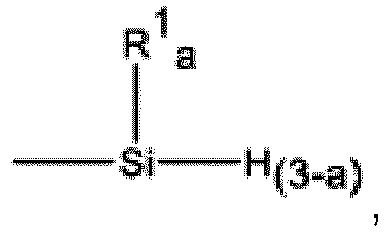
- Zusammensetzung nach Anspruch 3, wobeiein Ausgangsmaterial B1) ein Silan von Formel HSiR5 3 ist, wobei jedes R5 eine Alkylgruppe von 1 bis 6 Kohlenstoffatomen ist;ein Ausgangsmaterial B2) ein Polydiorganohydrogensiloxan der Einheitsformel ist: (HR4 2SiO1/2)g(R4 3SiO1/2)h(R4 2SiO2/2)i(HR4SiO2/2)j, wobei R4 wie vorstehend beschrieben ist, und Indizes g, h, i und j Werte derart aufweisen, dass g ≥ 0, h ≥ 0, eine Menge (g + h) einen Durchschnittswert von 2 aufweist, i ≥ 0, j ≥ 0 und eine Menge (g + j) ≥ 1 und eine Menge (i + j) in einem Bereich von 0 bis 1000 liegt; undein Ausgangsmaterial B3) ein SiH-funktionelles Polyolefin ist, das aus der Gruppe ausgewählt ist, bestehend aus Einheitsformel (B3-2):
 Einheitsformel (B3-3):
 Einheitsformel (B3-4):
- Verfahren zum Ausbilden von Produkt mit einer Siloxanbindung, das Verfahren umfassend:1) Kombinieren von Ausgangsmaterialien, umfassendA) eine fluorierte Triarylboran-Lewis-Säure, die aus der Gruppe ausgewählt ist, bestehend aus:A1) Tris(3,5-bis(trifluormethyl)phenyl)boran-THF-Addukt;A2) Bis(3,5-bis(trifluormethyl)phenyl)(4-trifluormethylphenyl)boran-THF-Addukt;A3) Bis(3,5-bis(trifluormethyl)phenyl)(2,4,6-trifluorphenyl)boran-THF-Addukt;A4) Bis(3,5-bis(trifluormethyl)phenyl)(2,6-difluorphenyl)boran-THF-Addukt;A5) Bis(3,5-bis(trifluormethyl)phenyl)(2,5-bis(trifluormethyl)phenyl)boran;A6) (3,5-Bis(trifluormethyl)phenyl)bis(2,5-bis(trifluormethyl)phenyl)boran;A7) Bis(3,5-bis(trifluormethyl)phenyl)(2,3,5,6-tetrafluor-4-trifluormethylphenyl)boran-THF-Addukt; undA8) eine Kombination von zwei oder mehr von A1) bis A7);B) ein Silylhydrid, das mindestens ein siliciumgebundenes Wasserstoffatom pro Molekül aufweist, undC) Wasser;
wobei dadurch Reagieren des siliciumgebundenen Wasserstoffatoms, um die Siloxanbindung und ein Nebenprodukt auszubilden, umfassend Wasserstoff. - Verfahren nach Anspruch 5, wobei das Ausgangsmaterial A) aus der Gruppe ausgewählt ist, bestehend aus:A4) Bis(3,5-bis(trifluormethyl)phenyl)(2,6-difluorphenyl)boran-THF-Addukt;A5) Bis(3,5-bis(trifluormethyl)phenyl)(2,5-bis(trifluormethyl)phenyl)boran; undA6) (3,5-Bis(trifluormethyl)phenyl)bis(2,5-bis(trifluormethyl)phenyl)boran.
- Verfahren nach Anspruch 5 oder 6, wobei B) das Silylhydrid aus der Gruppe ausgewählt ist, bestehend aus:B1) ein Silan von Formel HkSiR5 (4-k), wobei jedes R5 aus der Gruppe unabhängig ausgewählt ist, bestehend aus einer einwertigen Kohlenwasserstoffgruppe und einer einwertigen halogenierten Kohlenwasserstoffgruppe, und Index k 1 bis 3 ist;B2) ein Polyorganohydrogensiloxan, umfassend zwei oder mehr Siloxaneinheiten, die aus der Gruppe ausgewählt sind, bestehend aus HR4 2SiO1/2, R4 3SiO1/2, HR4SiO2/2, R4 2SiO2/2, R4SiO3/2, HSiO3/2 und SiO4/2, wobei jedes R4 eine unabhängig ausgewählte einwertige Kohlenwasserstoffgruppe ist, die frei von aliphatischer Ungesättigtheit ist; undB3) ein Polyolefin, das eine siliciumgebundene Wasserstofffunktionsgruppe von Formel (B3-1) aufweist:

- Verfahren nach Anspruch 7, wobei:das Ausgangsmaterial B1) ein Silan von Formel HSiR5 3 ist, wobei jedes R5 eine Alkylgruppe von 1 bis 6 Kohlenstoffatomen ist;das Ausgangsmaterial B2) ein Polydiorganohydrogensiloxan der Einheitsformel ist: (HR4 2SiO1/2)g(R4 3SiO1/2)h(R4 2SiO2/2)i(HR4SiO2/2)j, wobei R4 wie vorstehend beschrieben ist, und Indizes g, h, i und j Werte derart aufweisen, dass g ≥ 0, h ≥ 0, eine Menge (g + h) einen Durchschnittswert von 2 aufweist, i ≥ 0, j ≥ 0 und eine Menge (g + j) ≥ 1 und eine Menge (i + j) in dem Bereich von 0 bis 1000 liegt; unddas Ausgangsmaterial B3) ein SiH-funktionelles Polyolefincopolymer ist, das aus der Gruppe ausgewählt ist, bestehend ausEinheitsformel (B 3-2):
 wobei R1 und Index a wie vorstehend beschrieben sind, jedes R25 unabhängig H, eine einwertige Kohlenwasserstoffgruppe von 1 bis 18 Kohlenstoffatomen oder eine einwertige halogenierte Kohlenwasserstoffgruppe von 1 bis 18 Kohlenstoffatomen ist, 1 ≤ M ≤ 10 und 10 ≤ N ≤ 20.000;Einheitsformel (B3-3):
 Einheitsformel (B3-4):
- Verfahren nach einem der Ansprüche 5 bis 8, wobei das Kombinieren in Schritt 1) ein Mischen und ein Erhitzen von Ausgangsmaterialien A), B) und C) in beliebiger Reihenfolge umfasst.
- Verfahren nach einem der Ansprüche 5 bis 9, wobei das Ausgangsmaterial A) vor Schritt 1) in einem Lösungsmittel gelöst wird.
- Verfahren nach einem der Ansprüche 5 bis 10, wobei die Ausgangsmaterialien A) und B) vor Schritt 1) kombiniert werden.
- Verfahren nach einem der Ansprüche 5 bis 11, ferner umfassend: ein Neutralisieren einer verbleibenden fluorierten Triarylboran-Lewis-Säure in dem Produkt.
- Verfahren nach einem der Ansprüche 5 bis 12, ferner umfassend: während und/oder nach Schritt 1), Entfernen des Nebenprodukts, umfassend H2.
Applications Claiming Priority (2)
| Application Number | Priority Date | Filing Date | Title |
|---|---|---|---|
| US202063043149P | 2020-06-24 | 2020-06-24 | |
| PCT/US2021/037538 WO2021262492A1 (en) | 2020-06-24 | 2021-06-16 | Composition and method for silyl hydride reaction catalyzed by fluorinated arylborane lewis acids |
Publications (2)
| Publication Number | Publication Date |
|---|---|
| EP4172242A1 EP4172242A1 (de) | 2023-05-03 |
| EP4172242B1 true EP4172242B1 (de) | 2024-03-20 |
Family
ID=76859749
Family Applications (1)
| Application Number | Title | Priority Date | Filing Date |
|---|---|---|---|
| EP21740325.2A Active EP4172242B1 (de) | 2020-06-24 | 2021-06-16 | Zusammensetzung und verfahren zur silylhydridreaktion katalysiert durch fluorierte arylboran-lewis-säuren |
Country Status (6)
| Country | Link |
|---|---|
| US (1) | US12473404B2 (de) |
| EP (1) | EP4172242B1 (de) |
| JP (1) | JP7712962B2 (de) |
| KR (1) | KR20230029858A (de) |
| CN (1) | CN116134074B (de) |
| WO (1) | WO2021262492A1 (de) |
Families Citing this family (4)
| Publication number | Priority date | Publication date | Assignee | Title |
|---|---|---|---|---|
| KR20230029882A (ko) | 2020-06-24 | 2023-03-03 | 다우 글로벌 테크놀로지스 엘엘씨 | 올레핀/실란 혼성중합체에 의한 가교된 조성물 |
| EP4519345A1 (de) * | 2022-05-31 | 2025-03-12 | Dow Global Technologies LLC | Co-agent-unterstützte bildung von vernetztem silicium-polyolefin-interpolymer unter verwendung eines vernetzungsmittels |
| CN121969674A (zh) | 2023-10-23 | 2026-05-01 | 美国陶氏有机硅公司 | 有机硅氧烷及其制备方法和用途 |
| WO2026005873A1 (en) | 2024-06-24 | 2026-01-02 | Dow Silicones Corporation | Silicone coatings |
Family Cites Families (60)
| Publication number | Priority date | Publication date | Assignee | Title |
|---|---|---|---|---|
| US3159601A (en) | 1962-07-02 | 1964-12-01 | Gen Electric | Platinum-olefin complex catalyzed addition of hydrogen- and alkenyl-substituted siloxanes |
| US3296291A (en) | 1962-07-02 | 1967-01-03 | Gen Electric | Reaction of silanes with unsaturated olefinic compounds |
| US3220972A (en) | 1962-07-02 | 1965-11-30 | Gen Electric | Organosilicon process using a chloroplatinic acid reaction product as the catalyst |
| NL131800C (de) | 1965-05-17 | |||
| US3516946A (en) | 1967-09-29 | 1970-06-23 | Gen Electric | Platinum catalyst composition for hydrosilation reactions |
| US3814730A (en) | 1970-08-06 | 1974-06-04 | Gen Electric | Platinum complexes of unsaturated siloxanes and platinum containing organopolysiloxanes |
| US3989668A (en) | 1975-07-14 | 1976-11-02 | Dow Corning Corporation | Method of making a silicone elastomer and the elastomer prepared thereby |
| US4329273A (en) | 1978-03-07 | 1982-05-11 | General Electric Company | Self-bonding silicone rubber compositions |
| US4370358A (en) | 1980-09-22 | 1983-01-25 | General Electric Company | Ultraviolet curable silicone adhesives |
| US4374967A (en) | 1981-07-06 | 1983-02-22 | Dow Corning Corporation | Low temperature silicone gel |
| JPS61195129A (ja) | 1985-02-22 | 1986-08-29 | Toray Silicone Co Ltd | 有機けい素重合体の製造方法 |
| US4784879A (en) | 1987-07-20 | 1988-11-15 | Dow Corning Corporation | Method for preparing a microencapsulated compound of a platinum group metal |
| US4766176A (en) | 1987-07-20 | 1988-08-23 | Dow Corning Corporation | Storage stable heat curable organosiloxane compositions containing microencapsulated platinum-containing catalysts |
| JP2630993B2 (ja) | 1988-06-23 | 1997-07-16 | 東レ・ダウコーニング・シリコーン株式会社 | ヒドロシリル化反応用白金系触媒含有粒状物およびその製造方法 |
| JPH0214244A (ja) | 1988-06-30 | 1990-01-18 | Toray Dow Corning Silicone Co Ltd | 加熱硬化性オルガノポリシロキサン組成物 |
| US5036117A (en) | 1989-11-03 | 1991-07-30 | Dow Corning Corporation | Heat-curable silicone compositions having improved bath life |
| GB9103191D0 (en) | 1991-02-14 | 1991-04-03 | Dow Corning | Platinum complexes and use thereof |
| JP2511348B2 (ja) | 1991-10-17 | 1996-06-26 | 東レ・ダウコーニング・シリコーン株式会社 | オルガノポリシロキサンおよびその製造方法 |
| TW198054B (de) | 1992-02-10 | 1993-01-11 | Gen Electric | |
| US5625023A (en) | 1994-12-09 | 1997-04-29 | Dow Corning Corporation | Aerosol suppressant compositions for silicone coatings |
| US6624254B1 (en) | 1999-01-21 | 2003-09-23 | The Dow Chemical Company | Silane functionalized olefin interpolymer derivatives |
| GB9917372D0 (en) | 1999-07-23 | 1999-09-22 | Dow Corning | Silicone release coating compositions |
| FR2806930B1 (fr) | 2000-04-04 | 2002-06-28 | Rhodia Chimie Sa | Utilisation d'un derive de bore a titre de catalyseur thermoactivable pour la polymerisation et/ou reticulation de silicone par deshydrogenocondensation |
| US6586535B1 (en) | 2000-06-22 | 2003-07-01 | Dow Corning Corporation | Coatings containing silicone mist suppressant compositions |
| FR2812564B1 (fr) | 2000-08-04 | 2003-02-21 | Rhodia Chimie Sa | Utilisation d'un derive du bore a titre de catalyseur pour l'hydrosilylation de reactifs insatures |
| US6716533B2 (en) | 2001-08-27 | 2004-04-06 | General Electric Company | Paper release compositions having improved adhesion to paper and polymeric films |
| US20030129287A1 (en) | 2001-12-05 | 2003-07-10 | Guzman Adriana T. | Systems, methods and apparatus for producing a frozen confection |
| US7064173B2 (en) | 2002-12-30 | 2006-06-20 | General Electric Company | Silicone condensation reaction |
| US7005475B2 (en) | 2003-06-10 | 2006-02-28 | General Electric Company | Curable silicone compositions having improved adhesion to polymeric films |
| US20050038188A1 (en) | 2003-08-14 | 2005-02-17 | Dongchan Ahn | Silicones having improved chemical resistance and curable silicone compositions having improved migration resistance |
| JP2007538070A (ja) | 2004-05-20 | 2007-12-27 | ゼネラル・エレクトリック・カンパニイ | シリコーン縮合反応 |
| WO2006055233A1 (en) | 2004-11-18 | 2006-05-26 | Dow Corning Corporation | Silicone release coating compositions |
| PL374519A1 (pl) | 2005-04-20 | 2006-10-30 | General Electric Company | Sposób wytwarzania oligomeru Si-H-funkcyjnego siloksanu |
| US8048819B2 (en) | 2005-06-23 | 2011-11-01 | Momentive Performance Materials Inc. | Cure catalyst, composition, electronic device and associated method |
| PL2150575T3 (pl) | 2007-05-25 | 2017-05-31 | Dow Corning Corporation | Kompozycja powłoki antyadhezyjnej i sposób jej wytwarzania |
| EP2300515B1 (de) | 2008-07-11 | 2015-04-22 | Dow Corning Toray Co., Ltd. | Fresetzender modifikator und freisetzende organopolysiloxan-beschichtungszusammensetzung |
| EP2350099A1 (de) | 2008-10-23 | 2011-08-03 | Dow Global Technologies LLC | Blockierungsmittel für organoboranverbindung |
| US20110287267A1 (en) | 2008-11-26 | 2011-11-24 | Seiji Hori | Solventless Cured Release Coating-Forming Organopolysiloxane Composition And Sheet-Form Substrate Having A Cured Release Coating |
| US9593209B2 (en) | 2009-10-22 | 2017-03-14 | Dow Corning Corporation | Process for preparing clustered functional polyorganosiloxanes, and methods for their use |
| FR2980195B1 (fr) * | 2011-09-20 | 2013-08-23 | IFP Energies Nouvelles | Procede de separation du pentene-2 d'une coupe c5 contenant du pentene-2 et du pentene-1 par oligomerisation selective du pentene-1 |
| EP2764052B1 (de) | 2011-10-04 | 2018-07-18 | Dow Silicones Corporation | Eisen(iii)-haltiger komplex und kondensationsreaktionskatalysatoren, verfahren zur herstellung der katalysatoren und zusammensetzungen mit den katalysatoren |
| US9035008B2 (en) | 2011-12-29 | 2015-05-19 | 3M Innovative Properties Company | Curable-on-demand polysiloxane coating composition |
| WO2013142956A1 (en) | 2012-03-28 | 2013-10-03 | Uti Limited Partnership | Methods and compounds for photo lewis acid generation and uses thereof |
| US9670392B2 (en) | 2013-02-11 | 2017-06-06 | Dow Corning Corporation | Stable thermal radical curable silicone adhesive compositions |
| US9926410B2 (en) | 2013-03-28 | 2018-03-27 | Dow Corning Corporation | Organosiloxane compositions and coatings, manufactured articles, methods and uses |
| US20150080628A1 (en) * | 2013-09-19 | 2015-03-19 | Eastman Chemical Company | Catalyst and process for the co-dimerization of ethylene and propylene |
| CN105873984A (zh) * | 2013-12-31 | 2016-08-17 | 3M创新有限公司 | 可固化有机硅氧烷低聚物组合物 |
| JP6784638B2 (ja) * | 2017-04-14 | 2020-11-11 | 信越化学工業株式会社 | 硬化性有機ケイ素樹脂組成物 |
| US20200207919A1 (en) * | 2017-05-23 | 2020-07-02 | Wacker Chemie Ag | Crosslinking of hydridosiloxanes with silicon (ii) compounds |
| CN110770280B (zh) * | 2017-06-26 | 2022-02-22 | 美国陶氏有机硅公司 | 用于制备烷氧基官能有机氢硅氧烷低聚物的方法 |
| JP7256169B2 (ja) * | 2017-07-25 | 2023-04-11 | ダウ シリコーンズ コーポレーション | ポリオレフィン主鎖とポリオルガノシロキサンペンダント基とを有する、グラフトコポリマーを調製するための方法 |
| US11912822B2 (en) | 2017-09-14 | 2024-02-27 | Dow Global Technologies Llc | Process of manufacturing polyols |
| CN111263785B (zh) * | 2017-09-14 | 2023-06-09 | 陶氏环球技术有限责任公司 | 路易斯酸聚合催化剂 |
| US11479642B2 (en) | 2017-09-14 | 2022-10-25 | Dow Global Technologies Llc | Process of manufacturing polyols |
| CN111247101B (zh) | 2017-10-26 | 2023-03-07 | 住友金属矿山株式会社 | 镍复合氧化物和锂镍复合氧化物的制造方法 |
| US20210002467A1 (en) | 2018-03-19 | 2021-01-07 | Dow Global Technologies Llc | Process for functionalization of organo-metal compounds with silyl-based functionalization agents and silyl-functionalized compounds prepared thereby |
| TW201938602A (zh) | 2018-03-19 | 2019-10-01 | 美商陶氏全球科技有限責任公司 | 矽封端之遙爪聚烯烴組成物及其製備程序 |
| KR102794662B1 (ko) | 2018-09-28 | 2025-04-15 | 다우 글로벌 테크놀로지스 엘엘씨 | 폴리(산화부틸렌) 폴리올 기반의 폴리우레탄 캐스트 탄성중합체 및 폴리우레탄 캐스트 탄성중합체를 제조하는 방법 |
| CN113166418A (zh) | 2018-12-21 | 2021-07-23 | 美国陶氏有机硅公司 | 用于制备官能化聚有机硅氧烷的方法 |
| CN113993933B (zh) | 2019-06-04 | 2023-07-14 | 美国陶氏有机硅公司 | 作为用于Si-H和Si-OR之间的反应的热触发剂的桥联受阻路易斯对 |
-
2021
- 2021-06-16 EP EP21740325.2A patent/EP4172242B1/de active Active
- 2021-06-16 CN CN202180059984.9A patent/CN116134074B/zh active Active
- 2021-06-16 WO PCT/US2021/037538 patent/WO2021262492A1/en not_active Ceased
- 2021-06-16 KR KR1020237002584A patent/KR20230029858A/ko active Pending
- 2021-06-16 US US17/915,656 patent/US12473404B2/en active Active
- 2021-06-16 JP JP2022577259A patent/JP7712962B2/ja active Active
Also Published As
| Publication number | Publication date |
|---|---|
| EP4172242A1 (de) | 2023-05-03 |
| CN116134074A (zh) | 2023-05-16 |
| US12473404B2 (en) | 2025-11-18 |
| WO2021262492A1 (en) | 2021-12-30 |
| JP2023535667A (ja) | 2023-08-21 |
| CN116134074B (zh) | 2024-12-27 |
| JP7712962B2 (ja) | 2025-07-24 |
| US20230123215A1 (en) | 2023-04-20 |
| KR20230029858A (ko) | 2023-03-03 |
Similar Documents
| Publication | Publication Date | Title |
|---|---|---|
| EP4172242B1 (de) | Zusammensetzung und verfahren zur silylhydridreaktion katalysiert durch fluorierte arylboran-lewis-säuren | |
| EP0629648B1 (de) | Verfahren zur Herstellung karbinol-funktionalisierter Siloxane | |
| TWI800621B (zh) | 聚烯烴-聚二有機矽氧烷嵌段共聚物及用於其合成之方法 | |
| EP3824017B1 (de) | Polysiloxanharz-polyolefincopolymer und verfahren zur herstellung und verwendung davon | |
| TWI809058B (zh) | 聚烯烴-聚二有機矽氧烷嵌段共聚物及用於其合成之矽氫化反應方法 | |
| EP4172241B1 (de) | Zusammensetzung und verfahren zur umsetzung einer siliciumorganischen verbindung und eines silylhydrids, katalysiert durch eine fluorierte arylboran-lewis-säure | |
| CN101547958A (zh) | 用于生成单分散和窄分散的单官能聚硅氧烷的方法 | |
| EP3237477B1 (de) | Hydrosilylierungsverfahren | |
| JP6390473B2 (ja) | 両末端変性されたシラシクロブタン開環重合物及びその製造方法 | |
| GB2243370A (en) | Silethynyl-siloxane copolymers | |
| KR20220111311A (ko) | 실록산을 제조하기 위한 실리란-작용화된 화합물, 특히 오가노실리콘 화합물 |
Legal Events
| Date | Code | Title | Description |
|---|---|---|---|
| STAA | Information on the status of an ep patent application or granted ep patent |
Free format text: STATUS: UNKNOWN |
|
| STAA | Information on the status of an ep patent application or granted ep patent |
Free format text: STATUS: THE INTERNATIONAL PUBLICATION HAS BEEN MADE |
|
| PUAI | Public reference made under article 153(3) epc to a published international application that has entered the european phase |
Free format text: ORIGINAL CODE: 0009012 |
|
| STAA | Information on the status of an ep patent application or granted ep patent |
Free format text: STATUS: REQUEST FOR EXAMINATION WAS MADE |
|
| 17P | Request for examination filed |
Effective date: 20230104 |
|
| AK | Designated contracting states |
Kind code of ref document: A1 Designated state(s): AL AT BE BG CH CY CZ DE DK EE ES FI FR GB GR HR HU IE IS IT LI LT LU LV MC MK MT NL NO PL PT RO RS SE SI SK SM TR |
|
| P01 | Opt-out of the competence of the unified patent court (upc) registered |
Effective date: 20230526 |
|
| DAV | Request for validation of the european patent (deleted) | ||
| DAX | Request for extension of the european patent (deleted) | ||
| GRAP | Despatch of communication of intention to grant a patent |
Free format text: ORIGINAL CODE: EPIDOSNIGR1 |
|
| STAA | Information on the status of an ep patent application or granted ep patent |
Free format text: STATUS: GRANT OF PATENT IS INTENDED |
|
| INTG | Intention to grant announced |
Effective date: 20231212 |
|
| GRAS | Grant fee paid |
Free format text: ORIGINAL CODE: EPIDOSNIGR3 |
|
| GRAA | (expected) grant |
Free format text: ORIGINAL CODE: 0009210 |
|
| STAA | Information on the status of an ep patent application or granted ep patent |
Free format text: STATUS: THE PATENT HAS BEEN GRANTED |
|
| AK | Designated contracting states |
Kind code of ref document: B1 Designated state(s): AL AT BE BG CH CY CZ DE DK EE ES FI FR GB GR HR HU IE IS IT LI LT LU LV MC MK MT NL NO PL PT RO RS SE SI SK SM TR |
|
| REG | Reference to a national code |
Ref country code: GB Ref legal event code: FG4D |
|
| REG | Reference to a national code |
Ref country code: CH Ref legal event code: EP |
|
| REG | Reference to a national code |
Ref country code: IE Ref legal event code: FG4D |
|
| REG | Reference to a national code |
Ref country code: DE Ref legal event code: R096 Ref document number: 602021010729 Country of ref document: DE |
|
| PG25 | Lapsed in a contracting state [announced via postgrant information from national office to epo] |
Ref country code: LT Free format text: LAPSE BECAUSE OF FAILURE TO SUBMIT A TRANSLATION OF THE DESCRIPTION OR TO PAY THE FEE WITHIN THE PRESCRIBED TIME-LIMIT Effective date: 20240320 |
|
| REG | Reference to a national code |
Ref country code: LT Ref legal event code: MG9D |
|
| PG25 | Lapsed in a contracting state [announced via postgrant information from national office to epo] |
Ref country code: GR Free format text: LAPSE BECAUSE OF FAILURE TO SUBMIT A TRANSLATION OF THE DESCRIPTION OR TO PAY THE FEE WITHIN THE PRESCRIBED TIME-LIMIT Effective date: 20240621 |
|
| PG25 | Lapsed in a contracting state [announced via postgrant information from national office to epo] |
Ref country code: HR Free format text: LAPSE BECAUSE OF FAILURE TO SUBMIT A TRANSLATION OF THE DESCRIPTION OR TO PAY THE FEE WITHIN THE PRESCRIBED TIME-LIMIT Effective date: 20240320 Ref country code: RS Free format text: LAPSE BECAUSE OF FAILURE TO SUBMIT A TRANSLATION OF THE DESCRIPTION OR TO PAY THE FEE WITHIN THE PRESCRIBED TIME-LIMIT Effective date: 20240620 |
|
| REG | Reference to a national code |
Ref country code: NL Ref legal event code: MP Effective date: 20240320 |
|
| PG25 | Lapsed in a contracting state [announced via postgrant information from national office to epo] |
Ref country code: RS Free format text: LAPSE BECAUSE OF FAILURE TO SUBMIT A TRANSLATION OF THE DESCRIPTION OR TO PAY THE FEE WITHIN THE PRESCRIBED TIME-LIMIT Effective date: 20240620 Ref country code: NO Free format text: LAPSE BECAUSE OF FAILURE TO SUBMIT A TRANSLATION OF THE DESCRIPTION OR TO PAY THE FEE WITHIN THE PRESCRIBED TIME-LIMIT Effective date: 20240620 Ref country code: LT Free format text: LAPSE BECAUSE OF FAILURE TO SUBMIT A TRANSLATION OF THE DESCRIPTION OR TO PAY THE FEE WITHIN THE PRESCRIBED TIME-LIMIT Effective date: 20240320 Ref country code: HR Free format text: LAPSE BECAUSE OF FAILURE TO SUBMIT A TRANSLATION OF THE DESCRIPTION OR TO PAY THE FEE WITHIN THE PRESCRIBED TIME-LIMIT Effective date: 20240320 Ref country code: GR Free format text: LAPSE BECAUSE OF FAILURE TO SUBMIT A TRANSLATION OF THE DESCRIPTION OR TO PAY THE FEE WITHIN THE PRESCRIBED TIME-LIMIT Effective date: 20240621 Ref country code: FI Free format text: LAPSE BECAUSE OF FAILURE TO SUBMIT A TRANSLATION OF THE DESCRIPTION OR TO PAY THE FEE WITHIN THE PRESCRIBED TIME-LIMIT Effective date: 20240320 Ref country code: BG Free format text: LAPSE BECAUSE OF FAILURE TO SUBMIT A TRANSLATION OF THE DESCRIPTION OR TO PAY THE FEE WITHIN THE PRESCRIBED TIME-LIMIT Effective date: 20240320 |
|
| REG | Reference to a national code |
Ref country code: AT Ref legal event code: MK05 Ref document number: 1667789 Country of ref document: AT Kind code of ref document: T Effective date: 20240320 |
|
| PG25 | Lapsed in a contracting state [announced via postgrant information from national office to epo] |
Ref country code: SE Free format text: LAPSE BECAUSE OF FAILURE TO SUBMIT A TRANSLATION OF THE DESCRIPTION OR TO PAY THE FEE WITHIN THE PRESCRIBED TIME-LIMIT Effective date: 20240320 Ref country code: LV Free format text: LAPSE BECAUSE OF FAILURE TO SUBMIT A TRANSLATION OF THE DESCRIPTION OR TO PAY THE FEE WITHIN THE PRESCRIBED TIME-LIMIT Effective date: 20240320 |
|
| PG25 | Lapsed in a contracting state [announced via postgrant information from national office to epo] |
Ref country code: NL Free format text: LAPSE BECAUSE OF FAILURE TO SUBMIT A TRANSLATION OF THE DESCRIPTION OR TO PAY THE FEE WITHIN THE PRESCRIBED TIME-LIMIT Effective date: 20240320 |
|
| PG25 | Lapsed in a contracting state [announced via postgrant information from national office to epo] |
Ref country code: NL Free format text: LAPSE BECAUSE OF FAILURE TO SUBMIT A TRANSLATION OF THE DESCRIPTION OR TO PAY THE FEE WITHIN THE PRESCRIBED TIME-LIMIT Effective date: 20240320 |
|
| PG25 | Lapsed in a contracting state [announced via postgrant information from national office to epo] |
Ref country code: IS Free format text: LAPSE BECAUSE OF FAILURE TO SUBMIT A TRANSLATION OF THE DESCRIPTION OR TO PAY THE FEE WITHIN THE PRESCRIBED TIME-LIMIT Effective date: 20240720 |
|
| PG25 | Lapsed in a contracting state [announced via postgrant information from national office to epo] |
Ref country code: PT Free format text: LAPSE BECAUSE OF FAILURE TO SUBMIT A TRANSLATION OF THE DESCRIPTION OR TO PAY THE FEE WITHIN THE PRESCRIBED TIME-LIMIT Effective date: 20240722 Ref country code: SM Free format text: LAPSE BECAUSE OF FAILURE TO SUBMIT A TRANSLATION OF THE DESCRIPTION OR TO PAY THE FEE WITHIN THE PRESCRIBED TIME-LIMIT Effective date: 20240320 |
|
| PG25 | Lapsed in a contracting state [announced via postgrant information from national office to epo] |
Ref country code: ES Free format text: LAPSE BECAUSE OF FAILURE TO SUBMIT A TRANSLATION OF THE DESCRIPTION OR TO PAY THE FEE WITHIN THE PRESCRIBED TIME-LIMIT Effective date: 20240320 |
|
| PG25 | Lapsed in a contracting state [announced via postgrant information from national office to epo] |
Ref country code: CZ Free format text: LAPSE BECAUSE OF FAILURE TO SUBMIT A TRANSLATION OF THE DESCRIPTION OR TO PAY THE FEE WITHIN THE PRESCRIBED TIME-LIMIT Effective date: 20240320 Ref country code: EE Free format text: LAPSE BECAUSE OF FAILURE TO SUBMIT A TRANSLATION OF THE DESCRIPTION OR TO PAY THE FEE WITHIN THE PRESCRIBED TIME-LIMIT Effective date: 20240320 |
|
| PG25 | Lapsed in a contracting state [announced via postgrant information from national office to epo] |
Ref country code: AT Free format text: LAPSE BECAUSE OF FAILURE TO SUBMIT A TRANSLATION OF THE DESCRIPTION OR TO PAY THE FEE WITHIN THE PRESCRIBED TIME-LIMIT Effective date: 20240320 |
|
| PG25 | Lapsed in a contracting state [announced via postgrant information from national office to epo] |
Ref country code: PL Free format text: LAPSE BECAUSE OF FAILURE TO SUBMIT A TRANSLATION OF THE DESCRIPTION OR TO PAY THE FEE WITHIN THE PRESCRIBED TIME-LIMIT Effective date: 20240320 |
|
| PG25 | Lapsed in a contracting state [announced via postgrant information from national office to epo] |
Ref country code: SK Free format text: LAPSE BECAUSE OF FAILURE TO SUBMIT A TRANSLATION OF THE DESCRIPTION OR TO PAY THE FEE WITHIN THE PRESCRIBED TIME-LIMIT Effective date: 20240320 |
|
| PG25 | Lapsed in a contracting state [announced via postgrant information from national office to epo] |
Ref country code: SM Free format text: LAPSE BECAUSE OF FAILURE TO SUBMIT A TRANSLATION OF THE DESCRIPTION OR TO PAY THE FEE WITHIN THE PRESCRIBED TIME-LIMIT Effective date: 20240320 Ref country code: SK Free format text: LAPSE BECAUSE OF FAILURE TO SUBMIT A TRANSLATION OF THE DESCRIPTION OR TO PAY THE FEE WITHIN THE PRESCRIBED TIME-LIMIT Effective date: 20240320 Ref country code: RO Free format text: LAPSE BECAUSE OF FAILURE TO SUBMIT A TRANSLATION OF THE DESCRIPTION OR TO PAY THE FEE WITHIN THE PRESCRIBED TIME-LIMIT Effective date: 20240320 Ref country code: PT Free format text: LAPSE BECAUSE OF FAILURE TO SUBMIT A TRANSLATION OF THE DESCRIPTION OR TO PAY THE FEE WITHIN THE PRESCRIBED TIME-LIMIT Effective date: 20240722 Ref country code: PL Free format text: LAPSE BECAUSE OF FAILURE TO SUBMIT A TRANSLATION OF THE DESCRIPTION OR TO PAY THE FEE WITHIN THE PRESCRIBED TIME-LIMIT Effective date: 20240320 Ref country code: IS Free format text: LAPSE BECAUSE OF FAILURE TO SUBMIT A TRANSLATION OF THE DESCRIPTION OR TO PAY THE FEE WITHIN THE PRESCRIBED TIME-LIMIT Effective date: 20240720 Ref country code: ES Free format text: LAPSE BECAUSE OF FAILURE TO SUBMIT A TRANSLATION OF THE DESCRIPTION OR TO PAY THE FEE WITHIN THE PRESCRIBED TIME-LIMIT Effective date: 20240320 Ref country code: EE Free format text: LAPSE BECAUSE OF FAILURE TO SUBMIT A TRANSLATION OF THE DESCRIPTION OR TO PAY THE FEE WITHIN THE PRESCRIBED TIME-LIMIT Effective date: 20240320 Ref country code: CZ Free format text: LAPSE BECAUSE OF FAILURE TO SUBMIT A TRANSLATION OF THE DESCRIPTION OR TO PAY THE FEE WITHIN THE PRESCRIBED TIME-LIMIT Effective date: 20240320 Ref country code: AT Free format text: LAPSE BECAUSE OF FAILURE TO SUBMIT A TRANSLATION OF THE DESCRIPTION OR TO PAY THE FEE WITHIN THE PRESCRIBED TIME-LIMIT Effective date: 20240320 |
|
| PG25 | Lapsed in a contracting state [announced via postgrant information from national office to epo] |
Ref country code: IT Free format text: LAPSE BECAUSE OF FAILURE TO SUBMIT A TRANSLATION OF THE DESCRIPTION OR TO PAY THE FEE WITHIN THE PRESCRIBED TIME-LIMIT Effective date: 20240320 |
|
| REG | Reference to a national code |
Ref country code: DE Ref legal event code: R097 Ref document number: 602021010729 Country of ref document: DE |
|
| PG25 | Lapsed in a contracting state [announced via postgrant information from national office to epo] |
Ref country code: IT Free format text: LAPSE BECAUSE OF FAILURE TO SUBMIT A TRANSLATION OF THE DESCRIPTION OR TO PAY THE FEE WITHIN THE PRESCRIBED TIME-LIMIT Effective date: 20240320 |
|
| PG25 | Lapsed in a contracting state [announced via postgrant information from national office to epo] |
Ref country code: DK Free format text: LAPSE BECAUSE OF FAILURE TO SUBMIT A TRANSLATION OF THE DESCRIPTION OR TO PAY THE FEE WITHIN THE PRESCRIBED TIME-LIMIT Effective date: 20240320 |
|
| PLBE | No opposition filed within time limit |
Free format text: ORIGINAL CODE: 0009261 |
|
| STAA | Information on the status of an ep patent application or granted ep patent |
Free format text: STATUS: NO OPPOSITION FILED WITHIN TIME LIMIT |
|
| PG25 | Lapsed in a contracting state [announced via postgrant information from national office to epo] |
Ref country code: DK Free format text: LAPSE BECAUSE OF FAILURE TO SUBMIT A TRANSLATION OF THE DESCRIPTION OR TO PAY THE FEE WITHIN THE PRESCRIBED TIME-LIMIT Effective date: 20240320 Ref country code: MC Free format text: LAPSE BECAUSE OF FAILURE TO SUBMIT A TRANSLATION OF THE DESCRIPTION OR TO PAY THE FEE WITHIN THE PRESCRIBED TIME-LIMIT Effective date: 20240320 |
|
| REG | Reference to a national code |
Ref country code: CH Ref legal event code: PL |
|
| PG25 | Lapsed in a contracting state [announced via postgrant information from national office to epo] |
Ref country code: LU Free format text: LAPSE BECAUSE OF NON-PAYMENT OF DUE FEES Effective date: 20240616 |
|
| 26N | No opposition filed |
Effective date: 20241223 |
|
| PG25 | Lapsed in a contracting state [announced via postgrant information from national office to epo] |
Ref country code: IE Free format text: LAPSE BECAUSE OF NON-PAYMENT OF DUE FEES Effective date: 20240616 |
|
| PG25 | Lapsed in a contracting state [announced via postgrant information from national office to epo] |
Ref country code: BE Free format text: LAPSE BECAUSE OF NON-PAYMENT OF DUE FEES Effective date: 20240630 Ref country code: SI Free format text: LAPSE BECAUSE OF FAILURE TO SUBMIT A TRANSLATION OF THE DESCRIPTION OR TO PAY THE FEE WITHIN THE PRESCRIBED TIME-LIMIT Effective date: 20240320 Ref country code: CH Free format text: LAPSE BECAUSE OF NON-PAYMENT OF DUE FEES Effective date: 20240630 |
|
| PG25 | Lapsed in a contracting state [announced via postgrant information from national office to epo] |
Ref country code: FR Free format text: LAPSE BECAUSE OF NON-PAYMENT OF DUE FEES Effective date: 20240630 |
|
| REG | Reference to a national code |
Ref country code: BE Ref legal event code: MM Effective date: 20240630 |
|
| PGFP | Annual fee paid to national office [announced via postgrant information from national office to epo] |
Ref country code: DE Payment date: 20250402 Year of fee payment: 5 |
|
| PG25 | Lapsed in a contracting state [announced via postgrant information from national office to epo] |
Ref country code: CY Free format text: LAPSE BECAUSE OF FAILURE TO SUBMIT A TRANSLATION OF THE DESCRIPTION OR TO PAY THE FEE WITHIN THE PRESCRIBED TIME-LIMIT; INVALID AB INITIO Effective date: 20210616 |
|
| GBPC | Gb: european patent ceased through non-payment of renewal fee |
Effective date: 20250616 |
|
| PG25 | Lapsed in a contracting state [announced via postgrant information from national office to epo] |
Ref country code: HU Free format text: LAPSE BECAUSE OF FAILURE TO SUBMIT A TRANSLATION OF THE DESCRIPTION OR TO PAY THE FEE WITHIN THE PRESCRIBED TIME-LIMIT; INVALID AB INITIO Effective date: 20210616 |
|
| PG25 | Lapsed in a contracting state [announced via postgrant information from national office to epo] |
Ref country code: GB Free format text: LAPSE BECAUSE OF NON-PAYMENT OF DUE FEES Effective date: 20250616 |