EP4174875A1 - Procédé mis en oeuvre par ordinateur pour simuler le fonctionnement d'un coeur de réacteur - Google Patents
Procédé mis en oeuvre par ordinateur pour simuler le fonctionnement d'un coeur de réacteur Download PDFInfo
- Publication number
- EP4174875A1 EP4174875A1 EP21306504.8A EP21306504A EP4174875A1 EP 4174875 A1 EP4174875 A1 EP 4174875A1 EP 21306504 A EP21306504 A EP 21306504A EP 4174875 A1 EP4174875 A1 EP 4174875A1
- Authority
- EP
- European Patent Office
- Prior art keywords
- distribution
- reactor core
- core
- modal
- neutron flux
- Prior art date
- Legal status (The legal status is an assumption and is not a legal conclusion. Google has not performed a legal analysis and makes no representation as to the accuracy of the status listed.)
- Granted
Links
Images






Classifications
-
- G—PHYSICS
- G21—NUCLEAR PHYSICS; NUCLEAR ENGINEERING
- G21D—NUCLEAR POWER PLANT
- G21D3/00—Control of nuclear power plant
- G21D3/001—Computer implemented control
- G21D3/002—Core design; core simulations; core optimisation
-
- G—PHYSICS
- G21—NUCLEAR PHYSICS; NUCLEAR ENGINEERING
- G21D—NUCLEAR POWER PLANT
- G21D3/00—Control of nuclear power plant
- G21D3/001—Computer implemented control
- G21D3/004—Fuel shuffle simulation; fuel shuffle optimisation
Definitions
- the present invention concerns a computer implemented method for simulating an operation of a reactor core.
- Such heuristic approaches do typically feature clear restrictions in degrees of freedom for decreasing the overall 3D discrepancy between the 3D results of the model and the 3D observations. Due to these restrictions, the achieved 3D agreement is always limited in quality, and always inferior compared to what a postulated ideal approach would enable. Additionally, not rarely such heuristic adaptation approaches actually impose changes in the model that cannot possibly be commensurate with the ideal 3D model correction distribution (that can be postulated to exist). As such, heuristic adaptation approaches are non-ideal from several different perspectives.
- EP 2 287 853 B1 discloses a computer implemented method for modelling a nuclear reactor core.
- the method includes partitioning the core in cubes to constitute nodes of a grid for computer implemented calculation.
- a neutron flux is calculated by using an iterative solving procedure of at least one eigensystem corresponding to a steady-state diffusion equation, the components of an iterand of the eigensystem corresponding either to a neutron flux, to a neutron outcurrent or to a neutron incurrent, for a respective cube to be calculated, the neutron outcurrent coming from a respective cube and the neutron incurrent coming into a respective cube.
- CN101399091 relates to nuclear reactor core power monitoring field and discloses a method for online monitoring of the neutron flux distribution of the reactor core.
- the method is based on the use of measurement data supplied by M1 internal neutron detectors and external neutron detectors which are arranged on the reactor.
- M1 internal neutron detectors and external neutron detectors which are arranged on the reactor.
- the higher-order harmonic waves are used to (re-)construct the actual 3D neutron flux distribution in the reactor core.
- the aim of the invention is to enable power shape sensitivity analyses, and also inversion actions that enable goal-oriented adaptation and improvement of the reactor core model, in particular to by an enabled determination of a most plausible 3D root cause spatial distribution that is consistent with a 3D discrepancy distribution observed between a model and the actual (i.e. measured) power distribution and/or the actual 3D flux of neutrons of the nuclear reactor core.
- a computer implemented method for simulating an operation of a reactor core comprising:
- a computer implemented method for optimizing a reactor core provided, wherein the reactor core is simulated according to a method disclosed herein, wherein the method further includes the following step: permuting fuel assemblies based on the 3D adaptation distribution , optimizing the core loading pattern based on the 3D adaptation distribution and/or optimizing the fuel assembly design based on the 3D adaptation distribution.
- a computer program product comprising instructions, which, when the program is executed by a computer, cause the computer to carry out the computer implemented method of one of the embodiments disclosed herein.
- a data carrier signal is provided carrying the computer program product of an embodiment disclosed herein.
- a computer-readable storage medium comprising instructions which, when executed by a computer, cause the computer to carry out the computer implemented method of one of the embodiments disclosed herein.
- a data processing system comprising means for carrying out the computer implemented method of one of the embodiments disclosed herein.
- a computer program product comprising commands for executing the method according an embodiment disclosed herein, when loaded and executed on a processor.
- a computer program product may be a physical software product, for example a hard disc, a solid state disc, a CD-ROM, a DVD, comprising the program.
- Embodiments are also directed to the system for carrying out the disclosed methods steps and in particular including apparatus parts and/or devices for performing described method steps.
- the method steps may be performed by way of hardware components, firmware, software, a computer programmed by appropriate software, by any combination thereof or in any other manner.
- a data carrier signal carrying the computer program product according to an embodiment disclosed herein is provided.
- the present invention relates to computer-readable nonvolatile storage medium, for example a hard disc, a solid state device, a CD-ROM, a DVD, storing a program containing commands for executing the method according an embodiment disclosed herein, when loaded and executed on a processor.
- computer-readable nonvolatile storage medium for example a hard disc, a solid state device, a CD-ROM, a DVD, storing a program containing commands for executing the method according an embodiment disclosed herein, when loaded and executed on a processor.
- FIG. 1 shows schematically a nuclear reactor 1.
- the nuclear reactor includes a containment 3 and a reactor pressure vessel 5. Within the reactor pressure vessel 5, the reactor core 7 is arranged.
- the reactor core 7 includes a plurality of fuel assemblies 10.
- Each fuel assembly 10 includes a plurality of fuel rods 12 comprising pellets of nuclear fuel.
- the reactor core 7 is controlled using control rods 14 for controlling the chain reaction of the nuclear reactor 1.
- a plurality of sensors are provided (not shown) that are adapted to measure different parameters of the reactor core 7 during operation.
- the measurement results are provided to an instrumentation and control computing devices 16.
- the instrumentation and control computing devices 16 may be arranged in a control room.
- a processor 18, which is adapted to simulate the reactor core 7, in particular by using the measurement results. Also, other input may be provided to the processor 18, which are necessary to simulate the reactor core 7.
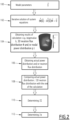
- Figure 2 shows a flow chart of a method of an embodiment of the invention.
- the method may be performed by the processor 18 of the nuclear reactor 1 or of a nuclear power plant comprising the nuclear reactor 1.
- an initial state of the reactor core 7 is determined.
- initial parameters are obtained using the initial state of a reactor core 7.
- the reactor core 7 is partitioned into cubes, which constitute nodes of a grid.
- the initial state of the reactor core 7 includes the parameters the reactor core grid, the reactor core size, the nuclide densities, the material densities the nuclear fuel loading structure and/or the nodal cross sections, which is or are, for example, provided to the processor 18.
- each node being a volume element of the reactor core 7 and in particular a surrounding reflector.
- the reactor core 7 being built as total volume by a few (dozens of) thousands volume elements i.e. nodes.
- a next step 102 the nodal target power distribution p and/or the target 3D neutron flux distribution ⁇ is calculated based on the initial state.
- an iterative process which solves system equations, as shown here below under (1) or (2) is executed, for example by the processor 18.
- a Nodal Expansion Method method is used for that purpose.
- such a process is disclosed in H. Finnemann, F. Bennewitz, M. Wagner, Interface current techniques for multidimensional reactor calculations, Atomkernenergie (ATKE) 30 (1977), referred to as [Finnemann 1977], Y.I. Kim, Y.J. Kim, S.J. Kim, T.K.
- a target 3D nodal power distribution p and/or a target 3D neutron flux distribution ⁇ is calculated using the above iterative process for each node and each energy group. Typically, this is calculated with two energy groups.
- the core's neutronic A-eigenvalue (which is the inverse of the core's effective multiplication factor) is determined iteratively (step 104). In some embodiments, this is shaped as a so-called critical boron concentration search, which finds the specific boron concentration (that influences the thermal macroscopic absorption cross-sections in all nodes directly) that enables a A-eigenvalue that is precisely equal to 1.
- critical boron concentration search finds the specific boron concentration (that influences the thermal macroscopic absorption cross-sections in all nodes directly) that enables a A-eigenvalue that is precisely equal to 1.
- the emerged neutrons have a very high kinetic energy, hence a very high speed with which they start migrating through the reactor.
- Some embodiments additionally include a heuristic adaptation approach that enables a heuristic correction of the computational model, for achieving an overall better agreement with measured 3D power shapes.
- nodal reactor simulators include the application of iterative solution methods, which are used to solve the different relevant systems of equations.
- Such nodal reactor simulators are commercially available and they have been applied since many years now, with examples being ARTEMIS TM (which is part of Framatome's ARCADIA reactor computation tool suite) and PRISM (which is part of Framatome's CASCADE-3D reactor computation tool suite, whose original development dates back to the 1980s and 1990s, of Siemens/KWU.
- reactor codes with extensive industrial application record are NEMO (developed at Framatome Inc in the USA) and SCIENCE (developed by Framatome SAS in France). Details of these systems have been for example published in the following articles R.G. Grummer et al., Siemens Integrated Code System CASCADE-3D for Core Design and Safety Analysis, Proceedings PHYSOR 2000, Pittsburgh, USA (2000 ) (hereafter referred to as [Grummer 2000]), Pautz et al, The ARTEMIS Core Simulator: a Central Component in AREVA NP's Code Convergence Project, Proceedings M&C + SNA 2007, Monterey, USA (2007 ) [hereafter referred to as [Pautz 2007]], and G.
- Hobson et al., ARTEMIS The core simulator of AREVA NP's next generation coupled neutronics-thermalhydraulics code system ARCADIA, Proceedings PHYSOR 2008, Interlaken, Switzerland (2008 ) [hereafter referred to as [Hobson 2008].
- the calculations disclosed in [Grummer 2000], [Hobson 2008] and [Pautz 2007] are incorporated herein by reference. In embodiments, such algorithms may be implemented in step 102.
- the core's neutronic A-eigenvalue is the fundamental eigenvalue associated with the fundamental mode solution of the modelled 3D nodal diffusion equation.
- the term "fundamental eigenvalue” comes the nomenclature as documented in the reference literature on neutron transport modal solutions, which are all solutions of the same eigenvalue equation system, with different eigenvalues and hence different solutions associated with these different eigenvalues.
- the highest (or lowest, depending on the specific eigenvalue definition) is the one associated with specific modal solution that, in dynamic behavior, is the one typically emerging as the dominant one.
- the eigenvalue has the physical meaning of the core's so-called effective multiplication factor, the it is the highest eigenvalue (and its associated 3D solution) that is referred to as fundamental eigenvalue, with its associated 3D solution being the fundamental mode. It is this fundamental mode that will emerge as the result of a neutron transport/diffusion solution process for a stationary reactor state.
- the high energy component of the solution is coupled with the low energy component of the solution, through the associated process cross-sections (for downscattering from the high energy group to the low energy group by moderation of neutrons in water, for absorption of neutrons (in boron, cadmium/control rods, structural material) and for absorption-followed-by-fission (fissionable atoms).
- the influence of the small perturbation will propagate itself over a self-sustaining standing 3D wave of the core-wide neutron flux distribution, as slight change in the global solution of the balanced interplay between neutron absorption, fission, scattering and leakage.
- the effect of the small perturbation will repeatedly travel from its location of origin over the core-wide self-sustaining 3D system solution, all the way towards the system boundary and back, until a new stationary equilibrium is finally established.
- the index l reflects the successive eigenvalue-wise ranking of the modal 3D neutron flux distribution solution ⁇ l for the respective variables.
- the ⁇ l are the higher modal eigenvalues associated with the higher modal solutions ⁇ l .
- the adjoint modes enable the computation of expansion coefficients for forward fundamental mode perturbations in terms of higher forward unperturbed modes, and vice versa.
- a perturbation (with influence on the 3D cross-section distribution ⁇ , including for example the nodal cross-section of absorption or fission ⁇ f and/or ⁇ a , can be imposed anywhere in the nuclear core 7 , whether only in one point/location, in a number of different points/locations, or basically everywhere (such as when perturbing the boron concentration in the nuclear core 7), therefore usually it has to be dealt with a certain spatial distribution of perturbations ; the local non-zero values for the perturbation of the 3D cross-sections distribution ⁇ lead to perturbations ⁇ M ⁇ and ⁇ F ⁇
- the fth mode ⁇ l is excited if the distribution of local operator perturbations (i.e. uncertainties or model imperfections as represented by ⁇ F ⁇ (perturbation of neutron production through fission) and ⁇ M ⁇ (perturbation of neutron absorption, leakage and scattering)) more or less coincides with the spatial shape of the fth adjoint mode ⁇ l ⁇ (and thereby also with the spatial shape of the fth forward mode ⁇ l ). Due to the division by ⁇ l - ⁇ 0 , magnitudes of excited modes of the 3D neutron flux distribution ⁇ l tend to be larger if the associated eigenvalues ⁇ l are closer to ⁇ 0 .
- the term ⁇ represents the difference or change in the 3D neutron flux distribution.
- the 3D neutron flux distribution ⁇ can be also described as vector ⁇ .
- the 3D multi-group neutron flux distribution ⁇ is captured in completeness by the entire collection of solution values per node and per energy group. This adds up to such values for a few (dozens of) thousands of nodes, and sub-arranged per individual node in terms of the different values for each energy group. This entire collection of values can be represented as a vector with length NT ⁇ NG, with NT the number of nodes and NG the number of (energy) groups.
- the vector ⁇ represents the combined, general 3D cross-section distributions, for example of absorption, scattering, transport, fission, etc.. In other words the 3D cross-section distributions ⁇ are used that could be adapted for the desired adaptation purposes.
- A represents the core's neutronic eigenvalue as already introduced here-above.
- the fission rate density is the 3D fission cross-section distribution, which is multiplied with the 3D neutron flux distribution. It is mainly the thermal part of the fission cross-section that, combined with the thermal part of the flux, determines the fission rate.
- the power distribution p is a vector of nodal values attached to each node.
- an actual power distribution and/or the actual 3D neutron flux distribution of the nuclear reactor core is obtained.
- this may be done through measurements and/or reference computations using high fidelity algorithms.
- High fidelity algorithms may be based on 3D Monte Carlo (which today is still computationally expensive/slow, and having high dynamic memory requirements, hence also requiring expensive hardware) or on detailed 3D computations on very fine space-energy meshes, using highly advanced many-group transport methods (with the latter also requiring very long CPU run times, and very expensive memory and hardware requirements
- step 108 the actual power distribution or actual 3D neutron flux distribution is then compared with the calculated target power distribution or the 3D neutron flux distribution ⁇ , respectively. For example, a difference between the target power distribution and the actual power distribution p of the nuclear reactor core and/or a difference ⁇ between the target 3D neutron flux distribution ⁇ and the actual 3D neutron flux distribution of the nuclear reactor core is determined.
- a reactor core's power imbalance sensitivity is actually not necessarily defined specifically in terms of the core's response to specific variations in specific locations, such as imposed in peripheral assemblies; instead it is valid generally with regard to any variation, and the sensitivity is just substantially co-determined by how the 3D distribution of imposed variations pre-adheres to a given modal 3D shape which then it will tend to trigger.
- 3D global power shape effects are excited through perturbation influence propagation only if the 3D cross-section distribution perturbation ⁇ ⁇ is such that at least one of the renormalized modal excitation integrals, as defined by the t l -1 ⁇ j l ⁇
- the MGPT formula has been adapted to the change of the 3D neutron flux distribution ⁇ instead of interface current relationships j, with the solution vector being the interface current j instead of 3D neutron flux distribution ⁇ , with the 3D neutron flux distribution ⁇ being a by-product that can be computed iteratively based on known interface current j.
- MGPT predictions are equated with the Fourier expansion coefficients ⁇ c l for a target change 3D neutron flux distribution ⁇ .
- the MGPT Model Generalized Perturbation Theory
- the first line represents the sum of triggered global modal effects.
- An adjoint matrix corresponds to a transposed conjugated matrix and is marked with " + " and a transposed matrix is marked with " ". .
- the "" symbolize some so-called high-frequency terms that are of lesser importance for the global 3D effect, and of lesser importance due to those having no influence on the values of the modal expansion coefficients ⁇ c l .
- t l ⁇ ⁇ l ⁇
- the expansion coefficients ⁇ c l are provided for the given expansion of the change in the 3D neutron flux distribution ⁇ in terms of the higher modal eigenvector components.
- the ⁇ c l are dimensionless scalar values, ordered per index l.
- the difference between the target power distribution p and the actual power distribution of the nuclear reactor core and/or the difference ⁇ between the target 3D neutron flux distribution ⁇ and the actual 3D neutron flux distribution of the nuclear reactor core can be also decomposed using a Fourier method.
- F denotes the operator of the neutron production through fission.
- the Fourier modal decomposition of the difference of 3D neturon flux distribution may be calculated as follwos.
- Equation 8a With and by pre-multiplication of Equation 8a with which yields: ⁇ j _ k ⁇
- ⁇ j _ HF ⁇ ⁇ 0
- Equation 8e can then yield the specific target values for themodal expansion coefficients that the searched 3D cross-section distribution perturbation ⁇ must enable.
- these same modal expansion coefficients also follow from MGPT in terms of the formula: ⁇ c l ⁇ 1 t l ⁇ 0 ⁇ ⁇ l ⁇ j _ l ⁇
- the formula 8g corresponds essentially to the formula 5a above with except the factor C 1 .
- Figure 8 confirms this formula.
- the factor C 1 relates to the propagation the nodal flux influences towards the nodal outcurrents leaving the node. From a mathematical point of view, it is clear that many different 3D cross-section distribution perturbation ⁇ can enable the same value for ⁇ j _ l ⁇
- step 110 the modal expansion coefficients ⁇ c l are determined using a Fourier modal decomposition based on the determined difference ( ⁇ ) and applying a Modal Generalized Perturbation Theory (MGPT) to the modal expansion coefficients ( ⁇ c l ) for determining a 3D cross-section distribution perturbation ( ⁇ ) causing the determined difference ( ⁇ ).
- MGPT Modal Generalized Perturbation Theory
- Reducing the representation of (the longer wavelengh part of) a change in the 3D neutron flux distribution ⁇ refers to the fact that the changes in the 3D solution can be analysed as being a weighted sum of triggered higher modal 3D solutions, with the most relevant being the ones with eigenvalues closest to the fundamental eigenvalues.
- These specific lower non-fundamental modes feature modest spatial curvatures that can be characterized as long waves, with regions of + or - sign being relatively large. The higher the mode, the higher the different spatial regions with different + or - signs for the local solution values, hence the shorter the wavelengths (and, in terms of Fourier analysis terminology, the higher the frequency).
- the wavelenghts refers in particular to the propagation of the perturbation.
- the ROM enables representing 3D multi-group core-wide flux solution change distributions in terms of merely few dimensionless expansion coefficients.
- a 3D cross-section distribution perturbation ⁇ responsible for an observed ⁇ can be estimated by a fitting approach in order to estimate a convenient orthogonal basis of the ROM, the generalized notation for which is: min ⁇ ⁇ ⁇ ⁇ c ⁇ ⁇ ⁇ ⁇ ⁇ c ⁇ ⁇ ⁇ ⁇
- ⁇ c represents a vector of the expansion coefficients.
- the minimum of the difference between the equations 7 and 8 i.e. the difference between the expansion coefficients ( ⁇ c l ) calculated by applying a Modal Generalized Perturbation Theory and the modal expansion coefficients ( ⁇ c l ) determined by using the Fourier modal decomposition, is determined on order to obtain the 3D cross-section distribution perturbation ⁇ responsible for an observed difference or change in the 3D neutron flux distribution ⁇ , see step 112.
- Equation (9) is a mathematically rigorous manner of expressing the objective of determining a 3D cross-section perturbation distribution ⁇ that, from the perspective of the entire collection of modal expansion coefficients , enables an overall optimum agreement between the 3D neutron flux distribution and/or power distribution solution as computed by the (adapted) model, vs the target 3D neutron flux distribution ⁇ and/or power distribution p.
- Equation (8g) For any given ⁇ it is possible, according to an embodiment, to determine the difference in any l -th modal expansion coefficient ⁇ c l [ ⁇ ] (for any mode with some index f), versus the target value ⁇ c l [ ⁇ ] as associated with any mode with some index l : ⁇ c l [ ⁇ ] - ⁇ c l [ ⁇ ].
- this difference ⁇ c l [ ⁇ ] - ⁇ c l [ ⁇ ] is ideally reduced to zero from the perspective of every individual modal expansion component indexed with l.
- This means mathematically that the sum of squared differences ( ⁇ c l [ ⁇ ] - ⁇ c l [ ⁇ ] ) 2 , as summed over l 1,2,3,4,..., should be minimized (and ideally reduced to zero) by optimum choice for ⁇ .
- This sum of squared differences has the convenient property that its absolute minimum value (which is zero) is achieved only if indeed all individual, l-wise differences are reduced to zero.
- This is the conventional manner of expressing such multidimensional fitting optimization challenges.
- the achieved advantage is that the dimension of the fitting space is very much reduced to merely a few relevant modal expansion coefficients that should be pushed towards accurate numerical agreement.
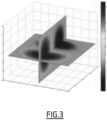
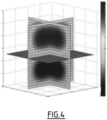
- Figures 3 to 5 illustrate some typical spatial shapes (specifically for the first three and first radial successive modal solutions), which are the principal components in the ROM, by enabling the above-mentioned modal expansion basis.
- Figure 3 shows east west azimuthal modes and Figure 4 a top bottom mode of higher modal solutions
- the east-west azimuthal modes and north-south modes are the (degenerate) 1 st and 2 nd mode
- the top-bottom mode is the 3 rd mode
- Figure 5 the 10 th mode
- Figure 6 the 48 th mode.
- constraints 3D cross-section distribution perturbation ⁇ (for example using only variations in fast diffusion coefficients as a 3D core wide distribution, only variations in fast diffusion coefficients only for the reflector nodes, only variations in the water density, only variations in a certain cross-section type (fission, absorption, or thermal fast neutrons)) can be selected in order to enable both the exact solution of the 3D power match equations and the enforcement the minimum-magnitude adaptation solution for that.
- a 3D cross-section distribution perturbation ⁇ may have to be constrained in the following possible manners:
- Figure 7 shows an example of a given known 3D cross-section distribution perturbation (or uncertainty) ⁇ , which is a ring of 1 % elevations in thermal absorption cross-sections. This means that the neutron absorption is increased of about 1% in this area.
- Figure 7 shows a simulated root cause of for a difference or change in the 3D neutron flux distribution ⁇ .
- the Figure 8 illustrates the agreement between the expansion coefficients of the MGPT (based on the cause 3D cross-section distribution perturbation ⁇ ) versus the Fourier (based on the effect ⁇ ).
- Both index n used in Figure 8 corresponds to the index l.
- Both expansion coefficients ⁇ c l are associated with the 3D effects of perturbations, hence with perturbation effects ⁇ as due to perturbations ⁇ .
- the expansion coefficient ⁇ c l can be directly determined by by the MGPT formula explained here-above with respect to equation 7.
- the Fourier values follow from application of the Fourier filtering formula as explained above with respect to the equations 8, 8a to 8e.
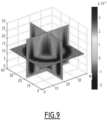
- Figures 8 and 9 show that MGPT can be used as a valid method for the calculation.
- the mathematical basis for the procedure is matching Eq.(8e) with Eq.(8g).
- the modal expansion coefficients ⁇ c l as determined by the MGPT formula must be matched with the modal expansion coefficients that (as a function of the 3D target (or observed) solution discrepancy distribution) follow from using Eq.(8g).
- the associated higher modal solutions for the adjoint /forward interface currents j + l and j l in the actual MGPT and Fourier expressions are used.
- An adjoint matrix corresponds to a transposed conjugated matrix and is marked with " " " .
- modal eigenvectors used as expansion functions, are meant can be solved (iteratively), through use ot the multi-modal deflation process as described in R. van Geemert, MODAL ANALYSIS OF 3D FULL-CORE INHOMOGENEOUS ADJOINT NODAL EQUATIONS AND ASSOCIATED ITERATIVE SOLUTION PROCESSES, Proceedings M&C 2019, Portland OR, USA (2019 ), which is incorporated by reference herein.
- a transfer operator T ⁇ x is introduced that symbolizes how a feasible 3D adaptation distribution ⁇ x of tuning parameters can influence the local nodal cross-section distribution ⁇ .
- the transfer operator T ⁇ x is used for enabling modal match optimizations with constraints, such as when users will only want to vary reflector properties, only vary moderator densities, and/or for making the computed power shape match the target power shape as much as possible.
- the varied quantities are then constrained spatially, and/or they are not cross-sections and they influence the cross-sections through indirect mechanisms.
- the Transfer operator is used for modeling the effect of variations in the tuning quantities on the 3D cross section distribution ⁇ , which may be used as input for MGPT calculations.
- ⁇ x can be constrainted to certain cross-section types, and to certain spatial subregions such as the radial and/or axial reflectors, or to certain groups of assemblies or control rods.
- ⁇ x denotes the general distribution of tuning parameters, for example moderator densities in fuel, or moderator densities in the reflector (which is spatially constrained) that act upon the nodal cross sections.
- the 3D cross-section distribution perturbation ⁇ being a (usually constrained) function of ⁇ x.
- ⁇ x is a vector length up to the number of nodes in the core, for example 10 4 to 10 5 .
- the modal match equations then boil down to: ⁇ ⁇ _ x l ⁇
- ⁇ x _ ⁇ ⁇ l ⁇ c l target with the ⁇ c l (target) denoting the target values for the expansion coefficients, as associated with a target solution deviation between the measured value and the calculated value in step 108.
- L is some number between 10 and 100, whereas the 3D adaptation distribution ⁇ x is typically defined for some few (tens of) thousands of nodes. Due to this, there are actually many different 3D adaptation distributions ⁇ x that fulfil these modal match equations.
- the overall discrepancy source distribution can be assumed to be related to model imperfections, such as use of diffusion instead of transport, imperfect reflector models, etc.
- the discrepancy root cause distribution will typically show peaks in areas such as fuel / reflector interface and within-core areas featuring large transitions in material properties. These give rise typically to modal shapes for the deviation in 3D power distribution.
- some known heuristic adaptation procedures define a modal shape for the adaptation in the model, instead of striving to find a physically plausible adaptation that might actually point out the imperfections in the model. These heuristic adaptations also typically imply a larger departure from the uncorrected model, also in inner-core areas in which the model approximations are actually well-justified.
- a 3D deviational shape is translated towards a minimum-norm, plausible (root cause) adaptation distribution ⁇ x.
- the equation (9) is the property that must be reached in any case, which however has mathematically several different solutions of which most have no physical meaning or are uninteresting.
- the present disclosure includes the derivation of application-tailored sensitivity expressions (based on MGPT as stated above with respect to Equations (5a), (8) constrained to Equation (9c) which can be tailored to applications using Equations (9) to (13), which describe how a choice for ⁇ x , that imposes constraints on the feasible ⁇ can nonetheless be handled appropriately by the present disclosure), modal sensitivity vectors ⁇ xl , and the derivation/formation of an orthonormal expansion basis with which the minimal-L2-norm solution can be spanned and solved (i.e. lower-diagonal system eventually).
- L2 refers to the Hilbert space, spanned by the orthogonoalized sensitivity expansion vectors.
- these adaptation distributions ⁇ x also focus on parts of the system where a root cause concentration is most plausible due to being most influential in spite of being small , combined with the (Occam's razor-like or Artificial Intelligence-like) assumption that the most plausible adaptation distribution ⁇ x is not rarely the one with the highest inherent influence propagation potential (i.e. the "usual suspects", such as the fuel-reflector interface which is hard to model highly accurately using nodal diffusion instead of fine-grid transport).
- this adaptation should preferably be consistent with that. It is exactly this kind of ( numerically smaller ) 3D adaptation distribution adaptation distribution ⁇ x that the new approach enables to determine, through the inversion procedure in particular comprising the Occam's razor principle through guaranteed minimization of the adaptation's L2-norm.
- the distinguished property is that, from a numerical point of view, a minimal overall local departure from the uncorrected state is enabled, because the adaptation change is minimal (i.e.
- the enabled 3D adaptation distributions ⁇ x offer the property of not only enabling the exact target global power shape deviation, they also provides info on which minimum- necessary distribution of root causes would have caused the globally observed discrepancy, it gives specific info on:
- Figure 11 illustrates a typical lower-diagonal structure of B.
- the matrix B allows a direct, non-iterative inversion of B, wherein each axis represents the modal indices.
- the coefficients ⁇ xl acquire a meaning once the precise manner in which they are solved is decided and applied, otherwise they are dimensionless. Their meaning is defined in terms of being the expansion coefficients associated with the minimum-necessary adaptation.
- the quadratic norm having the specific property that it is the lowest possibly overall 3D adaptation magnitude, if indeed the 3D adaptation distribution ⁇ x is constructed in this specific manner.
- the squares signify the use of the quadratic norm.
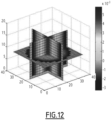
- FIG. 12 shows a calculation using a heuristic model
- figure 13 shows a calculation using the method according to the invention.
- 3D core power shape is essentially determined by how the different fuel assemblies (with varying degrees of fuel burnup) are loaded/ordered in the core, in other words the power of the nuclear reactor 7 at different locations in the nuclear core.
- the 3D nuclear power shape includes detailed information on the power level (as correlated to the fission rate combined with the local thermal flux value) in the different spatial and/or nodal positions in the core, with hence radial and axial dependence.
- the 3D core power shape provides valuable information about the actual 3D distribution of imperfections in the unadapted model, which can be acted upon in the context of pursuing application-targeted model fidelity improvements in large-scale-applied nodal reactor codes.
- an automated determination of an optimal 3D core adaptation for target 3D power distribution is enabled, that is numerically minimized (i.e. minimal integral quadratic norm), enables the target 3D power shape very comprehensively (in terms of exactly matching the main modal longer wavelength shape components), has a true physical meaning (such as auto-included local nodal transport corrections), enables nodal model quality boot-up while keeping the computational efficiency, has the advantages of nodal models, provides plausible insight about deviation root causes, and/or thereby also helps in complex 3D root cause analysis (such as for large pressurized water reactors (PWRs).
- the 3D adaptation distribution ⁇ x of the invention could be used to:
- the method according to the invention includes for example the following principle: the automated minimization of the adaptation's overall magnitude in terms of its so-called quadratic norm.
- quadratic norm For the modal formulation of the 3D power shape adaptation optimization challenge, there are actually infinitely many solutions. These are the infinitely many 3D adaptation distributions ⁇ x that would enable exactly the same multi-modal match.
- the basic assumption is that, among these infinitely many solutions, the one with the smallest overall quadratic norm magnitude must be the one with the highest physical plausibility, or at least must be the one with the highest desirability.
- the 3D adaptation distributions ⁇ x can actually be interpreted as automated corrections for inherent model deficiencies as due to the coarse (but computationally very attractive) few-group nodal diffusion approach, with uncertainties in cross-sections. This is then possibly the closest one can get to the ideal-yet-unavailable high-fidelity core model (whose unadapted solution would already enable the perfect 3D match with reality), while yet keeping the computational efficiency and conceptual simplicity of a nodal reactor core model.
Landscapes
- Engineering & Computer Science (AREA)
- Physics & Mathematics (AREA)
- General Engineering & Computer Science (AREA)
- Plasma & Fusion (AREA)
- High Energy & Nuclear Physics (AREA)
- Monitoring And Testing Of Nuclear Reactors (AREA)
Priority Applications (4)
| Application Number | Priority Date | Filing Date | Title |
|---|---|---|---|
| EP21306504.8A EP4174875B1 (fr) | 2021-10-27 | 2021-10-27 | Procédé mis en oeuvre par ordinateur pour simuler le fonctionnement d'un coeur de réacteur |
| PCT/EP2022/079792 WO2023072937A1 (fr) | 2021-10-27 | 2022-10-25 | Procédé mis en œuvre par ordinateur pour simuler le fonctionnement d'un cœur de réacteur |
| US18/705,363 US20250006391A1 (en) | 2021-10-27 | 2022-10-25 | Computer implemented method for simulating an operation of a reactor core |
| CN202280072527.8A CN118176547A (zh) | 2021-10-27 | 2022-10-25 | 用于模拟反应堆堆芯运行的计算机实施的方法 |
Applications Claiming Priority (1)
| Application Number | Priority Date | Filing Date | Title |
|---|---|---|---|
| EP21306504.8A EP4174875B1 (fr) | 2021-10-27 | 2021-10-27 | Procédé mis en oeuvre par ordinateur pour simuler le fonctionnement d'un coeur de réacteur |
Publications (2)
| Publication Number | Publication Date |
|---|---|
| EP4174875A1 true EP4174875A1 (fr) | 2023-05-03 |
| EP4174875B1 EP4174875B1 (fr) | 2024-07-10 |
Family
ID=79021832
Family Applications (1)
| Application Number | Title | Priority Date | Filing Date |
|---|---|---|---|
| EP21306504.8A Active EP4174875B1 (fr) | 2021-10-27 | 2021-10-27 | Procédé mis en oeuvre par ordinateur pour simuler le fonctionnement d'un coeur de réacteur |
Country Status (4)
| Country | Link |
|---|---|
| US (1) | US20250006391A1 (fr) |
| EP (1) | EP4174875B1 (fr) |
| CN (1) | CN118176547A (fr) |
| WO (1) | WO2023072937A1 (fr) |
Cited By (1)
| Publication number | Priority date | Publication date | Assignee | Title |
|---|---|---|---|---|
| WO2024259878A1 (fr) * | 2023-06-19 | 2024-12-26 | 中广核研究院有限公司 | Procédé et appareil d'analyse de l'incertitude de mesure de la distribution de puissance d'un cœur de réacteur, et dispositif |
Families Citing this family (3)
| Publication number | Priority date | Publication date | Assignee | Title |
|---|---|---|---|---|
| CN118398260B (zh) * | 2024-04-18 | 2025-01-24 | 上海交通大学 | 核反应堆堆芯中子通量分布变化的快速推断方法 |
| CN119397124B (zh) * | 2024-09-20 | 2025-11-21 | 华能核能技术研究院有限公司 | 反应堆堆芯功率分布在线监测敏感性系数计算方法及系统 |
| CN120413112A (zh) * | 2025-04-24 | 2025-08-01 | 西安热工研究院有限公司 | 压水堆一回路硼浓度预测及控制方法及系统 |
Citations (2)
| Publication number | Priority date | Publication date | Assignee | Title |
|---|---|---|---|---|
| CN101399091A (zh) | 2008-11-07 | 2009-04-01 | 西安交通大学 | 一种用于在线监测核反应堆堆芯中子通量分布的方法 |
| EP2287853B1 (fr) | 2009-08-18 | 2012-10-03 | Areva NP | Procédé informatique pour modéliser un coeur d'un réacteur nucléaire et programme informatique correspondant |
-
2021
- 2021-10-27 EP EP21306504.8A patent/EP4174875B1/fr active Active
-
2022
- 2022-10-25 CN CN202280072527.8A patent/CN118176547A/zh active Pending
- 2022-10-25 WO PCT/EP2022/079792 patent/WO2023072937A1/fr not_active Ceased
- 2022-10-25 US US18/705,363 patent/US20250006391A1/en active Pending
Patent Citations (2)
| Publication number | Priority date | Publication date | Assignee | Title |
|---|---|---|---|---|
| CN101399091A (zh) | 2008-11-07 | 2009-04-01 | 西安交通大学 | 一种用于在线监测核反应堆堆芯中子通量分布的方法 |
| EP2287853B1 (fr) | 2009-08-18 | 2012-10-03 | Areva NP | Procédé informatique pour modéliser un coeur d'un réacteur nucléaire et programme informatique correspondant |
Non-Patent Citations (9)
| Title |
|---|
| ANDREAS PAUTZ ET AL: "THE ARTEMIS CORE SIMULATOR: A CENTRAL COMPONENT IN AREVA NP's CODE CONVERGENCE PROJECT", CD-ROM, 15 April 2007 (2007-04-15), XP055253393, Retrieved from the Internet <URL:http://citeseerx.ist.psu.edu/viewdoc/download?doi=10.1.1.204.9095&rep=rep1&type=pdf> * |
| G. HOBSON ET AL.: "ARTEMIS: The core simulator of AREVA NP's next generation coupled neutronics-thermalhydraulics code system ARCADIA", PROCEEDINGS PHYSOR 2008, 2008 |
| GANDINI: "Implicit and Explicit Higher Order Perturbation Methods for Nuclear Reactor Analysis", NUCLEAR SCIENCE AND ENGINEERING, vol. 67, 1987, pages 347 |
| J.J. DUDERSTADTL.J. HAMILTON: "Nuclear Reactor Analysis", 1975, WILEY & SONS |
| PAUTZ ET AL.: "The ARTEMIS Core Simulator: a Central Component in AREVA NP's Code Convergence Project", PROCEEDINGS M&C + SNA 2007, MONTEREY, USA |
| R. VAN GEEMERT: "Analysis of Sensitivity and Uncertainty Propagation for Industrial Reactor Simulation Tools", LECTURE NOTES PROVIDED FOR THE FREDERIC JOLIOT & OTTO HAHN (FJOH) SUMMER SCHOOL IN NUCLEAR REACTOR PHYSICS |
| R.G. GRUMMER ET AL.: "Siemens Integrated Code System CASCADE-3D for Core Design and Safety Analysis", PROCEEDINGS PHYSOR, 2000 |
| VAN GEEMERT R: "MODAL ANALYSIS OF 3D FULL-CORE INHOMOGENEOUS ADJOINT NODAL EQUATIONS AND ASSOCIATED ITERATIVE SOLUTION PROCESSES", INTERNATIONAL CONFERENCE ON MATHEMATICS AND COMPUTATIONAL METHODS APPLIED TO NUCLEAR SCIENCE AND ENGINEERING (M & C 2019) : PORTLAND, OREGON, USA, 25-29 AUGUST 2019, vol. 3, 29 August 2019 (2019-08-29), USA, pages 1544 - 1561, XP055901773, ISBN: 978-1-5108-9619-2, Retrieved from the Internet <URL:https://www.ans.org/pubs/proceedings/article-46738/> * |
| Y.I. KIMY.J. KIMS.J. KIMT.K. KIM: "A semi-analytic multi-group nodal method", ANNALS OF NUCLEAR ENERGY, vol. 26, 1999, pages 699 - 708 |
Cited By (1)
| Publication number | Priority date | Publication date | Assignee | Title |
|---|---|---|---|---|
| WO2024259878A1 (fr) * | 2023-06-19 | 2024-12-26 | 中广核研究院有限公司 | Procédé et appareil d'analyse de l'incertitude de mesure de la distribution de puissance d'un cœur de réacteur, et dispositif |
Also Published As
| Publication number | Publication date |
|---|---|
| EP4174875B1 (fr) | 2024-07-10 |
| CN118176547A (zh) | 2024-06-11 |
| WO2023072937A1 (fr) | 2023-05-04 |
| US20250006391A1 (en) | 2025-01-02 |
Similar Documents
| Publication | Publication Date | Title |
|---|---|---|
| EP4174875B1 (fr) | Procédé mis en oeuvre par ordinateur pour simuler le fonctionnement d'un coeur de réacteur | |
| Wang et al. | Analysis of BEAVRS two-cycle benchmark using RMC based on full core detailed model | |
| US20180254109A1 (en) | System and method for modeling a nuclear reactor | |
| Ivanov et al. | High fidelity simulation of conventional and innovative LWR with the coupled Monte-Carlo thermal-hydraulic system MCNP-SUBCHANFLOW | |
| Knebel et al. | Validation of the Serpent 2-DYNSUB code sequence using the special power excursion reactor test III (SPERT III) | |
| Aghaie et al. | Coupled neutronic thermal–hydraulic transient analysis of accidents in PWRs | |
| Pusa et al. | Uncertainty analysis of assembly and core-level calculations with application to CASMO-4E and SIMULATE-3 | |
| Abdel-Khalik et al. | Uncertainty quantification, sensitivity analysis, and data assimilation for nuclear systems simulation | |
| Fitzgerald | Parallel 3-d method of characteristics with linear source and advanced transverse integration | |
| Nyalunga et al. | Quantification and propagation of neutronics uncertainties of the Kozloduy-6 VVER-1000 fuel assembly using SCALE 6.2. 1 within the NEA/OECD benchmark for uncertainty analysis in modelling of LWRs | |
| Trottier et al. | Nuclear data sensitivity for reactor physics parameters in a lead-cooled reactor | |
| Ćalić et al. | Use of Effective Diffusion Homogenization method with the Monte Carlo code for light water reactor | |
| Jiménez et al. | Comparative analysis of neutronics/thermal-hydraulics multi-scale coupling for LWR analysis | |
| Elzohery | On model-order reduction in neutronic systems via POD-galerkin projection | |
| Zhong et al. | Continuous-energy multidimensional SN transport for problem-dependent resonance self-shielding calculations | |
| Njayou Tsepeng et al. | Representativity studies of GEN-III large cores to ZPR experiments with respect to nuclear data: A first step towards transposition | |
| Yoon et al. | COMBINE7. 1-A portable ENDF/B-VII. 0 Based Neutron Spectrum and Cross-Section Generation Program | |
| Kutlu | Development of a Coupled Code Between MCNP6. 2 and CTF4. 0 for VVER Applications | |
| Ball | Uncertainty analysis in lattice reactor physics calculations | |
| Jessee et al. | Many-group cross-section adjustment techniques for boiling water reactor adaptive simulation | |
| Bartel | Analysis and Improvement of the bRAPID Algorithm and its Implementation | |
| Ni | A High-to-Low Iterative Method for Light Water Reactor Analysis | |
| Patel | Novel Uncertainty Quantification Method for Computational Reactor Design Analysis of Nuclear Thermal Propulsion Cores | |
| Kim et al. | Verification and Validation of the ENDF/B-VII. 1 v4. 3m1 MPACT 51-Group Cross Section Library | |
| Wyant et al. | Numerical study of error propagation in Monte Carlo depletion simulations |
Legal Events
| Date | Code | Title | Description |
|---|---|---|---|
| PUAI | Public reference made under article 153(3) epc to a published international application that has entered the european phase |
Free format text: ORIGINAL CODE: 0009012 |
|
| STAA | Information on the status of an ep patent application or granted ep patent |
Free format text: STATUS: THE APPLICATION HAS BEEN PUBLISHED |
|
| STAA | Information on the status of an ep patent application or granted ep patent |
Free format text: STATUS: REQUEST FOR EXAMINATION WAS MADE |
|
| AK | Designated contracting states |
Kind code of ref document: A1 Designated state(s): AL AT BE BG CH CY CZ DE DK EE ES FI FR GB GR HR HU IE IS IT LI LT LU LV MC MK MT NL NO PL PT RO RS SE SI SK SM TR |
|
| 17P | Request for examination filed |
Effective date: 20230407 |
|
| RBV | Designated contracting states (corrected) |
Designated state(s): AL AT BE BG CH CY CZ DE DK EE ES FI FR GB GR HR HU IE IS IT LI LT LU LV MC MK MT NL NO PL PT RO RS SE SI SK SM TR |
|
| STAA | Information on the status of an ep patent application or granted ep patent |
Free format text: STATUS: EXAMINATION IS IN PROGRESS |
|
| 17Q | First examination report despatched |
Effective date: 20230705 |
|
| GRAP | Despatch of communication of intention to grant a patent |
Free format text: ORIGINAL CODE: EPIDOSNIGR1 |
|
| STAA | Information on the status of an ep patent application or granted ep patent |
Free format text: STATUS: GRANT OF PATENT IS INTENDED |
|
| INTG | Intention to grant announced |
Effective date: 20240223 |
|
| RIN1 | Information on inventor provided before grant (corrected) |
Inventor name: VAN GEEMERT, RENE |
|
| GRAS | Grant fee paid |
Free format text: ORIGINAL CODE: EPIDOSNIGR3 |
|
| GRAA | (expected) grant |
Free format text: ORIGINAL CODE: 0009210 |
|
| STAA | Information on the status of an ep patent application or granted ep patent |
Free format text: STATUS: THE PATENT HAS BEEN GRANTED |
|
| AK | Designated contracting states |
Kind code of ref document: B1 Designated state(s): AL AT BE BG CH CY CZ DE DK EE ES FI FR GB GR HR HU IE IS IT LI LT LU LV MC MK MT NL NO PL PT RO RS SE SI SK SM TR |
|
| REG | Reference to a national code |
Ref country code: CH Ref legal event code: EP |
|
| REG | Reference to a national code |
Ref country code: DE Ref legal event code: R096 Ref document number: 602021015439 Country of ref document: DE |
|
| REG | Reference to a national code |
Ref country code: SE Ref legal event code: TRGR |
|
| REG | Reference to a national code |
Ref country code: LT Ref legal event code: MG9D |
|
| REG | Reference to a national code |
Ref country code: NL Ref legal event code: MP Effective date: 20240710 |
|
| PG25 | Lapsed in a contracting state [announced via postgrant information from national office to epo] |
Ref country code: PT Free format text: LAPSE BECAUSE OF FAILURE TO SUBMIT A TRANSLATION OF THE DESCRIPTION OR TO PAY THE FEE WITHIN THE PRESCRIBED TIME-LIMIT Effective date: 20241111 |
|
| REG | Reference to a national code |
Ref country code: AT Ref legal event code: MK05 Ref document number: 1702788 Country of ref document: AT Kind code of ref document: T Effective date: 20240710 |
|
| PG25 | Lapsed in a contracting state [announced via postgrant information from national office to epo] |
Ref country code: NL Free format text: LAPSE BECAUSE OF FAILURE TO SUBMIT A TRANSLATION OF THE DESCRIPTION OR TO PAY THE FEE WITHIN THE PRESCRIBED TIME-LIMIT Effective date: 20240710 |
|
| PG25 | Lapsed in a contracting state [announced via postgrant information from national office to epo] |
Ref country code: PT Free format text: LAPSE BECAUSE OF FAILURE TO SUBMIT A TRANSLATION OF THE DESCRIPTION OR TO PAY THE FEE WITHIN THE PRESCRIBED TIME-LIMIT Effective date: 20241111 Ref country code: NL Free format text: LAPSE BECAUSE OF FAILURE TO SUBMIT A TRANSLATION OF THE DESCRIPTION OR TO PAY THE FEE WITHIN THE PRESCRIBED TIME-LIMIT Effective date: 20240710 |
|
| PG25 | Lapsed in a contracting state [announced via postgrant information from national office to epo] |
Ref country code: NO Free format text: LAPSE BECAUSE OF FAILURE TO SUBMIT A TRANSLATION OF THE DESCRIPTION OR TO PAY THE FEE WITHIN THE PRESCRIBED TIME-LIMIT Effective date: 20241010 |
|
| PG25 | Lapsed in a contracting state [announced via postgrant information from national office to epo] |
Ref country code: FI Free format text: LAPSE BECAUSE OF FAILURE TO SUBMIT A TRANSLATION OF THE DESCRIPTION OR TO PAY THE FEE WITHIN THE PRESCRIBED TIME-LIMIT Effective date: 20240710 Ref country code: GR Free format text: LAPSE BECAUSE OF FAILURE TO SUBMIT A TRANSLATION OF THE DESCRIPTION OR TO PAY THE FEE WITHIN THE PRESCRIBED TIME-LIMIT Effective date: 20241011 Ref country code: PL Free format text: LAPSE BECAUSE OF FAILURE TO SUBMIT A TRANSLATION OF THE DESCRIPTION OR TO PAY THE FEE WITHIN THE PRESCRIBED TIME-LIMIT Effective date: 20240710 |
|
| PG25 | Lapsed in a contracting state [announced via postgrant information from national office to epo] |
Ref country code: BG Free format text: LAPSE BECAUSE OF FAILURE TO SUBMIT A TRANSLATION OF THE DESCRIPTION OR TO PAY THE FEE WITHIN THE PRESCRIBED TIME-LIMIT Effective date: 20240710 |
|
| PG25 | Lapsed in a contracting state [announced via postgrant information from national office to epo] |
Ref country code: LV Free format text: LAPSE BECAUSE OF FAILURE TO SUBMIT A TRANSLATION OF THE DESCRIPTION OR TO PAY THE FEE WITHIN THE PRESCRIBED TIME-LIMIT Effective date: 20240710 |
|
| PG25 | Lapsed in a contracting state [announced via postgrant information from national office to epo] |
Ref country code: AT Free format text: LAPSE BECAUSE OF FAILURE TO SUBMIT A TRANSLATION OF THE DESCRIPTION OR TO PAY THE FEE WITHIN THE PRESCRIBED TIME-LIMIT Effective date: 20240710 Ref country code: IS Free format text: LAPSE BECAUSE OF FAILURE TO SUBMIT A TRANSLATION OF THE DESCRIPTION OR TO PAY THE FEE WITHIN THE PRESCRIBED TIME-LIMIT Effective date: 20241110 |
|
| PG25 | Lapsed in a contracting state [announced via postgrant information from national office to epo] |
Ref country code: HR Free format text: LAPSE BECAUSE OF FAILURE TO SUBMIT A TRANSLATION OF THE DESCRIPTION OR TO PAY THE FEE WITHIN THE PRESCRIBED TIME-LIMIT Effective date: 20240710 |
|
| PG25 | Lapsed in a contracting state [announced via postgrant information from national office to epo] |
Ref country code: ES Free format text: LAPSE BECAUSE OF FAILURE TO SUBMIT A TRANSLATION OF THE DESCRIPTION OR TO PAY THE FEE WITHIN THE PRESCRIBED TIME-LIMIT Effective date: 20240710 Ref country code: RS Free format text: LAPSE BECAUSE OF FAILURE TO SUBMIT A TRANSLATION OF THE DESCRIPTION OR TO PAY THE FEE WITHIN THE PRESCRIBED TIME-LIMIT Effective date: 20241010 |
|
| PG25 | Lapsed in a contracting state [announced via postgrant information from national office to epo] |
Ref country code: RS Free format text: LAPSE BECAUSE OF FAILURE TO SUBMIT A TRANSLATION OF THE DESCRIPTION OR TO PAY THE FEE WITHIN THE PRESCRIBED TIME-LIMIT Effective date: 20241010 Ref country code: PL Free format text: LAPSE BECAUSE OF FAILURE TO SUBMIT A TRANSLATION OF THE DESCRIPTION OR TO PAY THE FEE WITHIN THE PRESCRIBED TIME-LIMIT Effective date: 20240710 Ref country code: NO Free format text: LAPSE BECAUSE OF FAILURE TO SUBMIT A TRANSLATION OF THE DESCRIPTION OR TO PAY THE FEE WITHIN THE PRESCRIBED TIME-LIMIT Effective date: 20241010 Ref country code: LV Free format text: LAPSE BECAUSE OF FAILURE TO SUBMIT A TRANSLATION OF THE DESCRIPTION OR TO PAY THE FEE WITHIN THE PRESCRIBED TIME-LIMIT Effective date: 20240710 Ref country code: IS Free format text: LAPSE BECAUSE OF FAILURE TO SUBMIT A TRANSLATION OF THE DESCRIPTION OR TO PAY THE FEE WITHIN THE PRESCRIBED TIME-LIMIT Effective date: 20241110 Ref country code: HR Free format text: LAPSE BECAUSE OF FAILURE TO SUBMIT A TRANSLATION OF THE DESCRIPTION OR TO PAY THE FEE WITHIN THE PRESCRIBED TIME-LIMIT Effective date: 20240710 Ref country code: GR Free format text: LAPSE BECAUSE OF FAILURE TO SUBMIT A TRANSLATION OF THE DESCRIPTION OR TO PAY THE FEE WITHIN THE PRESCRIBED TIME-LIMIT Effective date: 20241011 Ref country code: FI Free format text: LAPSE BECAUSE OF FAILURE TO SUBMIT A TRANSLATION OF THE DESCRIPTION OR TO PAY THE FEE WITHIN THE PRESCRIBED TIME-LIMIT Effective date: 20240710 Ref country code: ES Free format text: LAPSE BECAUSE OF FAILURE TO SUBMIT A TRANSLATION OF THE DESCRIPTION OR TO PAY THE FEE WITHIN THE PRESCRIBED TIME-LIMIT Effective date: 20240710 Ref country code: BG Free format text: LAPSE BECAUSE OF FAILURE TO SUBMIT A TRANSLATION OF THE DESCRIPTION OR TO PAY THE FEE WITHIN THE PRESCRIBED TIME-LIMIT Effective date: 20240710 Ref country code: AT Free format text: LAPSE BECAUSE OF FAILURE TO SUBMIT A TRANSLATION OF THE DESCRIPTION OR TO PAY THE FEE WITHIN THE PRESCRIBED TIME-LIMIT Effective date: 20240710 |
|
| REG | Reference to a national code |
Ref country code: DE Ref legal event code: R097 Ref document number: 602021015439 Country of ref document: DE |
|
| PG25 | Lapsed in a contracting state [announced via postgrant information from national office to epo] |
Ref country code: SM Free format text: LAPSE BECAUSE OF FAILURE TO SUBMIT A TRANSLATION OF THE DESCRIPTION OR TO PAY THE FEE WITHIN THE PRESCRIBED TIME-LIMIT Effective date: 20240710 Ref country code: RO Free format text: LAPSE BECAUSE OF FAILURE TO SUBMIT A TRANSLATION OF THE DESCRIPTION OR TO PAY THE FEE WITHIN THE PRESCRIBED TIME-LIMIT Effective date: 20240710 Ref country code: DK Free format text: LAPSE BECAUSE OF FAILURE TO SUBMIT A TRANSLATION OF THE DESCRIPTION OR TO PAY THE FEE WITHIN THE PRESCRIBED TIME-LIMIT Effective date: 20240710 |
|
| PG25 | Lapsed in a contracting state [announced via postgrant information from national office to epo] |
Ref country code: EE Free format text: LAPSE BECAUSE OF FAILURE TO SUBMIT A TRANSLATION OF THE DESCRIPTION OR TO PAY THE FEE WITHIN THE PRESCRIBED TIME-LIMIT Effective date: 20240710 |
|
| PG25 | Lapsed in a contracting state [announced via postgrant information from national office to epo] |
Ref country code: CZ Free format text: LAPSE BECAUSE OF FAILURE TO SUBMIT A TRANSLATION OF THE DESCRIPTION OR TO PAY THE FEE WITHIN THE PRESCRIBED TIME-LIMIT Effective date: 20240710 |
|
| PG25 | Lapsed in a contracting state [announced via postgrant information from national office to epo] |
Ref country code: SK Free format text: LAPSE BECAUSE OF FAILURE TO SUBMIT A TRANSLATION OF THE DESCRIPTION OR TO PAY THE FEE WITHIN THE PRESCRIBED TIME-LIMIT Effective date: 20240710 Ref country code: IT Free format text: LAPSE BECAUSE OF FAILURE TO SUBMIT A TRANSLATION OF THE DESCRIPTION OR TO PAY THE FEE WITHIN THE PRESCRIBED TIME-LIMIT Effective date: 20240710 |
|
| REG | Reference to a national code |
Ref country code: DE Ref legal event code: R119 Ref document number: 602021015439 Country of ref document: DE |
|
| PLBE | No opposition filed within time limit |
Free format text: ORIGINAL CODE: 0009261 |
|
| STAA | Information on the status of an ep patent application or granted ep patent |
Free format text: STATUS: NO OPPOSITION FILED WITHIN TIME LIMIT |
|
| REG | Reference to a national code |
Ref country code: CH Ref legal event code: PL |
|
| 26N | No opposition filed |
Effective date: 20250411 |
|
| PG25 | Lapsed in a contracting state [announced via postgrant information from national office to epo] |
Ref country code: MC Free format text: LAPSE BECAUSE OF FAILURE TO SUBMIT A TRANSLATION OF THE DESCRIPTION OR TO PAY THE FEE WITHIN THE PRESCRIBED TIME-LIMIT Effective date: 20240710 |
|
| PG25 | Lapsed in a contracting state [announced via postgrant information from national office to epo] |
Ref country code: DE Free format text: LAPSE BECAUSE OF NON-PAYMENT OF DUE FEES Effective date: 20250501 |
|
| PG25 | Lapsed in a contracting state [announced via postgrant information from national office to epo] |
Ref country code: LU Free format text: LAPSE BECAUSE OF NON-PAYMENT OF DUE FEES Effective date: 20241027 Ref country code: BE Free format text: LAPSE BECAUSE OF NON-PAYMENT OF DUE FEES Effective date: 20241031 |
|
| PG25 | Lapsed in a contracting state [announced via postgrant information from national office to epo] |
Ref country code: CH Free format text: LAPSE BECAUSE OF NON-PAYMENT OF DUE FEES Effective date: 20241031 |
|
| REG | Reference to a national code |
Ref country code: BE Ref legal event code: MM Effective date: 20241031 |
|
| PG25 | Lapsed in a contracting state [announced via postgrant information from national office to epo] |
Ref country code: IE Free format text: LAPSE BECAUSE OF NON-PAYMENT OF DUE FEES Effective date: 20241027 |
|
| PGFP | Annual fee paid to national office [announced via postgrant information from national office to epo] |
Ref country code: GB Payment date: 20251023 Year of fee payment: 5 |
|
| PGFP | Annual fee paid to national office [announced via postgrant information from national office to epo] |
Ref country code: FR Payment date: 20251027 Year of fee payment: 5 |
|
| PGFP | Annual fee paid to national office [announced via postgrant information from national office to epo] |
Ref country code: SE Payment date: 20251029 Year of fee payment: 5 |
|
| PG25 | Lapsed in a contracting state [announced via postgrant information from national office to epo] |
Ref country code: CY Free format text: LAPSE BECAUSE OF FAILURE TO SUBMIT A TRANSLATION OF THE DESCRIPTION OR TO PAY THE FEE WITHIN THE PRESCRIBED TIME-LIMIT; INVALID AB INITIO Effective date: 20211027 |
|
| PG25 | Lapsed in a contracting state [announced via postgrant information from national office to epo] |
Ref country code: HU Free format text: LAPSE BECAUSE OF FAILURE TO SUBMIT A TRANSLATION OF THE DESCRIPTION OR TO PAY THE FEE WITHIN THE PRESCRIBED TIME-LIMIT; INVALID AB INITIO Effective date: 20211027 |