EP4175016A1 - Verfahren zur inertisierung von elektrochemischen akkumulatoren, insbesondere metall-ionen-batterien, durch anfängliches eintauchen in eine niedrigtemperatur-calciumchloridlösung und elektrische kurzschlüsse zur zerkleinerung davon - Google Patents
Verfahren zur inertisierung von elektrochemischen akkumulatoren, insbesondere metall-ionen-batterien, durch anfängliches eintauchen in eine niedrigtemperatur-calciumchloridlösung und elektrische kurzschlüsse zur zerkleinerung davon Download PDFInfo
- Publication number
- EP4175016A1 EP4175016A1 EP22203030.6A EP22203030A EP4175016A1 EP 4175016 A1 EP4175016 A1 EP 4175016A1 EP 22203030 A EP22203030 A EP 22203030A EP 4175016 A1 EP4175016 A1 EP 4175016A1
- Authority
- EP
- European Patent Office
- Prior art keywords
- accumulator
- accumulators
- aqueous solution
- temperature
- inerting
- Prior art date
- Legal status (The legal status is an assumption and is not a legal conclusion. Google has not performed a legal analysis and makes no representation as to the accuracy of the status listed.)
- Pending
Links
- 238000000034 method Methods 0.000 title claims abstract description 31
- UXVMQQNJUSDDNG-UHFFFAOYSA-L Calcium chloride Chemical compound [Cl-].[Cl-].[Ca+2] UXVMQQNJUSDDNG-UHFFFAOYSA-L 0.000 title claims abstract description 13
- 238000007654 immersion Methods 0.000 title claims abstract description 12
- 229910021645 metal ion Inorganic materials 0.000 title abstract description 6
- 239000007864 aqueous solution Substances 0.000 claims abstract description 35
- 239000007788 liquid Substances 0.000 claims abstract description 16
- 150000003839 salts Chemical class 0.000 claims description 26
- 238000001816 cooling Methods 0.000 claims description 21
- 239000000203 mixture Substances 0.000 claims description 18
- 229910001416 lithium ion Inorganic materials 0.000 claims description 14
- 238000004064 recycling Methods 0.000 claims description 13
- 238000004806 packaging method and process Methods 0.000 claims description 6
- WHXSMMKQMYFTQS-UHFFFAOYSA-N Lithium Chemical compound [Li] WHXSMMKQMYFTQS-UHFFFAOYSA-N 0.000 claims description 5
- 229910052744 lithium Inorganic materials 0.000 claims description 5
- OKTJSMMVPCPJKN-UHFFFAOYSA-N Carbon Chemical compound [C] OKTJSMMVPCPJKN-UHFFFAOYSA-N 0.000 claims description 3
- 229910002992 LiNi0.33Mn0.33Co0.33O2 Inorganic materials 0.000 claims description 3
- RTAQQCXQSZGOHL-UHFFFAOYSA-N Titanium Chemical compound [Ti] RTAQQCXQSZGOHL-UHFFFAOYSA-N 0.000 claims description 3
- 229910002804 graphite Inorganic materials 0.000 claims description 3
- 239000010439 graphite Substances 0.000 claims description 3
- 229910012851 LiCoO 2 Inorganic materials 0.000 claims description 2
- 229910010707 LiFePO 4 Inorganic materials 0.000 claims description 2
- 239000007773 negative electrode material Substances 0.000 claims 1
- 239000007774 positive electrode material Substances 0.000 claims 1
- 239000000243 solution Substances 0.000 abstract description 40
- 239000001110 calcium chloride Substances 0.000 abstract description 9
- 229910001628 calcium chloride Inorganic materials 0.000 abstract description 9
- 238000010438 heat treatment Methods 0.000 abstract description 7
- 238000010521 absorption reaction Methods 0.000 abstract description 2
- FAPWRFPIFSIZLT-UHFFFAOYSA-M Sodium chloride Chemical compound [Na+].[Cl-] FAPWRFPIFSIZLT-UHFFFAOYSA-M 0.000 description 13
- 238000009434 installation Methods 0.000 description 8
- IJGRMHOSHXDMSA-UHFFFAOYSA-N Atomic nitrogen Chemical compound N#N IJGRMHOSHXDMSA-UHFFFAOYSA-N 0.000 description 7
- HBBGRARXTFLTSG-UHFFFAOYSA-N Lithium ion Chemical compound [Li+] HBBGRARXTFLTSG-UHFFFAOYSA-N 0.000 description 6
- 239000011780 sodium chloride Substances 0.000 description 6
- UFHFLCQGNIYNRP-UHFFFAOYSA-N Hydrogen Chemical compound [H][H] UFHFLCQGNIYNRP-UHFFFAOYSA-N 0.000 description 5
- 238000006243 chemical reaction Methods 0.000 description 3
- 230000000694 effects Effects 0.000 description 3
- 238000004880 explosion Methods 0.000 description 3
- 239000007789 gas Substances 0.000 description 3
- 239000001257 hydrogen Substances 0.000 description 3
- 229910052739 hydrogen Inorganic materials 0.000 description 3
- 230000007062 hydrolysis Effects 0.000 description 3
- 238000006460 hydrolysis reaction Methods 0.000 description 3
- 229910052757 nitrogen Inorganic materials 0.000 description 3
- 239000007787 solid Substances 0.000 description 3
- XLYOFNOQVPJJNP-UHFFFAOYSA-N water Substances O XLYOFNOQVPJJNP-UHFFFAOYSA-N 0.000 description 3
- 206010011906 Death Diseases 0.000 description 2
- 239000012080 ambient air Substances 0.000 description 2
- 229910052799 carbon Inorganic materials 0.000 description 2
- 230000005518 electrochemistry Effects 0.000 description 2
- 238000005868 electrolysis reaction Methods 0.000 description 2
- 239000000463 material Substances 0.000 description 2
- 239000012266 salt solution Substances 0.000 description 2
- 239000000126 substance Substances 0.000 description 2
- 230000002123 temporal effect Effects 0.000 description 2
- WFKWXMTUELFFGS-UHFFFAOYSA-N tungsten Chemical compound [W] WFKWXMTUELFFGS-UHFFFAOYSA-N 0.000 description 2
- 229910052721 tungsten Inorganic materials 0.000 description 2
- 239000010937 tungsten Substances 0.000 description 2
- 229910010490 Li4TiO5O12 Inorganic materials 0.000 description 1
- 229910032387 LiCoO2 Inorganic materials 0.000 description 1
- 229910052493 LiFePO4 Inorganic materials 0.000 description 1
- JLVVSXFLKOJNIY-UHFFFAOYSA-N Magnesium ion Chemical compound [Mg+2] JLVVSXFLKOJNIY-UHFFFAOYSA-N 0.000 description 1
- FKNQFGJONOIPTF-UHFFFAOYSA-N Sodium cation Chemical compound [Na+] FKNQFGJONOIPTF-UHFFFAOYSA-N 0.000 description 1
- 241000897276 Termes Species 0.000 description 1
- 240000008042 Zea mays Species 0.000 description 1
- QVGXLLKOCUKJST-UHFFFAOYSA-N atomic oxygen Chemical compound [O] QVGXLLKOCUKJST-UHFFFAOYSA-N 0.000 description 1
- 230000003416 augmentation Effects 0.000 description 1
- 238000007599 discharging Methods 0.000 description 1
- 238000005553 drilling Methods 0.000 description 1
- 239000003792 electrolyte Substances 0.000 description 1
- 230000007613 environmental effect Effects 0.000 description 1
- 238000003912 environmental pollution Methods 0.000 description 1
- 230000005496 eutectics Effects 0.000 description 1
- 239000002360 explosive Substances 0.000 description 1
- 239000003517 fume Substances 0.000 description 1
- 239000011244 liquid electrolyte Substances 0.000 description 1
- 239000007791 liquid phase Substances 0.000 description 1
- 229910001425 magnesium ion Inorganic materials 0.000 description 1
- 238000004519 manufacturing process Methods 0.000 description 1
- 238000002844 melting Methods 0.000 description 1
- 230000008018 melting Effects 0.000 description 1
- 239000001301 oxygen Substances 0.000 description 1
- 229910052760 oxygen Inorganic materials 0.000 description 1
- 239000011347 resin Substances 0.000 description 1
- 229920005989 resin Polymers 0.000 description 1
- 229910001415 sodium ion Inorganic materials 0.000 description 1
- 231100000331 toxic Toxicity 0.000 description 1
- 230000002588 toxic effect Effects 0.000 description 1
- 230000007704 transition Effects 0.000 description 1
- 238000009423 ventilation Methods 0.000 description 1
Images


Classifications
-
- H—ELECTRICITY
- H01—ELECTRIC ELEMENTS
- H01M—PROCESSES OR MEANS, e.g. BATTERIES, FOR THE DIRECT CONVERSION OF CHEMICAL ENERGY INTO ELECTRICAL ENERGY
- H01M6/00—Primary cells; Manufacture thereof
- H01M6/52—Reclaiming serviceable parts of waste cells or batteries, e.g. recycling
-
- H—ELECTRICITY
- H01—ELECTRIC ELEMENTS
- H01M—PROCESSES OR MEANS, e.g. BATTERIES, FOR THE DIRECT CONVERSION OF CHEMICAL ENERGY INTO ELECTRICAL ENERGY
- H01M10/00—Secondary cells; Manufacture thereof
- H01M10/05—Accumulators with non-aqueous electrolyte
- H01M10/052—Li-accumulators
- H01M10/0525—Rocking-chair batteries, i.e. batteries with lithium insertion or intercalation in both electrodes; Lithium-ion batteries
-
- H—ELECTRICITY
- H01—ELECTRIC ELEMENTS
- H01M—PROCESSES OR MEANS, e.g. BATTERIES, FOR THE DIRECT CONVERSION OF CHEMICAL ENERGY INTO ELECTRICAL ENERGY
- H01M10/00—Secondary cells; Manufacture thereof
- H01M10/54—Reclaiming serviceable parts of waste accumulators
-
- H—ELECTRICITY
- H01—ELECTRIC ELEMENTS
- H01M—PROCESSES OR MEANS, e.g. BATTERIES, FOR THE DIRECT CONVERSION OF CHEMICAL ENERGY INTO ELECTRICAL ENERGY
- H01M10/00—Secondary cells; Manufacture thereof
- H01M10/60—Heating or cooling; Temperature control
- H01M10/61—Types of temperature control
- H01M10/613—Cooling or keeping cold
-
- H—ELECTRICITY
- H01—ELECTRIC ELEMENTS
- H01M—PROCESSES OR MEANS, e.g. BATTERIES, FOR THE DIRECT CONVERSION OF CHEMICAL ENERGY INTO ELECTRICAL ENERGY
- H01M10/00—Secondary cells; Manufacture thereof
- H01M10/60—Heating or cooling; Temperature control
- H01M10/65—Means for temperature control structurally associated with the cells
- H01M10/656—Means for temperature control structurally associated with the cells characterised by the type of heat-exchange fluid
- H01M10/6567—Liquids
-
- H—ELECTRICITY
- H01—ELECTRIC ELEMENTS
- H01M—PROCESSES OR MEANS, e.g. BATTERIES, FOR THE DIRECT CONVERSION OF CHEMICAL ENERGY INTO ELECTRICAL ENERGY
- H01M4/00—Electrodes
- H01M4/02—Electrodes composed of, or comprising, active material
- H01M4/13—Electrodes for accumulators with non-aqueous electrolyte, e.g. for lithium-accumulators; Processes of manufacture thereof
- H01M4/131—Electrodes based on mixed oxides or hydroxides, or on mixtures of oxides or hydroxides, e.g. LiCoOx
-
- H—ELECTRICITY
- H01—ELECTRIC ELEMENTS
- H01M—PROCESSES OR MEANS, e.g. BATTERIES, FOR THE DIRECT CONVERSION OF CHEMICAL ENERGY INTO ELECTRICAL ENERGY
- H01M4/00—Electrodes
- H01M4/02—Electrodes composed of, or comprising, active material
- H01M4/13—Electrodes for accumulators with non-aqueous electrolyte, e.g. for lithium-accumulators; Processes of manufacture thereof
- H01M4/133—Electrodes based on carbonaceous material, e.g. graphite-intercalation compounds or CFx
-
- H—ELECTRICITY
- H01—ELECTRIC ELEMENTS
- H01M—PROCESSES OR MEANS, e.g. BATTERIES, FOR THE DIRECT CONVERSION OF CHEMICAL ENERGY INTO ELECTRICAL ENERGY
- H01M4/00—Electrodes
- H01M4/02—Electrodes composed of, or comprising, active material
- H01M4/36—Selection of substances as active materials, active masses, active liquids
- H01M4/38—Selection of substances as active materials, active masses, active liquids of elements or alloys
- H01M4/40—Alloys based on alkali metals
- H01M4/405—Alloys based on lithium
-
- H—ELECTRICITY
- H01—ELECTRIC ELEMENTS
- H01M—PROCESSES OR MEANS, e.g. BATTERIES, FOR THE DIRECT CONVERSION OF CHEMICAL ENERGY INTO ELECTRICAL ENERGY
- H01M4/00—Electrodes
- H01M4/02—Electrodes composed of, or comprising, active material
- H01M4/36—Selection of substances as active materials, active masses, active liquids
- H01M4/48—Selection of substances as active materials, active masses, active liquids of inorganic oxides or hydroxides
- H01M4/485—Selection of substances as active materials, active masses, active liquids of inorganic oxides or hydroxides of mixed oxides or hydroxides for inserting or intercalating light metals, e.g. LiTi2O4 or LiTi2OxFy
-
- H—ELECTRICITY
- H01—ELECTRIC ELEMENTS
- H01M—PROCESSES OR MEANS, e.g. BATTERIES, FOR THE DIRECT CONVERSION OF CHEMICAL ENERGY INTO ELECTRICAL ENERGY
- H01M4/00—Electrodes
- H01M4/02—Electrodes composed of, or comprising, active material
- H01M4/36—Selection of substances as active materials, active masses, active liquids
- H01M4/48—Selection of substances as active materials, active masses, active liquids of inorganic oxides or hydroxides
- H01M4/50—Selection of substances as active materials, active masses, active liquids of inorganic oxides or hydroxides of manganese
- H01M4/505—Selection of substances as active materials, active masses, active liquids of inorganic oxides or hydroxides of manganese of mixed oxides or hydroxides containing manganese for inserting or intercalating light metals, e.g. LiMn2O4 or LiMn2OxFy
-
- H—ELECTRICITY
- H01—ELECTRIC ELEMENTS
- H01M—PROCESSES OR MEANS, e.g. BATTERIES, FOR THE DIRECT CONVERSION OF CHEMICAL ENERGY INTO ELECTRICAL ENERGY
- H01M4/00—Electrodes
- H01M4/02—Electrodes composed of, or comprising, active material
- H01M4/36—Selection of substances as active materials, active masses, active liquids
- H01M4/48—Selection of substances as active materials, active masses, active liquids of inorganic oxides or hydroxides
- H01M4/52—Selection of substances as active materials, active masses, active liquids of inorganic oxides or hydroxides of nickel, cobalt or iron
- H01M4/525—Selection of substances as active materials, active masses, active liquids of inorganic oxides or hydroxides of nickel, cobalt or iron of mixed oxides or hydroxides containing iron, cobalt or nickel for inserting or intercalating light metals, e.g. LiNiO2, LiCoO2 or LiCoOxFy
-
- H—ELECTRICITY
- H01—ELECTRIC ELEMENTS
- H01M—PROCESSES OR MEANS, e.g. BATTERIES, FOR THE DIRECT CONVERSION OF CHEMICAL ENERGY INTO ELECTRICAL ENERGY
- H01M4/00—Electrodes
- H01M4/02—Electrodes composed of, or comprising, active material
- H01M4/36—Selection of substances as active materials, active masses, active liquids
- H01M4/58—Selection of substances as active materials, active masses, active liquids of inorganic compounds other than oxides or hydroxides, e.g. sulfides, selenides, tellurides, halogenides or LiCoFy; of polyanionic structures, e.g. phosphates, silicates or borates
- H01M4/583—Carbonaceous material, e.g. graphite-intercalation compounds or CFx
-
- B—PERFORMING OPERATIONS; TRANSPORTING
- B09—DISPOSAL OF SOLID WASTE; RECLAMATION OF CONTAMINATED SOIL
- B09B—DISPOSAL OF SOLID WASTE NOT OTHERWISE PROVIDED FOR
- B09B2101/00—Type of solid waste
- B09B2101/15—Electronic waste
- B09B2101/16—Batteries
-
- B—PERFORMING OPERATIONS; TRANSPORTING
- B09—DISPOSAL OF SOLID WASTE; RECLAMATION OF CONTAMINATED SOIL
- B09B—DISPOSAL OF SOLID WASTE NOT OTHERWISE PROVIDED FOR
- B09B3/00—Destroying solid waste or transforming solid waste into something useful or harmless
- B09B3/30—Destroying solid waste or transforming solid waste into something useful or harmless involving mechanical treatment
- B09B3/35—Shredding, crushing or cutting
-
- H—ELECTRICITY
- H01—ELECTRIC ELEMENTS
- H01M—PROCESSES OR MEANS, e.g. BATTERIES, FOR THE DIRECT CONVERSION OF CHEMICAL ENERGY INTO ELECTRICAL ENERGY
- H01M4/00—Electrodes
- H01M4/02—Electrodes composed of, or comprising, active material
- H01M2004/026—Electrodes composed of, or comprising, active material characterised by the polarity
- H01M2004/027—Negative electrodes
-
- H—ELECTRICITY
- H01—ELECTRIC ELEMENTS
- H01M—PROCESSES OR MEANS, e.g. BATTERIES, FOR THE DIRECT CONVERSION OF CHEMICAL ENERGY INTO ELECTRICAL ENERGY
- H01M4/00—Electrodes
- H01M4/02—Electrodes composed of, or comprising, active material
- H01M2004/026—Electrodes composed of, or comprising, active material characterised by the polarity
- H01M2004/028—Positive electrodes
-
- Y—GENERAL TAGGING OF NEW TECHNOLOGICAL DEVELOPMENTS; GENERAL TAGGING OF CROSS-SECTIONAL TECHNOLOGIES SPANNING OVER SEVERAL SECTIONS OF THE IPC; TECHNICAL SUBJECTS COVERED BY FORMER USPC CROSS-REFERENCE ART COLLECTIONS [XRACs] AND DIGESTS
- Y02—TECHNOLOGIES OR APPLICATIONS FOR MITIGATION OR ADAPTATION AGAINST CLIMATE CHANGE
- Y02E—REDUCTION OF GREENHOUSE GAS [GHG] EMISSIONS, RELATED TO ENERGY GENERATION, TRANSMISSION OR DISTRIBUTION
- Y02E60/00—Enabling technologies; Technologies with a potential or indirect contribution to GHG emissions mitigation
- Y02E60/10—Energy storage using batteries
-
- Y—GENERAL TAGGING OF NEW TECHNOLOGICAL DEVELOPMENTS; GENERAL TAGGING OF CROSS-SECTIONAL TECHNOLOGIES SPANNING OVER SEVERAL SECTIONS OF THE IPC; TECHNICAL SUBJECTS COVERED BY FORMER USPC CROSS-REFERENCE ART COLLECTIONS [XRACs] AND DIGESTS
- Y02—TECHNOLOGIES OR APPLICATIONS FOR MITIGATION OR ADAPTATION AGAINST CLIMATE CHANGE
- Y02W—CLIMATE CHANGE MITIGATION TECHNOLOGIES RELATED TO WASTEWATER TREATMENT OR WASTE MANAGEMENT
- Y02W30/00—Technologies for solid waste management
- Y02W30/50—Reuse, recycling or recovery technologies
- Y02W30/52—Mechanical processing of waste for the recovery of materials, e.g. crushing, shredding, separation or disassembly
-
- Y—GENERAL TAGGING OF NEW TECHNOLOGICAL DEVELOPMENTS; GENERAL TAGGING OF CROSS-SECTIONAL TECHNOLOGIES SPANNING OVER SEVERAL SECTIONS OF THE IPC; TECHNICAL SUBJECTS COVERED BY FORMER USPC CROSS-REFERENCE ART COLLECTIONS [XRACs] AND DIGESTS
- Y02—TECHNOLOGIES OR APPLICATIONS FOR MITIGATION OR ADAPTATION AGAINST CLIMATE CHANGE
- Y02W—CLIMATE CHANGE MITIGATION TECHNOLOGIES RELATED TO WASTEWATER TREATMENT OR WASTE MANAGEMENT
- Y02W30/00—Technologies for solid waste management
- Y02W30/50—Reuse, recycling or recovery technologies
- Y02W30/84—Recycling of batteries or fuel cells
Definitions
- the present invention relates to the field of electrochemical accumulators, and more particularly metal-ion accumulators or other chemistries (lead, etc.).
- the invention aims in the first place to guarantee the electric discharge of accumulators by short-circuiting before their recycling, and without generating a thermal runaway of said accumulators.
- the invention applies to any metal-ion electrochemical battery, that is to say also sodium-ion, magnesium-ion, aluminum-ion, or even others. chemicals (Lead..)...
- the inerting of lithium-ion batteries is an essential step prior to the recycling process as such to ensure the safety of people and the environment during their recycling. Indeed, one of the stages of recycling consists in carrying out the grinding of the accumulators.
- a process that allows rapid and secure discharge of a large quantity of accumulators so that they can be recycled afterwards consists of immersing the accumulators, previously separated from each other, in a tank containing an NaCl solution of given concentration.
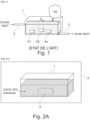
- FIG. 1 schematically represents an installation implementing such a process: the accumulators A1, A2, ..Ax whose electrochemistry is still active are immersed in a tank 1 containing a solution of NaCl introduced by a supply conduit 2. The solution of NaCl can be extracted through outlet pipe 3.
- each accumulator with active electrochemistry discharges electrically gradually.
- the flow of hydrogen which can be released by the hydrolysis can be significant.
- the quantity of dihydrogen generated by the hydrolysis is all the higher as the number of accumulators is large.
- the patent US5888463A proposes to immerse lithium batteries in liquid nitrogen, which is at a temperature of the order of -196°C, then to grind them. This technique makes it possible to crush the batteries while guaranteeing that they do not go into thermal runaway.
- the use of liquid nitrogen is expensive and requires going down to extremely low temperatures (-196°C).
- the devices, in particular for grinding, must therefore be specifically designed to be able to withstand these temperatures, which adds an additional cost to the process.
- the object of the invention is to meet this need at least in part.
- step i/ consists of supplying an aqueous solution of calcium chloride (CaCl2).
- the concentration is advantageously between 0% and 30% by mass of CaCl2.
- the temperature determined in step 0/ is greater than or equal to -50°C.
- step iv/ is carried out by piercing or crushing the packaging of the accumulator(s).
- step iv/ is carried out for a period (t) of between 0.5 and 7 hours, preferably less than 4 hours.
- the invention also relates to a process for inerting a plurality of electrochemical accumulators as described previously, the plurality of accumulators being assembled within a module or a battery pack during steps iii/ and iv/ and, where applicable, disassembled at the end of step iv/.
- Another subject of the invention is an accumulator electrically discharged according to the method described above.
- the invention also relates to a method for recycling electrochemical accumulators, comprising a step of grinding accumulators resulting from the method described previously.
- the grinding step is carried out subsequently to step v/ and if necessary in another installation than that implementing steps i/ to v/.
- the invention essentially consists in generating a short-circuit of electrochemical accumulators immersed in an aqueous solution of CaCl 2 whose low temperature in the liquid state, typically -50°C, guarantees the thermal absorption of the heating of the accumulators and therefore certainly avoids their thermal runaway, and this beforehand and independently of the crushing of the accumulators.
- thermo runaway For the thermal runaway phenomenon, see publication [1] and the protocol described in this publication.
- the so-called “thermal runaway” temperature is denoted T2 in this publication.
- the temperature T2 is the temperature from which the accumulator heats up at a typical heating rate of 10°C/min under adiabatic conditions, which leads to the melting of the separator in the electrochemical bundle of the accumulator , to a short circuit and thus to the collapse of the voltage.
- thermo runaway a ratio between the value of the derivative of the heating temperature and that of the time at least equal to 0.02° C. per min.
- FIG. 1 relates to an installation implementing direct inerting of a plurality of Li-ion accumulators according to the state of the art. This figure 1 has already been commented on in the preamble and is therefore not commented on further below.
- salts in aqueous mixtures can be used when the mixture has a eutectic at the desired temperature.
- NaCl salt 23.3% by mass allowing to reach -21°C.
- other salts KCl, MgCl 2 or a mixture of salts.
- An aqueous solution of CaCl 2 whose concentration is between 0% and 30% by mass in CaCl2 makes it possible to reach temperatures between 0°C and -50°C in the liquid state.
- the lowest cooling temperature in the liquid phase is of the order of -50°C. Indeed, with this mass concentration, the solution is liquid down to -50°C, a temperature which makes it possible to have a sufficient passive heat exchange coefficient with the accumulator(s) to absorb their heating during their electrical discharge and in in any case avoid their thermal runaway. This is the choice made here.
- Stage i/ an aqueous solution of salt or mixture of salts as defined previously, here of calcium chloride, is provided at a mass concentration of 30%.
- Stage ii/ At this concentration, the solution is cooled to the temperature defined above.
- Steps iii/ in a tank 1 filled with the aqueous solution of calcium chloride CaCl 2 at 30% mass concentration, at least one Li-ion accumulator A is immersed, which is placed in an enclosure 2 cooled and maintained at -50° VS ( figure 2A ).
- Stage iv/ The tank 1 containing the accumulator A and the aqueous solution cooled to -50° C. is then taken out of the enclosure 2 and placed in the ambient air under an extractor hood, not shown.
- the packaging of the accumulator A is then pierced by a nail 3, in order to generate a short circuit ( figure 2B ). It is specified here that any means of piercing other than a nail, suitable for piercing the packaging of the accumulator, can be used.
- the heating linked to the short-circuit is thermally absorbed by the cooled solution until the total electrical discharge of accumulator A.
- Accumulator A can thus be crushed in order to carry out its recycling without any risk of fire or explosion.
- a solution for crushing an accumulator of cylindrical geometry A is shown in picture 3 : a bar of semi-circular section 4 is moved to crush the packaging of the accumulator A.
- the advantage of a crushing solution is that this can prevent the liquid electrolyte contained in the accumulator A from flow outside of its packaging and therefore allows both not to contaminate the bath and to keep the physical integrity of the accumulator.
- preserving the physical integrity of accumulators A facilitates their transport and storage, before they are crushed for recycling. It is thus possible to carry out the grinding step in a place other than immersion with a short circuit, in complete safety.
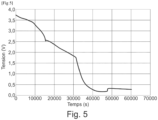
- the inventors conducted a test, in order to verify the feasibility of the inerting process according to the invention.
- This 18650 accumulator was immersed in a bath containing an aqueous solution of CaCl 2 with a mass concentration equal to 30% and cooled to -50°C.
- Thermocouples were placed on the terminals of the accumulator and in the CaCl 2 solution in order to monitor the heating of the accumulator.
- thermocouples designate the temperatures measured by the thermocouples positioned respectively in the ambient air, in the aqueous solution of CaCl 2 , at the positive output terminal of the accumulator, at the negative terminal , and on the tungsten nail that made the hole.
- the example illustrated concerns a single accumulator: it goes without saying that the same steps can be implemented for a plurality of accumulators, if necessary still assembled in modules or in a battery pack when they are short-circuited by drilling or crush.
Landscapes
- Chemical & Material Sciences (AREA)
- Chemical Kinetics & Catalysis (AREA)
- Electrochemistry (AREA)
- General Chemical & Material Sciences (AREA)
- Engineering & Computer Science (AREA)
- Manufacturing & Machinery (AREA)
- Materials Engineering (AREA)
- Inorganic Chemistry (AREA)
- Life Sciences & Earth Sciences (AREA)
- Sustainable Development (AREA)
- Secondary Cells (AREA)
- Chemical Treatment Of Metals (AREA)
- Battery Electrode And Active Subsutance (AREA)
- Environmental & Geological Engineering (AREA)
Applications Claiming Priority (1)
| Application Number | Priority Date | Filing Date | Title |
|---|---|---|---|
| FR2111377A FR3128587B1 (fr) | 2021-10-26 | 2021-10-26 | Procédé d’inertage d’accumulateurs électrochimiques, notamment métal-ion, par immersion initiale dans une solution de chlorure de calcium à basse température, puis court-circuitage électrique en vue de leur broyage. |
Publications (1)
| Publication Number | Publication Date |
|---|---|
| EP4175016A1 true EP4175016A1 (de) | 2023-05-03 |
Family
ID=80122507
Family Applications (1)
| Application Number | Title | Priority Date | Filing Date |
|---|---|---|---|
| EP22203030.6A Pending EP4175016A1 (de) | 2021-10-26 | 2022-10-21 | Verfahren zur inertisierung von elektrochemischen akkumulatoren, insbesondere metall-ionen-batterien, durch anfängliches eintauchen in eine niedrigtemperatur-calciumchloridlösung und elektrische kurzschlüsse zur zerkleinerung davon |
Country Status (6)
| Country | Link |
|---|---|
| US (1) | US20230126198A1 (de) |
| EP (1) | EP4175016A1 (de) |
| JP (1) | JP2023064739A (de) |
| KR (1) | KR20230059761A (de) |
| CN (1) | CN116031520A (de) |
| FR (1) | FR3128587B1 (de) |
Citations (4)
| Publication number | Priority date | Publication date | Assignee | Title |
|---|---|---|---|---|
| US5888463A (en) | 1998-01-02 | 1999-03-30 | Toxco | Li reclamation process |
| US7833646B2 (en) | 2002-02-01 | 2010-11-16 | Batrec Industrie Ag | Method of and apparatus for dismantling and storage of objects comprising alkali metals, such as alkali metal containing batteries |
| KR101275849B1 (ko) * | 2011-05-13 | 2013-06-17 | 엘에스니꼬동제련 주식회사 | 리튬이온전지의 재생공정을 위한 전처리방법 |
| WO2021201151A1 (ja) * | 2020-03-31 | 2021-10-07 | 国立大学法人京都大学 | リチウムイオン二次電池を失活化する方法 |
Family Cites Families (7)
| Publication number | Priority date | Publication date | Assignee | Title |
|---|---|---|---|---|
| JP3080606B2 (ja) * | 1998-03-11 | 2000-08-28 | アサカ理研工業株式会社 | 非水電解液電池の不活性化装置 |
| FR3037725B1 (fr) * | 2015-06-22 | 2021-12-31 | Commissariat Energie Atomique | Procede de realisation d'un faisceau electrochimique d'accumulateur au lithium avec mousse metallique aux extremites de feuillards |
| FR3040550B1 (fr) * | 2015-08-25 | 2017-08-11 | Commissariat Energie Atomique | Batterie au lithium-ion gelifiee |
| FR3041483A1 (fr) * | 2015-09-21 | 2017-03-24 | Commissariat Energie Atomique | Electrolyte liquide hydrocarbone |
| US10205200B2 (en) * | 2016-07-07 | 2019-02-12 | Grst International Limited | Method for recycling lithium-ion battery |
| FR3067170A1 (fr) * | 2017-06-02 | 2018-12-07 | Commissariat A L'energie Atomique Et Aux Energies Alternatives | Traversee formant borne pour accumulateur electrochimique metal-ion, integrant une soupape de liberation des gaz, accumulateur associe |
| FR3085803B1 (fr) * | 2018-09-12 | 2020-10-09 | Commissariat Energie Atomique | Pack-batterie d'accumulateurs, comprenant des shunts magnetiques actionnables sur demande pour la commutation electrique d'un ou plusieurs des accumulateurs |
-
2021
- 2021-10-26 FR FR2111377A patent/FR3128587B1/fr active Active
-
2022
- 2022-10-21 EP EP22203030.6A patent/EP4175016A1/de active Pending
- 2022-10-25 JP JP2022170675A patent/JP2023064739A/ja active Pending
- 2022-10-26 US US18/049,702 patent/US20230126198A1/en active Pending
- 2022-10-26 KR KR1020220139280A patent/KR20230059761A/ko not_active Ceased
- 2022-10-26 CN CN202211320716.0A patent/CN116031520A/zh active Pending
Patent Citations (4)
| Publication number | Priority date | Publication date | Assignee | Title |
|---|---|---|---|---|
| US5888463A (en) | 1998-01-02 | 1999-03-30 | Toxco | Li reclamation process |
| US7833646B2 (en) | 2002-02-01 | 2010-11-16 | Batrec Industrie Ag | Method of and apparatus for dismantling and storage of objects comprising alkali metals, such as alkali metal containing batteries |
| KR101275849B1 (ko) * | 2011-05-13 | 2013-06-17 | 엘에스니꼬동제련 주식회사 | 리튬이온전지의 재생공정을 위한 전처리방법 |
| WO2021201151A1 (ja) * | 2020-03-31 | 2021-10-07 | 国立大学法人京都大学 | リチウムイオン二次電池を失活化する方法 |
Non-Patent Citations (2)
| Title |
|---|
| OJANEN SEVERI ET AL: "Challenging the concept of electrochemical discharge using salt solutions for lithium-ion batteries recycling", WASTE MANAGEMENT., vol. 76, 1 April 2018 (2018-04-01), US, pages 242 - 249, XP055926942, ISSN: 0956-053X, DOI: 10.1016/j.wasman.2018.03.045 * |
| XUNING FENG ET AL.: "Key Characteristics for Thermal Runaway of Li-ion Batteries", ENERGY PROCEDIA, vol. 158, 2019, pages 4684 - 4689, XP085634813, DOI: 10.1016/j.egypro.2019.01.736 |
Also Published As
| Publication number | Publication date |
|---|---|
| CN116031520A (zh) | 2023-04-28 |
| KR20230059761A (ko) | 2023-05-03 |
| FR3128587B1 (fr) | 2024-02-16 |
| US20230126198A1 (en) | 2023-04-27 |
| FR3128587A1 (fr) | 2023-04-28 |
| JP2023064739A (ja) | 2023-05-11 |
Similar Documents
| Publication | Publication Date | Title |
|---|---|---|
| Ren et al. | Investigating the relationship between internal short circuit and thermal runaway of lithium-ion batteries under thermal abuse condition | |
| CN102160220A (zh) | 循环利用具有碱性电解质的电池 | |
| JP2012110850A (ja) | 電池破砕装置および破砕方法 | |
| CA2869911A1 (fr) | Systeme d'accumulateurs et piles aluminium air | |
| JP2022554418A (ja) | 電池不活性化 | |
| EP3948993B1 (de) | Verfahren zum zerkleinern eines elektrochemischen generators | |
| FR2775124A1 (fr) | Accumulateur au lithium, composition cathodique et cathode pour accumulateur au lithium | |
| FR2474195A1 (fr) | Procede de regulation thermique | |
| EP3775323A1 (de) | Elektrochemisches verfahren zur erzeugung von unter druck stehendem wasserstoffgas durch elektrolyse und anschliessende depolarisation | |
| EP4226455B1 (de) | Verfahren zum öffnen eines elektrochemischen generators | |
| WO2021198600A1 (fr) | Procede de recyclage d'une electrode | |
| EP4226454B1 (de) | Verfahren zum entladen eines elektrochemischen generators | |
| EP4011676A1 (de) | Batteriemodul mit mehreren elektrochemischen akkumulatoren und einer vorrichtung zum sprühen von mikrotröpfchen im falle eines thermischen durchgehens von mindestens einem der akkus | |
| FR3128587A1 (fr) | Procédé d’inertage d’accumulateurs électrochimiques, notamment métal-ion, par immersion initiale dans une solution de chlorure de calcium à basse température, puis court-circuitage électrique en vue de leur broyage. | |
| EP4420175A1 (de) | Verfahren zum öffnen eines elektrochemischen generators | |
| FR2816762A1 (fr) | Procede et dispositif de securite pour le demarrage et l'arret d'une pile a combustible | |
| FR3157002A1 (fr) | Procédé de recyclage d’accumulateurs électrochimiques métal-ion hors d’usage et/ou en fin de vie), Appareil et Installation de recyclage associés. | |
| FR3144974A1 (fr) | Source d’énergie pour systeme de gonflage (batterie thermique) | |
| EP3846269A1 (de) | Vorrichtung zum auslösen des thermischen durchgehens eines elektrochemischen akkus, insbesondere eines metall-ionen-akkus, und entsprechendes verfahren | |
| FR3115933A1 (fr) | Système d'alimentation électrique | |
| CA2965086C (fr) | Procede de production d'electricite par une pile a combustible; dispositif associe | |
| WO2024056962A1 (fr) | Procédé d'ouverture et de décharge d'un générateur électrochimique | |
| FR3117271A1 (fr) | Procédé d’inertage d’accumulateurs électrochimiques, notamment métal-ion, par immersion initiale dans une solution de nitrite de sodium puis dans une solution de chlorure de sodium. | |
| CA2894471A1 (fr) | Procede pyrotechnique de mise a disposition d'hydrogene de tres grande purete et dispositif associe | |
| FR3157675A1 (fr) | Procédé d’ouverture et de décharge d’une cellule électrochimique d’une batterie à insertion-désinsertion ionique et procédé de recyclage d’une batterie à insertion-désinsertion ionique |
Legal Events
| Date | Code | Title | Description |
|---|---|---|---|
| PUAI | Public reference made under article 153(3) epc to a published international application that has entered the european phase |
Free format text: ORIGINAL CODE: 0009012 |
|
| STAA | Information on the status of an ep patent application or granted ep patent |
Free format text: STATUS: REQUEST FOR EXAMINATION WAS MADE |
|
| 17P | Request for examination filed |
Effective date: 20221021 |
|
| AK | Designated contracting states |
Kind code of ref document: A1 Designated state(s): AL AT BE BG CH CY CZ DE DK EE ES FI FR GB GR HR HU IE IS IT LI LT LU LV MC ME MK MT NL NO PL PT RO RS SE SI SK SM TR |
|
| RAP3 | Party data changed (applicant data changed or rights of an application transferred) |
Owner name: COMMISSARIAT A L'ENERGIE ATOMIQUE ET AUX ENERGIESALTERNATIVES |