EP4177331A1 - Verfahren und vorrichtung zur nukleinsäuresequenzierung - Google Patents
Verfahren und vorrichtung zur nukleinsäuresequenzierung Download PDFInfo
- Publication number
- EP4177331A1 EP4177331A1 EP21832476.2A EP21832476A EP4177331A1 EP 4177331 A1 EP4177331 A1 EP 4177331A1 EP 21832476 A EP21832476 A EP 21832476A EP 4177331 A1 EP4177331 A1 EP 4177331A1
- Authority
- EP
- European Patent Office
- Prior art keywords
- nanopore
- nucleotide
- nucleic acid
- compartment
- membrane
- Prior art date
- Legal status (The legal status is an assumption and is not a legal conclusion. Google has not performed a legal analysis and makes no representation as to the accuracy of the status listed.)
- Pending
Links
Images



Classifications
-
- C—CHEMISTRY; METALLURGY
- C12—BIOCHEMISTRY; BEER; SPIRITS; WINE; VINEGAR; MICROBIOLOGY; ENZYMOLOGY; MUTATION OR GENETIC ENGINEERING
- C12Q—MEASURING OR TESTING PROCESSES INVOLVING ENZYMES, NUCLEIC ACIDS OR MICROORGANISMS; COMPOSITIONS OR TEST PAPERS THEREFOR; PROCESSES OF PREPARING SUCH COMPOSITIONS; CONDITION-RESPONSIVE CONTROL IN MICROBIOLOGICAL OR ENZYMOLOGICAL PROCESSES
- C12Q1/00—Measuring or testing processes involving enzymes, nucleic acids or microorganisms; Compositions therefor; Processes of preparing such compositions
- C12Q1/68—Measuring or testing processes involving enzymes, nucleic acids or microorganisms; Compositions therefor; Processes of preparing such compositions involving nucleic acids
- C12Q1/6869—Methods for sequencing
-
- G—PHYSICS
- G01—MEASURING; TESTING
- G01N—INVESTIGATING OR ANALYSING MATERIALS BY DETERMINING THEIR CHEMICAL OR PHYSICAL PROPERTIES
- G01N27/00—Investigating or analysing materials by the use of electric, electrochemical, or magnetic means
- G01N27/26—Investigating or analysing materials by the use of electric, electrochemical, or magnetic means by investigating electrochemical variables; by using electrolysis or electrophoresis
- G01N27/416—Systems
- G01N27/447—Systems using electrophoresis
- G01N27/44704—Details; Accessories
- G01N27/44717—Arrangements for investigating the separated zones, e.g. localising zones
- G01N27/4473—Arrangements for investigating the separated zones, e.g. localising zones by electric means
-
- G—PHYSICS
- G01—MEASURING; TESTING
- G01N—INVESTIGATING OR ANALYSING MATERIALS BY DETERMINING THEIR CHEMICAL OR PHYSICAL PROPERTIES
- G01N27/00—Investigating or analysing materials by the use of electric, electrochemical, or magnetic means
- G01N27/26—Investigating or analysing materials by the use of electric, electrochemical, or magnetic means by investigating electrochemical variables; by using electrolysis or electrophoresis
- G01N27/416—Systems
- G01N27/447—Systems using electrophoresis
- G01N27/44756—Apparatus specially adapted therefor
- G01N27/44791—Microapparatus
-
- C—CHEMISTRY; METALLURGY
- C12—BIOCHEMISTRY; BEER; SPIRITS; WINE; VINEGAR; MICROBIOLOGY; ENZYMOLOGY; MUTATION OR GENETIC ENGINEERING
- C12Q—MEASURING OR TESTING PROCESSES INVOLVING ENZYMES, NUCLEIC ACIDS OR MICROORGANISMS; COMPOSITIONS OR TEST PAPERS THEREFOR; PROCESSES OF PREPARING SUCH COMPOSITIONS; CONDITION-RESPONSIVE CONTROL IN MICROBIOLOGICAL OR ENZYMOLOGICAL PROCESSES
- C12Q1/00—Measuring or testing processes involving enzymes, nucleic acids or microorganisms; Compositions therefor; Processes of preparing such compositions
- C12Q1/68—Measuring or testing processes involving enzymes, nucleic acids or microorganisms; Compositions therefor; Processes of preparing such compositions involving nucleic acids
- C12Q1/6806—Preparing nucleic acids for analysis, e.g. for polymerase chain reaction [PCR] assay
Definitions
- the present invention belongs to the field of nucleic acid sequencing, specifically, a technique for sequencing by synthesis of nucleic acids through a nanopore (Sequencing by Synthesis), and specifically relates to a nucleic acid sequencing method.
- the method at least one modified nucleotide for nucleic acid synthesis is separated from a nucleic acid sequence to be analyzed and other components on both sides of a bimolecular membrane, and the synthesis reaction is carried out when the modified nucleotide is transferred to the other side of the bimolecular membrane through a nanopore embedded in the bimolecular membrane under the action of voltage, and base type of the nucleotide is determined according to a change in electrical propertie of the nanopore caused by the transfer of the modified nucleotide by the nanopore, thus enabling sequencing.
- RNA molecules due to their own charged nature, spontaneously cross the nanopore in an electric field and cause a change in the resistance of the nanopore during the crossing, generating the so-called blocking current.
- the four different bases of DNA (RNA), A, T(U), C and G have recognizable differences in their blocking effects on the current generated when crossing the nanopore due to their own chemical structures, generating their corresponding characteristic blocking currents. Accurate detection of the characteristic blocking currents allows the determination of the corresponding base type and thus the nucleic acid sequence.
- nucleotides for replication can improve the recognition of the characteristic blocking currents corresponding to different bases, and the time interval between the entry of individual nucleotide labels into the nanopore can help to determine the sequences of consecutive homopolymers of the same bases, it is difficult to ensure that the label of each nucleotide used for synthesis enters the nanopore to give blocking current, which causes deletion error in the sequencing process; it is also difficult to avoid various background noises caused by the nucleotide label not participating in the synthesis reaction entering the nanopore to interfere with the reading of the valid signal, or even to generate the error of redundant blocking current signals being read by the system as valid sequence signals (insertion error).
- the present invention proposes a new sequencing improvement by using a nanopore to transport the nucleotides used for synthesis, thus ensuring that each nucleotide added to the nascent nucleic acid chain necessarily records its characteristic blocking current through the nanopore, thus avoiding deletion errors. Also, after a possible contact with the polymerase, the unreacted intact phosphate deoxynucleotide and the polyphosphate group produced by the reaction will pass through the nanopore again, and the unreacted intact phosphate deoxynucleotide and the polyphosphate group will give different blocking currents, thus helping to determine whether a particular deoxynucleotide has been incorporated into the nucleic acid product. This information will effectively avoid insertion errors caused by the system incorrectly recording signals from nucleotides not involved in the synthesis reaction.
- One aspect of the present invention provides a method for determining type of a nucleotide on a nucleic acid sequence to be analyzed, comprising the steps of:
- the term "lower driving voltage" in step S04 refers to that the electric field with a lower voltage has a voltage difference of 0 mV or more compared to the electric field with a higher voltage, for example, a voltage difference of 0 mV or more, 5 mV or more, 10 mV or more, 20 mV or more, 30 mV or more, 40 mV or more, 50 mV or more, 60 mV or more, 70 mV or more, 80 mV or more, 90 mV or more, 100 mV or more, 110 mV or more, 120 mV or more, 130 mV or more, 140 mV or more, 150 mV or more, 160 mV or more, 170 mV or more, 180 mV or more, 190 mV, 200 mV or more, or any value in any of the above voltage difference ranges.
- the second compartment including, but not limited to, a nucleic acid polymerase and a template primer, etc.
- the nucleic acid polymeras is bound to the nanopore.
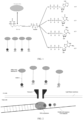
- the nucleotide molecule is a modified nucleotide molecule as shown in Formula I: NXP-L-B Formula I wherein NXP (Nucleoside phosphate) represents a phosphate deoxyribonucleotide and/or a phosphate nucleotide, the phosphate deoxyribonucleotides comprising dAXP (deoxyadenine phosphate), dTXP (deoxythymidine phosphate), dCXP (deoxycytidine phosphate) and dGXP (deoxyguanine phosphate); the phosphate nucleotides comprising AXP (guanine phosphate), TXP/LTXP (thymine/uracil phosphate), CXP (cytosine phosphate) and GXP (guanine phosphate).
- NXP Nucleoside phosphate
- NXP Nucleoside phosphate
- L represents a linker part having a long chain segment for spacing the NXP part and the B part of Formula I.
- the long chain segment is a biocompatible straight chain polymer, and such biocompatible straight chain polymer is for example, but not limited to, a PEG chain, a polymer formed by phosphodiester bonds (similar to nucleic acid backbone structure), a polypeptide, and suitable nanowires.
- the linker part also has a linking segment such as, but not limited to, biotin, maleimide, etc. for specific attachment of a bulky steric hindrance part.
- B represents a bulky steric hindrance part, which is selected from a protein molecule, preferably a globular protein molecule.
- the bulky steric hindrance part is characterized by a structurally stable nature and is linked to the linker part by the above-mentioned linking segment, such as, but not limited to, a biotin-binding protein (avidin), which is linked to the linker by biotin; or xylanase with a cysteine residue introduced at the C-terminus, which is linked to the linker via maleimide.
- avidin biotin-binding protein
- xylanase with a cysteine residue introduced at the C-terminus which is linked to the linker via maleimide.
- the biocompatible straight chain polymer segment is preferably a polyethylene glycol PEG or a polypeptide comprising glycine and serine (e.g. GSGSGGGSSSSSSSGSSSSSSGSSS).
- the linking segment is biotin or maleimide.
- the bulky steric hindrance part is preferably a biotin-binding protein (avidin), which is linked to the linker by biotin; or a xylanase with a cysteine residue introduced at the C-terminus, which is linked to the linker via maleimide.
- the membrane is selected from a natural lipid bilayer membrane and a bilayer membrane formed by an artificial amphiphilic molecule.
- the membrane has at least one nanopore. In some preferred embodiments, the membrane has one nanopore.
- the nanopore is selected from natural protein nanopores and nanopores prepared from artificial materials.
- the nanopore is bacterial toxin ⁇ -hemolysin.
- the nanopore is other type of protein pores, such as but not limited to MspA, CsgG, OmpF, etc.
- the nanopores is a variant of wild-type protein nanopore with modifications.
- the nanopore may also be an artificial nanopore prepared from an artificial material such as, but not limited to, silicon or graphene. The artificial material such as, but not limited to, silicon or graphene is made into a membrane, and then a nanopore is formed on the membrane.
- Another aspect of the present invention provides a sequencing method for a nucleic acid sequence to be analyzed, comprising repeating steps S01 to S05 of the method according to the above aspect, sequentially determining type of each nucleotide of the nucleic acid sequence to be analyzed until the sequencing of the nucleic acid sequence to be analyzed is completed.
- nucleic acid sequencing device for the above described method for determining type of a nucleotide on a nucleic acid sequence to be analyzed and/or a nucleic acid sequencing method, comprising:
- the device of the present invention is a single-channel device based on the sequencing method of the present invention, intended to further illustrate the principles and implementation of the present invention.
- the present invention can also be extended to devices with multi-channel arrays for simultaneous sequencing of several DNA molecules.
- the present invention provides a method for determining the type of nucleotide on a nucleic acid sequence using a nanopore on a bilayer membrane and modified nucleotides.
- the present invention also provides a sequencing method for a nucleic acid sequence using a nanopore on a bilayer membrane and modified nucleotides.
- the modified nucleotides are complexes as shown in Formula I: NXP-L-B Formula I wherein NXP (Nucleoside phosphate) represents a phosphate deoxyribonucleotide and/or a phosphate nucleotide, the phosphate deoxyribonucleotides comprising dAXP, dTXP, dCXP and dGXP; the phosphate nucleotides comprising AXP, TXP/UXP, CXP and GXP.
- NXP Nucleoside phosphate
- phosphate deoxynucleotide includes, but is not limited to, monophosphate deoxynucleotides and polyphosphate deoxynucleotides, wherein polyphosphate deoxynucleotides include, but are not limited to, diphosphate deoxynucleotides, triphosphate deoxynucleotides, tetraphosphate deoxynucleotides, pentaphosphate deoxynucleotides and hexaphosphate deoxynucleotides, preferably triphosphate deoxynucleotides.
- phosphonucleotide includes, but is not limited to, monophosphate nucleotides and polyphosphate nucleotides, wherein polyphosphate nucleotides include, but are not limited to, diphosphate nucleotides, triphosphate nucleotides, tetraphosphate nucleotides, penta-phosphate nucleotides and hexaphosphate nucleotides, preferably triphosphate nucleotides.
- the phosphoribonucleotides and/or phosphodeoxynucleotides employed in the present invention can also be modified at multiple sites, such as, but not limited to, the second position on ribose, the fifth position on pyrimidines, and the seventh position on purines.
- Any manner of modification as long as the modified phosphate nucleotide and/or phosphate deoxynucleotide can still support efficient nucleic acid synthesis reactions, can be a candidate modification option in the present invention to help obtain better sequencing results. According to their corresponding blocking currents, appropriate modifications can be screened to make the characteristic blocking currents of different nucleotides more distinguishable and the signals clearer and easier to be identified.
- modifications can also alter the size, or charge characteristics, of phosphonucleotide and/or phosphodeoxynucleotide molecules, thereby slowing their entry, transit and/or exit times into the nanopore, helping to obtain clearer and more accurate current measurements.
- the nucleic acid sequence to be analyzed may be a DNA nucleic acid sequence or an RNA nucleic acid sequence.
- DNA polymerase can be used to employ modified deoxyribonucleotides (dATP, dTTP, dCTP, and dGTP) or RNA polymerase can be used to synthesize an RNA strand using a DNA template and modified nucleotides (ATP, TTP/LTTP, CTP, and GTP).
- reverse transcriptase When determining the nucleotide type in the RNA nucleic acid sequence or sequencing the RNA nucleic acid sequence, reverse transcriptase can be used to synthesize a cDNA strand complementary to it using the above-mentioned deoxyribonucleotides as a template.
- L represents a linker part having a long chain segment and a linking segment.
- the long chain segment is preferably a biocompatible straight chain polymer.
- Biocompatible straight chain polymers that can be used in the present invention include, but are not limited to, straight chain polypeptides, preferably straight chain polypeptides.
- As the main structure of the long chain segment itself in addition to straight chain polypeptides, other chemical chain polymers such as polymers formed by phosphodiester bonds (similar to the main chain structure of nucleic acids), polyethylene glycol PEG, and suitable nanowires, etc., can also be used in the present invention.
- the length range of the long chain segment can be adjusted according to the scale of the nanopore protein chosen and the different ways of coupling the nanopore and the nucleic acid polymerase.
- the long chain segments may have a length range in the range of 5 to 25 nm, preferably in the range of 8 to 15 nm.
- different linkers can be distinguished by subscript letters, such as L N , L A , L T , L U , L C , L G , etc., where the subscripts A, T, U, C and G represent the type of nucleotide linked to the linker part L, and N is a generic representation of the nucleotide, which can be any one of A, T, U, C and G.
- the linking segment that can be used in the present invention is for example, but not limited to, biotin, maleimide, etc.
- the linking segment has the ability to bind specifically to a specific protein, for example biotin binds specifically to biotin-binding protein.
- B represents a bulky steric hindrance part
- the term "bulky steric hindrance part” refers to a biomolecular part having a diameter greater than 1 to 2 nm, preferably greater than 2 nm, and more preferably greater than 3 nm.
- the bulky steric hindrance part is selected from a protein molecule, preferably a globular protein molecule.
- the bulky steric hindrance part is characterized by a structurally stable nature and is linked to the linker part by the above-mentioned linking segment, such as, but not limited to, a biotin-binding protein, which is linked to the linker by biotin.
- biotin/biotin-binding protein to couple proteins at the end of the linker chain
- other proteins or other blockers with diameters larger than the nanopore, and other coupling methods are also applicable to the present invention.
- a maleimide active group is added to the end of the linker by chemical synthesis as a linking segment, and then any stable, spherical protein with a size larger than the nanopore pore size is selected.
- xylanase is employed as the bulky steric hindrance part, and cysteine is introduced at the C-terminus of the recombinant protein, which is covalently coupled to the linking segment maleimide using its sulfhydryl group -SH.
- said linker allows the phosphonucleotide part to be confined near the opening of the nanopore.
- the linker assists in controlling the reverse passage time of the phosphonucleotide or phosphate group through the nanopore.
- the linker can be chemically modified to introduce charged groups, such as -NH 2 group carrying a positive charge or -PO 4 group carrying a negative charge in the system's operating pH range (6-9).
- the variation of the charge density and charge sites introduced on the chain allows the entire modified nucleotide molecule, i.e., the phosphonucleotide/phosphate deoxynucleotide-linker-bulky steric hindrance molecule complex, to be subjected to different driving forces in the electric field, thus affecting the timing and manner of interaction of the nucleotide part with the nanopore, as well as the direction of motion at a given voltage.
- introducing a positive charge near the site where the linker is attached to the phosphate nucleotide reduces the net negative charge density of the complex, allowing the nucleotide to be driven by a reduced electric field in the nanopore, thus allowing it to exit the nanopore in the second direction even at high voltages, facilitating the recording of the current characteristics at high voltages when exiting the nanopore and improving the signal-to-noise ratio.
- lipid bilayer refers to a membrane prepared based on the tendency of lipid molecules, such as but not limited to phospholipids, to form stable lipid bilayers in the aqueous phase.
- the lipid bilayer that may be used in the present invention includes, but is not limited to phospholipid bilayers.
- nanopore refers to a nano-sized pore which can be formed by pores in porous proteins or synthetic materials such as silicon or graphene. Protein pores in electrically insulating membranes or artificial solid pores machined from insulating materials can be used as single molecule detectors. It can be a bioprotein channel in a highly resistive lipid bilayer, a protein channel in a synthetic membrane or directly an artificial solid state pore.
- nucleotide and “NXP” cover both nucleotides and deoxyribonucleotides, unless the context specifically indicates otherwise.
- the sequencing system of the present invention involves the formation of a phospholipid bilayer for separating and insulating the cis and trans sides of the bilayer and providing a suitable chemical environment for the nanopore to embed, forming a small pore of 1.4 to 2 nm diameter to pass through the cis and trans sides, thereby allowing ions to pass through to form microcurrents under the action of an electric field.
- DPhPC phospholipid 1,2-diphytanoyl-sn-glycero-3-phosphocholine
- methods such as coating, folding, microfluidic methods, etc., for forming phospholipid bilayers on scales of several microns to 200 microns across surface materials with hydrophobic properties, such as polyimide, polyethylene, etc.
- the present invention is quite adaptable and can theoretically employ a variety of different transmembrane nanopores for the transport and recognition of phosphonucleotides, such as but not limited to ⁇ -hemolysin, ⁇ -hemolysin, MspA, OmpF, etc.
- Nanopores can be used for sequencing in the manner described herein as long as they are structurally stable after being embedded in phospholipid membranes, the corresponding currents are relatively stable and measurable, and the pore size is appropriate to allow the passage of phosphonucleotides and linkers while blocking large-sized proteins.
- the present invention can also employ modified variants of nanopore proteins.
- the present invention is equally applicable to artificial solid-state nanopores as long as they meet the prerequisites of current stability and appropriate pore size.
- the system By applying a voltage of, for example, 50-300 mV, such as 75 mV-275 mV, 100 mV-250 mV, 125 mV-225 mV, 150 mV-200 mV, or 80 mV, 90 mV, 100 mV, 125 mV, 150 mV, 175 mV, 180 mV, 190 mV, 200 mV, or any value between any of the above voltage values, to both sides of the insulating lipid bilayer, the system will form a potential gradient across the membrane along the inner diameter of the nanopore.
- a voltage of, for example, 50-300 mV such as 75 mV-275 mV, 100 mV-250 mV, 125 mV-225 mV, 150 mV-200 mV, or 80 mV
- 90 mV 100 mV, 125 mV, 150 mV, 175 mV, 180 mV, 190
- the electrolyte is driven by the potential gradient to form a current in the nanopore by directed motion within the nanopore, i.e., the open nanopore current.
- the negatively charged nucleotide part approaches the nanopore opening under the dual action of free diffusion and electrophoretic motion, it will be captured by the potential gradient along the nanopore and thus driven by the electric field force through the narrow nanopore to achieve transmembrane transport.
- the nucleotides will interfere to some extent with the movement of the electrolyte in the nanopore, thus changing the current magnitude and creating a so-called blocking current.
- the four different bases A, T(U), C, and G of different nucleotides can be distinguished from each other by the blocking currents formed by their interaction with nanopores due to differences in structure and physicochemical properties, as well as in linker structure. Recording and identifying this characteristic blocking current can be used to determine the type of nucleotide bases passing through the nanopore.
- the modified nucleotide part connected to the linker passes through the nanopore under the action of a strong electric field, but the bulky steric hindrance part connected to the linker cannot pass through the nanopore due to its size and therefore remains on one side of the nanopore while the linker part is located in the nanopore.
- the nucleotide or its enzymatically reacted pyrophosphate part will exit the nanopore in the second direction described above.
- the intact nucleotide and pyrophosphate will give distinguishable current characteristics to help determine whether the exit group on the linker is the intact nucleotide or the enzymatically reacted product pyrophosphate.
- the method of the present invention can accurately identify the type of nucleotide passing through the nanopore and determine whether the nucleotide is captured by nucleic acid polymerase and involved in nucleic acid synthesis.
- the method records the current values in the fully open state of the nanopore; the current characteristic values of nucleotides (both nucleotides and deoxynucleotides) interacting with linker and nanopore at a high voltage, for example, not less than 160 mV, not less than 170 mV, not less than 180 mV, not less than 190 mV, not less than 200 mV; and the current characteristics values of linker carrying the nucleotide/or pyrophosphate exiting the nanopore in the second direction at a low voltage, for example, not higher than 100 mV, not higher than 90 mV, not higher than 80 mV, not higher than 70 mV, not higher than 60 mV, not higher than 50 mV.
- the type of nucleotide passing through the nanopore and whether it successfully participates in nucleic acid synthesis is deduced through the logical relationship of the above-mentioned current value with time and system state.
- the method has great potential and value in reducing deletion errors and insertion errors in nucleic acid sequencing using a nanopore, thereby improving sequencing accuracy.
- the electrolyte solution used in the present invention is an electrolyte solution suitable for performing nucleic acid synthesis, such as a KCl solution, specifically a KCl solution with a concentration of 0.1 to 1 M, such as 0.3M KCl solution, 0.5M KCl solution.
- a KCl solution specifically a KCl solution with a concentration of 0.1 to 1 M, such as 0.3M KCl solution, 0.5M KCl solution.
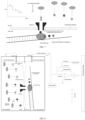
- the nucleotide part of the complex of the present invention is negatively charged and can reach the trans side (the second compartment) from the cis side of the phospholipid membrane (the first compartment) through the nanopore along the potential gradient in the electric field.
- the nucleotide part reaches the trans side, it can be captured and utilized by the nucleic acid polymerase coupled to the nanopore through free diffusion.
- the nucleotide part may interact with the nanopore as it enters/passes through the nanopore thereby generating a characteristic blocking current and is recorded by a microcurrent measurement system connected to the nanopore, thereby determining the base type of this nucleotide being transported by the nanopore.
- the present invention provides a way to allow the phosphonucleotide part (or pyrophosphate part, if the synthesis reaction has been carried out) that has passed through the nanopore to the trans side of the phospholipid membrane to return to the cis side through the nanopore again and thus be detected by the nanopore a second time.
- the nucleotide phosphates are linked by PEG or similar long chains, and a biotin/biotin-binding protein complex.
- the biotin/biotin-binding protein complex cannot pass through the nanopore but remains on the cis side and confines the nucleotide part near the opening on the trans side of the nanopore by the PEG-linking chain spanning the nanopore.
- the electric field force is weakened, the nucleotide near the opening on the trans side of this nanopore will pass through the nanopore again under thermal movement or diffusion and return to the cis side and generate the characteristic blocking current for the second time.
- the second characteristic blocking current corresponds to an intact nucleotide or to pyrophosphate after the synthesis reaction is complete, it can be used to determine whether this nucleotide is involved in the nucleic acid synthesis reaction.
- the present invention relates to a way of covalently coupling a nucleic acid polymerase to a nanopore on the trans side, thereby helping to limit the distance between the polymerase active center and the opening on the trans side of the nanopore to the range of 1 to 3 nm.
- the phosphate nucleotide After the phosphate nucleotide enters the trans side through the nanopore, the phosphate nucleotide is also confined nearby by the long chain of linker, which corresponds to a great increase in the effective local concentration of polymerase and nucleotide, thus greatly reducing the time for the phosphate nucleotide to be captured by the polymerase and contributing to the sequencing efficiency of the present invention.
- the present invention also allows inferring whether the transported nucleotide is involved in DNA synthesis.
- phosphonucleotides that are transported to the trans side by the nanopore are confined near the nanopore opening by the long chain of linker. After a certain time, the nucleotide (or pyrophosphate if the nucleotide participates and completes the nucleic acid synthesis reaction) eventually passes back to the cis side through the nanopore again by diffusion, regardless of whether it participates in the synthesis reaction or not.
- the system will again record the characteristic blocking current corresponding to the exit of the intact nucleotide from the nanopore; conversely, the system will detect the blocking current caused by the exit of pyrophosphate from the nanopore.
- the present invention is implemented so that each nucleotide involved in a nucleic acid synthesis reaction must be transported through the nanopore and its characteristic blocking current is recorded, so as to obtain the information of its base type. After a certain period of time, the molecules transported or entering the trans side pass through the nanopore again and are transported back to the cis side, and in this process, it is determined whether the nucleotide participates in the synthesis reaction. By monitoring each nucleotide that may come into contact with the polymerase and inferring whether it is involved in the reaction, the present invention can obtain the sequence of the template DNA (or RNA) to be analyzed and effectively avoid deletion errors and insertion errors during the sequencing process, obtaining an increase in accuracy.
- the linker part was chosen to use a long chain polypeptide.
- One end of the polypeptide was attached to the third phosphate group of the deoxynucleotide triphosphate dNTP and the other end was attached to the maleimide.
- Different nucleotides of A, T, C and G were attached to different sequences of the polypeptide to facilitate the determination of the base type based on different characteristic blocking current values.
- the bulk steric hindrance protein part was the globular protein xylanase, which is structurally stable.
- the nucleotide-linker-bulky steric hindrance part complex was synthetically prepared by introducing a cysteine residue at the C-terminus of xylanase through protein recombination, and its sulfhydryl-SH formed a stable covalent bond with the maleimide of the linker part.
- the compartment system that meets the requirements of the present invention was purchased from Warner Instruments, and the aperture size between the left and right compartments was chosen to be 150 ⁇ m.
- the hydrophobic material near the opening was suitable for phospholipid adhesion.
- a 0.3 M solution of KCl was added to each of the left and right small compartments with the liquid level below the opening.
- 1,2-diphytanoyl-sn-glycero-3-phosphocholine (DphPC) was selected and dissolved in the organic solvent pentane at a final concentration of 10 mg/ml. This phospholipid solution was added to the existing KCl solution in the compartment to form an organic phase that covered the KCl liquid surface.
- the organic phase containing the phospholipid layer rose with the liquid level thereby flooding the small pore between the two compartments.
- phospholipids bound to hydrophobic materials near the pore and spontaneously formed a phospholipid bilayer across the pore.
- the nanopore solution was added to the first compartment to a final concentration of 1 nM, while testing the current between the two compartments.
- the system would detect the nanopore opening current.
- the excess nanopore solution was removed in time to ensure that only a single-molecule nanopore channel was present in the phospholipid membrane.
- Cysteine was introduced at the trans side of the above nanopore. After the nanopore was successfully embedded in the phospholipid membrane, it was coupled together with DNA polymerase which also carried cysteine, using maleimide-PEG-maleimide (available from the reagent company nanosoft polymers) as a linkage intermediary. The coupled polymerase as well as the corresponding DNA template to be analyzed and primer components were in the second compartment.
- the phospholipid membrane with nanopore and DNA replication components were prepared by the above operation.
- the nucleic acid sequencing device as described in FIG. 8 was fabricated according to the steps described in Example 2, 0.3 M KCl buffer was added to the first and second compartments, and the current characteristic value I o through the phospholipid bilayer membrane was measured when the nanopore was fully open.
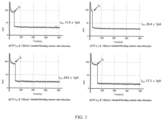
- a 5 ⁇ M concentration of dATP-L A -B complex prepared as described in Example 1 was added to the first compartment at a voltage value of 180 mV, while the change in current value through the nanopore was recorded at a sampling frequency of 1 KHz or more.
- the system first recorded the open nanopore I o , and then the dATP part passed through the nanopore under the electric field from the first compartment into the second compartment, and remained relatively stable under the electric field driving force.
- the system recorded the current I A1 formed by the dATP-L A -B complex in interaction with the nanopore; after 400 ms the voltage value was reduced to 80 mV and continued for 200 ms to record the characteristic current profile I A2 caused by the exit of dATP from the nanopore in the direction from the second compartment to the first compartment.
- the above voltage stimulation protocol was repeatedly used to continuously record current changes for 15 minutes to obtain a sufficiently large sample size to obtain a range of characteristic blocking current values I A1 for dATP-L A -B at 180 mV, as well as to clarify the reproducibility of the characteristics presented by the current profile I A2 .
- the characteristic current profiles I A3 , I B3 , I C3 and I G3 of the four complexes, PP-L A -B, PP-L T -B, PP-L C -B and PP-L G -B, during the exit of the PP part from the second compartment back to the first compartment at 80 mV were recorded in the above manner.
- the nucleic acid sequence to be analyzed was synthesized by Tsingke Biotechnology Co., Ltd., Beijing, as described in SEQ ID NO. 1,
- the nucleic acid sequence to be analyzed and the primer sequence were dissolved in a 0.3 M KCl solution and added to the second compartment of the nucleic acid sequencing device, where the nucleic acid polymerase complex was coupled to the nanopore thereby being near the opening on the trans side of the nanopore in the second compartment.
- the nucleotide complexes prepared as described in Example 1 were dissolved in a 0.3 M KCl solution and added to the first compartment of the nucleic acid sequencing device.
- the measured current values were compared to the individual standard current characteristic values measured in Example 3 to determine the type of nucleotide that crossed the nanopore in each cycle, as well as to determine whether the nucleotide was successfully synthesized onto the nucleic acid sequence to be analyzed.
- nucleotides involved in the synthesis reaction were GCGTCTAT in order, so the original nucleic acid sequence to be analyzed was ATAGACGC from 5' to 3'.
Landscapes
- Life Sciences & Earth Sciences (AREA)
- Chemical & Material Sciences (AREA)
- Health & Medical Sciences (AREA)
- Molecular Biology (AREA)
- Organic Chemistry (AREA)
- Proteomics, Peptides & Aminoacids (AREA)
- Analytical Chemistry (AREA)
- General Health & Medical Sciences (AREA)
- Immunology (AREA)
- Biochemistry (AREA)
- Physics & Mathematics (AREA)
- Zoology (AREA)
- Engineering & Computer Science (AREA)
- Wood Science & Technology (AREA)
- Chemical Kinetics & Catalysis (AREA)
- Electrochemistry (AREA)
- General Physics & Mathematics (AREA)
- Pathology (AREA)
- Microbiology (AREA)
- Bioinformatics & Cheminformatics (AREA)
- General Engineering & Computer Science (AREA)
- Biotechnology (AREA)
- Genetics & Genomics (AREA)
- Biophysics (AREA)
- Dispersion Chemistry (AREA)
- Measuring Or Testing Involving Enzymes Or Micro-Organisms (AREA)
Applications Claiming Priority (2)
| Application Number | Priority Date | Filing Date | Title |
|---|---|---|---|
| CN202010632420 | 2020-07-02 | ||
| PCT/CN2021/104256 WO2022002251A1 (zh) | 2020-07-02 | 2021-07-02 | 核酸测序方法及装置 |
Publications (2)
| Publication Number | Publication Date |
|---|---|
| EP4177331A1 true EP4177331A1 (de) | 2023-05-10 |
| EP4177331A4 EP4177331A4 (de) | 2024-07-31 |
Family
ID=79317482
Family Applications (1)
| Application Number | Title | Priority Date | Filing Date |
|---|---|---|---|
| EP21832476.2A Pending EP4177331A4 (de) | 2020-07-02 | 2021-07-02 | Verfahren und vorrichtung zur nukleinsäuresequenzierung |
Country Status (4)
| Country | Link |
|---|---|
| US (1) | US20230265498A1 (de) |
| EP (1) | EP4177331A4 (de) |
| CN (1) | CN115843309A (de) |
| WO (1) | WO2022002251A1 (de) |
Families Citing this family (2)
| Publication number | Priority date | Publication date | Assignee | Title |
|---|---|---|---|---|
| WO2024228928A1 (en) * | 2023-05-03 | 2024-11-07 | Illumina, Inc. | Controlled polynucleotide translocation in nanopore sequencing |
| EP4784789A1 (de) * | 2023-09-29 | 2026-08-05 | Illumina, Inc. | Spaltbare zyklische schleifennukleotide zur nanoporensequenzierung |
Family Cites Families (9)
| Publication number | Priority date | Publication date | Assignee | Title |
|---|---|---|---|---|
| CN101495656B (zh) * | 2006-06-07 | 2017-02-08 | 纽约哥伦比亚大学理事会 | 采用带修饰的核苷酸通过纳米通道进行dna序列测定 |
| CN103282518B (zh) * | 2010-12-17 | 2016-11-16 | 纽约哥伦比亚大学理事会 | 使用经修饰的核苷酸和纳米孔检测的dna边合成边测序 |
| US9121059B2 (en) * | 2010-12-22 | 2015-09-01 | Genia Technologies, Inc. | Nanopore-based single molecule characterization |
| ES2779699T3 (es) * | 2012-06-20 | 2020-08-18 | Univ Columbia | Secuenciación de ácidos nucleicos mediante detección en nanoporos de moléculas de etiqueta |
| JP6592402B2 (ja) * | 2016-06-03 | 2019-10-16 | 株式会社日立ハイテクノロジーズ | 生体分子計測装置 |
| US10669580B2 (en) * | 2016-08-26 | 2020-06-02 | Roche Sequencing Solutions, Inc. | Tagged nucleotides useful for nanopore detection |
| GB201801768D0 (en) * | 2018-02-02 | 2018-03-21 | Oxford Nanopore Tech Ltd | Synthesis method |
| CN112708544A (zh) * | 2019-10-25 | 2021-04-27 | 成都今是科技有限公司 | 基因测序的测量装置及其测量方法 |
| CN111019814B (zh) * | 2019-12-26 | 2022-12-09 | 中国科学院苏州生物医学工程技术研究所 | 一种基于纳米孔的核酸测序装置、核酸测序方法 |
-
2021
- 2021-07-02 US US18/004,145 patent/US20230265498A1/en not_active Abandoned
- 2021-07-02 EP EP21832476.2A patent/EP4177331A4/de active Pending
- 2021-07-02 CN CN202180045967.XA patent/CN115843309A/zh active Pending
- 2021-07-02 WO PCT/CN2021/104256 patent/WO2022002251A1/zh not_active Ceased
Also Published As
| Publication number | Publication date |
|---|---|
| CN115843309A (zh) | 2023-03-24 |
| WO2022002251A1 (zh) | 2022-01-06 |
| EP4177331A4 (de) | 2024-07-31 |
| US20230265498A1 (en) | 2023-08-24 |
Similar Documents
| Publication | Publication Date | Title |
|---|---|---|
| US20230392157A1 (en) | Aptamer method | |
| US12473595B2 (en) | Coupling method | |
| JP6744852B2 (ja) | ナノポアベースの分子検出および配列決定 | |
| CN101495656B (zh) | 采用带修饰的核苷酸通过纳米通道进行dna序列测定 | |
| CN103282518B (zh) | 使用经修饰的核苷酸和纳米孔检测的dna边合成边测序 | |
| US20230265498A1 (en) | Nucleic acid sequencing method and apparatus | |
| US20190093157A1 (en) | Rna nanotubes for single molecule sensing and dna/rna/protein sequencing | |
| CN117587110A (zh) | 富集方法、表征分析物的方法及其装置 |
Legal Events
| Date | Code | Title | Description |
|---|---|---|---|
| STAA | Information on the status of an ep patent application or granted ep patent |
Free format text: STATUS: THE INTERNATIONAL PUBLICATION HAS BEEN MADE |
|
| PUAI | Public reference made under article 153(3) epc to a published international application that has entered the european phase |
Free format text: ORIGINAL CODE: 0009012 |
|
| STAA | Information on the status of an ep patent application or granted ep patent |
Free format text: STATUS: REQUEST FOR EXAMINATION WAS MADE |
|
| 17P | Request for examination filed |
Effective date: 20230113 |
|
| AK | Designated contracting states |
Kind code of ref document: A1 Designated state(s): AL AT BE BG CH CY CZ DE DK EE ES FI FR GB GR HR HU IE IS IT LI LT LU LV MC MK MT NL NO PL PT RO RS SE SI SK SM TR |
|
| DAV | Request for validation of the european patent (deleted) | ||
| DAX | Request for extension of the european patent (deleted) | ||
| A4 | Supplementary search report drawn up and despatched |
Effective date: 20240703 |
|
| RIC1 | Information provided on ipc code assigned before grant |
Ipc: C12Q 1/6869 20180101ALI20240627BHEP Ipc: C12M 1/34 20060101AFI20240627BHEP |
|
| STAA | Information on the status of an ep patent application or granted ep patent |
Free format text: STATUS: EXAMINATION IS IN PROGRESS |
|
| 17Q | First examination report despatched |
Effective date: 20260401 |