EP4177345A1 - Procédé d'édition d'arn amélioré - Google Patents
Procédé d'édition d'arn amélioré Download PDFInfo
- Publication number
- EP4177345A1 EP4177345A1 EP21838580.5A EP21838580A EP4177345A1 EP 4177345 A1 EP4177345 A1 EP 4177345A1 EP 21838580 A EP21838580 A EP 21838580A EP 4177345 A1 EP4177345 A1 EP 4177345A1
- Authority
- EP
- European Patent Office
- Prior art keywords
- rna
- target
- residue
- arrna
- base
- Prior art date
- Legal status (The legal status is an assumption and is not a legal conclusion. Google has not performed a legal analysis and makes no representation as to the accuracy of the status listed.)
- Withdrawn
Links
- 238000000034 method Methods 0.000 title claims abstract description 136
- 108091032973 (ribonucleotides)n+m Proteins 0.000 claims abstract description 262
- 239000003184 complementary RNA Substances 0.000 claims abstract description 151
- 238000011144 upstream manufacturing Methods 0.000 claims abstract description 146
- 108020004394 Complementary RNA Proteins 0.000 claims abstract description 142
- 201000010099 disease Diseases 0.000 claims abstract description 23
- 208000037265 diseases, disorders, signs and symptoms Diseases 0.000 claims abstract description 23
- 210000004027 cell Anatomy 0.000 claims description 115
- 230000000295 complement effect Effects 0.000 claims description 96
- OIRDTQYFTABQOQ-KQYNXXCUSA-N adenosine group Chemical group [C@@H]1([C@H](O)[C@H](O)[C@@H](CO)O1)N1C=NC=2C(N)=NC=NC12 OIRDTQYFTABQOQ-KQYNXXCUSA-N 0.000 claims description 90
- 108090000623 proteins and genes Proteins 0.000 claims description 65
- 102000004169 proteins and genes Human genes 0.000 claims description 59
- 125000003729 nucleotide group Chemical group 0.000 claims description 55
- 239000002773 nucleotide Substances 0.000 claims description 51
- 230000003197 catalytic effect Effects 0.000 claims description 48
- UHDGCWIWMRVCDJ-UHFFFAOYSA-N 1-beta-D-Xylofuranosyl-NH-Cytosine Natural products O=C1N=C(N)C=CN1C1C(O)C(O)C(CO)O1 UHDGCWIWMRVCDJ-UHFFFAOYSA-N 0.000 claims description 45
- 239000002126 C01EB10 - Adenosine Substances 0.000 claims description 45
- UHDGCWIWMRVCDJ-PSQAKQOGSA-N Cytidine Natural products O=C1N=C(N)C=CN1[C@@H]1[C@@H](O)[C@@H](O)[C@H](CO)O1 UHDGCWIWMRVCDJ-PSQAKQOGSA-N 0.000 claims description 45
- 229960005305 adenosine Drugs 0.000 claims description 45
- UHDGCWIWMRVCDJ-ZAKLUEHWSA-N cytidine Chemical compound O=C1N=C(N)C=CN1[C@H]1[C@H](O)[C@@H](O)[C@H](CO)O1 UHDGCWIWMRVCDJ-ZAKLUEHWSA-N 0.000 claims description 45
- 230000008685 targeting Effects 0.000 claims description 44
- 239000013612 plasmid Substances 0.000 claims description 40
- 102000055025 Adenosine deaminases Human genes 0.000 claims description 37
- 230000035772 mutation Effects 0.000 claims description 37
- 101710169336 5'-deoxyadenosine deaminase Proteins 0.000 claims description 36
- 102100026846 Cytidine deaminase Human genes 0.000 claims description 34
- 108010031325 Cytidine deaminase Proteins 0.000 claims description 34
- 108020001507 fusion proteins Proteins 0.000 claims description 34
- 102000037865 fusion proteins Human genes 0.000 claims description 34
- 230000000694 effects Effects 0.000 claims description 33
- 150000007523 nucleic acids Chemical group 0.000 claims description 32
- DRTQHJPVMGBUCF-XVFCMESISA-N Uridine Chemical compound O[C@@H]1[C@H](O)[C@@H](CO)O[C@H]1N1C(=O)NC(=O)C=C1 DRTQHJPVMGBUCF-XVFCMESISA-N 0.000 claims description 26
- 108020004999 messenger RNA Proteins 0.000 claims description 20
- 238000007385 chemical modification Methods 0.000 claims description 19
- 239000013598 vector Substances 0.000 claims description 19
- 241000700605 Viruses Species 0.000 claims description 16
- 102000039446 nucleic acids Human genes 0.000 claims description 16
- 108020004707 nucleic acids Proteins 0.000 claims description 16
- DRTQHJPVMGBUCF-PSQAKQOGSA-N beta-L-uridine Natural products O[C@H]1[C@@H](O)[C@H](CO)O[C@@H]1N1C(=O)NC(=O)C=C1 DRTQHJPVMGBUCF-PSQAKQOGSA-N 0.000 claims description 13
- DRTQHJPVMGBUCF-UHFFFAOYSA-N uracil arabinoside Natural products OC1C(O)C(CO)OC1N1C(=O)NC(=O)C=C1 DRTQHJPVMGBUCF-UHFFFAOYSA-N 0.000 claims description 13
- 229940045145 uridine Drugs 0.000 claims description 13
- 102000040650 (ribonucleotides)n+m Human genes 0.000 claims description 12
- 108090000765 processed proteins & peptides Proteins 0.000 claims description 7
- 108020004485 Nonsense Codon Proteins 0.000 claims description 6
- 230000001594 aberrant effect Effects 0.000 claims description 6
- 210000004962 mammalian cell Anatomy 0.000 claims description 5
- 206010069754 Acquired gene mutation Diseases 0.000 claims description 3
- 238000012239 gene modification Methods 0.000 claims description 3
- 239000000203 mixture Substances 0.000 claims description 3
- 108091032955 Bacterial small RNA Proteins 0.000 claims description 2
- 108091046869 Telomeric non-coding RNA Proteins 0.000 claims description 2
- 108020004566 Transfer RNA Proteins 0.000 claims description 2
- 239000002243 precursor Substances 0.000 claims description 2
- 230000002441 reversible effect Effects 0.000 claims description 2
- 239000002585 base Substances 0.000 description 598
- 238000010357 RNA editing Methods 0.000 description 56
- 230000026279 RNA modification Effects 0.000 description 56
- 235000018102 proteins Nutrition 0.000 description 52
- 239000002777 nucleoside Substances 0.000 description 46
- 150000003833 nucleoside derivatives Chemical class 0.000 description 37
- 238000012360 testing method Methods 0.000 description 34
- 238000005516 engineering process Methods 0.000 description 25
- 238000002474 experimental method Methods 0.000 description 25
- 230000004048 modification Effects 0.000 description 25
- 238000012986 modification Methods 0.000 description 25
- NYHBQMYGNKIUIF-UUOKFMHZSA-N Guanosine Chemical compound C1=NC=2C(=O)NC(N)=NC=2N1[C@@H]1O[C@H](CO)[C@@H](O)[C@H]1O NYHBQMYGNKIUIF-UUOKFMHZSA-N 0.000 description 24
- 108091033409 CRISPR Proteins 0.000 description 19
- 108010043121 Green Fluorescent Proteins Proteins 0.000 description 19
- 102000004144 Green Fluorescent Proteins Human genes 0.000 description 19
- 101000742223 Homo sapiens Double-stranded RNA-specific editase 1 Proteins 0.000 description 19
- 239000005090 green fluorescent protein Substances 0.000 description 19
- NYHBQMYGNKIUIF-UHFFFAOYSA-N D-guanosine Natural products C1=2NC(N)=NC(=O)C=2N=CN1C1OC(CO)C(O)C1O NYHBQMYGNKIUIF-UHFFFAOYSA-N 0.000 description 17
- 238000013461 design Methods 0.000 description 17
- 102100038191 Double-stranded RNA-specific editase 1 Human genes 0.000 description 16
- 238000001890 transfection Methods 0.000 description 16
- UYTPUPDQBNUYGX-UHFFFAOYSA-N guanine Chemical compound O=C1NC(N)=NC2=C1N=CN2 UYTPUPDQBNUYGX-UHFFFAOYSA-N 0.000 description 14
- 229940029575 guanosine Drugs 0.000 description 13
- MIKUYHXYGGJMLM-GIMIYPNGSA-N Crotonoside Natural products C1=NC2=C(N)NC(=O)N=C2N1[C@H]1O[C@@H](CO)[C@H](O)[C@@H]1O MIKUYHXYGGJMLM-GIMIYPNGSA-N 0.000 description 12
- 102100028089 RING finger protein 112 Human genes 0.000 description 12
- 239000012634 fragment Substances 0.000 description 11
- 238000010354 CRISPR gene editing Methods 0.000 description 10
- 101000865408 Homo sapiens Double-stranded RNA-specific adenosine deaminase Proteins 0.000 description 10
- 108091028043 Nucleic acid sequence Proteins 0.000 description 10
- 108020004414 DNA Proteins 0.000 description 9
- 102000004190 Enzymes Human genes 0.000 description 9
- 108090000790 Enzymes Proteins 0.000 description 9
- 229940088598 enzyme Drugs 0.000 description 9
- 229960003786 inosine Drugs 0.000 description 9
- 125000003835 nucleoside group Chemical group 0.000 description 9
- 239000012096 transfection reagent Substances 0.000 description 9
- 102100029791 Double-stranded RNA-specific adenosine deaminase Human genes 0.000 description 8
- 238000007069 methylation reaction Methods 0.000 description 8
- 241000713666 Lentivirus Species 0.000 description 7
- 101710163270 Nuclease Proteins 0.000 description 7
- 150000001413 amino acids Chemical class 0.000 description 7
- 108020005004 Guide RNA Proteins 0.000 description 6
- 229930010555 Inosine Natural products 0.000 description 6
- UGQMRVRMYYASKQ-KQYNXXCUSA-N Inosine Chemical compound O[C@@H]1[C@H](O)[C@@H](CO)O[C@H]1N1C2=NC=NC(O)=C2N=C1 UGQMRVRMYYASKQ-KQYNXXCUSA-N 0.000 description 6
- 101150063416 add gene Proteins 0.000 description 6
- 235000001014 amino acid Nutrition 0.000 description 6
- 238000010276 construction Methods 0.000 description 6
- MHMNJMPURVTYEJ-UHFFFAOYSA-N fluorescein-5-isothiocyanate Chemical compound O1C(=O)C2=CC(N=C=S)=CC=C2C21C1=CC=C(O)C=C1OC1=CC(O)=CC=C21 MHMNJMPURVTYEJ-UHFFFAOYSA-N 0.000 description 6
- 238000012163 sequencing technique Methods 0.000 description 6
- 230000014616 translation Effects 0.000 description 6
- 238000010442 DNA editing Methods 0.000 description 5
- 230000009615 deamination Effects 0.000 description 5
- 238000006481 deamination reaction Methods 0.000 description 5
- 238000012217 deletion Methods 0.000 description 5
- 230000037430 deletion Effects 0.000 description 5
- 229910052739 hydrogen Inorganic materials 0.000 description 5
- 239000001257 hydrogen Substances 0.000 description 5
- 230000008569 process Effects 0.000 description 5
- 238000011160 research Methods 0.000 description 5
- 238000012216 screening Methods 0.000 description 5
- 238000013519 translation Methods 0.000 description 5
- 101100468236 Mus musculus Adarb1 gene Proteins 0.000 description 4
- IQFYYKKMVGJFEH-XLPZGREQSA-N Thymidine Chemical compound O=C1NC(=O)C(C)=CN1[C@@H]1O[C@H](CO)[C@@H](O)C1 IQFYYKKMVGJFEH-XLPZGREQSA-N 0.000 description 4
- ISAKRJDGNUQOIC-UHFFFAOYSA-N Uracil Chemical compound O=C1C=CNC(=O)N1 ISAKRJDGNUQOIC-UHFFFAOYSA-N 0.000 description 4
- 230000008859 change Effects 0.000 description 4
- 239000003153 chemical reaction reagent Substances 0.000 description 4
- OPTASPLRGRRNAP-UHFFFAOYSA-N cytosine Chemical compound NC=1C=CNC(=O)N=1 OPTASPLRGRRNAP-UHFFFAOYSA-N 0.000 description 4
- 230000006870 function Effects 0.000 description 4
- 230000014509 gene expression Effects 0.000 description 4
- FDGQSTZJBFJUBT-UHFFFAOYSA-N hypoxanthine Chemical compound O=C1NC=NC2=C1NC=N2 FDGQSTZJBFJUBT-UHFFFAOYSA-N 0.000 description 4
- 238000000338 in vitro Methods 0.000 description 4
- 230000011987 methylation Effects 0.000 description 4
- 108700007502 mouse ADAR1 Proteins 0.000 description 4
- 108700007949 mouse ADAR2 Proteins 0.000 description 4
- 238000004806 packaging method and process Methods 0.000 description 4
- RWQNBRDOKXIBIV-UHFFFAOYSA-N thymine Chemical compound CC1=CNC(=O)NC1=O RWQNBRDOKXIBIV-UHFFFAOYSA-N 0.000 description 4
- 108020005544 Antisense RNA Proteins 0.000 description 3
- 102100025064 Cellular tumor antigen p53 Human genes 0.000 description 3
- 239000006144 Dulbecco’s modified Eagle's medium Substances 0.000 description 3
- 208000028782 Hereditary disease Diseases 0.000 description 3
- 239000002299 complementary DNA Substances 0.000 description 3
- 230000008094 contradictory effect Effects 0.000 description 3
- 230000006378 damage Effects 0.000 description 3
- 230000003247 decreasing effect Effects 0.000 description 3
- 230000005923 long-lasting effect Effects 0.000 description 3
- 238000010839 reverse transcription Methods 0.000 description 3
- 230000009466 transformation Effects 0.000 description 3
- ASJSAQIRZKANQN-CRCLSJGQSA-N 2-deoxy-D-ribose Chemical compound OC[C@@H](O)[C@@H](O)CC=O ASJSAQIRZKANQN-CRCLSJGQSA-N 0.000 description 2
- 229930024421 Adenine Natural products 0.000 description 2
- GFFGJBXGBJISGV-UHFFFAOYSA-N Adenine Chemical compound NC1=NC=NC2=C1N=CN2 GFFGJBXGBJISGV-UHFFFAOYSA-N 0.000 description 2
- DWRXFEITVBNRMK-UHFFFAOYSA-N Beta-D-1-Arabinofuranosylthymine Natural products O=C1NC(=O)C(C)=CN1C1C(O)C(O)C(CO)O1 DWRXFEITVBNRMK-UHFFFAOYSA-N 0.000 description 2
- HMFHBZSHGGEWLO-SOOFDHNKSA-N D-ribofuranose Chemical compound OC[C@H]1OC(O)[C@H](O)[C@@H]1O HMFHBZSHGGEWLO-SOOFDHNKSA-N 0.000 description 2
- 102100024692 Double-stranded RNA-specific editase B2 Human genes 0.000 description 2
- 206010059866 Drug resistance Diseases 0.000 description 2
- 206010064571 Gene mutation Diseases 0.000 description 2
- WHUUTDBJXJRKMK-UHFFFAOYSA-N Glutamic acid Natural products OC(=O)C(N)CCC(O)=O WHUUTDBJXJRKMK-UHFFFAOYSA-N 0.000 description 2
- 241000282412 Homo Species 0.000 description 2
- 101000686486 Homo sapiens Double-stranded RNA-specific editase B2 Proteins 0.000 description 2
- UGQMRVRMYYASKQ-UHFFFAOYSA-N Hypoxanthine nucleoside Natural products OC1C(O)C(CO)OC1N1C(NC=NC2=O)=C2N=C1 UGQMRVRMYYASKQ-UHFFFAOYSA-N 0.000 description 2
- 108091034117 Oligonucleotide Proteins 0.000 description 2
- 238000012408 PCR amplification Methods 0.000 description 2
- PYMYPHUHKUWMLA-LMVFSUKVSA-N Ribose Natural products OC[C@@H](O)[C@@H](O)[C@@H](O)C=O PYMYPHUHKUWMLA-LMVFSUKVSA-N 0.000 description 2
- AYFVYJQAPQTCCC-UHFFFAOYSA-N Threonine Natural products CC(O)C(N)C(O)=O AYFVYJQAPQTCCC-UHFFFAOYSA-N 0.000 description 2
- 239000004473 Threonine Substances 0.000 description 2
- 102000004357 Transferases Human genes 0.000 description 2
- 108090000992 Transferases Proteins 0.000 description 2
- 102000044209 Tumor Suppressor Genes Human genes 0.000 description 2
- 108700025716 Tumor Suppressor Genes Proteins 0.000 description 2
- 229960000643 adenine Drugs 0.000 description 2
- 150000003838 adenosines Chemical class 0.000 description 2
- HMFHBZSHGGEWLO-UHFFFAOYSA-N alpha-D-Furanose-Ribose Natural products OCC1OC(O)C(O)C1O HMFHBZSHGGEWLO-UHFFFAOYSA-N 0.000 description 2
- 238000004458 analytical method Methods 0.000 description 2
- IQFYYKKMVGJFEH-UHFFFAOYSA-N beta-L-thymidine Natural products O=C1NC(=O)C(C)=CN1C1OC(CO)C(O)C1 IQFYYKKMVGJFEH-UHFFFAOYSA-N 0.000 description 2
- 230000008827 biological function Effects 0.000 description 2
- 230000015572 biosynthetic process Effects 0.000 description 2
- 229930189065 blasticidin Natural products 0.000 description 2
- 210000004899 c-terminal region Anatomy 0.000 description 2
- 108020001778 catalytic domains Proteins 0.000 description 2
- 238000006243 chemical reaction Methods 0.000 description 2
- 238000004132 cross linking Methods 0.000 description 2
- 229940104302 cytosine Drugs 0.000 description 2
- 238000011161 development Methods 0.000 description 2
- 239000003814 drug Substances 0.000 description 2
- 238000001976 enzyme digestion Methods 0.000 description 2
- 238000001943 fluorescence-activated cell sorting Methods 0.000 description 2
- 230000002068 genetic effect Effects 0.000 description 2
- BRZYSWJRSDMWLG-CAXSIQPQSA-N geneticin Chemical compound O1C[C@@](O)(C)[C@H](NC)[C@@H](O)[C@H]1O[C@@H]1[C@@H](O)[C@H](O[C@@H]2[C@@H]([C@@H](O)[C@H](O)[C@@H](C(C)O)O2)N)[C@@H](N)C[C@H]1N BRZYSWJRSDMWLG-CAXSIQPQSA-N 0.000 description 2
- 238000010362 genome editing Methods 0.000 description 2
- 235000013922 glutamic acid Nutrition 0.000 description 2
- 239000004220 glutamic acid Substances 0.000 description 2
- ZDXPYRJPNDTMRX-UHFFFAOYSA-N glutamine Natural products OC(=O)C(N)CCC(N)=O ZDXPYRJPNDTMRX-UHFFFAOYSA-N 0.000 description 2
- 238000012165 high-throughput sequencing Methods 0.000 description 2
- 102000043770 human ADAR Human genes 0.000 description 2
- 102000044898 human ADARB1 Human genes 0.000 description 2
- 230000006872 improvement Effects 0.000 description 2
- 239000000463 material Substances 0.000 description 2
- 230000001404 mediated effect Effects 0.000 description 2
- 230000036438 mutation frequency Effects 0.000 description 2
- 230000002018 overexpression Effects 0.000 description 2
- 230000035790 physiological processes and functions Effects 0.000 description 2
- 239000013600 plasmid vector Substances 0.000 description 2
- 238000007747 plating Methods 0.000 description 2
- 239000000843 powder Substances 0.000 description 2
- 230000010076 replication Effects 0.000 description 2
- 108091008146 restriction endonucleases Proteins 0.000 description 2
- 238000002741 site-directed mutagenesis Methods 0.000 description 2
- 210000000130 stem cell Anatomy 0.000 description 2
- 239000000126 substance Substances 0.000 description 2
- 238000002560 therapeutic procedure Methods 0.000 description 2
- 229940104230 thymidine Drugs 0.000 description 2
- 229940113082 thymine Drugs 0.000 description 2
- 229940035893 uracil Drugs 0.000 description 2
- XLYOFNOQVPJJNP-UHFFFAOYSA-N water Substances O XLYOFNOQVPJJNP-UHFFFAOYSA-N 0.000 description 2
- GUZKUUQRIKVBQI-JOAULVNJSA-N 3-[(2S,4S,5R)-2-(2,4-dioxopyrimidin-1-yl)-4-hydroxy-5-(hydroxymethyl)oxolan-2-yl]prop-2-enoic acid Chemical compound C(=O)(O)C=C[C@@]1(C[C@H](O)[C@@H](CO)O1)N1C(=O)NC(=O)C=C1 GUZKUUQRIKVBQI-JOAULVNJSA-N 0.000 description 1
- FWMNVWWHGCHHJJ-SKKKGAJSSA-N 4-amino-1-[(2r)-6-amino-2-[[(2r)-2-[[(2r)-2-[[(2r)-2-amino-3-phenylpropanoyl]amino]-3-phenylpropanoyl]amino]-4-methylpentanoyl]amino]hexanoyl]piperidine-4-carboxylic acid Chemical compound C([C@H](C(=O)N[C@H](CC(C)C)C(=O)N[C@H](CCCCN)C(=O)N1CCC(N)(CC1)C(O)=O)NC(=O)[C@H](N)CC=1C=CC=CC=1)C1=CC=CC=C1 FWMNVWWHGCHHJJ-SKKKGAJSSA-N 0.000 description 1
- 208000030507 AIDS Diseases 0.000 description 1
- 108700040115 Adenosine deaminases Proteins 0.000 description 1
- 229920000936 Agarose Polymers 0.000 description 1
- 241000894006 Bacteria Species 0.000 description 1
- 238000010356 CRISPR-Cas9 genome editing Methods 0.000 description 1
- 108091028075 Circular RNA Proteins 0.000 description 1
- 108091026890 Coding region Proteins 0.000 description 1
- 108020004705 Codon Proteins 0.000 description 1
- 238000007702 DNA assembly Methods 0.000 description 1
- 230000005778 DNA damage Effects 0.000 description 1
- 231100000277 DNA damage Toxicity 0.000 description 1
- 230000006820 DNA synthesis Effects 0.000 description 1
- 241000702421 Dependoparvovirus Species 0.000 description 1
- LCGLNKUTAGEVQW-UHFFFAOYSA-N Dimethyl ether Chemical compound COC LCGLNKUTAGEVQW-UHFFFAOYSA-N 0.000 description 1
- 108091092584 GDNA Proteins 0.000 description 1
- 102100037850 Interferon gamma Human genes 0.000 description 1
- 108010074328 Interferon-gamma Proteins 0.000 description 1
- 241000124008 Mammalia Species 0.000 description 1
- 208000024556 Mendelian disease Diseases 0.000 description 1
- 241001465754 Metazoa Species 0.000 description 1
- 206010028980 Neoplasm Diseases 0.000 description 1
- 229910019142 PO4 Inorganic materials 0.000 description 1
- 108010019160 Pancreatin Proteins 0.000 description 1
- 102000052575 Proto-Oncogene Human genes 0.000 description 1
- 108700020978 Proto-Oncogene Proteins 0.000 description 1
- 108091028664 Ribonucleotide Proteins 0.000 description 1
- 241000191967 Staphylococcus aureus Species 0.000 description 1
- 241000193996 Streptococcus pyogenes Species 0.000 description 1
- 108020005038 Terminator Codon Proteins 0.000 description 1
- 230000004721 adaptive immunity Effects 0.000 description 1
- 239000011543 agarose gel Substances 0.000 description 1
- 229910000147 aluminium phosphate Inorganic materials 0.000 description 1
- 230000003321 amplification Effects 0.000 description 1
- 230000005784 autoimmunity Effects 0.000 description 1
- 230000008901 benefit Effects 0.000 description 1
- 238000010804 cDNA synthesis Methods 0.000 description 1
- 201000011510 cancer Diseases 0.000 description 1
- 150000001720 carbohydrates Chemical group 0.000 description 1
- 238000006555 catalytic reaction Methods 0.000 description 1
- 230000002759 chromosomal effect Effects 0.000 description 1
- 238000003776 cleavage reaction Methods 0.000 description 1
- 238000010367 cloning Methods 0.000 description 1
- 238000004891 communication Methods 0.000 description 1
- 238000007796 conventional method Methods 0.000 description 1
- 230000022813 cytidine to uridine editing Effects 0.000 description 1
- 230000007547 defect Effects 0.000 description 1
- 238000001514 detection method Methods 0.000 description 1
- 230000029087 digestion Effects 0.000 description 1
- 238000004090 dissolution Methods 0.000 description 1
- 238000009510 drug design Methods 0.000 description 1
- 238000000605 extraction Methods 0.000 description 1
- 238000000684 flow cytometry Methods 0.000 description 1
- 102000034287 fluorescent proteins Human genes 0.000 description 1
- 108091006047 fluorescent proteins Proteins 0.000 description 1
- 230000008014 freezing Effects 0.000 description 1
- 238000007710 freezing Methods 0.000 description 1
- 230000004927 fusion Effects 0.000 description 1
- 239000000499 gel Substances 0.000 description 1
- 238000001415 gene therapy Methods 0.000 description 1
- HNDVDQJCIGZPNO-UHFFFAOYSA-N histidine Natural products OC(=O)C(N)CC1=CN=CN1 HNDVDQJCIGZPNO-UHFFFAOYSA-N 0.000 description 1
- 238000009396 hybridization Methods 0.000 description 1
- 125000002887 hydroxy group Chemical group [H]O* 0.000 description 1
- 230000028993 immune response Effects 0.000 description 1
- 230000005847 immunogenicity Effects 0.000 description 1
- 230000002779 inactivation Effects 0.000 description 1
- 208000015181 infectious disease Diseases 0.000 description 1
- 238000003780 insertion Methods 0.000 description 1
- 230000037431 insertion Effects 0.000 description 1
- 208000032839 leukemia Diseases 0.000 description 1
- 239000002609 medium Substances 0.000 description 1
- 238000010369 molecular cloning Methods 0.000 description 1
- 238000007481 next generation sequencing Methods 0.000 description 1
- 238000003199 nucleic acid amplification method Methods 0.000 description 1
- 229940046166 oligodeoxynucleotide Drugs 0.000 description 1
- 229940055695 pancreatin Drugs 0.000 description 1
- 230000001717 pathogenic effect Effects 0.000 description 1
- 239000010452 phosphate Substances 0.000 description 1
- NBIIXXVUZAFLBC-UHFFFAOYSA-N phosphoric acid Substances OP(O)(O)=O NBIIXXVUZAFLBC-UHFFFAOYSA-N 0.000 description 1
- 102000040430 polynucleotide Human genes 0.000 description 1
- 108091033319 polynucleotide Proteins 0.000 description 1
- 239000002157 polynucleotide Substances 0.000 description 1
- 231100000683 possible toxicity Toxicity 0.000 description 1
- 230000001124 posttranscriptional effect Effects 0.000 description 1
- 238000012545 processing Methods 0.000 description 1
- 230000004853 protein function Effects 0.000 description 1
- 238000011084 recovery Methods 0.000 description 1
- 230000008844 regulatory mechanism Effects 0.000 description 1
- 239000002336 ribonucleotide Substances 0.000 description 1
- 125000002652 ribonucleotide group Chemical group 0.000 description 1
- 230000007017 scission Effects 0.000 description 1
- 210000002966 serum Anatomy 0.000 description 1
- 238000006467 substitution reaction Methods 0.000 description 1
- 239000000758 substrate Substances 0.000 description 1
- 238000003786 synthesis reaction Methods 0.000 description 1
- 238000010257 thawing Methods 0.000 description 1
- 230000001225 therapeutic effect Effects 0.000 description 1
- 231100000419 toxicity Toxicity 0.000 description 1
- 230000001988 toxicity Effects 0.000 description 1
- 230000002103 transcriptional effect Effects 0.000 description 1
Images







Classifications
-
- C—CHEMISTRY; METALLURGY
- C12—BIOCHEMISTRY; BEER; SPIRITS; WINE; VINEGAR; MICROBIOLOGY; ENZYMOLOGY; MUTATION OR GENETIC ENGINEERING
- C12N—MICROORGANISMS OR ENZYMES; COMPOSITIONS THEREOF; PROPAGATING, PRESERVING, OR MAINTAINING MICROORGANISMS; MUTATION OR GENETIC ENGINEERING; CULTURE MEDIA
- C12N15/00—Mutation or genetic engineering; DNA or RNA concerning genetic engineering, vectors, e.g. plasmids, or their isolation, preparation or purification; Use of hosts therefor
- C12N15/09—Recombinant DNA-technology
- C12N15/11—DNA or RNA fragments; Modified forms thereof; Non-coding nucleic acids having a biological activity
-
- C—CHEMISTRY; METALLURGY
- C12—BIOCHEMISTRY; BEER; SPIRITS; WINE; VINEGAR; MICROBIOLOGY; ENZYMOLOGY; MUTATION OR GENETIC ENGINEERING
- C12N—MICROORGANISMS OR ENZYMES; COMPOSITIONS THEREOF; PROPAGATING, PRESERVING, OR MAINTAINING MICROORGANISMS; MUTATION OR GENETIC ENGINEERING; CULTURE MEDIA
- C12N15/00—Mutation or genetic engineering; DNA or RNA concerning genetic engineering, vectors, e.g. plasmids, or their isolation, preparation or purification; Use of hosts therefor
- C12N15/09—Recombinant DNA-technology
- C12N15/10—Processes for the isolation, preparation or purification of DNA or RNA
- C12N15/102—Mutagenizing nucleic acids
-
- C—CHEMISTRY; METALLURGY
- C12—BIOCHEMISTRY; BEER; SPIRITS; WINE; VINEGAR; MICROBIOLOGY; ENZYMOLOGY; MUTATION OR GENETIC ENGINEERING
- C12N—MICROORGANISMS OR ENZYMES; COMPOSITIONS THEREOF; PROPAGATING, PRESERVING, OR MAINTAINING MICROORGANISMS; MUTATION OR GENETIC ENGINEERING; CULTURE MEDIA
- C12N15/00—Mutation or genetic engineering; DNA or RNA concerning genetic engineering, vectors, e.g. plasmids, or their isolation, preparation or purification; Use of hosts therefor
- C12N15/09—Recombinant DNA-technology
- C12N15/10—Processes for the isolation, preparation or purification of DNA or RNA
-
- C—CHEMISTRY; METALLURGY
- C12—BIOCHEMISTRY; BEER; SPIRITS; WINE; VINEGAR; MICROBIOLOGY; ENZYMOLOGY; MUTATION OR GENETIC ENGINEERING
- C12N—MICROORGANISMS OR ENZYMES; COMPOSITIONS THEREOF; PROPAGATING, PRESERVING, OR MAINTAINING MICROORGANISMS; MUTATION OR GENETIC ENGINEERING; CULTURE MEDIA
- C12N15/00—Mutation or genetic engineering; DNA or RNA concerning genetic engineering, vectors, e.g. plasmids, or their isolation, preparation or purification; Use of hosts therefor
- C12N15/09—Recombinant DNA-technology
- C12N15/11—DNA or RNA fragments; Modified forms thereof; Non-coding nucleic acids having a biological activity
- C12N15/111—General methods applicable to biologically active non-coding nucleic acids
-
- C—CHEMISTRY; METALLURGY
- C12—BIOCHEMISTRY; BEER; SPIRITS; WINE; VINEGAR; MICROBIOLOGY; ENZYMOLOGY; MUTATION OR GENETIC ENGINEERING
- C12N—MICROORGANISMS OR ENZYMES; COMPOSITIONS THEREOF; PROPAGATING, PRESERVING, OR MAINTAINING MICROORGANISMS; MUTATION OR GENETIC ENGINEERING; CULTURE MEDIA
- C12N15/00—Mutation or genetic engineering; DNA or RNA concerning genetic engineering, vectors, e.g. plasmids, or their isolation, preparation or purification; Use of hosts therefor
- C12N15/09—Recombinant DNA-technology
- C12N15/11—DNA or RNA fragments; Modified forms thereof; Non-coding nucleic acids having a biological activity
- C12N15/113—Non-coding nucleic acids modulating the expression of genes, e.g. antisense oligonucleotides; Antisense DNA or RNA; Triplex- forming oligonucleotides; Catalytic nucleic acids, e.g. ribozymes; Nucleic acids used in co-suppression or gene silencing
-
- C—CHEMISTRY; METALLURGY
- C12—BIOCHEMISTRY; BEER; SPIRITS; WINE; VINEGAR; MICROBIOLOGY; ENZYMOLOGY; MUTATION OR GENETIC ENGINEERING
- C12N—MICROORGANISMS OR ENZYMES; COMPOSITIONS THEREOF; PROPAGATING, PRESERVING, OR MAINTAINING MICROORGANISMS; MUTATION OR GENETIC ENGINEERING; CULTURE MEDIA
- C12N15/00—Mutation or genetic engineering; DNA or RNA concerning genetic engineering, vectors, e.g. plasmids, or their isolation, preparation or purification; Use of hosts therefor
- C12N15/09—Recombinant DNA-technology
- C12N15/63—Introduction of foreign genetic material using vectors; Vectors; Use of hosts therefor; Regulation of expression
- C12N15/79—Vectors or expression systems specially adapted for eukaryotic hosts
- C12N15/85—Vectors or expression systems specially adapted for eukaryotic hosts for animal cells
-
- C—CHEMISTRY; METALLURGY
- C12—BIOCHEMISTRY; BEER; SPIRITS; WINE; VINEGAR; MICROBIOLOGY; ENZYMOLOGY; MUTATION OR GENETIC ENGINEERING
- C12N—MICROORGANISMS OR ENZYMES; COMPOSITIONS THEREOF; PROPAGATING, PRESERVING, OR MAINTAINING MICROORGANISMS; MUTATION OR GENETIC ENGINEERING; CULTURE MEDIA
- C12N15/00—Mutation or genetic engineering; DNA or RNA concerning genetic engineering, vectors, e.g. plasmids, or their isolation, preparation or purification; Use of hosts therefor
- C12N15/09—Recombinant DNA-technology
- C12N15/63—Introduction of foreign genetic material using vectors; Vectors; Use of hosts therefor; Regulation of expression
- C12N15/79—Vectors or expression systems specially adapted for eukaryotic hosts
- C12N15/85—Vectors or expression systems specially adapted for eukaryotic hosts for animal cells
- C12N15/86—Viral vectors
-
- C—CHEMISTRY; METALLURGY
- C12—BIOCHEMISTRY; BEER; SPIRITS; WINE; VINEGAR; MICROBIOLOGY; ENZYMOLOGY; MUTATION OR GENETIC ENGINEERING
- C12N—MICROORGANISMS OR ENZYMES; COMPOSITIONS THEREOF; PROPAGATING, PRESERVING, OR MAINTAINING MICROORGANISMS; MUTATION OR GENETIC ENGINEERING; CULTURE MEDIA
- C12N9/00—Enzymes; Proenzymes; Compositions thereof; Processes for preparing, activating, inhibiting, separating or purifying enzymes
- C12N9/14—Hydrolases (3)
- C12N9/16—Hydrolases (3) acting on ester bonds (3.1)
- C12N9/22—Ribonucleases [RNase]; Deoxyribonucleases [DNase]
-
- C—CHEMISTRY; METALLURGY
- C12—BIOCHEMISTRY; BEER; SPIRITS; WINE; VINEGAR; MICROBIOLOGY; ENZYMOLOGY; MUTATION OR GENETIC ENGINEERING
- C12N—MICROORGANISMS OR ENZYMES; COMPOSITIONS THEREOF; PROPAGATING, PRESERVING, OR MAINTAINING MICROORGANISMS; MUTATION OR GENETIC ENGINEERING; CULTURE MEDIA
- C12N9/00—Enzymes; Proenzymes; Compositions thereof; Processes for preparing, activating, inhibiting, separating or purifying enzymes
- C12N9/14—Hydrolases (3)
- C12N9/78—Hydrolases (3) acting on carbon to nitrogen bonds other than peptide bonds (3.5)
-
- C—CHEMISTRY; METALLURGY
- C12—BIOCHEMISTRY; BEER; SPIRITS; WINE; VINEGAR; MICROBIOLOGY; ENZYMOLOGY; MUTATION OR GENETIC ENGINEERING
- C12Y—ENZYMES
- C12Y305/00—Hydrolases acting on carbon-nitrogen bonds, other than peptide bonds (3.5)
- C12Y305/04—Hydrolases acting on carbon-nitrogen bonds, other than peptide bonds (3.5) in cyclic amidines (3.5.4)
- C12Y305/04004—Adenosine deaminase (3.5.4.4)
-
- C—CHEMISTRY; METALLURGY
- C12—BIOCHEMISTRY; BEER; SPIRITS; WINE; VINEGAR; MICROBIOLOGY; ENZYMOLOGY; MUTATION OR GENETIC ENGINEERING
- C12Y—ENZYMES
- C12Y305/00—Hydrolases acting on carbon-nitrogen bonds, other than peptide bonds (3.5)
- C12Y305/04—Hydrolases acting on carbon-nitrogen bonds, other than peptide bonds (3.5) in cyclic amidines (3.5.4)
- C12Y305/04005—Cytidine deaminase (3.5.4.5)
-
- C—CHEMISTRY; METALLURGY
- C12—BIOCHEMISTRY; BEER; SPIRITS; WINE; VINEGAR; MICROBIOLOGY; ENZYMOLOGY; MUTATION OR GENETIC ENGINEERING
- C12N—MICROORGANISMS OR ENZYMES; COMPOSITIONS THEREOF; PROPAGATING, PRESERVING, OR MAINTAINING MICROORGANISMS; MUTATION OR GENETIC ENGINEERING; CULTURE MEDIA
- C12N2310/00—Structure or type of the nucleic acid
- C12N2310/10—Type of nucleic acid
-
- C—CHEMISTRY; METALLURGY
- C12—BIOCHEMISTRY; BEER; SPIRITS; WINE; VINEGAR; MICROBIOLOGY; ENZYMOLOGY; MUTATION OR GENETIC ENGINEERING
- C12N—MICROORGANISMS OR ENZYMES; COMPOSITIONS THEREOF; PROPAGATING, PRESERVING, OR MAINTAINING MICROORGANISMS; MUTATION OR GENETIC ENGINEERING; CULTURE MEDIA
- C12N2310/00—Structure or type of the nucleic acid
- C12N2310/10—Type of nucleic acid
- C12N2310/11—Antisense
-
- C—CHEMISTRY; METALLURGY
- C12—BIOCHEMISTRY; BEER; SPIRITS; WINE; VINEGAR; MICROBIOLOGY; ENZYMOLOGY; MUTATION OR GENETIC ENGINEERING
- C12N—MICROORGANISMS OR ENZYMES; COMPOSITIONS THEREOF; PROPAGATING, PRESERVING, OR MAINTAINING MICROORGANISMS; MUTATION OR GENETIC ENGINEERING; CULTURE MEDIA
- C12N2310/00—Structure or type of the nucleic acid
- C12N2310/10—Type of nucleic acid
- C12N2310/20—Type of nucleic acid involving clustered regularly interspaced short palindromic repeats [CRISPR]
-
- C—CHEMISTRY; METALLURGY
- C12—BIOCHEMISTRY; BEER; SPIRITS; WINE; VINEGAR; MICROBIOLOGY; ENZYMOLOGY; MUTATION OR GENETIC ENGINEERING
- C12N—MICROORGANISMS OR ENZYMES; COMPOSITIONS THEREOF; PROPAGATING, PRESERVING, OR MAINTAINING MICROORGANISMS; MUTATION OR GENETIC ENGINEERING; CULTURE MEDIA
- C12N2740/00—Reverse transcribing RNA viruses
- C12N2740/00011—Details
- C12N2740/10011—Retroviridae
- C12N2740/16011—Human Immunodeficiency Virus, HIV
- C12N2740/16041—Use of virus, viral particle or viral elements as a vector
- C12N2740/16043—Use of virus, viral particle or viral elements as a vector viral genome or elements thereof as genetic vector
Definitions
- the present application belongs to the field of gene editing, and particularly to the field of RNA editing, and it comprises introducing deaminase-recruiting RNA (dRNA, also referred to as arRNA) or a construct encoding the arRNA into a host cell to edit target RNA at a target residue position in the host cell.
- dRNA deaminase-recruiting RNA
- arRNA deaminase-recruiting RNA
- CRISPR clustered regularly interspaced short palindromic repeats
- WO2014018423A3 clustered regularly interspaced short palindromic repeats
- CRISPR-based DNA editing requires the introduction of exogenously expressed Cas9 or other nucleases with similar function, which results in the following problems.
- the nuclease requiring to be exogenously expressed usually has relatively high molecular weight, which makes the efficiency of delivering it into the body via a virus vector decreasing dramatically.
- the expression of Cas9 has been shown to be a potential cancer risk in multiple studies. p53 is the most extensively studied tumor suppressor gene, the study of Haapaniemi et al.
- the Cas9-edited genome will have large fragment deletions including millions of bases, and more importantly, these deleted fragments include 5 proto-oncogenes and 7 tumor suppressor genes (Cullot et al., 2019).
- the exogenously expressed Cas9 is usually derived from bacteria e.g., Staphylococcus aureus and Streptococcus pyogenes, but does not naturally occur in humans or mammals, making it possible to elicit the immune response in the body of a patient.
- the study of Charlesworth et al. has revealed that IgG antibodies for Cas9 exist in human serum (Charlesworth et al., 2019).
- the antibodies may neutralize the exogenously expressed nuclease to inactive the nuclease, and on the other hand, the nuclease may cause damage or even toxicity to a patient or hinder further intervention treatment.
- RNA editing In order to avoid potential risks in DNA editing, scientists also conduct studies on RNA editing.
- the genetic information in DNA needs to be transcribed into RNA and further translated into a protein to exert normal physiological functions, which is called the central dogma of organisms.
- editing at the RNA level Compared with editing at the DNA level, editing at the RNA level not only avoids damage to the genome, but also can change final biological functions.
- Common RNA editing is adenosine deaminases acting on RNA (ADAR)-mediated adenosine (A)-to-inosine (I) (guanosine) editing.
- ADAR adenosine deaminases acting on RNA
- A adenosine
- I guanosine
- RNA editing for programmable A to I replacement REPAIR
- Cas13-ADAR fusion protein and single guide RNA sgRNA
- sgRNA single guide RNA
- this method Cas13 binds to sgRNA to exert the targeting function so as to guide the fusion protein to a position to be edited, and meanwhile, the deaminating domain of ADAR exerts the catalytic function to realize A-to-I editing.
- this method also requires the expression of an exogenous protein. The problems caused by the expression of an exogenous protein cannot be solved.
- this technology gets rid of the dependence on overexpression of an exogenous nuclease in principle, making it have more advantages in the transformation to the medical field.
- this technology can only realize adenosine (A)-to-inosine (I) editing, i.e., adenosine (A)-to-guanosine (G) editing (because inosine (I) will be recognized as guanosine (G) during protein translation), so its application is still limited.
- this technology also requires a fragment of RNA serving as a guide to recruit an endogenous nuclease to a position to be edited.
- the fragment of guide RNA is named as ADAR-recruiting RNA (arRNA).
- RESTORE also requires a fragment of guide RNA that must be a chemically synthesized oligonucleotide necessary to artificially introduce numerous chemical modifications into it to ensure the stability.
- some of the modifications may have potential toxicity or immunogenicity, and some may also lead to different conformations of the same base chain, such that RNA with the same sequence may have dozens of different conformation combinations.
- LEAPER can not only realize editing through chemically synthesized RNA, but also deliver it via a vector (such as an adeno-associated virus (AAV) and a lentivirus) into a cell of a patient to function, and thus the delivery means are flexible.
- AAV adeno-associated virus
- RNA editing In DNA editing, an edited position will be delivered to all daughter cells by replication. Although the efficiency of editing at the DNA level is relatively low, edited cells can also be enriched by screening daughter cells or other methods. Different from DNA editing, in RNA editing, the resulting edited RNA are not inherited. Therefore, on the one hand, off-target sites in RNA editing cannot be inherited to offspring, making editing at the RNA level safer than DNA editing, and on the other hand, the efficiency of RNA editing is more important. In RNA editing of A-to-I, the REPAIR ( WO2019005884A1 ), RESTORE ( WO2020001793A1 ), or LEAPER ( WO2020074001A1 ) system requires ADAR serving as a key enzyme in catalytic reaction.
- ADAR1 two isotypes: p110 and p150
- ADAR2 ADAR3
- a catalytic substrate of ADAR protein is double-stranded RNA
- ADAR protein can remove the -NH2 group from the adenosine (A) nucleobase to convert A to inosine (I) which is recognized as guanosine (G) and paired with cytidine (C) in the subsequent physiological processes of cells, for example, in the reverse transcription and translation processes or in the replication process of virus RNA in cells.
- a catalytic substrate of ADAR protein is double-stranded RNA
- ADAR protein can remove the -NH2 group from the adenosine (A) nucleobase to convert A to inosine (I) which is recognized as guanosine (G) and paired with cytidine (C) in the subsequent physiological processes of cells, for example, in the reverse transcription and translation processes or in the replication process of virus RNA in cells.
- ADAR RNA editing
- One of the factors is upstream and downstream residues and sequences adjacent to the position to be edited. What bases are respectively the 5'-upstream and 3'-downstream bases adjacent to adenosine (A) (target A) to be edited (i.e., a target residue herein) in mRNA will obviously affect the editing efficiency.
- A adenosine
- a motif formed by linking a 5'-upstream base (upstream residue) adjacent to a target residue, a target residue, and a 3'-downstream base (downstream residue) adjacent to the target residue in the order of the 5'-end to the 3'-end is called a "three-base motif". Since the upstream residue or the downstream residue adjacent to the target A may be A, U, C or G, there are 16 three-base motifs: AAA, AAU, AAC, AAG, UAA, UAU, UAC, UAG, CAA, CAU, CAC, CAG, GAA, GAU, GAC, and GAG. Editing efficiencies of the REPAIR, RESTORE or LEAPER system for different three-base motifs are different, and this situation of different editing efficiencies for different three-base motifs is referred to as "three-consecutive-base preference" herein.
- a catalytic domain of human ADAR1 is fused with a C-terminal domain (SNAP-tag) of human O 6 -alkylguanine-DNA-alkyl transferase (hAGT), subjecting to mutation of glutamic acid to glutamine (E-Q) at the position 835 amino acid, and covalently cross-linking with guide RNA through SNAP-tag (Keppler, A.
- a catalytic domain of human ADAR2 is fused with a C-terminal domain (SNAP-tag) of a human O 6 -alkylguanine-DNA-alkyl transferase (hAGT), subjecting to mutation of glutamic acid to glutamine (E-Q) at the position 1310 amino acid, and covalently cross-linking with guide RNA through SNAP-tag (Keppler, A. et al., 2003; Stafforst, T., et al., 2012).
- the editing efficiency for the three-base motif of GAA, GAU, GAC or GAG is usually far lower than the editing efficiencies for other three-base motifs and even close to the unedited level, and UAG is one of the three-base motifs with the highest editing efficiencies.
- the editing efficiency of this system for UAG can be up to 10 times that of this system for the three-base motif having a upstream residue of G.
- the editing efficiency for the three-base motif of UAG is the highest, and similarly, the editing efficiency of the LEAPER system for UAG can also be up to more than 10 times that of the LEAPER system for the three-base motif having a upstream residue of G.
- the REPAIR system since the exogenously overexpressed Cas13-ADAR is adopted, the REPAIR system has slightly different three-consecutive-base preference. However, in the LEAPER system and the RESTORE system, since unmodified or unchanged ADAR is adopted, the two systems show similar three-consecutive-base preferences.
- the editing efficiency for UAG is the highest, or UAG is one of the three-base motifs with the highest editing efficiencies.
- the 5'-upstream residue is G
- the editing efficiency is obviously reduced and even close to zero, and the editing efficiency for UAG may be more than 10 times the editing efficiency for the three-base motif with a 5'-upstream residue of G. It indicates that the endogenous ADAR-based RNA editing systems in the prior art are almost unable to edit a position in a three-base motif having a 5'-upstream residue of G.
- the three-consecutive-base preference of the technical systems performing RNA editing by deaminase in the prior art limits the application scope of the existing RNA editing technologies.
- the existing RNA editing technologies are almost unable to edit a position in a three-base motif having a upstream residue of G, which greatly affects the application of these systems in the treatment of diseases. It is difficult to correct and treat an inherited disease caused by a pathogenic gene whose mutated position having an upstream residue of G by the known RNA editing means.
- the problem to be solved by the present application is, with respect to the three-base motifs other than the preferred three-base motif in the prior arts (e.g., the three-base motifs other than UAG), breaking through the limitation of the three-consecutive-base preference without modifying or changing the existing deaminase by adjusting the deaminase-recruiting RNA (dRNA or arRNA) sequence for recruiting a deaminase to target RNA to realize accurate editing, so as to greatly improve the editing efficiency for a three-base motif having an upstream residue of G or C.
- dRNA or arRNA deaminase-recruiting RNA
- the present application provides a method for editing target RNA at a target residue position in a host cell, which comprises introducing ADAR-recruiting RNA (arRNA) or a construct encoding the arRNA into a host cell, wherein the arRNA comprises a complementary RNA sequence that hybridizes to a target RNA, and the target residue is located in a three-base motif comprising a 5' nearest-neighbor residue (upstream residue) of the target residue in the target RNA, the target residue, and a 3' nearest-neighbor residue (downstream residue) of the target residue in the target RNA, wherein the three-base motif is not UAG, and the complementary RNA sequence comprises a mismatch directly opposite to the upstream residue or the downstream residue in the target RNA.
- arRNA ADAR-recruiting RNA
- the present application provides a method for editing target RNA at a target residue position in a host cell, which comprises introducing ADAR-recruiting RNA (arRNA) or a construct encoding the arRNA into a host cell, wherein the arRNA comprises a complementary RNA sequence that hybridizes to a target RNA, and the target residue is located in a three-base motif comprises a 5' nearest-neighbor residue (upstream residue) of the target residue in the target RNA, the target residue, and a 3' nearest-neighbor residue (downstream residue) of the target residue in the target RNA; wherein the three-base motif is not UAG, and the complementary RNA sequence comprises mismatches directly opposite to the upstream residue and the downstream residue in the target RNA.
- arRNA ADAR-recruiting RNA
- the upstream residue in the three-base motif is G. In certain embodiments, the upstream residue in the three-base motif is A. In certain embodiments, the upstream residue in the three-base motif is C. In certain embodiments, the downstream residue in the three-base motif is C. In certain embodiments, the downstream residue in the three-base motif is U. In certain embodiments, the downstream residue in the three-base motif is A. In certain embodiments, the three-base motif is selected from the group consisting of: GAG, GAC, GAA, GAU, AAG, AAC, AAA, AAU, CAG, CAC, CAA, CAU, UAA, UAC, and UAU.
- the base opposite to the upstream residue in the complementary RNA is G.
- the base opposite to the upstream residue in the complementary RNA is A.
- the three-base motif is GAU, and three consecutive complementary bases (directly opposite to the three-base motif) comprised in the complementary RNA sequence are ACG or ACA.
- the three-base motif is GAU, and three consecutive complementary bases (directly opposite to the three-base motif) comprised in the complementary RNA sequence are ACG.
- the three-base motif is GAA, and three consecutive complementary bases (directly opposite to the three-base motif) comprised in the complementary RNA sequence are UCA, CCG, CCC or UCC.
- the three-base motif is GAA, and three consecutive complementary bases (directly opposite to the three-base motif) comprised in the complementary RNA sequence are UCA.
- the three-base motif is GAC, and three consecutive complementary bases (directly opposite to the three-base motif) comprised in the complementary RNA sequence are GCG or GCA.
- the three-base motif is GAC, and three consecutive complementary bases (directly opposite to the three-base motif) comprised in the complementary RNA sequence are GCG.
- the three-base motif is GAG, and three consecutive complementary bases (directly opposite to the three-base motif) comprised in the complementary RNA sequence are CCG, CCA, CCC, UCC or UCG. In certain embodiments, the three-base motif is GAG, and three consecutive complementary bases (directly opposite to the three-base motif) comprised in the complementary RNA sequence are CCG.
- the complementary RNA sequence comprises cytidine (C), adenosine (A) or uridine (U) directly opposite to the target adenosine in the target RNA.
- the complementary RNA sequence comprises C directly opposite to the target adenosine in the target RNA.
- the complementary RNA sequence that hybridizes to the target RNA further comprises one or more mismatches respectively opposite to a non-target adenosine in the target RNA.
- the mismatch nucleoside opposite to one or more non-target adenosines is guanosine.
- the upstream residue in the three-base motif is G, and the base opposite to the upstream residue in the complementary RNA is G or A. In some embodiments, the downstream residue in the three-base motif is strictly complementary to an opposite base in the complementary RNA. In some embodiments, the upstream residue in the three-base motif is G, wherein the base opposite to the upstream residue in the complementary RNA is G or A, and the downstream residue in the three-base motif is strictly complementary to an opposite base in the complementary RNA.
- the complementary RNA sequence comprises C directly opposite to the target adenosine in the target RNA, and the upstream residue in the three-base motif is G, wherein the base opposite to the upstream residue in the complementary RNA is G or A, and the downstream residue in the three-base motif is strictly complementary to an opposite base in the complementary RNA.
- the complementary RNA sequence comprises C directly opposite to the target adenosine in the target RNA, and the upstream residue in the three-base motif is G, wherein the base opposite to the upstream residue in the complementary RNA is G, and the downstream residue in the three-base motif is strictly complementary to an opposite base in the complementary RNA.
- the RNA editing efficiency is increased by at least 90% to 1100%, e.g., at least 100%, 200%, 300%, 400%, 500%, 600%, 700%, 800%, 900%, and 1000%, as compared to the prior art.
- the target adenosine (A) in the target RNA is deaminated through an adenosine deaminase (adenosine deaminase acting on RNA, ADAR).
- ADAR adenosine deaminase acting on RNA
- the adenosine deaminase is natural ADAR, or a homologous protein thereof.
- the adenosine deaminase is an adenosine deaminase functional variant that is modified but retains the adenosine deaminase activity, e.g., a variant that is obtained by modifying natural ADAR or a homologous protein thereof by one or more position mutations and retains the adenosine deaminase activity.
- the adenosine deaminase is a fusion protein comprising an ADAR catalytic domain, or ADAR homologous protein catalytic domain, or adenosine deaminase functional variant.
- the fusion protein comprising an ADAR protein catalytic domain is a fusion protein comprising Cas13 protein that loses catalytic activity after mutation and an ADAR functional domain, or ADAR homologous protein functional domain, or adenosine deaminase functional variant.
- the deaminase with the adenosine deaminase activity is exogenously introduced into a host cell or expressed in the host cell by introducing a construct encoding the deaminase.
- the fusion protein comprising an ADAR protein catalytic domain is a fusion protein comprising ⁇ N peptide and an ADAR functional domain, or ADAR homologous protein catalytic domain, or adenosine deaminase functional variant.
- the fusion protein comprising an ADAR protein catalytic domain is SNAP-tag-labelled ADAR, or a SNAP-tag-labelled ADAR functional variant.
- the ADAR is ADAR1 and/or ADAR2.
- ADAR is one or more ADARs selected from the group consisting of: hADAR1, hADAR2, mouse ADAR1, and mouse ADAR2.
- the ADAR is expressed by a host cell.
- ADAR naturally or endogenously occurs in a host cell, for example, ADAR naturally or endogenously occurs in a eukaryocyte.
- the ADAR protein is exogenously introduced into a host cell.
- the ADAR or a construct encoding the ADAR is introduced into a host cell.
- the construct is any one selected from (but is not limited to): a linear nucleic acid, a plasmid, a virus, etc.
- the ADAR comprises the above natural ADAR and a homologous protein thereof, an adenosine deaminase functional variant that is modified but retains the adenosine deaminase activity (e.g., a variant that is obtained by modifying natural ADAR or a homologous protein thereof by one or more position mutations and retains the adenosine deaminase activity), and a fusion protein comprising an ADAR catalytic domain, or ADAR homologous protein catalytic domain, or adenosine deaminase functional variant.
- the method does not comprise the step of introducing any protein into a host cell.
- the ADAR is ADAR1 and/or ADAR2.
- ADAR is one or more ADAR selected from the group consisting of: hADAR1, hADAR2, mouse ADAR1, and mouse ADAR2.
- the present application provides a method for editing target RNA at a target residue position in a host cell, wherein the target residue is cytidine, and arRNA recruits a deaminase acting on RNA and having cytidine deaminase activity (or referred to as a "cytidine deaminase", in the present application, the deaminase with the cytidine deaminase activity and the cytidine deaminase have the same meaning and are interchangeable), so as to deaminate the target cytidine in target RNA.
- the deaminase with the cytidine deaminase activity or a construct encoding the deaminase with the cytidine deaminase activity is introduced into a host cell.
- the arRNA comprises a complementary RNA sequence that hybridizes to the target RNA, and the target residue is located in a three-base motif comprising a 5' nearest-neighbor residue (upstream residue) of the target residue in the target RNA, the target residue, and a 3' nearest-neighbor residue (downstream residue) of the target residue in the target RNA, wherein the target residue is cytidine (C), and the complementary RNA sequence comprises a mismatch directly opposite to the upstream residue and/or the downstream residue in the target RNA.
- C cytidine
- the three-base motif in which the target cytidine is located is selected from any one selected from the group consisting of: GCG, GCC, GCA, GCU, ACG, ACC, ACA, ACU, CCG, CCC, CCA, CCU, UCA, UCC, UCU, and UCG.
- the arRNA comprises an unpaired nucleotide at a position corresponding to the target residue in the target RNA to form a mismatch with the target residue.
- the complementary RNA sequence in the arRNA that can hybridize to the target RNA comprises cytidine, adenosine or uridine directly opposite to the target cytidine in the target RNA.
- the complementary RNA sequence comprises uridine directly opposite to the target cytidine.
- the arRNA comprises one or more unpaired nucleotides at positions corresponding to non-target editing positions in the target RNA to form one or more mismatches with the non-target positions in the target RNA.
- the upstream residue in the three-base motif is G, and the base opposite to the upstream residue in the complementary RNA is G.
- the downstream residue in the three-base motif is A
- the base opposite to the downstream residue in the complementary RNA is U or A.
- the three-base motif is ACA, and the complementary RNA sequence comprises AUU or GUU opposite to the three-base motif.
- the three-base motif is ACA, and the complementary RNA sequence comprises AUU opposite to the three-base motif.
- the three-base motif is UCA, and the complementary RNA sequence comprises AUA, GUA or CUA opposite to the three-base motif.
- the three-base motif is UCA, and the complementary RNA sequence comprises AUA opposite to the three-base motif. In some embodiments, the three-base motif is GCA, and the complementary RNA sequence comprises UUG or UCG opposite to the three-base motif. In some embodiments, the three-base motif is GCA, and the complementary RNA sequence comprises UUG opposite to the three-base motif. In some embodiments, the three-base motif is CCA, and the complementary RNA sequence comprises AUG opposite to the three-base motif.
- the deaminase with the cytidine deaminase activity is a deaminase with the C-to-U catalytic activity that is obtained by gene modification of ADAR protein or a fusion protein comprising an ADAR catalytic domain.
- the cytidine deaminase is modified ADAR2, and comprises one or more mutant ADAR2 catalytic domains selected from: E488Q/V351 G/S486A/T37 5S/S370C/P462A/N 597I/L332I/I398V /K350I/M383L/D619G/S582T/V 440I/S495N/K418E/S661T.
- the cytidine deaminase is a fusion protein comprising all of the following mutant ADAR2 catalytic domains: E488Q/V351 G/S486A/T37 5S/S370C/P462A/N 597I/L332I/I398V /K350I/M383L/D619G/S582T/V 440I/S495N/K418E/S661T.
- the deaminase with the cytidine deaminase activity further comprises a targeting domain.
- the targeting domain comprises, but is not limited to, any one selected from the group consisting of: Cas13 protein that loses catalytic activity after mutation, ⁇ N peptide, and SNAP-tag.
- the deaminase with the cytidine deaminase activity comprises Cas13 protein that loses catalytic activity after mutation.
- the fusion protein comprises Cas13 protein that loses catalytic activity after mutation and an ADAR2 catalytic domain with the cytidine deaminase activity.
- the deaminase with the cytidine deaminase activity is exogenously introduced into a host cell or expressed in the host cell by introducing a construct encoding the deaminase.
- the method comprises the step of introducing the cytidine deaminase or the fusion protein or a construct encoding the cytidine deaminase or the fusion protein into a cell comprising target RNA, wherein the construct encoding the cytidine deaminase or the fusion protein is any one selected from (but is not limited to): a linear nucleic acid, a plasmid, a vector, etc.
- the target residue in a three-base motif in the target RNA is cytidine
- the upstream residue in the three-base motif is a nucleotide selected from G, C, A, and U, and the preferred order is as follows: G>C>A ⁇ U.
- the arRNA is single-stranded RNA.
- the complementary RNA sequence is completely single-stranded.
- the arRNA comprises one or more (e.g., 1, 2, 3 or more) double-stranded regions and/or one or more stem-loop regions.
- the arRNA is composed of the complementary RNA sequence only.
- the arRNA has a length of about 20-260 nucleotides, for example, the arRNA has a length of 40-260, 45-250, 50-240, 60-230, 65-220, 70-220, 70-210, 70-200, 70-190, 70-180, 70-170, 70-160, 70-150, 70-140, 70-130, 70-120, 70-110, 70-100, 70-90, 70-80, 75-200, 80-190, 85-180, 90-170, 95-160, 100-200, 100-150, 100-175, 110-200, 110-175, 110-150 or 105-140 nucleotides.
- the arRNA has a length of about 60-200 (e.g., any one of about 60-150, 65-140, 68-130, and 70-120) nucleotides. In some embodiments, the arRNA further comprises an ADAR-recruiting domain.
- the arRNA comprises one or more chemical modifications.
- the chemical modifications comprise methylation and/or phosphorothioation, e.g., 2'-O-methylation (2'-O-Me) and/or an internucleotide phosphorothioate bond.
- the first and last 3 or 5 nucleotides in the arRNA comprise 2'-O-Me modifications, and/or the linkages between the first and last 3, 4 or 5 nucleotides comprise phosphorothioate bond modifications.
- one or more or all uridines in the arRNA comprise 2'-O-Me modifications.
- a targeting nucleoside in the arRNA, and/or a nucleoside (e.g., one or two nucleosides directly adjacent to the 5'-end and/or the 3'-end of the targeting nucleoside) adjacent to the 5'-end and/or the 3'-end of the targeting nucleoside comprise 2'-O-Me modifications.
- a targeting nucleoside in the arRNA, and/or a nucleoside (e.g., one or two nucleosides directly adjacent to the 5'-end and/or the 3'-end of the targeting nucleoside) adjacent to the 5'-end and/or the 3'-end of the targeting nucleoside comprise 3'-phosphorothioate bond modifications.
- the arRNA does not comprise any chemical modification.
- the present application further provides edited RNA produced by the target RNA editing method of the present application, or a host cell comprising the edited RNA.
- the method for editing target RNA at a target residue position in a host cell of the present application can be applied to treat or prevent a disease or condition in an individual. Therefore, the present application further provides a method for treating or preventing a disease or condition in an individual, which comprises the following steps: editing target RNA associated with a disease or condition in an individual cell by any method for editing target RNA at a target residue position in a host cell according to the present application.
- the disease or condition is an inherited gene disease, or a disease or condition associated with one or more acquired gene mutations (e.g., drug resistance).
- RNA that can be applied to the method of the present application for recruiting a deaminase acting on RNA to deaminate a target residue in target RNA, which comprises a complementary RNA sequence that hybridizes to the target RNA, wherein the target residue is located in a three-base motif comprising a 5' nearest-neighbor residue (upstream residue) of the target residue in the target RNA, the target residue, and a 3' nearest-neighbor residue (downstream residue) of the target residue in the target RNA, wherein the three-base motif is not UAG, and the complementary RNA sequence comprises a mismatch directly opposite to the upstream residue and/or the downstream residue in the target RNA.
- arRNA RNA
- the arRNA comprises C directly opposite to target adenosine in the target RNA.
- the arRNA that hybridizes to the target RNA further comprises one or more mismatches respectively opposite to a non-target adenosine in the target RNA.
- the mismatch opposite to one or more non-target adenosines is guanosine.
- the three-base motif is GAU, and three consecutive complementary bases (directly opposite to the three-base motif) comprised in the arRNA are ACG or ACA.
- the three-base motif is GAU, and three consecutive complementary bases (directly opposite to the three-base motif) comprised in the arRNA are ACG.
- the three-base motif is GAA, and three consecutive complementary bases (directly opposite to the three-base motif) comprised in the arRNA are UCA, CCG, CCC or UCC. In certain embodiments, the three-base motif is GAA, and three consecutive complementary bases (directly opposite to the three-base motif) comprised in the arRNA are UCA. In certain embodiments, the three-base motif is GAC, and three consecutive complementary bases (directly opposite to the three-base motif) comprised in the arRNA are GCG or GCA. In certain embodiments, the three-base motif is GAC, and three consecutive complementary bases (directly opposite to the three-base motif) comprised in the arRNA are GCG.
- the three-base motif is GAG, and three consecutive complementary bases (directly opposite to the three-base motif) comprised in the arRNA are CCG, CCA, CCC, UCC or UCG. In certain embodiments, the three-base motif is GAG, and three consecutive complementary bases (directly opposite to the three-base motif) comprised in the arRNA are CCG.
- the arRNA has a length of about 20-260 nucleotides, for example, the arRNA has a length of 40-260, 45-250, 50-240, 60-230, 65-220, 70-220, 70-210, 70-200, 70-190, 70-180, 70-170, 70-160, 70-150, 70-140, 70-130, 70-120, 70-110, 70-100, 70-90, 70-80, 75-200, 80-190, 85-180, 90-170, 95-160, 100-200, 100-150, 100-175, 110-200, 110-175, 110-150 or 105-140 nucleotides.
- the arRNA has a length of about 60-200 (e.g., any one of about 60-150, 65-140, 68-130, and 70-120) nucleotides. In some embodiments, the arRNA further comprises an ADAR-recruiting domain.
- the arRNA comprises one or more chemical modifications.
- the chemical modifications comprise methylation and/or phosphorothioation, e.g., 2'-O-methylation (2'-O-Me) and/or an internucleotide phosphorothioate bond.
- the first and last 3 or 5 nucleotides in the arRNA comprise 2'-O-Me modifications, and/or the linkages between the first and last 3, 4 or 5 nucleotides comprise phosphorothioate bonds.
- one or more or all uridines in the arRNA comprise 2'-O-Me modifications.
- a targeting nucleoside in the arRNA, and/or a nucleoside (e.g., one or two nucleosides directly adjacent to the 5'-end and/or the 3'-end of the targeting nucleoside) adjacent to the 5'-end and/or the 3'-end of the targeting nucleoside comprise 2'-O-Me modifications.
- a targeting nucleoside in the arRNA, and/or a nucleoside (e.g., one or two nucleosides directly adjacent to the 5'-end and/or the 3'-end of the targeting nucleoside) adjacent to the 5'-end and/or the 3'-end of the targeting nucleoside comprise 3'-phosphorothioate bond modifications.
- the arRNA does not comprise any chemical modification.
- the present application further provides a virus vector, plasmid or linear nucleic acid chain, which comprises any arRNA described above according to the present application, and the arRNA does not comprise any chemical modification.
- the present application further provides a library, which comprises any arRNA described above according to the present application, or any virus vector, plasmid or linear nucleic acid chain described above according to the present application.
- the present application further provides a composition, which comprises any arRNA described above according to the present application, or any virus vector, plasmid or linear nucleic acid chain described above according to the present application.
- the present application provides a host cell, which comprises any arRNA described above according to the present application, or any virus vector, plasmid or linear nucleic acid chain described above according to the present application.
- the host cell comprising any arRNA described above according to the present application is a eukaryocyte.
- the present application provides a method for editing target RNA at a target residue position in a host cell, which comprises introducing ADAR-recruiting RNA (arRNA) or a construct encoding the arRNA into a host cell.
- the arRNA comprises a complementary RNA sequence hybridizing to a target RNA to form double-stranded RNA for recruiting a deaminase acting on RNA to deaminate a target residue in the target RNA, and the base type of the residue is changed after deamination.
- the present application provides a target RNA editing method, through the design of arRNA and the target RNA, the method significantly improves editing efficiencies of the three-base motifs other than UAG which are not in conformity with the natural preference of ADAR by using the ADAR-based RNA editing systems in the prior art, and breaks through the long-lasting limitation in selection of editing positions in the application of RNA editing.
- the scope and efficacy of treatment of diseases by RNA editing can be greatly expanded, so that more diseases (e.g., more inherited diseases) caused by gene mutations have the opportunity to be safely and effectively treated by RNA editing.
- a three-base motif in which a mutation position is located can be selected more flexibly.
- the editing efficiency of the prior art cannot meet the treatment requirements, while the editing efficiency of the method according to the present application is at least 10 times of that of the prior art.
- the method according to the present application can further improve editing efficiencies of an RNA editing system for different three-base motifs having a target residue of C.
- the present application provides a method for editing target RNA at a target residue position in a host cell, which comprises introducing ADAR-recruiting RNA (arRNA) or a construct encoding the arRNA into a host cell, wherein the arRNA comprises a complementary RNA sequence that hybridizes to the target RNA, and the target residue is located in a three-base motif comprising a 5' nearest-neighbor residue (upstream residue) of the target residue in the target RNA, the target residue, and a 3' nearest-neighbor residue (downstream residue)o of the target residue in the target RNA, wherein the three-base motif is not UAG, and the complementary RNA sequence comprises a mismatch directly opposite to the upstream residue and/or the downstream residue in the target RNA.
- arRNA ADAR-recruiting RNA
- RNA herein is RNA to be edited.
- base and “residue” herein refer to a nucleobase such as “adenine”, “guanine”, “cytosine”, “thymine”, “uracil”, and “hypoxanthine”.
- adenosine, “guanosine”, “cytidine”, “thymidine”, “uridine”, and “inosine” refer to a nucleobase linked with the carbohydrate moiety of ribose or deoxyribose.
- nucleoside refers to a nucleobase linked with ribose or deoxyribose.
- nucleotide refers to the respective nucleobase-ribose-phosphate, or nucleobase-deoxyribose-phosphate.
- A adenosine and adenine
- G guanosine and guanine
- C cytosine and cytidine
- U uracil and uridine
- T thymine and thymidine
- I inosine and hypoxanthine
- nucleotide residue In a nucleic acid chain, the 3'-hydroxyl group of the previous nucleotide and 5'-phosphoric acid of the next nucleotide form a 3',5'-phosphodiester bond, a hydroxyl group -OH is removed from the 3'-end of a nucleotide, which is referred to as a "nucleotide residue" or "residue".
- nucleobase, base, nucleoside, nucleotide, nucleotide residue, and residue are interchangeable, unless a difference is clearly described in the context.
- complementarity of nucleic acids refers to the ability of a nucleic acid to form hydrogen bonds with another nucleic acid through conventional Watson-Crick base pairing. Percent complementarity represents the percentage of residues in a nucleic acid molecule that can form hydrogen bonds (i.e., Watson-Crick base pairing) with another nucleic acid molecule (e.g., about 5, 6, 7, 8, 9 or 10 out of 10 represents about 50%, 60%, 70%, 80%, 90% or 100% complementarity). "Completely complementary” refers to that all consecutive residues in a nucleic acid sequence form hydrogen bonds with the same number of consecutive residues in a second nucleic acid sequence.
- substantially complementary refers to at least about 70%, 75%, 80%, 85%, 90%, 95%, 97%, 98%, 99% or 100% complementarity for a region of about 40, 50, 60, 70, 80, 100, 150, 200, 250 or more nucleotides, or refers to two nucleic acids hybridizing under strict conditions.
- the paring of A with T or U, or the paring of C with G or I is referred to as complementary or matched, and vice versa.
- other base pairing is referred to as non-complementary or unmatched.
- Hybridization refers to a reaction by which one or more polynucleotides form a complex, and the complex is stabilized by hydrogen bonds between bases of nucleotide residues.
- the hydrogen bonds may be formed by Watson Crick base pairing, Hoogstein binding or any other sequence-specific manner.
- a sequence that can hybridize to a given sequence is referred to as a "complementary sequence" of the given sequence.
- RNA editing refers to phenomena, such as insertion, deletion, and substitution of bases on RNA.
- An enzyme usually used in many RNA editing systems is an adenosine deaminase acting on RNA (ADAR) or a variant thereof, or a complex comprising an ADAR functional domain.
- ADAR adenosine deaminase acting on RNA
- the ADAR protein family can bind to a double-stranded region of a specific RNA, and it can remove the -NH2 group from an adenosine (A) nucleotide base to convert A to inosine (I), and I is recognized as guanosine (G) and paired with cytidine (C) in the subsequent translation process of cells.
- A adenosine
- I inosine
- G guanosine
- C cytidine
- RNA editing of Adenosine-to-inosine is the most common type of RNA editing in animals, and it is widely involved in several gene regulation mechanisms at the transcriptional and post-transcriptional levels, for example, it changes an amino acid sequence at the transcriptome level, and regulates the splicing and stability of mRNA and formation of circular RNA (Nishkura K. 2010).
- ADAR1 two isotypes: p110 and p150
- ADAR2 two isotypes: p110 and p150
- ADAR3 without the catalytic activity
- the researchers made ⁇ N peptide fuse with a human ADAR1 or ADAR2 deaminase domain to construct a ⁇ N-ADARDD system, which can be guided by fusion RNA consisting of BoxB stem-loop and antisense RNA so as to bind to a specific RNA target.
- target A can be edited to I (A-C mismatch is introduced) at the target A base position to result in A-to-G RNA base editing.
- RNA editing methods comprises a method for editing target RNA by making antisense RNA fuse with the R/G motif (an ADAR-recruiting RNA scaffold) so as to overexpress ADAR1 or ADAR2 protein in mammalian cells, and a method for accurately targeting and editing RNA by using dCas13-ADAR. Editing at the RNA level not only avoids damage to the genome, but also can change the final biological functions.
- RNA deaminase-recruiting RNA
- dRNA dRNA
- arRNA ADAR-recruiting RNA
- ADAR-recruiting RNA RNA that can recruit ADAR, an ADAR variant or certain complexes comprising an ADAR domain to deaminate target adenosine or target cytidine in RNA.
- target RNA refers to that a deaminase-recruiting RNA sequence is designed as an RNA sequence completely complementary or substantively complementary to the target RNA, and the target RNA comprises a target residue.
- target residue herein refers to a nucleotide residue to be modified by RNA editing such as introduction of ADAR enzyme and arRNA.
- a target sequence hybridizes to arRNA to form a double-stranded RNA (dsRNA) region comprising a target residue, which recruits an adenosine deaminase acting on the target residue (ADAR) or a variant thereof, and the enzyme or the variant thereof deaminates the target residue.
- dsRNA double-stranded RNA
- the "three-base motif” represents a three-consecutive-base sequence comprising a 5' nearest-neighbor residue (upstream residue) of a target residue in the target RNA, the target residue, and a 3' nearest-neighbor residue (downstream residue) of the target residue in the target RNA.
- the "target residue” is located at an "editing position", so the “target residue” and the “editing position” are interchangeable, unless otherwise specified.
- An upstream residue and a downstream residue in a three-base motif often determine the editing efficiency of RNA editing for a target residue.
- RNA editing systems such as REPAIR ( WO2019005884A1 ), RESTORE ( WO2020001793A1 ), and LEAPER ( WO2020074001A1 )
- REPAIR WO2019005884A1
- RESTORE WO2020001793A1
- LEAPER WO2020074001A1
- Three bases in the complementary RNA sequence which are directly opposite to the three-base motif in the target RNA, i.e., a three-consecutive-base motif consisting of a base (referring to as a "targeting base” herein) directly opposite to the target residue, a 5' nearest-neighbor residue of the base, and a 3' nearest-neighbor residue of the base are referred to as "three consecutive complementary bases" herein.
- the target RNA hybridizes to the arRNA to form a double-stranded RNA (dsRNA) region comprising the target residue, which recruits a deaminase acting on RNA, and this enzyme deaminates the target residue.
- the method of the present application comprises designing arRNA and introducing the arRNA or a construct encoding the arRNA into a host cell.
- a complementary RNA sequence in the arRNA sequence hybridizes to target RNA to form a double-stranded RNA capable of recruiting a deaminase acting on RNA so as to deaminate a target residue in the target RNA, and the base type of the residue can be changed after deamination.
- adenosine (A) can be converted to inosine (I), and I is recognized as guanosine (G), thereby realizing A-to-G editing.
- cytidine (C) can be converted to uridine (U), thereby realizing C-to-U editing.
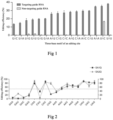
- RNA editing The three-consecutive-base preference of RNA editing is shown, for example, in Fig. 2 and Fig. 3 .
- the lower three-consecutive-base preference for three-base motifs having an upstream residue of guanosine (G) is a common feature of the current ADAR-based RNA editing methods.
- the published documents also reveal obvious three-consecutive-base preference. Due to the limitation of the three-consecutive-base preference, in order to meet practical application requirements and realize efficient editing, in the prior art it is necessary to select three-base motifs having higher three-consecutive-base preferences to edit in the deaminase-based RNA editing systems. Thus, the application scope of RNA editing is limited.
- the present application provides an improved method for editing target RNA at a target residue position in a host cell, which comprises introducing more mismatches to base positions directly opposite to a three-base motif in arRNA, which significantly improves editing efficiencies of the ADAR-based RNA editing systems in the prior art for the target bases in three-base motifs that do not meet the three-consecutive-base preference of the deaminase, thereby breaking through the long-lasting limitation in selection of editing positions in the application of RNA editing.
- the present application provides a method for editing target RNA at a target residue position in a host cell, which comprises introducing ADAR-recruiting RNA (arRNA) or a construct encoding the arRNA into a host cell, wherein the arRNA comprises a complementary RNA sequence, and the complementary RNA sequence hybridizes to target RNA to form double-stranded RNA capable of recruiting a deaminase acting on RNA so as to deaminate a target residue in the target RNA.
- arRNA ADAR-recruiting RNA
- the complementary RNA sequence hybridizes to target RNA to form double-stranded RNA capable of recruiting a deaminase acting on RNA so as to deaminate a target residue in the target RNA.
- the target residue is located in a three-base motif in the target RNA, and the three-base motif comprises a 5' nearest-neighbor residue (upstream residue) of the target residue in the target RNA, the target residue, and a 3' nearest-neighbor residue (downstream residue) of the target residue in the target RNA.
- a triplet formed by linking the upstream residue, the target residue, and the downstream residue in sequence in the order of the 5'-end to the 3'-end is referred to as a "three-base motif".
- all three-base motifs are described in the order of the 5'-end to the 3'-end.
- the three bases (opposite to the three-base motif in the target RNA) in the complementary RNA sequence are also in the order of the 5'-end to the 3'-end.
- the present application provides a method for editing target RNA at a target residue position in a host cell, which comprises introducing ADAR-recruiting RNA (arRNA) or a construct encoding the arRNA into a host cell, wherein the arRNA comprises a complementary RNA sequence that hybridizes to target RNA, and the target residue is located in a three-base motif comprising a 5' nearest-neighbor residue (upstream residue) of the target residue in the target RNA, the target residue, and a 3' nearest-neighbor residue (downstream residue) of the target residue in the target RNA; wherein the three-base motif is not UAG, and the complementary RNA sequence comprises a mismatch directly opposite to the upstream residue or the downstream residue in the target RNA.
- arRNA ADAR-recruiting RNA
- the present application provides a method for editing target RNA at a target residue position in a host cell, which comprises introducing ADAR-recruiting RNA (arRNA) or a construct encoding the arRNA into a host cell, wherein the arRNA comprises a complementary RNA sequence that hybridizes to the target RNA, and the target residue is located in a three-base motif comprising a 5' nearest-neighbor residue (upstream residue) of the target residue in the target RNA, the target residue, and a 3' nearest-neighbor residue (downstream residue) of the target residue in the target RNA, wherein the three-base motif is not UAG, and the complementary RNA sequence comprises mismatches directly opposite to the upstream residue and the downstream residue in the target RNA.
- arRNA ADAR-recruiting RNA
- the upstream residue in the three-base motif is G. In certain embodiments, the upstream residue in the three-base motif is A. In certain embodiments, the upstream residue in the three-base motif is C. In certain embodiments, the downstream residue in the three-base motif is C. In certain embodiments, the downstream residue in the three-base motif is U. In certain embodiments, the downstream residue in the three-base motif is A. In certain embodiments, the three-base motif is selected from the group consisting of: GAG, GAC, GAA, GAU, AAG, AAC, AAA, AAU, CAG, CAC, CAA, CAU, UAA, UAC, and UAU. In certain embodiments, the three-base motif is GAU.
- the three-base motif is GAG. In certain embodiments, the three-base motif is GAA. In certain embodiments, the three-base motif is GAC.
- the upstream residue in the target RNA is a nucleotide selected from the group consisting of: G, C, A and U, and the preferred order is as follows: G>C ⁇ A>U.
- the complementary RNA sequence comprises cytidine (C), adenosine (A) or uridine (U) directly opposite to the target adenosine in the target RNA. In some specific embodiments, the complementary RNA sequence comprises C directly opposite to the target adenosine in the target RNA.
- the complementary RNA sequence that hybridizes to the target RNA further comprises one or more mismatches respectively opposite to a non-target adenosine in the target RNA.
- the mismatch nucleoside opposite to one or more non-target adenosine is guanosine.
- the three-base motif is GAU, and three consecutive complementary bases (directly opposite to the three-base motif) comprised in the complementary RNA sequence are ACG or ACA.
- the three-base motif is GAU, and three consecutive complementary bases (directly opposite to the three-base motif) comprised in the complementary RNA sequence are ACG.
- the three-base motif is GAA, and three consecutive complementary bases (directly opposite to the three-base motif) comprised in the complementary RNA sequence are UCA, CCG, CCC or UCC.
- the three-base motif is GAA, and three consecutive complementary bases (directly opposite to the three-base motif) comprised in the complementary RNA sequence are UCA.
- the three-base motif is GAC, and three consecutive complementary bases (directly opposite to the three-base motif) comprised in the complementary RNA sequence are GCG or GCA.
- the three-base motif is GAC, and three consecutive complementary bases (directly opposite to the three-base motif) comprised in the complementary RNA sequence are GCG.
- the three-base motif is GAG, and three consecutive complementary bases (directly opposite to the three-base motif) comprised in the complementary RNA sequence are CCG, CCA, CCC, UCC or UCG. In certain embodiments, the three-base motif is GAG, and three consecutive complementary bases (directly opposite to the three-base motif) comprised in the complementary RNA sequence are CCG.
- the upstream residue in the three-base motif is G, and the base opposite to the upstream residue in the complementary RNA is G or A. In some embodiments, the downstream residue in the three-base motif is strictly complementary to an opposite base in the complementary RNA.
- the upstream residue in the three-base motif is G, wherein the base opposite to the upstream residue in the complementary RNA is G or A, and the downstream residue in the three-base motif is strictly complementary to an opposite base in the complementary RNA.
- the complementary RNA sequence comprises C directly opposite to the target adenosine in the target RNA, the upstream residue in the three-base motif is G, wherein the base opposite to the upstream residue in the complementary RNA is G or A, and the downstream residue in the three-base motif is strictly complementary to an opposite base in the complementary RNA.
- the complementary RNA sequence comprises C directly opposite to the target adenosine in the target RNA, the upstream residue in the three-base motif is G, wherein the base opposite to the upstream residue in the complementary RNA is G, and the downstream residue in the three-base motif is strictly complementary to an opposite base in the complementary RNA.
- the RNA editing efficiency of the method according to the present application is increased by at least 90% to 1100%, for example, at least 100%, 200%, 300%, 400%, 500%, 600%, 700%, 800%, 900%, and 1000%.
- the target adenosine (A) in the target RNA is deaminated through an adenosine deaminase acting on RNA (ADAR).
- ADAR adenosine deaminase acting on RNA
- the adenosine deaminase is natural ADAR or a homologous protein thereof.
- the adenosine deaminase is an adenosine deaminase functional variant that is modified but retains the adenosine deaminase activity, for example, a variant that is obtained by modifying natural ADAR or a homologous protein thereof with one or more position mutations and retains the adenosine deaminase activity.
- the adenosine deaminase is a fusion protein comprising an ADAR catalytic domain, or ADAR homologous protein catalytic domain, or adenosine deaminase functional variant.
- the fusion protein comprising an ADAR protein catalytic domain is a fusion protein comprising Cas13 protein that loses catalytic activity after mutation and an ADAR functional domain, or ADAR homologous protein functional domain, or adenosine deaminase functional variant.
- the deaminase with the adenosine deaminase activity is exogenously introduced into the host cell or expressed in the host cell by introducing a construct encoding the deaminase.
- the fusion protein comprising an ADAR protein catalytic domain is a fusion protein comprising ⁇ N peptide and an ADAR functional domain, or ADAR homologous protein catalytic domain, or adenosine deaminase functional variant.
- the fusion protein comprising an ADAR protein catalytic domain is SNAP-tag-labelled ADAR, or a SNAP-tag-labelled ADAR functional variant.
- the ADAR is ADAR1 and/or ADAR2.
- ADAR is one or more ADAR selected from the group consisting of: hADAR1, hADAR2, mouse ADAR1, and mouse ADAR2.
- the ADAR is expressed by the host cell.
- ADAR naturally or endogenously occurs in a host cell, for example, ADAR naturally or endogenously occurs in a eukaryocyte.
- the ADAR protein is exogenously introduced into the host cell.
- the ADAR or a construct encoding the ADAR is introduced into a host cell.
- the construct comprises, but is not limited to, a linear nucleic acid, a plasmid, a vector, etc.
- the ADAR comprises the natural ADAR and the homologous protein thereof, the adenosine deaminase functional variant that is modified but retains the adenosine deaminase activity (e.g., a variant that is obtained by modifying natural ADAR or a homologous protein thereof with one or more position mutations and retains the adenosine deaminase activity), or the fusion protein comprising an ADAR catalytic domain, or ADAR homologous protein catalytic domain, or adenosine deaminase functional variant.
- the adenosine deaminase functional variant that is modified but retains the adenosine deaminase activity
- the fusion protein comprising an ADAR catalytic domain, or ADAR homologous protein catalytic domain, or adenosine deaminase functional variant.
- the fusion protein comprising an ADAR catalytic domain or ADAR homologous protein catalytic domain or adenosine deaminase functional variant is a fusion protein comprising a targeting domain and the ADAR catalytic domain or ADAR homologous protein catalytic domain or adenosine deaminase functional variant.
- the targeting domain comprises any one of, but is not limited to: Cas13 protein that loses catalytic activity after mutation, ⁇ N peptide, and SNAP-tag.
- ADAR is one or more ADAR selected from the group consisting of: hADAR1, hADAR2, mouse ADAR1, and mouse ADAR2.
- the method does not comprise the step of introducing any protein into a host cell.
- the ADAR is ADAR1 and/or ADAR2.
- the present application provides a method for editing target RNA at a target residue position in a host cell, which comprises introducing ADAR-recruiting RNA (arRNA) or a construct encoding the arRNA into a host cell, wherein the arRNA comprises a complementary RNA sequence that hybridizes to target RNA, wherein the target residue is located in a three-base motif comprising a 5' nearest-neighbor residue (upstream residue) of the target residue in the target RNA, the target residue, and a 3' nearest-neighbor residue (downstream residue) of the target residue in the target RNA, and the target residue is cytidine (C); wherein the complementary RNA sequence comprises a mismatch directly opposite to the upstream residue and/or the downstream residue in the target RNA, and the method further comprises introducing a deaminase with the cytidine deaminase activity or a cytidine deaminase or a construct encoding the deaminase into
- the deaminase with the cytidine deaminase activity is a deaminase with the C-to-U catalytic activity that is obtained by gene modification of ADAR protein or a fusion protein comprising an ADAR catalytic domain.
- the deaminase with the cytidine deaminase activity further comprises a targeting domain.
- the three-base motif in which the target cytidine is located is any one selected from the group consisting of: GCG, GCC, GCA, GCU, ACG, ACC, ACA, ACU, CCG, CCC, CCA, CCU, UCA, UCC, UCU, and UCG.
- the arRNA comprises an unpaired nucleotide at a position corresponding to the target residue in the target RNA to form a mismatch with the target residue.
- the complementary RNA sequence in the arRNA that can hybridize to the target RNA comprises cytidine, adenosine or uridine directly opposite to the target cytidine in the target RNA.
- the complementary RNA sequence comprises cytidine directly opposite to the target cytidine.
- the arRNA comprises one or more unpaired nucleotides at positions corresponding to non-target editing positions in the target RNA to form one or more mismatches with the non-target positions in the target RNA. Cytidine-to-uridine editing efficiencies in a case that there is a single mismatch opposite to the target residue in the three-base motif and in a case that there are multiple mismatches of the residues in the three-base motif are respectively tested in Example 4, and results are shown in Fig. 22 .
- the editing efficiency in a case that there are multiple mismatches is equal to the editing efficiency in a case that there is a single mismatch of the target residue
- the upstream residue in the three-base motif is G
- the complementary RNA sequence comprises G directly opposite to the upstream residue.
- the three-base motif is ACA, and the complementary RNA sequence comprises AUU or GUU opposite to the three-base motif. In some embodiments, the three-base motif is ACA, and the complementary RNA sequence preferably comprises AUU opposite to the three-base motif. In some embodiments, the three-base motif is UCA, and the complementary RNA sequence comprises AUA, GUA or CUA opposite to the three-base motif. In some embodiments, the three-base motif is UCA, and the complementary RNA sequence preferably comprises AUA opposite to the three-base motif. In certain embodiments, the three-base motif is GCA, and the complementary RNA sequence comprises UUG or UCG opposite to the three-base motif.
- the three-base motif is GCA
- the complementary RNA sequence preferably comprises UUG opposite to the three-base motif.
- the three-base motif is CCA
- the complementary RNA sequence comprises AUG opposite to the three-base motif.
- the target residue in the three-base motif in the target RNA is cytidine
- the upstream residue in the three-base motif is a nucleotide selected from G, C, A, and U
- the preferred order is as follows: G>C>A ⁇ U.
- the arRNA recruits a deaminase with the cytidine deaminase activity to the target RNA so as to deaminate and convert the target cytidine (C) in the target RNA to uridine.
- the cytidine deaminase is an cytidine deaminase or a homologous protein variant thereof that has the cytidine deaminating activity after modification (e.g., deletion or mutation of amino acids at one or more positions).
- the cytidine deaminase that has the cytidine deaminating activity after modification comprises those disclosed in the prior art, for example, one or more mutant cytidine deaminase fragments with the cytidine deaminating activity that are disclosed in Abudayyeh et al., 2019.
- the cytidine deaminase that has the cytidine deaminating activity after modification is ADAR2 comprising one or more mutant selected from: E488Q/V351 G/S486A/T37 5S/S370C/P462A/N 597I/L332I/I398V IK350I/M383L/D619G/S582T/V 440I/S495N/K418E/S661T.
- the cytidine deaminase that has the cytidine deaminating activity after modification is ADAR2 comprising all of the following mutants: E488Q/V351 G/S486A/T37 5S/S370C/P462A/N 597I/L332I/I398V IK350I/M383L/D619G/S582T/V 440I/S495N/K418E/S661T.
- the cytidine deaminase is a fusion protein of ADAR2 catalytic domain comprising all of the following mutants: E488Q/V351 G/S486A/T37 5S/S370C/P462A/N 597I/L332I/I398V IK350I/M383L/D619G/S582T/V 440I/S495N/K418E/S661T.
- the deaminase with the cytidine deaminase activity further comprises a targeting domain.
- the targeting domain comprises any one of, but is not limited to: Cas13 protein that loses catalytic activity after mutation, ⁇ N peptide, and SNAP-tag.
- the method comprises introducing the cytidine deaminase or the fusion protein or a construct encoding the cytidine deaminase or the fusion protein into a host cell.
- the construct comprises, but is not limited to: a linear nucleic acid, a plasmid, a vector, etc.
- the arRNA is single-stranded RNA.
- the complementary RNA sequence is completely single-stranded.
- the arRNA comprises one or more (e.g., 1, 2, 3 or more) double-stranded regions, and/or one or more stem-loop regions.
- the arRNA is composed of the complementary RNA sequence only.
- the complementary RNA sequence comprises two or more mismatches corresponding to the target sequence. In some embodiments, the complementary RNA sequence comprises one or more mismatches corresponding to the target sequence in addition to the three consecutive complementary bases. In some embodiments, when the complementary RNA sequence hybridizes to the target sequence, one or more wobble base pairs may be formed. In some embodiments, when the complementary RNA sequence hybridizes to the target sequence, one or more unilateral protrusions may be formed. In some embodiments, when the complementary RNA sequence hybridizes to the target sequence, one or more wobble base pairs and one or more unilateral protrusions may be formed.
- the arRNA has a length of about 20-260 nucleotides, for example, the arRNA has a length less than or equal to any one of about 30, 40, 45, 50, 55, 60, 65, 70, 75, 80, 85, 90, 95, 100, 105, 110, 120, 130, 140, 150, 160, 170, 180, 190, 200, or more nucleotides.
- the complementary RNA sequence has a length of any one of 40-260, 45-250, 50-240, 60-230, 65-220, 70-220, 70-210, 70-200, 70-190, 70-180, 70-170, 70-160, 70-150, 70-140, 70-130, 70-120, 70-110, 70-100, 70-90, 70-80, 75-200, 80-190, 85-180, 90-170, 95-160, 100-200, 100-150, 100-175, 110-200, 110-175, 110-150, or 105-140 nucleotides.
- the arRNA has a length of about 60-200 (e.g., any one of about 60-150, 65-140, 68-130, or 70-120) nucleotides. In some embodiments, the arRNA further comprises an ADAR-recruiting domain.
- the arRNA comprises one or more chemical modifications.
- the chemical modifications comprise methylation and/or phosphorothioation, e.g., 2'-O-methylation (2'-O-Me) and/or an internucleotide phosphorothioate bond.
- the first and last 3 or 5 nucleotides in the arRNA comprise 2'-O-Me modifications, and/or the linkages between the first and last 3 or 5 nucleotides comprise phosphorothioate bond modifications.
- one or more or all uridines in the arRNA comprise 2'-O-Me modifications.
- a targeting nucleoside in the arRNA and/or a nucleoside e.g., one or two nucleosides directly adjacent to the 5'-end and/or the 3'-end of the targeting nucleoside
- a nucleoside e.g., one or two nucleosides directly adjacent to the 5'-end and/or the 3'-end of the targeting nucleoside adjacent to the 5'-end and/or the 3'-end of the targeting nucleoside comprise 2'-O-Me modifications.
- a targeting nucleoside in the arRNA and/or a nucleoside e.g., one or two nucleosides directly adjacent to the 5'-end and/or the 3'-end of the targeting nucleoside
- a targeting nucleoside in the arRNA and/or a nucleoside e.g., one or two nucleosides directly adjacent to the 5'-end and/or the 3'-end of the targeting nucleoside adjacent to the 5'-end and/or the 3'-end of the targeting nucleoside comprise 3'-phosphorothioate bond modifications.
- the arRNA does not comprise any chemical modification.
- the target RNA is RNA selected from messenger RNA precursor, messenger RNA, ribosome RNA, transfer RNA, long non-coding RNA, and small RNA.
- the target residue in the target RNA is edited to result in a missense mutation, premature termination codon, aberrant splicing or alternative splicing in the target RNA, alternatively, to reverse a missense mutation, premature termination codon, aberrant splicing or alternative splicing in the target RNA.
- the target residue in the target RNA is edited to result in point mutation, truncation, extension and/or misfolding of a protein encoded by the target RNA, alternatively, to obtain a functional, full-length, correctly folded and/or wild-type protein by reversing a missense mutation, premature termination codon, aberrant splicing or alternative splicing in the target RNA.
- the host cell is a eukaryocyte.
- the host cell is a mammalian cell.
- the host cell is a human or mouse cell.
- edited RNA or a host cell comprising the edited RNA can be produced. Therefore, the present application further provides edited RNA or a host cell comprising the edited RNA produced by the target RNA editing method according to the present application.
- the method for editing target RNA at a target residue position in a host cell can be applied to treat or prevent a disease or condition in an individual. Therefore, the present application further provides a method for treating or preventing a disease or condition in an individual, which comprises editing the target RNA associated with a disease or condition in an individual cell by any method for editing target RNA at a target residue position in a host cell described above according to the present application.
- the disease or condition is an inherited gene disease, or a disease or condition associated with one or more acquired gene mutations (e.g., drug resistance).
- the present application further provides RNA (arRNA) that can be applied to the method of the present application for recruiting a deaminase acting on RNA so as to deaminate a target residue in target RNA, which comprises a complementary RNA sequence that hybridizes to the target RNA, wherein the target residue is located in a three-base motif comprising a 5' nearest-neighbor residue (upstream residue) of the target residue in the target RNA, the target residue, and a 3' nearest-neighbor residue (downstream residue) of the target residue in the target RNA, wherein the three-base motif is not UAG, and the complementary RNA sequence comprises a mismatch directly opposite to the upstream residue and/or the downstream residue in the target RNA.
- arRNA RNA
- the target residue (targeted by the arRNA) in the three-base motif in the target RNA is adenosine, wherein the upstream residue in the target RNA is a nucleotide selected from G, C, A, and U, and the preferred order is as follows: G>C ⁇ A>U.
- the three-base motif is selected from the group consisting of: GAG, GAC, GAA, GAU, AAG, AAC, AAA, AAU, CAG, CAC, CAA, CAU, UAA, UAC, and UAU.
- the arRNA comprises cytidine (C), adenosine (A) or uridine (U) directly opposite to the target adenosine in the target RNA.
- the arRNA comprises C directly opposite to the target adenosine in the target RNA.
- the arRNA that hybridizes to the target RNA further comprises one or more mismatches respectively opposite to a non-target adenosine in the target RNA.
- the mismatche opposite to one or more non-target adenosine is guanosine.
- the upstream residue in the three-base motif is G
- the base opposite to the upstream residue in the complementary RNA is G or A.
- the three-base motif is GAU, and three consecutive complementary bases (directly opposite to the three-base motif) comprised in the arRNA are ACG or ACA. In certain embodiments, the three-base motif is GAU, and three consecutive complementary bases (directly opposite to the three-base motif) comprised in the arRNA are ACG. In certain embodiments, the three-base motif is GAA, and three consecutive complementary bases (directly opposite to the three-base motif) comprised in the arRNA are UCA, CCG, CCC or UCC. In certain embodiments, the three-base motif is GAA, and three consecutive complementary bases (directly opposite to the three-base motif) comprised in the arRNA are UCA.
- the three-base motif is GAC, and three consecutive complementary bases (directly opposite to the three-base motif) comprised in the arRNA are GCG or GCA. In certain embodiments, the three-base motif is GAC, and three consecutive complementary bases (directly opposite to the three-base motif) comprised in the arRNA are GCG. In certain embodiments, the three-base motif is GAG, and three consecutive complementary bases (directly opposite to the three-base motif) comprised in the arRNA are CCG, CCA, CCC, UCC or UCG. In certain embodiments, the three-base motif is GAG, and three consecutive complementary bases (directly opposite to the three-base motif) comprised in the arRNA are CCG. In certain embodiments, the arRNA comprises one or more mismatches respectively opposite to a non-target adenosine in the target RNA.
- the target residue (targeted by the arRNA) in the three-base motif in the target RNA may be cytidine (C), which is referred to as target cytidine.
- the upstream residue in the three-base motif is a nucleotide selected from G, C, A, and U, and the preferred order is as follows: G>C>A ⁇ U.
- the three-base motif in which the target cytidine is located is any one selected from the group consisting of: GCG, GCC, GCA, GCU, ACG, ACC, ACA, ACU, CCG, CCC, CCA, CCU, UCA, UCC, UCU, and UCG.
- the upstream residue in the three-base motif is G, and the base opposite to the upstream residue in the complementary RNA is G.
- the downstream residue in the three-base motif is A
- the base opposite to the downstream residue in the complementary RNA is U or A.
- the three-base motif is ACA, and the complementary RNA sequence comprises AUU or GUU opposite to the three-base motif.
- the three-base motif is ACA, and the complementary RNA sequence comprises AUU opposite to the three-base motif.
- the three-base motif is UCA, and the complementary RNA sequence comprises AUA, GUA or CUA opposite to the three-base motif.
- the three-base motif is UCA, and the complementary RNA sequence comprises AUA opposite to the three-base motif. In some embodiments, the three-base motif is GCA, and the complementary RNA sequence comprises UUG or UCG opposite to the three-base motif. In some embodiments, the three-base motif is GCA, and the complementary RNA sequence comprises UUG opposite to the three-base motif. In some embodiments, the three-base motif is CCA, and the complementary RNA sequence comprises AUG opposite to the three-base motif. In certain embodiments, the arRNA comprises an unpaired nucleotide at a position corresponding to the target residue in the target RNA to form a mismatch with the target residue.
- the complementary RNA sequence in the arRNA that can hybridize to the target RNA comprises cytidine, adenosine or uridine directly opposite to the target cytidine in the target RNA. In certain embodiments, the complementary RNA sequence comprises cytidine directly opposite to the target cytidine. In certain embodiments, the arRNA comprises one or more unpaired nucleotides at positions corresponding to non-target editing positions in the target RNA to form one or more mismatches with the non-target positions in the target RNA.
- the arRNA is single-stranded RNA.
- the complementary RNA sequence is completely single-stranded.
- the arRNA comprises one or more (e.g., 1, 2, 3 or more) double-stranded regions and one or more stem-loop regions.
- the arRNA comprises one or more (e.g., 1, 2, 3 or more) double-stranded regions.
- the arRNA comprises one or more (e.g., 1, 2, 3 or more) stem-loop regions.
- the arRNA comprises a region that can form an intramolecular stem-loop structure for recruiting ADAR enzyme.
- the arRNA does not comprise a region that can form an intramolecular stem-loop structure for recruiting ADAR enzyme.
- the arRNA is composed of the complementary RNA sequence only.
- one or more wobble base pairs may be formed.
- one or more unilateral protrusions may be formed.
- one or more wobble base pairs and one or more unilateral protrusions may be formed.
- the arRNA has a length of about 20-260 nucleotides, for example, the arRNA has a length less than or equal to any one of about 30, 40, 45, 50, 55, 60, 65, 70, 75, 80, 85, 90, 95, 100, 105, 110, 120, 130, 140, 150, 160, 170, 180, 190, 200, or more nucleotides.
- the complementary RNA sequence has a length of any one of 40-260, 45-250, 50-240, 60-230, 65-220, 70-220, 70-210, 70-200, 70-190, 70-180, 70-170, 70-160, 70-150, 70-140, 70-130, 70-120, 70-110, 70-100, 70-90, 70-80, 75-200, 80-190, 85-180, 90-170, 95-160, 100-200, 100-150, 100-175, 110-200, 110-175, 110-150, or 105-140 nucleotides.
- the arRNA has a length of about 60-200 (e.g., any one of about 60-150, 65-140, 68-130, or 70-120) nucleotides. In some embodiments, the arRNA further comprises an ADAR-recruiting domain.
- the arRNA comprises one or more chemical modifications.
- the chemical modifications comprise methylation and/or phosphorothioation, e.g., 2'-O-methylation (2'-O-Me) and/or an internucleotide phosphorothioate bond.
- the first and last 3 or 5 nucleotides in the arRNA comprise 2'-O-Me modifications, and/or the linkages between the first and last 3 or 5 nucleotides comprise phosphorothioate bond modifications.
- one or more or all uridines in the arRNA comprise 2'-O-Me modifications.
- a targeting nucleoside in the arRNA and/or a nucleoside e.g., one or two nucleosides directly adjacent to the 5'-end and/or the 3'-end of the targeting nucleoside
- a nucleoside e.g., one or two nucleosides directly adjacent to the 5'-end and/or the 3'-end of the targeting nucleoside adjacent to the 5'-end and/or the 3'-end of the targeting nucleoside comprise 2'-O-Me modifications.
- a targeting nucleoside in the arRNA and/or a nucleoside e.g., one or two nucleosides directly adjacent to the 5'-end and/or the 3'-end of the targeting nucleoside
- a targeting nucleoside in the arRNA and/or a nucleoside e.g., one or two nucleosides directly adjacent to the 5'-end and/or the 3'-end of the targeting nucleoside adjacent to the 5'-end and/or the 3'-end of the targeting nucleoside comprise 3'-phosphorothioate bond modifications.
- the arRNA does not comprise any chemical modification.
- the present application further provides a virus vector, plasmid or linear nucleic acid chain, which comprises any arRNA described above according to the present application, and the arRNA does not comprise any chemical modification.
- the present application further provides a library, which comprises any arRNA described above according to the present application, or any virus vector, plasmid or linear nucleic acid chain described above according to the present application.
- the present application further provides a composition, which comprises any arRNA described above according to the present application, or any virus vector, plasmid or linear nucleic acid chain described above according to the present application.
- the present application further provides a host cell, which comprises any arRNA described above according to the present application, or any virus vector, plasmid or linear nucleic acid chain described above according to the present application.
- the host cell comprising any arRNA described above according to the present application is a eukaryocyte.
- a small arRNA fragment partially or completely complementary to target RNA comprising target adenosine (A) is exogenously introduced, and the RNA is used for recruiting endogenous ADAR to perform A-to-I editing on the target A.
- the arRNA is synthesized in vitro, and has a length of 71-111 nt. As shown in Fig.
- three bases (directly opposite to a three-base motif in a target sequence) in arRNA used in the present application have weaker complementarity to the three-base motif, i.e., in addition to a mismatch opposite to the target A, the three bases (directly opposite to the three-base motif) in the arRNA further comprise a base mismatched with an upstream residue and/or a downstream residue.
- Such a change breaks through the three-consecutive-base preference, such that freer and more efficient editing can be performed on three-base motifs having an upstream residue of G or the three-base motifs other than UAG by the existing and future ADAR-based editing methods.
- Example 1 Construction of three-base motif reporter systems and corresponding arRNAs
- reporter systems comprising 16 three-base motifs were constructed.
- a difference between editing efficiencies for the three-base motif of UAG is tested (Qu et al., 2019).
- nucleosides that can be complementarily paired with arRNA except for the editing position were designed to be the same as sequences in the above document related to LEAPER, as shown in Fig. 5 .
- An original plasmid Reporter 1 was donated by Professor Wei Wensheng of School of Life Sciences, Peking University.
- a plasmid profile is shown in Fig. 14 , and the plasmid comprises a sequence shown in Table 4.
- Target RNA RNA
- final three-base motif reporter system cells which were named as three-base motifs shown in Table 2.
- Example 2 Comparison of the editing efficiencies of different arRNAs for the three-base motif of UAG based on proportions of GFP-positive cells
- each of the 16 types of target RNAs in Example 1 has a green fluorescent protein (GFP) nucleic acid sequence at the 3'-end of the target sequence.
- the sequence can be translated correctly into a GFP emitting a green fluorescence under normal conditions.
- the three-base motif is UAG
- UAG is a termination codon
- the LEAPER system was used to edit A in the three-base motif of UAG. If A is successfully edited, UAG will be converted to UIG, UIG will be recognized as UGG in the translation process, so that translation will be not terminated and the downstream GFP can be normally translated. Therefore, according to proportions of GFP-positive cells, editing efficiencies of different arRNAs can be roughly determined.
- RNAiMAX reagent Invitrogen 13778150 was used to transfect the 16 types of arRNAs of Example 1 into cells respectively, and the specific procedure was as follows:
- the cells were 293T cells transcribing mRNA with the three-base motif of UAG. After the cells were co-cultured with the arRNA for 72 h (48h after transfection), the FITC channel intensity was analyzed by using the flow cytometer. Results are shown in Fig. 7 , UT is a control without any transfection, and Vech is a control that is added with an RNAiMAX transfection reagent and is not transfected with any dRNA.
- Fig. 9 the editing efficiency of the LEAPER system by using a reporter system similar to that in the present example for the three-base motif of UAG is shown in Fig. 9 (Qu et al., 2019).
- the annotations on the horizontal axis in Fig. 9 are the names of the arRNA sequences, which correspond to subscripts of the names on the horizontal axis in Fig. 7 or Fig. 8 .
- the arRNAs in Fig. 7 or Fig. 8 are arranged in the same order as the arRNAs in Fig. 9 .
- the chemically synthesized arRNAs are used for transfection in the present example, and plasmids are used for transfection in Fig.
- the overall editing efficiency of the present example is relatively high but an overall trend is the same as that of Fig. 9 . That is, in a case that the three-base motif is UAG, the efficiency of an arRNA is the highest, when the base (corresponding to the target A) in the arRNA is C and the other two bases corresponding to the upstream residue U and the downstream residue G are A and C respectively paired with U and G, i.e., the corresponding arRNA is arRNA CCA . However, in a case that the three-base motif is UAG, the editing efficiency of an arRNA is not improved significantly but reduced, when the bases (respectively corresponding to the upstream residue U and the downstream residue G) in the arRNA are other unpaired bases.
- Example 3 RNA editing efficiency for a three-base motif of GAN
- the reporter system cells respectively comprising three-base motifs of UAG, GAA, GAU, GAC, and GAG were transfected with 16 types of arRNA respectively, and the transfection procedure was the same as that in Example 2.
- RNA TRIzol Reagent, ambion REF15596026
- 1 ⁇ g of RNA was reversely transcribed with 20 ⁇ L of reverse transcription system (TransScript ® One-Step gDNA Removal and cDNA Synthesis SuperMix, TransGen AT311-02), and PCR amplification was performed with 1 ⁇ L of reverse transcription product by using the following pair of primers: ggagtgagtacggtgtgcGACGAGCTGTACAAGCTGCAGGG (SEQ ID NO: 1), and gagttggatgctggatggTGGTGCAGATGAACTTCAGGGTCAG (SEQ ID NO: 2) (small letters represent primer adapters required by a Hi-Tom kit), and a library was built by using a Hi-Tom kit (Novogene, REF PT045).
- ggagtgagtacggtgtgcGACGAGCTGTACAAGCTGCAGGG SEQ ID NO: 1
- next-generation sequencing was performed according to the following procedure, and the A->G editing efficiency for an editing position was analyzed.
- the built sequencing library was subjected to high-throughput sequencing by means of PE150 on the NovaSeq6000 platform.
- Raw data obtained by the high-throughput sequencing were quality-controlled with fastp (v0.19.6) to filter out sequences with low quality, adapter sequences, or polyG.
- the obtained high-quality sequencing data were split into each sample according to a corresponding barcode sequence with a self-developed split script, comparing with the sequence of the amplified target region by using the BWA (v0.7.17-r1188) software, subjecting to format conversion to generate a BAM file and statistical comparison information by using SAMtools (v1.9), then rearranging, and indexing.
- RNA editing positions were detected by using the JACUSA (v1.3.0) software, and used parameters were call-1-a B,R,D,I,Y,M:4-C ACGT-c2-p1-P UNSTRANDED-R-u DirMult-CE.
- JACUSA JACUSA
- a value three times the average mutation frequency except for the A->G mutation was taken as a threshold value, and a part of the A->G mutation frequency of an editing position that is greater than the threshold value was taken as the true frequency of the mutation of target A to G.
- the arRNA of the present application achieves unexpected editing effects, as shown in Fig. 11 .
- the efficiency of the arRNA of the present application for GAU is particularly obviously improved.
- the editing efficiency of arRNA ACC designed by the conventional method in the prior art is substantively 0, which is consistent with the document reports.
- the editing efficiency can be greatly improved. As shown in Fig. 11A , the editing efficiency is more than 10 times that of the inherent design (arRNA ACC ) in the prior art, and the editing efficiency of arRNA ACC designed according to the prior art is very low, which is consistent with previous reports.
- the editing efficiency of arRNA with appropriately reduced complementarity to the three-base motif is unexpectedly high.
- the editing efficiency of the arRNA GCC designed according to the inherent principle in the prior art is substantively zero, while the editing efficiencies of the arRNAccc and the arRNA CCA with more introduced mismatches are obviously higher.
- the efficiency is the highest.
- the editing efficiency of the arRNAucc designed according to the fixed pattern in the prior art is not high, while in a case that the base (opposite to the target A) in the arRNA is C, the base opposite to the downstream residue A is a complementary base U, and the base opposite to the upstream residue G is a mismatched base A (i.e., arRNA UCA ), the editing efficiency is higher.
- the efficiencies for different three-base motifs are improved as follows: GAU>GAC ⁇ GAA>GAG; while the base paired with the upstream residue G adjacent to the target residue A is changed from C in the inherent technology to A, the efficiencies for different three-base motifs are improved as follows: GAC>GAU ⁇ GAG ⁇ GAA.
- the efficiencies for the three-base motifs of GAU, GAC and GAA are the lowest, and close to zero (see Fig. 3 ). Therefore, these three-base motifs should be avoided as much as possible during RNA editing.
- the present application breaks through this limitation by creatively introducing more mismatched bases (opposite to the three-base motif) into the arRNA. It can be seen from the example of the present application that, in a case that among three bases (opposite to the three-base motif) in arRNA, the base opposite to the target A is C, and the base opposite to the upstream and/or downstream residue is a mismatched base, the editing efficiency can be significantly improved.
- the efficiency is higher; particularly, in a case that the base opposite to the upstream residue G is a mismatched base G, the editing efficiency is the highest.
- Example 4 Study on the three-consecutive-base preference for C-to-U RNA editing
- the ADAR2 catalytic domain was induced to mutate, and the mutation positions were the same as r16 (dADAR2 (E488Q/V351 G/S486A/T37 5S/S370C/P462A/N 597I/L332I/I398V /K350I/M383L/D619G/S582T /V 440I/S495N/K418E/S661T) r16, https://benchling.com/s/seq-19Ytwwh0i0vSIbyXYZ95) in the document.
- a sequence between an ADAR2 XmaI restriction site and an AscI restriction site in a pLenti-ADAR2 plasmid vector was synthesized in vitro by the conventional DNA synthesis technology (a pLenti-ADAR2 plasmid backbone was donated by Professor Wei Wensheng's laboratory), and the above mutation is comprised in the sequence.
- ADAR2-r16 A full-length cDNA sequence of ADAR2-r16 is shown in Table 6.
- pCAG-VSVG was donated by Arthur Nienhuis & Patrick Salmon (Addgene plasmid #35616; http://n2t.net/addgene:35616; RRID: Addgene_35616); and pCMVR8.74 was donated by Didier Trono (Addgene plasmid # 22036; http://n2t.net/addgene:22036; RRID: Addgene_22036)
- pLenti-ADAR2-r16 was packaged as a lentivirus, 293T cells were transfected with the lentivirus, and 48h after transfection, resistance screening was performed with Blasticidin (Solarbio B9300) at a final concentration of 10 ⁇ g/mL. After screening, surviving cells were referred to as ADAR2-r16-293T.
- a BFP reporter system was constructed with reference to the document ( Vu, L. T., Nguyen, T. T. K., Md Thoufic, A. A., Suzuki, H., & Tsukahara, T. (2016).
- Chemical RNA editing for genetic restoration the relationship between the structure and deamination efficiency of carboxyvinyldeoxyuridine oligodeoxynucleotides. Chemical biology & drug design, 87(4), 583-593 ), and all cDNA sequences of BFP were synthesized in vitro from DNA, the specific sequences are shown in Table 7.
- the BFP cDNA sequence was cloned into a pCDH-CMV plasmid vector through multiple cloning sites behind the CMV promoter (a pCDH-CMV plasmid skeleton was donated by Kazuhiro Oka, Addgene plasmid #72265; http://n2t.net/addgene:72265; RRID: Addgene_72265).
- a C-to-U editing position in the reporter system was the base C of position 199 in the BFP sequence, and the bases of positions 199-201 were CAC, which corresponded to the histidine of position 66.
- the bases of positions 198-200 in the sequence are CCA in order, which is named as BFP-CCA, and abbreviated as C*. If the base C of position 199 is deaminated and edited to U at the RNA level, the amino acid of position 66 will be changed, and the BFP fluorescent protein is changed from the original blue fluorescence to green fluorescence, so that a signal can be detected by using a fluorescein isothiocyanate (FITC) channel of flow cytometry.
- FITC fluorescein isothiocyanate
- the codon of the amino acid of position 65 is coded by ACC, ACA, ACT or ACG, and they all respectively encodes threonine, so the mutation at this position is a synonymous mutation. Accordingly, when the upstream residue adjacent to the target residue of position 199 in mRNA is a different base, the C-to-U editing efficiencies can be determined and compared at the same time by using the reporter system.
- a mutation was introduced into the base of position 198 by using a site-directed mutagenesis kit (Q5 ® Site-Directed Mutagenesis Kit, NEB E0554S), the bases of positions 198-200 were respectively: GCA named as BFP-GCA, and abbreviated as G*; ACA named as BFP-ACA, and abbreviated as A*; and TCA named as BFP-TCA, and abbreviated as T*.
- BFP-GCA BFP-ACA
- BFP-TCA BFP-TCA
- BFP-CCA BFP-CCA
- 293T cells or ADAR2-r16-293T cells were transfected with the lentivirus, 48h after transfection, resistance screening was performed with 500 ⁇ g/mL Geneticin (Gibco, Catalog number: 10131035) or Blasticidin (Solarbio B9300) at a final concentration of 10 ⁇ g/mL, and after screening the surviving cells were respectively named as 293T-GCA, 293T-ACA, 293T-TCA, 293T-CCA, and ADAR2-r16-GCA, ADAR2-r16-ACA, ADAR2-r16-TCA, ADAR2-r16-CCA.
- RNA in the present example and the term “dRNA” herein have the same meaning, and are interchangeable.
- the base (opposite to a target residue in a three-base motif) in arRNA was located in the middle of the arRNA, and the 5' upstream and the 3'-downstream extend to both sides by the same length. Due to the limitation of synthesized length, in the present example, RNA with a length of 91 nt was first synthesized in vitro, and according to different nucleotides position 46 (targeting base), i.e., the nucleotide of position 46 is A, U, G or C respectively, the four synthesized arRNAs were respectively abbreviated as A*, U*, G*, and C*.
- arRNAs respectively comprising different three consecutive complementary bases were synthesized under the conditions that the target residue in the three-base motif was cytidine and the 'upstream residue was adenosine, and specific sequences are shown in Table 8.
- the nucleotide of position 46 in the arRNA was fixed as U, and nucleotides of positions 45 and 47 were respectively A, U, G or C, and a total of 16 arRNAs were synthesized.
- Each arRNA was named according to the following principles: all arRNAs were named by starting with "arRNA", and then three consecutive complementary bases in arRNA were displayed in the form of subscripts.
- the target residue C in mRNA corresponds to a targeting base of U in arRNA
- three consecutive complementary bases were displayed in the order of the 5'-end to the 3'-end.
- the upstream residue adjacent to the target residue C is C
- the corresponding 3' nearest-neighbor residue of targeting base in arRNA is G
- the targeting base C the corresponding targeting residue in the arRNA is U
- the downstream residue adjacent to the target residue C is A
- the corresponding 5' nearest-neighbor residue of the targeting base in the arRNA is U
- this antisense RNA is named as arRNA UUG .
- the first batch of four synthesized arRNAs (A*, U*, G*, and C*) and the second batch of 16 synthesized RNAs were respectively named as arRNA UAG , arRNA UUG , arRNA UGG , and arRNAucc in the following experiment. It should be noted that in the two experiments, a sequence of the arRNA UUG synthesized for the first time is exactly the same as that of the arRNA UUG synthesized for the second time, and the arRNA UUG was synthesized in two different batches.
- ADAR2-r16-293T cells were plated onto a 6-well plate at a density of 300000 cells/well, 24 h after plating, the cells were transfected with Lipofectamine TM 3000 Transfection Reagent (Invitrogen, Catalog number: L3000015), the transfection procedure was performed according to the instructions. Two repeated experiments were performed with Lipofectamine 3000 transfection reagents at different concentrations according to the instructions, and 3.75 ⁇ L and 7.5 ⁇ L transfection reagent concentration per well were respectively used in Repeat 1 and Repeat 2.
- BFP-GCA abbreviated G*
- BFP-ACA abbreviated A*
- BFP-TCA abbreviated T*
- BFP-CUA abbreviated CUA
- the mRNA row indicates the BFP reporter system plasmid added in the corresponding well
- the arRNA row indicates the arRNA added in the corresponding well.
- the bases of positions 198-200 in the original sequence are CCA, when the base C of position 198 is converted to A or T or G, the amino acid of position 65 is converted to threonine, so changes of the base of position 198 in the four different reporter systems of BFP-GCA, BFP-CCA, BFP-ACA, and BFP-TCA will not affect the original protein function.
- the bases of positions 198-200 in the original sequence are CCA, when the base C of position 198 is converted to A or T or G, the amino acid of position 65 is converted to threonine, so changes of the base of position 198 in the four different reporter systems of BFP-GCA, BFP-CCA, BFP-ACA, and BFP-TCA will not affect the original protein function.
- BFP-GCA base C of position 198
- BFP-CCA amino acid
- MFI of the background GFP signal of the reporter system is 5 ⁇ 10 4 (the reporter system is marked as U*, arRNA is marked as /; and the reporter is marked as A*, and arRNA is marked as /).
- MFI of a GFP signal is about 2.4 ⁇ 10 6 -3.1 ⁇ 10 6 , which is about 100 times that of the background signal. Therefore, it indicates that if the base C of position 199 is converted to U at the RNA level, MFI of a GFP signal will be increased by about 100 times.
- BFP reporter system the applicant integrated the four plasmids: BFP-GCA, BFP-ACA, BFP-TCA, and BFP-CCA respectively into ordinary 293T cells without ADAR2-r16 by lentiviral packaging and 293T cells stably integrated with ADAR2-r16, and the procedure and nomenclature referred to ii. Construction of BFP reporter system. Because the reporter system was integrated into the cell genome, different transfection reagents were used in the transfection with arRNA in the three-consecutive-base preference test, and the transfection with arRNA in the target C para-antisense RNA test.
- 293T cells or ADAR2-r16-293T cells comprising different reporter systems were plated onto a 12-well plate at a density of 150000 cells/well, 24 h after plating, the cells in each well were transfected with 15 pmol of arRNA by using an RNAiMAX reagent, 48h after transfection, the FITC channel signal intensity was detected by FACS, and the percentage of GFP+ cells was counted.
- the test results are shown in Fig.
- the results of the three-consecutive-base test once brought great troubles to this study.
- the three consecutive bases comprise a base A, U, C or G corresponding to the target C
- C is paired with U.
- the data of the case where the base (corresponding to the target C) in the arRNA is U in the experiment corresponding to Fig. 15 was separately extracted, and redrawn to obtain Fig. 18 .
- the conclusions of the two experiments are obviously contradictory.
- the statistical patterns in the two figures are different, the trends in the same batch of experiments are significantly different.
- Fig. 18 redrawn according to the data in Fig. 15 , efficiencies for GCA and CCA are high, while in Fig. 17 , efficiencies for TCA and ACA are obviously high.
- Fig. 19A shows the pairing relationship between the three-base motif in mRNA used in Fig. 18 and the three consecutive complementary bases in the arRNA
- Fig. 19B shows the pairing relationship between the three-base motif in mRNA used in Fig. 17 and the three consecutive complementary bases in the arRNA.
- FIG. 19A shows the case that the base (opposite to the upstream residue adjacent to the target C) in the arRNA is G, and the upstream residue is mismatched with the opposite base in the arRNA except for the case that the upstream residue adjacent to the target C is C; and the latter ( Fig. 19B ) shows the case that the base (opposite to the upstream residue adjacent to the target C) in the arRNA is a base strictly complementary to the upstream residue. Therefore, the inventors speculated that the reason for the above contradiction was that a mismatch between the base in the three consecutive complementary bases in the arRNA and the upstream residue may lead to a change in the three-consecutive-base preference.
- the arRNAs synthesized in iv. Target C para-antisense RNA test, and the arRNAs synthesized in v. Three-consecutive-base preference test were tested together, and GFP percentages and MFI were counted.
- the tests conditions were exactly the same as those in v. Three-consecutive-base preference test.
- the upper panels of Fig. 20 and Fig. 21 show test results of the arRNAs synthesized in iv. Target C para-antisense RNA test
- the lower panels of Fig. 20 and Fig. 21 show test results of the arRNAs synthesized in v. Three-consecutive-base preference test.
- the inventors considered whether the editing efficiency can be further improved by introducing other additional unmatched sequences into three-base motifs.
- the base (opposite to the target C) in the arRNA was U, more mutations were introduced to the positions (opposite to the upstream residue and/or the downstream residue adjacent to the target base in the three-base motif) in the three consecutive complementary bases in the arRNA.
- the base opposite to the upstream residue of the target base may be A, U, C or G
- the other base opposite to the downstream residue of the target base may also be A, U, C or G
- arRNAs comprising the above 16 three-consecutive-complementary-base sequences were synthesized, and they were named according to the three-consecutive-complementary-base sequences, the specific sequences are shown in Table 8.
- RNAiMAX i.e., BFP-ACA-293T and BFP-ACA-293T-ADAR2-r16
- BFP-TCA-293T and BFP-TCA-293T-ADAR2-r16 see Fig. 22A
- BFP-CCA-293T and BFP-CCA-293T-ADAR2-r16 see Fig. 22D
- BFP-GCA-293T and BFP-GCA-293T-ADAR2-r16 Fig. 22C
- the transfection conditions and test time were the same as those in the experiments related to Fig. 17 .
- the controls in the 4 Figs 22A-D are the same sample, "random sequence of 91 nt” is a control added with a random sequence of 91 nt, "vector only” is a control added with an RNAiMAX transfection reagent but not added with RNA, "Opti-DMEM medium” is a control added with an equal volume of Opti-DMEM but not added with an RNAiMAX transfection reagent, "untreated” is a control without transfection, particularly, arRNA UAG , arRNA UUG , arRNA UCG , and arRNAucc respectively comprise the same sequence as CCA-arRNA UAG , CCA-arRNA UUG , CCA-arRNAucc, and CCA-arRNAucc, but they are synthesized in two different batches.
- Fig. 22 shows the preferred selections for introducing more mismatches, i.e., in a case that the three-base motif is ACA, the editing efficiency of arRNA having the three consecutive complementary bases of AUU or GUU is high, particularly the editing efficiency of arRNA having the three consecutive complementary bases of AUU is higher; in a case that the three-base motif is UCA (TCA in the plasmid), the editing efficiency of arRNA having the three consecutive complementary bases of AUA, GUA or CUA is high, particularly the editing efficiency of arRNA having the three consecutive complementary bases of AUA is higher; in a case that the three-base motif is GCA, the editing efficiency of arRNA having the three consecutive complementary bases of UUG or UCG is high, particularly the editing efficiency of arRNA having the three consecutive complementary bases of UUG is higher; and in a case that the three-base motif is CCA, the editing efficiency of arRNA having the three consecutive complementary bases of AUG is higher.
- the three-base motif is ACA
- the arRNA comprising the three-consecutive-complementary-base sequence UUU having a single base mismatch opposite to the target residue can reach an editing efficiency comparable to that of AUU or GUU having mismatches directly opposite to the upstream residue and/or the downstream residue; and in a case that the three-base motif is UCA, the arRNA comprising the three-consecutive-complementary-base sequence UUA having a single mismatch opposite to the target residue can reach an editing efficiency comparable to that of AUA having mismatches directly opposite to the upstream residue and/or the downstream residue.
- the editing efficiency of the three-consecutive-complementary-base sequence UUC having a single base mismatch opposite to the target residue is close to 0, and the editing efficiency of UUG or UCG having mismatches directly opposite to the upstream residue and/or the downstream residue may be several times to more than 10 times that of UUC.
- the editing efficiency of AUG introducing mismatches directly opposite to the upstream residue and/or the downstream residue is also similar to that of UCG.
- the preferred order of the mismatches of the upstream residue in the three-base motif is as follows: G>C>A ⁇ U, i.e., in a case that the upstream residue in the three-base motif is G, the editing efficiency can be significantly improved by introducing G that is mismatched with the upstream residue.
- the maximum efficiency for ACA or UCA is about 10% GFP+; with respect to GCA, the editing efficiency of the arRNA having a single mismatch opposite to the target base is close to 0; and the editing efficiency of the arRNA that not only comprises a mismatch opposite to the target base but also is introduced with mismatches directly opposite to the upstream residue and/or the downstream residue can be increased to 6%-8% GFP+; however, with respect to CCA, the maximum efficiency of arRNA that is introduced with mismatches directly opposite to the upstream residue and/or the downstream residue is not greater than 2.5% GFP+.
- the present application breaks through the limitation of the low editing efficiency of the existing RNA editing technology for three-base motifs of GAU, GAC, etc., so that the three-base motifs starting with G can still be edited with considerable efficiency to break through the embarrassing situation that the existing RNA editing technology cannot edit the sites of GAU, GAC, etc., thereby significantly improving the editing efficiencies of the ADAR-based RNA editing systems (e.g., LEAPR ( WO2020074001A1 ) and RESTORE ( WO2020001793A1 )) in the prior art for the three-base motifs (other than UAG) that do not meet the natural preference of ADAR.
- the ADAR-based RNA editing systems e.g., LEAPR ( WO2020074001A1 ) and RESTORE ( WO2020001793A1 )
- the technical solutions of the present application also break through the limitation of the low editing efficiency of the existing RNA editing technology for the three-base motifs such as GCA, and compared with the low editing efficiency of RESCUE in the prior art ( WO2019071048A9 ) for the three-base motif of GCA, the present application greatly enhances the ability to edit GCA by introducing additional base mismatches.
- the present application breaks through the long-lasting limitation in selection of editing sites in the application of RNA editing. For example, in terms of disease therapy development, according to the present application, more inherited diseases caused by gene mutations have the opportunity to be more safely and efficiently treated by RNA editing.
- RNA Corresponding arRNA RNA sequence A arRNA UAG U ⁇ arRNA UUG C ⁇ arRNA UCG G ⁇ arRNA UGG Note: there is no difference between capital and small letters, and capital letters are only used for highlighting differences between sequences.
- Table 8 Relevant arRNA sequences used in Example 4 Corresponding arRNA SEQ ID NO: RNA sequence arRNA UUU 61 arRNA AUU 62 arRNA GUU 63 arRNA CUU 64 arRNA UUA 65 arRNA AUA 66 arRNA GUA 67 arRNA CUA 68 arRNA UUG 56 arRNA AUG 69 arRNA GUG 70 arRNA CUG 71 arRNA UUC 72 arRNA AUC 73 arRNA GUC 74 arRNA CUC 75 Ran-91 76 Note: there is no difference between capital and small letters, and capital letters are only used for highlighting three consecutive complementary bases.
Landscapes
- Health & Medical Sciences (AREA)
- Life Sciences & Earth Sciences (AREA)
- Genetics & Genomics (AREA)
- Engineering & Computer Science (AREA)
- Chemical & Material Sciences (AREA)
- Organic Chemistry (AREA)
- Bioinformatics & Cheminformatics (AREA)
- Zoology (AREA)
- Wood Science & Technology (AREA)
- Biomedical Technology (AREA)
- General Engineering & Computer Science (AREA)
- Biotechnology (AREA)
- Molecular Biology (AREA)
- General Health & Medical Sciences (AREA)
- Biochemistry (AREA)
- Microbiology (AREA)
- Biophysics (AREA)
- Plant Pathology (AREA)
- Physics & Mathematics (AREA)
- Medicinal Chemistry (AREA)
- Crystallography & Structural Chemistry (AREA)
- Virology (AREA)
- Pharmaceuticals Containing Other Organic And Inorganic Compounds (AREA)
- Enzymes And Modification Thereof (AREA)
- Micro-Organisms Or Cultivation Processes Thereof (AREA)
- Medicines That Contain Protein Lipid Enzymes And Other Medicines (AREA)
- Saccharide Compounds (AREA)
- Measuring Or Testing Involving Enzymes Or Micro-Organisms (AREA)
Applications Claiming Priority (2)
| Application Number | Priority Date | Filing Date | Title |
|---|---|---|---|
| CN2020100467 | 2020-07-06 | ||
| PCT/CN2021/104801 WO2022007803A1 (fr) | 2020-07-06 | 2021-07-06 | Procédé d'édition d'arn amélioré |
Publications (2)
| Publication Number | Publication Date |
|---|---|
| EP4177345A1 true EP4177345A1 (fr) | 2023-05-10 |
| EP4177345A4 EP4177345A4 (fr) | 2024-06-26 |
Family
ID=79552779
Family Applications (1)
| Application Number | Title | Priority Date | Filing Date |
|---|---|---|---|
| EP21838580.5A Withdrawn EP4177345A4 (fr) | 2020-07-06 | 2021-07-06 | Procédé d'édition d'arn amélioré |
Country Status (9)
| Country | Link |
|---|---|
| US (1) | US20230272379A1 (fr) |
| EP (1) | EP4177345A4 (fr) |
| JP (1) | JP2023532375A (fr) |
| KR (1) | KR20230035362A (fr) |
| CN (1) | CN116194582A (fr) |
| AU (1) | AU2021305359A1 (fr) |
| CA (1) | CA3185231A1 (fr) |
| TW (1) | TW202214853A (fr) |
| WO (1) | WO2022007803A1 (fr) |
Cited By (1)
| Publication number | Priority date | Publication date | Assignee | Title |
|---|---|---|---|---|
| WO2024099575A1 (fr) * | 2022-11-11 | 2024-05-16 | Eberhard Karls Universität Tübingen | Acides nucléiques artificiels pour l'édition dirigée sur un site d'un arn cible |
Families Citing this family (26)
| Publication number | Priority date | Publication date | Assignee | Title |
|---|---|---|---|---|
| WO2017220751A1 (fr) | 2016-06-22 | 2017-12-28 | Proqr Therapeutics Ii B.V. | Oligonucléotides d'édition d'arn monocaténaire |
| CN110352244B (zh) | 2016-09-01 | 2023-03-21 | ProQR治疗上市公司Ⅱ | 化学修饰的编辑rna的单链寡核苷酸 |
| GB201808146D0 (en) | 2018-05-18 | 2018-07-11 | Proqr Therapeutics Ii Bv | Stereospecific Linkages in RNA Editing Oligonucleotides |
| EP4479535A1 (fr) | 2022-02-14 | 2024-12-25 | ProQR Therapeutics II B.V. | Oligonucléotides guides pour l'édition d'acides nucléiques dans le traitement de l'hypercholestérolémie |
| WO2023185231A1 (fr) * | 2022-04-02 | 2023-10-05 | Edigene Therapeutics (Beijing) Inc. | Arn de recrutement adar modifiés et procédés d'utilisation pour le syndrome d'usher |
| JP2025524566A (ja) | 2022-07-15 | 2025-07-30 | プロキューアール セラピューティクス ツー ベスローテン フェンノートシャップ | Adar媒介rna編集のためのオリゴヌクレオチドおよびその使用 |
| US20260027237A1 (en) | 2022-07-15 | 2026-01-29 | Proqr Therapeutics Ii B.V. | Chemically modified oligonucleotides for adar-mediated rna editing |
| GB202215614D0 (en) | 2022-10-21 | 2022-12-07 | Proqr Therapeutics Ii Bv | Heteroduplex rna editing oligonucleotide complexes |
| WO2024110565A1 (fr) | 2022-11-24 | 2024-05-30 | Proqr Therapeutics Ii B.V. | Oligonucléotides antisens pour le traitement de l'hémochromatose hfe héréditaire |
| GB202218090D0 (en) | 2022-12-01 | 2023-01-18 | Proqr Therapeutics Ii Bv | Antisense oligonucleotides for the treatment of aldehyde dehydrogenase 2 deficiency |
| AU2023390632A1 (en) | 2022-12-09 | 2025-07-10 | Proqr Therapeutics Ii B.V. | Antisense oligonucleotides for the treatment of cardiovascular disease |
| GB202300865D0 (en) | 2023-01-20 | 2023-03-08 | Proqr Therapeutics Ii Bv | Delivery of oligonucleotides |
| WO2024175550A1 (fr) | 2023-02-20 | 2024-08-29 | Proqr Therapeutics Ii B.V. | Oligonucléotides antisens pour le traitement d'une maladie cardiovasculaire athérosclérotique |
| GB202304363D0 (en) | 2023-03-24 | 2023-05-10 | Proqr Therapeutics Ii Bv | Chemically modified antisense oligonucleotides for use in RNA editing |
| EP4689110A1 (fr) | 2023-03-24 | 2026-02-11 | ProQR Therapeutics II B.V. | Oligonucléotides antisens pour le traitement de troubles neurologiques |
| EP4688143A1 (fr) | 2023-03-27 | 2026-02-11 | ProQR Therapeutics II B.V. | Oligonucléotides antisens pour traitement des maladies du foie |
| TW202516003A (zh) | 2023-06-16 | 2025-04-16 | 荷蘭商Proqr治療上市公司Ii | 用於治療神經退化性疾病之反義寡核苷酸 |
| WO2025051946A1 (fr) | 2023-09-07 | 2025-03-13 | Proqr Therapeutics Ii B.V. | Oligonucléotides antisens pour le traitement de troubles métaboliques |
| WO2025104239A1 (fr) | 2023-11-16 | 2025-05-22 | Proqr Therapeutics Ii B.V. | Oligonucléotides antisens pour le traitement de galactosémie classique |
| WO2025132708A1 (fr) | 2023-12-20 | 2025-06-26 | Proqr Therapeutics Ii B.V. | Oligonucléotides antisens pour traitement de maladie de huntington |
| GB202404661D0 (en) | 2024-04-02 | 2024-05-15 | Proqr Therapeutics Ii Bv | Antisense oligoncleotides for the treatment of liver disease |
| WO2025224230A1 (fr) | 2024-04-25 | 2025-10-30 | Proqr Therapeutics Ii B.V. | Oligonucléotides antisens pour traitement de la stéatose hépatique |
| GB202410081D0 (en) | 2024-07-11 | 2024-08-28 | Proqr Therapeutics Ii Bv | Antisense oligonucleotides for the treatment of cardiovascular disease |
| WO2026022136A1 (fr) | 2024-07-23 | 2026-01-29 | Proqr Therapeutics Ii B.V. | Oligonucléotides antisens pour le traitement de troubles métaboliques |
| WO2026060374A2 (fr) | 2024-09-16 | 2026-03-19 | Proqr Therapeutics Ii B.V. | Oligonucléotides antisens pour le traitement de troubles neurologiques |
| WO2026068781A1 (fr) | 2024-09-30 | 2026-04-02 | Proqr Therapeutics Ii B.V. | Oligonucléotides antisens pour traitement des maladies hépatiques |
Family Cites Families (9)
| Publication number | Priority date | Publication date | Assignee | Title |
|---|---|---|---|---|
| AU2013293270B2 (en) | 2012-07-25 | 2018-08-16 | Massachusetts Institute Of Technology | Inducible DNA binding proteins and genome perturbation tools and applications thereof |
| EP3234134B1 (fr) * | 2014-12-17 | 2020-05-27 | ProQR Therapeutics II B.V. | Édition ciblée d'arn |
| EP3323890A4 (fr) * | 2015-07-14 | 2019-01-30 | Fukuoka University | Procédé pour induire des mutations d'arn spécifiques d'un site, arn-guide d'édition cible utilisés dans le procédé, et complexe arn cible-arn guide d'édition cible |
| IL310721B2 (en) * | 2015-10-23 | 2025-11-01 | Harvard College | Nucleobase editors and uses thereof |
| KR102761791B1 (ko) | 2017-06-26 | 2025-02-05 | 더 브로드 인스티튜트, 인코퍼레이티드 | 표적화된 핵산 편집을 위한 crispr/cas-아데닌 데아미나아제 기반 조성물, 시스템 및 방법 |
| WO2019071048A1 (fr) * | 2017-10-04 | 2019-04-11 | The Broad Institute, Inc. | Systèmes, procédés et compositions d'édition ciblée d'acides nucléiques |
| JP7347830B2 (ja) | 2018-06-29 | 2023-09-20 | エバーハルト カール ウニヴェルジテート テュービンゲン | Rna編集のための人工核酸 |
| US20220010333A1 (en) * | 2018-09-06 | 2022-01-13 | The Regents Of The University Of California | Rna and dna base editing via engineered adar recruitment |
| EP3864152B1 (fr) * | 2018-10-12 | 2023-08-16 | Peking University | Procédés et compositions pour éditer des arn |
-
2021
- 2021-07-06 US US18/015,054 patent/US20230272379A1/en active Pending
- 2021-07-06 CN CN202180047686.8A patent/CN116194582A/zh active Pending
- 2021-07-06 JP JP2023501188A patent/JP2023532375A/ja active Pending
- 2021-07-06 TW TW110124834A patent/TW202214853A/zh unknown
- 2021-07-06 WO PCT/CN2021/104801 patent/WO2022007803A1/fr not_active Ceased
- 2021-07-06 AU AU2021305359A patent/AU2021305359A1/en not_active Abandoned
- 2021-07-06 KR KR1020237004198A patent/KR20230035362A/ko not_active Withdrawn
- 2021-07-06 CA CA3185231A patent/CA3185231A1/fr active Pending
- 2021-07-06 EP EP21838580.5A patent/EP4177345A4/fr not_active Withdrawn
Cited By (2)
| Publication number | Priority date | Publication date | Assignee | Title |
|---|---|---|---|---|
| WO2024099575A1 (fr) * | 2022-11-11 | 2024-05-16 | Eberhard Karls Universität Tübingen | Acides nucléiques artificiels pour l'édition dirigée sur un site d'un arn cible |
| WO2024100247A1 (fr) * | 2022-11-11 | 2024-05-16 | Eberhard Karls Universität Tübingen | Acides nucléiques artificiels pour l'édition dirigée sur un site d'un arn cible |
Also Published As
| Publication number | Publication date |
|---|---|
| TW202214853A (zh) | 2022-04-16 |
| WO2022007803A1 (fr) | 2022-01-13 |
| CA3185231A1 (fr) | 2022-01-13 |
| CN116194582A (zh) | 2023-05-30 |
| JP2023532375A (ja) | 2023-07-27 |
| KR20230035362A (ko) | 2023-03-13 |
| EP4177345A4 (fr) | 2024-06-26 |
| AU2021305359A1 (en) | 2023-02-16 |
| US20230272379A1 (en) | 2023-08-31 |
Similar Documents
| Publication | Publication Date | Title |
|---|---|---|
| EP4177345A1 (fr) | Procédé d'édition d'arn amélioré | |
| EP3956449B1 (fr) | Procédés et compositions pour éditer des arn | |
| US20230242916A1 (en) | Method and drug for treating hurler syndrome | |
| CN113631708B (zh) | 编辑rna的方法和组合物 | |
| EP3712269A1 (fr) | Édition ciblée d'arn | |
| IL263332B1 (en) | RNA-editing single-stranded oligonucleotides | |
| CN118056014B (zh) | 单碱基编辑修复hba2基因突变的方法及其应用 | |
| CN117384880A (zh) | 工程化的核酸修饰编辑器 | |
| CN113528582B (zh) | 基于leaper技术靶向编辑rna的方法和药物 | |
| EP4085931A1 (fr) | Nouveau procédé d'édition ciblée d'arn | |
| CN113122524B (zh) | 一种靶向编辑rna的新方法 | |
| WO2025036482A1 (fr) | Protéine cas de type ii, système crispr-cas et utilisations associées | |
| HK40051598A (en) | New method for targeted editing of rna | |
| HK40051598B (en) | New method for targeted editing of rna | |
| HK40061041A (en) | Methods and compositions for editing rnas | |
| HK40081918B (en) | Methods and compositions for editing rna | |
| HK40055462B (en) | Methods and drugs for targeted editing of rna based on leaper technology |
Legal Events
| Date | Code | Title | Description |
|---|---|---|---|
| STAA | Information on the status of an ep patent application or granted ep patent |
Free format text: STATUS: THE INTERNATIONAL PUBLICATION HAS BEEN MADE |
|
| PUAI | Public reference made under article 153(3) epc to a published international application that has entered the european phase |
Free format text: ORIGINAL CODE: 0009012 |
|
| STAA | Information on the status of an ep patent application or granted ep patent |
Free format text: STATUS: REQUEST FOR EXAMINATION WAS MADE |
|
| 17P | Request for examination filed |
Effective date: 20230203 |
|
| AK | Designated contracting states |
Kind code of ref document: A1 Designated state(s): AL AT BE BG CH CY CZ DE DK EE ES FI FR GB GR HR HU IE IS IT LI LT LU LV MC MK MT NL NO PL PT RO RS SE SI SK SM TR |
|
| DAV | Request for validation of the european patent (deleted) | ||
| DAX | Request for extension of the european patent (deleted) | ||
| RIC1 | Information provided on ipc code assigned before grant |
Ipc: C12N 15/11 20060101ALI20240228BHEP Ipc: C12N 15/113 20100101AFI20240228BHEP |
|
| A4 | Supplementary search report drawn up and despatched |
Effective date: 20240527 |
|
| RIC1 | Information provided on ipc code assigned before grant |
Ipc: C12N 15/11 20060101ALI20240521BHEP Ipc: C12N 15/113 20100101AFI20240521BHEP |
|
| STAA | Information on the status of an ep patent application or granted ep patent |
Free format text: STATUS: THE APPLICATION HAS BEEN WITHDRAWN |
|
| 18W | Application withdrawn |
Effective date: 20240723 |