EP4177794A1 - Betriebsprogramm, betriebsverfahren und rechner - Google Patents
Betriebsprogramm, betriebsverfahren und rechner Download PDFInfo
- Publication number
- EP4177794A1 EP4177794A1 EP22184499.6A EP22184499A EP4177794A1 EP 4177794 A1 EP4177794 A1 EP 4177794A1 EP 22184499 A EP22184499 A EP 22184499A EP 4177794 A1 EP4177794 A1 EP 4177794A1
- Authority
- EP
- European Patent Office
- Prior art keywords
- learning
- quantization
- bits
- error
- layers
- Prior art date
- Legal status (The legal status is an assumption and is not a legal conclusion. Google has not performed a legal analysis and makes no representation as to the accuracy of the status listed.)
- Withdrawn
Links
Images








Classifications
-
- G—PHYSICS
- G06—COMPUTING OR CALCULATING; COUNTING
- G06N—COMPUTING ARRANGEMENTS BASED ON SPECIFIC COMPUTATIONAL MODELS
- G06N3/00—Computing arrangements based on biological models
- G06N3/02—Neural networks
- G06N3/08—Learning methods
- G06N3/082—Learning methods modifying the architecture, e.g. adding, deleting or silencing nodes or connections
-
- G—PHYSICS
- G06—COMPUTING OR CALCULATING; COUNTING
- G06N—COMPUTING ARRANGEMENTS BASED ON SPECIFIC COMPUTATIONAL MODELS
- G06N3/00—Computing arrangements based on biological models
- G06N3/02—Neural networks
- G06N3/08—Learning methods
- G06N3/084—Backpropagation, e.g. using gradient descent
-
- G—PHYSICS
- G06—COMPUTING OR CALCULATING; COUNTING
- G06N—COMPUTING ARRANGEMENTS BASED ON SPECIFIC COMPUTATIONAL MODELS
- G06N3/00—Computing arrangements based on biological models
- G06N3/02—Neural networks
- G06N3/08—Learning methods
-
- G—PHYSICS
- G06—COMPUTING OR CALCULATING; COUNTING
- G06N—COMPUTING ARRANGEMENTS BASED ON SPECIFIC COMPUTATIONAL MODELS
- G06N3/00—Computing arrangements based on biological models
- G06N3/02—Neural networks
- G06N3/04—Architecture, e.g. interconnection topology
- G06N3/045—Combinations of networks
-
- G—PHYSICS
- G06—COMPUTING OR CALCULATING; COUNTING
- G06N—COMPUTING ARRANGEMENTS BASED ON SPECIFIC COMPUTATIONAL MODELS
- G06N3/00—Computing arrangements based on biological models
- G06N3/02—Neural networks
- G06N3/04—Architecture, e.g. interconnection topology
- G06N3/0464—Convolutional networks [CNN, ConvNet]
-
- G—PHYSICS
- G06—COMPUTING OR CALCULATING; COUNTING
- G06N—COMPUTING ARRANGEMENTS BASED ON SPECIFIC COMPUTATIONAL MODELS
- G06N3/00—Computing arrangements based on biological models
- G06N3/02—Neural networks
- G06N3/04—Architecture, e.g. interconnection topology
- G06N3/0495—Quantised networks; Sparse networks; Compressed networks
-
- G—PHYSICS
- G06—COMPUTING OR CALCULATING; COUNTING
- G06N—COMPUTING ARRANGEMENTS BASED ON SPECIFIC COMPUTATIONAL MODELS
- G06N3/00—Computing arrangements based on biological models
- G06N3/02—Neural networks
- G06N3/08—Learning methods
- G06N3/09—Supervised learning
-
- G—PHYSICS
- G06—COMPUTING OR CALCULATING; COUNTING
- G06F—ELECTRIC DIGITAL DATA PROCESSING
- G06F2218/00—Aspects of pattern recognition specially adapted for signal processing
- G06F2218/12—Classification; Matching
-
- G—PHYSICS
- G06—COMPUTING OR CALCULATING; COUNTING
- G06N—COMPUTING ARRANGEMENTS BASED ON SPECIFIC COMPUTATIONAL MODELS
- G06N3/00—Computing arrangements based on biological models
- G06N3/02—Neural networks
- G06N3/04—Architecture, e.g. interconnection topology
- G06N3/048—Activation functions
Definitions
- the embodiment discussed herein is related to an operation program, an operation method, and a calculator.
- a recognition rate of a deep neural network has been improved by increasing a scale and a depth of the DNN.
- the increases in the scale and the depth increase the amount of operations in the DNN, and a learning time of the DNN also increases in proportion to the increase in the amount of operations.
- a low-precision operation (LPO) of a floating-point 8-bit (FP8) or a floating-point 16-bit (FP16) may be used for learning (training) of the DNN.
- LPO low-precision operation
- FP8 floating-point 8-bit
- FP16 floating-point 16-bit
- SIMD single instruction multiple data
- an operation time may be shortened to 1/4.
- LPO of FP8 or FP16 the operation of FP32 may be referred to as a full precision operation (FPO).
- a case where the operation of the DNN is changed from FPO to LPO by decreasing the number of bits of data such as a case where FP32 is changed to FP8 may be referred to as quantization.
- An operation of a DNN in which FPO and LPO are mixed may be referred to as a mixed precision operation (MPO).
- MPO mixed precision training: MPT
- the layer in which the quantization is performed is determined in advance, and it is difficult to determine, in accordance with the learning phase, the layer in which FPO is executed.
- an object of the present disclosure is to provide a computer-readable recording medium storing an operation program, an operation method, and a calculator that improve a recognition rate while a learning time of a learning model is shortened.
- an operation program including instructions which, when executed by a computer, cause the computer to execute processing including: performing first learning with a high-precision data type in each of layers included in a learning model; calculating a number of bits to be used for quantization in each of the layers, based on a threshold value that corresponds to a first quantization error and a degree of attenuation by accumulation of quantization errors in a case where quantization is performed in the first learning; and repeatedly performing second learning that includes quantization in a data type based on the calculated number of bits for each of the layers until the second learning converges.
- the recognition rate may be improved while the learning time of the DNN is shortened.
- a computer-readable recording medium storing an operation program, an operation method, and a calculator disclosed in the present application is described in detail based on the drawings.
- a computer-readable recording medium storing an operation program, an operation method, and a calculator disclosed in the present application are not limited to the following embodiment.
- a value value of a floating-point operation is given by Expression (1).
- s is a sign bit fixed to 1 bit
- N ebit is the number of bits of an exponent part e
- N mbit is the number of bits of a significand part m.
- Expression (2) is an Expression in a case where the value value is a normalized number.
- the shared exponent bias value b is given by the following Expression (4), and shifts a dynamic range of the floating-point operation illustrated in Expression (1).
- e max in Expression (4) is an exponential term of f max in Expression (5), and f in Expression (5) is all elements to be quantized.
- FIG. 1 is a diagram illustrating an example of a configuration of a DNN. In a case where calculation processing by the DNN is considered, the following points are influenced by a quantization error.
- a point for evaluating the quantization error is a quantization error of logits, which is an output 101 of a neural network before being passed to a Softmax activation function in the case of the forward propagation in FIG. 1 , and is a quantization error of weight gradients 102 in the case of the backward propagation.
- One factor is a quantization error caused by a dynamic range. In a case where quantization is performed, the dynamic range is narrowed. Thus, an error occurs due to the occurrence of a region that is not represented.
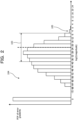
- FIG. 2 is a diagram for describing the quantization error caused by the dynamic range.
- a horizontal axis in FIG. 2 represents the number of bits, and a vertical axis represents a value obtained by a probability density function (PDF) for an error gradient for each number of bits.
- PDF probability density function
- the graph illustrated in FIG. 2 represents a probability distribution for each bit used to represent each element included in a tensor before quantization input to a certain layer.
- a range 103 in FIG. 2 represents a dynamic range after quantization. For example, after quantization, elements included in a region 104 are zero, and elements included in a region 105 are saturated.
- a point 106 represents a maximum value after quantization.
- D i sat is an element of a region to be saturated
- D i zero is an element of a region to be zero
- N sat is the number of elements to be saturated
- N zero is the number of elements to be zero
- N all is the number of all elements.
- D absmax represents a maximum value after quantization.
- N mbit is the number of bits of the significand part m.
- the absolute error is represented in the same manner at the time of rounding up.
- a maximum value of the absolute error is represented by the following Expression (8).
- the weight gradient is calculated from activation gradients that propagate from the top to the bottom of the DNN by an error backward propagation. Due to the quantization error caused by the dynamic range, when the activation gradients propagate to the bottom side and is attenuated, the absolute value of the weight gradients on the bottom side is also attenuated, and an absolute value with which the weighting factor is updated decreases. For example, since an amount by which a learning result is reflected in the weighting factor decreases, a learning amount for obtaining the same learning result increases.
- FIG. 3 is a block diagram of a DNN learning device according to an embodiment.
- a DNN learning device 10 performs learning (training) by obtaining the number of bits to be used for the quantization in each of layers.
- information processing apparatuses such as various computers may be adopted as the DNN learning device 10.
- the DNN learning device 10 executes learning processing of the DNN and inference processing using the learned DNN.
- the DNN learning device 10 executes the learning of the DNN by repeating learning in units of epochs that include a plurality of iterations.
- the DNN learning device 10 includes a learning processing management unit 11, a number-of-bits calculation unit 12, and a learning unit 13.
- the learning processing management unit 11 performs overall management of the learning processing.
- the learning processing management unit 11 has an epoch number of a timing at which the quantization is reviewed in advance.
- an epoch at the timing at which the quantization is reviewed is referred to as a "review epoch”.
- the learning processing management unit 11 has the number of times of iterations included in one epoch in advance.
- the learning processing management unit 11 Upon receiving an instruction to start learning, the learning processing management unit 11 causes the learning unit 13 to start the learning of the DNN.
- the learning processing management unit 11 counts the number of times of iterations in a first epoch. Thereafter, when a last iteration in the first epoch is executed, the learning processing management unit 11 instructs the number-of-bits calculation unit 12 to calculate the number of bits to be used for the quantization.
- the learning processing management unit 11 counts epochs executed by the learning unit 13, and obtains an epoch number of an epoch to be executed next. In a case where the learning unit 13 executes a second epoch, the learning processing management unit 11 instructs the learning unit 13 to reflect the number of bits to be used for the quantization determined in the last iteration of the first epoch.
- the learning processing management unit 11 determines whether or not the epoch number to be executed next by the learning unit 13 is an epoch number of the review epoch. In a case where the epoch number to be executed next by the learning unit 13 is not the epoch number of the review epoch, the learning processing management unit 11 causes the learning unit 13 to continue learning using quantization in a data type being used at this point in time in each of the layers.
- the learning processing management unit 11 notifies the learning unit 13 of the review of the quantization.
- the learning processing management unit 11 counts the number of times of iterations in the review epoch and acquires an iteration number. Thereafter, in a case where the current iteration reaches a last iteration in the review epoch, the learning processing management unit 11 instructs the number-of-bits calculation unit 12 to calculate the number of bits to be used for the quantization.
- the learning processing management unit 11 instructs the learning unit 13 to reflect the number of bits to be used for the quantization determined in the last iteration of the review epoch.
- the review epochs are be provided at a plurality of timings.
- the learning processing management unit 11 repeatedly reviews the number of bits by notifying the learning unit 13 of the review of the quantization and causing the number-of-bits calculation unit 12 to calculate the number of bits to be used for the quantization.
- the number-of-bits calculation unit 12 receives an instruction to calculate the number of bits to be used for the quantization from the learning processing management unit 11.
- the number-of-bits calculation unit 12 calculates the number of bits of the exponent part and the number of bits of the significand part to be used for the quantization.
- the number of bits of the exponent part is referred to as the "number of exponent bits”
- the number of bits of the significand part is referred to as the "number of significand bits”.
- the number-of-bits calculation unit 12 notifies the learning unit 13 of the calculated number of exponent bits and the calculated number of significand bits.
- the number-of-bits calculation unit 12 includes a number-of-exponent-bits calculation unit 121 and a number-of-significand-bits calculation unit 122.
- the number-of-exponent-bits calculation unit 121 sets a threshold value for the quantization error and obtains the number of exponent bits for each layer. When the quantization is repeated, the quantization error is accumulated. Since a value having a large absolute value is saturated and a small absolute value is zero by quantization, a total sum of absolute values of all elements of the tensor is attenuated by an amount corresponding to the quantization error.
- the quantization error per quantization is E Q e .
- T is a threshold value of the attenuation, and is a value that defines an upper limit of a quantization error of a value of one quantization.
- the quantization error per quantization is represented by the following Expression (13) in terms of a relative value.
- the number-of-exponent-bits calculation unit 121 sets activation of top as a tensor to be analyzed in the case of the forward propagation, and sets a gradient of bottom_diff as a tensor to be analyzed in the case of the backward propagation.
- the number-of-exponent-bits calculation unit 121 calculates a total sum of the absolute values of all the elements of the tensor.
- the total sum of the absolute values of all the elements of the tensor is represented by ⁇
- the number-of-exponent-bits calculation unit 121 sorts the elements of the tensor in ascending order of the absolute values.
- the sorted array is represented as D abs [1:N all ].
- the number-of-exponent-bits calculation unit 121 sets the number of elements to be saturated in quantization to be zero. For example, the number-of-exponent-bits calculation unit 121 sets a quantization range such that a maximum value after quantization matches a maximum value of the elements of the tensor. For example, a maximum value of a dynamic range after quantization is set to match the maximum value of the graph in FIG. 2 .
- E Q e which is the quantization error per quantization is represented by the following Expression (14).
- the number-of-exponent-bits calculation unit 121 adds the sorted array in order from 1 up to an upper limit that satisfies the following Expression (15) obtained from Expression (13).
- D abs [N zero ] which is an element added last in this case, is a maximum value that satisfies Expression (13) that defines the quantization error.
- the number-of-exponent-bits calculation unit 121 calculates a dynamic range R dyn of the tensor by using the following Expression (16).
- R dyn log 2 D abs N all ⁇ log 2 D abs N zero
- the number-of-exponent-bits calculation unit 121 calculates the number of bits of the exponent part by using the following Expression (17).
- N ebit ⁇ log 2 R dyn + 3 ⁇ N mbit ⁇
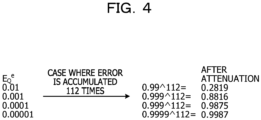
- FIG. 4 is a diagram illustrating the attenuation corresponding to the magnitude of an error in the case of ResNet-50.
- the quantization is repeated 112 times. Details of the quantization are 48 times in Convolution, 48 times in BatchNorm, and 16 times in eltwise.
- E Q e the error is attenuated as illustrated in FIG. 4 in accordance with E Q e .
- E Q e which is the quantization error per quantization
- 0.2919 which is a value obtained by raising 0.99 to the 112-th power
- FIG. 5 is a diagram illustrating the error corresponding to the threshold value.
- T of the attenuation is set to each of values of 0.90, 0.95, 0.98, and 0.99
- each value of E Q e that is the error is obtained as illustrated in FIG. 5 .
- a lower limit of the threshold value of the attenuation is determined such that the learning amount does not increase much.
- T that is the threshold value of the attenuation is set to 0.90 to 0.95 or the like based on FIG. 5 .
- the number-of-significand-bits calculation unit 122 obtains the number of significand bits for each layer.
- the error in the rounding of the significand part is represented by Expression (8).
- the logits which are input values of the Softmax function, take values of a data type of FP32. Accordingly, it may be assumed that the calculation of the logits is also performed by FPO.
- the number of significand bits may be obtained by expressing how much the quantization error of the tensor input to an inner product to be used to calculate the logits is accumulated in the logits.
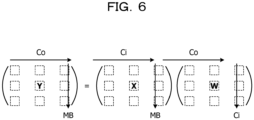
- FIG. 6 is a diagram illustrating the inner product in the calculation of the logits.
- FIG. 6 illustrates an operation of the inner product in a case where the error does not occur.
- X in FIG. 6 is an input value for the calculation of the logits, and W is a weighting factor.
- Y in FIG. 5 which is a calculation result by Expression (18), represents the logits.
- ⁇ Q m is a relative error in the case of the quantization error ⁇ Q m .
- the quantization error is a uniform distribution having randomness and also having positive and negative signs. Since the uniform distribution does not have reproducibility, a linear sum is not a uniform distribution, and the quantization error has a protrusion type distribution function such as a normal distribution in a distribution form by repeating the linear sum. Accordingly, the probability distribution of the quantization error may be approximated by the normal distribution.
- the maximum value may be represented by the following Expression (27). 2 ⁇ N mbit + 1 + e ⁇ 127 ⁇ x 1 ⁇ x 2 2 ⁇ 0.05 Ci
- the number-of-significand-bits calculation unit 122 calculates the number of significand bits for each layer by using Expression (28).
- FIG. 7 is a diagram illustrating an example of syntax of processing of calculating the number of bits in quantization using a floating-point number in the forward propagation.
- Fn in a fourth line in FIG. 7 represents all elements of an output tensor n.
- x represents the logits of a Softmax function in a next stage.
- x1 in a sixth line in FIG. 7 represents a maximum value of the logits which are the input values of the Softmax function and x2 represents a second largest value of X1, respectively.
- Ci is an inner product number of a layer of the Softmax function in a previous stage.
- Dabs[1:Nall] is an array in which tensors are sorted in ascending order of absolute values.
- Dabs[Nall] is a value of a maximum absolute value of the tensors.
- Nzero is the number of elements that become zero at the time of quantization.
- Dabs[Nzero] may be obtained by adding up the sorted array in order from 1 until Expression (10) is not satisfied.
- a last line in FIG. 7 is based on the assumption that the number of bits is a multiple of 8. The last line in FIG. 7 may be represented by the following Expression (29) when the last line is described in an expression of the C language.
- the number-of-exponent-bits calculation unit 121 and the number-of-significand-bits calculation unit 122 may calculate the number of bits (1, N ebit , N mbit ) of the output tensor n by executing processing represented by the syntax illustrated in FIG. 6 .
- This number of bits is the number of bits of a layer n+1.
- N mbit N ′ mbit + 1 + N ebit + N ′ mbit % 8
- FIG. 8 is a diagram illustrating an example of syntax of processing of calculating the number of bits in quantization using a floating-point number in the backward propagation.
- the last line in FIG. 8 may be represented by the following Expression (30) when the last line is described in an expression of the C language.
- the number-of-exponent-bits calculation unit 121 and the number-of-significand-bits calculation unit 122 may calculate the number of bits (1, N ebit , N mbit ) of the error gradient n by executing processing represented by the syntax illustrated in FIG. 8 .
- This number of bits is the number of bits of a layer n-1.
- N mbit N ′ mbit + 1 + N ebit + N ′ mbit % 8
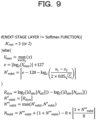
- FIG. 9 is a diagram illustrating an example of syntax of processing of calculating the number of bits in quantization using an integer representation in the forward propagation.
- a last line in FIG. 9 may be represented by the following Expression (31) when the last line is described in an expression of the C language.
- the number-of-exponent-bits calculation unit 121 and the number-of-significand-bits calculation unit 122 may calculate the number of bits (1, N mbit ) of the output tensor n by executing processing represented by the syntax illustrated in FIG. 9 .
- This number of bits is the number of bits of a layer n+1.
- N mbit N ′′′ mbit + 1 + N ′′′ mbit % 8
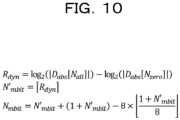
- FIG. 10 is a diagram illustrating an example of syntax of processing of calculating the number of bits in quantization using an integer representation in the backward propagation.
- a last line in FIG. 10 may be represented by the following Expression (32) when the last line is described in an expression of the C language.
- the number-of-exponent-bits calculation unit 121 and the number-of-significand-bits calculation unit 122 may calculate the number of bits (1, N mbit ) of an error gradient n by executing processing represented by the syntax illustrated in FIG. 10 .
- This number of bits is the number of bits of a layer n-1.
- N mbit N ′′′ mbit + 1 + N ′′′ mbit % 8
- the learning unit 13 receives an instruction to start learning from the learning processing management unit 11.
- the learning unit 13 sets data types of all the layers of the DNN to FP32. Thereafter, the learning unit 13 acquires training data and starts the learning of the DNN.
- the learning unit 13 receives, as inputs, the number of exponent bits and the number of significand bits to be used in each of the layers of the DNN from the number-of-bits calculation unit 12. Subsequently, the learning unit 13 reflects the designated number of exponent bits and the designated number of significand bits in each of the layers. For example, the learning unit 13 sets a data type based on the designated number of exponent bits and the designated number of significand bits for each of the layers. The learning unit 13 learns the second and subsequent epochs by using the data type set for each of the layers.
- the learning unit 13 determines whether or not the learning has converged and reached a target. In a case where the learning result has reached the target, the learning unit 13 ends the learning.
- the learning unit 13 repeats the learning while maintaining the data type to be used for the quantization for each layer until a notification of the review of the quantization is received from the learning processing management unit 11.
- the learning unit 13 sets the data types of all the layers of the DNN to FP32.
- the learning unit 13 executes learning in a state where the data types of all the layers of the DNN are set to FP32.
- the learning unit 13 receives, as the inputs, the number of exponent bits and the number of significand bits to be used in each of the layers of the DNN from the number-of-bits calculation unit 12 and reflects the inputs in each of the layers. Until the learning converges and reaches the target, the learning unit 13 repeats the above processing.
- FIG. 11 is a block diagram illustrating the details of the learning unit.
- the learning unit 13 includes a bias operator 131, a SIMD operator 132, and a quantizer 133.
- the bias operator 131 calculates the shared exponent bias value b corresponding to the designated number of bits.
- the SIMD operator 132 calculates a tensor dst of FP32, which is a product-sum operation result, by performing a SIMD operation based on Expressions (2) and (3).
- the quantizer 133 calculates a tensor of a final result by quantizing the tensor dst of FP32 into a tensor having the designated number of bits. Quantization in the quantizer 133 may be performed by using a well-known technique such as calculating the exponent part and the significand part of all the elements of the tensor and performing stochastic rounding processing in the calculation of the significand part.
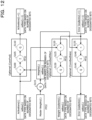
- FIG. 12 is a diagram illustrating an example of a data flow in the learning unit.
- steps S100 and S105 a product-sum operation is performed on a dataset of an activation value (L) and a shared exponent bias value (L) corresponding to the designated number of bits and a dataset of a weight (L) and a shared exponent bias value (L) corresponding to the designated number of bits.
- the shared exponent bias value (L) corresponds to the shared exponent bias value b described above, and is calculated by the bias operator 131.
- the product-sum operation in steps S100 and S105 is performed by the SIMD operator 132.
- step S110 quantization for setting the product-sum operation result of FP32 in steps S100 and S105 to the designated number of bits is performed, the activation value (L) is updated to an activation value (L+1) and the shared exponent bias value (L) is updated to a shared exponent bias value (L+1) by the quantization in step S110.
- the quantization in step S110 is performed by the quantizer 133. However, in a case where the designated number of bits is FP32, the quantization is not actually performed.
- step S115 a weight (L) corresponding to the designated number of bits is obtained by quantizing a master weight (L) of FP32 to the designated number of bits.
- the quantization in step S115 is performed by the quantizer 133.
- steps S120 and S125 a product-sum operation is performed on a dataset of an activation value (L) and a shared exponent bias value (L) corresponding to the designated number of bits and a dataset of an error gradient (L+1) and a shared exponent bias value (L+1) corresponding to the designated number of bits.
- the shared exponent bias values (L) and (L+1) correspond to the shared exponent bias value b described above, and are calculated by the bias operator 131.
- the product-sum operation in S120 and S125 is performed by the SIMD operator 132.
- step S130 quantization for setting the product-sum operation result of FP32 in steps S120 and S125 to the designated number of bits is performed, and the weight gradient (L) and the shared exponent bias value (L) corresponding to the designated number of bits are obtained by the quantization in step S130.
- the quantization in step S130 is performed by the quantizer 133. However, in a case where the designated number of bits is FP32, the quantization is not actually performed.
- steps S135 and S140 a product-sum operation is performed on a dataset of a weight (L) and a shared exponent bias value (L) corresponding to the designated number of bits and a dataset of an error gradient (L+1) and a shared exponent bias value (L+1) corresponding to the designated number of bits.
- the shared exponent bias values (L) and (L+1) correspond to the shared exponent bias value b described above, and are calculated by the bias operator 131.
- the product-sum operation in steps S135 and S140 is performed by the SIMD operator 132.
- step S145 quantization for setting the product-sum operation result of FP32 in steps S135 and S140 to the designated number of bits is performed, and the error gradient (L+1) is updated to the error gradient (L) and the shared exponent bias value (L+1) is updated to the shared exponent bias value (L) by the quantization in step S145.
- the quantization in step S145 is performed by the quantizer 133. However, in a case where the designated number of bits is FP32, the quantization is not actually performed.
- FIG. 13 is a flowchart of the learning processing by the DNN learning device according to the embodiment. Next, a flow of the learning processing performed by the DNN learning device 10 according to the embodiment will be described with reference to FIG. 13 .
- the learning processing management unit 11 notifies the learning unit 13 of the start of the learning processing.
- the learning processing management unit 11 sets the epoch number to 1 (step S1).
- the learning processing management unit 11 determines whether the current epoch is the first epoch or the epoch at the timing at which the quantization is reviewed by using the epoch number (step S2).
- the learning processing management unit 11 notifies the learning unit 13 of the review of the quantization.
- the learning unit 13 sets the data types in all the layers to FP32 (step S3).
- the learning processing management unit 11 sets the iteration number to 1 (step S4).
- the learning unit 13 executes the forward propagation with the data types in all the layers set to FP32 (step S5).
- the learning unit 13 executes the backward propagation with the data types in all the layers set to FP32 (step S6).
- the learning unit 13 updates parameters of the DNN (step S7).
- the learning processing management unit 11 increments the iteration number by one (step S8).
- the learning processing management unit 11 determines whether or not a next iteration is a last iteration by using the iteration number (step S9). In a case where the next iteration is not the last iteration (step S9: No), the learning processing returns to step S5.
- step S9 the learning processing management unit 11 instructs the number-of-bits calculation unit 12 to calculate the number of bits for each layer.
- the learning unit 13 executes the forward propagation.
- the number-of-bits calculation unit 12 acquires the output tensor for each layer and calculates the number of bits to be used for the quantization in each of the layers (step S10).
- the number-of-bits calculation unit 12 acquires the error gradient for each layer, and calculates the number of bits to be used for the quantization in each of the layers (step S11).
- the learning unit 13 updates the parameters of the DNN (step S12). Thereafter, the learning processing proceeds to step S21.
- step S2 determines whether the current epoch is the second epoch or a next epoch of the epoch at the timing at which the quantization is reviewed (step S13). In a case where the current epoch is neither the second epoch nor the next epoch of the epoch at the timing at which the quantization is reviewed (step S13: No), the learning processing proceeds to step S15.
- the learning processing management unit 11 instructs the learning unit 13 to reset the number of bits.
- the learning unit 13 sets the data type of each of the layers based on the number of bits for each layer calculated by the number-of-bits calculation unit 12 (step S14).
- the learning processing management unit 11 sets the iteration number to 1 (step S15).
- the learning unit 13 executes the forward propagation by using the data type of each of the layers set based on the number of bits for each layer calculated by the number-of-bits calculation unit 12 (step S16).
- the learning unit 13 executes the backward propagation by using the data type of each of the layers set based on the number of bits for each layer calculated by the number-of-bits calculation unit 12 (step S17).
- the learning unit 13 updates the parameters of the DNN (step S18).
- the learning processing management unit 11 increments the iteration number by one (step S19).
- step S20 determines whether all the iterations of the current epoch have been ended by using the iteration number. In a case where the iteration to be executed remains (step S20: No), the learning processing returns to step S16.
- step S20 Yes
- the learning processing proceeds to step S21.
- the learning unit 13 determines whether or not the learning has converged and reached the target (step S21). In a case where the learning has not converged (step S21: No), the learning processing management unit 11 increments the epoch number by one (step S22). Thereafter, the learning processing returns to step S2. By contrast, in a case where the learning has converged (step S21: Yes), the learning unit 13 ends the learning processing.
- the DNN learning device calculates the number of exponent bits by setting the threshold value for the quantization error for each layer included in the DNN, and calculates the number of significand bits by using the condition in which the recognition rate does not decrease.
- the DNN learning device sets the data type to be used in each of the layers and performs learning. Accordingly, a decrease in the recognition rate is suppressed by using an appropriate data type in each of the layers of the DNN, and thus, the recognition rate may be improved while the learning time of the DNN is shortened.
- the last layer in ResNet-50 is fc1000 and the layer in the previous stage is pool5.
- an operation result of fc1000 is set to fc1000.Y
- an operation result of pool5 is set to pool5.Y.
- pool5.Y is an input of fc1000 in the forward propagation.
- an input of fc1000 is set to fc1000.dY and an input of pool5 is set to pool5.dY.
- pool5.dY is an operation result of fc1000 in the backward propagation.
- Each of the numbers of bits is set so as to be 8, 16, or 32 bits in accordance with a sign bit of 1 bit.
- fc1000.Y and fc1000.dY were set to FP32.
- the reaching precision of the learning was 75.92%.
- the reaching precision of the learning was 75.26%, and the precision was lowered by 0.87% as compared with the case of FP32.
- the reaching precision of the learning was 75.71%, and the precision was lowered by 0.28% as compared with the case of FP32.
- the precision was improved as compared with a case where the data types of all the layers were FP8 while the learning time was shortened as compared with a case where the data types of all the layers were FP32.
- FIG. 14 is a hardware configuration diagram of a computer.
- the DNN learning device 1 is implemented by, for example, a computer 90 illustrated in FIG. 14 .
- the computer 90 includes a processor 91, a memory 92, a hard disk 93, and a network interface 94.
- the processor 91 is coupled to the memory 92, the hard disk 93, and the network interface 94 via a bus.
- the network interface 94 is an interface that relays communication between the computer 90 and an external device.
- the hard disk 93 is an auxiliary storage device.
- the hard disk 93 stores various programs that include programs for implementing the functions of the learning processing management unit 11, the number-of-bits calculation unit 12, and the learning unit 13 illustrated in FIG. 1 .
- the processor 91 reads the various programs from the hard disk 93, loads the programs in the memory 92, and executes the programs. Accordingly, the processor 91 implements the functions of the learning processing management unit 11, the number-of-bits calculation unit 12, and the learning unit 13 illustrated in FIG. 1 .
Landscapes
- Engineering & Computer Science (AREA)
- Theoretical Computer Science (AREA)
- Physics & Mathematics (AREA)
- General Health & Medical Sciences (AREA)
- Computing Systems (AREA)
- Biomedical Technology (AREA)
- Biophysics (AREA)
- Computational Linguistics (AREA)
- Data Mining & Analysis (AREA)
- Evolutionary Computation (AREA)
- Life Sciences & Earth Sciences (AREA)
- Molecular Biology (AREA)
- Artificial Intelligence (AREA)
- General Engineering & Computer Science (AREA)
- General Physics & Mathematics (AREA)
- Mathematical Physics (AREA)
- Software Systems (AREA)
- Health & Medical Sciences (AREA)
- Compression, Expansion, Code Conversion, And Decoders (AREA)
- Image Analysis (AREA)
Applications Claiming Priority (1)
| Application Number | Priority Date | Filing Date | Title |
|---|---|---|---|
| JP2021181901A JP2023069780A (ja) | 2021-11-08 | 2021-11-08 | 演算プログラム、演算方法及び計算機 |
Publications (1)
| Publication Number | Publication Date |
|---|---|
| EP4177794A1 true EP4177794A1 (de) | 2023-05-10 |
Family
ID=82458692
Family Applications (1)
| Application Number | Title | Priority Date | Filing Date |
|---|---|---|---|
| EP22184499.6A Withdrawn EP4177794A1 (de) | 2021-11-08 | 2022-07-12 | Betriebsprogramm, betriebsverfahren und rechner |
Country Status (4)
| Country | Link |
|---|---|
| US (1) | US20230144390A1 (de) |
| EP (1) | EP4177794A1 (de) |
| JP (1) | JP2023069780A (de) |
| CN (1) | CN116108915A (de) |
Families Citing this family (1)
| Publication number | Priority date | Publication date | Assignee | Title |
|---|---|---|---|---|
| WO2025041872A1 (ko) * | 2023-08-18 | 2025-02-27 | 한국전자기술연구원 | 메모리 최적화 기반 딥러닝 네트워크 혼합 정밀도 양자화 방법 |
Citations (4)
| Publication number | Priority date | Publication date | Assignee | Title |
|---|---|---|---|---|
| US20200143282A1 (en) | 2018-11-07 | 2020-05-07 | Alibaba Group Holding Limited | Quantizing machine learning models with balanced resolution via damped encoding |
| JP2020113273A (ja) | 2019-01-09 | 2020-07-27 | 三星電子株式会社Samsung Electronics Co.,Ltd. | ニューラルネットワーク量子化のための方法及び装置 |
| EP3772023A1 (de) * | 2019-06-12 | 2021-02-03 | Shanghai Cambricon Information Technology Co., Ltd | Verfahren zur bestimmung von quantisierungsparametern in einem neuronalen netzwerk und zugehörige produkte |
| EP3792748A1 (de) * | 2019-09-13 | 2021-03-17 | Fujitsu Limited | Informationsverarbeitungsvorrichtung und -verfahren und programm |
Family Cites Families (11)
| Publication number | Priority date | Publication date | Assignee | Title |
|---|---|---|---|---|
| US20110004644A1 (en) * | 2009-07-03 | 2011-01-06 | Via Technologies, Inc. | Dynamic floating point register precision control |
| US20190050710A1 (en) * | 2017-08-14 | 2019-02-14 | Midea Group Co., Ltd. | Adaptive bit-width reduction for neural networks |
| JP6528893B1 (ja) * | 2018-11-07 | 2019-06-12 | 富士通株式会社 | 学習プログラム、学習方法、情報処理装置 |
| US12169782B2 (en) * | 2018-11-12 | 2024-12-17 | Advanced Micro Devices, Inc. | Dynamic precision scaling at epoch granularity in neural networks |
| US11586883B2 (en) * | 2018-12-14 | 2023-02-21 | Microsoft Technology Licensing, Llc | Residual quantization for neural networks |
| US20200302283A1 (en) * | 2019-03-18 | 2020-09-24 | Microsoft Technology Licensing, Llc | Mixed precision training of an artificial neural network |
| US11531893B2 (en) * | 2019-06-03 | 2022-12-20 | Samsung Electronics Co., Ltd. | Method and apparatus with neural network parameter quantization |
| US12518168B2 (en) * | 2019-08-29 | 2026-01-06 | Canon Kabushiki Kaisha | Training and application method apparatus system and storage medium of neural network model |
| CN113298843B (zh) * | 2020-02-24 | 2024-05-14 | 中科寒武纪科技股份有限公司 | 数据量化处理方法、装置、电子设备和存储介质 |
| KR102505946B1 (ko) * | 2020-09-02 | 2023-03-08 | 네이버 주식회사 | 인공신경망 모델 학습 방법 및 시스템 |
| US20220207361A1 (en) * | 2020-12-25 | 2022-06-30 | Samsung Electronics Co., Ltd. | Neural network model quantization method and apparatus |
-
2021
- 2021-11-08 JP JP2021181901A patent/JP2023069780A/ja active Pending
-
2022
- 2022-07-12 EP EP22184499.6A patent/EP4177794A1/de not_active Withdrawn
- 2022-07-14 US US17/864,475 patent/US20230144390A1/en active Pending
- 2022-08-04 CN CN202210933289.7A patent/CN116108915A/zh active Pending
Patent Citations (4)
| Publication number | Priority date | Publication date | Assignee | Title |
|---|---|---|---|---|
| US20200143282A1 (en) | 2018-11-07 | 2020-05-07 | Alibaba Group Holding Limited | Quantizing machine learning models with balanced resolution via damped encoding |
| JP2020113273A (ja) | 2019-01-09 | 2020-07-27 | 三星電子株式会社Samsung Electronics Co.,Ltd. | ニューラルネットワーク量子化のための方法及び装置 |
| EP3772023A1 (de) * | 2019-06-12 | 2021-02-03 | Shanghai Cambricon Information Technology Co., Ltd | Verfahren zur bestimmung von quantisierungsparametern in einem neuronalen netzwerk und zugehörige produkte |
| EP3792748A1 (de) * | 2019-09-13 | 2021-03-17 | Fujitsu Limited | Informationsverarbeitungsvorrichtung und -verfahren und programm |
Also Published As
| Publication number | Publication date |
|---|---|
| US20230144390A1 (en) | 2023-05-11 |
| CN116108915A (zh) | 2023-05-12 |
| JP2023069780A (ja) | 2023-05-18 |
Similar Documents
| Publication | Publication Date | Title |
|---|---|---|
| US12566962B2 (en) | Dithered quantization of parameters during training with a machine learning tool | |
| CN110008952B (zh) | 一种目标识别方法及设备 | |
| US20170061279A1 (en) | Updating an artificial neural network using flexible fixed point representation | |
| EP3607496B1 (de) | Bedingte graphausführung basierend auf einer vorherigen ausführung eines vereinfachten graphen | |
| EP4206922A1 (de) | Ressourcenzuteilungsverfahren, ressourcenzuteilungsgerät, vorrichtung, medium und computerprogrammprodukt | |
| EP3796233A1 (de) | Informationsverarbeitungsvorrichtung und -verfahren und programm | |
| EP3816866A1 (de) | Verfahren und vorrichtung zum betrieb einer netzwerkschicht in einem tiefen neuronalen netzwerk | |
| US20250200348A1 (en) | Model Compression Method and Apparatus, and Related Device | |
| US20240404262A1 (en) | Method and machine learning system to perform quantization of neural network | |
| CN110874625A (zh) | 一种深度神经网络量化方法及装置 | |
| EP3518152A1 (de) | Informationsverarbeitungsverfahren und informationsverarbeitungssystem | |
| US11551063B1 (en) | Implementing monotonic constrained neural network layers using complementary activation functions | |
| CN112115407A (zh) | 伊辛机数据输入设备以及将数据输入至伊辛机的方法 | |
| US20230376769A1 (en) | Method and system for training machine learning models using dynamic fixed-point data representations | |
| Cao et al. | From the binomial reshuffling model to Poisson distribution of money | |
| CN114830137A (zh) | 用于生成预测模型的方法和系统 | |
| US10410140B1 (en) | Categorical to numeric conversion of features for machine learning models | |
| EP4177794A1 (de) | Betriebsprogramm, betriebsverfahren und rechner | |
| US11809995B2 (en) | Information processing device and method, and recording medium for determining a variable data type for a neural network | |
| US6789070B1 (en) | Automatic feature selection system for data containing missing values | |
| US20230042275A1 (en) | Network quantization method and network quantization device | |
| US12547896B2 (en) | Method for updating an artificial neural network | |
| CN110276448B (zh) | 一种模型压缩方法及装置 | |
| US20230385600A1 (en) | Optimizing method and computing apparatus for deep learning network and computer-readable storage medium | |
| US20220405561A1 (en) | Electronic device and controlling method of electronic device |
Legal Events
| Date | Code | Title | Description |
|---|---|---|---|
| PUAI | Public reference made under article 153(3) epc to a published international application that has entered the european phase |
Free format text: ORIGINAL CODE: 0009012 |
|
| STAA | Information on the status of an ep patent application or granted ep patent |
Free format text: STATUS: THE APPLICATION HAS BEEN PUBLISHED |
|
| AK | Designated contracting states |
Kind code of ref document: A1 Designated state(s): AL AT BE BG CH CY CZ DE DK EE ES FI FR GB GR HR HU IE IS IT LI LT LU LV MC MK MT NL NO PL PT RO RS SE SI SK SM TR |
|
| STAA | Information on the status of an ep patent application or granted ep patent |
Free format text: STATUS: THE APPLICATION IS DEEMED TO BE WITHDRAWN |
|
| 18D | Application deemed to be withdrawn |
Effective date: 20231111 |