EP4178005A1 - Procédé de réutilisation de matériau actif à l'aide de débris de cathode - Google Patents
Procédé de réutilisation de matériau actif à l'aide de débris de cathode Download PDFInfo
- Publication number
- EP4178005A1 EP4178005A1 EP21861858.5A EP21861858A EP4178005A1 EP 4178005 A1 EP4178005 A1 EP 4178005A1 EP 21861858 A EP21861858 A EP 21861858A EP 4178005 A1 EP4178005 A1 EP 4178005A1
- Authority
- EP
- European Patent Office
- Prior art keywords
- active material
- lithium
- positive electrode
- electrode active
- reuse method
- Prior art date
- Legal status (The legal status is an assumption and is not a legal conclusion. Google has not performed a legal analysis and makes no representation as to the accuracy of the status listed.)
- Pending
Links
Images

Classifications
-
- H—ELECTRICITY
- H01—ELECTRIC ELEMENTS
- H01M—PROCESSES OR MEANS, e.g. BATTERIES, FOR THE DIRECT CONVERSION OF CHEMICAL ENERGY INTO ELECTRICAL ENERGY
- H01M10/00—Secondary cells; Manufacture thereof
- H01M10/54—Reclaiming serviceable parts of waste accumulators
-
- C—CHEMISTRY; METALLURGY
- C01—INORGANIC CHEMISTRY
- C01G—COMPOUNDS CONTAINING METALS NOT COVERED BY SUBCLASSES C01D OR C01F
- C01G53/00—Compounds of nickel
- C01G53/40—Complex oxides containing nickel and at least one other metal element
- C01G53/42—Complex oxides containing nickel and at least one other metal element containing alkali metals, e.g. LiNiO2
-
- C—CHEMISTRY; METALLURGY
- C01—INORGANIC CHEMISTRY
- C01G—COMPOUNDS CONTAINING METALS NOT COVERED BY SUBCLASSES C01D OR C01F
- C01G53/00—Compounds of nickel
- C01G53/40—Complex oxides containing nickel and at least one other metal element
- C01G53/42—Complex oxides containing nickel and at least one other metal element containing alkali metals, e.g. LiNiO2
- C01G53/44—Complex oxides containing nickel and at least one other metal element containing alkali metals, e.g. LiNiO2 containing manganese
- C01G53/50—Complex oxides containing nickel and at least one other metal element containing alkali metals, e.g. LiNiO2 containing manganese of the type (MnO2)n-, e.g. Li(NixMn1-x)O2 or Li(MyNixMn1-x-y)O2
-
- C—CHEMISTRY; METALLURGY
- C22—METALLURGY; FERROUS OR NON-FERROUS ALLOYS; TREATMENT OF ALLOYS OR NON-FERROUS METALS
- C22B—PRODUCTION AND REFINING OF METALS; PRETREATMENT OF RAW MATERIALS
- C22B23/00—Obtaining nickel or cobalt
-
- C—CHEMISTRY; METALLURGY
- C22—METALLURGY; FERROUS OR NON-FERROUS ALLOYS; TREATMENT OF ALLOYS OR NON-FERROUS METALS
- C22B—PRODUCTION AND REFINING OF METALS; PRETREATMENT OF RAW MATERIALS
- C22B7/00—Working up raw materials other than ores, e.g. scrap, to produce non-ferrous metals and compounds thereof; Methods of a general interest or applied to the winning of more than two metals
- C22B7/001—Dry processes
-
- H—ELECTRICITY
- H01—ELECTRIC ELEMENTS
- H01M—PROCESSES OR MEANS, e.g. BATTERIES, FOR THE DIRECT CONVERSION OF CHEMICAL ENERGY INTO ELECTRICAL ENERGY
- H01M10/00—Secondary cells; Manufacture thereof
- H01M10/05—Accumulators with non-aqueous electrolyte
- H01M10/052—Li-accumulators
-
- H—ELECTRICITY
- H01—ELECTRIC ELEMENTS
- H01M—PROCESSES OR MEANS, e.g. BATTERIES, FOR THE DIRECT CONVERSION OF CHEMICAL ENERGY INTO ELECTRICAL ENERGY
- H01M4/00—Electrodes
- H01M4/02—Electrodes composed of, or comprising, active material
- H01M4/04—Processes of manufacture in general
- H01M4/0471—Processes of manufacture in general involving thermal treatment, e.g. firing, sintering, backing particulate active material, thermal decomposition, pyrolysis
-
- H—ELECTRICITY
- H01—ELECTRIC ELEMENTS
- H01M—PROCESSES OR MEANS, e.g. BATTERIES, FOR THE DIRECT CONVERSION OF CHEMICAL ENERGY INTO ELECTRICAL ENERGY
- H01M4/00—Electrodes
- H01M4/02—Electrodes composed of, or comprising, active material
- H01M4/13—Electrodes for accumulators with non-aqueous electrolyte, e.g. for lithium-accumulators; Processes of manufacture thereof
- H01M4/131—Electrodes based on mixed oxides or hydroxides, or on mixtures of oxides or hydroxides, e.g. LiCoOx
-
- H—ELECTRICITY
- H01—ELECTRIC ELEMENTS
- H01M—PROCESSES OR MEANS, e.g. BATTERIES, FOR THE DIRECT CONVERSION OF CHEMICAL ENERGY INTO ELECTRICAL ENERGY
- H01M4/00—Electrodes
- H01M4/02—Electrodes composed of, or comprising, active material
- H01M4/36—Selection of substances as active materials, active masses, active liquids
- H01M4/48—Selection of substances as active materials, active masses, active liquids of inorganic oxides or hydroxides
- H01M4/50—Selection of substances as active materials, active masses, active liquids of inorganic oxides or hydroxides of manganese
- H01M4/505—Selection of substances as active materials, active masses, active liquids of inorganic oxides or hydroxides of manganese of mixed oxides or hydroxides containing manganese for inserting or intercalating light metals, e.g. LiMn2O4 or LiMn2OxFy
-
- H—ELECTRICITY
- H01—ELECTRIC ELEMENTS
- H01M—PROCESSES OR MEANS, e.g. BATTERIES, FOR THE DIRECT CONVERSION OF CHEMICAL ENERGY INTO ELECTRICAL ENERGY
- H01M4/00—Electrodes
- H01M4/02—Electrodes composed of, or comprising, active material
- H01M4/36—Selection of substances as active materials, active masses, active liquids
- H01M4/48—Selection of substances as active materials, active masses, active liquids of inorganic oxides or hydroxides
- H01M4/52—Selection of substances as active materials, active masses, active liquids of inorganic oxides or hydroxides of nickel, cobalt or iron
- H01M4/525—Selection of substances as active materials, active masses, active liquids of inorganic oxides or hydroxides of nickel, cobalt or iron of mixed oxides or hydroxides containing iron, cobalt or nickel for inserting or intercalating light metals, e.g. LiNiO2, LiCoO2 or LiCoOxFy
-
- H—ELECTRICITY
- H01—ELECTRIC ELEMENTS
- H01M—PROCESSES OR MEANS, e.g. BATTERIES, FOR THE DIRECT CONVERSION OF CHEMICAL ENERGY INTO ELECTRICAL ENERGY
- H01M4/00—Electrodes
- H01M4/02—Electrodes composed of, or comprising, active material
- H01M2004/026—Electrodes composed of, or comprising, active material characterised by the polarity
- H01M2004/028—Positive electrodes
-
- Y—GENERAL TAGGING OF NEW TECHNOLOGICAL DEVELOPMENTS; GENERAL TAGGING OF CROSS-SECTIONAL TECHNOLOGIES SPANNING OVER SEVERAL SECTIONS OF THE IPC; TECHNICAL SUBJECTS COVERED BY FORMER USPC CROSS-REFERENCE ART COLLECTIONS [XRACs] AND DIGESTS
- Y02—TECHNOLOGIES OR APPLICATIONS FOR MITIGATION OR ADAPTATION AGAINST CLIMATE CHANGE
- Y02P—CLIMATE CHANGE MITIGATION TECHNOLOGIES IN THE PRODUCTION OR PROCESSING OF GOODS
- Y02P10/00—Technologies related to metal processing
- Y02P10/20—Recycling
-
- Y—GENERAL TAGGING OF NEW TECHNOLOGICAL DEVELOPMENTS; GENERAL TAGGING OF CROSS-SECTIONAL TECHNOLOGIES SPANNING OVER SEVERAL SECTIONS OF THE IPC; TECHNICAL SUBJECTS COVERED BY FORMER USPC CROSS-REFERENCE ART COLLECTIONS [XRACs] AND DIGESTS
- Y02—TECHNOLOGIES OR APPLICATIONS FOR MITIGATION OR ADAPTATION AGAINST CLIMATE CHANGE
- Y02W—CLIMATE CHANGE MITIGATION TECHNOLOGIES RELATED TO WASTEWATER TREATMENT OR WASTE MANAGEMENT
- Y02W30/00—Technologies for solid waste management
- Y02W30/50—Reuse, recycling or recovery technologies
- Y02W30/84—Recycling of batteries or fuel cells
Definitions
- the reusable active material may include a content of fluorine (F) equal to or less than 100 ppm.
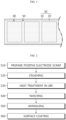
- the positive electrode scrap is crushed to an appropriate size (step s20).
- Crushing refers to cutting or shredding of the positive electrode scrap into pieces of suitable and easy-to-handle size. After crushed, the positive electrode scrap is cut into small pieces, for example, 1 cm x 1 cm.
- various dry grinding equipment such as hand-mill, pin-mill, disk-mill, cutting-mill and hammer-mill may be used, or a high speed cutter may be used.
- heat treatment is performed to thermally decompose the binder in the active material layer.
- heat treatment may be performed at 300 to 650 °C, which may be called high temperature heat treatment.
- a temperature less than 300 °C it is difficult to remove the binder, which causes a problem that the current collector may not be separated.
- the current collector melts (Al melting point: 660 °C), which causes a phenomenon that the current collector may not be separated.
- the active material is recovered in powder form, and the carbon component generated by carbonization of the binder or the conductive material may not remain on the surface.
- Co 3 O 4 may be generated by thermal decomposition on the surface. If a battery including Co 3 O 4 is manufactured, battery properties may deteriorate. In the present disclosure, the initial properties of the active material may be restored or improved to the level similar to that of the fresh active material by restoring the crystal structure and removing Co 3 O 4 through step s50.
- the present disclosure proposes an acceptable amount of the remaining lithium compound with respect to the capacity and lifespan properties.
- the present disclosure proposes that at least the content of the remaining lithium compound should be 0.0001 to 1.2 wt%.
- Annealing may be performed at 400 to 1000 °C in the air.
- An annealing temperature may be 600 to 900°C. This temperature should be changed within a limited range depending on a type of the lithium precursor. It is preferable to set the annealing time to be equal to or greater than one hour. Preferably, the annealing time is about 5 hours. If the annealing time is long, the crystal structure may be sufficiently recovered, but even if the annealing time is a long time, the performance of the active material is not significantly affected. The annealing time is, for example, within 15 hours. Annealing equipment may use the same or similar equipment as in heat treatment of step s30.
- the annealing temperature is preferably 700 to 900 °C, more preferably 710 to 780 °C. This is because the melting point of Li 2 CO 3 is 723 °C. Most preferably, annealing is performed at 750 °C. In the case of using LiOH as a lithium precursor, the annealing temperature is preferably 400 to 600 °C, more preferably 450 to 480 °C. This is because the melting point of LiOH is 462 °C.
- the annealing temperature is preferably a temperature exceeding the melting point of the lithium precursor. However, at a temperature exceeding 1000 °C, thermal decomposition of the positive electrode active material occurs and the performance of the active material deteriorates, and thus the temperature should not exceed 1000 °C.
- step s60 may be further performed.
- step s60 surface coating is applied to the active material annealed in step s50.
- the surface coating step may be coating at least one of metal, organic metal and a carbon component on the surface in a solid or liquid manner and then heat treating the coated one at 100 to 1200 °C.
- heat treatment is performed at a temperature exceeding 1200 °C, there is a risk of performance degradation due to thermal decomposition of the positive electrode active material.
- coating on the surface in the solid or liquid manner may use methods such as mixing, milling, spray drying, grinding, etc.
- a surface protective layer is formed by a heterogeneous metal through surface coating.
- a molar ratio of lithium to other metals in the positive electrode active material is 1:1 by supplementing the lost lithium, if the lithium in the active material reacts with a surface coating material, and the molar ratio of lithium to other metals in the positive electrode active material decreases to less than 1:1, 100% capacity expression may not be achieved. Therefore, insufficient lithium is added in the previous step s50 so that not only the molar ratio of lithium to other metals in the positive electrode active material is 1:1 but also further an excess of lithium should be added to include more lithium compared to other metals in the positive electrode active material.
- LiF or metal fluoride is removed during washing of step s40. Washing is safe and inexpensive, may remove LiF or metal fluoride without loss of other elements, and prevent elution of transition metals, etc. In particular, the decrease of lithium in the active material may be minimized, by optimizing conditions of the cleaning solution, the washing time, etc. Then, the amount of lithium precursor to be added later may be minimized. If an aqueous solution of a lithium compound showing basicity in an aqueous solution is used as the cleaning solution during washing, there is also advantage of supplementing the loss of lithium occurring during the process.
- the loss of lithium in the active material may be minimized during a heat treatment process for separating the current collector and a washing process for surface modification, such as the removal of residues.
- the loss of lithium may be minimized by optimizing the heat treatment process as well as the amount of the current collector reacting with the active material or precipitating by heat treatment may be minimized.
- the loss of lithium in the active material may be minimized while removing LiF which may act as a resistance if remains. Since the loss of lithium element is maximally prevented during the process of obtaining the reuse active material, the composition of a fresh active material is not significantly different from that of the reuse active material. Insufficient lithium is added through an additional lithium precursor addition process. In this regard, the addition amount of the lithium precursor is determined so that the amount of the remaining lithium compound in the reusable active material is 0.0001 to 1.2 wt%, and thus excellent lifespan and capacity properties may be maintained.
- the annealing step after addition of the lithium precursor also has advantage of being safe and inexpensive, effectively removing Co 3 O 4 , and recovering the cell properties of the reuse active material by recovering the crystal structure, that is, by improving crystallinity.
- the reusable active material obtained according to the present disclosure may have a particle size distribution similar to that of the fresh active material, and thus separate treatment for adjusting the particle size distribution may not be required. Since the carbon component generated by carbonization of the binder or the conductive material does not remain on the surface, a step for removing the carbon component, etc. is not required. Accordingly, the active material obtained through the method of FIG. 2 described above may be reused as it is without additional treatment and used to manufacture the positive electrode.
- Sample 1 A fresh NCM-based lithium composite transition metal oxide was used, other than a reuse active material.
- Sample 3 Sample 2 was additionally washed for 10 minutes according to the washing step (s40) of the active material reuse method of the present disclosure.
- As the cleaning solution an aqueous solution containing LiOH was used.
- Sample 6 Annealing of step s50 was performed on Sample 3 at 750 °C in the air for 15 hours by adding Li 2 CO 3 at a molar ratio of 0.08 as a lithium precursor.
- Samples 5 and 6 to which Li 2 CO 3 is added at the molar ratio less than 0.09 have smaller molar ratios of lithium to other metals than that of Sample 1. Therefore, it may be confirmed that when the lithium precursor is added (Sample 8) similarly to a decrease ratio (the molar ratio of 0.1 in Sample 1 to Sample 4) confirmed in Sample 4 which was annealed without the addition of the lithium precursor, the molar ratio of lithium to other metals may be increased to an equivalent level compared to Sample 1.
- Sample 10 has a decreased annealing time after washing compared to Sample 3, but it may be seen that there is no change in the molar ratio of lithium to other metals. That is, it was confirmed that even if the annealing time is equal to or greater than 5 hours, there was no significant effect on the decrease of lithium.
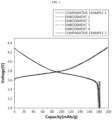
- Each positive electrode active material was prepared using methods below, a positive electrode was manufactured, then a cell (Coin Half Cell, CHC) was manufactured, and electrochemical performance thereof was evaluated.
- Embodiment 1 Up to annealing was performed like Sample 8 but an annealing time was set to 5 hours shorter than Sample 8. That is, the positive electrode scrap was heat treated at 550 °C in the air for 30 minutes, washed for 10 minutes, and annealed at 750 °C for 5 hours by adding Li 2 CO 3 at a molar ratio of 0.1 as a lithium precursor.
- Embodiment 4 Same as Embodiment 2, except that the addition amount of lithium precursor was a molar ratio of 0.12 which is greater than the molar ratio of 0.1 in
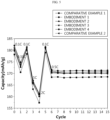
- FIG. 5 shows C-rate properties.
- the rate performance was reviewed by evaluating the capacity according to the number of cycle repetitions at different currents.
- the equipment used for evaluation is a general charging/discharging test apparatus that is well used in the laboratory. There is no deviation according to a measuring apparatus or method.
- the horizontal axis indicates the number of cycles and the vertical axis indicates the capacity.
- the voltage was set to 3 to 4.3V, and initial formation charging/discharging was performed at 0.1C/0.1C.
- An electrolyte constituting the cell that is carbonate-based has 3:7 of ethylene carbonate (EC) to ethyl methyl carbonate (EMC), and partially includes an additive was used.
- EC ethylene carbonate
- EMC ethyl methyl carbonate
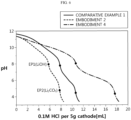
- the total remaining lithium compound is a value obtained by summing the remaining amounts of LiOH and Li 2 CO 3 .
- the lower limit of the amount of the remaining lithium compound is managed to be equal to or greater than 0.0001 wt% which is considered to be the measurable limit amount.
- the active material may be recovered from the positive electrode scrap so as to be directly reused. It is safe because a toxic and explosive solvent such as NMP, DMC, acetone, and methanol is not used, and it is suitable for mass production because simple and safe methods such as heat treatment, cleaning and drying, and annealing are used.
- a toxic and explosive solvent such as NMP, DMC, acetone, and methanol
- the amount of the remaining lithium compound of Embodiment 2 is 0.473 wt%, and the capacity of the remaining lithium compound is equal to or greater than that of Comparative Example 1 and less than 1.2 wt% which is the upper limit of the remaining lithium compound with good lifespan properties, and thus it was evaluated as very desirable.
Landscapes
- Chemical & Material Sciences (AREA)
- Engineering & Computer Science (AREA)
- Chemical Kinetics & Catalysis (AREA)
- Electrochemistry (AREA)
- General Chemical & Material Sciences (AREA)
- Manufacturing & Machinery (AREA)
- Organic Chemistry (AREA)
- Inorganic Chemistry (AREA)
- Materials Engineering (AREA)
- Mechanical Engineering (AREA)
- Metallurgy (AREA)
- Life Sciences & Earth Sciences (AREA)
- Environmental & Geological Engineering (AREA)
- General Life Sciences & Earth Sciences (AREA)
- Geology (AREA)
- Battery Electrode And Active Subsutance (AREA)
- Secondary Cells (AREA)
Applications Claiming Priority (2)
| Application Number | Priority Date | Filing Date | Title |
|---|---|---|---|
| KR1020200106083A KR102887856B1 (ko) | 2020-08-24 | 2020-08-24 | 양극 스크랩을 이용한 활물질 재사용 방법 |
| PCT/KR2021/008206 WO2022045557A1 (fr) | 2020-08-24 | 2021-06-29 | Procédé de réutilisation de matériau actif à l'aide de débris de cathode |
Publications (2)
| Publication Number | Publication Date |
|---|---|
| EP4178005A1 true EP4178005A1 (fr) | 2023-05-10 |
| EP4178005A4 EP4178005A4 (fr) | 2024-01-17 |
Family
ID=80353502
Family Applications (1)
| Application Number | Title | Priority Date | Filing Date |
|---|---|---|---|
| EP21861858.5A Pending EP4178005A4 (fr) | 2020-08-24 | 2021-06-29 | Procédé de réutilisation de matériau actif à l'aide de débris de cathode |
Country Status (6)
| Country | Link |
|---|---|
| US (1) | US12603338B2 (fr) |
| EP (1) | EP4178005A4 (fr) |
| JP (1) | JP7457871B2 (fr) |
| KR (1) | KR102887856B1 (fr) |
| CN (1) | CN116194604B (fr) |
| WO (1) | WO2022045557A1 (fr) |
Cited By (1)
| Publication number | Priority date | Publication date | Assignee | Title |
|---|---|---|---|---|
| EP4503263A4 (fr) * | 2022-11-23 | 2026-04-22 | Lg Energy Solution Ltd | Procédé de recyclage de matériau actif d'électrode positive et matériau actif d'électrode positive recyclé à partir de celui-ci |
Families Citing this family (7)
| Publication number | Priority date | Publication date | Assignee | Title |
|---|---|---|---|---|
| KR102887811B1 (ko) * | 2020-05-25 | 2025-11-17 | 주식회사 엘지에너지솔루션 | 양극 스크랩을 이용한 활물질 재사용 방법 |
| KR102887845B1 (ko) * | 2020-05-25 | 2025-11-17 | 주식회사 엘지에너지솔루션 | 양극 스크랩을 이용한 활물질 재사용 방법 |
| KR102742136B1 (ko) * | 2020-05-29 | 2024-12-11 | 주식회사 엘지에너지솔루션 | 양극 스크랩을 이용한 활물질 재사용 방법 |
| KR102887897B1 (ko) * | 2020-08-24 | 2025-11-17 | 주식회사 엘지에너지솔루션 | 활물질 회수 장치 및 이를 이용한 활물질 재사용 방법 |
| EP4485573A4 (fr) * | 2022-09-23 | 2026-01-14 | Beijing Easpring Mat Tech Co Ltd | Précurseur de matériau d'électrode positive en oxyde contenant du lithium, matériau d'électrode positive en oxyde contenant du lithium, leurs procédés de préparation et leur utilisation, plaque d'électrode positive et son utilisation |
| GB2643510A (en) * | 2024-08-16 | 2026-02-25 | Altilium Metals Ltd | Recycled battery composition |
| CN119812551A (zh) * | 2025-03-13 | 2025-04-11 | 海辰储能装备(深圳)有限公司 | 一种锂电池极片膜料回收的方法 |
Family Cites Families (27)
| Publication number | Priority date | Publication date | Assignee | Title |
|---|---|---|---|---|
| JP3452769B2 (ja) | 1997-09-18 | 2003-09-29 | 株式会社東芝 | 電池の処理方法 |
| KR100503385B1 (ko) | 2002-12-10 | 2005-07-26 | 한규승 | 전기화학적 환류법을 이용한 리튬이차전지의 재활용방법 및 이를 위한 장치 |
| JP2007194209A (ja) | 2005-12-22 | 2007-08-02 | Mitsubishi Chemicals Corp | リチウム二次電池及びそれを連結した組電池 |
| CN101919107B (zh) * | 2009-03-16 | 2012-10-31 | 丰田自动车株式会社 | 电池部件的处理方法 |
| KR101049937B1 (ko) | 2009-09-03 | 2011-07-15 | 한국과학기술연구원 | 폐 리튬 이차전지의 양극물질로부터 리튬 화합물을 회수하는 방법 |
| KR101191154B1 (ko) | 2010-09-20 | 2012-10-15 | 한국과학기술연구원 | 리튬이차전지용 금속산화물계 양극활물질의 재처리 및 합성 방법 |
| JP5675452B2 (ja) | 2011-03-15 | 2015-02-25 | 三井金属鉱業株式会社 | 再生材料の製造方法 |
| JP6055761B2 (ja) | 2011-04-28 | 2016-12-27 | 昭和電工株式会社 | リチウム二次電池用正極活物質の製造方法 |
| KR101294335B1 (ko) | 2012-05-25 | 2013-08-16 | 한국과학기술연구원 | 재활용을 통한 리튬 이차전지용 리튬인산철 양극활물질의 제조 방법, 이에 따라 제조된 리튬 이차전지용 리튬인산철 양극활물질, 리튬인산철 양극 및 리튬 이차전지 |
| KR101349900B1 (ko) * | 2012-06-11 | 2014-01-14 | 한국과학기술연구원 | 금속산화물 전극활물질의 재활용 방법, 이에 따라 제조된 리튬 이차전지용 금속산화물 전극활물질, 리튬 이차전지용 전극 및 리튬 이차전지 |
| KR101439427B1 (ko) | 2013-03-14 | 2014-09-11 | 한국과학기술연구원 | 리튬이차전지용 올리빈계 양극소재의 재활용 방법, 이에 의하여 제조된 양극소재, 이를 포함하는 리튬이차전지용 양극 및 리튬이차전지 |
| WO2015012650A1 (fr) * | 2013-07-26 | 2015-01-29 | 주식회사 엘지화학 | Matière active d'anode et procédé de fabrication de celle-ci |
| JP6312576B2 (ja) | 2014-10-29 | 2018-04-18 | 信越化学工業株式会社 | リチウム複合酸化物の再生方法、電気化学デバイスの製造方法、並びに、リチウムイオン二次電池の製造方法 |
| KR101929961B1 (ko) * | 2015-09-17 | 2018-12-18 | 주식회사 에코프로비엠 | 폐양극활물질을 재활용한 양극활물질 전구체의 제조 방법, 이에 의하여 제조된 양극활물질 전구체, 및 이를 이용한 양극활물질의 제조 방법, 이에 의하여 제조된 양극활물질 |
| CN105895854A (zh) * | 2016-06-14 | 2016-08-24 | 天齐锂业股份有限公司 | 锂离子电池正极边角料的回收方法 |
| US20190288284A1 (en) | 2016-07-22 | 2019-09-19 | Umicore | Lithium metal composite oxide powder |
| KR101992715B1 (ko) | 2017-01-25 | 2019-06-25 | 주식회사 엘지화학 | 리튬 이차전지에서의 양극 활물질 회수방법 |
| CN117170173A (zh) | 2018-02-18 | 2023-12-05 | Asml荷兰有限公司 | 二元化方法和自由形式的掩模优化流程 |
| KR102231062B1 (ko) | 2018-03-09 | 2021-03-23 | 주식회사 엘지화학 | 양극 활물질, 그 제조 방법, 이를 포함하는 양극 및 이차전지 |
| CN109309266A (zh) | 2018-09-20 | 2019-02-05 | 广东工业大学 | 一种回收废旧锂离子电池正极材料的方法和再生正极材料 |
| CN109704412A (zh) | 2018-12-05 | 2019-05-03 | 郑州中科新兴产业技术研究院 | 一种退役锂离子动力电池镍钴锰酸锂三元正极材料回收再利用方法 |
| CN110165324B (zh) * | 2019-06-24 | 2021-07-16 | 中国科学院青海盐湖研究所 | 一种从废旧锂电池中回收正极并再生修复的方法及系统 |
| CN110842006A (zh) * | 2019-11-15 | 2020-02-28 | 武汉瑞杰特材料有限责任公司 | 锂电池正极回收材料的干法纯化分离与再生方法及得到的锂电池正极回收材料 |
| KR102887811B1 (ko) * | 2020-05-25 | 2025-11-17 | 주식회사 엘지에너지솔루션 | 양극 스크랩을 이용한 활물질 재사용 방법 |
| KR102887843B1 (ko) * | 2020-06-29 | 2025-11-17 | 주식회사 엘지에너지솔루션 | 양극 스크랩을 이용한 활물질 재사용 방법 |
| KR20230019723A (ko) * | 2021-08-02 | 2023-02-09 | 주식회사 엘지에너지솔루션 | 양극 스크랩을 이용한 활물질 재사용 방법 |
| JP7690515B2 (ja) * | 2023-05-01 | 2025-06-10 | キヤノン株式会社 | 画像形成装置 |
-
2020
- 2020-08-24 KR KR1020200106083A patent/KR102887856B1/ko active Active
-
2021
- 2021-06-29 CN CN202180056006.9A patent/CN116194604B/zh active Active
- 2021-06-29 EP EP21861858.5A patent/EP4178005A4/fr active Pending
- 2021-06-29 WO PCT/KR2021/008206 patent/WO2022045557A1/fr not_active Ceased
- 2021-06-29 US US18/016,217 patent/US12603338B2/en active Active
- 2021-06-29 JP JP2023504855A patent/JP7457871B2/ja active Active
Cited By (1)
| Publication number | Priority date | Publication date | Assignee | Title |
|---|---|---|---|---|
| EP4503263A4 (fr) * | 2022-11-23 | 2026-04-22 | Lg Energy Solution Ltd | Procédé de recyclage de matériau actif d'électrode positive et matériau actif d'électrode positive recyclé à partir de celui-ci |
Also Published As
| Publication number | Publication date |
|---|---|
| CN116194604B (zh) | 2025-12-02 |
| US20230275278A1 (en) | 2023-08-31 |
| JP2023535946A (ja) | 2023-08-22 |
| WO2022045557A1 (fr) | 2022-03-03 |
| US12603338B2 (en) | 2026-04-14 |
| EP4178005A4 (fr) | 2024-01-17 |
| KR102887856B1 (ko) | 2025-11-17 |
| KR20220025410A (ko) | 2022-03-03 |
| JP7457871B2 (ja) | 2024-03-28 |
| CN116194604A (zh) | 2023-05-30 |
Similar Documents
| Publication | Publication Date | Title |
|---|---|---|
| US12603338B2 (en) | Active material recovery method using positive electrode scrap | |
| KR102909872B1 (ko) | 양극 스크랩을 이용한 활물질 재사용 방법 | |
| EP4145590A1 (fr) | Procédé pour réutiliser un matériau actif en utilisant des déchets d'électrode positive | |
| KR102721367B1 (ko) | 양극 스크랩을 이용한 활물질 재사용 방법 | |
| KR102689694B1 (ko) | 양극 스크랩을 이용한 활물질 재사용 방법 | |
| KR102887811B1 (ko) | 양극 스크랩을 이용한 활물질 재사용 방법 | |
| JP7612880B2 (ja) | 正極スクラップを用いた活物質の再使用方法 | |
| EP4164026A1 (fr) | Appareil permettant de récupérer un matériau actif et procédé permettant de réutiliser un matériau actif en utilisant celui-ci | |
| KR20210145454A (ko) | 양극 스크랩을 이용한 활물질 재사용 방법 | |
| KR20210145456A (ko) | 양극 스크랩을 이용한 활물질 재사용 방법 | |
| EP4120431A1 (fr) | Appareil de récupération de matériau actif et procédé de réutilisation de matériau actif à l'aide de celui-ci | |
| KR20210147597A (ko) | 양극 스크랩을 이용한 활물질 재사용 방법 | |
| JP7357800B2 (ja) | 正極スクラップを用いた活物質の再使用方法 | |
| KR102957631B1 (ko) | 양극 스크랩을 이용한 활물질 재사용 방법 | |
| EP4625613A1 (fr) | Procédé de recyclage de matériau actif d'électrode positive, matériau actif d'électrode positive recyclé ainsi fabriqué et batterie secondaire le comprenant | |
| KR20220042659A (ko) | 양극 스크랩을 이용한 활물질 재사용 방법 |
Legal Events
| Date | Code | Title | Description |
|---|---|---|---|
| STAA | Information on the status of an ep patent application or granted ep patent |
Free format text: STATUS: THE INTERNATIONAL PUBLICATION HAS BEEN MADE |
|
| PUAI | Public reference made under article 153(3) epc to a published international application that has entered the european phase |
Free format text: ORIGINAL CODE: 0009012 |
|
| STAA | Information on the status of an ep patent application or granted ep patent |
Free format text: STATUS: REQUEST FOR EXAMINATION WAS MADE |
|
| 17P | Request for examination filed |
Effective date: 20230201 |
|
| AK | Designated contracting states |
Kind code of ref document: A1 Designated state(s): AL AT BE BG CH CY CZ DE DK EE ES FI FR GB GR HR HU IE IS IT LI LT LU LV MC MK MT NL NO PL PT RO RS SE SI SK SM TR |
|
| DAV | Request for validation of the european patent (deleted) | ||
| DAX | Request for extension of the european patent (deleted) | ||
| A4 | Supplementary search report drawn up and despatched |
Effective date: 20231218 |
|
| RIC1 | Information provided on ipc code assigned before grant |
Ipc: H01M 10/052 20100101ALI20231212BHEP Ipc: H01M 4/525 20100101ALI20231212BHEP Ipc: H01M 4/505 20100101ALI20231212BHEP Ipc: H01M 4/131 20100101ALI20231212BHEP Ipc: H01M 4/04 20060101ALI20231212BHEP Ipc: C01G 53/00 20060101ALI20231212BHEP Ipc: C22B 7/00 20060101ALI20231212BHEP Ipc: H01M 10/54 20060101AFI20231212BHEP |