EP4178139A1 - Pdcch-überwachungsverfahren, sendeverfahren und zugehörige vorrichtung - Google Patents
Pdcch-überwachungsverfahren, sendeverfahren und zugehörige vorrichtung Download PDFInfo
- Publication number
- EP4178139A1 EP4178139A1 EP21832474.7A EP21832474A EP4178139A1 EP 4178139 A1 EP4178139 A1 EP 4178139A1 EP 21832474 A EP21832474 A EP 21832474A EP 4178139 A1 EP4178139 A1 EP 4178139A1
- Authority
- EP
- European Patent Office
- Prior art keywords
- pdcch
- repetition
- parameter
- information
- monitoring
- Prior art date
- Legal status (The legal status is an assumption and is not a legal conclusion. Google has not performed a legal analysis and makes no representation as to the accuracy of the status listed.)
- Pending
Links
Images




Classifications
-
- H—ELECTRICITY
- H04—ELECTRIC COMMUNICATION TECHNIQUE
- H04L—TRANSMISSION OF DIGITAL INFORMATION, e.g. TELEGRAPHIC COMMUNICATION
- H04L5/00—Arrangements affording multiple use of the transmission path
- H04L5/003—Arrangements for allocating sub-channels of the transmission path
- H04L5/0053—Allocation of signalling, i.e. of overhead other than pilot signals
-
- H—ELECTRICITY
- H04—ELECTRIC COMMUNICATION TECHNIQUE
- H04L—TRANSMISSION OF DIGITAL INFORMATION, e.g. TELEGRAPHIC COMMUNICATION
- H04L1/00—Arrangements for detecting or preventing errors in the information received
- H04L1/08—Arrangements for detecting or preventing errors in the information received by repeating transmission, e.g. Verdan system
-
- H—ELECTRICITY
- H04—ELECTRIC COMMUNICATION TECHNIQUE
- H04L—TRANSMISSION OF DIGITAL INFORMATION, e.g. TELEGRAPHIC COMMUNICATION
- H04L5/00—Arrangements affording multiple use of the transmission path
- H04L5/003—Arrangements for allocating sub-channels of the transmission path
- H04L5/0058—Allocation criteria
- H04L5/0064—Rate requirement of the data, e.g. scalable bandwidth, data priority
-
- H—ELECTRICITY
- H04—ELECTRIC COMMUNICATION TECHNIQUE
- H04L—TRANSMISSION OF DIGITAL INFORMATION, e.g. TELEGRAPHIC COMMUNICATION
- H04L5/00—Arrangements affording multiple use of the transmission path
- H04L5/0091—Signalling for the administration of the divided path, e.g. signalling of configuration information
Definitions
- This application pertains to the field of communication technologies, and specifically relates to a PDCCH monitoring method, a PDCCH sending method, and a related device.
- Reduced capability UE is a device with limited capabilities, for example, a wearable device, an industrial sensor, or a video monitoring device. Because the RedCap UE has limited capabilities, coverage performance of an existing physical downlink control channel (Physical Downlink Control Channel, PDCCH) cannot meet a coverage requirement of the RedCap UE.
- PDCCH Physical Downlink Control Channel
- Embodiments of this application provide a PDCCH monitoring method, a PDCCH sending method, and a related device, so that a problem of poor PDCCH coverage performance can be resolved.
- a PDCCH monitoring method is provided, where the method is applied to a terminal, and the method includes:
- a PDCCH sending method is provided, where the method is applied to a network side device, and the method includes:
- a PDCCH monitoring apparatus where the PDCCH monitoring apparatus is applied to a terminal, and the PDCCH monitoring apparatus includes:
- a PDCCH sending apparatus is provided, where the PDCCH sending apparatus is applied to a network side device, and the PDCCH sending apparatus includes:
- a terminal includes a processor, a memory, and a program or an instruction that is stored in the memory and executable on the processor, and when the program or the instruction is executed by the processor, steps in the method described in the first aspect are implemented.
- a network side device includes a processor, a memory, and a program or an instruction that is stored in the memory and executable on the processor, and when the program or the instruction is executed by the processor, steps in the method described in the second aspect are implemented.
- a readable storage medium stores a program or an instruction, and when the program or the instruction is executed by a processor, steps in the method described in the first aspect are implemented, or steps in the method described in the second aspect are implemented.
- a chip includes a processor and a communication interface, the communication interface is coupled to the processor, and the processor is configured to execute a program or an instruction of a network side device, to implement the method described in the first aspect or the method described in the second aspect.
- an embodiment of this application provides a computer software product, where the computer software product is stored in a non-volatile storage medium, and the software product is configured to be executed by at least one processor to implement steps in the method described in the first aspect or steps in the method described in the second aspect.
- a communication device configured to perform the method described in the first aspect, or perform the method described in the second aspect.
- first information is obtained, and a PDCCH for repetition transmissions is monitored based on the first information, where the first information includes at least one of following: a first parameter, where the first parameter is used to indicate PDCCH repetition information, and the PDCCH repetition information includes at least one of following: times of PDCCH repetition, a monitoring occasion of the PDCCH for repetition transmissions, or duration of each PDCCH for repetition transmissions; a second parameter, where the second parameter is used to indicate whether to perform the PDCCH repetition; a third parameter, where the third parameter is used to indicate P search spaces for the PDCCH repetition, and P is a positive integer; and a fourth parameter, where the fourth parameter is used to indicate Q control resource sets CORESETs for the PDCCH repetition, and Q is a positive integer.
- first and second in the specification and claims of this application are used to distinguish between similar objects, and do not need to be used to describe a specific order or sequence. It should be understood that data used in this way may be interchangeable in an appropriate case, so that the embodiments of this application can be implemented in a sequence other than those shown or described herein, and objects distinguished by “first” and “second” are generally of a same type, and a quantity of objects is not limited. For example, there may be one or more first targets.
- “and/or” represents at least one of connected objects, and the character “/” generally represents an "or” relationship between associated objects.
- LTE Long Term Evolution
- LTE-A Long Term Evolution-advanced
- CDMA Code Division Multiple Access
- TDMA Time Division Multiple Access
- FDMA Frequency Division Multiple Access
- OFDMA Orthogonal Frequency Division Multiple Access
- SC-FDMA Single-carrier Frequency-Division Multiple Access
- SC-FDMA Single-carrier Frequency-Division Multiple Access
- system and “network” in the embodiments of this application are often used interchangeably.
- the described technology may be used in the foregoing system and radio technology, and may also be used in another system and radio technology.
- New Radio New Radio
- NR New Radio
- NR New Radio
- FIG. 1 is a block diagram of a wireless communication system to which an embodiment of this application is applicable.
- the wireless communication system includes a terminal 11 and a network side device 12.
- the terminal 11 may also be referred to as a terminal device or user equipment (User Equipment, UE).
- UE User Equipment
- the terminal 11 may be a terminal side device such as a mobile phone, a tablet personal computer (Tablet Personal Computer), a laptop computer (Laptop Computer) or a notebook computer, a personal digital assistant (Personal Digital Assistant, PDA), a palmtop computer, a netbook, an ultra-mobile personal computer (ultra-mobile personal computer, UMPC), a mobile Internet device (Mobile Internet Device, MID), a wearable device (Wearable Device) or a vehicle user equipment (vehicle user equipment, VUE), or pedestrian user equipment (pedestrian user equipment, PUE).
- the wearable device includes a band, a headset, eyeglasses, or the like. It should be noted that a specific type of the terminal 11 is not limited in this embodiment of this application.
- the network side device 12 may be a base station or a core network.
- the base station may be referred to as a NodeB, an evolved NodeB, an access point, a base transceiver station (Base Transceiver Station, BTS), a radio base station, a radio transceiver, a basic service set (Basic Service Set, BSS), an extended service set (Extended Service Set, ESS), a NodeB, an evolved NodeB (evolved Node B, eNB), a home NodeB, a home evolved NodeB, a wireless local area network (wireless local area network, WLAN) access point, a wireless fidelity (wireless fidelity, WiFi) node, a transmitting receiving point (Transmitting Receiving Point, TRP), or another suitable term in the field, and the base station is not limited to a specific technical term provided that a same technical effect is achieved.
- the RedCap UE is a device with limited capabilities, for example, a wearable device, an industrial sensor, or a video monitoring device.
- a reduced capability (Reduced Capability) of the RedCap UE may be embodied in multiple aspects, for example, device complexity, device size reduction, a processing capability, and supported features (a quantity of carrier aggregation (Carrier Aggregation, CA) component carriers (Component Carrier, CC) and a quantity of supported receive antennas).
- Carrier Aggregation, CA Carrier Aggregation
- CC Component Carrier
- Physical downlink control channel Physical Downlink Control Channel, PDCCH
- search space Search Space, SS
- a PDCCH in New Radio (New Radio, NR) carries downlink control information (Downlink Control Information, DCI).
- DCI Downlink Control Information
- the DCI is mapped to a physical resource in a unit of a control channel element (Control Channel Element, CCE).
- CCE Control Channel Element
- L 1, 2, 4, 8, or 16 CCEs may be allocated, and a quantity of CCEs for the DCI is represented as an aggregation level (Aggregation Level, AL).
- multiple SS sets are configured on the network side, and there are two types of SS sets: a common search space (Common SS, CSS) set shared by a group of UEs in a cell, and a user-specific search space (User SS, USS) set monitored by single UE.
- the SS set further configures, for the UE, PDCCH candidates (PDCCH candidates) that need to be monitored (monitoring) by the UE.
- PDCCH candidates PDCCH candidates
- the CORESET is to resolve an existence range problem of the PDCCH, such as a frequency domain resource and a time domain resource.
- RRC Radio Resource Control
- a configuration of the CORESET does not indicate a specific time domain location at which UE monitors (monitor) the PDCCH (only a time domain resource is provided, that is, in time domain, Duration (duration) of the CORESET: quantity of symbols).
- the specific time domain location at which the UE monitors the PDCCH is provided by a monitoring occasion (Monitoring occasion, MO) provided by an SS. In such a design, greater flexibility can be achieved.
- the CORESET may be configured at any frequency domain location (a parameter frequency domain resource (frequencyDomainResources) information element (Information Element, IE) is configured as a bitmap (Bitmap) numbered by a physical resource block (Physical Resource Block, PRB) of a current bandwidth part (Bandwidth Part, BWP)).
- the search space is to resolve a problem of how the UE performs searching, and aims to reduce blind detection complexity of the UE as much as possible. It can be learned that the configuration of the PDCCH can be determined only after one CORESET is bound to one SS. However, it should be noted that one CORESET can be bound to multiple SSs, but one SS can be bound to only one CORESET.
- An SS IE configures a monitoring periodicity, a start location, and a slot offset (Slot Offset) of the UE.
- a monitoring symbol within slot (monitoringSymbolsWithinSlot) IE parameter may be understood as a start symbol (such as an orthogonal frequency division multiplexing (Orthogonal Frequency Division Multiplex, OFDM) symbol) of an SS on which each slot in consecutive N slots indicated by duration in the SS IE needs an MO.
- the SS IE parameter may be shown in Table 1.
- Table 1 SS IE parameter Parameter name Function Search space identifier (searchSpaceId) Search space ID, used to identify a corresponding search space configuration
- ControlResourceSetId Indicate a CORESET bound to the search space
- Monitoring slot periodicity and offset Indicate a search space periodicity and an offset within the periodicity Duration (duration) Indicate slot-level duration
- Start symbol of a PDCCH monitoring occasion within slot (monitoringSymbolsWithinSlot) Indicate a start symbol of the search space within slot
- Quantity of PDCCH candidates (nrofCandidates) Indicate a quantity of PDCCH candidates
- Search space type SearchSpaceType) Indicate the search space type and a type of DCI to be blindly detected
- the search space type may include UE-specific search space (for a single user) and common search space (for all users).
- a configuration parameter frequencyDomainResources of the CORESET IE indicates that a CORESET corresponding to the BWP1 is offset by three PRBs, and is consecutive in 12 PRBs.
- the configuration parameter Duration indicates that one monitoring occasion will last for three OFDM symbols.
- a configuration parameter monitoringSlotPeriodicityAndOffset of the SS IE indicates that a periodicity of the SS is five slots, and is offset by two slots.
- the configuration parameter monitoringSymbolsWithinSlot indicates that there are two monitoring occasions in each slot, starting from the third symbol and the ninth symbol.
- the configuration parameter Duration indicates that the SS is consecutive for three slots, and each slot exists. For a resource of the BWP1, reference may be made to FIG. 2 .
- a configuration parameter frequencyDomainResources of the CORESET IE indicates that a CORESET corresponding to the BWP2 is offset by zero PRBs, and is consecutive in 12 PRBs.
- the configuration parameter Duration indicates that one monitoring occasion will last for two OFDM symbols.
- a configuration parameter monitoringSlotPeriodicityAndOffset of the SS IE indicates that a periodicity of the SS is four slots, and is offset by one slot.
- the configuration parameter monitoringSymbolsWithinSlot indicates that there is only monitoring occasion in each slot, starting from the third symbol.
- the configuration parameter Duration indicates that the SS is consecutive for one slot. For a resource of the BWP2, reference may be made to FIG. 3 .
- the PDCCH for repetition transmissions may also be referred to as a repeated PDCCH or a repeatedly sent PDCCH.
- search space other than search space at a specific AL may also be represented as a search space set.
- the search space or the search space set may include multiple ALs.
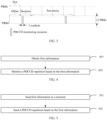
- FIG. 4 is a flowchart of a PDCCH monitoring method according to an embodiment of this application.
- the PDCCH monitoring method in this embodiment of this application may be applied to a terminal.
- the PDCCH monitoring method may include the following steps: Step 401: obtain first information.
- the first information may be but is not limited to at least one of following:
- the PDCCH repetition information may be used to determine related information of the PDCCH for repetition transmissions, for example, one or more of a quantity of repetition times, a monitoring occasion, and duration, so that a terminal can conveniently determine a monitoring occasion of the PDCCH for repetition transmissions.
- parameters included in the first information may be carried in different IEs or in a same IE, and this may be specifically determined according to an actual requirement. This is not limited in this embodiment of this application. Further, an IE used to carry the parameters of the first information can be carried by RRC signaling, but is not limited thereto.
- the first information may be carried by a search space information element.
- all parameters included in the first information may be carried in the search space IE.
- one or more of the foregoing four parameters may be carried in a search space IE, a CORESET IE, or a newly added IE.
- multiple parameters included in the first information may be carried in a same IE, or may be carried in different IEs.
- the first information may be carried by at least one of a search space IE, a CORESET IE, or a newly added IE.
- the first information may be carried by at least one of a search space IE or a CORESET IE.
- any one of the foregoing parameters may be any one of following:
- the first parameter may be a parameter newly added to a search space IE that carries the first parameter
- the second parameter may be an extended parameter of an original parameter in a search space IE that carries the second parameter
- the original parameter may be a duration parameter or a monitoringSymbolsWithinSlot parameter in the search space IE, but is not limited thereto
- the third parameter may be a parameter newly added to a CORESET IE that carries the third parameter
- the fourth parameter may be a modified parameter of an original parameter controlResourceSetId in a search space IE that carries the fourth parameter.
- the first parameter may be represented as a time monitor location (timeMonitorLocations) parameter
- the second parameter may be represented as a repetition on or off (repetitionOnOrOff) parameter
- the third parameter may be represented as a linkage search space identifier list (linkagesearchSpaceIdList) parameter
- the fourth parameter may be represented as a control resource set identifier list (controlResourceSetIdList) parameter, but this is not limited thereto.
- the first information may include the first parameter and the second parameter; or the first information may include the second parameter and the third parameter; or the first information may include the second parameter and the fourth parameter. This is not limited.
- the first information includes the first parameter and the second parameter
- the first parameter includes PDCCH repetition information
- the information is used to indicate the times of the PDCCH repetition.
- the terminal may learn, by obtaining the first information, a search space identifier of search space in which the PDCCH for repetition transmissions exists and the times of the PDCCH repetition.
- Step 402 monitor a PDCCH for repetition transmissions based on the first information.
- the monitoring occasion of the repeated PDCCH may be directly obtained based on the foregoing parameters included in the first information.
- the monitoring occasion of the repeated PDCCH may be obtained based on the foregoing parameters included in the first information and another parameter in an RRC configuration.
- the terminal may directly monitor the PDCCH for repetition transmissions on the monitoring occasion of the PDCCH for repetition transmissions that is indicated by the first parameter.
- the PDCCH repetition information includes the times of the PDCCH repetition.
- the terminal may monitor the repeated PDCCH based on the times of the PDCCH repetition and with reference to the duration parameter or the monitoringSymbolsWithinSlot parameter in the search space IE.
- the terminal combines two parameters to monitor the PDCCH for repetition transmissions.
- the terminal may monitor the PDCCH for repetition transmissions based on the first information.
- the first information includes at least one of following: a first parameter, where the first parameter is used to indicate PDCCH repetition information, and the PDCCH repetition information includes at least one of following: times of PDCCH repetition, a monitoring occasion of the PDCCH for repetition transmissions, or duration of each PDCCH for repetition transmissions; a second parameter, where the second parameter is used to indicate whether to perform the PDCCH repetition; a third parameter, where the third parameter is used to indicate P search spaces for the PDCCH repetition, and P is a positive integer; and a fourth parameter, where the fourth parameter is used to indicate Q control resource sets CORESETs for the PDCCH repetition, and Q is a positive integer.
- the terminal can enhance PDCCH coverage by monitoring the repeated PDCCH.
- the PDCCH for repetition transmissions is a PDCCH associated with a target object
- the target object includes any one of following:
- Scenario 1 the target object is search space for the repetition transmissions.
- the search space for the repetition transmissions may include one or more search spaces.
- types of different search spaces may be the same or may be different.
- the search space may be determined according to an actual requirement. This is not limited in this embodiment of this application.
- the PDCCH for repetition transmissions may include all PDCCH candidates configured in the search space for the repetition transmissions.
- Scenario 2 the target object is a first type of search space for the repetition transmissions.
- the first type of search space may be UE-specific search space or common search space.
- the first type of search space may include one or more search spaces, and may be specifically determined according to an actual requirement. This is not limited in this embodiment of this application.
- the PDCCH for repetition transmissions may include all PDCCH candidates configured in the first type of search space for the repetition transmissions.
- Scenario 3 the target object is a first AL for the repetition transmissions.
- the target object is the first AL for the repetition transmissions, or may be expressed as a PDCCH candidate at the first AL for the repetition transmissions.
- a PDCCH candidate at a specific AL is referred to as one search space. Therefore, the first AL for the repetition transmissions may also be referred to as search space at the AL for the repetition transmissions.
- the PDCCH for repetition transmissions may include a PDCCH candidate corresponding to the first AL for the repetition transmissions.
- Scenario 4 the target object is DCI with a first format for the repetition transmissions.
- the DCI in the first format may include one or more DCI formats, for example, a DCI format 1-1 and a DCI format 0-1; or a DCI format 1-0 and a DCI format 0-0. This may be specifically determined according to an actual requirement, and is not limited in this embodiment of this application. In addition, this embodiment of this application sets no specific limitation on the DCI in the first format for the repetition transmissions.
- the PDCCH for repetition transmissions may include a PDCCH that carries the DCI in the first format for the repetition transmissions.
- a specific representation form of the target object may be determined in at least the following manners: Manner 1: the specific representation form of the target object may be directly configured by a network side device or agreed upon in a protocol.
- the target object is determined based on the first information.
- the first information further includes a fifth parameter used to indicate the target object, or the second parameter is used to indicate whether the target object performs PDCCH repetition.
- the network side device may indicate the target object by using the first information.
- the network side device may explicitly indicate the target object by configuring the fifth parameter in the first information; and in another implementation, the network side device may indicate the target object by using the second parameter. In this way, the network side device may flexibly configure the target object based on an actual situation, to implement network configuration flexibility.
- the target object may be determined based on a location at which the first information is placed in an IE.
- the IE that carries the first information may include R candidate locations, the R candidate locations may be used to place the first information, different candidate locations in the R candidate locations are associated with different target objects, and R is a positive integer.
- the terminal may implicitly obtain or determine the target object based on the location at which the first information is placed in the IE.
- the IE that carries the first information is a search space IE
- the IE includes a first candidate location and a second candidate location
- the target object associated with the first candidate location is the DCI in the first format for the repetition transmissions
- the target object associated with the second candidate location is the first AL for the repetition transmissions. If the first information obtained by the terminal is placed at the second candidate location, the terminal may monitor a PDCCH candidate at the first AL for the repetition transmissions based on the first information.
- the first information includes the first parameter and/or the second parameter; in other words, the first information includes at least one of the first parameter and the second parameter.
- the network side device does not need to explicitly configure a parameter used to indicate the target object, thereby reducing signaling overheads.
- the monitoring a PDCCH for repetition transmissions based on the first information includes: monitoring the PDCCH for repetition transmissions on N PDCCH monitoring occasions, where the N PDCCH monitoring occasions are determined based on the first information, and N is a positive integer.
- the terminal may first determine the N PDCCH monitoring occasions based on the first information, and then monitor the PDCCH for repetition transmissions on the N PDCCH monitoring occasions.
- the N PDCCH monitoring occasions meet at least one of following:
- Case 1 the first information includes the first parameter, and the PDCCH repetition information includes the monitoring occasion of the PDCCH for repetition transmissions.
- the N PDCCH monitoring occasions may include the monitoring occasion of the PDCCH for repetition transmissions indicated by the PDCCH repetition information, and may further include a PDCCH monitoring occasion that is originally configured in the first search space.
- the first search space is a search space associated with the IE that carries the first information.
- the first information is carried in a search space IE, and a search space identifier (searchSpaceId) carried in the search space IE is an identifier of the first search space.
- the search space IE configures a PDCCH monitoring occasion of the first search space by using original parameters duration and monitoringSymbolsWithinSlot.
- the first information includes the first parameter, and the first parameter is used to indicate the monitoring occasion of the PDCCH for repetition transmissions. If the terminal is configured with the first search space that carries the first information, the LTE needs to monitor two types of PDCCH monitoring occasions indicated by the first parameter and indicated by the original parameter. It can be learned that, in this case, the monitoring occasion of the PDCCH for repetition transmissions indicated by the first parameter is a supplementary indication of the PDCCH monitoring occasion configured in the original search space.
- Case 2 the first information includes the first parameter, and the PDCCH repetition information includes the times of the PDCCH repetition.
- the N PDCCH monitoring occasions may include the first N PDCCH monitoring occasions configured in the first search space.
- the first search space is a search space associated with the IE that carries the first information.
- the first information is carried in a search space IE, and a search space identifier (searchSpaceId) carried in the search space IE is an identifier of the first search space.
- the search space IE configures a PDCCH monitoring occasion of the first search space by using original parameters duration and monitoringSymbolsWithinSlot.
- the first information includes the first parameter, and the first parameter is used to indicate the times of the PDCCH repetition.
- the LTE may monitor the PDCCH for repetition transmissions on the first N PDCCH monitoring occasions in the PDCCH monitoring occasions indicated by the original parameter. The terminal may consider that content transmitted on a remaining PDCCH monitoring occasion is not the PDCCH for repetition transmissions, that is, does not have a repetition characteristic.
- Case 3 the first information includes the second parameter and does not include the first parameter.
- the N PDCCH monitoring occasions may include all PDCCH monitoring occasions configured in the first search space, and the N PDCCH monitoring occasions are PDCCH monitoring occasions configured in the first search space.
- the first search space is a search space associated with the IE that carries the first information.
- the first information is carried in a search space IE
- a search space identifier (searchSpaceId) carried in the search space IE is an identifier of the first search space.
- the search space IE configures a PDCCH monitoring occasion of the first search space by using original parameters duration and monitoringSymbolsWithinSlot.
- the first information includes the second parameter, and the second parameter is used to instruct to repeatedly transmit the PDCCH. If the terminal is configured with the first search space that carries the first information, the LTE may monitor all PDCCH monitoring occasions in the PDCCH monitoring occasions indicated by the original parameter.
- the PDCCH for repetition transmissions may be repeated in a same SS associated with same CORESETs.
- Case 4 the first information includes the third parameter.
- CORESETs associated with the P search spaces are the same, or CORESETs associated with the P search spaces are different. It can be learned that the PDCCH for repetition transmissions is repeated in different search spaces associated with a same CORESET or different CORESETs. A specific association relationship of the P search spaces is determined based on the third parameter.
- Case 5 the first information includes the fourth parameter.
- the search spaces associated with the Q CORESETs may be understood as the same search space associated with the Q CORESETs. It can be learned that the PDCCH for repetition transmissions may be repeated in a same SS associated with different CORESETs. A specific association relationship of the Q CORESETs is determined based on the fourth parameter.
- the N PDCCH monitoring occasions may also be determined in another manner.
- the first parameter may indicate the times of the PDCCH repetition and the monitoring occasion of the PDCCH for repetition transmissions by using a bitmap (Bitmap) or a bit string (Bit String).
- Bitmap Bitmap
- Bit String bit string
- the first parameter may be an extended parameter of monitoringSymbolsWithinSlot in the search space IE.
- the first parameter includes 14 bits, and each bit represents one symbol. It is assumed that a value of the first parameter is "11110011001101", and duration of one PDCCH monitoring occasion is one symbol, and this indicates that one slot includes nine PDCCH monitoring occasions, which are respectively the first, the second, the third, the fourth, the seventh, the eighth, the eleventh, the twelfth, and the fourteenth symbols of the slot.
- CORESETs associated with the P search spaces are the same, or CORESETs associated with the P search spaces are different.
- the P search spaces may be associated with P CORESETs; the P search spaces may be associated with one CORESET; or the P search spaces may be associated with H CORESETs, where H is an integer greater than 1 and less than P.
- M search spaces in the P search spaces have the same time domain-related parameters.
- the time-domain related parameters include at least one of following: a monitoring periodicity, a monitoring offset, duration, or a monitoring symbol within slot (monitoringSymbolsWithinSlot), where M is an integer greater than 1.
- some or all time domain-related parameters of the M search spaces are the same. In this way, a time domain distance between the M search spaces can be ensured to be close, thereby reducing complexity of monitoring, by the terminal, the PDCCH for repetition transmissions and reducing power consumption.
- the Q control resource sets CORESETs in this embodiment of this application are described below.
- frequency domain resources of the Q CORESETs do not overlap.
- the N PDCCH monitoring occasions include all PDCCH monitoring occasions configured in search spaces associated with a first CORESET; and the first CORESET includes K CORESETs whose frequency domain resources do not overlap in the Q CORESETs, and K is an integer greater than 1 and less than or equal to Q.
- the terminal may consider that a target CORESET in the at least two CORESETs is a valid CORESET, and other CORESETs are invalid CORESETs, where the target CORESET may be any one of the at least two CORESETs.
- the target CORESET may be a CORESET with a smallest identifier or a largest identifier in the at least two CORESETs. In this way, it is not difficult to understand that the first CORESET includes the target CORESET.
- the terminal may monitor the PDCCH for repetition transmissions on a PDCCH monitoring occasion in search spaces associated with K CORESETs whose frequency domain resources do not overlap, and does not monitor the PDCCH for repetition transmissions on a PDCCH monitoring occasion in search spaces associated with a second CORESET, where the second CORESET is a CORESET except the first CORESET in the Q CORESETs.
- the terminal may monitor the PDCCH for repetition transmissions on a PDCCH monitoring occasion in search spaces associated with K CORESETs whose frequency domain resources do not overlap, and does not monitor the PDCCH for repetition transmissions on a PDCCH monitoring occasion in search spaces associated with a second CORESET, where the second CORESET is a CORESET except the first CORESET in the Q CORESETs.
- the method further includes: reporting terminal capability information to the network side device, where the terminal capability information includes at least one of following: a blind detection manner supported by the terminal, and a PDCCH repetition manner supported by the terminal.
- the network side device may be convenient for the network side device to configure a blind detection manner or a PDCCH repetition manner that matches a capability of the terminal, thereby improving a bind detection success rate of the terminal for monitoring the PDCCH for repetition transmissions.
- the blind detection manner includes at least one of following: joint blind detection or independent blind detection.
- the PDCCH repetition manner includes at least one of following: segmented DCI transmission or integral DCI transmission.
- the joint blind detection may be understood as follows: the terminal buffers PDCCHs monitored in the N PDCCH monitoring occasions for joint blind detection and demodulation.
- the independent blind detection may be understood as follows: the terminal needs to separately perform independent blind detection and demodulation on a PDCCH monitored in each of the N PDCCH monitoring occasions.
- the integral DCI transmission may be understood as follows: DCI is transmitted as a whole. In this way, one complete piece of DCI may be monitored on each PDCCH monitoring occasion of the N PDCCH monitoring occasions of the terminal.
- the segmented DCI transmission may be understood as follows: DCI is split into multiple pieces for transmission, where a splitting manner may be even splitting or the like. In this way, the terminal may detect a part of one complete piece of DCI on each PDCCH monitoring occasion in the N PDCCH monitoring occasions, and all content monitored by the terminal in the N PDCCH monitoring occasions forms one complete piece of DCI.
- the method further includes:
- the target blind detection manner may be joint blind detection or independent blind detection.
- the PDCCH repetition manner may be segmented DCI transmission or integral DCI transmission.
- the network side device may configure, based on a related capability reported by the terminal, at least one of the target blind detection manner and the target PDCCH repetition manner that match the capability of the terminal.
- the target PDCCH repetition manner is integral DCI transmission.
- the terminal may monitor a complete piece of DCI on each PDCCH monitoring occasion, so that a blind detection success rate of the DCI can be improved, and detected content does not need to be combined or jointly demodulated, thereby reducing power consumption of the terminal.
- the terminal may no longer perform blind detection, to reduce power consumption of the terminal. If the detection fails, the terminal continues the detection until the detection succeeds.
- the target PDCCH repetition manner configured by the network side device may be segmented DCI transmission, and after buffering all monitored content, the terminal may obtain one piece of complete DCI through joint demodulation.
- the target PDCCH repetition manner configured by the network side device may be integral DCI transmission, and the terminal may buffer all content obtained through monitoring, and perform demodulation and combination processing.
- DCI carried by the PDCCH for repetition transmissions meets at least one of following: a same DCI size, a same DCI format, or same DCI content.
- the terminal when the network configures repetition transmission of the DCI format 0-0 and the DCI format 1-0, in a case that the target blind detection manner is joint blind detection, and the target PDCCH repetition manner is integral DCI transmission, the terminal does not expect to detect the DCI format 0-0 and the DCI format 1-0 that are inconsistent in content and/or inconsistent in size on the monitoring occasion of the PDCCH for repetition transmissions.
- FIG. 5 is a flowchart of a PDCCH sending method according to an embodiment of this application.
- the PDCCH sending method in this embodiment of this application is applied to a network side device.
- the PDCCH sending method may include the following steps:
- the first information includes at least one of following:
- the first information is sent to the terminal, and the PDCCH for repetition transmissions is sent based on the first information; where the first information includes at least one of following: a first parameter, where the first parameter is used to indicate PDCCH repetition information, and the PDCCH repetition information includes at least one of following: times of PDCCH repetition, a monitoring occasion of the PDCCH for repetition transmissions, or duration of each PDCCH for repetition transmissions; a second parameter, where the second parameter is used to indicate whether to perform the PDCCH repetition; a third parameter, where the third parameter is used to indicate P search spaces for the PDCCH repetition, and P is a positive integer; and a fourth parameter, where the fourth parameter is used to indicate Q control resource sets CORESETs for the PDCCH repetition, and Q is a positive integer.
- the PDCCH for repetition transmissions is a PDCCH associated with a target object
- the target object includes any one of following:
- the target object is determined based on the first information.
- the first information further includes a fifth parameter used to indicate the target object, or the second parameter is used to indicate whether the target object performs PDCCH repetition.
- the sending a PDCCH for repetition transmissions based on the first information includes: sending the PDCCH for repetition transmissions on N PDCCH monitoring occasions, where the N PDCCH monitoring occasions are determined based on the first information, and N is a positive integer.
- the N PDCCH monitoring occasions meet at least one of following:
- CORESETs associated with the P search spaces are the same, or CORESETs associated with the P search spaces are different.
- M search spaces in the P search spaces have the same time domain-related parameters.
- the time-domain related parameters include at least one of following: a monitoring periodicity, a monitoring offset, duration, or a monitoring symbol within slot, where M is an integer greater than 1.
- frequency domain resources of the Q CORESETs do not overlap.
- the N PDCCH monitoring occasions include all PDCCH monitoring occasions configured in search spaces associated with a first CORESET; and the first CORESET includes K CORESETs whose frequency domain resources do not overlap in the Q CORESETs, and K is an integer greater than 1 and less than or equal to Q.
- the method before the sending a PDCCH for repetition transmissions based on the first information, the method further includes: receiving terminal capability information reported by the terminal, where the terminal capability information includes at least one of following: a blind detection manner supported by the terminal, and a PDCCH repetition manner supported by the terminal.
- the blind detection manner includes at least one of following: joint blind detection or independent blind detection.
- the PDCCH repetition manner includes at least one of following: segmented DCI transmission or integral DCI transmission.
- the method further includes:
- the target PDCCH repetition manner is integral DCI transmission.
- DCI carried by the PDCCH for repetition transmissions meets at least one of following: a same DCI size, a same DCI format, or same DCI content.
- the first information is carried in at least one of a search space information element or a CORESET information element.
- this embodiment is used as an implementation of the network side corresponding to the method embodiment in FIG. 4 . Therefore, reference may be made to related descriptions in the method embodiment in FIG. 4 , and a same beneficial effect can be achieved. To avoid repetition of description, details are not described herein again.
- Solution 1 being repeated in one (same) SS of a same CORESET.
- Solution 2 being repeated in different SSs of a same or different CORESET(s).
- Solution 3 being repeated in a same SS of different CORESETs.
- a new parameter may be introduced/defined or an existing parameter may be extended/enhanced to indicate repetition of a PDCCH in time domain and/or frequency domain.
- a repetition granularity (which may be understood as a repetition object) may be repetition of an entire SS, repetition of a specific SS type, such as a CSS or a USS, repetition of all PDCCH candidates at an AL, and repetition of a group of DCI formats or a specific DCI format.
- One AL may include one or more PDCCH candidates.
- the PDCCH candidate may carry one or more DCI formats.
- the parameter may indicate any one or more of repeated time domain granularities (a slot level, a symbol level, a slot bundle (bundle), a symbol bundle, or a span (span)), specific locations, or quantities of repetition times.
- a blind detection manner in this embodiment of this application is joint blind detection or independent blind detection.
- a repetition manner of this embodiment of this application is: splitting one piece of DCI into each repeated SS resource for transmission, or repeatedly transmitting one complete piece of DCI on multiple SS resources.
- the network side device configures a blind detection manner and a repetition manner that match the user capability.
- Solution 1 PDCCH repetition is implemented in one (same) SS of a same CORESET.
- Option 1 in a search space IE, a parameter timeMonitorLocations is added, and the parameter is used to indicate repetition in time domain.
- the parameter may be placed at different locations, to implement repetition of a DCI format, repetition of a PDCCH candidate at a group of ALs, and the like.
- repetition of an entire SS may be implemented at a location 1 of the search space IE
- repetition of a CSS or a USS may be implemented at a location 2 of the search space IE
- repetition of a specific group of DCI formats may be implemented at a location 4 of the search space IE
- repetition of all PDCCH candidates at a specific AL may be implemented at a location (5) of the search space IE.
- a repetition factor (repetition factor) or a number enumerated (number ENUMERATED) ⁇ n1, n2, n4, n8, n16, ..., nx ⁇ is introduced, where n1 represents no repetition (transmission is performed once), n2 represents that repetition transmission is performed twice, and nx represents that repetition transmission is performed x times.
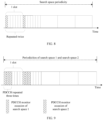
- a periodicity of the SS is 5 slots
- duration is 2 slots
- monitoringSymbolsWithinSlot ' 10000000000000'
- duration of the CORESET is 2 symbols.
- timeMonitorLocations at the location (5) of search space IE is configured as '1110000'. Therefore, for a PDCCH monitoring occasion of the SS, reference may be made to FIG. 7 .
- Each slot in the duration of the SS is repeated three times.
- Option 2 an existing parameter is expanded to implement repetition of an entire SS level, for example, the duration or monitoringSymbolsWithinSlot parameter in the foregoing SS IE is expanded.
- a parameter repetitionOnOrOff is extended in the duration of the search space IE.
- a value of the parameter may be 1 bit, where '0' indicates no repetition, and '1' indicates repetition; or may be multiple bits, where each code point represents different quantities of repetition times. Alternatively, repetition or not is distinguished through configuration or no configuration. If the parameter is configured, it indicates repetition. If the parameter is not configured, it indicates no repetition.
- a periodicity of the SS is 5 slots
- duration is 2 slots
- monitoringSymbolsWithinSlot '10000000000000'
- duration of CORESET is 2 symbols.
- Option 3 a duration or monitoringSymbolsWithinSlot parameter in an original SS IE is reused, and repetitionOnOrOff is configured at several locations provided in the foregoing option 1 to implement repetition of different granularities.
- a parameter repetitionOnOrOff is configured at AL 4 by using a related configuration of an existing SS IE. If the parameter is set to '1', it indicates that AL4 is repeated in all PDCCH MOs configured in the SS.
- a periodicity of the SS is 5 slots
- duration is 2 slots
- monitoringSymbolsWithinSlot '10000000000000'
- duration of CORESET is 2 symbols.
- Solution 2 PDCCH repetition within different SSs.
- linkagesearchSpaceIdList is configured in a CORESET IE or a new IE. This parameter indicates multiple SSs with PDCCH repetition linkage.
- the linkagesearchSpaceIdList may indicate an SS of a most significant bit (Most Significant Bit, MSB) MSB or a least significant bit (Least Significant Bit, LSB) LSB in the linkagesearchSpaceIdList, and the repetitionOnOrOff parameter is configured in a certain parameter, which indicates that the parameter is repeated between different SSs, so as to implement PDCCH repetition of different granularities, for example, a PDCCH candidate at an AL.
- configuring the foregoing PDCCH repetition parameter in CORESET IE or new IE is not excluded. If nothing is configured, the default granularity of the PDCCH repetition is SS.
- the foregoing different SSs may be associated with the same CORESET, or may be associated with different CORESETs.
- time-domain related parameters e.g., monitoringSlotPeriodicity AndOffset, duration, or monitoringSymbolsWithinSlot etc.
- periodicities i.e., monitoringSlotPeriodicity of different linking SSs need to be the same.
- offsets i.e., monitoringSlotOffset and duration of different SSs can be the same. Or they have similar configuration parameters. This is to ensure that different SSs are near in terms of time domain.
- a parameter linkagesearchSpaceIdList (SS1, SS2) is added to the CORESET IE, and duration is 2 symbols. In this case, repetition is performed once within one slot of the duration of the SS1, and repetition is performed twice within one slot of the duration of the SS2.
- Solution 3 being repeated in a same SS of different CORESETs.
- controlResourceSetId in the SS IE can be changed to controlResourceSetIdList.
- the parameter includes multiple CORESETs with PDCCH repetition linkage.
- a repetition granularity may be configured with reference to the solution 1, that is, repetition of an entire SS or repetition of a PDCCH candidate at a specific AL.
- the multiple CORESETs with PDCCH repetition linkage relationship cannot overlap in frequency domain or a limitation condition is not defined. However, when multiple CORESETs overlap, the user considers that a CORESET with a smallest CORESET id is a valid CORESET, and the user gives up PDCCH detection of other CORESETs.
- the UE needs to detect and demodulate each repeated SS resource separately.
- One complete piece of DCI is repeatedly transmitted on multiple SS resources. Each repeated SS resource carries a complete piece of DCI.
- the UE reports a capability based on the blind detection manner and the repetition manner. If the network is configured with PDCCH repetition and the UE is configured to perform joint detection or combine multiple detection results, the UE does not expect to detect different DCI on multiple repeated SS resources.
- the different means at least one of following: a DCI size, a DCI format, or DCI content.
- the base station configures a blind detection manner and a corresponding repetition manner that match the user capability.
- the base station may configure a repetition manner 2: one complete piece of DCI is repeatedly transmitted on multiple SS resources.
- the UE does not continue blind detection after successful detection. The detection fails, and the LTE continues detection until the detection succeeds. The UE does not need to perform soft bit combination on results of previous multiple detections, so that power consumption of the terminal can be reduced.
- a repetition manner of DCI in this case is configured by the network or is agreed on in a protocol.
- behavior of the UE is to buffer all repeated SS resources for joint demodulation.
- This embodiment of this application includes at least the following content: three solutions for implementing PDCCH repetition: repetition in one SS (Solution 1), repetition in different SSs (Solution 2), and repetition in a same SS of different CORESETs (Solution 3).
- Blind detection mode joint or independent blind detection.
- Repetition manner DCI is split (equally divided) to each repeated part for transmission or entire DCI is repeatedly transmitted. According to the user capability, the base station configures a blind detection manner and a repetition manner that match the user capability.
- the PDCCH monitoring method provided in this embodiment of this application may be performed by a PDCCH monitoring apparatus or a control module in the PDCCH monitoring apparatus that is configured to perform the PDCCH monitoring method.
- the PDCCH monitoring apparatus provided in this embodiment of this application is described by using an example in which the PDCCH monitoring apparatus performs the PDCCH monitoring method.
- FIG. 11 is a structural diagram of a PDCCH monitoring apparatus according to an embodiment of this application.
- the PDCCH monitoring apparatus 1100 includes:
- the first information includes at least one of following:
- the PDCCH for repetition transmissions is a PDCCH associated with a target object
- the target object includes any one of following:
- the target object is determined based on the first information.
- the first information further includes a fifth parameter used to indicate the target object, or the second parameter is used to indicate whether the target object performs PDCCH repetition.
- the monitoring module 1102 is specifically configured to: monitor the PDCCH for repetition transmissions on N PDCCH monitoring occasions, where the N PDCCH monitoring occasions are determined based on the first information, and N is a positive integer.
- the N PDCCH monitoring occasions meet at least one of following:
- the first search space is a search space associated with the PDCCH for repetition transmissions.
- CORESETs associated with the P search spaces are the same, or CORESETs associated with the P search spaces are different.
- M search spaces in the P search spaces have the same time domain-related parameters.
- the time-domain related parameters include at least one of following: a monitoring periodicity, a monitoring offset, duration, or a monitoring symbol within slot, where M is an integer greater than 1.
- frequency domain resources of the Q CORESETs do not overlap.
- the N PDCCH monitoring occasions include all PDCCH monitoring occasions configured in search spaces associated with a first CORESET; and the first CORESET includes K CORESETs whose frequency domain resources do not overlap in the Q CORESETs, and K is an integer greater than 1 and less than or equal to Q.
- the PDCCH monitoring apparatus 1100 further includes: a reporting module, configured to report terminal capability information to a network side device, where the terminal capability information includes at least one of following: a blind detection manner supported by the terminal, and a PDCCH repetition manner supported by the terminal.
- a reporting module configured to report terminal capability information to a network side device, where the terminal capability information includes at least one of following: a blind detection manner supported by the terminal, and a PDCCH repetition manner supported by the terminal.
- the blind detection manner includes at least one of following: joint blind detection or independent blind detection.
- the PDCCH repetition manner includes at least one of following: segmented DCI transmission or integral DCI transmission.
- the PDCCH monitoring apparatus 1100 further includes:
- the target PDCCH repetition manner is integral DCI transmission.
- DCI carried by the PDCCH for repetition transmissions meets at least one of following: a same DCI size, a same DCI format, or same DCI content.
- the first information is carried in at least one of a search space information element or a CORESET information element.
- the PDCCH monitoring apparatus in this embodiment of this application may be an apparatus, or may be a component, an integrated circuit, or a chip in a terminal.
- the apparatus may be a mobile terminal, or may be a non-mobile terminal.
- the mobile terminal may include but is not limited to the foregoing listed types of terminals 11.
- the non-mobile terminal may be a server, a network attached storage (Network Attached Storage, NAS), a personal computer (personal computer, PC), a television (television, TV), a teller machine, or a self-service machine. This is not specifically limited in this embodiment of this application.
- the PDCCH monitoring apparatus in this embodiment of this application may be an apparatus with an operating system.
- the operating system may be an Android (Android) operating system, may be an iOS operating system, or may be another possible operating system. This is not specifically limited in this embodiment of this application.
- the PDCCH monitoring apparatus 1100 provided in this embodiment of this application can implement each process implemented in the method embodiment of FIG. 4 , and a same technical effect is achieved. To avoid repetition, details are not described herein again.
- the PDCCH sending method provided in this embodiment of this application may be performed by a PDCCH sending apparatus or a control module that is in the PDCCH sending apparatus and that is configured to perform the PDCCH sending method.
- the PDCCH sending apparatus provided in this embodiment of this application is described by using an example in which the PDCCH sending apparatus performs the PDCCH sending method.
- FIG. 12 is a structural diagram of a PDCCH sending apparatus according to an embodiment of this application.
- the PDCCH sending apparatus 1200 includes:
- the first information includes at least one of following:
- the PDCCH for repetition transmissions is a PDCCH associated with a target object
- the target object includes any one of following:
- the target object is determined based on the first information.
- the first information further includes a fifth parameter used to indicate the target object, or the second parameter is used to indicate whether the target object performs PDCCH repetition.
- the second sending module 1202 is specifically configured to: send the PDCCH for repetition transmissions on N PDCCH monitoring occasions, where the N PDCCH monitoring occasions are determined based on the first information, and N is a positive integer.
- the N PDCCH monitoring occasions meet at least one of following:
- CORESETs associated with the P search spaces are the same, or CORESETs associated with the P search spaces are different.
- M search spaces in the P search spaces have the same time domain-related parameters.
- the time-domain related parameters include at least one of following: a monitoring periodicity, a monitoring offset, duration, or a monitoring symbol within slot, where M is an integer greater than 1.
- frequency domain resources of the Q CORESETs do not overlap.
- the N PDCCH monitoring occasions include all PDCCH monitoring occasions configured in search spaces associated with a first CORESET; and the first CORESET includes K CORESETs whose frequency domain resources do not overlap in the Q CORESETs, and K is an integer greater than 1 and less than or equal to Q.
- the PDCCH sending apparatus 1200 further includes: a second receiving module, configured to receive terminal capability information reported by the terminal, where the terminal capability information includes at least one of following: a blind detection manner supported by the terminal, and a PDCCH repetition manner supported by the terminal.
- a second receiving module configured to receive terminal capability information reported by the terminal, where the terminal capability information includes at least one of following: a blind detection manner supported by the terminal, and a PDCCH repetition manner supported by the terminal.
- the blind detection manner includes at least one of following: joint blind detection or independent blind detection.
- the PDCCH repetition manner includes at least one of following: segmented DCI transmission or integral DCI transmission.
- the PDCCH sending apparatus 1200 further includes:
- the target PDCCH repetition manner is integral DCI transmission.
- DCI carried by the PDCCH for repetition transmissions meets at least one of following: a same DCI size, a same DCI format, or same DCI content.
- the first information is carried in at least one of a search space information element or a CORESET information element.
- the PDCCH sending apparatus in this embodiment of this application may be an apparatus, or may be a component, an integrated circuit, or a chip in a network side device.
- the network side device may include but is not limited to the types of network side devices 12 listed above. This is not specifically limited in this embodiment of this application.
- the PDCCH sending apparatus 1200 provided in this embodiment of this application can implement each process implemented in the method embodiment of FIG. 5 , and a same technical effect is achieved. To avoid repetition, details are not described herein again.
- an embodiment of this application further provides a communication device 1300, including a processor 1301, a memory 1302, a program or an instruction that is stored in the memory 1302 and executable on the processor 1301.
- a communication device 1300 including a processor 1301, a memory 1302, a program or an instruction that is stored in the memory 1302 and executable on the processor 1301.
- the communication device 1300 is a terminal
- the program or the instruction is executed by the processor 1301 to implement each process in the method embodiment of FIG. 4 , and a same technical effect can be achieved.
- the communication device 1300 is a network side device
- the program or the instruction is executed by the processor 1301
- each process in the method embodiment of FIG. 5 is implemented, and a same technical effect can be achieved. To avoid repetition, details are not described herein again.
- FIG. 14 is a schematic diagram of a hardware structure of a terminal according to an embodiment of this application.
- the terminal 1400 includes but is not limited to components such as a radio frequency unit 1401, a network module 1402, an audio output unit 1403, an input unit 1404, a sensor 1405, a display unit 1406, a user input unit 1407, an interface unit 1408, a memory 1409, and a processor 1410.
- the terminal 1400 may further include a power supply (such as a battery) that supplies power to each component.
- the power supply may be logically connected to the processor 1410 by using a power management system, to implement functions such as charging, discharging, and power consumption management by using the power management system.
- a structure of the terminal shown in FIG. 14 does not constitute a limitation on the terminal device, and may include more or fewer parts than those shown in the figure, or combine some parts, or have different part arrangements. Details are not described herein again.
- the input unit 1404 may include a graphics processing unit (Graphics Processing Unit, GPU) 14041 and a microphone 14042.
- the graphics processing unit 14041 processes image data of a static picture or a video obtained by an image capture apparatus (such as a camera) in a video capture mode or an image capture mode.
- the display unit 1406 may include a display panel 14061, and the display panel 14061 may be configured in a form of a liquid crystal display, an organic light emitting diode, or the like.
- the user input unit 1407 includes a touch panel 14071 and another input device 14072.
- the touch panel 14071 is also referred to as a touchscreen.
- the touch panel 14071 may include two parts: a touch detection apparatus and a touch controller.
- the another input device 14072 may include but is not limited to one or more of a physical keyboard, a function key (such as a volume control key or an on/off key), a trackball, a mouse, a joystick, and the like. Details are not described herein.
- the radio frequency unit 1401 after receiving downlink data from a network side device, the radio frequency unit 1401 sends the downlink data to the processor 1410 for processing, and sends uplink data to the network side device.
- the radio frequency unit 1401 includes but is not limited to an antenna, at least one amplifier, a transceiver, a coupler, a low noise amplifier, a duplexer, and the like.
- the memory 1409 may be configured to store a software program or an instruction and various data.
- the memory 1409 may mainly include a storage program or instruction area and a storage data area, where the storage program or instruction area may store an operating system, an application program or an instruction required by at least one function (such as a sound play function or an image play function), and the like.
- the memory 1409 may include a high-speed random access memory, and may further include a non-volatile memory.
- the non-volatile memory may be a read-only memory (Read-Only Memory, ROM), a programmable read-only memory (Programmable ROM, PROM), an erasable programmable read-only memory (Erasable PROM, EPROM), an electrically erasable programmable read-only memory (Electrically EPROM, EEPROM), or a flash memory, for example, at least one magnetic disk storage device, a flash memory device, or another non-volatile solid-state storage device.
- ROM Read-Only Memory
- PROM programmable read-only memory
- Erasable PROM Erasable PROM
- EPROM electrically erasable programmable read-only memory
- EEPROM electrically erasable programmable read-only memory
- flash memory for example, at least one magnetic disk storage device, a flash memory device, or another non-volatile solid-state storage device.
- the processor 1410 may include one or more processing units.
- the processor 1410 may be integrated with an application processor and a modem processor.
- the application processor mainly processes an operating system, a user interface, an application program or an instruction, and the like
- the modem processor mainly processes wireless communication, for example, a baseband processor. It may be understood that the modem processor may also not be integrated into the processor 1410.
- the radio frequency unit 1401 is configured to:
- the first information includes at least one of following:
- the PDCCH for repetition transmissions is a PDCCH associated with a target object
- the target object includes any one of following:
- the target object is determined based on the first information.
- the first information further includes a fifth parameter used to indicate the target object, or the second parameter is used to indicate whether the target object performs PDCCH repetition.
- the radio frequency unit 1401 is configured to: monitor the PDCCH for repetition transmissions on N PDCCH monitoring occasions, where the N PDCCH monitoring occasions are determined based on the first information, and N is a positive integer.
- the N PDCCH monitoring occasions meet at least one of following:
- CORESETs associated with the P search spaces are the same, or CORESETs associated with the P search spaces are different.
- M search spaces in the P search spaces have the same time domain-related parameters.
- the time-domain related parameters include at least one of following: a monitoring periodicity, a monitoring offset, duration, or a monitoring symbol within slot, where M is an integer greater than 1.
- frequency domain resources of the Q CORESETs do not overlap.
- the N PDCCH monitoring occasions include all PDCCH monitoring occasions configured in search spaces associated with a first CORESET; and the first CORESET includes K CORESETs whose frequency domain resources do not overlap in the Q CORESETs, and K is an integer greater than 1 and less than or equal to Q.
- the radio frequency unit 1401 is further configured to: report terminal capability information to a network side device, where the terminal capability information includes at least one of following: a blind detection manner supported by the terminal, and a PDCCH repetition manner supported by the terminal.
- the blind detection manner includes at least one of following: joint blind detection or independent blind detection.
- the PDCCH repetition manner includes at least one of following: segmented DCI transmission or integral DCI transmission.
- the radio frequency unit 1401 is further configured to:
- the target PDCCH repetition manner is integral DCI transmission.
- DCI carried by the PDCCH for repetition transmissions meets at least one of following: a same DCI size, a same DCI format, or same DCI content.
- the first information is carried in at least one of a search space information element or a CORESET information element.
- terminal 1400 in this embodiment can implement each process in the method embodiment of FIG. 4 in the embodiments of the present invention, and achieve a same technical effect. To avoid repetition, details are not described herein again.
- the network device 1500 includes an antenna 151, a radio frequency apparatus 152, and a baseband apparatus 153.
- the antenna 151 is connected to the radio frequency apparatus 152.
- the radio frequency apparatus 152 receives information by using the antenna 151, and sends the received information to the baseband apparatus 153 for processing.
- the baseband apparatus 153 processes to-be-sent information, and sends the to-be-sent information to the radio frequency apparatus 152.
- the radio frequency apparatus 152 sends the information by using the antenna 151.
- the foregoing band processing apparatus may be located in the baseband apparatus 153.
- a method performed by the network side device may be implemented in the baseband apparatus 153.
- the baseband apparatus 153 includes a processor 154 and a memory 155.
- the baseband apparatus 153 may include at least one baseband board. Multiple chips are disposed on the baseband board. As shown in FIG. 15 , one chip is, for example, the processor 154, and is connected to the memory 155, to invoke a program in the memory 155 to perform an operation of the network side device shown in the foregoing method embodiment.
- the baseband apparatus 153 may further include a network interface 156, configured to exchange information with the radio frequency apparatus 152, where the interface is, for example, a common public radio interface (common public radio interface, CPRI).
- a common public radio interface common public radio interface, CPRI
- the network side device in this embodiment of the present invention further includes an instruction or a program that is stored in the memory 155 and executable on the processor 154.
- the processor 154 invokes the instruction or the program in the memory 155 to perform the processes in the method embodiment in FIG. 5 , and a same technical effect is achieved. To avoid repetition, details are not described herein.
- An embodiment of this application further provides a readable storage medium.
- a program or an instruction is stored in the readable storage medium.
- the processes of the method embodiment in FIG. 4 or FIG. 5 can be implemented, and a same technical effect can be achieved. To avoid repetition, details are not described herein.
- the processor is a processor in the terminal in the foregoing embodiment.
- the readable storage medium includes a computer-readable storage medium such as a read-only memory (Read-Only Memory, ROM), a random access memory (Random Access Memory, RAM), a magnetic disk, an optical disc, or the like.
- An embodiment of this application further provides a chip.
- the chip includes a processor and a communication interface, the communication interface is coupled to the processor, and the processor is configured to execute a program or an instruction of a network side device to implement the processes of the method embodiment in FIG. 4 or FIG. 5 , and a same technical effect can be achieved. To avoid repetition, details are not described herein again.
- the chip mentioned in this embodiment of this application may also be referred to as a system-level chip, a system chip, a chip system, or a system on a chip.
- the disclosed apparatus and method may be implemented in another manner.
- the described apparatus embodiment is merely an example.
- the unit division is merely logical function division.
- multiple units or components may be combined or integrated into another system, or some features may be ignored or not performed.
- the displayed or discussed mutual coupling or direct coupling or communication connection may be through some interfaces, indirect coupling or communication connection of the apparatus or unit, and may be in an electrical, mechanical, or another form.
- the units described as separate parts may or may not be physically separate, and parts displayed as units may or may not be physical units, may be located in one place, or may be distributed on multiple network units. Some or all of the units may be selected based on an actual requirement to implement the objectives of the solutions in the embodiments.
- functional units in the embodiments of the present disclosure may be integrated into one processing unit, or each unit may exist separately physically, or two or more units may be integrated into one unit.
- the foregoing method embodiments may be implemented by using software and a required universal hardware platform, or certainly may be implemented by using hardware. However, in many cases, the former is a better implementation.
- the technical solutions of this application essentially or the part contributing to existing technologies may be implemented in a form of a software product.
- the computer software product is stored in a storage medium (such as a ROM/RAM, a magnetic disk, or an optical disc) and includes several instructions for instructing a terminal (which may be a mobile phone, a computer, a server, an air conditioner, or a network device) to execute the methods described in the embodiments of this application.
- a module, a unit, a subunit, or the like may be implemented in one or more application specific integrated circuits (Application Specific Integrated Circuits, ASIC), a digital signal processor (Digital Signal Processing, DSP), a digital signal processing device (DSP Device, DSPD), a programmable logic device (Programmable Logic Device, PLD), a field-programmable gate array (Field-Programmable Gate Array, FPGA), a general purpose processor, a controller, a microcontroller, a microprocessor, another electronic unit configured to perform the functions described in the present disclosure, or a combination thereof.
- ASIC Application Specific Integrated Circuits
- DSP Digital Signal Processing
- DSP Device digital signal processing device
- PLD programmable logic device
- FPGA field-programmable gate array
- a general purpose processor a controller, a microcontroller, a microprocessor, another electronic unit configured to perform the functions described in the present disclosure, or a combination thereof.
- the techniques described in the embodiments of the present disclosure may be implemented by modules (for example, processes and functions) that perform the functions described in the embodiments of the present disclosure.
- the software code may be stored in a memory and executed by a processor.
- the memory may be implemented in or outside the processor.
Landscapes
- Engineering & Computer Science (AREA)
- Signal Processing (AREA)
- Computer Networks & Wireless Communication (AREA)
- Mobile Radio Communication Systems (AREA)
Applications Claiming Priority (2)
| Application Number | Priority Date | Filing Date | Title |
|---|---|---|---|
| CN202010635974.2A CN113890699A (zh) | 2020-07-03 | 2020-07-03 | Pdcch监听方法、发送方法及相关设备 |
| PCT/CN2021/104254 WO2022002250A1 (zh) | 2020-07-03 | 2021-07-02 | Pdcch监听方法、发送方法及相关设备 |
Publications (2)
| Publication Number | Publication Date |
|---|---|
| EP4178139A1 true EP4178139A1 (de) | 2023-05-10 |
| EP4178139A4 EP4178139A4 (de) | 2023-12-20 |
Family
ID=79013295
Family Applications (1)
| Application Number | Title | Priority Date | Filing Date |
|---|---|---|---|
| EP21832474.7A Pending EP4178139A4 (de) | 2020-07-03 | 2021-07-02 | Pdcch-überwachungsverfahren, sendeverfahren und zugehörige vorrichtung |
Country Status (4)
| Country | Link |
|---|---|
| US (1) | US12598044B2 (de) |
| EP (1) | EP4178139A4 (de) |
| CN (1) | CN113890699A (de) |
| WO (1) | WO2022002250A1 (de) |
Families Citing this family (4)
| Publication number | Priority date | Publication date | Assignee | Title |
|---|---|---|---|---|
| KR102920570B1 (ko) | 2020-07-17 | 2026-02-02 | 주식회사 윌러스표준기술연구소 | 무선 통신 시스템에서 물리 하향링크 제어 채널을 전송하는 방법 및 이를 위한 장치 |
| WO2023143550A1 (zh) * | 2022-01-29 | 2023-08-03 | 维沃移动通信有限公司 | 信道监听方法、终端及网络侧设备 |
| CN119547370A (zh) * | 2022-08-11 | 2025-02-28 | 深圳传音控股股份有限公司 | 控制方法、通信设备及存储介质 |
| CN119277435A (zh) * | 2024-09-23 | 2025-01-07 | 中国移动通信有限公司研究院 | 一种pdcch检测方法、装置、设备、存储介质和程序产品 |
Family Cites Families (14)
| Publication number | Priority date | Publication date | Assignee | Title |
|---|---|---|---|---|
| US9667386B2 (en) * | 2013-11-13 | 2017-05-30 | Samsung Electronics Co., Ltd | Transmission of control channel and data channels for coverage enhancements |
| CN106559161B (zh) * | 2015-09-24 | 2019-01-04 | 株式会社Kt | 传输和接收下行控制信息的方法及其装置 |
| CN109391971B (zh) * | 2017-08-11 | 2020-08-18 | 维沃移动通信有限公司 | 一种pdcch的搜索空间的配置、监听方法及设备 |
| CN109787710A (zh) * | 2017-11-14 | 2019-05-21 | 深圳市中兴微电子技术有限公司 | 一种盲检测方法和装置、计算机可读存储介质 |
| CN109818712B (zh) * | 2017-11-22 | 2021-02-19 | 大唐移动通信设备有限公司 | 一种基于窄带物联网的npdcch盲检方法和装置 |
| CN110166197B (zh) * | 2018-02-12 | 2021-11-19 | 北京紫光展锐通信技术有限公司 | 物理下行控制信道的发送、接收方法、装置、设备及基站 |
| US11134511B2 (en) * | 2018-07-09 | 2021-09-28 | Qualcomm Incorporated | System and method for repetition of scheduling information on a control channel |
| WO2020091570A1 (ko) * | 2018-11-02 | 2020-05-07 | 엘지전자 주식회사 | 무선 통신 시스템에서 단말이 기설정된 상향링크 자원을 기지국으로부터 수신하는 방법 및 이를 위한 장치 |
| US11197288B2 (en) * | 2018-11-26 | 2021-12-07 | FG Innovation Company Limited | Method and apparatus for PDCCH monitoring |
| KR102810403B1 (ko) * | 2019-03-29 | 2025-05-22 | 엘지전자 주식회사 | 무선 통신 시스템에서 사이드링크 통신을 위한 제어 정보를 송수신하는 방법 및 대역 부분 |
| CN113365358B (zh) * | 2019-04-26 | 2023-09-05 | 维沃移动通信有限公司 | 一种信道监听方法、终端及网络设备 |
| WO2020222598A1 (ko) * | 2019-05-02 | 2020-11-05 | 엘지전자 주식회사 | 무선 통신 시스템에서 무선 신호를 송수신하는 방법 및 장치 |
| CN111132338B (zh) * | 2019-12-19 | 2023-04-07 | 展讯通信(上海)有限公司 | 数据传输方法及其装置 |
| US11595987B2 (en) * | 2020-01-22 | 2023-02-28 | Qualcomm Incorporated | Techniques for physical downlink control channel (PDCCH) limits for multiple cells scheduling one cell in a wireless communication system |
-
2020
- 2020-07-03 CN CN202010635974.2A patent/CN113890699A/zh active Pending
-
2021
- 2021-07-02 EP EP21832474.7A patent/EP4178139A4/de active Pending
- 2021-07-02 WO PCT/CN2021/104254 patent/WO2022002250A1/zh not_active Ceased
-
2022
- 2022-12-30 US US18/091,506 patent/US12598044B2/en active Active
Also Published As
| Publication number | Publication date |
|---|---|
| WO2022002250A1 (zh) | 2022-01-06 |
| EP4178139A4 (de) | 2023-12-20 |
| US12598044B2 (en) | 2026-04-07 |
| CN113890699A (zh) | 2022-01-04 |
| US20230141826A1 (en) | 2023-05-11 |
Similar Documents
| Publication | Publication Date | Title |
|---|---|---|
| US12598044B2 (en) | PDCCH monitoring method, PDCCH sending method, and related device | |
| EP4340277A1 (de) | Verfahren und vorrichtung zur verarbeitung von csi-messressourcen, endgerät und lesbares speichermedium | |
| EP4280755A1 (de) | Übertragungsverarbeitungsverfahren und zugehörige vorrichtung | |
| EP3657862B1 (de) | Verfahren zur erfassung von blinddetektionsparametern, zugehörige vorrichtung und system | |
| EP4175344A1 (de) | Messanzeigeverfahren, endgerät und netzwerkseitige vorrichtung | |
| US12610375B2 (en) | Method for processing PDCCH monitoring capability, terminal, and network-side device | |
| EP3614756A1 (de) | Drahtloskommunikationsverfahren, endgerät und sende- und empfangsknoten | |
| US20230082126A1 (en) | Information transmission method and apparatus, and terminal device | |
| WO2023284796A1 (zh) | Tci状态的指示方法、装置、终端和网络侧设备 | |
| US20240372675A1 (en) | Srs port mapping method and apparatus, and terminal | |
| US20200068543A1 (en) | Data Transmission Method And Device | |
| US20240023108A1 (en) | Method and apparatus for determining pucch resource, and terminal | |
| WO2022028524A1 (zh) | 物理下行控制信道的监听方法、装置和设备 | |
| US12452018B2 (en) | Resource determining method and device | |
| CN115883043B (zh) | 通信指示的方法、终端及网络侧设备 | |
| US11265102B2 (en) | Downlink control channel detection method, downlink control channel transmission method, network side device and user equipment | |
| CN114698106B (zh) | 物理下行共享信道资源配置方法、装置、设备及存储介质 | |
| CN115134759B (zh) | 半静态harq码本的构造方法、装置、设备及可读存储介质 | |
| US20240032059A1 (en) | Physical downlink control channel repetition method and apparatus, and user equipment | |
| US20230354064A1 (en) | Signal configuration method and apparatus, device, and storage medium | |
| CN115250168A (zh) | 传输块大小计算方法、装置及通信设备 | |
| US20230422269A1 (en) | Channel transmission behavior determining method and apparatus and terminal | |
| EP4301068A1 (de) | Verfahren und vorrichtung zur anzeige von scs eines anfänglichen downlink-bwp | |
| EP4228192A1 (de) | Pdsch-übertragungsverfahren und -vorrichtung sowie vorrichtung und speichermedium | |
| WO2025148989A1 (zh) | Dci的接收方法、发送方法、装置、终端及网络侧设备 |
Legal Events
| Date | Code | Title | Description |
|---|---|---|---|
| STAA | Information on the status of an ep patent application or granted ep patent |
Free format text: STATUS: THE INTERNATIONAL PUBLICATION HAS BEEN MADE |
|
| PUAI | Public reference made under article 153(3) epc to a published international application that has entered the european phase |
Free format text: ORIGINAL CODE: 0009012 |
|
| STAA | Information on the status of an ep patent application or granted ep patent |
Free format text: STATUS: REQUEST FOR EXAMINATION WAS MADE |
|
| 17P | Request for examination filed |
Effective date: 20230203 |
|
| AK | Designated contracting states |
Kind code of ref document: A1 Designated state(s): AL AT BE BG CH CY CZ DE DK EE ES FI FR GB GR HR HU IE IS IT LI LT LU LV MC MK MT NL NO PL PT RO RS SE SI SK SM TR |
|
| DAV | Request for validation of the european patent (deleted) | ||
| DAX | Request for extension of the european patent (deleted) | ||
| A4 | Supplementary search report drawn up and despatched |
Effective date: 20231120 |
|
| RIC1 | Information provided on ipc code assigned before grant |
Ipc: H04L 5/00 20060101AFI20231114BHEP |
|
| GRAP | Despatch of communication of intention to grant a patent |
Free format text: ORIGINAL CODE: EPIDOSNIGR1 |
|
| STAA | Information on the status of an ep patent application or granted ep patent |
Free format text: STATUS: GRANT OF PATENT IS INTENDED |
|
| INTG | Intention to grant announced |
Effective date: 20260312 |