EP4178962B1 - Fabrication de composés et de compositions pour inhiber l'activité de shp2 - Google Patents
Fabrication de composés et de compositions pour inhiber l'activité de shp2 Download PDFInfo
- Publication number
- EP4178962B1 EP4178962B1 EP21740209.8A EP21740209A EP4178962B1 EP 4178962 B1 EP4178962 B1 EP 4178962B1 EP 21740209 A EP21740209 A EP 21740209A EP 4178962 B1 EP4178962 B1 EP 4178962B1
- Authority
- EP
- European Patent Office
- Prior art keywords
- formula
- compound
- yield
- group
- protecting group
- Prior art date
- Legal status (The legal status is an assumption and is not a legal conclusion. Google has not performed a legal analysis and makes no representation as to the accuracy of the status listed.)
- Active
Links
Classifications
-
- C—CHEMISTRY; METALLURGY
- C07—ORGANIC CHEMISTRY
- C07D—HETEROCYCLIC COMPOUNDS
- C07D491/00—Heterocyclic compounds containing in the condensed ring system both one or more rings having oxygen atoms as the only ring hetero atoms and one or more rings having nitrogen atoms as the only ring hetero atoms, not provided for by groups C07D451/00 - C07D459/00, C07D463/00, C07D477/00 or C07D489/00
- C07D491/02—Heterocyclic compounds containing in the condensed ring system both one or more rings having oxygen atoms as the only ring hetero atoms and one or more rings having nitrogen atoms as the only ring hetero atoms, not provided for by groups C07D451/00 - C07D459/00, C07D463/00, C07D477/00 or C07D489/00 in which the condensed system contains two hetero rings
- C07D491/10—Spiro-condensed systems
- C07D491/107—Spiro-condensed systems with only one oxygen atom as ring hetero atom in the oxygen-containing ring
-
- C—CHEMISTRY; METALLURGY
- C07—ORGANIC CHEMISTRY
- C07D—HETEROCYCLIC COMPOUNDS
- C07D211/00—Heterocyclic compounds containing hydrogenated pyridine rings, not condensed with other rings
- C07D211/04—Heterocyclic compounds containing hydrogenated pyridine rings, not condensed with other rings with only hydrogen or carbon atoms directly attached to the ring nitrogen atom
- C07D211/06—Heterocyclic compounds containing hydrogenated pyridine rings, not condensed with other rings with only hydrogen or carbon atoms directly attached to the ring nitrogen atom having no double bonds between ring members or between ring members and non-ring members
- C07D211/36—Heterocyclic compounds containing hydrogenated pyridine rings, not condensed with other rings with only hydrogen or carbon atoms directly attached to the ring nitrogen atom having no double bonds between ring members or between ring members and non-ring members with hetero atoms or with carbon atoms having three bonds to hetero atoms with at the most one bond to halogen, e.g. ester or nitrile radicals, directly attached to ring carbon atoms
- C07D211/60—Carbon atoms having three bonds to hetero atoms with at the most one bond to halogen, e.g. ester or nitrile radicals
-
- C—CHEMISTRY; METALLURGY
- C07—ORGANIC CHEMISTRY
- C07D—HETEROCYCLIC COMPOUNDS
- C07D241/00—Heterocyclic compounds containing 1,4-diazine or hydrogenated 1,4-diazine rings
- C07D241/02—Heterocyclic compounds containing 1,4-diazine or hydrogenated 1,4-diazine rings not condensed with other rings
- C07D241/10—Heterocyclic compounds containing 1,4-diazine or hydrogenated 1,4-diazine rings not condensed with other rings having three double bonds between ring members or between ring members and non-ring members
- C07D241/14—Heterocyclic compounds containing 1,4-diazine or hydrogenated 1,4-diazine rings not condensed with other rings having three double bonds between ring members or between ring members and non-ring members with hetero atoms or with carbon atoms having three bonds to hetero atoms with at the most one bond to halogen, e.g. ester or nitrile radicals, directly attached to ring carbon atoms
- C07D241/20—Nitrogen atoms
-
- C—CHEMISTRY; METALLURGY
- C07—ORGANIC CHEMISTRY
- C07D—HETEROCYCLIC COMPOUNDS
- C07D401/00—Heterocyclic compounds containing two or more hetero rings, having nitrogen atoms as the only ring hetero atoms, at least one ring being a six-membered ring with only one nitrogen atom
- C07D401/02—Heterocyclic compounds containing two or more hetero rings, having nitrogen atoms as the only ring hetero atoms, at least one ring being a six-membered ring with only one nitrogen atom containing two hetero rings
- C07D401/12—Heterocyclic compounds containing two or more hetero rings, having nitrogen atoms as the only ring hetero atoms, at least one ring being a six-membered ring with only one nitrogen atom containing two hetero rings linked by a chain containing hetero atoms as chain links
-
- Y—GENERAL TAGGING OF NEW TECHNOLOGICAL DEVELOPMENTS; GENERAL TAGGING OF CROSS-SECTIONAL TECHNOLOGIES SPANNING OVER SEVERAL SECTIONS OF THE IPC; TECHNICAL SUBJECTS COVERED BY FORMER USPC CROSS-REFERENCE ART COLLECTIONS [XRACs] AND DIGESTS
- Y02—TECHNOLOGIES OR APPLICATIONS FOR MITIGATION OR ADAPTATION AGAINST CLIMATE CHANGE
- Y02P—CLIMATE CHANGE MITIGATION TECHNOLOGIES IN THE PRODUCTION OR PROCESSING OF GOODS
- Y02P20/00—Technologies relating to chemical industry
- Y02P20/50—Improvements relating to the production of bulk chemicals
- Y02P20/55—Design of synthesis routes, e.g. reducing the use of auxiliary or protecting groups
Definitions
- the present invention relates to a process for the manufacture of a compound capable of inhibiting the activity of SHP2 and intermediates useful therein.
- the Src Homolgy-2 phosphatase (SHP2) is a non-receptor protein tyrosine phosphatase encoded by the PTPN11 gene that contributes to multiple cellular functions including proliferation, differentiation, cell cycle maintenance and migration. SHP2 is involved in signaling through the Ras-mitogen-activated protein kinase, the JAK-STAT or the phosphoinositol 3-kinase-AKT pathways.
- the Src Homolgy-2 phosphatase (SHP2) is a non-receptor protein tyrosine phosphatase encoded by the PTPN11 gene that contributes to multiple cellular functions including proliferation, differentiation, cell cycle maintenance and migration. SHP2 is involved in signaling through the Ras-mitogen-activated protein kinase, the JAK-STAT or the phosphoinositol 3-kinase-AKT pathways.
- SHP2 has two N-terminal Src homology 2 domains (N-SH2 and C-SH2), a catalytic domain (PTP), and a C-terminal tail.
- the two SH2 domains control the subcellular localization and functional regulation of SHP2.
- the molecule exists in an inactive, self-inhibited conformation stabilized by a binding network involving residues from both the N-SH2 and PTP domains. Stimulation by, for example, cytokines or growth factors leads to exposure of the catalytic site resulting in enzymatic activation of SHP2.
- SHP2 Mutations in the PTPN11 gene and subsequently in SHP2 have been identified in several human diseases, such as Noonan Syndrome, Leopard Syndrome, juvenile myelomonocytic leukemias, neuroblastoma, melanoma, acute myeloid leukemia and cancers of the breast, lung and colon. SHP2, therefore, represents a highly attractive target for the development of novel therapies for the treatment of various diseases.
- the compound that can be manufactured according to the present invention fulfills the need of small molecules that inhibit the activity of SHP2.
- WO 2020/065452 A1 describes three methods for the manufacture of the compound of the formula I which can be characterized by the following reaction schemes (for further details see WO 2020/065452 A1 ). These synthesis methods, while essentially feasible, can be improved upon (for example, using less material and producing less waste, while improving reaction safety). The methods can be summarized substantially as follows: Scheme 1: This shows the three Routes B to D disclosed in WO 2020/065452
- the HCl salt compound A17 (equivalent to B7, C10 and D10) is then converted into the compound of the formula I as follows:
- the present invention overcomes both the large quantities of material requirement and the thermo safety risk by manufacturing B4 using a new intermediate B3' with a chemical structure uniquely distinct from B3 and C3.
- a further improvement of the synthesis of the compound of formula I disclosed in WO 2020/065452 A1 relates to the variant (i) for the manufacture of the compound Y7c (above).
- the anhydrous Na 2 S used in this reaction is pyrophoric and not commercially available in large scale.
- the use of the tetrabutylammonium salt required for work-up is poorly biodegradable.
- the present invention provides a method for the manufacture of a compound of Formula I as mentioned above, or a pharmaceutically acceptable salt, acid co-crystal, hydrate or other solvate thereof.
- the present invention provides a method for the manufacture of a compound of Formula I as mentioned above, or a pharmaceutically acceptable salt, acid co-crystal, hydrate or other solvate thereof (these varaints are also included where subsequently only a compound of the formula I is referred to), said method comprising reacting a compound of the formula II with a compound of the formula III according to the following reaction scheme:
- the manufacturing of a compound of the formula II in a first step preferably followed by the further steps defined by further invention embodiments defined below, comprises reacting a compound of the formula V:
- a compound of the formula VI as just described is cyclized with hydroxylamine, or a salt thereof, to yield a hydroxylamine compound of the formula VII, respectively: wherein R 1 is as defined for a compound of the formula IV.
- a compound of the formula VII is either (a-i) hydrogenated to yield an amino compound of the formula VIII:
- a compound of the formula VIII is either (b-i) reduced to yield a compound of the formula IX:
- a compound of the formula VIII* is in a further reaction (b-ii) hydrogenated in the presence of a chiral hydrogenation catalyst to yield a compound of the formula X*:
- a further embodiment of the present invention as part of the overall synthesis of a compound of the formula (III) and/or the synthesis of a compound of the formula (I), relates to a new method of manufacture (synthesis) of the intermediate of the formula (III) wherein LG is a leaving group, comprising reacting a compound of the formula (XV), wherein LG is a leaving group and Mt is (then especially with regard to charge relatively half an atom of metal per sulfur) is an earth alkaline metal or (preferably) (then especially in the ratio of one Mt to one S) an alkaline metal atom, with a compound of the formula (XVI), to yield the compound of the formula (III), where the reaction takes place under transition metal free reaction conditions.
- the conditions for the reactions described above are especially chosen as follows:
- the reaction of a compound II with a compound of the formula III, wherein LG is a leaving group, preferably halo, especially bromo or more especially chloro, preferably takes place in the presence of a weak base, such as an alkali metal carbonate or metal-hydrogencarbonate, in a mixed solvent composed of aprotic solvent, such as an N,N-Dialkylamide of an alkanoic acid, for example dimethal acetamide or dimethyl formamide, and water, or in a mixed solvent composed of aprotic solvent such as sulfolane, and alcoholic solvent such as isopropanol, and water, at preferably elevated temperatures, for example in the range from 30 °C to the boiling point of the reaction mixtures, for example from 50 to 100 °C.
- a weak base such as an alkali metal carbonate or metal-hydrogencarbonate
- a mixed solvent composed of aprotic solvent such as an N,N-Dia
- the deprotecting (i) of a compound of the formula IV wherein R 1 is a secondary amino protecting group and R 2 is a protected amino group and R 3 is hydrogen to yield a compound of the formula II preferably takes place in the presence of a strong acid H n A, such as trifluoroacetic acid, trifluoromethane sulfonic acid or preferably an inorganic acid, for example sulfuric acid, phosphoric acid or especially a hydrogen halide, most especially hydrogen chloride, in a solvent, for example an alcohol, such as ethanol or especially methanol, or a mixture of alcohols (especially if R 2 is a benzyloxycarbonyl or especially alkoxycarbonyl, such as tert-butoxycarbonyl), or in an ester solvent such as isopropyl acetate (IPAc,) or in the presence of water (especially if R 2 is an acyl, especially lower alkanoyl, for example acetyl) at preferred temperatures in the range from 10 °C to
- the reaction of the compound of the formula V with L-Lactide to yield a compound of the formula VI preferably takes place in the presence of a strong base, especially an alkyl-alkaline metals, such as n-butyllithium, and a nitrogen base, especially di-isopropylamine or diethylamine, in a solvent, such as an acyclic or especially cyclic ether, especially tetrahydrofuran or preferably 2-methyltetrahydrofuran, at preferably low temperatures, for example in the range from -80 to -5 °C.
- a strong base especially an alkyl-alkaline metals, such as n-butyllithium, and a nitrogen base, especially di-isopropylamine or diethylamine
- a solvent such as an acyclic or especially cyclic ether, especially tetrahydrofuran or preferably 2-methyltetrahydrofuran, at preferably low temperatures, for example in the range from -80 to
- the reaction is conducted nearer to -80 to -40°C, especially in the range from -60 to -50 °C, and preferably if the amount of the compound of L-lactide (the L form of the lactide) corresponds to 30 to 70 mol percent, preferably 45 to 65 mol %, more preferably 50 to 60 mol %, in relation to the mol amount of the compound of formula V, that is, roughly about half of the molar amount of the compound of formula V, the result is a compound of the formula VI.
- Mol % refers to mole percent.
- the cyclization of a compound of the formula VI with hydroxylamine, or a salt thereof, to the compound of the formula VII preferably takes place with an acid addition salt of hydroxylamine, for example a hydrogen halide salt thereof, such as the hydrochloride salt thereof, in the presence of a weak base, for example an alkali metal alkanoate, such as sodium acetate, in solvent, for example an acyclic or especially cyclic ether, especially tetrahydrofuran or preferably 2-methyltetrahydrofuran, at preferred temperatures in the range from 0 to 80 °C, for example from 10 to 50 °C.
- an acid addition salt of hydroxylamine for example a hydrogen halide salt thereof, such as the hydrochloride salt thereof
- a weak base for example an alkali metal alkanoate, such as sodium acetate
- solvent for example an acyclic or especially cyclic ether, especially tetrahydrofuran or preferably 2-methyltetrahydrofuran
- the hydrogenation (a-i) of the hydroxylamine compound of the formula VII to the corresponding amine of the formula VIII preferably takes place as heterogeneous hydrogenation in the presence of a hydrogenation catalyst, for example platinum, palladium, rhodium, or ruthenium or other highly active catalysts, which operate at lower temperatures (for example from 0 to 40 °C) and lower pressures (for example, 1 bar) of H 2 , or non-precious metal catalysts, especially those based on nickel (such as Raney nickel and Urushibara nickel) at elevated temperatures and higher H 2 pressure, for example in the range from 5 to 50 bar, such as from 10 to 20 bar.
- a hydrogenation catalyst for example platinum, palladium, rhodium, or ruthenium or other highly active catalysts, which operate at lower temperatures (for example from 0 to 40 °C) and lower pressures (for example, 1 bar) of H 2 , or non-precious metal catalysts, especially those based on nickel (such as Raney
- the acylation (a-ii) of the hydroxyl compound of the formula VII under reducing conditions to the compound of the formula VIII* preferably takes place in the presence of an acylating agent, especially an anhydride of a carboxylic acid, such as an alkanoic acid anhydride, especially acetanhydride, in the presence of an ignoble metal, such as zinc (for example as zinc amalgam) or especially iron, and an acid, either an inorganic acid, such as a hydrogen halogenide, for example hydrogen chloride, sulfuric acid or an organic acid, such as the carboxylic acid corresponding to the anhydride, especially an alkanoic acid, especially acetic acid, as reductant, in an inert organic solvent, such as a hydrocarbon or an aromatic compound, for example toluene or xylylene, at preferably elevated temperatures in the range from 25 °C to the boiling point of the reaction mixture, for example in the range from 40 to 80 °C.
- an acylating agent especially an anhydride
- the reduction (b-i) of a compound of the formula VIII to a compound of the formula IX preferably takes place with a complex hydride reducing the oxo in formula VIII to the hydroxy in formula IX, such as diisobutylaluminium hydride, in an aprotic solvent, such as an ether or especially a cyclic ether, such as tetrahydrofurane, at preferably low temperatures in the range from -100 to -20 °C, for example from -80 to -70 °C.
- a complex hydride reducing the oxo in formula VIII to the hydroxy in formula IX
- an aprotic solvent such as an ether or especially a cyclic ether, such as tetrahydrofurane
- the reduction preferably takes place with a trialkylsilane, especially triethylsilane, in an acid, especially a strong organic sulfonic acid, such as trifluoromethane sulfonic acid, in an aprotic solvent, such as a hydrocarbon, an ester or especially a nitrile, such as acetonitrile, at preferably elevated temperatures in the range from 30 °C to the boiling point of the reaction mixture, for example from 50 to 95 °C.
- the subsequent reaction with the acid H n A preferably takes place in a protic, potentially aqueous solvent, such as isopropyl alcohol.
- the reducing of a compound of the formula X to a compound of the formula XI preferably takes place in the presence of a complex hydride capable of reducing the lactone group in formula X to the open ring in formula XI with two hydroxy groups, such as lithium borohydride and/or sodium borohydride, in an aprotic solvent, such as a linear or preferably a cyclic ether, for example tetrahydrofurane or 2-methyl tetrahydrofurane, preferably at a temperature in the range from 0 to 50 °C, for example at 20 to 40 °C.
- a complex hydride capable of reducing the lactone group in formula X to the open ring in formula XI with two hydroxy groups, such as lithium borohydride and/or sodium borohydride
- an aprotic solvent such as a linear or preferably a cyclic ether, for example tetrahydrofurane or 2-methyl tetrahydrofurane
- the reaction of a compound of the formula XI, leading to introduction of a leaving group of the formula LG2, with a leaving group forming agent LG*-X in which X is halogen, especially chloro, LG* is an electrophilic radical capable, with the hydroxy to which it is bound, of forming a leaving group LG2, especially a sulfonylhalogenide, preferably toluolsolfonylchloride or more preferably 2,4,6-triisopropylbenzenesulfonyl chloride, to yield a compound of the formula XII preferably takes place in the presence of a base, such as an alkali metal hydroxide, for example sodium hydroxide, in an aqueous organic solvent, such as an aqueous halogenated hydrocarbon, for example dichloromethane, or in an ether or especially a cyclic ether, such as tetrahydrofurane, at preferred temperatures in the range fom -10 to 50 °C, for example from
- phase transfer catalyst for example a tetraalkylammonium halogenide, such as tetra-n-butylammoniumbromide, in the presence of a base, especially an alkali metal hydroxide, such as sodium hydroxide, in an aqueous organic solvent, such as an aqueous halogenated hydrocarbon, for example dichloromethane, or in an ether or especially a cyclic ether, such as tetrahydrofurane at preferred temperatures in the range fom 0 to 50 °C, for example from 20 to 30 °C.
- a phase transfer catalyst for example a tetraalkylammonium halogenide, such as tetra-n-butylammoniumbromide
- a base especially an alkali metal hydroxide, such as sodium hydroxide, in an aqueous organic solvent, such as an aqueous halogenated hydrocarbon, for example dichloromethane, or in an ether or especially a
- the deprotection of a compound of the formula XIII preferably takes place with the acid H n A which is part of the salt of the resulting formula II in a polar solvent, such as an alcohol, for example an alkanol, such as ethanol or especially methanol, or in a ester solvent such as isopropyl acetate (IPAc), at preferred temperatures in the range from 0 to 50 °C, for example at 20 to 30 °C.
- a polar solvent such as an alcohol, for example an alkanol, such as ethanol or especially methanol
- IPAc isopropyl acetate
- the hydrogenation of a compound of the formula VIII* to a compound of the formula X* in the presence of a chiral hydrogenation catalyst preferably takes place with hydrogen under elevated pressure, for example in the range of from 3 to 50 bar, such as 20 to 40 bar, in a polar solvent, especially and 2,2,2-trifluoroethanol, at temperatures preferably ranging from 30 to 80 °C, for example from 40 to 60°C.
- a chiral hydrogenation catalyst usually formed from a precatalyst, for example on Ruthenium(I) basis, such as Bis(norbornadiene)rhodium(I)tetrafluoroborate and a chiral ligand
- This hydrogenation more generally takes place with hydrogen in the presence of a transition metal catalyst, preferably in the presence of a transition metal catalyst comprising an organometallic complex and a chiral ligand.
- the reduction may occur under hetero- or homogeneous hydrogenation conditions, preferably under homogeneous hydrogenation conditions.
- the transition metal is selected from group 9 or 10 of the periodic table. Therefore, the transition metal catalyst comprises, for example, Cobalt (Co), Rhodium (Rh), Iridium (Ir), Nickel (Ni), Palladium (Pd) and/or Platinum (Pt).
- the chiral catalysts all those allowing the hydrogenation of the double bond in the compound of formula VIII* to yield the configuration at the former double bond shown in formula X* are appropriate. It is further preferred that the chiral ligand comprises a chiral ferrocene.
- the active catalyst is formed by mixing 0.9 to 1.2, preferably 1.0 to 1.1, more preferably 1.0 to 1.05 mole of chiral ligand with 1.0 mole of transition metal atoms comprised in the transition metal catalyst.
- the active catalyst is formed by mixing 0.9 to 1.2, preferably 1.0 to 1.1, more preferably 1.0 to 1.05 mole of chiral ligand with 1.0 mole of transition metal atoms comprised in the transition metal catalyst.
- a dimer transition metal catalyst is employed, preferably two moles of chiral ligand are reacted with one mole of transition metal catalyst in order to form the "active catalyst".
- the chiral ligand is typically added to the reaction mixture in a solution prepared with the same solvent used for the reaction.
- the reduction of a compound of the formula X* to a compound of the formula XI* under ring opening preferably takes place in the presence of a complex hydride capable of reducing the lactone group in formula X to the open ring in formula XI with two hydroxy groups, such as lithium borohydride, in an aprotic solvent, such as a linear or preferably a cyclic ether, for example tetrahydrofurane, preferably at a temperature in the range from 0 to 50 °C, for example at 20 to 30 °C.
- a complex hydride capable of reducing the lactone group in formula X to the open ring in formula XI with two hydroxy groups
- an aprotic solvent such as a linear or preferably a cyclic ether, for example tetrahydrofurane
- Amino protecting groups are preferably groups that can be cleaved by not too harsh acidic conditions, for example in the presence of a hydrogen halogenide, such as HCl, or in the case where a compound of formula II is the direct reaction product, an acid of the formula H n A as defined for a compound of the formula II, especially wherein n is 1 and A is a halogenide anion, especially a chloride anion.
- a hydrogen halogenide such as HCl
- an acid of the formula H n A as defined for a compound of the formula II especially wherein n is 1 and A is a halogenide anion, especially a chloride anion.
- acyl groups especially alkanoyl groups, e.g. with 2 to 10 carbon atoms, such as acetyl, are also appropriate amino protecting groups.
- phase transfer catalyst for example a tetraalkylammonium halogenide, such as tetra-n-butylammoniumbromide, in the presence of a base, especially an alkali metal hydroxide, such as sodium hydroxide, in an aqueous organic solvent, such as an aqueous halogenated hydrocarbon, for example dichloromethane, at preferred temperatures in the range fom 0 to 50 °C, for example from 20 to 30 °C.
- a phase transfer catalyst for example a tetraalkylammonium halogenide, such as tetra-n-butylammoniumbromide
- base especially an alkali metal hydroxide, such as sodium hydroxide
- aqueous organic solvent such as an aqueous halogenated hydrocarbon, for example dichloromethane
- the deprotection of a compound of the formula XIII* preferably takes place with the acid H n A which is part of the salt of the resulting formula II in a polar solvent, such as an alcohol, for example an alkanol, such as ethanol or especially methanol, at preferably elevated temperatures in the range from 50 to 120 °C, for example at 100 to 115 °C.
- a polar solvent such as an alcohol, for example an alkanol, such as ethanol or especially methanol
- the compound of the formula III can be obtained as described in WO 2020/065452 A1 .
- it can be prepared as follows:
- the compound of the formula III, in a further single invention embodiment or as part of the total synthesis of a compound of the formula I according to invention with steps mentioned above and below, is according to one embodiment preferably obtained by reacting a compound of the formula XIV: (which can be obtained from the corresponding trichloro compound, 2,3-5-thrichloropyrazine (instead of the NH 2 and the LG, chloro is present in the precursor of compound XIV, respectively), with ammonia as described in WO 2020/065452 A1 ), wherein LG is a leaving group as defined for a compound of the formula III, especially halo, more preferably iodo, bromo or in particular chloro, with a metal thiosulfate salt (which may be a hydrate or not), especially an alkaline metal or earth alkaline metal thiosulfate salt,
- This reaction preferably takes place in an appropriate solvent, such as an aqueous alcohol, for example methanol or ethanol in mixture with water, in the presence of an acid, such as an inorganic acid, for example phosphoric acid and/or sodium dihydrogen phosphate, or preferably an organic acid, such as a sulfonic acid or more preferably of a strong carboxylic acid, e.g. a trihaloacetic acid, such as trifluoroacetic acid, or especially a carboxylic acid carrying more than one carboxyl (-COOH) group, e.g.
- an appropriate solvent such as an aqueous alcohol, for example methanol or ethanol in mixture with water
- an acid such as an inorganic acid, for example phosphoric acid and/or sodium dihydrogen phosphate
- an organic acid such as a sulfonic acid or more preferably of a strong carboxylic acid, e.g. a trihaloacetic acid, such as trifluoroacetic acid, or especially
- citric acid which generates less waste than phosphate buffer 85% H 3 PO 4 /NaH 2 PO 4
- temperatures in the range from 20 °C to the boiling temperature of the reaction mixture preferably at a temperature in the range from 20 to 100 °C, most preferably in the range form 50 to 90 °C, e.g. at about 85 °C.
- the reaction preferably takes place in the presence of a noble metal complex, especially formed from Pd 2 (dbba) 2 , in the presence of a ligand, such as Xantphos, and of a tertiary nitrogen base, such as diisopropylamine, in an aprotic solvent, such as an ether, for example a cyclic ether, especially dioxane, at preferably elevated temperatures, for example in the range from 30 °C to the boiling point of the reaction mixture.
- the reaction can be conducted under Ullmann type reaction conditions e.g. with copper salt such as copper(I)iodide and diamine ligand such as phenanthroline ligand as complex former in an appropriate solvent or solvent mixture, e.g. in an aqueous alcohol, such as aqueous methanol, ethanol, propanol or especially isopropanol, at preferred temperatures in the range from 25 to 100 °C, e.g. at 50 to 75 °C.
- an aqueous alcohol such as aqueous methanol, ethanol, propanol or especially isopropanol
- an acid such as an inorganic acid, for example phosphoric acid and/or sodium dihydrogen phosphate
- an organic acid such as an acetic acid or more preferably of a strong carboxylic acid, e.g. a trihaloacetic acid, such as trifluoroacetic acid, or especially a carboxylic acid carrying more than one carboxyl (-COOH) group, e.g.
- citric acid which has the additional advantage of generating less waste than phosphate buffer 85% H 3 PO 4 /NaH 2 PO 4
- temperatures in the range from 20 °C to the boiling temperature of the reaction mixture preferably at a temperature in the range from 20 to 100 °C, most preferably in the range form 60 to 80 °C.
- the present variant is highly advantageous especially in larger scale synthesis, e.g. in the more than 1 kg scale.
- the new reaction is part of the overall manufacture of a compound of the formula (III) with the preceding reaction steps as described herein, especially part of the overall manufacture of the compound of the formula (I) including this particular variant of the manufacture of a compound of the formula (III) as described herein.
- the compound of formula XVI can preferably be obtained by reacting a compound of the formula XVII: with iodine in the presence of a strong base.
- This reaction preferably takes place in the presence of a strong base, especially an alkyl-alkaline metal, such as n-butylllithium, and a nitrogen base, especially di-isopropylamine or diethylamine, in a solvent, such as an acyclic or especially cyclic ether, preferably tetrahyro-furane, at preferably low temperatures, for example in the range from -80 to -5 °C.
- a strong base especially an alkyl-alkaline metal, such as n-butylllithium, and a nitrogen base, especially di-isopropylamine or diethylamine
- a solvent such as an acyclic or especially cyclic ether, preferably tetrahyro-furane
- This reaction then preferably takes place in the presence of free ammonia and an inert polar solvent, such as DMSO, especially at elevated temperatures, preferably in the range from 30 °C to the boiling point of the reaction mixture, for example at 85 to 95 °C.
- an inert polar solvent such as DMSO
- Another embodiment of the invention comprises the manufacture of a compound of the formula II and a compound of the formula III as described above, namely a method for the manufacture of a compound of Formula I, or a pharmaceutically acceptable salt, acid co-crystal, hydrate or other solvate thereof, said method comprising reacting a compound of formula II with a compound of formula III according to the following reaction scheme: wherein LG is a leaving group, A is the anion of a protic acid, and n, m and p are independently 1, 2 or 3, so that the salt of the formula II is electrically neutral.
- Unsubstituted (preferred) or substituted alkyl where mentioned is especially C 1 -C 20 -alkyl, preferably C 1 -C 8 -alkyl, and may be linear or branched; preferred are methyl, ethyl, propyl, isopropyl, n-butyl, sec.-butyl or tert-butyl.
- Unsubstituted (preferred) or substituted cycloalkyl especially refers to a saturated ring having 3 to 20 ring carbon atoms, especially to C 3 -C 8 -cycloalkyl, such as cyclopentyl, cyclohexyl of cycloheptyl.
- Unsubstituted or substituted aryl especially refers to C 6 -C 22 -aryl, especially phenyl, naphthyl or fluorenyl.
- substituted preferably refers to substitution with one or more substituents the skilled person knows not to interfere with any of the described reaction, especially moieties selected from C 1 -C 8 -alkoxy, C 1 -C 8 -alkanoyloxy, hydroxyl, carboxy, C 1 -C 8 -alkoxycarbonyl, or (especially in the case of substituted alkyl) phenyl, naphthyl or fluorenyloxymethyl.
- Water (144 kg) was then added, and the mixture was stirred for 0.5 hour.
- the bottom aqueous phase was disposed.
- 7 wt% aq. NaCl (108 kg) was added, and the biphasic mixture was stirred for 0.5 hour.
- the bottom aqueous phase was disposed.
- the top organic phase was collected and distilled under vacuum at IT ⁇ 60°C until 216 kg of distillate was collected.
- Toluene (316 kg) was added, and the suspension was distilled under vacuum at IT ⁇ 60°C until 307 kg of distillate was collected.
- Step a and step b together in their sequential arrangement also represent a preferred invention embodiment.
- Step f
- Step a and step b are identical to Step a and step b:
- the suspension was filtered through microcrystalline cellulose to remove solid residue, which was then washed with EtOAc (150 mL ⁇ 2).
- the combined filtrates were cooled in an ice-water bath and washed with 5 wt% NaHCO 3 (300 mL) and 20 wt% brine (300 mL).
- the organic layer was separated, dried over Na 2 SO 4 and filtered.
- the filtrate was evaporated to dryness.
- the vial was placed into a hydrogenation reactor.
- the reactor was purged with nitrogen three times and then with hydrogen three times.
- the reaction was cooled to 20-25 °C, filtered through a short silica pad and concentrated to dryness to give C6 as a white solid (86 mg, 100%).
- Step f
- n -Bu 4 NBr (65 mg, 0.202 mmol) was added followed by NaOH (94 mg, 2.35 mmol) in water (2.0 mL). The mixture was then stirred for 16 hrs at 20-25 °C. The organic layer was separated, washed with 20 wt% brine (5 mL), dried over Na 2 SO 4 and filtered. The filtrate was evaporated to dryness to give C9 as a white solid (500 mg, 81%).
- Step g
- Step a and step b are identical to Step a and step b:
- Step f
- Step g
- Step a and Step b are conducted as described in Example 1, Route ALFA.
- the mixture was heated to 65 ⁇ 75 °C and a clear solution was obtained.
- the solution was cooled to 50 ⁇ 60 °C, and stirred for 1.5 h.
- n-Heptane (3 V) was added dropwise to the solution.
- the mixture was stirred for 1 h, cooled to 25 ⁇ 35 °C and stirred for additional 1 h.
- n-heptane (3.5 V) was added dropwise to the mixture.
- the mixture was cooled to 15 ⁇ 25 °C, stirred for 6 h, and filtered.
- Step f
- Step g
- Step a for variants A and B: 2,3,5-trichloropyrazine (70.50 g, 384.36 mmol, 1 equiv) and ammonia solution (25% wt, 364.00 g, 400 mL, 2.68 mol, 6.14 equiv) were added to a 1-L sealed reactor. The mixture was heated to 80 °C and stirred for 24 h, and the reaction was completed. The reaction mixture was cooled to 30 °C and filtered to give a brown filter cake. The brown filter cake was dissolved in acetone (50 mL), and filtered. To the filtrate was added petroleum ether (300 mL).
- Step c for variants A and B:
- Y7c' water solution 82.3 g, 12.2 wt%, 54.5 mmol
- water 80 mL
- IPA 150 mL
- Citric acid monohydrate 2.29 g, 10.9 mmol
- Y7b (16.6 g, 65.4 mmol)
- CuI 207 mg, 1.1 mmol
- 1,10-phenanthroline 393 mg, 2.2 mmol
- Step f (for variant B only):
- the filtrate was extracted with EA (4 x 20 L). The organic phase was concentrated in vacuum to offer the crude product which was combined with the cake. Then DCM (60 L) was added to the crude product and stirred at 25-30°C for 18h and then filtered. The filter cake was slurried with CH 2 Cl 2 (30 L) for 4 hrs and filtered. The filter cake was slurred in CH 2 Cl 2 (30 L) for 16 hrs and filtered. Then the filter cake was dried in vacuum to give Z17a (9.1 kg, 84 %) as light yellow solid.
Landscapes
- Chemical & Material Sciences (AREA)
- Organic Chemistry (AREA)
- Organic Low-Molecular-Weight Compounds And Preparation Thereof (AREA)
- Health & Medical Sciences (AREA)
- Plural Heterocyclic Compounds (AREA)
- Pyridine Compounds (AREA)
- Acyclic And Carbocyclic Compounds In Medicinal Compositions (AREA)
- Nitrogen Condensed Heterocyclic Rings (AREA)
- Pharmaceuticals Containing Other Organic And Inorganic Compounds (AREA)
- Medicinal Chemistry (AREA)
- Pharmacology & Pharmacy (AREA)
- Epidemiology (AREA)
- Life Sciences & Earth Sciences (AREA)
- Animal Behavior & Ethology (AREA)
- General Health & Medical Sciences (AREA)
- Public Health (AREA)
- Veterinary Medicine (AREA)
Claims (13)
- Procédé pour la fabrication d'un composé de formule I, ou d'un sel pharmaceutiquement acceptable, cocristal avec un acide, hydrate ou autre solvate de celui-ci, ledit procédé comprenant la réaction d'un composé de formule II avec un composé de formule III selon le schéma de réaction suivant :
 dans lequel LG est un groupe partant, A est l'anion d'un acide protique et n, m et p valent indépendamment 1, 2 ou 3, de sorte que le sel répondant à la formule II est électriquement neutre, dans lequel le composé de formule II est fabriqué dans un procédé comprenant la réaction d'un composé répondant à la formule V :
 dans lequel R1 est un groupe protecteur d'amino secondaire et R4 est un groupe protecteur de carboxyle, en présence d'une base forte avec du L-lactide répondant à la formule :
 pour donner un composé répondant à la formule VI :
 dans lequel R1 est un groupe protecteur d'amino secondaire et R5 est alkyle substitué ou non substitué, cycloalkyle substitué ou non substitué ou aryle substitué ou non substitué, etla cyclisation du composé de formule VI avec de l'hydroxylamine, ou un sel de celle-ci, respectivement, pour donner un composé d'hydroxylamine répondant à la formule VII :
 dans lequel R1 est un groupe protecteur d'amino secondaire.
 - Procédé selon la revendication 1, comprenant en outre l'hydrogénation du composé répondant à la formule VII pour donner un composé amino répondant à la formule VIII :
 (b-i) réduit pour donner un composé répondant à la formule IX :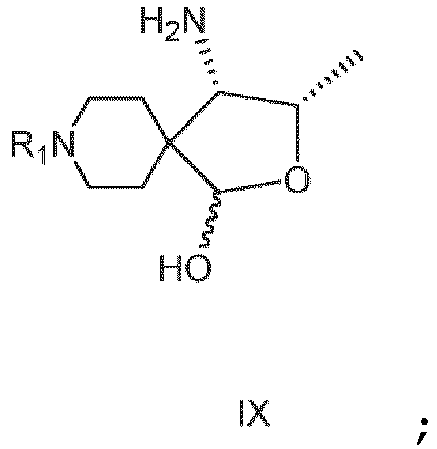
 (c-i) le composé répondant à la formule VIII est amené à réagir avec un composé d'insertion de groupe protecteur d'amino pour donner un composé répondant à la formule X :
 dans lequel R1 est un groupe protecteur d'amino secondaire et R2 est un groupe amino protégé, qui est ensuite réduit en un composé répondant à la formule XI :
 dans lequel R1 est un groupe protecteur d'amino secondaire et R2 est un groupe amino protégé, lequel composé de formule XI, dans une étape supplémentaire, est amené à réagir au niveau de l'hydroxy du groupe hydroxyméthyle avec un agent de formation de groupe partant répondant à la formule LG*-X dans laquelle LG* est un radical électrophile capable, avec l'hydroxy auquel il est lié, de former un groupe partant LG2 et X est un halogène, pour donner un composé répondant à la formule XII :
 dans lequel R1 est un groupe protecteur d'amino secondaire, R2 est un groupe amino protégé et LG2 est un groupe partant, lequel composé de formule XII est ensuite cyclisé dans des conditions basiques pour donner un composé répondant à la formule XIII :
 dans lequel R1 est un groupe protecteur d'amino secondaire et R2 est un groupe amino protégé, qui est un composé répondant à la formule IV représenté ci-dessus dans lequel R1 est un groupe protecteur d'amino secondaire, R2 est un groupe amino protégé et R3 est l'hydrogène, suivie d'une étape de déprotection du composé de formule XIII qui est effectuée à l'aide d'un acide HnA dans lequel A est l'anion d'un acide protique et n vaut 1, 2 ou 3, pour donner un composé répondant à la formule II défini dans la revendication 1 ;dans les deux cas (b-i) et (c-i), le composé répondant à la formule II étant amené à réagir avec un composé répondant à la formule III comme indiqué dans le schéma de réaction suivant pour donner un composé répondant à la formule I,
 dans lequel LG est un groupe partant, A est l'anion d'un acide protique et n, m et p valent indépendamment 1, 2 ou 3, de sorte que le sel répondant à la formule II est électriquement neutre, pour donner un composé de formule I, ou un sel pharmaceutiquement acceptable, cocristal avec un acide, hydrate ou autre solvate de celui-ci.
 - Procédé selon la revendication 1, comprenant en outre l'acylation du composé répondant à la formule VII dans des conditions réductrices pour donner un composé répondant à la formule VIII* :
 dans lequel R1 est un groupe protecteur d'amino secondaire et *R2 est amino acylé ; suivie de l'hydrogénation du composé répondant à la formule VIII* en présence d'un catalyseur d'hydrogénation chiral pour donner un composé répondant à la formule X* :
 dans lequel R1 est tel que défini pour un composé répondant à la formule VIII* et *R2 est un groupe amino acylé, suivie de la réduction du composé répondant à la formule X* en un composé répondant à la formule XI* :
 dans lequel R1 est tel que défini pour un composé répondant à la formule VIII* et *R2 est un groupe amino acylé ; dans une étape supplémentaire, la réaction du composé répondant à la formule XI* au niveau de l'hydroxy du groupe hydroxyméthyle avec un agent de formation de groupe partant répondant à la formule LG*-X dans laquelle LG* est un radical électrophile capable de former, avec l'hydroxy auquel il est lié, un groupe partant LG2, pour donner un composé répondant à la formule XII* :
 dans lequel R1 est tel que défini pour un composé répondant à la formule VIII*, R2 est un groupe amino protégé et LG2 est un groupe partant, puis la cyclisation du composé de formule XII* dans des conditions basiques pour donner un composé répondant à la formule XIII* :
 dans lequel R1 est un groupe protecteur d'amino secondaire et *R2 est un groupe amino acylé, qui correspond à un composé répondant à la formule IV :
 dans lequel R1 est un groupe protecteur d'amino secondaire, R2 est un groupe amino acylé et R3 est l'hydrogène, suivie de la déprotection du composé de formule XIII* à l'aide d'un acide HnA dans lequel A est l'anion d'un acide protique et n vaut 1, 2 ou 3 comme défini pour un composé répondant à la formule II pour donner un composé répondant à la formule II défini dans la revendication 1 ;le composé répondant à la formule II étant ensuite amené à réagir avec un composé répondant à la formule III comme indiqué dans le schéma de réaction suivant pour donner un composé répondant à la formule I :
 dans lequel LG est un groupe partant, A est l'anion d'un acide protique et n, m et p valent indépendamment 1, 2 ou 3, de sorte que le sel répondant à la formule II est électriquement neutre, pour donner un composé de formule I, ou un sel pharmaceutiquement acceptable, cocristal avec un acide, hydrate ou autre solvate de celui-ci.
 - Procédé de fabrication d'un composé répondant à la formule VI :
 dans lequel R1 est un groupe protecteur d'amino secondaire et R5 est alkyle substitué ou non substitué, cycloalkyle substitué ou non substitué ou aryle substitué ou non substitué, ledit procédé comprenant la réaction d'un composé répondant à la formule V :
 dans lequel R1 est un groupe protecteur d'amino secondaire et R4 est un groupe protecteur de carboxyle, en présence d'une base forte avec du L-lactide répondant à la formule :
 pour donner le composé répondant à la formule VI.
 - Procédé de fabrication d'un composé d'hydroxylamine répondant à la formule VII :
 dans lequel R1 est un groupe protecteur d'amino secondaire, comprenant la cyclisation d'un composé répondant à la formule VI :
 dans lequel R1 est un groupe protecteur d'amino secondaire et R5 est alkyle substitué ou non substitué, cycloalkyle substitué ou non substitué ou aryle substitué ou non substitué, avec de l'hydroxylamine, ou un sel de celle-ci, pour donner le composé répondant à la formule VII.
 - Composé répondant à la formule VI :

- Composé de formule VI selon la revendication 6, dans lequel R1 est tert-butoxycarbonyle, benzyloxycarbonyle ou fluorén-9-yloxacarbonyle et R5 est alkyle en C1-C8.
- Composé de formule VI selon la revendication 6, dans lequel R1 est tert-butoxycarbonyle et R5 est éthyle.
- Procédé de fabrication d'un composé répondant à la formule XV :
 dans lequel Mt est, lorsque, en ce qui concerne la charge relativement d'un demi-atome de métal par soufre, un métal alcalinoterreux ou, lorsqu'il est en un rapport d'un Mt pour un S, un atome de métal alcalin et LG est un groupe partant, ledit procédé comprenant la réaction d'un composé répondant à la formule XIV :
 dans lequel LG est un groupe partant, avec un sel thiosulfate métallique, dans lequel ledit métal est un sel thiosulfate de métal alcalin ou de métal alcalinoterreux, en présence d'un acide dans un solvant approprié, suivie d'un traitement avec une base aqueuse.
 - Procédé selon la revendication 9, dans lequel Mt dans la formule XV est le sodium et LG est chloro et le sel thiosulfate est le thiosulfate de sodium.
- Procédé selon la revendication 9 ou la revendication 10, dans lequel le composé répondant à la formule XIV est préparé par réaction de 2,3,5-trichloropyrazine avec de l'ammoniac.
- Procédé de fabrication d'un composé répondant à la formule (III)
 dans lequel LG est un groupe partant, comprenant la réaction d'un composé répondant à la formule (XV),
 dans lequel LG est un groupe partant et Mt est un atome de métal alcalinoterreux ou de métal alcalin, avec un composé répondant à la formule (XVI),
 pour donner le composé répondant à la formule (III), la réaction ayant lieu dans des conditions de réaction exemptes de métal de transition.
 - Procédé de fabrication d'un composé répondant à la formule I de la revendication 1, comprenant la réaction d'un composé de formule II avec un composé de formule III selon le schéma de réaction suivant :

Applications Claiming Priority (3)
| Application Number | Priority Date | Filing Date | Title |
|---|---|---|---|
| PCT/CN2020/100882 WO2022006780A1 (fr) | 2020-07-08 | 2020-07-08 | Fabrication de composés et de compositions pour inhiber l'activité de shp2 |
| PCT/CN2021/094139 WO2022007502A1 (fr) | 2020-07-08 | 2021-05-17 | Fabrication de composés et de compositions pour inhiber shp2 |
| PCT/IB2021/056057 WO2022009098A1 (fr) | 2020-07-08 | 2021-07-06 | Fabrication de composés et de compositions pour inhiber l'activité de shp2 |
Publications (2)
| Publication Number | Publication Date |
|---|---|
| EP4178962A1 EP4178962A1 (fr) | 2023-05-17 |
| EP4178962B1 true EP4178962B1 (fr) | 2025-06-11 |
Family
ID=76859661
Family Applications (1)
| Application Number | Title | Priority Date | Filing Date |
|---|---|---|---|
| EP21740209.8A Active EP4178962B1 (fr) | 2020-07-08 | 2021-07-06 | Fabrication de composés et de compositions pour inhiber l'activité de shp2 |
Country Status (11)
| Country | Link |
|---|---|
| US (1) | US12441737B2 (fr) |
| EP (1) | EP4178962B1 (fr) |
| JP (1) | JP7729870B2 (fr) |
| KR (1) | KR20230038197A (fr) |
| CN (1) | CN115916786B (fr) |
| AU (1) | AU2021305970B2 (fr) |
| CA (1) | CA3183946A1 (fr) |
| ES (1) | ES3040751T3 (fr) |
| IL (1) | IL298350A (fr) |
| TW (1) | TW202216723A (fr) |
| WO (1) | WO2022009098A1 (fr) |
Families Citing this family (3)
| Publication number | Priority date | Publication date | Assignee | Title |
|---|---|---|---|---|
| CA3113379A1 (fr) | 2018-09-29 | 2020-04-02 | Novartis Ag | Procede de fabrication d'un compose pour inhiber l'activite de shp2 |
| EP3856744A1 (fr) | 2018-09-29 | 2021-08-04 | Novartis AG | Fabrication de composés et de compositions pour inhiber l'activité de shp2 |
| CN115916786B (zh) | 2020-07-08 | 2025-10-17 | 诺华股份有限公司 | 用于抑制shp2活性的化合物和组合物的制造 |
Citations (1)
| Publication number | Priority date | Publication date | Assignee | Title |
|---|---|---|---|---|
| WO2020065452A1 (fr) * | 2018-09-29 | 2020-04-02 | Novartis Ag | Fabrication de composés et de compositions pour inhiber l'activité de shp2 |
Family Cites Families (23)
| Publication number | Priority date | Publication date | Assignee | Title |
|---|---|---|---|---|
| EP3094627B1 (fr) | 2014-01-17 | 2018-08-22 | Novartis AG | Dérivés de 1-pyridazin-/triazin-3-yl-piper(-azine)/idine/pyrolidine et compositions les contenant pour l'inhibition de l'activité de shp2 |
| JO3517B1 (ar) | 2014-01-17 | 2020-07-05 | Novartis Ag | ان-ازاسبيرو الكان حلقي كبديل مركبات اريل-ان مغايرة وتركيبات لتثبيط نشاط shp2 |
| EP3094629B1 (fr) | 2014-01-17 | 2018-08-22 | Novartis AG | Dérivés de 1-(triazin-3-yl/pyridazin-3-yl)-piper(-azine)idine et compositions les contenant pour l'inhibition de l'activité de shp2 |
| CN103922933A (zh) | 2014-04-22 | 2014-07-16 | 中国科学院长春应用化学研究所 | 一种乳酸乙酯的制备方法 |
| JP6878316B2 (ja) | 2015-06-19 | 2021-05-26 | ノバルティス アーゲー | Shp2の活性を阻害するための化合物および組成物 |
| ES2741746T3 (es) | 2015-06-19 | 2020-02-12 | Novartis Ag | Compuestos y composiciones para inhibir la actividad de SHP2 |
| US10287266B2 (en) | 2015-06-19 | 2019-05-14 | Novartis Ag | Compounds and compositions for inhibiting the activity of SHP2 |
| EA202092442A3 (ru) | 2016-06-07 | 2021-08-31 | Джакобио Фармасьютикалс Ко., Лтд. | Новые гетероциклические производные, применимые в качестве ингибиторов shp2 |
| AU2017283769B2 (en) | 2016-06-14 | 2019-08-15 | Novartis Ag | Compounds and compositions for inhibiting the activity of SHP2 |
| PH12019500056B1 (en) | 2016-07-12 | 2024-01-31 | Revolution Medicines Inc | 2,5-disubstituted 3-methyl pyrazines and 2,5,6-trisubstituted 3-methyl pyrazines as allosteric shp2 inhibitors |
| EP3568204B1 (fr) | 2017-01-10 | 2023-08-30 | Novartis AG | Combinaison pharmaceutique comprenant un inhibiteur d'alk et un inhibiteur de shp2 |
| BR112019015075A2 (pt) | 2017-01-23 | 2020-03-10 | Revolution Medicines, Inc. | Compostos bicíclicos como inibidores de shp2 alostéricos |
| WO2018172984A1 (fr) | 2017-03-23 | 2018-09-27 | Jacobio Pharmaceuticals Co., Ltd. | Nouveaux dérivés hétérocycliques utiles en tant qu'inhibiteurs de shp2 |
| SG11202002941WA (en) | 2017-10-12 | 2020-04-29 | Revolution Medicines Inc | Pyridine, pyrazine, and triazine compounds as allosteric shp2 inhibitors |
| CA3113379A1 (fr) | 2018-09-29 | 2020-04-02 | Novartis Ag | Procede de fabrication d'un compose pour inhiber l'activite de shp2 |
| US20220152026A1 (en) | 2019-02-12 | 2022-05-19 | Novartis Ag | Pharmaceutical combination comprising tno155 and a krasg12c inhibitor |
| CA3129031A1 (fr) | 2019-02-12 | 2020-08-20 | Novartis Ag | Combinaison pharmaceutique comprenant du tno155 et un inhibiteur de pd-1 |
| IL284835B2 (en) | 2019-02-12 | 2025-08-01 | Novartis Ag | Pharmaceutical combination comprising tno155 and ribociclib |
| CN111647000B (zh) | 2019-03-04 | 2021-10-12 | 勤浩医药(苏州)有限公司 | 吡嗪类衍生物及其在抑制shp2中的应用 |
| CN110713447B (zh) | 2019-11-15 | 2021-07-23 | 山东国邦药业有限公司 | 一种对甲硫基苯甲醛的制备方法 |
| EP4110338A1 (fr) | 2020-02-28 | 2023-01-04 | Novartis AG | Combinaison pharmaceutique triple comprenant du dabrafénib, un inhibiteur d'erk et un inhibiteur de shp2 |
| CA3179994A1 (fr) | 2020-05-08 | 2021-11-11 | Novartis Ag | Combinaison pharmaceutique comprenant du tno155 et du nazartinib |
| CN115916786B (zh) | 2020-07-08 | 2025-10-17 | 诺华股份有限公司 | 用于抑制shp2活性的化合物和组合物的制造 |
-
2021
- 2021-07-06 CN CN202180043650.2A patent/CN115916786B/zh active Active
- 2021-07-06 AU AU2021305970A patent/AU2021305970B2/en active Active
- 2021-07-06 TW TW110124805A patent/TW202216723A/zh unknown
- 2021-07-06 KR KR1020237001046A patent/KR20230038197A/ko not_active Ceased
- 2021-07-06 JP JP2023500286A patent/JP7729870B2/ja active Active
- 2021-07-06 US US18/004,313 patent/US12441737B2/en active Active
- 2021-07-06 ES ES21740209T patent/ES3040751T3/es active Active
- 2021-07-06 EP EP21740209.8A patent/EP4178962B1/fr active Active
- 2021-07-06 WO PCT/IB2021/056057 patent/WO2022009098A1/fr not_active Ceased
- 2021-07-06 CA CA3183946A patent/CA3183946A1/fr active Pending
- 2021-07-06 IL IL298350A patent/IL298350A/en unknown
Patent Citations (1)
| Publication number | Priority date | Publication date | Assignee | Title |
|---|---|---|---|---|
| WO2020065452A1 (fr) * | 2018-09-29 | 2020-04-02 | Novartis Ag | Fabrication de composés et de compositions pour inhiber l'activité de shp2 |
Non-Patent Citations (1)
| Title |
|---|
| M. J. LAMARCHE ET. AL.: "Isolation of TNO155, An Allosteric SHP2 Inhibitor for the Treatment of Cancer.", JOURNAL OF MEDICINAL CHEMISTRY, vol. 63, no. 22, 25 November 2020 (2020-11-25), pages 13578 - 13594, DOI: 10.1021/acs.jmedchem.0c01170 * |
Also Published As
| Publication number | Publication date |
|---|---|
| JP2023532748A (ja) | 2023-07-31 |
| EP4178962A1 (fr) | 2023-05-17 |
| CA3183946A1 (fr) | 2022-01-13 |
| US12441737B2 (en) | 2025-10-14 |
| AU2021305970A1 (en) | 2023-01-05 |
| TW202216723A (zh) | 2022-05-01 |
| ES3040751T3 (en) | 2025-11-04 |
| CN115916786A (zh) | 2023-04-04 |
| KR20230038197A (ko) | 2023-03-17 |
| JP7729870B2 (ja) | 2025-08-26 |
| US20230374029A1 (en) | 2023-11-23 |
| CN115916786B (zh) | 2025-10-17 |
| AU2021305970B2 (en) | 2023-07-27 |
| WO2022009098A1 (fr) | 2022-01-13 |
| IL298350A (en) | 2023-01-01 |
Similar Documents
| Publication | Publication Date | Title |
|---|---|---|
| JP7655997B2 (ja) | Shp2の活性を阻害するための化合物及び組成物の製造 | |
| AU2021305970B2 (en) | Manufacture of compounds and compositions for inhibiting the activity of SHP2 | |
| SK64697A3 (en) | Method of producing optically active metallocenyl phosphines | |
| PL173659B1 (pl) | Sposób wytwarzania nowych pochodnych piperydyny | |
| SK10972000A3 (sk) | Spôsob výroby (-)-cis-3-hydroxy-1-metyl-4-(2,4,6- -trimetoxyfenyl)piperidínu | |
| HK40084841B (en) | Manufacture of compounds and compositions for inhibiting the activity of shp2 | |
| HK40084841A (en) | Manufacture of compounds and compositions for inhibiting the activity of shp2 | |
| WO2022007502A1 (fr) | Fabrication de composés et de compositions pour inhiber shp2 | |
| RU2797951C2 (ru) | Производство соединений и композиций для подавления активности shp2 | |
| KR100574343B1 (ko) | 입체선택적 4-하이드록시-2-피페리디논의 제조방법 | |
| JP2005306804A (ja) | 光学活性3−キヌクリジノールの製造方法 |
Legal Events
| Date | Code | Title | Description |
|---|---|---|---|
| STAA | Information on the status of an ep patent application or granted ep patent |
Free format text: STATUS: UNKNOWN |
|
| STAA | Information on the status of an ep patent application or granted ep patent |
Free format text: STATUS: THE INTERNATIONAL PUBLICATION HAS BEEN MADE |
|
| PUAI | Public reference made under article 153(3) epc to a published international application that has entered the european phase |
Free format text: ORIGINAL CODE: 0009012 |
|
| STAA | Information on the status of an ep patent application or granted ep patent |
Free format text: STATUS: REQUEST FOR EXAMINATION WAS MADE |
|
| 17P | Request for examination filed |
Effective date: 20230208 |
|
| AK | Designated contracting states |
Kind code of ref document: A1 Designated state(s): AL AT BE BG CH CY CZ DE DK EE ES FI FR GB GR HR HU IE IS IT LI LT LU LV MC MK MT NL NO PL PT RO RS SE SI SK SM TR |
|
| REG | Reference to a national code |
Ref country code: HK Ref legal event code: DE Ref document number: 40084841 Country of ref document: HK |
|
| DAV | Request for validation of the european patent (deleted) | ||
| DAX | Request for extension of the european patent (deleted) | ||
| GRAP | Despatch of communication of intention to grant a patent |
Free format text: ORIGINAL CODE: EPIDOSNIGR1 |
|
| STAA | Information on the status of an ep patent application or granted ep patent |
Free format text: STATUS: GRANT OF PATENT IS INTENDED |
|
| INTG | Intention to grant announced |
Effective date: 20250102 |
|
| P01 | Opt-out of the competence of the unified patent court (upc) registered |
Free format text: CASE NUMBER: APP_8859/2025 Effective date: 20250221 |
|
| GRAS | Grant fee paid |
Free format text: ORIGINAL CODE: EPIDOSNIGR3 |
|
| GRAA | (expected) grant |
Free format text: ORIGINAL CODE: 0009210 |
|
| STAA | Information on the status of an ep patent application or granted ep patent |
Free format text: STATUS: THE PATENT HAS BEEN GRANTED |
|
| AK | Designated contracting states |
Kind code of ref document: B1 Designated state(s): AL AT BE BG CH CY CZ DE DK EE ES FI FR GB GR HR HU IE IS IT LI LT LU LV MC MK MT NL NO PL PT RO RS SE SI SK SM TR |
|
| REG | Reference to a national code |
Ref country code: GB Ref legal event code: FG4D |
|
| REG | Reference to a national code |
Ref country code: CH Ref legal event code: EP |
|
| REG | Reference to a national code |
Ref country code: IE Ref legal event code: FG4D |
|
| REG | Reference to a national code |
Ref country code: DE Ref legal event code: R096 Ref document number: 602021032138 Country of ref document: DE |
|
| PG25 | Lapsed in a contracting state [announced via postgrant information from national office to epo] |
Ref country code: FI Free format text: LAPSE BECAUSE OF FAILURE TO SUBMIT A TRANSLATION OF THE DESCRIPTION OR TO PAY THE FEE WITHIN THE PRESCRIBED TIME-LIMIT Effective date: 20250611 |
|
| PGFP | Annual fee paid to national office [announced via postgrant information from national office to epo] |
Ref country code: ES Payment date: 20250804 Year of fee payment: 5 |
|
| PGFP | Annual fee paid to national office [announced via postgrant information from national office to epo] |
Ref country code: DE Payment date: 20250716 Year of fee payment: 5 |
|
| REG | Reference to a national code |
Ref country code: LT Ref legal event code: MG9D |
|
| PG25 | Lapsed in a contracting state [announced via postgrant information from national office to epo] |
Ref country code: NO Free format text: LAPSE BECAUSE OF FAILURE TO SUBMIT A TRANSLATION OF THE DESCRIPTION OR TO PAY THE FEE WITHIN THE PRESCRIBED TIME-LIMIT Effective date: 20250911 Ref country code: GR Free format text: LAPSE BECAUSE OF FAILURE TO SUBMIT A TRANSLATION OF THE DESCRIPTION OR TO PAY THE FEE WITHIN THE PRESCRIBED TIME-LIMIT Effective date: 20250912 |
|
| REG | Reference to a national code |
Ref country code: NL Ref legal event code: MP Effective date: 20250611 |
|
| PG25 | Lapsed in a contracting state [announced via postgrant information from national office to epo] |
Ref country code: BG Free format text: LAPSE BECAUSE OF FAILURE TO SUBMIT A TRANSLATION OF THE DESCRIPTION OR TO PAY THE FEE WITHIN THE PRESCRIBED TIME-LIMIT Effective date: 20250611 |
|
| PGFP | Annual fee paid to national office [announced via postgrant information from national office to epo] |
Ref country code: GB Payment date: 20250717 Year of fee payment: 5 |
|
| PG25 | Lapsed in a contracting state [announced via postgrant information from national office to epo] |
Ref country code: HR Free format text: LAPSE BECAUSE OF FAILURE TO SUBMIT A TRANSLATION OF THE DESCRIPTION OR TO PAY THE FEE WITHIN THE PRESCRIBED TIME-LIMIT Effective date: 20250611 |
|
| PGFP | Annual fee paid to national office [announced via postgrant information from national office to epo] |
Ref country code: AT Payment date: 20251020 Year of fee payment: 5 Ref country code: FR Payment date: 20250721 Year of fee payment: 5 |
|
| PG25 | Lapsed in a contracting state [announced via postgrant information from national office to epo] |
Ref country code: RS Free format text: LAPSE BECAUSE OF FAILURE TO SUBMIT A TRANSLATION OF THE DESCRIPTION OR TO PAY THE FEE WITHIN THE PRESCRIBED TIME-LIMIT Effective date: 20250911 |
|
| PG25 | Lapsed in a contracting state [announced via postgrant information from national office to epo] |
Ref country code: LV Free format text: LAPSE BECAUSE OF FAILURE TO SUBMIT A TRANSLATION OF THE DESCRIPTION OR TO PAY THE FEE WITHIN THE PRESCRIBED TIME-LIMIT Effective date: 20250611 |
|
| REG | Reference to a national code |
Ref country code: ES Ref legal event code: FG2A Ref document number: 3040751 Country of ref document: ES Kind code of ref document: T3 Effective date: 20251104 |
|
| PG25 | Lapsed in a contracting state [announced via postgrant information from national office to epo] |
Ref country code: NL Free format text: LAPSE BECAUSE OF FAILURE TO SUBMIT A TRANSLATION OF THE DESCRIPTION OR TO PAY THE FEE WITHIN THE PRESCRIBED TIME-LIMIT Effective date: 20250611 |
|
| PG25 | Lapsed in a contracting state [announced via postgrant information from national office to epo] |
Ref country code: PT Free format text: LAPSE BECAUSE OF FAILURE TO SUBMIT A TRANSLATION OF THE DESCRIPTION OR TO PAY THE FEE WITHIN THE PRESCRIBED TIME-LIMIT Effective date: 20251013 |
|
| REG | Reference to a national code |
Ref country code: AT Ref legal event code: MK05 Ref document number: 1802253 Country of ref document: AT Kind code of ref document: T Effective date: 20250611 |
|
| PG25 | Lapsed in a contracting state [announced via postgrant information from national office to epo] |
Ref country code: IS Free format text: LAPSE BECAUSE OF FAILURE TO SUBMIT A TRANSLATION OF THE DESCRIPTION OR TO PAY THE FEE WITHIN THE PRESCRIBED TIME-LIMIT Effective date: 20251011 |
|
| PG25 | Lapsed in a contracting state [announced via postgrant information from national office to epo] |
Ref country code: AT Free format text: LAPSE BECAUSE OF FAILURE TO SUBMIT A TRANSLATION OF THE DESCRIPTION OR TO PAY THE FEE WITHIN THE PRESCRIBED TIME-LIMIT Effective date: 20250611 Ref country code: SM Free format text: LAPSE BECAUSE OF FAILURE TO SUBMIT A TRANSLATION OF THE DESCRIPTION OR TO PAY THE FEE WITHIN THE PRESCRIBED TIME-LIMIT Effective date: 20250611 |
|
| PG25 | Lapsed in a contracting state [announced via postgrant information from national office to epo] |
Ref country code: CZ Free format text: LAPSE BECAUSE OF FAILURE TO SUBMIT A TRANSLATION OF THE DESCRIPTION OR TO PAY THE FEE WITHIN THE PRESCRIBED TIME-LIMIT Effective date: 20250611 |
|
| PG25 | Lapsed in a contracting state [announced via postgrant information from national office to epo] |
Ref country code: PL Free format text: LAPSE BECAUSE OF FAILURE TO SUBMIT A TRANSLATION OF THE DESCRIPTION OR TO PAY THE FEE WITHIN THE PRESCRIBED TIME-LIMIT Effective date: 20250611 |
|
| PG25 | Lapsed in a contracting state [announced via postgrant information from national office to epo] |
Ref country code: EE Free format text: LAPSE BECAUSE OF FAILURE TO SUBMIT A TRANSLATION OF THE DESCRIPTION OR TO PAY THE FEE WITHIN THE PRESCRIBED TIME-LIMIT Effective date: 20250611 |
|
| PG25 | Lapsed in a contracting state [announced via postgrant information from national office to epo] |
Ref country code: SK Free format text: LAPSE BECAUSE OF FAILURE TO SUBMIT A TRANSLATION OF THE DESCRIPTION OR TO PAY THE FEE WITHIN THE PRESCRIBED TIME-LIMIT Effective date: 20250611 |
|
| REG | Reference to a national code |
Ref country code: CH Ref legal event code: H13 Free format text: ST27 STATUS EVENT CODE: U-0-0-H10-H13 (AS PROVIDED BY THE NATIONAL OFFICE) Effective date: 20260224 |
|
| PG25 | Lapsed in a contracting state [announced via postgrant information from national office to epo] |
Ref country code: RO Free format text: LAPSE BECAUSE OF FAILURE TO SUBMIT A TRANSLATION OF THE DESCRIPTION OR TO PAY THE FEE WITHIN THE PRESCRIBED TIME-LIMIT Effective date: 20250611 |
|
| REG | Reference to a national code |
Ref country code: DE Ref legal event code: R097 Ref document number: 602021032138 Country of ref document: DE |
|
| PG25 | Lapsed in a contracting state [announced via postgrant information from national office to epo] |
Ref country code: LU Free format text: LAPSE BECAUSE OF NON-PAYMENT OF DUE FEES Effective date: 20250706 |
|
| REG | Reference to a national code |
Ref country code: BE Ref legal event code: MM Effective date: 20250731 |
|
| PG25 | Lapsed in a contracting state [announced via postgrant information from national office to epo] |
Ref country code: MC Free format text: LAPSE BECAUSE OF FAILURE TO SUBMIT A TRANSLATION OF THE DESCRIPTION OR TO PAY THE FEE WITHIN THE PRESCRIBED TIME-LIMIT Effective date: 20250611 |
|
| PG25 | Lapsed in a contracting state [announced via postgrant information from national office to epo] |
Ref country code: DK Free format text: LAPSE BECAUSE OF FAILURE TO SUBMIT A TRANSLATION OF THE DESCRIPTION OR TO PAY THE FEE WITHIN THE PRESCRIBED TIME-LIMIT Effective date: 20250611 |
|
| PG25 | Lapsed in a contracting state [announced via postgrant information from national office to epo] |
Ref country code: BE Free format text: LAPSE BECAUSE OF NON-PAYMENT OF DUE FEES Effective date: 20250731 |
|
| PLBE | No opposition filed within time limit |
Free format text: ORIGINAL CODE: 0009261 |
|
| STAA | Information on the status of an ep patent application or granted ep patent |
Free format text: STATUS: NO OPPOSITION FILED WITHIN TIME LIMIT |
|
| PG25 | Lapsed in a contracting state [announced via postgrant information from national office to epo] |
Ref country code: CH Free format text: LAPSE BECAUSE OF NON-PAYMENT OF DUE FEES Effective date: 20250731 |
|
| REG | Reference to a national code |
Ref country code: CH Ref legal event code: L10 Free format text: ST27 STATUS EVENT CODE: U-0-0-L10-L00 (AS PROVIDED BY THE NATIONAL OFFICE) Effective date: 20260423 |