EP4179047B1 - Additifs de carburant pour atténuer l'encrassement d'une buse d'injecteur et réduire les émissions de particules - Google Patents
Additifs de carburant pour atténuer l'encrassement d'une buse d'injecteur et réduire les émissions de particules Download PDFInfo
- Publication number
- EP4179047B1 EP4179047B1 EP21740216.3A EP21740216A EP4179047B1 EP 4179047 B1 EP4179047 B1 EP 4179047B1 EP 21740216 A EP21740216 A EP 21740216A EP 4179047 B1 EP4179047 B1 EP 4179047B1
- Authority
- EP
- European Patent Office
- Prior art keywords
- amine
- detergent
- hydrocarbyl
- fuel
- nitrogen
- Prior art date
- Legal status (The legal status is an assumption and is not a legal conclusion. Google has not performed a legal analysis and makes no representation as to the accuracy of the status listed.)
- Active
Links
Images







Classifications
-
- C—CHEMISTRY; METALLURGY
- C10—PETROLEUM, GAS OR COKE INDUSTRIES; TECHNICAL GASES CONTAINING CARBON MONOXIDE; FUELS; LUBRICANTS; PEAT
- C10L—FUELS NOT OTHERWISE PROVIDED FOR; NATURAL GAS; SYNTHETIC NATURAL GAS OBTAINED BY PROCESSES NOT COVERED BY SUBCLASSES C10G OR C10K; LIQUIFIED PETROLEUM GAS; USE OF ADDITIVES TO FUELS OR FIRES; FIRE-LIGHTERS
- C10L1/00—Liquid carbonaceous fuels
- C10L1/10—Liquid carbonaceous fuels containing additives
- C10L1/14—Organic compounds
- C10L1/22—Organic compounds containing nitrogen
- C10L1/222—Organic compounds containing nitrogen containing at least one carbon-to-nitrogen single bond
- C10L1/2222—(cyclo)aliphatic amines; polyamines (no macromolecular substituent 30C); quaternair ammonium compounds; carbamates
- C10L1/2225—(cyclo)aliphatic amines; polyamines (no macromolecular substituent 30C); quaternair ammonium compounds; carbamates hydroxy containing
-
- C—CHEMISTRY; METALLURGY
- C10—PETROLEUM, GAS OR COKE INDUSTRIES; TECHNICAL GASES CONTAINING CARBON MONOXIDE; FUELS; LUBRICANTS; PEAT
- C10L—FUELS NOT OTHERWISE PROVIDED FOR; NATURAL GAS; SYNTHETIC NATURAL GAS OBTAINED BY PROCESSES NOT COVERED BY SUBCLASSES C10G OR C10K; LIQUIFIED PETROLEUM GAS; USE OF ADDITIVES TO FUELS OR FIRES; FIRE-LIGHTERS
- C10L1/00—Liquid carbonaceous fuels
- C10L1/10—Liquid carbonaceous fuels containing additives
- C10L1/14—Organic compounds
- C10L1/22—Organic compounds containing nitrogen
-
- C—CHEMISTRY; METALLURGY
- C10—PETROLEUM, GAS OR COKE INDUSTRIES; TECHNICAL GASES CONTAINING CARBON MONOXIDE; FUELS; LUBRICANTS; PEAT
- C10L—FUELS NOT OTHERWISE PROVIDED FOR; NATURAL GAS; SYNTHETIC NATURAL GAS OBTAINED BY PROCESSES NOT COVERED BY SUBCLASSES C10G OR C10K; LIQUIFIED PETROLEUM GAS; USE OF ADDITIVES TO FUELS OR FIRES; FIRE-LIGHTERS
- C10L10/00—Use of additives to fuels or fires for particular purposes
- C10L10/02—Use of additives to fuels or fires for particular purposes for reducing smoke development
-
- C—CHEMISTRY; METALLURGY
- C10—PETROLEUM, GAS OR COKE INDUSTRIES; TECHNICAL GASES CONTAINING CARBON MONOXIDE; FUELS; LUBRICANTS; PEAT
- C10L—FUELS NOT OTHERWISE PROVIDED FOR; NATURAL GAS; SYNTHETIC NATURAL GAS OBTAINED BY PROCESSES NOT COVERED BY SUBCLASSES C10G OR C10K; LIQUIFIED PETROLEUM GAS; USE OF ADDITIVES TO FUELS OR FIRES; FIRE-LIGHTERS
- C10L10/00—Use of additives to fuels or fires for particular purposes
- C10L10/04—Use of additives to fuels or fires for particular purposes for minimising corrosion or incrustation
-
- C—CHEMISTRY; METALLURGY
- C10—PETROLEUM, GAS OR COKE INDUSTRIES; TECHNICAL GASES CONTAINING CARBON MONOXIDE; FUELS; LUBRICANTS; PEAT
- C10L—FUELS NOT OTHERWISE PROVIDED FOR; NATURAL GAS; SYNTHETIC NATURAL GAS OBTAINED BY PROCESSES NOT COVERED BY SUBCLASSES C10G OR C10K; LIQUIFIED PETROLEUM GAS; USE OF ADDITIVES TO FUELS OR FIRES; FIRE-LIGHTERS
- C10L1/00—Liquid carbonaceous fuels
- C10L1/10—Liquid carbonaceous fuels containing additives
- C10L1/14—Organic compounds
- C10L1/22—Organic compounds containing nitrogen
- C10L1/222—Organic compounds containing nitrogen containing at least one carbon-to-nitrogen single bond
-
- C—CHEMISTRY; METALLURGY
- C10—PETROLEUM, GAS OR COKE INDUSTRIES; TECHNICAL GASES CONTAINING CARBON MONOXIDE; FUELS; LUBRICANTS; PEAT
- C10L—FUELS NOT OTHERWISE PROVIDED FOR; NATURAL GAS; SYNTHETIC NATURAL GAS OBTAINED BY PROCESSES NOT COVERED BY SUBCLASSES C10G OR C10K; LIQUIFIED PETROLEUM GAS; USE OF ADDITIVES TO FUELS OR FIRES; FIRE-LIGHTERS
- C10L1/00—Liquid carbonaceous fuels
- C10L1/10—Liquid carbonaceous fuels containing additives
- C10L1/14—Organic compounds
- C10L1/22—Organic compounds containing nitrogen
- C10L1/222—Organic compounds containing nitrogen containing at least one carbon-to-nitrogen single bond
- C10L1/2222—(cyclo)aliphatic amines; polyamines (no macromolecular substituent 30C); quaternair ammonium compounds; carbamates
-
- C—CHEMISTRY; METALLURGY
- C10—PETROLEUM, GAS OR COKE INDUSTRIES; TECHNICAL GASES CONTAINING CARBON MONOXIDE; FUELS; LUBRICANTS; PEAT
- C10L—FUELS NOT OTHERWISE PROVIDED FOR; NATURAL GAS; SYNTHETIC NATURAL GAS OBTAINED BY PROCESSES NOT COVERED BY SUBCLASSES C10G OR C10K; LIQUIFIED PETROLEUM GAS; USE OF ADDITIVES TO FUELS OR FIRES; FIRE-LIGHTERS
- C10L1/00—Liquid carbonaceous fuels
- C10L1/10—Liquid carbonaceous fuels containing additives
- C10L1/14—Organic compounds
- C10L1/22—Organic compounds containing nitrogen
- C10L1/222—Organic compounds containing nitrogen containing at least one carbon-to-nitrogen single bond
- C10L1/224—Amides; Imides carboxylic acid amides, imides
-
- C—CHEMISTRY; METALLURGY
- C10—PETROLEUM, GAS OR COKE INDUSTRIES; TECHNICAL GASES CONTAINING CARBON MONOXIDE; FUELS; LUBRICANTS; PEAT
- C10L—FUELS NOT OTHERWISE PROVIDED FOR; NATURAL GAS; SYNTHETIC NATURAL GAS OBTAINED BY PROCESSES NOT COVERED BY SUBCLASSES C10G OR C10K; LIQUIFIED PETROLEUM GAS; USE OF ADDITIVES TO FUELS OR FIRES; FIRE-LIGHTERS
- C10L1/00—Liquid carbonaceous fuels
- C10L1/10—Liquid carbonaceous fuels containing additives
- C10L1/14—Organic compounds
- C10L1/22—Organic compounds containing nitrogen
- C10L1/234—Macromolecular compounds
- C10L1/238—Macromolecular compounds obtained otherwise than by reactions involving only carbon-to-carbon unsaturated bonds
-
- C—CHEMISTRY; METALLURGY
- C10—PETROLEUM, GAS OR COKE INDUSTRIES; TECHNICAL GASES CONTAINING CARBON MONOXIDE; FUELS; LUBRICANTS; PEAT
- C10L—FUELS NOT OTHERWISE PROVIDED FOR; NATURAL GAS; SYNTHETIC NATURAL GAS OBTAINED BY PROCESSES NOT COVERED BY SUBCLASSES C10G OR C10K; LIQUIFIED PETROLEUM GAS; USE OF ADDITIVES TO FUELS OR FIRES; FIRE-LIGHTERS
- C10L1/00—Liquid carbonaceous fuels
- C10L1/10—Liquid carbonaceous fuels containing additives
- C10L1/14—Organic compounds
- C10L1/22—Organic compounds containing nitrogen
- C10L1/234—Macromolecular compounds
- C10L1/238—Macromolecular compounds obtained otherwise than by reactions involving only carbon-to-carbon unsaturated bonds
- C10L1/2383—Polyamines or polyimines, or derivatives thereof (poly)amines and imines; derivatives thereof (substituted by a macromolecular group containing 30C)
-
- C—CHEMISTRY; METALLURGY
- C10—PETROLEUM, GAS OR COKE INDUSTRIES; TECHNICAL GASES CONTAINING CARBON MONOXIDE; FUELS; LUBRICANTS; PEAT
- C10L—FUELS NOT OTHERWISE PROVIDED FOR; NATURAL GAS; SYNTHETIC NATURAL GAS OBTAINED BY PROCESSES NOT COVERED BY SUBCLASSES C10G OR C10K; LIQUIFIED PETROLEUM GAS; USE OF ADDITIVES TO FUELS OR FIRES; FIRE-LIGHTERS
- C10L1/00—Liquid carbonaceous fuels
- C10L1/10—Liquid carbonaceous fuels containing additives
- C10L1/14—Organic compounds
- C10L1/22—Organic compounds containing nitrogen
- C10L1/234—Macromolecular compounds
- C10L1/238—Macromolecular compounds obtained otherwise than by reactions involving only carbon-to-carbon unsaturated bonds
- C10L1/2383—Polyamines or polyimines, or derivatives thereof (poly)amines and imines; derivatives thereof (substituted by a macromolecular group containing 30C)
- C10L1/2387—Polyoxyalkyleneamines (poly)oxyalkylene amines and derivatives thereof (substituted by a macromolecular group containing 30C)
-
- C—CHEMISTRY; METALLURGY
- C10—PETROLEUM, GAS OR COKE INDUSTRIES; TECHNICAL GASES CONTAINING CARBON MONOXIDE; FUELS; LUBRICANTS; PEAT
- C10L—FUELS NOT OTHERWISE PROVIDED FOR; NATURAL GAS; SYNTHETIC NATURAL GAS OBTAINED BY PROCESSES NOT COVERED BY SUBCLASSES C10G OR C10K; LIQUIFIED PETROLEUM GAS; USE OF ADDITIVES TO FUELS OR FIRES; FIRE-LIGHTERS
- C10L2200/00—Components of fuel compositions
- C10L2200/04—Organic compounds
- C10L2200/0407—Specifically defined hydrocarbon fractions as obtained from, e.g. a distillation column
- C10L2200/0415—Light distillates, e.g. LPG, naphtha
- C10L2200/0423—Gasoline
-
- C—CHEMISTRY; METALLURGY
- C10—PETROLEUM, GAS OR COKE INDUSTRIES; TECHNICAL GASES CONTAINING CARBON MONOXIDE; FUELS; LUBRICANTS; PEAT
- C10L—FUELS NOT OTHERWISE PROVIDED FOR; NATURAL GAS; SYNTHETIC NATURAL GAS OBTAINED BY PROCESSES NOT COVERED BY SUBCLASSES C10G OR C10K; LIQUIFIED PETROLEUM GAS; USE OF ADDITIVES TO FUELS OR FIRES; FIRE-LIGHTERS
- C10L2200/00—Components of fuel compositions
- C10L2200/04—Organic compounds
- C10L2200/0407—Specifically defined hydrocarbon fractions as obtained from, e.g. a distillation column
- C10L2200/0438—Middle or heavy distillates, heating oil, gasoil, marine fuels, residua
- C10L2200/0446—Diesel
-
- C—CHEMISTRY; METALLURGY
- C10—PETROLEUM, GAS OR COKE INDUSTRIES; TECHNICAL GASES CONTAINING CARBON MONOXIDE; FUELS; LUBRICANTS; PEAT
- C10L—FUELS NOT OTHERWISE PROVIDED FOR; NATURAL GAS; SYNTHETIC NATURAL GAS OBTAINED BY PROCESSES NOT COVERED BY SUBCLASSES C10G OR C10K; LIQUIFIED PETROLEUM GAS; USE OF ADDITIVES TO FUELS OR FIRES; FIRE-LIGHTERS
- C10L2270/00—Specifically adapted fuels
- C10L2270/02—Specifically adapted fuels for internal combustion engines
- C10L2270/023—Specifically adapted fuels for internal combustion engines for gasoline engines
Definitions
- This disclosure relates to fuel components that can improve engine performance. More specifically, this disclosure describes compositions and methods for mitigating injector nozzle fouling and reducing particulate emissions in direct injection spark ignition engines.
- DISI direct injection spark ignition
- DIG direct injection gasoline
- GDI gasoline injection
- the formation of deposits can have significant negative impact on one or more of fuel flow rate, injection duration, and/or spray pattern. This, in turn, can lead to increased emission, increased particulate matter (PM) formation, reduced fuel economy, loss of power/performance, increased wear, and/or reduced equipment life.
- PM particulate matter
- US 2004/010967 A1 discloses spark-ignition fuel compositions including a friction modifier and methods for controlling, i.e., reducing or eliminating, deposits and wear in engines, fuel pumps and injectors while imparting enhanced fuel economy performance.
- a fuel composition comprising: a hydrocarbon-based fuel boiling in the gasoline or diesel range; an amine-based detergent given by formula R 1 -O-(CH 2 ) m -NHR 2 , wherein the detergent is present in about 10 ppm to about 750 ppm by weight based on total weight of the fuel composition; wherein R 1 is a hydrocarbyl group having 8 to 20 carbons, R 2 is hydrogen or (CH 2 ) n NH 2 moiety, and wherein m, n are independently integers having a value of 3 or greater; and one or more nitrogen-containing detergent, wherein the one or more nitrogen-containing detergent is an aliphatic hydrocarbyl amine, hydrocarbyl-substituted poly(oxyalkylene)amine, hydrocarbyl-substituted succinimide, Mannich reaction product, nitro and amino aromatic ester of polyalkylphenoxyalkanol, or polyalkylphenoxyaminoalkane.
- a concentrate composition comprising: about 30 to 90 wt % of an organic solvent boiling in a range of from 65°C to 205°C and; about 10 to 70 wt % of a detergent mixture comprising: (1) an amine-based detergent given by formula R 1 -O-(CH 2 ) m -NHR 2 , wherein R 1 is a hydrocarbyl group having 8 to 20 carbons, R 2 is hydrogen or (CH 2 ) n NH 2 moiety, and wherein m, n are independently integers having a value of 3 or greater; and (2) one or more nitrogen-containing detergent, wherein the one or more nitrogen-containing detergent is an aliphatic hydrocarbyl amine, hydrocarbyl-substituted poly(oxyalkylene)amine, hydrocarbyl-substituted succinimide, Mannich reaction product, nitro and amino aromatic ester of polyalkylphenoxyalkanol, or polyalkylphenoxyaminoalkane.
- a detergent mixture compris
- a method of controlling injector fouling comprising: supplying to a direct injection engine a fuel composition comprising: a hydrocarbon-based fuel boiling in the gasoline or diesel range; an amine-based detergent given by formula R 1 -O-(CH 2 ) m -NHR 2 , wherein the amine-based detergent is present in about 10 ppm to about 750 ppm by weight based on total weight of the fuel composition; wherein R 1 is a hydrocarbyl group having 8 to 20 carbons, R 2 is hydrogen or (CH 2 ) n NH 2 moiety, and wherein m, n are independently integers having a value of 3 or greater; and one or more nitrogen-containing detergent.
- the present invention describes compositions and methods for deposit control in direct injection engines. More specifically, the present invention provides detergent additive compositions that can be utilized as components of fuel compositions and methods of using the compositions thereof.
- the fuel composition of the present invention comprises (i) a hydrocarbon-based fuel, (ii) a primary fuel additive and (iii) one or more secondary fuel additives.
- the hydrocarbon-based fuel includes gasoline and diesel.
- Gasoline fuel refers to a composition containing at least predominantly C 4 -C 12 hydrocarbons.
- gasoline or gasoline boiling range components is further defined to refer to a composition containing at least predominantly C 4 -C 12 hydrocarbons and further having a boiling range of from about 37.8°C (100°F) to about 204°C (400°F).
- gasoline is defined to refer to a composition containing at least predominantly C 4 -C 12 hydrocarbons, having a boiling range of from about 37.8°C (100°F) to about 204°C (400°F), and further defined to meet ASTM D4814.
- Diesel fuel refers to middle distillate fuels containing at least predominantly C 10 -C 25 hydrocarbons.
- diesel is further defined to refer to a composition containing at least predominantly C 10 -C 25 hydrocarbons, and further having a boiling range of from about 165.6°C (330°F) to about 371.1°C (700°F).
- diesel is as defined above to refer to a composition containing at least predominantly C 10 -C 25 hydrocarbons, having a boiling range of from about 165.6°C (330°F) to about 371.1°C (700°F), and further defined to meet ASTM D975.
- the hydrocarbon-based fuel is present in a major amount by weight % of the total fuel composition.
- the hydrocarbon-based fuel is present in about 50 wt% or greater, 55 wt% or greater, 60 wt% or greater, 65 wt% or greater, 70 wt% or greater, 75 wt% or greater, 80 wt% or greater, 85 wt% or greater, 90 wt% or greater, 95 wt% or greater or between any range from about 50 wt% to up to below 100 wt%.
- the gasoline employed in the present invention may be clean burning gasoline (CBG).
- CBG refers to gasoline formulations that contain reduced levels of sulfur, aromatics and olefins. The exact formulation may vary depending on local regulatory definitions.
- a fuel-soluble, non-volatile carrier fluid or oil may also be used with compounds of this disclosure.
- the carrier fluid is a chemically inert hydrocarbonsoluble liquid vehicle which substantially increases the non-volatile residue (NVR), or solvent-free liquid fraction of the fuel additive composition while not overwhelmingly contributing to octane requirement increase.
- the carrier fluid may be a natural or synthetic oil, such as mineral oil, refined petroleum oils, synthetic polyalkanes and alkenes, including hydrogenated and unhydrogenated polyalphaolefins, synthetic polyoxyalkylene-derived oils, such as those described in U.S. Patent Nos. 3,756,793 ; 4,191,537 ; and 5,004,478 ; and in European Patent Appl. Pub. Nos. 356,726 and 382,159 .
- the carrier fluids may be employed in amounts ranging from 35 to 5000 ppm by weight of the hydrocarbon fuel (e.g., 50 to 3000 ppm of the fuel). When employed in a fuel concentrate, carrier fluids may be present in amounts ranging from 20 to 60 wt % (e.g., 30 to 50 wt %).
- the primary fuel additive of the present invention is an amine-based detergent (more specifically, a linear/branched aliphatic ether amine) having the following formula: R 1 -O-(CH 2 ) m -NHR 2 Formula I where R 1 is a hydrocarbyl group having 8 to 20 carbons, R 2 is hydrogen or (CH 2 ) n NH 2 moiety, and m, n are independently integers having a value of 3 or greater.
- the hydrocarbyl group may be saturated or unsaturated. In some embodiments, the hydrocarbyl group may contain more than one unsaturated bond.
- the fuel additives of the present invention can deliver more basic nitrogen at the same treat rate compared to conventional amine-based fuel detergents (such as polyisobutylamine, polyether amine, etc.). This feature is important in determining detergency.
- conventional amine-based fuel detergents such as polyisobutylamine, polyether amine, etc.
- the low molecular weight of the additives of the present invention along with their low decomposition temperature and high volatility prevents the additives from generating harmful deposits.
- Particularly illustrative aliphatic ether amines compatible with the present invention include isotridecyloxypropylamine and 2-ethylhexyloxypropyl amine. These are illustrative examples that are not intended to be limiting.
- the primary fuel additive can be present in about 10 ppm to about 750 ppm (such as 20 to 700, 30 to 650, 50 to 600, 100 to 500, 200 to 400, 250 to 350, and so forth) based on the total fuel composition.
- the fuel composition of the present invention includes one or more secondary fuel additives.
- the secondary fuel additive is a nitrogen-containing detergent that provides enhanced detergency when paired with the primary fuel additive of the present invention.
- Suitable secondary fuel additives are classified as aliphatic hydrocarbyl-substituted amines, hydrocarbyl-substituted poly(oxyalkylene)amines, hydrocarbyl-substituted succinimides, Mannich reaction products, polyalkylphenoxyaminoalkanes, and nitro and amino aromatic esters of polyalkylphenoxyalkanols.
- Each class of secondary fuel additive will be described in more detail herein.
- the aliphatic hydrocarbyl-substituted amines employed in the present invention may be straight or branched chain hydrocarbyl-substituted amines having at least one basic nitrogen and wherein the hydrocarbyl group has a number average molecular weight of about 700 to 3,000.
- Specific examples of aliphatic hydrocarbyl-substituted amines include polyisobutenyl amines and polyisobutyl amines. These amines can be derived as monoamines or polyamines. Preparation of aliphatic amines are generally known and described in detail in U.S. Pat. Nos. 3,438,757 ; 3,565,804 ; 3,574,576 ; 3,848,056 ; 3,960,515 ; 4,832,702 ; and 6,203,584 .
- hydrocarbyl-substituted poly(oxyalkylene)amines employed in the present invention may include hydrocarbyl poly(oxyalkylene)amines (monoamines or polyamines) wherein the hydrocarbyl group contains from about 1 to about 30 carbon atoms.
- the number of oxyalkylene units can range from about 5 to about 100.
- the amine moiety is derived from ammonia, primary alkyl or secondary dialkyl monoamine, or polyamine having a terminal amino nitrogen atom.
- the oxyalkylene moiety may be oxypropylene or oxybutylene or a mixture thereof.
- Hydrocarbyl-substituted poly(oxyalkylene)amines are described in U.S. Pat. No. 6,217,624 , and U.S. Pat. No. 5,112,364 .
- Specific examples of hydrocarbyl-substituted poly(oxyalkylene)monoamine include alkylphenyl poly(oxyalkylene)monoamine wherein the poly(oxyalkylene) moiety contains oxypropylene units or oxybutylene units or mixtures of oxypropylene and oxybutylene units.
- the alkyl group on the alkylphenyl moiety is a straight or branched-chain alkyl of about 1 to about 24 carbon atoms.
- a preferred alkylphenyl moiety is tetrapropenylphenyl where the alkyl group is a branched-chain alkyl of 12 carbon atoms derived from a propylene tetramer.
- additional hydrocarbyl-substituted poly(oxyalkylene)amines include hydrocarbyl-substituted poly(oxyalkylene)aminocarbamates disclosed in U.S. Pat. Nos. 4,288,612 ; 4,236,020 ; 4,160,648 ; 4,191,537 ; 4,270,930 ; 4,233,168 ; 4,197,409 ; 4,243,798 and 4,881,945 .
- These hydrocarbyl poly(oxyalkylene)aminocarbamates contain at least one basic nitrogen atom and have an average molecular weight of about 500 to 10,000, preferably about 500 to 5,000, and more preferably about 1,000 to 3,000.
- a preferred aminocarbamate is alkylphenyl poly(oxybutylene)aminocarbamate wherein the amine moiety is derived from ethylene diamine or diethylene triamine.
- the hydrocarbyl-substituted succinimides employed in the present invention include polyalkyl and polyalkenyl succinimides wherein the polyalkyl or polyalkenyl group has an average molecular weight of about 500 to 5,000, and preferably about 700 to 3,000.
- the hydrocarbyl-substituted succinimides are typically prepared by reacting a hydrocarbyl-substituted succinic anhydride with an amine or polyamine having at least one reactive hydrogen bonded to an amine nitrogen atom.
- Preferred hydrocarbyl-substituted succinimides include polyisobutenyl and polyisobutanyl succinimides, and derivatives thereof.
- the Mannich reaction products employed in the present invention include products typically obtained from Mannich condensation of a high molecular weight alkyl-substituted hydroxyaromatic compound, an amine containing at least one reactive hydrogen, and an aldehyde.
- the high molecular weight alkyl-substituted hydroxyaromatic compounds are preferably polyalkylphenols, such as polypropylphenol and polybutylphenol, especially polyisobutylphenol, wherein the polyakyl group has an average molecular weight of about 600 to 3,000.
- the amine reactant is typically a polyamine, such as alkylene polyamines, especially ethylene or polyethylene polyamines, for example, ethylene diamine, diethylene triamine, triethylene tetramine, and the like.
- the aldehyde reactant is generally an aliphatic aldehyde, such as formaldehyde, including paraformaldehyde and formalin, and acetaldehyde.
- a preferred Mannich reaction product is obtained by condensing a polyisobutylphenol with formaldehyde and diethylene triamine, wherein the polyisobutyl group has an average molecular weight of about 1,000.
- the Mannich reaction products suitable for use in the present invention are described, for example, in U.S. Pat. Nos. 4,231,759 and 5,697,988 .
- a still further class of detergent additive suitable for use in the present invention are polyalkylphenoxyaminoalkanes.
- Preferred polyalkylphenoxyaminoalkanes include those having the following formula: wherein R 5 is a polyalkyl group having an average molecular weight in the range of about 600 to 5,000; R 6 and R 7 are independently hydrogen or lower alkyl having 1 to 6 carbon atoms; and A is amino, N-alkyl amino having about 1 to about 20 carbon atoms in the alkyl group, N,N-dialkyl amino having about 1 to about 20 carbon atoms in each alkyl group, or a polyamine moiety having about 2 to about 12 amine nitrogen atoms and about 2 to about 40 carbon atoms.
- the polyalkylphenoxyaminoalkanes of Formula II above and their preparations are described in detail in U.S. Pat. No. 5,669,939 .
- Certain detergent mixtures may be particularly useful as secondary additives in accordance with the present invention.
- mixtures of polyalkylphenoxyaminoalkanes and poly(oxyalkylene)amines may be employed. These mixtures are described in detail in U.S. Pat. No. 5,851,242 .
- nitro and amino aromatic esters of polyalkylphenoxyalkanols may be employed.
- Preferred nitro and amino aromatic esters of polyalkylphenoxyalkanols include those having the formula: wherein: R 8 is nitro or -(CH 2 )-NR 13 R 14 , wherein R 13 and R 14 are independently hydrogen or lower alkyl having 1 to 6 carbon atoms; R 9 is hydrogen, hydroxy, nitro or -NR 15 R 16 , wherein R 15 and R 16 are independently hydrogen or lower alkyl having 1 to 6 carbon atoms; R 10 and R 11 are independently hydrogen or lower alkyl having 1 to 6 carbon atoms; and R 12 is a polyalkyl group having an average molecular weight in the range of about 450 to 5,000.
- the aromatic esters of polyalkylphenoxyalkanols shown in Formula III above and their preparations are described in detail in U.S. Pat. No. 5,618,320 .
- Preferred hydrocarbyl-substituted poly(oxyalkylene)amines which may be employed as detergent additives in the present invention include those having the following formula: wherein: R 17 is a hydrocarbyl group having from about 1 to about 30 carbon atoms; R 18 and R 19 are each independently hydrogen or lower alkyl having about 1 to about 6 carbon atoms and each R 18 and R 19 is independently selected in each -O-CHR 18 -CHR 19 - unit; m is from about 5 to about 100; B is amino, N-alkyl amino having about 1 to about 20 carbon atoms in the alkyl group, N,N-dialkyl amino having about 1 to about 20 carbon atoms in each alkyl group, or a polyamine moiety having about 2 to about 12 amine nitrogen atoms and about 2 to about 40 carbon atoms; and m is an integer from about 5 to about 100.
- hydrocarbyl-substituted poly(oxyalkylene)amines of Formula IV above and their preparations are described in detail in U.S. Pat. No. 6,217,624 .
- the hydrocarbyl-substituted poly(oxyalkylene)amines of Formula IV are preferably utilized either by themselves or in combination with other detergent additives, particularly with the polyalkylphenoxyaminoalkanes or the nitro and amino aromatic esters of polyalkylphenoxyalkanols. More preferably, the detergent additives employed in the present invention will be combinations of the hydrocarbyl-substituted poly(oxyalkylene)amines with the nitro and amino aromatic esters of polyalkylphenoxyalkanols.
- a particularly preferred hydrocarbyl-substituted poly(oxyalkylene)amine detergent additive is dodecylphenoxy poly(oxybutylene)amine and a particularly preferred combination of detergent additives is the combination of dodecylphenoxy poly(oxybutylene)amine and 4-polyisobutylphenoxyethyl para-aminobenzoate.
- the carburetor/injector detergent additives are typically low molecular weight compounds having a number average molecular weight of about 100 to about 600 and possessing at least one polar moiety and at least one non-polar moiety.
- the non-polar moiety is typically a linear or branched-chain alkyl or alkenyl group having about 6 to about 40 carbon atoms.
- the polar moiety is typically nitrogen-containing.
- Typical nitrogen-containing polar moieties include amines (for example, as described in U.S. Pat. No. 5,139,534 and PCT International Publication No. WO 90/10051 ), ether amines (for example, as described in U.S. Pat.
- Each secondary fuel additive can be present in about 50 ppm to about 2500 ppm (such as 100 to 2000, 200 to 1500, 300 to 1000 and the like) by weight of the fuel composition. More preferably, the secondary fuel additive is present in about 50 ppm to about 1000 ppm by weight of the fuel composition.
- the fuel composition may comprise other generally known fuel additives. Suitable examples include, but are not limited to, antioxidants, metal deactivators, demulsifiers, oxygenates, antiknock agents, dispersants and other detergents. In diesel fuel, other well-known additives can be employed such as pour point depressants, flow improvers, and the like.
- each of the foregoing additives when used, is used at a functionally effective amount to impart the desired properties to the fuel composition.
- concentration of each of these additives, when used may range, unless otherwise specified, from about 0.001 to about 20 wt. %, such as about 0.01 to about 10 wt. %.
- the compounds of the present disclosure may be formulated as a concentrate using an inert stable oleophilic (i.e., soluble in hydrocarbon fuel) organic solvent boiling in a range of 65°C to 205°C.
- An aliphatic or an aromatic hydrocarbon solvent may be used, such as benzene, toluene, xylene, or higher-boiling aromatics or aromatic thinners.
- Aliphatic alcohols containing 2 to 8 carbon atoms, such as ethanol, isopropanol, methyl isobutyl carbinol, n-butanol and the like, in combination with the hydrocarbon solvents are also suitable for use with the present additives.
- the amount of the additive may range from 10 to 70 wt % (e.g., 20 to 40 wt %).
- Table 1 summarizes the additives used to test injector fouling and/or deposit control performance. Additives used in the following tests include isotridecyloxypropylamine (Example 1), and polyoxybutylene amine (Example 2). Base Fuel is unadditized gasoline composition. Table 1 Name Ex. 1 isotridecyloxypro pylamine Ex. 2 Polyoxybutylene amine
- Example 1 was blended in gasoline and tested for their ability to mitigate DISI injector fouling in a test vehicle using the test method described herein.
- a 2017 VW Jetta SE equipped with 1.4L turbocharged DISI 4-cylinder gasoline was the test vehicle used in this Example.
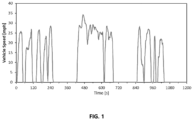
- FIG. 1 illustrates engine speed and load test conditions observed during a vehicle drive cycle.
- the vehicle drive cycle is based on 10 hills extracted from the transient phase of the Environmental Protection Agency (EPA) Urban Dynamometer Drive Schedule (UDDS) with additional idle periods added.
- Total drive cycle is 20 minutes in duration and the overall test duration is 2,000-miles.
- EPA Environmental Protection Agency
- UDDS Urban Dynamometer Drive Schedule
- Additive testing is conducted in a "keep clean" configuration which starts with a clean injector and combustion chamber. This test configuration evaluates the ability of a given deposit control additive to keep the injector and combustion chamber clean over the duration of the test.
- test fuel samples were formulated with the target deposit control additive.
- Three injector "keep clean" tests were performed: (i) two tests using the unadditized base fuel and (ii) one test using the same base fuel as in (i) blended with 200 ppmw of Example 1.
- injector fuel restriction (average) after the designated drive cycles are summarized in Table 2 below.
- the injector fuel restriction substantially decreased during additized fuel use as compared to during nonadditized fuel use.
- Injector fuel restriction measures the decrease in fuel flow from the injector, representing the presence of deposits in the injector orifices.
- Injector restriction can force the engine controller to make additional control adjustments to maintain proper engine fuel delivery, and the presence of deposits in the injector orifices can impact fuel mixing, leading to decreased engine performance and increased particulate emissions.
- Injector face images of each formulation after completion of test are shown in FIG. 2 and correspond to Table 2.
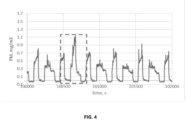
- a test engine was also used to evaluate PM emissions of Example 1.
- a 2016 BMW B48O DISI 2.0L 16-valve turbocharged engine was used in this test.
- the engine drive cycle is 360s in duration with engine speeds ranging from idle to 3000-RPM, and load varying up to 100-Nm.
- the overall test duration is 96 hours.
- FIG. 3 illustrates engine speed and load test conditions.
- MSS Micro Soot Sensor
- FIGS. 5A-5C illustrate the results of PM emissions trendlines (96 hour test) for fuel compositions with 150 ppmw of Example 2 ( FIG. 5A ), with 150 ppmw of Example 2 and 150 ppmw of Example 1 ( FIG. 5B ), and with 150 ppmw of Example 2 and 750 ppmw of Example 1 ( FIG. 5C ).
- FIGS. 6A-6C illustrate the results of the PM emissions trendlines (96 hour test) for fuel compositions with 2000 ppmw of Example 3 ( FIG. 6A ), with 2000 ppmw of Example 2 and 150 ppmw of Example 1 ( FIG. 6B ), and with 2000 ppmw of Example 2 and 750 ppmw of Example 1 ( FIG. 6C ).
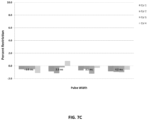
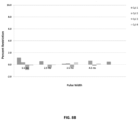
- FIGS. 7A-7C and FIGS. 8A-8C illustrate results of direct injection spark-ignition (DISI) rig injector flow tests. These graphs show percent restriction relative to clean injector flow for various pulse widths (1.5 ms, 2.5 ms, 3.5 ms, and 4.5 ms) at 100 bar injection pressure.
- the samples tested include fuel compositions with 150 ppmw of Example 2 ( FIG. 7A ), with 150 ppmw of Example 2 and 150 ppmw of Example 1 ( FIG. 7B ), and with 150 ppmw of Example 2 and 750 ppmw of Example 1 ( FIG. 7C ).
- the samples also include fuel compositions with 2000 ppmw of Example 2 ( FIG. 8A ), with 2000 ppmw of Example 2 and 150 ppmw of Example 1 ( FIG. 8B ), and with 2000 ppmw of Example 2 and 750 ppmw of Example 1 ( FIG. 8C ).
- FIGS. 9A-9C show injector face images that were taken after end of vehicle or engine test (prior to flow tests) corresponding to samples containing fuel compositions with 150 ppmw of Example 2 ( FIG. 9A ), with 150 ppmw of Example 2 and 150 ppmw of Example 1 ( FIG. 9B ), and with 150 ppmw of Example 2 and 750 ppmw of Example 1 ( FIG. 9C ).
- FIGS. 10A-10C show injector face images that were taken after end of vehicle or engine test (prior to flow tests) corresponding to samples containing fuel compositions with 2000 ppmw of Example 2 ( FIG. 10A ), with 2000 ppmw of Example 2 and 150 ppmw of Example 1 ( FIG. 10B ), and with 2000 ppmw of Example 2 and 750 ppmw of Example 1 ( FIG. 10C ).
- FIG. 11A shows average injector tip deposit volume (mm 3 ) for fuel compositions with 150 ppmw of Example 2 (left bar), with 150 ppmw of Example 2 and 150 ppmw of Example 1 (middle bar), and with 150 ppmw of Example 2 and 750 ppm of Example 1 (right bar).
- FIG. 11B shows average injector tip deposit volume (mm 3 ) for fuel compositions with 2000 ppmw of Example 2 (left bar), with 2000 ppmw of Example 2 and 150 ppmw of Example 1 (middle bar), and 2000 ppmw of Example 2 and 750 ppmw of Example 1 (right bar). These measurements were taken end of vehicle or engine test (prior to flow tests).
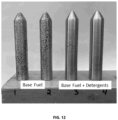
- Table 3 summarizes samples that were tested and rated for anti-corrosion property using NACE TM0172 standard test method.
- Base fuel is unadditized fuel.
- FIG. 12 provides visual confirmation of the anti-corrosion test.
- Table 3 Samples NACE Corrosion in ASTM Type II Water % corrosion Rating Base fuel (trial 1) 70.68 D Base fuel (trial 2) 74.03 D Base fuel + 400 ppmw of Example 1 + 350 ppmw of Example 2 (trial 1) 15.69 B Base fuel + 400 ppmw of Example 1 + 350 ppmw of Example 2 (trial 2) 3.97 B+
- ranges from any lower limit may be combined with any upper limit to recite a range not explicitly recited, as well as, ranges from any lower limit may be combined with any other lower limit to recite a range not explicitly recited, in the same way, ranges from any upper limit may be combined with any other upper limit to recite a range not explicitly recited.
- ranges from any upper limit may be combined with any other upper limit to recite a range not explicitly recited.
- within a range includes every point or individual value between its end points even though not explicitly recited. Thus, every point or individual value may serve as its own lower or upper limit combined with any other point or individual value or any other lower or upper limit, to recite a range not explicitly recited.
- compositions, an element or a group of elements are preceded with the transitional phrase “comprising,” it is understood that we also contemplate the same composition or group of elements with transitional phrases “consisting essentially of,” “consisting of,” “selected from the group of consisting of,” or “is” preceding the recitation of the composition, element, or elements and vice versa.
Landscapes
- Chemical & Material Sciences (AREA)
- Oil, Petroleum & Natural Gas (AREA)
- Engineering & Computer Science (AREA)
- Organic Chemistry (AREA)
- Combustion & Propulsion (AREA)
- Chemical Kinetics & Catalysis (AREA)
- General Chemical & Material Sciences (AREA)
- Solid Fuels And Fuel-Associated Substances (AREA)
- Nozzles For Spraying Of Liquid Fuel (AREA)
Claims (14)
- Composition de carburant comprenant :un carburant à base d'hydrocarbure dont le point d'ébullition est dans la plage de l'essence ou du diesel ;un détergent à base d'amine donné par la formule
R1-O-(CH2)m-NHR2,
dans laquelle le détergent à base d'amine est présent en une quantité d'environ 10 ppm à environ 750 ppm en poids sur la base du poids total de la composition de carburant ; dans laquelle R1 est un groupe hydrocarbyle ayant 8 à 20 atomes de carbone, R2 est un atome d'hydrogène ou un groupement (CH2)nNH2, et dans laquelle m, n sont indépendamment des entiers ayant une valeur égale ou supérieure à 3 ; etun ou plusieurs détergents contenant de l'azote,dans laquelle le ou les détergents contenant de l'azote est une hydrocarbylamine aliphatique, une poly(oxyalkylène) amine substituée par hydrocarbyle, un succinimide substitué par hydrocarbyle, un produit de réaction de Mannich, un ester nitro et amino aromatiques de polyalkylphénoxyalcanol ou polyalkylphénoxyaminoalcane. - Composition de carburant selon la revendication 1, dans laquelle R1 est linéaire ou ramifié.
- Composition de carburant selon la revendication 1, dans laquelle le détergent à base d'amine ou le ou les détergents contenant de l'azote est/sont une monoamine ou une polyamine.
- Composition de carburant selon la revendication 1, dans laquelle le ou les détergents contenant de l'azote sont présents en une quantité d'environ 50 ppm à environ 2 500 ppm de la composition de carburant.
- Composition de carburant selon la revendication 1, comprenant en outre des antioxydants, des désactivateurs de métaux, des désémulsifiants, des composés oxygénés, des agents antidétonants, des dispersants, des agents d'abaissement du point d'écoulement ou des agents d'amélioration de l'écoulement.
- Composition de concentré comprenant :environ 30 à 90 % en poids d'un solvant organique à ébullition dans une plage allant de 65 °C à 205 °C et ;environ 10 à 70 % en poids d'un mélange de détergents comprenant :(1) un détergent à base d'amine donné par la formule
R1-O- (CH2)m-NHR2,
dans laquelle R1 est un groupe hydrocarbyle ayant 8 à 20 atomes de carbone, R2 est un hydrogène ou un groupement (CH2)nNH2, et dans laquelle m, n sont indépendamment des entiers ayant une valeur de 3 ou plus ; et(2) un ou plusieurs détergents contenant de l'azote,dans laquelle le ou les détergents contenant de l'azote est une hydrocarbylamine aliphatique, une poly(oxyalkylène) amine substituée par hydrocarbyle, un succinimide substitué par hydrocarbyle, un produit de réaction de Mannich, un ester nitro et amino aromatiques de polyalkylphénoxyalcanol ou polyalkylphénoxyaminoalcane. - Composition de concentré selon la revendication 6, dans laquelle R1 est linéaire ou ramifié.
- Composition de concentré selon la revendication 6, dans laquelle le détergent à base d'amine ou le ou les détergents contenant de l'azote est/sont une monoamine ou une polyamine.
- Procédé de contrôle de l'encrassement d'injecteurs, le procédé comprenant :
la fourniture à un moteur à injection directe d'une composition de carburant comprenant :un carburant à base d'hydrocarbure dont le point d'ébullition est dans la plage de l'essence ou du diesel ;un détergent à base d'amine donné par la formule R1-O-(CH2)m-NHR2,dans laquelle le détergent à base d'amine est présent en une quantité d'environ 10 à environ 750 ppm en poids sur la base du poids total de la composition de carburant ;dans laquelle R1 est un groupe hydrocarbyle ayant 8 à 20 atomes de carbone, R2 est un hydrogène ou un groupement (CH2)nNH2, et dans laquelle m, n sont indépendamment des entiers ayant une valeur de 3 ou plus ; etun ou plusieurs détergents contenant de l'azote. - Procédé selon la revendication 9, dans lequel R1 est linéaire ou ramifié.
- Procédé selon la revendication 9, dans lequel le ou les détergents contenant de l'azote sont une hydrocarbylamine aliphatique, une poly(oxyalkylène) amine substituée par hydrocarbyle, un succinimide substitué par hydrocarbyle, un produit de réaction de Mannich, un ester nitro et amino aromatiques de polyalkylphénoxyalcanol, ou polyalkylphénoxyaminoalcane.
- Procédé selon la revendication 9, dans lequel le détergent à base d'amine ou le ou les détergents contenant de l'azote sont une monoamine ou une polyamine.
- Procédé selon la revendication 9, dans lequel le ou les détergents contenant de l'azote sont présents en une quantité d'environ 50 ppm à environ 2 500 ppm de la composition de carburant.
- Procédé selon la revendication 9, dans lequel la composition de carburant comprend en outre des antioxydants, des désactivateurs de métaux, des désémulsifiants, des composés oxygénés, des agents antidétonants, des dispersants, des agents d'abaissement du point d'écoulement ou des agents d'amélioration de l'écoulement.
Applications Claiming Priority (2)
| Application Number | Priority Date | Filing Date | Title |
|---|---|---|---|
| US202063048922P | 2020-07-07 | 2020-07-07 | |
| PCT/IB2021/056075 WO2022009105A1 (fr) | 2020-07-07 | 2021-07-07 | Additifs de carburant pour atténuer l'encrassement d'une buse d'injecteur et réduire les émissions de particules |
Publications (2)
| Publication Number | Publication Date |
|---|---|
| EP4179047A1 EP4179047A1 (fr) | 2023-05-17 |
| EP4179047B1 true EP4179047B1 (fr) | 2025-02-12 |
Family
ID=76859668
Family Applications (1)
| Application Number | Title | Priority Date | Filing Date |
|---|---|---|---|
| EP21740216.3A Active EP4179047B1 (fr) | 2020-07-07 | 2021-07-07 | Additifs de carburant pour atténuer l'encrassement d'une buse d'injecteur et réduire les émissions de particules |
Country Status (13)
| Country | Link |
|---|---|
| US (1) | US20220145199A1 (fr) |
| EP (1) | EP4179047B1 (fr) |
| JP (2) | JP2023533737A (fr) |
| KR (1) | KR102861162B1 (fr) |
| CN (1) | CN116134116B (fr) |
| AU (1) | AU2021304467B2 (fr) |
| CA (1) | CA3188758A1 (fr) |
| CO (1) | CO2023001087A2 (fr) |
| ES (1) | ES3025473T3 (fr) |
| MX (1) | MX2023000329A (fr) |
| PL (1) | PL4179047T3 (fr) |
| WO (1) | WO2022009105A1 (fr) |
| ZA (1) | ZA202300764B (fr) |
Families Citing this family (4)
| Publication number | Priority date | Publication date | Assignee | Title |
|---|---|---|---|---|
| US12319878B2 (en) | 2020-08-06 | 2025-06-03 | Chevron U.S.A. Inc. | Upgrading of low value lipid feedstocks for refinery processing |
| US12319881B1 (en) | 2024-09-27 | 2025-06-03 | Chevron U.S.A. Inc. | Converting a renewable fuel intermediate composition to finished transportation fuel |
| US12582954B1 (en) | 2024-12-13 | 2026-03-24 | Chevron U.S.A. Inc. | Processing feedstocks |
| US12590258B1 (en) | 2025-02-28 | 2026-03-31 | Chevron U.S.A. Inc. | Converting a lipid feedstock to fuel |
Family Cites Families (62)
| Publication number | Priority date | Publication date | Assignee | Title |
|---|---|---|---|---|
| US2622018A (en) | 1949-10-19 | 1952-12-16 | Socony Vacuum Oil Co Inc | Motor fuel |
| US3574576A (en) | 1965-08-23 | 1971-04-13 | Chevron Res | Distillate fuel compositions having a hydrocarbon substituted alkylene polyamine |
| GB1346765A (en) | 1970-06-16 | 1974-02-13 | Shell Int Research | Fuel compositions |
| US3849083A (en) * | 1972-04-14 | 1974-11-19 | Ethyl Corp | Gasoline additive |
| US3848056A (en) | 1972-09-05 | 1974-11-12 | Continental Oil Co | Molten alkaline alkanoic mixtures for absorption of sulfur oxides |
| US4231759A (en) | 1973-03-12 | 1980-11-04 | Standard Oil Company (Indiana) | Liquid hydrocarbon fuels containing high molecular weight Mannich bases |
| US3960515A (en) | 1973-10-11 | 1976-06-01 | Chevron Research Company | Hydrocarbyl amine additives for distillate fuels |
| GB1486144A (en) | 1974-03-13 | 1977-09-21 | Cities Service Oil Co | Gasoline additive |
| US4160648A (en) | 1976-06-21 | 1979-07-10 | Chevron Research Company | Fuel compositions containing deposit control additives |
| US4191537A (en) | 1976-06-21 | 1980-03-04 | Chevron Research Company | Fuel compositions of poly(oxyalkylene) aminocarbamate |
| US4236020A (en) | 1976-06-21 | 1980-11-25 | Chevron Research Company | Carbamate deposit control additives |
| US4288612A (en) | 1976-06-21 | 1981-09-08 | Chevron Research Company | Deposit control additives |
| US4233168A (en) | 1978-06-19 | 1980-11-11 | Chevron Research Company | Lubricant compositions containing dispersant additives |
| US4197409A (en) | 1978-08-08 | 1980-04-08 | Chevron Research Company | Poly(oxyalkylene)aminocarbomates of alkylene polyamine |
| US4243798A (en) | 1979-08-09 | 1981-01-06 | Chevron Research Company | Process for the production of a polymeric carbamate |
| US4292046A (en) | 1979-08-10 | 1981-09-29 | Mobil Oil Corporation | Detergent compositions |
| US4270930A (en) | 1979-12-21 | 1981-06-02 | Chevron Research Company | Clean combustion chamber fuel composition |
| US4518782A (en) | 1981-08-10 | 1985-05-21 | Texaco Inc. | Fuel compositions containing N-alkyl glycyl imidazoline |
| US4392866A (en) * | 1981-11-05 | 1983-07-12 | Texaco Inc. | Etheramine corrosion inhibitor for alcohols |
| US4409000A (en) | 1981-12-14 | 1983-10-11 | The Lubrizol Corporation | Combinations of hydroxy amines and carboxylic dispersants as fuel additives |
| EP0149486A3 (fr) | 1984-01-17 | 1986-10-08 | Atlantic Richfield Company | Détergents et composition de carburant les contenant |
| US4836829A (en) | 1986-03-14 | 1989-06-06 | Exxon Research And Engineering Company | Fuel composition and process for multi-port fuel injection systems (PNE-509) |
| DE3611230A1 (de) | 1986-04-04 | 1987-10-08 | Basf Ag | Polybutyl- und polyisobutylamine, verfahren zu deren herstellung und diese enthaltende kraft- und schmierstoffzusammensetzungen |
| US4810263A (en) | 1986-04-11 | 1989-03-07 | Exxon Research And Engineering Company | Fuel composition |
| US4729769A (en) | 1986-05-08 | 1988-03-08 | Texaco Inc. | Gasoline compositions containing reaction products of fatty acid esters and amines as carburetor detergents |
| US4881945A (en) | 1987-10-23 | 1989-11-21 | Chevron Research Company | Fuel compositions containing very long chain alkylphenyl poly(oxyalkylene) aminocarbonates |
| JP2602553B2 (ja) * | 1988-08-05 | 1997-04-23 | 花王株式会社 | 燃料添加剤 |
| EP0353713B1 (fr) * | 1988-08-05 | 1994-03-16 | Kao Corporation | Utilisation d'un additif pour fuel |
| DE3826608A1 (de) | 1988-08-05 | 1990-02-08 | Basf Ag | Polyetheramine oder polyetheraminderivate enthaltende kraftstoffe fuer ottomotoren |
| DE3826797A1 (de) | 1988-08-06 | 1990-02-08 | Basf Ag | Kraftstoffzusammensetzungen, die polycarbonsaeureester langkettiger alkohole enthalten |
| DE3838918A1 (de) | 1988-11-17 | 1990-05-23 | Basf Ag | Kraftstoffe fuer verbrennungsmaschinen |
| EP0382159A1 (fr) | 1989-02-06 | 1990-08-16 | E.I. Du Pont De Nemours And Company | Désencrassage d'appareils à combustible |
| WO1990010051A1 (fr) | 1989-02-21 | 1990-09-07 | Union Oil Company Of California | Composition de carburant permettant la regulation de depots sur des soupapes d'admission |
| JPH0662966B2 (ja) * | 1990-03-14 | 1994-08-17 | 花王株式会社 | 燃料油添加剤組成物 |
| GB9007431D0 (en) | 1990-04-03 | 1990-05-30 | Shell Int Research | Diesel fuel additives |
| US5197997A (en) * | 1990-11-29 | 1993-03-30 | The Lubrizol Corporation | Composition for use in diesel powered vehicles |
| EP0557516B1 (fr) | 1991-09-13 | 1996-07-17 | Chevron Chemical Company | Compositions additives pour carburant contenant des succinimides de polyisobutenyle |
| US5697988A (en) | 1991-11-18 | 1997-12-16 | Ethyl Corporation | Fuel compositions |
| GB9207383D0 (en) * | 1992-04-03 | 1992-05-13 | Ass Octel | Multi-functional gasoline detergent compositions |
| GB9208034D0 (en) | 1992-04-10 | 1992-05-27 | Bp Chem Int Ltd | Fuel composition |
| US5405419A (en) * | 1994-05-02 | 1995-04-11 | Chevron Chemical Company | Fuel additive compositions containing an aliphatic amine, a polyolefin and a poly(oxyalkylene) monool |
| US5620486A (en) | 1994-12-30 | 1997-04-15 | Chevron Chemical Company | Fuel compositions containing aryl succinimides |
| US5669939A (en) | 1996-05-14 | 1997-09-23 | Chevron Chemical Company | Polyalkylphenoxyaminoalkanes and fuel compositions containing the same |
| US5618320A (en) | 1996-05-14 | 1997-04-08 | Chevron Chemical Company | Aromatic esters of polyalkylphenoxyalkanols and fuel compositions containing the same |
| US5782937A (en) * | 1997-05-19 | 1998-07-21 | Ethyl Corporation | Gasoline compositions containing ignition improvers |
| US5993499A (en) * | 1997-06-27 | 1999-11-30 | Chevron Chemical Company | Fuel composition containing an aliphatic amine and a poly (oxyalkylene) monool |
| US6203584B1 (en) | 1998-03-31 | 2001-03-20 | Chevron Chemical Company Llc | Fuel composition containing an amine compound and an ester |
| US5916825A (en) | 1998-08-28 | 1999-06-29 | Chevron Chemical Company Llc | Polyisobutanyl succinimides and fuel compositions containing the same |
| US5993497A (en) | 1998-08-28 | 1999-11-30 | Chevron Chemical Company Llc | Esters of polyalkyl or polyalkenyl N-hydroxyalkyl succinimides and fuel compositions containing the same |
| US5954843A (en) | 1998-08-28 | 1999-09-21 | Chevron Chemical Company Llc | Aminocarbamates of polyalkyl or polyalkenyl N-hydroxyalkyl succinimides and fuel compositions containing the same |
| US6114542A (en) | 1998-08-28 | 2000-09-05 | Chevron Chemical Company Llc | Ethers of polyalkyl or polyalkenyl N-hydroxyalkyl succinimides and fuel compositions containing the same |
| US6071319A (en) * | 1998-12-22 | 2000-06-06 | Chevron Chemical Company Llc | Fuel additive compositions containing aromatic esters of polyalkylphenoxyalkanols and aliphatic amines |
| US6217624B1 (en) | 1999-02-18 | 2001-04-17 | Chevron Chemical Company Llc | Fuel compositions containing hydrocarbyl-substituted polyoxyalkylene amines |
| KR20000074755A (ko) * | 1999-05-25 | 2000-12-15 | 이정국 | 새로운 연료유 청정제인 하이드로 폴리옥시알킬렌 옥시알킬 아민계 화합물 |
| US6361573B1 (en) * | 1999-08-31 | 2002-03-26 | Ethyl Corporation | Fuel dispersants with enhanced lubricity |
| US6746495B2 (en) * | 2000-10-24 | 2004-06-08 | Exxonmobil Research And Engineering Company | Method for controlling deposit formation in gasoline direct injection engine by use of a fuel having particular compositional characteristics |
| US6866690B2 (en) * | 2002-04-24 | 2005-03-15 | Ethyl Corporation | Friction modifier additives for fuel compositions and methods of use thereof |
| US7435272B2 (en) * | 2002-04-24 | 2008-10-14 | Afton Chemical Intangibles | Friction modifier alkoxyamine salts of carboxylic acids as additives for fuel compositions and methods of use thereof |
| US8231695B2 (en) * | 2006-08-09 | 2012-07-31 | Afton Chemical Corporation | Fuel compositions comprising hydrocarbon oil carriers and methods for using the same |
| US8920524B2 (en) * | 2009-12-18 | 2014-12-30 | Chevron Oronite Company Llc | Polyisobutenyl alcohols and fuel compositions |
| AU2011260433A1 (en) * | 2010-06-01 | 2012-12-13 | Basf Se | Low-molecular weight polyisobutyl-substituted amines as detergent boosters |
| WO2013101256A2 (fr) * | 2011-12-30 | 2013-07-04 | Butamax (Tm) Advanced Biofuels Llc | Compositions d'inhibiteurs de corrosion pour essences oxygénées |
-
2021
- 2021-07-07 CN CN202180059812.1A patent/CN116134116B/zh active Active
- 2021-07-07 MX MX2023000329A patent/MX2023000329A/es unknown
- 2021-07-07 AU AU2021304467A patent/AU2021304467B2/en active Active
- 2021-07-07 EP EP21740216.3A patent/EP4179047B1/fr active Active
- 2021-07-07 CA CA3188758A patent/CA3188758A1/fr active Pending
- 2021-07-07 PL PL21740216.3T patent/PL4179047T3/pl unknown
- 2021-07-07 US US17/368,918 patent/US20220145199A1/en active Pending
- 2021-07-07 WO PCT/IB2021/056075 patent/WO2022009105A1/fr not_active Ceased
- 2021-07-07 ES ES21740216T patent/ES3025473T3/es active Active
- 2021-07-07 KR KR1020237002934A patent/KR102861162B1/ko active Active
- 2021-07-07 JP JP2023501273A patent/JP2023533737A/ja active Pending
-
2023
- 2023-01-17 ZA ZA2023/00764A patent/ZA202300764B/en unknown
- 2023-01-31 CO CONC2023/0001087A patent/CO2023001087A2/es unknown
-
2025
- 2025-11-17 JP JP2025196906A patent/JP2026048664A/ja active Pending
Also Published As
| Publication number | Publication date |
|---|---|
| US20220145199A1 (en) | 2022-05-12 |
| EP4179047A1 (fr) | 2023-05-17 |
| ZA202300764B (en) | 2024-11-27 |
| CN116134116A (zh) | 2023-05-16 |
| ES3025473T3 (en) | 2025-06-09 |
| CA3188758A1 (fr) | 2022-01-13 |
| MX2023000329A (es) | 2023-03-27 |
| PL4179047T3 (pl) | 2025-06-23 |
| JP2026048664A (ja) | 2026-03-17 |
| CO2023001087A2 (es) | 2023-02-06 |
| JP2023533737A (ja) | 2023-08-04 |
| KR102861162B1 (ko) | 2025-09-18 |
| AU2021304467A1 (en) | 2023-02-23 |
| KR20230035330A (ko) | 2023-03-13 |
| CN116134116B (zh) | 2025-05-23 |
| AU2021304467B2 (en) | 2025-12-04 |
| WO2022009105A1 (fr) | 2022-01-13 |
Similar Documents
| Publication | Publication Date | Title |
|---|---|---|
| EP4179047B1 (fr) | Additifs de carburant pour atténuer l'encrassement d'une buse d'injecteur et réduire les émissions de particules | |
| NZ535013A (en) | Use of hydrocarbyl primary monoamines as gasoline additives | |
| AU689585B2 (en) | Fuel additive compositions containing an aliphatic amine, a polyolefin and a poly(oxyalkylene) monool | |
| EP3887488B1 (fr) | Composé amidoamine gras quaternaire destiné à être utilisé en tant qu'additif pour carburant | |
| CA2440548C (fr) | Methode de reduction des emissions de particules dans des moteurs a combustion interne | |
| EP4413100B1 (fr) | Additifs de carburant pour abaisser le dépôt et l'émission de particules | |
| EP4214297B1 (fr) | Aryloxy alkylamines utilisées comme additifs de carburant pour réduire l'encrassement des injecteurs dans des moteurs à essence, allumage par étincelle et injection directe | |
| AU2003219078B2 (en) | Gasoline additives |
Legal Events
| Date | Code | Title | Description |
|---|---|---|---|
| STAA | Information on the status of an ep patent application or granted ep patent |
Free format text: STATUS: UNKNOWN |
|
| STAA | Information on the status of an ep patent application or granted ep patent |
Free format text: STATUS: THE INTERNATIONAL PUBLICATION HAS BEEN MADE |
|
| PUAI | Public reference made under article 153(3) epc to a published international application that has entered the european phase |
Free format text: ORIGINAL CODE: 0009012 |
|
| STAA | Information on the status of an ep patent application or granted ep patent |
Free format text: STATUS: REQUEST FOR EXAMINATION WAS MADE |
|
| 17P | Request for examination filed |
Effective date: 20230103 |
|
| AK | Designated contracting states |
Kind code of ref document: A1 Designated state(s): AL AT BE BG CH CY CZ DE DK EE ES FI FR GB GR HR HU IE IS IT LI LT LU LV MC MK MT NL NO PL PT RO RS SE SI SK SM TR |
|
| DAV | Request for validation of the european patent (deleted) | ||
| DAX | Request for extension of the european patent (deleted) | ||
| RIC1 | Information provided on ipc code assigned before grant |
Ipc: C10L 10/04 20060101ALI20240104BHEP Ipc: C10L 1/2383 20060101ALI20240104BHEP Ipc: C10L 1/22 20060101ALI20240104BHEP Ipc: C10L 1/2387 20060101ALI20240104BHEP Ipc: C10L 1/238 20060101ALI20240104BHEP Ipc: C10L 1/23 20060101ALI20240104BHEP Ipc: C10L 1/224 20060101ALI20240104BHEP Ipc: C10L 1/222 20060101ALI20240104BHEP Ipc: C10L 10/06 20060101ALI20240104BHEP Ipc: C10L 10/02 20060101ALI20240104BHEP Ipc: C10L 1/10 20060101AFI20240104BHEP |
|
| STAA | Information on the status of an ep patent application or granted ep patent |
Free format text: STATUS: EXAMINATION IS IN PROGRESS |
|
| 17Q | First examination report despatched |
Effective date: 20240207 |
|
| RAP3 | Party data changed (applicant data changed or rights of an application transferred) |
Owner name: CHEVRON U.S.A. INC. Owner name: CHEVRON ORONITE COMPANY LLC |
|
| GRAP | Despatch of communication of intention to grant a patent |
Free format text: ORIGINAL CODE: EPIDOSNIGR1 |
|
| STAA | Information on the status of an ep patent application or granted ep patent |
Free format text: STATUS: GRANT OF PATENT IS INTENDED |
|
| INTG | Intention to grant announced |
Effective date: 20240909 |
|
| GRAS | Grant fee paid |
Free format text: ORIGINAL CODE: EPIDOSNIGR3 |
|
| GRAA | (expected) grant |
Free format text: ORIGINAL CODE: 0009210 |
|
| STAA | Information on the status of an ep patent application or granted ep patent |
Free format text: STATUS: THE PATENT HAS BEEN GRANTED |
|
| P01 | Opt-out of the competence of the unified patent court (upc) registered |
Free format text: CASE NUMBER: APP_64739/2024 Effective date: 20241206 |
|
| AK | Designated contracting states |
Kind code of ref document: B1 Designated state(s): AL AT BE BG CH CY CZ DE DK EE ES FI FR GB GR HR HU IE IS IT LI LT LU LV MC MK MT NL NO PL PT RO RS SE SI SK SM TR |
|
| REG | Reference to a national code |
Ref country code: GB Ref legal event code: FG4D |
|
| REG | Reference to a national code |
Ref country code: CH Ref legal event code: EP |
|
| REG | Reference to a national code |
Ref country code: DE Ref legal event code: R096 Ref document number: 602021026021 Country of ref document: DE |
|
| REG | Reference to a national code |
Ref country code: IE Ref legal event code: FG4D |
|
| REG | Reference to a national code |
Ref country code: ES Ref legal event code: FG2A Ref document number: 3025473 Country of ref document: ES Kind code of ref document: T3 Effective date: 20250609 |
|
| REG | Reference to a national code |
Ref country code: NL Ref legal event code: MP Effective date: 20250212 |
|
| PG25 | Lapsed in a contracting state [announced via postgrant information from national office to epo] |
Ref country code: RS Free format text: LAPSE BECAUSE OF FAILURE TO SUBMIT A TRANSLATION OF THE DESCRIPTION OR TO PAY THE FEE WITHIN THE PRESCRIBED TIME-LIMIT Effective date: 20250512 |
|
| PG25 | Lapsed in a contracting state [announced via postgrant information from national office to epo] |
Ref country code: FI Free format text: LAPSE BECAUSE OF FAILURE TO SUBMIT A TRANSLATION OF THE DESCRIPTION OR TO PAY THE FEE WITHIN THE PRESCRIBED TIME-LIMIT Effective date: 20250212 |
|
| PGFP | Annual fee paid to national office [announced via postgrant information from national office to epo] |
Ref country code: PL Payment date: 20250612 Year of fee payment: 5 |
|
| PGFP | Annual fee paid to national office [announced via postgrant information from national office to epo] |
Ref country code: GB Payment date: 20250529 Year of fee payment: 5 |
|
| REG | Reference to a national code |
Ref country code: LT Ref legal event code: MG9D |
|
| PG25 | Lapsed in a contracting state [announced via postgrant information from national office to epo] |
Ref country code: IS Free format text: LAPSE BECAUSE OF FAILURE TO SUBMIT A TRANSLATION OF THE DESCRIPTION OR TO PAY THE FEE WITHIN THE PRESCRIBED TIME-LIMIT Effective date: 20250612 Ref country code: NO Free format text: LAPSE BECAUSE OF FAILURE TO SUBMIT A TRANSLATION OF THE DESCRIPTION OR TO PAY THE FEE WITHIN THE PRESCRIBED TIME-LIMIT Effective date: 20250512 |
|
| PG25 | Lapsed in a contracting state [announced via postgrant information from national office to epo] |
Ref country code: NL Free format text: LAPSE BECAUSE OF FAILURE TO SUBMIT A TRANSLATION OF THE DESCRIPTION OR TO PAY THE FEE WITHIN THE PRESCRIBED TIME-LIMIT Effective date: 20250212 |
|
| PG25 | Lapsed in a contracting state [announced via postgrant information from national office to epo] |
Ref country code: HR Free format text: LAPSE BECAUSE OF FAILURE TO SUBMIT A TRANSLATION OF THE DESCRIPTION OR TO PAY THE FEE WITHIN THE PRESCRIBED TIME-LIMIT Effective date: 20250212 |
|
| PG25 | Lapsed in a contracting state [announced via postgrant information from national office to epo] |
Ref country code: LV Free format text: LAPSE BECAUSE OF FAILURE TO SUBMIT A TRANSLATION OF THE DESCRIPTION OR TO PAY THE FEE WITHIN THE PRESCRIBED TIME-LIMIT Effective date: 20250212 Ref country code: PT Free format text: LAPSE BECAUSE OF FAILURE TO SUBMIT A TRANSLATION OF THE DESCRIPTION OR TO PAY THE FEE WITHIN THE PRESCRIBED TIME-LIMIT Effective date: 20250612 |
|
| PGFP | Annual fee paid to national office [announced via postgrant information from national office to epo] |
Ref country code: FR Payment date: 20250610 Year of fee payment: 5 |
|
| PG25 | Lapsed in a contracting state [announced via postgrant information from national office to epo] |
Ref country code: BG Free format text: LAPSE BECAUSE OF FAILURE TO SUBMIT A TRANSLATION OF THE DESCRIPTION OR TO PAY THE FEE WITHIN THE PRESCRIBED TIME-LIMIT Effective date: 20250212 Ref country code: GR Free format text: LAPSE BECAUSE OF FAILURE TO SUBMIT A TRANSLATION OF THE DESCRIPTION OR TO PAY THE FEE WITHIN THE PRESCRIBED TIME-LIMIT Effective date: 20250513 |
|
| REG | Reference to a national code |
Ref country code: AT Ref legal event code: MK05 Ref document number: 1766059 Country of ref document: AT Kind code of ref document: T Effective date: 20250212 |
|
| PG25 | Lapsed in a contracting state [announced via postgrant information from national office to epo] |
Ref country code: SE Free format text: LAPSE BECAUSE OF FAILURE TO SUBMIT A TRANSLATION OF THE DESCRIPTION OR TO PAY THE FEE WITHIN THE PRESCRIBED TIME-LIMIT Effective date: 20250212 |
|
| PG25 | Lapsed in a contracting state [announced via postgrant information from national office to epo] |
Ref country code: SM Free format text: LAPSE BECAUSE OF FAILURE TO SUBMIT A TRANSLATION OF THE DESCRIPTION OR TO PAY THE FEE WITHIN THE PRESCRIBED TIME-LIMIT Effective date: 20250212 |
|
| PGFP | Annual fee paid to national office [announced via postgrant information from national office to epo] |
Ref country code: ES Payment date: 20250804 Year of fee payment: 5 |
|
| PG25 | Lapsed in a contracting state [announced via postgrant information from national office to epo] |
Ref country code: DK Free format text: LAPSE BECAUSE OF FAILURE TO SUBMIT A TRANSLATION OF THE DESCRIPTION OR TO PAY THE FEE WITHIN THE PRESCRIBED TIME-LIMIT Effective date: 20250212 |
|
| PGFP | Annual fee paid to national office [announced via postgrant information from national office to epo] |
Ref country code: DE Payment date: 20250604 Year of fee payment: 5 |
|
| PG25 | Lapsed in a contracting state [announced via postgrant information from national office to epo] |
Ref country code: IT Free format text: LAPSE BECAUSE OF FAILURE TO SUBMIT A TRANSLATION OF THE DESCRIPTION OR TO PAY THE FEE WITHIN THE PRESCRIBED TIME-LIMIT Effective date: 20250212 |
|
| PG25 | Lapsed in a contracting state [announced via postgrant information from national office to epo] |
Ref country code: AT Free format text: LAPSE BECAUSE OF FAILURE TO SUBMIT A TRANSLATION OF THE DESCRIPTION OR TO PAY THE FEE WITHIN THE PRESCRIBED TIME-LIMIT Effective date: 20250212 |
|
| PG25 | Lapsed in a contracting state [announced via postgrant information from national office to epo] |
Ref country code: EE Free format text: LAPSE BECAUSE OF FAILURE TO SUBMIT A TRANSLATION OF THE DESCRIPTION OR TO PAY THE FEE WITHIN THE PRESCRIBED TIME-LIMIT Effective date: 20250212 Ref country code: CZ Free format text: LAPSE BECAUSE OF FAILURE TO SUBMIT A TRANSLATION OF THE DESCRIPTION OR TO PAY THE FEE WITHIN THE PRESCRIBED TIME-LIMIT Effective date: 20250212 |
|
| PG25 | Lapsed in a contracting state [announced via postgrant information from national office to epo] |
Ref country code: RO Free format text: LAPSE BECAUSE OF FAILURE TO SUBMIT A TRANSLATION OF THE DESCRIPTION OR TO PAY THE FEE WITHIN THE PRESCRIBED TIME-LIMIT Effective date: 20250212 |
|
| PG25 | Lapsed in a contracting state [announced via postgrant information from national office to epo] |
Ref country code: SK Free format text: LAPSE BECAUSE OF FAILURE TO SUBMIT A TRANSLATION OF THE DESCRIPTION OR TO PAY THE FEE WITHIN THE PRESCRIBED TIME-LIMIT Effective date: 20250212 |
|
| REG | Reference to a national code |
Ref country code: DE Ref legal event code: R097 Ref document number: 602021026021 Country of ref document: DE |
|
| PLBE | No opposition filed within time limit |
Free format text: ORIGINAL CODE: 0009261 |
|
| STAA | Information on the status of an ep patent application or granted ep patent |
Free format text: STATUS: NO OPPOSITION FILED WITHIN TIME LIMIT |
|
| REG | Reference to a national code |
Ref country code: CH Ref legal event code: L10 Free format text: ST27 STATUS EVENT CODE: U-0-0-L10-L00 (AS PROVIDED BY THE NATIONAL OFFICE) Effective date: 20251224 |
|
| 26N | No opposition filed |
Effective date: 20251113 |
|
| REG | Reference to a national code |
Ref country code: CH Ref legal event code: H13 Free format text: ST27 STATUS EVENT CODE: U-0-0-H10-H13 (AS PROVIDED BY THE NATIONAL OFFICE) Effective date: 20260224 |
|
| PG25 | Lapsed in a contracting state [announced via postgrant information from national office to epo] |
Ref country code: LU Free format text: LAPSE BECAUSE OF NON-PAYMENT OF DUE FEES Effective date: 20250707 |
|
| REG | Reference to a national code |
Ref country code: BE Ref legal event code: MM Effective date: 20250731 |
|
| PG25 | Lapsed in a contracting state [announced via postgrant information from national office to epo] |
Ref country code: BE Free format text: LAPSE BECAUSE OF NON-PAYMENT OF DUE FEES Effective date: 20250731 |