EP4179929B1 - Système et procédé de préparation des aliments - Google Patents
Système et procédé de préparation des aliments Download PDFInfo
- Publication number
- EP4179929B1 EP4179929B1 EP21208127.7A EP21208127A EP4179929B1 EP 4179929 B1 EP4179929 B1 EP 4179929B1 EP 21208127 A EP21208127 A EP 21208127A EP 4179929 B1 EP4179929 B1 EP 4179929B1
- Authority
- EP
- European Patent Office
- Prior art keywords
- food
- control device
- monitoring device
- mobile device
- preparation
- Prior art date
- Legal status (The legal status is an assumption and is not a legal conclusion. Google has not performed a legal analysis and makes no representation as to the accuracy of the status listed.)
- Active
Links
Images


Classifications
-
- A—HUMAN NECESSITIES
- A47—FURNITURE; DOMESTIC ARTICLES OR APPLIANCES; COFFEE MILLS; SPICE MILLS; SUCTION CLEANERS IN GENERAL
- A47J—KITCHEN EQUIPMENT; COFFEE MILLS; SPICE MILLS; APPARATUS FOR MAKING BEVERAGES
- A47J36/00—Parts, details or accessories of cooking-vessels
- A47J36/32—Time-controlled igniting mechanisms or alarm devices
-
- A—HUMAN NECESSITIES
- A47—FURNITURE; DOMESTIC ARTICLES OR APPLIANCES; COFFEE MILLS; SPICE MILLS; SUCTION CLEANERS IN GENERAL
- A47J—KITCHEN EQUIPMENT; COFFEE MILLS; SPICE MILLS; APPARATUS FOR MAKING BEVERAGES
- A47J27/00—Cooking-vessels
-
- A—HUMAN NECESSITIES
- A47—FURNITURE; DOMESTIC ARTICLES OR APPLIANCES; COFFEE MILLS; SPICE MILLS; SUCTION CLEANERS IN GENERAL
- A47J—KITCHEN EQUIPMENT; COFFEE MILLS; SPICE MILLS; APPARATUS FOR MAKING BEVERAGES
- A47J27/00—Cooking-vessels
- A47J27/04—Cooking-vessels for cooking food in steam; Devices for extracting fruit juice by means of steam ; Vacuum cooking vessels
-
- A—HUMAN NECESSITIES
- A47—FURNITURE; DOMESTIC ARTICLES OR APPLIANCES; COFFEE MILLS; SPICE MILLS; SUCTION CLEANERS IN GENERAL
- A47J—KITCHEN EQUIPMENT; COFFEE MILLS; SPICE MILLS; APPARATUS FOR MAKING BEVERAGES
- A47J36/00—Parts, details or accessories of cooking-vessels
-
- A—HUMAN NECESSITIES
- A47—FURNITURE; DOMESTIC ARTICLES OR APPLIANCES; COFFEE MILLS; SPICE MILLS; SUCTION CLEANERS IN GENERAL
- A47J—KITCHEN EQUIPMENT; COFFEE MILLS; SPICE MILLS; APPARATUS FOR MAKING BEVERAGES
- A47J36/00—Parts, details or accessories of cooking-vessels
- A47J36/32—Time-controlled igniting mechanisms or alarm devices
- A47J36/321—Time-controlled igniting mechanisms or alarm devices the electronic control being performed over a network, e.g. by means of a handheld device
-
- A—HUMAN NECESSITIES
- A47—FURNITURE; DOMESTIC ARTICLES OR APPLIANCES; COFFEE MILLS; SPICE MILLS; SUCTION CLEANERS IN GENERAL
- A47J—KITCHEN EQUIPMENT; COFFEE MILLS; SPICE MILLS; APPARATUS FOR MAKING BEVERAGES
- A47J43/00—Implements for preparing or holding food, not provided for in other groups of this subclass
- A47J43/04—Machines for domestic use not covered elsewhere, e.g. for grinding, mixing, stirring, kneading, emulsifying, whipping or beating foodstuffs, e.g. power-driven
-
- A—HUMAN NECESSITIES
- A47—FURNITURE; DOMESTIC ARTICLES OR APPLIANCES; COFFEE MILLS; SPICE MILLS; SUCTION CLEANERS IN GENERAL
- A47J—KITCHEN EQUIPMENT; COFFEE MILLS; SPICE MILLS; APPARATUS FOR MAKING BEVERAGES
- A47J43/00—Implements for preparing or holding food, not provided for in other groups of this subclass
- A47J43/04—Machines for domestic use not covered elsewhere, e.g. for grinding, mixing, stirring, kneading, emulsifying, whipping or beating foodstuffs, e.g. power-driven
- A47J43/046—Machines for domestic use not covered elsewhere, e.g. for grinding, mixing, stirring, kneading, emulsifying, whipping or beating foodstuffs, e.g. power-driven with tools driven from the bottom side
-
- A—HUMAN NECESSITIES
- A47—FURNITURE; DOMESTIC ARTICLES OR APPLIANCES; COFFEE MILLS; SPICE MILLS; SUCTION CLEANERS IN GENERAL
- A47J—KITCHEN EQUIPMENT; COFFEE MILLS; SPICE MILLS; APPARATUS FOR MAKING BEVERAGES
- A47J43/00—Implements for preparing or holding food, not provided for in other groups of this subclass
- A47J43/04—Machines for domestic use not covered elsewhere, e.g. for grinding, mixing, stirring, kneading, emulsifying, whipping or beating foodstuffs, e.g. power-driven
- A47J43/07—Parts or details, e.g. mixing tools, whipping tools
-
- F—MECHANICAL ENGINEERING; LIGHTING; HEATING; WEAPONS; BLASTING
- F24—HEATING; RANGES; VENTILATING
- F24C—DOMESTIC STOVES OR RANGES ; DETAILS OF DOMESTIC STOVES OR RANGES, OF GENERAL APPLICATION
- F24C7/00—Stoves or ranges heated by electric energy
- F24C7/08—Arrangement or mounting of control or safety devices
- F24C7/082—Arrangement or mounting of control or safety devices on ranges, e.g. control panels, illumination
- F24C7/085—Arrangement or mounting of control or safety devices on ranges, e.g. control panels, illumination on baking ovens
-
- G—PHYSICS
- G01—MEASURING; TESTING
- G01D—MEASURING NOT SPECIALLY ADAPTED FOR A SPECIFIC VARIABLE; ARRANGEMENTS FOR MEASURING TWO OR MORE VARIABLES NOT COVERED IN A SINGLE OTHER SUBCLASS; TARIFF METERING APPARATUS; MEASURING OR TESTING NOT OTHERWISE PROVIDED FOR
- G01D21/00—Measuring or testing not otherwise provided for
- G01D21/02—Measuring two or more variables by means not covered by a single other subclass
-
- G—PHYSICS
- G01—MEASURING; TESTING
- G01K—MEASURING TEMPERATURE; MEASURING QUANTITY OF HEAT; THERMALLY-SENSITIVE ELEMENTS NOT OTHERWISE PROVIDED FOR
- G01K1/00—Details of thermometers not specially adapted for particular types of thermometer
- G01K1/02—Means for indicating or recording specially adapted for thermometers
- G01K1/024—Means for indicating or recording specially adapted for thermometers for remote indication
-
- H—ELECTRICITY
- H04—ELECTRIC COMMUNICATION TECHNIQUE
- H04M—TELEPHONIC COMMUNICATION
- H04M1/00—Substation equipment, e.g. for use by subscribers
- H04M1/72—Mobile telephones; Cordless telephones, i.e. devices for establishing wireless links to base stations without route selection
- H04M1/724—User interfaces specially adapted for cordless or mobile telephones
- H04M1/72403—User interfaces specially adapted for cordless or mobile telephones with means for local support of applications that increase the functionality
- H04M1/72409—User interfaces specially adapted for cordless or mobile telephones with means for local support of applications that increase the functionality by interfacing with external accessories
- H04M1/72415—User interfaces specially adapted for cordless or mobile telephones with means for local support of applications that increase the functionality by interfacing with external accessories for remote control of appliances
-
- A—HUMAN NECESSITIES
- A47—FURNITURE; DOMESTIC ARTICLES OR APPLIANCES; COFFEE MILLS; SPICE MILLS; SUCTION CLEANERS IN GENERAL
- A47J—KITCHEN EQUIPMENT; COFFEE MILLS; SPICE MILLS; APPARATUS FOR MAKING BEVERAGES
- A47J2202/00—Devices having temperature indicating means
-
- G—PHYSICS
- G01—MEASURING; TESTING
- G01K—MEASURING TEMPERATURE; MEASURING QUANTITY OF HEAT; THERMALLY-SENSITIVE ELEMENTS NOT OTHERWISE PROVIDED FOR
- G01K2207/00—Application of thermometers in household appliances
- G01K2207/02—Application of thermometers in household appliances for measuring food temperature
- G01K2207/06—Application of thermometers in household appliances for measuring food temperature for preparation purposes
Definitions
- the invention relates to a system for preparing a meal.
- the system comprises a monitoring device for the preparation of the meal by a kitchen appliance and a control device for the preparation of the meal using an electronically stored recipe.
- the system comprises a mobile device.
- the invention also relates to a food thermometer and a method.
- Food processors can increase the level of automation in the preparation of a meal. For example, a control device on a food processor can automatically adjust the temperature of the food preparation vessel of the food processor. It is then not necessary for a user to monitor and, if necessary, intervene to avoid temperatures that are too high or too low. A user can then be absent if no other processing steps have to be carried out manually. An increased level of automation therefore allows for longer periods of absence.
- a food processor can include a timer and a loudspeaker.
- the time required to bring a dish to the right temperature can be set manually or automatically using the timer.
- an acoustic signal will sound to let the user know that the cooking time has ended.
- a user may be away, but they must be within earshot to hear the signal.
- the publication EP 3056 882 A1 discloses a method for measuring a temperature within a kitchen appliance using a temperature sensor arranged in the food.
- the publication CN 111 449 493 A describes a structure for measuring a temperature with a pot lid in which a temperature sensor, a Bluetooth module, a battery and a charging circuit are arranged.
- the object of the invention is to relieve the burden on a user who wants to prepare a meal.
- a system comprises the features of the first claim.
- a method comprises the features of the secondary claim.
- Advantageous embodiments comprise the features of the dependent claims.
- a system for preparing a meal with a monitoring device for monitoring the meal comprises a control device for preparing the meal using a kitchen appliance and using an electronically stored recipe.
- the system comprises a device, in particular a mobile device.
- the system can also comprise both the mobile device and the non-mobile device.
- the monitoring device can communicate with the control device and the preferably mobile device.
- the preferably mobile device can transmit information from the monitoring device to a user.
- the system enables a meal to be prepared with a high degree of automation. The higher the degree of automation, the less a user has to be present during the preparation of a meal. In order to maximize the periods of time that allow a user to be absent, the system comprises the mobile device.
- the mobile An absent user can also use the device to find out about the status of food preparation. This allows the user to better estimate when his presence is required again during the preparation of a meal.
- the invention can therefore make absence easier. In particular, a user does not have to be within earshot.
- Meals are made from foodstuffs.
- One or more foods are processed to prepare a meal.
- Processing may include mechanical processing of foodstuffs, such as mixing, stirring and/or chopping foodstuffs.
- Processing may include the application of heat. Heat may be applied to meat, vegetables, casseroles or dough for baked goods, for example, to produce a meal or to contribute to the production of a meal.
- the kitchen appliance is a stationary device that is set up in a kitchen, for example, for preparing a meal.
- the kitchen appliance is a device that can and should contribute to the preparation of a meal.
- the kitchen appliance basically comprises a vessel or a space in which a meal can be prepared.
- the kitchen appliance can comprise a tool with which food can be processed.
- the tool can be a mixing tool and/or a cutting tool for stirring, mixing and/or chopping food.
- the kitchen appliance can comprise a tempering device with which food can be tempered for preparing a meal. Tempering can comprise heating or cooling.
- the kitchen appliance can comprise a steam generation device in order to be able to process food using steam.
- the monitoring device comprises one or more detectors with which the preparation of a meal can be monitored.
- a detector can be, for example, a temperature sensor, an optical sensor, a humidity sensor or a weight sensor.
- the monitoring device monitors one or more conditions that prevail in the meal or in the environment of the meal.
- the monitoring device can therefore, for example, Monitor temperatures, optical conditions, humidity or weight during the preparation of a meal.
- the monitoring device can therefore be, for example, a camera with which a meal can be visually monitored during preparation.
- the control device can control the preparation of a meal using an electronically stored recipe.
- the control device can be a computer that is programmed and set up to control the preparation of a meal.
- the recipe can be stored in a memory of the control device.
- the recipe can be stored in an external memory.
- the control device can be set up so that it can access the externally stored recipe, for example via the Internet.
- a recipe includes a number of steps for preparing food for a dish. For example, one step may be to weigh 500g of potatoes. Another step may be to peel the 500g of potatoes using the kitchen appliance. Another step may be to put the peeled potatoes into a baking dish together with other ingredients such as spices, cream and cheese. Another step may be to preheat an oven. Another step may be to place the baking dish with the potatoes and the other ingredients into the preheated oven. Another step may be to heat the baking dish with the potatoes and the other ingredients in the oven for 30 minutes. The recipe also makes it clear that several different kitchen appliances may be required to prepare a dish.
- the control device can control the execution of the steps.
- the control device can issue an instruction to a user acoustically via a loudspeaker and/or visually via a screen.
- the instruction can be to weigh 500g of potatoes in a container of a kitchen appliance that can weigh and peel potatoes.
- the loudspeaker and/or the screen can be part of the control device.
- the control device can, for example, control the peeling of the potatoes. by the control device automatically setting a speed and a rotation duration of the peeling tool of the kitchen appliance and/or automatically stopping the peeling tool when the end of the peeling duration is reached.
- the control device can also control another kitchen appliance, for example, such as the temperature in the aforementioned oven.
- the monitoring device can communicate with the control device.
- the communication can include transmitting detected values from the monitoring device to the control device.
- the communication can be wireless.
- the mobile device is designed and suitable for being carried by a user or at least for being able to be set up in a freely selectable location.
- the mobile device is therefore generally not set up in a kitchen where the kitchen appliance for cooking is located.
- a mobile phone such as a smartphone is an example of a mobile device.
- Another example of a mobile device is an assistant speaker that allows voice control.
- a mobile device usually includes an integrated power supply.
- the integrated power supply can be a battery.
- the integrated power supply means that the mobile device can be operated electrically regardless of location.
- the monitoring device can communicate with the preferably mobile device.
- the communication can include the transmission of detected values from the monitoring device to the control device.
- the communication can include the transmission of manufacturer information from the monitoring device to the control device.
- the communication between the preferably mobile device and the monitoring device is preferably wireless.
- the communication can include the control device controlling the start and/or end of measurements and the sending of measured values by the monitoring device.
- a mobile device comprises an output device in order to be able to output a status that has been detected by the monitoring device and transmitted to the mobile device.
- the output device can be a loudspeaker or an optical signaling device.
- the optical signaling device can comprise, for example, one or more light-emitting diodes.
- the optical signaling device can be a display.
- the control system is set up in such a way that it can detect possible periods of absence for a user during the controlled preparation of a meal and inform the user of this. This allows for better use of the possibilities for absence. This further reduces the burden on the user.
- Controlled preparation means that the preparation is carried out using an electronically stored recipe.
- a processing step of a recipe can include information as to whether or not a user is required for processing.
- a processing step of a recipe can include information as to how much time is required to carry out the processing step.
- the control device is able to evaluate this information and thus recognize when the presence of a user is not required to prepare the meal.
- the control device can use this information to calculate how long a user may be absent.
- the control device can, for example, inform a user that he or she may be absent as soon as the period of possible absence exceeds a predetermined threshold.
- the preparation of a dish involves, on the one hand, cooking a saddle of lamb in an oven at a temperature of 160°C for 40 minutes and, on the other hand, reducing a stock in a food processor vessel by heating it at 98°C for 20 minutes. Both steps are carried out in an automated and/or monitored manner such that the presence of a user is not required.
- the control device uses this information to determine, in the event that the two steps begin at the same time, that a User can be absent for 20 minutes. For example, a threshold value of 10 minutes is stored in the control device. Since 20 minutes is above the threshold value, the control device informs the user that he may be absent. Preferably, the control device then also informs the user about the duration of his possible absence.
- the user is therefore informed that he may be absent for 20 minutes.
- the information can be provided acoustically via a loudspeaker or visually via a display.
- the loudspeaker and display can be part of the control device.
- the user can then move away and still monitor conditions during food preparation via the mobile device. If the monitoring device monitors the temperature in the oven and/or the temperature in the saddle of lamb and/or the temperature in the bowl of the food processor, the user can monitor one or more temperatures despite his absence at the place where the food is prepared. If the monitoring device monitors one or more other conditions, the user can monitor one or more other conditions despite his absence at the place where the food is prepared.
- the monitoring device can be a mobile food thermometer.
- the food thermometer is a temperature measuring device that is designed and suitable for measuring temperatures in food during preparation.
- the food thermometer can therefore measure temperatures that can occur during preparation of food. Temperatures that deviate significantly from this cannot be measured.
- the food thermometer can withstand the ambient conditions that can occur during preparation of food.
- temperatures of less than 220°C are reached when preparing a meal.
- temperatures of 350°C can also be reached, for example when baking a pizza.
- Temperatures of more than 350°C are generally not exceeded.
- the food thermometer in the sense of the present invention is therefore designed so that temperatures above 400°C, preferably above 300°C, particularly preferably above 250°C, can no longer be measured.
- the food thermometer is designed so that it can be used in a conventional oven, i.e. at temperatures of up to 250°C or at least up to 220°C.
- the food thermometer is not designed to measure very low temperatures, such as temperatures below minus temperatures, such as those reached in standard household freezers or freezer cabinets.
- a food thermometer in the sense of the present invention is therefore fundamentally not designed to measure temperatures of less than -70°C.
- a food thermometer in the sense of the present invention is designed so that it can no longer measure temperatures below -50°C, because food is usually prepared using heat and very low temperatures are only used for freezing food.
- the food thermometer can withstand a steam atmosphere.
- the food thermometer is therefore always encapsulated in a waterproof manner.
- the food thermometer is resistant to common ingredients in food, such as acid from lemons or vinegar.
- the food thermometer is physically separated from the other devices in the system. It can therefore be used in a mobile manner.
- the food thermometer can therefore be used in an oven as well as in another vessel of a kitchen appliance in order to be able to measure temperatures.
- the monitoring device could be integrated in a food preparation vessel.
- the food preparation vessel can be a frying pan, for example.
- the food thermometer has a radio unit. Due to the radio unit, the food thermometer can be connected to the preferably mobile device and to the control device.
- Bluetooth Low Energy can be used as a radio technology so that the power consumption of the food thermometer can be kept low.
- WiFi or Ultra Wideband (UWB) is also possible, although this leads to higher power consumption.
- the food thermometer preferably has an internal power supply so that it can be used on the move without any problems.
- the food thermometer preferably has two spatially separated temperature sensors. If the food thermometer is inserted into a dish, one temperature sensor can measure the temperature in the dish. The other temperature sensor can measure the ambient temperature. Overall, temperature profiles can be determined more precisely, which can improve the preparation of a dish. The distance between the two temperature sensors can be at least 5 cm in order to be able to measure temperatures in a spatially separated manner.
- the food thermometer preferably has a pointed end.
- a temperature sensor is preferably located at the pointed end in order to be able to measure the temperature inside a dish.
- a second temperature sensor is then conveniently located in the half of the food thermometer that is away from the tip. The second temperature sensor can then be used to measure an ambient temperature when the tip has been inserted into a dish.
- the system can comprise a food processor.
- the food processor comprises a food preparation vessel that can be inserted into a stand of the food processor.
- the stand can and should be used to place the food processor on a surface.
- the food preparation vessel inserted into the stand can also be removed from the stand and then used independently of the stand.
- the food processor comprises a mixing and/or cutting tool that can be inserted into the stand. can mix and/or chop food in the food preparation vessel.
- the food processor can comprise a heating device with which a foodstuff located in the food preparation vessel can be heated.
- the heating device is preferably an electrical heating device.
- the food preparation vessel can comprise electrical heating conductors with which foodstuffs in the food preparation vessel can be heated electrically.
- the food processor can include a scale that can be used to weigh food in the food preparation vessel.
- the food processor can include a touch-sensitive display that can be used to control the food processor.
- the display can also show states that occur during the preparation of a meal on the food processor or on another kitchen appliance.
- the food processor can include a loudspeaker to be able to output states acoustically, for example.
- the food processor can include a microphone to be able to make inputs using voice commands.
- the food processor preferably has a radio unit.
- the radio unit can include Bluetooth Low Energy and/or Ultra Wideband as radio technology. Since the food processor is a stationary device, it can easily be supplied with electrical energy via an external power source. It is therefore not necessary to ensure very low power consumption in order to enable long operating times.
- the food processor can therefore alternatively or additionally include Wi-Fi as a radio standard in order to be able to access electronically stored recipes via the Internet, for example.
- the food processor may include a thermometer for measuring a temperature in the food preparation vessel.
- the food processor can comprise one or more mechanical control elements.
- the mechanical control element can be a rotary knob, which can be used to change the speed of rotation of the rotating mixing and/or cutting tool can be set.
- target temperatures can be set that can be reached in the food preparation vessel and maintained under the control of the control device.
- the control device can be integrated into the food processor.
- the control device is generally located in the stand part of the food processor. This means that the number of devices in the system can be kept to a minimum. Nevertheless, the system is still powerful and allows for a wide range of preparation options.
- a push button can be used as a mechanical control element. By pressing the push button, for example, a processing step can be started or an input can be confirmed.
- knob that can be both turned and pressed in order to keep the number of controls to a minimum for reasons of clarity.
- the lid for the food preparation vessel so that the food preparation vessel can be partially or completely closed by the lid during the preparation of a meal.
- the lid can be locked and unlocked manually or automatically. When locked, the lid cannot be removed from the food preparation vessel.
- the system can be set up in such a way that the monitoring device can only be connected to the control device for communication.
- the monitoring device can then only send data to the mobile device and/or to another device and/or be connected to the mobile device or another device for communication if the control device allows this. This prevents accidental interference with the preparation of a meal. This ensures that there can be phases of meal preparation in which only a user present can intervene to make corrections if necessary.
- a user who is present can reliably judge whether an intervention is necessary. Even if an intervention is then carried out in error, the user who is present can immediately take comprehensive corrective measures. A user who is not present is not able to do this.
- the monitoring device may have a status indicator that controls whether only one connection to a device is allowed.
- the status indicator may be set during an existing connection in such a way that a further connection is excluded.
- a charger for the monitoring device may be provided.
- the monitoring device may be configured such that charging a battery of the monitoring device causes one or both status indicators to be set such that the monitoring device is free for connection and/or control.
- the control device is preferably set up in such a way that it enables the possibility of data transmission or a connection between the monitoring device and the preferably mobile device after a possible absence period for a user has been detected by the control device during the controlled preparation of a meal. It may be that a user must first confirm this before the authorization. Confirmation can be made, for example, by operating a control element on the control device. For example, the control device recognizes that a user may be absent for 20 minutes and therefore informs the user that he may now be absent. The user then operates a control element on the control device. By operating the control element, the user confirms that he wishes to make use of the option of absence. The user therefore grants the authorization by operating the control element.
- the control device then controls the system in usually the monitoring device in such a way that the monitoring device can connect to the mobile device and/or another device or at least send data to the mobile device and/or another device.
- the mobile device and/or another device can then receive data from the monitoring device.
- "Receiving data from the monitoring device” means that data can be received in such a way that it can be processed by the receiving device. Processing can consist in that monitored states can be displayed visually on the receiving device. Processing can consist in that monitored states can be output acoustically via the receiving device. Processing can consist in that a connection for communication is established between the monitoring device and the receiving device. If a connection for communication is established, the receiving device can, for example, receive status information or states from the monitoring device and/or request that the monitoring device receive status information or states.
- a control element can be a mechanically operated control element.
- a control element can be provided by a touch-sensitive display.
- a control element can be implemented by voice input.
- the connection between the control device and the monitoring device is terminated when the possibility of data transmission or a connection between the monitoring device and the preferably mobile device is enabled.
- This improves the prevention of a third party, for example, accidentally operating the control device in the absence of the user in such a way that the preparation of a meal is incorrect. For example, a user has confirmed the release by operating a control element of the control device.
- the control device then terminates the connection between the control device and the monitoring device.
- the monitoring device is then set up in such a way that the termination of the Connection between the monitoring device and the control device results in the preferably mobile device being able to connect to the monitoring device.
- ending the connection between the monitoring device and the control device can result in data being sent from the monitoring device, which can be received by the preferably mobile device.
- the sending of data can then take place periodically, for example. Data can therefore be sent every two, three or four seconds, for example.
- the control device can be set up in such a way that it can control which data the monitoring device sends.
- the control device is set up in such a way that it controls which data is sent by the monitoring device following a release.
- This data is also called user data or payload.
- the control device is set up in such a way that it controls the monitoring device in such a way that, following a release, the monitoring device sends different data than before the release.
- the monitoring device is set up in such a way that data A and B are sent from the monitoring device to the control device, for example periodically.
- the control device determines that the user may be absent and informs the user.
- the user then confirms the release by operating a control element on the control device.
- the control device then controls the monitoring device in such a way that data B and C are now sent by the monitoring device.
- the monitoring device then still sends B, but also other data and thus changed data because of C.
- the advantage of this design is that it is possible to react to changing requirements. It may be useful for the monitoring device to transmit the measured temperatures within a feed to the control device (data A) and also the temperatures (data B) measured in the cooking vessel of the corresponding kitchen appliance outside the food. These temperatures can be sent to the control device, for example, so that the control device can control the kitchen appliance in a particularly suitable way.
- the control device If it is finally achieved that the temperature in the cooking vessel outside the food only needs to be kept constant and therefore no longer requires control by the control device, this can result in the control device informing the user that he may be absent. It is now of interest to the user that he is not only informed by the mobile device about temperatures, but also about the end of the cooking time.
- the expected end of the cooking time is known to the control device, since it controls the food preparation.
- the control device therefore then controls the monitoring device, for example, in such a way that it not only sends the measured temperature (data A and B), but also the time (data C) of the expected end of the cooking time.
- the expected end of the cooking time has therefore been transmitted from the control device to the monitoring device in such a way that the monitoring device then sends the expected end of the cooking time.
- the control device can therefore be set up in such a way that it can transmit information such as the expected end of the cooking time to the monitoring device in such a way that the monitoring device subsequently sends the information or at least can send it.
- the monitoring device can also be controlled by the control device in such a way that only temperatures measured outside the food (data B) and the end of the cooking time (data C) are transmitted to the mobile device.
- the change in the data sent by the monitoring device results in a reduction in the amount of data.
- the amount of data is therefore larger before the change than after the reduction.
- a name individually specified by the user can be sent to the control device before the amount of data is reduced. This This may be done so that a user can more easily identify which monitoring device the control device is connected to.
- the name can be omitted from the sending process. Reducing the amount of data makes it technically easier to implement the change.
- the data sent after a change should include at least the measured values of the monitoring device, a time until the end of the absence and status information about the monitoring device. If the monitoring device is a food thermometer with two temperature sensors, then the measured values of the two temperature sensors are sent by the food thermometer.
- the control device can be set up in such a way that switching off the control device causes the monitoring device to be controlled by the control device as described above. This ensures that monitoring by a mobile device is still possible after the control device has been switched off.
- This transmission by the monitoring device can take place without a connection to a mobile device having to be established beforehand.
- several mobile devices can receive data from the monitoring device at the same time. This design is particularly useful when a mobile device only displays data such as temperatures and the end of the cooking time, without the mobile device being able to control the food preparation.
- This transmission by the monitoring device can only take place if a connection to a mobile device has been established beforehand.
- This design is particularly useful if a mobile device can not only display data such as temperatures and the end of the cooking time, but can also be used to control the food preparation or the monitoring device. This ensures that only a mobile device that has been previously authorized by connecting can send a Control of food preparation and/or monitoring equipment.
- the sending of data from the monitoring device to one or more mobile devices preferably takes place periodically.
- the data is therefore sent again and again, with a predetermined time period between the first and second sending of the data.
- the predetermined time period can be, for example, 1 second to 10 seconds. 2 to 4 seconds are particularly useful so that on the one hand the power consumption can be kept low and on the other hand a user does not have to wait too long.
- Data can also be sent from the monitoring device to one or more non-mobile devices.
- Data can be sent, for example, to a second, non-mobile control device so that the second control device can replace the first control device.
- An exclusive connection can then be established, for example, between the second control device and the monitoring device.
- the first control device can then, for example, be part of a food processor that can process food using a mixing tool and/or cutting tool at high speeds of, for example, at least 5000 or 10000 revolutions per minute.
- the second control device can then, for example, be part of a mixer that can process food using a mixing tool and/or cutting tool only at low speeds of, for example, no more than 1000 or no more than 300 revolutions per minute.
- a user is then able to switch off a food processor and continue preparation using only the mixer when the food processor is no longer needed and only the mixer is needed.
- non-mobile devices it is also possible to use two identical non-mobile devices to prepare a meal, for example two food processors. Another non-mobile device is then also a food processor.
- Data that the monitoring device can send can include states that are monitored by the monitoring device.
- the data can include an indication of the time at which a processing step ends. The time can be specified, for example, in the form of minutes and seconds that still have to be waited until the end of the processing step.
- the data can include a state of the monitoring device, such as the state of a battery in the monitoring device.
- the data can include information about the identity of the monitoring device, such as manufacturer information. A receiving device can thus be informed which monitoring device it is. The receiving device can then, for example, set, depending on this, what can be displayed by the receiving device and how.
- connection between the monitoring device and the control device and/or the connection between the monitoring device and the preferably mobile device may require the entry of a key in order to authorize connections.
- a key can, for example, be printed on the monitoring device in the form of a letter/number code or shown on a display of the monitoring device. To connect, the key must then be entered into the control device or the preferably mobile device.
- control device is set up in such a way that it displays a key that must be entered into the preferably mobile device so that the preferably mobile device can connect to the monitoring device.
- the control device can request this key from the monitoring device and subsequently receive it from the monitoring device.
- the control device can generate this key, for example, using a random generator and send it to the monitoring device. This embodiment can further improve the ability of only authorized, preferably mobile devices to connect to the monitoring device.
- the key only needs to be entered once. For example, if a connection between the control device and the monitoring device and/or the preferably mobile device and the monitoring device has been authorized for the first time, then reconnecting does not require the key to be entered again. It may be that the key needs to be entered again each time a connection is established. It is preferable that a key only needs to be entered once.
- monitoring devices are present as part of the system. Preferably, there is then only one key for all monitoring devices so that the connection is not unnecessarily complicated. It is also possible that a key can be displayed by a program that is installed on the preferably mobile device. These designs are based on the realization that a fairly simple security standard is sufficient to prevent accidental incorrect operation. It may be that the program makes it possible to select one in the case of several monitoring devices.
- the control or control device and/or the mobile device can be set up in such a way that they can connect not only to the monitoring device, but also to the kitchen appliance with which a meal monitored by the monitoring device is prepared. This can enable the kitchen appliance to be controlled by the control device and/or by the preferably mobile device. The level of automation of meal preparation can thus be further improved.
- the preferably mobile device is set up in such a way that by calling up a program or only after calling up a program that is installed on the preferably mobile device, states can be received from the monitoring device and/or a connection for communication is or can be established.
- a program can therefore be installed on the preferably mobile device that can be called up. The program can then advantageously provide additional options that support the preparation of the meal.
- data transmitted by the monitoring device is only displayed by the preferably mobile device due to the program. It may be that an ongoing processing step in the food preparation can be controlled due to the program. It may be that the monitoring device can be allowed to send data to other devices due to the program. The preparation of a meal can thus be made even easier.
- the preferably mobile device can be set up in such a way that it alerts the user, for example acoustically via a loudspeaker and/or visually via a display, when a monitored temperature or a monitored condition exceeds a predetermined threshold and/or falls below a predetermined threshold. This further improves the possibility of absence.
- the loudspeaker and/or the display can be part of the preferably mobile device.
- the kitchen appliance used to prepare the food can have an integrated thermometer.
- the integrated thermometer can be used to measure temperatures in a cooking vessel or cooking chamber of the kitchen appliance, for example.
- the kitchen appliance can have a kitchen appliance control system to be able to control temperatures in the cooking vessel or cooking chamber of the kitchen appliance, for example, without having to use the control device.
- the monitoring device, the control device and/or the preferably mobile device can each comprise a radio unit in order to be able to send and/or receive data wirelessly.
- the monitoring device, the control device and the preferably mobile device preferably communicate with each other wirelessly.
- kitchen appliances with a heating device such as an oven or pizza oven, microwave, steamer, cooking area with cooking vessel, food processor or grill can be used according to the present invention.
- the system may include more than one mobile device, kitchen appliance and/or monitoring device.
- the invention also relates to a control device that is configured as described above.
- the invention also relates to a monitoring device that is configured as described above.
- the invention also relates to a mobile device that is configured as described above.
- the invention relates to a method for preparing a meal using the system described above.
- the monitoring device is connected exclusively to the control device for communication in such a way that the monitoring device cannot then be connected to the mobile device for communication. This prevents the system from being influenced in an uncontrolled manner, for example accidentally, by a mobile device at the start of meal preparation.
- the connection can be automated as soon as the control device and monitoring device have been switched on.
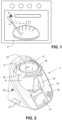
- the Figure 1 shows a monitoring device.
- the monitoring device is a pen-shaped food thermometer 1, which is inserted with its tip into a bread dough 2.
- the bread dough 2 is located in a kitchen appliance.
- the kitchen appliance is an oven 3.
- the bread dough 2 is heated in the oven 3.
- the food thermometer 1 determines spatially resolved temperatures in the oven, which are determined both outside the bread dough and inside the bread dough using two temperature sensors 5 and 6. These determined temperatures are sent by a radio unit 4 to an external control device or to a mobile device.
- the bread preparation is controlled by the control device. This can be done by directly controlling the temperature of the oven 3 or by giving instructions to a user on how to set the temperature of the oven, the type of heat supply and/or the
- the arrangement of the bread within the oven is to be changed.
- the type of temperature supply refers to options such as top heat, bottom heat or circulating air.
- the arrangement refers to where in the oven 3 the bread dough 2 should be.
- the mobile device can at least display the temperatures determined and
- the Figure 2 shows a food processor 7 with a food preparation vessel 8.
- a lid part 9 is placed on the food preparation vessel 8.
- the lid part 9 for the food preparation vessel 8 is locked by arm-like locking elements, i.e. arms 10.
- the lid part 9 is located between the two arms 10.
- the arms 10 can be rotated about their longitudinal axis by a motor and thus back and forth between an open position and a locked position.
- the lid part 9 has a sensor, namely a rocker arm 11 of an electrical switch, which is pressed down and thus triggered.
- the arm-like locking elements 10 and the rocker arm 11 are attached to a base part 12 of the food processor 7.
- the food preparation vessel 8 is inserted into the base part 12 and can be removed from the base part 12.
- the base part 12 has a touch-sensitive display 14 and a rotary switch 15 for operation.
- the rotary switch 15 can be turned and pressed.
- the display 14 and rotary switch 15 are therefore control elements of the food processor 7.
- the lid part 9 has an opening 16 in the middle, which can be closed with a vessel-like closure.
- a control device 17 is located in the base part 12. Data can be entered into the control device using the operating elements 14 and 15.
- a radio unit 18 is located in the base part 12, via which data can be sent and received wirelessly. The control device 17 can access an externally stored recipe using the radio unit 18. The control device 17 can then use the recipe to control the preparation of a meal. The control device 17 can exchange data wirelessly, i.e. communicate, with the food thermometer 1 using the radio unit 18.
- a cutting tool that can be driven by a motor.
- the motor is located in the base part 12.
- a heating device that can be connected to the base part 12 in an electrically conductive manner for heating.
- the Figure 3 shows a mobile device.
- the mobile device is a smartphone 19.
- the smartphone 19 comprises a touch-sensitive display 20, a loudspeaker 21 and a microphone 22.
- the smartphone comprises a radio unit.
- the smartphone 19 can exchange data with the thermometer 1 via the radio unit.
- the radio unit can comprise WiFi, Bluetooth Low Energy and/or Ultra Wideband (UWB) as standard.
- the Figure 4 shows the system according to the invention.
- the system comprises a loudspeaker assistant 23.
- a user 24 and an external computer 25 are shown.
- the food processor 7 is connected to the computer 25, for example via the Internet, so that data can be exchanged between the computer 25 and the food processor 7.
- Recipes are stored electronically on the computer.
- the user 24 can have the recipes shown on the display of the food processor and select a recipe. Alternatively or additionally, recipes can be stored in a memory of the food processor 7.
- a program can be installed on the first smartphone 19, which can also establish or has established a connection to the computer 25, as indicated by the double arrow.
- the first smartphone 19 can be a smartphone of the user 24.
- a recipe can therefore also be selected by the user 24 via the first smartphone 19.
- the first smartphone is part of the system according to the invention.
- the loudspeaker assistant 23 can be connected to the computer 25.
- a recipe can then be selected by the user 24.
- the selection can be made, for example, by voice recognition.
- thermometer 1 is connected exclusively to the food processor 7 in such a way that the control device of the food processor 7 can exchange data with the thermometer 1.
- the exchange of data is such that this contributes to the control of the preparation of a meal.
- the thermometer 1 cannot send data to other devices in such a way that another device can contribute data to the preparation of a meal. In particular, no connection can be established between the thermometer 1 and another device that would allow an exchange of data in such a way that this can contribute to the preparation of a meal.
- a status indicator can be used to ensure that the control device of the food processor 7 is only connected to the food thermometer 1 and no other connection can be established. Status indicators are also called "flags". For example, the electronics of the food thermometer 1 can have a status indicator that is set in such a way that the food thermometer 1 is not free for other connections. Another status indicator can be present and set in such a way that the food thermometer is not free for control.
- the thermometer 1 can send determined temperatures or at least a measure of determined temperatures to the control device of the food processor 7.
- the thermometer 1 can send determined manufacturer information to the food processor 7 so that the control device 1 knows how to interpret and evaluate the data received.
- the data sent from the thermometer 1 to the controller of the food processor 7 may include a Universally Unique Identifier (UUID) and/or a name.
- UUID Universally Unique Identifier
- the name may, for example, have been selected by the user 24 in order to easily identify the thermometer 1.
- the second smartphone 19' There may be a second smartphone 19'. This is not connected to any other device and cannot be connected to any other device unless a suitable program is installed on the second smartphone 19' and is called. This second smartphone 19' is therefore not part of the system according to the invention. This does not exclude the possibility that the second smartphone 19' can become part of the system.
- a bread is prepared using a recipe controlled by the control device of the food processor 7.
- the recipe finally states that the control device of the food processor 7 is no longer required.
- the control device of the food processor 7 specifies user data that the thermometer will send in the future. This user data is also called a "payload".
- the control of the food processor 7 specifies, for example, that the food thermometer 1 can send the user data and thus data to other devices in such a way that other devices can receive the data in such a way that it can be used by other devices. If another device is able to show the data at least partially, for example on a display or to output it acoustically, then another device can use the data.
- the data includes in particular temperatures determined by the food thermometer 1.
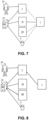
- the food thermometer 1 then sends the Figure 5 indicated by dashed lines, data is also sent to other devices. It may be that other devices can then receive the data at least in part in such a way that they can output useful data optically and/or acoustically. It may be that sending data only enables another device to establish an exclusive connection to the control device of the food processor 7. There may still be a connection between the control device of the food processor 7 and the food thermometer 7, which allows communication in such a way that, for example, useful data can be changed again. However, it may also be that this connection has been interrupted.
- the first smartphone 19 now establishes an exclusive connection to the control device of the food processor 7. No more data that can be received and used by other devices is then sent to all other devices. In particular, there is now no connection between the control device of the food processor 7 and the food thermometer 1.
- the first smartphone 19 now receives from the food thermometer 1 at least the user data that has been determined by the control of the food processor 7.
- the connection between the food thermometer 1 and the first smartphone 19 can be made by a program that has been installed and called up on the first smartphone 19.
- the connection can have involved entering a letter and/or number combination, i.e. a key, that was previously output acoustically and/or visually by the food processor 7.
- the user 24 may also be possible for the user 24 to set the first smartphone 19 so that data, in particular the user data, are sent to other devices in such a way that other devices can at least partially read and output the data sent. This situation is in the Figure 7 It may also be possible for the user 24 to set the first smartphone 19 to send data to other devices in such a way that another device can establish an exclusive connection. If necessary, for example, an exclusive connection could be established again between the control of the food processor 7 and the food thermometer 1.
- a system is shown that has a second control device 26.
- the second control device 26 can be intended and suitable to take over control from the first control device 17 when the first control device is switched off, for example.
- the first control device can then be part of a food processor that is switched off.
- the second control device can then be part of another non-mobile kitchen appliance.
Landscapes
- Engineering & Computer Science (AREA)
- Food Science & Technology (AREA)
- Mechanical Engineering (AREA)
- Physics & Mathematics (AREA)
- General Physics & Mathematics (AREA)
- Combustion & Propulsion (AREA)
- Chemical & Material Sciences (AREA)
- General Engineering & Computer Science (AREA)
- Human Computer Interaction (AREA)
- Computer Networks & Wireless Communication (AREA)
- Signal Processing (AREA)
- General Preparation And Processing Of Foods (AREA)
- Medical Treatment And Welfare Office Work (AREA)
- Pharmaceuticals Containing Other Organic And Inorganic Compounds (AREA)
Claims (14)
- Système pour la préparation d'un aliment (2) comprenant un dispositif de surveillance (1) pour la surveillance de l'aliment (2) pendant sa préparation, un dispositif de commande (17) pour la préparation de l'aliment (2) à l'aide d'un appareil de cuisine (3) et à l'aide d'une recette stockée électroniquement, avec un appareil mobile (19, 23) et/ou avec un appareil non mobile (26), dans lequel le dispositif de surveillance (1) peut communiquer avec le dispositif de commande (17) et l'appareil mobile (19, 23) et/ou avec l'appareil non mobile (26), dans lequel l'appareil mobile (19, 23) et/ou l'appareil non mobile (26) est configuré de sorte que celui-ci peut transmettre des informations du dispositif de surveillance (1) à un utilisateur (24),
caractérisé en ce que le dispositif de commande (17) est configuré de sorte que celui-ci reconnaît, pendant la préparation commandée d'un aliment (2), des temps d'absence possibles pour un utilisateur (24), en ce que le dispositif de commande (17) évalue des étapes de traitement de la recette et reconnaît ainsi dès que la présence de l'utilisateur (24) n'est pas nécessaire pour la préparation de l'aliment (2), et en informe l'utilisateur (24). - Système selon l'une des revendications précédentes, caractérisé en ce que le dispositif de surveillance est un thermomètre à aliments (1) utilisable de manière mobile avec une unité radio (4).
- Système selon l'une des revendications précédentes, caractérisé en ce que le système comprend une machine de cuisine (7) et le dispositif de commande (17) est intégré à la machine de cuisine (7), dans lequel la machine de cuisine (7) comprend un récipient de préparation d'aliments (8) qui peut être inséré dans une partie de stand (12) de la machine de cuisine (7) et un outil de mélange et/ou de coupe qui peut mélanger et/ou hacher des aliments présents dans le récipient de préparation d'aliments.
- Système selon l'une des revendications précédentes, caractérisé en ce que le système est configuré de sorte que le dispositif de surveillance (1) peut être connecté exclusivement au dispositif de commande (17) pour une communication de sorte que le dispositif de surveillance (1) ne peut être connecté à l'appareil mobile (19, 23) et/ou à l'appareil non mobile (26) pour une communication que lorsque le dispositif de commande (17) le permet.
- Système selon la revendication précédente, caractérisé en ce que le dispositif de commande (17) est configuré de sorte que celui-ci permet à l'appareil mobile (19, 23) et/ou à l'appareil non mobile (26) de se connecter au dispositif de surveillance (1) pour communiquer ou à l'appareil mobile (19, 23) et/ou à l'appareil non mobile (26) de recevoir des données du dispositif de surveillance (1), après que le dispositif de commande (17) a détecté un temps d'absence possible pour un utilisateur (24) pendant la préparation commandée d'un aliment (2), ou après que le dispositif de commande (17) a détecté un temps d'absence possible pour un utilisateur (24) pendant la préparation commandée d'un aliment (2) et que l'utilisateur (24) a confirmé une autorisation en actionnant un élément de commande du dispositif de commande (17), ou lorsque le dispositif de commande (17) est mis hors tension.
- Système selon la revendication précédente, caractérisé en ce que le système est configuré de sorte que la connexion entre le dispositif de commande (17) et le dispositif de surveillance (1) est interrompue lorsque la possibilité est autorisée que le dispositif de surveillance (1) peut se connecter à l'appareil mobile (19, 23) et/ou à l'appareil non mobile (26) et/ou que le dispositif de surveillance (1) peut envoyer des données à l'appareil mobile (19, 23) et/ou à l'appareil non mobile (26).
- Système selon l'une des revendications précédentes, caractérisé en ce que le dispositif de commande (17) est configuré pour pouvoir commander quelles données sont envoyées par le dispositif de surveillance (1).
- Système selon la revendication précédente, caractérisé en ce que le dispositif de commande (17) est configuré pour pouvoir transmettre une information au dispositif de surveillance (1) de sorte que, à la suite de cela, le dispositif de surveillance (1) envoie l'information.
- Système selon l'une des revendications précédentes, caractérisé en ce que le dispositif de surveillance (1) peut envoyer une ou plusieurs des données suivantes :• un ou plusieurs états, qui sont surveillés par le dispositif de surveillance (1) ;• une indication d'un temps jusqu'à la fin d'une étape de traitement ;• un ou plusieurs états du dispositif de surveillance (1).
- Système selon l'une des revendications précédentes, caractérisé en ce qu'une connexion entre le dispositif de surveillance (1) et l'appareil mobile (19, 23) et/ou l'appareil non mobile (26) nécessite l'introduction d'une clé qui est affichée par le dispositif de commande (17) et/ou est envoyée par le dispositif de surveillance (1).
- Thermomètre à aliments (1) configuré de sorte que celui-ci peut communiquer sans fil avec un dispositif de commande (17) et un appareil mobile et/ou non mobile (19, 23 ; 26), et configuré de sorte que celui-ci peut recevoir des données du dispositif de commande (17), qui, à la suite de cela, peuvent être envoyées par le thermomètre à aliments (1) à l'appareil mobile et/ou non mobile (19, 23 ; 26).
- Thermomètre à aliments (1) selon la revendication précédente avec une pointe et deux capteurs de température (5, 6), dans lequel l'un capteur de température (5) est disposé près de la pointe et l'autre capteur de température (6) présente une distance d'au moins 5 cm de la pointe.
- Thermomètre à aliments (1) selon l'une des deux revendications précédentes, caractérisé en ce que le thermomètre à aliments (1) comprend une unité radio avec Bluetooth.
- Procédé pour la préparation d'un aliment (2) avec un système selon l'une des revendications précédentes 1 à 10, caractérisé en ce qu'au début d'une préparation d'un aliment (2), le dispositif de surveillance (1) est connecté exclusivement au dispositif de commande (17) pour une communication, de sorte que le dispositif de surveillance (1) ne peut alors pas être connecté à l'appareil mobile et/ou non mobile (19, 23 ; 26) pour une communication.
Priority Applications (4)
| Application Number | Priority Date | Filing Date | Title |
|---|---|---|---|
| EP21208127.7A EP4179929B1 (fr) | 2021-11-15 | 2021-11-15 | Système et procédé de préparation des aliments |
| AU2022256180A AU2022256180A1 (en) | 2021-11-15 | 2022-10-20 | System and method for a food preparation |
| US17/980,966 US20230148791A1 (en) | 2021-11-15 | 2022-11-04 | System and method for a food preparation |
| CN202211426275.2A CN116115081A (zh) | 2021-11-15 | 2022-11-14 | 用于食物制备的系统和方法 |
Applications Claiming Priority (1)
| Application Number | Priority Date | Filing Date | Title |
|---|---|---|---|
| EP21208127.7A EP4179929B1 (fr) | 2021-11-15 | 2021-11-15 | Système et procédé de préparation des aliments |
Publications (3)
| Publication Number | Publication Date |
|---|---|
| EP4179929A1 EP4179929A1 (fr) | 2023-05-17 |
| EP4179929C0 EP4179929C0 (fr) | 2025-02-26 |
| EP4179929B1 true EP4179929B1 (fr) | 2025-02-26 |
Family
ID=78621732
Family Applications (1)
| Application Number | Title | Priority Date | Filing Date |
|---|---|---|---|
| EP21208127.7A Active EP4179929B1 (fr) | 2021-11-15 | 2021-11-15 | Système et procédé de préparation des aliments |
Country Status (4)
| Country | Link |
|---|---|
| US (1) | US20230148791A1 (fr) |
| EP (1) | EP4179929B1 (fr) |
| CN (1) | CN116115081A (fr) |
| AU (1) | AU2022256180A1 (fr) |
Families Citing this family (1)
| Publication number | Priority date | Publication date | Assignee | Title |
|---|---|---|---|---|
| USD1101580S1 (en) | 2024-01-31 | 2025-11-11 | Sharkninja Operating Llc | Temperature probe holder |
Family Cites Families (68)
| Publication number | Priority date | Publication date | Assignee | Title |
|---|---|---|---|---|
| EP0322836B1 (fr) * | 1987-12-28 | 1993-12-08 | Matsushita Electric Industrial Co., Ltd. | Méthode d'installation d'un pétrin dans un four et dispositif pour la mise en oeuvre de cette méthode |
| US6397735B1 (en) * | 2001-08-21 | 2002-06-04 | Kayue Electric Company Limited | Electronic food processor |
| US8931400B1 (en) * | 2009-05-28 | 2015-01-13 | iDevices. LLC | Remote cooking systems and methods |
| US20130092032A1 (en) * | 2011-10-18 | 2013-04-18 | Bsh Home Appliances Corporation | Intelligent home cooking appliance, associated systems, and/or methods |
| FR2982756B1 (fr) * | 2011-11-18 | 2013-11-08 | Seb Sa | Dispositif de cuisson |
| US10172373B2 (en) * | 2012-10-23 | 2019-01-08 | Vita-Mix Management Corporation | Modular blending system |
| KR20140088667A (ko) * | 2013-01-03 | 2014-07-11 | 정 호 이 | 무선통신과 연결된 밥솥을 이용한 독거노인 식사패턴 분석 및 안전관리 시스템 |
| US20140251987A1 (en) * | 2013-03-06 | 2014-09-11 | Haier America Trading, Llc | Appliance monitoring system and method with connectivity and communication protocols |
| CN105103461B (zh) * | 2013-03-15 | 2020-08-18 | 维他拌管理有限公司 | 无线混合装置和系统 |
| DE102013104107A1 (de) * | 2013-04-23 | 2014-10-23 | Cuciniale Gmbh | Verfahren zur Regelung eines Garprozesses |
| US10609762B2 (en) * | 2013-06-06 | 2020-03-31 | Zebra Technologies Corporation | Method, apparatus, and computer program product improving backhaul of sensor and other data to real time location system network |
| US20150208858A1 (en) * | 2014-01-27 | 2015-07-30 | CircuitLab, Inc. | Apparatus for cooking and methods |
| US9545168B2 (en) * | 2014-03-13 | 2017-01-17 | TrackThings LLC | Method and apparatus for quickly cooking comestibles |
| US9924297B2 (en) * | 2014-04-28 | 2018-03-20 | International Business Machines Corporation | Timed and variable duration for multiple device synching |
| US10820750B2 (en) * | 2014-08-05 | 2020-11-03 | Lynx Grills, Inc. | Computer-controlled grills |
| CN205433271U (zh) * | 2014-08-19 | 2016-08-10 | 美亚知识产权有限公司 | 食物制备系统、控制旋钮、套件和烹饪装置 |
| WO2016034488A1 (fr) * | 2014-09-03 | 2016-03-10 | Electrolux Appliances Aktiebolag | Procédé de communication de données avec un appareil électrodomestique par un dispositif informatique mobile, dispositif informatique mobile et appareil électrodomestique |
| US20160081515A1 (en) * | 2014-09-18 | 2016-03-24 | Tahi Techologies, Inc. | System and method for assistive interactions with an automated cooking device |
| US20160113438A1 (en) * | 2014-10-23 | 2016-04-28 | Value Added Services & Technology, Inc. | System and method for customized control and monitoring of commercial kitchen equipment |
| DE112015005709T5 (de) * | 2014-12-22 | 2017-09-14 | ChefSteps, Inc. | Nahrungsmittelzubereitungsführungs-system |
| US9439530B2 (en) * | 2015-01-13 | 2016-09-13 | Twin Harbor Labs, LLC | Intelligent cooking apparatuses and methods |
| US20160374501A1 (en) * | 2015-01-13 | 2016-12-29 | Twin Harbor Labs, LLC | Intelligent Cooking Apparatuses and Methods |
| US10194770B2 (en) * | 2015-01-30 | 2019-02-05 | ChefSteps, Inc. | Food preparation control system |
| ES2774351T3 (es) * | 2015-02-13 | 2020-07-20 | Vorwerk Co Interholding | Procedimiento para medir una temperatura dentro de un aparato de cocina |
| US20170035249A1 (en) * | 2015-03-06 | 2017-02-09 | Blendtec, Inc. | Ingredient scale system and methods |
| US9644847B2 (en) * | 2015-05-05 | 2017-05-09 | June Life, Inc. | Connected food preparation system and method of use |
| US10739013B2 (en) * | 2015-05-05 | 2020-08-11 | June Life, Inc. | Tailored food preparation with an oven |
| US11506545B2 (en) * | 2015-06-25 | 2022-11-22 | Apption Labs Limited | Food thermometer and method of using thereof |
| EP3722761B1 (fr) * | 2015-06-25 | 2023-06-07 | Apption Labs Ltd. | Procédé d'utilisation d'un thermomètre alimentaire |
| PL3153080T3 (pl) * | 2015-10-09 | 2021-01-11 | Vorwerk & Co. Interholding Gmbh | Napędzane elektrycznie urządzenie kuchenne |
| US10455022B2 (en) * | 2015-10-23 | 2019-10-22 | Traeger Pellet Grills, Llc | Cloud system for controlling outdoor grill with mobile application |
| US10785363B2 (en) * | 2015-10-23 | 2020-09-22 | Traeger Pellet Grills, Llc | Cloud system for controlling outdoor grill with mobile application |
| US10735575B2 (en) * | 2015-10-23 | 2020-08-04 | Traeger Pellet Grills, Llc | Mobile application for controlling outdoor grill |
| US10757244B2 (en) * | 2015-10-23 | 2020-08-25 | Traeger Pellet Grills, Llc | Cloud system for controlling outdoor grill with mobile application |
| US10701199B2 (en) * | 2015-10-23 | 2020-06-30 | Traeger Pellet Grills, Llc | Cloud system for controlling outdoor grill with mobile application |
| US10491738B2 (en) * | 2015-10-23 | 2019-11-26 | Traeger Pellet Grills, Llc | Cloud system for controlling outdoor grill with mobile application |
| US10791208B2 (en) * | 2015-10-23 | 2020-09-29 | Traeger Pellet Grills, Llc | Mobile application for controlling outdoor grill |
| US10444723B2 (en) * | 2015-11-16 | 2019-10-15 | ChefSteps, Inc. | Data aggregation and personalization for remotely controlled cooking devices |
| US10416027B2 (en) * | 2015-11-17 | 2019-09-17 | Haier Us Appliance Solutions, Inc. | Thermal management for a wireless cooking probe |
| EP3172996B1 (fr) * | 2015-11-30 | 2021-01-13 | Whirlpool Corporation | Systeme de cuisson |
| ES2684424T3 (es) * | 2016-02-09 | 2018-10-02 | Vorwerk & Co. Interholding Gmbh | Sistema y método para sincronizar los pasos de procesamiento de alimentos de un aparato de cocción multifunción con pasos de procesamiento de alimentos de un dispositivo de cocina a distancia |
| WO2017143224A1 (fr) * | 2016-02-18 | 2017-08-24 | Meyer Intellectual Properties Limited | Bouton auxiliaire pour système de cuisson |
| KR20190057020A (ko) * | 2016-02-18 | 2019-05-27 | 다렌 에릭 벤그로프 | 요리 시스템용 사용자 인터페이스 |
| US11766151B2 (en) * | 2016-02-18 | 2023-09-26 | Meyer Intellectual Properties Ltd. | Cooking system with error detection |
| US20190125120A1 (en) * | 2016-02-18 | 2019-05-02 | Meyer Intellectual Properties Limited | Cooking system for tracking a cooking device |
| CA2929530C (fr) * | 2016-05-10 | 2020-03-24 | Iguardfire Ltd. | Controle de la capacite thermique d'un appareil selon la proximite de l'utilisateur et avertissement aux utilisateurs distants par internet envue d'augmenter la securite |
| US11426029B2 (en) * | 2016-06-01 | 2022-08-30 | Dabble Ventures, Llc | Grill cooking device for digitizing coal with pixelation control |
| EP3366175B1 (fr) * | 2017-02-22 | 2024-11-13 | Taurus Research and Development S.L.U. | Procédé, système et programmes d'ordinateur pour gérer la commande à distance d'un appareil de cuisson pour fournir un régime personnalisé |
| WO2018200974A1 (fr) * | 2017-04-27 | 2018-11-01 | Meyer Intellectual Properties Ltd. | Système de commande de cuisson |
| US11723489B2 (en) * | 2017-06-01 | 2023-08-15 | Apption Labs Limited | Temperature sensing devices and wireless communication improvements for cooking appliances |
| US11056763B2 (en) * | 2017-06-01 | 2021-07-06 | Apption Labs Limited | Wireless communication improvements for cooking appliances |
| US11478766B2 (en) * | 2017-06-30 | 2022-10-25 | Vita-Mix Management Corporation | Intelligent blending system |
| EP3749150A4 (fr) * | 2018-02-08 | 2021-11-03 | Mendons Jeyaseelan, Collin Arumai Harinath | Dispositif d'automatisation de préparation de recette |
| US11422037B2 (en) * | 2018-03-15 | 2022-08-23 | Brava Home, Inc. | Temperature probe systems and methods |
| EP3788845A4 (fr) * | 2018-04-30 | 2022-04-20 | Spyce Food Co. | Appareil et procédé de chauffage robotisé |
| CN113194792B (zh) * | 2018-10-15 | 2022-05-20 | 广东美的厨房电器制造有限公司 | 训练烹饪器具、定位食物以及确定烹饪进度的系统和方法 |
| KR102017041B1 (ko) * | 2019-01-22 | 2019-09-02 | (주) 피큐아이넷 | 불판 온도 조절 시스템 및 방법 |
| ES2983884T3 (es) * | 2019-04-24 | 2024-10-25 | Vorwerk Co Interholding | Robot de cocina doméstico |
| EP4000152B1 (fr) * | 2019-07-15 | 2025-07-09 | SharkNinja Operating LLC | Appareil à détection intégrée de défaut de mise à la terre |
| CN110693342B (zh) * | 2019-09-30 | 2021-01-01 | 广东美的厨房电器制造有限公司 | 烤箱的控制方法及具有其的烤箱 |
| PL3799771T3 (pl) * | 2019-10-01 | 2024-10-28 | Vorwerk & Co. Interholding Gmbh | Robot kuchenny do sterowania innym urządzeniem dla gospodarstwa domowego |
| PL3855146T3 (pl) * | 2020-01-21 | 2025-02-10 | Vorwerk & Co. Interholding Gmbh | Jednostka zasilająca do wytwarzania energii elektrycznej, przyrząd kuchenny i system kuchenny |
| US20210251263A1 (en) * | 2020-02-14 | 2021-08-19 | Cooksy Corporation | Intelligent cooking assistant |
| WO2021173730A1 (fr) * | 2020-02-25 | 2021-09-02 | Rj Brands, Llc | Dispositif et système de cuisson |
| EP3884819A1 (fr) * | 2020-03-26 | 2021-09-29 | Vorwerk & Co. Interholding GmbH | Procédé de fonctionnement d'un système de cuisine, système de cuisine permettant de préparer une denrée alimentaire et produit programme informatique |
| CN111449493A (zh) * | 2020-04-23 | 2020-07-28 | 深圳市北鼎科技有限公司 | 养生壶测温结构 |
| US12239256B2 (en) * | 2021-04-07 | 2025-03-04 | Wh Products, Llc | Outdoor cooking appliance control system |
| US12035845B1 (en) * | 2023-04-26 | 2024-07-16 | Sharkninja Operating Llc | Systems and methods for cooking pizza |
-
2021
- 2021-11-15 EP EP21208127.7A patent/EP4179929B1/fr active Active
-
2022
- 2022-10-20 AU AU2022256180A patent/AU2022256180A1/en active Pending
- 2022-11-04 US US17/980,966 patent/US20230148791A1/en active Pending
- 2022-11-14 CN CN202211426275.2A patent/CN116115081A/zh active Pending
Also Published As
| Publication number | Publication date |
|---|---|
| US20230148791A1 (en) | 2023-05-18 |
| EP4179929C0 (fr) | 2025-02-26 |
| EP4179929A1 (fr) | 2023-05-17 |
| CN116115081A (zh) | 2023-05-16 |
| AU2022256180A1 (en) | 2023-06-01 |
Similar Documents
| Publication | Publication Date | Title |
|---|---|---|
| EP3153080B1 (fr) | Robot menager electrique | |
| DE3485991T2 (de) | Knetvorrichtung fuer eine vorrichtung zum backen von brot. | |
| EP3664418B1 (fr) | Système de préparation de denrées alimentaires et procédé de commande d'un appareil de cuisine | |
| DE102014101079B4 (de) | Verfahren zum Betrieb einer Küchenmaschine und Küchenmaschine | |
| EP4000483B1 (fr) | Robot de cuisine avec contrôle de charge d'un appareil auxiliaire | |
| EP4070700A1 (fr) | Procédé et système d'alimentation en chaleur aux aliments | |
| EP3884819A1 (fr) | Procédé de fonctionnement d'un système de cuisine, système de cuisine permettant de préparer une denrée alimentaire et produit programme informatique | |
| EP2189724A1 (fr) | Procédé destiné à la sélection d'au moins un programme de travail d'un appareil de cuisson et appareil de cuisson correspondant | |
| EP2999928B1 (fr) | Procédé et appareil de cuisson | |
| EP3730015B1 (fr) | Appareil electromenager | |
| EP3056882A1 (fr) | Procédé de mesure d'une température dans un appareil de cuisine | |
| EP4212840B1 (fr) | Système comprenant un dispositif de commande et un thermomètre alimentaire | |
| EP3415061A1 (fr) | Appareil ménager | |
| EP3892173A1 (fr) | Adaptateur de cuisson pour un robot de cuisine | |
| WO2016030367A1 (fr) | Transformation automatique d'un aliment | |
| EP2042809B1 (fr) | Procédé de programmation simplifiée de programmes d'un appareil de cuisson | |
| EP3799771B1 (fr) | Machine de cuisine permettant de commander un autre appareil électroménager | |
| EP2773245A1 (fr) | Dispositif de cuisson | |
| WO2020148329A1 (fr) | Préparation d'un aliment grâce à un accessoire d'un appareil de traitement des aliments | |
| EP4179929A1 (fr) | Système et procédé de préparation des aliments | |
| DE102021201931B4 (de) | Küchenmaschine zur Synchronisation des Energiebedarfs nebst Verfahren | |
| WO2019197277A1 (fr) | Détection de paramètres de fonctionnement d'un espace de traitement d'un appareil ménager | |
| EP0625676A2 (fr) | Procédé pour rôtir, frire et cuire des aliments | |
| DE102023200814B3 (de) | Nutzung von Restwärme in einem Gargerät | |
| EP3984424A1 (fr) | Système pourvu de robot de cuisine et procédé |
Legal Events
| Date | Code | Title | Description |
|---|---|---|---|
| PUAI | Public reference made under article 153(3) epc to a published international application that has entered the european phase |
Free format text: ORIGINAL CODE: 0009012 |
|
| STAA | Information on the status of an ep patent application or granted ep patent |
Free format text: STATUS: THE APPLICATION HAS BEEN PUBLISHED |
|
| AK | Designated contracting states |
Kind code of ref document: A1 Designated state(s): AL AT BE BG CH CY CZ DE DK EE ES FI FR GB GR HR HU IE IS IT LI LT LU LV MC MK MT NL NO PL PT RO RS SE SI SK SM TR |
|
| STAA | Information on the status of an ep patent application or granted ep patent |
Free format text: STATUS: REQUEST FOR EXAMINATION WAS MADE |
|
| 17P | Request for examination filed |
Effective date: 20231115 |
|
| RBV | Designated contracting states (corrected) |
Designated state(s): AL AT BE BG CH CY CZ DE DK EE ES FI FR GB GR HR HU IE IS IT LI LT LU LV MC MK MT NL NO PL PT RO RS SE SI SK SM TR |
|
| GRAP | Despatch of communication of intention to grant a patent |
Free format text: ORIGINAL CODE: EPIDOSNIGR1 |
|
| STAA | Information on the status of an ep patent application or granted ep patent |
Free format text: STATUS: GRANT OF PATENT IS INTENDED |
|
| INTG | Intention to grant announced |
Effective date: 20241007 |
|
| GRAS | Grant fee paid |
Free format text: ORIGINAL CODE: EPIDOSNIGR3 |
|
| GRAA | (expected) grant |
Free format text: ORIGINAL CODE: 0009210 |
|
| STAA | Information on the status of an ep patent application or granted ep patent |
Free format text: STATUS: THE PATENT HAS BEEN GRANTED |
|
| AK | Designated contracting states |
Kind code of ref document: B1 Designated state(s): AL AT BE BG CH CY CZ DE DK EE ES FI FR GB GR HR HU IE IS IT LI LT LU LV MC MK MT NL NO PL PT RO RS SE SI SK SM TR |
|
| RAP3 | Party data changed (applicant data changed or rights of an application transferred) |
Owner name: VORWERK & CO. INTERHOLDING GMBH |
|
| REG | Reference to a national code |
Ref country code: GB Ref legal event code: FG4D Free format text: NOT ENGLISH |
|
| REG | Reference to a national code |
Ref country code: CH Ref legal event code: EP |
|
| REG | Reference to a national code |
Ref country code: DE Ref legal event code: R096 Ref document number: 502021006776 Country of ref document: DE |
|
| REG | Reference to a national code |
Ref country code: IE Ref legal event code: FG4D Free format text: LANGUAGE OF EP DOCUMENT: GERMAN |
|
| U01 | Request for unitary effect filed |
Effective date: 20250312 |
|
| U07 | Unitary effect registered |
Designated state(s): AT BE BG DE DK EE FI FR IT LT LU LV MT NL PT RO SE SI Effective date: 20250320 |
|
| PG25 | Lapsed in a contracting state [announced via postgrant information from national office to epo] |
Ref country code: RS Free format text: LAPSE BECAUSE OF FAILURE TO SUBMIT A TRANSLATION OF THE DESCRIPTION OR TO PAY THE FEE WITHIN THE PRESCRIBED TIME-LIMIT Effective date: 20250526 |
|
| PG25 | Lapsed in a contracting state [announced via postgrant information from national office to epo] |
Ref country code: PL Free format text: LAPSE BECAUSE OF FAILURE TO SUBMIT A TRANSLATION OF THE DESCRIPTION OR TO PAY THE FEE WITHIN THE PRESCRIBED TIME-LIMIT Effective date: 20250226 |
|
| PG25 | Lapsed in a contracting state [announced via postgrant information from national office to epo] |
Ref country code: ES Free format text: LAPSE BECAUSE OF FAILURE TO SUBMIT A TRANSLATION OF THE DESCRIPTION OR TO PAY THE FEE WITHIN THE PRESCRIBED TIME-LIMIT Effective date: 20250226 |
|
| PG25 | Lapsed in a contracting state [announced via postgrant information from national office to epo] |
Ref country code: NO Free format text: LAPSE BECAUSE OF FAILURE TO SUBMIT A TRANSLATION OF THE DESCRIPTION OR TO PAY THE FEE WITHIN THE PRESCRIBED TIME-LIMIT Effective date: 20250526 Ref country code: IS Free format text: LAPSE BECAUSE OF FAILURE TO SUBMIT A TRANSLATION OF THE DESCRIPTION OR TO PAY THE FEE WITHIN THE PRESCRIBED TIME-LIMIT Effective date: 20250626 |
|
| PG25 | Lapsed in a contracting state [announced via postgrant information from national office to epo] |
Ref country code: HR Free format text: LAPSE BECAUSE OF FAILURE TO SUBMIT A TRANSLATION OF THE DESCRIPTION OR TO PAY THE FEE WITHIN THE PRESCRIBED TIME-LIMIT Effective date: 20250226 |
|
| PG25 | Lapsed in a contracting state [announced via postgrant information from national office to epo] |
Ref country code: GR Free format text: LAPSE BECAUSE OF FAILURE TO SUBMIT A TRANSLATION OF THE DESCRIPTION OR TO PAY THE FEE WITHIN THE PRESCRIBED TIME-LIMIT Effective date: 20250527 |
|
| PG25 | Lapsed in a contracting state [announced via postgrant information from national office to epo] |
Ref country code: SM Free format text: LAPSE BECAUSE OF FAILURE TO SUBMIT A TRANSLATION OF THE DESCRIPTION OR TO PAY THE FEE WITHIN THE PRESCRIBED TIME-LIMIT Effective date: 20250226 |
|
| PG25 | Lapsed in a contracting state [announced via postgrant information from national office to epo] |
Ref country code: CZ Free format text: LAPSE BECAUSE OF FAILURE TO SUBMIT A TRANSLATION OF THE DESCRIPTION OR TO PAY THE FEE WITHIN THE PRESCRIBED TIME-LIMIT Effective date: 20250226 |
|
| PG25 | Lapsed in a contracting state [announced via postgrant information from national office to epo] |
Ref country code: SK Free format text: LAPSE BECAUSE OF FAILURE TO SUBMIT A TRANSLATION OF THE DESCRIPTION OR TO PAY THE FEE WITHIN THE PRESCRIBED TIME-LIMIT Effective date: 20250226 |
|
| U20 | Renewal fee for the european patent with unitary effect paid |
Year of fee payment: 5 Effective date: 20251117 |
|
| PLBE | No opposition filed within time limit |
Free format text: ORIGINAL CODE: 0009261 |
|
| STAA | Information on the status of an ep patent application or granted ep patent |
Free format text: STATUS: NO OPPOSITION FILED WITHIN TIME LIMIT |
|
| 26N | No opposition filed |
Effective date: 20251127 |